Writing: purpose, audience and register
IntroducedWhy and who
- Before you write, ask: why am I writing, and who will read it?
- Purpose: to inform, to argue, or to discuss.
- Audience: a friend, a teacher, an organiser.
An email to a friend and a letter to a manager should not borrow each other’s shoes.
You should write to a friend and a teacher in the same way.
No — the register changes with the reader.
Formal or informal?
- Register = how formal your language is.
- Friend → informal: I'm, don't, friendly words.
- Teacher → formal: I am, do not, polite words, no slang.
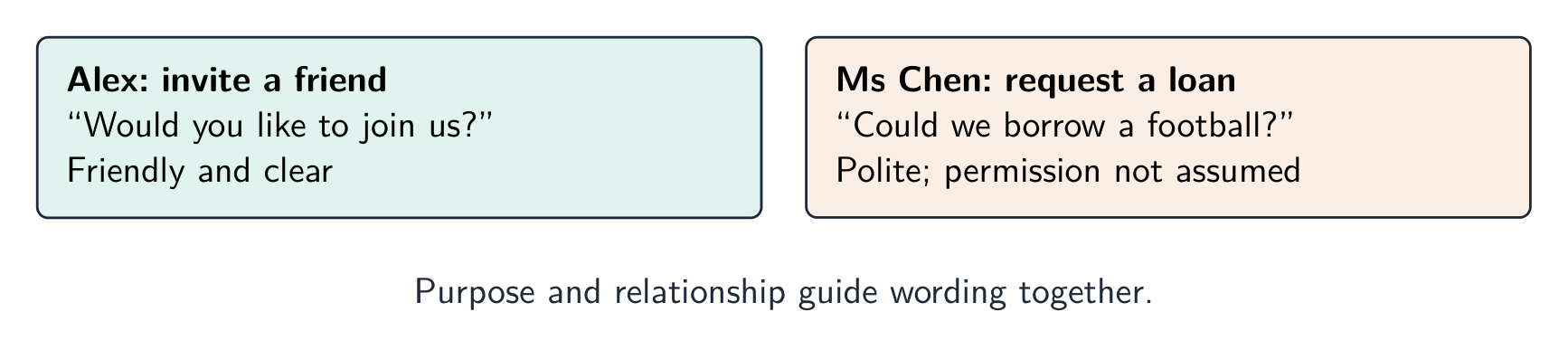
Purpose and audience together decide how formal your writing should be
Formal or informal?
Hear the register of a phrase before you borrow it for your own writing.
You write to your head teacher. Which opening is best?
A head teacher needs formal, polite language.
Join your ideas
- Put one main idea in each paragraph.
- Link ideas: also, however, therefore.
- A short plan keeps your writing in order.
Choose a contrast word: 'I like tea. ___, I prefer coffee.'
'However' shows contrast between two ideas.
Write one polite sentence you could say to a teacher to ask for help with your homework.
Example: 'Could you please help me with my essay?'
One message, two voices
- To a friend: "Hey Sam! Fancy helping at the school fair on Sat? It'll be fun!"
- To the head: "Dear Mrs Chen, I am writing to ask whether we could hold a school fair on Saturday."
- Same request — different greeting, verbs and tone, because the reader changed.
- Pick the register before your first word: it decides Hey vs Dear, fancy vs whether we could.
Match the reader to the best opening.
The reader chooses the greeting for you — friend gets warmth, stranger gets formality.
- Know your purpose and audience first.
- Match the register to the reader.
- One idea per paragraph; link them clearly.