1 State the distinguishing properties of solids, liquids and gases
2 Describe the structures of solids, liquids and gases in terms of particle separation, arrangement and motion
3 Describe changes of state in terms of melting, boiling, evaporating, freezing and condensing
5 Explain changes of state in terms of kinetic particle theory, including the interpretation of heating and cooling curves
4 Describe the effects of temperature and pressure on the volume of a gas
6 Explain, in terms of kinetic particle theory, the effects of temperature and pressure on the volume of a gas
日本語
コア
サプリメント
1 固体、液体、気体の区別される性質を述べる
2 粒子間距離、配列、運動の観点から、固体、液体、気体の構造を記述する
3 融解、沸騰、蒸発、凝固、凝縮の観点から、状態変化を記述する
5 運動論的粒子理論の観点から状態変化を説明し、加熱曲線および冷却曲線の解釈を行う
4 温度および圧力が気体の体積に与える効果を記述する
6 運動論的粒子理論の観点から、温度および圧力が気体の体積に与える効果を説明する
Source: Cambridge International syllabus · 出典: Cambridge International シラバス
English
Solid, liquid, gas: particle motion
Everything around you is made of tiny particles 粒子 — these can be atoms 原子, molecules 分子, or ions 离子. The kinetic particle theory 粒子动理论 says these particles are always moving. How close the particles are, how they are arranged, and how they move decides whether matter is a solid 固体, a liquid 液体, or a gas 气体.
Properties you can observe
You do not need a microscope to tell the three states apart. They behave in different ways:
A solid has a fixed shape and a fixed volume 体积. It does not flow and you cannot compress 压缩 it (squeeze it smaller).
A liquid has a fixed volume but no fixed shape. It flows and takes the shape of its container. It is almost impossible to compress.
A gas has no fixed shape and no fixed volume. It flows and spreads out to fill the whole container. A gas is easy to compress.
The table below sums up these properties. Density 密度 means how much mass 质量 is packed into a given volume.
Property
Solid
Liquid
Gas
Shape
fixed
takes the shape of the container
fills the whole container
Volume
fixed
fixed
fills the whole container
Can it be compressed?
no
almost none
yes, easily
Does it flow?
no
yes
yes
Density
high
high
low
The particle picture
The kinetic particle theory explains these properties by looking at three things: the separation 间距 of the particles (how far apart they are), their arrangement 排列 (the pattern), and their motion 运动 (how they move).
Solid
Liquid
Gas
Separation
touching, very close
close together
far apart
Arrangement
regular 规则 pattern
random, no pattern
random, no pattern
Motion
vibrate 振动 about fixed positions
move and slide past each other
move quickly in all directions
Strong forces of attraction 引力 hold the particles together. In a solid these forces are strong enough to hold every particle in place, so a solid keeps its shape. In a liquid the forces are weaker, so particles can move around. In a gas the particles move so fast that the forces hardly act at all, so the gas spreads out.
日本語
Solid, liquid, gas: particle motion
Everything around you is made of tiny particles 粒子 — these can be atoms 原子, molecules 分子, or ions 离子. The kinetic particle theory 粒子动理论 says these particles are always moving. How close the particles are, how they are arranged, and how they move decides whether matter is a solid 固体, a liquid 液体, or a gas 气体.
Properties you can observe
You do not need a microscope to tell the three states apart. They behave in different ways:
A solid has a fixed shape and a fixed volume 体积. It does not flow and you cannot compress 压缩 it (squeeze it smaller).
A liquid has a fixed volume but no fixed shape. It flows and takes the shape of its container. It is almost impossible to compress.
A gas has no fixed shape and no fixed volume. It flows and spreads out to fill the whole container. A gas is easy to compress.
The table below sums up these properties. Density 密度 means how much mass 质量 is packed into a given volume.
Property
Solid
Liquid
Gas
Shape
fixed
takes the shape of the container
fills the whole container
Volume
fixed
fixed
fills the whole container
Can it be compressed?
no
almost none
yes, easily
Does it flow?
no
yes
yes
Density
high
high
low
The particle picture
The kinetic particle theory explains these properties by looking at three things: the separation 间距 of the particles (how far apart they are), their arrangement 排列 (the pattern), and their motion 运动 (how they move).
Solid
Liquid
Gas
Separation
touching, very close
close together
far apart
Arrangement
regular 规则 pattern
random, no pattern
random, no pattern
Motion
vibrate 振动 about fixed positions
move and slide past each other
move quickly in all directions
Strong forces of attraction 引力 hold the particles together. In a solid these forces are strong enough to hold every particle in place, so a solid keeps its shape. In a liquid the forces are weaker, so particles can move around. In a gas the particles move so fast that the forces hardly act at all, so the gas spreads out.
Particles are packed and regular in a solid, close and random in a liquid, and far apart in a gas
Explore · 探索
States of matter · 物質の状態
Heat the box and watch the particles break free: a vibrating solid melts to a flowing liquid, then spreads out as a gas. Same particles — just more energy. · 箱を加熱して粒子が解放される様子を見てください:振動する固体が溶けて流れ出る液体になり、さらに広がって気体になります。同じ粒子ですが、エネルギーが大きくなっただけです。
When you heat or cool a substance, it can change from one state to another. You must know the name of each change.
Change
What happens
Name
solid → liquid
melting 熔化
melting
liquid → solid
freezing 凝固
freezing
liquid → gas (at the surface, below the boiling point)
evaporating 蒸发
evaporation
liquid → gas (all through the liquid)
boiling 沸腾
boiling
gas → liquid
condensing 凝结
condensation
A pure solid melts at one fixed temperature, the melting point 熔点. A pure liquid boils at one fixed temperature, the boiling point 沸点. The same substance freezes at its melting point and condenses at its boiling point.
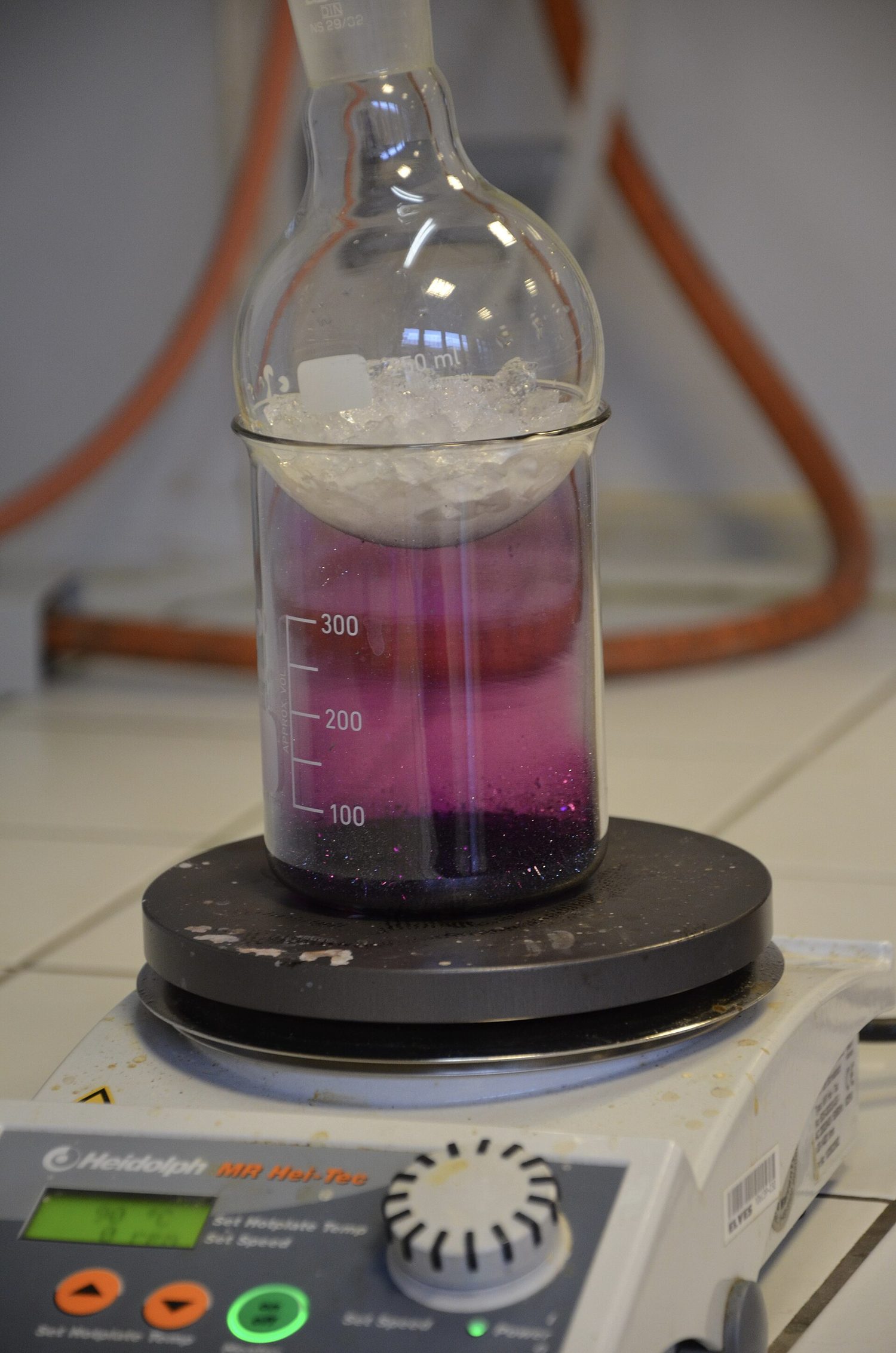
A few substances change straight from solid to gas without melting first. This is called sublimation 升华. In the photo below, warmed solid iodine in a beaker turns directly into a purple gas; the gas then cools on the round flask of ice above and turns back into a solid.
Explaining changes of state with the particle theory
Each change of state is really a change in the energy 能量 of the particles.
When you heat a solid, the particles gain energy and vibrate faster. At the melting point the particles have enough energy to break away from their fixed places and slide around — the solid melts.
When you heat a liquid, the particles move faster. At the boiling point they have enough energy to fully escape the forces of attraction and become a gas.
Cooling does the opposite. The particles lose energy, move more slowly, and the forces of attraction pull them back together.
During a change of state the energy goes into breaking the forces of attraction, not into making the particles move faster. This is why the temperature stays the same while a substance is melting or boiling.
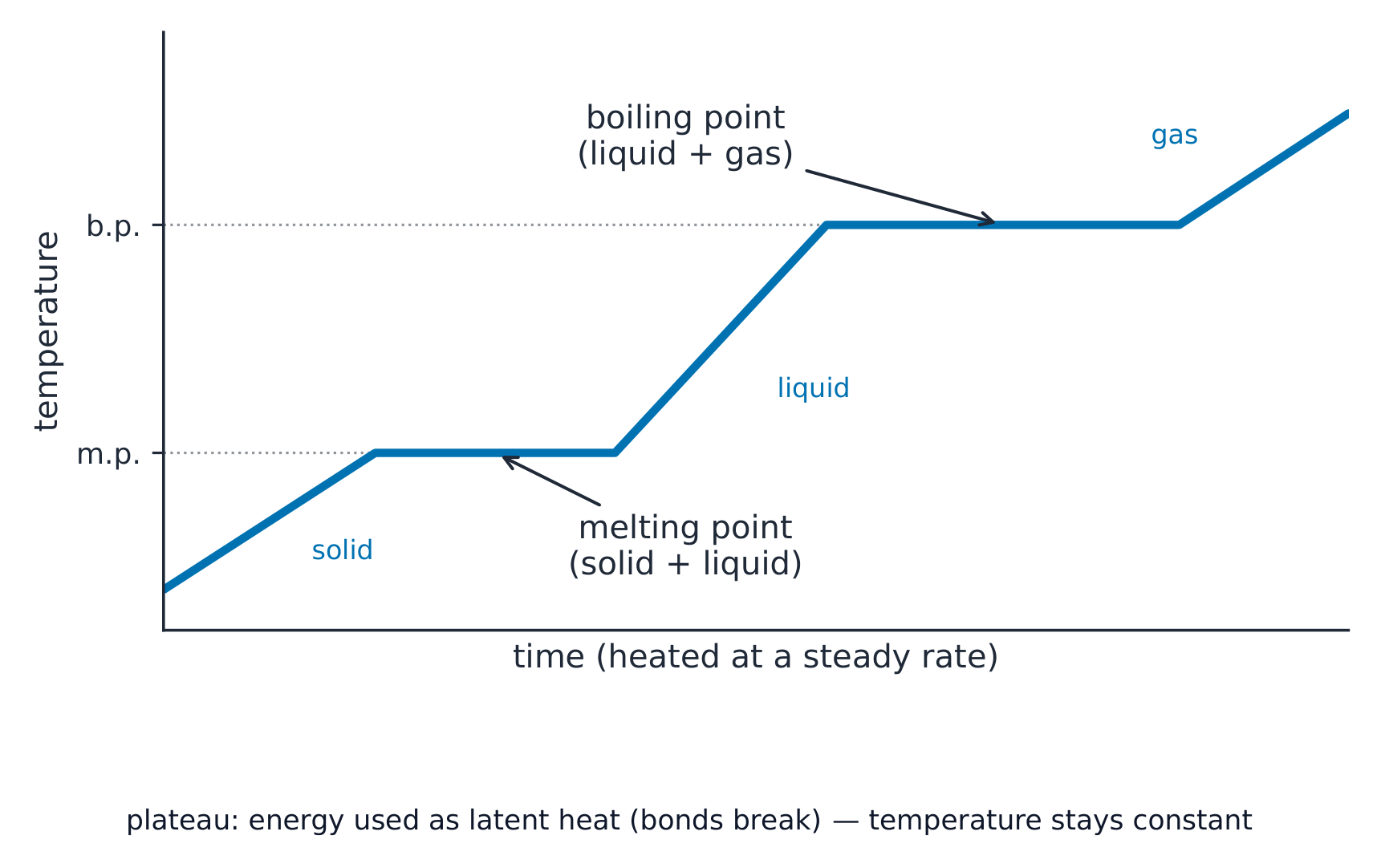
Heating and cooling curves
A heating curve 加热曲线 is a graph of temperature against time as you heat a substance steadily. A cooling curve 冷却曲线 is the same graph as the substance cools.
On a heating curve there are two flat (level) parts:
The first flat part is at the melting point. Here solid and liquid are both present. The heat energy breaks the forces holding the solid together, so the temperature does not rise.
The second flat part is at the boiling point. Here liquid and gas are both present, and the temperature again stays constant.
A cooling curve is the reverse. It has a flat part at the boiling point (the gas condenses) and a flat part at the melting point (the liquid freezes). As the particles slow down, thermal energy 热能 is released to the surroundings.
日本語
Ice melting to water: a change of state as the solid warms.
When you heat or cool a substance, it can change from one state to another. You must know the name of each change.
Change
What happens
Name
solid → liquid
melting 熔化
melting
liquid → solid
freezing 凝固
freezing
liquid → gas (at the surface, below the boiling point)
evaporating 蒸发
evaporation
liquid → gas (all through the liquid)
boiling 沸腾
boiling
gas → liquid
condensing 凝结
condensation
A pure solid melts at one fixed temperature, the melting point 熔点. A pure liquid boils at one fixed temperature, the boiling point 沸点. The same substance freezes at its melting point and condenses at its boiling point.
Heating: solid → liquid → gas; cooling reverses each change
A few substances change straight from solid to gas without melting first. This is called sublimation 升华. In the photo below, warmed solid iodine in a beaker turns directly into a purple gas; the gas then cools on the round flask of ice above and turns back into a solid.
Warmed solid iodine turns straight into a purple gas (sublimation)The everyday example: dry ice is solid carbon dioxide, and it sublimes too — it never leaves a puddle
Explaining changes of state with the particle theory
Each change of state is really a change in the energy 能量 of the particles.
When you heat a solid, the particles gain energy and vibrate faster. At the melting point the particles have enough energy to break away from their fixed places and slide around — the solid melts.
When you heat a liquid, the particles move faster. At the boiling point they have enough energy to fully escape the forces of attraction and become a gas.
Cooling does the opposite. The particles lose energy, move more slowly, and the forces of attraction pull them back together.
During a change of state the energy goes into breaking the forces of attraction, not into making the particles move faster. This is why the temperature stays the same while a substance is melting or boiling.
Heating and cooling curves
A heating curve 加热曲线 is a graph of temperature against time as you heat a substance steadily. A cooling curve 冷却曲线 is the same graph as the substance cools.
On a heating curve there are two flat (level) parts:
The first flat part is at the melting point. Here solid and liquid are both present. The heat energy breaks the forces holding the solid together, so the temperature does not rise.
The second flat part is at the boiling point. Here liquid and gas are both present, and the temperature again stays constant.
A cooling curve is the reverse. It has a flat part at the boiling point (the gas condenses) and a flat part at the melting point (the liquid freezes). As the particles slow down, thermal energy 热能 is released to the surroundings.
Temperature stays constant at the melting and boiling points while forces of attraction are broken
Explore · 探索
Heating a substance through its states · 物質の状態を通じた加熱
Step up the temperature. Adding heat gives the particles more energy until they break free — and the temperature pauses at each change of state while the energy does that work. · 温度を上げます。熱を加えると粒子にエネルギーが加わり、解放されるまで動きます—そして、エネルギーがその作業をする間に、各状態変化で温度は一時的に停滞します。
A gas pushes on the walls of its container. This push, spread over the area of the wall, is the pressure 压强 of the gas. Pressure comes from the gas particles hitting the walls.
Effect of temperature
If you heat a fixed mass of gas while keeping the pressure the same, its volume increases.
Using the particle theory: heating gives the particles more kinetic energy 动能, so they move faster. They hit the walls harder and more often. To keep the pressure the same, the gas must take up more space, so the volume gets bigger.
If instead the volume is fixed (a sealed, rigid container), heating the gas makes the pressure rise, because the faster particles collide 碰撞 with the walls harder and more often.
Effect of pressure
If you increase the pressure on a fixed mass of gas while keeping the temperature the same, its volume decreases. Squeezing the gas into a smaller space means the particles hit the walls more often, which is what a higher pressure means.
日本語
A gas pushes on the walls of its container. This push, spread over the area of the wall, is the pressure 压强 of the gas. Pressure comes from the gas particles hitting the walls.
Effect of temperature
If you heat a fixed mass of gas while keeping the pressure the same, its volume increases.
A heated gas: faster particles spread out and take up more space
Using the particle theory: heating gives the particles more kinetic energy 动能, so they move faster. They hit the walls harder and more often. To keep the pressure the same, the gas must take up more space, so the volume gets bigger.
If instead the volume is fixed (a sealed, rigid container), heating the gas makes the pressure rise, because the faster particles collide 碰撞 with the walls harder and more often.
Effect of pressure
If you increase the pressure on a fixed mass of gas while keeping the temperature the same, its volume decreases. Squeezing the gas into a smaller space means the particles hit the walls more often, which is what a higher pressure means.
Squeezing a gas into a smaller volume makes the particles hit the walls more often, so the pressure rises
Explore · 探索
Gases, pressure & volume · 気体、圧力 & 体積
p = k / V
Squeeze the volume and the pressure rises (Boyle's law). · 体積を圧縮すると圧力が上昇します(ボイルの法則)。
1 Describe and explain diffusion in terms of kinetic particle theory
2 Describe and explain the effect of relative molecular mass on the rate of diffusion of gases
日本語
コア
サプリメント
1 運動論的粒子理論の観点から、拡散を記述・説明する
2 相対分子量が気体の拡散速度に与える効果を記述・説明する
Source: Cambridge International syllabus · 出典: Cambridge International シラバス
English
Diffusion: random motion, one-way flow
Diffusion 扩散 is the spreading of particles from a region where they are crowded to a region where they are spread out — that is, from high concentration 浓度 to low concentration. It happens because particles are always moving in random directions.
Diffusion explains why you can smell food from across a room: the smell particles move and mix with the air until they reach your nose. Diffusion happens in gases and in liquids, but not in solids, because solid particles cannot move from place to place.
Rate of diffusion and molecular mass
Lighter gas particles move faster than heavier ones at the same temperature. So a gas with a smaller relative molecular mass 相对分子质量 (a smaller mass for each molecule) has a faster rate 速率 of diffusion.
A classic experiment shows this. Cotton wool soaked in ammonia 氨气 ($\text{NH}_3$) is put at one end of a long glass tube. Cotton wool soaked in hydrogen chloride 氯化氢 ($\text{HCl}$) is put at the other end. Both gases diffuse along the tube and meet to form a white ring of ammonium chloride 氯化铵 ($\text{NH}_4\text{Cl}$).
Ammonia has $M_r = 17$ and hydrogen chloride has $M_r = 36.5$. Ammonia is lighter, so it diffuses faster and travels further along the tube. The white ring forms nearer the hydrogen chloride end.
Worked example. Bromine ($M_r = 160$) and ammonia ($M_r = 17$) are released at the same moment from opposite ends of a long tube. Which travels further before they meet? Compare the relative molecular masses. Ammonia's $M_r$ is far smaller, so its molecules move faster at the same temperature and it diffuses more quickly. Ammonia therefore travels the greater distance, and the two gases meet nearer the bromine end. The rule is always "lighter means faster" - argue from $M_r$, never from how big the formula looks on paper.
日本語
Diffusion: random motion, one-way flow
Diffusion 扩散 is the spreading of particles from a region where they are crowded to a region where they are spread out — that is, from high concentration 浓度 to low concentration. It happens because particles are always moving in random directions.
Particles diffuse from high to low concentration until they are spread out evenly
Diffusion explains why you can smell food from across a room: the smell particles move and mix with the air until they reach your nose. Diffusion happens in gases and in liquids, but not in solids, because solid particles cannot move from place to place.
Rate of diffusion and molecular mass
Lighter gas particles move faster than heavier ones at the same temperature. So a gas with a smaller relative molecular mass 相对分子质量 (a smaller mass for each molecule) has a faster rate 速率 of diffusion.
A classic experiment shows this. Cotton wool soaked in ammonia 氨气 ($\text{NH}_3$) is put at one end of a long glass tube. Cotton wool soaked in hydrogen chloride 氯化氢 ($\text{HCl}$) is put at the other end. Both gases diffuse along the tube and meet to form a white ring of ammonium chloride 氯化铵 ($\text{NH}_4\text{Cl}$).
Ammonia has $M_r = 17$ and hydrogen chloride has $M_r = 36.5$. Ammonia is lighter, so it diffuses faster and travels further along the tube. The white ring forms nearer the hydrogen chloride end.
Ammonia ($M_r=17$) is lighter, so it diffuses faster and further; the white ring forms nearer the HCl end
Worked example. Bromine ($M_r = 160$) and ammonia ($M_r = 17$) are released at the same moment from opposite ends of a long tube. Which travels further before they meet? Compare the relative molecular masses. Ammonia's $M_r$ is far smaller, so its molecules move faster at the same temperature and it diffuses more quickly. Ammonia therefore travels the greater distance, and the two gases meet nearer the bromine end. The rule is always "lighter means faster" - argue from $M_r$, never from how big the formula looks on paper.
Explore · 探索
Diffusion · 拡散
Release the cloud and the particles spread on their own from the crowded corner until they fill the box evenly — diffusion, sped up by heat. · 雲を解放すると、粒子は混み合った隅から自分自身の力で広がり、均等に箱を満たします—これは熱によって加速された拡散です。
Explore · 探索
Diffusion · 拡散
Set the concentration on each side. Particles spread from high to low concentration until evenly mixed. · 両側の濃度を設定せよ。粒子は高い方から低い方へ濃度差がなくなるまで拡散する。
During melting and boiling the temperature stays constant (the flat parts of a heating curve), because the energy breaks the forces between particles instead of making them move faster.
Evaporation happens only at the surface and at any temperature; boiling happens throughout the liquid at one fixed temperature.
Explain gas behaviour with the particle theory: heating a gas at fixed volume raises the pressure because the particles hit the walls harder and more often — the particles themselves do not get bigger.
Diffusion is faster for lighter particles (smaller $M_r$) and cannot happen in solids. In the ammonia/hydrogen chloride tube the lighter ammonia travels further, so the white ring forms nearer the HCl end.
1 Describe the differences between elements, compounds and mixtures
日本語
コア
サプリメント
1 元素、化合物、および混合物の違いを説明せよ
Source: Cambridge International syllabus · 出典: Cambridge International シラバス
English
All substances are made from about 100 simple building blocks. Knowing how they are joined lets you sort every substance into one of three groups.
An element 元素 is a substance made of only one type of atom 原子. You cannot break it into anything simpler by a chemical reaction. Examples: copper, oxygen, carbon.
A compound 化合物 is two or more elements chemically joined (bonded) together. The atoms are joined in a fixed ratio. Examples: water, carbon dioxide. A compound has different properties from the elements in it.
A mixture 混合物 is two or more substances that are just mixed, not chemically joined. The parts keep their own properties and can be separated by physical methods. Example: air.
The key difference: in a compound the elements are bonded and can only be separated by chemical reactions; in a mixture they are not bonded and are easy to separate.
日本語
A pure element (vanadium): elements are the simplest substances.
All substances are made from about 100 simple building blocks. Knowing how they are joined lets you sort every substance into one of three groups.
An element 元素 is a substance made of only one type of atom 原子. You cannot break it into anything simpler by a chemical reaction. Examples: copper, oxygen, carbon.
A compound 化合物 is two or more elements chemically joined (bonded) together. The atoms are joined in a fixed ratio. Examples: water, carbon dioxide. A compound has different properties from the elements in it.
A mixture 混合物 is two or more substances that are just mixed, not chemically joined. The parts keep their own properties and can be separated by physical methods. Example: air.
The key difference: in a compound the elements are bonded and can only be separated by chemical reactions; in a mixture they are not bonded and are easy to separate.
An element has one type of atom; a compound has different atoms bonded in a fixed ratio; a mixture is not bonded
Explore · 探索
Elements, compounds and mixtures lab · 元素、化合物、混合物の実験
Classify everyday particle examples by composition. · 日常の粒子の例を組成に基づいて分類します。
1 Describe the structure of the atom as a central nucleus containing neutrons and protons surrounded by electrons in shells
2 State the relative charges and relative masses of a proton, a neutron and an electron
3 Define proton number/atomic number as the number of protons in the nucleus of an atom
4 Define mass number/nucleon number as the total number of protons and neutrons in the nucleus of an atom
5 Determine the electronic configuration of elements and their ions with proton number 1 to 20, e.g. 2,8,3
6 State that: (a) Group VIII noble gases have a full outer electron shell (b) the number of outer shell electrons is equal to the group number in Groups I to VII (c) the number of occupied electron shells is equal to the period number
Source: Cambridge International syllabus · 出典: Cambridge International シラバス
English
Inside the atom
Every atom has a small, dense centre called the nucleus 原子核. Around it, electrons 电子 move in shells 电子层 (energy levels). The nucleus contains two kinds of particle: protons 质子 and neutrons 中子.
Each particle has a relative mass and a relative charge 电荷. You must learn these values:
Particle
Relative mass
Relative charge
proton
1
$+1$
neutron
1
$0$
electron
$\frac{1}{1840}$ (almost 0)
$-1$
An atom has no overall charge because it has equal numbers of protons ($+1$ each) and electrons ($-1$ each).
Proton number and mass number
Two numbers describe an atom:
The proton number 质子数 (also called the atomic number 原子序数) is the number of protons in the nucleus. It tells you which element the atom is.
The mass number 质量数 (also called the nucleon number 核子数) is the total number of protons and neutrons in the nucleus.
So the number of neutrons $=$ mass number $-$ proton number.
Electronic configuration
The electrons fill the shells from the inside out. The first shell holds up to 2 electrons; the next shells hold up to 8 each (for the first 20 elements). The electronic configuration 电子排布 lists how many electrons are in each shell, starting from the inside.
For example, an atom with 13 electrons has the configuration $2,8,3$. Sodium (proton number 11) is $2,8,1$. Calcium (proton number 20) is $2,8,8,2$.
The configuration links to the Periodic Table 周期表:
A Group 族 number (Groups I to VII) equals the number of electrons in the outer shell. So $2,8,1$ is in Group I.
A Period 周期 number equals the number of shells that hold electrons. So $2,8,1$ has three shells, so it is in Period 3.
The noble gases 稀有气体 in Group VIII (or 0) have a full outer shell, which makes them very unreactive.
日本語
Inside the atom
Every atom has a small, dense centre called the nucleus 原子核. Around it, electrons 电子 move in shells 电子层 (energy levels). The nucleus contains two kinds of particle: protons 质子 and neutrons 中子.
An atom has a tiny nucleus of protons and neutrons, with electrons in shells around it
Each particle has a relative mass and a relative charge 电荷. You must learn these values:
Particle
Relative mass
Relative charge
proton
1
$+1$
neutron
1
$0$
electron
$\frac{1}{1840}$ (almost 0)
$-1$
An atom has no overall charge because it has equal numbers of protons ($+1$ each) and electrons ($-1$ each).
Proton number and mass number
Two numbers describe an atom:
The proton number 质子数 (also called the atomic number 原子序数) is the number of protons in the nucleus. It tells you which element the atom is.
The mass number 质量数 (also called the nucleon number 核子数) is the total number of protons and neutrons in the nucleus.
So the number of neutrons $=$ mass number $-$ proton number.
Electronic configuration
The electrons fill the shells from the inside out. The first shell holds up to 2 electrons; the next shells hold up to 8 each (for the first 20 elements). The electronic configuration 电子排布 lists how many electrons are in each shell, starting from the inside.
For example, an atom with 13 electrons has the configuration $2,8,3$. Sodium (proton number 11) is $2,8,1$. Calcium (proton number 20) is $2,8,8,2$.
The configuration links to the Periodic Table 周期表:
A Group 族 number (Groups I to VII) equals the number of electrons in the outer shell. So $2,8,1$ is in Group I.
A Period 周期 number equals the number of shells that hold electrons. So $2,8,1$ has three shells, so it is in Period 3.
The noble gases 稀有气体 in Group VIII (or 0) have a full outer shell, which makes them very unreactive.
Sodium's configuration 2,8,1 links to the Periodic Table: one outer electron means Group I, three shells means Period 3
Explore · 探索
Electron shells · 電子殻
Change the atomic number and watch the shells fill (2, 8, 8) — the electron arrangement of the first 20 elements. · 原子番号を変化させ、殻が埋まっていく様子(2, 8, 8)を見よ——初めから20番までの元素の電子配置である。
1 Define isotopes as different atoms of the same element that have the same number of protons but different numbers of neutrons
3 State that isotopes of the same element have the same chemical properties because they have the same number of electrons and therefore the same electronic configuration
2 Interpret and use symbols for atoms, e.g. $^{12}_{6}\text{C}$, and ions, e.g. $^{35}_{17}\text{Cl}^-$
4 Calculate the relative atomic mass of an element from the relative masses and abundances of its isotopes
Source: Cambridge International syllabus · 出典: Cambridge International シラバス
English
Isotopes 同位素 are atoms of the same element that have the same number of protons but different numbers of neutrons. Because the proton number is the same, they are the same element. Because the neutron number is different, they have different mass numbers.
You write an atom with its mass number on top and proton number below, like $^{12}_{6}\text{C}$. For an ion you add the charge, like $^{35}_{17}\text{Cl}^{-}$.
Isotopes of an element have the same chemical properties. This is because chemical reactions only involve electrons, and isotopes have the same number of electrons and the same electronic configuration. (The extra neutrons change only the mass.)
Calculating relative atomic mass
The relative atomic mass 相对原子质量 ($A_r$) of an element is the average mass of its atoms, taking into account how common each isotope is. The abundance 丰度 is the percentage of each isotope.
Worked example. Boron has two isotopes, $^{10}\text{B}$ and $^{11}\text{B}$, and its $A_r$ is 10.8. Find the percentage of each. Let the abundance of $^{11}\text{B}$ be $x$, so the abundance of $^{10}\text{B}$ is $(100 - x)$. Then
$$\frac{11x + 10(100 - x)}{100} = 10.8$$
so $11x + 1000 - 10x = 1080$, giving $x = 80$. Boron is 80%$^{11}\text{B}$ and 20%$^{10}\text{B}$. Check it against common sense: 10.8 lies closer to 11, so the heavier isotope must be the more common one. If your answer gives the majority to the isotope further from $A_r$, you have them the wrong way round.
日本語
Isotopes 同位素 are atoms of the same element that have the same number of protons but different numbers of neutrons. Because the proton number is the same, they are the same element. Because the neutron number is different, they have different mass numbers.
You write an atom with its mass number on top and proton number below, like $^{12}_{6}\text{C}$. For an ion you add the charge, like $^{35}_{17}\text{Cl}^{-}$.
Isotopes of an element have the same chemical properties. This is because chemical reactions only involve electrons, and isotopes have the same number of electrons and the same electronic configuration. (The extra neutrons change only the mass.)
Calculating relative atomic mass
The relative atomic mass 相对原子质量 ($A_r$) of an element is the average mass of its atoms, taking into account how common each isotope is. The abundance 丰度 is the percentage of each isotope.
Relative atomic mass is a weighted average: chlorine is 75 percent Cl-35 and 25 percent Cl-37, so A_r is 35.5
Worked example. Boron has two isotopes, $^{10}\text{B}$ and $^{11}\text{B}$, and its $A_r$ is 10.8. Find the percentage of each. Let the abundance of $^{11}\text{B}$ be $x$, so the abundance of $^{10}\text{B}$ is $(100 - x)$. Then
$$\frac{11x + 10(100 - x)}{100} = 10.8$$
so $11x + 1000 - 10x = 1080$, giving $x = 80$. Boron is 80%$^{11}\text{B}$ and 20%$^{10}\text{B}$. Check it against common sense: 10.8 lies closer to 11, so the heavier isotope must be the more common one. If your answer gives the majority to the isotope further from $A_r$, you have them the wrong way round.
Explore · 探索
Protons, neutrons & isotopes · 陽子、中性子 & 同位体
Change the neutrons to make isotopes (same element, different mass number); change the electrons to make ions. · 中性子を変化させると同位体(同じ元素、質量数が異なる)になり、電子を変化させるとイオンになります。
Explore · 探索
Isotope lab · 同位体の実験
Classify isotope facts by proton, neutron and mass number. · 陽子、中性子、質量数に基づいて同位体の事実を分類する。
1 Describe the formation of positive ions, known as cations, and negative ions, known as anions
5 Describe the giant lattice structure of ionic compounds as a regular arrangement of alternating positive and negative ions
2 State that an ionic bond is a strong electrostatic attraction between oppositely charged ions
6 Describe the formation of ionic bonds between ions of metallic and non-metallic elements, including the use of dot-and-cross diagrams
3 Describe the formation of ionic bonds between elements from Group I and Group VII, including the use of dot-and-cross diagrams
7 Explain in terms of structure and bonding the properties of ionic compounds: (a) high melting points and boiling points (b) good electrical conductivity when aqueous or molten and poor when solid
4 Describe the properties of ionic compounds: (a) high melting points and boiling points (b) good electrical conductivity when aqueous or molten and poor when solid
Source: Cambridge International syllabus · 出典: Cambridge International シラバス
English
Ionic bonding: electron transfer
An ion 离子 is an atom (or group of atoms) that has lost or gained electrons, so it has an electric charge.
A metal atom loses electrons to form a positive ion, called a cation 阳离子.
A non-metal atom gains electrons to form a negative ion, called an anion 阴离子.
Atoms do this to get a full outer shell, like a noble gas.
How an ionic bond forms
An ionic bond 离子键 is a strong electrostatic attraction 静电引力 between oppositely charged ions (a $+$ ion and a $-$ ion pull together).
Ionic bonds form between a metal 金属 and a non-metal 非金属. Take sodium chloride, $\text{NaCl}$. Sodium ($2,8,1$) gives its one outer electron to chlorine ($2,8,7$). Now sodium is $\text{Na}^{+}$ ($2,8$) and chlorine is $\text{Cl}^{-}$ ($2,8,8$). Both have full outer shells, and the opposite charges attract.
You can show this with a dot-and-cross diagram: draw each atom's outer-shell electrons as dots for one element and crosses for the other, then show the electron moving from the metal to the non-metal.
The structure and properties of ionic compounds
An ionic compound 离子化合物 is not made of separate molecules 分子. The ions pack together into a giant lattice 晶格 — a regular pattern of huge numbers of alternating 交替 positive and negative ions.
This structure explains the properties:
Property
Reason
high melting point 熔点 and boiling point 沸点
the strong electrostatic attraction between ions needs a lot of energy to break
poor electrical conductivity 导电性 when solid
the ions are fixed in place and cannot move
good conductor when molten 熔融 or aqueous 水溶液
the ions are now free to move and carry charge
日本語
Ionic bonding: electron transfer
An ion 离子 is an atom (or group of atoms) that has lost or gained electrons, so it has an electric charge.
A metal atom loses electrons to form a positive ion, called a cation 阳离子.
A non-metal atom gains electrons to form a negative ion, called an anion 阴离子.
Atoms do this to get a full outer shell, like a noble gas.
How an ionic bond forms
An ionic bond 离子键 is a strong electrostatic attraction 静电引力 between oppositely charged ions (a $+$ ion and a $-$ ion pull together).
Ionic bonds form between a metal 金属 and a non-metal 非金属. Take sodium chloride, $\text{NaCl}$. Sodium ($2,8,1$) gives its one outer electron to chlorine ($2,8,7$). Now sodium is $\text{Na}^{+}$ ($2,8$) and chlorine is $\text{Cl}^{-}$ ($2,8,8$). Both have full outer shells, and the opposite charges attract.
You can show this with a dot-and-cross diagram: draw each atom's outer-shell electrons as dots for one element and crosses for the other, then show the electron moving from the metal to the non-metal.
Sodium gives its outer electron to chlorine; both reach full outer shells and the opposite charges attract (the blue electron came from sodium)
The structure and properties of ionic compounds
An ionic compound 离子化合物 is not made of separate molecules 分子. The ions pack together into a giant lattice 晶格 — a regular pattern of huge numbers of alternating 交替 positive and negative ions.
Ions pack into a giant lattice: a regular, repeating pattern of alternating positive and negative ionsA halite crystal: sodium chloride's cubic shape is the ionic lattice inside it, made big enough to see
This structure explains the properties:
Property
Reason
high melting point 熔点 and boiling point 沸点
the strong electrostatic attraction between ions needs a lot of energy to break
poor electrical conductivity 导电性 when solid
the ions are fixed in place and cannot move
good conductor when molten 熔融 or aqueous 水溶液
the ions are now free to move and carry charge
Explore · 探索
Forming an ionic bond (NaCl) · イオン結合の形成(NaCl)
Step through it. A metal hands its outer electron to a non-metal; the oppositely charged ions then attract and pack into a giant lattice. · 手順を追って確認します。金属が最外殻の電子を非金属に渡すと、反対の電荷を持つイオン同士が引き合い、巨大な格子状構造を形成します。
Step through it: the metal hands its outer electron(s) to the non-metal, both reach full shells, and the resulting + and − ions attract — an ionic bond. · 手順を追って確認します:金属が最外殻の電子を非金属に渡し、両方とも最外殻が満タンになり、生じた+と−のイオン同士が引き合って、イオン結合が形成されます。
1 State that a covalent bond is formed when a pair of electrons is shared between two atoms leading to noble gas electronic configurations
2 Describe the formation of covalent bonds in simple molecules, including $\text{H}_2$, $\text{Cl}_2$, $\text{H}_2\text{O}$, $\text{CH}_4$, $\text{NH}_3$ and $\text{HCl}$. Use dot-and-cross diagrams to show the electronic configurations in these and similar molecules
4 Describe the formation of covalent bonds in simple molecules, including $\text{CH}_3\text{OH}$, $\text{C}_2\text{H}_4$, $\text{O}_2$, $\text{CO}_2$ and $\text{N}_2$. Use dot-and-cross diagrams to show the electronic configurations in these and similar molecules
3 Describe in terms of structure and bonding the properties of simple molecular compounds: (a) low melting points and boiling points (b) poor electrical conductivity
5 Explain in terms of structure and bonding the properties of simple molecular compounds: (a) low melting points and boiling points in terms of weak intermolecular forces (specific types of intermolecular forces are not required) (b) poor electrical conductivity
Source: Cambridge International syllabus · 出典: Cambridge International シラバス
English
Covalent bonding: a shared pair
A covalent bond 共价键 forms when two atoms share a pair of electrons. By sharing, each atom gets a full outer shell (a noble gas configuration). Covalent bonds form between non-metal atoms.
Some molecules to know:
$\text{H}_2$ — two hydrogen atoms share one pair of electrons (a single bond).
$\text{Cl}_2$, $\text{HCl}$ — one shared pair each.
$\text{H}_2\text{O}$ — oxygen shares one pair with each of two hydrogen atoms.
$\text{NH}_3$ — nitrogen shares a pair with each of three hydrogen atoms.
$\text{CH}_4$ — carbon shares a pair with each of four hydrogen atoms.
$\text{O}_2$ and $\text{CO}_2$ have double bonds (two shared pairs); $\text{N}_2$ has a triple bond (three shared pairs); $\text{C}_2\text{H}_4$ and $\text{CH}_3\text{OH}$ also use shared pairs.
In a dot-and-cross diagram for a molecule, you draw the outer electrons of each atom and show which pairs are shared in the overlap between the atoms.
Properties of simple molecular compounds
These substances are made of small, separate molecules.
They have low melting points and boiling points. The covalent bonds inside each molecule are strong, but the intermolecular forces 分子间作用力 (the forces between one molecule and the next) are weak, so little energy is needed to separate the molecules.
They are poor conductors of electricity, because the molecules have no overall charge and no free electrons or ions to carry charge.
日本語
Covalent bonding: a shared pairA model of a water molecule: atoms share electrons in covalent bonds.
A covalent bond 共价键 forms when two atoms share a pair of electrons. By sharing, each atom gets a full outer shell (a noble gas configuration). Covalent bonds form between non-metal atoms.
Some molecules to know:
$\text{H}_2$ — two hydrogen atoms share one pair of electrons (a single bond).
$\text{Cl}_2$, $\text{HCl}$ — one shared pair each.
$\text{H}_2\text{O}$ — oxygen shares one pair with each of two hydrogen atoms.
$\text{NH}_3$ — nitrogen shares a pair with each of three hydrogen atoms.
$\text{CH}_4$ — carbon shares a pair with each of four hydrogen atoms.
$\text{O}_2$ and $\text{CO}_2$ have double bonds (two shared pairs); $\text{N}_2$ has a triple bond (three shared pairs); $\text{C}_2\text{H}_4$ and $\text{CH}_3\text{OH}$ also use shared pairs.
In a dot-and-cross diagram for a molecule, you draw the outer electrons of each atom and show which pairs are shared in the overlap between the atoms.
In a covalent bond, atoms share pairs of electrons so each reaches a full outer shell
Properties of simple molecular compounds
These substances are made of small, separate molecules.
They have low melting points and boiling points. The covalent bonds inside each molecule are strong, but the intermolecular forces 分子间作用力 (the forces between one molecule and the next) are weak, so little energy is needed to separate the molecules.
They are poor conductors of electricity, because the molecules have no overall charge and no free electrons or ions to carry charge.
Explore · 探索
Why a molecule has its shape · 分子が特定の形状を持つ理由
Shared electron pairs repel one another and spread out as far apart as they can. Four bonding pairs and no lone pairs gives a tetrahedral shape, like methane (CH4). · 共有電子対同士は反発し合い、可能な限り離れて配置される。4つの結合電子対で非共有電子対がない場合、メタン (CH4) のように四面体構造となる。
Explore · 探索
Covalent bonding (sharing) · 共有結合(共有)
Step through it: two non-metal atoms overlap and share a pair of electrons — counting for both — so each reaches a full outer shell. That shared pair is the covalent bond; O₂ shares two pairs (a double bond). · 手順を追う:2つの非金属原子が重なり合い、電子対を共有して双方の価電子殻を満たす。この共有電子対が共有結合であり、O₂ は2組の電子対(二重結合)を共有している。
1 Describe the giant covalent structures of graphite and diamond
3 Describe the giant covalent structure of silicon(IV) oxide, $\text{SiO}_2$
2 Relate the structures and bonding of graphite and diamond to their uses, limited to: (a) graphite as a lubricant and as an electrode (b) diamond in cutting tools
4 Describe the similarity in properties between diamond and silicon(IV) oxide, related to their structures
Source: Cambridge International syllabus · 出典: Cambridge International シラバス
English
Some covalent substances are not small molecules. Instead, millions of atoms are joined by covalent bonds into one giant covalent structure 巨型共价结构. The two you must know are both forms of carbon.
Diamond 金刚石: each carbon atom is bonded to four other carbon atoms. This makes a very strong, rigid 3-D network. Diamond is extremely hard, so it is used in cutting tools 切割工具.
Graphite 石墨: each carbon atom is bonded to only three others, forming flat layers 层. There are weak forces between the layers, so the layers can slide over each other — this makes graphite a good lubricant 润滑剂. The fourth outer electron of each carbon is free; these delocalised electrons 离域电子 can move, so graphite conducts electricity and is used as an electrode 电极.
Silicon(IV) oxide 二氧化硅 ($\text{SiO}_2$) has a giant covalent structure like diamond, so it is also very hard and has a very high melting point.
日本語
Some covalent substances are not small molecules. Instead, millions of atoms are joined by covalent bonds into one giant covalent structure 巨型共价结构. The two you must know are both forms of carbon.
Diamond 金刚石: each carbon atom is bonded to four other carbon atoms. This makes a very strong, rigid 3-D network. Diamond is extremely hard, so it is used in cutting tools 切割工具.
Graphite 石墨: each carbon atom is bonded to only three others, forming flat layers 层. There are weak forces between the layers, so the layers can slide over each other — this makes graphite a good lubricant 润滑剂. The fourth outer electron of each carbon is free; these delocalised electrons 离域电子 can move, so graphite conducts electricity and is used as an electrode 电极.
Diamond bonds each carbon to four others (hard); graphite forms flat layers with weak forces between them (slippery)Natural graphite: those weak forces between the layers are why the specimen flakes, and why it marks paper
Silicon(IV) oxide 二氧化硅 ($\text{SiO}_2$) has a giant covalent structure like diamond, so it is also very hard and has a very high melting point.
Explore · 探索
Giant covalent lab · 巨大共有結合の実験室
Compare giant covalent structures by bonding and properties. · 結合と性質によって巨大共有結合構造を比較せよ。
Source: Cambridge International syllabus · 出典: Cambridge International シラバス
English
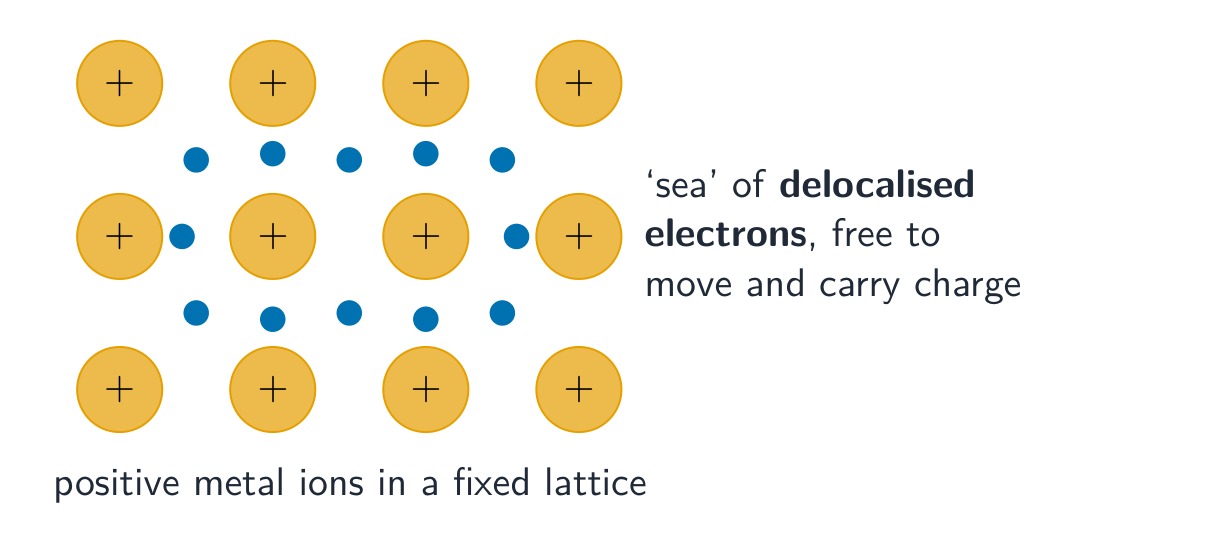
A metal is a giant structure of positive ions surrounded by a 'sea' of delocalised electrons that are free to move through the whole metal. Metallic bonding 金属键 is the strong electrostatic attraction between these positive ions and the sea of electrons.
This explains two key properties of metals:
Good electrical conductivity: the delocalised electrons are free to move and carry charge through the metal.
Malleability 展性 (can be hammered into sheets) and ductility 延性 (can be pulled into wires): the layers of positive ions can slide over each other without breaking the metallic bond, so the metal changes shape instead of shattering.
日本語
A metal is a giant structure of positive ions surrounded by a 'sea' of delocalised electrons that are free to move through the whole metal. Metallic bonding 金属键 is the strong electrostatic attraction between these positive ions and the sea of electrons.
A metal is positive ions in a 'sea' of delocalised electrons that are free to move and carry charge
This explains two key properties of metals:
Good electrical conductivity: the delocalised electrons are free to move and carry charge through the metal.
Malleability 展性 (can be hammered into sheets) and ductility 延性 (can be pulled into wires): the layers of positive ions can slide over each other without breaking the metallic bond, so the metal changes shape instead of shattering.
Explore · 探索
Inside a metal — and why it behaves that way · 金属内部の構造と、その物理的性質の理由
Step through it. Positive ions sit in a shared sea of delocalised electrons — that one picture explains conduction and why metals bend instead of snapping. · 手順を追う。正イオンが非局在電子の海の中に座っている — この図は伝導と、なぜ金属が折れることなく曲げられるかを説明する。
Number of neutrons = mass number − proton number. The proton number is what decides which element an atom is.
Isotopes have the same chemical properties because reactions involve only electrons, and isotopes share the same electron configuration; only the mass differs.
Match structure to properties: ionic = giant lattice (high melting point; conducts only when molten or aqueous); simple molecular = weak forces between molecules (low melting point; no conduction); giant covalent = very hard, very high melting point.
Graphite conducts and is slippery (one free electron per carbon; layers slide); diamond does neither (all four electrons bonded, so hard and non-conducting). Metals conduct and bend thanks to the sea of delocalised electrons.
For relative atomic mass, take the weighted average: $A_r = \dfrac{\sum(\text{isotope mass} \times \text{abundance})}{100}$.
Stoichiometry 化学计量 is the study of the amounts of substances in a reaction — how much reacts and how much is made. This topic is mostly about counting atoms and doing calculations.
日本語
Stoichiometry 化学计量 is the study of the amounts of substances in a reaction — how much reacts and how much is made. This topic is mostly about counting atoms and doing calculations.
3.1
Chemical formulae
Syllabus · シラバス
English
Core
Supplement
1 State the formulae of the elements and compounds named in the subject content
2 Define the molecular formula of a compound as the number and type of different atoms in one molecule
5 Define the empirical formula of a compound as the simplest whole number ratio of the different atoms or ions in a compound
3 Deduce the formula of a simple compound from the relative numbers of atoms present in a model or a diagrammatic representation
6 Deduce the formula of an ionic compound from the relative numbers of the ions present in a model or a diagrammatic representation or from the charges on the ions
4 Construct word equations and symbol equations to show how reactants form products, including state symbols
7 Construct symbol equations with state symbols, including ionic equations
8 Deduce the symbol equation with state symbols for a chemical reaction, given relevant information
Source: Cambridge International syllabus · 出典: Cambridge International シラバス
English
A formula 化学式 shows which atoms 原子 are in a substance, and how many of each. There are two kinds of formula you must know.
The molecular formula 分子式 is the actual number of each atom in one molecule 分子. For glucose it is $\text{C}_6\text{H}_{12}\text{O}_6$.
The empirical formula 实验式 is the simplest whole-number ratio 比例 of the atoms or ions 离子 in a compound 化合物. For glucose it is $\text{CH}_2\text{O}$.
Working out a formula
If you are given a model or diagram, just count the atoms of each element and write them as a formula.
For an ionic compound 离子化合物 you can work out the formula from the charges on the ions. The total positive charge must balance the total negative charge, because the compound has no overall charge. Some common ions:
For example, $\text{Na}^{+}$ and $\text{O}^{2-}$: you need two $\text{Na}^{+}$ to balance one $\text{O}^{2-}$, so the formula is $\text{Na}_2\text{O}$.
日本語
A formula 化学式 shows which atoms 原子 are in a substance, and how many of each. There are two kinds of formula you must know.
The molecular formula 分子式 is the actual number of each atom in one molecule 分子. For glucose it is $\text{C}_6\text{H}_{12}\text{O}_6$.
The empirical formula 实验式 is the simplest whole-number ratio 比例 of the atoms or ions 离子 in a compound 化合物. For glucose it is $\text{CH}_2\text{O}$.
Working out a formula
If you are given a model or diagram, just count the atoms of each element and write them as a formula.
For an ionic compound 离子化合物 you can work out the formula from the charges on the ions. The total positive charge must balance the total negative charge, because the compound has no overall charge. Some common ions:
For example, $\text{Na}^{+}$ and $\text{O}^{2-}$: you need two $\text{Na}^{+}$ to balance one $\text{O}^{2-}$, so the formula is $\text{Na}_2\text{O}$.
For an ionic compound, the ion charges cross over to give the formula (here $\text{Al}_2\text{O}_3$)
Explore · 探索
Formula writing route · 化学式の書き方
Follow charges or valencies to a neutral chemical formula. · 電荷または価数に従って、電荷の釣り合った化学式を導く。
You add state symbols 状态符号 in brackets to show the physical state: $(s)$ solid, $(l)$ liquid, $(g)$ gas, and $(aq)$ for aqueous 水溶液 (dissolved in water).
An ionic equation 离子方程式 shows only the ions that actually change. Ions that are the same on both sides are spectator ions 旁观离子 and are left out. For example, when an acid reacts with an alkali:
A balanced symbol equation has the same number of each atom on both sides
You add state symbols 状态符号 in brackets to show the physical state: $(s)$ solid, $(l)$ liquid, $(g)$ gas, and $(aq)$ for aqueous 水溶液 (dissolved in water).
An ionic equation 离子方程式 shows only the ions that actually change. Ions that are the same on both sides are spectator ions 旁观离子 and are left out. For example, when an acid reacts with an alkali:
Source: Cambridge International syllabus · 出典: Cambridge International シラバス
English
The relative atomic mass 相对原子质量 ($A_r$) of an element 元素 is the average mass 质量 of its atoms compared to $\tfrac{1}{12}$ of the mass of one $^{12}\text{C}$ atom.
The relative molecular mass 相对分子质量 ($M_r$) is the sum of the relative atomic masses of all the atoms in the molecule. For ionic compounds we use the relative formula mass 相对式量, found the same way from the formula.
You can sometimes find a reacting mass without the mole. If 24 g of magnesium makes 40 g of magnesium oxide, then 12 g of magnesium (half as much) makes 20 g of magnesium oxide.
日本語
A laboratory balance measures mass — the basis of mole calculations.
The relative atomic mass 相对原子质量 ($A_r$) of an element 元素 is the average mass 质量 of its atoms compared to $\tfrac{1}{12}$ of the mass of one $^{12}\text{C}$ atom.
The relative molecular mass 相对分子质量 ($M_r$) is the sum of the relative atomic masses of all the atoms in the molecule. For ionic compounds we use the relative formula mass 相对式量, found the same way from the formula.
You can sometimes find a reacting mass without the mole. If 24 g of magnesium makes 40 g of magnesium oxide, then 12 g of magnesium (half as much) makes 20 g of magnesium oxide.
Explore · 探索
Formula mass lab · 式量実験
mass = moles x Mr · 質量 = モル数 × 式量(Mr)
Change number of formula units and see total mass scale. · 式単位数を変えて総質量スケールを確認する。
2 State that the mole, mol, is the unit of amount of substance and that one mole contains $6.02 \times 10^{23}$ particles, e.g. atoms, ions, molecules; this number is the Avogadro constant
3 Use the relationship $\text{amount of substance (mol)} = \frac{\text{mass (g)}}{\text{molar mass (g/mol)}}$ to calculate: (a) amount of substance (b) mass (c) molar mass (d) relative atomic mass or relative molecular/formula mass (e) number of particles, using the value of the Avogadro constant
4 Use the molar gas volume, taken as $24\text{ dm}^3$ at room temperature and pressure, r.t.p., in calculations involving gases
1 State that concentration can be measured in $\text{g/dm}^3$ or $\text{mol/dm}^3$
5 Calculate stoichiometric reacting masses, limiting reactants, volumes of gases at r.t.p., volumes of solutions and concentrations of solutions expressed in $\text{g/dm}^3$ and $\text{mol/dm}^3$, including conversion between $\text{cm}^3$ and $\text{dm}^3$
6 Use experimental data from a titration to calculate the moles of solute, or the concentration or volume of a solution
7 Calculate empirical formulae and molecular formulae, given appropriate data
8 Calculate percentage yield, percentage composition by mass and percentage purity, given appropriate data
Source: Cambridge International syllabus · 出典: Cambridge International シラバス
English
The mole 摩尔 (symbol mol) is the unit for the amount of substance 物质的量. One mole of any substance contains $6.02 \times 10^{23}$particles 粒子 (atoms, ions or molecules). This number is the Avogadro constant 阿伏伽德罗常数.
The molar mass 摩尔质量 is the mass of one mole, in grams per mole (g/mol). Its number is the same as the $A_r$ or $M_r$. The key relationship is:
$$\text{amount (mol)} = \frac{\text{mass (g)}}{\text{molar mass (g/mol)}}$$
Worked example. How many moles are in 36 g of water? Molar mass of water $= 18$ g/mol.
$$n = \frac{36}{18} = 2 \text{ mol}$$
To find the number of particles, multiply the moles by the Avogadro constant.
Volumes of gases
At room temperature and pressure (r.t.p.), one mole of any gas takes up the same volume 体积. This molar gas volume 摩尔气体体积 is $24 \text{ dm}^3$.
$$\text{volume of gas (dm}^3) = \text{amount (mol)} \times 24$$
Worked example. What volume does $0.25$ mol of carbon dioxide occupy at r.t.p.?
The concentration 浓度 of a solution 溶液 can be given in $\text{g/dm}^3$ or in $\text{mol/dm}^3$.
$$\text{concentration (mol/dm}^3) = \frac{\text{amount of solute (mol)}}{\text{volume (dm}^3)}$$
Remember to convert volume: $1 \text{ dm}^3 = 1000 \text{ cm}^3$, so divide a volume in $\text{cm}^3$ by 1000.
日本語
The mole 摩尔 (symbol mol) is the unit for the amount of substance 物质的量. One mole of any substance contains $6.02 \times 10^{23}$particles 粒子 (atoms, ions or molecules). This number is the Avogadro constant 阿伏伽德罗常数.
The molar mass 摩尔质量 is the mass of one mole, in grams per mole (g/mol). Its number is the same as the $A_r$ or $M_r$. The key relationship is:
$$\text{amount (mol)} = \frac{\text{mass (g)}}{\text{molar mass (g/mol)}}$$
Worked example. How many moles are in 36 g of water? Molar mass of water $= 18$ g/mol.
$$n = \frac{36}{18} = 2 \text{ mol}$$
To find the number of particles, multiply the moles by the Avogadro constant.
Volumes of gases
At room temperature and pressure (r.t.p.), one mole of any gas takes up the same volume 体积. This molar gas volume 摩尔气体体积 is $24 \text{ dm}^3$.
One mole of any gas fills 24 cubic decimetres at room temperature and pressure
$$\text{volume of gas (dm}^3) = \text{amount (mol)} \times 24$$
Worked example. What volume does $0.25$ mol of carbon dioxide occupy at r.t.p.?
Most calculations follow the same steps: change the known amount into moles, use the balanced equation to find the moles of what you want, then change back into mass, volume or concentration.
Worked example. What mass of magnesium oxide forms when 12 g of magnesium burns completely? $2\text{Mg} + \text{O}_2 \rightarrow 2\text{MgO}$. ($A_r$: Mg $= 24$, O $= 16$.)
Moles of Mg $= 12 / 24 = 0.5$ mol. The ratio Mg : MgO is $1 : 1$, so $0.5$ mol of MgO forms. Its molar mass is $24 + 16 = 40$ g/mol, so the mass is $0.5 \times 40 = 20$ g — the same answer as the simple-proportion method above.
Limiting reactant
When two reactants are mixed, often one runs out first. This is the limiting reactant 限量反应物. It decides how much product can form; any other reactant is in excess (left over).
Worked example. 8 g of hydrogen reacts with 8 g of oxygen: $2\text{H}_2 + \text{O}_2 \rightarrow 2\text{H}_2\text{O}$. Which is the limiting reactant, and what mass of water forms? ($A_r$: H $= 1$, O $= 16$.)
Moles of $\text{H}_2 = 8 / 2 = 4$ mol; moles of $\text{O}_2 = 8 / 32 = 0.25$ mol. The equation needs $2\text{H}_2$ for every one $\text{O}_2$, so $0.25$ mol of $\text{O}_2$ reacts with only $0.5$ mol of $\text{H}_2$. There is far more hydrogen than that, so oxygen is the limiting reactant and the hydrogen is in excess. The oxygen makes $2 \times 0.25 = 0.5$ mol of water, so the mass is $0.5 \times 18 = 9$ g. Always work in moles, not masses — the reactant with the smaller mass is not always the one that runs out.
Titration calculation
In a titration 滴定 you measure the volume of one solution that reacts with another. From the volume and concentration you find the moles of one solute 溶质, then use the equation ratio to find the moles, concentration or volume of the other.
Worked example.$25.0 \text{ cm}^3$ of sodium hydroxide solution is exactly neutralised by $20.0 \text{ cm}^3$ of $0.10 \text{ mol/dm}^3$ hydrochloric acid. $\text{NaOH} + \text{HCl} \rightarrow \text{NaCl} + \text{H}_2\text{O}$. Find the concentration of the sodium hydroxide.
Moles of HCl $= 0.10 \times \dfrac{20.0}{1000} = 0.0020$ mol. The ratio is $1 : 1$, so there are $0.0020$ mol of NaOH in $25.0 \text{ cm}^3$:
To find an empirical formula from masses or percentages:
Divide each element's mass (or %) by its $A_r$.
Divide all the answers by the smallest one to get the simplest ratio.
To find the molecular formula, compare the empirical formula mass with the real $M_r$ and multiply up.
Worked example. A compound contains $40\%$ calcium, $12\%$ carbon and $48\%$ oxygen by mass. Find its empirical formula. ($A_r$: Ca $= 40$, C $= 12$, O $= 16$.)
Divide each percentage by its $A_r$: Ca $= 40/40 = 1$, C $= 12/12 = 1$, O $= 48/16 = 3$. The ratio is $1 : 1 : 3$, so the empirical formula is $\text{CaCO}_3$.
Percentages
Percentage yield 产率 compares how much product you actually got with the most you could get: $\dfrac{\text{actual}}{\text{theoretical}} \times 100$.
Percentage composition by mass 质量分数 of an element $= \dfrac{\text{mass of the element}}{M_r} \times 100$.
Percentage purity 纯度$= \dfrac{\text{mass of pure substance}}{\text{mass of impure sample}} \times 100$.
Worked example. Find the percentage by mass of nitrogen in ammonium nitrate, $\text{NH}_4\text{NO}_3$. ($A_r$: N $= 14$, H $= 1$, O $= 16$.)
$M_r = (2 \times 14) + (4 \times 1) + (3 \times 16) = 80$. The mass of nitrogen is $2 \times 14 = 28$, so
A titration measures exactly how much acid reacts with a base.
Most calculations follow the same steps: change the known amount into moles, use the balanced equation to find the moles of what you want, then change back into mass, volume or concentration.
Worked example. What mass of magnesium oxide forms when 12 g of magnesium burns completely? $2\text{Mg} + \text{O}_2 \rightarrow 2\text{MgO}$. ($A_r$: Mg $= 24$, O $= 16$.)
Moles of Mg $= 12 / 24 = 0.5$ mol. The ratio Mg : MgO is $1 : 1$, so $0.5$ mol of MgO forms. Its molar mass is $24 + 16 = 40$ g/mol, so the mass is $0.5 \times 40 = 20$ g — the same answer as the simple-proportion method above.
Limiting reactant
When two reactants are mixed, often one runs out first. This is the limiting reactant 限量反应物. It decides how much product can form; any other reactant is in excess (left over).
B runs out first, so it is the limiting reactant and sets how much product forms; the spare A is left over in excess
Worked example. 8 g of hydrogen reacts with 8 g of oxygen: $2\text{H}_2 + \text{O}_2 \rightarrow 2\text{H}_2\text{O}$. Which is the limiting reactant, and what mass of water forms? ($A_r$: H $= 1$, O $= 16$.)
Moles of $\text{H}_2 = 8 / 2 = 4$ mol; moles of $\text{O}_2 = 8 / 32 = 0.25$ mol. The equation needs $2\text{H}_2$ for every one $\text{O}_2$, so $0.25$ mol of $\text{O}_2$ reacts with only $0.5$ mol of $\text{H}_2$. There is far more hydrogen than that, so oxygen is the limiting reactant and the hydrogen is in excess. The oxygen makes $2 \times 0.25 = 0.5$ mol of water, so the mass is $0.5 \times 18 = 9$ g. Always work in moles, not masses — the reactant with the smaller mass is not always the one that runs out.
Titration calculation
In a titration 滴定 you measure the volume of one solution that reacts with another. From the volume and concentration you find the moles of one solute 溶质, then use the equation ratio to find the moles, concentration or volume of the other.
Worked example.$25.0 \text{ cm}^3$ of sodium hydroxide solution is exactly neutralised by $20.0 \text{ cm}^3$ of $0.10 \text{ mol/dm}^3$ hydrochloric acid. $\text{NaOH} + \text{HCl} \rightarrow \text{NaCl} + \text{H}_2\text{O}$. Find the concentration of the sodium hydroxide.
Moles of HCl $= 0.10 \times \dfrac{20.0}{1000} = 0.0020$ mol. The ratio is $1 : 1$, so there are $0.0020$ mol of NaOH in $25.0 \text{ cm}^3$:
The titration calculation: known solution to moles, ratio, then the unknown concentration
Empirical and molecular formulae from data
To find an empirical formula from masses or percentages:
Divide each element's mass (or %) by its $A_r$.
Divide all the answers by the smallest one to get the simplest ratio.
To find the molecular formula, compare the empirical formula mass with the real $M_r$ and multiply up.
Worked example. A compound contains $40\%$ calcium, $12\%$ carbon and $48\%$ oxygen by mass. Find its empirical formula. ($A_r$: Ca $= 40$, C $= 12$, O $= 16$.)
Divide each percentage by its $A_r$: Ca $= 40/40 = 1$, C $= 12/12 = 1$, O $= 48/16 = 3$. The ratio is $1 : 1 : 3$, so the empirical formula is $\text{CaCO}_3$.
Percentages
Percentage yield 产率 compares how much product you actually got with the most you could get: $\dfrac{\text{actual}}{\text{theoretical}} \times 100$.
Percentage composition by mass 质量分数 of an element $= \dfrac{\text{mass of the element}}{M_r} \times 100$.
Percentage purity 纯度 $= \dfrac{\text{mass of pure substance}}{\text{mass of impure sample}} \times 100$.
Worked example. Find the percentage by mass of nitrogen in ammonium nitrate, $\text{NH}_4\text{NO}_3$. ($A_r$: N $= 14$, H $= 1$, O $= 16$.)
$M_r = (2 \times 14) + (4 \times 1) + (3 \times 16) = 80$. The mass of nitrogen is $2 \times 14 = 28$, so
percentage composition by mass/pəˈsentɪdʒ ˌkɒmpəˈzɪʃn baɪ mæs/
質量百分組成
percentage purity/pəˈsentɪdʒ ˈpjʊərɪti/
百分率純度
3.3
Exam tips
Always turn masses, gas volumes and concentrations into moles first, use the balanced equation's ratio, then convert back. Never compare masses directly across an equation.
Key formulas: $n = \dfrac{\text{mass}}{M_r}$, gas volume $= n \times 24\ \text{dm}^3$ at r.t.p., and concentration $= \dfrac{n}{\text{volume in dm}^3}$. Change cm³ to dm³ by dividing by 1000.
To balance a symbol equation you may only change the big numbers in front of a formula, never the small subscripts inside it.
The limiting reactant is the one that runs out (fewest moles once you allow for the ratio); it sets how much product forms. The other reactant is in excess.
Percentage yield = actual ÷ theoretical × 100; percentage purity = mass of pure substance ÷ mass of sample × 100. Both are always 100% or less.
1 Define electrolysis as the decomposition of an ionic compound, when molten or in aqueous solution, by the passage of an electric current
8 Describe the transfer of charge during electrolysis to include: (a) the movement of electrons in the external circuit (b) the loss or gain of electrons at the electrodes (c) the movement of ions in the electrolyte
2 Identify in simple electrolytic cells: (a) the anode as the positive electrode (b) the cathode as the negative electrode (c) the electrolyte as the molten or aqueous substance that undergoes electrolysis
3 Identify the products formed at the electrodes and describe the observations made during the electrolysis of: (a) molten lead(II) bromide (b) concentrated aqueous sodium chloride (c) dilute sulfuric acid using inert electrodes made of platinum or carbon/graphite
9 Identify the products formed at the electrodes and describe the observations made during the electrolysis of aqueous copper(II) sulfate using inert carbon/graphite electrodes and when using copper electrodes
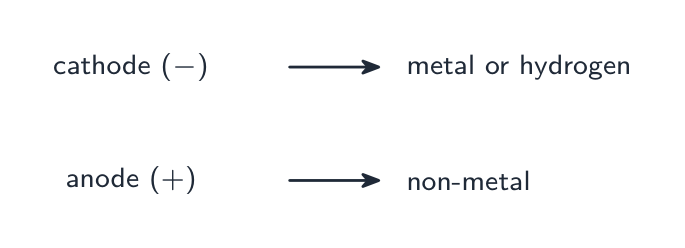
4 State that metals or hydrogen are formed at the cathode and that non-metals (other than hydrogen) are formed at the anode
5 Predict the identity of the products at each electrode for the electrolysis of a binary compound in the molten state
10 Predict the identity of the products at each electrode for the electrolysis of a halide compound in dilute or concentrated aqueous solution
11 Construct ionic half-equations for reactions at the anode (to show oxidation) and at the cathode (to show reduction)
6 State that metal objects are electroplated to improve their appearance and resistance to corrosion
Source: Cambridge International syllabus · 出典: Cambridge International シラバス
English
Electrolysis: ions discharge at the electrodes
Electrolysis 电解 is the breaking down (decomposition 分解) of an ionic compound 离子化合物 — when it is molten 熔融 or in aqueous 水溶液 solution — by passing an electric current 电流 through it.
It only works when the substance is molten or dissolved, because then the ions 离子 are free to move and carry the charge. A solid ionic compound cannot be electrolysed because its ions are locked in place.
The electrolytic cell
The set-up is called an electrolytic cell 电解池. Two electrodes 电极 (solid conductors) dip into the electrolyte 电解质 — the molten or aqueous substance being broken down.
The anode 阳极 is the positive ($+$) electrode.
The cathode 阴极 is the negative ($-$) electrode.
The electrodes are often inert 惰性 (they do not react), such as platinum 铂 or carbon/graphite 石墨.
What is formed at each electrode
There is a simple rule:
Metals 金属 or hydrogen 氢气 are formed at the cathode.
Non-metals 非金属 (other than hydrogen) are formed at the anode.
For aqueous solutions, the product can depend on whether the solution is dilute 稀 or concentrated 浓. Here are the three Core examples:
Electrolyte
At the cathode ($-$)
At the anode ($+$)
molten lead(II) bromide, $\text{PbBr}_2$
lead 铅 (silvery liquid)
bromine 溴 (red-brown vapour)
concentrated aqueous sodium chloride
hydrogen (bubbles of gas)
chlorine 氯气 (pale green gas)
dilute sulfuric acid 硫酸
hydrogen (bubbles of gas)
oxygen 氧气 (bubbles of gas)
Worked example. Predict the products of electrolysing molten zinc chloride, $\text{ZnCl}_2$. Because it is molten, only zinc ions and chloride ions are present - there is no water to complicate things. Zinc is a metal, so it forms at the cathode: $\text{Zn}^{2+}$ ions gain electrons and silvery zinc appears. Chlorine is a non-metal, so it forms at the anode: pale green chlorine gas bubbles off. Always check the state first. A molten compound simply gives you its own two elements, while an aqueous one brings water into the competition - which is why concentrated sodium chloride solution gives hydrogen at the cathode rather than sodium.
How the charge moves
During electrolysis:
Electrons 电子 move through the wires (the external circuit 外电路) from the power supply.
At the cathode, positive ions gain electrons. Gaining electrons is reduction 还原.
At the anode, negative ions lose electrons. Losing electrons is oxidation 氧化.
Inside the electrolyte, the ions move: positive ions go to the cathode and negative ions go to the anode.
You can write a half-equation 半反应式 for each electrode. For molten lead(II) bromide:
The product at the anode depends on the electrode:
With inert carbon electrodes: copper 铜 forms at the cathode and oxygen forms at the anode. The blue colour of the solution slowly fades as copper is removed.
With copper electrodes: copper forms at the cathode, while the anode itself dissolves into the solution. The blue colour stays the same. This is used to purify copper.
Electroplating
Electroplating 电镀 means covering a metal object with a thin layer of another metal. This improves its appearance and its resistance to corrosion 腐蚀 (rusting and wearing away).
To electroplate an object:
the object to be coated is made the cathode;
the plating metal is made the anode;
the electrolyte is a solution containing ions of the plating metal.
日本語
Electrolysis: ions discharge at the electrodes
Electrolysis 电解 is the breaking down (decomposition 分解) of an ionic compound 离子化合物 — when it is molten 熔融 or in aqueous 水溶液 solution — by passing an electric current 电流 through it.
An electrolysis cell splits a compound using an electric current.
It only works when the substance is molten or dissolved, because then the ions 离子 are free to move and carry the charge. A solid ionic compound cannot be electrolysed because its ions are locked in place.
Electrolysis of water: gas bubbles off at each electrode and collects in the tubes above, with about twice as much hydrogen as oxygen
The electrolytic cell
The set-up is called an electrolytic cell 电解池. Two electrodes 电极 (solid conductors) dip into the electrolyte 电解质 — the molten or aqueous substance being broken down.
The anode 阳极 is the positive ($+$) electrode.
The cathode 阴极 is the negative ($-$) electrode.
The electrodes are often inert 惰性 (they do not react), such as platinum 铂 or carbon/graphite 石墨.
What is formed at each electrode
There is a simple rule:
Metals and hydrogen form at the cathode; non-metals at the anode
Metals 金属 or hydrogen 氢气 are formed at the cathode.
Non-metals 非金属 (other than hydrogen) are formed at the anode.
For aqueous solutions, the product can depend on whether the solution is dilute 稀 or concentrated 浓. Here are the three Core examples:
Electrolyte
At the cathode ($-$)
At the anode ($+$)
molten lead(II) bromide, $\text{PbBr}_2$
lead 铅 (silvery liquid)
bromine 溴 (red-brown vapour)
concentrated aqueous sodium chloride
hydrogen (bubbles of gas)
chlorine 氯气 (pale green gas)
dilute sulfuric acid 硫酸
hydrogen (bubbles of gas)
oxygen 氧气 (bubbles of gas)
Worked example. Predict the products of electrolysing molten zinc chloride, $\text{ZnCl}_2$. Because it is molten, only zinc ions and chloride ions are present - there is no water to complicate things. Zinc is a metal, so it forms at the cathode: $\text{Zn}^{2+}$ ions gain electrons and silvery zinc appears. Chlorine is a non-metal, so it forms at the anode: pale green chlorine gas bubbles off. Always check the state first. A molten compound simply gives you its own two elements, while an aqueous one brings water into the competition - which is why concentrated sodium chloride solution gives hydrogen at the cathode rather than sodium.
How the charge moves
During electrolysis:
Electrons 电子 move through the wires (the external circuit 外电路) from the power supply.
At the cathode, positive ions gain electrons. Gaining electrons is reduction 还原.
At the anode, negative ions lose electrons. Losing electrons is oxidation 氧化.
Inside the electrolyte, the ions move: positive ions go to the cathode and negative ions go to the anode.
You can write a half-equation 半反应式 for each electrode. For molten lead(II) bromide:
In molten lead(II) bromide, $\text{Pb}^{2+}$ moves to the cathode and $\text{Br}^-$ to the anode, where each is discharged
Electrolysis of copper(II) sulfate
The product at the anode depends on the electrode:
With inert carbon electrodes: copper 铜 forms at the cathode and oxygen forms at the anode. The blue colour of the solution slowly fades as copper is removed.
With copper electrodes: copper forms at the cathode, while the anode itself dissolves into the solution. The blue colour stays the same. This is used to purify copper.
Electroplating
Electroplating 电镀 means covering a metal object with a thin layer of another metal. This improves its appearance and its resistance to corrosion 腐蚀 (rusting and wearing away).
To electroplate an object:
the object to be coated is made the cathode;
the plating metal is made the anode;
the electrolyte is a solution containing ions of the plating metal.
To electroplate, make the object the cathode and the plating metal the anode, in a solution of the plating-metal ions
Explore · 探索
Inside an electrolysis cell · 電気分解セル内部
Pick an electrolyte and watch ions move: positive ions to the cathode, negative ions to the anode. · 電解質を選び、イオンが動く様子を見よ:陽イオンは陰極へ、陰イオンは陽極へ向かう。
It is useful to compare a fuel cell with a normal petrol (gasoline) engine in a vehicle.
Hydrogen–oxygen fuel cell
Petrol engine
Main product
water only
carbon dioxide and pollutants 污染物
Effect on air
clean
adds to air pollution
Fuel storage
hydrogen is hard and dangerous to store (flammable, needs high pressure)
petrol is easy to store
Source
hydrogen may be made using fossil fuels
made from crude oil
Advantages of the fuel cell: the only product is water, so it does not pollute the air, and it changes chemical energy into electricity efficiently. Disadvantages: hydrogen is hard to store and transport safely, and producing the hydrogen can still use energy from fossil fuels.
日本語
A fuel cell 燃料电池 uses hydrogen and oxygen to make electricity directly. The only chemical product is water.
A hydrogen–oxygen fuel cell turns chemical energy straight into electricity, with water as the only product
It is useful to compare a fuel cell with a normal petrol (gasoline) engine in a vehicle.
Hydrogen–oxygen fuel cell
Petrol engine
Main product
water only
carbon dioxide and pollutants 污染物
Effect on air
clean
adds to air pollution
Fuel storage
hydrogen is hard and dangerous to store (flammable, needs high pressure)
petrol is easy to store
Source
hydrogen may be made using fossil fuels
made from crude oil
Advantages of the fuel cell: the only product is water, so it does not pollute the air, and it changes chemical energy into electricity efficiently. Disadvantages: hydrogen is hard to store and transport safely, and producing the hydrogen can still use energy from fossil fuels.
Explore · 探索
Inside a hydrogen–oxygen fuel cell · 水素-酸素燃料電池の内部
Step through a fuel cell. Hydrogen and oxygen combine to make water, and the energy of that reaction is released as electricity — with no carbon dioxide. · 燃料電池の仕組み。水素と酸素が結合して水となり、この反応エネルギーが電気として放出されます——二酸化炭素は発生しません。
At the cathode (negative) you get a metal or hydrogen; at the anode (positive) you get a non-metal. Positive ions move to the cathode, negative ions to the anode.
A molten compound just gives its two elements. An aqueous solution can give something different (concentrated sodium chloride gives hydrogen and chlorine, not sodium).
Reduction is gain of electrons (at the cathode); oxidation is loss of electrons (at the anode). Remember OIL RIG.
In a half-equation the atoms and the charges must balance, with the electrons on the correct side: $\text{Pb}^{2+} + 2e^- \rightarrow \text{Pb}$ (cathode).
To electroplate an object, make it the cathode, make the plating metal the anode, and use a solution containing ions of the plating metal.
Exothermic and endothermic reactions · 発熱反応と吸熱反応
Syllabus · シラバス
English
Core
Supplement
1 State that an exothermic reaction transfers thermal energy to the surroundings leading to an increase in the temperature of the surroundings
4 State that the transfer of thermal energy during a reaction is called the enthalpy change, $\Delta H$, of the reaction. $\Delta H$ is negative for exothermic reactions and positive for endothermic reactions
2 State that an endothermic reaction takes in thermal energy from the surroundings leading to a decrease in the temperature of the surroundings
5 Define activation energy, $E_a$, as the minimum energy that colliding particles must have to react
3 Interpret reaction pathway diagrams showing exothermic and endothermic reactions
6 Draw and label reaction pathway diagrams for exothermic and endothermic reactions using information provided, to include: (a) reactants (b) products (c) enthalpy change of the reaction, $\Delta H$ (d) activation energy, $E_a$
7 State that bond breaking is an endothermic process and bond making is an exothermic process and explain the enthalpy change of a reaction in terms of bond breaking and bond making
8 Calculate the enthalpy change of a reaction using bond energies
Source: Cambridge International syllabus · 出典: Cambridge International シラバス
English
Reaction profile: exothermic energy change
In every chemical reaction, energy is transferred. The reaction is either exothermic or endothermic, depending on which way the energy moves.
An exothermic reaction 放热反应 gives out thermal energy 热能 to the surroundings 环境. So the temperature of the surroundings goes up.
An endothermic reaction 吸热反应 takes in thermal energy from the surroundings. So the temperature of the surroundings goes down.
Examples of exothermic reactions are combustion 燃烧 (burning a fuel) and neutralisation 中和 (an acid reacting with an alkali). An example of an endothermic reaction is the thermal decomposition 分解 of a compound (breaking it down using heat).
Particles do not react every time they meet. The activation energy 活化能 ($E_a$) is the smallest amount of energy that colliding 碰撞particles 粒子 must have before they can react. It is like a hill the particles must get over before the reaction can happen.
Every reaction must climb the activation-energy barrier before products can form. · すべての反応では、生成物が形成される前に活性化エネルギーの障壁を越えなければなりません。
5.1
Reaction pathway diagrams · 反応経路図
English
A reaction pathway diagram 反应进程图 shows how the energy changes as a reaction happens. Energy is on the vertical axis, and the progress of the reaction is on the horizontal axis.
The line starts at the energy level of the reactants 反应物.
It rises over a 'hill' — the height of this hill is the activation energy $E_a$.
It then falls or rises to the energy level of the products 生成物.
The gap between the reactant level and the product level is the enthalpy change $\Delta H$.
For an exothermic reaction, the products are lower than the reactants, so energy is given out and $\Delta H$ is negative.
For an endothermic reaction, the products are higher than the reactants, so energy is taken in and $\Delta H$ is positive.
Drag ΔH and the activation energy. Exothermic releases energy; endothermic takes it in; the hump is the energy barrier. · ΔHと活性化エネルギーをドラッグせよ。発熱反応はエネルギーを放出し、吸熱反応は取り込む。山のような形がエネルギー障壁である。
5.1
Bonds and energy · 結合とエネルギー
English
A reaction involves breaking the bonds in the reactants and making new bonds in the products.
Bond breaking 断键 takes in energy, so it is an endothermic step.
Bond making 成键 gives out energy, so it is an exothermic step.
The bond energy 键能 is the energy needed to break one mole of a particular bond. You can use bond energies to find the enthalpy change:
$$\Delta H = (\text{energy to break all bonds}) - (\text{energy released making all bonds})$$
If more energy is given out making bonds than is taken in breaking bonds, the reaction is exothermic ($\Delta H$ negative). If less energy is given out, it is endothermic ($\Delta H$ positive).
Worked example
For the reaction $\text{H}_2 + \text{Cl}_2 \rightarrow 2\text{HCl}$, use these bond energies (in kJ/mol): H–H $= 436$, Cl–Cl $= 242$, H–Cl $= 431$.
Bonds broken: one H–H and one Cl–Cl $= 436 + 242 = 678$.
Bonds made: two H–Cl $= 2 \times 431 = 862$.
$$\Delta H = 678 - 862 = -184 \text{ kJ/mol}$$
The answer is negative, so this reaction is exothermic.
Exothermic gives out heat, so the surroundings warm up and $\Delta H$ is negative; endothermic takes in heat, so the surroundings cool and $\Delta H$ is positive.
Bond breaking takes energy in (endothermic); bond making gives energy out (exothermic). Use $\Delta H = (\text{energy to break bonds}) - (\text{energy released making bonds})$.
If more energy is released making bonds than is used breaking them, the reaction is exothermic. Always check the sign of your final answer.
On a reaction pathway diagram, an exothermic reaction ends lower than it starts; an endothermic one ends higher. The height of the hill is the activation energy.
1 Identify physical and chemical changes, and describe the differences between them
日本語
コア
サプリメント
1 物理変化および化学変化を識別し、それらの違いを説明する
Source: Cambridge International syllabus · 出典: Cambridge International シラバス
English
A physical change 物理变化 does not make a new substance. The substance only changes its state or shape, and the change can usually be reversed. Melting ice and dissolving sugar are physical changes.
A chemical change 化学变化 (a chemical reaction) makes one or more new substances and is usually hard to reverse. Signs of a chemical change include a colour change, a gas being given off, an energy change, or a precipitate 沉淀 (a solid) forming.
Physical change vs chemical change · 物理変化 vs 化学変化
Step through the difference. A physical change makes no new substance and is usually easy to reverse; a chemical change makes a new substance and is hard to undo. · 違いを確認しましょう。物理変化では新しい物質は生成せず、通常容易に元に戻せます;化学変化では新しい物質が生成され、元に戻すのは困難です。
6.2
Rate of reaction · 反応速度
Syllabus · シラバス
English
Core
Supplement
5 Describe collision theory in terms of: (a) number of particles per unit volume (b) frequency of collisions between particles (c) kinetic energy of particles (d) activation energy, $E_a$
1 Describe the effect on the rate of reaction of: (a) changing the concentration of solutions (b) changing the pressure of gases (c) changing the surface area of solids (d) changing the temperature (e) adding or removing a catalyst, including enzymes
6 Describe and explain the effect on the rate of reaction of: (a) changing the concentration of solutions (b) changing the pressure of gases (c) changing the surface area of solids (d) changing the temperature (e) adding or removing a catalyst, including enzymes using collision theory
2 State that a catalyst increases the rate of a reaction and is unchanged at the end of a reaction
7 State that a catalyst decreases the activation energy, $E_a$, of a reaction
3 Describe practical methods for investigating the rate of a reaction including change in mass of a reactant or a product and the formation of a gas
8 Evaluate practical methods for investigating the rate of a reaction including change in mass of a reactant or a product and the formation of a gas
4 Interpret data, including graphs, from rate of reaction experiments
Source: Cambridge International syllabus · 出典: Cambridge International シラバス
English
Collision theory: energy and orientation
The rate of reaction 反应速率 tells you how fast the reactants 反应物 change into products 生成物.
Collision theory
Collision theory 碰撞理论 explains what controls the rate. For a reaction to happen, the particles 粒子 must collide 碰撞, and they must collide with enough energy. The least energy they need is the activation energy 活化能 ($E_a$). A faster rate happens when the particles have successful collisions more often.
What changes the rate
Change
Effect
Reason (collision theory)
increase concentration 浓度 of a solution
faster
more particles in the same volume, so collisions happen more often
increase pressure 压强 of gases
faster
particles are pushed closer, so collisions happen more often
increase surface area 表面积 of a solid
faster
more particles are exposed, so collisions happen more often
increase temperature
faster
particles gain kinetic energy 动能 and move faster, so collisions are more frequent and more of them have enough energy
add a catalyst 催化剂
faster
the catalyst lowers the activation energy, so more collisions are successful
Catalysts
A catalyst speeds up a reaction but is not used up — it is unchanged at the end. It works by lowering the activation energy. Enzymes 酶 are biological catalysts (catalysts that work in living things).
Measuring the rate
You can follow a reaction over time in these ways:
Change in mass: stand the flask on a balance. If a gas escapes, the mass falls. Record the mass at regular times.
Volume of gas: collect the gas in a gas syringe 注射器 and read its volume at regular times.
Formation of a precipitate: in a reaction that turns cloudy, time how long it takes for a mark under the flask to disappear.
On a graph of product against time, the line is steepest at the start (fastest rate), becomes less steep as reactants are used up, and goes flat when the reaction has finished.
The gradient of the volume–time curve is the rate; it is steepest at the start and flattens as reactants run out. · 体積-時間曲線の傾きは速度であり、始点で最も急で、試薬が尽きるにつれて緩やかになる。
Explore · 探索
Rate of reaction · 反応速度
conc = c₀·bᵗ
Concentration falls over time — fast at first, then slower. · 濃度は時間とともに 低下 する — 最初は速く、後に遅くなる。
Explore · 探索
Collision theory in action · 衝突理論の実践
Watch the particles collide. Heat speeds them up so they collide more often and harder; more particles or a catalyst give more successful collisions — the rate climbs. · 粒子が衝突する様子を見る。熱は粒子を加速させ、衝突の頻度と強さを増します;より多くの粒子や触媒はより成功した衝突をもたらす — 速度は上昇する。
1 State that some chemical reactions are reversible as shown by the symbol $\rightleftharpoons$
3 State that a reversible reaction in a closed system is at equilibrium when: (a) the rate of the forward reaction is equal to the rate of the reverse reaction (b) the concentrations of reactants and products are no longer changing
2 Describe how changing the conditions can change the direction of a reversible reaction for: (a) the effect of heat on hydrated compounds (b) the addition of water to anhydrous compounds limited to copper(II) sulfate and cobalt(II) chloride
4 Predict and explain, for a reversible reaction, how the position of equilibrium is affected by: (a) changing temperature (b) changing pressure (c) changing concentration (d) using a catalyst using information provided
5 State the symbol equation for the production of ammonia in the Haber process, $\text{N}_2\text{(g)} + 3\text{H}_2\text{(g)} \rightleftharpoons 2\text{NH}_3\text{(g)}$
6 State the sources of the hydrogen (methane) and nitrogen (air) in the Haber process
7 State the typical conditions in the Haber process as $450\text{ }^{\circ}\text{C}$, $20\,000\text{ kPa}/200\text{ atm}$ and an iron catalyst
8 State the symbol equation for the conversion of sulfur dioxide to sulfur trioxide in the Contact process, $2\text{SO}_2\text{(g)} + \text{O}_2\text{(g)} \rightleftharpoons 2\text{SO}_3\text{(g)}$
9 State the sources of the sulfur dioxide (burning sulfur or roasting sulfide ores) and oxygen (air) in the Contact process
10 State the typical conditions for the conversion of sulfur dioxide to sulfur trioxide in the Contact process as $450\text{ }^{\circ}\text{C}$, $200\text{ kPa}/2\text{ atm}$ and a vanadium(V) oxide catalyst
11 Explain, in terms of rate of reaction and position of equilibrium, why the typical conditions stated are used in the Haber process and in the Contact process, including safety considerations and economics
Source: Cambridge International syllabus · 出典: Cambridge International シラバス
English
Le Chatelier's principleDynamic equilibrium: the rates converge
Some reactions are reversible 可逆反应: the products can react to form the reactants again. We show this with the symbol $\rightleftharpoons$.
Changing the direction
A clear example uses hydrated 水合 and anhydrous 无水 compounds:
Blue hydrated copper(II) sulfate, when heated, loses its water to become white anhydrous copper(II) sulfate. Adding water turns it blue again.
Pink hydrated cobalt(II) chloride loses water when heated to become blue anhydrous cobalt(II) chloride. Adding water turns it pink again.
Adding water to the anhydrous solid (and seeing the colour return) is used as a test for water.
Equilibrium
In a closed system 密闭系统 (where nothing enters or leaves), a reversible reaction reaches equilibrium 平衡 when:
the rate of the forward reaction 正反应 equals the rate of the reverse reaction 逆反应, and
the concentrations of the reactants and products are no longer changing.
Changing the position of equilibrium
The position of equilibrium 平衡位置 tells you whether there are more reactants or more products. You can move it:
Temperature: heating moves the equilibrium in the direction that takes in heat (the endothermic 吸热反应 direction); cooling moves it in the direction that gives out heat (the exothermic 放热反应 direction).
Pressure (gases): more pressure moves the equilibrium to the side with fewer gas molecules.
Concentration: adding more of a substance moves the equilibrium to the other side, to use it up.
A catalyst does not move the position of equilibrium. It only helps the reaction reach equilibrium faster.
The sulfur dioxide comes from burning sulfur 硫 (or roasting sulfide ores); the oxygen 氧气 comes from the air.
Typical conditions: a temperature of $450\,{}^{\circ}\text{C}$, a pressure of about $2$ atm ($200$ kPa), and a vanadium(V) oxide 五氧化二钒 catalyst.
Why these conditions are chosen
The conditions are a compromise 折中:
A higher pressure would give more product, but very high pressure is dangerous and expensive, so a medium pressure is used.
A lower temperature would give more product (both forward reactions are exothermic), but the reaction would be too slow, so a fairly high temperature is used to keep a good rate.
The catalyst speeds up the reaction without changing the position of equilibrium, which lowers cost.
1 Use a Roman numeral to indicate the oxidation number of an element in a compound
2 Define redox reactions as involving simultaneous oxidation and reduction
3 Define oxidation as gain of oxygen and reduction as loss of oxygen
6 Define oxidation in terms of: (a) loss of electrons (b) an increase in oxidation number
7 Define reduction in terms of: (a) gain of electrons (b) a decrease in oxidation number
4 Identify redox reactions as reactions involving gain and loss of oxygen
8 Identify redox reactions as reactions involving gain and loss of electrons
5 Identify oxidation and reduction in redox reactions
9 Identify redox reactions by changes in oxidation number using: (a) the oxidation number of elements in their uncombined state is zero (b) the oxidation number of a monatomic ion is the same as the charge on the ion (c) the sum of the oxidation numbers in a compound is zero (d) the sum of the oxidation numbers in an ion is equal to the charge on the ion
10 Identify redox reactions by the colour changes involved when using acidified aqueous potassium manganate(VII) or aqueous potassium iodide
11 Define an oxidising agent as a substance that oxidises another substance and is itself reduced
12 Define a reducing agent as a substance that reduces another substance and is itself oxidised
13 Identify oxidising agents and reducing agents in redox reactions
Source: Cambridge International syllabus · 出典: Cambridge International シラバス
English
Oxidation 氧化 and reduction 还原 always happen at the same time, in what is called a redox reaction 氧化还原反应. ('Redox' is short for reduction–oxidation.)
There are three ways to describe oxidation and reduction:
Oxygen: oxidation is the gain of oxygen; reduction is the loss of oxygen.
Electrons 电子: oxidation is the loss of electrons; reduction is the gain of electrons.
Oxidation number 氧化数: in oxidation the oxidation number goes up; in reduction it goes down.
A useful memory aid is OIL RIG: Oxidation Is Loss, Reduction Is Gain — of electrons.
Oxidation number rules
The oxidation number is shown by a Roman numeral, as in iron(II) and iron(III). The rules are:
An element that is not combined has an oxidation number of $0$.
A single-atom ion has an oxidation number equal to its charge (so $\text{Na}^{+}$ is $+1$).
The oxidation numbers in a compound add up to $0$.
The oxidation numbers in an ion add up to the charge on the ion.
Worked example. Find the oxidation number of manganese in the manganate(VII) ion, $\text{MnO}_4^{-}$. Each oxygen is $-2$, and there are four of them, giving $4 \times (-2) = -8$. The oxidation numbers in an ion must add up to the charge on the ion, which here is $-1$. So if manganese is $x$, then $x + (-8) = -1$, giving $x = +7$ - exactly what the (VII) in the name tells you. Set the total to the ion's charge, not to zero: zero is only for a neutral compound.
Oxidising and reducing agents
An oxidising agent 氧化剂 oxidises another substance, and is itself reduced.
A reducing agent 还原剂 reduces another substance, and is itself oxidised.
Some redox reactions show clear colour changes:
Acidified potassium manganate(VII) 高锰酸钾 is purple. When it acts as an oxidising agent it is reduced, and the purple colour fades to colourless.
Potassium iodide 碘化钾 is colourless. When it is oxidised, red-brown iodine 碘 is formed.
Oxidation and reduction happen together · 酸化と還元は同時に起こる
Step through a redox reaction. One substance loses electrons while another gains them — you can never have one without the other. · 酸化還元反応をステップごとに確認する。一方の物質が電子を失う間にもう一方が得る — どちらか片方だけが存在することは never ない。
Explain a faster rate with collision theory: successful collisions happen more often. Concentration, pressure and surface area all raise how often particles collide; a higher temperature does that and gives more particles enough energy.
A catalyst lowers the activation energy and speeds the reaction up, but is not used up and does not change $\Delta H$ or the position of equilibrium.
At equilibrium the forward and reverse rates are equal and the concentrations stop changing — it does not mean the amounts of reactant and product are equal.
Use Le Chatelier's principle: raising temperature favours the endothermic direction; raising pressure favours the side with fewer gas molecules; adding a substance shifts the equilibrium away from it.
Redox — OIL RIG: Oxidation Is Loss, Reduction Is Gain of electrons. They always happen together, and an oxidising agent is itself reduced.
1 Describe the characteristic properties of acids in terms of their reactions with: (a) metals (b) bases (c) carbonates
2 Describe acids in terms of their effect on: (a) litmus (b) thymolphthalein (c) methyl orange
3 State that bases are oxides or hydroxides of metals and that alkalis are soluble bases
4 Describe the characteristic properties of bases in terms of their reactions with: (a) acids (b) ammonium salts
5 Describe alkalis in terms of their effect on: (a) litmus (b) thymolphthalein (c) methyl orange
6 State that aqueous solutions of acids contain $\text{H}^+$ ions and aqueous solutions of alkalis contain $\text{OH}^-$ ions
9 Define acids as proton donors and bases as proton acceptors
10 Define a strong acid as an acid that is completely dissociated in aqueous solution and a weak acid as an acid that is partially dissociated in aqueous solution
11 State that hydrochloric acid is a strong acid, as shown by the symbol equation, $\text{HCl}(\text{aq}) \rightarrow \text{H}^+(\text{aq}) + \text{Cl}^-(\text{aq})$
12 State that ethanoic acid is a weak acid, as shown by the symbol equation, $\text{CH}_3\text{COOH}(\text{aq}) \rightleftharpoons \text{H}^+(\text{aq}) + \text{CH}_3\text{COO}^-(\text{aq})$
7 Describe how to compare hydrogen ion concentration, neutrality, relative acidity and relative alkalinity in terms of colour and pH using universal indicator paper
8 Describe the neutralisation reaction between an acid and an alkali to produce water, $\text{H}^+(\text{aq}) + \text{OH}^-(\text{aq}) \rightarrow \text{H}_2\text{O}(l)$
Source: Cambridge International syllabus · 出典: Cambridge International シラバス
English
An acid 酸 is a substance that forms hydrogen ions ($\text{H}^{+}$) when dissolved in water. Acids have three typical reactions:
with metals 金属: acid + metal → a salt 盐 + hydrogen 氢气
with bases: acid + base 碱 → a salt + water (this is neutralisation 中和)
with carbonates 碳酸盐: acid + carbonate → a salt + water + carbon dioxide 二氧化碳
Describing what you see
Naming the products is only half of what the exam wants. "State the observations" asks what you would see with your eyes, and it carries its own marks - so learn the words:
So for magnesium added to hydrochloric acid, a full answer is: effervescence, and the solid dissolves (and the tube gets warm). For copper(II) oxide added to warm sulfuric acid: the black solid dissolves and the solution turns blue.
Two rules save most of the lost marks. Never write "hydrogen is given off" as an observation - you cannot see hydrogen, you can only see the bubbles, so write effervescence. And do not write a name you cannot see: "a salt forms" is a conclusion, not an observation.
Indicators
An indicator 指示剂 is a dye that changes colour to show whether a solution is acidic or alkaline.
Indicator
In acid
In alkali
litmus 石蕊
red
blue
thymolphthalein 百里酚酞
colourless
blue
methyl orange 甲基橙
red
yellow
Aqueous solutions of acids contain hydrogen ions 离子 ($\text{H}^{+}$). Aqueous solutions of alkalis contain hydroxide ions ($\text{OH}^{-}$).
日本語
An acid 酸 is a substance that forms hydrogen ions ($\text{H}^{+}$) when dissolved in water. Acids have three typical reactions:
Acids react with metals, bases and carbonates to give different products
with metals 金属: acid + metal → a salt 盐 + hydrogen 氢气
with bases: acid + base 碱 → a salt + water (this is neutralisation 中和)
with carbonates 碳酸盐: acid + carbonate → a salt + water + carbon dioxide 二氧化碳
Describing what you see
Naming the products is only half of what the exam wants. "State the observations" asks what you would see with your eyes, and it carries its own marks - so learn the words:
So for magnesium added to hydrochloric acid, a full answer is: effervescence, and the solid dissolves (and the tube gets warm). For copper(II) oxide added to warm sulfuric acid: the black solid dissolves and the solution turns blue.
Two rules save most of the lost marks. Never write "hydrogen is given off" as an observation - you cannot see hydrogen, you can only see the bubbles, so write effervescence. And do not write a name you cannot see: "a salt forms" is a conclusion, not an observation.
Indicators
An indicator 指示剂 is a dye that changes colour to show whether a solution is acidic or alkaline.
Indicator
In acid
In alkali
litmus 石蕊
red
blue
thymolphthalein 百里酚酞
colourless
blue
methyl orange 甲基橙
red
yellow
Aqueous solutions of acids contain hydrogen ions 离子 ($\text{H}^{+}$). Aqueous solutions of alkalis contain hydroxide ions ($\text{OH}^{-}$).
Litmus paper: blue litmus turns red in an acid, and red litmus turns blue in an alkali
1 Classify oxides as acidic, including $\text{SO}_2$ and $\text{CO}_2$, or basic, including $\text{CuO}$ and $\text{CaO}$, related to metallic and non-metallic character
2 Describe amphoteric oxides as oxides that react with acids and with bases to produce a salt and water
3 Classify $\text{Al}_2\text{O}_3$ and $\text{ZnO}$ as amphoteric oxides
1 Describe the preparation, separation and purification of soluble salts by reaction of an acid with: (a) an alkali by titration (b) excess metal (c) excess insoluble base (d) excess insoluble carbonate
4 Describe the preparation of insoluble salts by precipitation
2 Describe the general solubility rules for salts: (a) sodium, potassium and ammonium salts are soluble (b) nitrates are soluble (c) chlorides are soluble, except lead and silver (d) sulfates are soluble, except barium, calcium and lead (e) carbonates are insoluble, except sodium, potassium and ammonium (f) hydroxides are insoluble, except sodium, potassium, ammonium and calcium (partially)
3 Define a hydrated substance as a substance that is chemically combined with water and an anhydrous substance as a substance containing no water
5 Define the term water of crystallisation as the water molecules present in hydrated crystals, including $\text{CuSO}_4\bullet5\text{H}_2\text{O}$ and $\text{CoCl}_2\bullet6\text{H}_2\text{O}$
Source: Cambridge International syllabus · 出典: Cambridge International シラバス
English
Whether a salt can be made by a certain method depends on whether it is soluble 可溶 (dissolves) or insoluble 不溶 (does not dissolve).
Solubility rules
Salt type
Rule
sodium, potassium, ammonium salts
all soluble
nitrates 硝酸盐
all soluble
chlorides 氯化物
soluble, except lead and silver
sulfates 硫酸盐
soluble, except barium, calcium and lead
carbonates
insoluble, except sodium, potassium and ammonium
hydroxides
insoluble, except sodium, potassium, ammonium and (partly) calcium
Making a soluble salt
You react an acid with one of these:
an alkali, using titration 滴定 (since both are solutions, you must measure the exact volumes);
an excess 过量 of a metal, an insoluble base, or an insoluble carbonate.
When you use an excess of a solid, you then filter 过滤 to remove the leftover solid. Finally you evaporate 蒸发 some water and let the solution crystallise 结晶 to get the salt.
Worked example. Which method would you use to prepare (a) copper(II) sulfate and (b) barium sulfate? Check the solubility rules first. (a) Copper(II) sulfate is soluble (only barium, calcium and lead sulfates are not), so make it from an insoluble solid and an acid: add excess copper(II) oxide to warm dilute sulfuric acid, filter off the leftover solid, then evaporate some water and crystallise. (b) Barium sulfate is insoluble, so make it by precipitation: mix two solutions that each carry one of the needed ions, then filter, wash and dry the solid. The solubility of the salt you want is what decides the method - consult the rules before you choose.
Making an insoluble salt
An insoluble salt is made by precipitation 沉淀: mix two solutions that each contain one of the needed ions, and the insoluble salt forms as a solid. You then filter, wash and dry it.
Water in salts
A hydrated 水合 substance is chemically joined with water.
An anhydrous 无水 substance contains no water.
The water molecules inside hydrated crystals are called the water of crystallisation 结晶水. For example, $\text{CuSO}_4 \bullet 5\text{H}_2\text{O}$ has five water molecules for each formula unit.
日本語
Whether a salt can be made by a certain method depends on whether it is soluble 可溶 (dissolves) or insoluble 不溶 (does not dissolve).
Solubility rules
Salt type
Rule
sodium, potassium, ammonium salts
all soluble
nitrates 硝酸盐
all soluble
chlorides 氯化物
soluble, except lead and silver
sulfates 硫酸盐
soluble, except barium, calcium and lead
carbonates
insoluble, except sodium, potassium and ammonium
hydroxides
insoluble, except sodium, potassium, ammonium and (partly) calcium
Making a soluble salt
You react an acid with one of these:
an alkali, using titration 滴定 (since both are solutions, you must measure the exact volumes);
an excess 过量 of a metal, an insoluble base, or an insoluble carbonate.
When you use an excess of a solid, you then filter 过滤 to remove the leftover solid. Finally you evaporate 蒸发 some water and let the solution crystallise 结晶 to get the salt.
Making a soluble salt from an insoluble solid: react with excess, filter off the excess, evaporate, then crystalliseLetting the solution crystallise slowly gives well-shaped crystals — here, the blue crystals of copper(II) sulfate
Worked example. Which method would you use to prepare (a) copper(II) sulfate and (b) barium sulfate? Check the solubility rules first. (a) Copper(II) sulfate is soluble (only barium, calcium and lead sulfates are not), so make it from an insoluble solid and an acid: add excess copper(II) oxide to warm dilute sulfuric acid, filter off the leftover solid, then evaporate some water and crystallise. (b) Barium sulfate is insoluble, so make it by precipitation: mix two solutions that each carry one of the needed ions, then filter, wash and dry the solid. The solubility of the salt you want is what decides the method - consult the rules before you choose.
Making an insoluble salt
An insoluble salt is made by precipitation 沉淀: mix two solutions that each contain one of the needed ions, and the insoluble salt forms as a solid. You then filter, wash and dry it.
Mixing two solutions that each carry one of the needed ions makes the insoluble salt appear as a solid precipitate, which you then filter off
Water in salts
A hydrated 水合 substance is chemically joined with water.
An anhydrous 无水 substance contains no water.
The water molecules inside hydrated crystals are called the water of crystallisation 结晶水. For example, $\text{CuSO}_4 \bullet 5\text{H}_2\text{O}$ has five water molecules for each formula unit.
Explore · 探索
Preparing a soluble salt
Step through the method. React an acid with excess insoluble base, filter off what's left over, then evaporate and crystallise to get pure salt crystals.
Learn the three acid reactions: acid + metal → salt + hydrogen; acid + base → salt + water (neutralisation); acid + carbonate → salt + water + carbon dioxide.
Strong and weak describe how much the acid splits into ions (dissociation), not how concentrated it is. A strong acid is fully dissociated; a weak acid only partly.
A lower pH means a higher hydrogen-ion concentration. pH 7 is neutral, below 7 is acidic, above 7 is alkaline.
Choose the salt method by solubility: a soluble salt is made from an acid + excess solid (then filter, evaporate, crystallise), or by titration with an alkali; an insoluble salt is made by precipitation (mix two solutions, then filter).
Learn the solubility rules — all sodium, potassium, ammonium and nitrate salts are soluble.
1 Describe the Periodic Table as an arrangement of elements in periods and groups and in order of increasing proton number/atomic number
2 Describe the change from metallic to non‑metallic character across a period
3 Describe the relationship between group number and the charge of the ions formed from elements in that group
4 Explain similarities in the chemical properties of elements in the same group of the Periodic Table in terms of their electronic configuration
5 Explain how the position of an element in the Periodic Table can be used to predict its properties
6 Identify trends in groups, given information about the elements
日本語
コア
サプリメント
1 周期表を、原子番号/陽子数が増加する順に、周期および族で配置された元素の配列として説明せよ。
2 周期に沿った金属性から非金属性への変化を説明せよ。
3 族番号と、その族の元素から形成されるイオンの電荷との関係性を説明せよ。
4 電子配置の観点から、周期表の同一族にある元素の化学的性質の類似点を説明せよ。
5 周期表における元素の位置を用いてその性質を予測する方法を説明する
6 元素に関する情報に基づき、族における傾向を同定する
Source: Cambridge International syllabus · 出典: Cambridge International シラバス
English
The Periodic Table 周期表 arranges all the elements 元素 in order of increasing proton number 质子数 (the atomic number 原子序数). The horizontal rows are called periods 周期 and the vertical columns are called groups 族.
A few key patterns:
Across a period, the elements change from metals 金属 on the left to non-metals 非金属 on the right.
The group number tells you the charge of the ions 离子 that the elements form. Group I forms $+1$ ions, Group II forms $+2$ ions, and Group VII forms $-1$ ions.
Elements in the same group have similar chemical properties. This is because they have the same number of outer-shell electrons 电子 (the same outer electronic configuration 电子排布).
Because of these patterns, you can use an element's position to predict its properties.
日本語
The periodic table arranges the elements in order of atomic number.
The Periodic Table 周期表 arranges all the elements 元素 in order of increasing proton number 质子数 (the atomic number 原子序数). The horizontal rows are called periods 周期 and the vertical columns are called groups 族.
A few key patterns:
Across a period, the elements change from metals 金属 on the left to non-metals 非金属 on the right.
The group number tells you the charge of the ions 离子 that the elements form. Group I forms $+1$ ions, Group II forms $+2$ ions, and Group VII forms $-1$ ions.
Elements in the same group have similar chemical properties. This is because they have the same number of outer-shell electrons 电子 (the same outer electronic configuration 电子排布).
Because of these patterns, you can use an element's position to predict its properties.
Groups are the columns and periods are the rows; metals lie to the left of the staircase, non-metals to the right
Explore · 探索
Spot a trend across a period
Reading across a period, properties change in a regular, repeating pattern. Switch the trend to watch atomic radius, ionisation energy or melting point change element by element.
1 Describe the Group I alkali metals, lithium, sodium and potassium, as relatively soft metals with general trends down the group, limited to: (a) decreasing melting point (b) increasing density (c) increasing reactivity
2 Predict the properties of other elements in Group I, given information about the elements
Source: Cambridge International syllabus · 出典: Cambridge International シラバス
English
Group I elements are the alkali metals 碱金属: lithium 锂, sodium 钠 and potassium 钾. They are soft 柔软 metals (you can cut them with a knife).
Going down the group, there are clear trends 趋势:
Property
Trend going down the group
melting point 熔点
decreases
density 密度
increases
reactivity 活泼性
increases
You can use these trends to predict the properties of other Group I elements. For example, rubidium (below potassium) would be even more reactive and have an even lower melting point.
Reaction with water, and what you see
This is the reaction the exam asks about most. Every Group I metal reacts with water to give an alkali (the metal hydroxide) plus hydrogen - which is exactly why they are called the alkali metals:
"Describe what you see" is worth marks of its own, so learn the list for sodium on water:
it floats - the metal is less dense than water.
it melts into a ball - the reaction gives out heat, and the metal's melting point is low.
it moves about on the surface - the hydrogen jetting off pushes it around.
there is effervescence 泡腾 (fizzing) - the hydrogen gas escaping.
it gets smaller and disappears as it is used up.
the solution turns alkaline, so universal indicator goes purple (it is now $\text{NaOH}$).
The trend shows up in how violent this is: lithium fizzes steadily but does not melt; sodium melts into a ball and darts around; potassium is fast enough to ignite its own hydrogen, burning with a lilac flame. Two answers to avoid: "hydrogen is given off" is not an observation (you cannot see it - say effervescence), and the metal melts because the reaction is exothermic, not because "water is hot".
日本語
Group I elements are the alkali metals 碱金属: lithium 锂, sodium 钠 and potassium 钾. They are soft 柔软 metals (you can cut them with a knife).
Potassium reacts violently with water, giving off hydrogen that burns with a lilac flame — reactivity increases down Group IEvery Group I atom has one electron in its outer shell, which is why they react in similar ways
Going down the group, there are clear trends 趋势:
Property
Trend going down the group
melting point 熔点
decreases
density 密度
increases
reactivity 活泼性
increases
You can use these trends to predict the properties of other Group I elements. For example, rubidium (below potassium) would be even more reactive and have an even lower melting point.
Reaction with water, and what you see
This is the reaction the exam asks about most. Every Group I metal reacts with water to give an alkali (the metal hydroxide) plus hydrogen - which is exactly why they are called the alkali metals:
"Describe what you see" is worth marks of its own, so learn the list for sodium on water:
it floats - the metal is less dense than water.
it melts into a ball - the reaction gives out heat, and the metal's melting point is low.
it moves about on the surface - the hydrogen jetting off pushes it around.
there is effervescence 泡腾 (fizzing) - the hydrogen gas escaping.
it gets smaller and disappears as it is used up.
the solution turns alkaline, so universal indicator goes purple (it is now $\text{NaOH}$).
The trend shows up in how violent this is: lithium fizzes steadily but does not melt; sodium melts into a ball and darts around; potassium is fast enough to ignite its own hydrogen, burning with a lilac flame. Two answers to avoid: "hydrogen is given off" is not an observation (you cannot see it - say effervescence), and the metal melts because the reaction is exothermic, not because "water is hot".
Explore · 探索
Group I trend lab
Follow Group I metals down the group and watch reactivity increase.
1 Describe the Group VII halogens, chlorine, bromine and iodine, as diatomic non-metals with general trends down the group, limited to: (a) increasing density (b) decreasing reactivity
2 State the appearance of the halogens at r.t.p. as: (a) chlorine, a pale yellow-green gas (b) bromine, a red-brown liquid (c) iodine, a grey-black solid
3 Describe and explain the displacement reactions of halogens with other halide ions
4 Predict the properties of other elements in Group VII, given information about the elements
Source: Cambridge International syllabus · 出典: Cambridge International シラバス
English
Group VII elements are the halogens 卤素: chlorine 氯气, bromine 溴 and iodine 碘. They are diatomic 双原子 non-metals (each molecule is made of two atoms, such as $\text{Cl}_2$).
Their appearance at room temperature and pressure:
Halogen
Appearance
chlorine
a pale yellow-green gas
bromine
a red-brown liquid
iodine
a grey-black solid
Going down the group, the density increases but the reactivity decreases (the opposite trend to Group I).
Displacement reactions
A more reactive halogen pushes out (displaces) a less reactive halide 卤化物 ion from its solution. This is a displacement reaction 置换反应.
For example, chlorine is more reactive than bromine, so chlorine displaces bromine from potassium bromide:
Worked example. Aqueous chlorine is added to potassium iodide solution; then aqueous iodine is added to potassium bromide solution. What happens in each? Reactivity falls down Group VII: chlorine, then bromine, then iodine. (a) Chlorine is above iodine, so it is more reactive and displaces it: $\text{Cl}_2 + 2\text{KI} \rightarrow 2\text{KCl} + \text{I}_2$, and the solution turns red-brown as iodine is released. (b) Iodine is below bromine, so it is less reactive and cannot displace it - there is no reaction and no colour change. "No reaction" is a complete answer worth marks: check the order in the group before you write any equation.
日本語
Group VII elements are the halogens 卤素: chlorine 氯气, bromine 溴 and iodine 碘. They are diatomic 双原子 non-metals (each molecule is made of two atoms, such as $\text{Cl}_2$).
Their appearance at room temperature and pressure:
Halogen
Appearance
chlorine
a pale yellow-green gas
bromine
a red-brown liquid
iodine
a grey-black solid
Going down the group, the density increases but the reactivity decreases (the opposite trend to Group I).
Group I gets more reactive down the group, while Group VII gets less reactive down — opposite trends
Displacement reactions
A more reactive halogen pushes out (displaces) a less reactive halide 卤化物 ion from its solution. This is a displacement reaction 置换反应.
For example, chlorine is more reactive than bromine, so chlorine displaces bromine from potassium bromide:
Chlorine is more reactive, so it displaces bromine from the solution; the released bromine turns the colourless solution orange
Worked example. Aqueous chlorine is added to potassium iodide solution; then aqueous iodine is added to potassium bromide solution. What happens in each? Reactivity falls down Group VII: chlorine, then bromine, then iodine. (a) Chlorine is above iodine, so it is more reactive and displaces it: $\text{Cl}_2 + 2\text{KI} \rightarrow 2\text{KCl} + \text{I}_2$, and the solution turns red-brown as iodine is released. (b) Iodine is below bromine, so it is less reactive and cannot displace it - there is no reaction and no colour change. "No reaction" is a complete answer worth marks: check the order in the group before you write any equation.
Explore · 探索
Group VII trend lab
Follow halogens down the group and watch reactivity decrease.
1 Describe the transition elements as metals that: (a) have high densities (b) have high melting points (c) form coloured compounds (d) often act as catalysts as elements and in compounds
2 Describe transition elements as having ions with variable oxidation numbers, including iron(II) and iron(III)
1 Describe the Group VIII noble gases as unreactive, monatomic gases and explain this in terms of electronic configuration
日本語
コア
サプリメント
1 VIII族の希ガスを不活性で単原子性の気体であり、その理由を電子配置の観点から説明せよ。
Source: Cambridge International syllabus · 出典: Cambridge International シラバス
English
The Group VIII noble gases 稀有气体 are unreactive 不活泼, monatomic 单原子 gases (they exist as single atoms, not as molecules).
They are unreactive because they already have a full outer shell of electrons. This makes them stable, so they do not need to gain, lose or share electrons.
日本語
The Group VIII noble gases 稀有气体 are unreactive 不活泼, monatomic 单原子 gases (they exist as single atoms, not as molecules).
They are unreactive because they already have a full outer shell of electrons. This makes them stable, so they do not need to gain, lose or share electrons.
Passing electricity through each noble gas makes it glow a characteristic colour — this is how neon signs and other lights work
Explore · 探索
Noble gas lab
Classify noble gas uses by the property that makes them useful.
The Periodic Table is ordered by proton number. Elements in the same group (column) have the same number of outer electrons, so they react in similar ways; periods are the rows.
Group I (alkali metals) get more reactive going down; Group VII (halogens) get less reactive going down — opposite trends.
A more reactive halogen displaces a less reactive one from a solution of its salt — for example chlorine displaces bromine.
Noble gases are unreactive because they have a full outer shell. Transition elements are hard and dense, form coloured compounds, act as catalysts and have variable oxidation numbers.
1 Compare the general physical properties of metals and non-metals, including: (a) thermal conductivity (b) electrical conductivity (c) malleability and ductility (d) melting points and boiling points
2 Describe the general chemical properties of metals, limited to their reactions with: (a) dilute acids (b) cold water and steam (c) oxygen
Source: Cambridge International syllabus · 出典: Cambridge International シラバス
English
Physical properties
Metals 金属 and non-metals 非金属 behave very differently:
Property
Metals
Non-metals
thermal conductivity 导热性 (conducting heat)
good
poor
electrical conductivity 导电性
good
poor (except graphite)
malleability 展性 and ductility 延性
malleable and ductile
brittle 易碎 (they snap)
melting point 熔点 and boiling point 沸点
usually high
usually low
Chemical properties
Metals react in three main ways:
with dilute acids 酸 → a salt 盐 + hydrogen 氢气
with cold water or steam 蒸汽 → a metal hydroxide (or oxide) + hydrogen
with oxygen 氧气 → a metal oxide 氧化物
日本語
物理的性質
金属と非金属は非常に異なる振る舞いを示す:
性質
金属
非金属
熱伝導率(熱を伝える能力)
良い
悪い
電気伝導率
良い
悪い(グラファイトを除く)
展性および延性
展性および延性がある
脆い(折れる)
融点および沸点
通常高い
通常低い
化学的性質
金属は主に3つの方法で反応する:
希酸 → 塩 + 水素
冷水または蒸気 → 金属水酸化物(または酸化物)+ 水素
酸素 → 金属酸化物
自然銅:金属は光沢があり、密度が高く、展性・延性があり、熱と電気の良質な伝導体である
Explore · 探索
Metallic bonding · 金属結合
Positive ions sit in a sea of delocalised electrons — that is why metals conduct and bend. Push the layers and the bond holds. · 正イオンは非局在電子の海の中に配置されている——これが金属が電気伝導性を持ち、曲げられる理由である。層を押し付けると結合は保たれる。
Explore · 探索
Metal property lab · 金属の性質実験
Link metal properties to the particle model. · 金属の性質と粒子モデルを関連付ける。
1 Describe the uses of metals in terms of their physical properties, including: (a) aluminium in the manufacture of aircraft because of its low density (b) aluminium in the manufacture of overhead electrical cables because of its low density and good electrical conductivity (c) aluminium in food containers because of its resistance to corrosion (d) copper in electrical wiring because of its good electrical conductivity and ductility
1 Describe an alloy as a mixture of a metal with other elements, including: (a) brass as a mixture of copper and zinc (b) stainless steel as a mixture of iron and other elements such as chromium, nickel and carbon
2 State that alloys can be harder and stronger than the pure metals and are more useful
5 Explain in terms of structure how alloys can be harder and stronger than the pure metals because the different sized atoms in alloys mean the layers can no longer slide over each other
3 Describe the uses of alloys in terms of their physical properties, including stainless steel in cutlery because of its hardness and resistance to rusting
4 Identify representations of alloys from diagrams of structure
Source: Cambridge International syllabus · 出典: Cambridge International シラバス
English
An alloy 合金 is a mixture 混合物 of a metal with one or more other elements.
Brass 黄铜 is a mixture of copper and zinc 锌.
Stainless steel 不锈钢 is a mixture of iron 铁 with other elements such as chromium 铬, nickel 镍 and carbon 碳.
Alloys are usually harder and stronger than the pure metals, which makes them more useful. For example, stainless steel is used for cutlery because it is hard and does not rust.
Why alloys are harder. In a pure metal, the atoms 原子 are all the same size, so the layers 层 can slide over each other easily. In an alloy, the different-sized atoms stop the layers from sliding, so the alloy is harder and stronger.
1 State the order of the reactivity series as: potassium, sodium, calcium, magnesium, aluminium, carbon, zinc, iron, hydrogen, copper, silver, gold
4 Describe the relative reactivities of metals in terms of their tendency to form positive ions, by displacement reactions, if any, with the aqueous ions of magnesium, zinc, iron, copper and silver
2 Describe the reactions, if any, of: (a) potassium, sodium and calcium with cold water (b) magnesium with steam (c) magnesium, zinc, iron, copper, silver and gold with dilute hydrochloric acid and explain these reactions in terms of the position of the metals in the reactivity series
5 Explain the apparent unreactivity of aluminium in terms of its oxide layer
3 Deduce an order of reactivity from a given set of experimental results
(most reactive at the top, least reactive at the bottom)
The higher a metal is, the more easily it forms positive ions 离子. This explains its reactions:
potassium, sodium and calcium react with cold water.
magnesium reacts with steam (but only very slowly with cold water).
magnesium, zinc and iron react with dilute hydrochloric acid; copper, silver and gold do not.
Displacement reactions
A more reactive metal will displace a less reactive metal from a solution of its ions (a displacement reaction 置换反应). For example, zinc displaces copper from copper(II) sulfate solution, because zinc is more reactive than copper:
Be ready to say what you would see, because those are separate marks:
the blue colour of the solution fades - the blue $\text{Cu}^{2+}$ ions are being used up (zinc sulfate is colourless).
a pink-brown solid coats the zinc - that is the displaced copper.
the grey zinc dissolves and gets smaller.
the mixture warms up - displacement is exothermic.
Metal-and-acid reactions have their own list: effervescence 泡腾 (the hydrogen escaping) and the solid dissolves. With copper(II) oxide or carbonate and acid, add that the solution turns blue. Never write "hydrogen is given off" as an observation - you cannot see the gas, only the bubbles, so write effervescence.
Worked example. Zinc and aluminium are both found as oxides. Which can be extracted by heating with carbon, and why? Find each metal's place relative to carbon in the reactivity series. Zinc sits below carbon, so carbon is the more reactive of the two and can take the oxygen away from it: zinc oxide is reduced by heating with carbon. Aluminium sits above carbon, so carbon is not reactive enough to displace it, and aluminium must be extracted by electrolysis instead - which is why aluminium costs far more to extract. The line in the series that decides the method is carbon's, not the top of the list.
The special case of aluminium
Aluminium seems less reactive than its position suggests. This is because it is covered by a thin, strong oxide layer 氧化层 that stops other substances reaching the metal underneath.
** worked example. 亜鉛とアルミニウムはどちらも酸化物として存在する。どちらを炭素と加熱して抽出できるか、またなぜか? 反応性系列において各金属の炭素に対する位置を確認する。亜鉛は炭素の下にあるため、炭素の方がこの2つの中で反応性が高く、酸素を取り除くことができる:炭素と加熱することで酸化亜鉛は還元される。アルミニウムは炭素の上にあるため、炭素はそれを置換するだけの反応性を持たず、代わりにアルミニウムは電解法**で抽出されなければならない——これがアルミニウムの抽出コストが非常に高い理由である。方法を決定するのは系列の最上段ではなく、炭素のラインである。
Displacement and the reactivity series · 置換反応と反応性系列
Step through a displacement. A more reactive metal pushes a less reactive one out of its compound — which is exactly what the reactivity series predicts. · 置換反応の流れを確認しましょう。より反応性の高い金属は、より反応性の低い金属をその化合物から押し出します——これはまさに反応性系列が予測することです。
1 State the conditions required for the rusting of iron and steel to form hydrated iron(III) oxide
2 State some common barrier methods, including painting, greasing and coating with plastic
4 Describe the use of zinc in galvanising as an example of a barrier method and sacrificial protection
3 Describe how barrier methods prevent rusting by excluding oxygen or water
5 Explain sacrificial protection in terms of the reactivity series and in terms of electron loss
日本語
コア
サプリメント
1 鉄および鋼が水化第三酸化鉄となるために必要な条件を記述せよ
2 塗装、脂塗り、プラスチックコーティングなどの一般的なバリア方法を列挙する
4 亜鉛を用いたメッキをバリア方法および犠牲的保護の例として記述する
3 バリア方法が酸素または水を排除することで錆びを防ぐ仕組みを記述する
5 反応性の順序および電子の損失の観点から、犠牲的保護を説明する
Source: Cambridge International syllabus · 出典: Cambridge International シラバス
English
Rusting 生锈 is the corrosion of iron and steel. Two things are needed for rusting: oxygen (from the air) and water. The rust 铁锈 formed is hydrated iron(III) oxide.
Stopping rust
Barrier methods 隔离法 keep oxygen and water away from the iron:
painting, greasing (covering with oil), and coating with plastic.
Galvanising 镀锌 means coating iron with a layer of zinc. This works in two ways:
it is a barrier (the zinc keeps out air and water);
it gives sacrificial protection 牺牲保护. Because zinc is more reactive than iron, the zinc loses electrons 电子 and corrodes instead of the iron — even if the surface is scratched.
Why iron rusts — and how to stop it · 鉄が錆びる理由と防止方法
Step through rusting. Iron needs BOTH water and oxygen, and once it starts the rust flakes off to expose fresh metal — which is why we protect iron. · 錆びる流れを確認しましょう。鉄には水と酸素の両方が必要であり、一度錆び始めると錆が剥がれて新鮮な金属が露出するため、鉄を保護するのです。
1 Describe the ease in obtaining metals from their ores, related to the position of the metal in the reactivity series
2 Describe the extraction of iron from hematite in the blast furnace, limited to: (a) the burning of carbon (coke) to provide heat and produce carbon dioxide (b) the reduction of carbon dioxide to carbon monoxide (c) the reduction of iron(III) oxide by carbon monoxide (d) the thermal decomposition of calcium carbonate/limestone to produce calcium oxide (e) the formation of slag Symbol equations are not required
4 State the symbol equations for the extraction of iron from hematite (a) $\text{C} + \text{O}_2 \rightarrow \text{CO}_2$ (b) $\text{C} + \text{CO}_2 \rightarrow 2\text{CO}$ (c) $\text{Fe}_2\text{O}_3 + 3\text{CO} \rightarrow 2\text{Fe} + 3\text{CO}_2$ (d) $\text{CaCO}_3 \rightarrow \text{CaO} + \text{CO}_2$ (e) $\text{CaO} + \text{SiO}_2 \rightarrow \text{CaSiO}_3$
3 State that the main ore of aluminium is bauxite and that aluminium is extracted by electrolysis
5 Describe the extraction of aluminium from purified bauxite/aluminium oxide, including: (a) the role of cryolite (b) why the carbon anodes need to be regularly replaced (c) the reactions at the electrodes, including ionic half-equations Details of the purification of bauxite are not required
Source: Cambridge International syllabus · 出典: Cambridge International シラバス
English
How a metal is taken from its ore 矿石 depends on its place in the reactivity series. Metals below carbon can be extracted by heating with carbon (which removes the oxygen). Metals above carbon are too reactive for this and must be extracted by electrolysis 电解.
Iron from the blast furnace
Iron is extracted from its ore hematite 赤铁矿 (iron(III) oxide) in a blast furnace 高炉:
Carbon (coke) burns in hot air to give carbon dioxide and lots of heat.
This carbon dioxide 二氧化碳 reacts with more carbon to form carbon monoxide 一氧化碳.
The carbon monoxide reduces the iron(III) oxide to iron (this is reduction 还原).
Limestone 石灰石 (calcium carbonate) breaks down in the heat to form calcium oxide 氧化钙.
The calcium oxide reacts with sandy impurities to form slag 炉渣, which is removed.
Aluminium by electrolysis
Aluminium is extracted from its ore bauxite 铝土矿 (purified to aluminium oxide) by electrolysis:
The aluminium oxide is dissolved in molten cryolite 冰晶石 to lower its melting point and save energy.
At the cathode 阴极, aluminium ions gain electrons to form aluminium metal.
At the anode 阳极, oxygen is formed. This oxygen reacts with the hot carbon anodes and burns them away, so they must be replaced regularly.
Learn the reactivity series (potassium → gold). A more reactive metal displaces a less reactive one from a solution of its ions.
Metals above carbon are extracted by electrolysis; those below carbon (like iron) can be extracted by heating with carbon.
Rusting needs both water and oxygen. Barrier methods (paint, oil) keep them out; galvanising also gives sacrificial protection, because the more reactive zinc corrodes instead of the iron.
Alloys are harder than pure metals because the different-sized atoms stop the layers of ions sliding over each other.
1 Describe chemical tests for the presence of water using anhydrous cobalt(II) chloride and anhydrous copper(II) sulfate
2 Describe how to test for the purity of water using melting point and boiling point
3 Explain that distilled water is used in practical chemistry rather than tap water because it contains fewer chemical impurities
4 State that water from natural sources may contain substances, including: (a) dissolved oxygen (b) metal compounds (c) plastics (d) sewage (e) harmful microbes (f) nitrates from fertilisers (g) phosphates from fertilisers and detergents
5 State that some of these substances are beneficial, including: (a) dissolved oxygen for aquatic life (b) some metal compounds provide essential minerals for life
6 State that some of these substances are potentially harmful, including: (a) some metal compounds are toxic (b) some plastics harm aquatic life (c) sewage contains harmful microbes which cause disease (d) nitrates and phosphates lead to deoxygenation of water and damage to aquatic life Details of the eutrophication process are not required
7 Describe the treatment of the domestic water supply in terms of: (a) sedimentation and filtration to remove solids (b) use of carbon to remove tastes and odours (c) chlorination to kill microbes
Source: Cambridge International syllabus · 出典: Cambridge International シラバス
English
Testing for water
Two chemical tests show that water is present:
Anhydrous 无水 cobalt(II) chloride turns from blue to pink when water is added.
Anhydrous copper(II) sulfate turns from white to blue when water is added.
These tests only show that water is there. To show that water is pure, you test its melting point 熔点 and boiling point 沸点: pure water melts at exactly $0\,{}^{\circ}\text{C}$ and boils at exactly $100\,{}^{\circ}\text{C}$. Any dissolved substance changes these values.
This is why distilled water 蒸馏水 is used in chemistry instead of tap water — it has far fewer chemical impurities 杂质.
What is in natural water
Water from rivers, lakes and the sea is not pure. It may contain dissolved oxygen 氧气, metal compounds, plastics, sewage 污水, harmful microbes 微生物, and nitrates 硝酸盐 and phosphates 磷酸盐 (which come from fertilisers and detergents).
Some of these are helpful:
dissolved oxygen lets aquatic life 水生生物 (fish and plants) breathe;
some metal compounds give essential minerals 矿物质.
Others are harmful:
some metal compounds are toxic 有毒 (poisonous);
some plastics harm aquatic life;
sewage carries microbes that cause disease;
nitrates and phosphates cause deoxygenation 缺氧 (loss of oxygen) in the water, which harms aquatic life.
Treating drinking water
To make water safe to drink, the water supply is treated in steps:
sedimentation 沉降 and filtration 过滤 remove solid bits;
passing it through carbon 碳 removes bad tastes and smells;
1 State the composition of clean, dry air as approximately 78% nitrogen, $\text{N}_2$, 21% oxygen, $\text{O}_2$ and the remainder as a mixture of noble gases and carbon dioxide, $\text{CO}_2$
2 State the source of each of these air pollutants, limited to: (a) carbon dioxide from the complete combustion of carbon-containing fuels (b) carbon monoxide and particulates from the incomplete combustion of carbon-containing fuels (c) methane from the decomposition of vegetation and waste gases from digestion in animals (d) oxides of nitrogen from car engines (e) sulfur dioxide from the combustion of fossil fuels which contain sulfur compounds
3 State the adverse effect of these air pollutants, limited to: (a) carbon dioxide: higher levels of carbon dioxide leading to increased global warming, which leads to climate change (b) carbon monoxide: toxic gas (c) particulates: increased risk of respiratory problems and cancer (d) methane: higher levels of methane leading to increased global warming, which leads to climate change (e) oxides of nitrogen: acid rain, photochemical smog and respiratory problems (f) sulfur dioxide: acid rain
7 Describe how the greenhouse gases carbon dioxide and methane cause global warming, limited to: (a) the absorption, reflection and emission of thermal energy (b) reducing thermal energy loss to space
4 State and explain strategies to reduce the effects of these environmental issues, limited to: (a) climate change: planting trees, reduction in livestock farming, decreasing use of fossil fuels, increasing use of hydrogen and renewable energy, e.g. wind, solar (b) acid rain: use of catalytic converters in vehicles, reducing emissions of sulfur dioxide by using low-sulfur fuels and flue gas desulfurisation with calcium oxide
8 Explain how oxides of nitrogen form in car engines and describe their removal by catalytic converters, e.g. $2\text{CO} + 2\text{NO} \rightarrow 2\text{CO}_2 + \text{N}_2$
5 Describe photosynthesis as the reaction between carbon dioxide and water to produce glucose and oxygen in the presence of chlorophyll and using energy from light
6 State the word equation for photosynthesis, carbon dioxide + water $\rightarrow$ glucose + oxygen
9 State the symbol equation for photosynthesis, $6\text{CO}_2 + 6\text{H}_2\text{O} \rightarrow \text{C}_6\text{H}_{12}\text{O}_6 + 6\text{O}_2$
Source: Cambridge International syllabus · 出典: Cambridge International シラバス
English
Clean, dry air is approximately:
78% nitrogen ($\text{N}_2$)
21% oxygen ($\text{O}_2$)
the rest is a mixture of noble gases 稀有气体 and carbon dioxide ($\text{CO}_2$).
Air pollutants and their sources
Pollutant
Main source
carbon dioxide ($\text{CO}_2$)
complete combustion 完全燃烧 of carbon-containing fuels
carbon monoxide 一氧化碳 and particulates 颗粒物
incomplete combustion 不完全燃烧 of carbon-containing fuels
methane 甲烷
rotting plants and waste gases from animal digestion
oxides of nitrogen 氮氧化物
car engines
sulfur dioxide
burning fossil fuels 化石燃料 that contain sulfur 硫
Effects of these pollutants
Carbon dioxide 二氧化碳 and methane are greenhouse gases 温室气体: more of them causes global warming 全球变暖, which leads to climate change 气候变化.
Carbon monoxide is a toxic gas.
Particulates increase the risk of respiratory 呼吸 (breathing) problems and cancer 癌症.
Oxides of nitrogen cause acid rain 酸雨, photochemical smog 光化学烟雾 and breathing problems.
Sulfur dioxide causes acid rain.
Worked example. A power station burns coal containing sulfur, and a lake downwind slowly turns acidic. Name the pollutant, explain the link, and give one way to stop it. Burning a fossil fuel that contains sulfur releases sulfur dioxide, which causes acid rain, so the rain falling on the lake is acidic. To stop it at the source, use flue gas desulfurisation, where calcium oxide removes the sulfur dioxide from the waste gases before they leave the chimney, or switch to a low-sulfur fuel. Match the fix to the pollutant: a catalytic converter treats a car's oxides of nitrogen and would do nothing about a coal-fired power station's sulfur dioxide.
Reducing these problems
To slow climate change: plant trees, farm fewer animals, burn fewer fossil fuels, and use more hydrogen and renewable energy 可再生能源 such as wind and solar power.
To reduce acid rain: fit catalytic converters 催化转化器 in cars, use low-sulfur fuels, and use flue gas desulfurisation 烟气脱硫 with calcium oxide 氧化钙 to remove sulfur dioxide from waste gases.
How greenhouse gases warm the Earth
Greenhouse gases such as carbon dioxide and methane let sunlight through, but they absorb the thermal energy 热能 given off by the warm Earth, and send some of it back down. This reduces the thermal energy lost to space, so the Earth gets warmer.
In a car engine, the high temperature makes nitrogen and oxygen from the air react to form oxides of nitrogen. A catalytic converter removes them, for example:
Photosynthesis 光合作用 is the opposite of combustion — it removes carbon dioxide from the air. Plants use light energy and chlorophyll 叶绿素 to turn carbon dioxide and water into glucose 葡萄糖 and oxygen:
** worked example.** 硫黄を含む石炭を燃やす発電所があり、下風側の湖がゆっくりと酸性化している。汚染物質の名前を答え、その因果関係を説明し、対策を一つ挙げよ。硫黄を含む化石燃料を燃やすと二酸化硫黄が放出され、酸雨の原因となるため、湖に降る雨は酸性になる。発生源で防ぐには、煙突から排出される前に排ガス中の二酸化硫黄を除去する**排ガス脱硫(フリューガス脱硫)**を使用するか、低硫黄燃料に切り替える。対策と汚染物質を結びつけよ: 触媒コンバーターは自動車の窒素酸化物を処理するため、石炭火力発電所の二酸化硫黄には全く効果がない。
Two tests show water is present (cobalt(II) chloride blue → pink; copper(II) sulfate white → blue), but only fixed melting and boiling points (0 °C and 100 °C) show it is pure.
Clean, dry air is about 78% nitrogen, 21% oxygen and 1% other gases (mostly noble gases and carbon dioxide).
Match each pollutant to its source and effect: carbon monoxide (incomplete combustion; toxic); sulfur dioxide and oxides of nitrogen (acid rain); carbon dioxide and methane (greenhouse gases → global warming).
Greenhouse gases let sunlight through but absorb the heat the warm Earth gives off and send some back down, so the Earth warms up.
日本語
2つの試験で水が存在することを確認できます(コバルト(II)塩化物:青→ピンク;硫酸銅(II):白→青)、ただし純度を示すのは固定された融点・沸点のみ(0 °C および 100 °C)です。
Organic chemistry is the chemistry of carbon compounds. Carbon is special because it can join to other carbon atoms to make long chains and rings.
11.1
Formulae and key words
Syllabus · シラバス
English
Core
Supplement
1 Draw and interpret the displayed formula of a molecule to show all the atoms and all the bonds
2 Write and interpret general formulae of compounds in the same homologous series, limited to: (a) alkanes, $\text{C}_n\text{H}_{2n+2}$ (b) alkenes, $\text{C}_n\text{H}_{2n}$ (c) alcohols, $\text{C}_n\text{H}_{2n+1}\text{OH}$ (d) carboxylic acids, $\text{C}_n\text{H}_{2n+1}\text{COOH}$
3 Identify a functional group as an atom or group of atoms that determine the chemical properties of a homologous series
7 State that a structural formula is an unambiguous description of the way the atoms in a molecule are arranged, including $\text{CH}_2=\text{CH}_2$, $\text{CH}_3\text{CH}_2\text{OH}$, $\text{CH}_3\text{COOCH}_3$
8 Define structural isomers as compounds with the same molecular formula, but different structural formulae, including $\text{C}_4\text{H}_{10}$ as $\text{CH}_3\text{CH}_2\text{CH}_2\text{CH}_3$ and $\text{CH}_3\text{CH}(\text{CH}_3)\text{CH}_3$ and $\text{C}_4\text{H}_8$ as $\text{CH}_3\text{CH}_2\text{CH}=\text{CH}_2$ and $\text{CH}_3\text{CH}=\text{CHCH}_3$
4 State that a homologous series is a family of similar compounds with similar chemical properties due to the presence of the same functional group
9 Describe the general characteristics of a homologous series as: (a) having the same functional group (b) having the same general formula (c) differing from one member to the next by a –CH2– unit (d) displaying a trend in physical properties (e) sharing similar chemical properties
5 State that a saturated compound has molecules in which all carbon–carbon bonds are single bonds
6 State that an unsaturated compound has molecules in which one or more carbon–carbon bonds are not single bonds
Source: Cambridge International syllabus · 出典: Cambridge International シラバス
English
There are several ways to write an organic molecule:
The molecular formula 分子式 shows how many of each atom there are, for example $\text{C}_2\text{H}_6$.
The displayed formula 结构式 shows every atom and every bond drawn out in full.
The structural formula 结构简式 shows how the atoms are arranged without drawing every bond, for example $\text{CH}_3\text{CH}_2\text{OH}$.
The general formula 通式 works for a whole family, for example $\text{C}_n\text{H}_{2n+2}$ for alkanes.
A homologous series 同系物 is a family of compounds with the same functional group 官能团 — the atom or group of atoms that gives the family its chemical properties. Members of a series have the same general formula, differ by a $\text{CH}_2$ unit each step, and have similar chemical properties with a gradual change in physical properties.
Series
Functional group
General formula
alkanes
C–C single bonds only
$\text{C}_n\text{H}_{2n+2}$
alkenes
C=C double bond
$\text{C}_n\text{H}_{2n}$
alcohols
–OH
$\text{C}_n\text{H}_{2n+1}\text{OH}$
carboxylic acids
–COOH
$\text{C}_n\text{H}_{2n+1}\text{COOH}$
A saturated 饱和 compound has only single carbon–carbon bonds. An unsaturated 不饱和 compound has one or more carbon–carbon bonds that are not single (such as a C=C double bond).
Structural isomers 同分异构体 are compounds with the same molecular formula but different structural formulae. For example, $\text{C}_4\text{H}_{10}$ can be a straight chain or a branched chain.
日本語
There are several ways to write an organic molecule:
The molecular formula 分子式 shows how many of each atom there are, for example $\text{C}_2\text{H}_6$.
The displayed formula 结构式 shows every atom and every bond drawn out in full.
The structural formula 结构简式 shows how the atoms are arranged without drawing every bond, for example $\text{CH}_3\text{CH}_2\text{OH}$.
The general formula 通式 works for a whole family, for example $\text{C}_n\text{H}_{2n+2}$ for alkanes.
A homologous series 同系物 is a family of compounds with the same functional group 官能团 — the atom or group of atoms that gives the family its chemical properties. Members of a series have the same general formula, differ by a $\text{CH}_2$ unit each step, and have similar chemical properties with a gradual change in physical properties.
Series
Functional group
General formula
alkanes
C–C single bonds only
$\text{C}_n\text{H}_{2n+2}$
alkenes
C=C double bond
$\text{C}_n\text{H}_{2n}$
alcohols
–OH
$\text{C}_n\text{H}_{2n+1}\text{OH}$
carboxylic acids
–COOH
$\text{C}_n\text{H}_{2n+1}\text{COOH}$
The alkanes are a homologous series: each member has one more $\text{CH}_2$ unit (general formula $\text{C}_n\text{H}_{2n+2}$)
A saturated 饱和 compound has only single carbon–carbon bonds. An unsaturated 不饱和 compound has one or more carbon–carbon bonds that are not single (such as a C=C double bond).
A saturated compound has only single C–C bonds; an unsaturated one has a C=C double bond
Structural isomers 同分异构体 are compounds with the same molecular formula but different structural formulae. For example, $\text{C}_4\text{H}_{10}$ can be a straight chain or a branched chain.
Structural isomers: butane and 2-methylpropane share the formula $\text{C}_4\text{H}_{10}$ but have different structures
Explore · 探索
Functional group lab · 官能基実験室
Classify organic molecules by the group that controls their reactions. · 有機分子を、その反応を支配する官能基に基づいて分類せよ。
1 Name and draw the displayed formulae of: (a) methane and ethane (b) ethene (c) ethanol (d) ethanoic acid (e) the products of the reactions stated in sections 11.4–11.7
3 Name and draw the structural and displayed formulae of unbranched: (a) alkanes (b) alkenes, including but-1-ene and but-2-ene (c) alcohols, including propan-1-ol, propan-2-ol, butan-1-ol and butan-2-ol (d) carboxylic acids containing up to four carbon atoms per molecule
2 State the type of compound present, given a chemical name ending in -ane, -ene, -ol, or -oic acid or from a molecular formula or displayed formula
4 Name and draw the displayed formulae of the unbranched esters which can be made from unbranched alcohols and carboxylic acids, each containing up to four carbon atoms
Source: Cambridge International syllabus · 出典: Cambridge International シラバス
The end of the name tells you the family:
Ending
Family
Example
-ane
alkane
methane, ethane
-ene
alkene
ethene
-ol
alcohol
ethanol
-oic acid
carboxylic acid
ethanoic acid
The start of the name tells you the number of carbon atoms: meth- = 1, eth- = 2, prop- = 3, but- = 4. For longer alkenes and alcohols, a number shows where the functional group is, for example but-1-ene and but-2-ene, or propan-1-ol and propan-2-ol.
Explore · 探索
Organic naming route · 有機命名法の手順
Follow the route from structure to systematic name. · 構造から系統名への手順に従う。
1 Name the fossil fuels: coal, natural gas and petroleum
2 Name methane as the main constituent of natural gas
3 State that hydrocarbons are compounds that contain hydrogen and carbon only
4 State that petroleum is a mixture of hydrocarbons
5 Describe the separation of petroleum into useful fractions by fractional distillation
6 Describe how the properties of fractions obtained from petroleum change from the bottom to the top of the fractionating column, limited to: (a) decreasing chain length (b) higher volatility (c) lower boiling points (d) lower viscosity
7 Name the uses of the fractions as: (a) refinery gas fraction for gas used in heating and cooking (b) gasoline/petrol fraction for fuel used in cars (c) naphtha fraction as a chemical feedstock (d) kerosene/paraffin fraction for jet fuel (e) diesel oil/gas oil fraction for fuel used in diesel engines (f) fuel oil fraction for fuel used in ships and home heating systems (g) lubricating oil fraction for lubricants, waxes and polishes (h) bitumen fraction for making roads
Source: Cambridge International syllabus · 出典: Cambridge International シラバス
English
Fractional distillation of crude oil
The three fossil fuels 化石燃料 are coal 煤, natural gas 天然气 and petroleum 石油 (crude oil). Methane 甲烷 is the main part of natural gas.
A hydrocarbon 碳氢化合物 is a compound made of hydrogen and carbon only. Petroleum is a mixture of many different hydrocarbons.
Fractional distillation
Petroleum is separated into useful fractions 馏分 by fractional distillation 分馏. The mixture is heated, and the different hydrocarbons turn to gas and rise up a tall fractionating column 分馏塔. The column is hot at the bottom and cool at the top, so each fraction turns back to liquid at a different height.
Going from the bottom to the top of the column, the fractions have:
shorter chain length 链长 (smaller molecules);
higher volatility 挥发性 (they turn to gas more easily);
lower boiling points;
lower viscosity 黏度 (they flow more easily).
Fraction
Use
refinery gas
gas for heating and cooking
gasoline / petrol
fuel for cars
naphtha
raw material for making chemicals
kerosene / paraffin
jet fuel
diesel oil
fuel for diesel engines
fuel oil
fuel for ships and home heating
lubricating oil
lubricants, waxes and polishes
bitumen 沥青
making roads
日本語
Fractional distillation of crude oilAn oil refinery separates crude oil into useful fuels by fractional distillation.
The three fossil fuels 化石燃料 are coal 煤, natural gas 天然气 and petroleum 石油 (crude oil). Methane 甲烷 is the main part of natural gas.
A hydrocarbon 碳氢化合物 is a compound made of hydrogen and carbon only. Petroleum is a mixture of many different hydrocarbons.
Fractional distillation
Petroleum is separated into useful fractions 馏分 by fractional distillation 分馏. The mixture is heated, and the different hydrocarbons turn to gas and rise up a tall fractionating column 分馏塔. The column is hot at the bottom and cool at the top, so each fraction turns back to liquid at a different height.
Fractions separate by boiling point: small molecules leave the cool top, thick bitumen stays at the hot bottom
Going from the bottom to the top of the column, the fractions have:
shorter chain length 链长 (smaller molecules);
higher volatility 挥发性 (they turn to gas more easily);
lower boiling points;
lower viscosity 黏度 (they flow more easily).
Fraction
Use
refinery gas
gas for heating and cooking
gasoline / petrol
fuel for cars
naphtha
raw material for making chemicals
kerosene / paraffin
jet fuel
diesel oil
fuel for diesel engines
fuel oil
fuel for ships and home heating
lubricating oil
lubricants, waxes and polishes
bitumen 沥青
making roads
Explore · 探索
Fuel chain lab · 燃料鎖実験
Follow a fuel from source to combustion products. · 原料から燃焼生成物まで燃料を追跡せよ。
1 State that the bonding in alkanes is single covalent and that alkanes are saturated hydrocarbons
2 Describe the properties of alkanes as being generally unreactive, except in terms of combustion and substitution by chlorine
3 State that in a substitution reaction one atom or group of atoms is replaced by another atom or group of atoms
4 Describe the substitution reaction of alkanes with chlorine as a photochemical reaction, with ultraviolet light providing the activation energy, $E_a$, and draw the structural or displayed formulae of the products, limited to monosubstitution
Source: Cambridge International syllabus · 出典: Cambridge International シラバス
English
Alkanes 烷烃 have only single covalent bonds, so they are saturated hydrocarbons. They are generally unreactive. Their two important reactions are:
Combustion 燃烧: they burn in plenty of oxygen to give carbon dioxide and water.
Substitution with chlorine.
In a substitution reaction 取代反应, one atom (or group of atoms) is replaced by another. Alkanes react with chlorine only in ultraviolet light 紫外线 — this is a photochemical reaction 光化学反应, where the light provides the activation energy 活化能. For example:
Alkanes 烷烃 have only single covalent bonds, so they are saturated hydrocarbons. They are generally unreactive. Their two important reactions are:
Combustion 燃烧: they burn in plenty of oxygen to give carbon dioxide and water.
Substitution with chlorine.
In a substitution reaction 取代反应, one atom (or group of atoms) is replaced by another. Alkanes react with chlorine only in ultraviolet light 紫外线 — this is a photochemical reaction 光化学反应, where the light provides the activation energy 活化能. For example:
Step through combustion. With plenty of oxygen an alkane burns cleanly; starve it of oxygen and you get toxic carbon monoxide and soot instead. · 燃焼プロセスを確認する。十分な酸素があればアルカンはきれいに燃焼しますが、酸素を不足させると有毒な一酸化炭素と黒煙が代わりの生成物として得られます。
1 State that the bonding in alkenes includes a double carbon–carbon covalent bond and that alkenes are unsaturated hydrocarbons
2 Describe the manufacture of alkenes and hydrogen by the cracking of larger alkane molecules using a high temperature and a catalyst
3 Describe the reasons for the cracking of larger alkane molecules
5 State that in an addition reaction only one product is formed
4 Describe the test to distinguish between saturated and unsaturated hydrocarbons by their reaction with aqueous bromine
6 Describe the properties of alkenes in terms of addition reactions with: (a) bromine or aqueous bromine (b) hydrogen in the presence of a nickel catalyst (c) steam in the presence of an acid catalyst and draw the structural or displayed formulae of the products
Source: Cambridge International syllabus · 出典: Cambridge International シラバス
English
Alkenes 烯烃 have a carbon–carbon double bond (C=C), so they are unsaturated hydrocarbons.
Cracking
Large alkane molecules are not very useful. Cracking 裂化 breaks them into smaller, more useful molecules — smaller alkanes and alkenes — using a high temperature and a catalyst 催化剂. Cracking also makes hydrogen 氢气 and provides alkenes for making plastics.
Worked example. Cracking one molecule of decane, $\text{C}_{10}\text{H}_{22}$, gives octane, $\text{C}_8\text{H}_{18}$, and one other product. Identify it, and say how you would tell the two products apart. Atoms are conserved, so subtract: carbon $10 - 8 = 2$, hydrogen $22 - 18 = 4$. The other product is $\text{C}_2\text{H}_4$, ethene - an alkene, because it fits $\text{C}_n\text{H}_{2n}$. To tell them apart, shake each with orange bromine water: ethene has a C=C, so it decolourises the bromine water, while octane is saturated and leaves it orange. Balance a cracking equation by counting atoms on each side; the alkene is whatever is left over.
Reactions of alkenes
The C=C double bond makes alkenes reactive. They take part in addition reactions 加成反应, where two molecules join to form a single product.
Test for unsaturation: shake the compound with bromine 溴 water (which is orange). An alkene turns the bromine water colourless; an alkane does not change it.
With hydrogen and a nickel 镍 catalyst, an alkene becomes an alkane.
With steam 蒸汽 and an acid catalyst, an alkene becomes an alcohol.
日本語
Alkenes 烯烃 have a carbon–carbon double bond (C=C), so they are unsaturated hydrocarbons.
Cracking
Large alkane molecules are not very useful. Cracking 裂化 breaks them into smaller, more useful molecules — smaller alkanes and alkenes — using a high temperature and a catalyst 催化剂. Cracking also makes hydrogen 氢气 and provides alkenes for making plastics.
Cracking breaks one large alkane into a smaller alkane plus an alkene (with a C=C), using heat and a catalyst
Worked example. Cracking one molecule of decane, $\text{C}_{10}\text{H}_{22}$, gives octane, $\text{C}_8\text{H}_{18}$, and one other product. Identify it, and say how you would tell the two products apart. Atoms are conserved, so subtract: carbon $10 - 8 = 2$, hydrogen $22 - 18 = 4$. The other product is $\text{C}_2\text{H}_4$, ethene - an alkene, because it fits $\text{C}_n\text{H}_{2n}$. To tell them apart, shake each with orange bromine water: ethene has a C=C, so it decolourises the bromine water, while octane is saturated and leaves it orange. Balance a cracking equation by counting atoms on each side; the alkene is whatever is left over.
Reactions of alkenes
The C=C double bond makes alkenes reactive. They take part in addition reactions 加成反应, where two molecules join to form a single product.
Test for unsaturation: shake the compound with bromine 溴 water (which is orange). An alkene turns the bromine water colourless; an alkane does not change it.
The bromine water test: an alkene decolourises the orange bromine water (its C=C reacts), while an alkane leaves it orange
With hydrogen and a nickel 镍 catalyst, an alkene becomes an alkane.
With steam 蒸汽 and an acid catalyst, an alkene becomes an alcohol.
Explore · 探索
Addition across the C=C double bond · C=C二重結合への付加反応
Step through an addition reaction. The C=C double bond is an alkene's reactive spot — molecules add right across it, which also gives the bromine-water test. · 付加反応のプロセスを確認する。C=C二重結合はアルケンの反応部位であり、分子がその両端に直接付加することで、ブロム水試験にもつながる。
1 Describe the manufacture of ethanol by: (a) fermentation of aqueous glucose at 25–35 °C in the presence of yeast and in the absence of oxygen (b) catalytic addition of steam to ethene at 300 °C and 6000 kPa / 60 atm in the presence of an acid catalyst
4 Describe the advantages and disadvantages of the manufacture of ethanol by: (a) fermentation (b) catalytic addition of steam to ethene
2 Describe the combustion of ethanol
3 State the uses of ethanol as: (a) a solvent (b) a fuel
日本語
コア
サプリメント
1 エタノール製造法を記述せよ:(a) 酵母の存在下、無酸素状態で 25–35 °C の水溶液グルコースの発酵 (b) 酸触媒存在下、300 °C および 6000 kPa / 60 atm でエチレンへの蒸気の触媒付加
4 エタノール製造法((a) 発酵、(b) エチレンへの蒸気の触媒付加)の利点と欠点を述べよ
2 エタノールの燃焼を説明する
3 エタノールの用途として次のように述べる:(a) 溶媒として (b) 燃料として
Source: Cambridge International syllabus · 出典: Cambridge International シラバス
English
Alcohols 醇 contain the –OH functional group. The most important one is ethanol 乙醇. There are two ways to make ethanol.
Method
Conditions
Notes
fermentation 发酵 of glucose
yeast, 25–35 °C, no oxygen
uses renewable sugar, but slow and gives impure ethanol
addition of steam to ethene 乙烯
300 °C, 60 atm, acid catalyst
fast and pure, but uses petroleum (non-renewable)
In fermentation, yeast 酵母 turns glucose 葡萄糖 into ethanol and carbon dioxide.
Ethanol burns well (combustion), so it is used as a fuel. It also dissolves many substances, so it is used as a solvent 溶剂.
日本語
Alcohols 醇 contain the –OH functional group. The most important one is ethanol 乙醇. There are two ways to make ethanol.
Two routes to ethanol: fermentation, and hydration of ethene
Method
Conditions
Notes
fermentation 发酵 of glucose
yeast, 25–35 °C, no oxygen
uses renewable sugar, but slow and gives impure ethanol
addition of steam to ethene 乙烯
300 °C, 60 atm, acid catalyst
fast and pure, but uses petroleum (non-renewable)
In fermentation, yeast 酵母 turns glucose 葡萄糖 into ethanol and carbon dioxide.
Ethanol burns well (combustion), so it is used as a fuel. It also dissolves many substances, so it is used as a solvent 溶剂.
Explore · 探索
Making ethanol by fermentation · 発酵によるエタノール製造
Step through fermentation. Yeast turns sugar into ethanol with no air — the same alcohol can then be oxidised to vinegar. · 発酵の過程。酵母は酸素なしで糖をエタノールに変える。このアルコール subsequently 酢酸(酢)に酸化される。
1 Describe the reaction of ethanoic acid with: (a) metals (b) bases (c) carbonates including names and formulae of the salts produced
2 Describe the formation of ethanoic acid by the oxidation of ethanol: (a) with acidified aqueous potassium manganate(VII) (b) by bacterial oxidation during vinegar production
3 Describe the reaction of a carboxylic acid with an alcohol using an acid catalyst to form an ester
Source: Cambridge International syllabus · 出典: Cambridge International シラバス
English
Carboxylic acids 羧酸 contain the –COOH functional group. Ethanoic acid 乙酸 is the one to know. Like other acids, it reacts with:
metals 金属 → a salt + hydrogen;
bases 碱 → a salt 盐 + water;
carbonates 碳酸盐 → a salt + water + carbon dioxide.
The salts formed are called ethanoates.
Ethanoic acid can be made by the oxidation 氧化 of ethanol, either using acidified potassium manganate(VII) 高锰酸钾, or by bacteria during the making of vinegar 醋.
When a carboxylic acid reacts with an alcohol (using an acid catalyst), it forms an ester 酯. For example, ethanol + ethanoic acid → ethyl ethanoate + water. The ester's functional group is $-\text{COO}-$, and you name it from its two parents: the alcohol gives the first part with an -yl ending (ethyl), the acid gives the second part with an -oate ending (ethanoate). Its displayed formula is $\text{CH}_3\text{-COO-CH}_2\text{-CH}_3$.
日本語
Carboxylic acids 羧酸 contain the –COOH functional group. Ethanoic acid 乙酸 is the one to know. Like other acids, it reacts with:
A carboxylic acid and an alcohol react to make an ester and water
metals 金属 → a salt + hydrogen;
bases 碱 → a salt 盐 + water;
carbonates 碳酸盐 → a salt + water + carbon dioxide.
The salts formed are called ethanoates.
Ethanoic acid can be made by the oxidation 氧化 of ethanol, either using acidified potassium manganate(VII) 高锰酸钾, or by bacteria during the making of vinegar 醋.
When a carboxylic acid reacts with an alcohol (using an acid catalyst), it forms an ester 酯. For example, ethanol + ethanoic acid → ethyl ethanoate + water. The ester's functional group is $-\text{COO}-$, and you name it from its two parents: the alcohol gives the first part with an -yl ending (ethyl), the acid gives the second part with an -oate ending (ethanoate). Its displayed formula is $\text{CH}_3\text{-COO-CH}_2\text{-CH}_3$.
Explore · 探索
A weak acid's pH · 弱酸のpH
Carboxylic acids are weak acids — they only partly ionise, so they sit just below pH 7. Slide the scale to see where they fall. · カルボン酸は弱酸であり、部分的に電離するため、pH 7より少し低い位置にある。スケールをスライドさせてその位置を確認する。
1 Define polymers as large molecules built up from many smaller molecules called monomers
6 Identify the repeat units and/or linkages in addition polymers and in condensation polymers
2 Describe the formation of poly(ethene) as an example of addition polymerisation using ethene monomers
7 Deduce the structure or repeat unit of an addition polymer from a given alkene and vice versa
8 Deduce the structure or repeat unit of a condensation polymer from given monomers and vice versa, limited to: (a) polyamides from a dicarboxylic acid and a diamine (b) polyesters from a dicarboxylic acid and a diol
9 Describe the differences between addition and condensation polymerisation
10 Describe and draw the structure of: (a) nylon, a polyamide [image] (b) PET, a polyester [image] The full name for PET, polyethylene terephthalate, is not required
3 State that plastics are made from polymers
4 Describe how the properties of plastics have implications for their disposal
11 State that PET can be converted back into monomers and re-polymerised
5 Describe the environmental challenges caused by plastics, limited to: (a) disposal in landfill sites (b) accumulation in oceans (c) formation of toxic gases from burning
12 Describe proteins as natural polyamides and that they are formed from amino acid monomers with the general structure: [image] where R represents different types of side-chain
13 Describe and draw the structure of proteins as: [image]
12 プロテインを天然ポリアミドであり、一般構造 [画像] を持つアミノ酸単量体から形成されることを記述せよ。ここで R は異なる種類の側鎖を表す
13 プロテインの構造を [画像] として記述し描け
Source: Cambridge International syllabus · 出典: Cambridge International シラバス
English
A polymer 聚合物 is a very large molecule built from many small molecules called monomers 单体.
Addition polymerisation
In addition polymerisation 加聚, many unsaturated monomers join together with no other product. For example, many ethene monomers join to make poly(ethene). The small part that repeats along the chain is the repeat unit 重复单元.
Condensation polymerisation
In condensation polymerisation 缩聚, monomers join and a small molecule (usually water) is lost each time a bond forms. This makes two important types:
Polyamides 聚酰胺 are made from a dicarboxylic acid and a diamine. Nylon 尼龙 is a polyamide.
Polyesters 聚酯 are made from a dicarboxylic acid and a diol. PET is a polyester, and it can be broken back into its monomers and re-made.
The new bond joining the monomers is the linkage: an amide linkage 酰胺键 (written $-\text{CO-NH}-$) in a polyamide such as nylon, and an ester linkage 酯键 (written $-\text{CO-O}-$) in a polyester such as PET. A repeat unit is drawn in brackets, e.g. nylon as $-[\text{CO-}(\text{CH}_2)_4\text{-CO-NH-}(\text{CH}_2)_6\text{-NH}]-$; in an exam you may be asked to circle the linkage in a drawn repeat unit.
Plastics and the environment
Plastics 塑料 are made from polymers. Because many plastics do not break down, getting rid of them is a problem:
they build up in landfill 填埋 sites;
they collect in the oceans and harm sea life;
burning them can make toxic gases.
Proteins
Proteins 蛋白质 are natural polyamides. They are made from amino acid 氨基酸 monomers joined in long chains.
日本語
A polymer 聚合物 is a very large molecule built from many small molecules called monomers 单体.
Addition polymerisation
In addition polymerisation 加聚, many unsaturated monomers join together with no other product. For example, many ethene monomers join to make poly(ethene). The small part that repeats along the chain is the repeat unit 重复单元.
In addition polymerisation the C=C bonds open up and many ethene monomers join into a long poly(ethene) chain
Condensation polymerisation
In condensation polymerisation 缩聚, monomers join and a small molecule (usually water) is lost each time a bond forms. This makes two important types:
Polyamides 聚酰胺 are made from a dicarboxylic acid and a diamine. Nylon 尼龙 is a polyamide.
Polyesters 聚酯 are made from a dicarboxylic acid and a diol. PET is a polyester, and it can be broken back into its monomers and re-made.
The new bond joining the monomers is the linkage: an amide linkage 酰胺键 (written $-\text{CO-NH}-$) in a polyamide such as nylon, and an ester linkage 酯键 (written $-\text{CO-O}-$) in a polyester such as PET. A repeat unit is drawn in brackets, e.g. nylon as $-[\text{CO-}(\text{CH}_2)_4\text{-CO-NH-}(\text{CH}_2)_6\text{-NH}]-$; in an exam you may be asked to circle the linkage in a drawn repeat unit.
Plastics and the environment
Plastics 塑料 are made from polymers. Because many plastics do not break down, getting rid of them is a problem:
they build up in landfill 填埋 sites;
they collect in the oceans and harm sea life;
burning them can make toxic gases.
Most plastics are non-biodegradable, so waste plastic collects on beaches and in the oceans for hundreds of years
Proteins
Proteins 蛋白质 are natural polyamides. They are made from amino acid 氨基酸 monomers joined in long chains.
Explore · 探索
Making a polymer · ポリマーの製造
Small monomers join into a long chain — the basis of all plastics. · 小さなモノマーが長い鎖になる — これはすべてのプラスチックの基礎である。
Learn each homologous series by its functional group and general formula: alkanes $\text{C}_n\text{H}_{2n+2}$, alkenes $\text{C}_n\text{H}_{2n}$, alcohols $-\text{OH}$, carboxylic acids $-\text{COOH}$.
The bromine water test for unsaturation: an alkene (with its C=C) turns orange bromine water colourless; an alkane leaves it orange.
Cracking breaks large, less useful alkanes into smaller alkanes and alkenes, using heat and a catalyst.
Two routes to ethanol: fermentation of glucose (renewable but slow and impure) and adding steam to ethene (fast and pure, but from petroleum).
Addition polymerisation joins unsaturated monomers with no other product; condensation polymerisation joins monomers and loses a small molecule (usually water) each time.
1 Name appropriate apparatus for the measurement of time, temperature, mass and volume, including: (a) stop-watches (b) thermometers (c) balances (d) burettes (e) volumetric pipettes (f) measuring cylinders (g) gas syringes
2 Suggest advantages and disadvantages of experimental methods and apparatus
3 Describe a: (a) solvent as a substance that dissolves a solute (b) solute as a substance that is dissolved in a solvent (c) solution as a mixture of one or more solutes dissolved in a solvent (d) saturated solution as a solution containing the maximum concentration of a solute dissolved in the solvent at a specified temperature (e) residue as a substance that remains after evaporation, distillation, filtration or any similar process (f) filtrate as a liquid or solution that has passed through a filter
Source: Cambridge International syllabus · 出典: Cambridge International シラバス
English
Titration curve and equivalence point
A titration 滴定 finds the exact volume of one solution that reacts with another.
Use a volumetric pipette to measure a fixed volume of one solution into a flask.
Add a few drops of a suitable indicator 指示剂.
Add the other solution from a burette, slowly, until the colour just changes.
The end-point 终点 is the moment the indicator changes colour, which shows the reaction is exactly complete. You read the burette to find the volume added.
1 Describe how paper chromatography is used to separate mixtures of soluble coloured substances, using a suitable solvent
3 Describe how paper chromatography is used to separate mixtures of soluble colourless substances, using a suitable solvent and a locating agent Knowledge of specific locating agents is not required
2 Interpret simple chromatograms to identify: (a) unknown substances by comparison with known substances (b) pure and impure substances
4 State and use the equation for $R_{\text{f}}$:
$$R_{\text{f}} = \frac{\text{distance travelled by substance}}{\text{distance travelled by solvent}}$$
$$R_{\text{f}} = \frac{\text{distance travelled by substance}}{\text{distance travelled by solvent}}$$
Source: Cambridge International syllabus · 出典: Cambridge International シラバス
English
Paper chromatography 纸色谱法 separates a mixture of soluble substances. You put a spot of the mixture near the bottom of the paper, then stand the paper in a solvent. As the solvent rises up the paper, the substances move different distances, so they separate.
For coloured substances you can see the spots directly.
For colourless substances you must spray a locating agent 显色剂 to make the spots show up.
The finished paper is a chromatogram 色谱图. You can use it to:
identify an unknown substance by comparing it with known substances;
tell if a substance is pure (a pure substance gives only one spot).
You can also calculate the $R_{\text{f}}$ value of a spot:
$$R_{\text{f}} = \frac{\text{distance moved by the substance}}{\text{distance moved by the solvent}}$$
Worked example. On a chromatogram the solvent front has risen 8.0 cm from the baseline, and a spot has moved 6.0 cm. Find its $R_{\text{f}}$ value.
$$R_{\text{f}} = \frac{6.0}{8.0} = 0.75$$
Both distances are measured from the baseline (the pencil line), and the spot's distance is taken to the centre of the spot. An $R_{\text{f}}$ has no unit, and it is always less than 1, because a spot can never travel further than the solvent carrying it - an answer above 1 means the two distances have been divided the wrong way round.
Source: Cambridge International syllabus · 出典: Cambridge International シラバス
English
You choose a method based on the mixture:
Method
Used to separate
dissolving in a suitable solvent, then filtration 过滤
an insoluble solid from a liquid
crystallisation 结晶
a soluble solid from its solution
simple distillation 蒸馏
a solvent (the liquid) from a solution
fractional distillation 分馏
two or more liquids with different boiling points
You can check the purity of a substance using its melting point 熔点 and boiling point 沸点: a pure substance melts and boils at sharp, fixed temperatures, while impurities lower the melting point and raise the boiling point.
1 Describe tests to identify the anions: (a) carbonate, $\text{CO}_3^{2-}$, by reaction with dilute acid and then testing for carbon dioxide gas (b) chloride, $\text{Cl}^-$, bromide, $\text{Br}^-$, and iodide, $\text{I}^-$, by acidifying with dilute nitric acid then adding aqueous silver nitrate (c) nitrate, $\text{NO}_3^-$, reduction with aluminium foil and aqueous sodium hydroxide and then testing for ammonia gas (d) sulfate, $\text{SO}_4^{2-}$, by acidifying with dilute nitric acid and then adding aqueous barium nitrate (e) sulfite, $\text{SO}_3^{2-}$, by reaction with acidified aqueous potassium manganate(VII)
2 Describe tests using aqueous sodium hydroxide and aqueous ammonia to identify the aqueous cations: (a) aluminium, $Al^{3+}$ (b) ammonium, $NH_4^+$ (c) calcium, $Ca^{2+}$ (d) chromium(III), $Cr^{3+}$ (e) copper(II), $Cu^{2+}$ (f) iron(II), $Fe^{2+}$ (g) iron(III), $Fe^{3+}$ (h) zinc, $Zn^{2+}$
3 Describe tests to identify the gases: (a) ammonia, $NH_3$, using damp red litmus paper (b) carbon dioxide, $CO_2$, using limewater (c) chlorine, $Cl_2$, using damp litmus paper (d) hydrogen, $H_2$, using a lighted splint (e) oxygen, $O_2$, using a glowing splint (f) sulfur dioxide, $SO_2$, using acidified aqueous potassium manganate(VII)
4 Describe the use of a flame test to identify the cations: (a) lithium, $Li^+$ (b) sodium, $Na^+$ (c) potassium, $K^+$ (d) calcium, $Ca^{2+}$ (e) barium, $Ba^{2+}$ (f) copper(II), $Cu^{2+}$
Pick apparatus by the measurement: a burette or pipette for accurate volumes, a measuring cylinder for a rough volume, a gas syringe for a gas volume, a balance for mass.
$R_f = \dfrac{\text{distance moved by the substance}}{\text{distance moved by the solvent}}$, so it is always less than 1. A pure substance gives a single spot.
Learn the anion tests: a carbonate fizzes and the gas turns limewater milky; halides with silver nitrate give a chloride white, bromide cream, iodide yellow precipitate; a sulfate gives a white precipitate with barium nitrate.
Learn the gas tests: hydrogen gives a squeaky pop, oxygen relights a glowing splint, carbon dioxide turns limewater milky, chlorine bleaches damp litmus, ammonia turns damp red litmus blue.
For cations, add sodium hydroxide and read the precipitate colour: copper(II) light blue, iron(II) green, iron(III) red-brown.
Type to search notes, lessons, code, vocabulary and past-paper questions across every subject. · すべての科目でノートImplemented、Implemented、コード、語彙、過去問問題を検索するために入力してください。