Skip to content · ⁨コンテンツへスキップ⁩

Longer Fiction or Drama II · ⁨長編小説または演劇 II⁩

AP English Literature and Composition · ⁨AP 英語文学と作文⁩ · Topic 6 · ⁨トピック 6⁩

View Slides · ⁨查看幻灯片⁩ Train · ⁨練習する⁩
Video lesson for this topic · ⁨このトピックのビデオレッスン⁩ Open the video page · ⁨動画ページを開く⁩
9:35

単元6: 長編小説または演劇 II

単元6は二番目の長編小説または演劇単元であり、コースで最も洗練された二つのツールを追加します:語り手の信頼性と象徴です。ここで開かれるのは…です。

English narration · English + 中文 subtitles burned in · ⁨英語ナレーション・英語+中文字幕 burning-in⁩

6.1

What Textual Details Reveal About a Character · ⁨本文のディテールがキャラクターについて何を明らかにするか⁩

Syllabus · ⁨シラバス⁩
English

Enduring Understanding (CHR-1): Characters in literature allow readers to study and explore a range of values, beliefs, assumptions, biases, and cultural norms represented by those characters.

Learning Objective 1.A: Identify and describe what specific textual details reveal about a character, that character’s perspective, and that character’s motives.

  • CHR-1.T Different character, narrator, or speaker perspectives often reveal different information, develop different attitudes, and influence different interpretations of a text and the ideas in it.
日本語

永続的理解 (CHR-1): 文学作品中の登場人物は、その人物が表す多様な価値観、信念、前提、偏見、文化的規範について、読者が研究・探求するための手段となる。

学習目標 1.A: 特定の文本的细节が、登場人物、その人物の視点、およびその人物の動機について何を明らかにしているかを特定・記述する。

  • CHR-1.T キャラクター、語り手、話者 viewpoints は異なる情報を明らかにし、異なる態度を発展させ、テキストおよびその理念に対する異なる解釈に影響を与えることが多々ある。
Source: College Board AP Course and Exam Description · ⁨出典: College Board AP コースおよび試験説明書⁩

English

Unit 6 is the second longer-fiction-or-drama unit and it adds the two most sophisticated tools in the course: narrator reliability and the symbol.

Different character, narrator, or speaker perspectives often reveal different information and develop different interpretations of the same events.

In a long work with several perspectives, the discrepancies between them are not a problem to reconcile. They are the text's method.

日本語

ユニット6は、より長い小説やドラマを取り扱う二番目のユニットであり、本コースで最も高度なツールの二つ——信頼できる叙述者と象徴——を追加する。

異なるキャラクター、物語話者、または語り手の視点often reveal different information and develop different interpretations of the same events.(注:原文の日本語混在部分を意図的に翻訳)異なるキャラクター、物語話者、または語り手の視点は、しばしば異なる情報を明かし、同一の出来事に対する異なる解釈を生み出す。

複数の視点を持つ長編作品において、それらの間の乖離は解決すべき問題ではない。それこそがテキストの手法である。

6.2

The Function of Contrasting Characters · ⁨対照的なキャラクターの機能⁩

Syllabus · ⁨シラバス⁩
English

Enduring Understanding (CHR-1): Characters in literature allow readers to study and explore a range of values, beliefs, assumptions, biases, and cultural norms represented by those characters.

Learning Objective 1.C: Explain the function of contrasting characters.

  • CHR-1.U Foil characters (foils) serve to illuminate, through contrast, the traits, attributes, or values of another character.
日本語

永続的理解 (CHR-1): 文学作品中の登場人物は、その人物が表す多様な価値観、信念、前提、偏見、文化的規範について、読者が研究・探求するための手段となる。

学習目標 1.C: 対照的なキャラクターの機能を説明する。

  • CHR-1.U フォイルキャラクター(foil)は、対照を通じて別のキャラクターの特性、属性、価値観を浮き彫りにする役割を果たす。

Source: College Board AP Course and Exam Description · ⁨出典: College Board AP コースおよび試験説明書⁩

English

Foil characters 陪衬人物 serve to illuminate, through contrast, the traits, attributes, or values of another character.

A foil is not an antagonist. A foil may be an ally, a sibling, a friend - what makes them a foil is that they are similar enough for the difference to be visible. The useful question is always: what does this character have that the protagonist lacks, and what does the text do with that gap?

日本語

陪衬人物(Foil characters) は、対比を通じて別のキャラクターの特性、属性、または価値観を照らし出す役割を果たす。

陪衬人物は敵対者(アンタゴニスト)ではない。陪衬人物は味方、兄弟姉妹、友人也可以是 anything ——但它们成为陪衬人物的原因在于它们足够相似,以至于差异显而易见。有用的问题始终是:这个角色拥有什么主人公所缺乏的东西?文本如何利用这个差距?

Vocabulary · ⁨語彙⁩ Train · ⁨練習する⁩
English 日本語
Foil characters/fɔɪl ˈkærɪktəz/ 対照キャラクター
6.3

Choices, Actions, and Speech Reveal Complexity · ⁨選択、行動、発言が複雑さを明らかにする⁩

Syllabus · ⁨シラバス⁩
English

Enduring Understanding (CHR-1): Characters in literature allow readers to study and explore a range of values, beliefs, assumptions, biases, and cultural norms represented by those characters.

Learning Objective 1.E: Explain how a character’s own choices, actions, and speech reveal complexities in that character, and explain the function of those complexities.

  • CHR-1.V Inconsistencies between the private thoughts of characters and their actual behavior reveal tensions and complexities between private and professed values.
  • CHR-1.W A character’s competing, conflicting, or inconsistent choices or actions contribute to complexity in a text.
日本語

永続的理解 (CHR-1): 文学作品中の登場人物は、その人物が表す多様な価値観、信念、前提、偏見、文化的規範について、読者が研究・探求するための手段となる。

学習目標 1.E: キャラクター自身の選択、行動、発言がそのキャラクターの複雑さをどのように明らかにするかを説明し、それらの複雑さの機能を説明する。

  • CHR-1.V キャラクターの private thoughts と実際の行動との不一致は、private と公言された価値観の間の緊張と複雑さを明らかにする。
  • CHR-1.W キャラクターの競合的、対立的、または矛盾する選択や行動は、テキストに複雑さを加える。

Source: College Board AP Course and Exam Description · ⁨出典: College Board AP コースおよび試験説明書⁩

English
  • Inconsistencies between the private thoughts of characters and their actual behaviour reveal tensions.
  • A character's competing, conflicting, or inconsistent choices contribute to complexity.

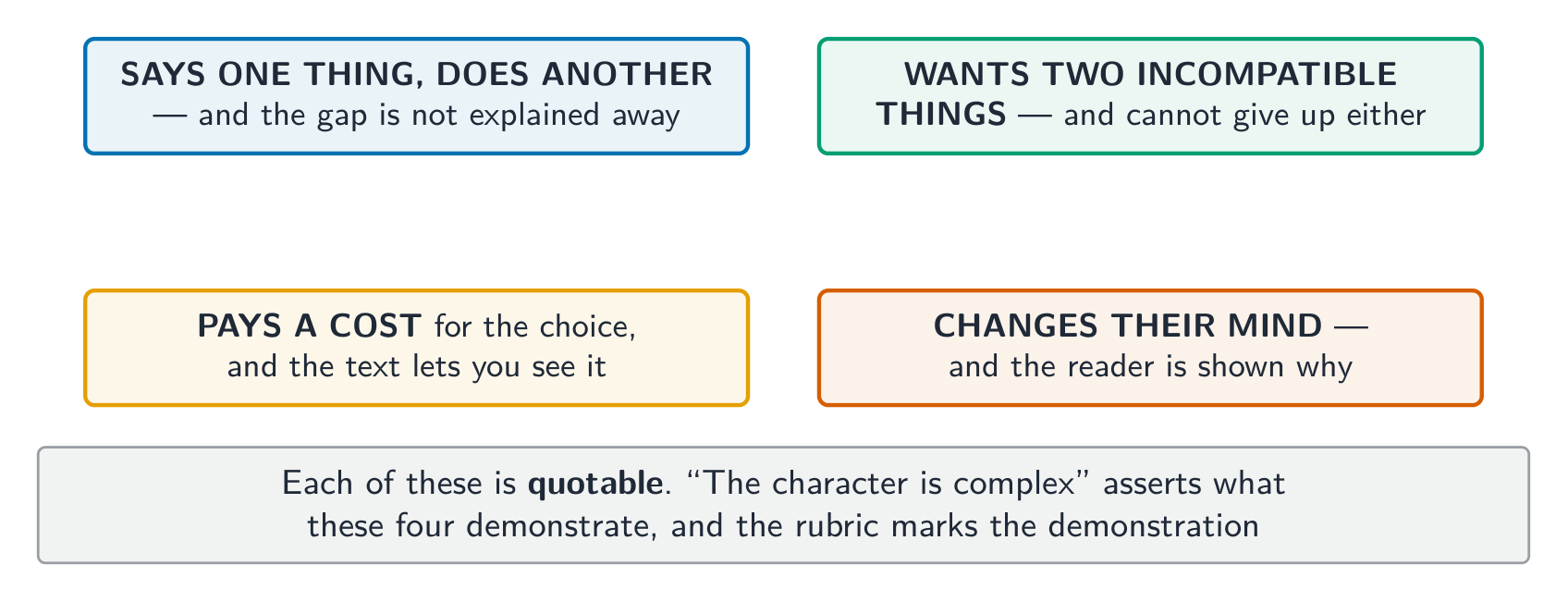
This is where AP Literature parts company with simpler reading. Inconsistency is not a flaw in a character; it is the evidence that the character has an interior. A character who always acts on what they think is a position, not a person.

日本語
  • キャラクターの私的な思考と実際の行動との間の不一致は、緊張感を明らかにする。
  • キャラクターの競合する、対立する、あるいは一貫性のない選択は、複雑さに寄与する。

ここから APリテラチュアは単純な読解とは道半ばに分かれる。一貫性のない行為はキャラクターの欠陥ではない。むしろ、そのキャラクターに内面があることの証拠である。常に自分の考えに基づいて行動する人物ではなく、一人の「人」である。

引用可能なパターン4つ - ルブリックは断言ではなく実証を評価する
Explore · ⁨探索⁩

Find the quotable sign of complexity

The rubric marks the demonstration, not the assertion — and each of these is something you can quote.

6.4

How Plot Orders Events · ⁨物語の順序付け方⁩

Syllabus · ⁨シラバス⁩
English

Enduring Understanding (STR-1): The arrangement of the parts and sections of a text, the relationship of the parts to each other, and the sequence in which the text reveals information are all structural choices made by a writer that contribute to the reader’s interpretation of a text.

Learning Objective 3.A: Identify and describe how plot orders events in a narrative.

  • STR-1.X Some narrative structures interrupt the chronology of a plot; such structures include flashback, foreshadowing, in medias res, and stream of consciousness.
日本語

永続的理解 (STR-1): テキストの構成部分とセクションの配置、各部分同士の関係、そしてテキストが情報を開示する順序は、すべて作家による構造的選択であり、これらは読者によるテキストの解釈に寄与する。

学習目標 3.A: プロットが物語における出来事をどのように並べ替えているかを特定・記述する。

  • STR-1.X 物語構造の中にはプロットの時系列を中断するものがあり、ypes as 回想、予感、in medias res、stream of consciousness が含まれる。

Source: College Board AP Course and Exam Description · ⁨出典: College Board AP コースおよび試験説明書⁩

English

Some narrative structures interrupt the chronology of a plot: flashback 倒叙, foreshadowing 伏笔, and in medias res 从中间开始.

日本語

一部の物語構造はプロットの時間順序を中断する:フラッシュバック(倒叙)、フーシャドーディング(伏笔)、およびイン・メディアス・レス(从中间开始)。

6.5

The Function of a Sequence of Events · ⁨出来事の連なりとしての機能⁩

Syllabus · ⁨シラバス⁩
English

Enduring Understanding (STR-1): The arrangement of the parts and sections of a text, the relationship of the parts to each other, and the sequence in which the text reveals information are all structural choices made by a writer that contribute to the reader’s interpretation of a text.

Learning Objective 3.B: Explain the function of a particular sequence of events in a plot.

  • STR-1.Y Narrative structures that interrupt the chronology of a plot, such as flashback, foreshadowing, in medias res, and stream of consciousness, can directly affect readers’ experiences with a text by creating anticipation or suspense or building tension.
日本語

永続的理解 (STR-1): テキストの構成部分とセクションの配置、各部分同士の関係、そしてテキストが情報を開示する順序は、すべて作家による構造的選択であり、これらは読者によるテキストの解釈に寄与する。

学習目標 3.B: プロットにおける特定の出来事の連続の機能について説明する。

  • STR-1.Y 回想、予感、in medias res、stream of consciousness など、プロットの時系列を中断する物語構造は、期待や懸念を生み出したり、緊張感を高めたりすることで、読者のテキスト体験に直接影響を与えることができる。

Source: College Board AP Course and Exam Description · ⁨出典: College Board AP コースおよび試験説明書⁩

English

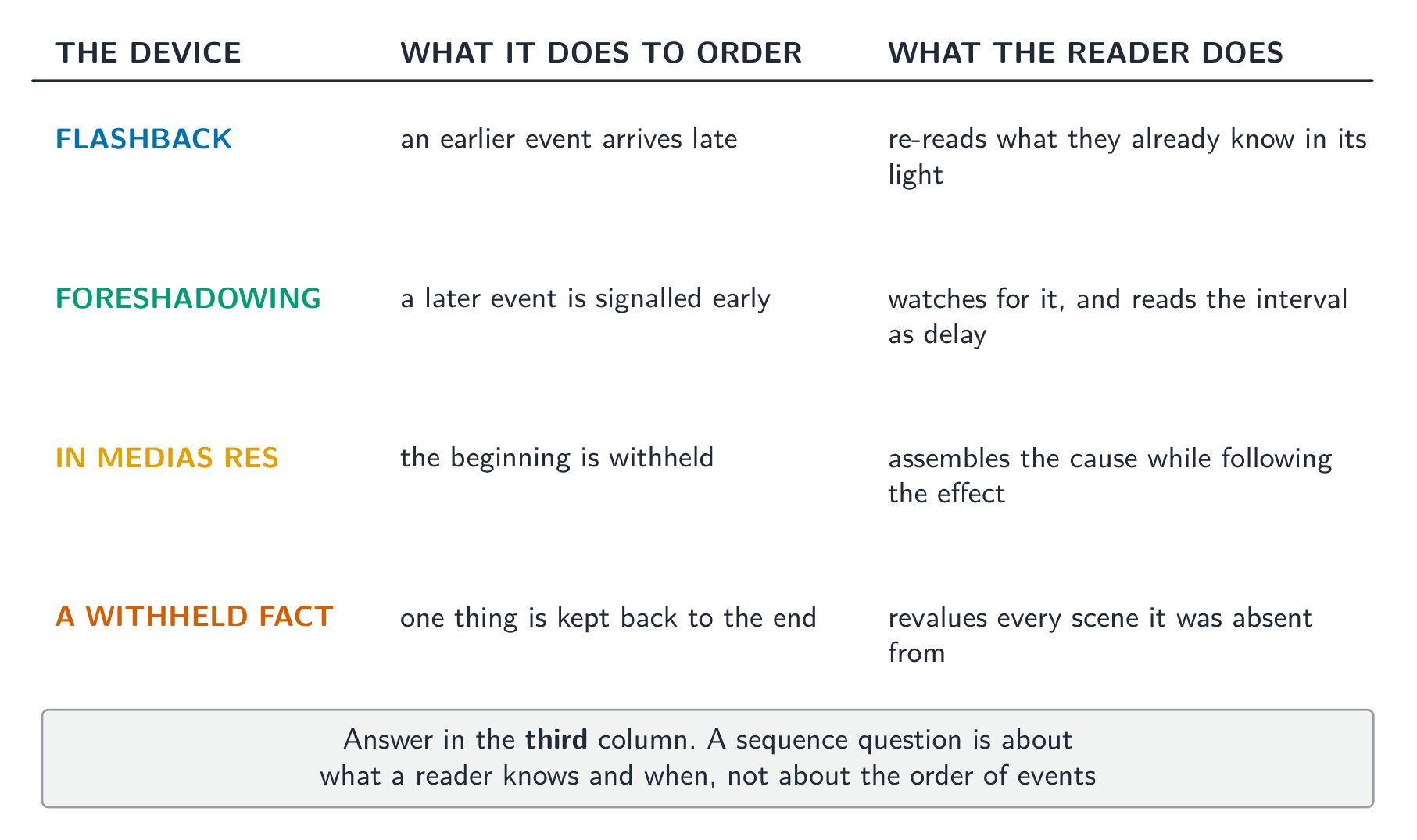
Those interrupting structures affect the reader's experience of the narrative - what is known when, and therefore what is felt when.

The analytical move is always to ask what the reader knows at that moment. Foreshadowing gives the reader knowledge the characters lack, which converts suspense into dread. A flashback withholds until a later point, so the earlier scenes are read twice - once in ignorance and once in retrospect.

日本語

これらの中断構造は、物語の読者の体験に影響を与える——何がいつ分かったか、したがって何がいつ感じられたかである。

分析の手順は常に「その瞬間に読者が何を知っているか」を問うことにあり、 foreshadowing(先取り)は読者に登場人物にはない知識を与えることで、サスペンスを恐怖に変換する。 flashback(回想)は後ほど明かされるため、以前のシーンが二回読み解かれる——一度は無知のまま、もう一度は回顧的に。

Answer in the third column: what a reader knows, and when
Explore · ⁨探索⁩

Match each device to what the reader then does

A sequence question is about what a reader knows and when, not about the order of events.

Vocabulary · ⁨語彙⁩ Train · ⁨練習する⁩
English 日本語
flashback/ˈflæʃbæk/ フラッシュバック
foreshadowing/fɔːˈʃædəʊɪŋ/ in medias res
in medias res/ɪn ˈmiːdiːəz rez/ in medias res(物語の中間から始める手法)
6.6

The Function of Contrasts Within a Text

Syllabus · ⁨シラバス⁩
English

Enduring Understanding (STR-1): The arrangement of the parts and sections of a text, the relationship of the parts to each other, and the sequence in which the text reveals information are all structural choices made by a writer that contribute to the reader’s interpretation of a text.

Learning Objective 3.D: Explain the function of contrasts within a text.

  • STR-1.Z Contrasts often represent contradictions or inconsistencies that introduce nuance, ambiguity, or contradiction into a text. As a result, contrasts make texts more complex.
日本語

永続的理解 (STR-1): テキストの構成部分とセクションの配置、各部分同士の関係、そしてテキストが情報を開示する順序は、すべて作家による構造的選択であり、これらは読者によるテキストの解釈に寄与する。

学習目標 3.D: テキスト内の対比の機能を説明する。

  • STR-1.Z 対比はしばしば矛盾や不整合を表しており、テキストにニュアンス、曖昧さ、または対立をもたらす。その結果、対比はテキストをより複雑にする。

Source: College Board AP Course and Exam Description · ⁨出典: College Board AP コースおよび試験説明書⁩

English

Contrasts often represent contradictions or inconsistencies that introduce nuance, ambiguity, or contradictory interpretations.

Note the last phrase. The CED explicitly permits a text to support more than one reading. An essay that acknowledges a competing interpretation and shows why its own is better is doing exactly what the sophistication point rewards.

日本語

対比はしばしば矛盾や不整合を表し、ニュアンス、曖昧さ、あるいは対立する解釈を導入する。

最後のフレーズに注目されたい。CED(評価基準)は明確に、1つのテキストが複数の読み方を支えうることを認めている。競合する解釈を認め、なぜ自身の解釈の方が優れているかを示すエッセイは、まさに洗練された点数的なポイントを獲得していることとなる。

6.7

Details, Diction, and Syntax Reveal Perspective · ⁨詳細、語彙、文法構造による視点の露出⁩

Syllabus · ⁨シラバス⁩
English

Enduring Understanding (NAR-1): A narrator’s or speaker’s perspective controls the details and emphases that affect how readers experience and interpret a text.

Learning Objective 4.C: Identify and describe details, diction, or syntax in a text that reveal a narrator’s or speaker’s perspective.

  • NAR-1.P The narrator’s or speaker’s tone toward events or characters in a text influences readers’ interpretation of the ideas associated with those things.
  • NAR-1.Q The syntactical arrangement of phrases and clauses in a sentence can emphasize details or ideas and convey a narrator’s or speaker’s tone.
  • NAR-1.R Information included and/or not included in a text conveys the perspective of characters, narrators, and/ or speakers.
  • NAR-1.S A narrator’s or speaker’s perspective may influence the details and amount of detail in a text and may reveal biases, motivations, or understandings.
日本語

永続的理解 (NAR-1): 叙述者または話者の視点は、読者がテキストを体験し解釈する方法に影響を与える细节と強調を統制する。

学習目標 4.C: 物語語り手や話者の視点を示すテキスト内の詳細、語彙、または文法構造を特定し説明する。

  • NAR-1.P テキスト内の出来事やキャラクターに対する語り手や話者のトーンは、読者がそれらに関連する理念を解釈する方法に影響を与える。
  • NAR-1.Q 文内のフレーズや節の構文的配列は、詳細や理念を強調し、語り手や話者のトーンを伝達できる。
  • NAR-1.R テキストに含まれる情報および含まれない情報は、キャラクター、語り手、および/または話者の視点 conveying する。
  • NAR-1.S 語り手または話者の視点は、テキストにおける詳細や情報の量に影響を与えることができ、偏見、動機、あるいは理解を明らかにすることがある。

Source: College Board AP Course and Exam Description · ⁨出典: College Board AP コースおよび試験説明書⁩

English
  • A narrator's or speaker's tone toward events or characters influences readers' interpretations.
  • The syntactical arrangement of phrases and clauses can emphasise details or ideas.
  • Information included and not included conveys the perspective of characters and narrators.
  • A narrator's perspective may influence the details and the amount of detail in a text.
日本語
  • 語り手や話者による出来事や登場人物への態度は、読者の解釈に影響を与える。
  • 句や節の構文上の配置は、詳細やアイデアを強調することがある。
  • 含まれる情報と含まれない情報の両方が、登場人物や語り手の視点 conveying 传递 viewpoint。
  • 語り手の視点は、テキストにおける詳細と、その詳細の量に影響を与えることがある。
6.8

How a Narrator's Reliability Affects a Narrative · ⁨語り手の信頼性が物語に与える影響⁩

Syllabus · ⁨シラバス⁩
English

Enduring Understanding (NAR-1): A narrator’s or speaker’s perspective controls the details and emphases that affect how readers experience and interpret a text.

Learning Objective 4.D: Explain how a narrator’s reliability affects a narrative.

  • NAR-1.T Readers can infer narrators’ biases by noting which details they choose to include in a narrative and which they choose to omit.
  • NAR-1.U Readers who detect bias in a narrator may find that narrator less reliable.
  • NAR-1.V The reliability of a narrator may influence a reader’s understanding of a character’s motives.
日本語

永続的理解 (NAR-1): 叙述者または話者の視点は、読者がテキストを体験し解釈する方法に影響を与える细节と強調を統制する。

学習目標 4.D: 語りの信頼性が物語に与える影響について説明する。

  • NAR-1.T 読者は、語り手が物語にどの詳細を含めることを選択し、どの詳細を省略することを選択したかに注目することで、語りの偏見を推測できる。
  • NAR-1.U 語り手の偏見を検知した読者は、その語り手をより信頼できないと考えることがある。
  • NAR-1.V 語りの信頼性は、読者がキャラクターの動機を理解する方法に影響を与えることができる。

Source: College Board AP Course and Exam Description · ⁨出典: College Board AP コースおよび試験説明書⁩

English
  • Readers can infer narrators' biases by noting which details they choose to include and which they omit.
  • Readers who detect bias in a narrator may find that narrator less reliable.
  • The reliability of a narrator may influence a reader's understanding of a character's motives.

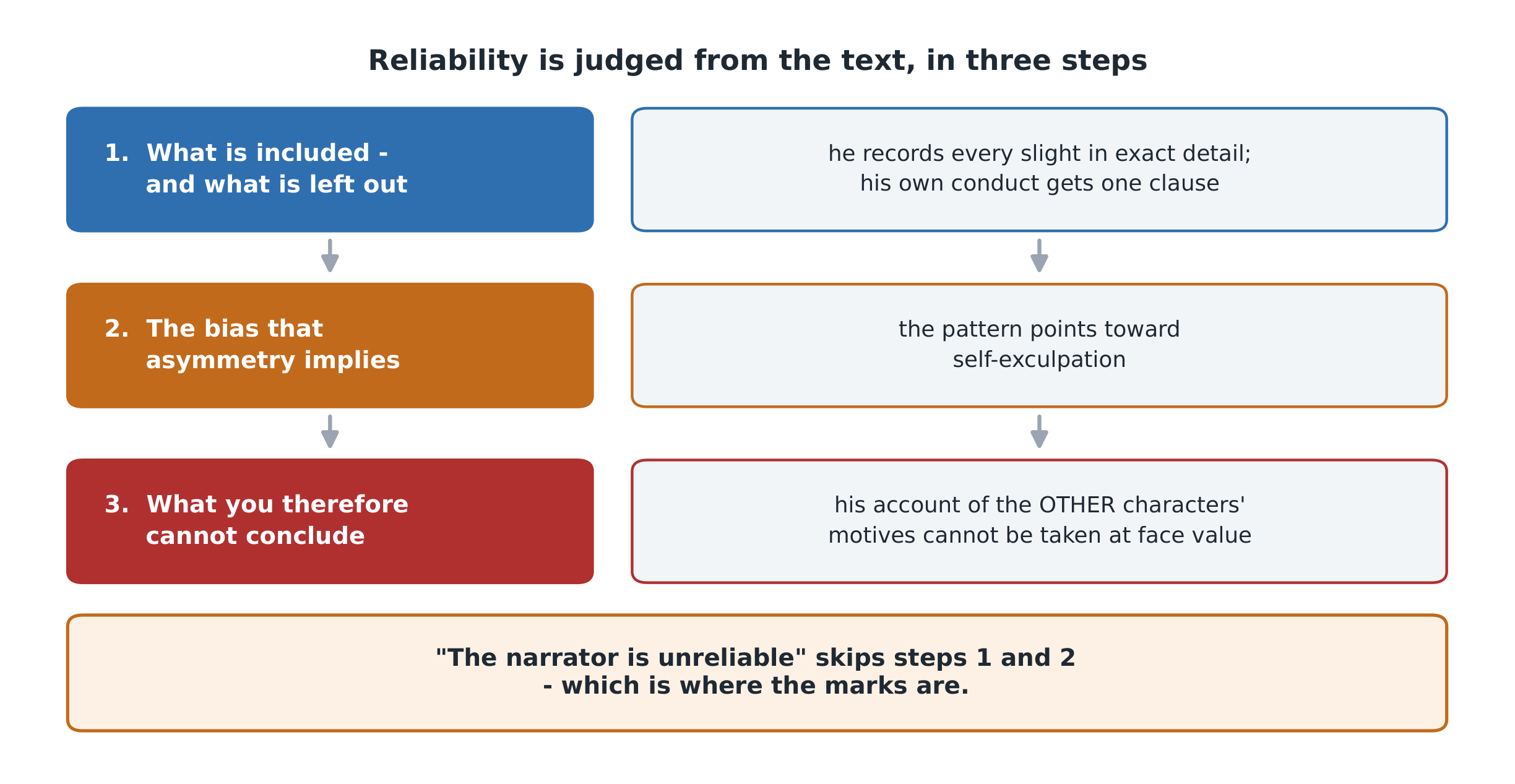
The CED gives this as a chain, and reproducing the chain is what makes an answer analytical rather than impressionistic. You do not assert that a narrator is unreliable; you show the pattern of inclusion and omission, name the bias it implies, and then say what that bias prevents you from concluding.

日本語
信頼性の判断方法 - それは感情ではなくテキストから判断される
偏見は、含まれるものと省略されるものから推測される。検出された偏見は信頼性を低下させる。信頼性の低下は、動機について導き出せる結論を変化させる
  • 読者は、語りがどの詳細を選択的に含み、どの詳細を省略するかに注意することで、語りの偏見を推測できる。
  • 語り手に偏見を見つけた読者は、その語り手をより信頼できないと考えるかもしれない。
  • 語り手の信頼性は、読者がキャラクターの動機を理解する方法に影響を与えることがあります。

CEDはこの関係を連鎖として提示しており、この連鎖を再現することが、答案を印象的なものから分析的なものにする理由である。あなたは「語り手が信頼できない」と単に主張するのではなく、包含と省略のパターンを示し、それが暗示する偏見を名指し、そしてその偏見によってあなたが何を結論づけられなくなるかを述べるべきである。

6.9

The Function of a Symbol · ⁨象徴の機能⁩

Syllabus · ⁨シラバス⁩
English

Enduring Understanding (FIG-1): Comparisons, representations, and associations shift meaning from the literal to the figurative and invite readers to interpret a text.

Learning Objective 5.C: Identify and explain the function of a symbol.

  • FIG-1.AA When a character comes to represent, or stand for, an idea or concept, that character becomes symbolic; some symbolic characters have become so common they are archetypal. Note: The AP Exam will not require students to identify or label archetypes.
  • FIG-1.X When a material object comes to represent, or stand for, an idea or concept, it becomes a symbol.
  • FIG-1.Y A symbol is an object that represents a meaning, so it is said to be symbolic or representative of that meaning. A symbol can represent different things depending on the experiences of a reader or the context of its use in a text.
  • FIG-1.Z Certain symbols are so common and recurrent that many readers have associations with them prior to reading a text. Other symbols are more contextualized and only come to represent certain things through their use in a particular text.
日本語

持続的理解(FIG-1): 比較、表現、連想は意味を字義から比喩へと移行させ、読者にテキストの解釈を促す。

学習目標 5.C: 象徴の機能を特定して説明する。

  • FIG-1.AA キャラクターが特定のアイデアや概念を象徴したり、代弁したりするようになると、そのキャラクターは象徴的となります。一部の象徴的なキャラクターはあまりにも一般的になり、原型となっています。なお、AP試験では原型の特定や名付けを要求しない。
  • FIG-1.X 具体的な物体が特定のアイデアや概念を象徴したり、代弁したりするようになると、それは象徴となる。
  • FIG-1.Y 象徴とは意味を表す物体であり、そのためその意味を象徴的または代表的であるとされる。象徴は、読者の経験やテキスト内での使用状況に応じて、異なるものを表すことがある。
  • FIG-1.Z 特定の象徴はあまりにも一般的で反復的に現れるため、多くの読者はテキストを読む前にそれらに関連性を持つ。他の象徴は文脈依存性が高く、特定のテキスト内での使用を通じてのみ特定のものを表すようになる。

Source: College Board AP Course and Exam Description · ⁨出典: College Board AP コースおよび試験説明書⁩

English
  • When a material object comes to represent an idea or concept, it becomes a symbol 象征.
  • When a character comes to represent an idea, that character becomes symbolic.
  • A symbol is an object that represents a meaning, so it is said to be symbolic or representative of that meaning.
  • Certain symbols are so common and recurrent that readers bring associations to them before reading.

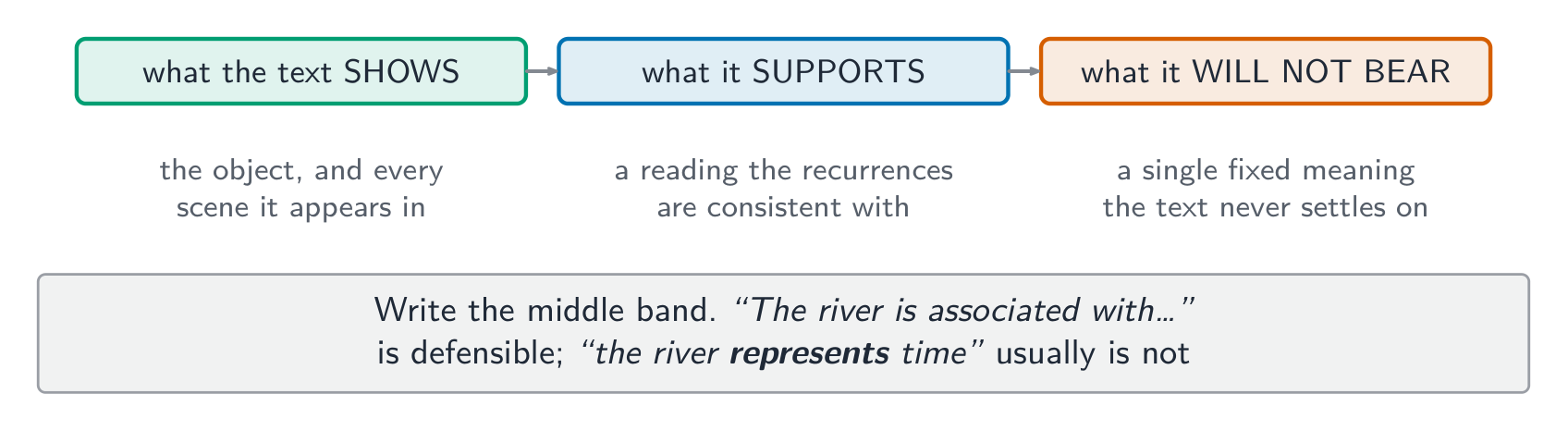
The last point is a warning. A conventional symbol arrives with meanings attached, and the text may be using them, refusing them, or inverting them. Check what the text does before importing the convention.

日本語
  • 具体的な物体がアイデアや概念を表すようになる時、それは象徴となる。
  • 登場人物がアイデアを表すようになる時、その登場人物は象徴的となる。
  • 象徴とは意味を表す物体であり、したがってその意味に対して象徴的または代表的であるとされる。
  • 特定の象徴は非常に一般的で反復的に出現するため、読者は読む前にそれらに関連付けられる連想を持って入ってくる。

最後のポイントは警告である。慣用的な象徴はすでに意味が紐付けられており、テキストはそれを使用したり、拒絶したり、逆転させたりする可能性がある。慣用法を持ち込む前に、テキストが実際にどうしているかを確認されたい。

中央の帯を記入されたい - 'related to' は 'represents' が適さない場合に正当化される
Vocabulary · ⁨語彙⁩ Train · ⁨練習する⁩
English 日本語
symbol/ˈsɪmbl/ 象徴
6.10 6.11 6.12

Developing a Literary Thesis, Commentary, and Evidence · ⁨文学的 Thesis の発展、解説、および根拠⁩

Syllabus · ⁨シラバス⁩
English

Enduring Understanding (LAN-1): Readers establish and communicate their interpretations of literature through arguments supported by textual evidence.

Learning Objective 7.B: Develop a thesis statement that conveys a defensible claim about an interpretation of literature and that may establish a line of reasoning.

  • LAN-1.D A thesis statement expresses an interpretation of a literary text, and requires a defense, through use of textual evidence and a line of reasoning, both of which are explained in an essay through commentary.
  • LAN-1.E A thesis statement may preview the development or line of reasoning of an interpretation. This is not to say that a thesis statement must list the points of an interpretation, literary elements to be analyzed, or specific evidence to be used in the argument.
日本語

持続的理解(LAN-1): 読者は、テキストの証拠で裏付けられた議論を通じて、文学作品の解釈を確立し伝達する。

学習目標 7.B: 文学の解釈に対する正当な主張を伝え、かつ論理の道筋を確立する可能性のあるテーゼステートメントを作成する。

  • LAN-1.D テーゼ文は文学作品の解釈を表し、エッセイの中で解説によって説明文と推論の系によって守られる必要がある。
  • LAN-1.E テーゼステートメントは、解釈の展開や論理の道筋を予見することがあります。これは、テーゼステートメントが解釈のポイント、分析されるべき文学的要素、または議論で用いられる具体的な証拠をリストアップしなければならないという意味ではありません。
English

Enduring Understanding (LAN-1): Readers establish and communicate their interpretations of literature through arguments supported by textual evidence.

Learning Objective 7.C: Develop commentary that establishes and explains relationships among textual evidence, the line of reasoning, and the thesis.

  • LAN-1.F A line of reasoning is the logical sequence of claims that work together to defend the overarching thesis statement.
  • LAN-1.G A line of reasoning is communicated through commentary that explains the logical relationship between the overarching thesis statement and the claims/evidence within the body of an essay.
日本語

持続的理解(LAN-1): 読者は、テキストの証拠で裏付けられた議論を通じて、文学作品の解釈を確立し伝達する。

学習目標 7.C: テキストの証拠、論理の道筋、およびテーゼとの間の関係を確立して説明する解説を作成する。

  • LAN-1.F 論理の道筋とは、包括的なテーゼステートメントを防御するために協力して機能する主張の論理的な順序です。
  • LAN-1.G 論理の道筋は、包括的なテーゼステートメントとエッセイの本文に含まれる主張/証拠との間の論理的関係を説明する解説を通じて伝達されます。
English

Enduring Understanding (LAN-1): Readers establish and communicate their interpretations of literature through arguments supported by textual evidence.

Learning Objective 7.D: Select and use relevant and sufficient evidence to both develop and support a line of reasoning.

  • LAN-1.H Writers use evidence strategically and purposefully to illustrate, clarify, exemplify, associate, amplify, or qualify a point.
  • LAN-1.I Evidence is effective when the writer of the essay uses commentary to explain a logical relationship between the evidence and the claim.
  • LAN-1.J Evidence is sufficient when its quantity and quality provide apt support for the line of reasoning.
  • LAN-1.K Developing and supporting an interpretation of a text is a recursive process; an interpretation can emerge from analyzing evidence and then forming a line of reasoning, or the interpretation can emerge from forming a line of reasoning and then identifying relevant evidence to support that line of reasoning.
日本語

持続的理解(LAN-1): 読者は、テキストの証拠で裏付けられた議論を通じて、文学作品の解釈を確立し伝達する。

学習目標 7.D: 論理の道筋を展開し支援するために、関連して十分十分な証拠を選定して使用する。

  • LAN-1.H 作家は、点を示し、明瞭にし、例示し、関連付け、拡大し、または限定するために、戦略的かつ意図的に証拠を使用します。
  • LAN-1.I エッセイの著者が解説を用いて証拠と主張との間の論理的関係を説明する場合、証拠は効果的です。
  • LAN-1.J 証拠の量と質が論理の道筋に対して適切な支援を提供する場合、それは十分です。
  • LAN-1.K テキストの解釈を展開し支援することは反復的プロセスです。解釈は、証拠を分析してから論理の道筋を形成することから生まれる也可能れば、論理の道筋を形成してからそれを支持するための関連する証拠を特定することから生まれることもあります。

Source: College Board AP Course and Exam Description · ⁨出典: College Board AP コースおよび試験説明書⁩

English

Unchanged from Units 3-5: an interpretation requiring textual defence; a line of reasoning of claims communicated through commentary; evidence used strategically, effective with commentary, sufficient in quantity and quality, developed recursively.

日本語

ユニット3〜5と同様:テキストによる防衛を要する解釈;解説を通じて伝達される主張の論理の道筋;戦略的に使用され、解説と相まって効果的であり、量と質において十分であり、再帰的に展開される根拠。

6.13

Control Over the Elements of Composition · ⁨作文要素への統制⁩

Syllabus · ⁨シラバス⁩
English

Enduring Understanding (LAN-1): Readers establish and communicate their interpretations of literature through arguments supported by textual evidence.

Learning Objective 7.E: Demonstrate control over the elements of composition to communicate clearly.

  • LAN-1.R Writers convey their ideas in a sentence through strategic selection and placement of phrases and clauses. Writers may use coordination to illustrate a balance or equality between ideas or subordination to illustrate an imbalance or inequality.
  • LAN-1.S Writers use words that enhance the clear communication of an interpretation.
  • LAN-1.T Punctuation conveys relationships between and among parts of a sentence.
日本語

持続的理解(LAN-1): 読者は、テキストの証拠で裏付けられた議論を通じて、文学作品の解釈を確立し伝達する。

学習目標 7.E: 構成要素を統制することで、明確にコミュニケーションを行うことを示す。

  • LAN-1.R 作家は、フレーズや節の戦略的な選択と配置を通じて、文の中で自らの考えを表現する。作家は、考え間のバランスや平等性を示すために並列法を使用したり、不均衡や不平等を示すために従属法を使用したりすることがある。
  • LAN-1.S 作家は、解釈の明確な伝達を高める言葉を使用する。
  • LAN-1.T 記号は、文の各部分間の関係を伝達する。

Source: College Board AP Course and Exam Description · ⁨出典: College Board AP コースおよび試験説明書⁩

English
  • Writers convey ideas through the strategic selection and placement of phrases and clauses.
  • Writers use words that enhance the clear communication of an interpretation.
  • Punctuation conveys relationships between parts of a sentence.

Worked example (a real AP exam task). A Question 3 literary-argument prompt asks how an unreliable narrator contributes to an interpretation of a work as a whole. A weak answer asserts: "The narrator is unreliable because he lies." A scoring answer runs the CED's chain: "The narrator records every slight he received in exact detail and summarises his own conduct in a clause - 'there was an argument, and I left'. The asymmetry of detail implies a bias toward self-exculpation, which means his account of the other characters' motives cannot be taken at face value. The novel therefore asks the reader to reconstruct a story the narrator is committed to not telling, and its subject is less the events than his need to arrange them." Inclusion and omission, the bias inferred, and what that bias prevents.

日本語
  • 作家は、フレーズや節の戦略的な選択と配置を通じてアイデアを伝える。
  • 作家は、解釈の明確な伝達を強化する言葉を使用する。
  • 句読点は、文の各部分間の関係性を伝える。

** worked example (実際のAP試験課題)。** Q3の文学的論証型問題では、「信頼性のない語り手が作品全体の解釈にどのように寄与しているか」を問う。弱い答えは次のように主張する:「語り手は嘘をついているので信頼できない。」 高得点の答えはCEDの連鎖を適用する:「語り手は受け取ったすべての些細な扱いを正確な詳細で記録しつつ、自身の行為については一節で要約している - '議論があり、私は去った'。詳細の非対称性は自己免責への偏見を暗示しており、これは他の登場人物の動機に関する彼の記述を素直に受け取ることはできないことを意味する。したがって、この小説は、語り手が語らないことに固執する物語を読者が再構築することを求めており、その主題は出来事そのものよりも、彼がそれらを構成しようとする必要にあるものである。」 包含と省略、推測される偏見、そしてその偏見によって結論づけられないこと。

6.13

Exam tips · ⁨試験対策⁩

English
  • Discrepancies between perspectives are the method, not a problem to reconcile.
  • A foil is similar enough for the difference to show. Ask what they have that the protagonist lacks.
  • Inconsistency is evidence of an interior. A perfectly consistent character is a position, not a person.
  • For any structural interruption, ask what the reader knows at that moment. That is the effect.
  • Reliability is a chain: inclusion and omission, then bias, then what you cannot conclude. Show all three.
  • With a conventional symbol, check whether the text uses, refuses, or inverts the association before importing it.
日本語
  • 視点の不一致は解決すべき問題ではなく、手法そのものである。
  • 対照的キャラクターは、違いが際立つほど似ている必要がある。彼らが主人公に欠いているものを問われたい。
  • 一貫性のないところは内面の証拠である。完璧に一貫した登場人物は、立場であり、人ではない。
  • どのような構造上の中断に対しても、その瞬間に読者が何を知っているかを問われたい。それが効果である。
  • 信頼性は連鎖である:包含と省略、次に偏見、最後にあなたが結論づけられないこと。これらすべてを示されたい。
  • 慣用的な象徴の場合、それを採用する前に、テキストが関連付けを使用し、拒絶しているか、あるいは逆転させているかを確認されたい。

Interactive lessons on this topic · ⁨このトピックのインタラクティブ授業⁩

Work through it step by step, with instant-check exercises. · ⁨一歩ずつ進め、即時チェック付きの問題で学習します。⁩

Past Papers · ⁨過去問⁩

More topics in AP English Literature and Composition · ⁨AP 英語文学と作文⁩ · ⁨AP English Literature and Composition · ⁨AP 英語文学と作文⁩ の他のトピック⁩

Log in or create account · ⁨ログインまたはアカウント作成⁩

IGCSE, A-Level & AP