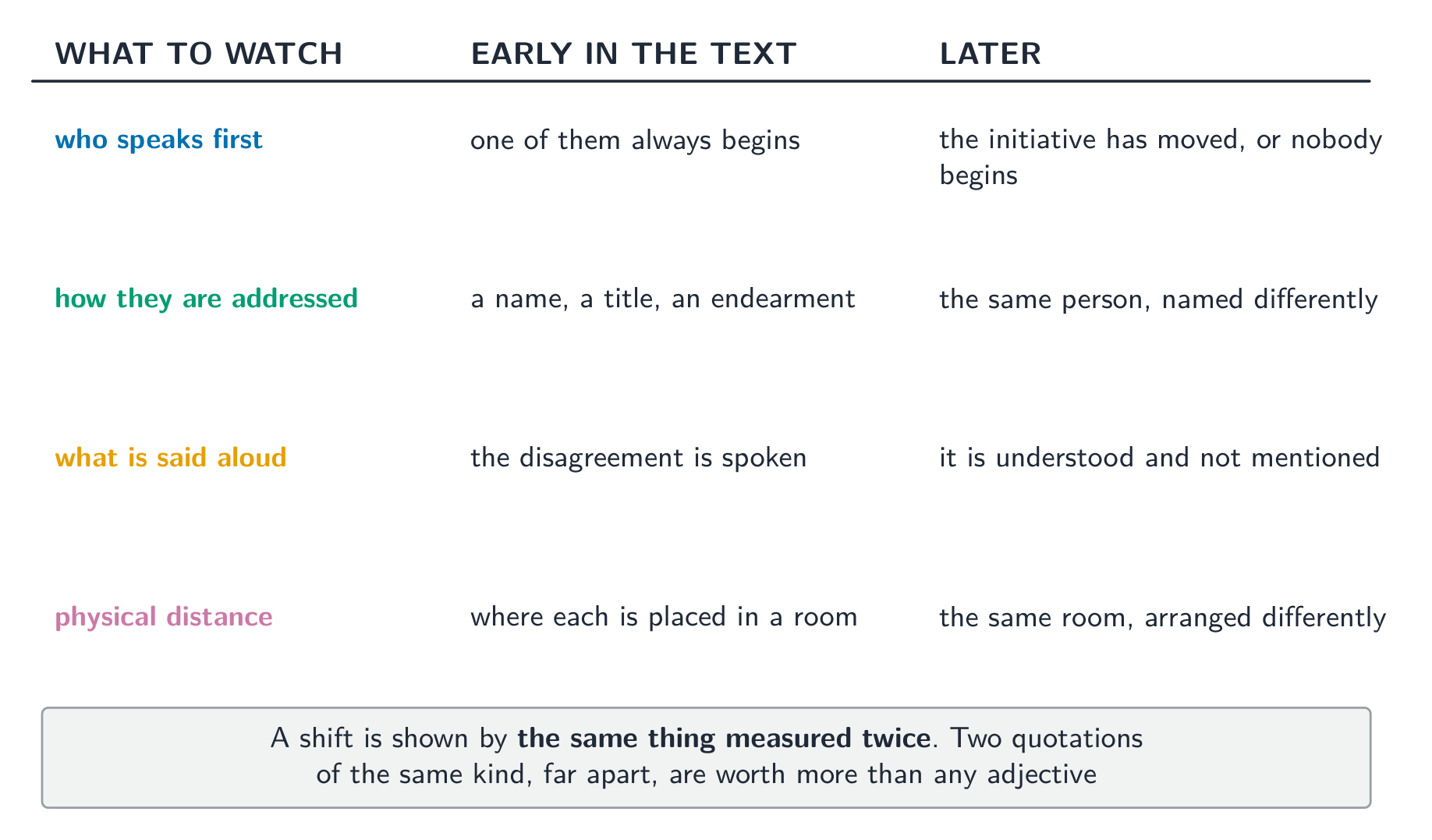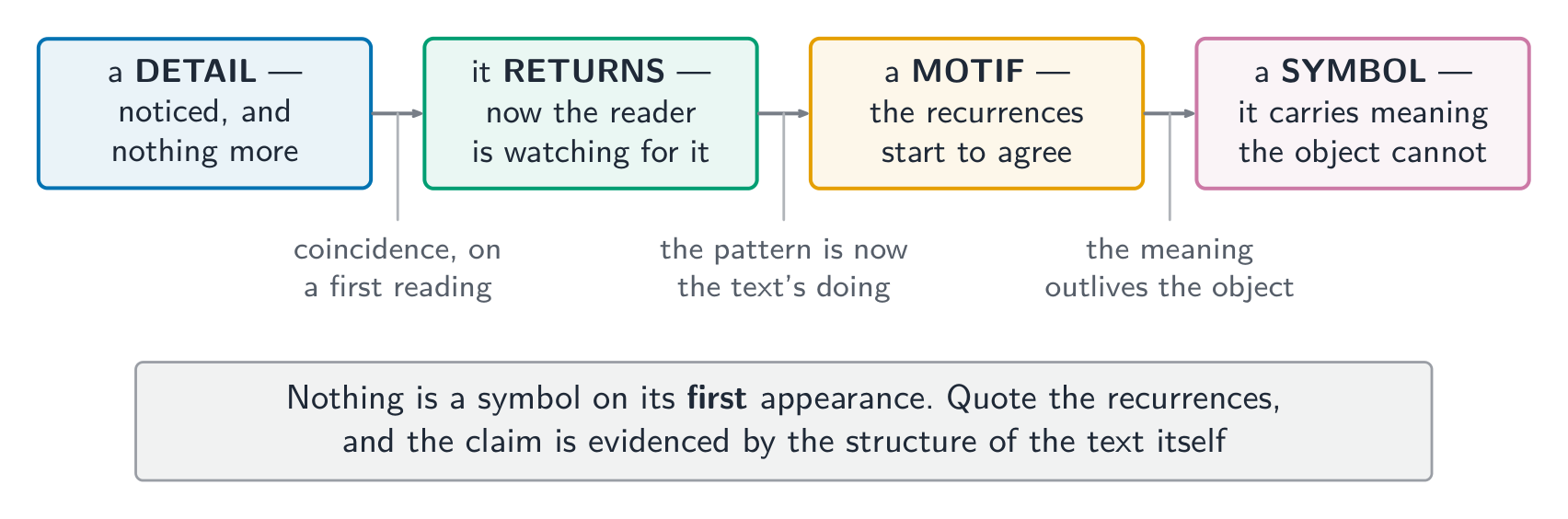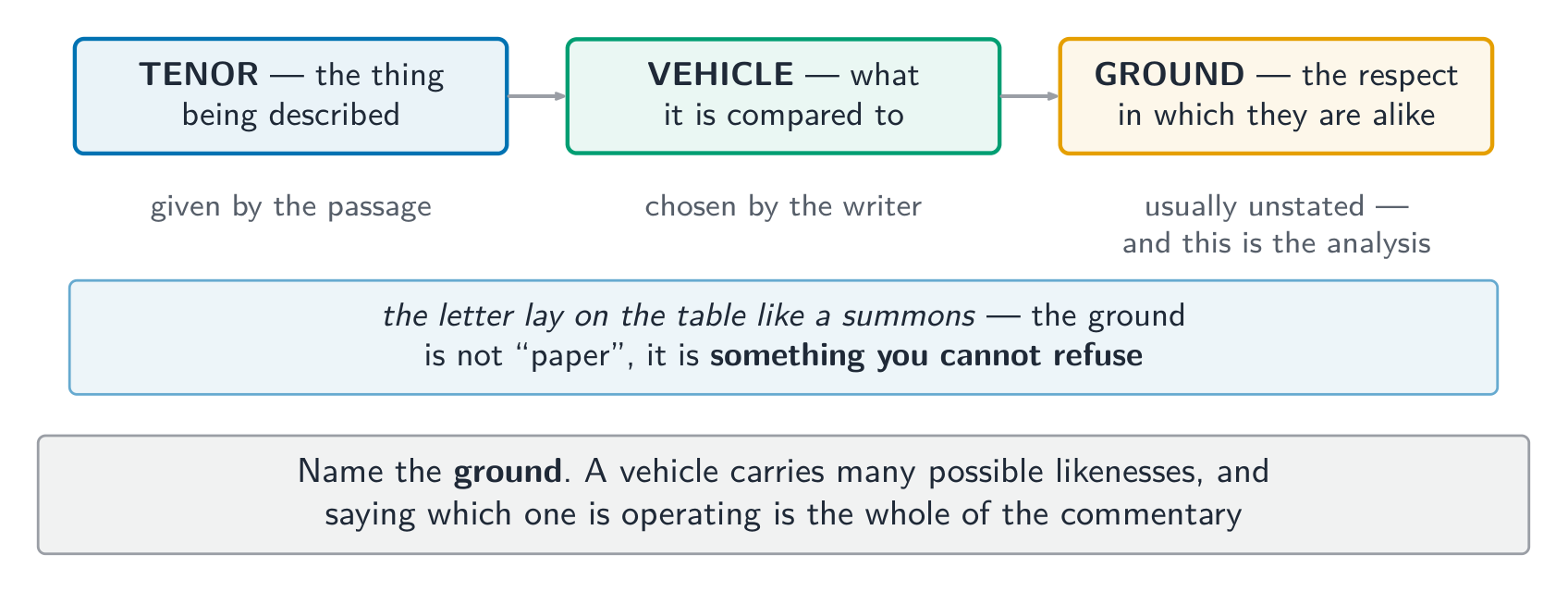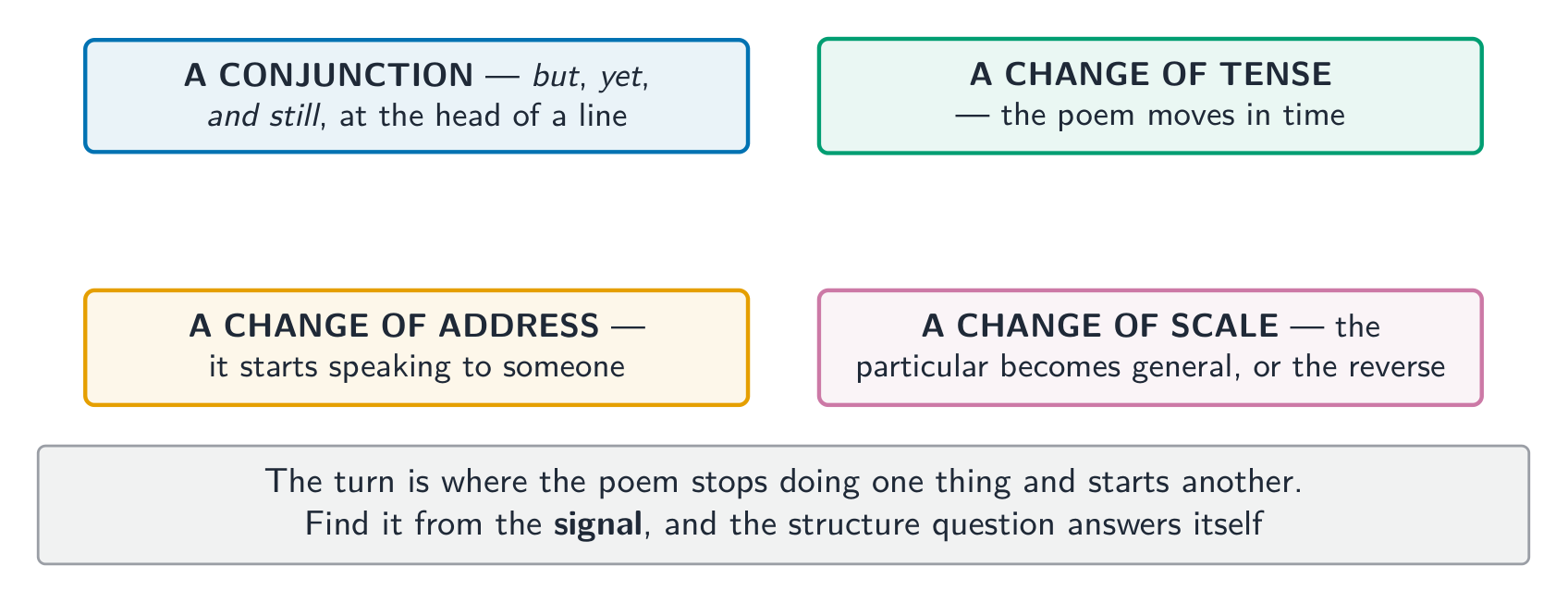
Skip to content · ⁨コンテンツへスキップ⁩
Subjects · ⁨科目⁩

AP English Literature and Composition · ⁨AP 英語文学と作文⁩

Tips · ⁨ヒント⁩

AP英語文学と構成は、3つのテキストタイプ(それぞれ3回ずつ扱う)において精読と文学的論証を教授する:短編小説、詩、および長編小説または戯曲。単元は螺旋状に展開するため、同じ技能がより深いレベルで再出現する。

コースは文芸要素に基づいて組織されている: キャラクター、舞台設定、構造、叙述、比喩表現、そして文学的論証。各要素には独自の技能があり、どの要素も根本的な問いを同一に投げかける——この選択がテキスト内で何をするか?

「機能(function of)」というフレーズに注目すること。 フレームワークは記号や対比、叙述の変化などの「機能」を繰り返し問う。技法を特定することは第一歩であり、それが果たす役割を説明することが正解である。

解釈は個人的な感情だけでなく、防御可能でなければならない。 テキストの詳細によって裏付けられ、推論を通じて発展された読み解き才是が点数を得られるため、文学的論証はすべての要素に沿って必要となる。

以下のメモはCollege Boardが指定する順序通り9つの単元に沿っており、短編小説、詩、長編作品がコースと同じように交互に配置されている。

  • 1

    Short Fiction I · ⁨短編小説 I⁩

    Watch lesson · ⁨レッスンを視聴⁩
    1.1

    What Textual Details Reveal About a Character

    Syllabus · ⁨シラバス⁩
    English

    Enduring Understanding (CHR-1): Characters in literature allow readers to study and explore a range of values, beliefs, assumptions, biases, and cultural norms represented by those characters.

    Learning Objective 1.A: Identify and describe what specific textual details reveal about a character, that character’s perspective, and that character’s motives.

    • CHR-1.A Description, dialogue, and behavior reveal characters to readers.
    • CHR-1.B Descriptions of characters may come from a speaker, narrator, other characters, or the characters themselves.
    • CHR-1.C Perspective is how narrators, characters, or speakers understand their circumstances, and is informed by background, personality traits, biases, and relationships.
    • CHR-1.D A character’s perspective is both shaped and revealed by relationships with other characters, the environment, the events of the plot, and the ideas expressed in the text.
    日本語

    永続的理解 (CHR-1): 文学作品中の登場人物は、その人物が表す多様な価値観、信念、前提、偏見、文化的規範について、読者が研究・探求するための手段となる。

    学習目標 1.A: 特定の文本的细节が、登場人物、その人物の視点、およびその人物の動機について何を明らかにしているかを特定・記述する。

    • CHR-1.A 描写、対話、行動は、登場人物を読者に提示する。
    • CHR-1.B 登場人物の描写は、話者、叙述者、他の登場人物、あるいは登場人物自身によって行われることがある。
    • CHR-1.C 視点は、叙述者、登場人物、または話者が自身の状況を理解する方法であり、背景、性格的特徴、偏見、および関係性によって形成される。
    • CHR-1.D 登場人物の視点は、他の登場人物との関係、環境、プロットにおける出来事、およびテキストに表現された思想によって形作られ、同時にそれらによって反映される。
    Source: College Board AP Course and Exam Description · ⁨出典: College Board AP コースおよび試験説明書⁩

    English

    AP English Literature reads texts in three genres across nine units - short fiction, poetry, and longer fiction or drama, each visited three times at increasing difficulty. Unit 1 installs the tools for all of them.

    Character 人物 is revealed by three things, and the CED names them exactly:

    • Description, dialogue, and behaviour 描写、对话与行为 reveal characters to readers.
    • Descriptions may come from a speaker, narrator, other characters, or the characters themselves - so who is describing is part of the evidence.
    • Perspective 视角 is how narrators, characters, or speakers understand their circumstances, informed by background, experience, and values.
    • A character's perspective is both shaped and revealed by relationships with other characters, the environment, and events.

    That last point is the one that turns character notes into analysis. A character is not a list of adjectives; a character is a way of seeing, which becomes visible in what they notice, what they misread, and how they respond.

    日本語

    AP English Literature reads texts in three genres across nine units - short fiction, poetry, and longer fiction or drama, each visited three times at increasing difficulty. Unit 1 installs the tools for all of them.

    Character 人物 is revealed by three things, and the CED names them exactly:

    • Description, dialogue, and behaviour 描写、对话与行为 reveal characters to readers.
    • Descriptions may come from a speaker, narrator, other characters, or the characters themselves - so who is describing is part of the evidence.
    • Perspective 视角 is how narrators, characters, or speakers understand their circumstances, informed by background, experience, and values.
    • A character's perspective is both shaped and revealed by relationships with other characters, the environment, and events.

    That last point is the one that turns character notes into analysis. A character is not a list of adjectives; a character is a way of seeing, which becomes visible in what they notice, what they misread, and how they respond.

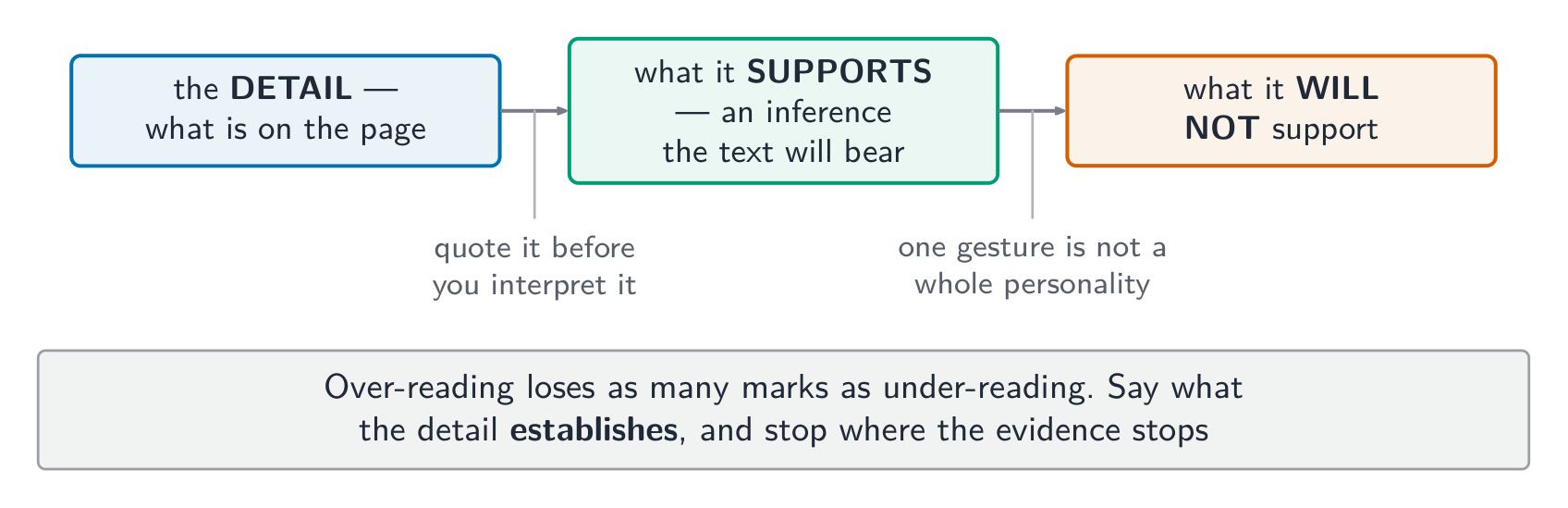
    Say what the detail establishes, and stop where the evidence stops
    Explore · ⁨探索⁩

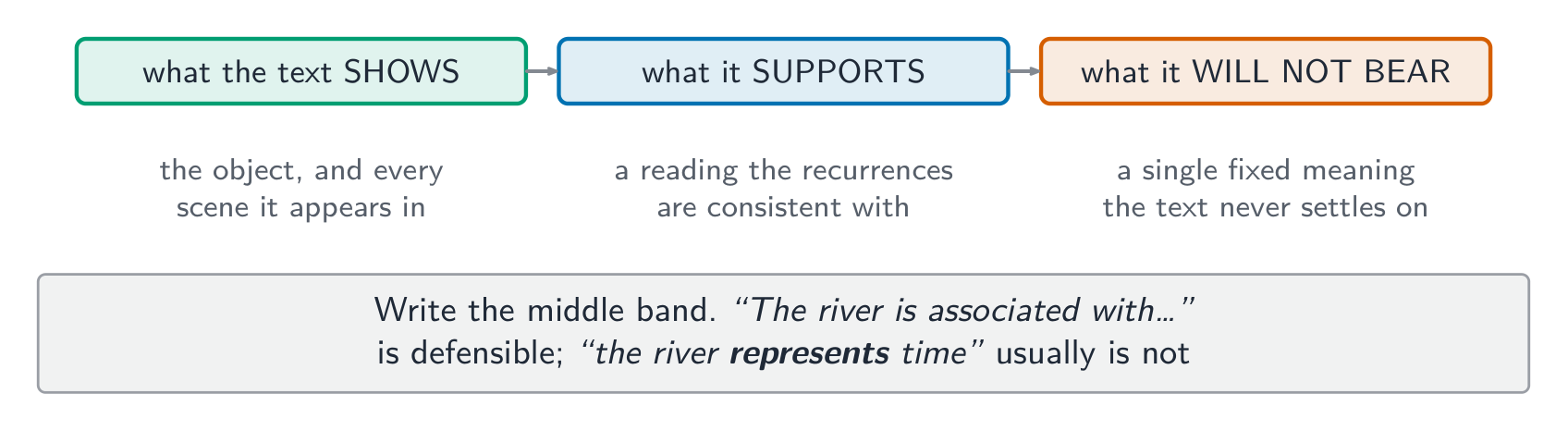
    Take a detail exactly as far as it goes · ⁨細部をそれが許す範囲まで正確に扱う⁩

    Over-reading loses as many marks as under-reading: say what the detail establishes, and stop where the evidence stops. · ⁨過度な解釈も不足した解釈も同様に点数を失う: 細部が何を証明するかを述べ、証拠が止まる所で終わる。⁩

    Vocabulary · ⁨語彙⁩ Train · ⁨練習する⁩
    English 日本語
    Character/ˈkærɪktə/ キャラクター
    Description, dialogue, and behaviour/dɪˈskrɪpʃn ˈdaɪəlɒɡ ænd bɪˈheɪvjə/ 説明、対話、および行動
    Perspective/pəˈspektɪv/ 視点
    1.2

    Textual Details That Convey Setting

    Syllabus · ⁨シラバス⁩
    English

    Enduring Understanding (SET-1): Setting and the details associated with it not only depict a time and place, but also convey values associated with that setting.

    Learning Objective 2.A: Identify and describe specific textual details that convey or reveal a setting.

    • SET-1.A Setting includes the time and place during which the events of the text occur.
    日本語

    永続的理解 (SET-1): 舞台設定とそれに付随する细节は、単に時代と場所を描くだけでなく、その舞台設定に関連する価値観も伝える。

    学習目標 2.A: 舞台設定を伝達または開示する具体的な文本的细节を特定・記述する。

    • SET-1.A 舞台設定とは、テキストの出来事が起こる時期と場所を含む。

    Source: College Board AP Course and Exam Description · ⁨出典: College Board AP コースおよび試験説明書⁩

    English

    Setting 背景 includes the time and place during which the events of the text occur.

    The CED's definition is deliberately minimal, and that is the trap. Setting earns marks not when it is described but when it is shown doing something - constraining a character, explaining a value, or contrasting with an interior state. A paragraph that establishes where a story happens has not yet made a claim.

    日本語

    Setting 背景 includes the time and place during which the events of the text occur.

    The CED's definition is deliberately minimal, and that is the trap. Setting earns marks not when it is described but when it is shown doing something - constraining a character, explaining a value, or contrasting with an interior state. A paragraph that establishes where a story happens has not yet made a claim.

    Vocabulary · ⁨語彙⁩ Train · ⁨練習する⁩
    English 日本語
    Setting/ˈsetɪŋ/ 舞台設定
    1.3

    How Plot Orders Events

    Syllabus · ⁨シラバス⁩
    English

    Enduring Understanding (STR-1): The arrangement of the parts and sections of a text, the relationship of the parts to each other, and the sequence in which the text reveals information are all structural choices made by a writer that contribute to the reader’s interpretation of a text.

    Learning Objective 3.A: Identify and describe how plot orders events in a narrative.

    • STR-1.A Plot is the sequence of events in a narrative; events throughout a narrative are connected, with each event building on the others, often with a cause-and-effect relationship.
    • STR-1.B The dramatic situation of a narrative includes the setting and action of the plot and how that narrative develops to place characters in conflict(s), and often involves the rising or falling fortunes of a main character or set of characters.
    日本語

    永続的理解 (STR-1): テキストの構成部分とセクションの配置、各部分同士の関係、そしてテキストが情報を開示する順序は、すべて作家による構造的選択であり、これらは読者によるテキストの解釈に寄与する。

    学習目標 3.A: プロットが物語における出来事をどのように並べ替えているかを特定・記述する。

    • STR-1.A プロットとは、物語における出来事の連続です。物語全体を通じて出来事は互いに結びついており、それぞれの出来事が他の出来事に積み重なっていくことが多く、因果関係が伴うことがあります。
    • STR-1.B 物語の劇的状況には、プロットの舞台設定とアクションが含まれ、物語がどのように展開して登場人物を対立状態に置くか、また、主人公または一連の登場人物の栄枯盛衰が関わる場合があります。

    Source: College Board AP Course and Exam Description · ⁨出典: College Board AP コースおよび試験説明書⁩

    English
    • Plot 情节 is the sequence of events in a narrative; events are connected, each building on those before it.
    • The dramatic situation 戏剧情境 includes the setting and action of the plot and how the narrative develops to place characters in conflict.

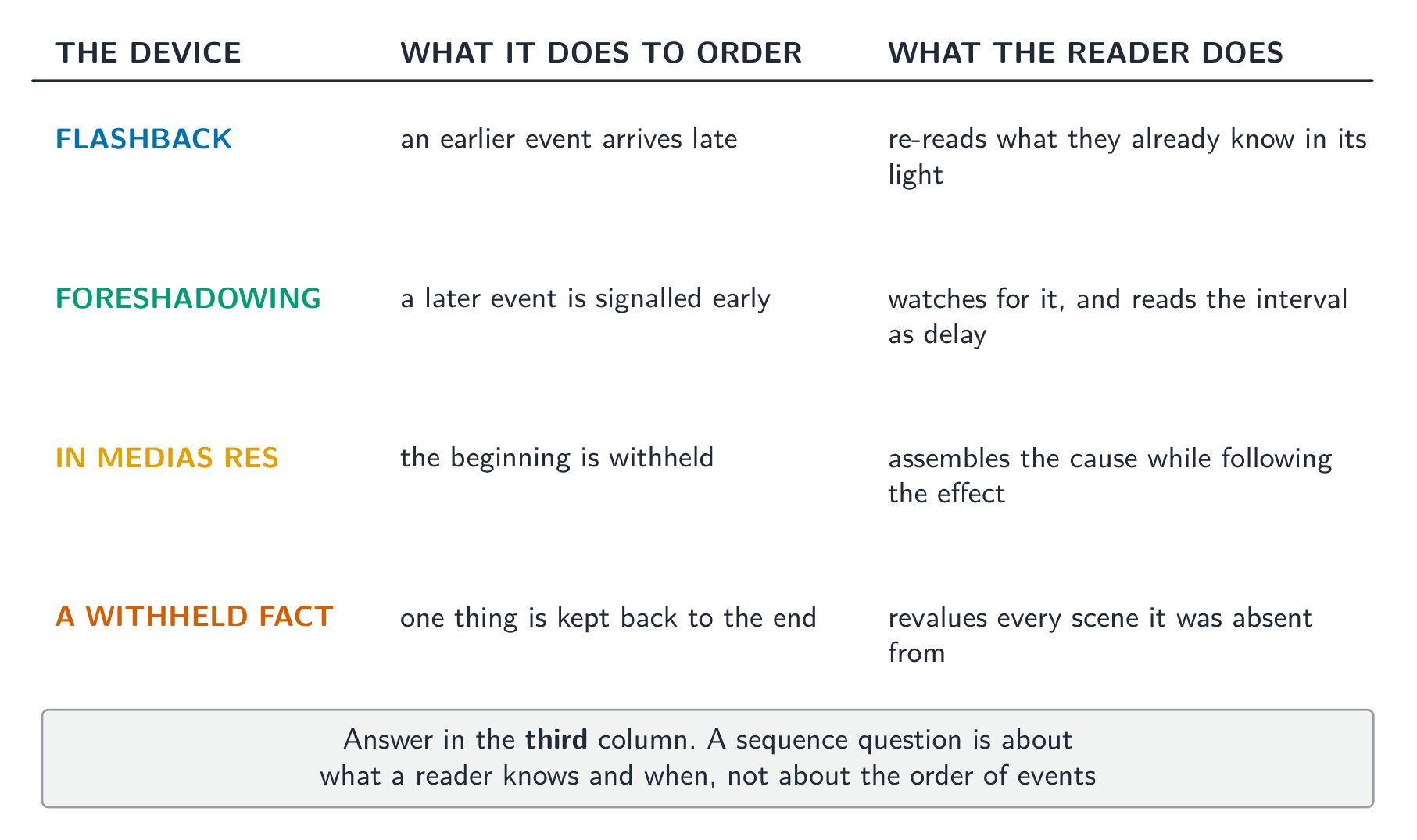
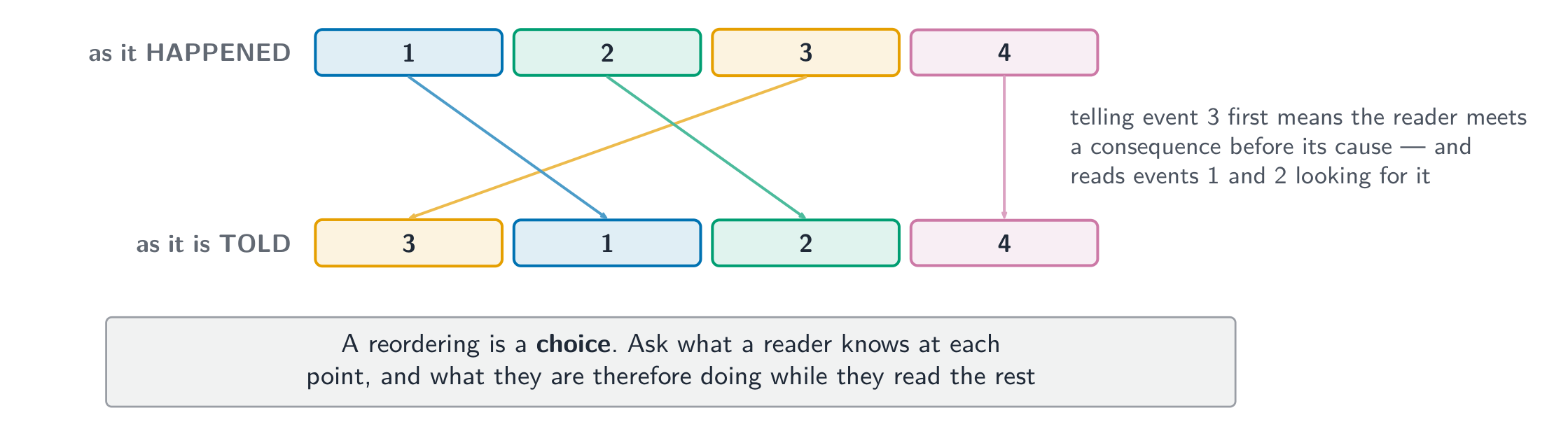
    The word sequence is doing work. Plot is not the events but their order - and an author who reveals something late that happened early has made a choice you can analyse.

    日本語
    • Plot 情节 is the sequence of events in a narrative; events are connected, each building on those before it.
    • The dramatic situation 戏剧情境 includes the setting and action of the plot and how the narrative develops to place characters in conflict.

    The word sequence is doing work. Plot is not the events but their order - and an author who reveals something late that happened early has made a choice you can analyse.

    The order events happened against the order you were told them - the difference is a choice
    Vocabulary · ⁨語彙⁩ Train · ⁨練習する⁩
    English 日本語
    Plot/plɒt/ プロット
    dramatic situation/drəˈmætɪk ˌsɪtʃuːˈeɪʃn/ 劇的状況
    1.4

    The Function of a Sequence of Events

    Syllabus · ⁨シラバス⁩
    English

    Enduring Understanding (STR-1): The arrangement of the parts and sections of a text, the relationship of the parts to each other, and the sequence in which the text reveals information are all structural choices made by a writer that contribute to the reader’s interpretation of a text.

    Learning Objective 3.B: Explain the function of a particular sequence of events in a plot.

    • STR-1.C Plot and the exposition that accompanies it focus readers’ attention on the parts of the narrative that matter most to its development, including characters, their relationships, and their roles in the narrative, as well as setting and the relationship between characters and setting.
    日本語

    永続的理解 (STR-1): テキストの構成部分とセクションの配置、各部分同士の関係、そしてテキストが情報を開示する順序は、すべて作家による構造的選択であり、これらは読者によるテキストの解釈に寄与する。

    学習目標 3.B: プロットにおける特定の出来事の連続の機能について説明する。

    • STR-1.C プロットとそれに伴う導入部は、読者の注意を物語の発展において最も重要な部分(登場人物、彼らの関係、物語内での役割、および舞台設定と登場人物との関係など)に向けさせる。

    Source: College Board AP Course and Exam Description · ⁨出典: College Board AP コースおよび試験説明書⁩

    Plot and the exposition that accompanies it focus readers' attention on the parts of the narrative that matter most to the text's meaning.

    That sentence is the whole method for prose analysis: proportion is evidence. What the text lingers over, and what it passes in a clause, is the author telling you where to look.

    1.5

    Identifying the Narrator or Speaker

    Syllabus · ⁨シラバス⁩
    English

    Enduring Understanding (NAR-1): A narrator’s or speaker’s perspective controls the details and emphases that affect how readers experience and interpret a text.

    Learning Objective 4.A: Identify and describe the narrator or speaker of a text.

    • NAR-1.A Narrators or speakers relate accounts to readers and establish a relationship between the text and the reader.
    • NAR-1.B Perspective refers to how narrators, characters, or speakers see their circumstances, while point of view refers to the position from which a narrator or speaker relates the events of a narrative.
    • NAR-1.C A speaker or narrator is not necessarily the author.
    日本語

    永続的理解 (NAR-1): 叙述者または話者の視点は、読者がテキストを体験し解釈する方法に影響を与える细节と強調を統制する。

    学習目標 4.A: テキストの叙述者または話者を特定・記述する。

    • NAR-1.A 叙述者または話者は、読者に対して物語を語るとともに、テキストと読者の間の関係を確立する。
    • NAR-1.B 「視点(perspective)」とは、語り手、登場人物、または話者が自身の状況をどのように見ているかを指し、「視点の位置(point of view)」とは、語り手や話者が物語の出来事を叙述する際の立場を指す。
    • NAR-1.C 話者や語り手が必ずしも作者であるとは限らない。

    Source: College Board AP Course and Exam Description · ⁨出典: College Board AP コースおよび試験説明書⁩

    English
    • Narrators or speakers relate accounts and establish a relationship between the text and the reader.
    • Perspective refers to how narrators, characters, or speakers see their circumstances; point of view 叙述视点 refers to the position from which they relate the account.
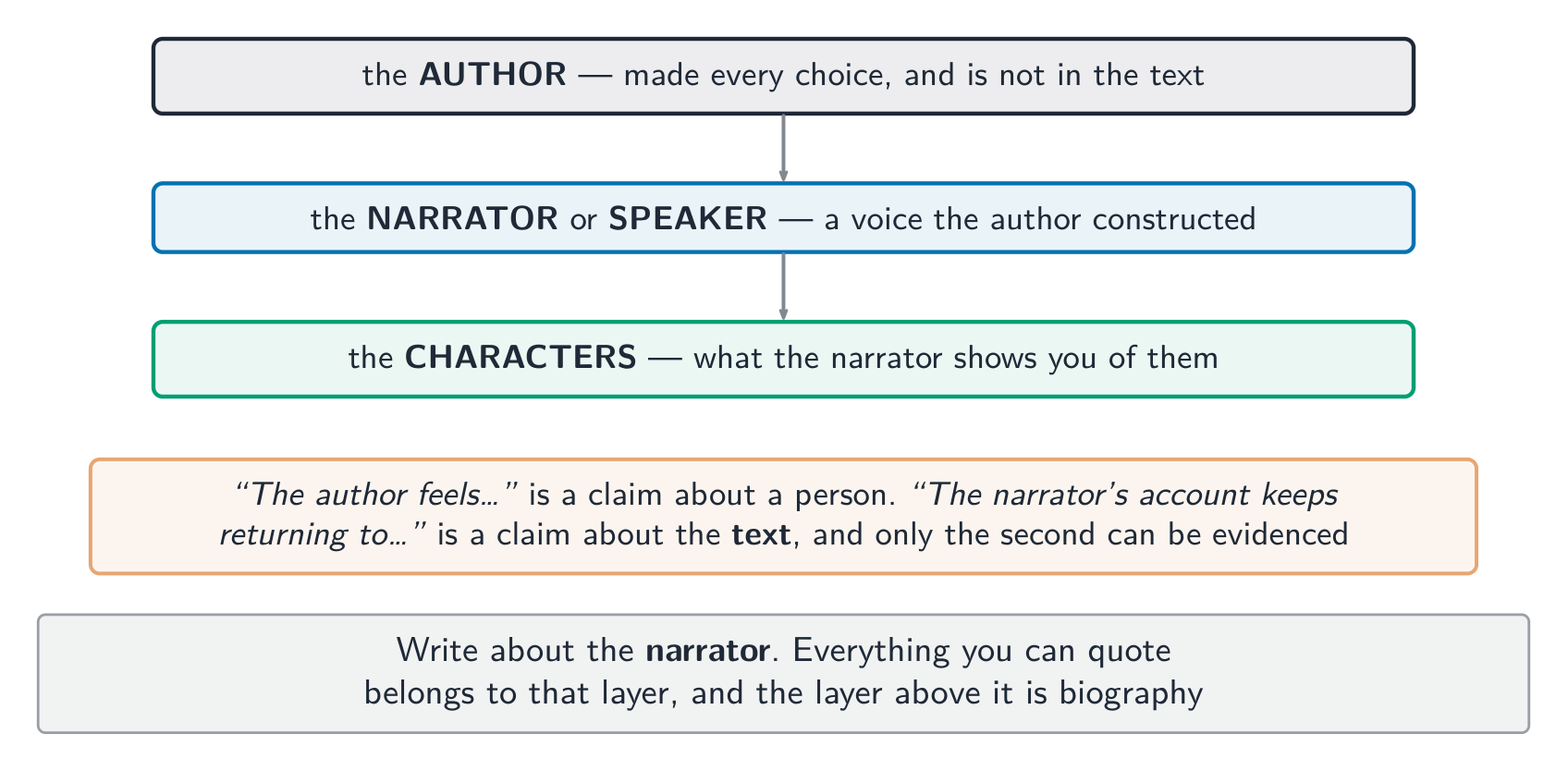
    • A speaker or narrator is not necessarily the author. Never write "the author feels" about a first-person narrator.
    日本語
    What each point of view can and cannot give you - and that limit is the analysis
    Perspective is how they see; point of view is where they stand. The CED separates them, and so should you
    • Narrators or speakers relate accounts and establish a relationship between the text and the reader.
    • Perspective refers to how narrators, characters, or speakers see their circumstances; point of view 叙述视点 refers to the position from which they relate the account.
    • A speaker or narrator is not necessarily the author. Never write "the author feels" about a first-person narrator.
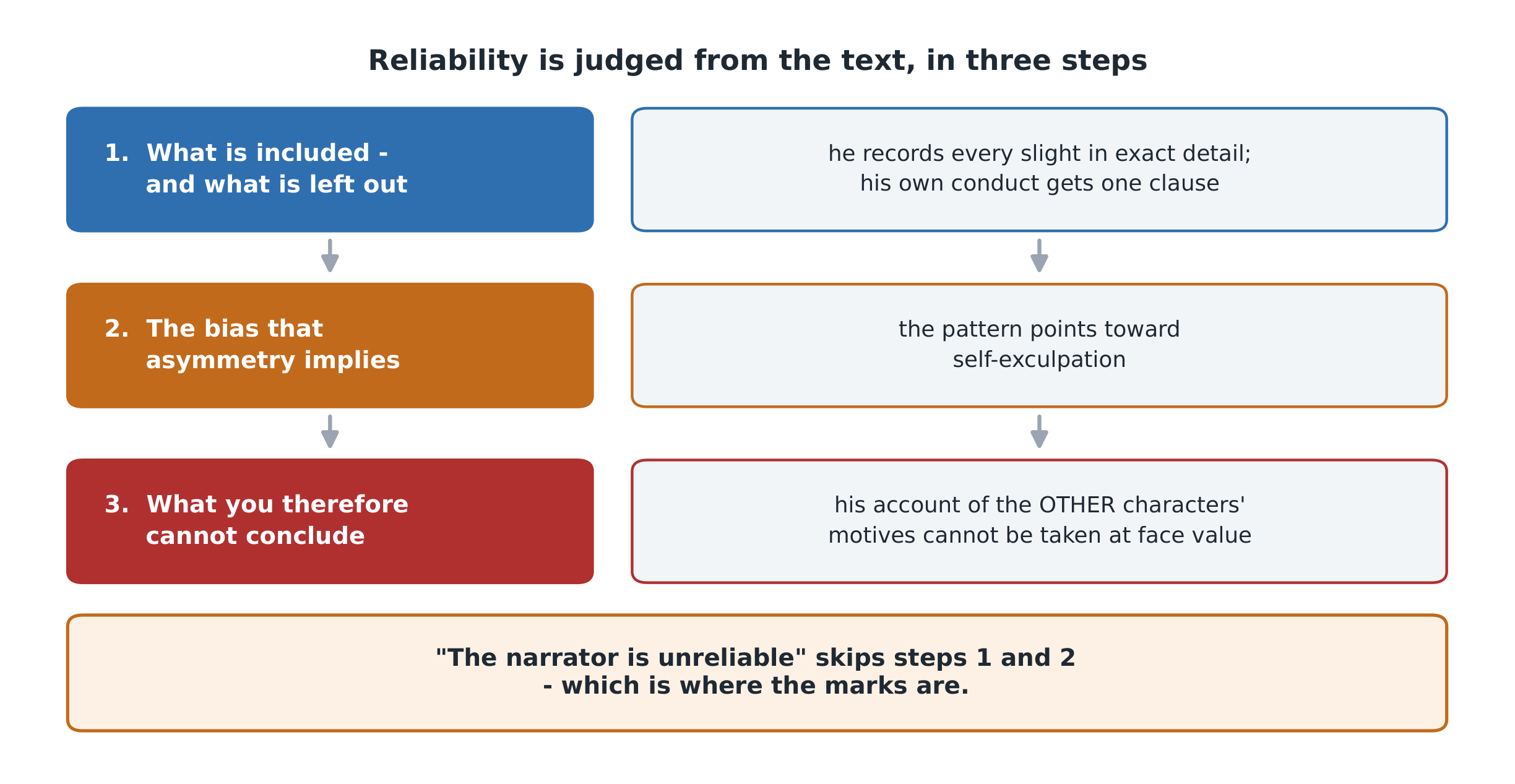
    Write about the narrator: everything you can quote belongs to that layer
    Explore · ⁨探索⁩

    Sort each statement by the layer it belongs to · ⁨各文を所属する層別に分類せよ⁩

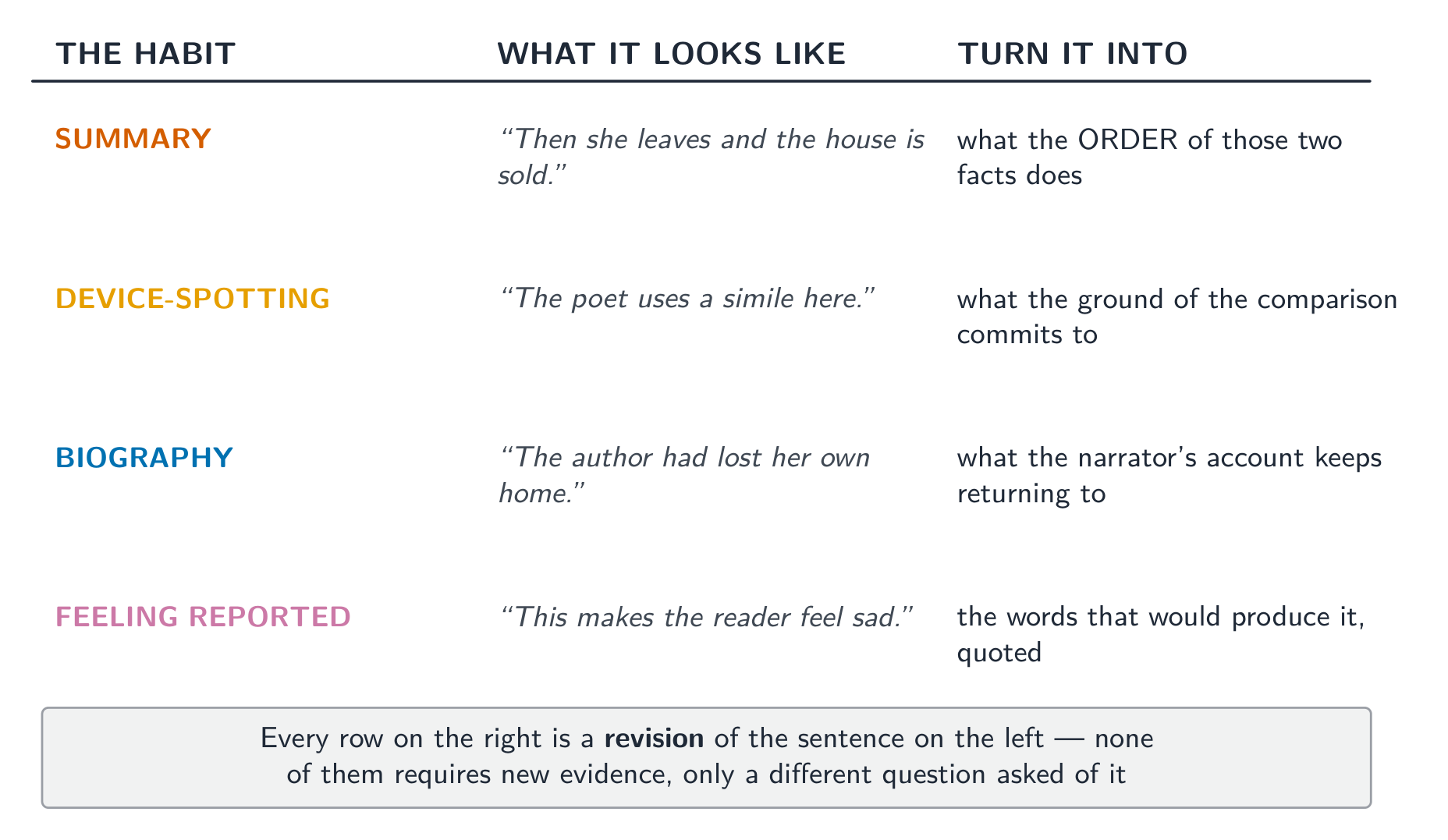
    Everything you can quote belongs to the narrator's layer. The layer above it is biography. · ⁨引用可能なものはすべて語り手の層に属する。その上の層は伝記である。⁩

    Vocabulary · ⁨語彙⁩ Train · ⁨練習する⁩
    English 日本語
    point of view/pɔɪnt ɒv vjuː/ 視点
    1.6

    The Function of Point of View

    Syllabus · ⁨シラバス⁩
    English

    Enduring Understanding (NAR-1): A narrator’s or speaker’s perspective controls the details and emphases that affect how readers experience and interpret a text.

    Learning Objective 4.B: Identify and explain the function of point of view in a narrative.

    • NAR-1.D The point of view contributes to what narrators, characters, or speakers can and cannot provide in a text based on their level of involvement and intimacy with the details, events, or characters.
    • NAR-1.E Narrators may also be characters, and their role as characters may influence their perspective.
    • NAR-1.F First-person narrators are involved in the narrative; their relationship to the events of the plot and the other characters shapes their perspective.
    • NAR-1.G Third-person narrators are outside observers.
    • NAR-1.H Third-person narrators’ knowledge about events and characters may range from observational to all-knowing, which shapes their perspective.
    • NAR-1.I The outside perspective of third-person narrators may not be affected by the events of the narrative.
    日本語

    永続的理解 (NAR-1): 叙述者または話者の視点は、読者がテキストを体験し解釈する方法に影響を与える细节と強調を統制する。

    学習目標 4.B: 物語における視点の位置の機能を特定し説明する。

    • NAR-1.D 視点の位置は、語り手、登場人物、または話者の関与度合いと詳細、出来事、あるいは登場人物との親密さによって、テキスト内で提供できること・できないことを決定する。
    • NAR-1.E 語り手が登場人物であることもあり、その登場人物としての役割が視点に影響を与えることがある。
    • NAR-1.F 一人称語り手は物語に関与しており、プロットの出来事や他の登場人物との関係性が視点形成一个する。
    • NAR-1.G 三人称語り手は外部の観察者である。
    • NAR-1.H 三人称語り手の出来事や登場人物に対する知識は、観察的なものから全知的なものまで多様であり、これが視点形成する。
    • NAR-1.I 三人称語り手の外部からの視点には、物語の出来事が影響を与えない場合がある。

    Source: College Board AP Course and Exam Description · ⁨出典: College Board AP コースおよび試験説明書⁩

    English
    • Point of view contributes to what narrators can and cannot provide in a text, based on their position.
    • Narrators may also be characters, and that role may influence their perspective.
    • First-person narrators are involved in the narrative; their relationship to events and to other characters shapes what they can tell you.
    • Third-person narrators are outside observers, and their knowledge may range from observational to all-knowing 全知.
    • The outside perspective of a third-person narrator may not be affected by the events of the narrative.

    The analytical payoff is the cannot. A first-person narrator cannot report what they did not witness or will not admit, and every gap is meaningful. A limited third-person narrator confines you to one consciousness, which is a choice about whose experience counts.

    日本語
    • Point of view contributes to what narrators can and cannot provide in a text, based on their position.
    • Narrators may also be characters, and that role may influence their perspective.
    • First-person narrators are involved in the narrative; their relationship to events and to other characters shapes what they can tell you.
    • Third-person narrators are outside observers, and their knowledge may range from observational to all-knowing 全知.
    • The outside perspective of a third-person narrator may not be affected by the events of the narrative.

    The analytical payoff is the cannot. A first-person narrator cannot report what they did not witness or will not admit, and every gap is meaningful. A limited third-person narrator confines you to one consciousness, which is a choice about whose experience counts.

    Vocabulary · ⁨語彙⁩ Train · ⁨練習する⁩
    English 日本語
    observational to all-knowing/ɒbzəˈveɪʃənl tʊ ɔːl ˈnəʊɪŋ/ 観察者から全知へ
    1.7

    Developing a Paragraph with Claim and Evidence

    Syllabus · ⁨シラバス⁩
    English

    Enduring Understanding (LAN-1): Readers establish and communicate their interpretations of literature through arguments supported by textual evidence.

    Learning Objective 7.A: Develop a paragraph that includes 1) a claim that requires defense with evidence from the text and 2) the evidence itself.

    • LAN-1.A In literary analysis, writers read a text closely to identify details that, in combination, enable them to make and defend a claim about an aspect of the text.
    • LAN-1.B A claim is a statement that requires defense with evidence from the text.
    • LAN-1.C In literary analysis, the initial components of a paragraph are the claim and textual evidence that defends the claim.
    日本語

    持続的理解(LAN-1): 読者は、テキストの証拠で裏付けられた議論を通じて、文学作品の解釈を確立し伝達する。

    学習目標 7.A: 1) テキストの証拠による擁護を必要とする主張と、2) その証拠自体を含む段落を作成する。

    • LAN-1.A 文学分析において、作家はテキストを精読し、組み合わさることでテキストのある側面に関する主張を立案し擁護できる詳細を特定する。
    • LAN-1.B 主張とは、テキストの証拠によって擁護を必要とする声明のことである。
    • LAN-1.C 文学分析において、段落の最初の要素は、主張を擁護するための主張とテキストの証拠である。

    Source: College Board AP Course and Exam Description · ⁨出典: College Board AP コースおよび試験説明書⁩

    • In literary analysis, writers read a text closely to identify details that, in combination, enable them to make and defend a claim.
    • A claim is a statement that requires defence with evidence from the text.
    • The initial components of a paragraph are the claim and the textual evidence that defends it.

    Note in combination. A single detail rarely supports an interpretive claim; two or three details that point the same way do.

    Worked example (a real AP exam task). The AP Literature free-response section has three questions - poetry analysis, prose fiction analysis, and a literary argument on a work you choose - all marked on a six-point rubric: thesis 1, evidence and commentary 4, sophistication 1. For a prose fiction prompt asking how the author uses narrative techniques to reveal a character's attitude, a weak answer writes "the narrator is first-person, which makes it personal." A scoring answer uses the cannot: "Because the narrator is a participant recounting events years later, the account gives us his present judgement of his younger self and withholds what the other characters thought - so the reader receives his self-criticism as the only available evidence, and must decide whether the harshness of it is accuracy or performance." Point of view, its limit, and the effect on the reader.

    1.7

    Exam tips

    • Character is a way of seeing, not a list of adjectives. Analyse what they notice and misread.
    • Setting must do something. Describing where a story happens is not yet a claim.
    • Plot is the order of events. A late revelation of an early event is an authorial choice worth analysing.
    • Proportion is evidence. What the text lingers over is where the meaning is.
    • The narrator is not the author. Never write "the author feels" about a first-person narrator.
    • The analytical gold in point of view is what the narrator cannot provide.
  • 2

    Poetry I · ⁨詩歌 I⁩

    Watch lesson · ⁨レッスンを視聴⁩
    2.1

    What Textual Details Reveal About a Character · ⁨本文のディテールがキャラクターについて何を明らかにするか⁩

    Syllabus · ⁨シラバス⁩
    English

    Enduring Understanding (CHR-1): Characters in literature allow readers to study and explore a range of values, beliefs, assumptions, biases, and cultural norms represented by those characters.

    Learning Objective 1.A: Identify and describe what specific textual details reveal about a character, that character’s perspective, and that character’s motives.

    • CHR-1.E Characters reveal their perspectives and biases through the words they use, the details they provide in the text, the organization of their thinking, the decisions they make, and the actions they take.
    日本語

    永続的理解 (CHR-1): 文学作品中の登場人物は、その人物が表す多様な価値観、信念、前提、偏見、文化的規範について、読者が研究・探求するための手段となる。

    学習目標 1.A: 特定の文本的细节が、登場人物、その人物の視点、およびその人物の動機について何を明らかにしているかを特定・記述する。

    • CHR-1.E キャラクターは、使用する言葉、テキストに提供する詳細、思考の構成、意思決定、および行動を通じて、自らの視点や偏りを表出する。

    Source: College Board AP Course and Exam Description · ⁨出典: College Board AP コースおよび試験説明書⁩

    English

    Unit 2 is the course's first poetry unit, and it adds two things to Unit 1's toolkit: structure as an object of analysis, and figurative language 比喻性语言 handled precisely rather than by name-dropping.

    One addition on character first: characters reveal their perspectives and biases through the words they use, the details they provide, and the details they omit.

    That last item is the analytical opening. What a speaker does not mention, in a poem where everything is chosen, is evidence.

    日本語

    Unit 2 はコース最初の詩のユニットであり、Unit 1 のツールキットに2つの要素を追加します: 分析の対象としての structure と、単に名前を挙げるのではなく正確に扱われる figurative language です。

    キャラクターに関する追加事項としてまず:characters reveal their perspectives and biases through the words they use, the details they provide, and the details they omit です。

    最後の項目が分析的な入り口です。すべてのものが選ばれた詩において、話者が not 提及しないことは、証拠となります。

    Vocabulary · ⁨語彙⁩ Train · ⁨練習する⁩
    English 日本語
    figurative language/ˈfɪɡjərətɪv ˈlæŋɡwɪdʒ/ 比喩的表現
    2.2

    The Function of Structure in a Text

    Syllabus · ⁨シラバス⁩
    English

    Enduring Understanding (STR-1): The arrangement of the parts and sections of a text, the relationship of the parts to each other, and the sequence in which the text reveals information are all structural choices made by a writer that contribute to the reader’s interpretation of a text.

    Learning Objective 3.C: Explain the function of structure in a text.

    • STR-1.D Line and stanza breaks contribute to the development and relationship of ideas in a poem.
    • STR-1.E The arrangement of lines and stanzas contributes to the development and relationship of ideas in a poem.
    • STR-1.F A text’s structure affects readers’ reactions and expectations by presenting the relationships among the ideas of the text via their relative positions and their placement within the text as a whole.
    日本語

    永続的理解 (STR-1): テキストの構成部分とセクションの配置、各部分同士の関係、そしてテキストが情報を開示する順序は、すべて作家による構造的選択であり、これらは読者によるテキストの解釈に寄与する。

    学習目標 3.C: テキストにおける構造の機能を説明する。

    • STR-1.D 行と節の区切りは、詩における思想の発展と相互関係に寄与する。
    • STR-1.E 行と節の配置は、詩における思想の発展と相互関係に寄与する。
    • STR-1.F テキストの構造は、思想間の関係を相対的な位置や全体としての配置を通じて提示することで、読者の反応や期待に影響を与える。

    Source: College Board AP Course and Exam Description · ⁨出典: College Board AP コースおよび試験説明書⁩

    English
    • Line and stanza breaks 行与诗节的断开 contribute to the development and relationship of ideas in a poem.
    • The arrangement of lines and stanzas contributes to that development.
    • A text's structure affects readers' reactions and expectations by presenting the relationships among ideas.

    Structure in poetry is not decoration; it is punctuation for thought. Where a line breaks decides which words sit at the ends of lines, and the end of a line is the most emphatic position available. A sentence that runs past a line break asks the reader to hold something unresolved; one that stops at the break closes it.

    日本語
    • Line and stanza breaks contribute to the development and relationship of ideas in a poem.
    • The arrangement of lines and stanzas contributes to that development.
    • A text's structure affects readers' reactions and expectations by presenting the relationships among ideas.

    詩における構造は装飾ではありません;それは思考のための句読点です。行の断ち切り(line break)在哪里决定哪些词位于行末,而行末是可用位置中最具强调性的。一个跨越行断的完整句子要求读者保持某种未解决的状态;而在断处结束的句子则将其封闭。

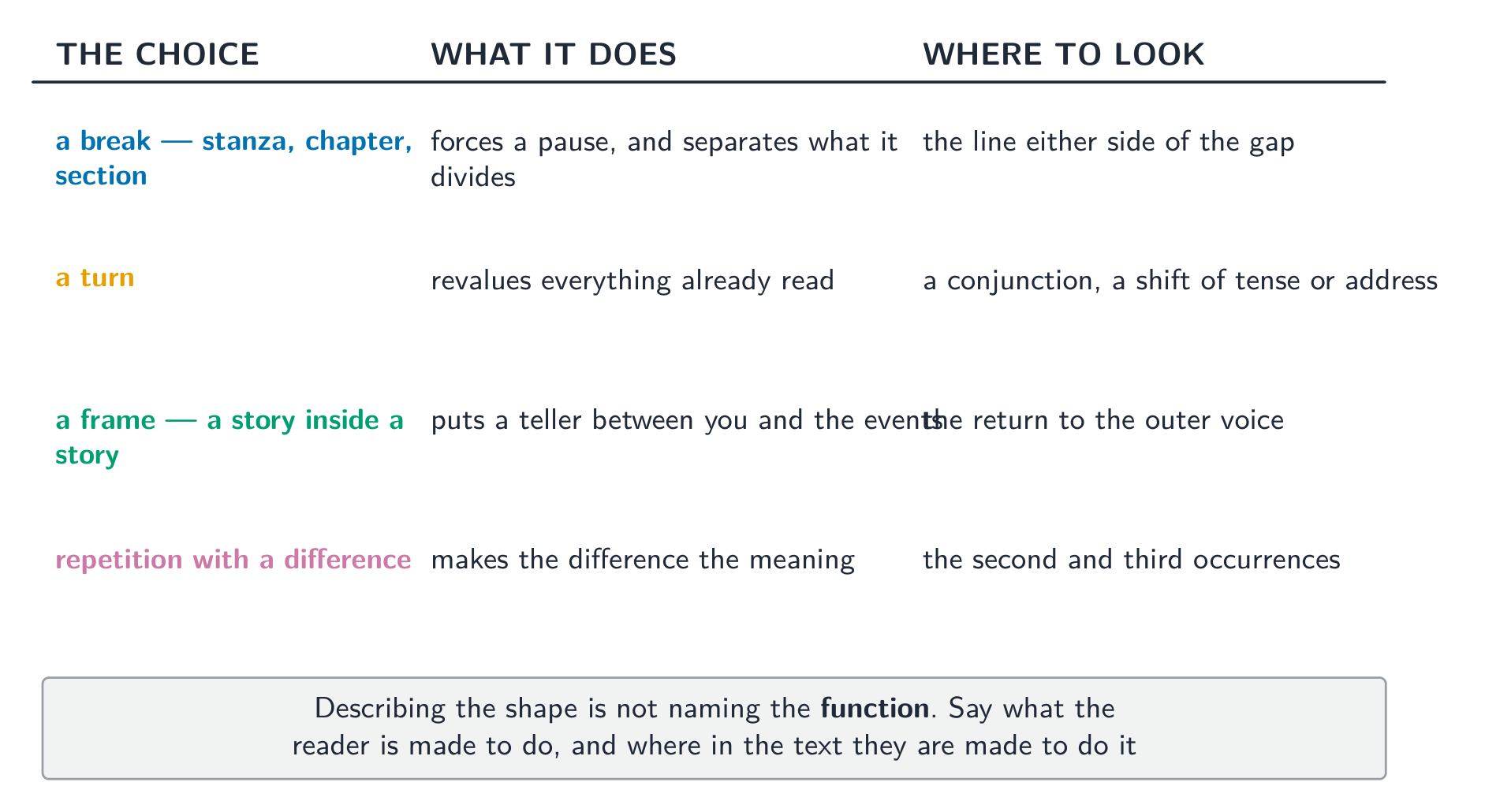
    Describing the shape is not naming the function - say what the reader is made to do
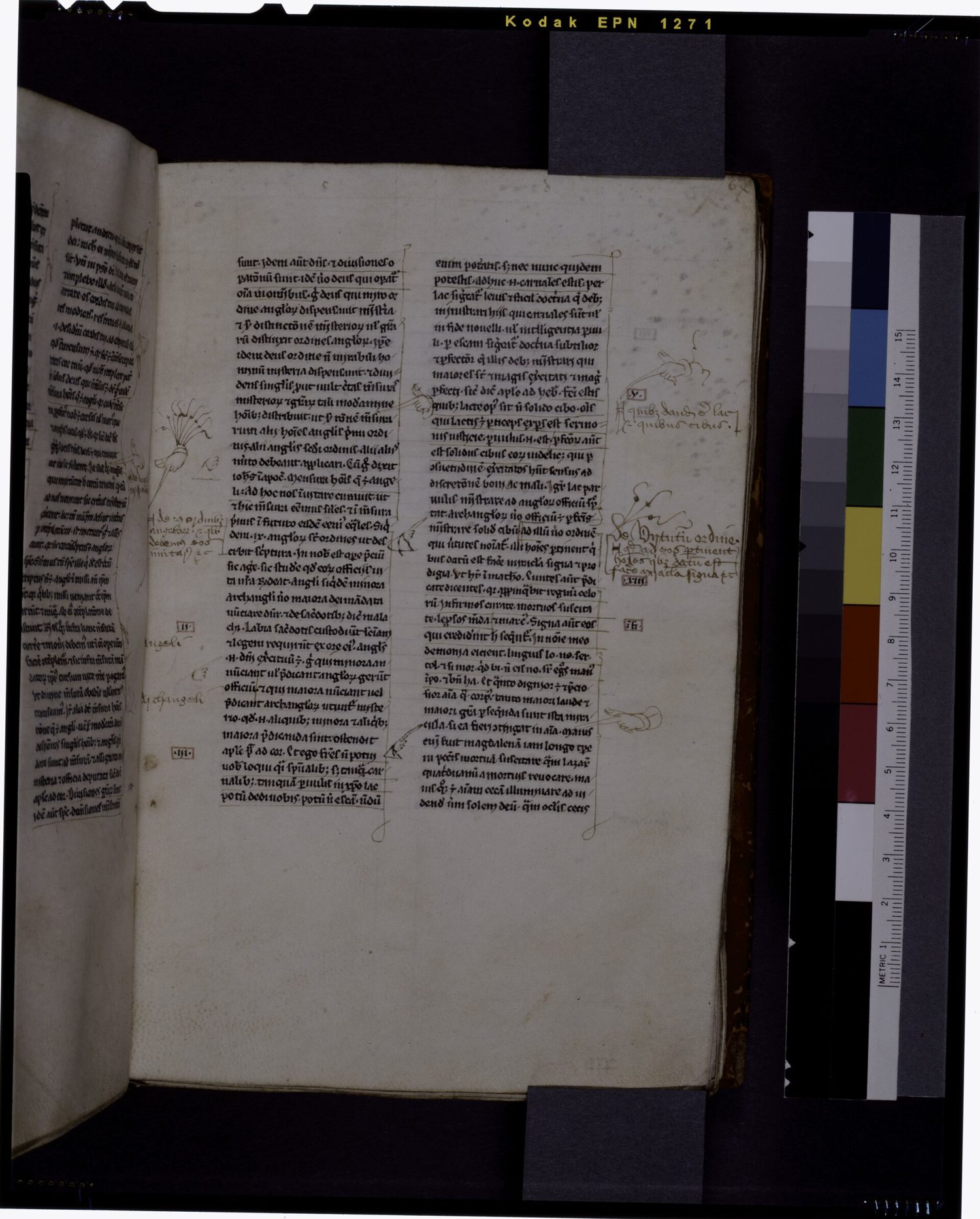
    A page carrying its own commentary in the margins - close reading, several centuries early
    Explore · ⁨探索⁩

    Match each structural choice to its function · ⁨各構造的要因と機能を対応させる⁩

    Describing the shape is not naming the function. Say what the reader is made to do, and where. · ⁨形を説明することは機能の名前来说えることではない。読者が何をさせられ、どこでさせられているかを述べよ。⁩

    Vocabulary · ⁨語彙⁩ Train · ⁨練習する⁩
    English 日本語
    Line and stanza breaks/laɪn ænd ˈstænzə breɪks/ 行と節の区切り
    2.3

    The Function of Contrasts Within a Text

    Syllabus · ⁨シラバス⁩
    English

    Enduring Understanding (STR-1): The arrangement of the parts and sections of a text, the relationship of the parts to each other, and the sequence in which the text reveals information are all structural choices made by a writer that contribute to the reader’s interpretation of a text.

    Learning Objective 3.D: Explain the function of contrasts within a text.

    • STR-1.G Contrast can be introduced through focus; tone; point of view; character, narrator, or speaker perspective; dramatic situation or moment; settings or time; or imagery.
    • STR-1.H Contrasts are the result of shifts or juxtapositions or both.
    • STR-1.I Shifts may be signaled by a word, a structural convention, or punctuation.
    • STR-1.J Shifts may emphasize contrasts between particular segments of a text.
    日本語

    永続的理解 (STR-1): テキストの構成部分とセクションの配置、各部分同士の関係、そしてテキストが情報を開示する順序は、すべて作家による構造的選択であり、これらは読者によるテキストの解釈に寄与する。

    学習目標 3.D: テキスト内の対比の機能を説明する。

    • STR-1.G 対比は、焦点;トーン;視点;キャラクター、語り手、または話者の視点;劇的な状況や瞬間;舞台設定や時間;あるいはイメージによって導入されることがある。
    • STR-1.H 対比は、転換や並置、あるいはその両方の結果として生じる。
    • STR-1.I 転換は、単語、構造上の慣習、または記号によって示されることがある。
    • STR-1.J 転換は、テキストの特定のセグメント間の対比を強調することがある。

    Source: College Board AP Course and Exam Description · ⁨出典: College Board AP コースおよび試験説明書⁩

    English
    • Contrast 对照 can be introduced through focus, tone, point of view, character or speaker perspective, and dramatic situation.
    • Contrasts are the result of shifts or juxtapositions or both.
    • Shifts may be signalled by a word, a structural convention, or punctuation.
    • Shifts may emphasise contrasts between particular segments of a text.

    This is the most reliable route into an unseen poem. Find the shift - a but, a stanza break, a change of tense or address - and the poem divides into a before and an after. What changed, and what the change costs or gains, is very often the poem's argument.

    日本語
    • Contrast can be introduced through focus, tone, point of view, character or speaker perspective, and dramatic situation。
    • Contrasts are the result of shifts or juxtapositions or both。
    • 転換は、ある言葉、構造的慣習、あるいは句読点によって合図されることがある。
    • Shifts may emphasise contrasts between particular segments of a text。

    これは未知の詩への最も確実なアプローチです。シフトを見つけてください - but、詩節の断ち切り、時制や呼びかけの変化など - そうすると詩は「前」と「後」に分かれます。何が変化したか、そしてその変化が何を失ったかまたは何を得たかは、しばしば詩の論理そのものです。

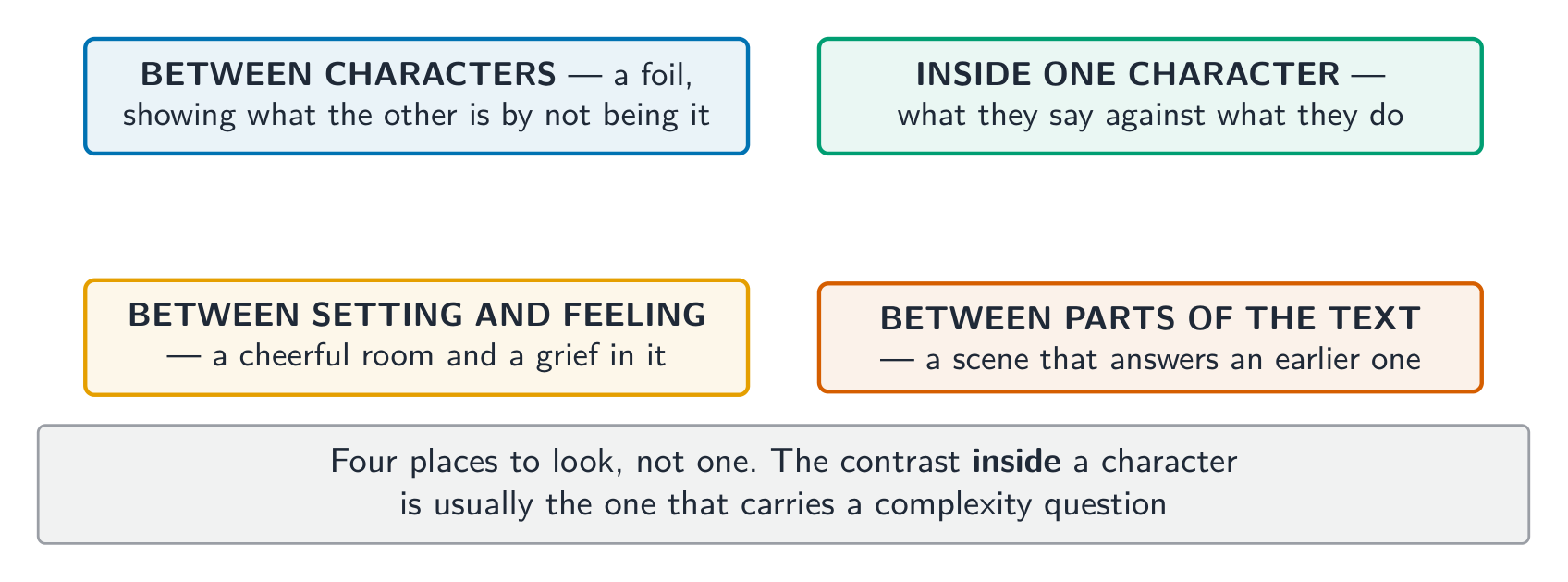
    Four places to look for contrast, not one
    Explore · ⁨探索⁩

    Find the contrast in four places, not one · ⁨一处ではなく四处の対比を見つける⁩

    Students find the obvious pairing and stop — and the contrast inside a character usually carries the complexity question. · ⁨学生は明らかなペアリングを見つけると止まる — 人物内部の対比は通常、複雑さを問う問題に関わる。⁩

    Vocabulary · ⁨語彙⁩ Train · ⁨練習する⁩
    English 日本語
    Contrast/ˈkɒntræst/ コントラスト
    2.4

    The Function of Specific Words and Phrases

    Syllabus · ⁨シラバス⁩
    English

    Enduring Understanding (FIG-1): Comparisons, representations, and associations shift meaning from the literal to the figurative and invite readers to interpret a text.

    Learning Objective 5.B: Explain the function of specific words and phrases in a text.

    • FIG-1.A An antecedent is a word, phrase, or clause that precedes its referent. Referents may include pronouns, nouns, phrases, or clauses.
    • FIG-1.B Referents are ambiguous if they can refer to more than one antecedent, which affects interpretation.
    • FIG-1.C Words or phrases may be repeated to emphasize ideas or associations.
    • FIG-1.D Alliteration is the repetition of the same letter sound at the beginning of adjacent or nearby words to emphasize those words and their associations or representations.
    日本語

    持続的理解(FIG-1): 比較、表現、連想は意味を字義から比喩へと移行させ、読者にテキストの解釈を促す。

    学習目標 5.B: テキスト内の特定の単語や句の機能を説明する。

    • FIG-1.A 先行語とは、参照語の直前にある単語、句、または節である。参照語には代名詞、名詞、句、または節が含まれる。
    • FIG-1.B 参照語が複数の先行語を指しうる場合は曖昧であり、解釈に影響を与える。
    • FIG-1.C アイデアや連想を強調するために、単語や句が反復されることがある。
    • FIG-1.D 頭韻(alliteration)とは、隣接するまたは近い言葉の先頭に同じ音の文字を反復し、それらの言葉や連想・表現を強調することである。

    Source: College Board AP Course and Exam Description · ⁨出典: College Board AP コースおよび試験説明書⁩

    English
    • An antecedent 先行词 is a word, phrase, or clause that precedes its referent.
    • Referents are ambiguous if they can refer to more than one antecedent, which affects interpretation 影响阐释.
    • Words or phrases may be repeated to emphasise ideas or associations.
    • Alliteration 头韵 is the repetition of the same initial sound in adjacent or nearby words, emphasising those words.

    Ambiguous reference is worth special attention. In prose it is usually a fault; in poetry it is often a device, and a pronoun that could point two ways may be holding both meanings deliberately.

    日本語
    • An antecedent はその先行語(referent)の前に来る言葉、フレーズ、あるいは節です。
    • Referents が複数のantecedentを指せる場合は曖昧で、which affects interpretation します。
    • Words or phrases may be repeated to emphasise ideas or associations。
    • Alliteration は隣接または近接する言葉で同じ頭音の反復であり、それらの言葉を強調します。

    曖昧な参照(ambiguous reference)は特別な注意が必要です。散文では通常、欠陥と見なされますが、詩ではしばしば手法として用いられ、二方向に指し示せる代名詞が意図的に両方の意味を保持していることがあります。

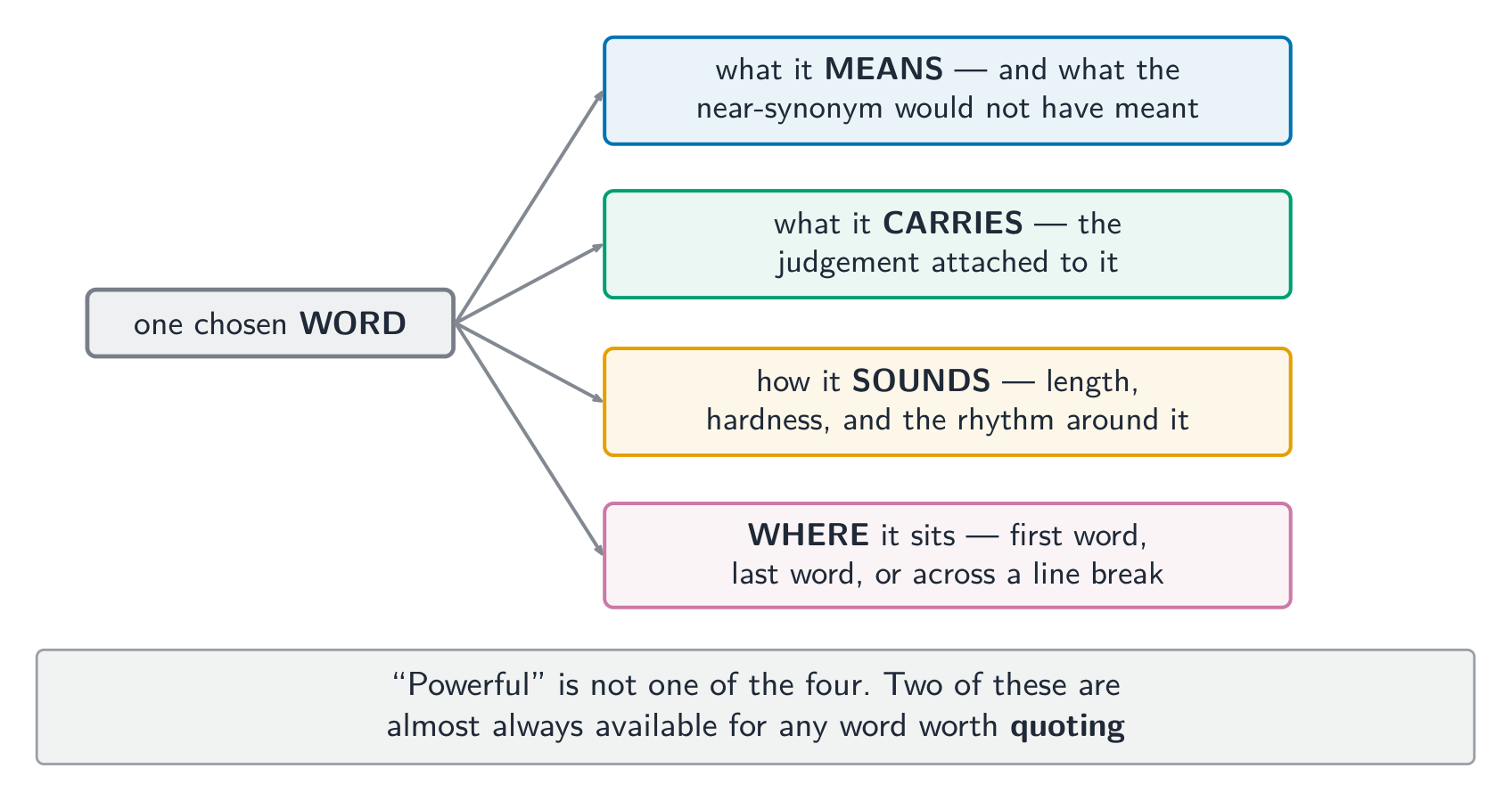
    One chosen word is doing up to four things - 'powerful' is not one of them
    Vocabulary · ⁨語彙⁩ Train · ⁨練習する⁩
    English 日本語
    antecedent/ˌæntɪˈsiːdənt/ antecedent(先行)
    affects interpretation/əˈfekts ɪnˌtɜːprɪˈteɪʃn/ 解釈に影響を与える
    Alliteration/əˌlɪtəˈreɪʃn/ 頭韻
    2.5

    The Function of a Simile

    Syllabus · ⁨シラバス⁩
    English

    Enduring Understanding (FIG-1): Comparisons, representations, and associations shift meaning from the literal to the figurative and invite readers to interpret a text.

    Learning Objective 6.A: Identify and explain the function of a simile.

    • FIG-1.E A simile uses the words “like” or “as” to liken two objects or concepts to each other.
    • FIG-1.F Similes liken two different things to transfer the traits or qualities of one to the other.
    • FIG-1.G In a simile, the thing being compared is the main subject; the thing to which it is being compared is the comparison subject.
    日本語

    持続的理解(FIG-1): 比較、表現、連想は意味を字義から比喩へと移行させ、読者にテキストの解釈を促す。

    学習目標 6.A: 明喻の機能を特定し説明する。

    • FIG-1.E 明喻は「like」または「as」という言葉を使って、2つの物体や概念を互いに例える。
    • FIG-1.F 明喻は2つの異なるものを例え、片方の特徴や性質を他方に移転させる。
    • FIG-1.G 明喻において、比較対象となるものは主要な主題であり、それと比較されるものは比較の主題である。

    Source: College Board AP Course and Exam Description · ⁨出典: College Board AP コースおよび試験説明書⁩

    English
    • A simile 明喻 uses "like" or "as" to liken two objects or concepts.
    • Similes liken two different things to transfer the traits or qualities of one to the other.
    • In a simile, the thing being compared is the main subject; the thing to which it is compared is the comparison subject.

    Those two terms are the whole method. A scoring answer names the main subject, names the comparison subject, and then says which quality was transferred - because that quality is the claim the poem is making.

    日本語
    The CED's own terms - and the transfer only runs one way
    Name the main subject, name the comparison subject, then say which quality crossed over
    • A simile uses 「like」or「as」 を用いて2つの対象や概念を類似させます。
    • Similes are used to liken two different things to transfer the traits or qualities of one to the other。
    • A simileにおいて、thing being compared は main subject であり、thing to which it is compared は comparison subject です。

    これらの2つの用語が手法全体です。高得点な答えはmain subjectを特定し、comparison subjectを特定し、その後 which quality was transferred を述べます。なぜなら、その品質こそが詩が主張していることだからです。

    Vocabulary · ⁨語彙⁩ Train · ⁨練習する⁩
    English 日本語
    simile/ˈsɪmɪlɪ/ 比喩( simile )
    metaphor/ˈmetəfɔː/ 隠喩
    2.6

    The Function of a Metaphor

    Syllabus · ⁨シラバス⁩
    English

    Enduring Understanding (FIG-1): Comparisons, representations, and associations shift meaning from the literal to the figurative and invite readers to interpret a text.

    Learning Objective 6.B: Identify and explain the function of a metaphor.

    • FIG-1.H A metaphor implies similarities between two (usually unrelated) concepts or objects in order to reveal or emphasize one or more things about one of them, though the differences between the two may also be revealing.
    • FIG-1.I In a metaphor, as in a simile, the thing being compared is the main subject; the thing to which it is being compared is the comparison subject.
    • FIG-1.J Comparisons between objects or concepts draw on the experiences and associations readers already have with those objects and concepts.
    • FIG-1.K Interpretation of a metaphor may depend on the context of its use; that is, what is happening in a text may determine what is transferred in the comparison.
    日本語

    持続的理解(FIG-1): 比較、表現、連想は意味を字義から比喩へと移行させ、読者にテキストの解釈を促す。

    学習目標 6.B: 隠喩の機能を特定し説明する。

    • FIG-1.H 隠は、2つ(通常無関係な)概念や物体間の類似性を暗示し、そのうちの一つについて何かを明らかにしたり強調したりするためのものであるが、2つ間の相違点が明らかにされることもある。
    • FIG-1.I 隠喩においても、明喻と同様に、比較対象となるものは主要な主題であり、それと比較されるものは比較の主題である。
    • FIG-1.J 物体や概念間の比較は、読者がすでに持つこれらの物体や概念への経験や連想に基づいている。
    • FIG-1.K 隠喩の解釈は使用文脈に依存することがあり、つまりテキストで何が起こっているかが、比較で移転される内容を決定することがある。

    Source: College Board AP Course and Exam Description · ⁨出典: College Board AP コースおよび試験説明書⁩

    English
    • A metaphor 隐喻 implies similarities between two usually unrelated concepts to reveal or emphasise qualities of the main subject.
    • The same main-subject and comparison-subject structure applies.
    • Comparisons draw on the experiences and associations readers already have with the comparison subject - which is why a metaphor can fail with an audience that lacks those associations.
    • Interpretation of a metaphor may depend on the context of its use: what is happening in the text may determine which of the comparison subject's qualities is meant.

    That last point protects you from the commonest error, which is importing every association a word has. If a poem calls grief a house, the relevant quality might be shelter, or confinement, or the fact that one must live inside it. The text decides which.

    日本語
    • A metaphor implies similarities between two usually unrelated concepts to reveal or emphasise qualities of the main subject。
    • 同じmain-subjectおよびcomparison-subjectの構造が適用されます。
    • Comparisons draw on the experiences and associations readers already have with the comparison subject - which is why a metaphor can fail with an audience that lacks those associations。
    • Interpretation of a metaphor may depend on the context of its use: what is happening in the text may determine which of the comparison subject's qualities is meant。

    その最後のポイントは、最も一般的な誤りを避けるためのものです。それは、ある言葉が持つすべての連想をそのまま取り込むことです。詩が悲しみ (a house) を「家」と呼んでいる場合、関連する特質は、保護、閉ざされた空間、あるいはそこに住まなければならないという事実のいずれかである可能性があります。本文がどの特質を指しているかを決定します。

    2.7

    Developing a Paragraph with Claim and Evidence · ⁨主張と証拠を含むパラグラフの構成⁩

    Syllabus · ⁨シラバス⁩
    English

    Enduring Understanding (LAN-1): Readers establish and communicate their interpretations of literature through arguments supported by textual evidence.

    Learning Objective 7.A: Develop a paragraph that includes 1) a claim that requires defense with evidence from the text and 2) the evidence itself.

    • LAN-1.A In literary analysis, writers read a text closely to identify details that, in combination, enable them to make and defend a claim about an aspect of the text.
    • LAN-1.B A claim is a statement that requires defense with evidence from the text.
    • LAN-1.C In literary analysis, the initial components of a paragraph are the claim and textual evidence that defends the claim.
    日本語

    持続的理解(LAN-1): 読者は、テキストの証拠で裏付けられた議論を通じて、文学作品の解釈を確立し伝達する。

    学習目標 7.A: 1) テキストの証拠による擁護を必要とする主張と、2) その証拠自体を含む段落を作成する。

    • LAN-1.A 文学分析において、作家はテキストを精読し、組み合わさることでテキストのある側面に関する主張を立案し擁護できる詳細を特定する。
    • LAN-1.B 主張とは、テキストの証拠によって擁護を必要とする声明のことである。
    • LAN-1.C 文学分析において、段落の最初の要素は、主張を擁護するための主張とテキストの証拠である。

    Source: College Board AP Course and Exam Description · ⁨出典: College Board AP コースおよび試験説明書⁩

    English

    Same three components as Unit 1: a claim requiring textual defence, the textual evidence, and details identified in combination.

    Worked example (a real AP exam task). A poetry-analysis prompt asks how the speaker's use of comparison conveys their attitude. A weak answer: "The poet uses a metaphor comparing memory to a house, which is effective." A scoring answer uses the CED's terms and the context rule: "The main subject is memory and the comparison subject a house, but the poem withholds warmth from the comparison: the house has 'rooms she no longer enters'. The quality transferred is therefore not shelter but confinement by a structure one built oneself - so the speaker's attitude to her own past is presented as inhabiting something she can neither leave nor fully occupy." Main subject, comparison subject, transferred quality, and the attitude it conveys.

    日本語

    Unit 1と同じ3つの構成要素です:主張(本文による裏付けが必要)、本文の証拠、そして組み合わせて特定される詳細。

    ワークドエグザム(実際のAP試験課題)。 詩の分析問題として、「話手が比喩を用いることで、自身の態度をどのように表現しているか」を問うたてつけがあります。弱い回答:「詩人は記憶を家と比較するメタファーを使用しており、これは効果的である。」採点基準に合格した回答は、CEDの用語と文脈のルールを用いています:「主要な対象は記憶であり、比較の対象は家だが、この詩では家に対する温かさを控えている。家は『彼女が入らない部屋』を持っている。したがって、移転された特質は保護ではなく、自身が造り出した構造物による閉ざされ方であり、話手の自身の過去への態度は、去ることも完全に占有することもできない何かに住むこととして提示されている。」主要な対象、比較の対象、移転された特質、およびそれが伝える態度。

    2.7

    Exam tips · ⁨試験対策⁩

    English
    • What a speaker omits is evidence. In a poem, everything present was chosen.
    • Find the shift first. A but, a stanza break, a change of tense - the poem divides there.
    • Line endings are the emphatic position. Say which words the poet put there.
    • An ambiguous referent in poetry is usually a device, not an error.
    • Always name main subject and comparison subject, then the quality transferred. That quality is the claim.
    • Context decides which quality a metaphor imports. Do not list every association the word has.
    日本語
    • 話手が省略していることも証拠となる。詩において、存在するものはすべて意図的に選ばれたものだからである。
    • まず変化点を見つける。butのような接続詞、段落の区切り、時制の変化など、詩が分割される場所がある。
    • 行末は強調される位置である。詩人がそこにどのような単語を配置したかを述べよ。
    • 詩における曖昧な参照先は、通常、誤りではなく、修辞的な装置である。
    • いつも主要な対象と比較の対象を挙げ、次に移転された特質を述べる。この特質こそが主張である。
    • 文脈によって、メタファーがどの特質を取り込むかが決まる。ある言葉が持つすべての連想を列挙してはならない。
  • 3

    Longer Fiction or Drama I · ⁨長編小説または演劇 I⁩

    Watch lesson · ⁨レッスンを視聴⁩
    3.1

    What Textual Details Reveal About a Character · ⁨本文のディテールがキャラクターについて何を明らかにするか⁩

    Syllabus · ⁨シラバス⁩
    English

    Enduring Understanding (CHR-1): Characters in literature allow readers to study and explore a range of values, beliefs, assumptions, biases, and cultural norms represented by those characters.

    Learning Objective 1.A: Identify and describe what specific textual details reveal about a character, that character’s perspective, and that character’s motives.

    • CHR-1.F The description of a character creates certain expectations for that character’s behaviors; how a character does or does not meet those expectations affects a reader’s interpretation of that character.
    • CHR-1.G Details associated with a character and/or used to describe a character contribute to a reader’s interpretation of that character.
    • CHR-1.H Readers’ understanding of a character’s perspective may depend on the perspective of the narrator or speaker.
    • CHR-1.I A character’s perspective may shift during the course of a narrative.
    • CHR-1.J When narrators, characters, or speakers compare another character to something or someone else, they reveal their perspective on the compared character and may also reveal something innate about the compared character.
    • CHR-1.K Readers can infer a character’s motives from that character’s actions or inactions.
    日本語

    永続的理解 (CHR-1): 文学作品中の登場人物は、その人物が表す多様な価値観、信念、前提、偏見、文化的規範について、読者が研究・探求するための手段となる。

    学習目標 1.A: 特定の文本的细节が、登場人物、その人物の視点、およびその人物の動機について何を明らかにしているかを特定・記述する。

    • CHR-1.F 登場人物の描写は、その人物の行動に対する特定の期待を生じさせます。その人物がこれらの期待に答えるか否かが、読者のその人物への解釈に影響を与えます。
    • CHR-1.G 登場人物に関連する詳細や、登場人物を説明するために用いられる詳細は、読者がその人物を解釈する上で寄与します。
    • CHR-1.H 読者が登場人物の視点を理解することは、物語語り手や話者の視点に依存することがあります。
    • CHR-1.I 物語の進行中、登場人物の視点が変化することがあります。
    • CHR-1.J 語り手、登場人物、または話者が他の登場人物を何物や他者と比較する場合、比較対象となる人物に対する自身の視点を開示し、同時にその人物の固有の性質についても何らかの情報を開示することがあります。
    • CHR-1.K 読者は、登場人物の行動または非行動から、その人物の動機を推測できます。

    Source: College Board AP Course and Exam Description · ⁨出典: College Board AP コースおよび試験説明書⁩

    English

    Unit 3 is the first longer-fiction-or-drama unit, and the length changes what is analysable: characters can now change, conflicts can intersect, and setting acquires a social and historical dimension.

    The CED's additions on character:

    • The description of a character creates expectations for that character's behaviour, and how a character meets or fails those expectations is meaningful.
    • Details associated with a character contribute to a reader's interpretation of them.
    • A reader's understanding of a character's perspective may depend on the perspective of the narrator.
    • A character's perspective may shift during the narrative.
    • When narrators or characters compare another character to something else, they reveal their own perspective as much as the compared character's.
    • Readers can infer motive from a character's actions or inactions.

    That last word - inactions - is the one worth keeping. What a character declines to do is evidence, and it is usually more revealing than what they do.

    日本語

    Unit 3は最初の長編小説・戯曲単元であり、長さの変化により分析可能になる要素が変わる:キャラクターが変化することができるようになり、対立が交差することができ、舞台設定が社会的かつ歴史的な次元を持つようになる。

    CEDが追加したキャラクターに関する内容:

    • キャラクターの描写は、そのキャラクターの行動に対する期待を生み出し、キャラクターがその期待に応えるか失敗するかという様子が意味を持つ。
    • キャラクターに関連する詳細は、読者がそれらを解釈する際に寄与する。
    • 読者のキャラクターの視点に対する理解は、物語語り人の視点に依存することがある。
    • キャラクターの視点は物語中に変化することがある。
    • 物語語り人やキャラクターが別のキャラクターを何かと比較する場合、それは比較対象となったキャラクターの視点だけでなく、自分たちの視点も明らかにする。
    • 読者は、キャラクターの行動または無作為から動機を推測できる。

    その最後の言葉 - inactions(無作為)- は特に重要である。キャラクターが行わないことは証拠であり、彼らが行うことよりも、しばしばより明瞭な示唆を与える。

    3.2

    Characters Who Change or Remain Unchanged · ⁨変化するか、変化しないかキャラクター⁩

    Syllabus · ⁨シラバス⁩
    English

    Enduring Understanding (CHR-1): Characters in literature allow readers to study and explore a range of values, beliefs, assumptions, biases, and cultural norms represented by those characters.

    Learning Objective 1.B: Explain the function of a character changing or remaining unchanged.

    • CHR-1.L A dynamic character who develops over the course of the narrative often makes choices that directly or indirectly affect the climax and/or the resolution of that narrative.
    • CHR-1.M Character changes can be visible and external, such as changes to health or wealth, or can be internal, psychological, or emotional changes; external changes can lead to internal changes, and vice versa.
    • CHR-1.N Some characters remain unchanged or are largely unaffected by the events of the narrative.
    日本語

    永続的理解 (CHR-1): 文学作品中の登場人物は、その人物が表す多様な価値観、信念、前提、偏見、文化的規範について、読者が研究・探求するための手段となる。

    学習目標 1.B: 登場人物が変化したり変化しなかったりする際の機能を説明する。

    • CHR-1.L 物語の進行中に発展する動的な登場人物は、しばしば物語のクライマックスおよび/または結末に直接的間接的に影響を与える選択を行います。
    • CHR-1.M 登場人物の変化は、健康や財産などの変化として可視化され外部に現れることもあれば、心理的・感情的な変化として内部に留まることもあります。外部の変化が内部の変化を引き起こすこともあり、逆に内部の変化が外部の変化をもたらすこともあります。
    • CHR-1.N 物語の出来事によってほとんど影響を受けず、変化しない、あるいは変化し続ける登場人物もいます。

    Source: College Board AP Course and Exam Description · ⁨出典: College Board AP コースおよび試験説明書⁩

    English
    • A dynamic character 动态人物 develops over the narrative and often makes choices that directly or indirectly cause change.
    • Character change can be visible and external - health, wealth, circumstance - or internal, in belief, value, or understanding.
    • Some characters remain unchanged 静态人物 or are largely unaffected by events.

    The unchanged character is not a failure of characterisation; it is often the measure by which the change in others is visible.

    日本語
    • ダイナミック・キャラクター (动态人物) は物語を通じて発展し、直接的または間接的に変化を引き起こす選択を行うことが多い。
    • キャラクターの変化は、健康、富、境遇などの外見上・外部のもの也可以是、信念、価値観、理解といった内面的なもの也可以是。
    • いくつかのキャラクターは変化せず (静态人物)、または出来事 largely by unaffected remain unchanged largely).

    変化しないキャラクターは、キャラクターizationの失敗ではない。むしろ、他の人々の変化が目立つための尺度となることが多い。

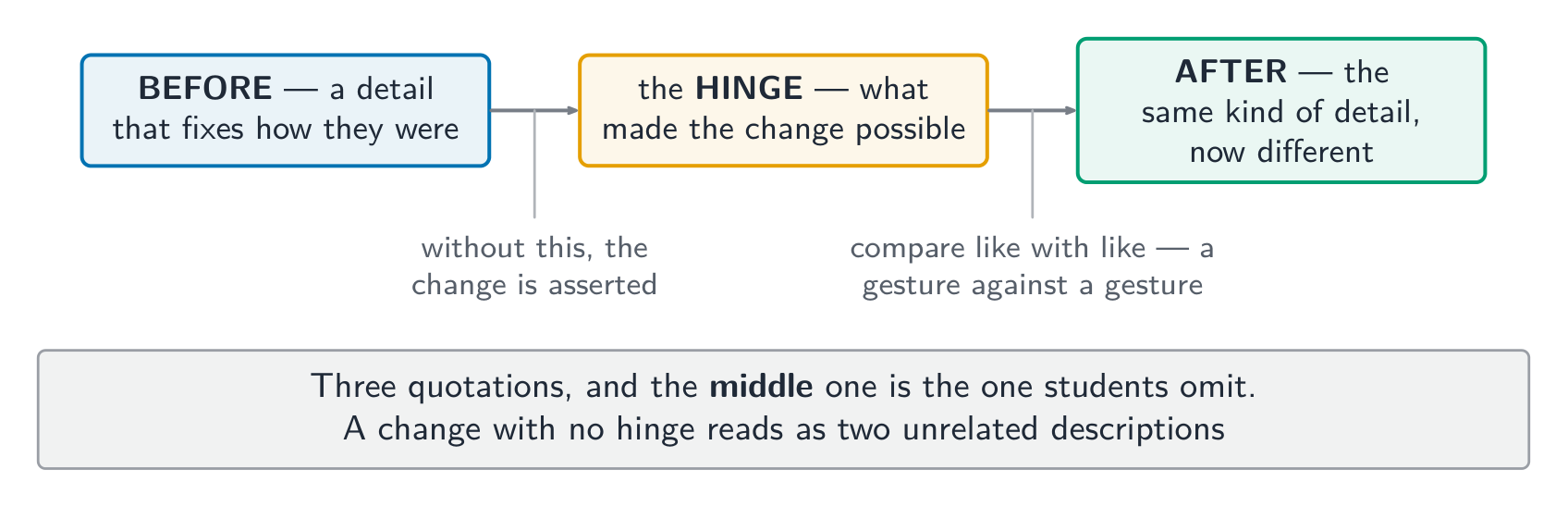
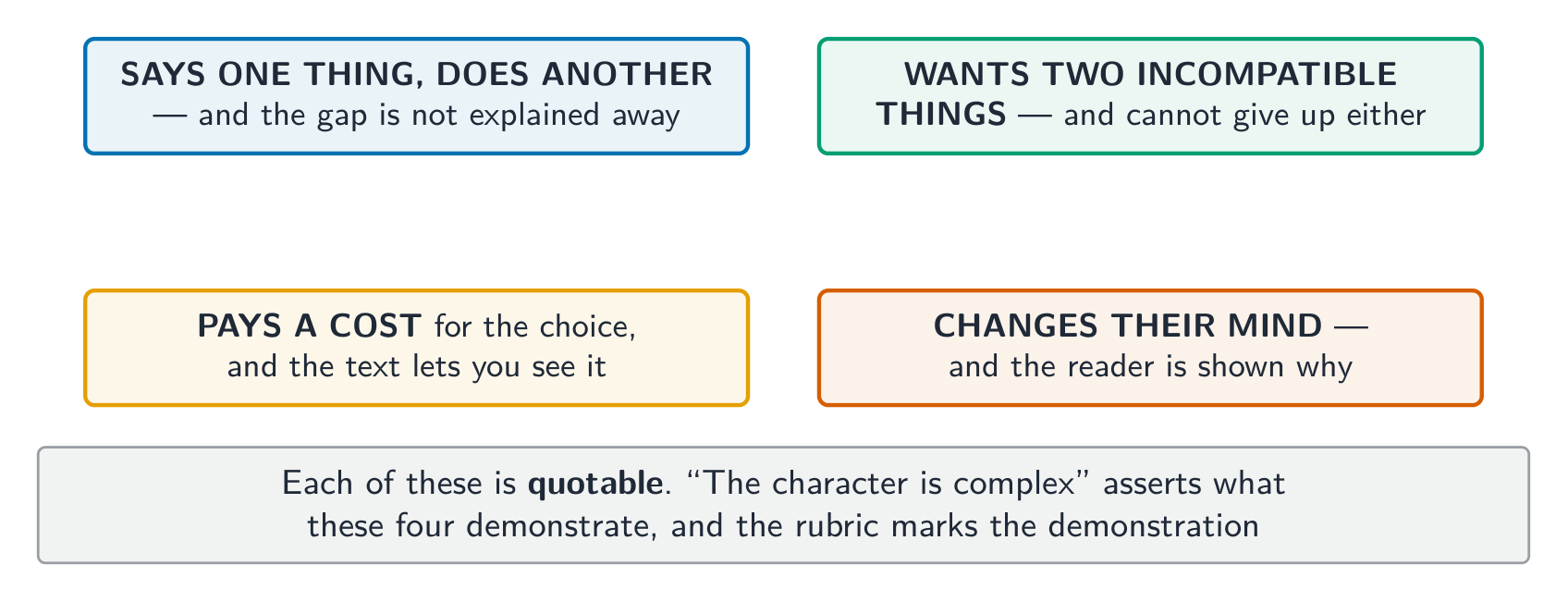
    Three quotations, and the middle one is the one students omit
    Explore · ⁨探索⁩

    Prove a change with three quotations · ⁨三つの引用で変化を証明せよ⁩

    Before, hinge, after — and the hinge is the one students omit, which leaves the change asserted. · ⁨前、支点、後 — 支点は学生が省略しがちであり、それにより変化が断定的になる。⁩

    3.3

    Textual Details That Convey Setting · ⁨舞台設定を伝える本文のディテール⁩

    Syllabus · ⁨シラバス⁩
    English

    Enduring Understanding (SET-1): Setting and the details associated with it not only depict a time and place, but also convey values associated with that setting.

    Learning Objective 2.A: Identify and describe specific textual details that convey or reveal a setting.

    • SET-1.B Setting includes the social, cultural, and historical situation during which the events of the text occur.
    日本語

    永続的理解 (SET-1): 舞台設定とそれに付随する细节は、単に時代と場所を描くだけでなく、その舞台設定に関連する価値観も伝える。

    学習目標 2.A: 舞台設定を伝達または開示する具体的な文本的细节を特定・記述する。

    • SET-1.B 舞台設定には、テキストの出来事が発生する社会、文化的、歴史的状況が含まれます。

    Source: College Board AP Course and Exam Description · ⁨出典: College Board AP コースおよび試験説明書⁩

    English

    Setting now includes the social, cultural, and historical situation in which the events occur - not only time and place.

    This widens what setting can do. A social setting supplies the constraints a character must act within, and constraint is what turns a choice into a revealing one.

    日本語

    舞台設定には、出来事が起こる社会的、文化的、歴史的状況が含まれるようになり、単なる時間や場所だけでなくなる。

    これにより舞台設定の役割が広がる。社会的な舞台設定は、キャラクターが行動しなければならない制約を提供し、その制約こそが、選択を意味深いものに転換させるものである。

    3.4

    Significant Events in a Plot · ⁨プロットにおける重要な出来事⁩

    Syllabus · ⁨シラバス⁩
    English

    Enduring Understanding (STR-1): The arrangement of the parts and sections of a text, the relationship of the parts to each other, and the sequence in which the text reveals information are all structural choices made by a writer that contribute to the reader’s interpretation of a text.

    Learning Objective 3.E: Explain the function of a significant event or related set of significant events in a plot.

    • STR-1.K A story, or narrative, is delivered through a series of events that relate to a conflict.
    • STR-1.L Events include episodes, encounters, and scenes in a narrative that can introduce and develop a plot.
    • STR-1.M The significance of an event depends on its relationship to the narrative, the conflict, and the development of characters.
    日本語

    永続的理解 (STR-1): テキストの構成部分とセクションの配置、各部分同士の関係、そしてテキストが情報を開示する順序は、すべて作家による構造的選択であり、これらは読者によるテキストの解釈に寄与する。

    学習目標 3.E: プロットにおける重要な出来事、または関連する重要な出来事のセットの機能を説明する。

    • STR-1.K 物語、またはナラティブは、対立(コンフリクト)に関連する一連の出来事を通じて語られます。
    • STR-1.L 出来事は、プロットを導入し発展させることのできる、物語中のエピソード、遭遇、および場面を含みます。
    • STR-1.M 出来事の重要性は、物語との関係性、対立(コンフリクト)、および登場人物の発展との関係に依存します。

    Source: College Board AP Course and Exam Description · ⁨出典: College Board AP コースおよび試験説明書⁩

    English
    • A narrative is delivered through a series of events that relate to a conflict.
    • Events include episodes, encounters, and scenes that introduce and develop plot.
    • The significance of an event depends on its relationship to the narrative, the conflict, and character development.

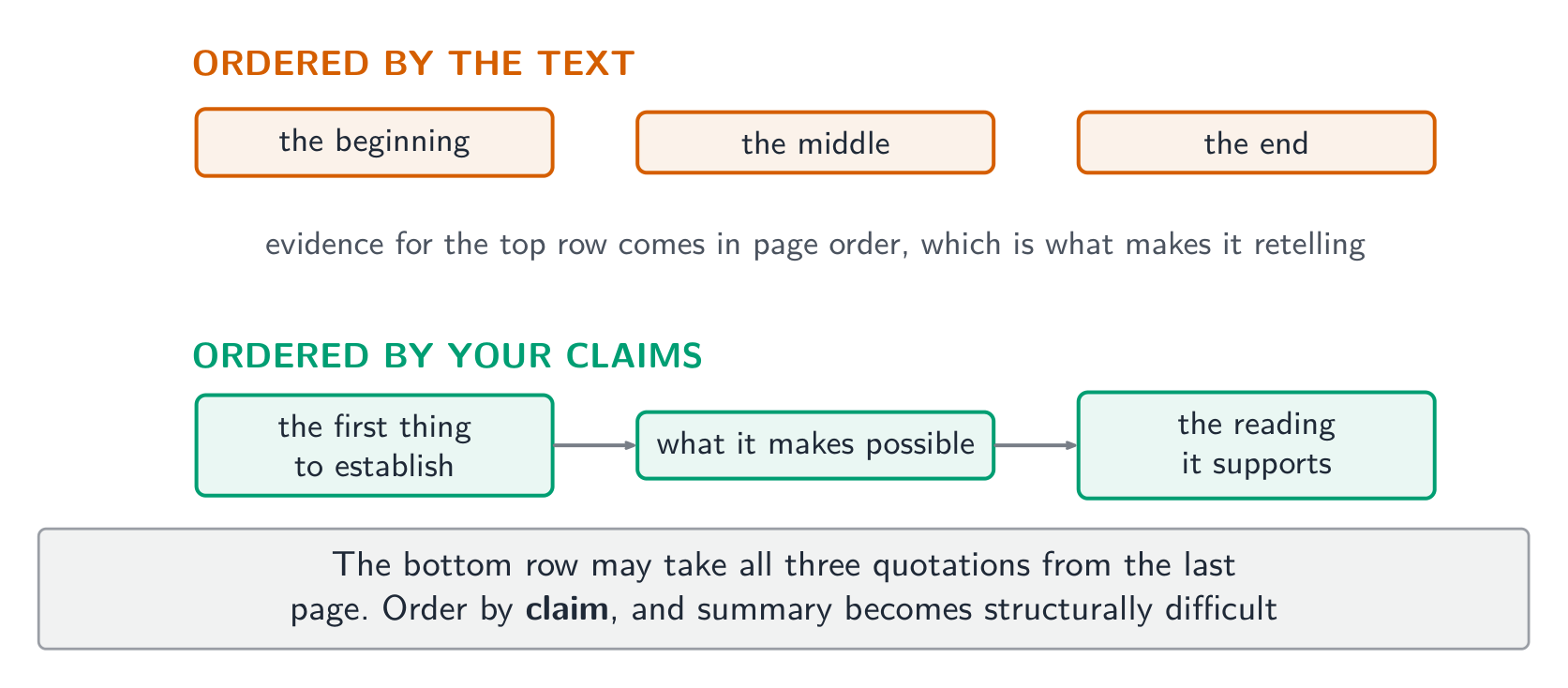
    That third statement is the test for essay selection: an event matters to your argument only if you can say what it does to the conflict or to a character. Retelling a striking scene that does neither is plot summary, which earns nothing.

    日本語
    • 物語は、対立に関係する一連の出来事を通じて語られる。
    • 出来事には、プロットを紹介し発展させるエピソード、遭遇、シーンが含まれる。
    • 出来事の重要性は、物語、対立、およびキャラクターの成長との関係性によって決まる。

    この三つ目の記述は、エッセイの選択のためのテストである。出来事は、それが対立やキャラクターに何をするか言える場合にのみ、あなたの議論にとって意義を持つ。どちらにも寄与しない印象的なシーンを単に叙述することはプロットの要約であり、得点は得られない。

    3.5

    The Function of Conflict in a Text · ⁨テキストにおける対立の機能⁩

    Syllabus · ⁨シラバス⁩
    English

    Enduring Understanding (STR-1): The arrangement of the parts and sections of a text, the relationship of the parts to each other, and the sequence in which the text reveals information are all structural choices made by a writer that contribute to the reader’s interpretation of a text.

    Learning Objective 3.F: Explain the function of conflict in a text.

    • STR-1.N Conflict is tension between competing values either within a character, known as internal or psychological conflict, or with outside forces that obstruct a character in some way, known as external conflict.
    • STR-1.O A text may contain multiple conflicts. Often two or more conflicts in a text intersect.
    • STR-1.P A primary conflict can be heightened by the presence of additional conflicts that intersect with it.
    • STR-1.Q Inconsistencies in a text may create contrasts that represent conflicts of values or perspectives.
    日本語

    永続的理解 (STR-1): テキストの構成部分とセクションの配置、各部分同士の関係、そしてテキストが情報を開示する順序は、すべて作家による構造的選択であり、これらは読者によるテキストの解釈に寄与する。

    学習目標 3.F: テキストにおける対立(コンフリクト)の機能を説明する。

    • STR-1.N 対立とは、同一の登場人物の内側にある競合する価値観による緊張(内面的または心理的な対立)であるか、あるいは登場人物を何らかの形で妨げる外部の力との間の緊張(外部的対立)です。
    • STR-1.O テキストには複数の対立が含まれることがあります。多くの場合、テキスト内の二つ以上の対立が交差します。
    • STR-1.P 主要な対立は、それと交差する追加の対立が存在することによって強調されることがあります。
    • STR-1.Q テキストの不整合は、価値観や視点の対立を表す対比を生み出すことがあります。

    Source: College Board AP Course and Exam Description · ⁨出典: College Board AP コースおよび試験説明書⁩

    English
    • Conflict 冲突 is tension between competing values, either within a character - internal or psychological conflict - or between a character and an external force.
    • A text may contain multiple conflicts, and often two or more intersect 交叉.
    • A primary conflict can be heightened by additional conflicts that intersect with it.
    • Inconsistencies in a text may create contrasts that represent conflicts of values or perspectives.

    Note the definition: conflict is between competing values, not merely between people. Two characters who want the same object are in a dispute; two characters who want incompatible goods are in a conflict, and only the second produces meaning.

    日本語
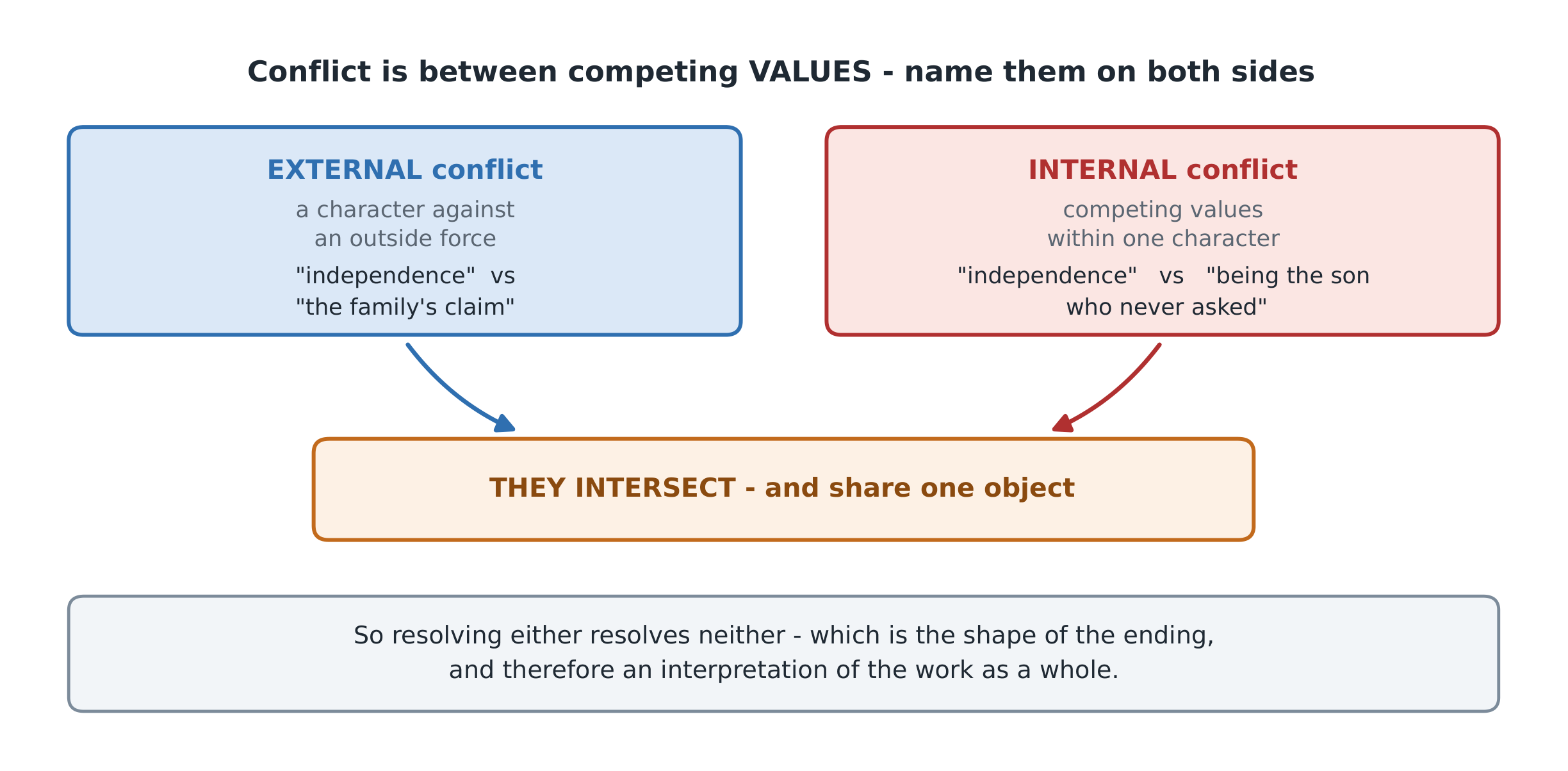
    Conflict has two locations and they compound - which is what makes long fiction analysable
    交差する対立によって強化された主要な対立は、小説や戯曲の標準的な形である
    • 対立 (冲突) は、競合する価値観との間の緊張であり、キャラクターの内部(内的・心理的対立)でもあり、キャラクターと外部の力との間でもありうる。
    • テキストには複数の対立が含まれることがあり、多くは二つ以上の対立が交差する (交叉)。
    • 主要な対立は、それと交差する追加の対立によって強化されることがある。
    • テキスト内の不整合は、価値観や視点の対立を表す対比を生み出すことがある。

    定義に注意せよ:対立とは、単に人間同士の対立ではなく、競合する価値観との間にあることである。同じ目的物を探求する二人のキャラクターは紛争にあり、互いに排他的な利益を求める二人のキャラクターは対立にあり、後者だけが意味を生み出す。

    Vocabulary · ⁨語彙⁩ Train · ⁨練習する⁩
    English 日本語
    dynamic character/daɪˈnæmɪk ˈkærɪktə/ 動的キャラクター
    Some characters remain unchanged/sʌm ˈkærɪktəz rɪˈmeɪn ʌnˈtʃeɪndʒd/ 一部のキャラクターは変化しない
    Conflict/ˈkɒnflɪkt/ 対立
    intersect/ˌɪntəˈsekt/ 交差する
    3.6

    Developing a Paragraph with Claim and Evidence · ⁨主張と証拠を含むパラグラフの構成⁩

    Syllabus · ⁨シラバス⁩
    English

    Enduring Understanding (LAN-1): Readers establish and communicate their interpretations of literature through arguments supported by textual evidence.

    Learning Objective 7.A: Develop a paragraph that includes 1) a claim that requires defense with evidence from the text and 2) the evidence itself.

    • LAN-1.A In literary analysis, writers read a text closely to identify details that, in combination, enable them to make and defend a claim about an aspect of the text.
    • LAN-1.B A claim is a statement that requires defense with evidence from the text.
    • LAN-1.C In literary analysis, the initial components of a paragraph are the claim and textual evidence that defends the claim.
    日本語

    持続的理解(LAN-1): 読者は、テキストの証拠で裏付けられた議論を通じて、文学作品の解釈を確立し伝達する。

    学習目標 7.A: 1) テキストの証拠による擁護を必要とする主張と、2) その証拠自体を含む段落を作成する。

    • LAN-1.A 文学分析において、作家はテキストを精読し、組み合わさることでテキストのある側面に関する主張を立案し擁護できる詳細を特定する。
    • LAN-1.B 主張とは、テキストの証拠によって擁護を必要とする声明のことである。
    • LAN-1.C 文学分析において、段落の最初の要素は、主張を擁護するための主張とテキストの証拠である。

    Source: College Board AP Course and Exam Description · ⁨出典: College Board AP コースおよび試験説明書⁩

    English

    Unchanged from Units 1 and 2: a claim requiring textual defence, textual evidence, and details identified in combination.

    日本語

    Unit 1およびUnit 2から変更なし:主張(本文による裏付けが必要)、本文の証拠、そして組み合わせて特定される詳細。

    3.7

    Developing a Literary Thesis Statement · ⁨文学的テーゼステートメントの構築⁩

    Syllabus · ⁨シラバス⁩
    English

    Enduring Understanding (LAN-1): Readers establish and communicate their interpretations of literature through arguments supported by textual evidence.

    Learning Objective 7.B: Develop a thesis statement that conveys a defensible claim about an interpretation of literature and that may establish a line of reasoning.

    • LAN-1.D A thesis statement expresses an interpretation of a literary text and requires a defense through use of textual evidence and a line of reasoning, both of which are explained in an essay through commentary.
    • LAN-1.E A thesis statement may preview the development or line of reasoning of an interpretation. This is not to say that a thesis statement must list the points of an interpretation, literary elements to be analyzed, or specific evidence to be used in the argument.
    日本語

    持続的理解(LAN-1): 読者は、テキストの証拠で裏付けられた議論を通じて、文学作品の解釈を確立し伝達する。

    学習目標 7.B: 文学の解釈に対する正当な主張を伝え、かつ論理の道筋を確立する可能性のあるテーゼステートメントを作成する。

    • LAN-1.D テーゼステートメントは、文学作品の解釈を表現しており、テキストの証拠と論理の道筋を用いて防御する必要があります。これら両方は、エッセイにおける解説によって説明されます。
    • LAN-1.E テーゼステートメントは、解釈の展開や論理の道筋を予見することがあります。これは、テーゼステートメントが解釈のポイント、分析されるべき文学的要素、または議論で用いられる具体的な証拠をリストアップしなければならないという意味ではありません。

    Source: College Board AP Course and Exam Description · ⁨出典: College Board AP コースおよび試験説明書⁩

    English
    • A thesis statement expresses an interpretation of a literary text and requires defence through textual evidence.
    • It may preview the development or line of reasoning of that interpretation - but is not required to list the reasons.

    The key word is interpretation. A thesis that states what happens in the text is not a thesis; it is a summary. A thesis must say what the text means or does, which is by definition arguable.

    日本語
    • テーゼステートメントは文学作品の解釈を表明し、本文の証拠によって裏付けられる必要がある。
    • その解釈の展開や論理の道筋を予見することがあるが、理由を列挙することが必須ではない。

    キーワードは解釈です。テキストで何が起こっているかを述べる主張は、主張ではなく要約に過ぎません。主張とは、テキストが何を意味するかまたは何を行うかを述べるものであり、定義上、議論の余地があるものです。

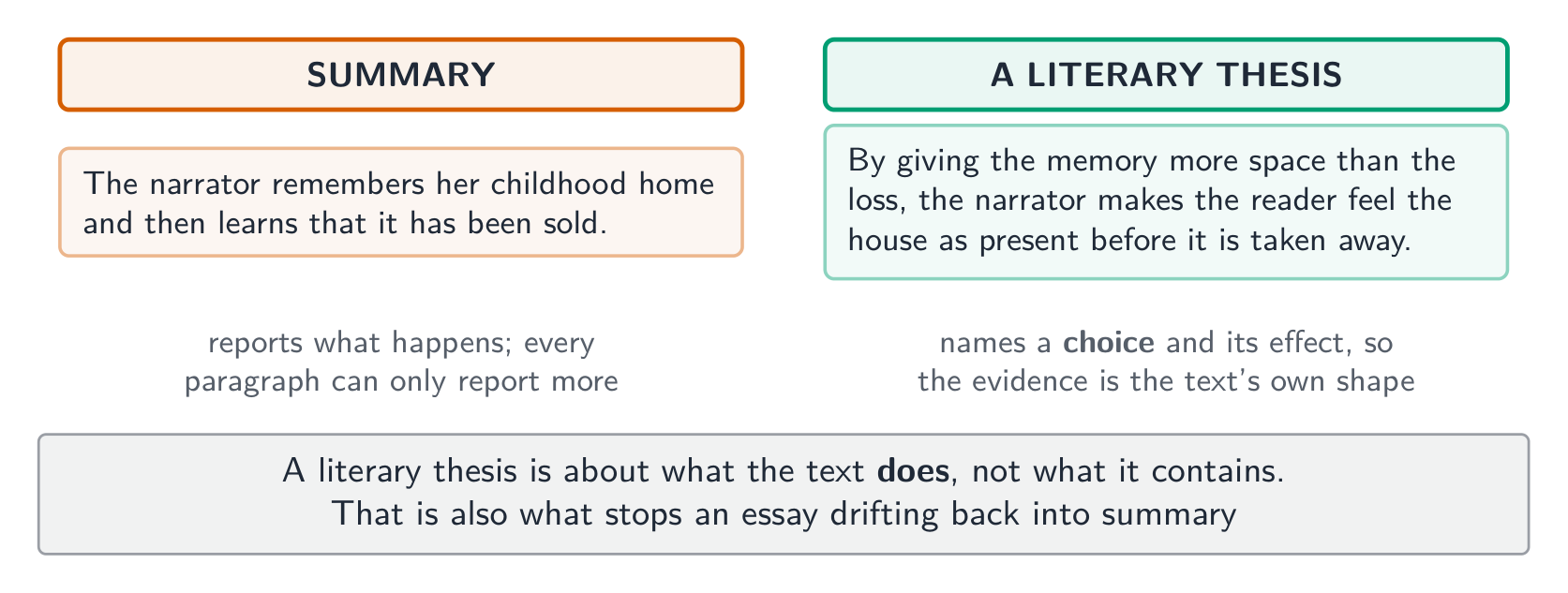
    文学的 thesis はテキストが含まるものではなく、何を行うものに関するものです
    Explore · ⁨探索⁩

    Sort summary from a literary thesis · ⁨要約と文学的 Thesis を分けよ⁩

    A literary thesis is about what the text does, not what it contains — which is also what stops an essay drifting into summary. · ⁨文学的 Thesis はテキストが何をするかについてであり、含まれる内容についてはではない — これはまたエッセイが要約に流れるのを防ぐものである。⁩

    3.8

    Developing Commentary · ⁨commentary の発展⁩

    Syllabus · ⁨シラバス⁩
    English

    Enduring Understanding (LAN-1): Readers establish and communicate their interpretations of literature through arguments supported by textual evidence.

    Learning Objective 7.C: Develop commentary that establishes and explains relationships among textual evidence, the line of reasoning, and the thesis.

    • LAN-1.F A line of reasoning is the logical sequence of claims that work together to defend the overarching thesis statement.
    • LAN-1.G A line of reasoning is communicated through commentary that explains the logical relationship between the overarching thesis statement and the claims/evidence within the body of an essay.
    日本語

    持続的理解(LAN-1): 読者は、テキストの証拠で裏付けられた議論を通じて、文学作品の解釈を確立し伝達する。

    学習目標 7.C: テキストの証拠、論理の道筋、およびテーゼとの間の関係を確立して説明する解説を作成する。

    • LAN-1.F 論理の道筋とは、包括的なテーゼステートメントを防御するために協力して機能する主張の論理的な順序です。
    • LAN-1.G 論理の道筋は、包括的なテーゼステートメントとエッセイの本文に含まれる主張/証拠との間の論理的関係を説明する解説を通じて伝達されます。

    Source: College Board AP Course and Exam Description · ⁨出典: College Board AP コースおよび試験説明書⁩

    English
    • A line of reasoning 推理线索 is the logical sequence of claims that together defend the overarching thesis.
    • It is communicated through commentary explaining the logical relationship between evidence and claim.
    日本語
    • 推理線(line of reasoning)は、包括的な thesis を守るための主張の論理的な系列です。
    • 証拠と主張との間の論理的関係について説明する commentaryを通じて伝えられます。
    Vocabulary · ⁨語彙⁩ Train · ⁨練習する⁩
    English 日本語
    line of reasoning/laɪn ɒv ˈriːzənɪŋ/ 推論の道筋
    3.9

    Selecting Relevant and Sufficient Evidence · ⁨関連性があり十分である証拠の選定⁩

    Syllabus · ⁨シラバス⁩
    English

    Enduring Understanding (LAN-1): Readers establish and communicate their interpretations of literature through arguments supported by textual evidence.

    Learning Objective 7.D: Select and use relevant and sufficient evidence to both develop and support a line of reasoning.

    • LAN-1.H Writers use evidence strategically and purposefully to illustrate, clarify, exemplify, associate, amplify, or qualify a point.
    • LAN-1.I Evidence is effective when the writer of the essay uses commentary to explain a logical relationship between the evidence and the claim.
    • LAN-1.J Evidence is sufficient when its quantity and quality provide apt support for the line of reasoning.
    • LAN-1.K Developing and supporting an interpretation of a text is a recursive process; an interpretation can emerge from analyzing evidence and then forming a line of reasoning, or the interpretation can emerge from forming a line of reasoning and then identifying relevant evidence to support that line of reasoning.
    日本語

    持続的理解(LAN-1): 読者は、テキストの証拠で裏付けられた議論を通じて、文学作品の解釈を確立し伝達する。

    学習目標 7.D: 論理の道筋を展開し支援するために、関連して十分十分な証拠を選定して使用する。

    • LAN-1.H 作家は、点を示し、明瞭にし、例示し、関連付け、拡大し、または限定するために、戦略的かつ意図的に証拠を使用します。
    • LAN-1.I エッセイの著者が解説を用いて証拠と主張との間の論理的関係を説明する場合、証拠は効果的です。
    • LAN-1.J 証拠の量と質が論理の道筋に対して適切な支援を提供する場合、それは十分です。
    • LAN-1.K テキストの解釈を展開し支援することは反復的プロセスです。解釈は、証拠を分析してから論理の道筋を形成することから生まれる也可能れば、論理の道筋を形成してからそれを支持するための関連する証拠を特定することから生まれることもあります。

    Source: College Board AP Course and Exam Description · ⁨出典: College Board AP コースおよび試験説明書⁩

    English
    • Writers use evidence strategically - to illustrate, clarify, exemplify, associate, or amplify.
    • Evidence is effective when commentary explains its logical relationship to the claim.
    • Evidence is sufficient when its quantity and quality provide apt support.
    • Developing an interpretation is a recursive process: an interpretation can emerge, and change, as you read and write.

    That last point is permission worth taking. If your reading changes while you draft, revise the thesis to match it.

    日本語
    • 作家は証拠を戦略的に使用します - 例示、明確化、具体例の提示、関連付け、または拡大のためです。
    • commentary が証拠と主張との間の論理的関係を説明している場合、証拠は効果的です。
    • 証拠の量と質が適切な支援を提供している場合、証拠は十分です。
    • 解釈を発展させることは反復的なプロセスです: 読みながら書きながら、解釈が生まれたり、変化したりすることがあります。

    最後の点は、取り入れる価値のある許可です。ドラフト中に読解が変わった場合は、それに合わせて thesis を修正してください。

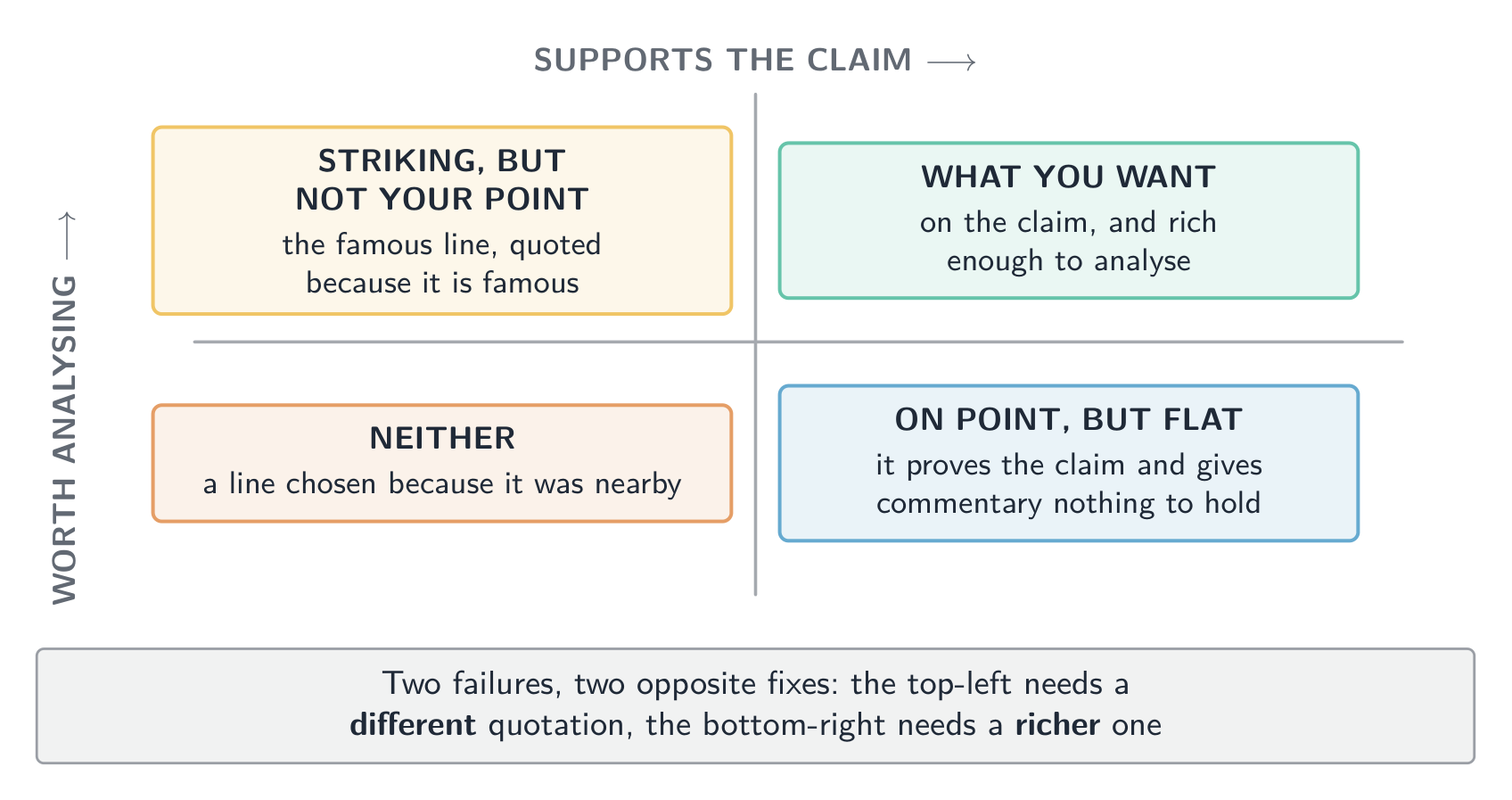
    2つの失敗に対する2つの相反する解決策:異なる引用文、あるいはより豊かな引用文
    3.10

    Control Over the Elements of Composition · ⁨作文要素への統制⁩

    Syllabus · ⁨シラバス⁩
    English

    Enduring Understanding (LAN-1): Readers establish and communicate their interpretations of literature through arguments supported by textual evidence.

    Learning Objective 7.E: Demonstrate control over the elements of composition to communicate clearly.

    • LAN-1.L Grammar and mechanics that follow established conventions of language allow writers to clearly communicate their interpretation of a text.
    日本語

    持続的理解(LAN-1): 読者は、テキストの証拠で裏付けられた議論を通じて、文学作品の解釈を確立し伝達する。

    学習目標 7.E: 構成要素を統制することで、明確にコミュニケーションを行うことを示す。

    • LAN-1.L 言語の確立された慣習に従った文法と記号法は、作家がテキストの解釈を明確に伝えることを可能にします。

    Source: College Board AP Course and Exam Description · ⁨出典: College Board AP コースおよび試験説明書⁩

    English

    Grammar and mechanics that follow established conventions allow writers to communicate clearly. On this exam, control of language is not a separate mark but a condition of the others: an unclear sentence cannot deliver commentary a reader can credit.

    Worked example (a real AP exam task). A Question 3 literary-argument prompt asks you to choose a work and analyse how a character's conflict contributes to an interpretation of the work as a whole. A weak answer narrates the plot around the conflict. A scoring answer identifies competing values and lets them intersect: "The protagonist's external conflict with his family over the inheritance is heightened by an internal one: he wants the independence the money would buy, and he wants to remain the son who never asked for it. Because the two conflicts share a single object, resolving either resolves neither - which is why the novel ends with a choice that satisfies no one, including him." Two conflicts, named as values, and an interpretation of the whole.

    日本語

    確立された慣習に従う文法と機械的要素は、作家が明確にコミュニケーションできるようにします。 この試験において、言語の統制は別個の得点項目ではなく、他の項目のための条件です:不明瞭な文は、読者が信頼できる commentary を提供することはできません。

    実演例(実際の AP 試験課題)。 Q3 の文学的論証問題では、作品を選び、キャラクターの葛藤が作品全体の解釈にどのように寄与するかを分析することを求められます。弱い回答は、葛藤を中心にプロットを叙述します。採点される回答は、競合する価値観を特定し、それらが交差するようにします:「主人公の家族との相続に関する外部の葛藤は、内部の葛藤によって激化しています。彼は金で買える独立を望み、同時に彼が決して要求しなかった息子であり続けることを望んでいます。2つの葛藤が単一の対象を共有しているため、どちらかを解決しても、どちらも解決されない - それが小説が誰にも満足しない選択で終わる理由です」。2つの葛藤、価値観として名付けられ、全体としての解釈。

    3.10

    Exam tips · ⁨試験対策⁩

    English
    • Inactions reveal motive. What a character declines to do is often the strongest evidence available.
    • The unchanged character is the measure by which change in others becomes visible.
    • Setting now includes the social and historical situation - it supplies the constraint that makes choices meaningful.
    • Conflict is between competing values, not merely between people. Name the values.
    • An event matters only if you can say what it does to the conflict or to a character. Otherwise it is plot summary.
    • A thesis must state an interpretation, not what happens. Summary cannot be defended.
    日本語
    • 無作為は動機を明らかにします。キャラクターが行わないことが、利用可能な最も強力な証拠であることが多いです。
    • 変化しないキャラクターは、他者の変化が可視になるための尺度です。
    • 舞台設定には現在、社会的および歴史的状況が含まれており、選択が意味を持つようにする制約を提供します。
    • 葛藤は人々同士ではなく、競合する価値観の間です。価値観の名前を挙げてください。
    • 出来事が重要なのは、それが葛藤やキャラクターに対して何を行うかを言える場合のみです。そうでなければ、それはプロットの要約です。
    • thesis は解釈を述べるべきであり、何が起こっているかを述べるべきではありません。要約は防御できません。
  • 4

    Short Fiction II · ⁨短編小説 II⁩

    Watch lesson · ⁨レッスンを視聴⁩
    4.1

    What Textual Details Reveal About a Character · ⁨本文のディテールがキャラクターについて何を明らかにするか⁩

    Syllabus · ⁨シラバス⁩
    English

    Enduring Understanding (CHR-1): Characters in literature allow readers to study and explore a range of values, beliefs, assumptions, biases, and cultural norms represented by those characters.

    Learning Objective 1.A: Identify and describe what specific textual details reveal about a character, that character’s perspective, and that character’s motives.

    • CHR-1.O The significance of characters is often revealed through their agency and through nuanced descriptions.
    • CHR-1.P Characters’ choices—in speech, action, and inaction— reveal what they value.
    日本語

    永続的理解 (CHR-1): 文学作品中の登場人物は、その人物が表す多様な価値観、信念、前提、偏見、文化的規範について、読者が研究・探求するための手段となる。

    学習目標 1.A: 特定の文本的细节が、登場人物、その人物の視点、およびその人物の動機について何を明らかにしているかを特定・記述する。

    • CHR-1.O キャラクターの重要性は、その主体性や微妙な描写を通じてしばしば明らかにされる。
    • CHR-1.P キャラクターの選択(言語、行動、および無作為)は、彼らが何を重視しているかを明らかにする。

    Source: College Board AP Course and Exam Description · ⁨出典: College Board AP コースおよび試験説明書⁩

    English

    Unit 4 returns to short fiction with a much larger toolkit. Its two most valuable additions are narrative distance and the idea that choices reveal values.

    • The significance of characters is often revealed through their agency 能动性 and through nuanced descriptions.
    • Characters' choices - in speech, action, and inaction - reveal what they value.

    That second statement is the most practical sentence in the whole course for essay-writing. Whenever you need a claim about a character, look at a choice and ask what it must be true for that choice to have made sense to them.

    日本語

    Unit 4 は、はるかに多くのツールキットを備えた短編小説に戻ります。その中で最も価値のある追加要素は、物語の距離(narrative distance) と、選択が価値観を明らかにするという概念です。

    • キャラクターの意義は、しばしばその能動的性(agency) および微妙な描写を通じて明らかにされます。
    • キャラクターの選択 - 言葉、行動、そして無作為において - は、彼らが何を重視しているかを明らかにします。

    この二つ目の文は、エッセイ執筆において最も実用的な文である。キャラクターに関する主張を立てる際は、そのキャラクターにとってその選択が合理に感じられるために何が必要であったかを問い、その選択の背景にある前提を探るべきである。

    Vocabulary · ⁨語彙⁩ Train · ⁨練習する⁩
    English 日本語
    agency/ˈeɪdʒənsi/ 主体性
    Narrative distance/ˈnærətɪv ˈdɪstəns/ 物語の距離感
    4.2

    The Function of Contrasting Characters · ⁨対照的なキャラクターの機能⁩

    Syllabus · ⁨シラバス⁩
    English

    Enduring Understanding (CHR-1): Characters in literature allow readers to study and explore a range of values, beliefs, assumptions, biases, and cultural norms represented by those characters.

    Learning Objective 1.C: Explain the function of contrasting characters.

    • CHR-1.Q The main character in a narrative is the protagonist; the antagonist in the narrative opposes the protagonist and may be another character, the internal conflicts of the protagonist, a collective (such as society), or nature.
    • CHR-1.R Protagonists and antagonists may represent contrasting values.
    日本語

    永続的理解 (CHR-1): 文学作品中の登場人物は、その人物が表す多様な価値観、信念、前提、偏見、文化的規範について、読者が研究・探求するための手段となる。

    学習目標 1.C: 対照的なキャラクターの機能を説明する。

    • CHR-1.Q 物語における主人公はプロタゴニストであり、アンチゴニストはプロタゴニストに対立し、別のキャラクター、プロタゴニストの内的葛藤、集団(社会など)、または自然であることができる。
    • CHR-1.R プロタゴニストとアンチゴニストは対照的な価値観を代表することがある。

    Source: College Board AP Course and Exam Description · ⁨出典: College Board AP コースおよび試験説明書⁩

    English
    • The main character is the protagonist 主人公; the antagonist 对立者 opposes them.
    • Protagonists and antagonists may represent contrasting values.

    The word may is doing careful work. An antagonist is not necessarily a villain; the strongest antagonists hold a value the reader can also recognise as good, which is why the conflict is a conflict rather than a rout.

    日本語
    • メインキャラクターは**主人公(protagonist)**であり、対立者(antagonist) はそれを反对します。
    • プロタゴニストとアンチゴニストは対立する価値を象徴することがある。

    単語 may は慎重な役割を果たしています。対立者は必ずしも悪役とは限りません;最強の対立者は、読者も善であると認識できる価値観を持っています。そのため、対立は敗北ではなく対立となります。

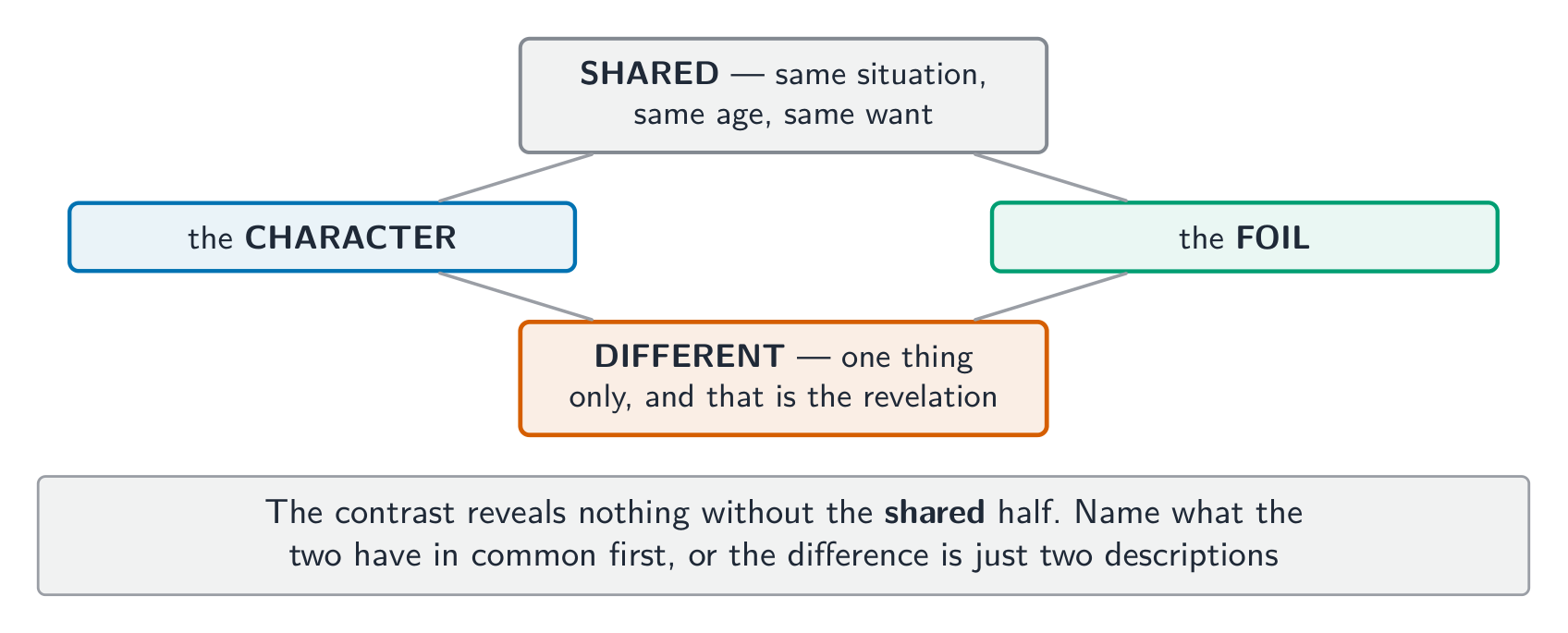
    共有された半分なしでは対照は何も明かしません - まずそれを名付けてください
    Vocabulary · ⁨語彙⁩ Train · ⁨練習する⁩
    English 日本語
    protagonist/ˈprəʊtəɡənɪst/ 主人公
    antagonist/ænˈtæɡənɪst/ 敵役
    4.3

    Nuances in Characters' Relationships · ⁨キャラクター間の関係における微妙な点⁩

    Syllabus · ⁨シラバス⁩
    English

    Enduring Understanding (CHR-1): Characters in literature allow readers to study and explore a range of values, beliefs, assumptions, biases, and cultural norms represented by those characters.

    Learning Objective 1.D: Describe how textual details reveal nuances and complexities in characters’ relationships with one another.

    • CHR-1.S Conflict among characters often arises from tensions generated by their different value systems.
    日本語

    永続的理解 (CHR-1): 文学作品中の登場人物は、その人物が表す多様な価値観、信念、前提、偏見、文化的規範について、読者が研究・探求するための手段となる。

    学習目標 1.D: テキストの詳細がキャラクター間の関係にどのような微妙さと複雑さを表しているかを説明する。

    • CHR-1.S キャラクター間の対立は、多くの場合、異なる価値観体系によって引き起こされる緊張から生まれる。

    Source: College Board AP Course and Exam Description · ⁨出典: College Board AP コースおよび試験説明書⁩

    English

    Conflict among characters often arises from tensions generated by their different value systems.

    This is Unit 3's definition applied to relationships. Two characters in a long-running disagreement usually disagree about something prior to the argument they are having.

    日本語

    キャラクター間の葛藤は、しばしば異なる価値観体系によって生じる緊張から発生します。

    これは、Unit 3 の定義を関係に適用したものです。長い間対立している2人のキャラクターは、通常、現在の議論以前のものについて異なっています。

    4.4

    The Function of Setting in a Narrative · ⁨物語における舞台設定の機能⁩

    Syllabus · ⁨シラバス⁩
    English

    Enduring Understanding (SET-1): Setting and the details associated with it not only depict a time and place, but also convey values associated with that setting.

    Learning Objective 2.B: Explain the function of setting in a narrative.

    • SET-1.C A setting may help establish the mood and atmosphere of a narrative.
    日本語

    永続的理解 (SET-1): 舞台設定とそれに付随する细节は、単に時代と場所を描くだけでなく、その舞台設定に関連する価値観も伝える。

    学習目標 2.B: 物語における舞台設定の機能を説明する。

    • SET-1.C 舞台設定は物語のムードや雰囲気を作り出すのに役立つことがある。

    Source: College Board AP Course and Exam Description · ⁨出典: College Board AP コースおよび試験説明書⁩

    English

    A setting may help establish the mood and atmosphere of a narrative.

    Mood is the reader's feeling; atmosphere is the quality the text creates around events. Both are produced by selection - which details of a place the text mentions, and which it does not.

    日本語

    舞台設定は、物語のムードと雰囲気确立に役立つことがあります。

    ムードは読者の感覚であり、雰囲気はテキストが出来事周囲に生成する品質です。両方とも選択によって生成されます - テキストが場所のどの詳細を言及し、どの詳細を言及しないかです。

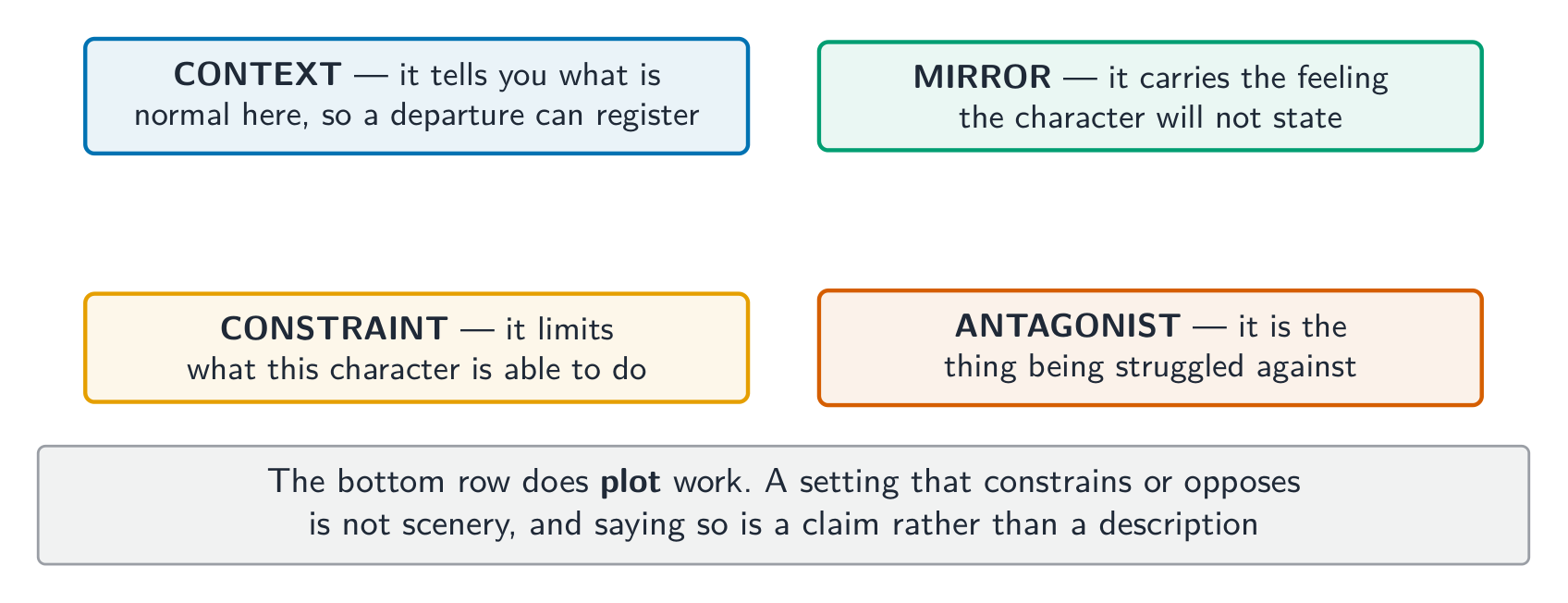
    舞台設定は4つの仕事を行い、下段はプロット作業を行います
    Explore · ⁨探索⁩

    Sort each setting into the job it is doing · ⁨各舞台設定が果たす役割で分類せよ⁩

    The bottom two do plot work: a setting that constrains or opposes a character is not scenery. · ⁨下二つはプロット上の役割を果たす: 人物を制限したり反対したりする舞台は単なる背景ではない。⁩

    4.5

    The Relationship Between Character and Setting · ⁨キャラクターと舞台設定の関係⁩

    Syllabus · ⁨シラバス⁩
    English

    Enduring Understanding (SET-1): Setting and the details associated with it not only depict a time and place, but also convey values associated with that setting.

    Learning Objective 2.C: Describe the relationship between a character and a setting.

    • SET-1.D The environment a character inhabits provides information about that character.
    日本語

    永続的理解 (SET-1): 舞台設定とそれに付随する细节は、単に時代と場所を描くだけでなく、その舞台設定に関連する価値観も伝える。

    学習目標 2.C: キャラクターと舞台設定の関係を説明する。

    • SET-1.D キャラクターが住む環境は、そのキャラクターに関する情報を提供する。

    Source: College Board AP Course and Exam Description · ⁨出典: College Board AP コースおよび試験説明書⁩

    English

    The environment a character inhabits provides information about that character.

    This is a second route into character that avoids the trap of psychologising. A room described through its neglect, its order, or its borrowed furniture tells you about the person who lives there, and it is textual evidence rather than speculation.

    日本語

    キャラクターが住む環境は、そのキャラクターに関する情報を提供します。

    これは、心理学的な罠を避けるためのキャラクターへの別のアプローチです。放置、秩序、あるいは借りた家具によって描写された部屋は、そこに住む人物について語り、それは推測ではなくテキスト上の証拠です。

    4.6

    How Plot Orders Events · ⁨物語の順序付け方⁩

    Syllabus · ⁨シラバス⁩
    English

    Enduring Understanding (STR-1): The arrangement of the parts and sections of a text, the relationship of the parts to each other, and the sequence in which the text reveals information are all structural choices made by a writer that contribute to the reader’s interpretation of a text.

    Learning Objective 3.A: Identify and describe how plot orders events in a narrative.

    • STR-1.R Some patterns in dramatic situations are so common that they are considered archetypes, and these archetypes create certain expectations for how the dramatic situations will progress and be resolved. Note: For the exam, students are not expected to identify or label archetypes.
    日本語

    永続的理解 (STR-1): テキストの構成部分とセクションの配置、各部分同士の関係、そしてテキストが情報を開示する順序は、すべて作家による構造的選択であり、これらは読者によるテキストの解釈に寄与する。

    学習目標 3.A: プロットが物語における出来事をどのように並べ替えているかを特定・記述する。

    • STR-1.R 劇的状況には非常に一般的なパターンがあり、これらはアーキタイプとみなされ、これらのアーキタイプは劇的状況がどのように進行し解決されるかについての特定の期待を生み出す。注:試験において、学生はアーキタイプを特定または命名する必要はない。

    Source: College Board AP Course and Exam Description · ⁨出典: College Board AP コースおよび試験説明書⁩

    English

    Some patterns in dramatic situations are so common that they are considered archetypes 原型, and these archetypes carry associations readers bring with them.

    Use archetypes carefully: recognising one is a starting point, and the interesting analysis is almost always where a text departs from the pattern it invoked.

    日本語

    劇的な状況におけるいくつかのパターンは非常に一般的であり、原型(archetypes) と見なされ、これらの原型は読者が持ち込む連想を含みます。

    原型を慎重に使用してください:一つを認識することは始まりであり、興味深い分析は、ほとんど常に、テキストがそのパターンから逸脱するところにあります。

    Vocabulary · ⁨語彙⁩ Train · ⁨練習する⁩
    English 日本語
    archetypes/ˈɑːkɪtaɪps/ 原型
    4.7

    The Function of Contrasts Within a Text

    Syllabus · ⁨シラバス⁩
    English

    Enduring Understanding (STR-1): The arrangement of the parts and sections of a text, the relationship of the parts to each other, and the sequence in which the text reveals information are all structural choices made by a writer that contribute to the reader’s interpretation of a text.

    Learning Objective 3.D: Explain the function of contrasts within a text.

    • STR-1.S The differences highlighted by a contrast emphasize the particular traits, aspects, or characteristics important for comparison of the things being contrasted.
    • STR-1.T Contrasts often represent conflicts in values related to character, narrator, or speaker perspectives on ideas represented by a text.
    日本語

    永続的理解 (STR-1): テキストの構成部分とセクションの配置、各部分同士の関係、そしてテキストが情報を開示する順序は、すべて作家による構造的選択であり、これらは読者によるテキストの解釈に寄与する。

    学習目標 3.D: テキスト内の対比の機能を説明する。

    • STR-1.S 対比によって強調される違いは、対比されるものの比較に重要な特定の属性、側面、または特徴を強調する。
    • STR-1.T 対比は、テキストによって表される考えに対するキャラクター、語り手、または話者の視点に関連する価値観の対立を表すことが多くある。

    Source: College Board AP Course and Exam Description · ⁨出典: College Board AP コースおよび試験説明書⁩

    English
    • The differences highlighted by a contrast emphasise particular traits or characteristics in the things contrasted.
    • Contrasts often represent conflicts in values related to character, narrator, or speaker perspectives.
    日本語
    • 対照によって強調される違いは、対照されるものの特定の属性や特徴を強調します。
    • 対照は、キャラクター、語り手、または話者の視点に関連する価値観の対立を表すことが多いです。
    4.8

    Identifying the Narrator or Speaker · ⁨語り手または話し手の特定⁩

    Syllabus · ⁨シラバス⁩
    English

    Enduring Understanding (NAR-1): A narrator’s or speaker’s perspective controls the details and emphases that affect how readers experience and interpret a text.

    Learning Objective 4.A: Identify and describe the narrator or speaker of a text.

    • NAR-1.J Narrators may function as characters in the narrative who directly address readers and either recall events or describe them as they occur.
    日本語

    永続的理解 (NAR-1): 叙述者または話者の視点は、読者がテキストを体験し解釈する方法に影響を与える细节と強調を統制する。

    学習目標 4.A: テキストの叙述者または話者を特定・記述する。

    • NAR-1.J 語り手は物語内で読者に直接呼びかけ、出来事を回顧するか、発生している様子を記述するキャラクターとして機能することがある。

    Source: College Board AP Course and Exam Description · ⁨出典: College Board AP コースおよび試験説明書⁩

    English

    Narrators may function as characters who directly address readers, and who either recall events or relate them as they occur.

    That distinction - recalling versus relating as they occur - is the first axis of narrative distance below.

    日本語

    語り手は物語の登場人物として機能し、読者直接向けに話しかけることができ、また出来事を回想したり、あるいはその場で伝達したりする。

    「回想する」か「その場で伝達するか」という区別が、以下で扱う語りの距離の最初の軸となる。

    4.9

    The Function of Point of View · ⁨叙述视点の機能⁩

    Syllabus · ⁨シラバス⁩
    English

    Enduring Understanding (NAR-1): A narrator’s or speaker’s perspective controls the details and emphases that affect how readers experience and interpret a text.

    Learning Objective 4.B: Identify and explain the function of point of view in a narrative.

    • NAR-1.K Narrative distance refers to the physical distance, chronological distance, relationships, or emotional investment of the narrator to the events or characters of the narrative.
    • NAR-1.L Stream of consciousness is a type of narration in which a character’s thoughts are related through a continuous dialogue or description.
    日本語

    永続的理解 (NAR-1): 叙述者または話者の視点は、読者がテキストを体験し解釈する方法に影響を与える细节と強調を統制する。

    学習目標 4.B: 物語における視点の位置の機能を特定し説明する。

    • NAR-1.K ナラティブ・ディスタンスとは、語り手が物語の出来事やキャラクターに対して持つ物理的距離、時間的距離、関係性、あるいは感情的な関与を指す。
    • NAR-1.L ストリーム・オブ・コンシャスネスとは、キャラクターの思考が連続した対話や記述を通じて語られるような叙述の種類である。

    Source: College Board AP Course and Exam Description · ⁨出典: College Board AP コースおよび試験説明書⁩

    English
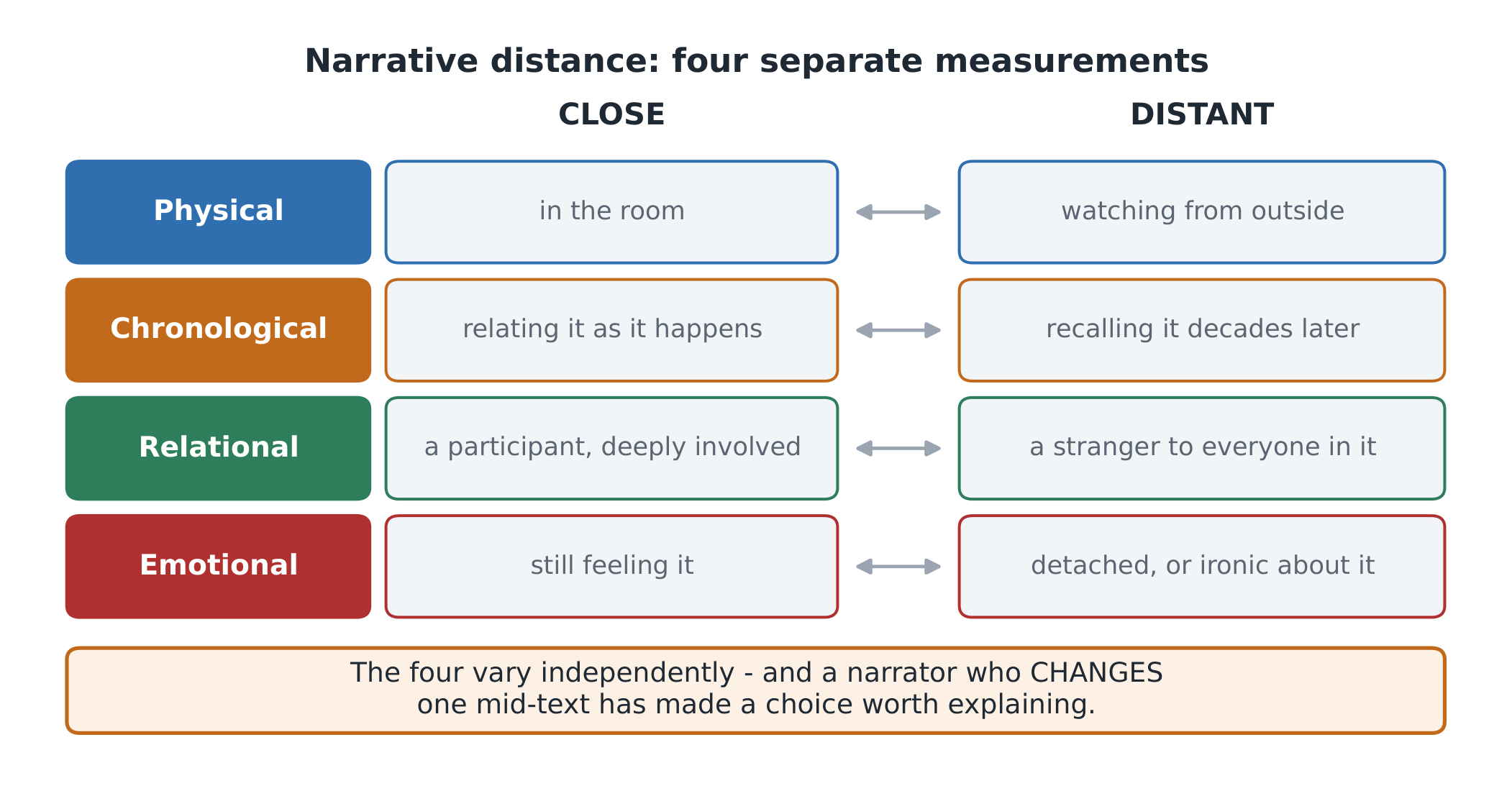
    • Narrative distance 叙述距离 refers to the physical distance, chronological distance, relationships, or emotional distance between the narrator and the events or characters.
    • Stream of consciousness 意识流 is narration in which a character's thoughts are related through a continuous flow, often with little conventional ordering.

    Narrative distance is the most powerful and least-used tool in this course. A narrator recounting their childhood forty years later is chronologically distant, and that distance supplies irony the child could not have had. Reduce the distance - a narrator relating events as they occur - and the irony vanishes, replaced by immediacy and unreliability.

    日本語
    語り手と出来事との間の四つの距離 - それぞれが選択である
    語り手の立場は一つの事実ではなく四つあり、どの一つでも分析の対象となり得る
    • 語りの距離(Narrative distance)とは、語り手と出来事や登場人物との間の物理的距離、時間的距離、関係性、または感情的距離を指す。
    • **意識流(Stream of consciousness)**とは、登場人物の思考が連続した流れの中で伝達される叙述であり、しばしば従来の順序付けはほとんど行われない。

    語りの距離は、このコースにおける最も強力だが最も用いられない道具である。四十年前の出来事を振り返って語る語り手は時間的に遠く離れており、その距離が子供にはあり得なかった皮肉を生み出す。距離を縮め - 出来事をその場で伝達する語り手 - と、皮肉は消え去り、緊迫感と信頼性の欠如に置き換わる。

    Vocabulary · ⁨語彙⁩ Train · ⁨練習する⁩
    English 日本語
    Stream of consciousness/striːm ɒv ˈkɒnʃəsnəs/ 意識の流れ
    4.10

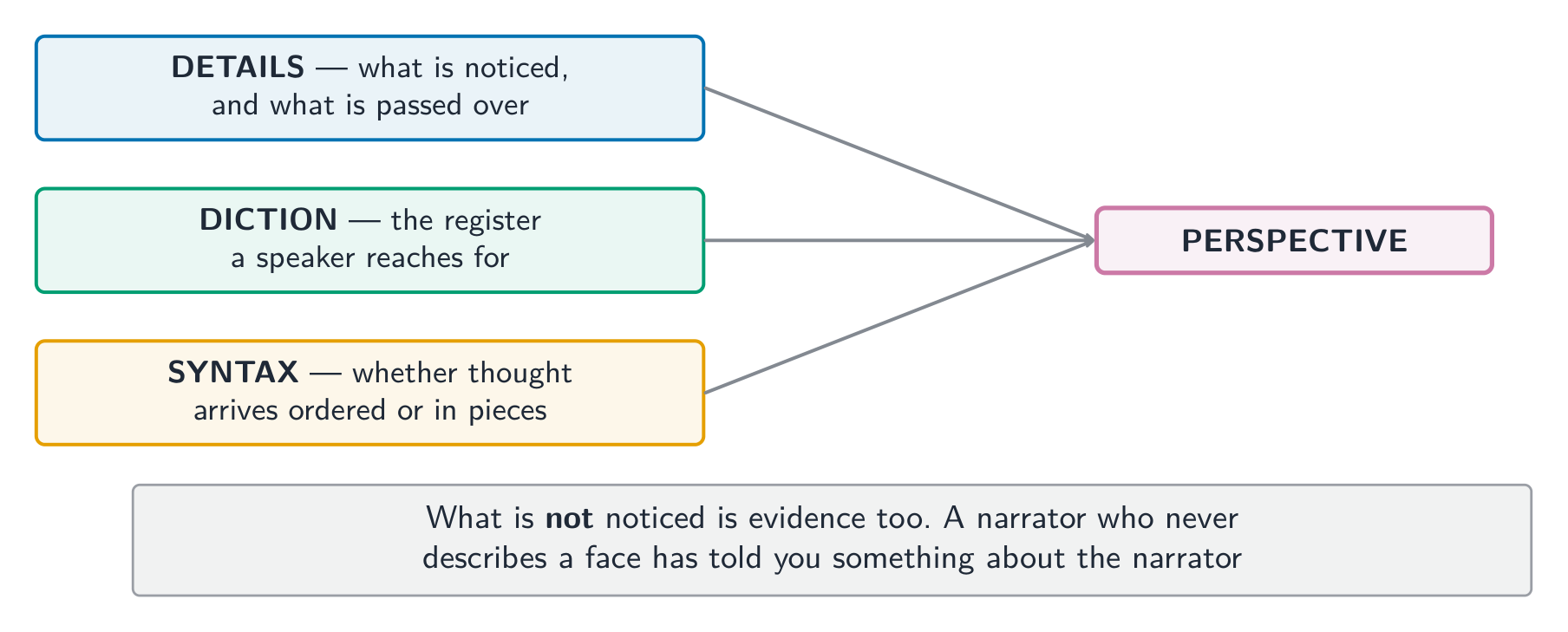
    Details, Diction, and Syntax Reveal Perspective · ⁨詳細、語彙、文法構造による視点の露出⁩

    Syllabus · ⁨シラバス⁩
    English

    Enduring Understanding (NAR-1): A narrator’s or speaker’s perspective controls the details and emphases that affect how readers experience and interpret a text.

    Learning Objective 4.C: Identify and describe details, diction, or syntax in a text that reveal a narrator’s or speaker’s perspective.

    • NAR-1.M The narrators’, characters’, or speakers’ backgrounds and perspectives shape the tone they convey about subjects or events in the text.
    • NAR-1.N Descriptive words, such as adjectives and adverbs, not only qualify or modify the things they describe but also convey a perspective toward those things.
    • NAR-1.O The attitude of narrators, characters, or speakers toward an idea, character, or situation emerges from their perspective and may be referred to as tone.
    日本語

    永続的理解 (NAR-1): 叙述者または話者の視点は、読者がテキストを体験し解釈する方法に影響を与える细节と強調を統制する。

    学習目標 4.C: 物語語り手や話者の視点を示すテキスト内の詳細、語彙、または文法構造を特定し説明する。

    • NAR-1.M 語り手の背景やキャラクター、話者の背景や視点は、テキスト内の対象や出来事に対するトーンを形成する。
    • NAR-1.N 形容詞や副詞のような形容詞的表現は、単に描写対象を限定・修飾するだけでなく、それらに対する視点も伝える。
    • NAR-1.O 語り手、キャラクター、または話者の考え、キャラクター、あるいは状況に対する態度は、彼らの視点から生じ、トーンとして呼ばれることがある。

    Source: College Board AP Course and Exam Description · ⁨出典: College Board AP コースおよび試験説明書⁩

    English
    • Narrators' and characters' backgrounds and perspectives shape the tone they convey.
    • Descriptive words not only qualify what they describe but convey a perspective toward it.
    • The attitude of a narrator or speaker toward an idea, character, or situation emerges from these choices.
    日本語
    • 語り手や登場人物の背景や視点は、彼らが伝えるトーンを形作る。
    • 形容詞的な言葉は、単に描写対象を限定するだけでなく、それに対する視点も伝達する。
    • 語り手や話者がある概念、登場人物、または状況に対して持つ態度は、これらの選択から浮かび上がる。
    視点は三つの観察可能な要素から構築される - かつ、気づかれなかったことも含意する
    Explore · ⁨探索⁩

    Build a perspective from three observables · ⁨三つの観察可能事象から視点を構築せよ⁩

    What is not noticed is evidence too: a narrator who never describes a face has told you something. · ⁨注意されなかったことも証拠である: 顔 NEVER 描写しない語り手が何かを教えてくれた。⁩

    4.11

    Developing a Literary Thesis Statement · ⁨文学的テーゼステートメントの構築⁩

    Syllabus · ⁨シラバス⁩
    English

    Enduring Understanding (LAN-1): Readers establish and communicate their interpretations of literature through arguments supported by textual evidence.

    Learning Objective 7.B: Develop a thesis statement that conveys a defensible claim about an interpretation of literature and that may establish a line of reasoning.

    • LAN-1.D A thesis statement expresses an interpretation of a literary text, and requires a defense, through use of textual evidence and a line of reasoning, both of which are explained in an essay through commentary.
    • LAN-1.E A thesis statement may preview the development or line of reasoning of an interpretation. This is not to say that a thesis statement must list the points of an interpretation, literary elements to be analyzed, or specific evidence to be used in the argument.
    日本語

    持続的理解(LAN-1): 読者は、テキストの証拠で裏付けられた議論を通じて、文学作品の解釈を確立し伝達する。

    学習目標 7.B: 文学の解釈に対する正当な主張を伝え、かつ論理の道筋を確立する可能性のあるテーゼステートメントを作成する。

    • LAN-1.D テーゼ文は文学作品の解釈を表し、エッセイの中で解説によって説明文と推論の系によって守られる必要がある。
    • LAN-1.E テーゼステートメントは、解釈の展開や論理の道筋を予見することがあります。これは、テーゼステートメントが解釈のポイント、分析されるべき文学的要素、または議論で用いられる具体的な証拠をリストアップしなければならないという意味ではありません。

    Source: College Board AP Course and Exam Description · ⁨出典: College Board AP コースおよび試験説明書⁩

    English

    Unchanged: a thesis expresses an interpretation and requires textual defence; it may preview the line of reasoning.

    日本語

    変更なし:论点は解釈を表現するものであり、本文による防御が必要であり、論理の道筋を予示することもある。

    4.12

    Developing Commentary · ⁨commentary の発展⁩

    Syllabus · ⁨シラバス⁩
    English

    Enduring Understanding (LAN-1): Readers establish and communicate their interpretations of literature through arguments supported by textual evidence.

    Learning Objective 7.C: Develop commentary that establishes and explains relationships among textual evidence, the line of reasoning, and the thesis.

    • LAN-1.F A line of reasoning is the logical sequence of claims that work together to defend the overarching thesis statement.
    • LAN-1.G A line of reasoning is communicated through commentary that explains the logical relationship between the overarching thesis statement and the claims/evidence within the body of an essay.
    • LAN-1.M The body paragraphs of a written argument develop the reasoning and justify claims using evidence and providing commentary that links the evidence to the overall thesis.
    • LAN-1.N Effective paragraphs are cohesive and often use topic sentences to state a claim and explain the reasoning that connects the various claims and evidence that make up the body of an essay.
    日本語

    持続的理解(LAN-1): 読者は、テキストの証拠で裏付けられた議論を通じて、文学作品の解釈を確立し伝達する。

    学習目標 7.C: テキストの証拠、論理の道筋、およびテーゼとの間の関係を確立して説明する解説を作成する。

    • LAN-1.F 論理の道筋とは、包括的なテーゼステートメントを防御するために協力して機能する主張の論理的な順序です。
    • LAN-1.G 論理の道筋は、包括的なテーゼステートメントとエッセイの本文に含まれる主張/証拠との間の論理的関係を説明する解説を通じて伝達されます。
    • LAN-1.M 書かれた議論の本文段落は、証拠を用いて推論を発展させ主張を正当化し、証拠を全体的なテーゼ文に結びつける解説を提供する。
    • LAN-1.N 効果的な段落は統合されており、テーマセンテンスを使用して主張を述べて、エッセイの本文を構成するさまざまな主張と証拠をつなぐ推論を説明することが多い。

    Source: College Board AP Course and Exam Description · ⁨出典: College Board AP コースおよび試験説明書⁩

    English
    • A line of reasoning is the logical sequence of claims defending the thesis, communicated through commentary.
    • Body paragraphs develop the reasoning and justify claims using evidence.
    • Effective paragraphs are cohesive and often use topic sentences 主题句 to state a claim and explain the reasoning.
    日本語
    • **論理の道筋(line of reasoning)**とは、论点を支持する主張の論理的な順序であり、**解説(commentary)**を通じて伝達される。
    • 本論段落は、証拠を用いて論理を発展させ、主張を正当化する。
    • 効果的な段落は**一貫性(cohesive)を持ち、多くはテーマ.entry(topic sentences)**を使用して主張を述べて論理を説明する。
    Vocabulary · ⁨語彙⁩ Train · ⁨練習する⁩
    English 日本語
    topic sentences/ˈtɒpɪk ˈsentənsɪz/ トピック文
    4.13

    Selecting Relevant and Sufficient Evidence · ⁨関連性があり十分である証拠の選定⁩

    Syllabus · ⁨シラバス⁩
    English

    Enduring Understanding (LAN-1): Readers establish and communicate their interpretations of literature through arguments supported by textual evidence.

    Learning Objective 7.D: Select and use relevant and sufficient evidence to both develop and support a line of reasoning.

    • LAN-1.H Writers use evidence strategically and purposefully to illustrate, clarify, exemplify, associate, amplify, or qualify a point.
    • LAN-1.I Evidence is effective when the writer of the essay uses commentary to explain a logical relationship between the evidence and the claim.
    • LAN-1.J Evidence is sufficient when its quantity and quality provide apt support for the line of reasoning.
    • LAN-1.K Developing and supporting an interpretation of a text is a recursive process; an interpretation can emerge from analyzing evidence and then forming a line of reasoning, or the interpretation can emerge from forming a line of reasoning and then identifying relevant evidence to support that line of reasoning.
    日本語

    持続的理解(LAN-1): 読者は、テキストの証拠で裏付けられた議論を通じて、文学作品の解釈を確立し伝達する。

    学習目標 7.D: 論理の道筋を展開し支援するために、関連して十分十分な証拠を選定して使用する。

    • LAN-1.H 作家は、点を示し、明瞭にし、例示し、関連付け、拡大し、または限定するために、戦略的かつ意図的に証拠を使用します。
    • LAN-1.I エッセイの著者が解説を用いて証拠と主張との間の論理的関係を説明する場合、証拠は効果的です。
    • LAN-1.J 証拠の量と質が論理の道筋に対して適切な支援を提供する場合、それは十分です。
    • LAN-1.K テキストの解釈を展開し支援することは反復的プロセスです。解釈は、証拠を分析してから論理の道筋を形成することから生まれる也可能れば、論理の道筋を形成してからそれを支持するための関連する証拠を特定することから生まれることもあります。

    Source: College Board AP Course and Exam Description · ⁨出典: College Board AP コースおよび試験説明書⁩

    English

    Same four points as Unit 3: evidence used strategically; effective when commentary explains the relationship; sufficient in quantity and quality; and interpretation as a recursive process.

    日本語

    ユニット3と同じ四つのポイント:証拠は戦略的に使用され、解説が関係を説明している場合に効果的であり、量と質において十分であり、解釈は**反復的(recursive)**なプロセスであること。

    4.14

    Control Over the Elements of Composition · ⁨作文要素への統制⁩

    Syllabus · ⁨シラバス⁩
    English

    Enduring Understanding (LAN-1): Readers establish and communicate their interpretations of literature through arguments supported by textual evidence.

    Learning Objective 7.E: Demonstrate control over the elements of composition to communicate clearly.

    • LAN-1.O Coherence occurs at different levels in a piece of writing. In a sentence, the idea in one clause logically links to an idea in the next. In a paragraph, the idea in one sentence logically links to an idea in the next. In a text, the ideas in one paragraph logically link to the ideas in the next.
    • LAN-1.P Writers achieve coherence when the arrangement and organization of reasons, evidence, ideas, or details is logical. Writers may use transitions, repetition, synonyms, pronoun references, or parallel structure to indicate relationships between and among those reasons, evidence, ideas, or details.
    日本語

    持続的理解(LAN-1): 読者は、テキストの証拠で裏付けられた議論を通じて、文学作品の解釈を確立し伝達する。

    学習目標 7.E: 構成要素を統制することで、明確にコミュニケーションを行うことを示す。

    • LAN-1.O 一貫性は書き物の異なるレベルで生じる。文中では、ある節の考えが次の節の考えと論理的に接続する。段落内では、ある文の考えが次の文の考えと論理的に接続する。テキスト全体では、ある段落の考えが次の段落の考えと論理的に接続する。
    • LAN-1.P 著者は、理由、証拠、考え、または詳細の配置と組織が論理的であることで一貫性を達成する。著者は、これらの理由、証拠、考え、または詳細間の関係を示すために、接続詞、反復、同義語、代名詞の参照、または平行構造を使用することができる。

    Source: College Board AP Course and Exam Description · ⁨出典: College Board AP コースおよび試験説明書⁩

    English

    Coherence occurs at different levels - within a sentence, between sentences, across the essay - and writers achieve it when the arrangement of reasons, evidence, and details makes the line of reasoning followable.

    Worked example (a real AP exam task). A prose fiction prompt asks how the author's narrative choices convey the narrator's attitude to a remembered event. A weak answer: "The narrator is nostalgic and uses descriptive language." A scoring answer uses narrative distance: "The narrator relates a single afternoon from a distance of decades, and the distance is doing the work: he describes his own excitement in the third person - 'the boy ran' - before returning to 'I' for the disappointment. Choosing where to close the chronological gap lets him withhold sympathy from his younger self while claiming the loss as his own." Distance, its variation, and the attitude it produces.

    日本語

    整合性(coherence)は異なるレベルで生じる - 文の内部、文と文の間、論文全体を通して - 著者が理由、証拠、詳細の配置によって論理の道筋を追跡可能にするときに達成される。

    ** worked example (実際のAP試験課題)。** 散文小説のプロンプトで、作者の語りの選択が語り手の記憶された出来事への態度をどう伝えるかを問う。弱かった回答:「語り手は懐かしさを感じており、形容詞的な言語を使っている。」採点された回答は語りの距離を用いる:「語り手は数十年という距離から単一の午後を伝達しており、その距離自体が役割を果たしている。彼は自分の興奮を三人称で記述する - 'the boy ran' - 之后、失望については'I'に戻っている。時間的ギャップをどこで埋めるかを選択することで、幼少期自分への同情を控える一方で、喪失を自身のものとしたとしている。」距離、その変動、そしてそこから生まれる態度。

    4.14

    Exam tips · ⁨試験対策⁩

    English
    • Choices reveal values. Ask what must have been true for the choice to make sense to that character.
    • An antagonist is not a villain. The strongest hold a value the reader can also recognise as good.
    • The environment tells you about the character - and it is textual evidence, not speculation.
    • Archetypes are a starting point. The analysis is where the text departs from the pattern.
    • Narrative distance has four kinds - physical, chronological, relational, emotional. It is the most underused tool here.
    • A narrator who closes or opens the distance mid-text has made a choice. Say what it produces.
    日本語
    • 選択は価値観を露わにする。 その選択がそのキャラクターにとって意味を持つために何が必要だったかを問いかけよ。
    • 敵対者(antagonist)は悪役ではない。 最も強いキャラクターは、読者にも善として認識できる価値観を持っている。
    • 環境はキャラクターについて教えてくれる - それは本文の証拠であり、推測ではない。
    • アーキタイプは出発点に過ぎない。分析こそが、本文がパターンから逸脱する地点である。
    • 語りの距離には四つの種類がある - 物理的、時間的、关系的、情緒的。ここでは最も用いられにくい道具である。
    • 文中で距離を縮めたり広げたりする語り手は選択を行った。それが何を産み出したかを述べよ。
  • 5

    Poetry II · ⁨詩歌 II⁩

    Watch lesson · ⁨レッスンを視聴⁩
    5.1

    The Function of Structure in a Text

    Syllabus · ⁨シラバス⁩
    English

    Enduring Understanding (STR-1): The arrangement of the parts and sections of a text, the relationship of the parts to each other, and the sequence in which the text reveals information are all structural choices made by a writer that contribute to the reader’s interpretation of a text.

    Learning Objective 3.C: Explain the function of structure in a text.

    • STR-1.U Closed forms of poetry include predictable patterns in the structure of lines, stanzas, meter, and rhyme, which develop relationships among ideas in the poem. Note: The AP Exam will not require students to label or identify specific rhyme schemes, metrical patterns, or forms of poetry.
    • STR-1.V Open forms of poetry may not follow expected or predictable patterns in the structure of their lines or stanzas, but they may still have structures that develop relationships between ideas in the poem.
    • STR-1.W Structures combine in texts to emphasize certain ideas and concepts.
    日本語

    永続的理解 (STR-1): テキストの構成部分とセクションの配置、各部分同士の関係、そしてテキストが情報を開示する順序は、すべて作家による構造的選択であり、これらは読者によるテキストの解釈に寄与する。

    学習目標 3.C: テキストにおける構造の機能を説明する。

    • STR-1.U 閉じた詩の形式には、行、連、リズム、韻の構造における予測可能なパターンが含まれており、これらは詩内の考え間の関係を発展させる。注:AP試験では、学生は特定の韻律、リズムのパターン、または詩の形式を特定または命名することを要求されない。
    • STR-1.V 開いた詩の形式は、行や連の構造における予想されるまたは予測可能なパターンに従わないかもしれないが、詩内の考え間の関係を発展させる構造を持つことはあり得る。
    • STR-1.W 構造はテキスト内で組み合わさり、特定の考えや概念を強調するために用いられる。

    Source: College Board AP Course and Exam Description · ⁨出典: College Board AP コースおよび試験説明書⁩

    English

    Unit 5 is the second poetry unit, and it does two things: it names the forms a poem can take, and it completes the figurative toolkit.

    • Closed forms 格律诗体 include predictable patterns in lines, stanzas, metre, and rhyme.
    • Open forms 自由诗体 may not follow expected or predictable patterns.
    • Structures combine in texts to emphasise certain ideas.

    The examinable question is never "which form is this?" but what the form does. In a closed form, the interesting moment is the departure - the line that runs long, the rhyme that fails to arrive. In an open form, the interesting moment is the imposition - the sudden regularity in a poem that has refused it.

    日本語

    ユニット5は二番目の詩の単位であり、二つのことを行う:それは詩が取れうる**形式(forms)**を命名し、比喩的ツールのセットを完成させる。

    • 閉鎖的形式(Closed forms)は、行、詩節、メトローム、韻において予測可能なパターンを含む。
    • **開放的形式(Open forms)**は、予想されるまたは予測可能なパターンに従わないことがある。
    • 構造はテキスト内で組み合わさり、特定のアイデアを強調する。

    受験問題は「これはどのような形式か?」ではなく、形式が何をするかである。閉鎖的形式では、興味深い瞬間は逸脱 - 長い行、失敗した韻 - である。開放的形式では、興味深い瞬間は強制 - 拒絶を続けてきた诗中での突然の整然とした規則性 - である。

    Vocabulary · ⁨語彙⁩ Train · ⁨練習する⁩
    English 日本語
    Closed forms/kləʊzd fɔːmz/ 閉じた形式
    Open forms/ˈəʊpən fɔːmz/ 開いた形式
    5.2

    Literal and Figurative Meaning · ⁨字義的および比喩的意味⁩

    Syllabus · ⁨シラバス⁩
    English

    Enduring Understanding (FIG-1): Comparisons, representations, and associations shift meaning from the literal to the figurative and invite readers to interpret a text.

    Learning Objective 5.A: Distinguish between the literal and figurative meanings of words and phrases.

    • FIG-1.L Words with multiple meanings or connotations add nuance or complexity that can contribute to interpretations of a text.
    日本語

    持続的理解(FIG-1): 比較、表現、連想は意味を字義から比喩へと移行させ、読者にテキストの解釈を促す。

    学習目標 5.A: 言葉や句の文字通りの意味と比喩的意味を区別する。

    • FIG-1.L 複数の意味や連想を持つ言葉は、解釈にニュアンスや複雑さを加えることができる。

    Source: College Board AP Course and Exam Description · ⁨出典: College Board AP コースおよび試験説明書⁩

    English

    Words with multiple meanings or connotations add nuance or complexity that can contribute to interpretation.

    In poetry, a word that could mean two things frequently means both. Resist choosing.

    日本語

    複数の意味や連想を持つ言葉は、解釈に寄与しうる微妙さや複雑さを加える。

    詩において、二つの意味を取りうる言葉はしばしば両方を意味する。どちらかを選ぶことへの抵抗を示せ。

    5.3

    The Function of Specific Words and Phrases

    Syllabus · ⁨シラバス⁩
    English

    Enduring Understanding (FIG-1): Comparisons, representations, and associations shift meaning from the literal to the figurative and invite readers to interpret a text.

    Learning Objective 5.B: Explain the function of specific words and phrases in a text.

    • FIG-1.M Descriptive words, such as adjectives and adverbs, qualify or modify the things they describe and affect readers’ interaction with the text.
    • FIG-1.N Hyperbole exaggerates while understatement minimizes. Exaggerating or minimizing an aspect of an object focuses attention on that trait and conveys a perspective about the object.
    日本語

    持続的理解(FIG-1): 比較、表現、連想は意味を字義から比喩へと移行させ、読者にテキストの解釈を促す。

    学習目標 5.B: テキスト内の特定の単語や句の機能を説明する。

    • FIG-1.M 形容詞や副詞などの修飾語は、説明対象を限定したり修正したりし、読者がテキストと関わる際に影響を与える。
    • FIG-1.N 誇張は強調し、過小評価は縮小させる。ある側面を誇張または縮小することで、その特徴への注意を集中させ、対象に対する見解を伝える。

    Source: College Board AP Course and Exam Description · ⁨出典: College Board AP コースおよび試験説明書⁩

    English
    • Descriptive words qualify or modify what they describe and affect how the reader perceives it.
    • Hyperbole 夸张 exaggerates while understatement 低调陈述 minimises. Exaggerating or minimising an aspect of a thing has an effect on how it is understood.

    Understatement is the more powerful of the pair and the more often missed by second-language readers. A poem that describes a catastrophe as inconvenient is not being calm; the gap between the event and the word is the poem's whole comment on it.

    日本語
    • 形容詞的な言葉は、描写対象を限定・修飾するとともに、読者がそれを如何に知覚するかにも影響を与える。
    • **夸张(Hyperbole)**は誇張する一方、**低调陈述(understatement)**は最小限に留める。ある側面を誇張したり最小限に留めたりすることは、それがどのように理解されるかに効果をもたらす。

    低调陈述はペアの中でより強力であり、第二言語読者に最も見逃されやすい。災害をinconvenient(不便な)として記述する詩は冷静であるわけではなく、出来事と言葉との間のギャップこそが、詩全体の評論である。

    Vocabulary · ⁨語彙⁩ Train · ⁨練習する⁩
    English 日本語
    Hyperbole/haɪˈpɜːbəli/ 誇張法(Hyperbole)
    understatement/ˌʌndəˈsteɪtmənt/ understatement(控えめな表現)
    contribute to sensory imagery/kənˈtrɪbjuːt tə ˈsensəri ˈɪmɪdʒri/ 感覚的イメージに寄与する
    extended metaphor/ekˈstendɪd ˈmetəfɔː/ 拡張されたメタファー
    5.4

    The Function of an Image or Imagery · ⁨映像やイメージの機能⁩

    Syllabus · ⁨シラバス⁩
    English

    Enduring Understanding (FIG-1): Comparisons, representations, and associations shift meaning from the literal to the figurative and invite readers to interpret a text.

    Learning Objective 5.D: Identify and explain the function of an image or imagery.

    • FIG-1.O Descriptive words, such as adjectives and adverbs, contribute to sensory imagery.
    • FIG-1.P An image can be literal or it can be a form of a comparison that represents something in a text through associations with the senses.
    • FIG-1.Q A collection of images, known as imagery, may emphasize ideas in parts of or throughout a text.
    日本語

    持続的理解(FIG-1): 比較、表現、連想は意味を字義から比喩へと移行させ、読者にテキストの解釈を促す。

    学習目標 5.D: 画像やイメージの機能を特定し説明する。

    • FIG-1.O 形容詞や副詞などの修飾語は、感覚的なイメージの形成に寄与する。
    • FIG-1.P 画像は文字通りのものであることもあれば、感覚との関連性を通じてテキスト内の何かを表す比較の一種であることもある。
    • FIG-1.Q イメージという一連の画像は、テキストの一部全体における理念の強調に寄与することがある。

    Source: College Board AP Course and Exam Description · ⁨出典: College Board AP コースおよび試験説明書⁩

    English
    • Descriptive words contribute to sensory imagery 感官意象.
    • An image can be literal, or a form of comparison representing something through another thing.
    • A collection of images - imagery - may emphasise ideas in parts of, or throughout, a text.

    The plural matters. A single image is a detail; a pattern of images running through a poem is a claim the poem is making without stating it.

    日本語
    Poetry IIの技法 - それぞれが読者に何をするか順に分類
    技法の名前を述べるだけでは何の価値もない。それが読者に何をするかを述べるのが分析である
    • 形容詞的な言葉は**感覚的イメージ(sensory imagery)**に寄与する。
    • イメージ(image)は字義的也可以是、別の事物を通じて何かを表す比較の一種也可以是。
    • イメージの集まり(イマジェリー)は、テキストの一部や全体において概念を強調することができる。

    単数形と複数形の区別が重要である。一つのイメージは「ディテール」に過ぎないが、詩全体を通じて反復されるイメージのパターンは、詩が明示せずとも主張していることとなる。

    象徴は読者によって作られるのではなく、テキストによって作られる
    Explore · ⁨探索⁩

    Image or symbol? Apply the test · ⁨イメージか象徴か? テストを適用せよ⁩

    A symbol is made by the text, not by the reader: the test is whether the text returns to it and gives it weight it does not need. · ⁨象徴は読者によって作られるのではなくテキストによって作られる: テストとは、テキストがそれを再び取り上げ、必要以上の重みを与えているかどうかである。⁩

    5.5

    The Function of a Metaphor

    Syllabus · ⁨シラバス⁩
    English

    Enduring Understanding (FIG-1): Comparisons, representations, and associations shift meaning from the literal to the figurative and invite readers to interpret a text.

    Learning Objective 6.B: Identify and explain the function of a metaphor.

    • FIG-1.R Metaphorical comparisons do not focus solely on the objects being compared; they focus on the particular traits, qualities, or characteristics of the things being compared.
    • FIG-1.S Comparisons not only communicate literal meaning but may also convey figurative meaning or transmit a perspective.
    • FIG-1.T An extended metaphor is created when the comparison of a main subject and comparison subject persists through parts of or an entire text, and when the comparison is expanded through additional details, similes, and images.
    • FIG-1.U Interpretation of an extended metaphor may depend on the context of its use; that is, what is happening in a text may determine what is transferred in the comparison.
    日本語

    持続的理解(FIG-1): 比較、表現、連想は意味を字義から比喩へと移行させ、読者にテキストの解釈を促す。

    学習目標 6.B: 隠喩の機能を特定し説明する。

    • FIG-1.R 隠喩による比較は、単に比較対象となる物体に焦点を当てるのではなく、比較されるものの特定の性質、特性、特徴に焦点を当てる。
    • FIG-1.S 比較は文字通りの意味を伝達するだけでなく、比喩的意味を伝えたり、見解を共有したりすることもある。
    • FIG-1.T 主要な主題と比較対象の比較が、テキストの一部全体にわたって持続し、追加の詳細、明喻、およびイメージによって拡張される場合、延長された隠喩が生成される。
    • FIG-1.U 延長された隠喩の解釈は使用文脈に依存することがあります。つまり、テキスト内で何が起こっているかが、比較で転送される内容を決めることがある。

    Source: College Board AP Course and Exam Description · ⁨出典: College Board AP コースおよび試験説明書⁩

    English
    • Metaphorical comparisons do not focus solely on the objects compared; they focus on the particular qualities the comparison brings out.
    • Comparisons communicate literal meaning and may also convey figurative meaning.
    • An extended metaphor 延伸隐喻 is created when the comparison of a main subject and comparison subject persists across a passage or a whole text.
    • Interpretation of an extended metaphor may depend on the context of its use.

    An extended metaphor is the most rewarding thing to find in an unseen poem, because it gives you structure and meaning at once: you can trace how the comparison develops, and a comparison that changes as it extends is the poem's argument in motion.

    日本語
    • 比喩的な比較は、比較対象となる物体そのものにのみ焦点を当てるわけではない。それは、比較によって浮き彫りにされた特定の性質に焦点を当てるものである。
    • 比較は文字通りの意味を伝達し、同時に比喩的な意味も伝えることがある。
    • 延長比喩は、主要な主題と比較対象との関係が一節や作品全体にわたって継続するときに成立する。
    • 延長比喩の解釈は、その使用文脈に依存することがある。

    延長比喩は未読の詩で発見できる最も価値のある要素の一つである。なぜなら、構造と意味を同時に提供してくれるからである:比較が発展していく様を追跡でき、変化する延長比喩こそが、詩の論理が動き出している状態そのものだからだ。

    5.6

    The Function of Personification · ⁨擬人化の機能⁩

    Syllabus · ⁨シラバス⁩
    English

    Enduring Understanding (FIG-1): Comparisons, representations, and associations shift meaning from the literal to the figurative and invite readers to interpret a text.

    Learning Objective 6.C: Identify and explain the function of personification.

    • FIG-1.V Personification is a type of comparison that assigns a human trait or quality to a nonhuman object, entity, or idea, thus characterizing that object, entity, or idea.
    日本語

    持続的理解(FIG-1): 比較、表現、連想は意味を字義から比喩へと移行させ、読者にテキストの解釈を促す。

    学習目標 6.C: 擬人化の機能を特定し説明する。

    • FIG-1.V 擬人化とは、非人間のもの、実体、概念に人間の特性や属性を与え、それらを人物化する比較の一種である。

    Source: College Board AP Course and Exam Description · ⁨出典: College Board AP コースおよび試験説明書⁩

    English

    Personification 拟人 is a type of comparison that assigns a human trait or quality to a nonhuman object, animal, or idea.

    Treat it as a comparison with the same parts as any other: the main subject is the nonhuman thing, the comparison subject is a person, and the transferred quality is the human trait. Then ask the useful question - what does granting this thing agency do? A wind that decides is not the same claim as a wind that blows.

    日本語

    擬人化とは、非人間の物体、動物、あるいは抽象的概念に人間特有の属性や性質を割り当てる比較の一種である。

    他のどの比較と同じように、この手法も同じ構成要素を持つとみなす:主要な主題は非人間のもののことであり、比較対象は人間であり、移転された性質は人間特有の属性である。そして、有益な質問を投げかける——この主体性(能動性)を与えることは何をもたらすか? 決断する風と、単に吹く風では、示唆する内容が全く異なる。

    '物体に命を与えている'という定義——第三列は解説である
    Vocabulary · ⁨語彙⁩ Train · ⁨練習する⁩
    English 日本語
    Personification/pɜːˈsɒnɪfɪkeɪʃn/ 擬人法(Personification)
    Allusions/əˈluːʒnz/ 典拠
    5.7

    The Function of an Allusion · ⁨典故の機能⁩

    Syllabus · ⁨シラバス⁩
    English

    Enduring Understanding (FIG-1): Comparisons, representations, and associations shift meaning from the literal to the figurative and invite readers to interpret a text.

    Learning Objective 6.D: Identify and explain the function of an allusion.

    • FIG-1.W Allusions in a text can reference literary works including myths and sacred texts; other works of art including paintings and music; or people, places, or events outside the text.
    日本語

    持続的理解(FIG-1): 比較、表現、連想は意味を字義から比喩へと移行させ、読者にテキストの解釈を促す。

    学習目標 6.D: 典拠の機能を特定し説明する。

    • FIG-1.W テキスト中の典拠は、神話や聖書などの文学作品、絵画や音楽などの芸術作品、あるいはテキスト外の人物、場所、出来事などを参照することができる。

    Source: College Board AP Course and Exam Description · ⁨出典: College Board AP コースおよび試験説明書⁩

    English

    Allusions 典故 may reference literary works including myths and sacred texts, other works of art, and historical events.

    An allusion imports meaning the poem has not written. That is its efficiency and its risk: it works only for readers who recognise it. When you meet one you do not know, say what the poem does with it structurally - where it is placed, what it interrupts - rather than pretending to a recognition you lack.

    日本語

    典故は、神話や聖典を含む文学作品、その他の芸術作品、歴史的出来事などを参照することがある。

    典故は、詩自体が書き記していない意味を作品に持ち込む。これがその効率さであり、かつリスクでもある:これはそれを認識した読者に対してのみ機能する。もし自分には分からない典故に出会ったら、自分の認識を偽るのではなく、構造的にどのような役割を果たしているかを述べる——どこに配置されているか、何を中断しているか——这样。

    典故は状況と判断を持ち込み、また代償も伴う)
    Explore · ⁨探索⁩

    Take an allusion past the source · ⁨出典を超えて暗示を解釈する⁩

    Naming the source is not the analysis. An allusion imports a situation and a judgement, and it costs something as well. · ⁨出典を名指すことは分析ではない。暗示は状況と判断を持ち込み、また何らかのコストも伴う。⁩

    5.8

    Developing a Literary Thesis Statement · ⁨文学的テーゼステートメントの構築⁩

    Syllabus · ⁨シラバス⁩
    English

    Enduring Understanding (LAN-1): Readers establish and communicate their interpretations of literature through arguments supported by textual evidence.

    Learning Objective 7.B: Develop a thesis statement that conveys a defensible claim about an interpretation of literature and that may establish a line of reasoning.

    • LAN-1.D A thesis statement expresses an interpretation of a literary text, and requires a defense, through use of textual evidence and a line of reasoning, both of which are explained in an essay through commentary.
    • LAN-1.E A thesis statement may preview the development or line of reasoning of an interpretation. This is not to say that a thesis statement must list the points of an interpretation, literary elements to be analyzed, or specific evidence to be used in the argument.
    日本語

    持続的理解(LAN-1): 読者は、テキストの証拠で裏付けられた議論を通じて、文学作品の解釈を確立し伝達する。

    学習目標 7.B: 文学の解釈に対する正当な主張を伝え、かつ論理の道筋を確立する可能性のあるテーゼステートメントを作成する。

    • LAN-1.D テーゼ文は文学作品の解釈を表し、エッセイの中で解説によって説明文と推論の系によって守られる必要がある。
    • LAN-1.E テーゼステートメントは、解釈の展開や論理の道筋を予見することがあります。これは、テーゼステートメントが解釈のポイント、分析されるべき文学的要素、または議論で用いられる具体的な証拠をリストアップしなければならないという意味ではありません。

    Source: College Board AP Course and Exam Description · ⁨出典: College Board AP コースおよび試験説明書⁩

    English

    Unchanged: an interpretation requiring textual defence, which may preview the line of reasoning.

    日本語

    変更なし:テキストによる裏付けが必要な解釈であり、推論の方向性を予期させることが可能である。

    5.9

    Developing Commentary · ⁨commentary の発展⁩

    Syllabus · ⁨シラバス⁩
    English

    Enduring Understanding (LAN-1): Readers establish and communicate their interpretations of literature through arguments supported by textual evidence.

    Learning Objective 7.C: Develop commentary that establishes and explains relationships among textual evidence, the line of reasoning, and the thesis.

    • LAN-1.F A line of reasoning is the logical sequence of claims that work together to defend the overarching thesis statement.
    • LAN-1.G A line of reasoning is communicated through commentary that explains the logical relationship between the overarching thesis statement and the claims/evidence within the body of an essay.
    日本語

    持続的理解(LAN-1): 読者は、テキストの証拠で裏付けられた議論を通じて、文学作品の解釈を確立し伝達する。

    学習目標 7.C: テキストの証拠、論理の道筋、およびテーゼとの間の関係を確立して説明する解説を作成する。

    • LAN-1.F 論理の道筋とは、包括的なテーゼステートメントを防御するために協力して機能する主張の論理的な順序です。
    • LAN-1.G 論理の道筋は、包括的なテーゼステートメントとエッセイの本文に含まれる主張/証拠との間の論理的関係を説明する解説を通じて伝達されます。

    Source: College Board AP Course and Exam Description · ⁨出典: College Board AP コースおよび試験説明書⁩

    English

    A line of reasoning is the logical sequence of claims defending the thesis, communicated through commentary explaining the relationship between evidence and claim.

    日本語

    推論の道筋とは、提言を防御するための論理的な主張の系列であり、証拠と主張の間の関係を説明する解説を通じて伝達される。

    5.10

    Selecting Relevant and Sufficient Evidence · ⁨関連性があり十分である証拠の選定⁩

    Syllabus · ⁨シラバス⁩
    English

    Enduring Understanding (LAN-1): Readers establish and communicate their interpretations of literature through arguments supported by textual evidence.

    Learning Objective 7.D: Select and use relevant and sufficient evidence to both develop and support a line of reasoning.

    • LAN-1.H Writers use evidence strategically and purposefully to illustrate, clarify, exemplify, associate, amplify, or qualify a point.
    • LAN-1.I Evidence is effective when the writer of the essay uses commentary to explain a logical relationship between the evidence and the claim.
    • LAN-1.J Evidence is sufficient when its quantity and quality provide apt support for the line of reasoning.
    • LAN-1.K Developing and supporting an interpretation of a text is a recursive process; an interpretation can emerge from analyzing evidence and then forming a line of reasoning, or the interpretation can emerge from forming a line of reasoning and then identifying relevant evidence to support that line of reasoning.
    日本語

    持続的理解(LAN-1): 読者は、テキストの証拠で裏付けられた議論を通じて、文学作品の解釈を確立し伝達する。

    学習目標 7.D: 論理の道筋を展開し支援するために、関連して十分十分な証拠を選定して使用する。

    • LAN-1.H 作家は、点を示し、明瞭にし、例示し、関連付け、拡大し、または限定するために、戦略的かつ意図的に証拠を使用します。
    • LAN-1.I エッセイの著者が解説を用いて証拠と主張との間の論理的関係を説明する場合、証拠は効果的です。
    • LAN-1.J 証拠の量と質が論理の道筋に対して適切な支援を提供する場合、それは十分です。
    • LAN-1.K テキストの解釈を展開し支援することは反復的プロセスです。解釈は、証拠を分析してから論理の道筋を形成することから生まれる也可能れば、論理の道筋を形成してからそれを支持するための関連する証拠を特定することから生まれることもあります。

    Source: College Board AP Course and Exam Description · ⁨出典: College Board AP コースおよび試験説明書⁩

    English

    Evidence used strategically, effective with commentary, sufficient in quantity and quality, and interpretation as a recursive process.

    日本語

    戦略的に用いられ、解説と共に効果的であり、量と質において十分である証拠、および再帰的プロセスとしての解釈。

    5.11

    Control Over the Elements of Composition · ⁨作文要素への統制⁩

    Syllabus · ⁨シラバス⁩
    English

    Enduring Understanding (LAN-1): Readers establish and communicate their interpretations of literature through arguments supported by textual evidence.

    Learning Objective 7.E: Demonstrate control over the elements of composition to communicate clearly.

    • LAN-1.Q Transitional elements are words or other elements (phrases, clauses, sentences, or paragraphs) that assist in creating coherence between sentences and paragraphs by showing relationships between ideas.
    日本語

    持続的理解(LAN-1): 読者は、テキストの証拠で裏付けられた議論を通じて、文学作品の解釈を確立し伝達する。

    学習目標 7.E: 構成要素を統制することで、明確にコミュニケーションを行うことを示す。

    • LAN-1.Q 接続語は、文と文、段落と段落の間の関係性を示すことで、文章全体の整合性を生み出すための言葉や他の要素(句、節、文、段落など)である。

    Source: College Board AP Course and Exam Description · ⁨出典: College Board AP コースおよび試験説明書⁩

    English

    Transitional elements - words, phrases, clauses, sentences, or paragraphs - assist in creating coherence.

    Worked example (a real AP exam task). A poetry-analysis prompt asks how the poet's use of figurative language conveys the speaker's attitude. A weak answer catalogues: "The poet uses personification, imagery, and a metaphor." A scoring answer traces one device developing: "The extended comparison of the tide to a creditor runs the length of the poem, but the terms change: in the first stanza it 'asks', by the third it 'takes what was always owed'. The comparison subject stays constant while the speaker's account of the relationship hardens - so the attitude the poem conveys is not fear of loss but the recognition that the loss was never hers to prevent." One device, traced, with the attitude it produces.

    日本語

    接続的要素——言葉、句、節、文、段落など——は、整合性の構築を助ける。

    ** worked example (実際のAP試験タスク)。** 詩の分析プロンプトとして、比喩表現の使い方が語り手の態度をどのように伝えるかを問う問題がある。弱い回答は以下のようにリストアップする:「詩人は擬人化、イメージ、および比喩を使用している。」 高得点の回答は、一つの技法が発展していく様を追跡する:「潮を債権者に例えた延長比較は詩の長さ全体に渡っているが、用語は変わる。最初の四行では『頼む』が、三番目の四行では『常に借金を返す』となる。比較対象は一定のままだが、語り手が関係性を描写する語気が硬直していく——したがって、詩が伝える態度は喪失への恐怖ではなく、喪失は本来防ぐことのできるものではなかったという認識である。」 一つの技法を追跡し、そこから生まれる態度を示す。

    5.11

    Exam tips · ⁨試験対策⁩

    English
    • Never ask "which form is this?" Ask what the form does - and look for the departure or the imposition.
    • A word with two meanings often means both. Do not choose prematurely.
    • Understatement is the more powerful half of the pair, and the more often missed. The gap is the comment.
    • A pattern of images is a claim the poem makes without stating it. A single image is only a detail.
    • An extended metaphor that changes as it extends is the poem's argument in motion. Trace it.
    • Cataloguing devices earns nothing. One device traced beats four devices named.
    日本語
    • 「これはどのような形式か?」と聞くのは避けるべきである。その形式が何をするのかを問い、逸脱や強制の兆候を探すべきである。
    • 二重の意味を持つ言葉は、両方の意味を含んでいることが多い。安易に片方だけを選ぶべきではない。
    • 謙譲法( understatement ) は対のより強力な側面であり、かつ見逃されやすい。そのギャップこそが評論である。
    • イメージのパターンは、詩が明示せずとも主張することである。一つのイメージは単なるディテールに過ぎない。
    • 変化する延長比喩こそが、詩の論理が動き出している状態である。それを追跡せよ。
    • 技法を羅列しても評価は上がらない。一つ追跡された技法は、四つ名指しされた技法よりも優れている。
  • 6

    Longer Fiction or Drama II · ⁨長編小説または演劇 II⁩

    Watch lesson · ⁨レッスンを視聴⁩
    6.1

    What Textual Details Reveal About a Character · ⁨本文のディテールがキャラクターについて何を明らかにするか⁩

    Syllabus · ⁨シラバス⁩
    English

    Enduring Understanding (CHR-1): Characters in literature allow readers to study and explore a range of values, beliefs, assumptions, biases, and cultural norms represented by those characters.

    Learning Objective 1.A: Identify and describe what specific textual details reveal about a character, that character’s perspective, and that character’s motives.

    • CHR-1.T Different character, narrator, or speaker perspectives often reveal different information, develop different attitudes, and influence different interpretations of a text and the ideas in it.
    日本語

    永続的理解 (CHR-1): 文学作品中の登場人物は、その人物が表す多様な価値観、信念、前提、偏見、文化的規範について、読者が研究・探求するための手段となる。

    学習目標 1.A: 特定の文本的细节が、登場人物、その人物の視点、およびその人物の動機について何を明らかにしているかを特定・記述する。

    • CHR-1.T キャラクター、語り手、話者 viewpoints は異なる情報を明らかにし、異なる態度を発展させ、テキストおよびその理念に対する異なる解釈に影響を与えることが多々ある。

    Source: College Board AP Course and Exam Description · ⁨出典: College Board AP コースおよび試験説明書⁩

    English

    Unit 6 is the second longer-fiction-or-drama unit and it adds the two most sophisticated tools in the course: narrator reliability and the symbol.

    Different character, narrator, or speaker perspectives often reveal different information and develop different interpretations of the same events.

    In a long work with several perspectives, the discrepancies between them are not a problem to reconcile. They are the text's method.

    日本語

    ユニット6は、より長い小説やドラマを取り扱う二番目のユニットであり、本コースで最も高度なツールの二つ——信頼できる叙述者と象徴——を追加する。

    異なるキャラクター、物語話者、または語り手の視点often reveal different information and develop different interpretations of the same events.(注:原文の日本語混在部分を意図的に翻訳)異なるキャラクター、物語話者、または語り手の視点は、しばしば異なる情報を明かし、同一の出来事に対する異なる解釈を生み出す。

    複数の視点を持つ長編作品において、それらの間の乖離は解決すべき問題ではない。それこそがテキストの手法である。

    6.2

    The Function of Contrasting Characters · ⁨対照的なキャラクターの機能⁩

    Syllabus · ⁨シラバス⁩
    English

    Enduring Understanding (CHR-1): Characters in literature allow readers to study and explore a range of values, beliefs, assumptions, biases, and cultural norms represented by those characters.

    Learning Objective 1.C: Explain the function of contrasting characters.

    • CHR-1.U Foil characters (foils) serve to illuminate, through contrast, the traits, attributes, or values of another character.
    日本語

    永続的理解 (CHR-1): 文学作品中の登場人物は、その人物が表す多様な価値観、信念、前提、偏見、文化的規範について、読者が研究・探求するための手段となる。

    学習目標 1.C: 対照的なキャラクターの機能を説明する。

    • CHR-1.U フォイルキャラクター(foil)は、対照を通じて別のキャラクターの特性、属性、価値観を浮き彫りにする役割を果たす。

    Source: College Board AP Course and Exam Description · ⁨出典: College Board AP コースおよび試験説明書⁩

    English

    Foil characters 陪衬人物 serve to illuminate, through contrast, the traits, attributes, or values of another character.

    A foil is not an antagonist. A foil may be an ally, a sibling, a friend - what makes them a foil is that they are similar enough for the difference to be visible. The useful question is always: what does this character have that the protagonist lacks, and what does the text do with that gap?

    日本語

    陪衬人物(Foil characters) は、対比を通じて別のキャラクターの特性、属性、または価値観を照らし出す役割を果たす。

    陪衬人物は敵対者(アンタゴニスト)ではない。陪衬人物は味方、兄弟姉妹、友人也可以是 anything ——但它们成为陪衬人物的原因在于它们足够相似,以至于差异显而易见。有用的问题始终是:这个角色拥有什么主人公所缺乏的东西?文本如何利用这个差距?

    Vocabulary · ⁨語彙⁩ Train · ⁨練習する⁩
    English 日本語
    Foil characters/fɔɪl ˈkærɪktəz/ 対照キャラクター
    6.3

    Choices, Actions, and Speech Reveal Complexity · ⁨選択、行動、発言が複雑さを明らかにする⁩

    Syllabus · ⁨シラバス⁩
    English

    Enduring Understanding (CHR-1): Characters in literature allow readers to study and explore a range of values, beliefs, assumptions, biases, and cultural norms represented by those characters.

    Learning Objective 1.E: Explain how a character’s own choices, actions, and speech reveal complexities in that character, and explain the function of those complexities.

    • CHR-1.V Inconsistencies between the private thoughts of characters and their actual behavior reveal tensions and complexities between private and professed values.
    • CHR-1.W A character’s competing, conflicting, or inconsistent choices or actions contribute to complexity in a text.
    日本語

    永続的理解 (CHR-1): 文学作品中の登場人物は、その人物が表す多様な価値観、信念、前提、偏見、文化的規範について、読者が研究・探求するための手段となる。

    学習目標 1.E: キャラクター自身の選択、行動、発言がそのキャラクターの複雑さをどのように明らかにするかを説明し、それらの複雑さの機能を説明する。

    • CHR-1.V キャラクターの private thoughts と実際の行動との不一致は、private と公言された価値観の間の緊張と複雑さを明らかにする。
    • CHR-1.W キャラクターの競合的、対立的、または矛盾する選択や行動は、テキストに複雑さを加える。

    Source: College Board AP Course and Exam Description · ⁨出典: College Board AP コースおよび試験説明書⁩

    English
    • Inconsistencies between the private thoughts of characters and their actual behaviour reveal tensions.
    • A character's competing, conflicting, or inconsistent choices contribute to complexity.

    This is where AP Literature parts company with simpler reading. Inconsistency is not a flaw in a character; it is the evidence that the character has an interior. A character who always acts on what they think is a position, not a person.

    日本語
    • キャラクターの私的な思考と実際の行動との間の不一致は、緊張感を明らかにする。
    • キャラクターの競合する、対立する、あるいは一貫性のない選択は、複雑さに寄与する。

    ここから APリテラチュアは単純な読解とは道半ばに分かれる。一貫性のない行為はキャラクターの欠陥ではない。むしろ、そのキャラクターに内面があることの証拠である。常に自分の考えに基づいて行動する人物ではなく、一人の「人」である。

    引用可能なパターン4つ - ルブリックは断言ではなく実証を評価する
    Explore · ⁨探索⁩

    Find the quotable sign of complexity

    The rubric marks the demonstration, not the assertion — and each of these is something you can quote.

    6.4

    How Plot Orders Events · ⁨物語の順序付け方⁩

    Syllabus · ⁨シラバス⁩
    English

    Enduring Understanding (STR-1): The arrangement of the parts and sections of a text, the relationship of the parts to each other, and the sequence in which the text reveals information are all structural choices made by a writer that contribute to the reader’s interpretation of a text.

    Learning Objective 3.A: Identify and describe how plot orders events in a narrative.

    • STR-1.X Some narrative structures interrupt the chronology of a plot; such structures include flashback, foreshadowing, in medias res, and stream of consciousness.
    日本語

    永続的理解 (STR-1): テキストの構成部分とセクションの配置、各部分同士の関係、そしてテキストが情報を開示する順序は、すべて作家による構造的選択であり、これらは読者によるテキストの解釈に寄与する。

    学習目標 3.A: プロットが物語における出来事をどのように並べ替えているかを特定・記述する。

    • STR-1.X 物語構造の中にはプロットの時系列を中断するものがあり、ypes as 回想、予感、in medias res、stream of consciousness が含まれる。

    Source: College Board AP Course and Exam Description · ⁨出典: College Board AP コースおよび試験説明書⁩

    English

    Some narrative structures interrupt the chronology of a plot: flashback 倒叙, foreshadowing 伏笔, and in medias res 从中间开始.

    日本語

    一部の物語構造はプロットの時間順序を中断する:フラッシュバック(倒叙)、フーシャドーディング(伏笔)、およびイン・メディアス・レス(从中间开始)。

    6.5

    The Function of a Sequence of Events · ⁨出来事の連なりとしての機能⁩

    Syllabus · ⁨シラバス⁩
    English

    Enduring Understanding (STR-1): The arrangement of the parts and sections of a text, the relationship of the parts to each other, and the sequence in which the text reveals information are all structural choices made by a writer that contribute to the reader’s interpretation of a text.

    Learning Objective 3.B: Explain the function of a particular sequence of events in a plot.

    • STR-1.Y Narrative structures that interrupt the chronology of a plot, such as flashback, foreshadowing, in medias res, and stream of consciousness, can directly affect readers’ experiences with a text by creating anticipation or suspense or building tension.
    日本語

    永続的理解 (STR-1): テキストの構成部分とセクションの配置、各部分同士の関係、そしてテキストが情報を開示する順序は、すべて作家による構造的選択であり、これらは読者によるテキストの解釈に寄与する。

    学習目標 3.B: プロットにおける特定の出来事の連続の機能について説明する。

    • STR-1.Y 回想、予感、in medias res、stream of consciousness など、プロットの時系列を中断する物語構造は、期待や懸念を生み出したり、緊張感を高めたりすることで、読者のテキスト体験に直接影響を与えることができる。

    Source: College Board AP Course and Exam Description · ⁨出典: College Board AP コースおよび試験説明書⁩

    English

    Those interrupting structures affect the reader's experience of the narrative - what is known when, and therefore what is felt when.

    The analytical move is always to ask what the reader knows at that moment. Foreshadowing gives the reader knowledge the characters lack, which converts suspense into dread. A flashback withholds until a later point, so the earlier scenes are read twice - once in ignorance and once in retrospect.

    日本語

    これらの中断構造は、物語の読者の体験に影響を与える——何がいつ分かったか、したがって何がいつ感じられたかである。

    分析の手順は常に「その瞬間に読者が何を知っているか」を問うことにあり、 foreshadowing(先取り)は読者に登場人物にはない知識を与えることで、サスペンスを恐怖に変換する。 flashback(回想)は後ほど明かされるため、以前のシーンが二回読み解かれる——一度は無知のまま、もう一度は回顧的に。

    Answer in the third column: what a reader knows, and when
    Explore · ⁨探索⁩

    Match each device to what the reader then does

    A sequence question is about what a reader knows and when, not about the order of events.

    Vocabulary · ⁨語彙⁩ Train · ⁨練習する⁩
    English 日本語
    flashback/ˈflæʃbæk/ フラッシュバック
    foreshadowing/fɔːˈʃædəʊɪŋ/ in medias res
    in medias res/ɪn ˈmiːdiːəz rez/ in medias res(物語の中間から始める手法)
    6.6

    The Function of Contrasts Within a Text

    Syllabus · ⁨シラバス⁩
    English

    Enduring Understanding (STR-1): The arrangement of the parts and sections of a text, the relationship of the parts to each other, and the sequence in which the text reveals information are all structural choices made by a writer that contribute to the reader’s interpretation of a text.

    Learning Objective 3.D: Explain the function of contrasts within a text.

    • STR-1.Z Contrasts often represent contradictions or inconsistencies that introduce nuance, ambiguity, or contradiction into a text. As a result, contrasts make texts more complex.
    日本語

    永続的理解 (STR-1): テキストの構成部分とセクションの配置、各部分同士の関係、そしてテキストが情報を開示する順序は、すべて作家による構造的選択であり、これらは読者によるテキストの解釈に寄与する。

    学習目標 3.D: テキスト内の対比の機能を説明する。

    • STR-1.Z 対比はしばしば矛盾や不整合を表しており、テキストにニュアンス、曖昧さ、または対立をもたらす。その結果、対比はテキストをより複雑にする。

    Source: College Board AP Course and Exam Description · ⁨出典: College Board AP コースおよび試験説明書⁩

    English

    Contrasts often represent contradictions or inconsistencies that introduce nuance, ambiguity, or contradictory interpretations.

    Note the last phrase. The CED explicitly permits a text to support more than one reading. An essay that acknowledges a competing interpretation and shows why its own is better is doing exactly what the sophistication point rewards.

    日本語

    対比はしばしば矛盾や不整合を表し、ニュアンス、曖昧さ、あるいは対立する解釈を導入する。

    最後のフレーズに注目されたい。CED(評価基準)は明確に、1つのテキストが複数の読み方を支えうることを認めている。競合する解釈を認め、なぜ自身の解釈の方が優れているかを示すエッセイは、まさに洗練された点数的なポイントを獲得していることとなる。

    6.7

    Details, Diction, and Syntax Reveal Perspective · ⁨詳細、語彙、文法構造による視点の露出⁩

    Syllabus · ⁨シラバス⁩
    English

    Enduring Understanding (NAR-1): A narrator’s or speaker’s perspective controls the details and emphases that affect how readers experience and interpret a text.

    Learning Objective 4.C: Identify and describe details, diction, or syntax in a text that reveal a narrator’s or speaker’s perspective.

    • NAR-1.P The narrator’s or speaker’s tone toward events or characters in a text influences readers’ interpretation of the ideas associated with those things.
    • NAR-1.Q The syntactical arrangement of phrases and clauses in a sentence can emphasize details or ideas and convey a narrator’s or speaker’s tone.
    • NAR-1.R Information included and/or not included in a text conveys the perspective of characters, narrators, and/ or speakers.
    • NAR-1.S A narrator’s or speaker’s perspective may influence the details and amount of detail in a text and may reveal biases, motivations, or understandings.
    日本語

    永続的理解 (NAR-1): 叙述者または話者の視点は、読者がテキストを体験し解釈する方法に影響を与える细节と強調を統制する。

    学習目標 4.C: 物語語り手や話者の視点を示すテキスト内の詳細、語彙、または文法構造を特定し説明する。

    • NAR-1.P テキスト内の出来事やキャラクターに対する語り手や話者のトーンは、読者がそれらに関連する理念を解釈する方法に影響を与える。
    • NAR-1.Q 文内のフレーズや節の構文的配列は、詳細や理念を強調し、語り手や話者のトーンを伝達できる。
    • NAR-1.R テキストに含まれる情報および含まれない情報は、キャラクター、語り手、および/または話者の視点 conveying する。
    • NAR-1.S 語り手または話者の視点は、テキストにおける詳細や情報の量に影響を与えることができ、偏見、動機、あるいは理解を明らかにすることがある。

    Source: College Board AP Course and Exam Description · ⁨出典: College Board AP コースおよび試験説明書⁩

    English
    • A narrator's or speaker's tone toward events or characters influences readers' interpretations.
    • The syntactical arrangement of phrases and clauses can emphasise details or ideas.
    • Information included and not included conveys the perspective of characters and narrators.
    • A narrator's perspective may influence the details and the amount of detail in a text.
    日本語
    • 語り手や話者による出来事や登場人物への態度は、読者の解釈に影響を与える。
    • 句や節の構文上の配置は、詳細やアイデアを強調することがある。
    • 含まれる情報と含まれない情報の両方が、登場人物や語り手の視点 conveying 传递 viewpoint。
    • 語り手の視点は、テキストにおける詳細と、その詳細の量に影響を与えることがある。
    6.8

    How a Narrator's Reliability Affects a Narrative · ⁨語り手の信頼性が物語に与える影響⁩

    Syllabus · ⁨シラバス⁩
    English

    Enduring Understanding (NAR-1): A narrator’s or speaker’s perspective controls the details and emphases that affect how readers experience and interpret a text.

    Learning Objective 4.D: Explain how a narrator’s reliability affects a narrative.

    • NAR-1.T Readers can infer narrators’ biases by noting which details they choose to include in a narrative and which they choose to omit.
    • NAR-1.U Readers who detect bias in a narrator may find that narrator less reliable.
    • NAR-1.V The reliability of a narrator may influence a reader’s understanding of a character’s motives.
    日本語

    永続的理解 (NAR-1): 叙述者または話者の視点は、読者がテキストを体験し解釈する方法に影響を与える细节と強調を統制する。

    学習目標 4.D: 語りの信頼性が物語に与える影響について説明する。

    • NAR-1.T 読者は、語り手が物語にどの詳細を含めることを選択し、どの詳細を省略することを選択したかに注目することで、語りの偏見を推測できる。
    • NAR-1.U 語り手の偏見を検知した読者は、その語り手をより信頼できないと考えることがある。
    • NAR-1.V 語りの信頼性は、読者がキャラクターの動機を理解する方法に影響を与えることができる。

    Source: College Board AP Course and Exam Description · ⁨出典: College Board AP コースおよび試験説明書⁩

    English
    • Readers can infer narrators' biases by noting which details they choose to include and which they omit.
    • Readers who detect bias in a narrator may find that narrator less reliable.
    • The reliability of a narrator may influence a reader's understanding of a character's motives.

    The CED gives this as a chain, and reproducing the chain is what makes an answer analytical rather than impressionistic. You do not assert that a narrator is unreliable; you show the pattern of inclusion and omission, name the bias it implies, and then say what that bias prevents you from concluding.

    日本語
    信頼性の判断方法 - それは感情ではなくテキストから判断される
    偏見は、含まれるものと省略されるものから推測される。検出された偏見は信頼性を低下させる。信頼性の低下は、動機について導き出せる結論を変化させる
    • 読者は、語りがどの詳細を選択的に含み、どの詳細を省略するかに注意することで、語りの偏見を推測できる。
    • 語り手に偏見を見つけた読者は、その語り手をより信頼できないと考えるかもしれない。
    • 語り手の信頼性は、読者がキャラクターの動機を理解する方法に影響を与えることがあります。

    CEDはこの関係を連鎖として提示しており、この連鎖を再現することが、答案を印象的なものから分析的なものにする理由である。あなたは「語り手が信頼できない」と単に主張するのではなく、包含と省略のパターンを示し、それが暗示する偏見を名指し、そしてその偏見によってあなたが何を結論づけられなくなるかを述べるべきである。

    6.9

    The Function of a Symbol · ⁨象徴の機能⁩

    Syllabus · ⁨シラバス⁩
    English

    Enduring Understanding (FIG-1): Comparisons, representations, and associations shift meaning from the literal to the figurative and invite readers to interpret a text.

    Learning Objective 5.C: Identify and explain the function of a symbol.

    • FIG-1.AA When a character comes to represent, or stand for, an idea or concept, that character becomes symbolic; some symbolic characters have become so common they are archetypal. Note: The AP Exam will not require students to identify or label archetypes.
    • FIG-1.X When a material object comes to represent, or stand for, an idea or concept, it becomes a symbol.
    • FIG-1.Y A symbol is an object that represents a meaning, so it is said to be symbolic or representative of that meaning. A symbol can represent different things depending on the experiences of a reader or the context of its use in a text.
    • FIG-1.Z Certain symbols are so common and recurrent that many readers have associations with them prior to reading a text. Other symbols are more contextualized and only come to represent certain things through their use in a particular text.
    日本語

    持続的理解(FIG-1): 比較、表現、連想は意味を字義から比喩へと移行させ、読者にテキストの解釈を促す。

    学習目標 5.C: 象徴の機能を特定して説明する。

    • FIG-1.AA キャラクターが特定のアイデアや概念を象徴したり、代弁したりするようになると、そのキャラクターは象徴的となります。一部の象徴的なキャラクターはあまりにも一般的になり、原型となっています。なお、AP試験では原型の特定や名付けを要求しない。
    • FIG-1.X 具体的な物体が特定のアイデアや概念を象徴したり、代弁したりするようになると、それは象徴となる。
    • FIG-1.Y 象徴とは意味を表す物体であり、そのためその意味を象徴的または代表的であるとされる。象徴は、読者の経験やテキスト内での使用状況に応じて、異なるものを表すことがある。
    • FIG-1.Z 特定の象徴はあまりにも一般的で反復的に現れるため、多くの読者はテキストを読む前にそれらに関連性を持つ。他の象徴は文脈依存性が高く、特定のテキスト内での使用を通じてのみ特定のものを表すようになる。

    Source: College Board AP Course and Exam Description · ⁨出典: College Board AP コースおよび試験説明書⁩

    English
    • When a material object comes to represent an idea or concept, it becomes a symbol 象征.
    • When a character comes to represent an idea, that character becomes symbolic.
    • A symbol is an object that represents a meaning, so it is said to be symbolic or representative of that meaning.
    • Certain symbols are so common and recurrent that readers bring associations to them before reading.

    The last point is a warning. A conventional symbol arrives with meanings attached, and the text may be using them, refusing them, or inverting them. Check what the text does before importing the convention.

    日本語
    • 具体的な物体がアイデアや概念を表すようになる時、それは象徴となる。
    • 登場人物がアイデアを表すようになる時、その登場人物は象徴的となる。
    • 象徴とは意味を表す物体であり、したがってその意味に対して象徴的または代表的であるとされる。
    • 特定の象徴は非常に一般的で反復的に出現するため、読者は読む前にそれらに関連付けられる連想を持って入ってくる。

    最後のポイントは警告である。慣用的な象徴はすでに意味が紐付けられており、テキストはそれを使用したり、拒絶したり、逆転させたりする可能性がある。慣用法を持ち込む前に、テキストが実際にどうしているかを確認されたい。

    中央の帯を記入されたい - 'related to' は 'represents' が適さない場合に正当化される
    Vocabulary · ⁨語彙⁩ Train · ⁨練習する⁩
    English 日本語
    symbol/ˈsɪmbl/ 象徴
    6.10 6.11 6.12

    Developing a Literary Thesis, Commentary, and Evidence · ⁨文学的 Thesis の発展、解説、および根拠⁩

    Syllabus · ⁨シラバス⁩
    English

    Enduring Understanding (LAN-1): Readers establish and communicate their interpretations of literature through arguments supported by textual evidence.

    Learning Objective 7.B: Develop a thesis statement that conveys a defensible claim about an interpretation of literature and that may establish a line of reasoning.

    • LAN-1.D A thesis statement expresses an interpretation of a literary text, and requires a defense, through use of textual evidence and a line of reasoning, both of which are explained in an essay through commentary.
    • LAN-1.E A thesis statement may preview the development or line of reasoning of an interpretation. This is not to say that a thesis statement must list the points of an interpretation, literary elements to be analyzed, or specific evidence to be used in the argument.
    日本語

    持続的理解(LAN-1): 読者は、テキストの証拠で裏付けられた議論を通じて、文学作品の解釈を確立し伝達する。

    学習目標 7.B: 文学の解釈に対する正当な主張を伝え、かつ論理の道筋を確立する可能性のあるテーゼステートメントを作成する。

    • LAN-1.D テーゼ文は文学作品の解釈を表し、エッセイの中で解説によって説明文と推論の系によって守られる必要がある。
    • LAN-1.E テーゼステートメントは、解釈の展開や論理の道筋を予見することがあります。これは、テーゼステートメントが解釈のポイント、分析されるべき文学的要素、または議論で用いられる具体的な証拠をリストアップしなければならないという意味ではありません。
    English

    Enduring Understanding (LAN-1): Readers establish and communicate their interpretations of literature through arguments supported by textual evidence.

    Learning Objective 7.C: Develop commentary that establishes and explains relationships among textual evidence, the line of reasoning, and the thesis.

    • LAN-1.F A line of reasoning is the logical sequence of claims that work together to defend the overarching thesis statement.
    • LAN-1.G A line of reasoning is communicated through commentary that explains the logical relationship between the overarching thesis statement and the claims/evidence within the body of an essay.
    日本語

    持続的理解(LAN-1): 読者は、テキストの証拠で裏付けられた議論を通じて、文学作品の解釈を確立し伝達する。

    学習目標 7.C: テキストの証拠、論理の道筋、およびテーゼとの間の関係を確立して説明する解説を作成する。

    • LAN-1.F 論理の道筋とは、包括的なテーゼステートメントを防御するために協力して機能する主張の論理的な順序です。
    • LAN-1.G 論理の道筋は、包括的なテーゼステートメントとエッセイの本文に含まれる主張/証拠との間の論理的関係を説明する解説を通じて伝達されます。
    English

    Enduring Understanding (LAN-1): Readers establish and communicate their interpretations of literature through arguments supported by textual evidence.

    Learning Objective 7.D: Select and use relevant and sufficient evidence to both develop and support a line of reasoning.

    • LAN-1.H Writers use evidence strategically and purposefully to illustrate, clarify, exemplify, associate, amplify, or qualify a point.
    • LAN-1.I Evidence is effective when the writer of the essay uses commentary to explain a logical relationship between the evidence and the claim.
    • LAN-1.J Evidence is sufficient when its quantity and quality provide apt support for the line of reasoning.
    • LAN-1.K Developing and supporting an interpretation of a text is a recursive process; an interpretation can emerge from analyzing evidence and then forming a line of reasoning, or the interpretation can emerge from forming a line of reasoning and then identifying relevant evidence to support that line of reasoning.
    日本語

    持続的理解(LAN-1): 読者は、テキストの証拠で裏付けられた議論を通じて、文学作品の解釈を確立し伝達する。

    学習目標 7.D: 論理の道筋を展開し支援するために、関連して十分十分な証拠を選定して使用する。

    • LAN-1.H 作家は、点を示し、明瞭にし、例示し、関連付け、拡大し、または限定するために、戦略的かつ意図的に証拠を使用します。
    • LAN-1.I エッセイの著者が解説を用いて証拠と主張との間の論理的関係を説明する場合、証拠は効果的です。
    • LAN-1.J 証拠の量と質が論理の道筋に対して適切な支援を提供する場合、それは十分です。
    • LAN-1.K テキストの解釈を展開し支援することは反復的プロセスです。解釈は、証拠を分析してから論理の道筋を形成することから生まれる也可能れば、論理の道筋を形成してからそれを支持するための関連する証拠を特定することから生まれることもあります。

    Source: College Board AP Course and Exam Description · ⁨出典: College Board AP コースおよび試験説明書⁩

    English

    Unchanged from Units 3-5: an interpretation requiring textual defence; a line of reasoning of claims communicated through commentary; evidence used strategically, effective with commentary, sufficient in quantity and quality, developed recursively.

    日本語

    ユニット3〜5と同様:テキストによる防衛を要する解釈;解説を通じて伝達される主張の論理の道筋;戦略的に使用され、解説と相まって効果的であり、量と質において十分であり、再帰的に展開される根拠。

    6.13

    Control Over the Elements of Composition · ⁨作文要素への統制⁩

    Syllabus · ⁨シラバス⁩
    English

    Enduring Understanding (LAN-1): Readers establish and communicate their interpretations of literature through arguments supported by textual evidence.

    Learning Objective 7.E: Demonstrate control over the elements of composition to communicate clearly.

    • LAN-1.R Writers convey their ideas in a sentence through strategic selection and placement of phrases and clauses. Writers may use coordination to illustrate a balance or equality between ideas or subordination to illustrate an imbalance or inequality.
    • LAN-1.S Writers use words that enhance the clear communication of an interpretation.
    • LAN-1.T Punctuation conveys relationships between and among parts of a sentence.
    日本語

    持続的理解(LAN-1): 読者は、テキストの証拠で裏付けられた議論を通じて、文学作品の解釈を確立し伝達する。

    学習目標 7.E: 構成要素を統制することで、明確にコミュニケーションを行うことを示す。

    • LAN-1.R 作家は、フレーズや節の戦略的な選択と配置を通じて、文の中で自らの考えを表現する。作家は、考え間のバランスや平等性を示すために並列法を使用したり、不均衡や不平等を示すために従属法を使用したりすることがある。
    • LAN-1.S 作家は、解釈の明確な伝達を高める言葉を使用する。
    • LAN-1.T 記号は、文の各部分間の関係を伝達する。

    Source: College Board AP Course and Exam Description · ⁨出典: College Board AP コースおよび試験説明書⁩

    English
    • Writers convey ideas through the strategic selection and placement of phrases and clauses.
    • Writers use words that enhance the clear communication of an interpretation.
    • Punctuation conveys relationships between parts of a sentence.

    Worked example (a real AP exam task). A Question 3 literary-argument prompt asks how an unreliable narrator contributes to an interpretation of a work as a whole. A weak answer asserts: "The narrator is unreliable because he lies." A scoring answer runs the CED's chain: "The narrator records every slight he received in exact detail and summarises his own conduct in a clause - 'there was an argument, and I left'. The asymmetry of detail implies a bias toward self-exculpation, which means his account of the other characters' motives cannot be taken at face value. The novel therefore asks the reader to reconstruct a story the narrator is committed to not telling, and its subject is less the events than his need to arrange them." Inclusion and omission, the bias inferred, and what that bias prevents.

    日本語
    • 作家は、フレーズや節の戦略的な選択と配置を通じてアイデアを伝える。
    • 作家は、解釈の明確な伝達を強化する言葉を使用する。
    • 句読点は、文の各部分間の関係性を伝える。

    ** worked example (実際のAP試験課題)。** Q3の文学的論証型問題では、「信頼性のない語り手が作品全体の解釈にどのように寄与しているか」を問う。弱い答えは次のように主張する:「語り手は嘘をついているので信頼できない。」 高得点の答えはCEDの連鎖を適用する:「語り手は受け取ったすべての些細な扱いを正確な詳細で記録しつつ、自身の行為については一節で要約している - '議論があり、私は去った'。詳細の非対称性は自己免責への偏見を暗示しており、これは他の登場人物の動機に関する彼の記述を素直に受け取ることはできないことを意味する。したがって、この小説は、語り手が語らないことに固執する物語を読者が再構築することを求めており、その主題は出来事そのものよりも、彼がそれらを構成しようとする必要にあるものである。」 包含と省略、推測される偏見、そしてその偏見によって結論づけられないこと。

    6.13

    Exam tips · ⁨試験対策⁩

    English
    • Discrepancies between perspectives are the method, not a problem to reconcile.
    • A foil is similar enough for the difference to show. Ask what they have that the protagonist lacks.
    • Inconsistency is evidence of an interior. A perfectly consistent character is a position, not a person.
    • For any structural interruption, ask what the reader knows at that moment. That is the effect.
    • Reliability is a chain: inclusion and omission, then bias, then what you cannot conclude. Show all three.
    • With a conventional symbol, check whether the text uses, refuses, or inverts the association before importing it.
    日本語
    • 視点の不一致は解決すべき問題ではなく、手法そのものである。
    • 対照的キャラクターは、違いが際立つほど似ている必要がある。彼らが主人公に欠いているものを問われたい。
    • 一貫性のないところは内面の証拠である。完璧に一貫した登場人物は、立場であり、人ではない。
    • どのような構造上の中断に対しても、その瞬間に読者が何を知っているかを問われたい。それが効果である。
    • 信頼性は連鎖である:包含と省略、次に偏見、最後にあなたが結論づけられないこと。これらすべてを示されたい。
    • 慣用的な象徴の場合、それを採用する前に、テキストが関連付けを使用し、拒絶しているか、あるいは逆転させているかを確認されたい。
  • 7

    Short Fiction III · ⁨短編小説 III⁩

    Watch lesson · ⁨レッスンを視聴⁩
    7.1

    Characters Who Change or Remain Unchanged · ⁨変化するか、変化しないかキャラクター⁩

    Syllabus · ⁨シラバス⁩
    English

    Enduring Understanding (CHR-1): Characters in literature allow readers to study and explore a range of values, beliefs, assumptions, biases, and cultural norms represented by those characters.

    Learning Objective 1.B: Explain the function of a character changing or remaining unchanged.

    • CHR-1.AA An epiphany may affect the plot by causing a character to act on his or her sudden realization.
    • CHR-1.X Often the change in a character emerges directly from a conflict of values represented in the narrative.
    • CHR-1.Y Changes in a character’s circumstances may lead to changes in that character.
    • CHR-1.Z While characters can change gradually over the course of a narrative, they can also change suddenly as the result of a moment of realization, known as an epiphany. An epiphany allows a character to see things in a new light and is often directly related to a central conflict of the narrative.
    日本語

    永続的理解 (CHR-1): 文学作品中の登場人物は、その人物が表す多様な価値観、信念、前提、偏見、文化的規範について、読者が研究・探求するための手段となる。

    学習目標 1.B: 登場人物が変化したり変化しなかったりする際の機能を説明する。

    • CHR-1.AA 悟りは、キャラクターが突然の気づきに基づいて行動することを引き起こすことでプロットに影響を与えることがある。
    • CHR-1.X しばしば、キャラクターの変化は、物語に表現された価値観の対立から直接生まれる。
    • CHR-1.Y キャラクターの環境の変化は、そのキャラクターの変化につながることがある。
    • CHR-1.Z キャラクターは物語の進行に伴って徐々に変化することもあるが、悟りと呼ばれる一つの瞬間による気づきの結果として急激に変化することもある。悟りはキャラクターに新しい視点を与え、物語の中心的な対立と密接に関係していることが多い。

    Source: College Board AP Course and Exam Description · ⁨出典: College Board AP コースおよび試験説明書⁩

    English

    Unit 7 is the last short-fiction unit, and it sharpens two things: how change happens in a character, and pacing as a deliberate manipulation of time.

    • Often the change in a character emerges directly from a conflict of values represented in the narrative.
    • Changes in a character's circumstances may lead to changes in that character.
    • Characters can change gradually, but they can also change suddenly 骤然.
    • An epiphany 顿悟 may affect the plot by causing a character to act on a sudden realisation.

    The two axes are independent, which is what makes them useful. A change caused by a conflict of values can arrive gradually or in an instant, and an epiphany is only examinable when the character acts on it - a realisation that changes nothing has not affected the plot.

    日本語

    ユニット7は最終的な短編小説のユニットであり、2つの点を鋭くする:登場人物における変化の起こり方と、時間を意図的に操作するペース。

    • しばしば、登場人物の変化は、物語に表された価値観の対立から直接現れる。
    • 人物の環境の変化が、その人物の変化につながることがある。
    • 登場人物は徐々に変化することもあれば、急激に 骤然 変化することもある。
    • 悟り 顿悟 は、登場人物が突然の気づきに基づいて行動することによってプロットに影響を与えることがある。
    変化の源と、それが訪れる速さ - これらは独立した2つの問い
    源のない変化は主張であり、プロットに結果をもたらさない変化は装飾である

    2つの軸は独立しており、これがその有用性をもたらしています。価値観の衝突によって引き起こされる変化は、徐々に訪れることもあれば、一瞬で現れることもあります。また、目覚め(エピファニー)が問題として扱われるのは、キャラクターがそれに対して行動する場合に限られます - 何の変化も带来しない気づきは、プロットに影響を与えていません。

    7.2

    Nuances in Characters' Relationships · ⁨キャラクター間の関係における微妙な点⁩

    Syllabus · ⁨シラバス⁩
    English

    Enduring Understanding (CHR-1): Characters in literature allow readers to study and explore a range of values, beliefs, assumptions, biases, and cultural norms represented by those characters.

    Learning Objective 1.D: Describe how textual details reveal nuances and complexities in characters’ relationships with one another.

    • CHR-1.AB A group or force can function as a character.
    • CHR-1.AC When readers consider a character, they should examine how that character interacts with other characters, groups, or forces and what those interactions may indicate about the character.
    • CHR-1.AD The relationship between a character and a group, including the inclusion or exclusion of that character, reveals the collective attitude of the group toward that character and possibly the character’s attitude toward the group.
    日本語

    永続的理解 (CHR-1): 文学作品中の登場人物は、その人物が表す多様な価値観、信念、前提、偏見、文化的規範について、読者が研究・探求するための手段となる。

    学習目標 1.D: テキストの詳細がキャラクター間の関係にどのような微妙さと複雑さを表しているかを説明する。

    • CHR-1.AB 集団や力はキャラクターとして機能することがある。
    • CHR-1.AC 読者がキャラクターを検討する場合、そのキャラクターが他のキャラクター、集団、または力とどのように相互作用し、その相互作用がそのキャラクターについて何を示唆しているかを調べるべきである。
    • CHR-1.AD キャラクターと集団との関係、特にそのキャラクターの inclusion または exclusion は、集団がそのキャラクターに対して持つ集団的な態度、ならびにキャラクターが集団に対して持つ態度を明らかにする。

    Source: College Board AP Course and Exam Description · ⁨出典: College Board AP コースおよび試験説明書⁩

    English
    • A group or force can function as a character.
    • Readers should examine how a character interacts with other characters.
    • The relationship between a character and a group - including their inclusion in or exclusion from it - is significant.

    The group-as-character idea is worth taking literally. A town, a family, an institution can hold values, exert pressure, and oppose a protagonist exactly as an individual antagonist would, and reading it that way often unlocks a story with no obvious opponent.

    日本語
    • グループや力がキャラクターとして機能することがあります。
    • 読者は、キャラクターが他のキャラクターとどのように相互作用するかを検討すべきです。
    • キャラクターとグループとの関係性 - その所属や排除を含む - は重要です。

    グループをキャラクターとする考えは、文字通り受け止める価値があります。町、家族、制度は、価値観を持ち、圧力をかけ、主人公に opposed することは、個々の敵対者と同じようにできます。そう読むことは、明確な相手がない物語を解き明かすことがよくあります。

    A shift is shown by the same thing measured twice, far apart
    7.3

    The Function of Setting in a Narrative · ⁨物語における舞台設定の機能⁩

    Syllabus · ⁨シラバス⁩
    English

    Enduring Understanding (SET-1): Setting and the details associated with it not only depict a time and place, but also convey values associated with that setting.

    Learning Objective 2.B: Explain the function of setting in a narrative.

    • SET-1.E When a setting changes, it may suggest other movements, changes, or shifts in the narrative.
    • SET-1.F Settings may be contrasted in order to establish a conflict of values or ideas associated with those settings.
    日本語

    永続的理解 (SET-1): 舞台設定とそれに付随する细节は、単に時代と場所を描くだけでなく、その舞台設定に関連する価値観も伝える。

    学習目標 2.B: 物語における舞台設定の機能を説明する。

    • SET-1.E 舞台設定が変化すると、物語内の他の動き、変化、または転換を示唆することがある。
    • SET-1.F 舞台設定は対比されることで、それぞれの舞台設定に関連する価値観や理念の対立を設定するために用いられる。

    Source: College Board AP Course and Exam Description · ⁨出典: College Board AP コースおよび試験説明書⁩

    English
    • When a setting changes, it may suggest other movements, changes, or shifts in the narrative.
    • Settings may be contrasted to establish a conflict of values or ideas associated with them.

    Two settings placed against each other are rarely just two places. They usually carry the competing value systems the plot is testing.

    日本語
    • 舞台設定が変わると、物語における他の動き、変化、または転換を示唆することがあります。
    • 舞台設定は対比されることがあり、それらに関連する価値観や理念の葛藤を確立するために用いられます。

    互いに対置された2つの舞台設定は、単なる2つの場所であることは稀です。通常、プロットが検証している競合する価値体系を担っています。

    7.4

    The Relationship Between Character and Setting · ⁨キャラクターと舞台設定の関係⁩

    Syllabus · ⁨シラバス⁩
    English

    Enduring Understanding (SET-1): Setting and the details associated with it not only depict a time and place, but also convey values associated with that setting.

    Learning Objective 2.C: Describe the relationship between a character and a setting.

    • SET-1.G The way characters interact with their surroundings provides insights about those characters and the setting(s) they inhabit.
    • SET-1.H The way characters behave in or describe their surroundings reveals an attitude about those surroundings and contributes to the development of those characters and readers’ interpretations of them.
    日本語

    永続的理解 (SET-1): 舞台設定とそれに付随する细节は、単に時代と場所を描くだけでなく、その舞台設定に関連する価値観も伝える。

    学習目標 2.C: キャラクターと舞台設定の関係を説明する。

    • SET-1.G キャラクターが周囲とどのように相互作用するかは、そのキャラクターや彼らが住む舞台設定についての洞察を提供する。
    • SET-1.H キャラクターが周囲に対して振る舞う様子や記述する様子は、それらの周囲に対する態度を明らかにし、キャラクターの発展や読者による解釈の形成に寄与する。

    Source: College Board AP Course and Exam Description · ⁨出典: College Board AP コースおよび試験説明書⁩

    English
    • The way characters interact with their surroundings provides insights about them.
    • The way characters behave in or describe their surroundings reveals an attitude toward those surroundings.
    日本語
    • キャラクターが周囲とどのように相互作用するかは、彼らについての洞察を提供します。
    • キャラクターが周囲の行動や説明方法は、それらの周囲に対する態度を明らかにします。
    7.5

    How Plot Orders Events · ⁨物語の順序付け方⁩

    Syllabus · ⁨シラバス⁩
    English

    Enduring Understanding (STR-1): The arrangement of the parts and sections of a text, the relationship of the parts to each other, and the sequence in which the text reveals information are all structural choices made by a writer that contribute to the reader’s interpretation of a text.

    Learning Objective 3.A: Identify and describe how plot orders events in a narrative.

    • STR-1.AA Pacing is the manipulation of time in a text. Several factors contribute to the pace of a narrative, including arrangement of details, frequency of events, narrative structures, syntax, the tempo or speed at which events occur, or shifts in tense and chronology in the narrative.
    日本語

    永続的理解 (STR-1): テキストの構成部分とセクションの配置、各部分同士の関係、そしてテキストが情報を開示する順序は、すべて作家による構造的選択であり、これらは読者によるテキストの解釈に寄与する。

    学習目標 3.A: プロットが物語における出来事をどのように並べ替えているかを特定・記述する。

    • STR-1.AA パース( pacing )とは、テキスト内で時間を操作することである。物語のパースには、詳細の配置、出来事の頻度、物語の構造、構文、出来事が起こるテンポや速度、あるいは物語内の時制や時間軸の変更など、いくつかの要因が関与する。

    Source: College Board AP Course and Exam Description · ⁨出典: College Board AP コースおよび試験説明書⁩

    English

    Pacing 节奏 is the manipulation of time in a text, and several factors contribute to it - the length given to an event, the compression of long periods, the interruption of chronology.

    日本語

    ペース(Pacing)はテキストにおける時間の操作であり、いくつかの要因がこれに寄与します - 出来事への割り当て時間、長期間の圧縮、時系列の中断など。

    Vocabulary · ⁨語彙⁩ Train · ⁨練習する⁩
    English 日本語
    suddenly/ˈsʌdənli/ 突然に
    epiphany/ɪˈpɪfənɪ/ 啓示
    Pacing/ˈpeɪsɪŋ/ テンポ
    7.6

    The Function of a Sequence of Events · ⁨出来事の連なりとしての機能⁩

    Syllabus · ⁨シラバス⁩
    English

    Enduring Understanding (STR-1): The arrangement of the parts and sections of a text, the relationship of the parts to each other, and the sequence in which the text reveals information are all structural choices made by a writer that contribute to the reader’s interpretation of a text.

    Learning Objective 3.B: Explain the function of a particular sequence of events in a plot.

    • STR-1.AB Narrative pacing may evoke an emotional reaction in readers by the order in which information is revealed; the relationships between the information, when it is provided, and other parts of the narrative; and the significance of the revealed information to other parts of the narrative.
    日本語

    永続的理解 (STR-1): テキストの構成部分とセクションの配置、各部分同士の関係、そしてテキストが情報を開示する順序は、すべて作家による構造的選択であり、これらは読者によるテキストの解釈に寄与する。

    学習目標 3.B: プロットにおける特定の出来事の連続の機能について説明する。

    • STR-1.AB 物語のパースは、情報が提示される順序によって読者に感情的な反応を引き起こすことができる;情報同士の関係性、情報が提供されるタイミング、および提示された情報が物語の他の部分に対して持つ重要性によってである。

    Source: College Board AP Course and Exam Description · ⁨出典: College Board AP コースおよび試験説明書⁩

    English

    Narrative pacing may evoke an emotional reaction in readers by the order in which information is revealed.

    Pacing is measurable and therefore very usable as evidence. Count the pages a text gives to an afternoon and to the following decade, and the disproportion is a claim about what mattered.

    日本語

    物語のペースは、情報が提示される順序によって読者に感情的な反応を引き起こすことがあります。

    ペース controllingは測定可能であるため、証拠として非常に有用である。テキストが午後の出来事と続く数十年に割り当てたページ数を数えれば、その不均衡が何を重視しているかの主張となる。

    7.7

    How a Narrator's Reliability Affects a Narrative · ⁨語り手の信頼性が物語に与える影響⁩

    Syllabus · ⁨シラバス⁩
    English

    Enduring Understanding (NAR-1): A narrator’s or speaker’s perspective controls the details and emphases that affect how readers experience and interpret a text.

    Learning Objective 4.D: Explain how a narrator’s reliability affects a narrative.

    • NAR-1.W Some narrators or speakers may provide details and information that others do not or cannot provide. Multiple narrators or speakers may provide contradictory information in a text.
    日本語

    永続的理解 (NAR-1): 叙述者または話者の視点は、読者がテキストを体験し解釈する方法に影響を与える细节と強調を統制する。

    学習目標 4.D: 語りの信頼性が物語に与える影響について説明する。

    • NAR-1.W 一部の語り手または話者は、他者が提供できない、または提供できない詳細や情報を提供することがある。複数の語り手または話者が存在する場合、テキスト内で矛盾する情報が提供されることがある。

    Source: College Board AP Course and Exam Description · ⁨出典: College Board AP コースおよび試験説明書⁩

    English

    Some narrators or speakers may provide details and information that others do not or cannot provide.

    Compare narrators where a text offers more than one. What one can say and another cannot is the clearest possible evidence of how the text is constructed.

    日本語

    ある語り手や話者は、他者が提供できない、あるいは提供できない詳細や情報を提供することがあります。

    テキストに複数の語り手が存在する場合、それらを比較してください。一人が言えることと、もう一人ができないことは、テキストがどのように構築されているかの最も明確な証拠です。

    7.8

    The Function of a Symbol · ⁨象徴の機能⁩

    Syllabus · ⁨シラバス⁩
    English

    Enduring Understanding (FIG-1): Comparisons, representations, and associations shift meaning from the literal to the figurative and invite readers to interpret a text.

    Learning Objective 5.C: Identify and explain the function of a symbol.

    • FIG-1.AB A setting may become symbolic when it is, or comes to be, associated with abstractions such as emotions, ideologies, and beliefs.
    • FIG-1.AC Over time, some settings have developed certain associations such that they almost universally symbolize particular concepts.
    日本語

    持続的理解(FIG-1): 比較、表現、連想は意味を字義から比喩へと移行させ、読者にテキストの解釈を促す。

    学習目標 5.C: 象徴の機能を特定して説明する。

    • FIG-1.AB 何らかの設定が、感情やイデオロギー、信念といった抽象的概念と結びついている、あるいは結びつくことにより、象徴的なものとなることがある。
    • FIG-1.AC 長年月をかけて、いくつかの設定は特定の連想を伴うようになり、結果として普遍的に特定の概念を象徴するようになった。

    Source: College Board AP Course and Exam Description · ⁨出典: College Board AP コースおよび試験説明書⁩

    English
    • A setting may become symbolic when it is associated with abstractions - emotions, ideas, times of life.
    • Over time, some settings have developed associations so strong that they almost universally symbolise something.
    日本語
    • 抽象的なもの - 感情、理念、人生の時期 - と関連付けられることで、舞台設定が象徴的になることがあります。
    • 長期間にわたって、一部の舞台設定には、ほぼ普遍的に何かを象徴するほど強い連想が発達しています。
    初登場時に象徴となるものはありません - 反復を引用してください
    Explore · ⁨探索⁩

    Watch repetition build a symbol · ⁨反復によって象徴が形成される様子 Watching⁩

    Nothing is a symbol on its first appearance. Quote the recurrences and the claim is evidenced by the text's own structure. · ⁨初出現時に何一つが象徴であるとは限らない。反復と主張を引用すれば、その根拠はテキスト自体の構造によって裏付けられる。⁩

    Vocabulary · ⁨語彙⁩ Train · ⁨練習する⁩
    English 日本語
    motif/məʊˈtiːf/ モチーフ
    7.9

    The Function of an Image or Imagery · ⁨映像やイメージの機能⁩

    Syllabus · ⁨シラバス⁩
    English

    Enduring Understanding (FIG-1): Comparisons, representations, and associations shift meaning from the literal to the figurative and invite readers to interpret a text.

    Learning Objective 5.D: Identify and explain the function of an image or imagery.

    • FIG-1.AD A motif is a unified pattern of recurring objects or images used to emphasize a significant idea in large parts of or throughout a text.
    日本語

    持続的理解(FIG-1): 比較、表現、連想は意味を字義から比喩へと移行させ、読者にテキストの解釈を促す。

    学習目標 5.D: 画像やイメージの機能を特定し説明する。

    • FIG-1.AD モティフとは、テキスト全体またはその大部分において重要な思想を強調するために用いられる、反復する物体や画像の統合されたパターンである。

    Source: College Board AP Course and Exam Description · ⁨出典: College Board AP コースおよび試験説明書⁩

    English

    A motif 母题 is a unified pattern of recurring objects or images used to emphasise a significant idea.

    A motif differs from a symbol in that it need not stand for one thing. It accumulates: each recurrence adds to what the pattern means, which is why noting the first and last appearance is usually more productive than listing them all.

    日本語

    **モチーフ(Motif)**とは、重要なアイデアを強調するために使われる、反復する物体やイメージの統合されたパターンです。

    モチーフは象徴と異なり、一つのものを表す必要はありません。蓄積していきます:各反復がパターンの意味を追加していくため、すべてをリストアップするよりも、最初と最後の出現に注記することの方が、通常は効果的です。

    7.10

    The Function of a Simile

    Syllabus · ⁨シラバス⁩
    English

    Enduring Understanding (FIG-1): Comparisons, representations, and associations shift meaning from the literal to the figurative and invite readers to interpret a text.

    Learning Objective 6.A: Identify and explain the function of a simile.

    • FIG-1.AE The function of a simile relies on the selection of the objects being compared as well as the traits of the objects.
    日本語

    持続的理解(FIG-1): 比較、表現、連想は意味を字義から比喩へと移行させ、読者にテキストの解釈を促す。

    学習目標 6.A: 明喻の機能を特定し説明する。

    • FIG-1.AE 比喩の機能は、比較対象となる物体の選択およびそれらの物体の特性に依存する。

    Source: College Board AP Course and Exam Description · ⁨出典: College Board AP コースおよび試験説明書⁩

    English

    The function of a simile relies on the selection of the objects being compared as well as the traits transferred. Both halves are choices, and both can be analysed.

    日本語

    比喩( simile )の機能は、比較対象の物体の選択だけでなく、移転された特性にも依存します。両方の要素は選択であり、どちらも分析可能です。

    土台の名前を挙げる - 乗り物には多くの類似性が含まれる
    Explore · ⁨探索⁩

    Name the ground of the comparison · ⁨比喩の比較対象(土台)の名前をつける⁩

    A vehicle carries many possible likenesses. Saying which one is operating is the whole of the commentary. · ⁨载体(ビークル)は多くの類似性を内包する。どれが機能しているかを明言することが、評論の全貌である。⁩

    7.11

    The Function of Personification · ⁨擬人化の機能⁩

    Syllabus · ⁨シラバス⁩
    English

    Enduring Understanding (FIG-1): Comparisons, representations, and associations shift meaning from the literal to the figurative and invite readers to interpret a text.

    Learning Objective 6.C: Identify and explain the function of personification.

    • FIG-1.AF By assigning the qualities of a nonhuman object, entity, or idea to a person or character, the narrator, character, or speaker communicates an attitude about that person or character.
    日本語

    持続的理解(FIG-1): 比較、表現、連想は意味を字義から比喩へと移行させ、読者にテキストの解釈を促す。

    学習目標 6.C: 擬人化の機能を特定し説明する。

    • FIG-1.AF 非人間の物体、実体、またはアイデアに人間特有の性質を割り当てることで、語り手、キャラクター、または話者は、その人物やキャラクターに対する態度を伝達する。

    Source: College Board AP Course and Exam Description · ⁨出典: College Board AP コースおよび試験説明書⁩

    English

    The CED adds the reverse move here: assigning the qualities of a nonhuman object, entity, or idea to a person or character - describing a person as mechanical, as weather, as an animal.

    This is worth watching for, because it usually indicates a judgement. A character described in the vocabulary of machinery has been characterised, and by someone.

    日本語

    CEDはここで逆の操作を加えます:非人間の物体、実体、または理念の性質を人々やキャラクターに割り当てること - 人を機械的に、天候のように、動物のように描写すること。

    これは注意深く見る価値があります。なぜなら、それは通常、判断を示すからです。機械の語彙で描写されたキャラクターは、誰かによって性格付けられています。

    7.12 7.13 7.14

    Developing a Literary Thesis, Commentary, and Evidence · ⁨文学的 Thesis の発展、解説、および根拠⁩

    Syllabus · ⁨シラバス⁩
    English

    Enduring Understanding (LAN-1): Readers establish and communicate their interpretations of literature through arguments supported by textual evidence.

    Learning Objective 7.B: Develop a thesis statement that conveys a defensible claim about an interpretation of literature and that may establish a line of reasoning.

    • LAN-1.D A thesis statement expresses an interpretation of a literary text, and requires a defense, through use of textual evidence and a line of reasoning, both of which are explained in an essay through commentary.
    • LAN-1.E A thesis statement may preview the development or line of reasoning of an interpretation. This is not to say that a thesis statement must list the points of an interpretation, literary elements to be analyzed, or specific evidence to be used in the argument.
    日本語

    持続的理解(LAN-1): 読者は、テキストの証拠で裏付けられた議論を通じて、文学作品の解釈を確立し伝達する。

    学習目標 7.B: 文学の解釈に対する正当な主張を伝え、かつ論理の道筋を確立する可能性のあるテーゼステートメントを作成する。

    • LAN-1.D テーゼ文は文学作品の解釈を表し、エッセイの中で解説によって説明文と推論の系によって守られる必要がある。
    • LAN-1.E テーゼステートメントは、解釈の展開や論理の道筋を予見することがあります。これは、テーゼステートメントが解釈のポイント、分析されるべき文学的要素、または議論で用いられる具体的な証拠をリストアップしなければならないという意味ではありません。
    English

    Enduring Understanding (LAN-1): Readers establish and communicate their interpretations of literature through arguments supported by textual evidence.

    Learning Objective 7.C: Develop commentary that establishes and explains relationships among textual evidence, the line of reasoning, and the thesis.

    • LAN-1.F A line of reasoning is the logical sequence of claims that work together to defend the overarching thesis statement.
    • LAN-1.G A line of reasoning is communicated through commentary that explains the logical relationship between the overarching thesis statement and the claims/evidence within the body of an essay.
    • LAN-1.U More sophisticated literary arguments may explain the significance or relevance of an interpretation within a broader context, discuss alternative interpretations of a text, or use relevant analogies to help an audience better understand an interpretation.
    日本語

    持続的理解(LAN-1): 読者は、テキストの証拠で裏付けられた議論を通じて、文学作品の解釈を確立し伝達する。

    学習目標 7.C: テキストの証拠、論理の道筋、およびテーゼとの間の関係を確立して説明する解説を作成する。

    • LAN-1.F 論理の道筋とは、包括的なテーゼステートメントを防御するために協力して機能する主張の論理的な順序です。
    • LAN-1.G 論理の道筋は、包括的なテーゼステートメントとエッセイの本文に含まれる主張/証拠との間の論理的関係を説明する解説を通じて伝達されます。
    • LAN-1.U より洗練された文学的議論では、解釈の意義や関連性をより広い文脈の中で説明したり、テキストに対する代替的な解釈を議論したり、適切なアナロジーを使用して聴衆に解釈をよりよく理解させたりする。
    English

    Enduring Understanding (LAN-1): Readers establish and communicate their interpretations of literature through arguments supported by textual evidence.

    Learning Objective 7.D: Select and use relevant and sufficient evidence to both develop and support a line of reasoning.

    • LAN-1.H Writers use evidence strategically and purposefully to illustrate, clarify, exemplify, associate, amplify, or qualify a point.
    • LAN-1.I Evidence is effective when the writer of the essay uses commentary to explain a logical relationship between the evidence and the claim.
    • LAN-1.J Evidence is sufficient when its quantity and quality provide apt support for the line of reasoning.
    • LAN-1.K Developing and supporting an interpretation of a text is a recursive process; an interpretation can emerge from analyzing evidence and then forming a line of reasoning, or the interpretation can emerge from forming a line of reasoning and then identifying relevant evidence to support that line of reasoning.
    • LAN-1.V Textual evidence may require revision to an interpretation and a line of reasoning if the evidence does not sufficiently support the initial interpretation and line of reasoning.
    日本語

    持続的理解(LAN-1): 読者は、テキストの証拠で裏付けられた議論を通じて、文学作品の解釈を確立し伝達する。

    学習目標 7.D: 論理の道筋を展開し支援するために、関連して十分十分な証拠を選定して使用する。

    • LAN-1.H 作家は、点を示し、明瞭にし、例示し、関連付け、拡大し、または限定するために、戦略的かつ意図的に証拠を使用します。
    • LAN-1.I エッセイの著者が解説を用いて証拠と主張との間の論理的関係を説明する場合、証拠は効果的です。
    • LAN-1.J 証拠の量と質が論理の道筋に対して適切な支援を提供する場合、それは十分です。
    • LAN-1.K テキストの解釈を展開し支援することは反復的プロセスです。解釈は、証拠を分析してから論理の道筋を形成することから生まれる也可能れば、論理の道筋を形成してからそれを支持するための関連する証拠を特定することから生まれることもあります。
    • LAN-1.V 証拠が最初の解釈と論理の筋道を十分に支持していない場合、その解釈と論理の筋道は修正が必要である。

    Source: College Board AP Course and Exam Description · ⁨出典: College Board AP コースおよび試験説明書⁩

    English
    • Unchanged: a thesis expresses an interpretation requiring textual defence.
    • New: more sophisticated literary arguments may explain the significance or relevance of an interpretation - why this reading matters, not only that it is supportable. This is the sophistication point stated directly.
    • New: textual evidence may require revision to an interpretation if the evidence does not support it.

    Worked example (a real AP exam task). A prose fiction prompt asks how the author's use of pacing conveys the significance of an event. A weak answer: "The story slows down at the important part." A scoring answer measures and interprets: "The story gives four pages to a conversation lasting minutes and a single sentence to the three years that follow. The disproportion refuses the reader the consolation of aftermath: we are held in the moment of the decision and then denied any account of whether it was right, so the story's subject becomes the irreversibility of the choice rather than its consequences." Pacing measured, and its effect on what the reader is allowed to know.

    日本語
    • 変更なし: Thesis( thesis statement )は、テキストによる防衛が必要な解釈を表現します。
    • 新規:より洗練された文学的議論は、解釈の意義や関連性を説明する場合があります - それが支持可能であることだけでなく、なぜこの読み方が重要なのか。これが直接的に述べられた洗練のポイントです。
    • 新規:もし証拠が解釈を裏付けない場合、解釈への修正が必要になることがあります。

    解題例(実際のAP試験問題)。 散文小説の問題文で、著者が「テンポ(pacing)」をどのように使用して出来事の重要性を伝えているかを問うています。不十分な回答:「重要な部分で物語のテンポが遅くなっている。」 高得点な回答は、テンポを定量化して解釈しています:「数分間の対話に4ページ分の篇幅が割かれ、その後の3年間に単一の一文しか割り当てられていません。この極端な非対称性は、読者に後始末への安堵を与えません。私たちは決断の瞬間に引きずり込まれ、それが正しかったかどうかの記述すら拒否されるため、物語の主題は結果ではなく、選択の不可逆性そのものになります。」 テンポを測定し、読者に何を知らせるかという効果も示されています。

    7.12 7.13 7.14

    Exam tips · ⁨試験対策⁩

    English
    • A change needs a source (a conflict of values, or changed circumstances) and a consequence in the plot.
    • An epiphany is examinable when the character acts on it. A realisation that changes nothing is decoration.
    • A group can function as a character. Try it on any story with no obvious antagonist.
    • Two contrasted settings usually carry the competing values the plot is testing.
    • Pacing is measurable. Count what gets space and what gets a clause; the disproportion is a claim.
    • For a motif, compare the first and last appearance rather than listing every one.
    日本語
    • 変化には、プロット内での原因(価値観の衝突や状況の変化)と結果が必要です。
    • キャラクターがそれに対して行動する場合にのみ、**エピファニー(目覚め)**が問題として扱われます。何も変化させない気づきは、飾り付けに過ぎません。
    • グループはキャラクターとして機能することができます。 明確な敵対者のない物語であれば何でも試してみてください。
    • 対比される2つの舞台設定は、通常、プロットが検証している競合する価値観を担っています。
    • ペースは測定可能です。 哪些 gets space and what gets a clause; the disproportion is a claim. を数えれば、不均衡は主張となります。(※原文の日本語混在部分は意訳: どの程度スペースを与え、どの程度文節を与えたかを数えれば、その不均衡は主張となります。)
    • モチーフについては、すべてをリストアップするのではなく、最初と最後の出現を比較してください。
  • 8

    Poetry III · ⁨詩歌 III⁩

    Watch lesson · ⁨レッスンを視聴⁩
    8.1

    The Function of Structure in a Text

    Syllabus · ⁨シラバス⁩
    English

    Enduring Understanding (STR-1): The arrangement of the parts and sections of a text, the relationship of the parts to each other, and the sequence in which the text reveals information are all structural choices made by a writer that contribute to the reader’s interpretation of a text.

    Learning Objective 3.C: Explain the function of structure in a text.

    • STR-1.AC Ideas and images in a poem may extend beyond a single line or stanza.
    • STR-1.AD Punctuation is often crucial to the understanding of a text.
    • STR-1.AE When structural patterns are created in a text, any interruption in the pattern creates a point of emphasis.
    日本語

    永続的理解 (STR-1): テキストの構成部分とセクションの配置、各部分同士の関係、そしてテキストが情報を開示する順序は、すべて作家による構造的選択であり、これらは読者によるテキストの解釈に寄与する。

    学習目標 3.C: テキストにおける構造の機能を説明する。

    • STR-1.AC 詩における思想やイメージは、単一の行や節に留まらず、より広い範囲にわたって展開されることがある。
    • STR-1.AD 句読法は、テキストの理解にとってしばしば重要である。
    • STR-1.AE テキストに構造的なパターンが形成される場合、そのパターンへの中断が強調点となる。

    Source: College Board AP Course and Exam Description · ⁨出典: College Board AP コースおよび試験説明書⁩

    English

    Unit 8 is the last poetry unit and it handles the hardest material in the course: the family of devices built on contradiction.

    • Ideas and images in a poem may extend beyond a single line or stanza.
    • Punctuation is often crucial to understanding a text.
    • When structural patterns are created, any interruption in the pattern creates a point of emphasis.

    That third statement is the most efficient reading tool in the course. Establish what the poem has been doing, then find the moment it stops doing it. That moment is where the poem points.

    Punctuation deserves the emphasis it gets. In a poem, a semicolon and a full stop are different claims about how tightly two statements are joined, and a poem without punctuation has made a decision about how you must read it.

    日本語

    Unit 8は最後の詩の単位であり、コースの中で最も難しい素材来处理します: 矛盾に基づいた装置のファミリーです。

    • 詩内の理念やイメージは、単一の行や stanza を超えて拡張されることがあります。
    • 句読点は、テキストを理解するためにしばしば不可欠です。
    • 構造パターンが形成されると、そのパターン中の中断は強調の点となります。

    この三つ目の文は、本コースで最も効率的な読書ツールである。詩がこれまで何を続けてきたかを把握し、そこから何をやめようとしている瞬間を見つける。その瞬間こそが、詩が指向するポイントである。

    句読点には、その強調に値する重要性があります。詩において、セミコロンとフルストップは、2つの文がどれほど密接に結びついているかについての異なる主張であり、句読点のない詩は、あなたがどのように読むべきかについて決断を下しています。

    詩の方向転換を示す4つの合図
    8.2

    The Function of Contrasts Within a Text

    Syllabus · ⁨シラバス⁩
    English

    Enduring Understanding (STR-1): The arrangement of the parts and sections of a text, the relationship of the parts to each other, and the sequence in which the text reveals information are all structural choices made by a writer that contribute to the reader’s interpretation of a text.

    Learning Objective 3.D: Explain the function of contrasts within a text.

    • STR-1.AF Juxtaposition may create or demonstrate an antithesis.
    • STR-1.AG Situational or verbal irony is created when events or statements in a text are inconsistent with either the expectations readers bring to a text or the expectations established by the text itself.
    • STR-1.AH Paradox occurs when seemingly contradictory elements are juxtaposed, but the contradiction—which may or may not be reconciled—can reveal a hidden or unexpected idea.
    日本語

    永続的理解 (STR-1): テキストの構成部分とセクションの配置、各部分同士の関係、そしてテキストが情報を開示する順序は、すべて作家による構造的選択であり、これらは読者によるテキストの解釈に寄与する。

    学習目標 3.D: テキスト内の対比の機能を説明する。

    • STR-1.AF 並置(ジュータポジション)は、対立概念を生み出したり示したりすることがある。
    • STR-1.AG テキスト内の出来事や表現が、読者がテキストに対して持ち込む期待値や、テキスト自体によって確立された期待値と矛盾する場合、状況的・言語的皮肉が生じる。
    • STR-1.AH 逆説は、一見矛盾している要素が並置されることで生じるが、この矛盾(和解される場合もあればそうでない場合もある)が、隠された或未预期的な思想を明らかにすることがある。

    Source: College Board AP Course and Exam Description · ⁨出典: College Board AP コースおよび試験説明書⁩

    English
    • Juxtaposition may create or demonstrate an antithesis.
    • Situational or verbal irony 情境反讽与言语反讽 is created when events or statements are inconsistent with what is expected.
    • Paradox 悖论 occurs when seemingly contradictory elements are juxtaposed, but the contradiction - which may be at odds with ordinary logic - reveals a deeper truth.

    The distinction matters and students routinely collapse it. An antithesis places two opposed things together, and both remain true in their own terms. An irony is a gap between the expected and the actual - and someone, the writer or the reader, is aware of the gap. A paradox looks like a contradiction and survives inspection: the contradiction is the point, not an error.

    日本語
    対比に基づく3つの修辞技法 - 全てが同じ技法ではありません
    反義法(アンチテーシス)は、対立する概念を並置します。皮肉(アイロニー)は不整合です。逆説(パラドックス)は矛盾しながらも真実であり続けます
    • 並置(ジュータポジション)は、反義法を生み出したり、提示したりすることがあります。
    • 状況的・言語的皮肉 は、出来事や声明が期待される内容と一致しない場合に生じます。
    • 逆説 は、一見すると矛盾する要素が並置され、その矛盾(通常の論理とは対立する場合もある)がより深い真実を明らかにする時に発生します。

    この区別は重要ですが、学生はしばしばこれらを混同してしまいます。反義法では、2つの対立する要素が並置され、それぞれ独自の文脈内では真実であり続けます。皮肉とは、期待されたことと現実との間のギャップであり、誰かが(作家か読者か)このギャップに気づいています。逆説は矛盾のように見え、分析しても成立しますが、矛盾自体が要点であり、誤りではありません。

    Vocabulary · ⁨語彙⁩ Train · ⁨練習する⁩
    English 日本語
    Situational or verbal irony/ˌsɪtʃuːˈeɪʃənl ɔː ˈvɜːbl ˈaɪrəni/ 状況的または言語的皮肉
    Paradox/ˈpærədɒks/ 逆説(Paradox)
    conceit/kənˈsiːt/ 隠喩
    8.3

    The Function of Specific Words and Phrases

    Syllabus · ⁨シラバス⁩
    English

    Enduring Understanding (FIG-1): Comparisons, representations, and associations shift meaning from the literal to the figurative and invite readers to interpret a text.

    Learning Objective 5.B: Explain the function of specific words and phrases in a text.

    • FIG-1.AG Ambiguity allows for different readings and understandings of a text by different readers.
    日本語

    持続的理解(FIG-1): 比較、表現、連想は意味を字義から比喩へと移行させ、読者にテキストの解釈を促す。

    学習目標 5.B: テキスト内の特定の単語や句の機能を説明する。

    • FIG-1.AG 曖昧性は、異なる読者によってテキストを異なる読み方や解釈とする可能性を生む。

    Source: College Board AP Course and Exam Description · ⁨出典: College Board AP コースおよび試験説明書⁩

    English

    Ambiguity allows for different readings and understandings of a text by different readers.

    In this course, ambiguity is a resource. An essay that identifies a genuinely ambiguous element, explores both readings, and then argues for one is doing exactly what the sophistication point rewards - far more than an essay that pretends the text is simpler than it is.

    日本語

    曖昧性(アンビグニュティ)は、異なる読者がテキストに対して異なる解釈や理解を行うことを可能にします。

    このコースにおいて、曖昧性はリソースとして扱われます。実際に曖昧な要素を特定し、両方の解釈を探求した上で、どちらを支持するかを論じるエッセイは、洗練度の高い評価基準が求めるものを正確に果たしており、テキストを実際よりも単純だと装うエッセイよりも遥かに優れています。

    曖昧性を主張することは、両方の解釈を示すことを約束することです
    Explore · ⁨探索⁩

    Ambiguity or vagueness? · ⁨曖昧さか、それとも不明瞭さか?⁩

    Claiming ambiguity commits you to showing both readings. Without the two quotations it reads as declining to decide. · ⁨曖昧さを主張するなら両方の解釈を示さなければならない。引用文が二つなければ、単に判断を避けると読まれる。⁩

    8.4

    The Function of a Symbol · ⁨象徴の機能⁩

    Syllabus · ⁨シラバス⁩
    English

    Enduring Understanding (FIG-1): Comparisons, representations, and associations shift meaning from the literal to the figurative and invite readers to interpret a text.

    Learning Objective 5.C: Identify and explain the function of a symbol.

    • FIG-1.AH Symbols in a text and the way they are used may imply that a narrator, character, or speaker has a particular attitude or perspective.
    日本語

    持続的理解(FIG-1): 比較、表現、連想は意味を字義から比喩へと移行させ、読者にテキストの解釈を促す。

    学習目標 5.C: 象徴の機能を特定して説明する。

    • FIG-1.AH テキスト内の象徴やその使用方法は、語り手、登場人物、または話者が特定の態度や視点を持っていることを暗示している可能性がある。

    Source: College Board AP Course and Exam Description · ⁨出典: College Board AP コースおよび試験説明書⁩

    English

    Symbols in a text, and the way they are used, may imply that a narrator, character, or speaker has a particular perspective.

    A symbol is not free-floating. Someone in the text is treating that object as meaningful, and asking who attaches this meaning is often more productive than asking what the meaning is.

    日本語

    テキスト内の象徴やその使い方は、物語語り、登場人物、または話者が特定の視点を持っていることを示唆している可能性があります。

    象徴は自由浮遊しているわけではありません。テキスト内の誰かがその物体に意味を与えており、「何が意味を持つか」を問うよりも「谁がその意味を付与しているか」を問う方が、多くの場合、より生産的です。

    8.5

    The Function of a Metaphor

    Syllabus · ⁨シラバス⁩
    English

    Enduring Understanding (FIG-1): Comparisons, representations, and associations shift meaning from the literal to the figurative and invite readers to interpret a text.

    Learning Objective 6.B: Identify and explain the function of a metaphor.

    • FIG-1.AI A conceit is a form of extended metaphor that often appears in poetry. Conceits develop complex comparisons that present images, concepts, and associations in surprising or paradoxical ways.
    • FIG-1.AJ Often, conceits are used to make complex comparisons between the natural world and an individual.
    • FIG-1.AK Multiple comparisons, representations, or associations may combine to affect one another in complex ways.
    日本語

    持続的理解(FIG-1): 比較、表現、連想は意味を字義から比喩へと移行させ、読者にテキストの解釈を促す。

    学習目標 6.B: 隠喩の機能を特定し説明する。

    • FIG-1.AI コンセプト(隠喩の一種)は、詩で頻繁に見られる延長された隠喩の形式である。コンセプトは、驚くべきか逆説的な方法で、イメージ、概念、連想を提示する複雑な比較を展開する。
    • FIG-1.AJ 多くの場合、コンセプトは自然世界と個人との間の複雑な比較を行うために用いられる。
    • FIG-1.AK 複数の比較、表現、あるいは連想が組み合わさって複雑な相互作用を生むことがある。

    Source: College Board AP Course and Exam Description · ⁨出典: College Board AP コースおよび試験説明書⁩

    English
    • A conceit 奇喻 is a form of extended metaphor, common in poetry, developing complex comparisons.
    • Conceits are often used to make complex comparisons between the natural world and an individual.
    • Multiple comparisons, representations, or associations may combine to affect one another in complex ways.

    A conceit is an extended metaphor that has been pushed further than seems reasonable, and the strain is deliberate. When analysing one, follow how far the poet takes the comparison and where it starts to resist - the resistance is usually the poem's real subject.

    日本語
    • 奇喻(コンシエイト) は、詩に共通する延長メタファーの一種であり、複雑な比較を展開します。
    • 奇喻は、自然世界と個人との間にある複雑な比較を成立させるために頻繁に使われます。
    • 複数の比較、表現、あるいは連想が、複雑な方法で互いに影響し合うことがあります。

    奇喻とは、合理的ではないほどまで押し込まれた延長メタファーであり、その緊張感は意図的なものです。分析する際は、詩人がどの程度まで比較を推し進め、どこから抵抗が始まるかを追跡してください。その抵抗こそが、詩の本当の主題であることが一般的です。

    この中断が試験対象となる瞬間です - 統制されたテキストが意図せず枠組みを破ることはありません
    Explore · ⁨探索⁩

    Follow an extended metaphor to its break · ⁨延長メタファーの破綻まで追跡せよ⁩

    An extended metaphor is a metaphor with obligations — and the place the writer breaks the frame is deliberate and analysable. · ⁨拡張的比喩は義務を負った比喩であり、作家が枠組みを壊す場所は意図的であり、分析可能である。⁩

    8.6

    The Function of an Allusion · ⁨典故の機能⁩

    Syllabus · ⁨シラバス⁩
    English

    Enduring Understanding (FIG-1): Comparisons, representations, and associations shift meaning from the literal to the figurative and invite readers to interpret a text.

    Learning Objective 6.D: Identify and explain the function of an allusion.

    • FIG-1.AL Because of shared knowledge about a reference, allusions create emotional or intellectual associations and understandings.
    日本語

    持続的理解(FIG-1): 比較、表現、連想は意味を字義から比喩へと移行させ、読者にテキストの解釈を促す。

    学習目標 6.D: 典拠の機能を特定し説明する。

    • FIG-1.AL 共有された知識に基づく参照のため、典拠は感情的または知覚的な連想や理解を生み出す。

    Source: College Board AP Course and Exam Description · ⁨出典: College Board AP コースおよび試験説明書⁩

    English

    Because of shared knowledge about a reference, allusions create emotional or intellectual associations in readers who recognise them.

    Note the condition: shared knowledge. An allusion is a bet on the reader's memory, and a poem that alludes heavily has chosen its audience.

    日本語

    参照に関する共有された知識があるため、オブリュージョンはそれを認識した読者に感情的あるいは知的な連想を生み出します。

    条件に注意してください:共有された知識。オブリュージョンは読者の記憶に対する賭けであり、多用する詩はその聴衆を選定しています。

    8.7 8.8 8.9

    Developing a Literary Thesis, Commentary, and Evidence · ⁨文学的 Thesis の発展、解説、および根拠⁩

    Syllabus · ⁨シラバス⁩
    English

    Enduring Understanding (LAN-1): Readers establish and communicate their interpretations of literature through arguments supported by textual evidence.

    Learning Objective 7.B: Develop a thesis statement that conveys a defensible claim about an interpretation of literature and that may establish a line of reasoning.

    • LAN-1.D A thesis statement expresses an interpretation of a literary text, and requires a defense, through use of textual evidence and a line of reasoning, both of which are explained in an essay through commentary.
    • LAN-1.E A thesis statement may preview the development or line of reasoning of an interpretation. This is not to say that a thesis statement must list the points of an interpretation, literary elements to be analyzed, or specific evidence to be used in the argument.
    日本語

    持続的理解(LAN-1): 読者は、テキストの証拠で裏付けられた議論を通じて、文学作品の解釈を確立し伝達する。

    学習目標 7.B: 文学の解釈に対する正当な主張を伝え、かつ論理の道筋を確立する可能性のあるテーゼステートメントを作成する。

    • LAN-1.D テーゼ文は文学作品の解釈を表し、エッセイの中で解説によって説明文と推論の系によって守られる必要がある。
    • LAN-1.E テーゼステートメントは、解釈の展開や論理の道筋を予見することがあります。これは、テーゼステートメントが解釈のポイント、分析されるべき文学的要素、または議論で用いられる具体的な証拠をリストアップしなければならないという意味ではありません。
    English

    Enduring Understanding (LAN-1): Readers establish and communicate their interpretations of literature through arguments supported by textual evidence.

    Learning Objective 7.C: Develop commentary that establishes and explains relationships among textual evidence, the line of reasoning, and the thesis.

    • LAN-1.F A line of reasoning is the logical sequence of claims that work together to defend the overarching thesis statement.
    • LAN-1.G A line of reasoning is communicated through commentary that explains the logical relationship between the overarching thesis statement and the claims/evidence within the body of an essay.
    • LAN-1.U More sophisticated literary arguments may explain the significance or relevance of an interpretation within a broader context, discuss alternative interpretations of a text, or use relevant analogies to help an audience better understand an interpretation.
    日本語

    持続的理解(LAN-1): 読者は、テキストの証拠で裏付けられた議論を通じて、文学作品の解釈を確立し伝達する。

    学習目標 7.C: テキストの証拠、論理の道筋、およびテーゼとの間の関係を確立して説明する解説を作成する。

    • LAN-1.F 論理の道筋とは、包括的なテーゼステートメントを防御するために協力して機能する主張の論理的な順序です。
    • LAN-1.G 論理の道筋は、包括的なテーゼステートメントとエッセイの本文に含まれる主張/証拠との間の論理的関係を説明する解説を通じて伝達されます。
    • LAN-1.U より洗練された文学的議論では、解釈の意義や関連性をより広い文脈の中で説明したり、テキストに対する代替的な解釈を議論したり、適切なアナロジーを使用して聴衆に解釈をよりよく理解させたりする。
    English

    Enduring Understanding (LAN-1): Readers establish and communicate their interpretations of literature through arguments supported by textual evidence.

    Learning Objective 7.D: Select and use relevant and sufficient evidence to both develop and support a line of reasoning.

    • LAN-1.H Writers use evidence strategically and purposefully to illustrate, clarify, exemplify, associate, amplify, or qualify a point.
    • LAN-1.I Evidence is effective when the writer of the essay uses commentary to explain a logical relationship between the evidence and the claim.
    • LAN-1.J Evidence is sufficient when its quantity and quality provide apt support for the line of reasoning.
    • LAN-1.K Developing and supporting an interpretation of a text is a recursive process; an interpretation can emerge from analyzing evidence and then forming a line of reasoning, or the interpretation can emerge from forming a line of reasoning and then identifying relevant evidence to support that line of reasoning.
    日本語

    持続的理解(LAN-1): 読者は、テキストの証拠で裏付けられた議論を通じて、文学作品の解釈を確立し伝達する。

    学習目標 7.D: 論理の道筋を展開し支援するために、関連して十分十分な証拠を選定して使用する。

    • LAN-1.H 作家は、点を示し、明瞭にし、例示し、関連付け、拡大し、または限定するために、戦略的かつ意図的に証拠を使用します。
    • LAN-1.I エッセイの著者が解説を用いて証拠と主張との間の論理的関係を説明する場合、証拠は効果的です。
    • LAN-1.J 証拠の量と質が論理の道筋に対して適切な支援を提供する場合、それは十分です。
    • LAN-1.K テキストの解釈を展開し支援することは反復的プロセスです。解釈は、証拠を分析してから論理の道筋を形成することから生まれる也可能れば、論理の道筋を形成してからそれを支持するための関連する証拠を特定することから生まれることもあります。

    Source: College Board AP Course and Exam Description · ⁨出典: College Board AP コースおよび試験説明書⁩

    English
    • A thesis expresses an interpretation requiring textual defence.
    • More sophisticated literary arguments explain the significance or relevance of an interpretation - the sophistication point, stated by the CED.
    • Evidence: strategic, effective with commentary, sufficient in quantity and quality, developed recursively.
    日本語
    • テーシスは、テキストによる防衛を必要とする解釈を表明します。
    • より洗練された文学的議論は、解釈の意義や関連性を説明します - CEDによって定義された洗練度のポイントです。
    • 証拠:戦略的であり、解説付きで効果的であり、量と質の面で十分であり、再帰的に展開されます。
    8.10

    Control Over the Elements of Composition · ⁨作文要素への統制⁩

    Syllabus · ⁨シラバス⁩
    English

    Enduring Understanding (LAN-1): Readers establish and communicate their interpretations of literature through arguments supported by textual evidence.

    Learning Objective 7.E: Demonstrate control over the elements of composition to communicate clearly.

    • LAN-1.W Writers must acknowledge words, ideas, images, texts, and other intellectual property of others through attribution, citation, or reference. Note: Students are not expected to use a specific attribution style (like MLA) within the timed essays on the AP Exam, but should follow such guidelines for any extended papers they develop in class through multiple revisions.
    日本語

    持続的理解(LAN-1): 読者は、テキストの証拠で裏付けられた議論を通じて、文学作品の解釈を確立し伝達する。

    学習目標 7.E: 構成要素を統制することで、明確にコミュニケーションを行うことを示す。

    • LAN-1.W 作家は、引用や参照を通じて、他者の言葉、思想、イメージ、テキスト、およびその他の知的財産権を認める必要がある。注意: AP試験の時間制限付き作文では、MLAのような特定の引用様式を使用する必要はないが、教室内で複数の推敲を経て完成させる長期論文においては、これらのガイドラインに従うべきである。

    Source: College Board AP Course and Exam Description · ⁨出典: College Board AP コースおよび試験説明書⁩

    English

    Writers must acknowledge the words, ideas, images, texts, and intellectual property of others through attribution and citation.

    Worked example (a real AP exam task). A poetry-analysis prompt asks how the poet's use of contrast conveys a complex attitude. A weak answer calls everything irony. A scoring answer separates the devices: "The poem places the harvest against the emptied village - an antithesis, in which both are simply true. But the speaker calls the year 'generous', and the surrounding stanzas have shown what the generosity cost; that mismatch is verbal irony. The final line is neither: 'the fuller the barn, the fewer to eat from it' is a paradox, and it is the only statement the poem does not undercut - the contradiction is exactly the truth the speaker has arrived at." Three devices, correctly distinguished, and an interpretation that needs all three.

    日本語

    作家は、出典表示と引用を通じて、他者の言葉、思想、イメージ、テキスト、および知的財産を認める必要があります。

    ** worked example (実際のAP試験課題) **。ある詩の分析プロンプトは、詩人の対比の使い方がどのような複雑な態度を伝えているかを問います。弱い回答はすべてを皮肉とします。高得点の回答は修辞技法を分離します:「詩は収穫と空虚な村を対置しています - これは反義法であり、どちらも単に真実です。しかし、話者は年を『寛容』と呼んでおり、周囲の stanza はその寛容が何 costing したかを見せていました;この不一致は言語的皮肉です。最終行は neither です:『倉庫が一杯になるほど、そこから食べる人は減る』は逆説であり、それが詩が否定しない唯一の声明です - この矛盾こそが、話者が到達した真実そのものです。」」。3つの修辞技法が正しく区別され、それら全てを必要とする解釈です。

    8.10

    Exam tips · ⁨試験対策⁩

    English
    • Establish the pattern, then find the interruption. The interruption is where the poem points.
    • Punctuation is a claim about how tightly statements are joined. A poem without it has made a decision too.
    • Antithesis, irony, paradox are not synonyms. Learn the three definitions precisely; conflating them costs marks.
    • Ambiguity is a resource. Explore both readings, then argue for one. That is the sophistication point.
    • Ask who attaches the meaning to a symbol. It is usually more productive than asking what it means.
    • A conceit is a comparison pushed past comfort. Follow it to where it resists - that is the subject.
    日本語
    • パターンを確認し、その後、中断を見つけます。 その中断こそが、詩が指し示す場所です。
    • 句読点は、文がどれほど密接に結びついているかという主張です。 句読点のない詩もまた、決断を下しています。
    • 反義法、皮肉、逆説は同義語ではありません。 3つの定義を正確に学び、混同すると失点します。
    • 曖昧性はリソースです。 両方の解釈を探求した上で、どちらを支持するかを論じます。これが洗練度のポイントです。
    • 象徴に対して「誰が意味を付与しているか」を問うてください。「何を意味するか」を問うよりも、多くの場合、より生産的です。
    • 奇喻 とは、快適さを越えた比較です。それが抵抗する地点まで追跡してください - それが主題です。
  • 9

    Longer Fiction or Drama III · ⁨長編小説または演劇 III⁩

    Watch lesson · ⁨レッスンを視聴⁩
    9.1

    Characters Who Change or Remain Unchanged · ⁨変化するか、変化しないかキャラクター⁩

    Syllabus · ⁨シラバス⁩
    English

    Enduring Understanding (CHR-1): Characters in literature allow readers to study and explore a range of values, beliefs, assumptions, biases, and cultural norms represented by those characters.

    Learning Objective 1.B: Explain the function of a character changing or remaining unchanged.

    • CHR-1.AE Minor characters often remain unchanged because the narrative doesn’t focus on them. They may only be part of the narrative to advance the plot or to interact with major characters.
    • CHR-1.AF Readers’ interpretations of a text are often affected by a character changing—or not—and the meaning conveyed by such changes or lack thereof.
    日本語

    永続的理解 (CHR-1): 文学作品中の登場人物は、その人物が表す多様な価値観、信念、前提、偏見、文化的規範について、読者が研究・探求するための手段となる。

    学習目標 1.B: 登場人物が変化したり変化しなかったりする際の機能を説明する。

    • CHR-1.AE 脇役は、物語が彼らに焦点を当てていないため、Often remain unchanged often remain unchanged because the narrative doesn’t focus on them. They may only be part of the narrative to advance the plot or to interact with major characters. 物語に焦点を当てられていないため、往往変化しない。彼らはプロットを進展させたり主要キャラクターと対話させたりするためにのみ物語の一部となっていることが多い。
    • CHR-1.AF 読者がテキストを解釈する方法は、しばしば登場人物が変化したかどうか、そしてそのような変化または非変化が伝える意味によって影響を受ける。

    Source: College Board AP Course and Exam Description · ⁨出典: College Board AP コースおよび試験説明書⁩

    English

    Unit 9 is the final unit, and its subject is how texts end - and what an ending lets a reader conclude about the whole work.

    • Minor characters often remain unchanged because the narrative does not focus on them; they may serve other functions.
    • Readers' interpretations are often affected by a character changing - or not - and by the nature of that change.

    The second is the interpretive move the whole course has been building toward. Whether a character changes is not a fact to report; it is the ground on which a reading of the work stands.

    日本語

    Unit 9 は最終単位であり、そのテーマはテキストの終わり方 - および、終わりが読者に作品全体について何 conclusion を導き出せるか - です。

    • Minor characters は、物語が彼らに焦点を当てないため、Often unchanged のまま残ることがあります;他の機能を果たすこともあります。
    • 読者の解釈は、キャラクターの変化 - または変化しないこと - および、その変化の種類によって often affected されます。

    二つ目は、本コース全体を通じて積み上げてきた解釈の手法である。キャラクターが変わったかどうかは単なる事実として伝えるべきではなく、作品の読み解きの根拠となるものである。

    Vocabulary · ⁨語彙⁩ Train · ⁨練習する⁩
    English 日本語
    denouement/deɪˈnuːmɒ/ 結末
    9.2

    Choices, Actions, and Speech Reveal Complexity · ⁨選択、行動、発言が複雑さを明らかにする⁩

    Syllabus · ⁨シラバス⁩
    English

    Enduring Understanding (CHR-1): Characters in literature allow readers to study and explore a range of values, beliefs, assumptions, biases, and cultural norms represented by those characters.

    Learning Objective 1.E: Explain how a character’s own choices, actions, and speech reveal complexities in that character, and explain the function of those complexities.

    • CHR-1.AG A character’s responses to the resolution of the narrative—in their words or in their actions—reveal something about that character’s own values; these responses may be inconsistent with the previously established behaviors or perspectives of that character.
    • CHR-1.AH Inconsistencies and unexpected developments in a character affect readers’ interpretation of that character; other characters; events in the plot; conflicts; the perspective of the narrator, character, or speaker; and/or setting.
    日本語

    永続的理解 (CHR-1): 文学作品中の登場人物は、その人物が表す多様な価値観、信念、前提、偏見、文化的規範について、読者が研究・探求するための手段となる。

    学習目標 1.E: キャラクター自身の選択、行動、発言がそのキャラクターの複雑さをどのように明らかにするかを説明し、それらの複雑さの機能を説明する。

    • CHR-1.AG 物語の解決に対する登場人物の反応(言葉や行動によって)は、その人物自身の価値観について何かを明らかにする。これらの反応は、その人物の前もって確立された振る舞いや視点と矛盾することもある。
    • CHR-1.AH 登場人物における不整合や予期せぬ展開は、読者がその人物、他の登場人物、プロットの出来事、対立、語り手・登場人物・話者の視点、および/または設定を解釈する方法に影響を与える。

    Source: College Board AP Course and Exam Description · ⁨出典: College Board AP コースおよび試験説明書⁩

    English
    • A character's responses to the resolution of the narrative - in words or in actions - are revealing.
    • Inconsistencies and unexpected developments in a character affect readers' interpretations.

    How a character behaves after the crisis is resolved is often the most compressed evidence in a text, and it is almost always overlooked, because by then the reader is finishing.

    日本語
    • 物語の解決に対する登場人物の反応(言葉や行動において)は、重要な手がかりとなる。
    • 登場人物の一貫性のない部分や予期せぬ展開は、読者の解釈に影響を与える。

    危機が解決された後の登場人物の振る舞いは、しばしばテキスト内で最も凝縮された証拠であり、読者が読み終える段階であるため、ほとんど無視されてしまう。

    9.3

    Significant Events in a Plot · ⁨プロットにおける重要な出来事⁩

    Syllabus · ⁨シラバス⁩
    English

    Enduring Understanding (STR-1): The arrangement of the parts and sections of a text, the relationship of the parts to each other, and the sequence in which the text reveals information are all structural choices made by a writer that contribute to the reader’s interpretation of a text.

    Learning Objective 3.E: Explain the function of a significant event or related set of significant events in a plot.

    • STR-1.AI Significant events often illustrate competing value systems that relate to a conflict present in the text.
    • STR-1.AJ Events in a plot collide and accumulate to create a sense of anticipation and suspense.
    日本語

    永続的理解 (STR-1): テキストの構成部分とセクションの配置、各部分同士の関係、そしてテキストが情報を開示する順序は、すべて作家による構造的選択であり、これらは読者によるテキストの解釈に寄与する。

    学習目標 3.E: プロットにおける重要な出来事、または関連する重要な出来事のセットの機能を説明する。

    • STR-1.AI 重要な出来事は、テキスト内の対立に関わる競合する価値体系を示すことがよくある。
    • STR-1.AJ プロット内の出来事が衝突し、蓄積することで、期待感や緊張感が生まれる。

    Source: College Board AP Course and Exam Description · ⁨出典: College Board AP コースおよび試験説明書⁩

    English
    • Significant events often illustrate competing value systems related to a conflict in the text.
    • Events collide and accumulate to create anticipation and suspense.

    Note accumulate. Suspense is not produced by a single event but by a series that narrows what can still happen.

    日本語
    • 重要な出来事は、テキスト内の対立に関連する相反する価値観を often 示す。
    • 出来事が衝突し、蓄積することで期待感と緊張感が生まれる。

    蓄積に注意されたい。緊張感は単一の出来事ではなく、まだ起こり得ることが狭まる一連の出来事によって生じる。

    9.4

    The Function of Conflict in a Text · ⁨テキストにおける対立の機能⁩

    Syllabus · ⁨シラバス⁩
    English

    Enduring Understanding (STR-1): The arrangement of the parts and sections of a text, the relationship of the parts to each other, and the sequence in which the text reveals information are all structural choices made by a writer that contribute to the reader’s interpretation of a text.

    Learning Objective 3.F: Explain the function of conflict in a text.

    • STR-1.AK The resolution of the anticipation, suspense, or central conflicts of a plot may be referred to as the moment of catharsis or emotional release.
    • STR-1.AL Sometimes things not actually shown in a narrative, such as an unseen character or a preceding action, may be in conflict with or result in conflict for a character.
    • STR-1.AM Although most plots end in resolution of the central conflicts, some have unresolved endings, and the lack of resolution may contribute to interpretations of the text.
    日本語

    永続的理解 (STR-1): テキストの構成部分とセクションの配置、各部分同士の関係、そしてテキストが情報を開示する順序は、すべて作家による構造的選択であり、これらは読者によるテキストの解釈に寄与する。

    学習目標 3.F: テキストにおける対立(コンフリクト)の機能を説明する。

    • STR-1.AK プロットの期待感、緊張感、あるいは中心的な対立の解決は、カタルシスの瞬間、あるいは情感的解放の瞬間と呼ばれることもある。
    • STR-1.AL 物語に実際に描かれていないもの、例えば unseen character や preceding action は、登場人物にとって対立の原因になったり、対立に至ったりすることがある。
    • STR-1.AM ほとんどのプロットは中心的な対立の解決で終わるが、いくつかには未解決の結末があり、解決の欠如がテキストの解釈に寄与することがある。

    Source: College Board AP Course and Exam Description · ⁨出典: College Board AP コースおよび試験説明書⁩

    English
    • The resolution of the anticipation, suspense, or central conflicts of a plot may be called the denouement 结局.
    • Sometimes things not actually shown in a narrative - an unseen character, a preceding action - affect the interpretation of what is shown.
    • Although most plots end in resolution, some have unresolved endings, and those affect interpretation too.

    The middle point is the least used and often the most powerful. What a text keeps offstage - a death that happened before the first page, a character who is discussed and never appears - shapes everything the reader is shown, and is textual evidence like any other.

    日本語
    Three things to establish about any ending - and the third is the one most answers miss
    何が解決されたか、何が見られなかったか、そしてテキストが実際に解決しているかどうか
    • プロットの期待感、緊張感、あるいは中心的な対立の解決は、デヌワメント(結末・解明)と呼ばれることがある。
    • 物語で実際には描かれていないこと - 目に見えないキャラクター、先行する行動 - は、描かれている内容の解釈に影響を与える。
    • ほとんどのプロットが解決で終わるものの、未解決の結末を持つ作品もあり、それらも解釈に影響を与える。

    中央点は最も使われていないが、しばしば最も強力な要素である。テキストが舞台裏に留めること - 初ページより前に起きた死、議論されるが一切現れないキャラクター - は、読者に提示されるすべての thing を形作っており、他のどの証拠と同様にテキスト上の証拠となる。

    対立が終了する3つの方法 - そのうち真の「解決」はただ一つのみ
    Explore · ⁨探索⁩

    Sort each ending by how the conflict closes · ⁨結末を、対立がどう解決されるかによって分類せよ⁩

    Only one of the three is resolution. A text that refuses to resolve is making a claim about the kind of problem it showed you. · ⁨3つ Among其中之一才是 resolution。解決を拒むテキストは、提示された問題の性質について主張している。⁩

    9.5

    Details, Diction, and Syntax Reveal Perspective · ⁨詳細、語彙、文法構造による視点の露出⁩

    Syllabus · ⁨シラバス⁩
    English

    Enduring Understanding (NAR-1): A narrator’s or speaker’s perspective controls the details and emphases that affect how readers experience and interpret a text.

    Learning Objective 4.C: Identify and describe details, diction, or syntax in a text that reveal a narrator’s or speaker’s perspective.

    • NAR-1.X Multiple, and even contrasting, perspectives can occur within a single text and contribute to the complexity of the text.
    • NAR-1.Y A narrator or speaker may change over the course of a text as a result of actions and interactions.
    • NAR-1.Z Changes and inconsistencies in a narrator’s or speaker’s perspective may contribute to irony or the complexity of the text.
    日本語

    永続的理解 (NAR-1): 叙述者または話者の視点は、読者がテキストを体験し解釈する方法に影響を与える细节と強調を統制する。

    学習目標 4.C: 物語語り手や話者の視点を示すテキスト内の詳細、語彙、または文法構造を特定し説明する。

    • NAR-1.X 複数の、さらには対照的な視点が単一のテキスト内で存在し、テキストの複雑さに寄与することがある。
    • NAR-1.Y 語り手または話者は、テキスト全体を通じて、行動や相互作用の結果として変化することがある。
    • NAR-1.Z 語り手または話者の視点における変化や不整合は、皮肉やテキストの複雑さに寄与することがある。

    Source: College Board AP Course and Exam Description · ⁨出典: College Board AP コースおよび試験説明書⁩

    English
    • Multiple, and even contrasting, perspectives can occur within a single text and contribute to its complexity.
    • A narrator or speaker may change over the course of a text as a result of actions and interactions.
    • Changes and inconsistencies in a narrator's or speaker's perspective may contribute to irony or to a reader's judgement of reliability.

    A narrator who changes is doubly analysable: as a character who developed, and as a lens that altered. When the lens changes, everything seen through it before is retrospectively re-lit.

    日本語
    • 複数の、あるいは対照的な視点が一つのテキスト内に存在することがあり、その複雑さに寄与する。
    • 物語語り手や話者は、作品全体を通じて行動や相互作用によって変化する可能性がある。
    • 語り手の視点における変化や一貫性の欠如は、皮肉を生むことや、読者の信頼性に関する判断に寄与することがある。

    変化をする語り手は二重に分析可能である:発展した一人のキャラクターとして、および歪んだレンズとして。レンズが変われば、それ以前に見てきたものはすべて回顧的に再評価される。

    9.6

    Developing a Literary Thesis Statement · ⁨文学的テーゼステートメントの構築⁩

    Syllabus · ⁨シラバス⁩
    English

    Enduring Understanding (LAN-1): Readers establish and communicate their interpretations of literature through arguments supported by textual evidence.

    Learning Objective 7.B: Develop a thesis statement that conveys a defensible claim about an interpretation of literature and that may establish a line of reasoning.

    • LAN-1.D A thesis statement expresses an interpretation of a literary text, and requires a defense, through use of textual evidence and a line of reasoning, both of which are explained in an essay through commentary.
    • LAN-1.E A thesis statement may preview the development or line of reasoning of an interpretation. This is not to say that a thesis statement must list the points of an interpretation, literary elements to be analyzed, or specific evidence to be used in the argument.
    日本語

    持続的理解(LAN-1): 読者は、テキストの証拠で裏付けられた議論を通じて、文学作品の解釈を確立し伝達する。

    学習目標 7.B: 文学の解釈に対する正当な主張を伝え、かつ論理の道筋を確立する可能性のあるテーゼステートメントを作成する。

    • LAN-1.D テーゼ文は文学作品の解釈を表し、エッセイの中で解説によって説明文と推論の系によって守られる必要がある。
    • LAN-1.E テーゼステートメントは、解釈の展開や論理の道筋を予見することがあります。これは、テーゼステートメントが解釈のポイント、分析されるべき文学的要素、または議論で用いられる具体的な証拠をリストアップしなければならないという意味ではありません。

    Source: College Board AP Course and Exam Description · ⁨出典: College Board AP コースおよび試験説明書⁩

    English

    Unchanged: an interpretation requiring textual defence, which may preview the line of reasoning. At this stage, the thesis you are aiming for is one that could not be written before reading the whole work - a claim about how the parts add up.

    日本語

    変更なし:解釈はテキストによる防御を要するものであり、場合によっては論理の方向性を予告することもある。この段階で目指す仮説とは、作品全体を読んだ上でしか書けない主張であり、各部分がどう組み合わさっているかについての主張である。

    主張順に並べ替えると、要約が構造的に困難になる
    9.7

    Developing Commentary · ⁨commentary の発展⁩

    Syllabus · ⁨シラバス⁩
    English

    Enduring Understanding (LAN-1): Readers establish and communicate their interpretations of literature through arguments supported by textual evidence.

    Learning Objective 7.C: Develop commentary that establishes and explains relationships among textual evidence, the line of reasoning, and the thesis.

    • LAN-1.F A line of reasoning is the logical sequence of claims that work together to defend the overarching thesis statement.
    • LAN-1.G A line of reasoning is communicated through commentary that explains the logical relationship between the overarching thesis statement and the claims/evidence within the body of an essay.
    • LAN-1.U More sophisticated literary arguments may explain the significance or relevance of an interpretation within a broader context, discuss alternative interpretations of a text, or use relevant analogies to help an audience better understand an interpretation.
    日本語

    持続的理解(LAN-1): 読者は、テキストの証拠で裏付けられた議論を通じて、文学作品の解釈を確立し伝達する。

    学習目標 7.C: テキストの証拠、論理の道筋、およびテーゼとの間の関係を確立して説明する解説を作成する。

    • LAN-1.F 論理の道筋とは、包括的なテーゼステートメントを防御するために協力して機能する主張の論理的な順序です。
    • LAN-1.G 論理の道筋は、包括的なテーゼステートメントとエッセイの本文に含まれる主張/証拠との間の論理的関係を説明する解説を通じて伝達されます。
    • LAN-1.U より洗練された文学的議論では、解釈の意義や関連性をより広い文脈の中で説明したり、テキストに対する代替的な解釈を議論したり、適切なアナロジーを使用して聴衆に解釈をよりよく理解させたりする。

    Source: College Board AP Course and Exam Description · ⁨出典: College Board AP コースおよび試験説明書⁩

    English
    • A line of reasoning is the sequence of claims defending the thesis, communicated through commentary.
    • More sophisticated literary arguments explain the significance or relevance of an interpretation.

    For the Question 3 literary argument in particular, the phrase in the prompt is almost always "an interpretation of the work as a whole". That phrase is a requirement: your claim must be about the whole, and the passage or character you analyse must be shown to bear on it.

    日本語
    • 論理の道筋とは、仮説を守る主張の列挙であり、解説を通じて伝達される。
    • より洗練された文学的論争は、解釈の意義や関連性を説明する。

    特にQuestion 3の文学的論争においては、設問にあるフレーズはほぼ常に「作品全体としての解釈」である。このフレーズは必須条件であり、あなたの主張は作品全体关于のものであり、分析する段落やキャラクターはそれが関与することを示さなければならない。

    4つの習慣、それぞれに対応する復習 - いずれも新しい証拠は不要
    Explore · ⁨探索⁩

    Convert each losing habit into its revision · ⁨各失敗した癖を、改善版に変換せよ⁩

    None of the four needs new evidence — only a different question asked of the evidence already there. · ⁨4つ Amongnone new evidence is needed — only a different question asked of the existing evidence.⁩

    9.8

    Selecting Relevant and Sufficient Evidence · ⁨関連性があり十分である証拠の選定⁩

    Syllabus · ⁨シラバス⁩
    English

    Enduring Understanding (LAN-1): Readers establish and communicate their interpretations of literature through arguments supported by textual evidence.

    Learning Objective 7.D: Select and use relevant and sufficient evidence to both develop and support a line of reasoning.

    • LAN-1.H Writers use evidence strategically and purposefully to illustrate, clarify, exemplify, associate, amplify, or qualify a point.
    • LAN-1.I Evidence is effective when the writer of the essay uses commentary to explain a logical relationship between the evidence and the claim.
    • LAN-1.J Evidence is sufficient when its quantity and quality provide apt support for the line of reasoning.
    • LAN-1.K Developing and supporting an interpretation of a text is a recursive process; an interpretation can emerge from analyzing evidence and then forming a line of reasoning, or the interpretation can emerge from forming a line of reasoning and then identifying relevant evidence to support that line of reasoning.
    日本語

    持続的理解(LAN-1): 読者は、テキストの証拠で裏付けられた議論を通じて、文学作品の解釈を確立し伝達する。

    学習目標 7.D: 論理の道筋を展開し支援するために、関連して十分十分な証拠を選定して使用する。

    • LAN-1.H 作家は、点を示し、明瞭にし、例示し、関連付け、拡大し、または限定するために、戦略的かつ意図的に証拠を使用します。
    • LAN-1.I エッセイの著者が解説を用いて証拠と主張との間の論理的関係を説明する場合、証拠は効果的です。
    • LAN-1.J 証拠の量と質が論理の道筋に対して適切な支援を提供する場合、それは十分です。
    • LAN-1.K テキストの解釈を展開し支援することは反復的プロセスです。解釈は、証拠を分析してから論理の道筋を形成することから生まれる也可能れば、論理の道筋を形成してからそれを支持するための関連する証拠を特定することから生まれることもあります。

    Source: College Board AP Course and Exam Description · ⁨出典: College Board AP コースおよび試験説明書⁩

    English

    Evidence used strategically; effective with commentary; sufficient in quantity and quality; and interpretation developed recursively, revised when the evidence does not support it.

    Worked example (a real AP exam question). A Question 3 prompt asks you to select a work in which a character's response to the resolution contributes to an interpretation of the work as a whole. A weak answer describes the ending. A scoring answer uses the unresolved ending and the offstage: "The novel refuses a denouement: the trial's verdict is never given, and the brother whose death set the plot in motion never appears. What we are shown instead is the protagonist returning to work the following Monday. Because the text withholds both the verdict and the origin, that ordinary Monday becomes the only available measure of what has happened - and the interpretation the novel supports is that the loss was never going to be settled by an outcome, only absorbed." An unresolved ending, an offstage cause, and a claim about the whole.

    日本語

    戦略的に用いられる証拠;解説付きで効果的であること;量と質において十分であること;解釈が反復的に発展し、証拠が支えていない場合は修正されること。

    ** worked example (実際のAP試験問題) **。Question 3の設問は、登場人物の解決への反応が作品全体としての解釈に寄与する作品を選ぶよう求めている。弱々しい回答は結末を記述するだけである。高得点の回答は未解決の結末と舞台裏の要素を用いる:「この小説はデヌワメントを拒絶している。裁判の判決は与えられず、プロットを動かした兄弟の死も一切描写されない。代わりに提示されるのは、主人公が翌月曜日に仕事に戻ることだ。テキストが判決も起源も隠蔽しているため、この平凡な月曜日が发生了什么かの唯一の尺度となる。小说が支持する解釈とは、喪失は結果によって解決されることはなく、受け入れられるのみだったということである。」 未解決の結末、舞台裏の要因、そして作品全体に関する主張。

    9.8

    Exam tips · ⁨試験対策⁩

    English
    • Whether a character changes is the ground of a reading, not a fact to report.
    • How a character behaves after the crisis is compressed evidence, and almost always overlooked.
    • Suspense accumulates. It comes from a series that narrows what can still happen, not from one event.
    • What is never shown - an unseen character, a prior action - is textual evidence. Use it.
    • An unresolved ending is a choice with meaning, not a failure to finish.
    • Question 3 asks for "the work as a whole". That is a requirement, and it is where most answers fall short.
    日本語
    • 登場人物が変化したかどうかは、読みの基礎であり、単なる事実の報告ではない。
    • 危機後の登場人物の振る舞いは凝縮された証拠であり、ほとんど無視される。
    • 緊張感は蓄積する。それはまだ起こり得ることが狭まる一連の出来事から来るものであり、単一の出来事からは来ない。
    • 一切描かれていないこと - 目に見えないキャラクター、先行する行動 - はテキスト上の証拠である。これを使用せよ。
    • 未解決の結末は意味を持つ選択であり、未完成の失敗ではない。
    • Question 3は「作品全体」を求める。これは必須条件であり、多くの回答がこの点で不足している。

Log in or create account · ⁨ログインまたはアカウント作成⁩

IGCSE, A-Level & AP