Skip to content · ⁨コンテンツへスキップ⁩

Natural Selection · ⁨自然選択⁩

AP Biology · ⁨AP生物学⁩ · Topic 7 · ⁨トピック 7⁩

View Slides · ⁨查看幻灯片⁩ Train · ⁨練習する⁩
Video lesson for this topic · ⁨このトピックのビデオレッスン⁩ Open the video page · ⁨動画ページを開く⁩
8:10

自然選択

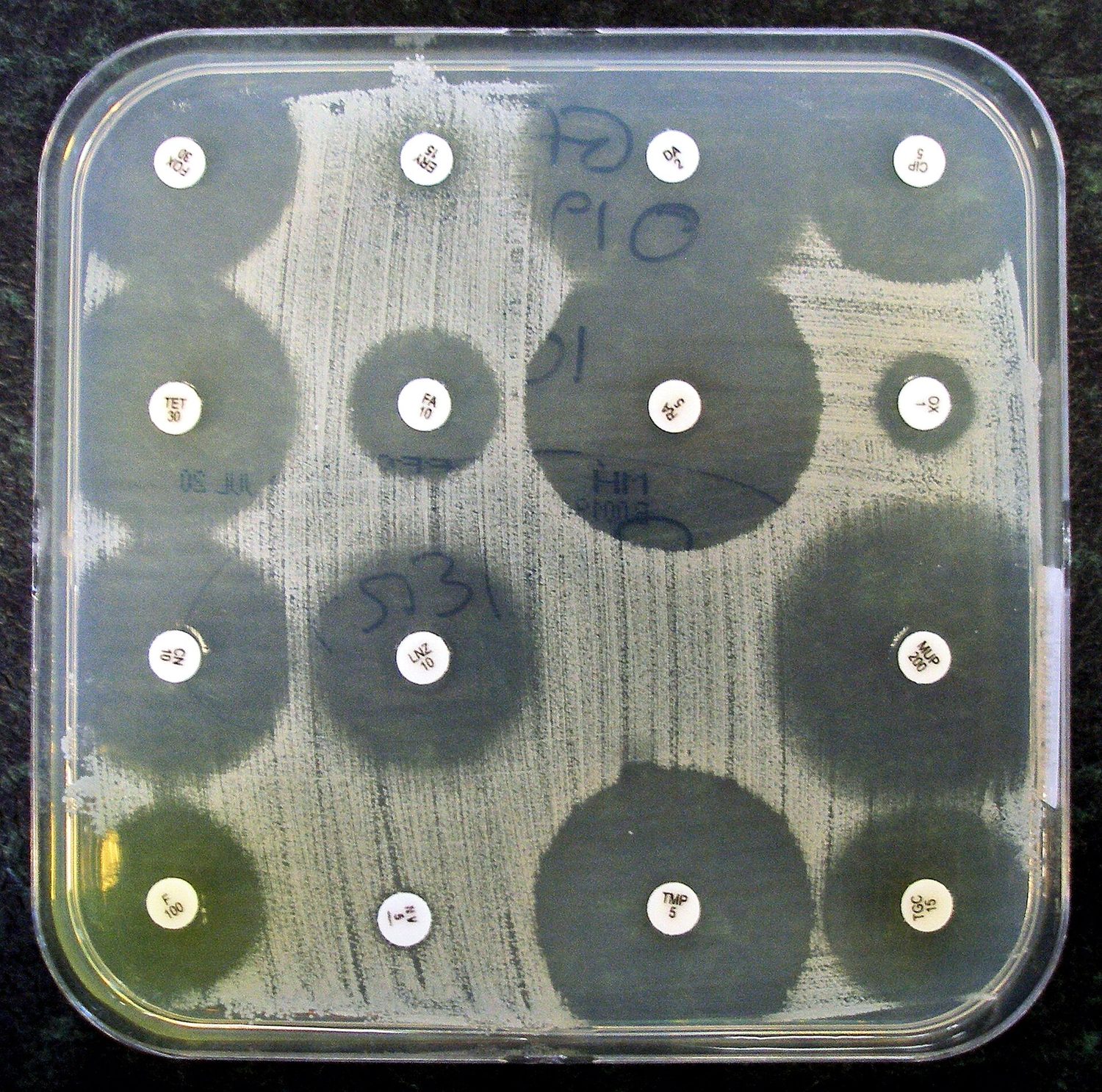
これは細菌の培地である。各白い円盤には異なる抗生物質(殺菌薬)が含まれている。透明な輪を見よ。広い輪は、その薬剤がまだ……

English narration · English + 中文 subtitles burned in · ⁨英語ナレーション・英語+中文字幕 burning-in⁩

7.1

Introduction to Natural Selection · ⁨自然選択の導入⁩

Syllabus · ⁨シラバス⁩
English

Enduring Understanding (BIG IDEA 1 — Evolution): The process of evolution drives the diversity and unity of life.

Learning Objective 7.1.A: Describe the causes of natural selection.

  • 7.1.A.1 Natural selection is a major mechanism of evolution.
  • 7.1.A.2 According to Darwin's theory of natural selection, competition for limited resources results in differential survival. Individuals with more favorable phenotypes are more likely to survive and produce more offspring, thus passing on those favorable traits to subsequent generations.

Learning Objective 7.1.B: Explain how natural selection affects populations.

  • 7.1.B.1 Evolutionary fitness is measured by reproductive success.
  • 7.1.B.2 Biotic and abiotic environments can fluctuate, affecting the rate and direction of evolution. Different genetic variations can be selected in each generation.
日本語

持続的理解(BIG IDEA 1 — 進化): 進化のプロセスは生命の多様性と統一性を駆動する。

学習目標 7.1.A: 自然選択の原因について記述せよ。

  • 7.1.A.1 自然選択は、進化の主要なメカニズムである。
  • 7.1.A.2 ダーウィンの自然選択理論によれば、限られた資源に対する競争は、生存率の差をもたらす。より有利な表現型を持つ個体は、生存し、より多くの子を残す可能性が高く、その有利な形質を後世代に伝えることになる。

学習目標 7.1.B: 自然選択が集団に与える影響について説明せよ。

  • 7.1.B.1 進化的適性は、繁殖的成功によって測定される。
  • 7.1.B.2 生物的要因および非生物的要因の環境は変動することがあり、進化の速度および方向に影響を与える。異なる遺伝的変異が各世代で選択されることがある。
Source: College Board AP Course and Exam Description · ⁨出典: College Board AP コースおよび試験説明書⁩

English

Evolution 进化 is a change in the heritable traits of a population over generations. Natural selection 自然选择 is its main driver: individuals vary, some variations are heritable, more offspring are produced than survive, and those with traits better suited to the environment survive and reproduce more. Over time, helpful traits become more common.

日本語

進化とは、世代を経て集団が持つ継承可能な形質が変化することです。自然選択はその主な駆動力です:個体にはばらつきがあり、一部の形質は継承可能であり、生存できるより多くの子供が生み出され、環境に適した形質を持つ個体がより多く生存して繁殖します。時間が経つと、有益な形質が一般的になっていきます。

自然選択:最も適応した個体が生存し、繁殖し、そのアルレールを後世に伝える
自然選択:最も適応した個体が生存・繁殖し、その対立遺伝子を後世に伝える
Vocabulary · ⁨語彙⁩ Train · ⁨練習する⁩
English 日本語
Evolution/ɪvəˈluːʃn/ 進化
Natural selection/ˈnætʃərəl sɪˈlekʃn/ 自然選択
7.2

Natural Selection · ⁨自然選択⁩

Syllabus · ⁨シラバス⁩
English

Enduring Understanding (BIG IDEA 1 — Evolution): The process of evolution drives the diversity and unity of life.

Learning Objective 7.2.A: Describe the importance of phenotypic variation in a population.

  • 7.2.A.1 Natural selection acts on phenotypic variations in populations.
  • 7.2.A.2 Environments change and apply selective pressures to populations.
    • Illustrative examples for 7.2.A.2: Flowering time in relation to global climate change
  • 7.2.A.3 Some phenotypic variations can increase or decrease the fitness of an organism in particular environments.
    • Illustrative examples for 7.2.A.3: Sickle cell anemia; DDT resistance in insects

Learning Objective 7.2.B: Explain how variation in molecules within cells connects to the fitness of an organism.

  • 7.2.B.1 Variation in the number and types of molecules within cells can provide populations a greater ability to survive and reproduce in different environments.
日本語

持続的理解(BIG IDEA 1 — 進化): 進化のプロセスは生命の多様性と統一性を駆動する。

学習目標 7.2.A: 個体群内の表現型の変異の重要性を説明せよ。

  • 7.2.A.1 自然選択は、個体群内の表現型の変異に対して作用する。
  • 7.2.A.2 環境は変化し、個体群に選択圧をかける。
    • 7.2.A.2 の例: 全球温暖化と開花時期
  • 7.2.A.3 特定の表現型の変異は、ある環境下での生物の適応度を高めたり低下させたりすることがある。
    • 7.2.A.3 の例: 鎌状細胞貧血症; 昆虫のDDT耐性

学習目標 7.2.B: 細胞内の分子の変異が生物の適応度とどのように関連するかを説明せよ。

  • 7.2.B.1 細胞内の分子の数や種類の変異は、異なる環境下での生存と繁殖の能力を個体群に高めることができる。

Source: College Board AP Course and Exam Description · ⁨出典: College Board AP コースおよび試験説明書⁩

English

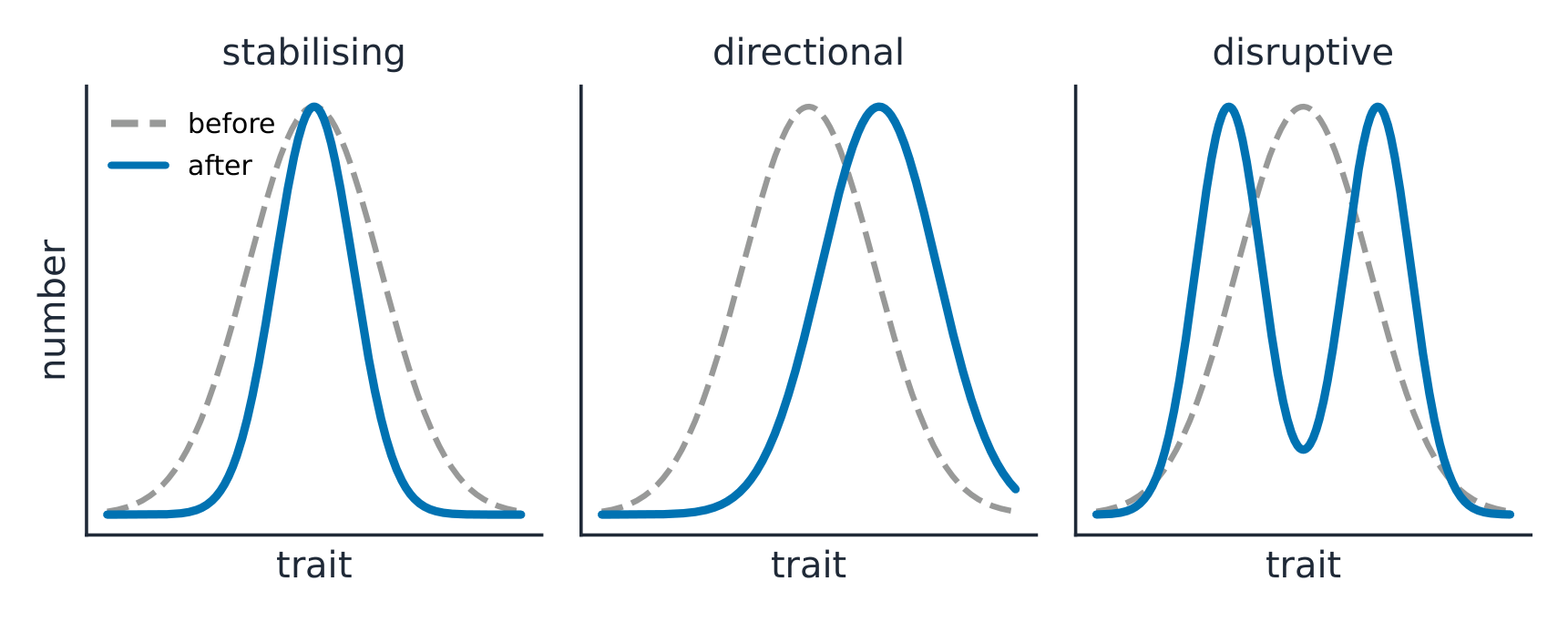
Selection acts on variation 变异. Fitness 适合度 means reproductive success, not strength. Selection comes in modes: directional (favors one extreme), stabilizing (favors the average), and disruptive (favors both extremes). The environment does the "selecting," so a trait that helps in one setting may not in another. Well-suited traits are adaptations 适应.

日本語
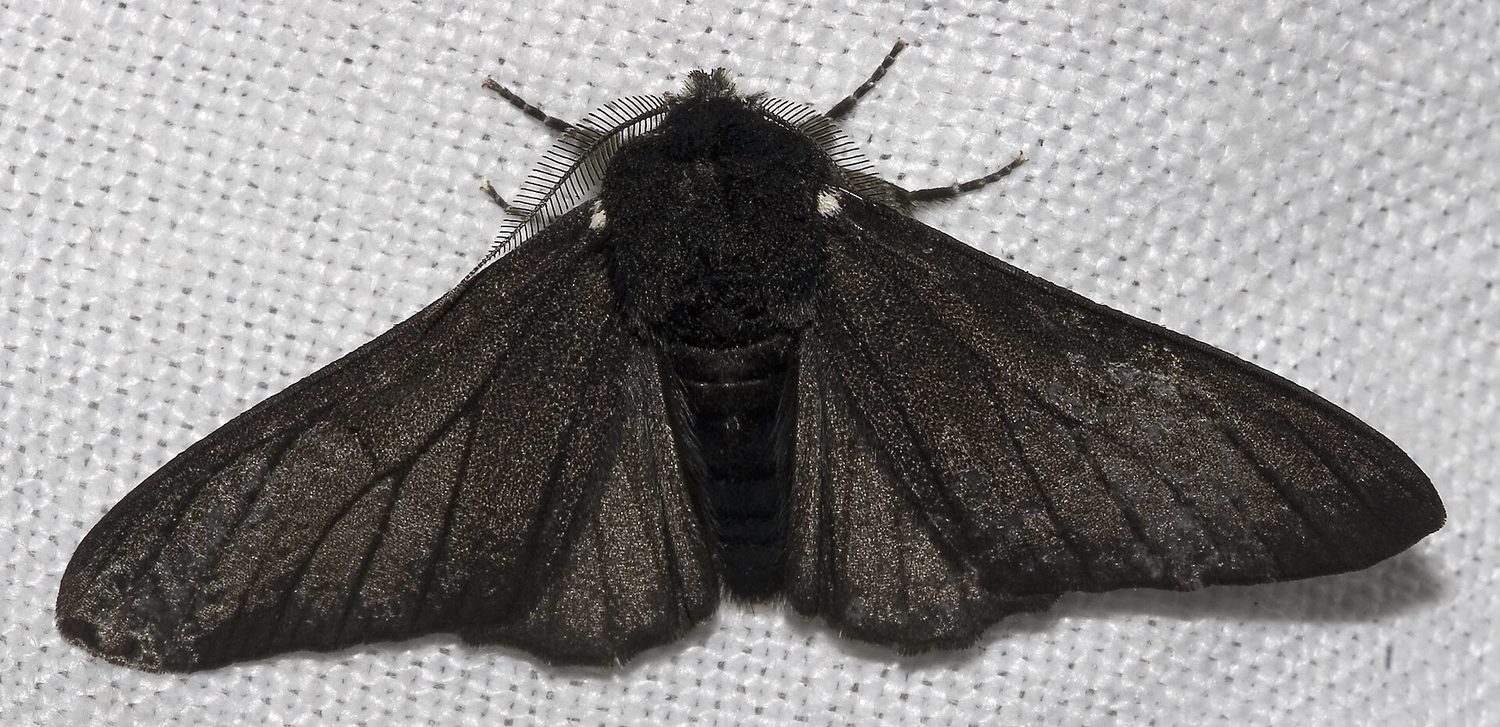
 Peppered moth の黒色型(carbonaria)— 工業 melanism は自然選択の古典的なケーススタディである
ハダカガラガスの黒色型(carbonaria)— 産業 melanism は自然選択の古典的な事例研究です

選択は変異に対して作用します。適応度とは強さではなく、繁殖成功を意味します。選択には几种類があります:方向性選択(片方の極端を好む)、安定化選択(平均を好む)、および破壊的選択(両方の極端を好む)。環境が「選択」を行うため、ある環境では役立つ形質が別の環境では役立たないこともあります。適切に適合した形質は適応と呼ばれます。

安定化選択、方向性選択、破壊的選択
安定化選択、方向性選択、破壊的選択
Explore · ⁨探索⁩

Watch selection shift a population · ⁨自然選択が集団を変える様子を見る⁩

Natural selection: individuals better suited to the environment survive and reproduce more, so helpful traits spread. Change the environment and watch the population adapt. · ⁨自然選択: 環境に適応した個体は生存・繁殖し、有益な形質が広がる。環境を変化させて集団が適応する様子を見る。⁩

7.3

Artificial Selection · ⁨人工選択⁩

Syllabus · ⁨シラバス⁩
English

Enduring Understanding (BIG IDEA 1 — Evolution): The process of evolution drives the diversity and unity of life.

Learning Objective 7.3.A: Explain how humans can affect diversity within a population.

  • 7.3.A.1 Through artificial selection, humans affect variation in other species.
日本語

持続的理解(BIG IDEA 1 — 進化): 進化のプロセスは生命の多様性と統一性を駆動する。

学習目標 7.3.A: 人間が個体群内の多様性に与える影響を説明せよ。

  • 7.3.A.1 人工選択を通じて、人間は他の種の変異に影響を与える。

Source: College Board AP Course and Exam Description · ⁨出典: College Board AP コースおよび試験説明書⁩

English

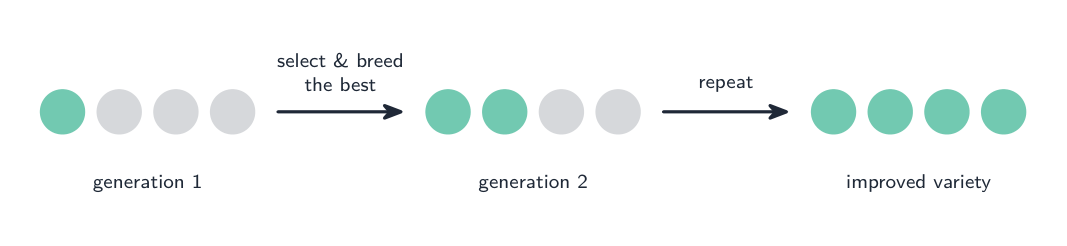
In artificial selection 人工选择, humans – not nature – choose which individuals breed, selecting for desired traits (crops, livestock, dogs). It works the same way as natural selection and, being fast and visible, is strong evidence that selection can reshape populations.

日本語

人工選択では、自然ではなく人間がどの個体が繁殖するかを選び、望ましい形質(作物、家畜、犬)を選択します。これは自然選択と同じ仕組みで働きますが、速く目に見えるため、選択が集団を再構成できることの強力な証拠となっています。

選択的育種では、望ましい形質が世代を重ねるごとに頻度が増加する
選抜交配は世代を通じて目的の形質を一般的にします
7.4

Population Genetics · ⁨集団遺伝学⁩

Syllabus · ⁨シラバス⁩
English

Enduring Understanding (BIG IDEA 1 — Evolution): The process of evolution drives the diversity and unity of life.

Learning Objective 7.4.A: Explain how random occurrences affect the genetic makeup of a population.

  • 7.4.A.1 Evolution is also driven by random occurrences.
    • i. Mutation is a random process that adds new genetic variation to a population.
    • ii. Genetic drift is a change in allele frequencies attributable to a nonselective process occurring in small populations.
    • iii. The bottleneck effect is a type of genetic drift that occurs when a population size is reduced to a small number of individuals for at least one generation.
    • iv. The founder effect is a type of genetic drift that occurs when a population is separated from other members of the population. The frequency of genes and traits will shift based on the genes in this new founder population.
    • v. Migration can result in gene flow (the addition or removal of alleles from a population).

Learning Objective 7.4.B: Describe the role of random processes in the evolution of specific populations.

  • 7.4.B.1 Random processes can lead to changes in allele frequencies in a population.
    • i. Mutations result in genetic variation, which provides phenotypes on which natural selection acts.
    • ii. Genetic drift can allow a small population to diverge from other populations of the same species.
    • iii. Gene flow between two populations prevents them from diverging into separate species.

Learning Objective 7.4.C: Describe the change in the genetic makeup of a population over time.

  • 7.4.C.1 Changes in allele frequencies provide evidence for the occurrence of evolution in a population.
日本語

持続的理解(BIG IDEA 1 — 進化): 進化のプロセスは生命の多様性と統一性を駆動する。

学習目標 7.4.A: 偶然の出来事が集団の遺伝構成に与える影響を説明せよ。

  • 7.4.A.1 進化は、偶然の出来事によっても推進される。
    • i. 突然変異は、集団に新しい遺伝的変異を加えるランダムなプロセスである。
    • ii. 遺伝的浮動とは、小規模な集団において選択的非起因のプロセスによって対立遺伝子の頻度が変化する現象である。
    • iii. 瓶頸効果とは、集団のサイズが少なくとも1世代にわたって少数の個体まで減少した際に生じる遺伝的浮動の一種である。
    • iv. 創始者効果とは、集団の一部が他の集団から分離した際に生じる遺伝的浮動の一種である。この新しい創始者集団の遺伝子に基づいて、遺伝子や形質の頻度が変化する。
    • v. 移動(遷移)は、遺伝子流動(集団への対立遺伝子の追加や除去)を引き起こすことがある。

学習目標 7.4.B: 特定の集団の進化における偶然のプロセスの役割を説明せよ。

  • 7.4.B.1 偶然のプロセスは、集団内の対立遺伝子の頻度の変化をもたらすことがある。
    • i. 突然変異は遺伝的変異を生み出し、それが自然選択が作用する表現型の基盤となる。
    • ii. 遺伝的浮動は、小規模な集団が同一種の他の集団から分岐することを可能にする。
    • iii. 2つの集団間の遺伝子流動は、それらが別々の種に分岐することを防ぐ。

学習目標 7.4.C: 時間の経過に伴う集団の遺伝構成の変化を説明せよ。

  • 7.4.C.1 対立遺伝子の頻度の変化は、集団内で進化が起こったことを示す証拠となる。

Source: College Board AP Course and Exam Description · ⁨出典: College Board AP コースおよび試験説明書⁩

English

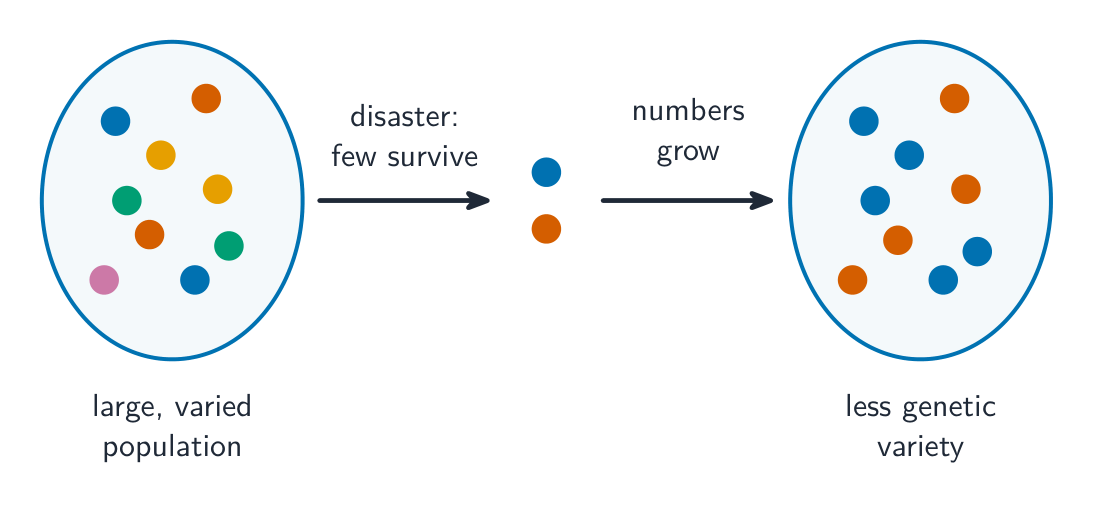
Population genetics 群体遗传学 studies the pool of alleles in a population. Evolution is a change in allele frequencies 等位基因频率 over time. Besides natural selection, allele frequencies change through mutation (new alleles), gene flow 基因流 (migration), and genetic drift 遗传漂变 (random change, strongest in small populations – the bottleneck and founder effects).

日本語

集団遺伝学は集団内の対立遺伝子のプールを研究します。進化とは時間経過に伴う対立遺伝子頻度の変化です。自然選択に加え、対立遺伝子頻度は変異(新しい対立遺伝子)、遺伝子流動(移住)、および遺伝的浮動(ランダムな変化、小集団で最も強い — ボトルネック効果と創始者効果)によって変化します。

人口ボトルネックは遺伝的多様性を減少させる
集団ボトルネックは遺伝的多様性を減少させる
7.5

Hardy-Weinberg Equilibrium · ⁨ハーディ=ワインベルグ平衡⁩

Syllabus · ⁨シラバス⁩
English

Enduring Understanding (BIG IDEA 1 — Evolution): The process of evolution drives the diversity and unity of life.

Learning Objective 7.5.A: Describe the conditions under which allele and genotype frequencies will change in populations.

  • 7.5.A.1 The Hardy–Weinberg Equilibrium is a model for describing and predicting allele frequencies in a non-evolving population. Conditions for a population or an allele to be in Hardy–Weinberg equilibrium are:

    • i. A large population size
    • ii. No migration
    • iii. No new mutations
    • iv. Random mating
    • v. No natural selection

    These conditions are never met, but they provide a valuable null hypothesis.

  • 7.5.A.2 Allele frequencies in a nonevolving population can be calculated from genotype frequencies.

    • Equation: Hardy–Weinberg Equation— $p^2 + 2pq + q^2 = 1$; $p + q = 1$, where: $p$ = frequency of allele 1 in the population; $q$ = frequency of allele 2 in the population
    • Illustrative examples for 7.5.A.2: Graphic analysis of allele frequencies in a population
日本語

持続的理解(BIG IDEA 1 — 進化): 進化のプロセスは生命の多様性と統一性を駆動する。

学習目標 7.5.A: 集団内で対立遺伝子頻度および遺伝子型頻度が変化する条件を説明せよ。

  • 7.5.A.1 ハーディ・ワインベルグ平衡は、進化していない集団における対立遺伝子頻度を記述・予測するためのモデルである。集団または対立遺伝子がハーディ・ワインベルグ平衡にあるための条件は以下の通り:

    • i. 集団のサイズが大きい
    • ii. 移動がない
    • iii. 新しい突然変異がない
    • iv. 無作為交配
    • v. 自然選択がない

    これらの条件は現実には満たされないが、重要な帰無仮説を提供する。

  • 7.5.A.2 進化していない集団における対立遺伝子頻度は、遺伝子型頻度から計算できる。

    • 式: ハーディ・ワインベルグの式 — $p^2 + 2pq + q^2 = 1$; $p + q = 1$、ここで: $p$ = 集団内におけるアルレール 1 の頻度; $q$ = 集団内におけるアルレール 2 の頻度
    • 7.5.A.2 のための例示: 集団内のアルレール頻度のグラフ解析

Source: College Board AP Course and Exam Description · ⁨出典: College Board AP コースおよび試験説明書⁩

English

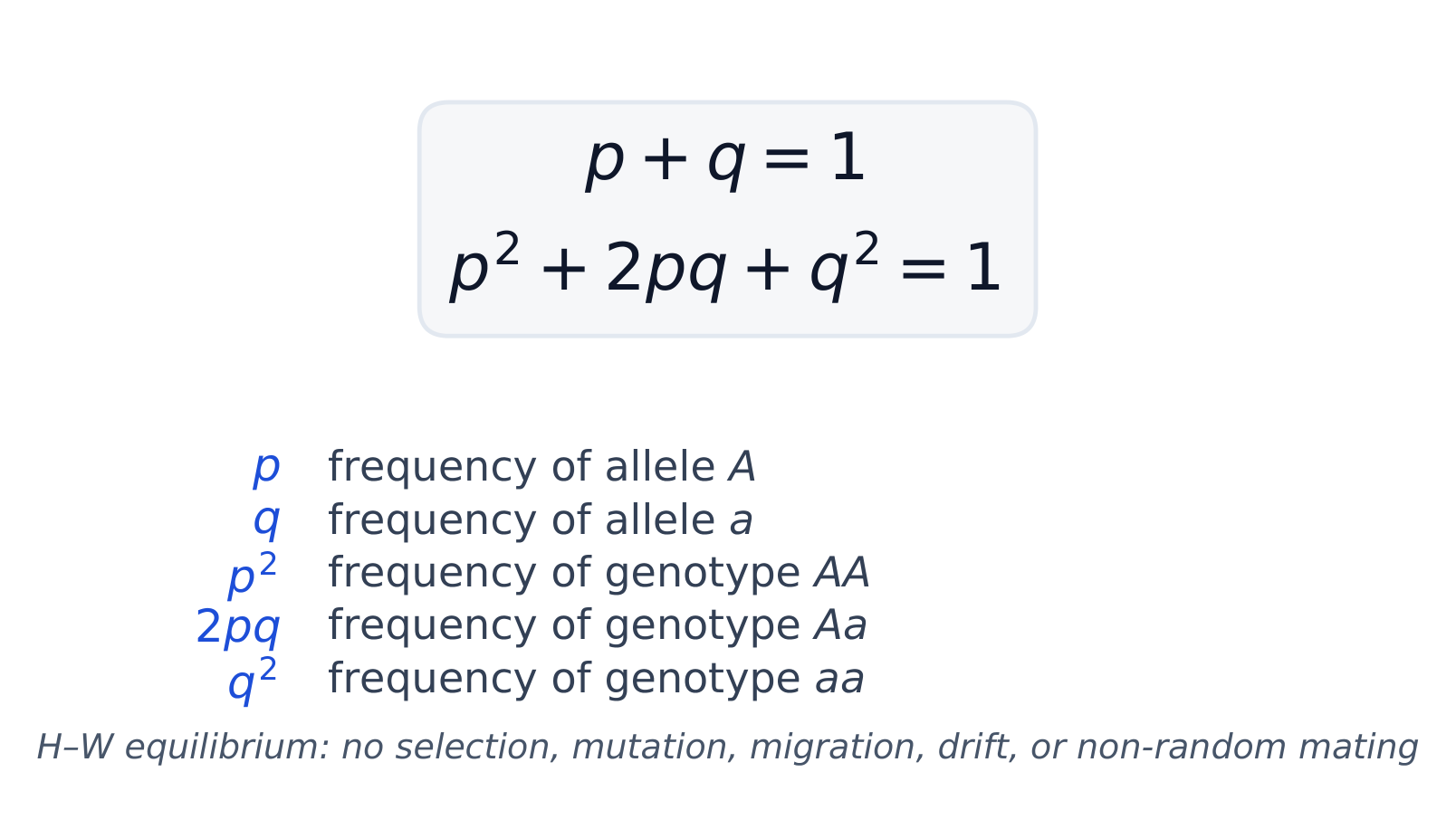
The Hardy–Weinberg 哈迪-温伯格 model gives the allele and genotype frequencies expected when a population is not evolving. With allele frequencies $p$ and $q$ ($p+q=1$):

$$p^2 + 2pq + q^2 = 1,$$
where $p^2$ and $q^2$ are the homozygotes and $2pq$ the heterozygotes. It holds only under five conditions (no selection, no mutation, no migration, random mating, large population); when real data differ from the prediction, the population is evolving.

Worked example. In a population, $16\%$ of individuals show the recessive phenotype, so $q^2=0.16$ and $q=\sqrt{0.16}=0.4$. Then $p=1-q=0.6$. The predicted carrier frequency (heterozygotes) is $2pq=2(0.6)(0.4)=0.48$, i.e. $48\%$, and the homozygous dominants are $p^2=0.6^2=0.36$, i.e. $36\%$. As a check, $0.36+0.48+0.16=1$. This is the standard route: recessive phenotype $\to q^2\to q\to p\to$ everything else.

日本語

ハーディ=ワインベルグモデルは、集団が進化していないときに期待される対立遺伝子頻度と遺伝子型頻度を示します。対立遺伝子頻度が $p$ と $q$ ($p+q=1$)の場合:

$$p^2 + 2pq + q^2 = 1,$$
ここで $p^2$ と $q^2$ はホモ接合体、$2pq$ はヘテロ接合体を表します。この法則は5つの条件(選択なし、変異なし、遷移なし、随机交配、大集団)の下でのみ成立します。実際のデータが予測と異なる場合、集団は進化していることを意味します。

計算例。 集団の中で $16\%$ の個体が劣性形質を示すため、$q^2=0.16$ および $q=\sqrt{0.16}=0.4$ となる。したがって、$p=1-q=0.6$ である。予測されるキャリア頻度(ヘテロ接合体)は $2pq=2(0.6)(0.4)=0.48$ 、すなわち $48\%$ であり、ホモ接合優性個体は $p^2=0.6^2=0.36$ 、すなわち $36\%$ である。検算として、$0.36+0.48+0.16=1$ が成立する。これが標準的な手順である:劣性形質 $\to q^2\to q\to p\to$其余の値を導くこと。

ハーディ=ヴァインベルグ:アルレール頻度 p と q が、遺伝子型頻度 p², 2pq, q² を生む
Explore · ⁨探索⁩

Allele frequencies across a cross · ⁨交配におけるアレル頻度⁩

Hardy-Weinberg predicts genotype frequencies ($p^2+2pq+q^2$) in a population that isn't evolving. A Punnett square shows the same allele combining at the population scale. · ⁨ハーディ・ワインベルグは進化していない集団における遺伝子型頻度($p^2+2pq+q^2$)を予測する。ペンネット正方形は集団レベルでの同じアレルの組み合わせを示す。⁩

7.6

Evidence of Evolution · ⁨進化の証拠⁩

Syllabus · ⁨シラバス⁩
English

Enduring Understanding (BIG IDEA 1 — Evolution): The process of evolution drives the diversity and unity of life.

Learning Objective 7.6.A: Describe the types of data that provide evidence for evolution.

  • 7.6.A.1 Evolution is supported by scientific evidence from many disciplines (geographical, geological, physical, biochemical, and mathematical data).

Learning Objective 7.6.B: Explain how morphological, biochemical, and geological data provide evidence that organisms have changed over time.

  • 7.6.B.1 Molecular, morphological, and genetic evidence from extant and extinct organisms adds to our understanding of evolution.
    • i. Fossils can be dated by a variety of methods. These include 1) the age of the rocks where a fossil is found; 2) the rate of decay of isotopes including carbon-14; and 3) geographical data.
    • ii. Morphological homologies, including vestigial structures, provide evidence of common ancestry.
  • 7.6.B.2 A comparison of DNA nucleotide sequences and protein amino acid sequences provides evidence for evolution and common ancestry.
日本語

持続的理解(BIG IDEA 1 — 進化): 進化のプロセスは生命の多様性と統一性を駆動する。

学習目標 7.6.A: 進化の証拠となるデータの種類を説明する。

  • 7.6.A.1 進化は、地理的、地質学的、物理的、生化学的、および数学的なデータなど、多岐にわたる学問分野からの科学的証拠によって支持されている。

学習目標 7.6.B: 形態学的、生化学的、および地質学的なデータが、生物が時間とともに変化してきたことをどう裏付けているかを説明する。

  • 7.6.B.1 現生および絶滅生物由来の分子、形態、遺伝的証拠は、進化に対する私たちの理解を深める。
    • i. 化石は多様な方法で年代測定が可能である。これには、1) 化石が発見された岩層の年齢、2) カルボン-14を含む同位体の崩壊速度、3) 地理的データが含まれる。
    • ii. 痕跡器官を含む形態的同族性は、共通祖先の証拠となる。
  • 7.6.B.2 DNA塩基配列とタンパク質アミノ酸配列の比較は、進化と共通祖先の証拠となる。

Source: College Board AP Course and Exam Description · ⁨出典: College Board AP コースおよび試験説明書⁩

English

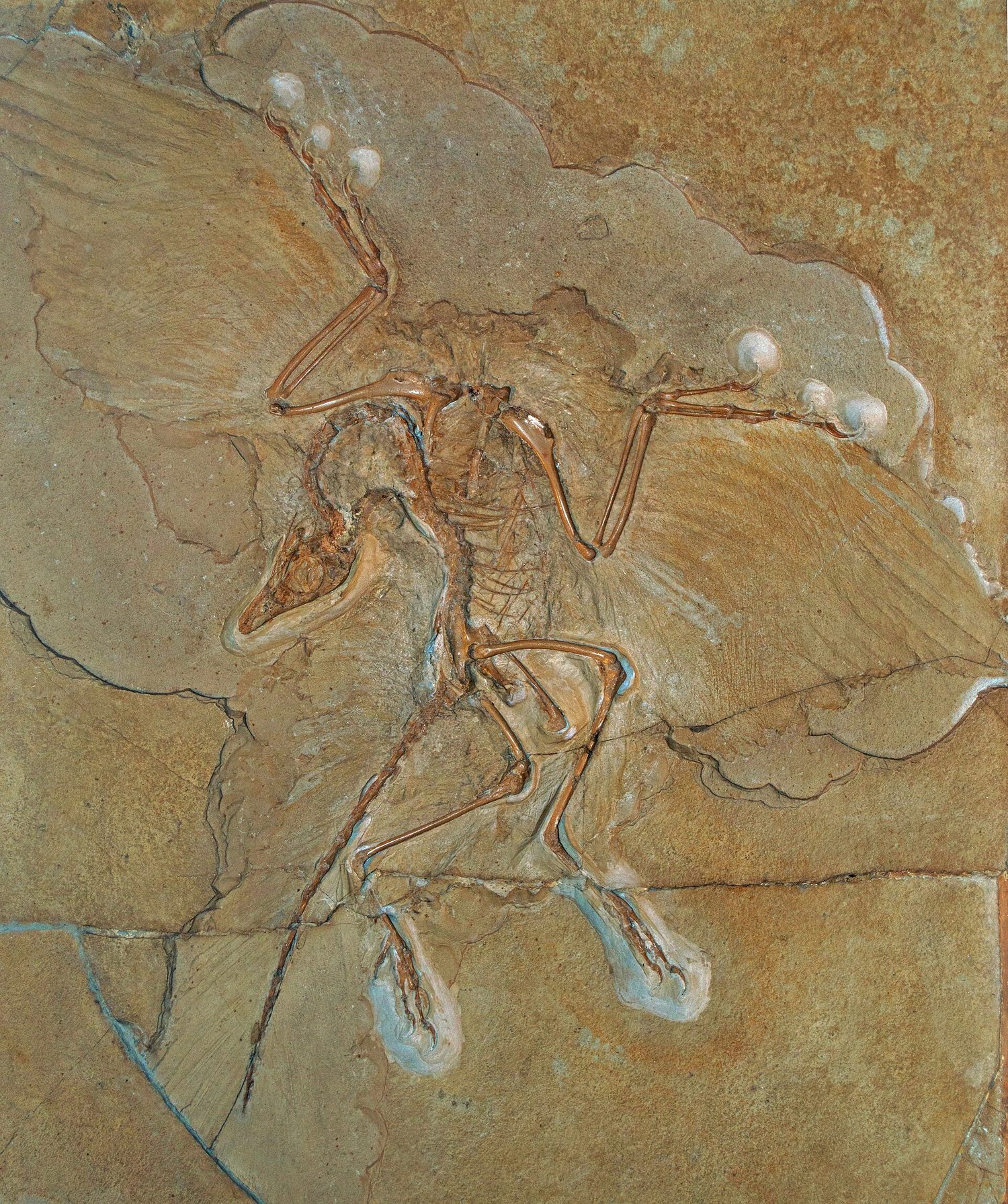
Multiple independent lines support evolution: the fossil record 化石记录, homologous structures 同源结构 (shared anatomy from common ancestry), vestigial structures 痕迹器官, shared embryology, and molecular evidence – the near-universal genetic code and matching DNA/protein sequences.

日本語
Archaeopteryx化石:羽毛と爬虫類の特徴 — 共通祖先の証拠

複数の独立した根拠が進化を裏付けている:化石記録、相同構造(共通祖先に由来する共有解剖学的特徴)、痕跡器官、共有される胚発生、および分子レベルの証拠——ほぼ普遍的な遺伝コードや一致するDNA/タンパク質配列などである。

7.7

Common Ancestry · ⁨共通祖先⁩

Syllabus · ⁨シラバス⁩
English

Enduring Understanding (BIG IDEA 1 — Evolution): The process of evolution drives the diversity and unity of life.

Learning Objective 7.7.A: Describe structural and functional evidence on cellular and molecular levels that provides evidence for the common ancestry of all eukaryotes.

  • 7.7.A.1 Structural and functional evidence indicates common ancestry of all eukaryotes. This evidence includes:
    • i. Membrane-bound organelles
    • ii. Linear chromosomes
    • iii. Genes that contain introns
日本語

持続的理解(BIG IDEA 1 — 進化): 進化のプロセスは生命の多様性と統一性を駆動する。

学習目標 7.7.A: 真核生物全体的の共通祖先を示す、細胞レベルおよび分子レベルでの構造・機能証拠を説明する。

  • 7.7.A.1 構造および機能証拠は、真核生物全体的の共通祖先を示している。これらの証拠には以下が含まれる:
    • i. 膜で覆われた小器官
    • ii. 直線状染色体
    • iii. イントロンを含む遺伝子

Source: College Board AP Course and Exam Description · ⁨出典: College Board AP コースおよび試験説明書⁩

English

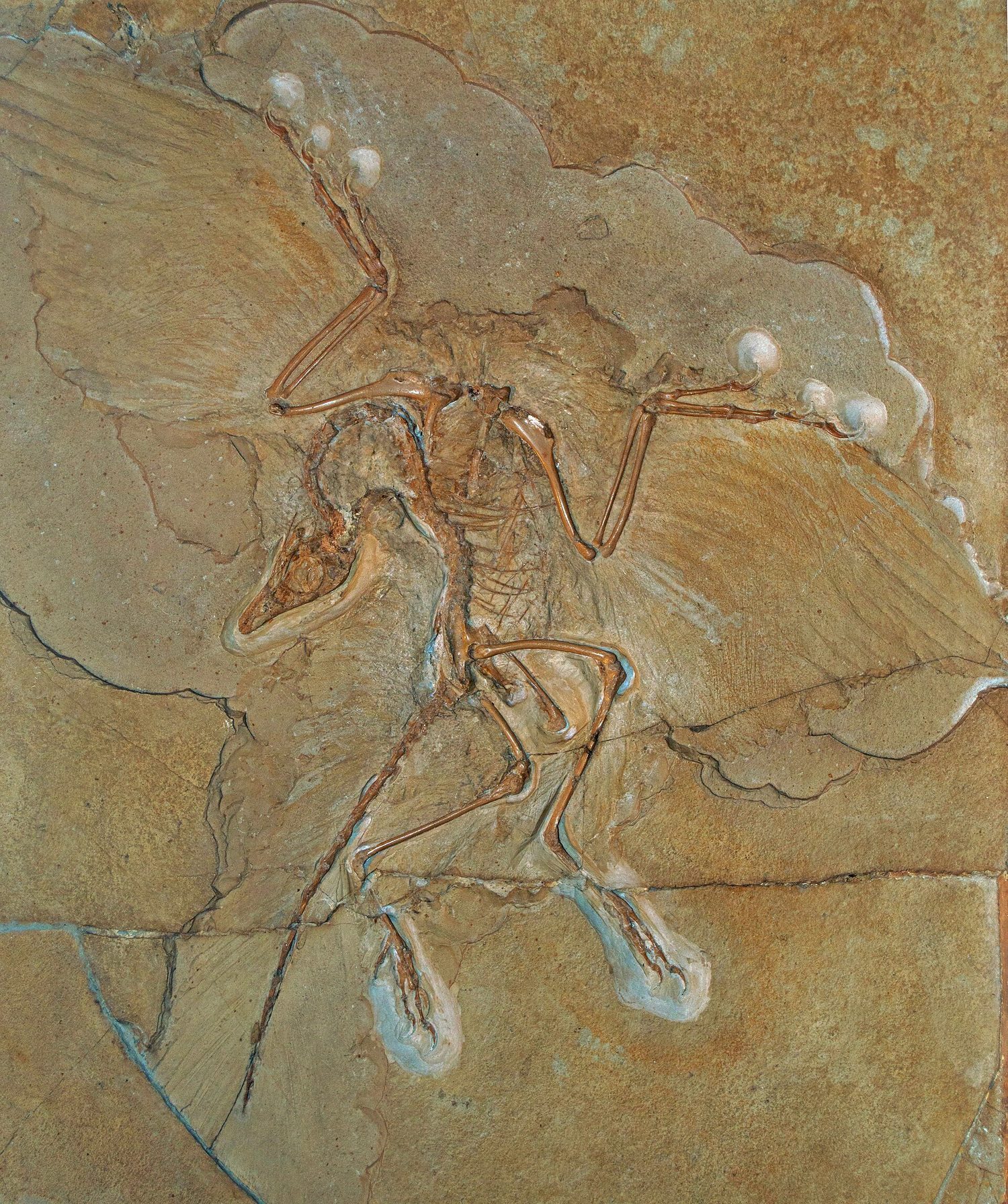
All life shares a common ancestor 共同祖先, shown by universal features: the same DNA/RNA machinery, the same genetic code, ribosomes, and core metabolic pathways in all organisms. The more features and sequences two species share, the more recently they diverged.

日本語

すべての生命は共通祖先を持ち、そのことは普遍的な特徴によって示されている:同じDNA/RNAメカニズム、同じ遺伝コード、リボソーム、そしてあらゆる生物に共通する主要代謝経路である。2つの種が共有する特徴や配列が多いほど、それら分岐した時期は最近である。

Archaeopteryx:移行化石は主要なグループをつなぎ、共通祖先を支持している
7.8

Continuing Evolution · ⁨継続的な進化⁩

Syllabus · ⁨シラバス⁩
English

Enduring Understanding (BIG IDEA 1 — Evolution): The process of evolution drives the diversity and unity of life.

Learning Objective 7.8.A: Explain how evolution is an ongoing process in all living organisms.

  • 7.8.A.1 All species have evolved and continue to evolve. Examples include:
    • i. Genomic changes over time
    • ii. Continuous change in the fossil record
    • iii. Evolution of resistance to antibiotics, pesticides, herbicides, or chemotherapy drugs
    • iv. Pathogens evolving and causing emergent diseases
日本語

持続的理解(BIG IDEA 1 — 進化): 進化のプロセスは生命の多様性と統一性を駆動する。

学習目標 7.8.A: 進化が全ての生き物において進行中のプロセスであることを説明する。

  • 7.8.A.1 全ての種は進化し、現在も進化し続けている。例として以下が挙げられる:
    • i. 時間の経過に伴うゲノムの変化
    • ii. 化石記録における連続的な変化
    • iii. 抗生物質、農薬、除草剤、または化学療法薬に対する耐性の進化
    • iv. 病原体の進化による新発感染症の発生

Source: College Board AP Course and Exam Description · ⁨出典: College Board AP コースおよび試験説明書⁩

English

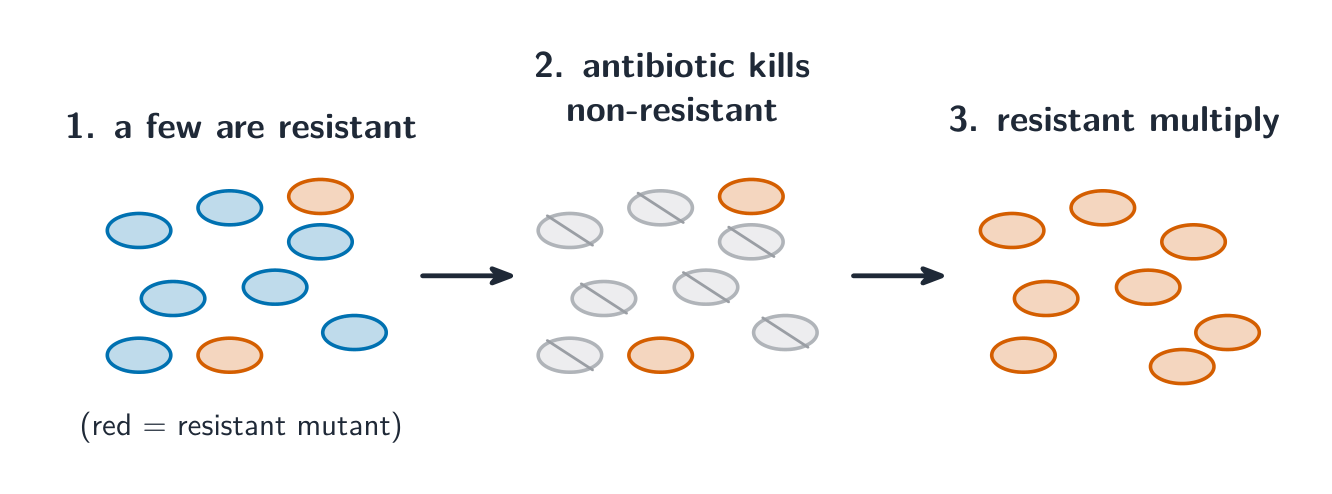
Evolution is ongoing and observable: antibiotic-resistant bacteria, pesticide-resistant insects, and rapid changes in fast-breeding species. Because environments keep changing, selection keeps acting – evolution has no endpoint.

日本語
抗生物質感受性培地:透明な輪はどの抗生物質が細菌を殺すかを示している

進化は進行中であり、観察可能である:抗生物質耐性菌、農薬耐性昆虫、急速繁殖種の急速な変化など。環境が絶えず変化するため、自然選択も働き続け、進化には終点がない。

自然選択によって集団内での抗生物質耐性が広がる様子
7.9

Phylogeny · ⁨系統樹⁩

Syllabus · ⁨シラバス⁩
English

Enduring Understanding (BIG IDEA 1 — Evolution): The process of evolution drives the diversity and unity of life.

Learning Objective 7.9.A: Describe the types of evidence that can be used to infer an evolutionary relationship.

  • 7.9.A.1 Phylogenetic trees and cladograms show hypothetical evolutionary relationships among lineages that can be tested.
  • 7.9.A.2 Phylogenetic trees show the amount of change over time calibrated by fossils or a molecular clock, whereas cladograms do not show time scale or the evolutionary difference between groups.
  • 7.9.A.3 Traits that are either gained or lost during evolution can be used to construct phylogenetic trees and cladograms. The out-group represents the lineage that is least closely related to the remainder of the organisms in the phylogenetic tree or cladogram.
    • i. Shared derived characters can be present in more than one lineage and indicate common ancestry. These are informative for the construction of phylogenetic trees and cladograms.
    • ii. Molecular data typically provide more accurate and reliable evidence than morphological traits in the construction of phylogenetic trees or cladograms.

Learning Objective 7.9.B: Explain how phylogenetic trees and cladograms can be used to infer evolutionary relatedness.

  • 7.9.B.1 Phylogenetic trees and cladograms can be used to illustrate speciation that has occurred. The nodes on a tree represent the most recent common ancestor of any two groups or lineages.
  • 7.9.B.2 Phylogenetic trees and cladograms can be constructed from morphological similarities of living or fossil species and from DNA and protein sequence similarities.
  • 7.9.B.3 Phylogenetic trees and cladograms represent hypotheses that are constantly being revised based on evidence.
日本語

持続的理解(BIG IDEA 1 — 進化): 進化のプロセスは生命の多様性と統一性を駆動する。

学習目標 7.9.A: 進化的な関係性を推定するために使用できる証拠の種類を説明する。

  • 7.9.A.1 系統樹およびクラドグラムは、検証可能な系統間の仮説的な進化的関係を示す。
  • 7.9.A.2 系統樹は、化石や分子時計によって較正された時間に対する変化の量を示すが、クラドグラムは時間軸やグループ間の進化的差異を示さない。
  • 7.9.A.3 進化過程で獲得または喪失した形質を用いて、系統樹およびクラドグラムを構築することができる。外群(アウトグループ)は、系統樹またはクラドグラムの他の生物との間で最も近縁でない系統を表す。
    • i. 共有派生形質は複数の系統に存在することがあり、共通祖先を示す。これらは系統樹およびクラドグラムの構築に有用である。
    • ii. 系統樹またはクラドグラムの構築において、分子データは形態的形質よりもより正確で信頼性が高い証拠を提供することが一般的である。

学習目標 7.9.B: 系統樹およびクラドグラムを用いて、進化的な親縁関係をどのように推定するかを説明する。

  • 7.9.B.1 系統樹およびクラドグラムは、発生した種分化を示すために使用できる。系統樹上の節点(ノード)は、2つのグループまたは系統の最近の共通祖先を表す。
  • 7.9.B.2 系統樹およびクラドグラムは、現生または化石種の形態的類似性、ならびにDNAおよびタンパク質配列の類似性から構築できる。
  • 7.9.B.3 系統樹およびクラドグラムは、証拠に基づいて絶えず修正される仮説を表す。

Source: College Board AP Course and Exam Description · ⁨出典: College Board AP コースおよび試験説明書⁩

English

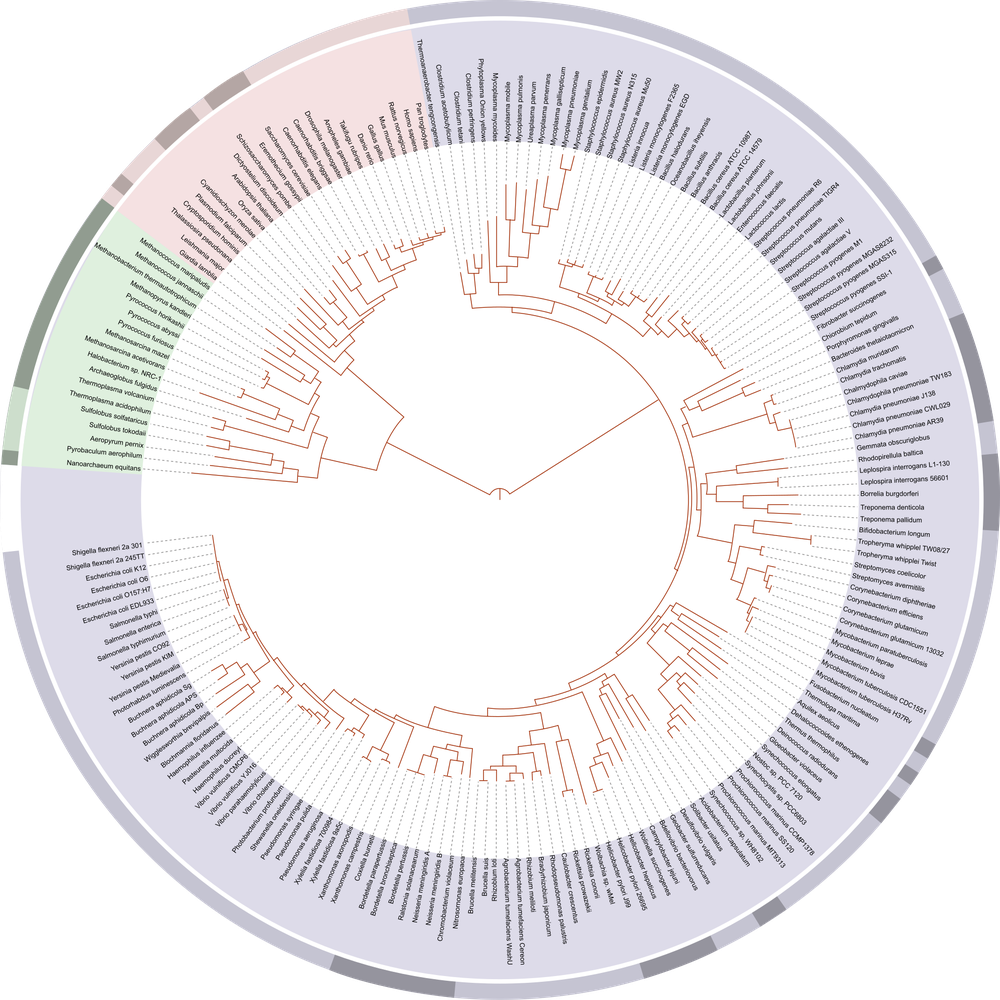
A phylogenetic tree 系统发育树 (cladogram) diagrams evolutionary relationships, with branch points marking common ancestors and shared derived traits grouping related species. Trees are hypotheses, revised as new (especially molecular) data arrive.

日本語

系統樹(クラドグラム)は進化的関係を図示し、枝分かれ点は共通祖先を表し、共有された派生形質が関連する種をグループ化する。系統樹は仮説であり、新しいデータ(特に分子データ)が入るたびに修正される。

生命の樹:系統樹は共通起源からの共有祖先に基づいて生物をグループ化する
7.10

Speciation · ⁨種形成⁩

Syllabus · ⁨シラバス⁩
English

Enduring Understanding (BIG IDEA 1 — Evolution): The process of evolution drives the diversity and unity of life.

Learning Objective 7.10.A: Describe the conditions under which new species may arise.

  • 7.10.A.1 Speciation occurs when two populations become reproductively isolated from each other.
  • 7.10.A.2 The biological species concept provides a commonly used definition of a species for sexually reproducing organisms. It states that species can be defined as a group capable of interbreeding and exchanging genetic information to produce viable, fertile offspring.

Learning Objective 7.10.B: Describe the rate of evolution and speciation under different ecological conditions.

  • 7.10.B.1 Punctuated equilibrium is when evolution occurs rapidly after a long period of stasis. Gradualism is when evolution occurs slowly over hundreds of thousands or millions of years.
  • 7.10.B.2 Divergent evolution occurs when adaptation to new habitats results in phenotypic diversification. Speciation rates can be especially rapid during times of adaptive radiation as new habitats become available.
  • 7.10.B.3 Convergent evolution occurs when similar selective pressures result in similar phenotypic adaptations in different populations or species.

Learning Objective 7.10.C: Explain the processes and mechanisms that drive speciation.

  • 7.10.C.1 Sympatric speciation occurs in populations with geographic overlap. Allopatric speciation occurs in populations that are geographically isolated.
  • 7.10.C.2 Various pre-zygotic and post-zygotic mechanisms can maintain reproductive isolation and prevent gene flow between populations.
  • Illustrative examples for 7.10.C: Hawaiian Drosophila; Caribbean Anolis; Apple maggot Rhagoletis
日本語

持続的理解(BIG IDEA 1 — 進化): 進化のプロセスは生命の多様性と統一性を駆動する。

学習目標 7.10.A: 新しい種が生じる条件について記述せよ。

  • 7.10.A.1 2つの集団が互いに生殖的に隔離されることで、種形成が起こる。
  • 7.10.A.2 生物学的種概念は、有性生殖を行う生物に対して広く用いられる種の定義を提供する。これは、種とは、交尾して生育可能な fertile な子孫を生み出し、遺伝情報を交換することのできる集団として定義されることを示している。

学習目標 7.10.B: 異なる生態的条件における進化および種形成の速度について記述せよ。

  • 7.10.B.1 断続的平衡とは、長期の停滞期之后に進化が急速に起こる状態である。漸進論とは、進化が数十万〜数百万年にわたってゆっくりと起こる状態である。
  • 7.10.B.2 分化進化とは、新たな生息地への適応が表現型の多様化をもたらす場合に起こる。新たな生息地が利用可能になる時期には、適応放散に伴って種形成の速度が特に速くなることがある。
  • 7.10.B.3 収斂進化とは、類似した選択圧が異なる集団や種において類似した表現型的適応をもたらす場合に起こる。

学習目標 7.10.C: 種形成を駆動するプロセスおよびメカニズムについて説明せよ。

  • 7.10.C.1 同所種形成とは、地理的な重複がある集団で起こる。異所種形成とは、地理的に隔離された集団で起こる。
  • 7.10.C.2 様々な前受精的および後受精的メカニズムが、生殖的隔離を維持し、集団間の遺伝流を防ぐことができる。
  • 7.10.Cの例示: ハワイ産Drosophila; カリブ海産Anolis; りんごバグRhagoletis

Source: College Board AP Course and Exam Description · ⁨出典: College Board AP コースおよび試験説明書⁩

English

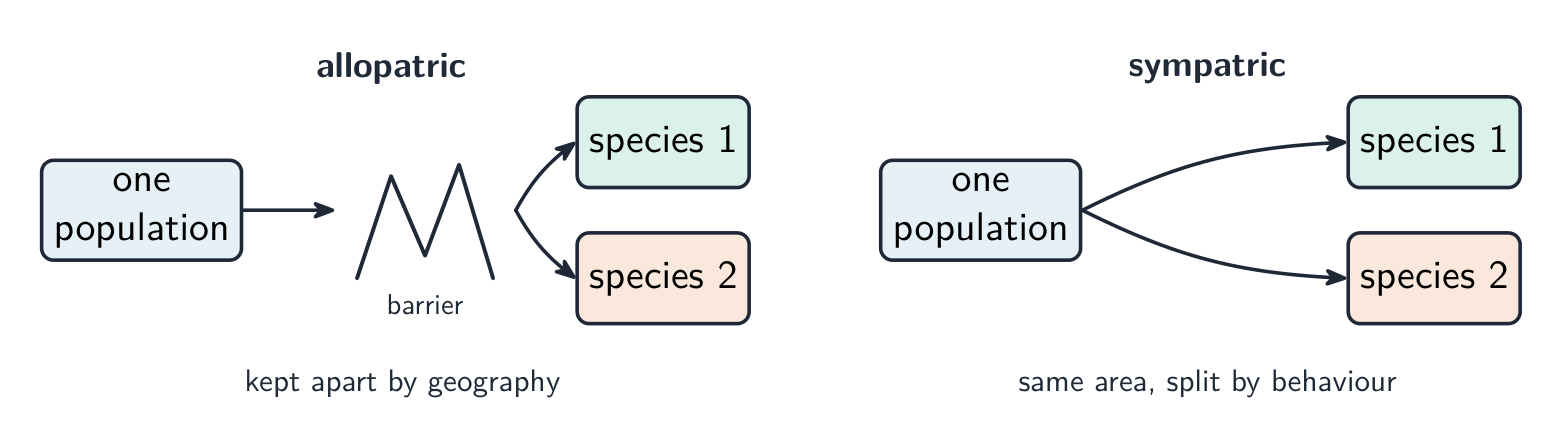
Speciation 物种形成 is the origin of new species, usually when populations become reproductively isolated 生殖隔离 and diverge. Allopatric speciation follows a geographic split; sympatric speciation happens without one. Once populations can no longer interbreed, they are separate species.

日本語

種形成は新たな種の起源であり、通常、集団が生殖的に隔離されて分化することによって起こる。異所種形成は地理的分断に伴うものであり、同所種形成はそのような分断なしに起こる。集団が交尾できなくなった時点で、それらは別の種となる。

異所種形成と同所種形成
異所種形成と同所種形成
Vocabulary · ⁨語彙⁩ Train · ⁨練習する⁩
English 日本語
Speciation/ˌspiːʃɪˈeɪʃn/ 種形成
reproductively isolated/rɪprəˈdʌktɪvli ˈaɪsəleɪtɪd/ 生殖的に隔離される
diversity/daɪˈvɜːsɪti/ 多様性
endosymbiosis/ˌendəʊˌsɪmbaɪˈəʊsɪs/ 内共生
7.11

Variations in Populations · ⁨集団内の多様性⁩

Syllabus · ⁨シラバス⁩
English

Enduring Understanding (BIG IDEA 4 — Systems Interactions): Biological systems interact, and these systems and their interactions exhibit complex properties.

Learning Objective 7.11.A: Explain how the genetic diversity of a species or population affects its ability to withstand environmental pressures.

  • 7.11.A.1 The level of variation in a population affects population dynamics.
    • i. The ability of a population to respond to changes in the environment is influenced by genetic diversity. Species and populations with little genetic diversity are at risk of decline or extinction.
    • ii. Genetically diverse populations are more resilient to environmental perturbation because they are more likely to contain individuals that can withstand the environmental pressure.
    • iii. Alleles that are adaptive in one environmental condition may be deleterious in another because of different selective pressures.
    • Illustrative examples for 7.11.A.1: California condors; Black-footed ferrets; Prairie chickens; Potato blight; Corn rust; Genetic diversity and selective pressures; Antibiotic resistance in bacteria (not all individuals in a diverse population are susceptible to a disease outbreak)
日本語

持続的理解(BIG IDEA 4 — システムの相互作用): 生物システムは互いに相互作用し、これらのシステムおよびその相互作用は複雑な性質を示す。

学習目標 7.11.A: 一種または集団の遺伝的多様性が、環境圧に耐える能力にどう影響するかを説明せよ。

  • 7.11.A.1 個体群内の変異の程度は、個体群動態に影響を与える。
    • i. 環境の変化に対する個体群の適応能力は遺伝的多様性に依存する。遺伝的多様性が少ない種や個体群は、減少または絶滅のリスクにさらされる。
    • ii. 遺伝的に多様な個体群は、環境変化に対する回復力が高く、環境圧に耐えうる個体が含まれる可能性が高い。
    • iii. ある環境条件下で有利な対立遺伝子も、選択圧が異なる別の環境下では有害になることがある。
    • 7.11.A.1 の例: カリフォルニアコンドル; ブラックフットフェレット; プレアリーチキン; ポテトラウター病; トウモロコシ錆病; 遺伝的多様性と自然選択; 細菌の抗生物質耐性(多様な個体群内でもすべての個体が疾病に感染するわけではない)

Source: College Board AP Course and Exam Description · ⁨出典: College Board AP コースおよび試験説明書⁩

English

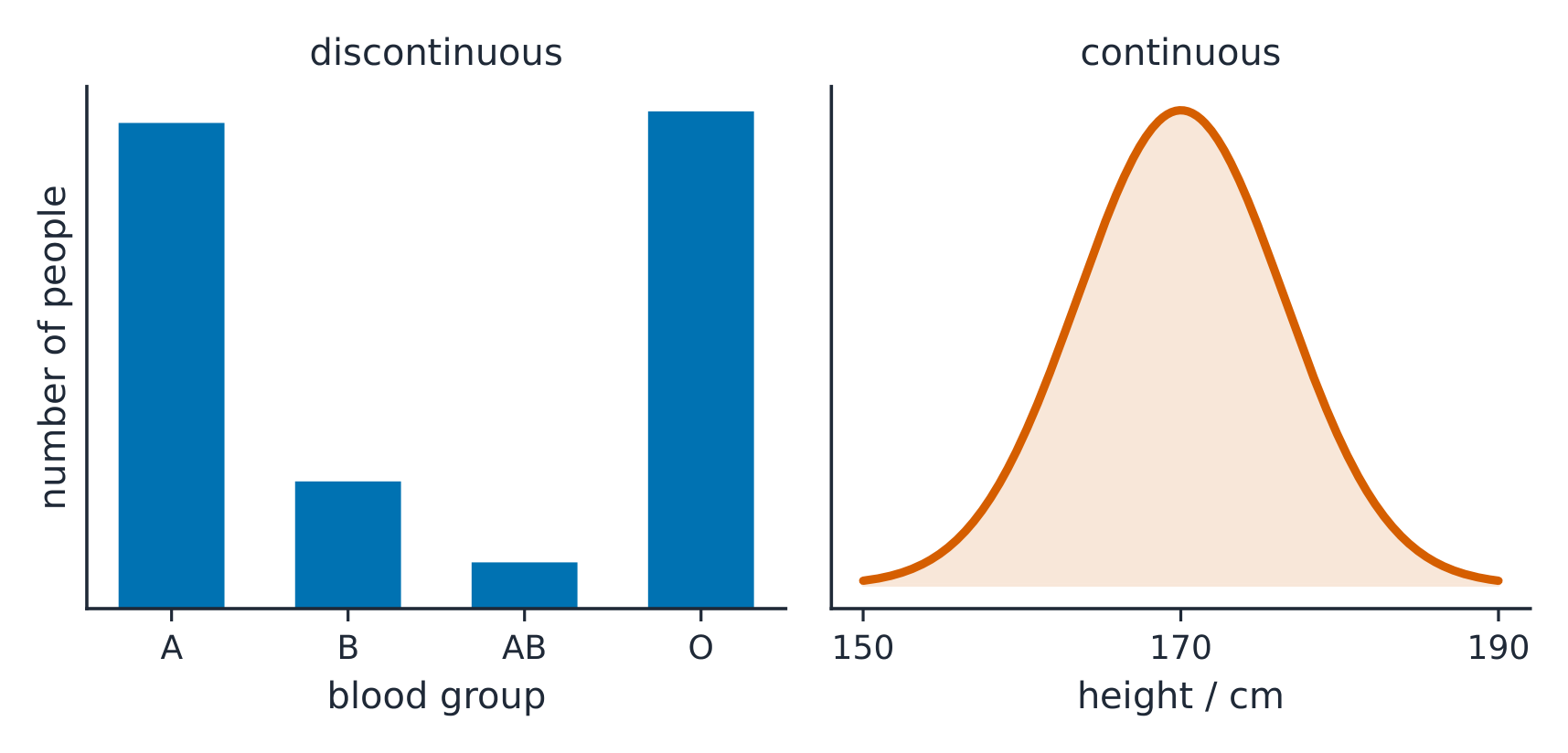
Genetic diversity 多样性 helps a population survive change – if conditions shift, some variants may already be suited to them. Low diversity (as in an endangered species) leaves a population vulnerable. Variation arises from mutation and the reshuffling of meiosis and sexual reproduction.

日本語

遺伝的多様性は集団が変化に耐えるのを助ける——条件が変わった場合、いくつかの変異型がすでに適応しているかもしれない。低い多様性(絶危種の例など)は集団を脆弱にする。変異は突然変異や減数分裂・有性生殖による組み換えから生じる。

不連続変異と連続変異
不連続変異と連続変異
Vocabulary · ⁨語彙⁩ Train · ⁨練習する⁩
English 日本語
variation/ˌveərɪˈeɪʃn/ 変異
Fitness/ˈfɪtnəs/ 適応度
adaptations/ˌædæpˈteɪʃnz/ 適応
artificial selection/ˌɑːtɪˈfɪʃl sɪˈlekʃn/ 人工選択
Population genetics/ˌpɒpjʊˈleɪʃn dʒɪˈnetɪks/ 集団遺伝学
allele frequencies/əˈliːl ˈfriːkwənsiz/ アレル頻度
gene flow/dʒiːn fləʊ/ 遺伝子流動
genetic drift/dʒɪˈnetɪk drɪft/ 遺伝的浮動
Hardy–Weinberg/ˈhɑːdi ˈwaɪnbɜːɡ/ ハーディ=ワインバーグ
fossil record/ˈfɒsl ˈrekɔːd/ 化石記録
homologous structures/həˈmɒləɡəs ˈstrʌktʃəz/ 相同器官
vestigial structures/ˈvestɪdʒl ˈstrʌktʃəz/ 痕跡器官
common ancestor/ˈkɒmən ˈænsestə/ 共通祖先
phylogenetic tree/ˌfaɪləʊdʒˈnetɪk triː/ 系統樹
7.12

Origins of Life on Earth · ⁨地球上の生命の起源⁩

Syllabus · ⁨シラバス⁩
English

Enduring Understanding (BIG IDEA 4 — Systems Interactions): Biological systems interact, and these systems and their interactions exhibit complex properties.

Learning Objective 7.12.A: Describe the scientific evidence that supports models of the origin of life on Earth.

  • 7.12.A.1 The origin of life on Earth is supported by scientific evidence.
    • i. Geological evidence reinforces models of the origin of life on Earth.
    • ii. Earth formed approximately 4.6 billion years ago (bya). The environment was too hostile for life until about 3.9 bya, and the earliest fossil evidence for life dates to 3.5 bya. Taken together, this evidence provides a plausible range of dates for the origin of life.
  • 7.12.A.2 The RNA world hypothesis proposes that RNA could have been the earliest genetic material. There are three assumptions:
    • i. At some point in time, genetic continuity was assured by the replication of RNA.
    • ii. Base-pairing is necessary for replication.
    • iii. Genetically encoded proteins were not involved as catalysts.
日本語

持続的理解(BIG IDEA 4 — システムの相互作用): 生物システムは互いに相互作用し、これらのシステムおよびその相互作用は複雑な性質を示す。

学習目標 7.12.A: 地球における生命の起源を支持する科学的証拠を説明せよ。

  • 7.12.A.1 地球における生命の起源は、科学的証拠によって裏付けられている。
    • i. 地質学的証拠は、地球における生命の起源に関するモデルを補強する。
    • ii. 地球は約 4.6 億年前(bya)に形成された。生命にとって環境があまりにも過酷だったのは約 3.9 bya までであり、生命の最初の化石証拠は 3.5 bya に遡る。これらの証拠を合わせると、生命の起源に関する妥当な年代範囲が得られる。
  • 7.12.A.2 RNA世界仮説は、RNAが最初の遺伝物質であった可能性を提案している。この仮説には以下の3つの前提がある:
    • i. 何らかの時点で、RNAの複製によって遺伝的な連続性が保証されていた。
    • ii. 塩基対結合は複製に必要である。
    • iii. 遺伝的にコードされたタンパク質は触媒として関与していなかった。

Source: College Board AP Course and Exam Description · ⁨出典: College Board AP コースおよび試験説明書⁩

English

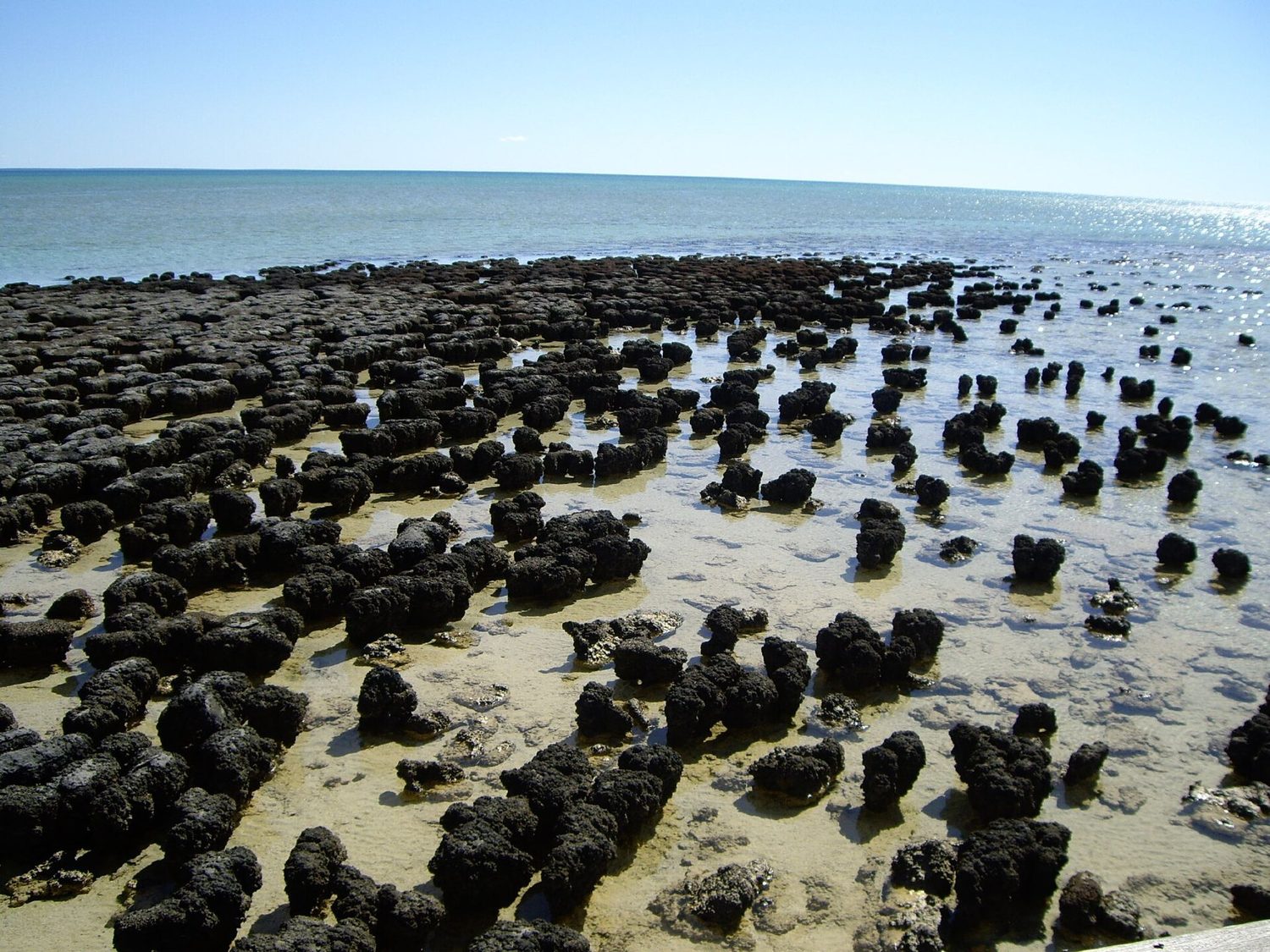
Evidence suggests early Earth's conditions could form simple organic molecules (the Miller–Urey type experiments), which assembled into polymers, then self-replicating RNA (the "RNA world"), and eventually membrane-bound cells. The first cells were prokaryotes; eukaryotes arose later through endosymbiosis 内共生.

日本語

証拠は初期地球の環境が単純な有機分子(ミラー=ユリー型実験のようなもの)を形成できたことを示唆しており、それらがポリマーに組み合わさり、自己複製可能なRNA(「RNA世界」)となり、最終的に膜で包まれた細胞になったと考えられる。最初の細胞は原核生物であり、真核生物は後になって内共生によって現れた。

ストロマトライト:層状微生物マットは地球上の最も古い生命の証拠の一つ
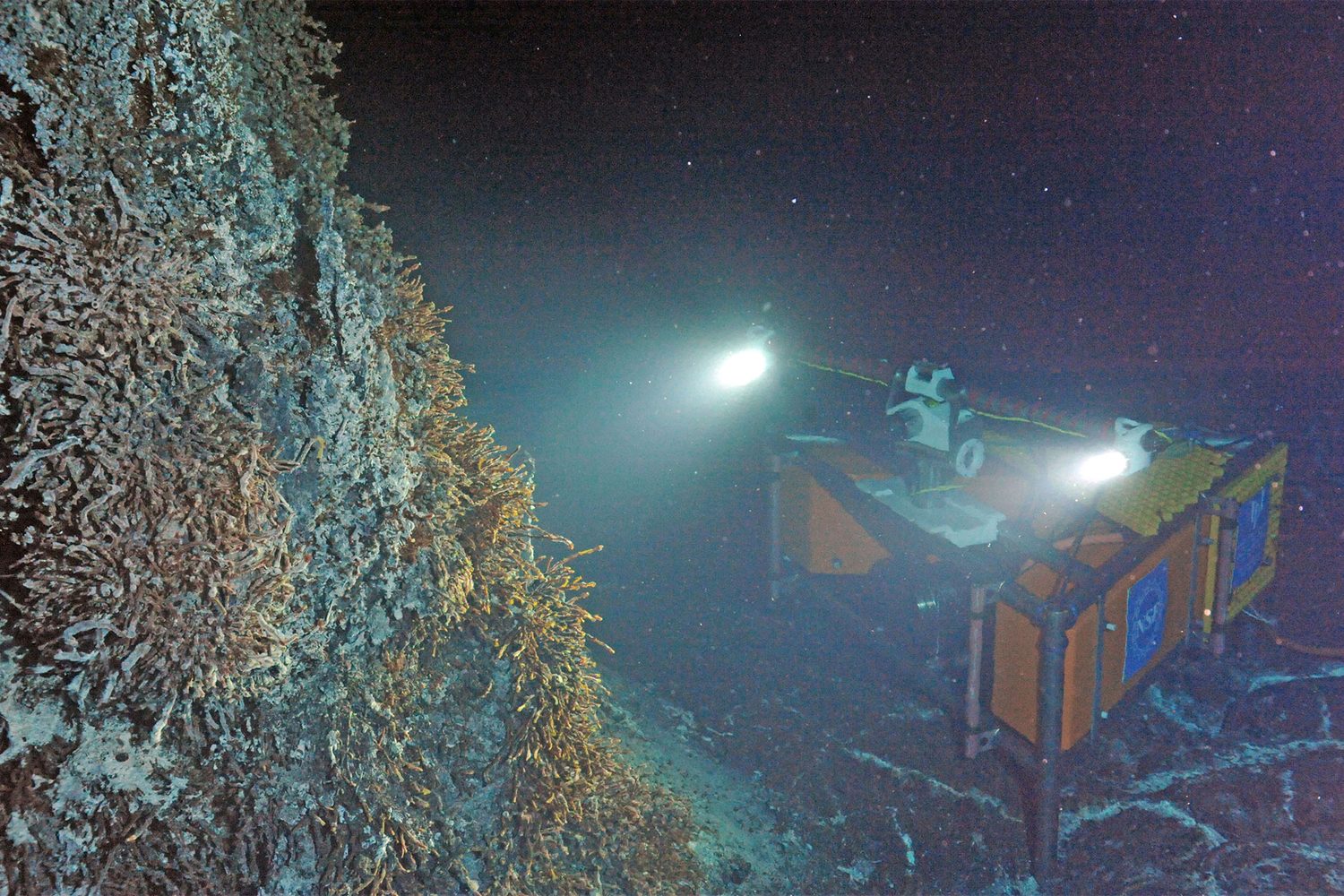
熱水噴出孔:化学物質に富んだ熱水が生命起源時の初期代謝を駆動した可能性がある
7.12

Exam tips · ⁨試験対策⁩

English
  • State natural selection cleanly: variation → differential survival and reproduction → helpful traits become common.
  • Fitness = reproductive success, not strength or health.
  • Evolution is a change in allele frequencies in a population — individuals do not evolve.
  • Use Hardy–Weinberg ($p^2+2pq+q^2=1$): start from the recessive phenotype $q^2\to q\to p$.
  • Cite independent evidence (fossils, homologous structures, DNA) and explain speciation via reproductive isolation.
日本語
  • 自然選択を明確に述べる:変異 → 生存率と繁殖数の差 → 有利な形質が一般的になる。
  • 適応度(フィットネス)=繁殖成功率であり、力や健康ではない。
  • 進化とは集団における対立子頻度の変化であり、個体が進化することはない。
  • ハーディ=ワインベルグの法則($p^2+2pq+q^2=1$)を使用する:劣性形質 $q^2\to q\to p$ から始める。
  • 独立した証拠(化石、相同構造、DNA)を引用し、生殖的隔離を通じて種形成を説明する。

Interactive lessons on this topic · ⁨このトピックのインタラクティブ授業⁩

Work through it step by step, with instant-check exercises. · ⁨一歩ずつ進め、即時チェック付きの問題で学習します。⁩

Past Papers · ⁨過去問⁩

More topics in AP Biology · ⁨AP生物学⁩ · ⁨AP Biology · ⁨AP生物学⁩ の他のトピック⁩

Log in or create account · ⁨ログインまたはアカウント作成⁩

IGCSE, A-Level & AP