A-Level Business (9609) covers five areas — business and its environment, human resources, marketing, operations, and finance and accounting — first at AS, then again at A2, where you look at the same five strategically rather than descriptively.
Almost every mark above the first is contextual. The case study is not decoration: an answer about "a business" earns the knowledge mark and stops. The same answer tied to that company's margins, market or workforce also earns application and analysis.
The top band always wants a judgement with a reason, not a list of advantages and disadvantages.
Source: Cambridge International syllabus · 出典: Cambridge International シラバス
English
People have needs 需要 (things you must have, like food and shelter) and wants 欲望 (things you would like, like a phone or a holiday). A business exists to meet these needs and wants by making goods 商品 and services 服务.
To do this, a business uses resources 资源. We sort resources into four factors of production 生产要素:
land 土地 — natural things, such as soil, water and minerals.
labour 劳动力 — the work done by people.
capital 资本 — the machines, tools, buildings and money used to produce.
enterprise 创业精神 — the skill of bringing the other three together and taking the risk 风险 to start a business.
Resources are scarce 稀缺 — there are not enough to meet everyone's wants. So every business must choose how to use them well.
Adding value 增值 means the selling price of a product is higher than the cost of the inputs 投入 (the bought-in materials) used to make it.
$$\text{value added} = \text{selling price} - \text{cost of bought-in materials}$$
A business can add value by branding 品牌, better quality, good design, fast service, or convenience. More value added can mean more profit 利润, but only if costs stay under control.
日本語
付加価値とは、製品の販売価格が、製造に用いた投入品(購入材)の原価より高い状態を指す。
$$\text{value added} = \text{selling price} - \text{cost of bought-in materials}$$
Change the bought-in cost, the selling price and other costs to see exactly where value added — and profit — come from. · 仕入コスト、販売価格、その他のコストを変化させ、付加価値と利益の exact な源泉を特定せよ。
1.1
Entrepreneurs and intrapreneurs · エンタープライザーとイントラプレナー
English
An entrepreneur 企业家 is a person who takes the risk to set up and run a business. They have the idea, organise the factors of production, and make the decisions. If the business fails, they can lose their money.
An intrapreneur 内部创业者 is an employee inside a larger business who acts like an entrepreneur. They build new ideas, products or ways of working, using the company's resources.
Characteristics of successful entrepreneurs
Successful entrepreneurs are usually:
innovative 有创新精神的 — full of new ideas.
willing to take risks, but in a careful way.
hard-working and determined 有决心的 — they do not give up easily.
self-confident 自信的 and good at making decisions.
good leaders who can plan ahead and manage money.
Why enterprise matters to a country
When people start new businesses (business start-ups 初创企业), the whole country can gain:
new jobs are created, which lowers unemployment 失业.
more goods and services are made, which raises output 产出 (and the country's GDP 国内生产总值).
more competition 竞争, giving customers lower prices and more choice.
some firms grow and export 出口, bringing money into the country.
economic growth 经济增长 and a higher standard of living.
Source: Cambridge International syllabus · 出典: Cambridge International シラバス
English
Every business works in one of four sectors:
Sector
What it does
Example
primary sector 第一产业
takes raw materials from nature
farming, mining, fishing
secondary sector 第二产业
makes (manufactures) goods
car factory, baker
tertiary sector 第三产业
provides services
shops, banks, transport
quaternary sector 第四产业
knowledge and information services
research, IT, consulting
Here raw materials 原材料 are the natural inputs a business starts with, and to manufacture 制造 means to make goods in large amounts. As a country develops, it usually moves from mostly primary work towards more tertiary and quaternary work.
The private sector 私营部门 is made up of businesses owned by private people. Their main aim is usually profit.
The public sector 公共部门 is made up of organisations owned by the government, such as state schools and public hospitals. Their aim is usually to provide a service, not to make profit.
A business must choose a legal form. The main ones are below.
A sole trader 个体经营者 is owned by one person. It is easy to set up and the owner keeps all the profit, but raising money is hard.
A partnership 合伙企业 is owned by two or more partners who share the work and profit. They often sign a deed of partnership 合伙协议 that sets out each partner's share.
A private limited company 私人有限公司 (Ltd) sells shares 股份 to a small group, such as family and friends. Its owners are shareholders 股东. Its shares are not sold to the public.
A public limited company 上市公司 (plc) sells its shares to the public on the stock exchange 证券交易所. It can raise large amounts of money, but it must follow more rules and faces the risk of a takeover 收购.
A franchise 特许经营 lets one firm use another firm's brand and business model. The franchisor 特许方 owns the brand; the franchisee 加盟方 pays a fee and a royalty 提成 to run a branch.
A joint venture 合资企业 is when two businesses join to run one project and share the costs and risks.
A social enterprise 社会企业 trades like a normal business but aims to do social or environmental 环境 good, and reinvests most of its profit.
Liability 责任 means who must pay the business's debts 债务 if it cannot pay them itself.
limited liability 有限责任 — the owners can only lose the money they put in. Their personal things, like a house or car, are safe. Companies have limited liability.
unlimited liability 无限责任 — the owners are personally responsible for all the debts. They could lose personal things. Sole traders and most partnerships have unlimited liability.
A company is a separate legal identity 独立法人 — it can own things, owe money, and be taken to court in its own name, apart from its owners.
Source: Cambridge International syllabus · 出典: Cambridge International シラバス
English
Economies of scale: average cost falls
There is no single best way to measure how big a business is. Common measures are:
the number of employees 员工.
revenue 营业收入 (also called sales turnover) — the value of what it sells.
capital employed 所用资本 — the total money invested in the business.
market share 市场份额 — the firm's sales as a percentage of the whole market.
market capitalisation 市值 — the total value of a company's shares (for a plc).
Different measures can give different answers, so it is best to use more than one.
Why small businesses matter
Small businesses create jobs, serve local communities 社区, give personal service, react quickly to change, bring new ideas, and supply parts and services to large firms.
Internal growth 内部增长 (organic growth) — the business grows by itself: selling more, opening new branches, or adding new products. It is slower but lower risk.
External growth 外部增长 — the business joins with another firm. This is called integration 整合, and it happens by:
a merger 合并 — two firms agree to join together as one.
a takeover — one firm buys control of another.
There are three types of integration:
horizontal integration 横向整合 — joining a firm at the same stage in the same industry (e.g. two car makers).
vertical integration 纵向整合 — joining a firm at a different stage in the same industry. Forward integration 前向整合 is towards the customer (e.g. buying a shop); backward integration 后向整合 is towards the supplier (e.g. buying a parts maker).
conglomerate integration 混合整合 — joining a firm in a completely different industry. This spreads risk, which is called diversification 多元化.
Firms grow to lower their costs, win a bigger market share and more market power 市场支配力, raise profit, and spread risk. But growth also brings problems: higher average costs, harder management and communication, different company cultures 企业文化 that may clash, and a need for a lot of finance.
Economies of scale 规模经济 are the cost savings a business gets as it grows larger. The average cost 平均成本 of each unit falls as output rises. The main types are:
Type
How it lowers cost
purchasing
buying in bulk 大批量 earns discounts
technical
large machines are more efficient
financial
large firms borrow at lower interest 利息
managerial
the firm can employ expert specialist managers
marketing
advertising cost is spread over more units
Diseconomies of scale 规模不经济 happen when a firm grows too big and the average cost starts to rise again. The usual causes are:
communication 沟通 becomes slow and unclear.
the coordination 协调 of many departments is hard.
workers may feel unimportant and lose motivation 激励.
Worked example. A factory making 10,000 units has fixed costs of £200,000 and variable costs of £6 per unit. It expands to 50,000 units, and bulk buying cuts the variable cost to £5. Find the unit cost at each output and explain the fall. Unit cost = total cost ÷ output. At 10,000: total = 200,000 + (10,000 × 6) = £260,000, so the unit cost is 260,000 ÷ 10,000 = £26. At 50,000: total = 200,000 + (50,000 × 5) = £450,000, so the unit cost is 450,000 ÷ 50,000 = £9. Two economies of scale are at work: the fixed costs are spread over far more units (£20 down to £4 each), and purchasing economies cut the variable cost. Note that the fixed cost total does not change - only the fixed cost per unit falls. Writing "fixed costs fall" is the error that loses the mark.
Source: Cambridge International syllabus · 出典: Cambridge International シラバス
English
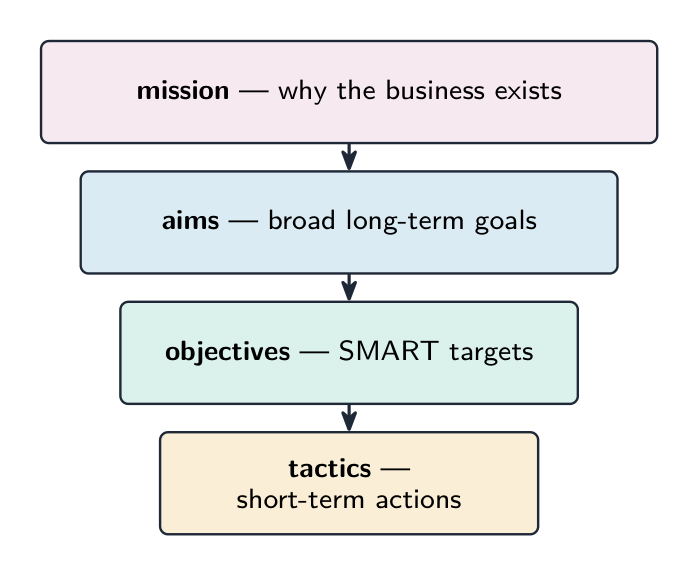
A mission statement 使命宣言 is a short sentence that says why the business exists and what it wants to be. It guides everyone in the firm.
From the mission come aims 目的 (broad, long-term goals), and then objectives 目标 (the specific targets that help reach the aims).
Good objectives are SMART — the first letters of:
Specific 具体的 — clear and exact.
Measurable 可衡量的 — you can check it with numbers.
Achievable 可实现的 — it is possible to reach.
Realistic 现实的 — sensible for the resources you have.
Time-bound 有时限的 — it has a deadline.
A strategy 战略 is the long-term plan to meet objectives. Tactics 策略 are the short-term actions that carry out the strategy. Objectives are shaped by the size and age of the firm, who owns it, the company culture, and conditions in the market.
staying in business, vital for new firms and in hard times
market share
winning a larger share of the market
social and ethical 道德 objectives
doing what is morally right, such as fair pay
Corporate social responsibility 企业社会责任 (CSR) is the idea that a business should act in the best interests of society and the environment, not just make profit. Examples are treating workers fairly, cutting pollution 污染, and helping the local community.
A firm's objectives can change over time. A new firm may aim to survive; later it may aim to grow; a large, safe firm may focus on profit or CSR.
explain the purpose and roles of human resource management (HRM): workforce planning, recruitment and selection, training and development
explain redundancy and dismissal, employer/employee rights and the management of change in HR
calculate and interpret labour turnover and labour productivity
日本語
**人事管理(HRM)**の目的と役割:労働力計画、採用と選考、研修と開発を説明する
解雇および退職金、雇用主・従業員の権利、HRにおける変革管理を説明する
離職率および労働生産性を計算・解釈する
Source: Cambridge International syllabus · 出典: Cambridge International シラバス
English
Human resource management 人力资源管理 (HRM) is the part of a business that looks after its people. Good HRM makes sure the firm has enough staff, with the right skills, who are well trained and motivated.
The main roles of HRM are:
workforce planning 人力规划 — working out how many staff, and what skills, the business will need in the future.
recruitment 招聘 and selection 甄选 — finding people to apply for jobs, then choosing the best.
training 培训 and development 培养 — improving staff skills now and helping them grow for the future.
日本語
Human resource management 人力资源管理 (HRM) is the part of a business that looks after its people. Good HRM makes sure the firm has enough staff, with the right skills, who are well trained and motivated.
Managers plan and organise the workforce — the core of human resource management.
The main roles of HRM are:
workforce planning 人力规划 — working out how many staff, and what skills, the business will need in the future.
recruitment 招聘 and selection 甄选 — finding people to apply for jobs, then choosing the best.
training 培训 and development 培养 — improving staff skills now and helping them grow for the future.
Explore · 探索
Human resources decision lab · 人事判断ラベル
Classify HR actions by the job they do inside the workforce. · workforce(労働力)内の役割に基づき、HR行動を分類せよ。
human resource management/ˈhjuːmən rɪˈzɔːs ˈmænɪdʒmənt/
人事管理
workforce planning/ˈwɜːkfɔːs ˈplænɪŋ/
労働力計画
recruitment/rɪˈkruːtmənt/
採用
selection/sɪˈlekʃn/
選択
training/ˈtreɪnɪŋ/
学習用
development/dɪˈveləpmənt/
発展
2.1
Workforce planning, recruitment and selection
English
Workforce planning looks at the firm's plans, then at the staff it already has, to find the gap. The gap may be filled by hiring, training, or moving staff.
To recruit, the firm first writes:
a job description 职位描述 — the title, duties and tasks of the job.
a person specification 人员规格 — the skills, qualifications 资格 and qualities the right person should have.
The firm can recruit from inside or outside:
internal recruitment 内部招聘 — filling the job with someone who already works there. It is cheaper and faster, and the person is known, but no new ideas come in.
external recruitment 外部招聘 — hiring someone from outside. It brings new skills and ideas, but costs more and is slower.
Selection methods include reading application forms and CVs, interviews 面试, tests, and group tasks.
日本語
Workforce planning looks at the firm's plans, then at the staff it already has, to find the gap. The gap may be filled by hiring, training, or moving staff.
Recruitment: describe the job, advertise, then select the best applicant
To recruit, the firm first writes:
a job description 职位描述 — the title, duties and tasks of the job.
a person specification 人员规格 — the skills, qualifications 资格 and qualities the right person should have.
The firm can recruit from inside or outside:
internal recruitment 内部招聘 — filling the job with someone who already works there. It is cheaper and faster, and the person is known, but no new ideas come in.
external recruitment 外部招聘 — hiring someone from outside. It brings new skills and ideas, but costs more and is slower.
Selection methods include reading application forms and CVs, interviews 面试, tests, and group tasks.
Selection: the interview is the stage most candidates meet, and the one most often assessed in the exam
Both sides have rights and duties. The employer 雇主 must follow the law on pay, safety, working hours and unfair dismissal. The employee 雇员 must work as agreed and follow safe, fair rules. These rights 权利 protect both sides.
Businesses change often — new technology, new markets, or restructuring 重组. The management of change 变革管理 in HR means planning the change, explaining it clearly, training staff for new roles, and listening to worries, so staff accept the change instead of resisting it.
日本語
Both sides have rights and duties. The employer 雇主 must follow the law on pay, safety, working hours and unfair dismissal. The employee 雇员 must work as agreed and follow safe, fair rules. These rights 权利 protect both sides.
Businesses change often — new technology, new markets, or restructuring 重组. The management of change 变革管理 in HR means planning the change, explaining it clearly, training staff for new roles, and listening to worries, so staff accept the change instead of resisting it.
Source: Cambridge International syllabus · 出典: Cambridge International シラバス
English
Motivation 激励 is the desire to work hard and do a good job. Motivated staff produce more and better work, take fewer days off, stay longer, and give better service. So motivation lowers costs and raises quality.
日本語
Motivation 激励 is the desire to work hard and do a good job. Motivated staff produce more and better work, take fewer days off, stay longer, and give better service. So motivation lowers costs and raises quality.
Several thinkers tried to explain what motivates people. You should know the main idea of each.
Thinker
Main idea
Taylor
scientific management 科学管理 — workers are mainly motivated by money. Pay them per unit made (piece rate 计件工资) and they work harder.
Mayo
human relations 人际关系 — workers are also motivated by attention, teamwork and feeling part of a group.
Maslow
hierarchy of needs 需求层次 — people meet needs in order, from low to high (see below).
Herzberg
two-factor theory 双因素理论 — some things cause unhappiness if missing, others truly motivate (see below).
McClelland
people are driven by three needs in different amounts: achievement 成就, power and affiliation (belonging).
Vroom
expectancy theory 期望理论 — people work hard only if they believe the effort will lead to a reward they want.
Maslow's hierarchy of needs
Maslow said people try to meet lower needs first, then move up:
physiological needs 生理需求 — food, water, rest (met by pay).
safety needs — a safe job and workplace.
social needs — friendship and being part of a team.
esteem needs 尊重需求 — respect and recognition 认可.
self-actualisation 自我实现 — reaching your full potential.
Herzberg's two factors
hygiene factors 保健因素 — things like pay, conditions and rules. If they are poor, staff are unhappy; but fixing them does not truly motivate.
motivators 激励因素 — things like achievement, responsibility and recognition. These give real, lasting motivation.
日本語
Maslow's hierarchy of needs, with workplace examples at each level.
Several thinkers tried to explain what motivates people. You should know the main idea of each.
Thinker
Main idea
Taylor
scientific management 科学管理 — workers are mainly motivated by money. Pay them per unit made (piece rate 计件工资) and they work harder.
Mayo
human relations 人际关系 — workers are also motivated by attention, teamwork and feeling part of a group.
Maslow
hierarchy of needs 需求层次 — people meet needs in order, from low to high (see below).
Herzberg
two-factor theory 双因素理论 — some things cause unhappiness if missing, others truly motivate (see below).
McClelland
people are driven by three needs in different amounts: achievement 成就, power and affiliation (belonging).
Vroom
expectancy theory 期望理论 — people work hard only if they believe the effort will lead to a reward they want.
Maslow's hierarchy of needs
Maslow said people try to meet lower needs first, then move up:
physiological needs 生理需求 — food, water, rest (met by pay).
safety needs — a safe job and workplace.
social needs — friendship and being part of a team.
esteem needs 尊重需求 — respect and recognition 认可.
self-actualisation 自我实现 — reaching your full potential.
Maslow's hierarchy: people meet lower needs before higher ones
Herzberg's two factors
hygiene factors 保健因素 — things like pay, conditions and rules. If they are poor, staff are unhappy; but fixing them does not truly motivate.
motivators 激励因素 — things like achievement, responsibility and recognition. These give real, lasting motivation.
Hygiene factors stop unhappiness; only motivators give real, lasting motivation
Explore · 探索
Maslow's hierarchy of needs · マ斯洛の欲求階層説
Maslow said people are motivated by needs in order — satisfy the lower ones first, then they aim higher. · マ斯洛によると、人間は欲求を満たすことで動機づけられ、下位から順に満たされ、上位を目指すようになる。
explain the role and functions of management (Fayol, Mintzberg)
explain leadership versus management and the importance of effective management
日本語
マネジメントの役割と機能(ファヨール、ミンツバーグ)を説明する
リーダーシップとマネジメントの違い、および効果的なマネジメントの重要性を説明する
Source: Cambridge International syllabus · 出典: Cambridge International シラバス
English
Management 管理 means getting work done through other people to reach the firm's objectives.
Fayol said managers carry out five functions:
Function
What the manager does
planning 计划
set objectives and decide how to reach them
organising 组织
arrange people and resources
commanding 指挥
give clear instructions and guidance
coordinating 协调
make sure all parts work together
controlling 控制
check results against the plan and correct problems
Mintzberg said managers also play ten roles 角色 in three groups: interpersonal (working with people), informational (sharing information), and decisional (making decisions). This shows that real management is busy and varied, not just the five neat functions.
日本語
Management 管理 means getting work done through other people to reach the firm's objectives.
Fayol said managers carry out five functions:
Function
What the manager does
planning 计划
set objectives and decide how to reach them
organising 组织
arrange people and resources
commanding 指挥
give clear instructions and guidance
coordinating 协调
make sure all parts work together
controlling 控制
check results against the plan and correct problems
Fayol's five functions of management form a repeating cycle
Mintzberg said managers also play ten roles 角色 in three groups: interpersonal (working with people), informational (sharing information), and decisional (making decisions). This shows that real management is busy and varied, not just the five neat functions.
Explore · 探索
Leadership style lab · リーダーシップスタイルラボ
Pick the management style that fits each situation. · 各状況に最適な経営スタイルを選択せよ。
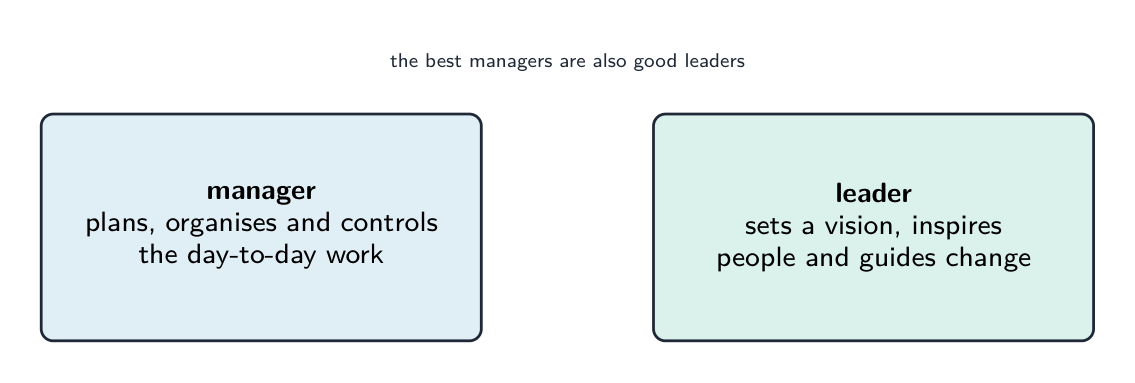
a manager plans, organises and controls the day-to-day work.
a leader sets a vision 愿景, inspires people, and guides change.
The best managers are also good leaders. Effective management matters because it raises productivity, keeps good staff, helps the firm adapt to change, and turns plans into real results.
日本語
Leadership 领导 and management are not the same.
a manager plans, organises and controls the day-to-day work.
a leader sets a vision 愿景, inspires people, and guides change.
A manager runs the day-to-day work; a leader sets direction and inspires — the best people do both
The best managers are also good leaders. Effective management matters because it raises productivity, keeps good staff, helps the firm adapt to change, and turns plans into real results.
Source: Cambridge International syllabus · 出典: Cambridge International シラバス
English
Elastic vs inelastic demandDemand shifts right: P and Q rise
Marketing 市场营销 is the job of finding out what customers want, then making and selling products that meet those wants at a profit. Good marketing links the business to its market 市场 (all the buyers and sellers of a product).
A business can be:
product-orientated 产品导向 — it focuses on the product first and hopes customers will buy it. This suits new or technical products.
market-orientated 市场导向 — it finds out what customers want first, then makes it. This lowers the risk of failure.
Customer relationship marketing 客户关系营销 (CRM) means building long-term links with customers so they come back again. Keeping a customer is cheaper than finding a new one.
日本語
Elastic vs inelastic demandDemand shifts right: P and Q rise
Marketing 市场营销 is the job of finding out what customers want, then making and selling products that meet those wants at a profit. Good marketing links the business to its market 市场 (all the buyers and sellers of a product).
A business can be:
product-orientated 产品导向 — it focuses on the product first and hopes customers will buy it. This suits new or technical products.
market-orientated 市场导向 — it finds out what customers want first, then makes it. This lowers the risk of failure.
Customer relationship marketing 客户关系营销 (CRM) means building long-term links with customers so they come back again. Keeping a customer is cheaper than finding a new one.
Explore · 探索
Marketing mix lab · マーケティングミックス実験室
See which part of the marketing mix changes in each real decision. · 各実際の意思決定において、マーケティングミックスのどの要素が変化するかを確認する。
If the whole market grows but the firm's sales stay at £4 million, its market share falls — so a firm can sell the same amount yet lose ground to faster-growing rivals.
日本語
market size 市场规模 — the total sales of all firms in a market, by value or by number of units.
market growth 市场增长 — how fast the market is getting bigger, shown as a percentage.
market share 市场份额 — one firm's sales as a percentage of the total market:
If the whole market grows but the firm's sales stay at £4 million, its market share falls — so a firm can sell the same amount yet lose ground to faster-growing rivals.
Market segmentation 市场细分 means splitting a market into groups (segments 细分市场) of buyers who are alike. Common ways to segment are by age, income, gender, location, and lifestyle. Segmentation lets a firm aim the right product and message at each group, which raises sales and cuts waste.
日本語
Shelf space is a marketing decision: segment, position, then price and promote
Market segmentation 市场细分 means splitting a market into groups (segments 细分市场) of buyers who are alike. Common ways to segment are by age, income, gender, location, and lifestyle. Segmentation lets a firm aim the right product and message at each group, which raises sales and cuts waste.
Splitting a market into segments by age, income and lifestyle
Demand 需求 is how much of a product buyers will buy at each price. Supply 供给 is how much sellers will offer at each price. Usually, when price falls, demand rises.
Elasticity 弹性 measures how strongly demand reacts to a change. You should know three types.
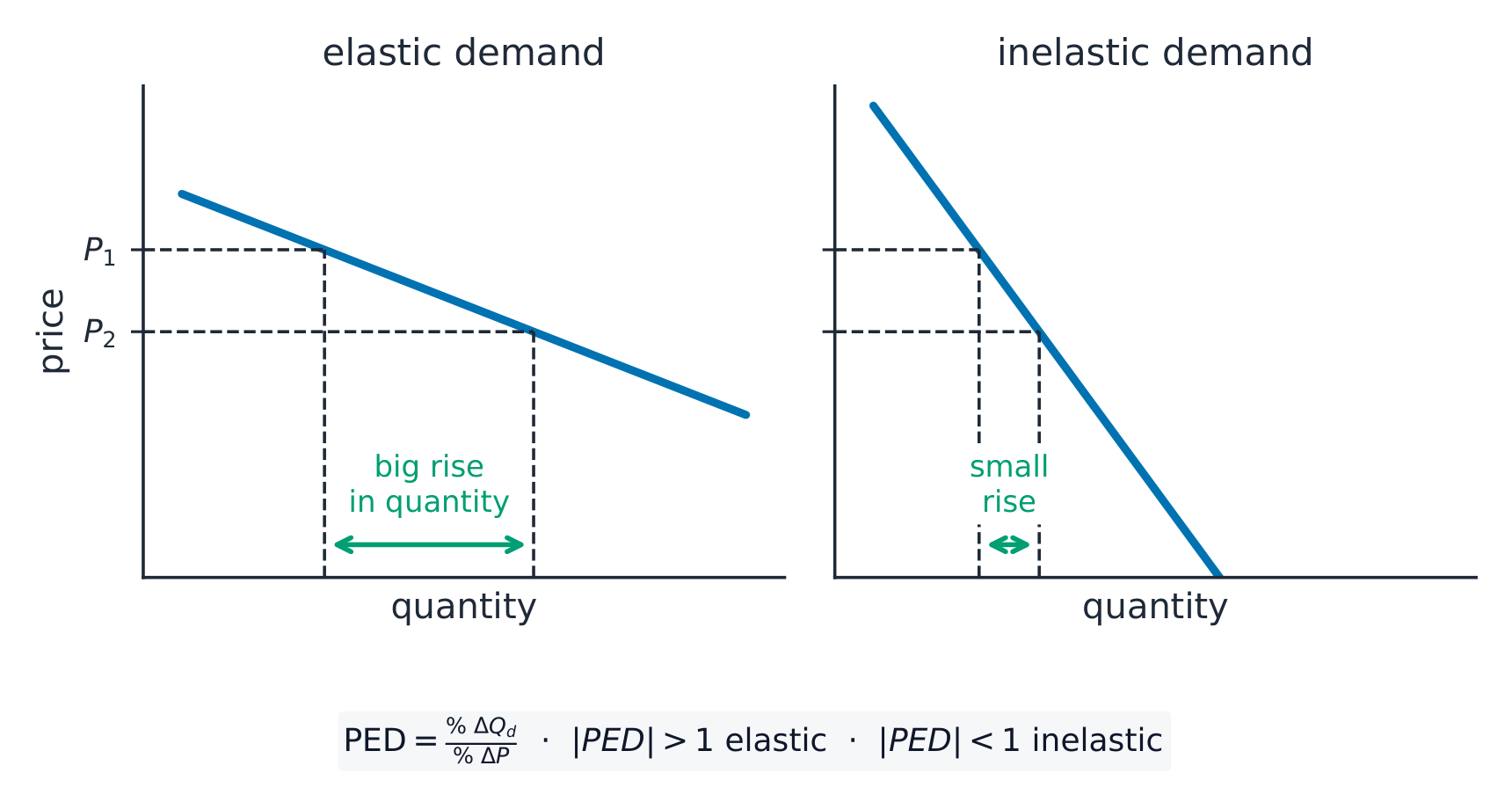
Price elasticity of demand 需求价格弹性 (PED) measures how demand reacts to a price change:
$$\text{PED} = \frac{\%\ \text{change in quantity demanded}}{\%\ \text{change in price}}$$
if PED is greater than 1, demand is price elastic 富有弹性 — a small price cut raises sales a lot, so lowering price can raise revenue.
if PED is less than 1, demand is price inelastic 缺乏弹性 — demand changes little, so raising price can raise revenue.
Income elasticity of demand 需求收入弹性 (YED) measures how demand reacts to a change in customers' income. Luxury goods react strongly; basic goods react weakly.
Cross elasticity of demand 需求交叉弹性 (XED) measures how the demand for one product reacts to a price change of another. It is positive for substitutes 替代品 (e.g. tea and coffee) and negative for complements 互补品 (e.g. cars and fuel).
Elasticity is useful because it helps a firm predict how a price change will affect sales and revenue.
日本語
Demand 需求 is how much of a product buyers will buy at each price. Supply 供给 is how much sellers will offer at each price. Usually, when price falls, demand rises.
Supply and demand meet at the equilibrium market price
Elasticity 弹性 measures how strongly demand reacts to a change. You should know three types.
Price elasticity of demand 需求价格弹性 (PED) measures how demand reacts to a price change:
$$\text{PED} = \frac{\%\ \text{change in quantity demanded}}{\%\ \text{change in price}}$$
if PED is greater than 1, demand is price elastic 富有弹性 — a small price cut raises sales a lot, so lowering price can raise revenue.
if PED is less than 1, demand is price inelastic 缺乏弹性 — demand changes little, so raising price can raise revenue.
The same price fall raises quantity a lot when demand is elastic, only a little when inelastic
Income elasticity of demand 需求收入弹性 (YED) measures how demand reacts to a change in customers' income. Luxury goods react strongly; basic goods react weakly.
Cross elasticity of demand 需求交叉弹性 (XED) measures how the demand for one product reacts to a price change of another. It is positive for substitutes 替代品 (e.g. tea and coffee) and negative for complements 互补品 (e.g. cars and fuel).
Elasticity is useful because it helps a firm predict how a price change will affect sales and revenue.
Explore · 探索
Demand, supply & elasticity · 需要、供給 & 弾力性
Price is set where demand meets supply. · 価格は需要と供給が一致する地点で設定される。
Explore · 探索
Demand and supply · 需要と供給
Shift the curves to see how price is set in a market — and how elasticity decides how much quantity responds. · 曲線を移動させて、市場での価格決定のプロセスと、価格弾性率がQuantityの反応度にどう影響するかを確認します。
price elasticity of demand/praɪs ɪlæˈstɪsɪti ɒv dɪˈmænd/
需要の価格弾力性
price elastic/praɪs ɪˈlæstɪk/
価格弾力性あり
price inelastic/praɪs ɪnɪˈlæstɪk/
価格弾力性なし
income elasticity of demand/ˈɪŋkʌm ɪlæˈstɪsɪti ɒv dɪˈmænd/
所得需要弾性
cross elasticity of demand/krɒs ɪlæˈstɪsɪti ɒv dɪˈmænd/
代替財の需要の交叉弾力性
substitutes/ˈsʌbstɪtjuːts/
代替財である
complements/ˈkɒmplɪmənts/
補完財である
3.2
Market research
Syllabus · シラバス
English
distinguish primary and secondary market research and qualitative and quantitative data
explain sampling methods and the reliability of data; present and interpret market research findings
日本語
一次調査と二次調査、および定性的データと定量的データを区別する
サンプリング方法とデータの信頼性を説明し、市場調査の結果を提示・解釈する
Source: Cambridge International syllabus · 出典: Cambridge International シラバス
English
Market research 市场调研 is collecting and studying information about customers, competitors 竞争对手 and the market.
primary research 一手调研 — new information you collect yourself, by surveys, interviews or observation. It fits your exact needs, but costs more and takes time.
secondary research 二手调研 — information that already exists, such as reports, websites and sales records. It is cheap and quick, but may be old or not exactly right.
Data can be:
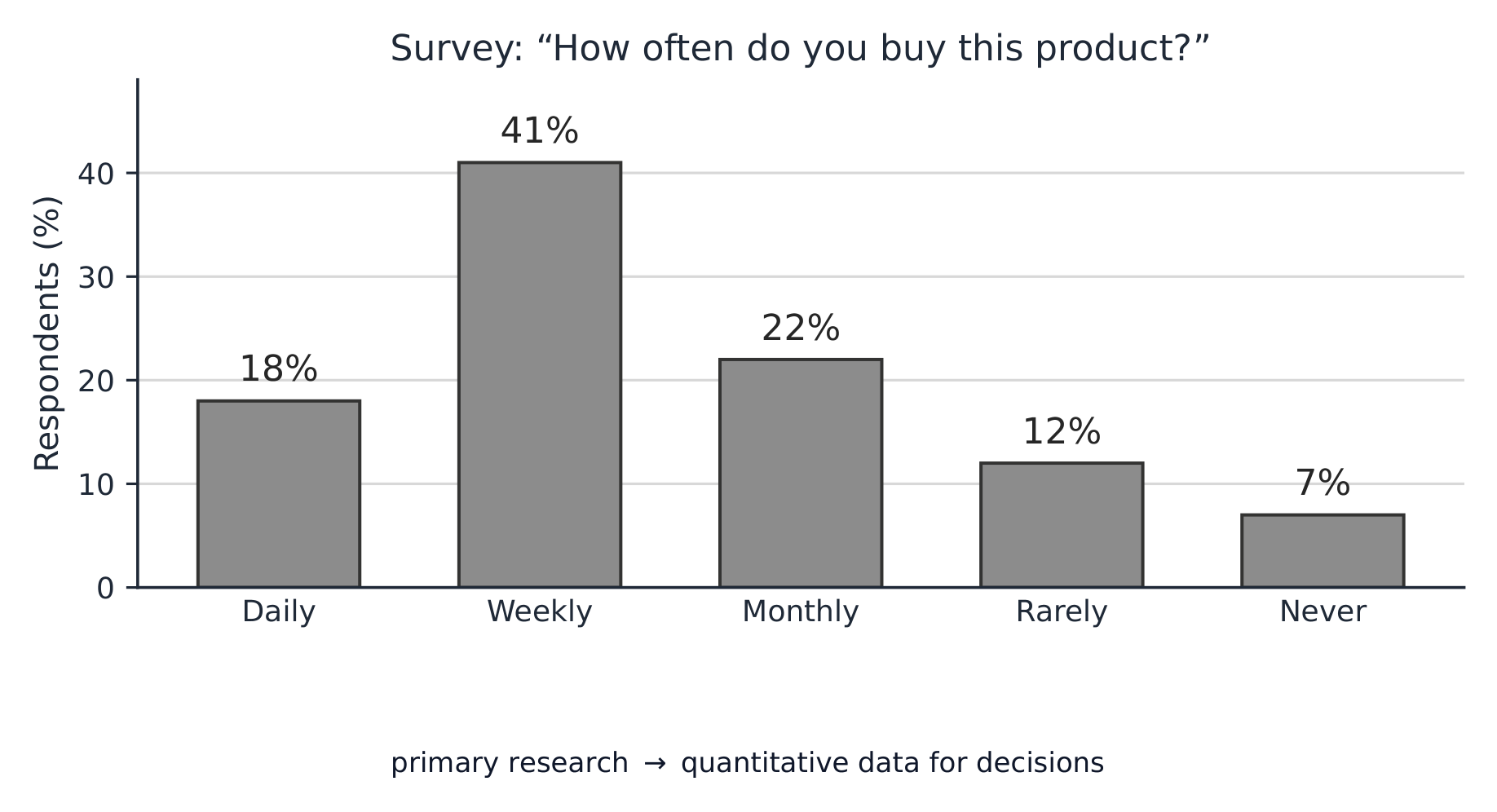
quantitative data 定量数据 — facts in numbers (e.g. "60% buy weekly"). Easy to compare.
qualitative data 定性数据 — opinions and reasons (e.g. "why people like the brand"). Gives deeper understanding.
Sampling and reliability
A sample 样本 is the small group of people asked, chosen to stand for the whole market. Sampling 抽样 methods include:
random sampling 随机抽样 — everyone has an equal chance of being picked.
quota sampling 配额抽样 — set numbers from each group are asked.
stratified sampling 分层抽样 — the sample copies the make-up of the whole market.
A larger, well-chosen sample gives more reliable 可靠的 results. Poor sampling can cause bias 偏差, which makes the findings wrong. Results are often shown in tables and charts, then read carefully to guide decisions.
日本語
Market research 市场调研 is collecting and studying information about customers, competitors 竞争对手 and the market.
primary research 一手调研 — new information you collect yourself, by surveys, interviews or observation. It fits your exact needs, but costs more and takes time.
secondary research 二手调研 — information that already exists, such as reports, websites and sales records. It is cheap and quick, but may be old or not exactly right.
Data can be:
quantitative data 定量数据 — facts in numbers (e.g. "60% buy weekly"). Easy to compare.
qualitative data 定性数据 — opinions and reasons (e.g. "why people like the brand"). Gives deeper understanding.
Sampling and reliability
A sample 样本 is the small group of people asked, chosen to stand for the whole market. Sampling 抽样 methods include:
random sampling 随机抽样 — everyone has an equal chance of being picked.
quota sampling 配额抽样 — set numbers from each group are asked.
stratified sampling 分层抽样 — the sample copies the make-up of the whole market.
A larger, well-chosen sample gives more reliable 可靠的 results. Poor sampling can cause bias 偏差, which makes the findings wrong. Results are often shown in tables and charts, then read carefully to guide decisions.
Primary research → quantitative data that guides marketing decisions
Explore · 探索
Market research cycle · 市場調査サイクル
Follow how a business turns customer data into a marketing decision. · 企業が顧客データをマーケティング意思決定に変換する流れを追う。
Source: Cambridge International syllabus · 出典: Cambridge International シラバス
English
The product life cycle
The marketing mix 营销组合 is the set of choices a firm makes to sell a product. It is often called the 4Ps:
P
Question it answers
product 产品
what are we selling?
price 价格
how much do we charge?
place 渠道
where and how do customers buy it?
promotion 促销
how do we tell customers about it?
The four parts must work together. For example, a high price needs high quality and a good image. Making the parts fit each other is called integration 整合.
日本語
The product life cycleA branded shop window — branding and place help sell the product.
The marketing mix 营销组合 is the set of choices a firm makes to sell a product. It is often called the 4Ps:
P
Question it answers
product 产品
what are we selling?
price 价格
how much do we charge?
place 渠道
where and how do customers buy it?
promotion 促销
how do we tell customers about it?
The marketing mix combines the four Ps
The four parts must work together. For example, a high price needs high quality and a good image. Making the parts fit each other is called integration 整合.
Product development 产品开发 is the work of designing and improving products to meet customer needs and beat rivals.
The product life cycle
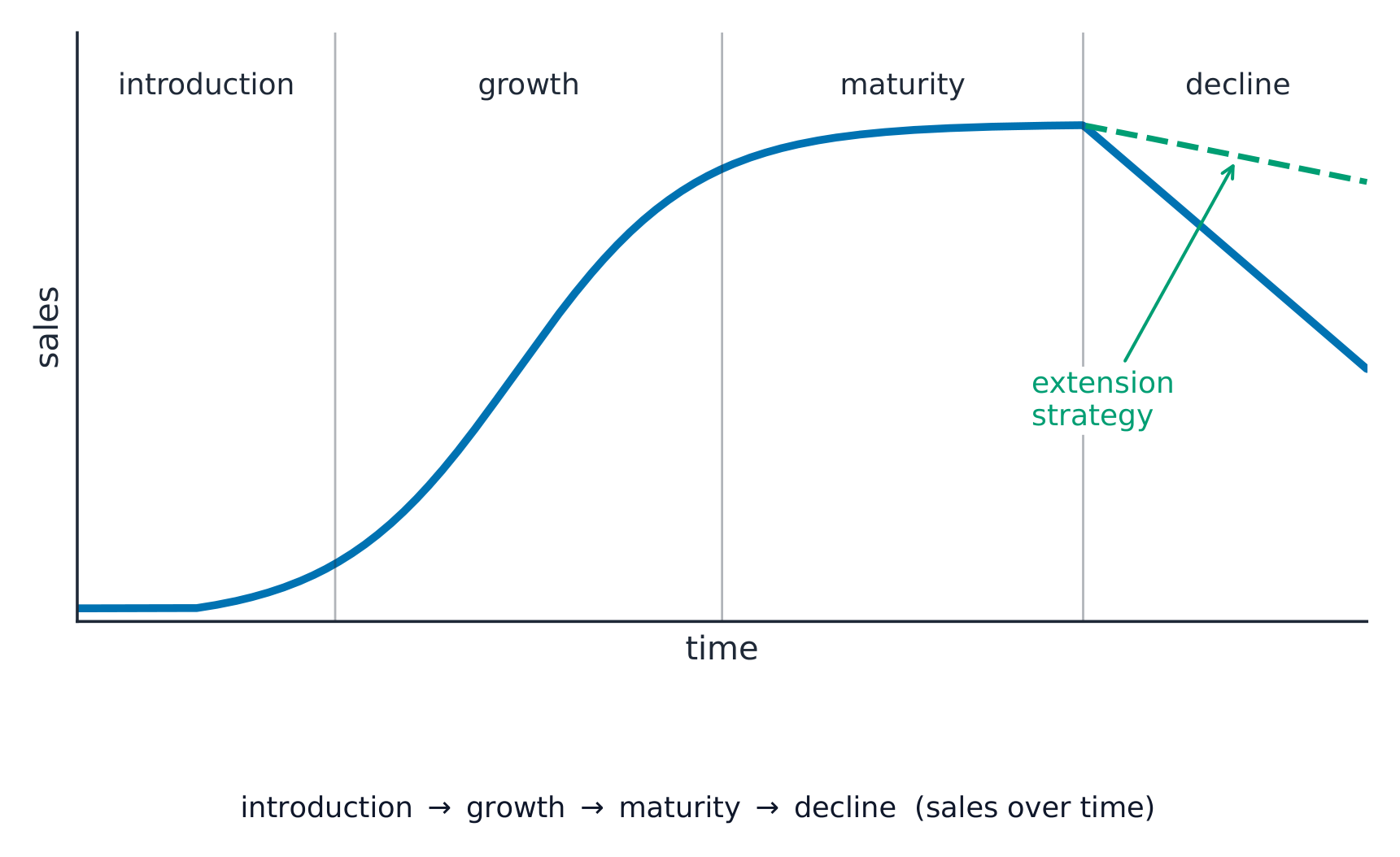
The product life cycle 产品生命周期 shows the sales of a product over time, in four stages:
introduction 引入期 — launch; low sales, high promotion cost.
growth 成长期 — sales rise quickly.
maturity 成熟期 — sales reach their peak and level off.
decline 衰退期 — sales fall as tastes change.
To keep sales up in maturity, firms use extension strategies 延长策略, such as new packaging, new uses, or selling in new markets.
The product portfolio (Boston Matrix)
The product portfolio 产品组合 is the full range of products a firm sells. The Boston Matrix 波士顿矩阵 sorts products by market share and market growth:
High market growth
Low market growth
High share
stars 明星产品
cash cows 现金牛
Low share
question marks 问题产品
dogs 瘦狗产品
Stars need investment but may become cash cows. Cash cows bring steady profit. Question marks are risky. Dogs are usually dropped.
Branding
Branding 品牌 gives a product a name, design and image that customers recognise. A strong brand builds loyalty 忠诚度, lets the firm charge more, and makes new products easier to launch.
日本語
A good product is the heart of the mix.
Product development 产品开发 is the work of designing and improving products to meet customer needs and beat rivals.
The product life cycle
The product life cycle 产品生命周期 shows the sales of a product over time, in four stages:
introduction 引入期 — launch; low sales, high promotion cost.
growth 成长期 — sales rise quickly.
maturity 成熟期 — sales reach their peak and level off.
decline 衰退期 — sales fall as tastes change.
Sales of a product over its four life-cycle stages, with an extension strategy in maturity
To keep sales up in maturity, firms use extension strategies 延长策略, such as new packaging, new uses, or selling in new markets.
The product portfolio (Boston Matrix)
The product portfolio 产品组合 is the full range of products a firm sells. The Boston Matrix 波士顿矩阵 sorts products by market share and market growth:
High market growth
Low market growth
High share
stars 明星产品
cash cows 现金牛
Low share
question marks 问题产品
dogs 瘦狗产品
The Boston Matrix sorts products by market share and market growth
Stars need investment but may become cash cows. Cash cows bring steady profit. Question marks are risky. Dogs are usually dropped.
Branding
Branding 品牌 gives a product a name, design and image that customers recognise. A strong brand builds loyalty 忠诚度, lets the firm charge more, and makes new products easier to launch.
Explore · 探索
The product life cycle · 製品ライフサイクル
Most products pass through four sales stages over time — from launch to decline. · ほとんどの製品は、導入から衰退まで、時間とともに4つの販売段階を経る。
Explore · 探索
Balance the product portfolio · 製品ポートフォリオをバランスさせる
Pick a product and drag its market share and growth — it re-classifies live, and Play walks one product through its whole life across the matrix. · 製品を選び、その市場シェアと成長率をドラッグしてください。リアルタイムで分類が更新され、Playがマトリクス全体を通じて1つの製品のライフサイクルをトレースします。
Place is how the product reaches the customer, through a distribution channel 分销渠道. A short channel (maker → customer) gives more control; a longer channel (maker → wholesaler 批发商 → shop → customer) reaches more buyers.
Promotion tells customers about a product and persuades them to buy. It is split into:
above-the-line promotion 大众媒体广告 — paid advertising 广告 in mass media, such as TV and online ads, aimed at a wide audience.
below-the-line promotion 直接促销 — targeted methods the firm controls, such as discounts, free samples and direct mail.
Digital marketing 数字营销 and e-commerce 电子商务 (buying and selling online) now play a huge role. They let small firms reach world markets cheaply, target adverts to the right people, and sell at any time of day.
日本語
Advertising on giant screens — promotion is part of the marketing mix.
Place is how the product reaches the customer, through a distribution channel 分销渠道. A short channel (maker → customer) gives more control; a longer channel (maker → wholesaler 批发商 → shop → customer) reaches more buyers.
A short channel gives more control; a longer channel reaches more buyers
Promotion tells customers about a product and persuades them to buy. It is split into:
above-the-line promotion 大众媒体广告 — paid advertising 广告 in mass media, such as TV and online ads, aimed at a wide audience.
below-the-line promotion 直接促销 — targeted methods the firm controls, such as discounts, free samples and direct mail.
Digital marketing 数字营销 and e-commerce 电子商务 (buying and selling online) now play a huge role. They let small firms reach world markets cheaply, target adverts to the right people, and sell at any time of day.
Source: Cambridge International syllabus · 出典: Cambridge International シラバス
English
Operations 运营 is the part of a business that makes the product. Operations management 运营管理 is the job of turning inputs 投入 into outputs 产出 well.
This is the transformation process 转化过程:
inputs — raw materials, labour, machines and money.
process — the work that changes the inputs.
outputs — finished goods and services for the customer.
Good operations add value 增值: the output is worth more than the inputs used to make it. Using raw materials 原材料 (the basic materials a business starts with) well is a big part of this.
日本語
Operations 运营 is the part of a business that makes the product. Operations management 运营管理 is the job of turning inputs 投入 into outputs 产出 well.
A distribution centre: operations management turns inputs into finished goods ready for customers.
This is the transformation process 转化过程:
inputs — raw materials, labour, machines and money.
process — the work that changes the inputs.
outputs — finished goods and services for the customer.
Operations turn inputs into outputs, adding value along the way
Good operations add value 增值: the output is worth more than the inputs used to make it. Using raw materials 原材料 (the basic materials a business starts with) well is a big part of this.
Explore · 探索
Operations: input → output · 業務:投入要素 → 産出物
Operations management turns inputs into finished goods or services through a transformation process. · 業務管理は、変換プロセスを通じて投入要素を完成品やサービスに変換します。
Efficiency 效率 means making products with as little waste of time, materials and money as possible. Higher productivity and efficiency lower the cost of each unit, so the firm can charge less or earn more.
Worked example. A factory of $20$ workers makes $800$ units in a day. Find the output per worker.
$$\text{productivity} = \frac{800}{20} = 40 \text{ units per worker per day}.$$
If training raised output to $1000$ units with the same $20$ workers, productivity would rise to $50$ units each — the same staff cost now spread over more units, so each unit is cheaper to make.
日本語
Productivity 生产率 measures how much output you get from your inputs:
Efficiency 效率 means making products with as little waste of time, materials and money as possible. Higher productivity and efficiency lower the cost of each unit, so the firm can charge less or earn more.
Worked example. A factory of $20$ workers makes $800$ units in a day. Find the output per worker.
$$\text{productivity} = \frac{800}{20} = 40 \text{ units per worker per day}.$$
If training raised output to $1000$ units with the same $20$ workers, productivity would rise to $50$ units each — the same staff cost now spread over more units, so each unit is cheaper to make.
Assembly line: productivity is output per worker (or per hour) — rising productivity cuts unit costs
a capital-intensive 资本密集型 operation uses mostly machines (e.g. a car factory). It has high set-up costs but low cost per unit, and is good for large amounts.
a labour-intensive 劳动密集型 operation uses mostly people (e.g. a hair salon). It is flexible and good for personal service, but quality can vary.
日本語
a capital-intensive 资本密集型 operation uses mostly machines (e.g. a car factory). It has high set-up costs but low cost per unit, and is good for large amounts.
a labour-intensive 劳动密集型 operation uses mostly people (e.g. a hair salon). It is flexible and good for personal service, but quality can vary.
Factory robots: capital-intensive production uses more machines relative to labour
Sustainability 可持续性 means meeting today's needs without harming the future or the planet. Sustainable operations cut waste, use less energy, recycle, and use materials that can be replaced.
Technology 技术 is widely used in operations. Automation 自动化 (machines and robots doing tasks) raises output, improves quality and lowers cost, but it has a high set-up cost and can replace jobs.
日本語
Sustainability 可持续性 means meeting today's needs without harming the future or the planet. Sustainable operations cut waste, use less energy, recycle, and use materials that can be replaced.
Technology 技术 is widely used in operations. Automation 自动化 (machines and robots doing tasks) raises output, improves quality and lowers cost, but it has a high set-up cost and can replace jobs.
inventory control chart/ˈɪnvəntri kənˈtrəʊl tʃɑːt/
在庫管理チャート
re-order level/riː ˈɔːdə ˈlevl/
発注ライン
lead time/liːd taɪm/
リードタイム
buffer inventory/ˈbʌfə ˈɪnvəntri/
バッファ在庫
maximum inventory/ˈmæksɪməm ˈɪnvəntri/
最大在庫量
4.2
Just-in-time and just-in-case
English
There are two main ways to manage stock.
just-in-time 准时制 (JIT) — stock arrives only as it is needed, so almost no inventory is held. This cuts holding costs and waste, but a late delivery can stop production.
just-in-case 备货制 — extra stock is held in case of problems. This is safer but costs more to store.
日本語
There are two main ways to manage stock.
just-in-time 准时制 (JIT) — stock arrives only as it is needed, so almost no inventory is held. This cuts holding costs and waste, but a late delivery can stop production.
just-in-case 备货制 — extra stock is held in case of problems. This is safer but costs more to store.
Just-in-time holds almost no stock (low cost, but risky if a delivery is late); just-in-case keeps a buffer (safer, but more to store)
This leaves $20\%$ spare. Winning an order for another $500$ units a week would lift utilisation to $90\%$, spreading the fixed costs over more units without needing new machines.
日本語
Capacity 产能 is the most a business can produce with its current resources. Capacity utilisation 产能利用率 shows how much of that capacity is being used:
Capacity utilisation: how much of the maximum output is used
$$\text{capacity utilisation} = \frac{\text{actual output}}{\text{maximum possible output}} \times 100\%$$
under-utilisation 产能利用不足 (a low figure) means resources sit idle, so the fixed cost spread over each unit is high.
over-utilisation 产能过度利用 (very close to 100%) leaves no time for repairs, can tire staff, and may lower quality.
Most firms aim for a high but not full level, around 85–90%.
Worked example. A factory can make $5000$ units a week but currently makes $4000$. Find its capacity utilisation.
This leaves $20\%$ spare. Winning an order for another $500$ units a week would lift utilisation to $90\%$, spreading the fixed costs over more units without needing new machines.
Outsourcing 外包 means paying another firm (a supplier 供应商) to do work the business used to do itself, such as cleaning, IT or making parts.
Benefits: it can be cheaper, lets the firm focus on what it does best, and adds flexibility. Drawbacks: less control over quality, possible delays, and the risk of sharing secrets with another firm.
日本語
Outsourcing 外包 means paying another firm (a supplier 供应商) to do work the business used to do itself, such as cleaning, IT or making parts.
Benefits: it can be cheaper, lets the firm focus on what it does best, and adds flexibility. Drawbacks: less control over quality, possible delays, and the risk of sharing secrets with another firm.
explain the need for business finance (capital expenditure and revenue expenditure, working capital)
distinguish the meaning of cash and profit
日本語
ビジネスファイナンス(固定資産投資および営業費、運転資金)の必要性について説明する
キャッシュと利益の意味を区別する
Source: Cambridge International syllabus · 出典: Cambridge International シラバス
English
Business finance 企业资金 is the money a firm needs to start, run and grow. A new firm needs money to buy premises 经营场所 and equipment; a growing firm needs money for new projects; and every firm needs money to pay day-to-day bills.
日本語
Business finance 企业资金 is the money a firm needs to start, run and grow. A new firm needs money to buy premises 经营场所 and equipment; a growing firm needs money for new projects; and every firm needs money to pay day-to-day bills.
Banks are a key external source of finance, through loans and overdrafts.
Explore · 探索
Sources of finance lab · 資金調達の仕組み
Choose the best type of finance by time, risk and ownership. · 時期、リスク、所有権に基づいて最適な資金調達方法を選択する。
Here current assets 流动资产 are things that become cash within a year (cash, inventory, money owed by customers), and current liabilities 流动负债 are debts due within a year. Too little working capital is dangerous — the firm may not be able to pay its bills.
日本語
Working capital 营运资本 is the money a firm has for its daily needs. It is found from the balance sheet 资产负债表:
Here current assets 流动资产 are things that become cash within a year (cash, inventory, money owed by customers), and current liabilities 流动负债 are debts due within a year. Too little working capital is dangerous — the firm may not be able to pay its bills.
Cash is working capital: firms need enough liquid assets to pay day-to-day bills
profit 利润 is what is left when total costs are taken from total revenue over a period.
cash 现金 is the money the firm actually has right now to spend.
A firm can be profitable but still run out of cash — for example, if it sells goods but customers have not paid yet. Many firms fail not from low profit, but from running out of cash.
日本語
This is a key idea.
profit 利润 is what is left when total costs are taken from total revenue over a period.
cash 现金 is the money the firm actually has right now to spend.
A firm can be profitable but still run out of cash — for example, if it sells goods but customers have not paid yet. Many firms fail not from low profit, but from running out of cash.
Profit and cash are different: a firm can look profitable on paper yet have no cash to pay its bills — which is why many fail
describe internal and external, short- and long-term sources of finance (retained profit, sale of assets, share capital, loans, debentures, overdraft, leasing, hire purchase, trade credit, venture capital, crowdfunding, microfinance)
explain the factors affecting the choice of source of finance
Source: Cambridge International syllabus · 出典: Cambridge International シラバス
English
Finance can come from inside the business (internal sources 内部来源) or from outside (external sources 外部来源). It can also be short-term 短期 (paid back within a year) or long-term 长期.
Source
Type
What it is
retained profit 留存利润
internal, long
profit kept in the business instead of paid out
sale of assets 出售资产
internal
selling items the firm no longer needs
share capital 股本
external, long
money raised by selling shares
loan 贷款
external, long
borrowed money repaid with interest
debenture 公司债券
external, long
a long-term loan certificate sold by a company
overdraft 透支
external, short
the bank lets the account go below zero for a short time
leasing 租赁
external
renting an asset instead of buying it
hire purchase 分期付款
external
buying an asset by paying in instalments
trade credit 商业信用
external, short
paying a supplier later (e.g. after 30 days)
venture capital 风险资本
external, long
money from investors into risky young firms
crowdfunding 众筹
external
small amounts raised from many people online
microfinance 小额信贷
external
small loans for people with little access to banks
日本語
A stock exchange: public limited companies raise finance by selling shares.
Finance can come from inside the business (internal sources 内部来源) or from outside (external sources 外部来源). It can also be short-term 短期 (paid back within a year) or long-term 长期.
Source
Type
What it is
retained profit 留存利润
internal, long
profit kept in the business instead of paid out
sale of assets 出售资产
internal
selling items the firm no longer needs
share capital 股本
external, long
money raised by selling shares
loan 贷款
external, long
borrowed money repaid with interest
debenture 公司债券
external, long
a long-term loan certificate sold by a company
overdraft 透支
external, short
the bank lets the account go below zero for a short time
leasing 租赁
external
renting an asset instead of buying it
hire purchase 分期付款
external
buying an asset by paying in instalments
trade credit 商业信用
external, short
paying a supplier later (e.g. after 30 days)
venture capital 风险资本
external, long
money from investors into risky young firms
crowdfunding 众筹
external
small amounts raised from many people online
microfinance 小额信贷
external
small loans for people with little access to banks
Sources of finance come from inside the business (internal) or outside it (external)
Explore · 探索
Sources of finance lab · 資金調達の仕組み
Choose the best type of finance by time, risk and ownership. · 時期、リスク、所有権に基づいて最適な資金調達方法を選択する。
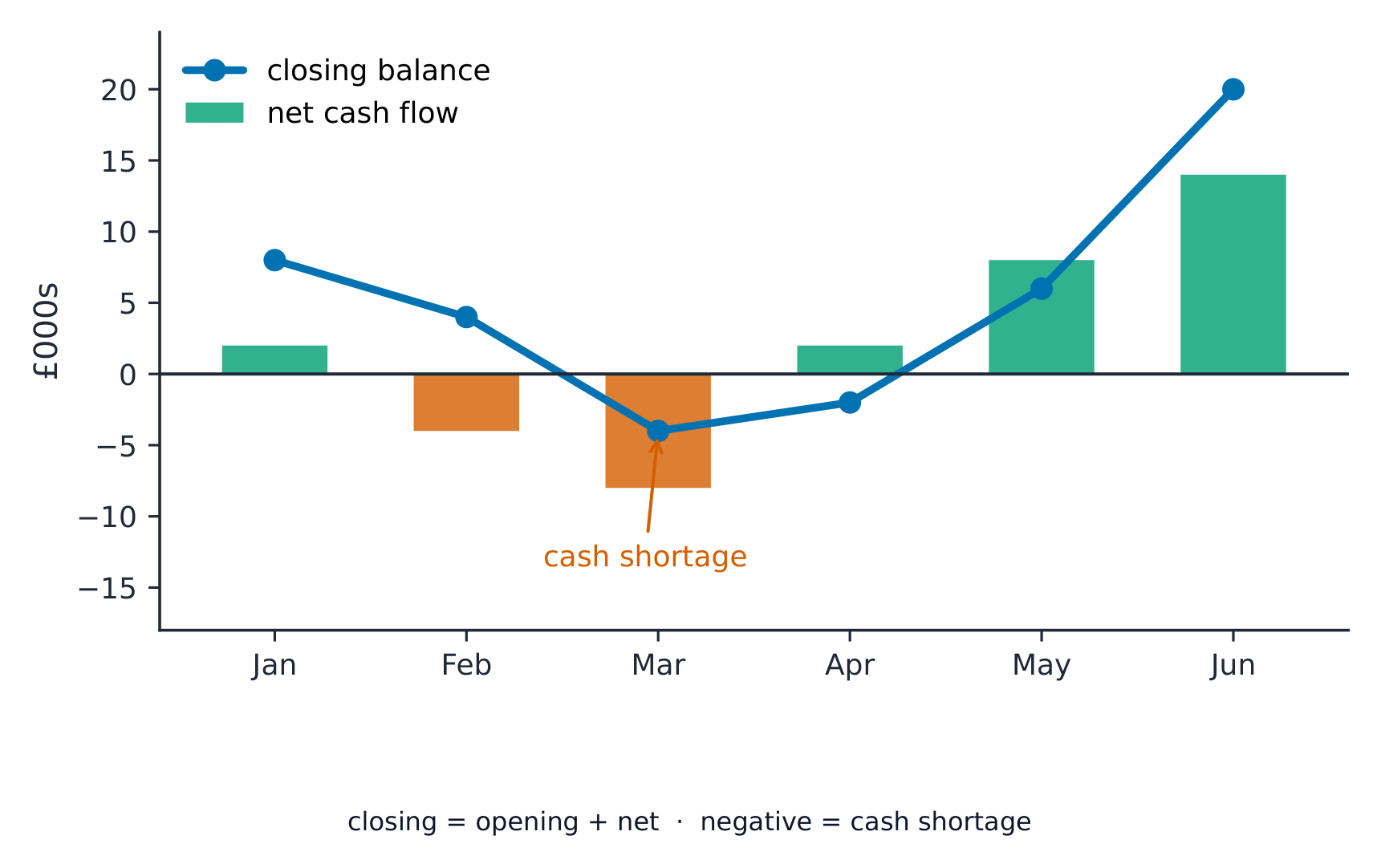
The opening balance 期初余额 is the cash at the start of the month. Adding net cash flow gives the closing balance 期末余额, which becomes next month's opening balance.
日本語
Cash-flow forecast
A cash-flow forecast 现金流量预测 predicts the cash coming in and going out each month. It helps a firm spot a shortage early.
cash inflows 现金流入 — money coming in, mostly from sales.
cash outflows 现金流出 — money going out, such as wages and rent.
net cash flow 净现金流 — inflows minus outflows for the period.
The opening balance 期初余额 is the cash at the start of the month. Adding net cash flow gives the closing balance 期末余额, which becomes next month's opening balance.
A cash-flow forecast tracks the closing balance each month, warning of a shortage early
Explore · 探索
A cash-flow forecast · キャッシュフロー見込み
A cash-flow forecast tracks money in and out each month — to spot a shortfall before it happens. · キャッシュフロー見込みは、月ごとの収入と支出を追跡し、不足が生じる前に検知するものである。
Common causes of cash-flow problems are: too many sales on credit, holding too much stock, buying too many assets at once, and overtrading 过度交易 (growing too fast for the cash available).
Ways to improve cash flow:
bring cash in sooner — ask customers to pay faster, or offer discounts for quick payment.
delay cash going out — agree longer trade credit with suppliers.
arrange an overdraft or short loan to cover a gap.
hold less stock to free up cash.
Good working capital management keeps enough cash to stay safe without holding so much that money sits idle.
日本語
Common causes of cash-flow problems are: too many sales on credit, holding too much stock, buying too many assets at once, and overtrading 过度交易 (growing too fast for the cash available).
Ways to improve cash flow:
bring cash in sooner — ask customers to pay faster, or offer discounts for quick payment.
delay cash going out — agree longer trade credit with suppliers.
arrange an overdraft or short loan to cover a gap.
hold less stock to free up cash.
Good working capital management keeps enough cash to stay safe without holding so much that money sits idle.
Explore · 探索
Cash-flow forecast lab · キャッシュフロー予測ラボ
Drag the monthly cash in, cash out and the one-off purchase — find the month that closes in the red, then fix it before it happens. · 月別の現金収入、支出、および一時的な購入費をドラッグしてください。赤字で終了する月を見つけ、発生する前に修正します。
Contribution 贡献 is how much each sale adds towards paying the fixed costs:
$$\text{contribution per unit} = \text{selling price} - \text{variable cost per unit}$$
Break-even 盈亏平衡 is the point where total revenue equals total costs, so profit is zero. The break-even point 盈亏平衡点 in units is:
$$\text{break-even point} = \frac{\text{fixed costs}}{\text{contribution per unit}}$$
The margin of safety 安全边际 is how far current sales are above the break-even point:
$$\text{margin of safety} = \text{actual output} - \text{break-even output}$$
Worked example. A product sells for £20 with a variable cost of £12 per unit. Fixed costs are £40,000, and the firm makes 6,000 units. Find the contribution per unit, the break-even output and the margin of safety.
A large margin of safety means sales can fall a lot before the firm makes a loss. Break-even analysis is quick and useful, but it has limitations 局限性: it assumes the selling price and costs stay the same, and that everything made is sold.
日本語
Contribution 贡献 is how much each sale adds towards paying the fixed costs:
$$\text{contribution per unit} = \text{selling price} - \text{variable cost per unit}$$
Break-even 盈亏平衡 is the point where total revenue equals total costs, so profit is zero. The break-even point 盈亏平衡点 in units is:
$$\text{break-even point} = \frac{\text{fixed costs}}{\text{contribution per unit}}$$
The break-even point is where total revenue equals total cost — left of it is loss, right of it is profit
The margin of safety 安全边际 is how far current sales are above the break-even point:
$$\text{margin of safety} = \text{actual output} - \text{break-even output}$$
Worked example. A product sells for £20 with a variable cost of £12 per unit. Fixed costs are £40,000, and the firm makes 6,000 units. Find the contribution per unit, the break-even output and the margin of safety.
A large margin of safety means sales can fall a lot before the firm makes a loss. Break-even analysis is quick and useful, but it has limitations 局限性: it assumes the selling price and costs stay the same, and that everything made is sold.
Explore · 探索
Break-even chart · 損益分岐点チャート
Add a revenue line to the fixed-cost and total-cost lines. Where revenue meets total cost is the break-even point; beyond it the firm makes a profit. · 固定原価線と総原価線に収益線を追加する。収益線と総原価線の交点が損益分岐点であり、そこから先では企業は利益を得る。
Explore · 探索
Break-even analysis · 損益分岐分析
Break-even is where total revenue crosses total cost. · 損益分岐点とは、総収益が総原価と交差する地点である。
explain the purpose of budgets and types of budget (incremental, zero-based)
calculate and interpret variances (favourable and adverse) using variance analysis
日本語
予算の目的と種類(増額予算、ゼロベース予算)について説明する
乖離分析を用いて乖離(有利および不利)を計算・解釈する
Source: Cambridge International syllabus · 出典: Cambridge International シラバス
English
A budget 预算 is a financial plan for the future — a target for income or spending. Budgets help a firm plan, control money, and check performance. Two types are:
incremental budget 增量预算 — last year's budget changed by a small amount.
zero-based budget 零基预算 — every cost must be explained from zero each year.
A variance 差异 is the difference between the budgeted figure and the actual figure:
Costs came in higher than planned, so this is an adverse variance.
a favourable variance 有利差异 is better for profit (costs lower, or revenue higher, than planned).
an adverse variance 不利差异 is worse for profit (costs higher, or revenue lower, than planned).
Studying variances shows managers where the plan went wrong, so they can act.
日本語
A budget 预算 is a financial plan for the future — a target for income or spending. Budgets help a firm plan, control money, and check performance. Two types are:
incremental budget 增量预算 — last year's budget changed by a small amount.
zero-based budget 零基预算 — every cost must be explained from zero each year.
A variance 差异 is the difference between the budgeted figure and the actual figure:
Show that cash is not profit — a profitable firm can still fail from a cash-flow shortage.
For break-even: contribution per unit $=$ price $-$ variable cost; break-even $=$ fixed costs $\div$ contribution; margin of safety $=$ actual $-$ break-even output.
Match a source of finance to the need (short-term for cash flow, long-term or equity for assets) and to the type of business.
Calculate a variance and label it favourable or adverse (actual against budget).
6
Business and its environment (A Level) · ビジネスとその環境(A-Level)
explain the impact of economic factors (business cycle, interest rates, exchange rates, inflation, taxation, unemployment) on business
explain the impact of political, legal, social, technological, environmental and ethical influences on business
日本語
経済的要因(景気循環、金利、為替レート、インフレ、税金、失業率)が企業に与える影響について説明する
政治的、法的、社会的、技術的、環境的、倫理的な影響が企業に与える影響について説明する
Source: Cambridge International syllabus · 出典: Cambridge International シラバス
English
A business cannot control everything. External influences 外部影响 are forces outside the firm that affect how it works. The firm must watch them and adapt. We group them into economic factors and wider (political, legal, social and other) factors.
Inflation 通货膨胀 is a general rise in prices over time. High inflation raises a firm's costs (materials and wages), makes planning harder, and can cut what customers can afford to buy. Low, steady inflation is usually best for business.
Taxation 税收 is money the government takes from people and firms.
a direct tax 直接税 is taken from income or profit (e.g. income tax, corporation tax).
an indirect tax 间接税 is added to spending (e.g. sales tax on goods).
Higher taxes leave people and firms with less money to spend, so demand falls.
Unemployment 失业 is the number of people who want work but cannot find it. High unemployment lowers demand, but it also makes workers easier and cheaper to hire.
Worked example. A house-builder has £8m of variable-rate loans. The central bank raises interest rates from 2% to 5%. Explain the effect on this business. Answer on both sides. On costs: annual interest rises from 8m × 0.02 = £160,000 to 8m × 0.05 = £400,000, so £240,000 comes straight off profit. On demand: mortgages become dearer, so fewer buyers can afford a house - and because houses are bought on credit and are a postponable purchase, demand falls sharply. Both effects strike this firm at once, which is why a highly geared house-builder is unusually sensitive to interest rates. Always give the cost of borrowing and the demand effect, and tie the size of the demand effect to whether the product is bought on credit - the same rate rise barely touches a firm selling cheap everyday goods with no debt.
Political, legal and social influences · 政治的・法的・社会的要因
English
political 政治 — government decisions, trade rules and stability affect how firms plan.
legal 法律 — firms must obey legislation 法规 on employment, consumer safety, competition and the environment. Breaking the law brings fines and bad publicity.
social 社会 — changes in society, such as ageing populations or new tastes, change what people buy.
Technological, environmental and ethical influences · 技術的・環境的・倫理的要因
English
technological 技术 — new technology can create new products and cut costs, but firms must keep up or fall behind.
environmental 环境 — firms face pressure and rules to cut pollution and waste, and to act in a sustainable way.
ethical 道德 — acting in a morally right way (fair pay, honest selling) builds trust, even if it costs more.
Together these wider factors are often studied with a PESTLE analysis 宏观环境分析, which checks Political, Economic, Social, Technological, Legal and Environmental forces.
explain the meaning of strategy and strategic management
use strategic analysis tools (SWOT analysis, and other planning tools) to inform business decisions
日本語
戦略および戦略的意思決定の意味を説明する
戦略分析ツール(SWOT分析、その他の計画ツール)を用いて企業の意思決定に役立てる
Source: Cambridge International syllabus · 出典: Cambridge International シラバス
English
A strategy 战略 is a long-term plan to reach the firm's main objectives. Strategic management 战略管理 is the work of setting that plan, putting it into action, and checking it. Good strategy aims to build a competitive advantage 竞争优势 — a reason customers choose you over rivals, such as lower cost or a better product.
Firms use other tools to make decisions, such as decision trees (weighing choices by their likely results) and the matrices you meet later in marketing and operations. Every planning tool turns information about the business and its environment into a clearer choice.
Drag the probability and payoffs — the tree rolls back to an expected value for each option, and the losing branch gets the exam cut marks. · 確率とペイオフをドラッグしてください。木は各選択肢について期待値に逆転計算され、負ける枝には試験の減点 marking が表示されます。
6.2
Exam tips · 試験対策
English
Explain how a change in interest rates, the exchange rate or inflation affects a firm on both the cost and the demand side.
A stronger exchange rate makes exports dearer and imports cheaper (SPICED / WPIDEC).
Use SWOT correctly: strengths and weaknesses are internal, opportunities and threats are external.
Support a strategy with a PEST/PESTLE scan of the external environment.
日本語
金利、為替レート、インフレの変化が、コスト面と需要面の両方において企業に与える影響を説明せよ。
通貨高は輸出を高くし輸入を安くする(SPICED / WPIDEC)。
SWOT を正しく使用すること:強みと弱みは内部、機会と脅威は外部である。
戦略を支持するために、外部環境に対するPEST/PESTLEスキャンを行うこと。
7
Human resource management (A Level) · 人事管理(A-Level)
explain organisational structures (hierarchy, chain of command, span of control, centralisation, decentralisation, delayering, matrix structures)
explain delegation, accountability and the impact of structure on business performance
日本語
組織構造(階層制、指揮系統、統轄幅、集権化、分権化、扁平化、マトリックス構造)を説明する
委任、責任、および構造が企業業績に与える影響について説明する
Source: Cambridge International syllabus · 出典: Cambridge International シラバス
English
An organisational structure 组织结构 shows how a business arranges its people: who reports to whom, and who does what. A good structure makes roles clear and helps the firm meet its objectives. It is often drawn as an organisation chart.
Compare ownership, control and liability in real business types. · 実際のビジネスタイプにおける所有、管理、責任を比較せよ。
7.1
Key terms in structure · 構造における重要用語
English
a hierarchy 层级 is the set of levels in a firm, from the top managers down to the shop-floor workers. A "tall" structure has many levels; a "flat" structure has few.
the chain of command 指挥链 is the line along which orders pass down, from the top to the bottom.
the span of control 管理幅度 is the number of staff one manager is directly in charge of. A wide span means many staff per manager; a narrow span means few.
A tall structure has narrow spans and a long chain of command, so messages travel slowly. A flat structure has wide spans, so managers must trust staff more.
centralisation 集权 — most decisions are made at the top. This gives strong control and quick, consistent decisions, but ignores local knowledge.
decentralisation 分权 — decisions are shared out to lower levels and local branches. This speeds up decisions and motivates staff, but control is weaker.
Delayering and matrix structures · レイヤードロップとマトリクス構造
English
Delayering 精简层级 means removing one or more levels of management. It cuts cost and shortens the chain of command, but it gives the remaining managers more to do.
A matrix structure 矩阵结构 groups staff by both their department and the project they work on, so a worker may report to two managers. It is good for teamwork across departments, but the two-boss system can cause confusion.
Delegation 授权 means a manager gives a task, and the power to do it, to a more junior worker. It frees the manager's time, develops staff, and motivates them.
But a manager who delegates is still accountable — the accountability 问责 for the result stays with them. So managers must delegate to people they trust, and still check the outcome.
Worked example. A firm has 5 levels of hierarchy and a span of control of 4. It delayers to a span of 8. What changes, and what is the risk? A wider span means each manager handles more subordinates, so fewer managers are needed at each level and the structure becomes flatter and wider. Communication improves, because a message now passes through fewer levels, and the wage bill falls. The risks are real too: each manager now supervises 8 people instead of 4, so there is less time per subordinate and weaker control; workloads rise; and the staff who remain lose promotion rungs, which can demotivate. Link the span of control to the number of levels - for the same workforce, a wider span always gives a flatter structure - and present the trade-off as speed and cost against control and supervision.
explain the process, methods and importance of effective communication
explain barriers to communication and how to improve communication in a business
日本語
効果的なコミュニケーションのプロセス、方法、重要性について説明する
コミュニケーションの障壁と、企業内でのコミュニケーション改善方法について説明する
Source: Cambridge International syllabus · 出典: Cambridge International シラバス
English
Communication 沟通 is the passing of a message from one person to another. Effective communication follows a clear path:
a sender 发送者 has a message.
the message is sent through a medium 媒介 (e.g. a meeting, email or notice).
a receiver 接收者 takes in the message.
feedback 反馈 shows the message was understood.
Good communication raises motivation, cuts mistakes, and speeds up decisions. Methods can be verbal (spoken), written, or visual; the best method depends on the message, the cost, and the need for a record.
A barrier 障碍 is anything that stops a message getting through clearly. Common barriers are:
a message that is too long or unclear.
a poor medium (e.g. a noisy phone line).
too many levels in the hierarchy, so the message is changed on the way.
language or cultural differences, and lack of trust.
To improve communication, a firm can shorten the chain of command, choose the right medium, keep messages short and clear, and always ask for feedback.
explain leadership styles (autocratic, democratic, paternalistic, laissez-faire) and theories of leadership
explain emotional intelligence and the importance of effective leadership in managing change
日本語
リーダーシップスタイル(独裁的、民主的、父権的、放任主義)およびリーダーシップ理論を説明する
感情知能と、変化管理における効果的なリーダーシップの重要性について説明する
Source: Cambridge International syllabus · 出典: Cambridge International シラバス
English
A leadership style 领导风格 is the way a leader 领导 makes decisions and treats staff. Four styles are:
Style
How decisions are made
autocratic 专制型
the leader decides alone and tells staff what to do
democratic 民主型
the leader asks staff for ideas before deciding
paternalistic 家长式
the leader decides, but in what they see as the staff's best interests
laissez-faire 放任型
the leader gives staff freedom to decide for themselves
No style is always best. The right one depends on the task, the staff, and the time available — an urgent crisis may need an autocratic style, while skilled staff may work best under a democratic or laissez-faire one.
Emotional intelligence and leading change · 感情的知能と変革主導
English
Emotional intelligence 情商 is a leader's skill in understanding their own and other people's feelings, and managing them well. Leaders with high emotional intelligence build trust and handle conflict better.
This matters most when leading change. People often resist change because they fear losing their job or status. A good leader explains why the change is needed, involves staff, and supports them through it.
Employer-employee relations and trade unions · 雇用主と従業員の関係および組合
English
The management of change 变革管理 works best when employer-employee relations 劳资关系 (the link between bosses and workers) are good.
A trade union 工会 is an organised group of workers that speaks for its members. Through collective bargaining 集体谈判, the union and the employer negotiate pay and conditions for the whole group, instead of one worker at a time. If talks fail, workers may take industrial action 劳工行动, such as a strike 罢工 (stopping work). Good relations and fair negotiation avoid this and keep the business running.
explain elasticity (price, income, cross) and its use in marketing decisions
日本語
定量的マーケティング分析を用いる:売上予測、時系列分析(移動平均、トレンド、季節変動)、相関
弾性(価格、所得、代替財)とそのマーケティング意思決定への利用について説明する
Source: Cambridge International syllabus · 出典: Cambridge International シラバス
English
Marketing analysis 营销分析 means using data to understand the market and to make better marketing decisions. At A Level you study some numbers tools: sales forecasting, time-series analysis, correlation, and elasticity.
Sales forecasting and time-series analysis · 売上予測と時系列分析
English
Sales forecasting 销售预测 is predicting future sales from past data and market knowledge. Good forecasts help a firm plan production, staff, stock and cash.
Time-series analysis 时间序列分析 studies past sales recorded over time to find a pattern. It has two main parts:
the trend 趋势 — the general direction of sales over the long run (up, down or flat).
the seasonal variation 季节性波动 — the regular rise and fall within a year (e.g. ice cream sells more in summer).
To find the trend, firms use a moving average 移动平均, which smooths the ups and downs by averaging several periods in a row. The seasonal variation is then how far the actual figure sits above or below the trend:
A forecast extends the trend into the future (called extrapolation 外推) and then adds the usual seasonal variation. This works only if past patterns continue, so forecasts are never certain.
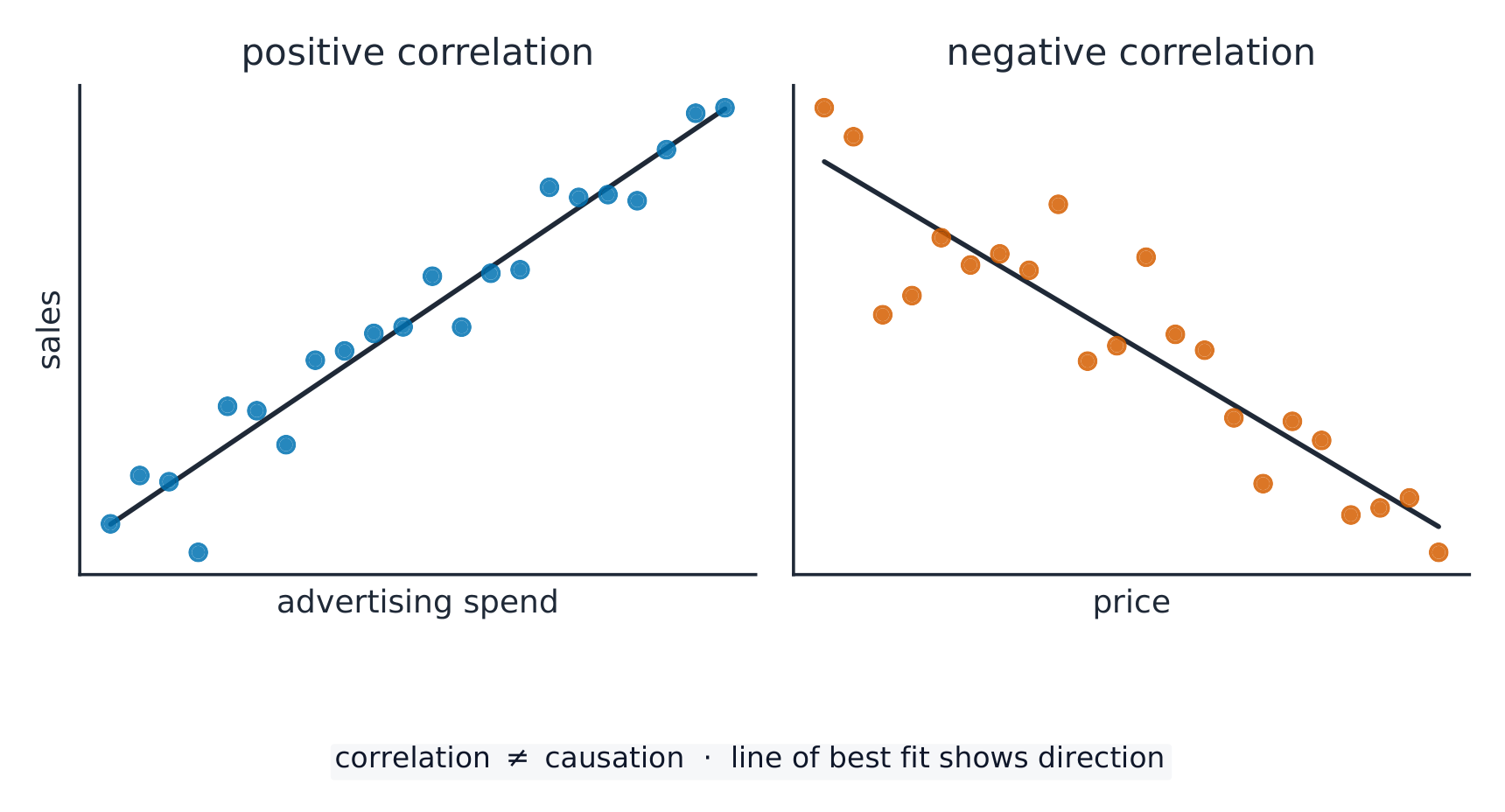
Change the strength of the relationship. A line of best fit lets a business spot a trend and forecast from it. · 関係の強さを変えてください。回帰直線により、企業はトレンドを特定し、そこから予測を行うことができます。
Using elasticity in marketing decisions · マーケティング意思決定における弾性の活用
English
Elasticity 弹性 measures how much demand reacts to a change. Three types guide marketing decisions.
price elasticity of demand 需求价格弹性 (PED) — for a price elastic 富有弹性 product, cutting the price raises total revenue; for a price inelastic 缺乏弹性 product, raising the price raises total revenue.
income elasticity of demand 需求收入弹性 (YED) — tells a firm how sales will change as incomes rise or fall, which helps plan for booms and recessions.
cross elasticity of demand 需求交叉弹性 (XED) — tells a firm how a rival's price change, or the price of a partner product, will affect its own sales.
So elasticity helps a firm set prices, choose products, and predict the effect of a competitor's move.
Worked example. Quarterly sales run Q1 100, Q2 140, Q3 180, Q4 120, then next Q1 108. Find the four-quarter moving-average trend centred on Q3, and the seasonal variation for Q3. Average the first four quarters: $(100 + 140 + 180 + 120) \div 4 = 135$. Average the next four: $(140 + 180 + 120 + 108) \div 4 = 137$. A four-period average falls between quarters, so centre the two: $(135 + 137) \div 2 = 136$, the trend at Q3. The seasonal variation is actual minus trend: $180 - 136 =$+44, so Q3 runs about 44 units above trend, and next year's Q3 forecast is the projected trend plus 44. The centring step is the one most answers drop: with an even number of periods the average lands between two quarters and must be centred before it can be compared with an actual figure.
Source: Cambridge International syllabus · 出典: Cambridge International シラバス
English
A marketing strategy 营销战略 is the long-term plan for how marketing will meet the firm's objectives. Marketing planning 营销规划 is the work of setting that plan: studying the market, choosing target customers, and deciding the marketing mix. Two tools shape strategy: Ansoff's matrix and product portfolio analysis.
Ansoff's matrix 安索夫矩阵 shows four ways to grow, by mixing existing or new products with existing or new markets. The risk rises as you move away from what you know.
Existing products
New products
Existing markets
market penetration 市场渗透 (sell more to current buyers)
product development 产品开发 (new products for current buyers)
New markets
market development 市场开发 (current products to new buyers)
diversification 多元化 (new products and new markets)
Market penetration is the safest; diversification is the riskiest because both the product and the market are new.
Product portfolio analysis 产品组合分析 looks at the firm's whole range of products together, using a tool like the Boston Matrix. It checks the balance: a firm needs some steady earners to fund its risky new products. The aim is a healthy mix, so the firm is not left with only ageing products.
Balance the product portfolio · 製品ポートフォリオをバランスさせる
Drag each product's share and growth — a healthy portfolio keeps a cash cow funding the stars and question marks that will replace it. · 各製品のシェアと成長率をドラッグしてください。健全なポートフォリオでは、Cash Cowが将来の代替となるStarsやQuestion Marksを資金提供します。
8.2
Entering international markets · 国際市場への参入
English
To grow, many firms sell abroad. Globalisation 全球化 (the world becoming more connected) has made this easier. A firm can enter a new country by exporting 出口, by setting up a joint venture 合资企业 with a local partner, or by opening its own branch there.
But a strategy that works at home may need changes. Localisation 本地化 means adapting the marketing mix to the new market — for example, changing the product, the language, the price, or the way it is sold to suit local tastes, laws and incomes.
explain the factors influencing the location and relocation of a business (including international location)
explain the optimum scale of operation and the significance of economies and diseconomies of scale
日本語
立地および移転に影響を与える要因を説明する(国際的な立地を含む)
最適生産规模と規模の経済および規模の不経済の意義について説明する
Source: Cambridge International syllabus · 出典: Cambridge International シラバス
English
Where a business sits affects its costs, its sales and its staff. Choosing a place is called location 选址; moving to a new place is relocation 迁址.
Factors that influence the choice fall into two groups:
quantitative factors 定量因素 — things you can measure in money, such as rent, wages, transport costs and government grants.
qualitative factors 定性因素 — things that are harder to measure, such as the skills of local workers, nearness to customers or suppliers, and the owner's own wishes.
A firm picks the place where the benefits, money and non-money together, are greatest.
Many firms now locate abroad. Moving production to another country is offshoring 离岸外包. The reasons are often lower wages, nearness to new markets, fewer rules, or government help. The risks are longer supply lines, language and culture differences, and possible damage to the firm's image.
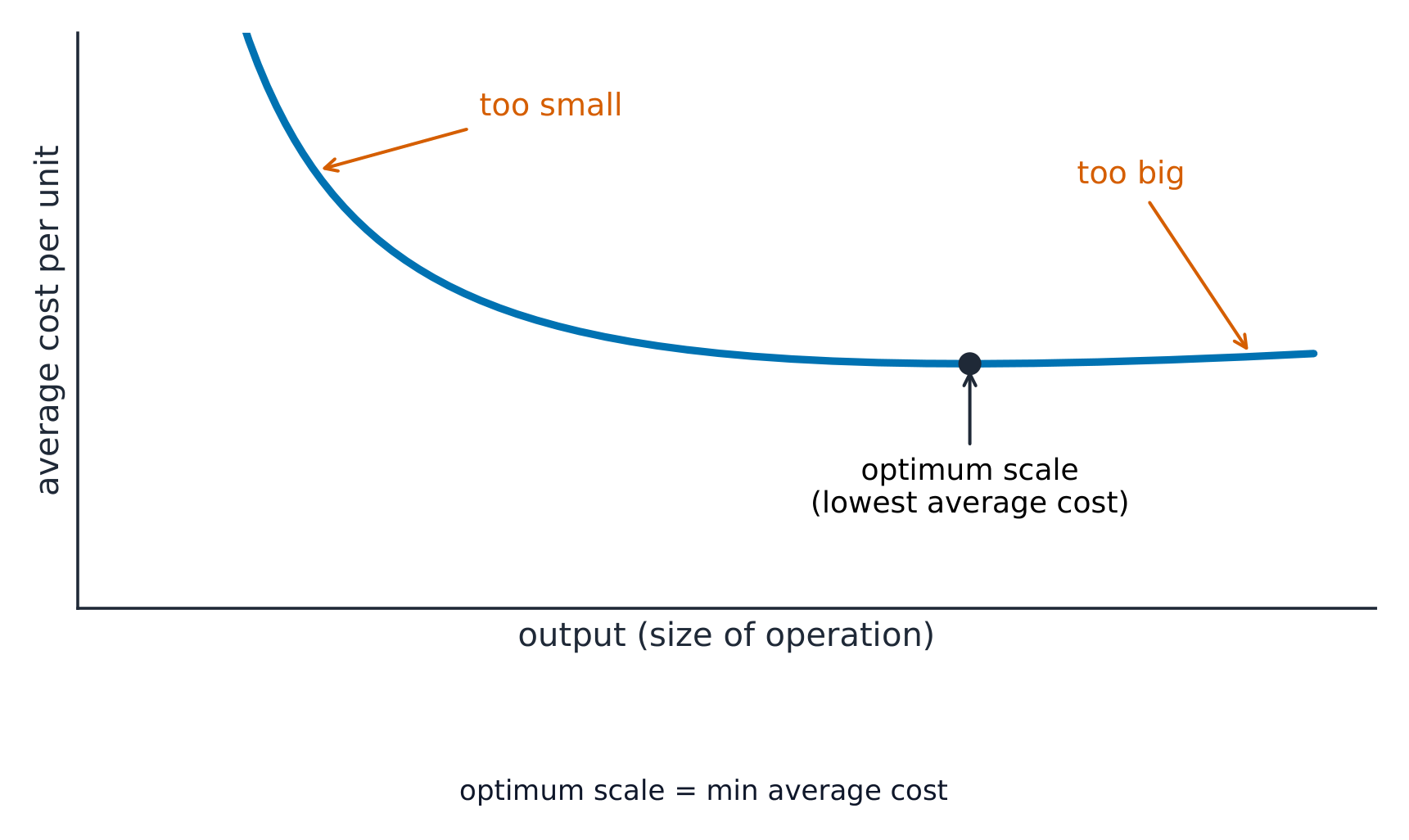
As a firm grows, its average cost first falls (from economies of scale) and later rises (from diseconomies of scale). The optimum scale 最优规模 is the size at which the average cost per unit is at its lowest.
economies of scale 规模经济 — cost savings from being larger (e.g. bulk buying).
diseconomies of scale 规模不经济 — rising average cost when a firm grows too big (e.g. poor communication).
A firm should try to grow up to its optimum scale, but not beyond it.
Source: Cambridge International syllabus · 出典: Cambridge International シラバス
English
Quality 质量 means how well a product meets the customer's needs. Good quality wins repeat custom, lets the firm charge more, protects its brand, and cuts the cost of waste and returns. Poor quality loses customers and damages the firm's name.
check finished products and remove the faulty ones at the end
quality assurance 质量保证
build quality into every stage, so faults are prevented, not just found
total quality management 全面质量管理 (TQM)
every worker takes responsibility for quality, aiming for zero faults
benchmarking 标杆管理
compare the firm's methods with the best firms, and copy what they do well
Quality control finds faults late, after money is already spent. Quality assurance and TQM try to stop faults happening, which is usually cheaper in the long run.
Source: Cambridge International syllabus · 出典: Cambridge International シラバス
English
Lean production 精益生产 means making products with the least possible waste 浪费 — of time, materials, space and effort. Methods like just-in-time and continuous improvement cut waste, lower cost, and raise quality. Less money is tied up in stock, and problems are fixed quickly.
Capacity management 产能管理 means matching what the firm can produce to the demand it faces. If demand is higher than capacity, the firm may add shifts, hire staff or outsource; if demand is lower, it may cut output or find new orders. New technology 技术, such as automation and data systems, helps a firm produce more, to a higher standard, at a lower cost.
Critical path analysis 关键路径分析 (CPA) is a tool for planning a project made of many tasks. It draws the tasks as a network of arrows and nodes 节点 (circles), in the order they must happen. For each task it works out timings:
the earliest start time 最早开始时间 (EST) — the soonest a task can begin, once earlier tasks are done.
the latest finish time 最晚完成时间 (LFT) — the latest a task can finish without delaying the whole project.
From these comes the total float 总浮动时间 — the spare time a task has before it delays the project:
The critical path 关键路径 is the chain of tasks with zero float. These tasks cannot be late, or the whole project is late. Adding up the times along this path gives the minimum project duration 最短项目工期 — the shortest time the project can take.
CPA helps managers find the tasks that matter most, order resources for the right time, and see where delays would hurt. But it is only as good as the time estimates it is built on.
Worked example. A task has an EST of 6 days, a duration of 4 days, and an LFT of 14 days. Find its total float, and say whether it lies on the critical path. Use the formula: total float = LFT − duration − EST = $14 - 4 - 6 =$4 days. So the task could start up to 4 days late, or overrun by 4 days, without delaying the project - and because its float is not zero, it is not on the critical path. Only tasks with zero float are critical. Two points carry the marks: float is the spare time on that task, so using it up makes the task critical; and shortening a non-critical task like this one does not shorten the project at all, because only the critical path sets the minimum project duration.
** worked example.** あるタスクのESTが6日、期間が4日、LFTが14日である。総スラックを求め、クリティカルパス上にあるかどうかを答える。以下の式を用いる:総スラック = LFT − 期間 − EST = $14 - 4 - 6 =$4日。したがって、このタスクは最大4日遅れても、または4日超過してもプロジェクトを遅延させず、スラックがゼロではないため、クリティカルパス上にはない。スラックがゼロであるタスクだけがクリティカルである。2ポイントで得点される:スラックはそのタスクの余剰時間であるため、使い切るとそのタスクはクリティカルになります;また、このように非クリティカルなタスクを短縮しても、クリティカルパスのみが最低プロジェクト期間を決定するため、プロジェクト全体の所要時間は全く短縮されません。
Explore · 探索
Critical path analysis · クリティカルパス分析
CPA finds the sequence of tasks that decides the shortest time a project can take. · CPAは、プロジェクトが完了するために要する最短時間を決定するタスクの順序を特定します。
Explore · 探索
Find the critical path · クリティカルパスを見つける
Drag the durations — the network rolls forward and back, the floats update, and the critical path jumps to whichever route is longest. · 所要期間をドラッグすると、ネットワークが前後に展開され、スラックが更新され、クリティカルパスが最も長い経路へ切り替わります。
explain the purpose and content of the income statement and the statement of financial position (balance sheet)
explain depreciation and how financial statements are used by stakeholders
日本語
損益計算書および**貸借対照表(バランスシート)**の目的と内容について説明する
減価償却を説明し、ステークホルダーが財務諸表をどのように利用するかを説明する
Source: Cambridge International syllabus · 出典: Cambridge International シラバス
English
Financial statements 财务报表 are the official records that show how a business is doing with money. You study two of them: the income statement and the statement of financial position. By law, companies must publish these each year.
日本語
Financial statements 财务报表 are the official records that show how a business is doing with money. You study two of them: the income statement and the statement of financial position. By law, companies must publish these each year.
Financial statements and ratios let stakeholders judge a firm's performance.
Explore · 探索
Financial statements flow
See how business events become the statements users read.
Depreciation 折旧 is the way the cost of a non-current asset is spread over the years it is used, instead of all in the year it was bought. For example, a £10,000 machine used for five years may lose £2,000 of value each year. Depreciation lowers the asset's value on the statement of financial position and counts as an expense on the income statement, so profit is not overstated.
日本語
Depreciation 折旧 is the way the cost of a non-current asset is spread over the years it is used, instead of all in the year it was bought. For example, a £10,000 machine used for five years may lose £2,000 of value each year. Depreciation lowers the asset's value on the statement of financial position and counts as an expense on the income statement, so profit is not overstated.
Straight-line depreciation lowers the asset's value by the same amount each year
Explore · 探索
Stakeholder interest lab
See how different stakeholders judge the same business decision.
calculate and interpret profitability, liquidity, efficiency and gearing ratios
use ratio analysis to assess and compare business performance and explain its limitations
日本語
収益性比率、流動性比率、効率性比率、レバレッジ比率を計算・解釈する
比率分析を用いて企業の業績を評価・比較し、その限界を説明する
Source: Cambridge International syllabus · 出典: Cambridge International シラバス
English
A single number means little on its own. Ratio analysis 比率分析 links two figures from the statements to judge performance, and lets you compare one year with another, or one firm with another.
日本語
A single number means little on its own. Ratio analysis 比率分析 links two figures from the statements to judge performance, and lets you compare one year with another, or one firm with another.
The ratio toolbox: profitability and liquidity at a glance
A higher gross profit margin 毛利率 or operating profit margin 营业利润率 means more profit is kept from each sale. The key overall measure is return on capital employed 资本回报率 (ROCE), which compares profit with the money invested:
Here capital employed 所用资本 is the total long-term money in the business. A higher ROCE means the money is being used well.
Worked example. A firm has revenue of £500,000, gross profit of £200,000, operating profit of £80,000 and capital employed of £400,000. Find its gross profit margin, operating profit margin and ROCE.
A higher gross profit margin 毛利率 or operating profit margin 营业利润率 means more profit is kept from each sale. The key overall measure is return on capital employed 资本回报率 (ROCE), which compares profit with the money invested:
Here capital employed 所用资本 is the total long-term money in the business. A higher ROCE means the money is being used well.
Worked example. A firm has revenue of £500,000, gross profit of £200,000, operating profit of £80,000 and capital employed of £400,000. Find its gross profit margin, operating profit margin and ROCE.
$$\text{acid test ratio} = \frac{\text{current assets} - \text{inventory}}{\text{current liabilities}}$$
The current ratio 流动比率 of about 1.5–2 is usually safe. The acid test ratio 速动比率 is stricter because it removes inventory, which can be slow to sell. Too low is risky; too high may mean cash is sitting idle.
Worked example. A firm has current assets of £60,000 (including £24,000 of inventory) and current liabilities of £30,000. Find its current ratio and acid test ratio.
$$\text{acid test ratio} = \frac{\text{current assets} - \text{inventory}}{\text{current liabilities}}$$
The current ratio 流动比率 of about 1.5–2 is usually safe. The acid test ratio 速动比率 is stricter because it removes inventory, which can be slow to sell. Too low is risky; too high may mean cash is sitting idle.
Worked example. A firm has current assets of £60,000 (including £24,000 of inventory) and current liabilities of £30,000. Find its current ratio and acid test ratio.
Efficiency 效率 ratios show how well the firm uses its resources — for example, inventory turnover 存货周转率 measures how many times a year the firm sells and replaces its stock. Faster turnover usually ties up less cash.
Gearing 杠杆比率 shows how much of the firm's long-term money comes from borrowing rather than from owners:
Below 50%, so the firm is low-geared — it relies more on owners' money than on borrowing.
日本語
Efficiency 效率 ratios show how well the firm uses its resources — for example, inventory turnover 存货周转率 measures how many times a year the firm sells and replaces its stock. Faster turnover usually ties up less cash.
Gearing 杠杆比率 shows how much of the firm's long-term money comes from borrowing rather than from owners:
Ratios are useful but limited. They use past data, which may not predict the future. They ignore non-money factors like staff morale and brand strength. And a fair comparison needs firms of similar size in the same industry.
10.3
Investment appraisal
Syllabus · シラバス
English
calculate and interpret investment appraisal methods: payback period, accounting rate of return (ARR) and net present value (NPV)
use investment appraisal to make and evaluate investment decisions
日本語
投資評価法の計算・解釈:回収期間、会計上収益性率(ARR)、正味現在価値(NPV)
投資評価法を用いて投資意思決定を行い、その評価を行う
Source: Cambridge International syllabus · 出典: Cambridge International シラバス
English
Investment appraisal 投资评估 is the study of whether a big spending project (such as a new machine or factory) is worth it. Three methods are used.
日本語
Investment appraisal 投资评估 is the study of whether a big spending project (such as a new machine or factory) is worth it. Three methods are used.
Explore · 探索
Investment appraisal route
Follow how a project is judged from cash flows to decision.
the net present value 净现值 (NPV) recognises that money in the future is worth less than money today. It uses discounting 折现 to shrink future cash flows back to today's value, then takes away the initial cost. A positive NPV means the project adds value.
Each method has strengths: payback is simple and focuses on risk; ARR shows profitability; NPV is the most complete but needs a chosen discount rate.
日本語
the payback period 回收期 is the time it takes for the project's cash inflows to repay the initial cost. A shorter payback is safer.
The payback period is when cumulative cash flow climbs back to zero
the accounting rate of return 会计回报率 (ARR) shows the average yearly profit as a percentage of the money invested:
the net present value 净现值 (NPV) recognises that money in the future is worth less than money today. It uses discounting 折现 to shrink future cash flows back to today's value, then takes away the initial cost. A positive NPV means the project adds value.
Discounting, the idea behind NPV: the same £100 is worth less the longer you wait for it, so future cash flows are shrunk back to today's value
Each method has strengths: payback is simple and focuses on risk; ARR shows profitability; NPV is the most complete but needs a chosen discount rate.
Explore · 探索
Will the machine pay for itself?
Drag the cost, yearly inflow and useful life — the cumulative line crosses zero at the payback period, and ARR is compared with the bank's rate.
accounting rate of return/əˈkaʊntɪŋ reɪt ɒv rɪˈtɜːn/
会計収益率
net present value/net ˈprezənt ˈvæljuː/
正味現在価値
discounting/ˈdɪskaʊntɪŋ/
割引
10.4
Finance and accounting strategy
Syllabus · シラバス
English
explain the use of financial data and budgets in strategic decision-making
evaluate the financial implications of strategic decisions
日本語
戦略的意思決定における財務データおよび予算の利用方法を説明する
戦略的意思決定の財務的影響を評価する
Source: Cambridge International syllabus · 出典: Cambridge International シラバス
At the top level, managers use financial data and budgets to choose between strategies. Before a big decision, they ask: can we afford it, how will it affect profit, cash flow and gearing, and what is the likely return? Financial information turns a risky guess into a reasoned choice — but numbers are only part of the picture, and must be weighed with the market, the staff and the firm's objectives.
Explore · 探索
Sources of finance lab
Choose the best type of finance by time, risk and ownership.
Type to search notes, lessons, code, vocabulary and past-paper questions across every subject. · すべての科目でノートImplemented、Implemented、コード、語彙、過去問問題を検索するために入力してください。