- explain the need for business finance (capital expenditure and revenue expenditure, working capital)
- distinguish the meaning of cash and profit
Finance and accounting
A-Level Business · Topic 5
 15:50
15:50
Finance and Accounting
A business can be profitable and still die. Here is how. You sell a hundred thousand pounds of goods on credit in March. The profit looks excellent. But the…
English narration · English + 中文 subtitles burned in
5.1
Why a business needs finance

Syllabus
Source: Cambridge International syllabus
Business finance 企业资金 is the money a firm needs to start, run and grow. A new firm needs money to buy premises 经营场所 and equipment; a growing firm needs money for new projects; and every firm needs money to pay day-to-day bills.
Explore
Sources of finance lab
Choose the best type of finance by time, risk and ownership.
Vocabulary
Train
| English |
|---|
| business finance/ˈbɪznəs ˈfaɪnæns/ |
| premises/ˈpremɪsɪz/ |
5.1
Capital and revenue expenditure

Spending falls into two types:
- capital expenditure 资本性支出 — money spent on fixed assets 固定资产 that last a long time, such as machines, vehicles and buildings.
- revenue expenditure 收益性支出 — money spent on day-to-day running, such as wages, rent and raw materials.
Vocabulary
Train
| English |
|---|
| capital expenditure/ˈkæpɪtl ekˈspendɪtʃə/ |
| fixed assets/fɪkst ˈæsets/ |
| revenue expenditure/ˈrevənjuː ekˈspendɪtʃə/ |
5.1
Working capital

Working capital 营运资本 is the money a firm has for its daily needs. It is found from the balance sheet 资产负债表:
$$\text{working capital} = \text{current assets} - \text{current liabilities}$$
Here current assets 流动资产 are things that become cash within a year (cash, inventory, money owed by customers), and current liabilities 流动负债 are debts due within a year. Too little working capital is dangerous — the firm may not be able to pay its bills.
Vocabulary
Train
| English |
|---|
| working capital/ˈwɜːkɪŋ ˈkæpɪtl/ |
| balance sheet/ˈbæləns ʃiːt/ |
| current assets/ˈkʌrənt ˈæsets/ |
| current liabilities/ˈkʌrənt ˌlaɪəˈbɪlɪtiz/ |
5.1
Cash is not the same as profit

This is a key idea.
- profit 利润 is what is left when total costs are taken from total revenue over a period.
- cash 现金 is the money the firm actually has right now to spend.
A firm can be profitable but still run out of cash — for example, if it sells goods but customers have not paid yet. Many firms fail not from low profit, but from running out of cash.
Vocabulary
Train
| English |
|---|
| profit/ˈprɒfɪt/ |
| cash/kæʃ/ |
5.2
Sources of finance

Syllabus
- describe internal and external, short- and long-term sources of finance (retained profit, sale of assets, share capital, loans, debentures, overdraft, leasing, hire purchase, trade credit, venture capital, crowdfunding, microfinance)
- explain the factors affecting the choice of source of finance
Source: Cambridge International syllabus
Finance can come from inside the business (internal sources 内部来源) or from outside (external sources 外部来源). It can also be short-term 短期 (paid back within a year) or long-term 长期.
| Source | Type | What it is |
|---|---|---|
| retained profit 留存利润 | internal, long | profit kept in the business instead of paid out |
| sale of assets 出售资产 | internal | selling items the firm no longer needs |
| share capital 股本 | external, long | money raised by selling shares |
| loan 贷款 | external, long | borrowed money repaid with interest |
| debenture 公司债券 | external, long | a long-term loan certificate sold by a company |
| overdraft 透支 | external, short | the bank lets the account go below zero for a short time |
| leasing 租赁 | external | renting an asset instead of buying it |
| hire purchase 分期付款 | external | buying an asset by paying in instalments |
| trade credit 商业信用 | external, short | paying a supplier later (e.g. after 30 days) |
| venture capital 风险资本 | external, long | money from investors into risky young firms |
| crowdfunding 众筹 | external | small amounts raised from many people online |
| microfinance 小额信贷 | external | small loans for people with little access to banks |

Explore
Sources of finance lab
Choose the best type of finance by time, risk and ownership.
Vocabulary
Train
| English |
|---|
| internal sources/ɪnˈtɜːnl ˈsɔːsɪz/ |
| external sources/ekˈstɜːnl ˈsɔːsɪz/ |
| short-term/ʃɔːt tɜːm/ |
| long-term/lɒŋ tɜːm/ |
| retained profit/rɪˈteɪnd ˈprɒfɪt/ |
| sale of assets/seɪl ɒv ˈæsets/ |
| share capital/ʃeə ˈkæpɪtl/ |
| loan/ləʊn/ |
| debenture/deˈbentʃə/ |
| overdraft/ˈəʊvədræft/ |
| leasing/ˈliːsɪŋ/ |
| hire purchase/ˈhaɪə ˈpɜːtʃɪs/ |
| trade credit/treɪd ˈkredɪt/ |
| venture capital/ˈventʃə ˈkæpɪtl/ |
| crowdfunding/ˈkraʊdfʌndɪŋ/ |
| microfinance/ˌmaɪkrəʊfaɪˈnæns/ |
5.2
Choosing a source of finance

There is no single best source. The choice depends on:
- the amount needed — large amounts may need shares or a long loan.
- the purpose — long-term assets should use long-term finance.
- the cost — interest and fees differ between sources.
- the legal structure — only a company can sell shares.
- how much the firm already owes, and whether it can offer collateral 抵押品 (an asset the lender can take if the loan is not repaid).
Vocabulary
Train
| English |
|---|
| collateral/kəˈlætərəl/ |
5.3
Cash-flow forecasts
Syllabus
- construct and interpret a cash-flow forecast and explain the causes of cash-flow problems
- explain methods of improving cash flow and the importance of working capital management
Source: Cambridge International syllabus
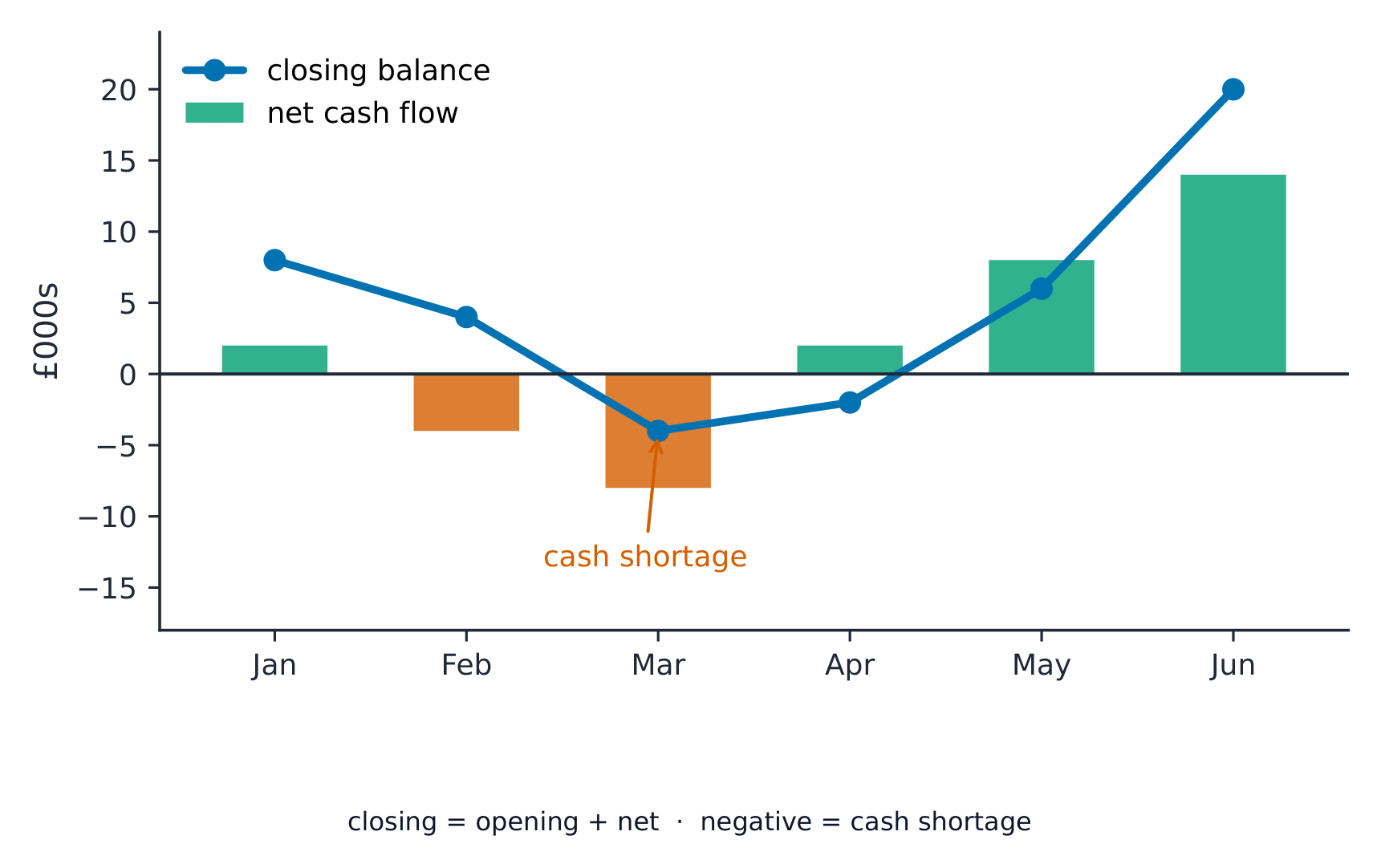
A cash-flow forecast 现金流量预测 predicts the cash coming in and going out each month. It helps a firm spot a shortage early.
- cash inflows 现金流入 — money coming in, mostly from sales.
- cash outflows 现金流出 — money going out, such as wages and rent.
- net cash flow 净现金流 — inflows minus outflows for the period.
$$\text{net cash flow} = \text{cash inflows} - \text{cash outflows}$$
The opening balance 期初余额 is the cash at the start of the month. Adding net cash flow gives the closing balance 期末余额, which becomes next month's opening balance.
Explore
A cash-flow forecast
A cash-flow forecast tracks money in and out each month — to spot a shortfall before it happens.
Vocabulary
Train
| English |
|---|
| cash-flow forecast/kæʃ fləʊ ˈfɔːkæst/ |
| cash inflows/kæʃ ˈɪnfləʊz/ |
| cash outflows/kæʃ aʊtˈfləʊz/ |
| net cash flow/net kæʃ fləʊ/ |
| opening balance/ˈəʊpənɪŋ ˈbæləns/ |
| closing balance/ˈkləʊzɪŋ ˈbæləns/ |
5.3
Cash-flow problems and how to fix them
Common causes of cash-flow problems are: too many sales on credit, holding too much stock, buying too many assets at once, and overtrading 过度交易 (growing too fast for the cash available).
Ways to improve cash flow:
- bring cash in sooner — ask customers to pay faster, or offer discounts for quick payment.
- delay cash going out — agree longer trade credit with suppliers.
- arrange an overdraft or short loan to cover a gap.
- hold less stock to free up cash.
Good working capital management keeps enough cash to stay safe without holding so much that money sits idle.
Explore
Cash-flow forecast lab
Drag the monthly cash in, cash out and the one-off purchase — find the month that closes in the red, then fix it before it happens.
Vocabulary
Train
| English |
|---|
| overtrading/ˌəʊvəˈtreɪdɪŋ/ |
5.4
Costs and how we classify them

Syllabus
- classify costs (fixed, variable, direct, indirect, marginal, average) and use cost information for decision-making
- construct and interpret break-even analysis (break-even point, margin of safety, contribution) and explain its limitations
Source: Cambridge International syllabus
A cost 成本 is money the business spends to make its product. We sort costs in several ways:
- fixed costs 固定成本 — costs that do not change with output, such as rent.
- variable costs 可变成本 — costs that rise and fall with output, such as raw materials.
- direct costs 直接成本 — costs clearly linked to one product, such as its materials.
- indirect costs 间接成本 (overheads) — costs not linked to one product, such as manager salaries.
- marginal cost 边际成本 — the cost of making one more unit.
- average cost 平均成本 — the cost per unit, found by total cost ÷ number of units.
Cost information helps managers set prices, choose what to make, and control spending.
Explore
Costs
y = ax + b
Total cost = fixed cost (intercept) + variable cost per unit (gradient).
Vocabulary
Train
| English |
|---|
| cost/kɒst/ |
| fixed costs/fɪkst kɒsts/ |
| variable costs/ˈveərɪəbl kɒsts/ |
| direct costs/daɪˈrekt kɒsts/ |
| indirect costs/ɪndaɪˈrekt kɒsts/ |
| marginal cost/ˈmɑːdʒɪnl kɒst/ |
| average cost/ˈævrɪdʒ kɒst/ |
5.4
Break-even analysis

Contribution 贡献 is how much each sale adds towards paying the fixed costs:
$$\text{contribution per unit} = \text{selling price} - \text{variable cost per unit}$$
Break-even 盈亏平衡 is the point where total revenue equals total costs, so profit is zero. The break-even point 盈亏平衡点 in units is:
$$\text{break-even point} = \frac{\text{fixed costs}}{\text{contribution per unit}}$$
The margin of safety 安全边际 is how far current sales are above the break-even point:
$$\text{margin of safety} = \text{actual output} - \text{break-even output}$$
Worked example. A product sells for £20 with a variable cost of £12 per unit. Fixed costs are £40,000, and the firm makes 6,000 units. Find the contribution per unit, the break-even output and the margin of safety.
$$\text{contribution per unit} = \text{\pounds} 20 - \text{\pounds} 12 = \text{\pounds} 8$$
$$\text{break-even point} = \frac{\text{\pounds} 40\,000}{\text{\pounds} 8} = 5\,000 \text{ units}$$
$$\text{margin of safety} = 6\,000 - 5\,000 = 1\,000 \text{ units}$$
A large margin of safety means sales can fall a lot before the firm makes a loss. Break-even analysis is quick and useful, but it has limitations 局限性: it assumes the selling price and costs stay the same, and that everything made is sold.
Explore
Break-even chart
Add a revenue line to the fixed-cost and total-cost lines. Where revenue meets total cost is the break-even point; beyond it the firm makes a profit.
Explore
Break-even analysis
Break-even is where total revenue crosses total cost.
Vocabulary
Train
| English |
|---|
| contribution/ˌkɒntrɪˈbjuːʃn/ |
| break-even/breɪk ˈiːvən/ |
| break-even point/breɪk ˈiːvən pɔɪnt/ |
| margin of safety/ˈmɑːdʒɪn ɒv ˈseɪfti/ |
| limitations/ˌlɪmɪˈteɪʃnz/ |
5.5
Budgets and variances

Syllabus
- explain the purpose of budgets and types of budget (incremental, zero-based)
- calculate and interpret variances (favourable and adverse) using variance analysis
Source: Cambridge International syllabus
A budget 预算 is a financial plan for the future — a target for income or spending. Budgets help a firm plan, control money, and check performance. Two types are:
- incremental budget 增量预算 — last year's budget changed by a small amount.
- zero-based budget 零基预算 — every cost must be explained from zero each year.
A variance 差异 is the difference between the budgeted figure and the actual figure:
$$\text{variance} = \text{actual figure} - \text{budgeted figure}$$
Worked example. A firm budgeted £30,000 for wages but actually spent £34,000. Find the variance and say whether it is favourable or adverse.
$$\text{variance} = \text{\pounds} 34\,000 - \text{\pounds} 30\,000 = \text{\pounds} 4\,000$$
Costs came in higher than planned, so this is an adverse variance.
- a favourable variance 有利差异 is better for profit (costs lower, or revenue higher, than planned).
- an adverse variance 不利差异 is worse for profit (costs higher, or revenue lower, than planned).
Studying variances shows managers where the plan went wrong, so they can act.

Explore
Budget control cycle
Follow how a budget becomes a control system, not just a number.
Vocabulary
Train
| English |
|---|
| budget/ˈbʌdʒɪt/ |
| incremental budget/ˌɪŋkrɪˈmentl ˈbʌdʒɪt/ |
| zero-based budget/ˈzɪərəʊ beɪst ˈbʌdʒɪt/ |
| variance/ˈveərɪəns/ |
| favourable variance/ˈfeɪvərəbl ˈveərɪəns/ |
| adverse variance/ædˈvɜːs ˈveərɪəns/ |
5.5
Exam tips
- Show that cash is not profit — a profitable firm can still fail from a cash-flow shortage.
- For break-even: contribution per unit $=$ price $-$ variable cost; break-even $=$ fixed costs $\div$ contribution; margin of safety $=$ actual $-$ break-even output.
- Match a source of finance to the need (short-term for cash flow, long-term or equity for assets) and to the type of business.
- Calculate a variance and label it favourable or adverse (actual against budget).
Interactive lessons on this topic
Work through it step by step, with instant-check exercises.