- explain the purpose of business activity, the concept of adding value and the role of the entrepreneur and intrapreneur
- explain the characteristics of successful entrepreneurs and the importance of enterprise to a country (business start-ups)
- explain the contents and purpose of a business plan
Tips
A-Level Business (9609) covers five areas — business and its environment, human resources, marketing, operations, and finance and accounting — first at AS, then again at A2, where you look at the same five strategically rather than descriptively.
Almost every mark above the first is contextual. The case study is not decoration: an answer about "a business" earns the knowledge mark and stops. The same answer tied to that company's margins, market or workforce also earns application and analysis.
The top band always wants a judgement with a reason, not a list of advantages and disadvantages.
-
1
Business and its environment
Watch lesson1.1
Why businesses exist

Syllabus
Source: Cambridge International syllabus
People have needs 需要 (things you must have, like food and shelter) and wants 欲望 (things you would like, like a phone or a holiday). A business exists to meet these needs and wants by making goods 商品 and services 服务.
Shops competing on a high street — the market a business operates in. To do this, a business uses resources 资源. We sort resources into four factors of production 生产要素:
- land 土地 — natural things, such as soil, water and minerals.
- labour 劳动力 — the work done by people.
- capital 资本 — the machines, tools, buildings and money used to produce.
- enterprise 创业精神 — the skill of bringing the other three together and taking the risk 风险 to start a business.

Land, labour, capital and enterprise are the four factors a business combines to make goods and services Resources are scarce 稀缺 — there are not enough to meet everyone's wants. So every business must choose how to use them well.
Vocabulary TrainEnglish needs/niːdz/ wants/wɒnts/ goods/ɡʊdz/ services/ˈsɜːvɪsɪz/ resources/rɪˈzɔːsɪz/ factors of production/ˈfæktəz ɒv prəˈdʌkʃn/ land/lænd/ labour/ˈleɪbə/ capital/ˈkæpɪtl/ enterprise/ˈentəpraɪz/ risk/rɪsk/ scarce/skeəs/ 1.1
Adding value

Adding value 增值 means the selling price of a product is higher than the cost of the inputs 投入 (the bought-in materials) used to make it.
$$\text{value added} = \text{selling price} - \text{cost of bought-in materials}$$Value added is the selling price minus the cost of bought-in materials A business can add value by branding 品牌, better quality, good design, fast service, or convenience. More value added can mean more profit 利润, but only if costs stay under control.
ExploreValue added lab
Change the bought-in cost, the selling price and other costs to see exactly where value added — and profit — come from.
Vocabulary TrainEnglish adding value/ˈædɪŋ ˈvæljuː/ inputs/ˈɪnpʊts/ branding/ˈbrændɪŋ/ profit/ˈprɒfɪt/ 1.1
Entrepreneurs and intrapreneurs

An entrepreneur 企业家 is a person who takes the risk to set up and run a business. They have the idea, organise the factors of production, and make the decisions. If the business fails, they can lose their money.
An intrapreneur 内部创业者 is an employee inside a larger business who acts like an entrepreneur. They build new ideas, products or ways of working, using the company's resources.
A food truck is enterprise you can see. The owner spotted a gap, spent their own savings on the van and stock, and now takes the daily risk of running it — the essence of being an entrepreneur Characteristics of successful entrepreneurs
Successful entrepreneurs are usually:
- innovative 有创新精神的 — full of new ideas.
- willing to take risks, but in a careful way.
- hard-working and determined 有决心的 — they do not give up easily.
- self-confident 自信的 and good at making decisions.
- good leaders who can plan ahead and manage money.
Why enterprise matters to a country
When people start new businesses (business start-ups 初创企业), the whole country can gain:
- new jobs are created, which lowers unemployment 失业.
- more goods and services are made, which raises output 产出 (and the country's GDP 国内生产总值).
- more competition 竞争, giving customers lower prices and more choice.
- some firms grow and export 出口, bringing money into the country.
- economic growth 经济增长 and a higher standard of living.
Vocabulary TrainEnglish entrepreneur/ˌɒntrɪprəˈnjʊə/ intrapreneur/ˌɪntrəprəˈnjʊə/ innovative/ˈɪnəveɪtɪv/ determined/dɪˈtɜːmɪnd/ self-confident/self ˈkɒnfɪdənt/ business start-ups/ˈbɪznəs stɑːt ʌps/ unemployment/ʌnemˈplɔɪmənt/ output/ˈaʊtpʊt/ GDP/ˌdʒiː diː ˈpiː/ competition/ˌkɒmpəˈtɪʃn/ export/ˈekspɔːt/ economic growth/ˌiːkəˈnɒmɪk ɡrəʊθ/ 1.1
The business plan
A business plan 商业计划书 is a written document that describes the business idea and how it will work. It usually contains:
Part of the plan What it covers The idea the product, and what makes it different The market target customers, market size, competitors Marketing price, promotion and place Operations how the product is made or delivered Finance start-up costs, a cash-flow forecast 现金流量预测, expected profit People the owners and key staff A business plan is useful because it helps the owner:
- get finance 融资 from a bank or an investor 投资者.
- set clear goals and lower the risk of failure.
- guide decisions as the business grows.
Vocabulary TrainEnglish business plan/ˈbɪznəs plæn/ cash-flow forecast/kæʃ fləʊ ˈfɔːkæst/ finance/ˈfaɪnæns/ investor/ɪnˈvestə/ 1.2
Sectors of business activity

Syllabus
- explain the classification of business activity (primary, secondary, tertiary, quaternary sectors) and the private and public sectors
- describe the legal structure of business: sole trader, partnership, private and public limited company, franchise, joint venture, social enterprise
- explain limited and unlimited liability
Source: Cambridge International syllabus
Every business works in one of four sectors:
Sector What it does Example primary sector 第一产业 takes raw materials from nature farming, mining, fishing secondary sector 第二产业 makes (manufactures) goods car factory, baker tertiary sector 第三产业 provides services shops, banks, transport quaternary sector 第四产业 knowledge and information services research, IT, consulting Business activity runs from the primary sector through to the quaternary sector Here raw materials 原材料 are the natural inputs a business starts with, and to manufacture 制造 means to make goods in large amounts. As a country develops, it usually moves from mostly primary work towards more tertiary and quaternary work.
ExploreClassify business activity
Sort real firms by the sector they mainly belong to.
Vocabulary TrainEnglish primary sector/ˈpraɪməri ˈsektə/ secondary sector/ˈsekəndəri ˈsektə/ tertiary sector/ˈtɜːʃjəri ˈsektə/ quaternary sector/kwəˈtɜːnəri ˈsektə/ raw materials/rɔː məˈtɪərɪəlz/ manufacture/ˌmænjuːˈfæktʃə/ 1.2
Private and public sectors
- The private sector 私营部门 is made up of businesses owned by private people. Their main aim is usually profit.
- The public sector 公共部门 is made up of organisations owned by the government, such as state schools and public hospitals. Their aim is usually to provide a service, not to make profit.
Vocabulary TrainEnglish private sector/ˈpraɪvət ˈsektə/ public sector/ˈpʌblɪk ˈsektə/ 1.2
Legal structures of business

A company headquarters: businesses range from sole traders to giant public limited companies. A business must choose a legal form. The main ones are below.
- A sole trader 个体经营者 is owned by one person. It is easy to set up and the owner keeps all the profit, but raising money is hard.
- A partnership 合伙企业 is owned by two or more partners who share the work and profit. They often sign a deed of partnership 合伙协议 that sets out each partner's share.
- A private limited company 私人有限公司 (Ltd) sells shares 股份 to a small group, such as family and friends. Its owners are shareholders 股东. Its shares are not sold to the public.
- A public limited company 上市公司 (plc) sells its shares to the public on the stock exchange 证券交易所. It can raise large amounts of money, but it must follow more rules and faces the risk of a takeover 收购.
- A franchise 特许经营 lets one firm use another firm's brand and business model. The franchisor 特许方 owns the brand; the franchisee 加盟方 pays a fee and a royalty 提成 to run a branch.
- A joint venture 合资企业 is when two businesses join to run one project and share the costs and risks.
- A social enterprise 社会企业 trades like a normal business but aims to do social or environmental 环境 good, and reinvests most of its profit.

Legal forms split by liability: unincorporated (unlimited) and incorporated (limited) ExploreChoose the ownership form
Compare ownership, control and liability in real business types.
Vocabulary TrainEnglish sole trader/səʊl ˈtreɪdə/ partnership/ˈpɑːtnəʃɪp/ deed of partnership/diːd ɒv ˈpɑːtnəʃɪp/ private limited company/ˈpraɪvət ˈlɪmɪtɪd ˈkʌmpəni/ shares/ʃeəz/ shareholders/ˈʃeəhəʊldəz/ public limited company/ˈpʌblɪk ˈlɪmɪtɪd ˈkʌmpəni/ stock exchange/stɒk eksˈtʃeɪndʒ/ takeover/ˈteɪkəʊvə/ franchise/ˈfræntʃaɪz/ franchisor/ˈfræntʃaɪzə/ franchisee/ˈfræntʃɪsiː/ royalty/ˈrɔɪəlti/ joint venture/dʒɔɪnt ˈventʃə/ social enterprise/ˈsəʊʃl ˈentəpraɪz/ environmental/enˌvaɪrənˈmentl/ 1.2
Limited and unlimited liability
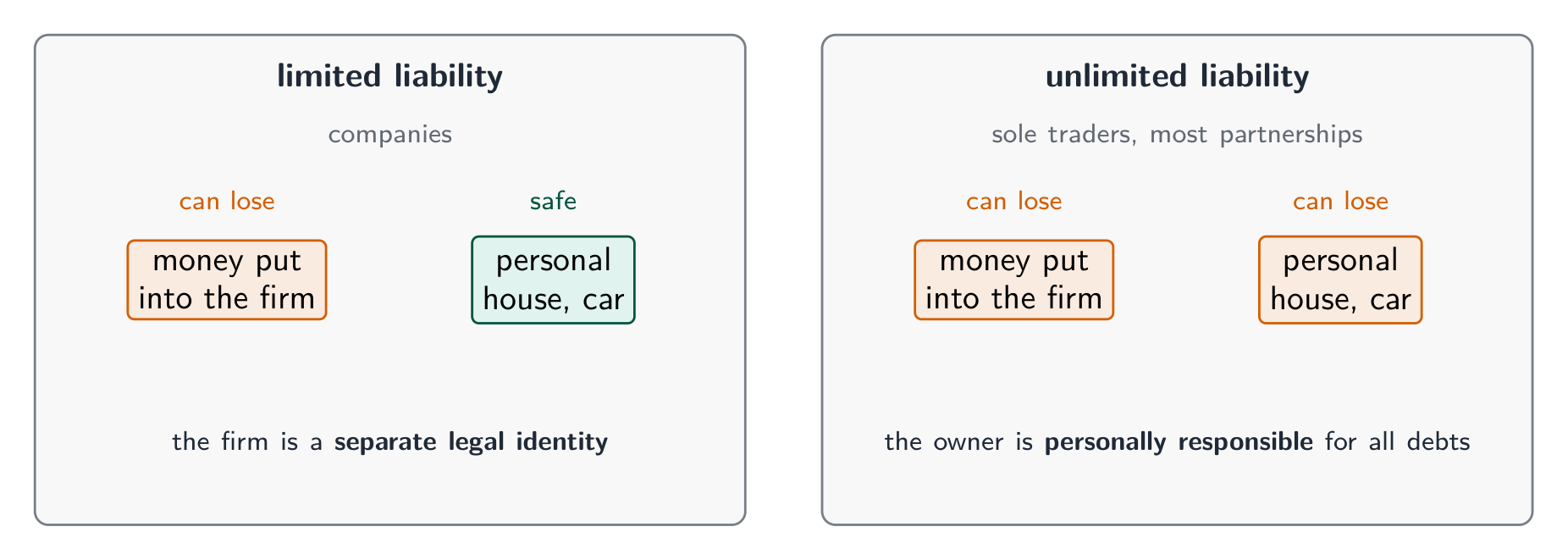
Liability 责任 means who must pay the business's debts 债务 if it cannot pay them itself.
- limited liability 有限责任 — the owners can only lose the money they put in. Their personal things, like a house or car, are safe. Companies have limited liability.
- unlimited liability 无限责任 — the owners are personally responsible for all the debts. They could lose personal things. Sole traders and most partnerships have unlimited liability.
A company is a separate legal identity 独立法人 — it can own things, owe money, and be taken to court in its own name, apart from its owners.
Limited liability risks only the money put in; unlimited liability risks the owner's personal things too Vocabulary TrainEnglish liability/ˌlaɪəˈbɪlɪti/ debts/dets/ limited liability/ˈlɪmɪtɪd ˌlaɪəˈbɪlɪti/ unlimited liability/ʌnˈlɪmɪtɪd ˌlaɪəˈbɪlɪti/ separate legal identity/ˈseprət ˈliːɡl aɪˈdentɪti/ 1.3
The size of a business

Syllabus
- explain how the size of a business is measured and the significance of small businesses
- explain internal and external growth (mergers and takeovers — horizontal, vertical, conglomerate) and the reasons for and problems of growth
- explain economies and diseconomies of scale
Source: Cambridge International syllabus
Economies of scale: average cost falls There is no single best way to measure how big a business is. Common measures are:
- the number of employees 员工.
- revenue 营业收入 (also called sales turnover) — the value of what it sells.
- capital employed 所用资本 — the total money invested in the business.
- market share 市场份额 — the firm's sales as a percentage of the whole market.
- market capitalisation 市值 — the total value of a company's shares (for a plc).
Different measures can give different answers, so it is best to use more than one.
Five ways to measure how big a business is; use more than one Why small businesses matter
Small businesses create jobs, serve local communities 社区, give personal service, react quickly to change, bring new ideas, and supply parts and services to large firms.
ExploreBusiness case lab
Classify real decisions so the main business concept becomes concrete.
Vocabulary TrainEnglish employees/emˈplɔɪiːz/ revenue/ˈrevənjuː/ capital employed/ˈkæpɪtl emˈplɔɪd/ market share/ˈmɑːkɪt ʃeə/ market capitalisation/ˈmɑːkɪt ˌkæpɪtəlaɪˈzeɪʃn/ communities/kəˈmjuːnɪtiz/ 1.3
Business growth

A business can grow in two ways.
Internal growth 内部增长 (organic growth) — the business grows by itself: selling more, opening new branches, or adding new products. It is slower but lower risk.
External growth 外部增长 — the business joins with another firm. This is called integration 整合, and it happens by:
- a merger 合并 — two firms agree to join together as one.
- a takeover — one firm buys control of another.
There are three types of integration:
- horizontal integration 横向整合 — joining a firm at the same stage in the same industry (e.g. two car makers).
- vertical integration 纵向整合 — joining a firm at a different stage in the same industry. Forward integration 前向整合 is towards the customer (e.g. buying a shop); backward integration 后向整合 is towards the supplier (e.g. buying a parts maker).
- conglomerate integration 混合整合 — joining a firm in a completely different industry. This spreads risk, which is called diversification 多元化.
The three types of integration when one firm joins with another Firms grow to lower their costs, win a bigger market share and more market power 市场支配力, raise profit, and spread risk. But growth also brings problems: higher average costs, harder management and communication, different company cultures 企业文化 that may clash, and a need for a lot of finance.
Vocabulary TrainEnglish internal growth/ɪnˈtɜːnl ɡrəʊθ/ external growth/ekˈstɜːnl ɡrəʊθ/ integration/ˌɪntɪˈɡreɪʃn/ merger/ˈmɜːdʒə/ horizontal integration/ˌhɒrɪˈzɒntl ˌɪntɪˈɡreɪʃn/ vertical integration/ˈvɜːtɪkl ˌɪntɪˈɡreɪʃn/ forward integration/ˈfɔːwəd ˌɪntɪˈɡreɪʃn/ backward integration/ˈbækwəd ˌɪntɪˈɡreɪʃn/ conglomerate integration/kənˈɡlɒməreɪt ˌɪntɪˈɡreɪʃn/ diversification/daɪˌvɜːsɪfɪˈkeɪʃn/ market power/ˈmɑːkɪt ˈpaʊə/ 1.3
Economies and diseconomies of scale

Economies of scale 规模经济 are the cost savings a business gets as it grows larger. The average cost 平均成本 of each unit falls as output rises. The main types are:
Type How it lowers cost purchasing buying in bulk 大批量 earns discounts technical large machines are more efficient financial large firms borrow at lower interest 利息 managerial the firm can employ expert specialist managers marketing advertising cost is spread over more units Diseconomies of scale 规模不经济 happen when a firm grows too big and the average cost starts to rise again. The usual causes are:
- communication 沟通 becomes slow and unclear.
- the coordination 协调 of many departments is hard.
- workers may feel unimportant and lose motivation 激励.
Average cost per unit falls (economies of scale) then rises (diseconomies of scale) as a firm grows Worked example. A factory making 10,000 units has fixed costs of £200,000 and variable costs of £6 per unit. It expands to 50,000 units, and bulk buying cuts the variable cost to £5. Find the unit cost at each output and explain the fall. Unit cost = total cost ÷ output. At 10,000: total = 200,000 + (10,000 × 6) = £260,000, so the unit cost is 260,000 ÷ 10,000 = £26. At 50,000: total = 200,000 + (50,000 × 5) = £450,000, so the unit cost is 450,000 ÷ 50,000 = £9. Two economies of scale are at work: the fixed costs are spread over far more units (£20 down to £4 each), and purchasing economies cut the variable cost. Note that the fixed cost total does not change - only the fixed cost per unit falls. Writing "fixed costs fall" is the error that loses the mark.
ExploreEconomies of scale
y = ax² + bx + c
Average cost falls then rises — economies, then diseconomies, of scale.
Vocabulary TrainEnglish economies of scale/ɪˈkɒnəmiz ɒv skeɪl/ average cost/ˈævrɪdʒ kɒst/ bulk/bʌlk/ interest/ˈɪntrest/ diseconomies of scale/ˌdɪsɪˈkɒnəmiz ɒv skeɪl/ communication/kəˌmjuːnɪˈkeɪʃn/ coordination/kəʊˈɔːdɪneɪʃn/ motivation/ˌməʊtɪˈveɪʃn/ 1.4
Aims, objectives and mission
Syllabus
- explain the importance of, and influences on, business objectives (mission statement, aims, objectives, SMART objectives, strategy and tactics)
- explain objectives such as profit maximisation, growth, survival, social and ethical objectives and corporate social responsibility (CSR)
Source: Cambridge International syllabus
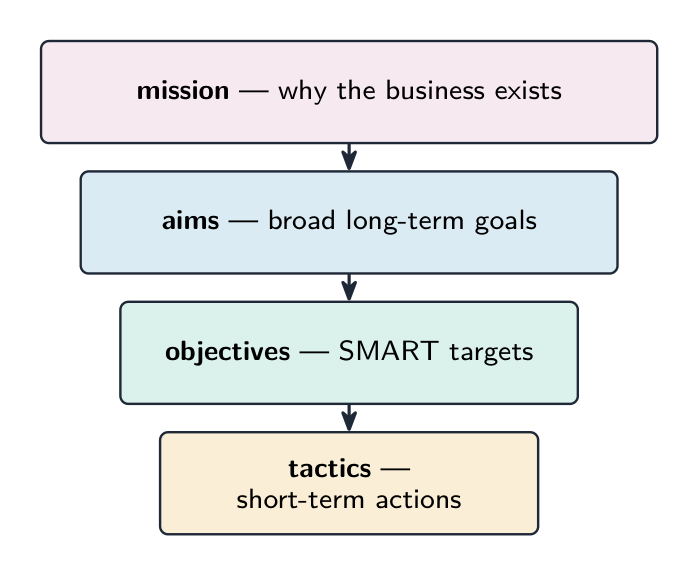
A mission statement 使命宣言 is a short sentence that says why the business exists and what it wants to be. It guides everyone in the firm.
From the mission come aims 目的 (broad, long-term goals), and then objectives 目标 (the specific targets that help reach the aims).
Goals get narrower and more specific down the chain: a broad mission becomes aims, then SMART objectives, then day-to-day tactics Good objectives are SMART — the first letters of:
- Specific 具体的 — clear and exact.
- Measurable 可衡量的 — you can check it with numbers.
- Achievable 可实现的 — it is possible to reach.
- Realistic 现实的 — sensible for the resources you have.
- Time-bound 有时限的 — it has a deadline.
A strategy 战略 is the long-term plan to meet objectives. Tactics 策略 are the short-term actions that carry out the strategy. Objectives are shaped by the size and age of the firm, who owns it, the company culture, and conditions in the market.
ExploreBusiness objectives lab
Match business examples to the objective they reveal.
Vocabulary TrainEnglish company culture/ˈkʌmpəni ˈkʌltʃə/ mission statement/ˈmɪʃn ˈsteɪtmənt/ aims/eɪmz/ objectives/ɒbˈdʒektɪvz/ specific/spəˈsɪfɪk/ measurable/ˈmeʒərəbl/ achievable/əˈtʃiːvəbl/ realistic/rɪəˈlɪstɪk/ time-bound/taɪm baʊnd/ strategy/ˈstrætədʒi/ tactics/ˈtæktɪks/ 1.4
Types of business objective

Objective What it means profit maximisation 利润最大化 making the largest possible profit growth getting bigger — more sales, more branches survival 生存 staying in business, vital for new firms and in hard times market share winning a larger share of the market social and ethical 道德 objectives doing what is morally right, such as fair pay SMART objectives: Specific, Measurable, Achievable, Realistic, Time-bound Corporate social responsibility 企业社会责任 (CSR) is the idea that a business should act in the best interests of society and the environment, not just make profit. Examples are treating workers fairly, cutting pollution 污染, and helping the local community.
A firm's objectives can change over time. A new firm may aim to survive; later it may aim to grow; a large, safe firm may focus on profit or CSR.
Vocabulary TrainEnglish profit maximisation/ˈprɒfɪt ˌmæksɪmaɪˈzeɪʃn/ survival/səˈvaɪvl/ ethical/ˈeθɪkl/ corporate social responsibility/ˈkɔːpərət ˈsəʊʃl rɪˌspɒnsəˈbɪlɪti/ pollution/pəˈluːʃn/ 1.5
Stakeholders

Syllabus
- identify internal and external stakeholders and their objectives
- explain how and why the objectives of stakeholders may conflict and how conflicts can be managed
Source: Cambridge International syllabus
A stakeholder 利益相关者 is any person or group with an interest in a business and how well it does.
Internal and external stakeholders all have an interest in the business Internal stakeholders 内部利益相关者 are inside the business:
- owners and shareholders — want profit and a good return.
- managers 管理者 — want growth, job security and bonuses.
- employees — want fair pay, safe work and job security.
External stakeholders 外部利益相关者 are outside the business:
Stakeholder Main objective customers 顾客 good quality at a fair price suppliers 供应商 regular orders, paid on time lenders 贷款方 (banks) to be repaid with interest the government tax, jobs, and that the firm obeys the law local community jobs, but little pollution or noise pressure groups 压力团体 to protect a cause, such as the environment Why stakeholder objectives conflict
Stakeholders often want different things, so their objectives can conflict 冲突 (clash). For example:
- owners want higher profit, but employees want higher pay — and higher pay lowers profit.
- customers want low prices, but owners want a high profit margin.
- the local community wants less pollution, but cutting pollution can raise costs.
How conflict can be managed
- keep good communication with every group.
- compromise 妥协 — give each group part of what it wants.
- negotiation 谈判 — talk until the groups reach an agreement.
- decide which stakeholders matter most for each decision, and act on that.
ExploreStakeholder interest lab
See how different stakeholders judge the same business decision.
Vocabulary TrainEnglish stakeholder/ˈsteɪkhəʊldə/ internal stakeholders/ɪnˈtɜːnl ˈsteɪkhəʊldəz/ external stakeholders/ekˈstɜːnl ˈsteɪkhəʊldəz/ managers/ˈmænɪdʒəz/ customers/ˈkʌstəməz/ suppliers/səˈplaɪəz/ lenders/ˈlendəz/ pressure groups/ˈpreʃə ɡruːps/ conflict/ˈkɒnflɪkt/ compromise/ˈkɒmprəmaɪz/ negotiation/nɪˌɡəʊʃɪˈeɪʃn/ 1.5
Exam tips
- Define added value $=$ selling price $-$ cost of bought-in inputs, and give a way to raise it (branding, quality, design).
- Distinguish unlimited vs limited liability and link it to sole trader/partnership versus Ltd/plc.
- Measure business size in more than one way (employees, revenue, capital employed, market share) — note each has limits.
- Distinguish objectives (SMART, specific) from a mission (overall purpose).
- In evaluation, use stakeholder conflicts (owners vs employees vs community) to argue both sides.
Vocabulary card meanings
needs: Basic requirements a person must meet, such as food and shelter. determined: Unwilling to give up until a difficult aim is reached. self-confident: Sure of one's own ability to succeed. business start-ups: New firms in their first stage of trading. GDP: The money value of final goods and services produced inside a country in one year, so intermediate goods are not added a second time. quaternary sector: The part of the economy that sells knowledge and information services. manufacture: To make goods in quantity, usually in a factory. deed of partnership: The written agreement that sets out how partners share a firm. public limited company: A company allowed to offer shares to the public, which need not be listed on an exchange. The paired Chinese term names only a listed firm. franchise: A licence to operate an outlet using another firm's name and methods. franchisor: The owner of a brand who sells others the right to use it. franchisee: The independent owner who pays a parent firm for the right to run one outlet under that firm's brand. royalty: A fee paid for the right to use a brand or a business format. environmental: Concerned with the natural surroundings in which a firm operates. liability: What a person or a firm can be forced to pay if things go wrong. separate legal identity: The company counts as its own person in law, distinct from its owners. communities: The people who live or work around a firm and are affected by it. forward integration: A firm taking over a business closer to the final customer. backward integration: A firm taking over a supplier that sits earlier in its chain. company culture: The shared habits and values inside a firm. bulk: A large quantity bought or produced at one time. realistic: Able to be achieved with the resources the firm actually has. corporate social responsibility: A firm's duties to people and the environment beyond making profit. internal stakeholders: People inside the firm, such as owners and staff, who are affected by its decisions. external stakeholders: People outside the firm, such as customers and neighbours, who are affected by it. lenders: People or banks that provide borrowed money.
-
2
Human resource management
Watch lesson2.1
What human resource management does

Syllabus
- explain the purpose and roles of human resource management (HRM): workforce planning, recruitment and selection, training and development
- explain redundancy and dismissal, employer/employee rights and the management of change in HR
- calculate and interpret labour turnover and labour productivity
Source: Cambridge International syllabus
Human resource management 人力资源管理 (HRM) is the part of a business that looks after its people. Good HRM makes sure the firm has enough staff, with the right skills, who are well trained and motivated.
Managers plan and organise the workforce — the core of human resource management. The main roles of HRM are:
- workforce planning 人力规划 — working out how many staff, and what skills, the business will need in the future.
- recruitment 招聘 and selection 甄选 — finding people to apply for jobs, then choosing the best.
- training 培训 and development 培养 — improving staff skills now and helping them grow for the future.
ExploreHuman resources decision lab
Classify HR actions by the job they do inside the workforce.
Vocabulary TrainEnglish human resource management/ˈhjuːmən rɪˈzɔːs ˈmænɪdʒmənt/ workforce planning/ˈwɜːkfɔːs ˈplænɪŋ/ recruitment/rɪˈkruːtmənt/ selection/sɪˈlekʃn/ training/ˈtreɪnɪŋ/ development/dɪˈveləpmənt/ 2.1
Workforce planning, recruitment and selection

Workforce planning looks at the firm's plans, then at the staff it already has, to find the gap. The gap may be filled by hiring, training, or moving staff.
Recruitment: describe the job, advertise, then select the best applicant To recruit, the firm first writes:
- a job description 职位描述 — the title, duties and tasks of the job.
- a person specification 人员规格 — the skills, qualifications 资格 and qualities the right person should have.
The firm can recruit from inside or outside:
- internal recruitment 内部招聘 — filling the job with someone who already works there. It is cheaper and faster, and the person is known, but no new ideas come in.
- external recruitment 外部招聘 — hiring someone from outside. It brings new skills and ideas, but costs more and is slower.
Selection methods include reading application forms and CVs, interviews 面试, tests, and group tasks.

Selection: the interview is the stage most candidates meet, and the one most often assessed in the exam Vocabulary TrainEnglish job description/dʒɒb dɪˈskrɪpʃn/ person specification/ˈpɜːsn ˌspesɪfɪˈkeɪʃn/ qualifications/ˌkwɒlɪfɪˈkeɪʃnz/ internal recruitment/ɪnˈtɜːnl rɪˈkruːtmənt/ external recruitment/ekˈstɜːnl rɪˈkruːtmənt/ interviews/ˈɪntəvjuːz/ 2.1
Training and development

Training improves the skills staff need to do their jobs well. Common types are:
Three kinds of training: induction, on-the-job and off-the-job - induction training 入职培训 — given to new staff so they learn how the firm works.
- on-the-job training 在岗培训 — learning while doing the real job.
- off-the-job training 脱产培训 — learning away from the workplace, such as a course.
Training costs time and money, but it raises quality, productivity 生产率 and motivation, and helps keep staff.
Vocabulary TrainEnglish induction training/ɪnˈdʌkʃn ˈtreɪnɪŋ/ on-the-job training/ɒnðə dʒɒb ˈtreɪnɪŋ/ off-the-job training/ɒf ðə dʒɒb ˈtreɪnɪŋ/ productivity/ˌprɒdəkˈtɪvɪti/ 2.1
Ending employment
Sometimes a worker has to leave.
- redundancy 裁员 happens when the job itself is no longer needed — for example, when a machine replaces it. It is not the worker's fault.
- dismissal 解雇 happens when a worker is made to leave because of poor work or bad behaviour.
Vocabulary TrainEnglish redundancy/rɪˈdʌndənsi/ dismissal/dɪˈsmɪsl/ 2.1
Rights and managing change
Both sides have rights and duties. The employer 雇主 must follow the law on pay, safety, working hours and unfair dismissal. The employee 雇员 must work as agreed and follow safe, fair rules. These rights 权利 protect both sides.
Businesses change often — new technology, new markets, or restructuring 重组. The management of change 变革管理 in HR means planning the change, explaining it clearly, training staff for new roles, and listening to worries, so staff accept the change instead of resisting it.
Vocabulary TrainEnglish employer/emˈplɔɪə/ employee/emˈplɔɪiː/ rights/raɪts/ restructuring/rɪˈstrʌktʃərɪŋ/ management of change/ˈmænɪdʒmənt ɒv tʃeɪndʒ/ 2.1
Measuring the workforce
Two simple measures help managers judge how the workforce is doing.
Labour turnover 员工流失率 shows the percentage of staff who leave in a year:
$$\text{labour turnover} = \frac{\text{number of staff leaving}}{\text{average number employed}} \times 100\%$$High labour turnover can mean low pay, poor motivation or weak management. It raises the cost of recruiting and training.
Worked example. A firm employs $200$ people on average, and $30$ leave during the year. Find its labour turnover.
$$\text{labour turnover} = \frac{30}{200} \times 100\% = 15\%.$$Labour productivity 劳动生产率 shows the output made by each worker:
$$\text{labour productivity} = \frac{\text{total output}}{\text{number of employees}}$$Higher labour productivity lowers the cost of each unit, so the firm can compete better.
Worked example. A team of $8$ workers makes $2400$ units in a week. Find the labour productivity.
$$\text{labour productivity} = \frac{2400}{8} = 300 \text{ units per worker per week}.$$Vocabulary TrainEnglish labour turnover/ˈleɪbə ˈtɜːnəʊvə/ labour productivity/ˈleɪbə ˌprɒdəkˈtɪvɪti/ 2.2
Why motivation matters
Syllabus
- explain the importance of motivation and the main motivation theories (Taylor, Mayo, Maslow, Herzberg, McClelland, Vroom)
- explain financial motivators (wages, salary, piece rate, commission, bonus, profit sharing, performance-related pay, fringe benefits)
- explain non-financial motivators (job enrichment, job rotation, job enlargement, empowerment, teamworking)
Source: Cambridge International syllabus
Motivation 激励 is the desire to work hard and do a good job. Motivated staff produce more and better work, take fewer days off, stay longer, and give better service. So motivation lowers costs and raises quality.
Vocabulary TrainEnglish motivation/ˌməʊtɪˈveɪʃn/ 2.2
Theories of motivation

Maslow's hierarchy of needs, with workplace examples at each level. Several thinkers tried to explain what motivates people. You should know the main idea of each.
Thinker Main idea Taylor scientific management 科学管理 — workers are mainly motivated by money. Pay them per unit made (piece rate 计件工资) and they work harder. Mayo human relations 人际关系 — workers are also motivated by attention, teamwork and feeling part of a group. Maslow hierarchy of needs 需求层次 — people meet needs in order, from low to high (see below). Herzberg two-factor theory 双因素理论 — some things cause unhappiness if missing, others truly motivate (see below). McClelland people are driven by three needs in different amounts: achievement 成就, power and affiliation (belonging). Vroom expectancy theory 期望理论 — people work hard only if they believe the effort will lead to a reward they want. Maslow's hierarchy of needs
Maslow said people try to meet lower needs first, then move up:
- physiological needs 生理需求 — food, water, rest (met by pay).
- safety needs — a safe job and workplace.
- social needs — friendship and being part of a team.
- esteem needs 尊重需求 — respect and recognition 认可.
- self-actualisation 自我实现 — reaching your full potential.

Maslow's hierarchy: people meet lower needs before higher ones Herzberg's two factors
- hygiene factors 保健因素 — things like pay, conditions and rules. If they are poor, staff are unhappy; but fixing them does not truly motivate.
- motivators 激励因素 — things like achievement, responsibility and recognition. These give real, lasting motivation.

Hygiene factors stop unhappiness; only motivators give real, lasting motivation ExploreMaslow's hierarchy of needs
Maslow said people are motivated by needs in order — satisfy the lower ones first, then they aim higher.
Vocabulary TrainEnglish scientific management/saɪənˈtɪfɪk ˈmænɪdʒmənt/ piece rate/piːs reɪt/ human relations/ˈhjuːmən rɪˈleɪʃnz/ hierarchy of needs/ˈhaɪərɑːki ɒv niːdz/ two-factor theory/tuː ˈfæktə ˈθɪəri/ achievement/əˈtʃiːvmənt/ expectancy theory/ekˈspektənsi ˈθɪəri/ physiological needs/ˌfɪzɪəˈlɒdʒɪkl niːdz/ esteem needs/eˈstiːm niːdz/ recognition/ˌrekəɡˈnɪʃn/ self-actualisation/self ˌæktʃuːəlaɪˈzeɪʃn/ hygiene factors/ˈhaɪdʒiːn ˈfæktəz/ motivators/ˈməʊtɪveɪtəz/ 2.2
Financial motivators
Financial motivators 经济激励 are rewards paid in money:
- wages 工资 — pay by the hour or week, often for manual work 体力劳动.
- salary 薪水 — a fixed yearly amount, paid monthly.
- piece rate — pay for each unit made.
- commission 佣金 — pay based on how much you sell.
- bonus 奖金 — an extra payment for good results.
- profit sharing 利润分享 — staff get a share of the firm's profit.
- performance-related pay 绩效工资 — extra pay for those who meet targets.
- fringe benefits 附加福利 — non-cash extras, such as a company car or health care.
ExploreMotivation methods lab
Compare financial and non-financial ways to raise effort.
Vocabulary TrainEnglish financial motivators/faɪˈnænʃl ˈməʊtɪveɪtəz/ wages/ˈweɪdʒɪz/ manual work/ˈmænjuːəl wɜːk/ salary/ˈsæləri/ commission/kəˈmɪʃn/ bonus/ˈbəʊnəs/ profit sharing/ˈprɒfɪt ˈʃeərɪŋ/ performance-related pay/pəˈfɔːməns rɪˈleɪtɪd peɪ/ fringe benefits/frɪndʒ ˈbenɪfɪts/ 2.2
Non-financial motivators

Non-financial motivators 非经济激励 reward staff without extra money, by making work more interesting and giving more control:
- job enrichment 工作丰富化 — giving more challenging tasks and responsibility.
- job rotation 工作轮换 — moving between different tasks to reduce boredom.
- job enlargement 工作扩大化 — adding more tasks at the same level.
- empowerment 授权 — letting staff make their own decisions about their work.
- teamworking 团队合作 — organising staff into teams that share goals.
Motivators are either financial (money) or non-financial (better, fuller work) Vocabulary TrainEnglish non-financial motivators/nɒn faɪˈnænʃl ˈməʊtɪveɪtəz/ job enrichment/dʒɒb enˈrɪtʃmənt/ job rotation/dʒɒb rəʊˈteɪʃn/ job enlargement/dʒɒb enˈlɑːdʒmənt/ empowerment/emˈpaʊəmənt/ teamworking/ˈtiːmwɜːkɪŋ/ 2.3
Management and its functions

Syllabus
- explain the role and functions of management (Fayol, Mintzberg)
- explain leadership versus management and the importance of effective management
Source: Cambridge International syllabus
Management 管理 means getting work done through other people to reach the firm's objectives.
Fayol said managers carry out five functions:
Function What the manager does planning 计划 set objectives and decide how to reach them organising 组织 arrange people and resources commanding 指挥 give clear instructions and guidance coordinating 协调 make sure all parts work together controlling 控制 check results against the plan and correct problems Fayol's five functions of management form a repeating cycle Mintzberg said managers also play ten roles 角色 in three groups: interpersonal (working with people), informational (sharing information), and decisional (making decisions). This shows that real management is busy and varied, not just the five neat functions.
ExploreLeadership style lab
Pick the management style that fits each situation.
Vocabulary TrainEnglish management/ˈmænɪdʒmənt/ planning/ˈplænɪŋ/ organising/ˈɔːɡənaɪzɪŋ/ commanding/kəˈmændɪŋ/ coordinating/kəʊˈɔːdɪneɪtɪŋ/ controlling/kənˈtrəʊlɪŋ/ roles/rəʊlz/ 2.3
Leadership versus management
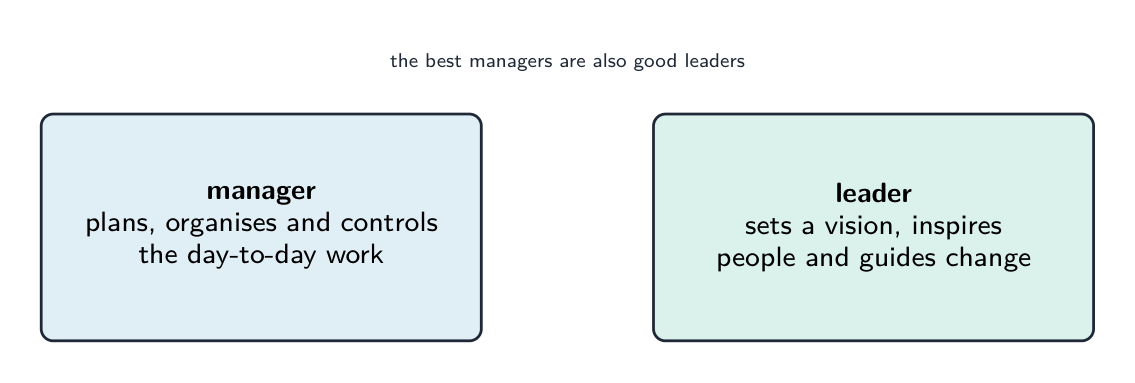
Leadership 领导 and management are not the same.
- a manager plans, organises and controls the day-to-day work.
- a leader sets a vision 愿景, inspires people, and guides change.
A manager runs the day-to-day work; a leader sets direction and inspires — the best people do both The best managers are also good leaders. Effective management matters because it raises productivity, keeps good staff, helps the firm adapt to change, and turns plans into real results.
Vocabulary TrainEnglish leadership/ˈliːdəʃɪp/ vision/ˈvɪʒn/ 2.3
Exam tips
- Calculate and interpret labour turnover and labour productivity; high turnover raises recruitment and training costs.
- Link a motivation theory to a method: Maslow (needs), Herzberg (hygiene vs motivators), Taylor (pay).
- Distinguish financial (piece rate, bonus) from non-financial (job enrichment, empowerment) motivators.
- Distinguish leadership from management and match a style (autocratic, democratic, laissez-faire) to the situation.
Vocabulary card meanings
development: Helping staff gain skills, rather than inventing a new product. dismissal: Ending someone's job because of their conduct or performance. employer: The person or firm that hires and pays staff. employee: A person who works for a firm in return for pay. rights: Entitlements that the law or a contract gives a person at work. restructuring: Changing how a firm is organised, often to cut costs. management of change: The way leaders plan and support people through a new way of working. hierarchy of needs: Maslow's order of human requirements, from survival up to personal growth. two-factor theory: Herzberg's split between things that prevent dissatisfaction and things that motivate. achievement: The satisfaction of reaching a demanding goal. expectancy theory: The idea that effort depends on whether people expect it to lead to a valued reward. physiological needs: The basic bodily requirements, such as food, water and rest. esteem needs: The desire to be respected and to respect oneself. financial motivators: Rewards paid in money, such as wages, bonuses or commission. manual work: Jobs done mainly with the body rather than at a desk. non-financial motivators: Rewards other than money, such as praise, responsibility or training.
-
3
Marketing
Watch lesson3.1
The role of marketing
Syllabus
- explain the role of marketing, market and product orientation, and customer relationship marketing (CRM)
- explain market size, market growth and market share, mass and niche markets and market segmentation
- explain demand and supply and the concept of elasticity (price, income, cross) and its usefulness
Source: Cambridge International syllabus
Elastic vs inelastic demand Demand shifts right: P and Q rise Marketing 市场营销 is the job of finding out what customers want, then making and selling products that meet those wants at a profit. Good marketing links the business to its market 市场 (all the buyers and sellers of a product).
A business can be:
- product-orientated 产品导向 — it focuses on the product first and hopes customers will buy it. This suits new or technical products.
- market-orientated 市场导向 — it finds out what customers want first, then makes it. This lowers the risk of failure.
Customer relationship marketing 客户关系营销 (CRM) means building long-term links with customers so they come back again. Keeping a customer is cheaper than finding a new one.
ExploreMarketing mix lab
See which part of the marketing mix changes in each real decision.
Vocabulary TrainEnglish marketing/ˈmɑːkɪtɪŋ/ market/ˈmɑːkɪt/ product-orientated/ˈprɒdʌkt ˈɔːrɪənteɪtɪd/ market-orientated/ˈmɑːkɪt ˈɔːrɪənteɪtɪd/ customer relationship marketing/ˈkʌstəmə rɪˈleɪʃənʃɪp ˈmɑːkɪtɪŋ/ 3.1
Market size, growth and share
- market size 市场规模 — the total sales of all firms in a market, by value or by number of units.
- market growth 市场增长 — how fast the market is getting bigger, shown as a percentage.
- market share 市场份额 — one firm's sales as a percentage of the total market:
$$\text{market share} = \frac{\text{firm's sales}}{\text{total market sales}} \times 100\%$$A rising market share is a sign of strong marketing.
Worked example. A firm sells £4 million of goods in a market worth £50 million in total. Find its market share.
$$\text{market share} = \frac{4}{50} \times 100\% = 8\%.$$If the whole market grows but the firm's sales stay at £4 million, its market share falls — so a firm can sell the same amount yet lose ground to faster-growing rivals.
Vocabulary TrainEnglish market size/ˈmɑːkɪt saɪz/ market growth/ˈmɑːkɪt ɡrəʊθ/ market share/ˈmɑːkɪt ʃeə/ 3.1
Mass and niche markets

- a mass market 大众市场 is large, with products aimed at most buyers (e.g. soft drinks). Sales are high, but competition is strong.
- a niche market 利基市场 is a small part of a market with special needs (e.g. left-handed tools). Competition is weaker, but sales are smaller.
A mass market targets everyone; a niche serves a small specialist group Vocabulary TrainEnglish mass market/mæs ˈmɑːkɪt/ niche market/niːʃ ˈmɑːkɪt/ 3.1
Market segmentation

Shelf space is a marketing decision: segment, position, then price and promote Market segmentation 市场细分 means splitting a market into groups (segments 细分市场) of buyers who are alike. Common ways to segment are by age, income, gender, location, and lifestyle. Segmentation lets a firm aim the right product and message at each group, which raises sales and cuts waste.

Splitting a market into segments by age, income and lifestyle Vocabulary TrainEnglish market segmentation/ˈmɑːkɪt ˌseɡmənˈteɪʃn/ segments/ˈseɡmənts/ 3.1
Demand, supply and elasticity

Demand 需求 is how much of a product buyers will buy at each price. Supply 供给 is how much sellers will offer at each price. Usually, when price falls, demand rises.
Supply and demand meet at the equilibrium market price Elasticity 弹性 measures how strongly demand reacts to a change. You should know three types.
Price elasticity of demand 需求价格弹性 (PED) measures how demand reacts to a price change:
$$\text{PED} = \frac{\%\ \text{change in quantity demanded}}{\%\ \text{change in price}}$$- if PED is greater than 1, demand is price elastic 富有弹性 — a small price cut raises sales a lot, so lowering price can raise revenue.
- if PED is less than 1, demand is price inelastic 缺乏弹性 — demand changes little, so raising price can raise revenue.
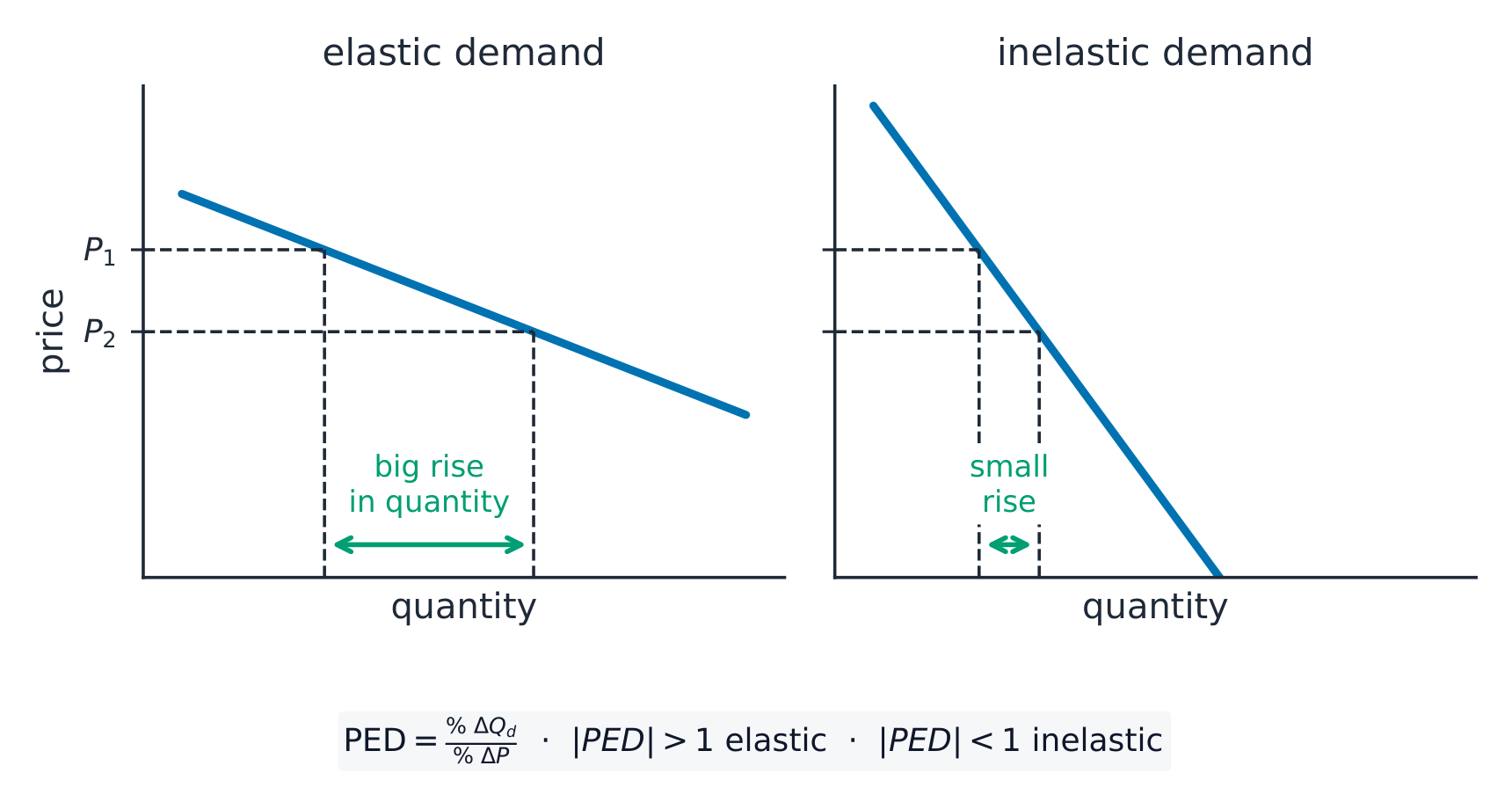
The same price fall raises quantity a lot when demand is elastic, only a little when inelastic Income elasticity of demand 需求收入弹性 (YED) measures how demand reacts to a change in customers' income. Luxury goods react strongly; basic goods react weakly.
Cross elasticity of demand 需求交叉弹性 (XED) measures how the demand for one product reacts to a price change of another. It is positive for substitutes 替代品 (e.g. tea and coffee) and negative for complements 互补品 (e.g. cars and fuel).
Elasticity is useful because it helps a firm predict how a price change will affect sales and revenue.
ExploreDemand, supply & elasticity
Price is set where demand meets supply.
ExploreDemand and supply
Shift the curves to see how price is set in a market — and how elasticity decides how much quantity responds.
Vocabulary TrainEnglish demand/dɪˈmænd/ supply/səˈplaɪ/ elasticity/ɪlæˈstɪsɪti/ price elasticity of demand/praɪs ɪlæˈstɪsɪti ɒv dɪˈmænd/ price elastic/praɪs ɪˈlæstɪk/ price inelastic/praɪs ɪnɪˈlæstɪk/ income elasticity of demand/ˈɪŋkʌm ɪlæˈstɪsɪti ɒv dɪˈmænd/ cross elasticity of demand/krɒs ɪlæˈstɪsɪti ɒv dɪˈmænd/ substitutes/ˈsʌbstɪtjuːts/ complements/ˈkɒmplɪmənts/ 3.2
Market research
Syllabus
- distinguish primary and secondary market research and qualitative and quantitative data
- explain sampling methods and the reliability of data; present and interpret market research findings
Source: Cambridge International syllabus
Market research 市场调研 is collecting and studying information about customers, competitors 竞争对手 and the market.
- primary research 一手调研 — new information you collect yourself, by surveys, interviews or observation. It fits your exact needs, but costs more and takes time.
- secondary research 二手调研 — information that already exists, such as reports, websites and sales records. It is cheap and quick, but may be old or not exactly right.
Data can be:
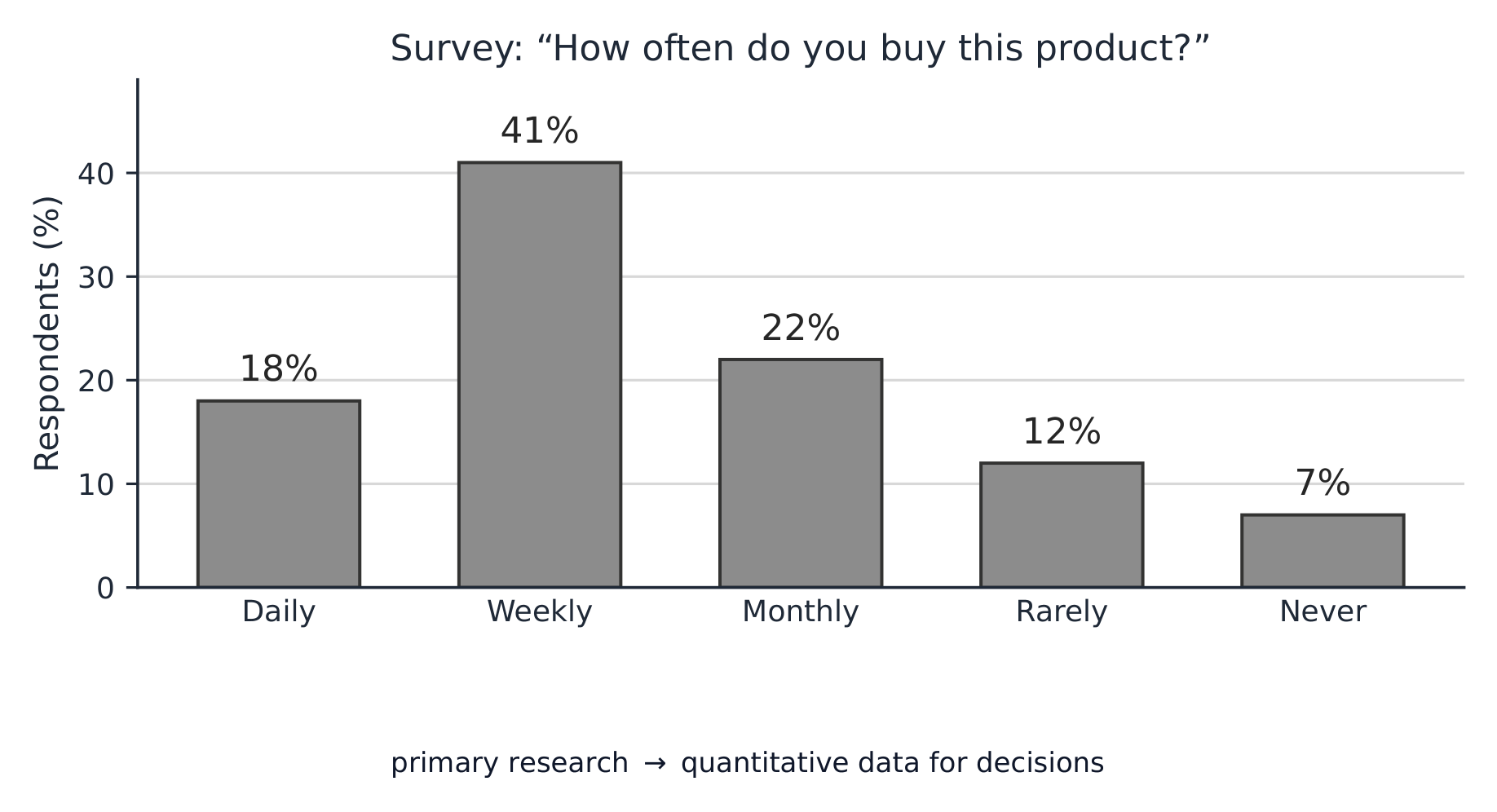
- quantitative data 定量数据 — facts in numbers (e.g. "60% buy weekly"). Easy to compare.
- qualitative data 定性数据 — opinions and reasons (e.g. "why people like the brand"). Gives deeper understanding.
Sampling and reliability
A sample 样本 is the small group of people asked, chosen to stand for the whole market. Sampling 抽样 methods include:
- random sampling 随机抽样 — everyone has an equal chance of being picked.
- quota sampling 配额抽样 — set numbers from each group are asked.
- stratified sampling 分层抽样 — the sample copies the make-up of the whole market.
A larger, well-chosen sample gives more reliable 可靠的 results. Poor sampling can cause bias 偏差, which makes the findings wrong. Results are often shown in tables and charts, then read carefully to guide decisions.
Primary research → quantitative data that guides marketing decisions ExploreMarket research cycle
Follow how a business turns customer data into a marketing decision.
Vocabulary TrainEnglish market research/ˈmɑːkɪt rɪˈsɜːtʃ/ competitors/kəmˈpetɪtəz/ primary research/ˈpraɪməri rɪˈsɜːtʃ/ secondary research/ˈsekəndəri rɪˈsɜːtʃ/ quantitative data/ˈkwɒntɪteɪtɪv ˈdeɪtə/ qualitative data/ˈkwɒlɪteɪtɪv ˈdeɪtə/ sample/ˈsæmpl/ sampling/ˈsæmplɪŋ/ random sampling/ˈrændəm ˈsæmplɪŋ/ quota sampling/ˈkwəʊtə ˈsæmplɪŋ/ stratified sampling/ˈstrætɪfaɪd ˈsæmplɪŋ/ reliable/rɪˈlaɪəbl/ bias/ˈbaɪəs/ 3.3
The marketing mix

Syllabus
- explain the elements of the marketing mix (product, price, place, promotion) and their integration
- product: product development, the product life cycle, the product portfolio (Boston Matrix), branding
- price: pricing methods and strategies (cost-plus, penetration, skimming, competitive, price discrimination, dynamic, psychological)
- place and promotion: distribution channels, above- and below-the-line promotion, and digital/e-commerce marketing
Source: Cambridge International syllabus
The product life cycle A branded shop window — branding and place help sell the product. The marketing mix 营销组合 is the set of choices a firm makes to sell a product. It is often called the 4Ps:
P Question it answers product 产品 what are we selling? price 价格 how much do we charge? place 渠道 where and how do customers buy it? promotion 促销 how do we tell customers about it? 
The marketing mix combines the four Ps The four parts must work together. For example, a high price needs high quality and a good image. Making the parts fit each other is called integration 整合.
Vocabulary TrainEnglish marketing mix/ˈmɑːkɪtɪŋ mɪks/ product/ˈprɒdʌkt/ price/praɪs/ place/pleɪs/ promotion/prəˈməʊʃn/ integration/ˌɪntɪˈɡreɪʃn/ 3.3
Product
A good product is the heart of the mix.
Product development 产品开发 is the work of designing and improving products to meet customer needs and beat rivals.
The product life cycle
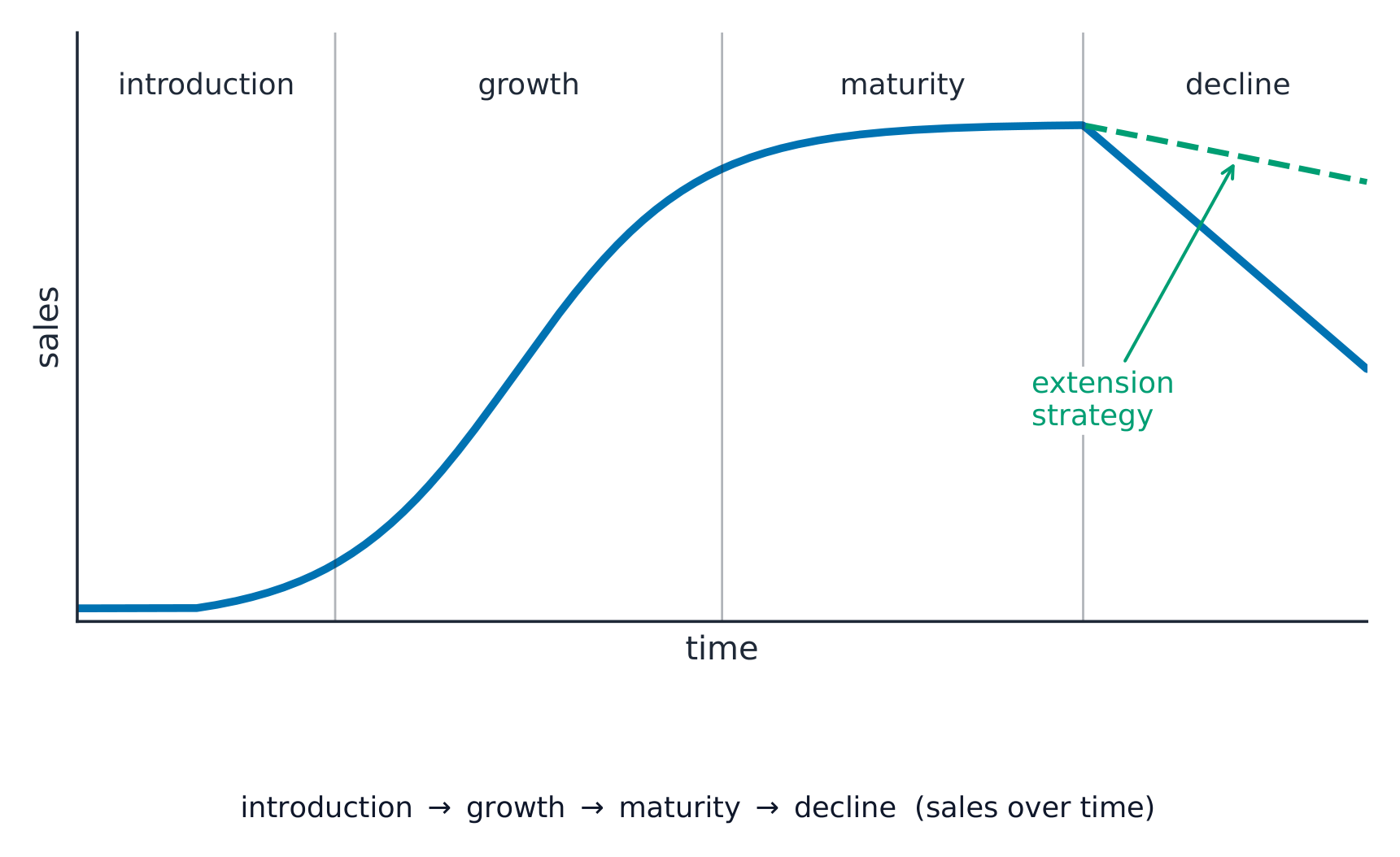
The product life cycle 产品生命周期 shows the sales of a product over time, in four stages:
- introduction 引入期 — launch; low sales, high promotion cost.
- growth 成长期 — sales rise quickly.
- maturity 成熟期 — sales reach their peak and level off.
- decline 衰退期 — sales fall as tastes change.
Sales of a product over its four life-cycle stages, with an extension strategy in maturity To keep sales up in maturity, firms use extension strategies 延长策略, such as new packaging, new uses, or selling in new markets.
The product portfolio (Boston Matrix)
The product portfolio 产品组合 is the full range of products a firm sells. The Boston Matrix 波士顿矩阵 sorts products by market share and market growth:
High market growth Low market growth High share stars 明星产品 cash cows 现金牛 Low share question marks 问题产品 dogs 瘦狗产品 
The Boston Matrix sorts products by market share and market growth Stars need investment but may become cash cows. Cash cows bring steady profit. Question marks are risky. Dogs are usually dropped.
Branding
Branding 品牌 gives a product a name, design and image that customers recognise. A strong brand builds loyalty 忠诚度, lets the firm charge more, and makes new products easier to launch.
ExploreThe product life cycle
Most products pass through four sales stages over time — from launch to decline.
ExploreBalance the product portfolio
Pick a product and drag its market share and growth — it re-classifies live, and Play walks one product through its whole life across the matrix.
Vocabulary TrainEnglish product development/ˈprɒdʌkt dɪˈveləpmənt/ product life cycle/ˈprɒdʌkt laɪf ˈsaɪkl/ introduction/ˌɪntrəˈdʌkʃn/ growth/ɡrəʊθ/ maturity/məˈtʃʊərɪti/ decline/dɪˈklaɪn/ extension strategies/ekˈstenʃn ˈstrætədʒiz/ product portfolio/ˈprɒdʌkt pɔːtˈfəʊlɪəʊ/ Boston Matrix/ˈbɒstn ˈmeɪtrɪks/ stars/stɑːz/ cash cows/kæʃ kaʊz/ question marks/ˈkwestʃn mɑːks/ dogs/dɒɡz/ branding/ˈbrændɪŋ/ loyalty/ˈlɔɪəlti/ 3.3
Price

Choosing a price is a key decision. The main methods and strategies are:
Method / strategy How it works cost-plus pricing 成本加成定价 add a fixed profit margin to the unit cost penetration pricing 渗透定价 set a low price to enter a market and win share price skimming 撇脂定价 set a high price first for a new, special product, then lower it competitive pricing 竞争定价 set a price close to rivals' prices price discrimination 价格歧视 charge different prices to different groups (e.g. peak vs off-peak) dynamic pricing 动态定价 change the price often as demand changes psychological pricing 心理定价 use prices like $9.99 that feel lower The best price depends on costs, competitors, the product's life-cycle stage, and how price elastic demand is.
Two launch strategies over time: penetration sets a low price to win share; skimming sets a high price first, then lowers it ExploreMarketing mix lab
See which part of the marketing mix changes in each real decision.
Vocabulary TrainEnglish cost-plus pricing/kɒst plʌs ˈpraɪsɪŋ/ penetration pricing/ˌpenɪˈtreɪʃn ˈpraɪsɪŋ/ price skimming/praɪs ˈskɪmɪŋ/ competitive pricing/kəmˈpetɪtɪv ˈpraɪsɪŋ/ price discrimination/praɪs dɪˌskrɪmɪˈneɪʃn/ dynamic pricing/daɪˈnæmɪk ˈpraɪsɪŋ/ psychological pricing/saɪkəˈlɒdʒɪkl ˈpraɪsɪŋ/ 3.3
Place and promotion

Advertising on giant screens — promotion is part of the marketing mix. Place is how the product reaches the customer, through a distribution channel 分销渠道. A short channel (maker → customer) gives more control; a longer channel (maker → wholesaler 批发商 → shop → customer) reaches more buyers.

A short channel gives more control; a longer channel reaches more buyers Promotion tells customers about a product and persuades them to buy. It is split into:
- above-the-line promotion 大众媒体广告 — paid advertising 广告 in mass media, such as TV and online ads, aimed at a wide audience.
- below-the-line promotion 直接促销 — targeted methods the firm controls, such as discounts, free samples and direct mail.
Digital marketing 数字营销 and e-commerce 电子商务 (buying and selling online) now play a huge role. They let small firms reach world markets cheaply, target adverts to the right people, and sell at any time of day.
Vocabulary TrainEnglish distribution channel/ˌdɪstrɪˈbjuːʃn ˈtʃænl/ wholesaler/ˈhəʊlseɪlə/ above-the-line promotion/əˈbʌv ðə laɪn prəˈməʊʃn/ advertising/ˈædvətaɪzɪŋ/ below-the-line promotion/bɪˈləʊ ðə laɪn prəˈməʊʃn/ digital marketing/ˈdɪdʒɪtl ˈmɑːkɪtɪŋ/ e-commerce/iː ˈkɒmɜːs/ 3.3
Exam tips
- Calculate market share and market growth as percentages; a firm can grow yet lose share in a faster-growing market.
- Use price elasticity of demand to decide pricing: raise price when demand is inelastic (revenue rises), cut it when elastic.
- Distinguish primary vs secondary and quantitative vs qualitative research, and comment on sampling reliability.
- Treat the marketing mix (4Ps) as a coordinated set — each P should support the others.
Vocabulary card meanings
customer relationship marketing: Building long-term links with buyers rather than chasing one-off sales. market segmentation: Splitting buyers into groups that share similar wants. segments: Groups of buyers who share similar wants. price elastic: Quantity demanded changes by a larger percentage than the price. price inelastic: Quantity demanded changes by a smaller percentage than the price. competitors: Other firms that sell to the same buyers. reliable: Able to be trusted to work or to tell the truth. Boston Matrix: A four-box chart that places products by their relative share of a market and by how fast that market is growing. stars: Products with a high share of a fast-growing market. cash cows: Products with a high share of a slow-growing market. question marks: Products with a low share of a fast-growing market. dogs: Products with a low share of a slow-growing market. psychological pricing: Setting a price, such as 9.99, to influence how buyers feel about it. distribution channel: The route a product takes from the producer to the buyer. wholesaler: A firm that buys in bulk from producers and sells on to shops. advertising: Paid messages that promote a product to many people at once. digital marketing: Promotion that uses the internet, apps or social media. e-commerce: Buying and selling through the internet.
-
4
Operations management
Watch lesson4.1
What operations management does

Syllabus
- explain operations as the transformation of inputs into outputs and the concept of adding value
- explain productivity, efficiency, capital- and labour-intensive operations and methods of production (job, batch, flow, mass customisation)
- explain sustainability of operations and the use of technology in operations
Source: Cambridge International syllabus
Operations 运营 is the part of a business that makes the product. Operations management 运营管理 is the job of turning inputs 投入 into outputs 产出 well.
A distribution centre: operations management turns inputs into finished goods ready for customers. This is the transformation process 转化过程:
- inputs — raw materials, labour, machines and money.
- process — the work that changes the inputs.
- outputs — finished goods and services for the customer.

Operations turn inputs into outputs, adding value along the way Good operations add value 增值: the output is worth more than the inputs used to make it. Using raw materials 原材料 (the basic materials a business starts with) well is a big part of this.
ExploreOperations: input → output
Operations management turns inputs into finished goods or services through a transformation process.
Vocabulary TrainEnglish operations/ˌɒpəˈreɪʃnz/ operations management/ˌɒpəˈreɪʃnz ˈmænɪdʒmənt/ inputs/ˈɪnpʊts/ outputs/ˈaʊtpʊts/ transformation process/trænsfɔːˈmeɪʃn ˈprəʊses/ adding value/ˈædɪŋ ˈvæljuː/ raw materials/rɔː məˈtɪərɪəlz/ 4.1
Productivity and efficiency

Productivity 生产率 measures how much output you get from your inputs:
$$\text{productivity} = \frac{\text{output}}{\text{input used}}$$Efficiency 效率 means making products with as little waste of time, materials and money as possible. Higher productivity and efficiency lower the cost of each unit, so the firm can charge less or earn more.
Worked example. A factory of $20$ workers makes $800$ units in a day. Find the output per worker.
$$\text{productivity} = \frac{800}{20} = 40 \text{ units per worker per day}.$$If training raised output to $1000$ units with the same $20$ workers, productivity would rise to $50$ units each — the same staff cost now spread over more units, so each unit is cheaper to make.
Assembly line: productivity is output per worker (or per hour) — rising productivity cuts unit costs Vocabulary TrainEnglish productivity/ˌprɒdəkˈtɪvɪti/ efficiency/ɪˈfɪʃənsi/ 4.1
Capital- and labour-intensive operations

- a capital-intensive 资本密集型 operation uses mostly machines (e.g. a car factory). It has high set-up costs but low cost per unit, and is good for large amounts.
- a labour-intensive 劳动密集型 operation uses mostly people (e.g. a hair salon). It is flexible and good for personal service, but quality can vary.
Factory robots: capital-intensive production uses more machines relative to labour Vocabulary TrainEnglish capital-intensive/ˈkæpɪtl ɪnˈtensɪv/ labour-intensive/ˈleɪbə ɪnˈtensɪv/ 4.1
Methods of production

A firm chooses how to organise production to suit its product and demand.
A car assembly line: flow production of identical units, one stage after another Method What it is Best for job production 单件生产 making one unique item at a time a wedding cake, a bridge batch production 批量生产 making a group of the same item, then switching bread in flavours flow production 流水线生产 making items non-stop on a line bottled drinks, cars mass customisation 大规模定制 a flow line that still lets customers choose options cars with chosen colours 
The three methods of production Job production is flexible but costly per unit. Flow production has a low unit cost but needs high, steady demand.
ExploreMethods of production
Firms choose how to produce depending on the product and the order size.
Vocabulary TrainEnglish job production/dʒɒb prəˈdʌkʃn/ batch production/bætʃ prəˈdʌkʃn/ flow production/fləʊ prəˈdʌkʃn/ mass customisation/mæs ˌkʌstəmaɪˈzeɪʃn/ 4.1
Sustainability and technology
Sustainability 可持续性 means meeting today's needs without harming the future or the planet. Sustainable operations cut waste, use less energy, recycle, and use materials that can be replaced.
Technology 技术 is widely used in operations. Automation 自动化 (machines and robots doing tasks) raises output, improves quality and lowers cost, but it has a high set-up cost and can replace jobs.
Vocabulary TrainEnglish sustainability/səˌsteɪnəˈbɪlɪti/ technology/tekˈnɒlədʒi/ automation/ˌɔːtəˈmeɪʃn/ 4.2
Inventory and why it matters
Syllabus
- explain the purpose of inventory and the costs of holding inventory
- interpret inventory control charts (re-order level, buffer inventory, lead time) and explain just-in-time (JIT) and just-in-case approaches
Source: Cambridge International syllabus
Stock control: the sawtooth chart Inventory 库存 (stock) is the goods a business holds: raw materials, part-finished goods, and finished goods waiting to be sold.
A firm holds inventory so it can keep producing and meet customer orders quickly. But holding inventory has costs:
- holding costs 持有成本 — storage, insurance, and money tied up in stock.
- the risk that goods go out of date or are damaged.
Holding too little stock is also risky: the firm may run out and lose sales.
ExploreLeadership style lab
Pick the management style that fits each situation.
Vocabulary TrainEnglish inventory/ˈɪnvəntri/ holding costs/ˈhəʊldɪŋ kɒsts/ 4.2
Inventory control charts

An inventory control chart 库存控制图 shows how stock rises when an order arrives and falls as it is used. Key terms:
- re-order level 再订货水平 — the stock level at which a new order is placed.
- lead time 交货周期 — the time between placing an order and receiving it.
- buffer inventory 缓冲库存 — a minimum "safety" stock kept in case of delays or extra demand.
- maximum inventory 最大库存 — the most stock the firm wants to hold.
Stock is used up, then replenished when a new order arrives after the lead time Vocabulary TrainEnglish inventory control chart/ˈɪnvəntri kənˈtrəʊl tʃɑːt/ re-order level/riː ˈɔːdə ˈlevl/ lead time/liːd taɪm/ buffer inventory/ˈbʌfə ˈɪnvəntri/ maximum inventory/ˈmæksɪməm ˈɪnvəntri/ 4.2
Just-in-time and just-in-case

There are two main ways to manage stock.
- just-in-time 准时制 (JIT) — stock arrives only as it is needed, so almost no inventory is held. This cuts holding costs and waste, but a late delivery can stop production.
- just-in-case 备货制 — extra stock is held in case of problems. This is safer but costs more to store.
Just-in-time holds almost no stock (low cost, but risky if a delivery is late); just-in-case keeps a buffer (safer, but more to store) Vocabulary TrainEnglish just-in-time/dʒʌst ɪn taɪm/ just-in-case/dʒʌst ɪn keɪs/ 4.3
Capacity utilisation

Syllabus
- calculate and interpret capacity utilisation and explain the problems of under- and over-utilisation
- explain outsourcing and its benefits and drawbacks
Source: Cambridge International syllabus
Capacity 产能 is the most a business can produce with its current resources. Capacity utilisation 产能利用率 shows how much of that capacity is being used:
Capacity utilisation: how much of the maximum output is used $$\text{capacity utilisation} = \frac{\text{actual output}}{\text{maximum possible output}} \times 100\%$$- under-utilisation 产能利用不足 (a low figure) means resources sit idle, so the fixed cost spread over each unit is high.
- over-utilisation 产能过度利用 (very close to 100%) leaves no time for repairs, can tire staff, and may lower quality.
Most firms aim for a high but not full level, around 85–90%.
Worked example. A factory can make $5000$ units a week but currently makes $4000$. Find its capacity utilisation.
$$\text{capacity utilisation} = \frac{4000}{5000} \times 100\% = 80\%.$$This leaves $20\%$ spare. Winning an order for another $500$ units a week would lift utilisation to $90\%$, spreading the fixed costs over more units without needing new machines.
ExploreCapacity utilisation lab
utilisation = output / capacity
Change output and see how close the firm is to full capacity.
Vocabulary TrainEnglish capacity/kəˈpæsɪti/ capacity utilisation/kəˈpæsɪti ˌjuːtɪlaɪˈzeɪʃn/ under-utilisation/ˈʌndə ˌjuːtɪlaɪˈzeɪʃn/ over-utilisation/ˈəʊvə ˌjuːtɪlaɪˈzeɪʃn/ 4.3
Outsourcing
Outsourcing 外包 means paying another firm (a supplier 供应商) to do work the business used to do itself, such as cleaning, IT or making parts.
Benefits: it can be cheaper, lets the firm focus on what it does best, and adds flexibility. Drawbacks: less control over quality, possible delays, and the risk of sharing secrets with another firm.
Vocabulary TrainEnglish outsourcing/aʊtˈsɔːsɪŋ/ supplier/səˈplaɪə/ 4.3
Exam tips
- Calculate capacity utilisation and productivity; high utilisation spreads fixed costs but leaves no slack for breakdowns or new orders.
- Read an inventory control chart (re-order level, lead time, buffer stock, maximum stock).
- Compare JIT vs JIC (low holding cost but delivery risk vs security of supply but higher cost).
- Match the production method (job, batch, flow) to the product and the size of the order.
Vocabulary card meanings
transformation process: Turning inputs such as materials and labour into outputs. mass customisation: Making large numbers of goods that can still be adapted to each buyer. inventory control chart: A diagram that tracks stock against reorder level and buffer stock. capacity utilisation: Current output as a percentage of the maximum output a firm could make. under-utilisation: Using much less of the available capacity than the firm could. over-utilisation: Running above a comfortable level of capacity, which strains staff and machines.
-
5
Finance and accounting
Watch lesson5.1
Why a business needs finance

Syllabus
- explain the need for business finance (capital expenditure and revenue expenditure, working capital)
- distinguish the meaning of cash and profit
Source: Cambridge International syllabus
Business finance 企业资金 is the money a firm needs to start, run and grow. A new firm needs money to buy premises 经营场所 and equipment; a growing firm needs money for new projects; and every firm needs money to pay day-to-day bills.
Banks are a key external source of finance, through loans and overdrafts. ExploreSources of finance lab
Choose the best type of finance by time, risk and ownership.
Vocabulary TrainEnglish business finance/ˈbɪznəs ˈfaɪnæns/ premises/ˈpremɪsɪz/ 5.1
Capital and revenue expenditure

Spending falls into two types:
Capital spending buys fixed assets; revenue spending covers running costs - capital expenditure 资本性支出 — money spent on fixed assets 固定资产 that last a long time, such as machines, vehicles and buildings.
- revenue expenditure 收益性支出 — money spent on day-to-day running, such as wages, rent and raw materials.
Vocabulary TrainEnglish capital expenditure/ˈkæpɪtl ekˈspendɪtʃə/ fixed assets/fɪkst ˈæsets/ revenue expenditure/ˈrevənjuː ekˈspendɪtʃə/ 5.1
Working capital

Working capital 营运资本 is the money a firm has for its daily needs. It is found from the balance sheet 资产负债表:
$$\text{working capital} = \text{current assets} - \text{current liabilities}$$Here current assets 流动资产 are things that become cash within a year (cash, inventory, money owed by customers), and current liabilities 流动负债 are debts due within a year. Too little working capital is dangerous — the firm may not be able to pay its bills.
Cash is working capital: firms need enough liquid assets to pay day-to-day bills Vocabulary TrainEnglish working capital/ˈwɜːkɪŋ ˈkæpɪtl/ balance sheet/ˈbæləns ʃiːt/ current assets/ˈkʌrənt ˈæsets/ current liabilities/ˈkʌrənt ˌlaɪəˈbɪlɪtiz/ 5.1
Cash is not the same as profit

This is a key idea.
- profit 利润 is what is left when total costs are taken from total revenue over a period.
- cash 现金 is the money the firm actually has right now to spend.
A firm can be profitable but still run out of cash — for example, if it sells goods but customers have not paid yet. Many firms fail not from low profit, but from running out of cash.
Profit and cash are different: a firm can look profitable on paper yet have no cash to pay its bills — which is why many fail Vocabulary TrainEnglish profit/ˈprɒfɪt/ cash/kæʃ/ 5.2
Sources of finance

Syllabus
- describe internal and external, short- and long-term sources of finance (retained profit, sale of assets, share capital, loans, debentures, overdraft, leasing, hire purchase, trade credit, venture capital, crowdfunding, microfinance)
- explain the factors affecting the choice of source of finance
Source: Cambridge International syllabus
A stock exchange: public limited companies raise finance by selling shares. Finance can come from inside the business (internal sources 内部来源) or from outside (external sources 外部来源). It can also be short-term 短期 (paid back within a year) or long-term 长期.
Source Type What it is retained profit 留存利润 internal, long profit kept in the business instead of paid out sale of assets 出售资产 internal selling items the firm no longer needs share capital 股本 external, long money raised by selling shares loan 贷款 external, long borrowed money repaid with interest debenture 公司债券 external, long a long-term loan certificate sold by a company overdraft 透支 external, short the bank lets the account go below zero for a short time leasing 租赁 external renting an asset instead of buying it hire purchase 分期付款 external buying an asset by paying in instalments trade credit 商业信用 external, short paying a supplier later (e.g. after 30 days) venture capital 风险资本 external, long money from investors into risky young firms crowdfunding 众筹 external small amounts raised from many people online microfinance 小额信贷 external small loans for people with little access to banks 
Sources of finance come from inside the business (internal) or outside it (external) ExploreSources of finance lab
Choose the best type of finance by time, risk and ownership.
Vocabulary TrainEnglish internal sources/ɪnˈtɜːnl ˈsɔːsɪz/ external sources/ekˈstɜːnl ˈsɔːsɪz/ short-term/ʃɔːt tɜːm/ long-term/lɒŋ tɜːm/ retained profit/rɪˈteɪnd ˈprɒfɪt/ sale of assets/seɪl ɒv ˈæsets/ share capital/ʃeə ˈkæpɪtl/ loan/ləʊn/ debenture/deˈbentʃə/ overdraft/ˈəʊvədræft/ leasing/ˈliːsɪŋ/ hire purchase/ˈhaɪə ˈpɜːtʃɪs/ trade credit/treɪd ˈkredɪt/ venture capital/ˈventʃə ˈkæpɪtl/ crowdfunding/ˈkraʊdfʌndɪŋ/ microfinance/ˌmaɪkrəʊfaɪˈnæns/ 5.2
Choosing a source of finance

There is no single best source. The choice depends on:
- the amount needed — large amounts may need shares or a long loan.
- the purpose — long-term assets should use long-term finance.
- the cost — interest and fees differ between sources.
- the legal structure — only a company can sell shares.
- how much the firm already owes, and whether it can offer collateral 抵押品 (an asset the lender can take if the loan is not repaid).
Match the finance to the purpose: short-term needs use short-term finance, long-term assets use long-term finance Vocabulary TrainEnglish collateral/kəˈlætərəl/ 5.3
Cash-flow forecasts
Syllabus
- construct and interpret a cash-flow forecast and explain the causes of cash-flow problems
- explain methods of improving cash flow and the importance of working capital management
Source: Cambridge International syllabus
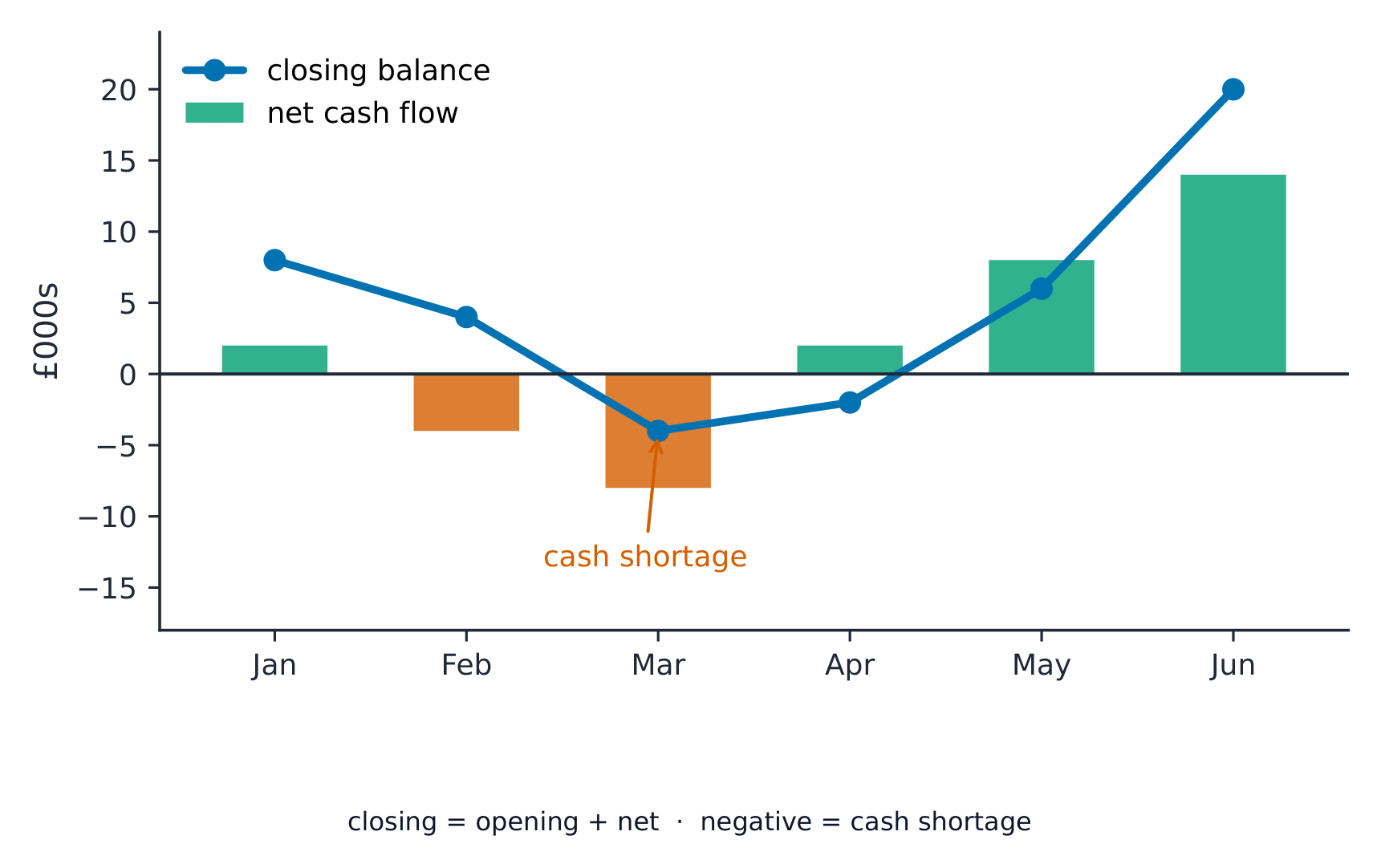
Cash-flow forecast A cash-flow forecast 现金流量预测 predicts the cash coming in and going out each month. It helps a firm spot a shortage early.
- cash inflows 现金流入 — money coming in, mostly from sales.
- cash outflows 现金流出 — money going out, such as wages and rent.
- net cash flow 净现金流 — inflows minus outflows for the period.
$$\text{net cash flow} = \text{cash inflows} - \text{cash outflows}$$The opening balance 期初余额 is the cash at the start of the month. Adding net cash flow gives the closing balance 期末余额, which becomes next month's opening balance.
A cash-flow forecast tracks the closing balance each month, warning of a shortage early ExploreA cash-flow forecast
A cash-flow forecast tracks money in and out each month — to spot a shortfall before it happens.
Vocabulary TrainEnglish cash-flow forecast/kæʃ fləʊ ˈfɔːkæst/ cash inflows/kæʃ ˈɪnfləʊz/ cash outflows/kæʃ aʊtˈfləʊz/ net cash flow/net kæʃ fləʊ/ opening balance/ˈəʊpənɪŋ ˈbæləns/ closing balance/ˈkləʊzɪŋ ˈbæləns/ 5.3
Cash-flow problems and how to fix them
Common causes of cash-flow problems are: too many sales on credit, holding too much stock, buying too many assets at once, and overtrading 过度交易 (growing too fast for the cash available).
Ways to improve cash flow:
- bring cash in sooner — ask customers to pay faster, or offer discounts for quick payment.
- delay cash going out — agree longer trade credit with suppliers.
- arrange an overdraft or short loan to cover a gap.
- hold less stock to free up cash.
Good working capital management keeps enough cash to stay safe without holding so much that money sits idle.
ExploreCash-flow forecast lab
Drag the monthly cash in, cash out and the one-off purchase — find the month that closes in the red, then fix it before it happens.
Vocabulary TrainEnglish overtrading/ˌəʊvəˈtreɪdɪŋ/ 5.4
Costs and how we classify them

Syllabus
- classify costs (fixed, variable, direct, indirect, marginal, average) and use cost information for decision-making
- construct and interpret break-even analysis (break-even point, margin of safety, contribution) and explain its limitations
Source: Cambridge International syllabus
Break-even analysis, built line by line A cost 成本 is money the business spends to make its product. We sort costs in several ways:
- fixed costs 固定成本 — costs that do not change with output, such as rent.
- variable costs 可变成本 — costs that rise and fall with output, such as raw materials.
- direct costs 直接成本 — costs clearly linked to one product, such as its materials.
- indirect costs 间接成本 (overheads) — costs not linked to one product, such as manager salaries.
- marginal cost 边际成本 — the cost of making one more unit.
- average cost 平均成本 — the cost per unit, found by total cost ÷ number of units.
Total cost = fixed cost + variable cost; only variable cost rises with output Cost information helps managers set prices, choose what to make, and control spending.
ExploreCosts
y = ax + b
Total cost = fixed cost (intercept) + variable cost per unit (gradient).
Vocabulary TrainEnglish cost/kɒst/ fixed costs/fɪkst kɒsts/ variable costs/ˈveərɪəbl kɒsts/ direct costs/daɪˈrekt kɒsts/ indirect costs/ɪndaɪˈrekt kɒsts/ marginal cost/ˈmɑːdʒɪnl kɒst/ average cost/ˈævrɪdʒ kɒst/ 5.4
Break-even analysis

Contribution 贡献 is how much each sale adds towards paying the fixed costs:
$$\text{contribution per unit} = \text{selling price} - \text{variable cost per unit}$$Break-even 盈亏平衡 is the point where total revenue equals total costs, so profit is zero. The break-even point 盈亏平衡点 in units is:
$$\text{break-even point} = \frac{\text{fixed costs}}{\text{contribution per unit}}$$The break-even point is where total revenue equals total cost — left of it is loss, right of it is profit The margin of safety 安全边际 is how far current sales are above the break-even point:
$$\text{margin of safety} = \text{actual output} - \text{break-even output}$$Worked example. A product sells for £20 with a variable cost of £12 per unit. Fixed costs are £40,000, and the firm makes 6,000 units. Find the contribution per unit, the break-even output and the margin of safety.
$$\text{contribution per unit} = \text{\pounds} 20 - \text{\pounds} 12 = \text{\pounds} 8$$$$\text{break-even point} = \frac{\text{\pounds} 40\,000}{\text{\pounds} 8} = 5\,000 \text{ units}$$$$\text{margin of safety} = 6\,000 - 5\,000 = 1\,000 \text{ units}$$A large margin of safety means sales can fall a lot before the firm makes a loss. Break-even analysis is quick and useful, but it has limitations 局限性: it assumes the selling price and costs stay the same, and that everything made is sold.
ExploreBreak-even chart
Add a revenue line to the fixed-cost and total-cost lines. Where revenue meets total cost is the break-even point; beyond it the firm makes a profit.
ExploreBreak-even analysis
Break-even is where total revenue crosses total cost.
Vocabulary TrainEnglish contribution/ˌkɒntrɪˈbjuːʃn/ break-even/breɪk ˈiːvən/ break-even point/breɪk ˈiːvən pɔɪnt/ margin of safety/ˈmɑːdʒɪn ɒv ˈseɪfti/ limitations/ˌlɪmɪˈteɪʃnz/ 5.5
Budgets and variances

Syllabus
- explain the purpose of budgets and types of budget (incremental, zero-based)
- calculate and interpret variances (favourable and adverse) using variance analysis
Source: Cambridge International syllabus
A budget 预算 is a financial plan for the future — a target for income or spending. Budgets help a firm plan, control money, and check performance. Two types are:
- incremental budget 增量预算 — last year's budget changed by a small amount.
- zero-based budget 零基预算 — every cost must be explained from zero each year.
A variance 差异 is the difference between the budgeted figure and the actual figure:
$$\text{variance} = \text{actual figure} - \text{budgeted figure}$$A variance is actual minus budget; favourable helps profit, adverse hurts it Worked example. A firm budgeted £30,000 for wages but actually spent £34,000. Find the variance and say whether it is favourable or adverse.
$$\text{variance} = \text{\pounds} 34\,000 - \text{\pounds} 30\,000 = \text{\pounds} 4\,000$$Costs came in higher than planned, so this is an adverse variance.
- a favourable variance 有利差异 is better for profit (costs lower, or revenue higher, than planned).
- an adverse variance 不利差异 is worse for profit (costs higher, or revenue lower, than planned).
Studying variances shows managers where the plan went wrong, so they can act.
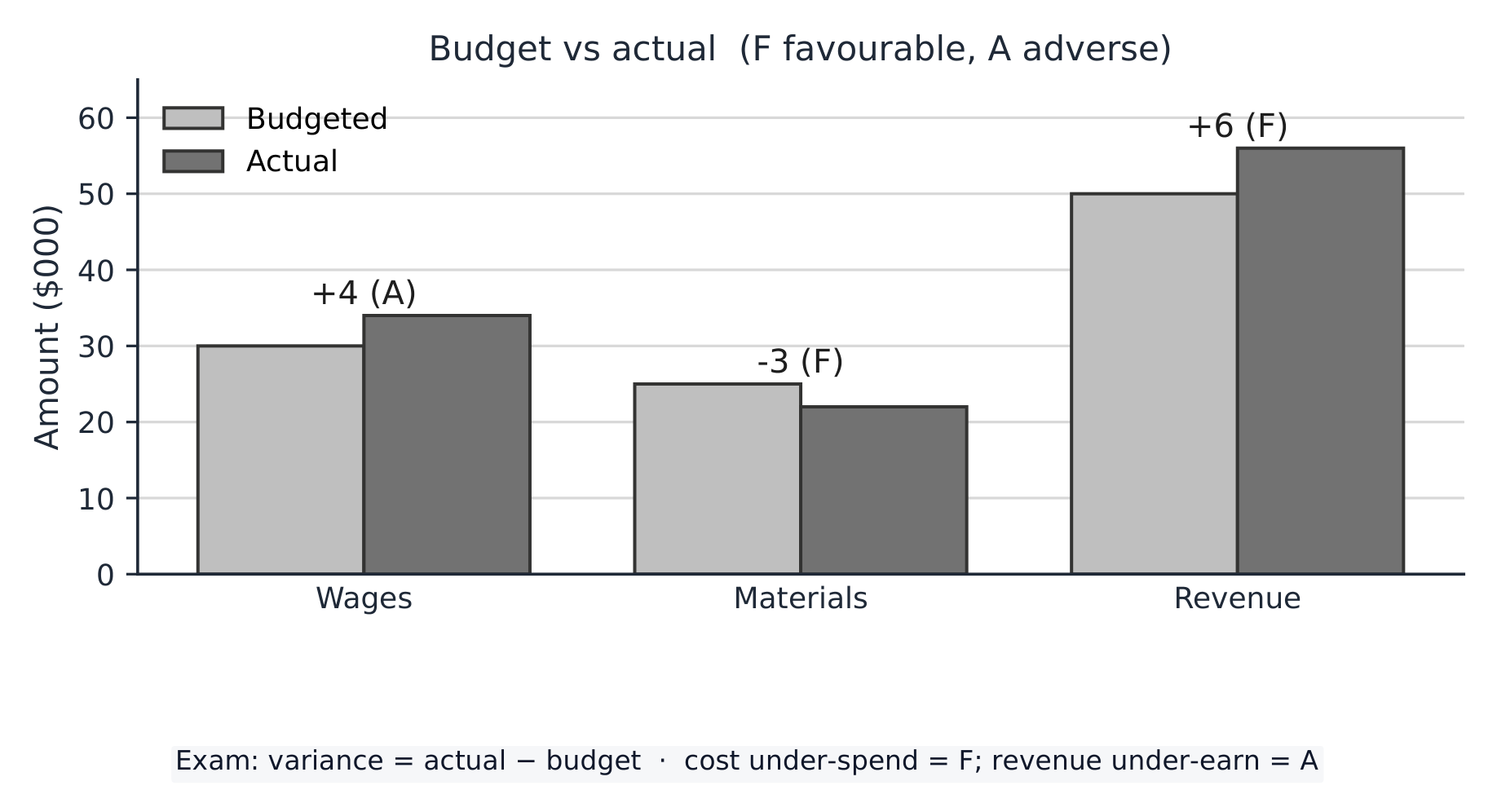
Variance = actual − budget: cost overspend is adverse; revenue over-earn is favourable ExploreBudget control cycle
Follow how a budget becomes a control system, not just a number.
Vocabulary TrainEnglish budget/ˈbʌdʒɪt/ incremental budget/ˌɪŋkrɪˈmentl ˈbʌdʒɪt/ zero-based budget/ˈzɪərəʊ beɪst ˈbʌdʒɪt/ variance/ˈveərɪəns/ favourable variance/ˈfeɪvərəbl ˈveərɪəns/ adverse variance/ædˈvɜːs ˈveərɪəns/ 5.5
Exam tips
- Show that cash is not profit — a profitable firm can still fail from a cash-flow shortage.
- For break-even: contribution per unit $=$ price $-$ variable cost; break-even $=$ fixed costs $\div$ contribution; margin of safety $=$ actual $-$ break-even output.
- Match a source of finance to the need (short-term for cash flow, long-term or equity for assets) and to the type of business.
- Calculate a variance and label it favourable or adverse (actual against budget).
Vocabulary card meanings
premises: The buildings and land a firm uses. fixed assets: Long-lasting items a firm owns, such as buildings and machines. internal sources: Finance that comes from inside the firm, such as retained profit. external sources: Finance that comes from outside the firm, such as a bank or new shareholders. short-term: Covering a brief period, often under a year. long-term: Covering several years rather than a few months. sale of assets: Raising money by selling something the firm owns. share capital: Money raised by selling shares in the company. loan: Money borrowed that must be repaid, usually with interest. debenture: A long-term loan certificate issued by a company. leasing: Paying to use an asset that another firm still owns. hire purchase: Paying for an asset in instalments and owning it only after the last payment. venture capital: Money from investors who take a share in a risky young firm. crowdfunding: Raising small sums from many people, usually online. collateral: An asset a borrower offers so the lender can sell it if the loan is not repaid. closing balance: The amount of cash left at the end of a period. overtrading: Growing sales faster than the firm can finance, so it runs short of cash. indirect costs: Costs that are not tied to one unit of output, such as rent. favourable variance: A difference from the budget that improves profit. adverse variance: A difference from the budget that reduces profit.
-
6
Business and its environment (A Level)
Watch lesson6.1
External influences on business

Syllabus
- explain the impact of economic factors (business cycle, interest rates, exchange rates, inflation, taxation, unemployment) on business
- explain the impact of political, legal, social, technological, environmental and ethical influences on business
Source: Cambridge International syllabus
A business cannot control everything. External influences 外部影响 are forces outside the firm that affect how it works. The firm must watch them and adapt. We group them into economic factors and wider (political, legal, social and other) factors.
Stacked shipping containers: globalisation lets firms trade and produce worldwide. ExploreExternal influences lab
Classify outside changes by the channel that hits the business.
Vocabulary TrainEnglish external influences/ekˈstɜːnl ˈɪnfluːənsɪz/ 6.1
The business cycle

The business cycle 经济周期 is the way the whole economy rises and falls over time. It has four stages:
- boom 繁荣 — fast growth; high demand, but rising costs and prices.
- recession 衰退 — falling demand and output; sales drop and some firms close.
- slump 萧条 — a deep, long recession with very low demand.
- recovery 复苏 — demand and output start to rise again.
The business cycle moves through boom, recession, slump and recovery around the long-term trend In a boom, firms expand; in a recession, they cut costs, hold less stock, and may aim only to survive.
Vocabulary TrainEnglish business cycle/ˈbɪznəs ˈsaɪkl/ boom/buːm/ recession/rɪˈseʃn/ slump/slʌmp/ recovery/rɪˈkʌvəri/ 6.1
Interest rates

The interest rate 利率 is the price of borrowing money, set as a percentage. When interest rates rise:
Higher interest rates raise borrowing costs and cut spending - loans and mortgages cost more, so customers spend less.
- firms with loans pay more, which lowers their profit.
- new investment is less likely, because borrowing is dear.
When interest rates fall, the opposite happens and spending usually rises.
Vocabulary TrainEnglish interest rate/ˈɪntrest reɪt/ 6.1
Exchange rates

The exchange rate 汇率 is the price of one currency in terms of another. It changes all the time.
- if the local currency rises in value (appreciation 升值), exports become dearer abroad and imports become cheaper.
- if the local currency falls in value (depreciation 贬值), exports become cheaper abroad and imports become dearer.
So an exporter 出口商 often gains from a weaker currency, while an importer 进口商 often gains from a stronger one.
A stronger currency makes exports dearer and imports cheaper; a weaker one does the opposite — so the same change helps one side and hurts the other Vocabulary TrainEnglish exchange rate/eksˈtʃeɪndʒ reɪt/ appreciation/əˌpriːʃɪˈeɪʃn/ depreciation/dɪˌpriːʃɪˈeɪʃn/ exporter/ekˈspɔːtə/ importer/ɪmˈpɔːtə/ 6.1
Inflation

Inflation 通货膨胀 is a general rise in prices over time. High inflation raises a firm's costs (materials and wages), makes planning harder, and can cut what customers can afford to buy. Low, steady inflation is usually best for business.
Inflation is a sustained rise in prices over time Vocabulary TrainEnglish inflation/ɪnˈfleɪʃn/ 6.1
Taxation and unemployment
Taxation 税收 is money the government takes from people and firms.
- a direct tax 直接税 is taken from income or profit (e.g. income tax, corporation tax).
- an indirect tax 间接税 is added to spending (e.g. sales tax on goods).
Higher taxes leave people and firms with less money to spend, so demand falls.
Unemployment 失业 is the number of people who want work but cannot find it. High unemployment lowers demand, but it also makes workers easier and cheaper to hire.
Worked example. A house-builder has £8m of variable-rate loans. The central bank raises interest rates from 2% to 5%. Explain the effect on this business. Answer on both sides. On costs: annual interest rises from 8m × 0.02 = £160,000 to 8m × 0.05 = £400,000, so £240,000 comes straight off profit. On demand: mortgages become dearer, so fewer buyers can afford a house - and because houses are bought on credit and are a postponable purchase, demand falls sharply. Both effects strike this firm at once, which is why a highly geared house-builder is unusually sensitive to interest rates. Always give the cost of borrowing and the demand effect, and tie the size of the demand effect to whether the product is bought on credit - the same rate rise barely touches a firm selling cheap everyday goods with no debt.
Vocabulary TrainEnglish taxation/tækˈseɪʃn/ direct tax/daɪˈrekt tæks/ indirect tax/ɪndaɪˈrekt tæks/ unemployment/ʌnemˈplɔɪmənt/ 6.1
Political, legal and social influences

A multinational's outlets look the same worldwide — a global brand operating across many legal and social settings. - political 政治 — government decisions, trade rules and stability affect how firms plan.
- legal 法律 — firms must obey legislation 法规 on employment, consumer safety, competition and the environment. Breaking the law brings fines and bad publicity.
- social 社会 — changes in society, such as ageing populations or new tastes, change what people buy.
Vocabulary TrainEnglish political/pəˈlɪtɪkl/ legal/ˈliːɡl/ legislation/ˌledʒɪˈsleɪʃn/ social/ˈsəʊʃl/ 6.1
Technological, environmental and ethical influences

- technological 技术 — new technology can create new products and cut costs, but firms must keep up or fall behind.
- environmental 环境 — firms face pressure and rules to cut pollution and waste, and to act in a sustainable way.
- ethical 道德 — acting in a morally right way (fair pay, honest selling) builds trust, even if it costs more.
Together these wider factors are often studied with a PESTLE analysis 宏观环境分析, which checks Political, Economic, Social, Technological, Legal and Environmental forces.
PESTLE groups the six wider external forces that act on a business Vocabulary TrainEnglish technological/ˌteknəˈlɒdʒɪkl/ environmental/enˌvaɪrənˈmentl/ ethical/ˈeθɪkl/ PESTLE analysis/ˈpesl əˈnæləsɪs/ 6.2
What strategy means
Syllabus
- explain the meaning of strategy and strategic management
- use strategic analysis tools (SWOT analysis, and other planning tools) to inform business decisions
Source: Cambridge International syllabus
A strategy 战略 is a long-term plan to reach the firm's main objectives. Strategic management 战略管理 is the work of setting that plan, putting it into action, and checking it. Good strategy aims to build a competitive advantage 竞争优势 — a reason customers choose you over rivals, such as lower cost or a better product.
ExploreSWOT strategy lab
Sort strategy evidence into internal and external factors.
Vocabulary TrainEnglish strategy/ˈstrætədʒi/ strategic management/strəˈtiːdʒɪk ˈmænɪdʒmənt/ competitive advantage/kəmˈpetɪtɪv ədˈvæntɪdʒ/ 6.2
SWOT analysis

A SWOT analysis SWOT分析 studies a firm's position under four headings:
Internal (inside the firm) External (outside the firm) strengths 优势 — what it does well opportunities 机会 — chances to grow weaknesses 劣势 — what it does poorly threats 威胁 — dangers it faces SWOT analysis: internal strengths and weaknesses, external opportunities and threats A firm should use its strengths to take opportunities, and fix or protect against its weaknesses and threats.
Vocabulary TrainEnglish SWOT analysis/swɒt əˈnæləsɪs/ strengths/streŋθs/ opportunities/ɒpəˈtjuːnɪtiz/ weaknesses/ˈwiːknəsɪz/ threats/θrets/ 6.2
Other planning tools
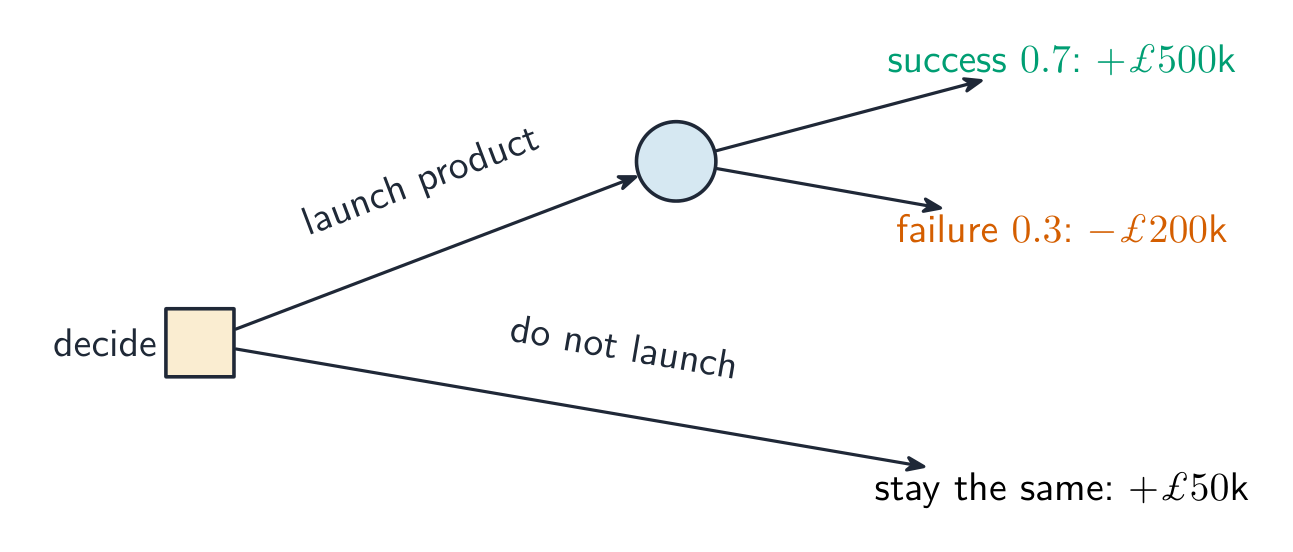
Firms use other tools to make decisions, such as decision trees (weighing choices by their likely results) and the matrices you meet later in marketing and operations. Every planning tool turns information about the business and its environment into a clearer choice.
A decision tree weighs each choice by the probability and payoff of its outcomes ExploreDecision tree & EMV lab
Drag the probability and payoffs — the tree rolls back to an expected value for each option, and the losing branch gets the exam cut marks.
6.2
Exam tips
- Explain how a change in interest rates, the exchange rate or inflation affects a firm on both the cost and the demand side.
- A stronger exchange rate makes exports dearer and imports cheaper (SPICED / WPIDEC).
- Use SWOT correctly: strengths and weaknesses are internal, opportunities and threats are external.
- Support a strategy with a PEST/PESTLE scan of the external environment.
Vocabulary card meanings
external influences: Forces outside the firm, such as law, the economy and technology. exporter: A firm that sells goods or services to other countries. importer: A firm that buys goods or services from other countries. legislation: Laws that a firm must obey. PESTLE analysis: A scan of political, economic, social, technological, legal and environmental forces. competitive advantage: Something a firm does better than rivals, which buyers value.
-
7
Human resource management (A Level)
Watch lesson7.1
Organisational structure
Syllabus
- explain organisational structures (hierarchy, chain of command, span of control, centralisation, decentralisation, delayering, matrix structures)
- explain delegation, accountability and the impact of structure on business performance
Source: Cambridge International syllabus
An organisational structure 组织结构 shows how a business arranges its people: who reports to whom, and who does what. A good structure makes roles clear and helps the firm meet its objectives. It is often drawn as an organisation chart.
ExploreChoose the ownership form
Compare ownership, control and liability in real business types.
Vocabulary TrainEnglish organisational structure/ˌɔːɡənaɪˈzeɪʃənl ˈstrʌktʃə/ 7.1
Key terms in structure

- a hierarchy 层级 is the set of levels in a firm, from the top managers down to the shop-floor workers. A "tall" structure has many levels; a "flat" structure has few.
- the chain of command 指挥链 is the line along which orders pass down, from the top to the bottom.
- the span of control 管理幅度 is the number of staff one manager is directly in charge of. A wide span means many staff per manager; a narrow span means few.
An organisation chart shows the chain of command and each manager's span of control A tall structure has narrow spans and a long chain of command, so messages travel slowly. A flat structure has wide spans, so managers must trust staff more.

Tall structures have many levels and narrow spans; flat structures have few levels and wide spans Vocabulary TrainEnglish hierarchy/ˈhaɪərɑːki/ chain of command/tʃeɪn ɒv kəˈmænd/ span of control/spæn ɒv kənˈtrəʊl/ 7.1
Centralisation and decentralisation

- centralisation 集权 — most decisions are made at the top. This gives strong control and quick, consistent decisions, but ignores local knowledge.
- decentralisation 分权 — decisions are shared out to lower levels and local branches. This speeds up decisions and motivates staff, but control is weaker.
Centralised: the top decides. Decentralised: branches decide Most firms sit somewhere between the two.
Vocabulary TrainEnglish centralisation/ˌsentrəlaɪˈzeɪʃn/ decentralisation/dɪˌsentrəlaɪˈzeɪʃn/ 7.1
Delayering and matrix structures

Delayering 精简层级 means removing one or more levels of management. It cuts cost and shortens the chain of command, but it gives the remaining managers more to do.
A matrix structure 矩阵结构 groups staff by both their department and the project they work on, so a worker may report to two managers. It is good for teamwork across departments, but the two-boss system can cause confusion.
In a matrix structure a worker reports to two managers — a function manager and a project manager ExploreBusiness case lab
Classify real decisions so the main business concept becomes concrete.
Vocabulary TrainEnglish delayering/dɪˈleɪərɪŋ/ matrix structure/ˈmeɪtrɪks ˈstrʌktʃə/ 7.1
Delegation and accountability

Delegation 授权 means a manager gives a task, and the power to do it, to a more junior worker. It frees the manager's time, develops staff, and motivates them.
Delegation passes the task and authority down; accountability stays up But a manager who delegates is still accountable — the accountability 问责 for the result stays with them. So managers must delegate to people they trust, and still check the outcome.
Worked example. A firm has 5 levels of hierarchy and a span of control of 4. It delayers to a span of 8. What changes, and what is the risk? A wider span means each manager handles more subordinates, so fewer managers are needed at each level and the structure becomes flatter and wider. Communication improves, because a message now passes through fewer levels, and the wage bill falls. The risks are real too: each manager now supervises 8 people instead of 4, so there is less time per subordinate and weaker control; workloads rise; and the staff who remain lose promotion rungs, which can demotivate. Link the span of control to the number of levels - for the same workforce, a wider span always gives a flatter structure - and present the trade-off as speed and cost against control and supervision.
Vocabulary TrainEnglish delegation/ˌdelɪˈɡeɪʃn/ accountability/əˌkaʊntəˈbɪlɪti/ 7.2
Business communication

Syllabus
- explain the process, methods and importance of effective communication
- explain barriers to communication and how to improve communication in a business
Source: Cambridge International syllabus
Communication 沟通 is the passing of a message from one person to another. Effective communication follows a clear path:
- a sender 发送者 has a message.
- the message is sent through a medium 媒介 (e.g. a meeting, email or notice).
- a receiver 接收者 takes in the message.
- feedback 反馈 shows the message was understood.
The message flows from sender to receiver, and feedback confirms it was understood Good communication raises motivation, cuts mistakes, and speeds up decisions. Methods can be verbal (spoken), written, or visual; the best method depends on the message, the cost, and the need for a record.
ExploreCommunication route lab
Watch a message move from sender to feedback and see where noise can enter.
Vocabulary TrainEnglish communication/kəˌmjuːnɪˈkeɪʃn/ sender/ˈsendə/ medium/ˈmiːdɪəm/ receiver/rɪˈsiːvə/ feedback/ˈfiːdbæk/ 7.2
Barriers to communication
A barrier 障碍 is anything that stops a message getting through clearly. Common barriers are:
- a message that is too long or unclear.
- a poor medium (e.g. a noisy phone line).
- too many levels in the hierarchy, so the message is changed on the way.
- language or cultural differences, and lack of trust.
To improve communication, a firm can shorten the chain of command, choose the right medium, keep messages short and clear, and always ask for feedback.
Vocabulary TrainEnglish barrier/ˈbærɪə/ 7.3
Leadership styles

Syllabus
- explain leadership styles (autocratic, democratic, paternalistic, laissez-faire) and theories of leadership
- explain emotional intelligence and the importance of effective leadership in managing change
Source: Cambridge International syllabus
Leaders set direction and motivate people, which shapes the whole organisation. A leadership style 领导风格 is the way a leader 领导 makes decisions and treats staff. Four styles are:
Style How decisions are made autocratic 专制型 the leader decides alone and tells staff what to do democratic 民主型 the leader asks staff for ideas before deciding paternalistic 家长式 the leader decides, but in what they see as the staff's best interests laissez-faire 放任型 the leader gives staff freedom to decide for themselves 
The styles form a continuum: autocratic keeps all control with the leader, while laissez-faire gives staff the most freedom No style is always best. The right one depends on the task, the staff, and the time available — an urgent crisis may need an autocratic style, while skilled staff may work best under a democratic or laissez-faire one.
ExploreLeadership style lab
Pick the management style that fits each situation.
Vocabulary TrainEnglish leadership style/ˈliːdəʃɪp staɪl/ leader/ˈliːdə/ autocratic/ˌɔːtəʊˈkrætɪk/ democratic/ˌdeməˈkrætɪk/ paternalistic/pəˌtɜːnəˈlɪstɪk/ laissez-faire/ˈleɪsez feə/ 7.3
Emotional intelligence and leading change
Emotional intelligence 情商 is a leader's skill in understanding their own and other people's feelings, and managing them well. Leaders with high emotional intelligence build trust and handle conflict better.
This matters most when leading change. People often resist change because they fear losing their job or status. A good leader explains why the change is needed, involves staff, and supports them through it.
Vocabulary TrainEnglish emotional intelligence/ɪˈməʊʃənl ɪnˈtelɪdʒəns/ 7.4
Hard and soft HRM
Syllabus
- explain hard and soft HRM and the use of workforce planning
- explain the management of change, employer-employee relations and the role of trade unions
Source: Cambridge International syllabus
There are two broad approaches to human resource management 人力资源管理 (HRM):
- hard HRM 硬性人力资源管理 treats staff as a resource like any other — to be used at the lowest cost. It uses tight control and short-term contracts.
- soft HRM 软性人力资源管理 treats staff as the firm's most valuable asset — to be developed and motivated. It uses training, involvement and long-term careers.
Both link to workforce planning 人力规划: working out the staff the firm will need, and how to get them.
ExploreHuman resources decision lab
Classify HR actions by the job they do inside the workforce.
Vocabulary TrainEnglish human resource management/ˈhjuːmən rɪˈzɔːs ˈmænɪdʒmənt/ hard HRM/hɑːd ˌeɪtʃ ɑː ˈem/ soft HRM/sɒft ˌeɪtʃ ɑː ˈem/ workforce planning/ˈwɜːkfɔːs ˈplænɪŋ/ 7.4
Employer-employee relations and trade unions
The management of change 变革管理 works best when employer-employee relations 劳资关系 (the link between bosses and workers) are good.
A trade union 工会 is an organised group of workers that speaks for its members. Through collective bargaining 集体谈判, the union and the employer negotiate pay and conditions for the whole group, instead of one worker at a time. If talks fail, workers may take industrial action 劳工行动, such as a strike 罢工 (stopping work). Good relations and fair negotiation avoid this and keep the business running.
Vocabulary TrainEnglish management of change/ˈmænɪdʒmənt ɒv tʃeɪndʒ/ employer-employee relations/emˈplɔɪə emˈplɔɪiː rɪˈleɪʃnz/ trade union/treɪd ˈjuːnɪən/ collective bargaining/kəˈlektɪv ˈbɑːɡɪnɪŋ/ industrial action/ɪnˈdʌstrɪəl ˈækʃn/ strike/straɪk/ 7.4
Exam tips
- Read an organisation chart: span of control, chain of command and levels of hierarchy.
- Compare tall vs flat structures and centralisation vs decentralisation (tight control vs local responsiveness).
- Distinguish hard vs soft HRM (workers as a cost versus as an asset).
- Explain how trade unions and good communication shape employer-employee relations.
Vocabulary card meanings
sender: The person who starts a message. receiver: The person a message is aimed at. barrier: Something that stops a message or a plan from getting through. employer-employee relations: How managers and staff deal with each other at work. strike: A refusal by staff to work, used as pressure in a dispute.
-
8
Marketing (A Level)
Watch lesson8.1
Marketing analysis

Syllabus
- use quantitative marketing analysis: sales forecasting, time-series analysis (moving averages, trend, seasonal variation), correlation
- explain elasticity (price, income, cross) and its use in marketing decisions
Source: Cambridge International syllabus
A supermarket: retailers use data to compete on price, range and customer experience. Marketing analysis 营销分析 means using data to understand the market and to make better marketing decisions. At A Level you study some numbers tools: sales forecasting, time-series analysis, correlation, and elasticity.
Vocabulary TrainEnglish marketing analysis/ˈmɑːkɪtɪŋ əˈnæləsɪs/ 8.1
Sales forecasting and time-series analysis

Sales forecasting 销售预测 is predicting future sales from past data and market knowledge. Good forecasts help a firm plan production, staff, stock and cash.
Time-series analysis 时间序列分析 studies past sales recorded over time to find a pattern. It has two main parts:
- the trend 趋势 — the general direction of sales over the long run (up, down or flat).
- the seasonal variation 季节性波动 — the regular rise and fall within a year (e.g. ice cream sells more in summer).
To find the trend, firms use a moving average 移动平均, which smooths the ups and downs by averaging several periods in a row. The seasonal variation is then how far the actual figure sits above or below the trend:
$$\text{seasonal variation} = \text{actual value} - \text{trend value}$$Actual sales wobble seasonally around a smooth underlying trend A forecast extends the trend into the future (called extrapolation 外推) and then adds the usual seasonal variation. This works only if past patterns continue, so forecasts are never certain.
ExploreSales forecast lab
sales = trend + seasonal effect
Move along a sales trend and see how forecast and actual can separate.
Vocabulary TrainEnglish sales forecasting/seɪlz ˈfɔːkæstɪŋ/ time-series analysis/taɪm ˈsɪəriːz əˈnæləsɪs/ trend/trɛnd/ seasonal variation/ˈsiːzənl ˌveərɪˈeɪʃn/ moving average/ˈmuːvɪŋ ˈævrɪdʒ/ extrapolation/ekˈstræpəleɪʃn/ 8.1
Correlation
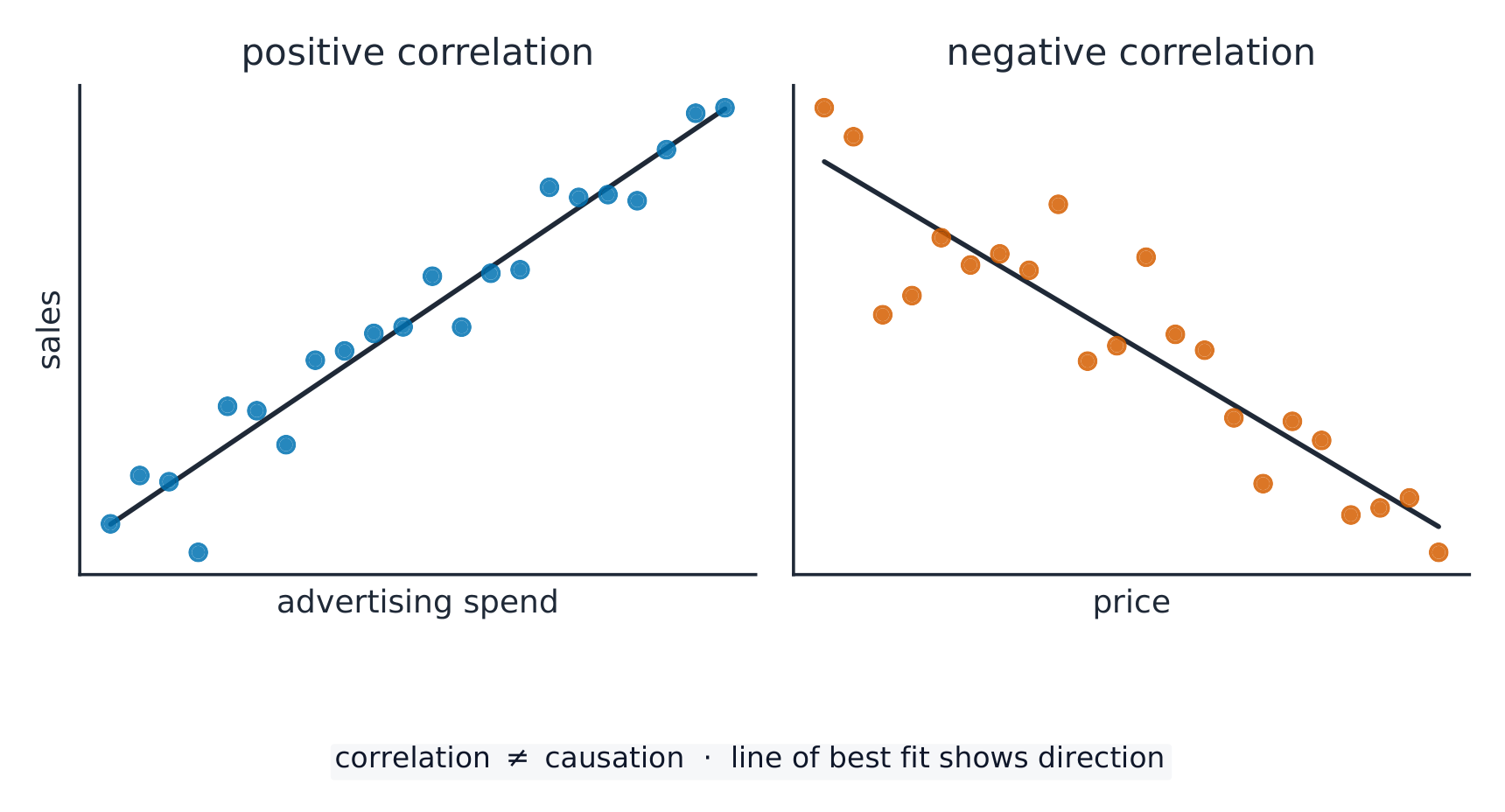
Correlation 相关性 measures how strongly two things move together — for example, advertising spending and sales.
- positive correlation 正相关 — when one rises, the other rises too.
- negative correlation 负相关 — when one rises, the other falls.
Positive correlation (both rise together) and negative correlation (one rises as the other falls) Strong correlation helps a firm predict, but it does not prove that one thing causes the other. Other factors may be at work.
ExploreCorrelation and the line of best fit
Change the strength of the relationship. A line of best fit lets a business spot a trend and forecast from it.
Vocabulary TrainEnglish correlation/ˌkɒrɪˈleɪʃn/ positive correlation/ˈpɒzɪtɪv ˌkɒrɪˈleɪʃn/ negative correlation/ˈneɡətɪv ˌkɒrɪˈleɪʃn/ 8.1
Using elasticity in marketing decisions

Elasticity 弹性 measures how much demand reacts to a change. Three types guide marketing decisions.
Elastic demand is flat; inelastic demand is steep - price elasticity of demand 需求价格弹性 (PED) — for a price elastic 富有弹性 product, cutting the price raises total revenue; for a price inelastic 缺乏弹性 product, raising the price raises total revenue.
- income elasticity of demand 需求收入弹性 (YED) — tells a firm how sales will change as incomes rise or fall, which helps plan for booms and recessions.
- cross elasticity of demand 需求交叉弹性 (XED) — tells a firm how a rival's price change, or the price of a partner product, will affect its own sales.
So elasticity helps a firm set prices, choose products, and predict the effect of a competitor's move.
Worked example. Quarterly sales run Q1 100, Q2 140, Q3 180, Q4 120, then next Q1 108. Find the four-quarter moving-average trend centred on Q3, and the seasonal variation for Q3. Average the first four quarters: $(100 + 140 + 180 + 120) \div 4 = 135$. Average the next four: $(140 + 180 + 120 + 108) \div 4 = 137$. A four-period average falls between quarters, so centre the two: $(135 + 137) \div 2 = 136$, the trend at Q3. The seasonal variation is actual minus trend: $180 - 136 =$ +44, so Q3 runs about 44 units above trend, and next year's Q3 forecast is the projected trend plus 44. The centring step is the one most answers drop: with an even number of periods the average lands between two quarters and must be centred before it can be compared with an actual figure.
Vocabulary TrainEnglish elasticity/ɪlæˈstɪsɪti/ price elasticity of demand/praɪs ɪlæˈstɪsɪti ɒv dɪˈmænd/ price elastic/praɪs ɪˈlæstɪk/ price inelastic/praɪs ɪnɪˈlæstɪk/ income elasticity of demand/ˈɪŋkʌm ɪlæˈstɪsɪti ɒv dɪˈmænd/ cross elasticity of demand/krɒs ɪlæˈstɪsɪti ɒv dɪˈmænd/ 8.2
Marketing planning and strategy

Syllabus
- explain marketing planning and marketing strategy (Ansoff's matrix, product portfolio analysis)
- explain how marketing strategy is adapted for entering international markets
Source: Cambridge International syllabus
Digital advertising screens — marketing increasingly happens online and on screens. A marketing strategy 营销战略 is the long-term plan for how marketing will meet the firm's objectives. Marketing planning 营销规划 is the work of setting that plan: studying the market, choosing target customers, and deciding the marketing mix. Two tools shape strategy: Ansoff's matrix and product portfolio analysis.
ExploreAnsoff strategy lab
Sort growth choices by product and market risk.
Vocabulary TrainEnglish marketing strategy/ˈmɑːkɪtɪŋ ˈstrætədʒi/ marketing planning/ˈmɑːkɪtɪŋ ˈplænɪŋ/ 8.2
Ansoff's matrix

Ansoff's matrix: four growth strategies, with risk rising to the bottom-right (diversification). Ansoff's matrix 安索夫矩阵 shows four ways to grow, by mixing existing or new products with existing or new markets. The risk rises as you move away from what you know.
Existing products New products Existing markets market penetration 市场渗透 (sell more to current buyers) product development 产品开发 (new products for current buyers) New markets market development 市场开发 (current products to new buyers) diversification 多元化 (new products and new markets) Market penetration is the safest; diversification is the riskiest because both the product and the market are new.
Vocabulary TrainEnglish Ansoff's matrix/ˈænsɒfs ˈmeɪtrɪks/ market penetration/ˈmɑːkɪt ˌpenɪˈtreɪʃn/ product development/ˈprɒdʌkt dɪˈveləpmənt/ market development/ˈmɑːkɪt dɪˈveləpmənt/ diversification/daɪˌvɜːsɪfɪˈkeɪʃn/ 8.2
Product portfolio analysis
Product portfolio analysis 产品组合分析 looks at the firm's whole range of products together, using a tool like the Boston Matrix. It checks the balance: a firm needs some steady earners to fund its risky new products. The aim is a healthy mix, so the firm is not left with only ageing products.
ExploreBalance the product portfolio
Drag each product's share and growth — a healthy portfolio keeps a cash cow funding the stars and question marks that will replace it.
Vocabulary TrainEnglish product portfolio analysis/ˈprɒdʌkt pɔːtˈfəʊlɪəʊ əˈnæləsɪs/ 8.2
Entering international markets

To grow, many firms sell abroad. Globalisation 全球化 (the world becoming more connected) has made this easier. A firm can enter a new country by exporting 出口, by setting up a joint venture 合资企业 with a local partner, or by opening its own branch there.
The entry modes trade off commitment against control: exporting risks least, an own branch gives the most control but costs and risks the most But a strategy that works at home may need changes. Localisation 本地化 means adapting the marketing mix to the new market — for example, changing the product, the language, the price, or the way it is sold to suit local tastes, laws and incomes.
ExploreInternational market lab
See how access to world markets changes quantity and price pressure.
Vocabulary TrainEnglish globalisation/ˌɡləʊbəlaɪˈzeɪʃn/ exporting/ekˈspɔːtɪŋ/ joint venture/dʒɔɪnt ˈventʃə/ localisation/ˌləʊkəlaɪˈzeɪʃn/ 8.2
Exam tips
- Read time-series data: separate the underlying trend from seasonal variation, and extrapolate with caution.
- Interpret correlation (strength and direction) but never assume it proves causation.
- Use Ansoff's matrix to classify a growth strategy and judge its risk (diversification is riskiest).
- Use elasticity values to justify a pricing or promotion decision numerically.
Vocabulary card meanings
marketing analysis: Using market data to judge products, buyers and rivals. time-series analysis: Studying figures over time to find trend, seasonal and random movements. seasonal variation: A regular rise or fall that repeats at the same time each year. product portfolio analysis: Judging the mix of products a firm sells, often with a share-growth grid.
-
9
Operations management (A Level)
Watch lesson9.1
Location and relocation

Syllabus
- explain the factors influencing the location and relocation of a business (including international location)
- explain the optimum scale of operation and the significance of economies and diseconomies of scale
Source: Cambridge International syllabus
Where a business sits affects its costs, its sales and its staff. Choosing a place is called location 选址; moving to a new place is relocation 迁址.
Factors that influence the choice fall into two groups:
- quantitative factors 定量因素 — things you can measure in money, such as rent, wages, transport costs and government grants.
- qualitative factors 定性因素 — things that are harder to measure, such as the skills of local workers, nearness to customers or suppliers, and the owner's own wishes.
A firm picks the place where the benefits, money and non-money together, are greatest.
A location decision weighs both the money factors and the harder-to-measure ones, then picks the place with the greatest total benefit ExploreLocation factor lab
Classify why a business chooses one site over another.
Vocabulary TrainEnglish location/ləʊˈkeɪʃn/ relocation/rɪləʊˈkeɪʃn/ quantitative factors/ˈkwɒntɪteɪtɪv ˈfæktəz/ qualitative factors/ˈkwɒlɪteɪtɪv ˈfæktəz/ 9.1
International location
Many firms now locate abroad. Moving production to another country is offshoring 离岸外包. The reasons are often lower wages, nearness to new markets, fewer rules, or government help. The risks are longer supply lines, language and culture differences, and possible damage to the firm's image.
Vocabulary TrainEnglish offshoring/ˈɒfʃərɪŋ/ 9.1
The optimum scale of operation
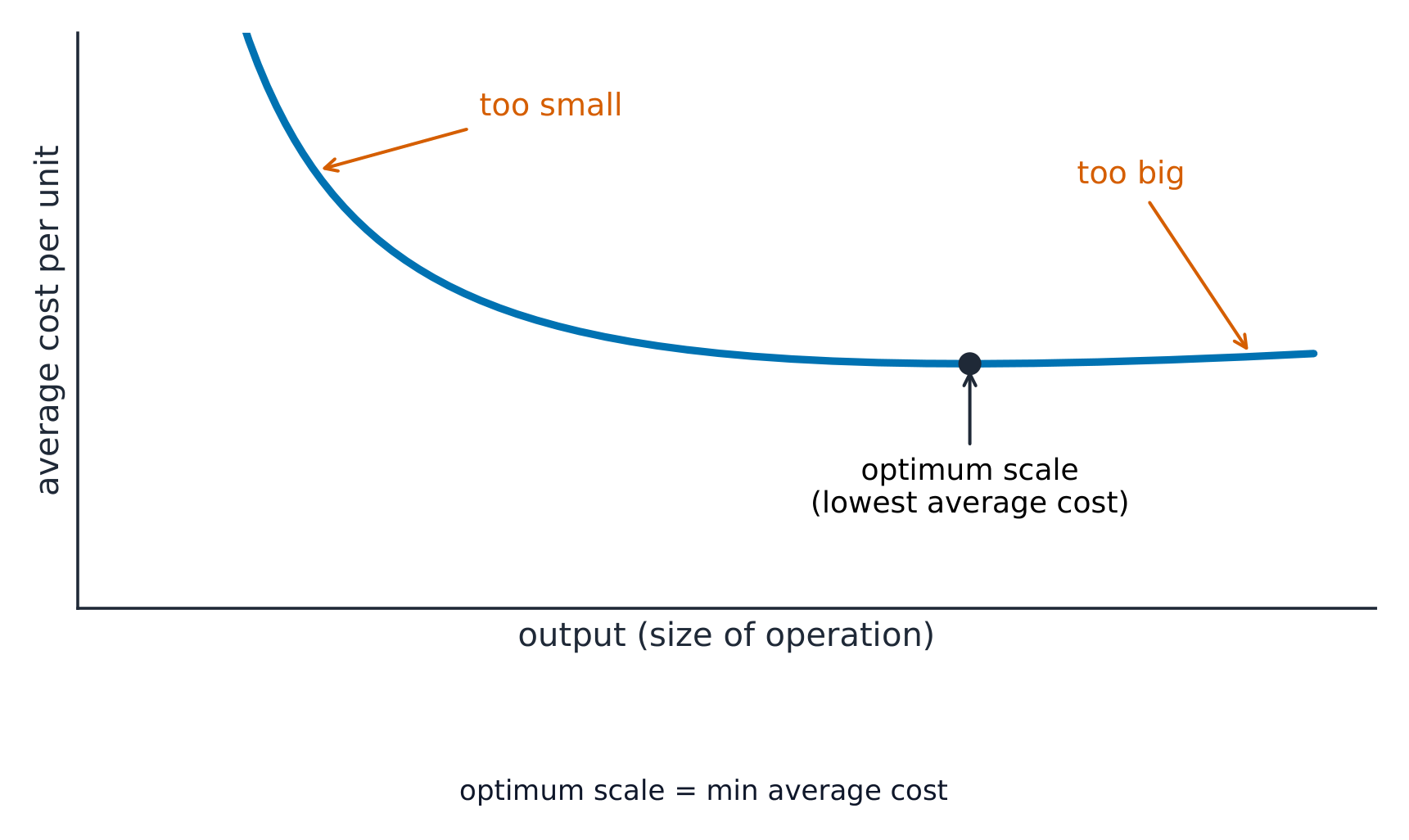
As a firm grows, its average cost first falls (from economies of scale) and later rises (from diseconomies of scale). The optimum scale 最优规模 is the size at which the average cost per unit is at its lowest.
- economies of scale 规模经济 — cost savings from being larger (e.g. bulk buying).
- diseconomies of scale 规模不经济 — rising average cost when a firm grows too big (e.g. poor communication).
A firm should try to grow up to its optimum scale, but not beyond it.
The optimum scale is the output where average cost per unit is lowest Vocabulary TrainEnglish optimum scale/ˈɒptɪməm skeɪl/ economies of scale/ɪˈkɒnəmiz ɒv skeɪl/ diseconomies of scale/ˌdɪsɪˈkɒnəmiz ɒv skeɪl/ 9.2
Why quality matters
Syllabus
- explain the importance of quality and methods of managing quality (quality control, quality assurance, total quality management, benchmarking)
Source: Cambridge International syllabus
Quality 质量 means how well a product meets the customer's needs. Good quality wins repeat custom, lets the firm charge more, protects its brand, and cuts the cost of waste and returns. Poor quality loses customers and damages the firm's name.
ExploreLeadership style lab
Pick the management style that fits each situation.
Vocabulary TrainEnglish quality/ˈkwɒlɪti/ 9.2
Methods of managing quality

Method How it works quality control 质量控制 check finished products and remove the faulty ones at the end quality assurance 质量保证 build quality into every stage, so faults are prevented, not just found total quality management 全面质量管理 (TQM) every worker takes responsibility for quality, aiming for zero faults benchmarking 标杆管理 compare the firm's methods with the best firms, and copy what they do well Quality control finds faults late, after money is already spent. Quality assurance and TQM try to stop faults happening, which is usually cheaper in the long run.
Quality control checks at the end; quality assurance builds quality into every stage Vocabulary TrainEnglish quality control/ˈkwɒlɪti kənˈtrəʊl/ quality assurance/ˈkwɒlɪti əˈʃʊərəns/ total quality management/ˈtəʊtl ˈkwɒlɪti ˈmænɪdʒmənt/ benchmarking/ˈbentʃmɑːkɪŋ/ 9.3
Operations strategy: lean production

Syllabus
- explain operations decisions: lean production, capacity management, and the use of technology
- use critical path analysis (CPA) to plan and manage projects (EST, LFT, total float, critical path, minimum project duration)
Source: Cambridge International syllabus
Factory automation — A-Level operations covers lean production, technology and the supply chain. Lean production 精益生产 means making products with the least possible waste 浪费 — of time, materials, space and effort. Methods like just-in-time and continuous improvement cut waste, lower cost, and raise quality. Less money is tied up in stock, and problems are fixed quickly.
ExploreSWOT strategy lab
Sort strategy evidence into internal and external factors.
Vocabulary TrainEnglish lean production/liːn prəˈdʌkʃn/ waste/weɪst/ 9.3
Capacity management and technology
Capacity management 产能管理 means matching what the firm can produce to the demand it faces. If demand is higher than capacity, the firm may add shifts, hire staff or outsource; if demand is lower, it may cut output or find new orders. New technology 技术, such as automation and data systems, helps a firm produce more, to a higher standard, at a lower cost.
Vocabulary TrainEnglish capacity management/kəˈpæsɪti ˈmænɪdʒmənt/ technology/tekˈnɒlədʒi/ 9.3
Critical path analysis

Critical path analysis 关键路径分析 (CPA) is a tool for planning a project made of many tasks. It draws the tasks as a network of arrows and nodes 节点 (circles), in the order they must happen. For each task it works out timings:
- the earliest start time 最早开始时间 (EST) — the soonest a task can begin, once earlier tasks are done.
- the latest finish time 最晚完成时间 (LFT) — the latest a task can finish without delaying the whole project.
From these comes the total float 总浮动时间 — the spare time a task has before it delays the project:
$$\text{total float} = \text{LFT} - \text{duration} - \text{EST}$$The critical path 关键路径 is the chain of tasks with zero float. These tasks cannot be late, or the whole project is late. Adding up the times along this path gives the minimum project duration 最短项目工期 — the shortest time the project can take.
The critical path is the chain of activities with zero float — they set the project's length CPA helps managers find the tasks that matter most, order resources for the right time, and see where delays would hurt. But it is only as good as the time estimates it is built on.
Worked example. A task has an EST of 6 days, a duration of 4 days, and an LFT of 14 days. Find its total float, and say whether it lies on the critical path. Use the formula: total float = LFT − duration − EST = $14 - 4 - 6 =$ 4 days. So the task could start up to 4 days late, or overrun by 4 days, without delaying the project - and because its float is not zero, it is not on the critical path. Only tasks with zero float are critical. Two points carry the marks: float is the spare time on that task, so using it up makes the task critical; and shortening a non-critical task like this one does not shorten the project at all, because only the critical path sets the minimum project duration.
ExploreCritical path analysis
CPA finds the sequence of tasks that decides the shortest time a project can take.
ExploreFind the critical path
Drag the durations — the network rolls forward and back, the floats update, and the critical path jumps to whichever route is longest.
Vocabulary TrainEnglish critical path analysis/ˈkrɪtɪkl pæθ əˈnæləsɪs/ nodes/nəʊdz/ earliest start time/ˈɜːlɪɪst stɑːt taɪm/ latest finish time/ˈleɪtɪst ˈfɪnɪʃ taɪm/ total float/ˈtəʊtl fləʊt/ critical path/ˈkrɪtɪkl pæθ/ minimum project duration/ˈmɪnɪməm ˈprɒdʒekt djʊəˈreɪʃn/ 9.3
Exam tips
- Compare quality methods: quality control (inspect at the end) versus quality assurance / TQM (build quality in at every stage).
- Explain lean production (cutting waste — time, stock, defects) with a named method (kaizen, JIT).
- On a critical path network, work out the EST/LFT, the float, and the critical activities (zero float) that set the minimum time.
Vocabulary card meanings
relocation: Moving a firm or a site to a different place. capacity management: Deciding how much a firm can produce and how fully that is used. earliest start time: The soonest an activity in a project can begin. latest finish time: The latest an activity can end without delaying the whole project. total float: How long an activity can slip without delaying the project finish. minimum project duration: The shortest time in which the whole project can be finished.
-
10
Finance and accounting (A Level)
Watch lesson10.1
Financial statements

Syllabus
- explain the purpose and content of the income statement and the statement of financial position (balance sheet)
- explain depreciation and how financial statements are used by stakeholders
Source: Cambridge International syllabus
Financial statements 财务报表 are the official records that show how a business is doing with money. You study two of them: the income statement and the statement of financial position. By law, companies must publish these each year.
Financial statements and ratios let stakeholders judge a firm's performance. ExploreFinancial statements flow
See how business events become the statements users read.
Vocabulary TrainEnglish financial statements/faɪˈnænʃl ˈsteɪtmənts/ 10.1
The income statement
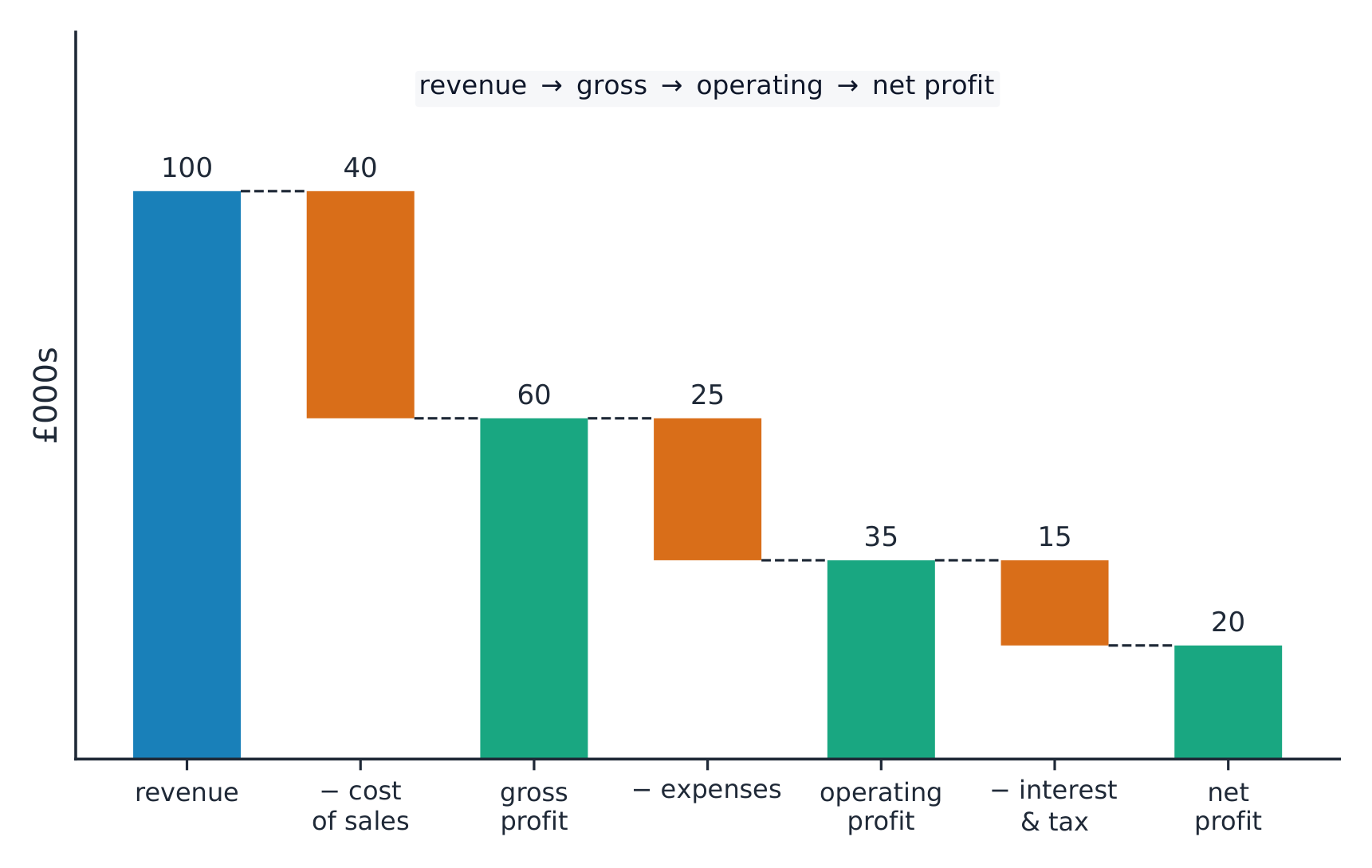
The income statement 利润表 shows the revenue 营业收入 and costs of a business over a period (usually a year), and the profit left at each stage.
$$\text{gross profit} = \text{revenue} - \text{cost of sales}$$- cost of sales 销售成本 is the direct cost of the goods that were sold.
- gross profit 毛利润 is what is left after taking cost of sales from revenue.
- after taking off expenses 费用 (such as rent, wages and marketing), you get the operating profit 营业利润.
- after interest and tax, what is left is the net profit 净利润 (the profit for the year).
The income statement steps down from revenue to net profit Vocabulary TrainEnglish income statement/ˈɪŋkʌm ˈsteɪtmənt/ revenue/ˈrevənjuː/ cost of sales/kɒst ɒv seɪlz/ gross profit/ɡrəʊs ˈprɒfɪt/ expenses/ekˈspensɪz/ operating profit/ˈɒpəreɪtɪŋ ˈprɒfɪt/ net profit/net ˈprɒfɪt/ 10.1
The statement of financial position

The statement of financial position 财务状况表 (also called the balance sheet 资产负债表) is a photo of what the business owns and owes on one day.
- non-current assets 非流动资产 — items kept for more than a year, such as buildings and machines.
- current assets 流动资产 — items that become cash within a year, such as inventory and money owed by customers.
- current liabilities 流动负债 — debts due within a year.
- non-current liabilities 非流动负债 — debts due after more than a year, such as a long loan.
- equity 所有者权益 — the money the owners have put in, plus profit kept in the business.
The two sides always balance: what the firm owns is funded by what it owes plus the owners' equity.
The two sides always balance: assets equal liabilities plus equity Vocabulary TrainEnglish statement of financial position/ˈsteɪtmənt ɒv faɪˈnænʃl pəˈzɪʃn/ balance sheet/ˈbæləns ʃiːt/ non-current assets/nɒn ˈkʌrənt ˈæsets/ current assets/ˈkʌrənt ˈæsets/ current liabilities/ˈkʌrənt ˌlaɪəˈbɪlɪtiz/ non-current liabilities/nɒn ˈkʌrənt ˌlaɪəˈbɪlɪtiz/ equity/ˈekwɪti/ 10.1
Depreciation

Depreciation 折旧 is the way the cost of a non-current asset is spread over the years it is used, instead of all in the year it was bought. For example, a £10,000 machine used for five years may lose £2,000 of value each year. Depreciation lowers the asset's value on the statement of financial position and counts as an expense on the income statement, so profit is not overstated.
Straight-line depreciation lowers the asset's value by the same amount each year ExploreStakeholder interest lab
See how different stakeholders judge the same business decision.
Vocabulary TrainEnglish depreciation (assets)/dɪˌpriːʃɪˈeɪʃn/ 10.1
How stakeholders use financial statements

Different stakeholders 利益相关者 read these statements for different reasons:
- owners and investors check the profit and the return on their money.
- lenders check whether the firm can repay its loans.
- managers use them to make decisions and set budgets.
- the government checks the tax due; suppliers check the firm can pay.
Each stakeholder reads the statements for a different reason Vocabulary TrainEnglish stakeholders/ˈsteɪkhəʊldəz/ 10.2
Ratio analysis

Syllabus
- calculate and interpret profitability, liquidity, efficiency and gearing ratios
- use ratio analysis to assess and compare business performance and explain its limitations
Source: Cambridge International syllabus
A single number means little on its own. Ratio analysis 比率分析 links two figures from the statements to judge performance, and lets you compare one year with another, or one firm with another.
The ratio toolbox: profitability and liquidity at a glance Vocabulary TrainEnglish ratio analysis/ˈreɪʃɪəʊ əˈnæləsɪs/ 10.2
Profitability ratios

Profitability 盈利能力 ratios show how good the firm is at turning sales and capital into profit.
$$\text{gross profit margin} = \frac{\text{gross profit}}{\text{revenue}} \times 100\%$$$$\text{operating profit margin} = \frac{\text{operating profit}}{\text{revenue}} \times 100\%$$A higher gross profit margin 毛利率 or operating profit margin 营业利润率 means more profit is kept from each sale. The key overall measure is return on capital employed 资本回报率 (ROCE), which compares profit with the money invested:
$$\text{ROCE} = \frac{\text{operating profit}}{\text{capital employed}} \times 100\%$$Here capital employed 所用资本 is the total long-term money in the business. A higher ROCE means the money is being used well.
Worked example. A firm has revenue of £500,000, gross profit of £200,000, operating profit of £80,000 and capital employed of £400,000. Find its gross profit margin, operating profit margin and ROCE.
$$\text{gross profit margin} = \frac{200\,000}{500\,000} \times 100\% = 40\%$$$$\text{operating profit margin} = \frac{80\,000}{500\,000} \times 100\% = 16\%$$$$\text{ROCE} = \frac{80\,000}{400\,000} \times 100\% = 20\%$$Investors use profitability, liquidity and gearing ratios to judge a firm's financial health ExploreAccounts ratio diagnosis
Classify ratios by the question they answer about a business.
Vocabulary TrainEnglish profitability/ˌprɒfɪtəˈbɪlɪti/ gross profit margin/ɡrəʊs ˈprɒfɪt ˈmɑːdʒɪn/ operating profit margin/ˈɒpəreɪtɪŋ ˈprɒfɪt ˈmɑːdʒɪn/ return on capital employed/rɪˈtɜːn ɒn ˈkæpɪtl emˈplɔɪd/ capital employed/ˈkæpɪtl emˈplɔɪd/ 10.2
Liquidity ratios
Liquidity 流动性 means how easily a firm can pay its short-term debts. Two ratios test it.
$$\text{current ratio} = \frac{\text{current assets}}{\text{current liabilities}}$$$$\text{acid test ratio} = \frac{\text{current assets} - \text{inventory}}{\text{current liabilities}}$$The current ratio 流动比率 of about 1.5–2 is usually safe. The acid test ratio 速动比率 is stricter because it removes inventory, which can be slow to sell. Too low is risky; too high may mean cash is sitting idle.
Worked example. A firm has current assets of £60,000 (including £24,000 of inventory) and current liabilities of £30,000. Find its current ratio and acid test ratio.
$$\text{current ratio} = \frac{60\,000}{30\,000} = 2.0$$$$\text{acid test ratio} = \frac{60\,000 - 24\,000}{30\,000} = 1.2$$Vocabulary TrainEnglish liquidity/lɪˈkwɪdɪti/ current ratio/ˈkʌrənt ˈreɪʃɪəʊ/ acid test ratio/ˈæsɪd test ˈreɪʃɪəʊ/ 10.2
Efficiency and gearing ratios
Efficiency 效率 ratios show how well the firm uses its resources — for example, inventory turnover 存货周转率 measures how many times a year the firm sells and replaces its stock. Faster turnover usually ties up less cash.
Gearing 杠杆比率 shows how much of the firm's long-term money comes from borrowing rather than from owners:
$$\text{gearing} = \frac{\text{non-current liabilities}}{\text{capital employed}} \times 100\%$$High gearing means heavy borrowing — risky if interest rates rise, but it can boost returns when times are good.
Worked example. A firm has non-current liabilities of £150,000 and capital employed of £500,000. Find its gearing.
$$\text{gearing} = \frac{150\,000}{500\,000} \times 100\% = 30\%$$Below 50%, so the firm is low-geared — it relies more on owners' money than on borrowing.
ExploreBusiness case lab
Classify real decisions so the main business concept becomes concrete.
Vocabulary TrainEnglish efficiency/ɪˈfɪʃənsi/ inventory turnover/ˈɪnvəntri ˈtɜːnəʊvə/ gearing/ˈɡɪərɪŋ/ 10.2
Limitations of ratio analysis
Ratios are useful but limited. They use past data, which may not predict the future. They ignore non-money factors like staff morale and brand strength. And a fair comparison needs firms of similar size in the same industry.
10.3
Investment appraisal
Syllabus
- calculate and interpret investment appraisal methods: payback period, accounting rate of return (ARR) and net present value (NPV)
- use investment appraisal to make and evaluate investment decisions
Source: Cambridge International syllabus
Investment appraisal 投资评估 is the study of whether a big spending project (such as a new machine or factory) is worth it. Three methods are used.
ExploreInvestment appraisal route
Follow how a project is judged from cash flows to decision.
Vocabulary TrainEnglish investment appraisal/ɪnˈvestmənt əˈpreɪzl/ 10.3
Payback, ARR and NPV

- the payback period 回收期 is the time it takes for the project's cash inflows to repay the initial cost. A shorter payback is safer.
The payback period is when cumulative cash flow climbs back to zero - the accounting rate of return 会计回报率 (ARR) shows the average yearly profit as a percentage of the money invested:
$$\text{ARR} = \frac{\text{average annual profit}}{\text{initial investment}} \times 100\%$$Worked example. A machine costs £100,000 and is expected to earn an average annual profit of £25,000. Find its accounting rate of return.
$$\text{ARR} = \frac{25\,000}{100\,000} \times 100\% = 25\%$$- the net present value 净现值 (NPV) recognises that money in the future is worth less than money today. It uses discounting 折现 to shrink future cash flows back to today's value, then takes away the initial cost. A positive NPV means the project adds value.

Discounting, the idea behind NPV: the same £100 is worth less the longer you wait for it, so future cash flows are shrunk back to today's value Each method has strengths: payback is simple and focuses on risk; ARR shows profitability; NPV is the most complete but needs a chosen discount rate.
ExploreWill the machine pay for itself?
Drag the cost, yearly inflow and useful life — the cumulative line crosses zero at the payback period, and ARR is compared with the bank's rate.
Vocabulary TrainEnglish payback period/ˈpeɪbæk ˈpɪərɪəd/ accounting rate of return/əˈkaʊntɪŋ reɪt ɒv rɪˈtɜːn/ net present value/net ˈprezənt ˈvæljuː/ discounting/ˈdɪskaʊntɪŋ/ 10.4
Finance and accounting strategy
Syllabus
- explain the use of financial data and budgets in strategic decision-making
- evaluate the financial implications of strategic decisions
Source: Cambridge International syllabus
At the top level, managers use financial data and budgets to choose between strategies. Before a big decision, they ask: can we afford it, how will it affect profit, cash flow and gearing, and what is the likely return? Financial information turns a risky guess into a reasoned choice — but numbers are only part of the picture, and must be weighed with the market, the staff and the firm's objectives.
ExploreSources of finance lab
Choose the best type of finance by time, risk and ownership.
10.4
Exam tips
- Calculate and interpret the key ratios — gross/net profit margin, current ratio, gearing, ROCE — always against a benchmark or a trend.
- For investment appraisal know payback (time to recover), ARR (average % return) and NPV (discounted; a positive NPV means accept).
- A current ratio of about 1.5–2 is healthy: too high wastes resources, too low risks liquidity problems.
- State the limitations of ratios (historical figures, no qualitative factors) in your evaluation.
Vocabulary card meanings
net profit: Profit left after all expenses have been deducted. depreciation (assets): Spreading the cost of a long-lasting asset over the years it is used. ratio analysis: Comparing pairs of figures from the accounts to judge performance. operating profit margin: Operating profit as a percentage of revenue. return on capital employed: Operating profit as a percentage of the long-term capital used in the business. acid test ratio: Current assets minus inventory, divided by current liabilities. inventory turnover: How many times a year stock is sold and replaced. accounting rate of return: Average profit per year as a percentage of the sum initially invested, the comparison used in this topic's machine example. net present value: The value today of future cash flows after subtracting the initial cost. discounting: Reducing future money to its value today because of the time value of money.