- explain the factors influencing the location and relocation of a business (including international location)
- explain the optimum scale of operation and the significance of economies and diseconomies of scale
Operations management (A Level)
A-Level Business · Topic 9
 7:46
7:46
Operations management (A Level)
A company promised its new factory in a hundred and fifteen weeks. It opened thirty weeks late, at a huge cost in wages and rent. One task slipped in the…
English narration · English + 中文 subtitles burned in
9.1
Location and relocation

Syllabus
Source: Cambridge International syllabus
Where a business sits affects its costs, its sales and its staff. Choosing a place is called location 选址; moving to a new place is relocation 迁址.
Factors that influence the choice fall into two groups:
- quantitative factors 定量因素 — things you can measure in money, such as rent, wages, transport costs and government grants.
- qualitative factors 定性因素 — things that are harder to measure, such as the skills of local workers, nearness to customers or suppliers, and the owner's own wishes.
A firm picks the place where the benefits, money and non-money together, are greatest.
Explore
Location factor lab
Classify why a business chooses one site over another.
Vocabulary
Train
| English |
|---|
| location/ləʊˈkeɪʃn/ |
| relocation/rɪləʊˈkeɪʃn/ |
| quantitative factors/ˈkwɒntɪteɪtɪv ˈfæktəz/ |
| qualitative factors/ˈkwɒlɪteɪtɪv ˈfæktəz/ |
9.1
International location
Many firms now locate abroad. Moving production to another country is offshoring 离岸外包. The reasons are often lower wages, nearness to new markets, fewer rules, or government help. The risks are longer supply lines, language and culture differences, and possible damage to the firm's image.
Vocabulary
Train
| English |
|---|
| offshoring/ˈɒfʃərɪŋ/ |
9.1
The optimum scale of operation
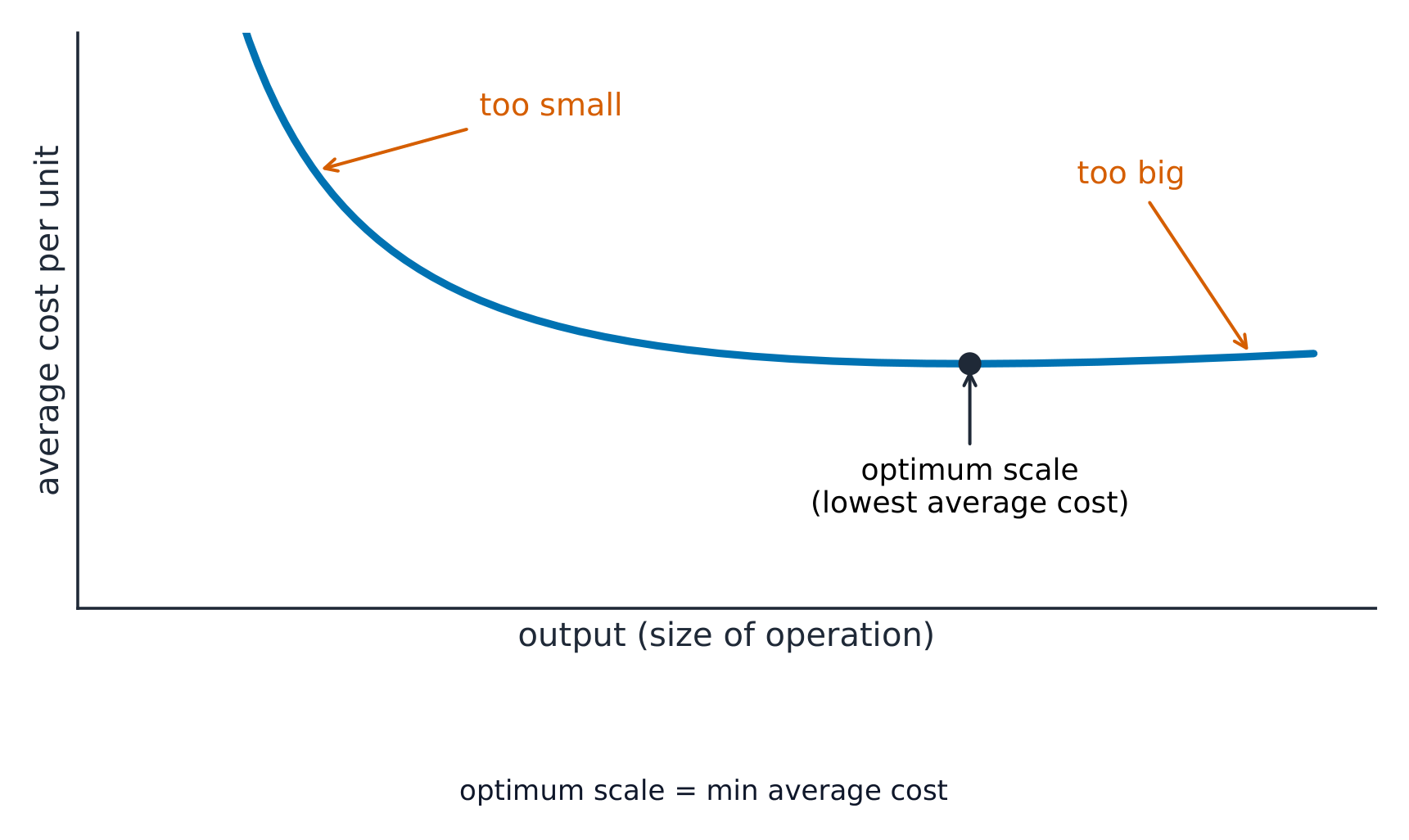
As a firm grows, its average cost first falls (from economies of scale) and later rises (from diseconomies of scale). The optimum scale 最优规模 is the size at which the average cost per unit is at its lowest.
- economies of scale 规模经济 — cost savings from being larger (e.g. bulk buying).
- diseconomies of scale 规模不经济 — rising average cost when a firm grows too big (e.g. poor communication).
A firm should try to grow up to its optimum scale, but not beyond it.
Vocabulary
Train
| English |
|---|
| optimum scale/ˈɒptɪməm skeɪl/ |
| economies of scale/ɪˈkɒnəmiz ɒv skeɪl/ |
| diseconomies of scale/ˌdɪsɪˈkɒnəmiz ɒv skeɪl/ |
9.2
Why quality matters
Syllabus
- explain the importance of quality and methods of managing quality (quality control, quality assurance, total quality management, benchmarking)
Source: Cambridge International syllabus
Quality 质量 means how well a product meets the customer's needs. Good quality wins repeat custom, lets the firm charge more, protects its brand, and cuts the cost of waste and returns. Poor quality loses customers and damages the firm's name.
Explore
Leadership style lab
Pick the management style that fits each situation.
Vocabulary
Train
| English |
|---|
| quality/ˈkwɒlɪti/ |
9.2
Methods of managing quality

| Method | How it works |
|---|---|
| quality control 质量控制 | check finished products and remove the faulty ones at the end |
| quality assurance 质量保证 | build quality into every stage, so faults are prevented, not just found |
| total quality management 全面质量管理 (TQM) | every worker takes responsibility for quality, aiming for zero faults |
| benchmarking 标杆管理 | compare the firm's methods with the best firms, and copy what they do well |
Quality control finds faults late, after money is already spent. Quality assurance and TQM try to stop faults happening, which is usually cheaper in the long run.
Vocabulary
Train
| English |
|---|
| quality control/ˈkwɒlɪti kənˈtrəʊl/ |
| quality assurance/ˈkwɒlɪti əˈʃʊərəns/ |
| total quality management/ˈtəʊtl ˈkwɒlɪti ˈmænɪdʒmənt/ |
| benchmarking/ˈbentʃmɑːkɪŋ/ |
9.3
Operations strategy: lean production

Syllabus
- explain operations decisions: lean production, capacity management, and the use of technology
- use critical path analysis (CPA) to plan and manage projects (EST, LFT, total float, critical path, minimum project duration)
Source: Cambridge International syllabus
Lean production 精益生产 means making products with the least possible waste 浪费 — of time, materials, space and effort. Methods like just-in-time and continuous improvement cut waste, lower cost, and raise quality. Less money is tied up in stock, and problems are fixed quickly.
Explore
SWOT strategy lab
Sort strategy evidence into internal and external factors.
Vocabulary
Train
| English |
|---|
| lean production/liːn prəˈdʌkʃn/ |
| waste/weɪst/ |
9.3
Capacity management and technology
Capacity management 产能管理 means matching what the firm can produce to the demand it faces. If demand is higher than capacity, the firm may add shifts, hire staff or outsource; if demand is lower, it may cut output or find new orders. New technology 技术, such as automation and data systems, helps a firm produce more, to a higher standard, at a lower cost.
Vocabulary
Train
| English |
|---|
| capacity management/kəˈpæsɪti ˈmænɪdʒmənt/ |
| technology/tekˈnɒlədʒi/ |
9.3
Critical path analysis

Critical path analysis 关键路径分析 (CPA) is a tool for planning a project made of many tasks. It draws the tasks as a network of arrows and nodes 节点 (circles), in the order they must happen. For each task it works out timings:
- the earliest start time 最早开始时间 (EST) — the soonest a task can begin, once earlier tasks are done.
- the latest finish time 最晚完成时间 (LFT) — the latest a task can finish without delaying the whole project.
From these comes the total float 总浮动时间 — the spare time a task has before it delays the project:
$$\text{total float} = \text{LFT} - \text{duration} - \text{EST}$$
The critical path 关键路径 is the chain of tasks with zero float. These tasks cannot be late, or the whole project is late. Adding up the times along this path gives the minimum project duration 最短项目工期 — the shortest time the project can take.
CPA helps managers find the tasks that matter most, order resources for the right time, and see where delays would hurt. But it is only as good as the time estimates it is built on.
Worked example. A task has an EST of 6 days, a duration of 4 days, and an LFT of 14 days. Find its total float, and say whether it lies on the critical path. Use the formula: total float = LFT − duration − EST = $14 - 4 - 6 =$ 4 days. So the task could start up to 4 days late, or overrun by 4 days, without delaying the project - and because its float is not zero, it is not on the critical path. Only tasks with zero float are critical. Two points carry the marks: float is the spare time on that task, so using it up makes the task critical; and shortening a non-critical task like this one does not shorten the project at all, because only the critical path sets the minimum project duration.
Explore
Critical path analysis
CPA finds the sequence of tasks that decides the shortest time a project can take.
Explore
Find the critical path
Drag the durations — the network rolls forward and back, the floats update, and the critical path jumps to whichever route is longest.
Vocabulary
Train
| English |
|---|
| critical path analysis/ˈkrɪtɪkl pæθ əˈnæləsɪs/ |
| nodes/nəʊdz/ |
| earliest start time/ˈɜːlɪɪst stɑːt taɪm/ |
| latest finish time/ˈleɪtɪst ˈfɪnɪʃ taɪm/ |
| total float/ˈtəʊtl fləʊt/ |
| critical path/ˈkrɪtɪkl pæθ/ |
| minimum project duration/ˈmɪnɪməm ˈprɒdʒekt djʊəˈreɪʃn/ |
9.3
Exam tips
- Compare quality methods: quality control (inspect at the end) versus quality assurance / TQM (build quality in at every stage).
- Explain lean production (cutting waste — time, stock, defects) with a named method (kaizen, JIT).
- On a critical path network, work out the EST/LFT, the float, and the critical activities (zero float) that set the minimum time.
Interactive lessons on this topic
Work through it step by step, with instant-check exercises.