- explain the role of marketing, market and product orientation, and customer relationship marketing (CRM)
- explain market size, market growth and market share, mass and niche markets and market segmentation
- explain demand and supply and the concept of elasticity (price, income, cross) and its usefulness
Marketing
A-Level Business · Topic 3
 15:14
15:14
Marketing
Two shops sell the same coffee at the same price. One is always busy; the other sits empty. Nothing about the product explains it. The difference is marketing…
English narration · English + 中文 subtitles burned in
3.1
The role of marketing
Syllabus
Source: Cambridge International syllabus
Marketing 市场营销 is the job of finding out what customers want, then making and selling products that meet those wants at a profit. Good marketing links the business to its market 市场 (all the buyers and sellers of a product).
A business can be:
- product-orientated 产品导向 — it focuses on the product first and hopes customers will buy it. This suits new or technical products.
- market-orientated 市场导向 — it finds out what customers want first, then makes it. This lowers the risk of failure.
Customer relationship marketing 客户关系营销 (CRM) means building long-term links with customers so they come back again. Keeping a customer is cheaper than finding a new one.
Explore
Marketing mix lab
See which part of the marketing mix changes in each real decision.
Vocabulary
Train
| English |
|---|
| marketing/ˈmɑːkɪtɪŋ/ |
| market/ˈmɑːkɪt/ |
| product-orientated/ˈprɒdʌkt ˈɔːrɪənteɪtɪd/ |
| market-orientated/ˈmɑːkɪt ˈɔːrɪənteɪtɪd/ |
| customer relationship marketing/ˈkʌstəmə rɪˈleɪʃənʃɪp ˈmɑːkɪtɪŋ/ |
3.1
Market size, growth and share
- market size 市场规模 — the total sales of all firms in a market, by value or by number of units.
- market growth 市场增长 — how fast the market is getting bigger, shown as a percentage.
- market share 市场份额 — one firm's sales as a percentage of the total market:
$$\text{market share} = \frac{\text{firm's sales}}{\text{total market sales}} \times 100\%$$
A rising market share is a sign of strong marketing.
Worked example. A firm sells £4 million of goods in a market worth £50 million in total. Find its market share.
$$\text{market share} = \frac{4}{50} \times 100\% = 8\%.$$
If the whole market grows but the firm's sales stay at £4 million, its market share falls — so a firm can sell the same amount yet lose ground to faster-growing rivals.
Vocabulary
Train
| English |
|---|
| market size/ˈmɑːkɪt saɪz/ |
| market growth/ˈmɑːkɪt ɡrəʊθ/ |
| market share/ˈmɑːkɪt ʃeə/ |
3.1
Mass and niche markets

- a mass market 大众市场 is large, with products aimed at most buyers (e.g. soft drinks). Sales are high, but competition is strong.
- a niche market 利基市场 is a small part of a market with special needs (e.g. left-handed tools). Competition is weaker, but sales are smaller.
Vocabulary
Train
| English |
|---|
| mass market/mæs ˈmɑːkɪt/ |
| niche market/niːʃ ˈmɑːkɪt/ |
3.1
Market segmentation
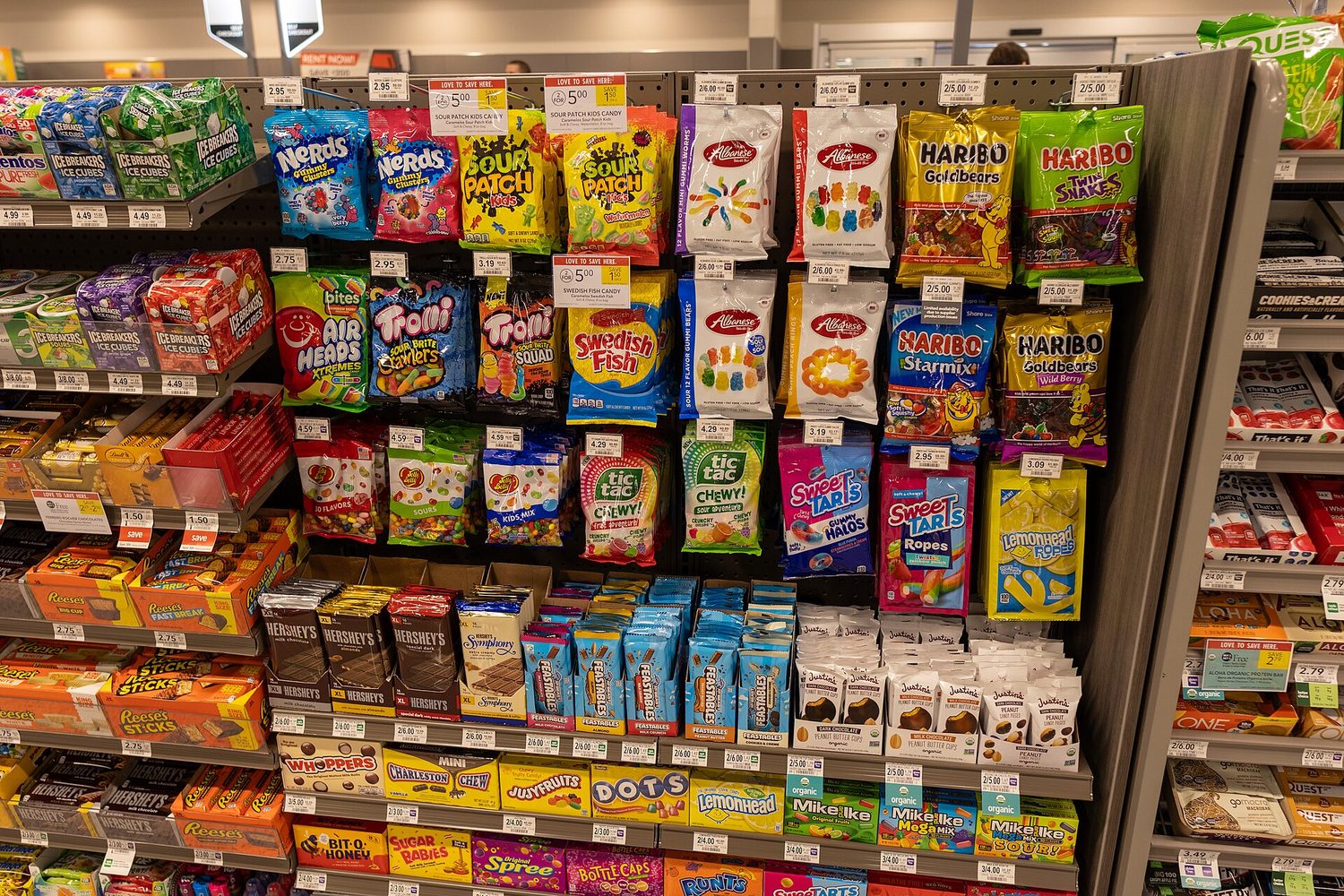
Market segmentation 市场细分 means splitting a market into groups (segments 细分市场) of buyers who are alike. Common ways to segment are by age, income, gender, location, and lifestyle. Segmentation lets a firm aim the right product and message at each group, which raises sales and cuts waste.

Vocabulary
Train
| English |
|---|
| market segmentation/ˈmɑːkɪt ˌseɡmənˈteɪʃn/ |
| segments/ˈseɡmənts/ |
3.1
Demand, supply and elasticity

Demand 需求 is how much of a product buyers will buy at each price. Supply 供给 is how much sellers will offer at each price. Usually, when price falls, demand rises.
Elasticity 弹性 measures how strongly demand reacts to a change. You should know three types.
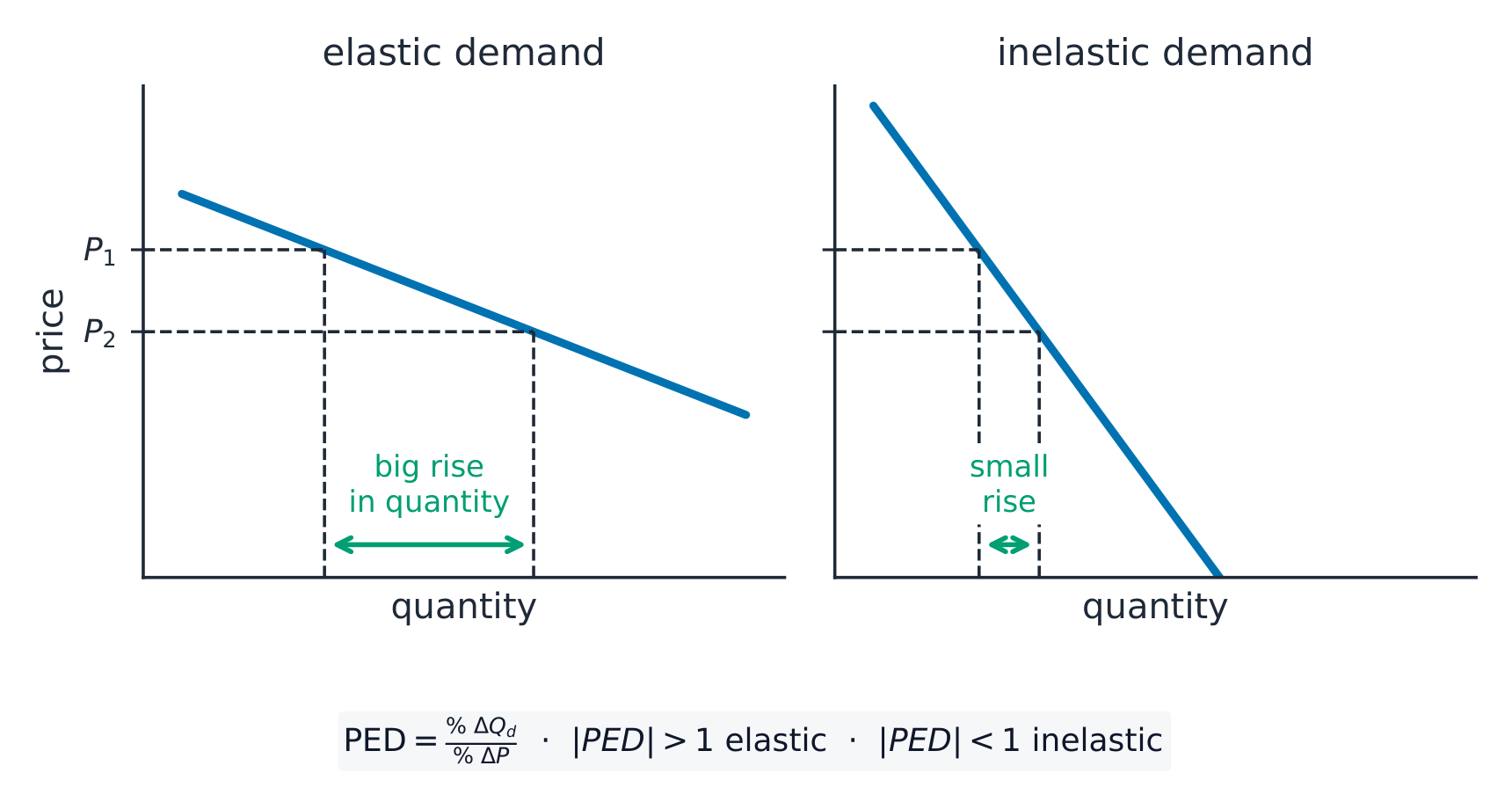
Price elasticity of demand 需求价格弹性 (PED) measures how demand reacts to a price change:
$$\text{PED} = \frac{\%\ \text{change in quantity demanded}}{\%\ \text{change in price}}$$
- if PED is greater than 1, demand is price elastic 富有弹性 — a small price cut raises sales a lot, so lowering price can raise revenue.
- if PED is less than 1, demand is price inelastic 缺乏弹性 — demand changes little, so raising price can raise revenue.
Income elasticity of demand 需求收入弹性 (YED) measures how demand reacts to a change in customers' income. Luxury goods react strongly; basic goods react weakly.
Cross elasticity of demand 需求交叉弹性 (XED) measures how the demand for one product reacts to a price change of another. It is positive for substitutes 替代品 (e.g. tea and coffee) and negative for complements 互补品 (e.g. cars and fuel).
Elasticity is useful because it helps a firm predict how a price change will affect sales and revenue.
Explore
Demand, supply & elasticity
Price is set where demand meets supply.
Explore
Demand and supply
Shift the curves to see how price is set in a market — and how elasticity decides how much quantity responds.
Vocabulary
Train
| English |
|---|
| demand/dɪˈmænd/ |
| supply/səˈplaɪ/ |
| elasticity/ɪlæˈstɪsɪti/ |
| price elasticity of demand/praɪs ɪlæˈstɪsɪti ɒv dɪˈmænd/ |
| price elastic/praɪs ɪˈlæstɪk/ |
| price inelastic/praɪs ɪnɪˈlæstɪk/ |
| income elasticity of demand/ˈɪŋkʌm ɪlæˈstɪsɪti ɒv dɪˈmænd/ |
| cross elasticity of demand/krɒs ɪlæˈstɪsɪti ɒv dɪˈmænd/ |
| substitutes/ˈsʌbstɪtjuːts/ |
| complements/ˈkɒmplɪmənts/ |
3.2
Market research
Syllabus
- distinguish primary and secondary market research and qualitative and quantitative data
- explain sampling methods and the reliability of data; present and interpret market research findings
Source: Cambridge International syllabus
Market research 市场调研 is collecting and studying information about customers, competitors 竞争对手 and the market.
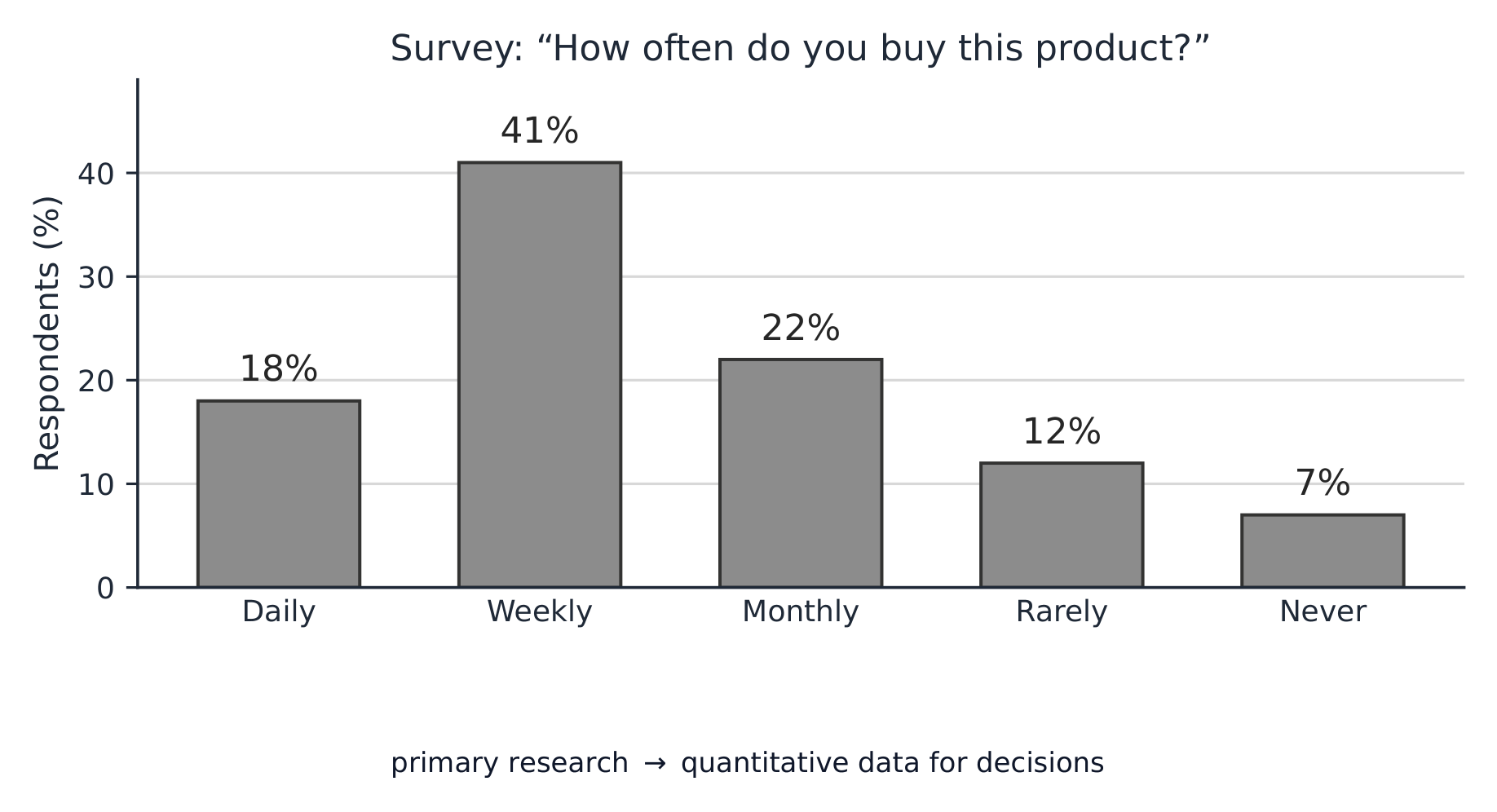
- primary research 一手调研 — new information you collect yourself, by surveys, interviews or observation. It fits your exact needs, but costs more and takes time.
- secondary research 二手调研 — information that already exists, such as reports, websites and sales records. It is cheap and quick, but may be old or not exactly right.
Data can be:
- quantitative data 定量数据 — facts in numbers (e.g. "60% buy weekly"). Easy to compare.
- qualitative data 定性数据 — opinions and reasons (e.g. "why people like the brand"). Gives deeper understanding.
Sampling and reliability
A sample 样本 is the small group of people asked, chosen to stand for the whole market. Sampling 抽样 methods include:
- random sampling 随机抽样 — everyone has an equal chance of being picked.
- quota sampling 配额抽样 — set numbers from each group are asked.
- stratified sampling 分层抽样 — the sample copies the make-up of the whole market.
A larger, well-chosen sample gives more reliable 可靠的 results. Poor sampling can cause bias 偏差, which makes the findings wrong. Results are often shown in tables and charts, then read carefully to guide decisions.
Explore
Market research cycle
Follow how a business turns customer data into a marketing decision.
Vocabulary
Train
| English |
|---|
| market research/ˈmɑːkɪt rɪˈsɜːtʃ/ |
| competitors/kəmˈpetɪtəz/ |
| primary research/ˈpraɪməri rɪˈsɜːtʃ/ |
| secondary research/ˈsekəndəri rɪˈsɜːtʃ/ |
| quantitative data/ˈkwɒntɪteɪtɪv ˈdeɪtə/ |
| qualitative data/ˈkwɒlɪteɪtɪv ˈdeɪtə/ |
| sample/ˈsæmpl/ |
| sampling/ˈsæmplɪŋ/ |
| random sampling/ˈrændəm ˈsæmplɪŋ/ |
| quota sampling/ˈkwəʊtə ˈsæmplɪŋ/ |
| stratified sampling/ˈstrætɪfaɪd ˈsæmplɪŋ/ |
| reliable/rɪˈlaɪəbl/ |
| bias/ˈbaɪəs/ |
3.3
The marketing mix

Syllabus
- explain the elements of the marketing mix (product, price, place, promotion) and their integration
- product: product development, the product life cycle, the product portfolio (Boston Matrix), branding
- price: pricing methods and strategies (cost-plus, penetration, skimming, competitive, price discrimination, dynamic, psychological)
- place and promotion: distribution channels, above- and below-the-line promotion, and digital/e-commerce marketing
Source: Cambridge International syllabus
The marketing mix 营销组合 is the set of choices a firm makes to sell a product. It is often called the 4Ps:
| P | Question it answers |
|---|---|
| product 产品 | what are we selling? |
| price 价格 | how much do we charge? |
| place 渠道 | where and how do customers buy it? |
| promotion 促销 | how do we tell customers about it? |

The four parts must work together. For example, a high price needs high quality and a good image. Making the parts fit each other is called integration 整合.
Vocabulary
Train
| English |
|---|
| marketing mix/ˈmɑːkɪtɪŋ mɪks/ |
| product/ˈprɒdʌkt/ |
| price/praɪs/ |
| place/pleɪs/ |
| promotion/prəˈməʊʃn/ |
| integration/ˌɪntɪˈɡreɪʃn/ |
3.3
Product
A good product is the heart of the mix.
Product development 产品开发 is the work of designing and improving products to meet customer needs and beat rivals.
The product life cycle
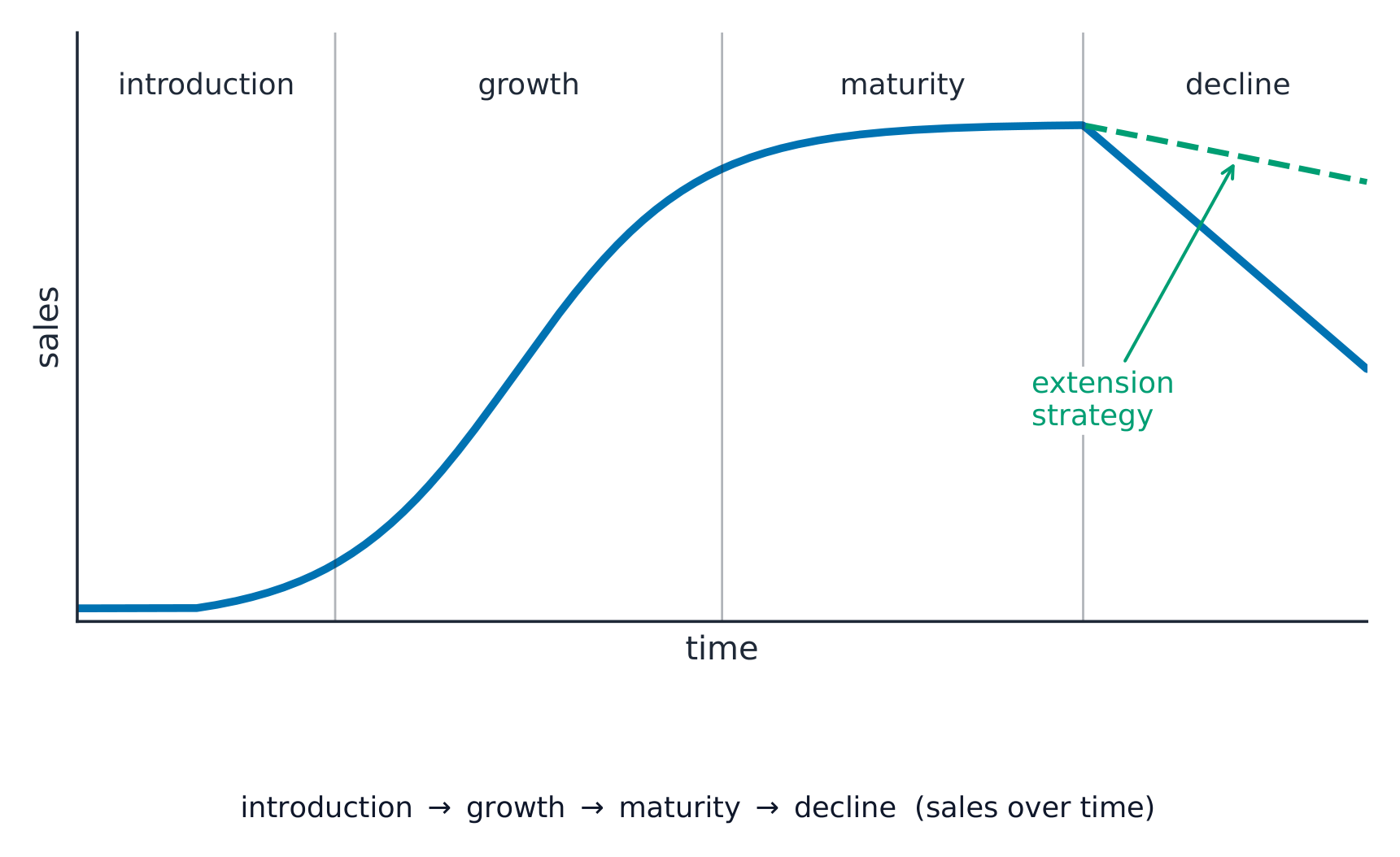
The product life cycle 产品生命周期 shows the sales of a product over time, in four stages:
- introduction 引入期 — launch; low sales, high promotion cost.
- growth 成长期 — sales rise quickly.
- maturity 成熟期 — sales reach their peak and level off.
- decline 衰退期 — sales fall as tastes change.
To keep sales up in maturity, firms use extension strategies 延长策略, such as new packaging, new uses, or selling in new markets.
The product portfolio (Boston Matrix)
The product portfolio 产品组合 is the full range of products a firm sells. The Boston Matrix 波士顿矩阵 sorts products by market share and market growth:
| High market growth | Low market growth | |
|---|---|---|
| High share | stars 明星产品 | cash cows 现金牛 |
| Low share | question marks 问题产品 | dogs 瘦狗产品 |

Stars need investment but may become cash cows. Cash cows bring steady profit. Question marks are risky. Dogs are usually dropped.
Branding
Branding 品牌 gives a product a name, design and image that customers recognise. A strong brand builds loyalty 忠诚度, lets the firm charge more, and makes new products easier to launch.
Explore
The product life cycle
Most products pass through four sales stages over time — from launch to decline.
Explore
Balance the product portfolio
Pick a product and drag its market share and growth — it re-classifies live, and Play walks one product through its whole life across the matrix.
Vocabulary
Train
| English |
|---|
| product development/ˈprɒdʌkt dɪˈveləpmənt/ |
| product life cycle/ˈprɒdʌkt laɪf ˈsaɪkl/ |
| introduction/ˌɪntrəˈdʌkʃn/ |
| growth/ɡrəʊθ/ |
| maturity/məˈtʃʊərɪti/ |
| decline/dɪˈklaɪn/ |
| extension strategies/ekˈstenʃn ˈstrætədʒiz/ |
| product portfolio/ˈprɒdʌkt pɔːtˈfəʊlɪəʊ/ |
| Boston Matrix/ˈbɒstn ˈmeɪtrɪks/ |
| stars/stɑːz/ |
| cash cows/kæʃ kaʊz/ |
| question marks/ˈkwestʃn mɑːks/ |
| dogs/dɒɡz/ |
| branding/ˈbrændɪŋ/ |
| loyalty/ˈlɔɪəlti/ |
3.3
Price

Choosing a price is a key decision. The main methods and strategies are:
| Method / strategy | How it works |
|---|---|
| cost-plus pricing 成本加成定价 | add a fixed profit margin to the unit cost |
| penetration pricing 渗透定价 | set a low price to enter a market and win share |
| price skimming 撇脂定价 | set a high price first for a new, special product, then lower it |
| competitive pricing 竞争定价 | set a price close to rivals' prices |
| price discrimination 价格歧视 | charge different prices to different groups (e.g. peak vs off-peak) |
| dynamic pricing 动态定价 | change the price often as demand changes |
| psychological pricing 心理定价 | use prices like $9.99 that feel lower |
The best price depends on costs, competitors, the product's life-cycle stage, and how price elastic demand is.
Explore
Marketing mix lab
See which part of the marketing mix changes in each real decision.
Vocabulary
Train
| English |
|---|
| cost-plus pricing/kɒst plʌs ˈpraɪsɪŋ/ |
| penetration pricing/ˌpenɪˈtreɪʃn ˈpraɪsɪŋ/ |
| price skimming/praɪs ˈskɪmɪŋ/ |
| competitive pricing/kəmˈpetɪtɪv ˈpraɪsɪŋ/ |
| price discrimination/praɪs dɪˌskrɪmɪˈneɪʃn/ |
| dynamic pricing/daɪˈnæmɪk ˈpraɪsɪŋ/ |
| psychological pricing/saɪkəˈlɒdʒɪkl ˈpraɪsɪŋ/ |
3.3
Place and promotion

Place is how the product reaches the customer, through a distribution channel 分销渠道. A short channel (maker → customer) gives more control; a longer channel (maker → wholesaler 批发商 → shop → customer) reaches more buyers.

Promotion tells customers about a product and persuades them to buy. It is split into:
- above-the-line promotion 大众媒体广告 — paid advertising 广告 in mass media, such as TV and online ads, aimed at a wide audience.
- below-the-line promotion 直接促销 — targeted methods the firm controls, such as discounts, free samples and direct mail.
Digital marketing 数字营销 and e-commerce 电子商务 (buying and selling online) now play a huge role. They let small firms reach world markets cheaply, target adverts to the right people, and sell at any time of day.
Vocabulary
Train
| English |
|---|
| distribution channel/ˌdɪstrɪˈbjuːʃn ˈtʃænl/ |
| wholesaler/ˈhəʊlseɪlə/ |
| above-the-line promotion/əˈbʌv ðə laɪn prəˈməʊʃn/ |
| advertising/ˈædvətaɪzɪŋ/ |
| below-the-line promotion/bɪˈləʊ ðə laɪn prəˈməʊʃn/ |
| digital marketing/ˈdɪdʒɪtl ˈmɑːkɪtɪŋ/ |
| e-commerce/iː ˈkɒmɜːs/ |
3.3
Exam tips
- Calculate market share and market growth as percentages; a firm can grow yet lose share in a faster-growing market.
- Use price elasticity of demand to decide pricing: raise price when demand is inelastic (revenue rises), cut it when elastic.
- Distinguish primary vs secondary and quantitative vs qualitative research, and comment on sampling reliability.
- Treat the marketing mix (4Ps) as a coordinated set — each P should support the others.
Interactive lessons on this topic
Work through it step by step, with instant-check exercises.