Skip to content · ⁨Lompat ke konten⁩

Modern Physics · ⁨Fisika Modern⁩

AP Physics 2 · ⁨AP Fisika 2⁩ · Topic 15 · ⁨Topik 15⁩

Video lesson for this topic · ⁨Pelajaran video untuk topik ini⁩ Open the video page · ⁨Buka halaman video⁩
9:32

Fisika Modern

Pada tahun seribu sembilan ratus, fisika tampak selesai. Kemudian tiga eksperimen meruntuhkannya. Benda bercahaya panas memancarkan warna yang salah. Cahaya jatuh pada logam…

English narration · English + 中文 subtitles burned in · ⁨Narasi bahasa Inggris · Subtitle bahasa Inggris + 中文 disematkan langsung⁩

15.1

Quantum Theory and Wave-Particle Duality · ⁨Teori Kuantum dan Dualisme Gelombang-Partikel⁩

Syllabus · ⁨Silabus⁩
English

Learning Objective 15.1.A: Describe the properties and behavior of an object that exhibits both particle-like and wave-like behavior.

  • 15.1.A.1 Quantum theory was developed to explain observations of matter and energy that could not be explained using classical mechanics. These phenomena include, but are not limited to, atomic spectra, blackbody radiation, and the photoelectric effect.
    • 15.1.A.1.i Quantum theory is necessary to describe the properties of matter at atomic and subatomic scales.
    • 15.1.A.1.ii In quantum theory, fundamental particles can exhibit both particle-like and wave-like behavior.
  • 15.1.A.2 Light can be modeled both as a wave and as discrete particles, called photons.
    • 15.1.A.2.i A photon is a massless, electrically neutral particle with energy proportional to the photon's frequency.
      • Relevant equations:
      • $E = hf$
      • $\lambda = \dfrac{c}{f}$
    • 15.1.A.2.ii Photons travel in straight lines unless they interact with matter.
  • 15.1.A.3 The speed of a photon depends on the medium through which the photon travels.
    • 15.1.A.3.i The speed of all photons in free space is equal to the speed of light, $c = 3.00 \times 10^{8}$ m/s.
    • 15.1.A.3.ii In general, the speed of photons through a given medium is inversely proportional to the index of refraction of that medium.
  • 15.1.A.4 Particles can demonstrate wave properties, as shown by variations of Young's double-slit experiment.
    • 15.1.A.4.i A wave model of matter is quantified by the de Broglie wavelength, which increases as the momentum of a particle decreases.
      • Relevant equation:
      • $\lambda = \dfrac{h}{p}$
    • 15.1.A.4.ii Quantum theory is necessary to describe systems where the de Broglie wavelength is comparable to the size of the system.
  • 15.1.A.5 Values of energy and momentum have discrete, or quantized, values for bound systems described by quantum theory.
Bahasa Indonesia

Tujuan Pembelajaran 15.1.A: Jelaskan sifat dan perilaku objek yang menunjukkan perilaku seperti partikel dan seperti gelombang.

  • 15.1.A.1 Teori kuantum dikembangkan untuk menjelaskan pengamatan materi dan energi yang tidak dapat dijelaskan menggunakan mekanika klasik. Fenomena ini mencakup, namun tidak terbatas pada, spektrum atom, radiasi benda hitam, dan efek fotoelektrik.
    • 15.1.A.1.i Teori kuantum diperlukan untuk menggambarkan sifat materi pada skala atom dan subatom.
    • 15.1.A.1.ii Dalam teori kuantum, partikel fundamental dapat menunjukkan perilaku seperti partikel dan seperti gelombang.
  • 15.1.A.2 Cahaya dapat dimodelkan baik sebagai gelombang maupun sebagai partikel diskrit, yang disebut foton.
    • 15.1.A.2.i Foton adalah partikel tanpa massa dan netral secara listrik dengan energi yang sebanding dengan frekuensi foton.
      • Persamaan yang Relevan:
      • $E = hf$
      • $\lambda = \dfrac{c}{f}$
    • 15.1.A.2.ii Foton merambat dalam garis lurus kecuali berinteraksi dengan materi.
  • 15.1.A.3 Kecepatan foton bergantung pada medium tempat foton tersebut merambat.
    • 15.1.A.3.i Kecepatan semua foton di ruang hampa sama dengan kecepatan cahaya, $c = 3.00 \times 10^{8}$ m/s.
    • 15.1.A.3.ii Secara umum, kecepatan foton melalui suatu medium berbanding terbalik dengan indeks bias medium tersebut.
  • 15.1.A.4 Partikel dapat menunjukkan sifat gelombang, seperti yang ditunjukkan oleh variasi eksperimen belah celah Young.
    • 15.1.A.4.i Model gelombang materi dikuantifikasi oleh panjang gelombang de Broglie, yang meningkat seiring dengan berkurangnya momentum partikel.
      • Persamaan yang Relevan:
      • $\lambda = \dfrac{h}{p}$
    • 15.1.A.4.ii Teori kuantum diperlukan untuk menggambarkan sistem di mana panjang gelombang de Broglie sebanding dengan ukuran sistem.
  • 15.1.A.5 Nilai energi dan momentum memiliki nilai diskrit, atau terkuantisasi, untuk sistem terikat yang dijelaskan oleh teori kuantum.
Source: College Board AP Course and Exam Description · ⁨Sumber: Deskripsi Kursus dan Ujian College Board AP⁩

English

At tiny scales, energy comes in discrete packets called quanta 量子. Light is carried by photons 光子, each with energy set by its frequency:

$$E=hf,$$
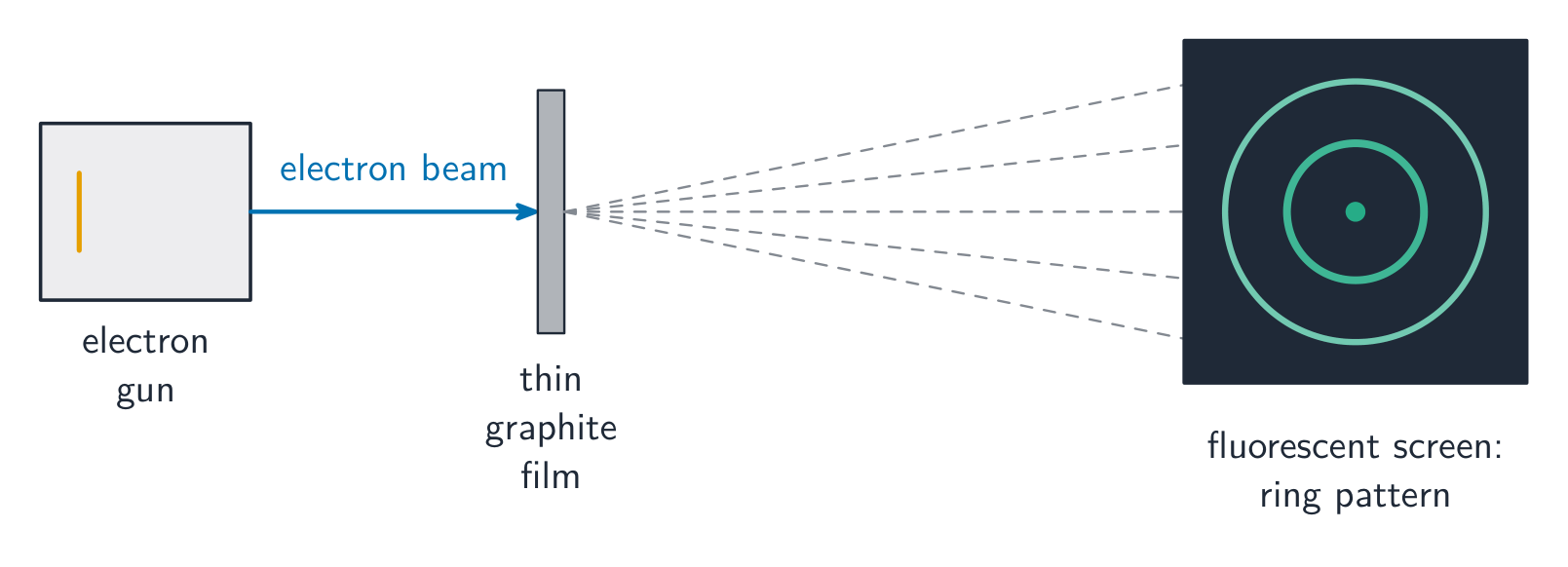
where $h$ is Planck's constant. Wave–particle duality 波粒二象性: light and matter each show both wave behavior (interference, diffraction) and particle behavior (photons, electrons as localized hits). A particle also has a matter wavelength $\lambda=\dfrac{h}{p}$, and particles genuinely produce interference - a variation of Young's double-slit experiment 双缝实验 done with electrons builds up the same fringe pattern as light.

Worked example. Find the energy of a photon of orange light with frequency $5.0\times10^{14}\ \text{Hz}$ ($h=6.63\times10^{-34}\ \text{J s}$): $E=hf=6.63\times10^{-34}\times5.0\times10^{14}=3.3\times10^{-19}\ \text{J}$, which is about $2.1\ \text{eV}$ (dividing by $1.6\times10^{-19}$). Visible-light photons carry a few electronvolts – just right to trigger the chemistry of vision and photosynthesis.

Bahasa Indonesia
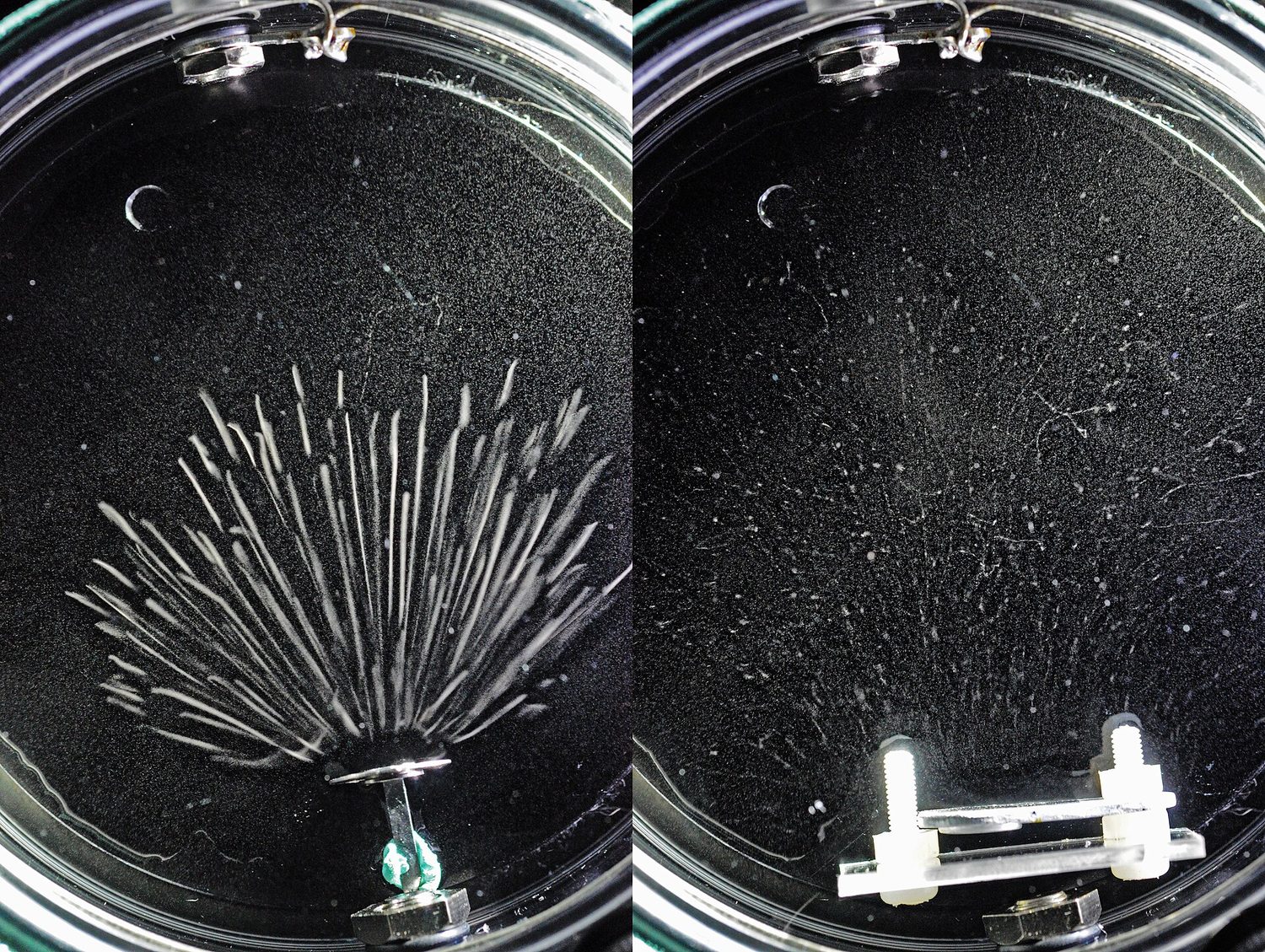
Ruang awan: fisika modern melacak partikel bermuatan dari peluruhan radioaktif
Kamari awan: fisika modern melacak partikel bermuatan dari peluruhan radioaktif

Pada skala mikroskopis, energi datang dalam paket diskrit yang disebut kuanta. Cahaya dibawa oleh foton, masing-masing dengan energi yang ditentukan oleh frekuensinya:

$$E=hf,$$
di mana $h$ adalah konstanta Planck. Dualisme gelombang-partikel: cahaya dan materi masing-masing menunjukkan perilaku gelombang (interferensi, difraksi) dan perilaku partikel (foton, elektron sebagai bentukan lokal). Partikel juga memiliki panjang gelombang materi $\lambda=\dfrac{h}{p}$, dan partikel benar-benar menghasilkan interferensi – variasi dari eksperimen celah ganda Young yang dilakukan dengan elektron membangun pola garis yang sama seperti cahaya.

Elektron membentuk pola difraksi, menunjukkan bahwa partikel memiliki sifat gelombang

Contoh terpecahkan. Temukan energi foton cahaya jingga dengan frekuensi $5.0\times10^{14}\ \text{Hz}$ ($h=6.63\times10^{-34}\ \text{J s}$): $E=hf=6.63\times10^{-34}\times5.0\times10^{14}=3.3\times10^{-19}\ \text{J}$, yang kira-kira $2.1\ \text{eV}$ (dibagi dengan $1.6\times10^{-19}$). Foton cahaya tampak membawa beberapa elektronvolt – pas untuk memicu kimia penglihatan dan fotosintesis.

15.2

The Bohr Model of Atomic Structure · ⁨Model Bohr Struktur Atom⁩

Syllabus · ⁨Silabus⁩
English

Learning Objective 15.2.A: Describe the properties of an atom.

  • 15.2.A.1 Atoms have internal structure.
    • 15.2.A.1.i Atoms consist of a small, positively charged nucleus surrounded by one or more negatively charged electrons.
    • 15.2.A.1.ii The nucleus of an atom is made up of protons and neutrons.
    • 15.2.A.1.iii The number of neutrons and protons in an atom can be represented using nuclear notation.
    • 15.2.A.1.iv An ion is an atom with a nonzero net electric charge.
  • 15.2.A.2 Each atomic element has a unique number of protons.
    • 15.2.A.2.i The number and arrangements of electrons affects how atoms interact.
    • 15.2.A.2.ii The total number of neutrons and protons identifies the isotope of an element.
    • 15.2.A.2.iii The mass of an atom is dominated by the total mass of the protons and neutrons in its nucleus.
  • 15.2.A.3 The Bohr model of the atom is based on classical physics and was the historical representation of the atom that led to the description of the hydrogen atom in terms of discrete energy states.
    • 15.2.A.3.i In the Bohr model of the atom, electrons are modeled as moving around the nucleus in circular orbits determined by the electron's charge and mass, as well as the electric force between the electron and the nucleus.
      • Relevant equations:
      • $F_e = k\dfrac{q_1 q_2}{r^2}$
      • $F_{\text{net}} = m\dfrac{v^2}{r}$
    • 15.2.A.3.ii The standing wave model of electrons accounts for the existence of specific allowed energy states of an electron in an atom, because the electron orbit's circumference must be an integer multiple of the electron's de Broglie wavelength.

Boundary statement: The analysis and description of electron structure is limited to energy levels and will not include such advanced descriptions as orbitals, orbital shapes, or probability functions.

Bahasa Indonesia

Tujuan Pembelajaran 15.2.A: Jelaskan sifat-sifat atom.

  • 15.2.A.1 Atom memiliki struktur internal.
    • 15.2.A.1.i Atom terdiri dari inti kecil bermuatan positif yang dikelilingi oleh satu atau lebih elektron bermuatan negatif.
    • 15.2.A.1.ii Inti atom terdiri dari proton dan neutron.
    • 15.2.A.1.iii Jumlah neutron dan proton dalam sebuah atom dapat direpresentasikan menggunakan notasi nuklir.
    • 15.2.A.1.iv Ion adalah atom dengan muatan listrik bersih yang tidak nol.
  • 15.2.A.2 Setiap unsur atom memiliki jumlah proton yang unik.
    • 15.2.A.2.i Jumlah dan susunan elektron memengaruhi bagaimana atom berinteraksi.
    • 15.2.A.2.ii Total jumlah neutron dan proton mengidentifikasi isotop dari suatu unsur.
    • 15.2.A.2.iii Massa sebuah atom didominasi oleh total massa proton dan neutron di dalam intinya.
  • 15.2.A.3 Model Bohr atom didasarkan pada fisika klasik dan merupakan representasi historis atom yang mengarah pada deskripsi atom hidrogen dalam keadaan energi diskrit.
    • 15.2.A.3.i Dalam model Bohr atom, elektron dimodelkan bergerak mengelilingi inti dalam orbit melingkar yang ditentukan oleh muatan dan massa elektron, serta gaya listrik antara elektron dan inti.
      • Persamaan yang Relevan:
      • $F_e = k\dfrac{q_1 q_2}{r^2}$
      • $F_{\text{net}} = m\dfrac{v^2}{r}$
    • 15.2.A.3.ii Model gelombang berdiri elektron menjelaskan keberadaan keadaan energi tertentu yang diizinkan bagi elektron dalam atom, karena keliling lintasan elektron harus merupakan kelipatan bulat dari panjang gelombang de Broglie elektron.

Pernyataan Batas: Analisis dan deskripsi struktur elektron dibatasi hanya pada tingkat energi dan tidak akan mencakup deskripsi canggih seperti orbital, bentuk orbital, atau fungsi probabilitas.

Source: College Board AP Course and Exam Description · ⁨Sumber: Deskripsi Kursus dan Ujian College Board AP⁩

English

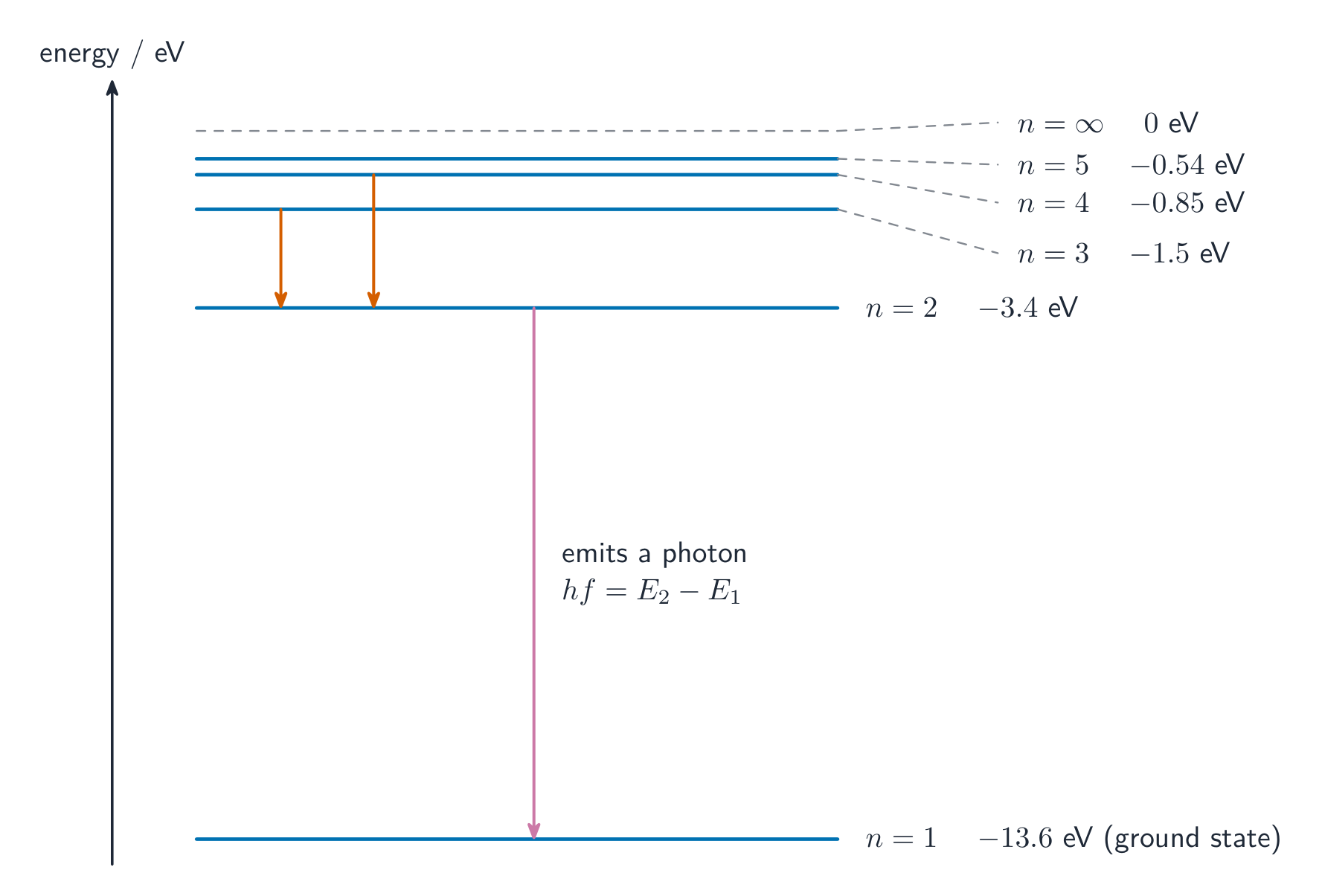
The Bohr model 玻尔模型 pictures electrons orbiting the nucleus only in certain allowed energy levels 能级. An electron can jump between levels only by absorbing or emitting a photon whose energy exactly matches the gap:

$$E_{\text{photon}}=|E_{\text{final}}-E_{\text{initial}}|.$$
Because the levels are discrete, only specific photon energies are allowed.

Bahasa Indonesia

Model Bohr menggambarkan elektron yang mengorbit inti hanya pada tingkat energi tertentu yang diizinkan. Elektron dapat berpindah antar tingkat hanya dengan menyerap atau memancarkan foton whose energy exactly matches the gap:

$$E_{\text{photon}}=|E_{\text{final}}-E_{\text{initial}}|.$$
Karena tingkat-tingkat tersebut terkuantisasi, hanya energi foton tertentu yang diizinkan.

15.3

Emission and Absorption Spectra · ⁨Spektra Emisi dan Absorpsi⁩

Syllabus · ⁨Silabus⁩
English

Learning Objective 15.3.A: Describe the emission or absorption of photons by atoms.

  • 15.3.A.1 Energy transfer occurs when photons are absorbed or emitted by an atom, which is modeled as a system consisting of a nucleus and an electron.
  • 15.3.A.2 Energy can only be absorbed or emitted by an atom if the amount of energy being absorbed or emitted corresponds to the energy difference between two atomic energy states.
    • 15.3.A.2.i An atom in a given energy state may absorb a photon of the appropriate energy and transition to a higher energy state.
    • 15.3.A.2.ii An atom in an excited energy state may emit a photon of the appropriate energy to spontaneously move to a lower energy state.
    • 15.3.A.2.iii Because an atom is modeled as a system consisting of an electron and a nucleus, a change in the energy state of an atom corresponds to a change in the interaction energy between the electron and the nucleus.
  • 15.3.A.3 Transitions between two energy states of an atom correspond to the absorption or emission of a photon of a single frequency and, therefore, a single wavelength.
  • 15.3.A.4 Atoms of each element have a unique set of allowed energy levels and thereby a unique set of absorption and emission frequencies. The unique set of frequencies determines the element's spectrum.
    • 15.3.A.4.i An emission spectrum can be used to determine the elements in a source of light.
    • 15.3.A.4.ii An absorption spectrum can be used to determine the elements composing a substance by observing what light the substance has absorbed.
    • 15.3.A.4.iii Energy level diagrams are commonly used to visually represent the energy states of an atom.
  • 15.3.A.5 Binding energy is the energy required to remove an electron from an atom, causing the atom to become ionized. An atom in the lowest energy level (ground state) will require the greatest amount of energy to remove the electron from the atom.

Boundary statement: In AP Physics 2, only energy level diagrams of single-electron atoms will be considered.

Bahasa Indonesia

Tujuan Pembelajaran 15.3.A: Deskripsikan emisi atau absorpsi foton oleh atom.

  • 15.3.A.1 Transfer energi terjadi ketika foton diserap atau dipancarkan oleh sebuah atom, yang dimodelkan sebagai sistem yang terdiri dari inti dan elektron.
  • 15.3.A.2 Energi hanya dapat diserap atau dipancarkan oleh atom jika jumlah energi yang diserap atau dipancarkan sesuai dengan selisih energi antara dua keadaan energi atom.
    • 15.3.A.2.i Atom dalam keadaan energi tertentu dapat menyerap foton dengan energi yang tepat dan beralih ke keadaan energi yang lebih tinggi.
    • 15.3.A.2.ii Atom dalam keadaan energi tereksitasi dapat memancarkan foton dengan energi yang tepat untuk secara spontan berpindah ke keadaan energi yang lebih rendah.
    • 15.3.A.2.iii Karena atom dimodelkan sebagai sistem yang terdiri dari elektron dan inti, perubahan keadaan energi atom berkorelasi dengan perubahan energi interaksi antara elektron dan inti.
  • 15.3.A.3 Transisi antara dua keadaan energi atom berkorelasi dengan penyerapan atau pemindaan foton dengan frekuensi tunggal, dan karenanya dengan panjang gelombang tunggal.
  • 15.3.A.4 Atom dari setiap unsur memiliki himpunan tingkat energi yang diizinkan yang unik, sehingga memiliki himpunan frekuensi absorpsi dan emisi yang unik. Himpunan frekuensi yang unik ini menentukan spektra unsur tersebut.
    • 15.3.A.4.i Spektra emisi dapat digunakan untuk menentukan unsur-unsur dalam sumber cahaya.
    • 15.3.A.4.ii Spektra absorpsi dapat digunakan untuk menentukan unsur-unsur penyusun suatu zat dengan mengamati cahaya apa yang telah diserap oleh zat tersebut.
    • 15.3.A.4.iii Diagram tingkat energi umumnya digunakan untuk merepresentasikan secara visual keadaan energi sebuah atom.
  • 15.3.A.5 Energi ikat adalah energi yang diperlukan untuk melepaskan elektron dari atom, menyebabkan atom menjadi terionisasi. Atom pada tingkat energi terendah (keadaan dasar) akan memerlukan jumlah energi terbesar untuk melepaskan elektron dari atom tersebut.

Pernyataan Batas: Dalam AP Physics 2, hanya diagram tingkat energi atom satu-elektron yang akan dipertimbangkan.

Source: College Board AP Course and Exam Description · ⁨Sumber: Deskripsi Kursus dan Ujian College Board AP⁩

English
  • An emission spectrum 发射光谱 is the set of bright lines given off when electrons drop to lower levels – each line a specific wavelength.
  • An absorption spectrum 吸收光谱 is the set of dark lines where those same wavelengths are absorbed from a continuous source.

The line pattern is a fingerprint of the element, since every element has its own energy levels.

Bahasa Indonesia
  • Spektra emisi adalah kumpulan garis terang yang dipancarkan ketika elektron turun ke tingkat yang lebih rendah – setiap garis memiliki panjang gelombang spesifik.
  • Spektra absorpsi adalah kumpulan garis gelap di mana panjang gelombang yang sama diserap dari sumber kontinu.
Tingkat energi diskrit hidrogen menghasilkan spektra garis

Pola garis ini merupakan sidik jari dari unsur tersebut, karena setiap unsur memiliki tingkat energinya sendiri.

Empat garis emisi tampak hidrogen pada latar belakang hitam
Spektra emisi hidrogen: setiap garis terang adalah cahaya dari elektron yang turun antara tingkat energi tetap
Explore · ⁨Jelajahi⁩

See an element's line spectrum · ⁨Lihat spektrum garis suatu unsur⁩

Electrons jump between fixed energy levels, emitting or absorbing photons of exact wavelengths — a line spectrum that fingerprints the element. · ⁨Elektron melompat antar tingkat energi tetap, memancarkan atau menyerap foton dengan panjang gelombang pasti — sebuah spektrum garis yang menjadi sidik jari unsur tersebut.⁩

Vocabulary · ⁨Kosa kata⁩ Train · ⁨Latih⁩
English Bahasa Indonesia
quanta/ˈkwɒntə/ kuanta
photons/ˈfəʊtɒnz/ foton
Wave–particle duality/weɪv ˈpɑːtɪkl djuːˈælɪti/ Dualitas gelombang-partikel
double-slit experiment/ˈdʌbl slɪt ekˈsperɪmənt/ Eksperimen celah ganda
Bohr model/ˈbəʊə ˈmɒdl/ model Bohr
energy levels/ˈenədʒi ˈlevlz/ tingkat energi
emission spectrum/ɪˈmɪʃn ˈspektrəm/ spektrum emisi
absorption spectrum/əbˈsɔːpʃn ˈspektrəm/ spektrum penyerapan
15.4

Blackbody Radiation · ⁨Radiasi Benda Hitam⁩

Syllabus · ⁨Silabus⁩
English

Learning Objective 15.4.A: Describe the electromagnetic radiation emitted by an object due to its temperature.

  • 15.4.A.1 Matter will spontaneously convert some of its internal thermal energy into electromagnetic energy.
  • 15.4.A.2 A blackbody is an idealized model of matter that absorbs all radiation that falls on the body. If the body is in equilibrium at a constant temperature, then it must in turn emit energy.
  • 15.4.A.3 A blackbody will emit a continuous spectrum that only depends on the body's temperature. The radiation emitted by a blackbody is often modeled by plotting intensity per unit wavelength as a function of wavelength.
    • 15.4.A.3.i The distribution of the intensity of a blackbody's spectrum as a function of temperature cannot be modeled using only classical physics concepts. A blackbody's spectrum is described by Planck's law, which assumes that the energy of light is quantized.
    • 15.4.A.3.ii The peak wavelength emitted by a blackbody (the wavelength at which the blackbody emits the greatest amount of radiation per unit wavelength) decreases with increasing temperature, as described by Wien's law.
      • Relevant equation:
      • $\lambda_{\max} = \dfrac{b}{T}$
    • 15.4.A.3.iii The rate at which energy is emitted (power) by a blackbody is proportional to the surface area of the body and to the temperature of the body raised to the fourth power, as described by the Stefan-Boltzmann law.
      • Relevant equation:
      • $P = A\sigma T^4$
Bahasa Indonesia

Tujuan Pembelajaran 15.4.A: Deskripsikan radiasi elektromagnetik yang dipancarkan oleh suatu benda akibat suhunya.

  • 15.4.A.1 Materi akan secara spontan mengonversi sebagian energi termal internalnya menjadi energi elektromagnetik.
  • 15.4.A.2 Benda hitam adalah model idealisasi materi yang menyerap semua radiasi yang jatuh padanya. Jika benda berada dalam kesetimbangan pada suhu konstan, maka ia harus memancarkan energi.
  • 15.4.A.3 Benda hitam akan memancarkan spektra kontinu yang hanya bergantung pada suhu benda. Radiasi yang dipancarkan oleh benda hitam sering dimodelkan dengan menggambar intensitas per satuan panjang gelombang sebagai fungsi dari panjang gelombang.
    • 15.4.A.3.i Distribusi intensitas spektra benda hitam sebagai fungsi suhu tidak dapat dimodelkan hanya menggunakan konsep fisika klasik. Spektra benda hitam dijelaskan oleh hukum Planck, yang mengasumsikan bahwa energi cahaya terkuantisasi.
    • 15.4.A.3.ii Panjang gelombang puncak yang dipancarkan oleh benda hitam (panjang gelombang di mana benda hitam memancarkan jumlah radiasi terbesar per satuan panjang gelombang) menurun seiring kenaikan suhu, sebagaimana dijelaskan oleh hukum Wien.
      • Persamaan yang Relevan:
      • $\lambda_{\max} = \dfrac{b}{T}$
    • 15.4.A.3.iii Laju di mana energi dipancarkan (daya) oleh benda hitam sebanding dengan luas permukaan benda dan suhu benda yang dipangkatkan empat, sebagaimana dijelaskan oleh hukum Stefan-Boltzmann.
      • Persamaan yang Relevan:
      • $P = A\sigma T^4$

Source: College Board AP Course and Exam Description · ⁨Sumber: Deskripsi Kursus dan Ujian College Board AP⁩

English

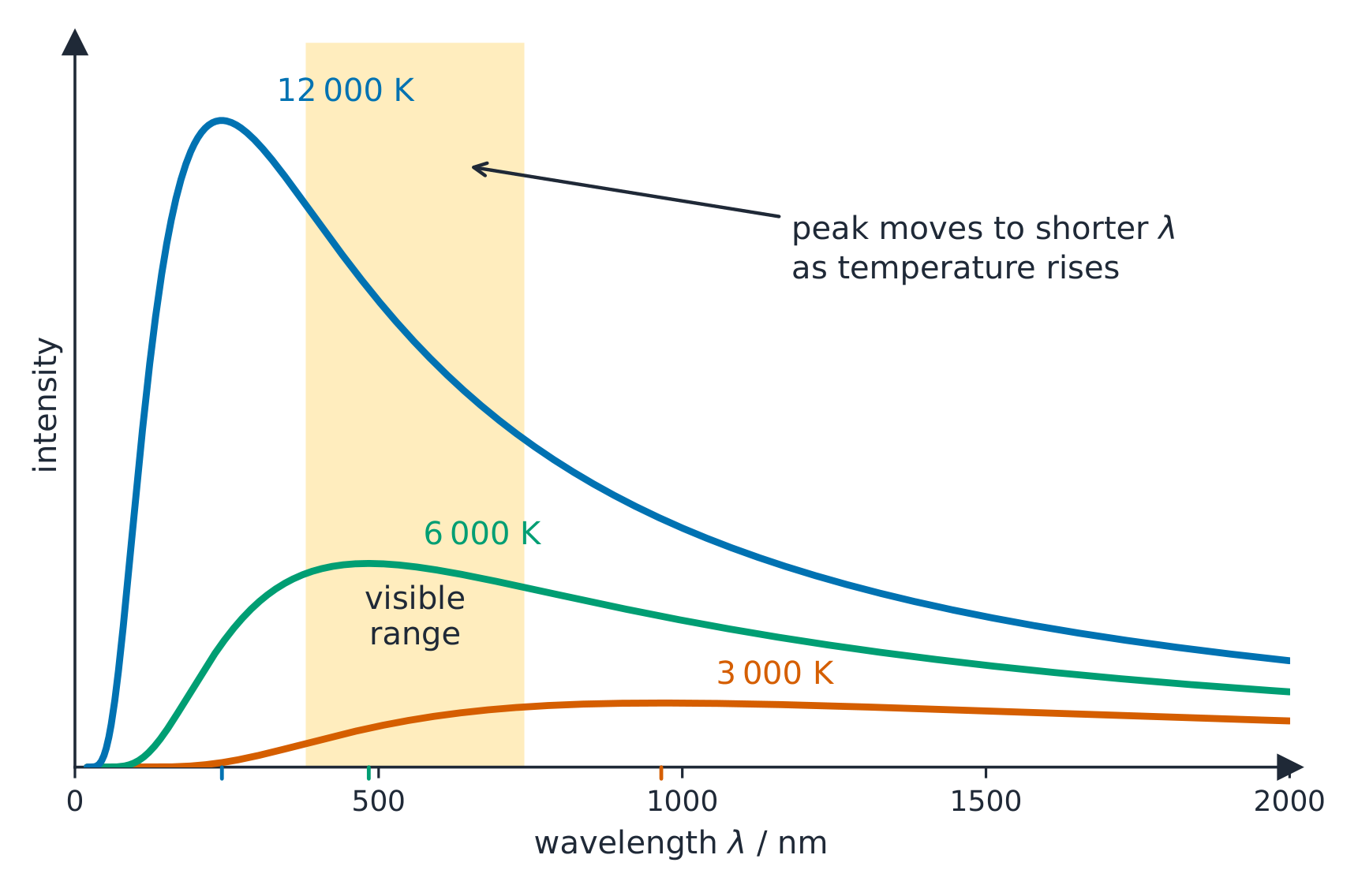
A blackbody 黑体 emits a continuous spectrum that depends only on its temperature. Hotter objects glow brighter and peak at shorter wavelengths (red-hot to white-hot to blue-hot). Explaining this spectrum required quantized energy – a founding problem of quantum theory.

Bahasa Indonesia

Sebuah benda hitam memancarkan spektra kontinu yang hanya bergantung pada suhunya. Objek yang lebih panas bersinar lebih terang dan puncaknya berada pada panjang gelombang yang lebih pendek (merah-panas hingga putih-panas hingga biru-panas). Menjelaskan spektra ini memerlukan energi terkuantisasi – sebuah masalah fondasi teori kuantum.

Benda hitam yang lebih panas memancarkan lebih banyak energi, dan puncaknya bergeser ke panjang gelombang yang lebih pendek
Benda hitam yang lebih panas memancarkan lebih banyak, dan puncaknya bergeser ke panjang gelombang yang lebih pendek
Vocabulary · ⁨Kosa kata⁩ Train · ⁨Latih⁩
English Bahasa Indonesia
blackbody/ˈblækbɒdi/ benda hitam
photoelectric effect/ˌfəʊtəʊɪˈlektrɪk ɪˈfekt/ efek fotolistrik
work function/wɜːk ˈfʌŋkʃn/ fungsi kerja
Compton scattering/ˈkɒmptn ˈskætərɪŋ/ hamburan Compton
nucleus/ˈnjuːklɪəs/ inti sel
Fission/ˈfɪʃn/ Fisi
Fusion/ˈfjuːʒn/ Fusi
15.5

The Photoelectric Effect · ⁨Efek Fotolistrik⁩

Syllabus · ⁨Silabus⁩
English

Learning Objective 15.5.A: Describe an interaction between photons and matter using the photoelectric effect.

  • 15.5.A.1 The photoelectric effect is the emission of electrons when electromagnetic radiation is incident upon a photoactive material.
  • 15.5.A.2 The emission of electrons via the photoelectric effect requires a minimum frequency of incident light, called the threshold frequency.
    • 15.5.A.2.i Light that is incident on a material and is at the threshold frequency or higher will induce electron emission, regardless of the number of photons that strike the material.
    • 15.5.A.2.ii The energy of the emitted electrons is not dependent on the number of photons that are incident upon the material, which provides evidence that light is a collection of discrete, quantized energy packets called photons.
  • 15.5.A.3 The maximum kinetic energy of an emitted electron is related to the frequency of the incident light and the work function of the material, $\phi$.
    • 15.5.A.3.i The work function of a material is the minimum energy required to emit an electron from atoms in the material.
    • 15.5.A.3.ii The maximum kinetic energy of an emitted electron is given by the equation $K_{\max} = hf - \phi$.
    • 15.5.A.3.iii In a typical experimental setup to demonstrate the photoelectric effect and determine the work function of a metal, two metal plates are placed in a vacuum chamber and connected to a variable source of potential difference. One of the plates is illuminated by monochromatic light that causes electrons to be ejected and the potential difference between the plates is adjusted until no current is measured in the circuit.

Boundary statement: Where applicable, work functions for materials will be provided on the exam; students are not expected to know values of work functions or variables of a material that influence the magnitude of its work function.

Bahasa Indonesia

Tujuan Pembelajaran 15.5.A: Deskripsikan interaksi antara foton dan materi menggunakan efek fotoelektrik.

  • 15.5.A.1 Efek fotoelektrik adalah emisi elektron ketika radiasi elektromagnetik mengenai material fotoaktif.
  • 15.5.A.2 Emisi elektron melalui efek fotoelektrik memerlukan frekuensi minimum cahaya insiden, yang disebut frekuensi ambang.
    • 15.5.A.2.i Cahaya yang mengenai material dan memiliki frekuensi ambang atau lebih tinggi akan menginduksi emisi elektron, terlepas dari jumlah foton yang mengenai material.
    • 15.5.A.2.ii Energi elektron yang dipancarkan tidak bergantung pada jumlah foton yang mengenai material, yang memberikan bukti bahwa cahaya merupakan kumpulan paket energi diskrit dan terkuantisasi yang disebut foton.
  • 15.5.A.3 Energi kinetik maksimum dari elektron yang dipancarkan berkaitan dengan frekuensi cahaya insiden dan fungsi kerja material, $\phi$.
    • 15.5.A.3.i Fungsi kerja suatu material adalah energi minimum yang diperlukan untuk memancarkan elektron dari atom-atom dalam material tersebut.
    • 15.5.A.3.ii Energi kinetik maksimum dari elektron yang dipancarkan diberikan oleh persamaan $K_{\max} = hf - \phi$.
    • 15.5.A.3.iii Dalam susunan eksperimen tipikal untuk mendemonstrasikan efek fotolistrik dan menentukan fungsi kerja logam, dua pelat logam ditempatkan di dalam ruang vakum dan dihubungkan ke sumber beda potensial variabel. Salah satu pelat diterangi oleh cahaya monokromatik yang menyebabkan elektron terlempar, dan beda potensial antara pelat-pelat tersebut disesuaikan hingga tidak ada arus yang terukur dalam sirkuit.

Pernyataan batas: Di mana berlaku, fungsi kerja untuk material akan disediakan pada ujian; siswa tidak diharapkan mengetahui nilai fungsi kerja atau variabel material yang memengaruhi besaran fungsi kerjanya.

Source: College Board AP Course and Exam Description · ⁨Sumber: Deskripsi Kursus dan Ujian College Board AP⁩

English
The photoelectric effect

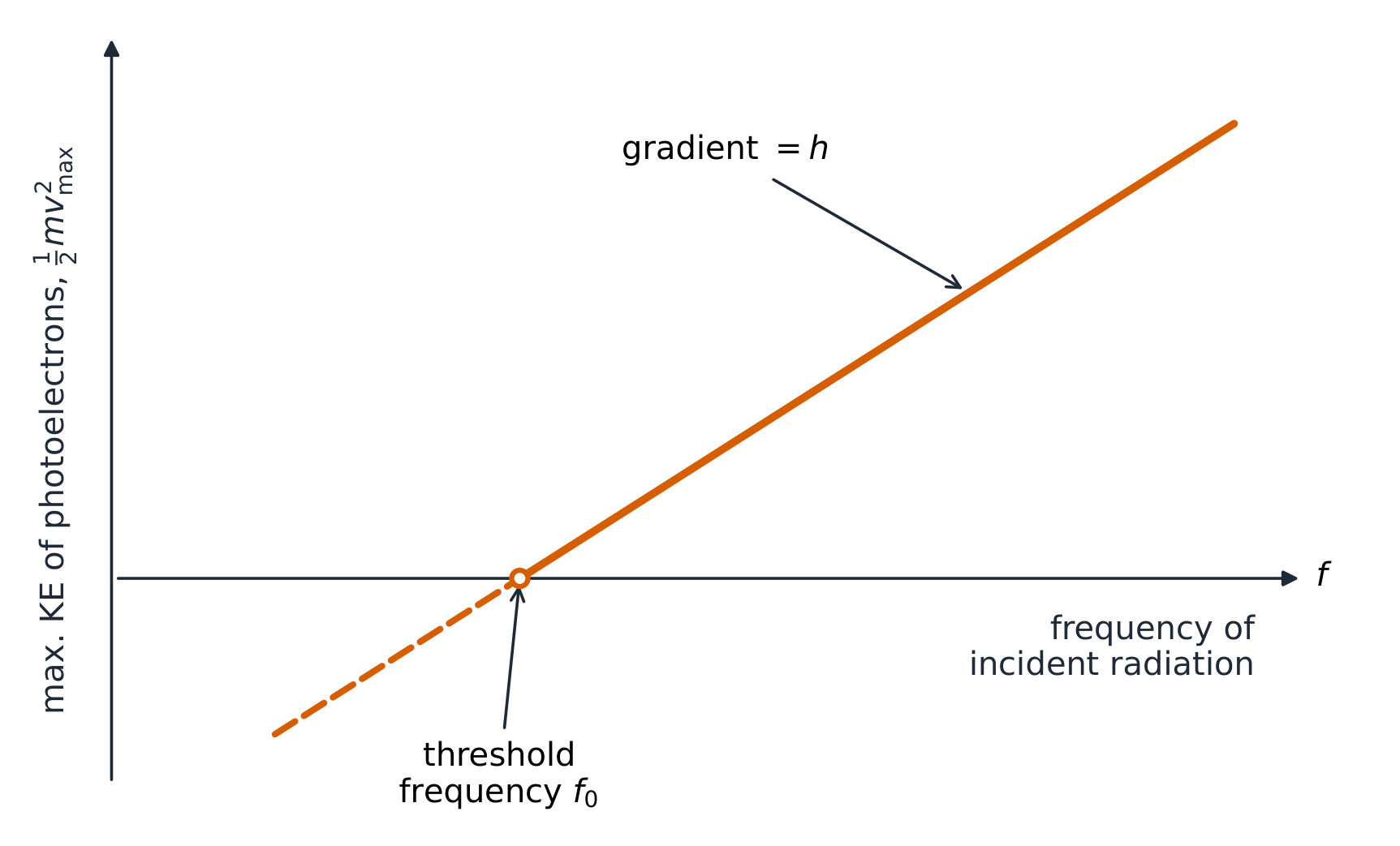
Shining light on a metal can eject electrons – the photoelectric effect 光电效应. Key facts (which only the photon picture explains): electrons come out only if the photon's frequency exceeds a threshold, no matter how bright a dimmer, lower-frequency light is. Energy conservation gives

$$K_{\max}=hf-\phi,$$
where $\phi$ is the metal's work function 逸出功 (the energy to free an electron).

Worked example. Light of frequency $8.0\times10^{14}\ \text{Hz}$ falls on a metal with work function $\phi=3.0\times10^{-19}\ \text{J}$. The most energetic electrons come off with

$$K_{\max}=hf-\phi=(6.63\times10^{-34}\times8.0\times10^{14})-3.0\times10^{-19}=5.3\times10^{-19}-3.0\times10^{-19}=2.3\times10^{-19}\ \text{J}.$$
Below the threshold frequency $\phi/h$, $K_{\max}$ would be negative – meaning no electrons escape at all, however bright the light.

Bahasa Indonesia
Efek fotolistrik

Menyinari logam dengan cahaya dapat mengeluarkan elektron – efek fotolistrik. Fakta kunci (yang hanya dijelaskan oleh gambar foton): elektron keluar hanya jika frekuensi foton melebihi ambang batas, tidak peduli seberapa terang cahaya berfrekuensi lebih rendah yang lebih redup. Kekekalan energi memberikan

$$K_{\max}=hf-\phi,$$
di mana $\phi$ adalah fungsi kerja logam (energi untuk membebaskan elektron).

Energi kinetik maksimum fotoelektron meningkat secara linear dengan frekuensi

Contoh dikerjakan. Cahaya dengan frekuensi $8.0\times10^{14}\ \text{Hz}$ jatuh pada logam dengan fungsi kerja $\phi=3.0\times10^{-19}\ \text{J}$. Elektron paling enerjik keluar dengan

$$K_{\max}=hf-\phi=(6.63\times10^{-34}\times8.0\times10^{14})-3.0\times10^{-19}=5.3\times10^{-19}-3.0\times10^{-19}=2.3\times10^{-19}\ \text{J}.$$
Di bawah frekuensi ambang $\phi/h$, $K_{\max}$ akan menjadi negatif – berarti tidak ada elektron yang melarikan diri sama sekali, tidak peduli seberapa terang cahayanya.

15.6

Compton Scattering · ⁨Hamburan Compton⁩

Syllabus · ⁨Silabus⁩
English

Learning Objective 15.6.A: Describe the interaction between photons and matter using Compton scattering.

  • 15.6.A.1 In Compton scattering, a photon interacts with a free electron. The Compton effect is when a photon that emerges from the interaction has a lower energy and longer wavelength than the incoming photon. The magnitude of the change is related to the direction of the photon after the collision.
  • 15.6.A.2 Compton scattering provides evidence that light is a collection of discrete, quantized energy packets called photons.
    • 15.6.A.2.i Compton scattering can be explained by treating a photon as a particle and applying conservation of energy and conservation of momentum to the collision between the photon and electron.
    • 15.6.A.2.ii The transfer of a photon's energy to an electron results in the energy, momentum, frequency, and wavelength of the photon changing.
      • Relevant equations:
      • $E = hf$
      • $\lambda = \dfrac{h}{p}$
  • 15.6.A.3 The change in wavelength experienced by a photon after colliding with an electron is related to how much the photon's direction changes.
    • Relevant equation:
    • $\Delta\lambda = \dfrac{h}{m_e c}(1 - \cos\theta)$

Boundary statement: AP Physics 2 includes full quantitative and qualitative treatments of conservation of momentum in two dimensions.

Bahasa Indonesia

Tujuan Pembelajaran 15.6.A: Deskripsikan interaksi antara foton dan materi menggunakan hamburan Compton.

  • 15.6.A.1 Dalam hamburan Compton, sebuah foton berinteraksi dengan elektron bebas. Efek Compton terjadi ketika foton yang keluar dari interaksi memiliki energi lebih rendah dan panjang gelombang lebih panjang daripada foton masuk. Besarnya perubahan ini berkaitan dengan arah foton setelah tabrakan.
  • 15.6.A.2 Hamburan Compton memberikan bukti bahwa cahaya merupakan kumpulan paket energi diskrit dan terkuantisasi yang disebut foton.
    • 15.6.A.2.i Hamburan Compton dapat dijelaskan dengan memperlakukan foton sebagai partikel dan menerapkan kekekalan energi serta kekekalan momentum pada tabrakan antara foton dan elektron.
    • 15.6.A.2.ii Perpindahan energi foton ke elektron mengakibatkan perubahan energi, momentum, frekuensi, dan panjang gelombang foton tersebut.
      • Persamaan yang Relevan:
      • $E = hf$
      • $\lambda = \dfrac{h}{p}$
  • 15.6.A.3 Perubahan panjang gelombang yang dialami foton setelah menabrak elektron berkaitan dengan seberapa besar arah foton berubah.
    • Persamaan relevan:
    • $\Delta\lambda = \dfrac{h}{m_e c}(1 - \cos\theta)$

Pernyataan batas: AP Fisika 2 mencakup perlakuan kuantitatif dan kualitatif penuh mengenai kekekalan momentum dalam dua dimensi.

Source: College Board AP Course and Exam Description · ⁨Sumber: Deskripsi Kursus dan Ujian College Board AP⁩

English

In Compton scattering 康普顿散射, a photon collides with an electron like two particles, transferring some energy and momentum. The scattered photon comes out with less energy (longer wavelength). This is direct evidence that photons carry momentum and behave as particles.

Bahasa Indonesia

Dalam hamburan Compton, sebuah foton bertabrakan dengan elektron seperti dua partikel, mentransfer sebagian energi dan momentum. Foton yang terhambur keluar dengan energi lebih sedikit (panjang gelombang lebih panjang). Ini adalah bukti langsung bahwa foton membawa momentum dan berperilaku sebagai partikel.

15.7

Fission, Fusion, and Nuclear Decay · ⁨Fisi, Fusi, dan Peluruhan Nuklir⁩

Syllabus · ⁨Silabus⁩
English

Learning Objective 15.7.A: Describe the physical properties that constrain the behavior of interacting nuclei, subatomic particles, and nucleons.

  • 15.7.A.1 The strong force is exerted at nuclear scales and dominates the interactions of nucleons (protons or neutrons).
  • 15.7.A.2 Possible nuclear reactions are constrained by the law of conservation of nucleon number.
  • 15.7.A.3 The behavior of the constituent particles of a nuclear reaction is constrained by laws of conservation of energy, energy-mass equivalence, and conservation of momentum.
  • 15.7.A.4 For all nuclear reactions, mass and energy may be exchanged due to mass-energy equivalence.
    • Relevant equation:
    • $E = mc^2$
  • 15.7.A.5 Energy may be released in nuclear processes in the form of kinetic energy of the products or as photons.
  • 15.7.A.6 Nuclear fusion is the process by which two or more smaller nuclei combine to form a larger nucleus, as well as subatomic particles.
  • 15.7.A.7 Nuclear fission is the process by which the nucleus of an atom splits into two or more smaller nuclei, as well as subatomic particles.
  • 15.7.A.8 Nuclear fission may occur spontaneously or may require an energy input, depending on the binding energy of the nucleus.

Learning Objective 15.7.B: Describe the radioactive decay of a given sample of material consisting of a finite number of nuclei.

  • 15.7.B.1 Radioactive decay is the spontaneous transformation of a nucleus into one or more different nuclei.
    • 15.7.B.1.i The time at which an individual nucleus undergoes radioactive decay is indeterminable, but decay rates can be described using probability
    • 15.7.B.1.ii The half-life, $t_{1/2}$, of a radioactive material is the time it takes for half of the initial number of radioactive nuclei to have spontaneously decayed.
    • 15.7.B.1.iii The decay constant $\lambda$ can be related to the half-life of a radioactive material with the equation $\lambda = \dfrac{\ln 2}{t_{1/2}}$.
  • 15.7.B.2 A material's decay constant may be used to predict the number of nuclei remaining in a sample after a period of time, or the age of a material if the initial amount of material is known.
    • Relevant equation:
    • $N = N_0 e^{-\lambda t}$
    • Derived equation:
    • $\ln\left(\dfrac{N}{N_0}\right) = -\lambda t$
  • 15.7.B.3 Different unstable elements and isotopes may have vastly different half-lives, ranging from fractions of a second to billions of years.
Bahasa Indonesia

Tujuan Pembelajaran 15.7.A: Deskripsikan sifat fisik yang membatasi perilaku inti yang saling berinteraksi, partikel subatomik, dan nukleon.

  • 15.7.A.1 Gaya kuat bekerja pada skala nuklir dan mendominasi interaksi nukleon (proton atau neutron).
  • 15.7.A.2 Reaksi nuklir yang mungkin dibatasi oleh hukum kekekalan bilangan nukleon.
  • 15.7.A.3 Perilaku partikel penyusun reaksi nuklir dibatasi oleh hukum kekekalan energi, kesetaraan energi-massa, dan kekekalan momentum.
  • 15.7.A.4 Untuk semua reaksi nuklir, massa dan energi dapat bertukar karena kesetaraan massa-energi.
    • Persamaan relevan:
    • $E = mc^2$
  • 15.7.A.5 Energi dapat dilepaskan dalam proses nuklir dalam bentuk energi kinetik produk atau sebagai foton.
  • 15.7.A.6 Fusi nuklir adalah proses di mana dua atau lebih inti kecil bergabung membentuk inti yang lebih besar, serta partikel subatomik.
  • 15.7.A.7 Fisi nuklir adalah proses di mana inti atom membelah menjadi dua atau lebih inti yang lebih kecil, serta partikel subatomik.
  • 15.7.A.8 Fisi nuklir dapat terjadi secara spontan atau memerlukan input energi, tergantung pada energi ikat inti tersebut.

Tujuan Pembelajaran 15.7.B: Deskripsikan peluruhan radioaktif dari sampel material tertentu yang terdiri dari jumlah inti yang terbatas.

  • 15.7.B.1 Peluruhan radioaktif adalah transformasi spontan dari sebuah inti menjadi satu atau lebih inti yang berbeda.
    • 15.7.B.1.i Waktu ketika sebuah inti individual mengalami peluruhan radioaktif tidak dapat ditentukan, tetapi laju peluruhan dapat dijelaskan menggunakan probabilitas
    • 15.7.B.1.ii Waktu paruh, $t_{1/2}$, dari bahan radioaktif adalah waktu yang dibutuhkan agar setengah dari jumlah awal inti radioaktif telah meluruh secara spontan.
    • 15.7.B.1.iii Konstanta peluruhan $\lambda$ dapat dikaitkan dengan waktu paruh bahan radioaktif dengan persamaan $\lambda = \dfrac{\ln 2}{t_{1/2}}$.
  • 15.7.B.2 Konstanta peluruhan suatu material dapat digunakan untuk memprediksi jumlah inti yang tersisa dalam sampel setelah periode waktu tertentu, atau usia material jika jumlah awal material diketahui.
    • Persamaan relevan:
    • $N = N_0 e^{-\lambda t}$
    • *Persamaan turunan:
    • $\ln\left(\dfrac{N}{N_0}\right) = -\lambda t$
  • 15.7.B.3 Elemen tak stabil dan isotop yang berbeda dapat memiliki waktu paruh yang sangat bervariasi, mulai dari pecahan detik hingga miliaran tahun.

Source: College Board AP Course and Exam Description · ⁨Sumber: Deskripsi Kursus dan Ujian College Board AP⁩

English

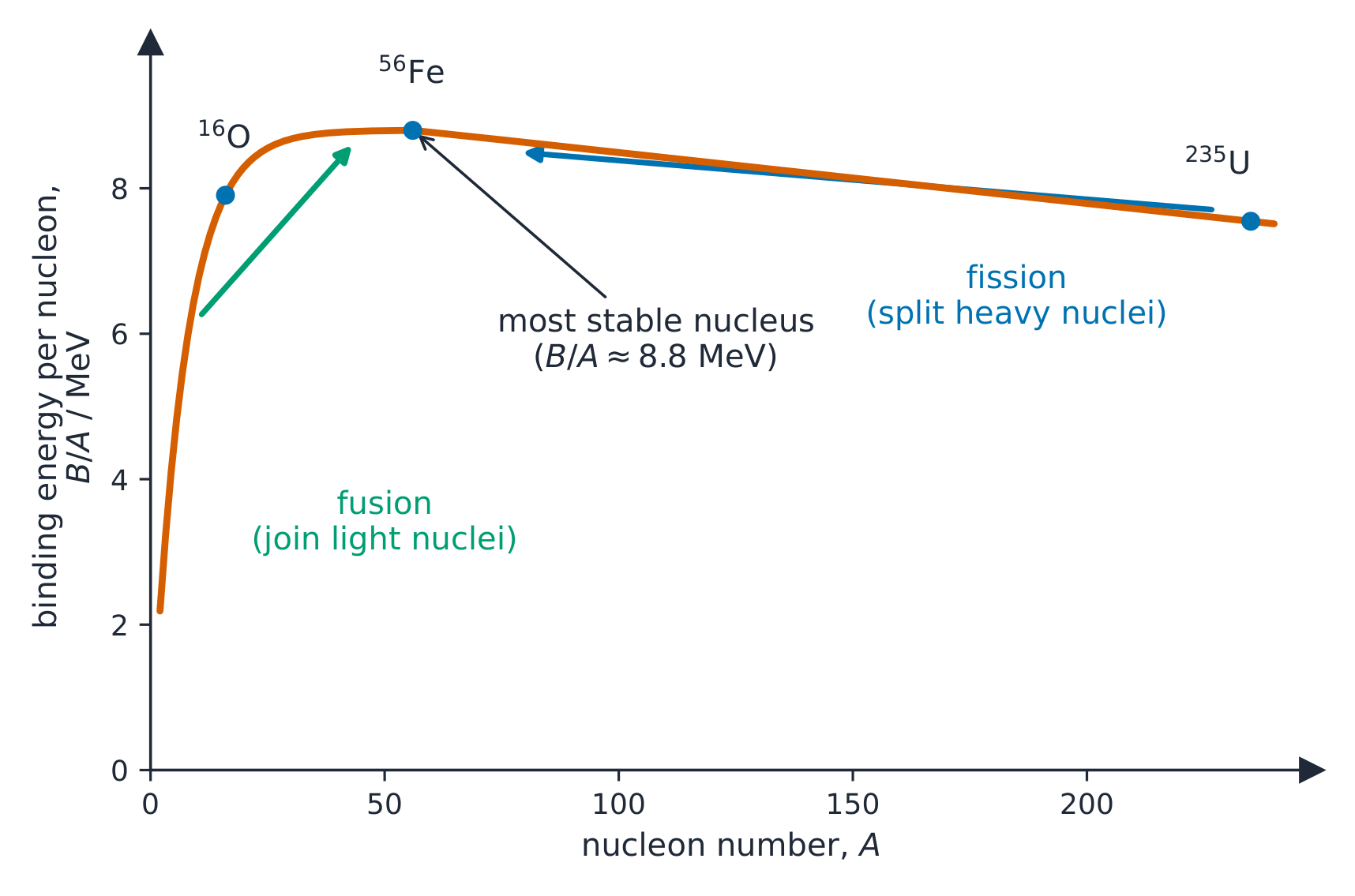
The nucleus 原子核 stores enormous energy. Fission 裂变 splits a heavy nucleus into lighter ones, releasing energy (nuclear reactors, bombs). Fusion 聚变 joins light nuclei into a heavier one (the Sun's power). Both release energy because the products have slightly less mass, converted by $E=mc^2$.

Worked example. Even a tiny mass converts to a huge energy. If a nuclear reaction loses $1.0\times10^{-3}\ \text{kg}$ of mass, it releases $E=mc^2=1.0\times10^{-3}\times(3.0\times10^{8})^2=9.0\times10^{13}\ \text{J}$ – roughly the energy of $20\,000$ tonnes of TNT.

Bahasa Indonesia

Inti menyimpan energi yang sangat besar. Fisi memecah inti berat menjadi inti yang lebih ringan, melepaskan energi (reaktor nuklir, bom). Fusi menggabungkan inti ringan menjadi inti yang lebih berat (tenaga Matahari). Keduanya melepaskan energi karena produknya memiliki massa sedikit lebih sedikit, dikonversi oleh $E=mc^2$.

Energi ikat per nukleon mencapai puncak di dekat besi, sehingga baik fusi maupun fisi dapat melepaskan energi
Energi ikat per nukleon mencapai puncak dekat besi, sehingga baik fusi maupun fisi dapat melepaskan energi

Contoh dikerjakan. Bahkan massa kecil pun berubah menjadi energi yang sangat besar. Jika reaksi nuklir kehilangan $1.0\times10^{-3}\ \text{kg}$ massa, ia melepaskan $E=mc^2=1.0\times10^{-3}\times(3.0\times10^{8})^2=9.0\times10^{13}\ \text{J}$ – sekitar energi dari $20\,000$ ton TNT.

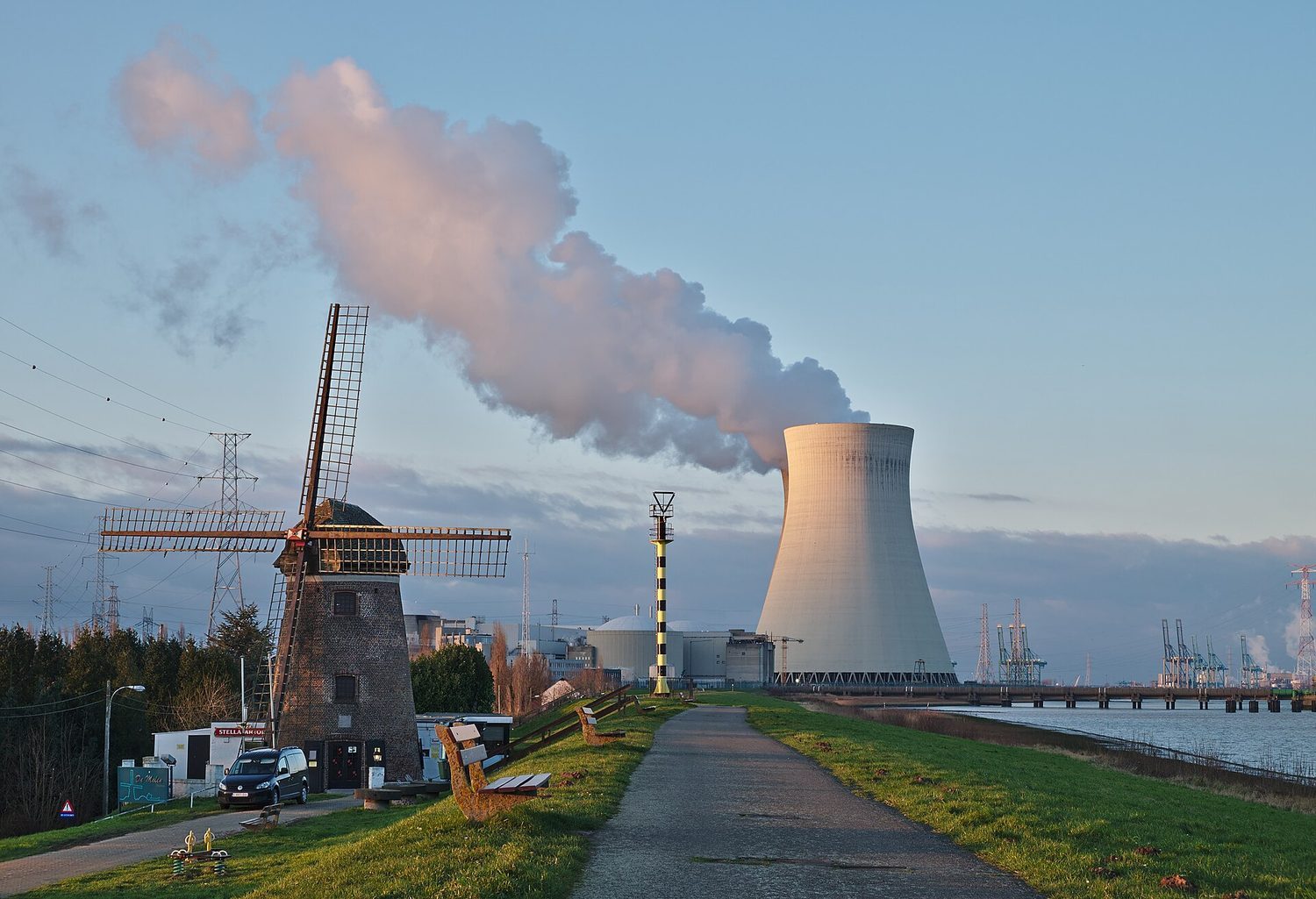
Pembangkit listrik tenaga nuklir: fisi inti berat melepaskan energi yang menggerakkan pembangkit tersebut
Pembangkit listrik tenaga nuklir: fisi inti berat melepaskan energi yang menggerakkan pembangkit
Explore · ⁨Jelajahi⁩

Balance a nuclear decay equation · ⁨Seimbangkan persamaan peluruhan nuklir⁩

In alpha, beta and gamma decay, nucleon and charge numbers must balance. Pick a mode and see how the parent turns into the daughter nuclide. · ⁨Dalam peluruhan alfa, beta dan gamma, nomor nukleon dan muatan harus seimbang. Pilih mode dan lihat bagaimana nukl induk berubah menjadi nukl anak.⁩

15.8

Types of Radioactive Decay · ⁨Jenis Peluruhan Radioaktif⁩

Syllabus · ⁨Silabus⁩
Learning ObjectiveEssential Knowledge

15.8.A
Describe the processes by which individual nuclei decay.

  • 15.8.A.1 Some processes by which nuclei decay emit subatomic particles with unique properties.
    • 15.8.A.1.i An alpha particle, or helium nucleus, consists of two neutrons and two protons and is symbolized by $\alpha$ or $\text{He}^{2+}$. (In Physics 2, only He-4 nuclei will be considered.)
    • 15.8.A.1.ii Neutrinos and antineutrinos are subatomic particles that have no electrical charge, have negligible mass, and are symbolized by $\nu$ and $\bar{\nu}$, respectively.
    • 15.8.A.1.iii Neutrinos and antineutrinos only interact with matter via the weak force and the gravitational force, which results in very little interaction with normal matter.
    • 15.8.A.1.iv Positrons, or antielectrons, are subatomic particles that have an electric charge opposite that of an electron, have the same mass as an electron, and are symbolized by $e^+$ or $\beta^+$.
  • 15.8.A.2 Nuclei can undergo radioactive decay via alpha decay, beta-minus decay ($\beta^-$), beta-plus decay ($\beta^+$), and gamma decay ($\gamma$).
    • 15.8.A.2.i In all nuclear decays, nucleon number (the number of neutrons and protons), lepton number (the number of electrons and neutrinos), and charge are conserved.
    • 15.8.A.2.ii Alpha decay occurs when a nucleus ejects an alpha particle.
    • 15.8.A.2.iii Beta-minus decay occurs when a neutron changes to a proton by emitting an electron and antineutrino.
    • 15.8.A.2.iv Beta-plus decay occurs when a proton changes to a neutron by emitting a positron and neutrino.
    • 15.8.A.2.v Gamma decay occurs after a nucleus has undergone alpha or beta decay and the excited nucleus decays to a lower energy state by emitting a photon.
  • 15.8.A.3 The type of decay exhibited by a given nucleus is determined by the isotope of the element.

Boundary statement: AP Physics 2 does not expect students to memorize the processes by which specific isotopes decay or the half-lives of specific isotopes. Neutron emission and electron capture are not included in the AP Physics 2 curriculum framework. Additionally, types of neutrinos, the characteristics that distinguish neutrinos and antineutrinos, and an explanation or application of the weak force are not within the scope of this course.

Source: College Board AP Course and Exam Description · ⁨Sumber: Deskripsi Kursus dan Ujian College Board AP⁩

English
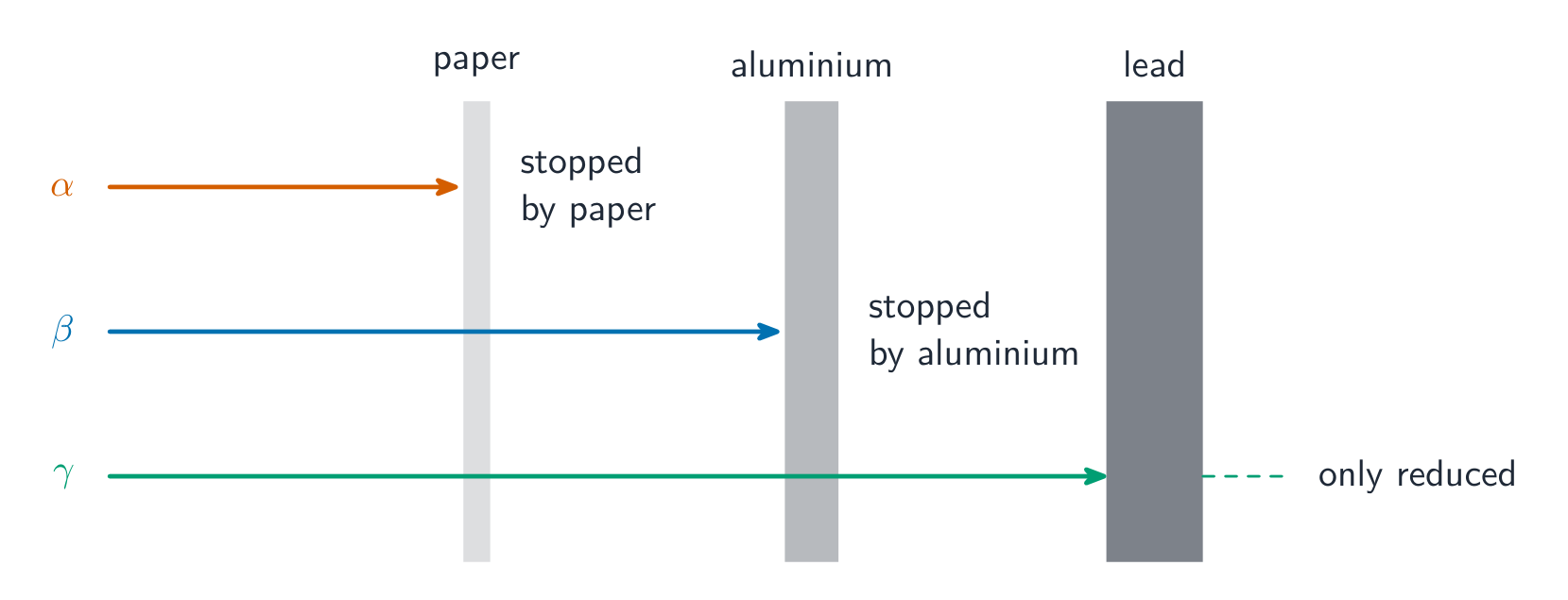
Radioactive decay & half-life

Unstable nuclei undergo radioactive decay 放射性衰变, emitting:

  • Alpha decay 阿尔法衰变 ($\alpha$): a helium nucleus – mass number drops by 4.
  • Beta decay 贝塔衰变 ($\beta$) comes in two kinds. In beta-minus ($\beta^-$) a neutron becomes a proton, emitting an electron and an antineutrino 反中微子: $n\rightarrow p+e^-+\bar{\nu}$. In beta-plus ($\beta^+$) a proton becomes a neutron, emitting a positron 正电子 and a neutrino 中微子: $p\rightarrow n+e^++\nu$.
  • Gamma decay 伽马衰变 ($\gamma$): a high-energy photon – the nucleus sheds excess energy.

The neutrino and antineutrino (symbols $\nu$, $\bar{\nu}$) are tiny, chargeless, almost-massless particles that carry off energy and keep beta decay balanced. Decay is random, but a sample halves every half-life 半衰期: after each half-life, half of the remaining nuclei have decayed. Every decay equation conserves three quantities: nucleon number (mass number), charge, and lepton number 轻子数 – an electron or neutrino counts as $+1$ lepton, a positron or antineutrino as $-1$, and the totals must match on both sides.

Worked example. A radioactive sample has a half-life of $8.0$ days. What fraction is left after $24$ days? That is $24/8.0=3$ half-lives, so the fraction remaining is $\left(\tfrac12\right)^3=\tfrac18$ – about $12.5\%$. In an alpha decay of uranium-238 ($^{238}_{\ 92}\text{U}$), the daughter has mass number $238-4=234$ and atomic number $92-2=90$: thorium-234.

Bahasa Indonesia
Peluruhan radioaktif & waktu paruh

Inti tidak stabil mengalami peluruhan radioaktif, memancarkan:

Daya tembus radiasi alfa, beta, dan gamma
  • Peluruhan alfa ($\alpha$): inti helium – nomor massa turun sebanyak 4.
  • Peluruhan beta ($\beta$) datang dalam dua jenis. Dalam beta-minus ($\beta^-$) neutron berubah menjadi proton, memancarkan elektron dan antineutrino: $n\rightarrow p+e^-+\bar{\nu}$. Dalam beta-plus ($\beta^+$) proton berubah menjadi neutron, memancarkan positron dan neutrino: $p\rightarrow n+e^++\nu$.
  • Peluruhan gamma ($\gamma$): foton berenergi tinggi – inti menanggalkan energi berlebih.

Neutrino dan antineutrino (simbol $\nu$, $\bar{\nu}$) adalah partikel yang sangat kecil, tanpa muatan, hampir tak bermassa yang membawa energi dan menjaga keseimbangan peluruhan beta. Peluruhan bersifat acak, namun sampel berkurang setengah setiap waktu paruh: setelah setiap waktu paruh, setengah dari inti yang tersisa telah meluruh. Setiap persamaan peluruhan mengawetkan tiga besaran: nomor nukleon (nomor massa), muatan, dan nomor lepton – elektron atau neutrino dihitung sebagai $+1$ lepton, positron atau antineutrino sebagai $-1$, dan total harus cocok di kedua sisi.

Contoh dikerjakan. Sampel radioaktif memiliki waktu paruh $8.0$ hari. Berapa fraksi yang tersisa setelah $24$ hari? Itu adalah $24/8.0=3$ waktu paruh, jadi fraksi yang tersisa adalah $\left(\tfrac12\right)^3=\tfrac18$ – sekitar $12.5\%$. Dalam peluruhan alfa uranium-238 ($^{238}_{\ 92}\text{U}$), anak memiliki nomor massa $238-4=234$ dan nomor atom $92-2=90$: torium-234.

Explore · ⁨Jelajahi⁩

Watch a sample decay · ⁨Amati peluruhan sampel⁩

Radioactive nuclei decay randomly with a fixed half-life: each half-life halves the number remaining. Step forward and watch the sample shrink. · ⁨Nuklir radioaktif meluruh secara acak dengan waktu paruh tetap: setiap waktu paruh mengurangi jumlah tersisa menjadi setengah. Majukan langkah dan saksikan sampel mengecil.⁩

Vocabulary · ⁨Kosa kata⁩ Train · ⁨Latih⁩
English Bahasa Indonesia
radioactive decay/ˌreɪdɪəʊˈæktɪv dɪˈkeɪ/ peluruhan radioaktif
Alpha decay/ˈælfə dɪˈkeɪ/ Peluruhan Alpha
Beta decay/ˈbiːtə dɪˈkeɪ/ Peluruhan Beta
antineutrino/ˌæntɪnjuːˈtriːnəʊ/ antineutrino
positron/ˈpɒzɪtrɒn/ positron
neutrino/njuːˈtriːnəʊ/ neutrino
Gamma decay/ˈɡæmə dɪˈkeɪ/ Peluruhan Gamma
half-life/hɑːf laɪf/ waktu paruh
lepton number/ˈleptɒn ˈnʌmbə/ Nomor lepton
15.8

Exam tips · ⁨Tips ujian⁩

English
  • Photon energy is $E=hf$; below the threshold frequency no electrons are emitted however bright the light (the photoelectric effect).
  • Use $K_{\max}=hf-\phi$ for the fastest photoelectrons ($\phi$ = work function).
  • Electrons jump between discrete energy levels by absorbing/emitting a photon whose energy equals the level gap — the source of line spectra.
  • In fission and fusion the small mass lost becomes energy via $E=mc^2$.
  • Balance decay equations by conserving mass number, charge, and lepton number (write the antineutrino in $\beta^-$, the neutrino in $\beta^+$), and halve the sample every half-life ($(\tfrac12)^n$ after $n$ half-lives).
Bahasa Indonesia
  • Energi foton adalah $E=hf$; di bawah frekuensi ambang tidak ada elektron yang dipancarkan seberapa terang pun cahayanya (efek fotolistrik).
  • Gunakan $K_{\max}=hf-\phi$ untuk fotoelektron tercepat ($\phi$ = fungsi kerja).
  • Elektron berpindah antar tingkat energi diskrit dengan menyerap/memancarkan foton whose energy equals the level gap — sumber spektra garis.
  • Dalam fisi dan fusi, massa hilang kecil berubah menjadi energi melalui $E=mc^2$.
  • Seimbangkan persamaan peluruhan dengan mengawalkan nomor massa, muatan, dan nomor lepton (tulis antineutrino dalam $\beta^-$, neutrino dalam $\beta^+$), dan kurangi sampel menjadi setengah setiap waktu paruh ($(\tfrac12)^n$ setelah $n$ waktu paruh).

Interactive lessons on this topic · ⁨Pelajaran interaktif untuk topik ini⁩

Work through it step by step, with instant-check exercises. · ⁨Kerjakan langkah demi langkah, dengan latihan pengecekan instan.⁩

Past Papers · ⁨Soal-Soil Masa Lalu⁩

More topics in AP Physics 2 · ⁨AP Fisika 2⁩ · ⁨Topik lain dalam AP Physics 2 · ⁨AP Fisika 2⁩⁩

Log in or create account · ⁨Masuk atau buat akun⁩

IGCSE, A-Level & AP