Skip to content · ⁨Lompat ke konten⁩

Torque and Rotational Dynamics · ⁨Torsi dan Dinamika Rotasi⁩

AP Physics 1 · ⁨AP Fisika 1⁩ · Topic 5 · ⁨Topik 5⁩

Video lesson for this topic · ⁨Pelajaran video untuk topik ini⁩ Open the video page · ⁨Buka halaman video⁩
7:41

Torsi dan Dinamika Rotasi

Dorong pintu berat tepat di dekat engselnya, sekuat tenaga. Pintu itu hampir tidak bergerak. Sekarang dorong dengan gaya yang sama, di gagang pintu — dan pintu terbuka lebar. Sama…

English narration · English + 中文 subtitles burned in · ⁨Narasi bahasa Inggris · Subtitle bahasa Inggris + 中文 disematkan langsung⁩

5.1

Rotational Kinematics · ⁨Kinematika Rotasi⁩

Syllabus · ⁨Silabus⁩
English

Learning Objective 5.1.A: Describe the rotation of a system with respect to time using angular displacement, angular velocity, and angular acceleration.

  • 5.1.A.1 Angular displacement is the measurement of the angle, in radians, through which a point on a rigid system rotates about a specified axis.
    • Equation: $\Delta\theta = \theta - \theta_0$
    • 5.1.A.1.i A rigid system is one that holds its shape but in which different points on the system move in different directions during rotation. A rigid system cannot be modeled as an object.
    • 5.1.A.1.ii One direction of angular displacement about an axis of rotation—clockwise or counterclockwise—is typically indicated as mathematically positive, with the other direction becoming mathematically negative.
    • 5.1.A.1.iii If the rotation of a system about an axis may be well described using the motion of the system's center of mass, the system may be treated as a single object. For example, the rotation of Earth about its axis may be considered negligible when considering the revolution of Earth about the center of mass of the Earth–Sun system.
  • 5.1.A.2 Average angular velocity is the average rate at which angular position changes with respect to time.
    • Equation: $\omega_{\text{avg}} = \dfrac{\Delta\theta}{\Delta t}$
  • 5.1.A.3 Average angular acceleration is the average rate at which the angular velocity changes with respect to time.
    • Equation: $\alpha_{\text{avg}} = \dfrac{\Delta\omega}{\Delta t}$
  • 5.1.A.4 Angular displacement, angular velocity, and angular acceleration around one axis are analogous to linear displacement, velocity, and acceleration in one dimension and demonstrate the same mathematical relationships.
    • 5.1.A.4.i For constant angular acceleration, the mathematical relationships between angular displacement, angular velocity, and angular acceleration can be described with the following equations:
      • Equation: $\omega = \omega_0 + \alpha t$
      • Equation: $\theta = \theta_0 + \omega_0 t + \dfrac{1}{2}\alpha t^2$
      • Equation: $\omega^2 = \omega_0^2 + 2\alpha(\theta - \theta_0)$
    • 5.1.A.4.ii Graphs of angular displacement, angular velocity, and angular acceleration as functions of time can be used to find the relationships between those quantities.

Boundary statement: Descriptions of the directions of rotation for a point or object are limited to clockwise and counterclockwise with respect to a given axis of rotation.

Bahasa Indonesia

Tujuan Pembelajaran 5.1.A: Deskripsikan rotasi suatu sistem terhadap waktu menggunakan simpangan sudut, kecepatan sudut, dan percepatan sudut.

  • 5.1.A.1 Simpangan sudut adalah pengukuran sudut, dalam radian, melalui mana sebuah titik pada sistem kaku berotasi sekitar sumbu yang ditentukan.
    • Persamaan: $\Delta\theta = \theta - \theta_0$
    • 5.1.A.1.i Sistem kaku adalah sistem yang mempertahankan bentuknya tetapi di mana titik-titik berbeda pada sistem bergerak ke arah yang berbeda selama rotasi. Sistem kaku tidak dapat dimodelkan sebagai satu objek.
    • 5.1.A.1.ii Salah satu arah simpangan sudut terhadap sumbu rotasi—searah jarum jam atau berlawanan arah jarum jam—biasanya ditunjukkan secara matematis sebagai positif, dengan arah lainnya menjadi negatif secara matematis.
    • 5.1.A.1.iii Jika rotasi sistem terhadap sumbu dapat dijelaskan dengan baik menggunakan gerakan pusat massa sistem, sistem tersebut dapat diperlakukan sebagai satu objek tunggal. Sebagai contoh, rotasi Bumi terhadap porosnya dapat dianggap dapat diabaikan ketika mempertimbangkan revolusi Bumi terhadap pusat massa sistem Bumi-Matahari.
  • 5.1.A.2 Kecepatan sudut rata-rata adalah laju rata-rata perubahan posisi sudut terhadap waktu.
    • Persamaan: $\omega_{\text{avg}} = \dfrac{\Delta\theta}{\Delta t}$
  • 5.1.A.3 Percepatan sudut rata-rata adalah laju rata-rata perubahan kecepatan sudut terhadap waktu.
    • Persamaan: $\alpha_{\text{avg}} = \dfrac{\Delta\omega}{\Delta t}$
  • 5.1.A.4 Simpangan sudut, kecepatan sudut, dan percepatan sudut di sekitar satu sumbu analog dengan perpindahan linear, kecepatan, dan percepatan dalam satu dimensi dan menunjukkan hubungan matematis yang sama.
    • 5.1.A.4.i Untuk percepatan sudut konstan, hubungan matematis antara simpangan sudut, kecepatan sudut, dan percepatan sudut dapat dijelaskan dengan persamaan berikut:
      • Persamaan: $\omega = \omega_0 + \alpha t$
      • Persamaan: $\theta = \theta_0 + \omega_0 t + \dfrac{1}{2}\alpha t^2$
      • Persamaan: $\omega^2 = \omega_0^2 + 2\alpha(\theta - \theta_0)$
    • 5.1.A.4.ii Grafik simpangan sudut, kecepatan sudut, dan percepatan sudut sebagai fungsi waktu dapat digunakan untuk menemukan hubungan antar besaran tersebut.

Pernyataan Batas: Deskripsi tentang arah rotasi untuk sebuah titik atau benda dibatasi hanya pada searah jarum jam dan berlawanan arah jarum jam relatif terhadap sumbu rotasi yang diberikan.
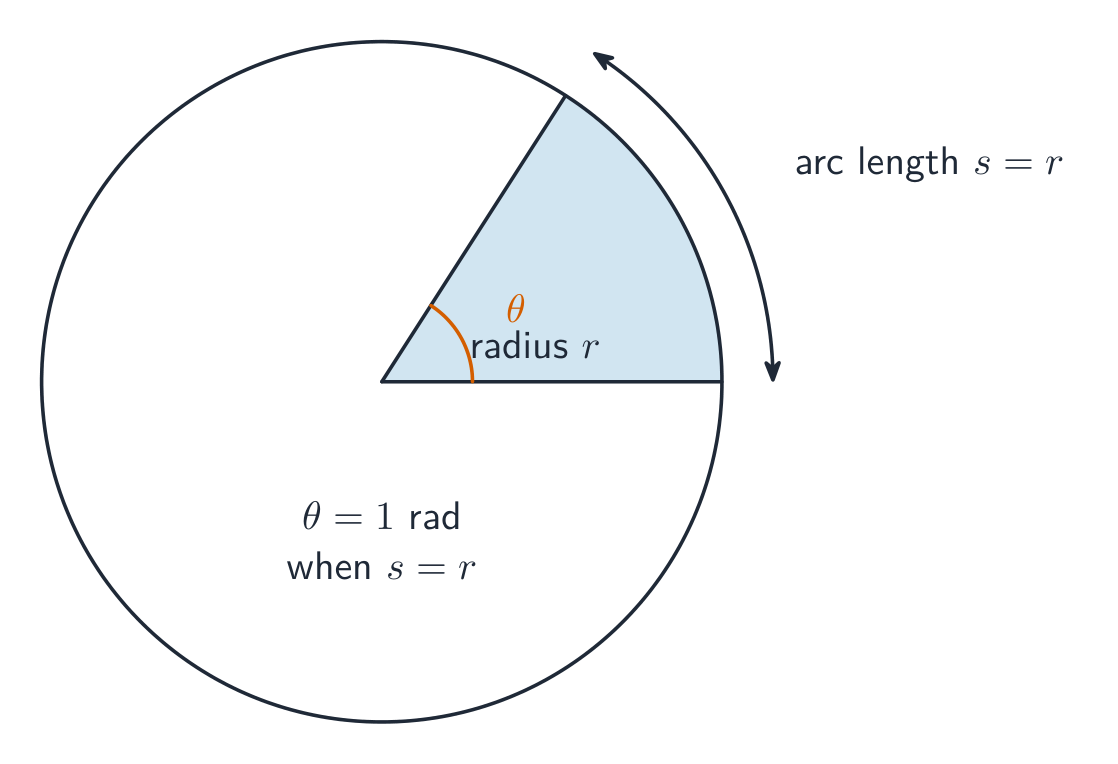
Source: College Board AP Course and Exam Description · ⁨Sumber: Deskripsi Kursus dan Ujian College Board AP⁩

English

Rotation is described by angular quantities that mirror the linear ones:

  • angular displacement 角位移 $\theta$ (in radians 弧度),
  • angular velocity 角速度 $\omega=\dfrac{\Delta\theta}{\Delta t}$,
  • angular acceleration 角加速度 $\alpha=\dfrac{\Delta\omega}{\Delta t}$.

For constant $\alpha$, the rotational kinematic equations have the same form as the linear ones, with $\theta,\omega,\alpha$ replacing $x,v,a$: $\omega=\omega_0+\alpha t$, $\theta=\omega_0 t+\tfrac12\alpha t^2$, and $\omega^2=\omega_0^2+2\alpha\theta$.

Worked example. A wheel starts from rest and speeds up uniformly to $30\ \text{rad/s}$ in $6.0\ \text{s}$. Find its angular acceleration and the total angle turned:

$$\alpha=\frac{\Delta\omega}{\Delta t}=\frac{30}{6.0}=5.0\ \text{rad/s}^2,\qquad \theta=\tfrac12\alpha t^2=\tfrac12\times5.0\times6.0^2=90\ \text{rad}.$$

Bahasa Indonesia
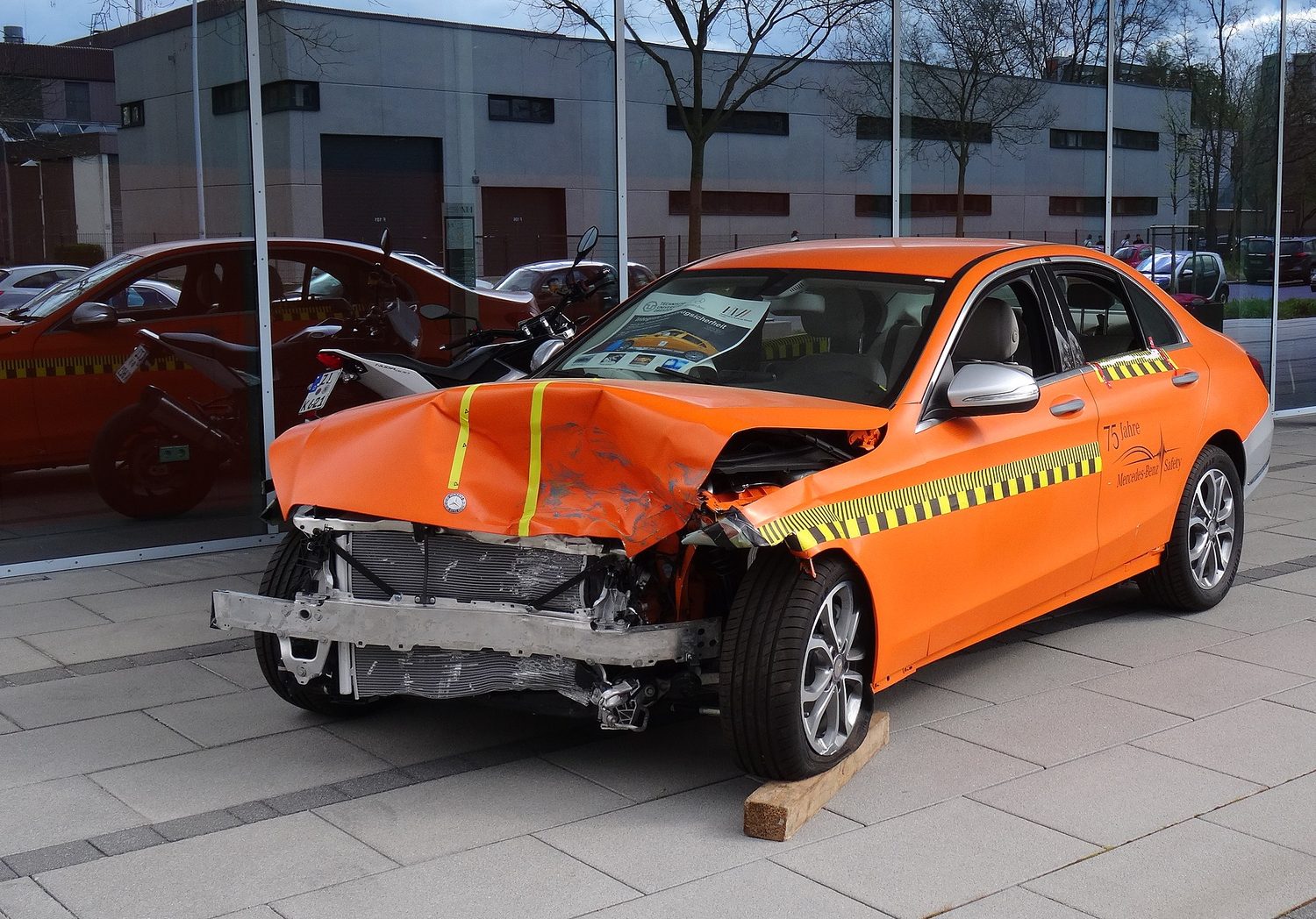
A crash-test collision: large forces and torques produce rapid changes in linear and angular motion
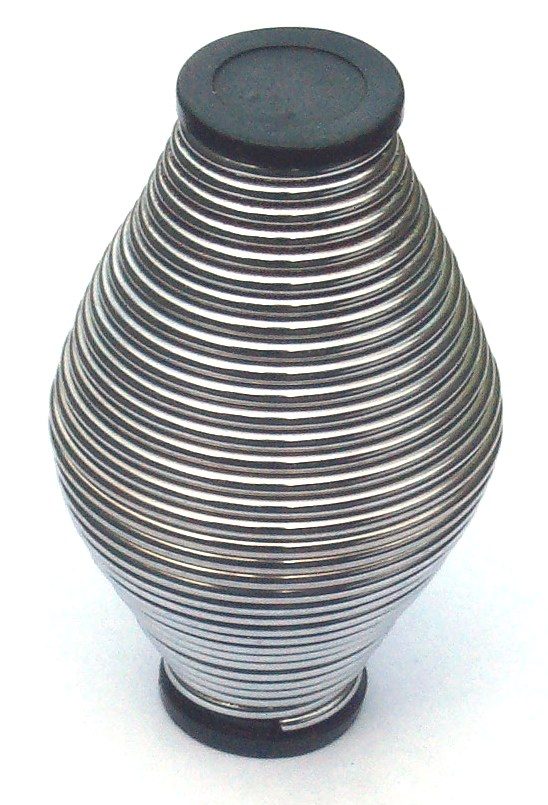
A spring under load: Hooke's law links force and extension — useful context for energy in rotating systems

Rotasi dijelaskan oleh besaran sudut yang mencerminkan besaran linear:

Satu radian adalah sudut yang panjang busurnya sama dengan jari-jari
  • pergeseran sudut $\theta$ (dalam radian),
  • kecepatan sudut $\omega=\dfrac{\Delta\theta}{\Delta t}$,
  • percepatan sudut $\alpha=\dfrac{\Delta\omega}{\Delta t}$.

Untuk $\alpha$ konstan, persamaan kinematika rotasi memiliki bentuk yang sama dengan persamaan linear, dengan $\theta,\omega,\alpha$ menggantikan $x,v,a$: $\omega=\omega_0+\alpha t$, $\theta=\omega_0 t+\tfrac12\alpha t^2$, dan $\omega^2=\omega_0^2+2\alpha\theta$.

Contoh terpecahkan. Roda mulai dari keadaan diam dan dipercepat secara seragam hingga mencapai $30\ \text{rad/s}$ dalam waktu $6.0\ \text{s}$. Temukan percepatan sudutnya dan total sudut yang berpusing:

$$\alpha=\frac{\Delta\omega}{\Delta t}=\frac{30}{6.0}=5.0\ \text{rad/s}^2,\qquad \theta=\tfrac12\alpha t^2=\tfrac12\times5.0\times6.0^2=90\ \text{rad}.$$

Vocabulary · ⁨Kosa kata⁩ Train · ⁨Latih⁩
English Bahasa Indonesia
angular displacement/ˈæŋɡjʊlə dɪˈspleɪsmənt/ pencucupan sudut
radians/ˈreɪdɪənz/ radian
angular velocity/ˈæŋɡjʊlə vəˈlɒsɪti/ halaju sudut
angular acceleration/ˈæŋɡjʊlə əkˌseləˈreɪʃn/ pecutan sudut
Torque/tɔːk/ Torsi
moment arm/ˈməʊmənt ɑːm/ Lengan momen
Rotational inertia/rəʊˈteɪʃənl ɪˈnɜːʃə/ Inersia rotasi
rotational equilibrium/rəʊˈteɪʃənl ˌiːkwɪˈlɪbrɪəm/ keseimbangan rotasi
5.2

Connecting Linear and Rotational Motion · ⁨Menghubungkan Gerak Linear dan Rotasi⁩

Syllabus · ⁨Silabus⁩
English

Learning Objective 5.2.A: Describe the linear motion of a point on a rotating rigid system that corresponds to the rotational motion of that point, and vice versa.

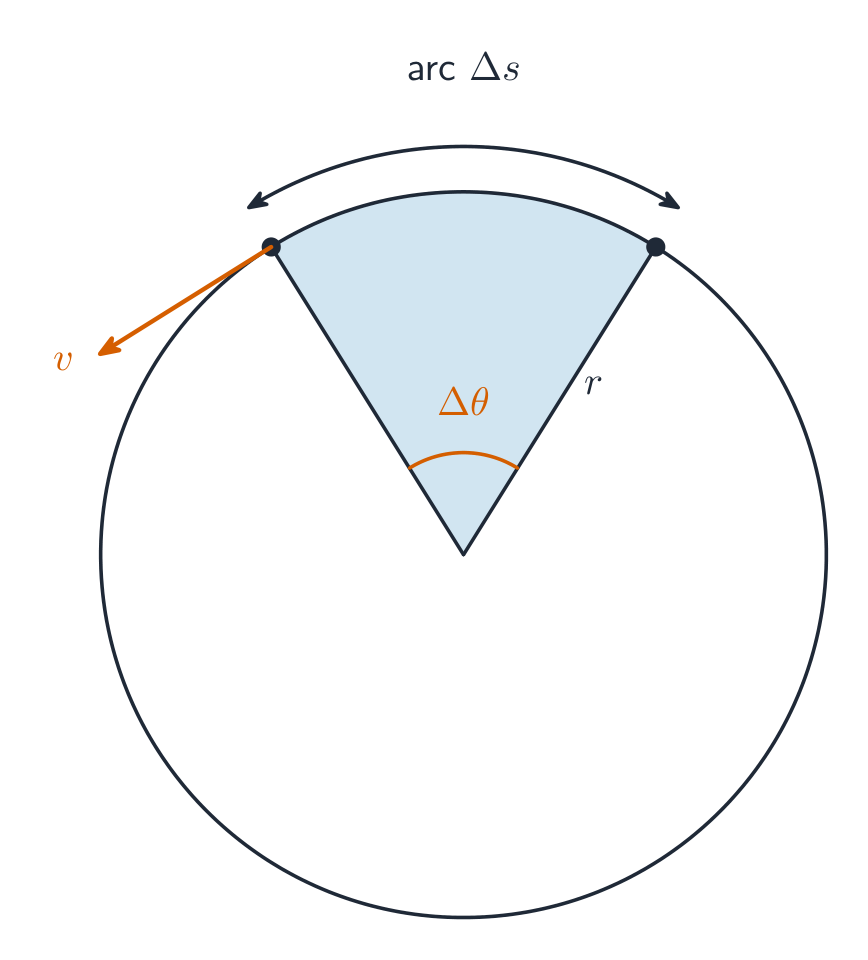
  • 5.2.A.1 For a point at a distance $r$ from a fixed axis of rotation, the linear distance $s$ traveled by the point as the system rotates through an angle $\Delta\theta$ is given by the equation $\Delta s = r\Delta\theta$.
  • 5.2.A.2 Derived relationships of linear velocity and of the tangential component of acceleration to their respective angular quantities are given by the following equations:
    • Equation: $s = r\theta$
    • Equation: $v = r\omega$
    • Equation: $a_T = r\alpha$
  • 5.2.A.3 For a rigid system, all points within that system have the same angular velocity and angular acceleration.

Boundary statement: Descriptions of the directions of rotation for a point or object are limited to clockwise and counterclockwise with respect to a given axis of rotation.

Bahasa Indonesia

Tujuan Pembelajaran 5.2.A: Deskripsikan gerakan linear sebuah titik pada sistem kaku berotasi yang sesuai dengan gerakan rotasi titik tersebut, dan sebaliknya.

  • 5.2.A.1 Untuk sebuah titik pada jarak $r$ dari sumbu rotasi tetap, jarak linear $s$ yang ditempuh oleh titik tersebut saat sistem berotasi sejauh sudut $\Delta\theta$ diberikan oleh persamaan $\Delta s = r\Delta\theta$.
  • 5.2.A.2 Hubungan turunan dari kecepatan linear dan komponen tangensial percepatan terhadap besaran sudut masing-masing diberikan oleh persamaan berikut:
    • Persamaan: $s = r\theta$
    • Persamaan: $v = r\omega$
    • Persamaan: $a_T = r\alpha$
  • 5.2.A.3 Untuk sistem kaku, semua titik di dalamnya memiliki kecepatan sudut dan percepatan sudut yang sama.

Pernyataan Batas: Deskripsi tentang arah rotasi untuk sebuah titik atau benda dibatasi hanya pada searah jarum jam dan berlawanan arah jarum jam relatif terhadap sumbu rotasi yang diberikan.
Source: College Board AP Course and Exam Description · ⁨Sumber: Deskripsi Kursus dan Ujian College Board AP⁩

English

A point at radius $r$ from the axis has linear quantities tied to the angular ones:

$$s=r\theta,\qquad v=r\omega,\qquad a_t=r\alpha.$$
Points farther from the axis move faster. This link lets you switch between "how fast the wheel spins" and "how fast a point on its rim moves."

Worked example. A bicycle wheel of radius $0.35\ \text{m}$ spins at $12\ \text{rad/s}$. A point on the rim (and so the bike) moves at $v=r\omega=0.35\times12=4.2\ \text{m/s}$. A point halfway to the axis moves at half that speed.

Bahasa Indonesia

Sebuah titik pada jari-jari $r$ dari sumbu memiliki besaran linear yang terkait dengan besaran sudutnya:

$$s=r\theta,\qquad v=r\omega,\qquad a_t=r\alpha.$$
Titik-titik yang lebih jauh dari sumbu bergerak lebih cepat. Hubungan ini memungkinkan Anda beralih antara "seberapa cepat roda berputar" dan "seberapa cepat sebuah titik di tepinya bergerak."

As the radius turns through an angle, a point moves along an arc at speed v

Contoh terpecahkan. Roda sepeda dengan jari-jari $0.35\ \text{m}$ berputar pada kecepatan $12\ \text{rad/s}$. Sebuah titik di tepi (dan sehingga sepeda) bergerak dengan kecepatan $v=r\omega=0.35\times12=4.2\ \text{m/s}$. Titik di tengah menuju sumbu bergerak dengan setengah kecepatan tersebut.

5.3

Torque · ⁨Torsi⁩

Syllabus · ⁨Silabus⁩
English

Learning Objective 5.3.A: Identify the torques exerted on a rigid system.

  • 5.3.A.1 Torque results only from the force component perpendicular to the position vector from the axis of rotation to the point of application of the force.
  • 5.3.A.2 The lever arm is the perpendicular distance from the axis of rotation to the line of action of the exerted force.

Learning Objective 5.3.B: Describe the torques exerted on a rigid system.

  • 5.3.B.1 Torques can be described using force diagrams.
    • 5.3.B.1.i Force diagrams are similar to free-body diagrams and are used to analyze the torques exerted on a rigid system.
    • 5.3.B.1.ii Similar to free-body diagrams, force diagrams represent the relative magnitude and direction of the forces exerted on a rigid system. Force diagrams also depict the location at which those forces are exerted relative to the axis of rotation.
  • 5.3.B.2 The magnitude of the torque exerted on a rigid system by a force is described by the following equation, where $\theta$ is the angle between the force vector and the position vector from the axis of rotation to the point of application of the force.
    • Equation: $\tau = rF_{\perp} = rF\sin\theta$

Boundary statement: While AP Physics 1 expects students to mathematically manipulate the magnitude of torque using vector conventions, the direction of torque is beyond the scope of the course.

Bahasa Indonesia

Tujuan Pembelajaran 5.3.A: Identifikasi torsi yang diberikan pada sistem kaku.

  • 5.3.A.1 Torsi hanya dihasilkan dari komponen gaya yang tegak lurus terhadap vektor posisi dari sumbu rotasi ke titik aplikasi gaya.
  • 5.3.A.2 Lengan tuas adalah jarak tegak lurus dari sumbu rotasi ke garis kerja gaya yang diberikan.

Tujuan Pembelajaran 5.3.B: Jelaskan torsi yang diberikan pada sistem kaku.

  • 5.3.B.1 Torsi dapat dijelaskan menggunakan diagram gaya.
    • 5.3.B.1.i Diagram gaya mirip dengan diagram benda bebas dan digunakan untuk menganalisis torsi yang diberikan pada sistem kaku.
    • 5.3.B.1.ii Mirip dengan diagram benda bebas, diagram gaya merepresentasikan besaran relatif dan arah gaya-gaya yang diberikan pada sistem kaku. Diagram gaya juga menggambarkan lokasi di mana gaya-gaya tersebut diberikan relatif terhadap sumbu rotasi.
  • 5.3.B.2 Besar torsi yang diberikan pada sistem kaku oleh sebuah gaya dijelaskan oleh persamaan berikut, di mana $\theta$ adalah sudut antara vektor gaya dan vektor posisi dari sumbu rotasi ke titik aplikasi gaya.
    • Persamaan: $\tau = rF_{\perp} = rF\sin\theta$

Pernyataan Batasan: Meskipun AP Physics 1 mengharapkan siswa memanipulasi secara matematis besar torsi menggunakan konvensi vektor, arah torsi berada di luar cakupan kursus ini.

Source: College Board AP Course and Exam Description · ⁨Sumber: Deskripsi Kursus dan Ujian College Board AP⁩

English
The principle of moments (torque)

Torque 力矩 is the rotational effect of a force – how effectively it turns an object about an axis:

$$\tau=r F\sin\theta = F\cdot r_\perp,$$
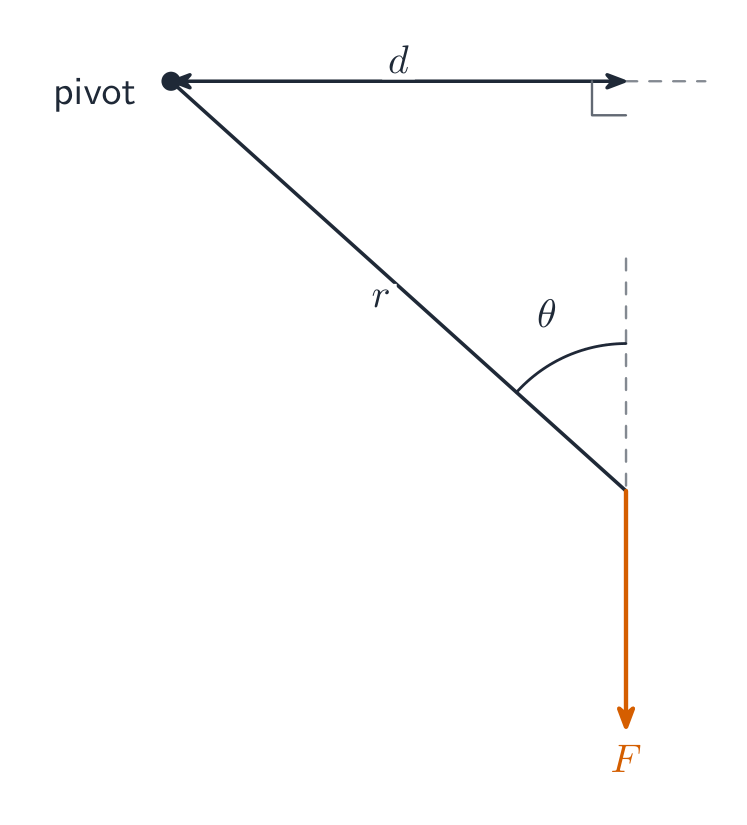
where $r_\perp$ is the moment arm 力臂 (the perpendicular distance from the axis to the force's line of action). A force applied farther out, or more perpendicular, produces more torque. Torque has a sign (clockwise vs counterclockwise).

Worked example. You push with $20\ \text{N}$ at the end of a $0.30\ \text{m}$ wrench. Perpendicular to the wrench the torque is $\tau=rF=0.30\times20=6.0\ \text{N m}$. If you push at $60^{\circ}$ to the wrench instead, only the perpendicular part counts: $\tau=rF\sin 60^{\circ}=0.30\times20\times0.87=5.2\ \text{N m}$ – which is why you push at a right angle for the most turning effect.

Bahasa Indonesia
The principle of moments (torque)

Torsi adalah efek rotasi dari gaya – seberapa efektifnya gaya itu memutar suatu objek tentang sumbu:

$$\tau=r F\sin\theta = F\cdot r_\perp,$$
di mana $r_\perp$ adalah lengan momen (jarak tegak lurus dari sumbu ke garis kerja gaya). Gaya yang diterapkan lebih jauh atau lebih tegak lurus menghasilkan torsi lebih besar. Torsi memiliki tanda (searah jarum jam vs berlawanan arah jarum jam).

The moment of a force depends on the perpendicular distance from the pivot

Contoh terpecahkan. Anda mendorong dengan gaya $20\ \text{N}$ di ujung kunci pas sepanjang $0.30\ \text{m}$. Tegak lurus terhadap kunci pas, torsinya adalah $\tau=rF=0.30\times20=6.0\ \text{N m}$. Jika Anda mendorong pada sudut $60^{\circ}$ terhadap kunci pas, hanya komponen tegak lurusnya yang dihitung: $\tau=rF\sin 60^{\circ}=0.30\times20\times0.87=5.2\ \text{N m}$ – inilah sebabnya Anda mendorong pada sudut siku-siku untuk efek putaran maksimal.

Explore · ⁨Jelajahi⁩

Balance torques on a beam · ⁨Seimbangkan torsi pada balok⁩

Torque is force times perpendicular distance, $\tau=Fd$. The beam is in rotational equilibrium when the torques on each side are equal. · ⁨Torsi adalah gaya dikali jarak tegak lurus, $\tau=Fd$. Balok berada dalam keseimbangan rotasi ketika torsi di kedua sisi sama.⁩

5.4

Rotational Inertia · ⁨Inersia Rotasi⁩

Syllabus · ⁨Silabus⁩
English

Learning Objective 5.4.A: Describe the rotational inertia of a rigid system relative to a given axis of rotation.

  • 5.4.A.1 Rotational inertia measures a rigid system's resistance to changes in rotation and is related to the mass of the system and the distribution of that mass relative to the axis of rotation.
  • 5.4.A.2 The rotational inertia of an object rotating a perpendicular distance $r$ from an axis is described by the equation
    • Equation: $I = mr^2$
  • 5.4.A.3 The total rotational inertia of a collection of objects about an axis is the sum of the rotational inertias of each object about that axis:
    • Equation: $I_{\text{tot}} = \sum I_i = \sum m_i r_i^2$

Learning Objective 5.4.B: Describe the rotational inertia of a rigid system rotating about an axis that does not pass through the system's center of mass.

  • 5.4.B.1 A rigid system's rotational inertia in a given plane is at a minimum when the rotational axis passes through the system's center of mass.
  • 5.4.B.2 The parallel axis theorem uses the following equation to relate the rotational inertia of a rigid system about any axis that is parallel to an axis through its center of mass:
    • Equation: $I' = I_{\text{cm}} + Md^2$

Boundary statement: AP Physics 1 only expects students to calculate the rotational inertia for systems of five or fewer objects arranged in a two-dimensional configuration.

Boundary statement: Students do not need to know the rotational inertia of extended rigid systems, as these will be provided within the exam. Students should have a qualitative understanding of the factors that affect rotational inertia; for example, how rotational inertia is greater when mass is farther from the axis of rotation, which is why a hoop has more rotational inertia than a solid disk of the same mass and radius.

Bahasa Indonesia

Tujuan Pembelajaran 5.4.A: Jelaskan inersia rotasi sistem kaku relatif terhadap sumbu rotasi tertentu.

  • 5.4.A.1 Inersia rotasi mengukur resistensi sistem kaku terhadap perubahan rotasi dan berkaitan dengan massa sistem serta distribusi massa tersebut relatif terhadap sumbu rotasi.
  • 5.4.A.2 Inersia rotasi dari suatu objek yang berotasi pada jarak tegak lurus $r$ dari sebuah sumbu dijelaskan oleh persamaan
    • Persamaan: $I = mr^2$
  • 5.4.A.3 Total inersia rotasi dari sekumpulan objek terhadap sebuah sumbu adalah jumlah dari inersia rotasi setiap objek terhadap sumbu tersebut:
    • Persamaan: $I_{\text{tot}} = \sum I_i = \sum m_i r_i^2$

Tujuan Pembelajaran 5.4.B: Jelaskan inersia rotasi sistem kaku yang berotasi tentang sumbu yang tidak melewati pusat massa sistem.

  • 5.4.B.1 Inersia rotasi sistem kaku dalam bidang tertentu mencapai nilai minimum ketika sumbu rotasi melewati pusat massa sistem.
  • 5.4.B.2 Teorem sumbu sejajar menggunakan persamaan berikut untuk menghubungkan inersia rotasi sistem kaku tentang sembarang sumbu yang sejajar dengan sumbu yang melalui pusat massanya:
    • Persamaan: $I' = I_{\text{cm}} + Md^2$

Pernyataan Batasan: AP Physics 1 hanya mengharapkan siswa menghitung inersia rotasi untuk sistem lima objek atau kurang yang tersusun dalam konfigurasi dua dimensi.

Pernyataan Batasan: Siswa tidak perlu mengetahui inersia rotasi dari sistem kaku yang meluas, karena hal ini akan disediakan dalam ujian. Siswa harus memiliki pemahaman kualitatif mengenai faktor-faktor yang mempengaruhi inersia rotasi; misalnya, bagaimana inersia rotasi lebih besar ketika massa berada jauh dari sumbu rotasi, yang menjelaskan mengapa lingkaran (hoop) memiliki inersia rotasi lebih besar daripada cakram solid dengan massa dan jari-jari yang sama.

Source: College Board AP Course and Exam Description · ⁨Sumber: Deskripsi Kursus dan Ujian College Board AP⁩

English

Rotational inertia 转动惯量 (moment of inertia) $I$ measures how hard it is to change an object's rotation – the rotational version of mass. It depends on both the mass and how far that mass sits from the axis: mass spread farther out gives a larger $I$. For a point mass, $I=mr^2$; for extended bodies, standard formulas are provided (a hoop is $mR^2$, a solid disk $\tfrac12 mR^2$). This is why a figure skater spins faster when she pulls her arms in – she reduces $I$.

Bahasa Indonesia

Inersia rotasi (momen inersia) $I$ mengukur seberapa sulit mengubah rotasi suatu objek – versi rotasi dari massa. Ini bergantung pada massa dan seberapa jauh massa tersebut berada dari sumbu: massa yang tersebar lebih jauh menghasilkan $I$ yang lebih besar. Untuk massa titik, $I=mr^2$; untuk benda berekstensi, rumus standar disediakan (lingkaran adalah $mR^2$, cakram pekat $\tfrac12 mR^2$). Inilah sebabnya seorang penari es berputar lebih cepat saat menarik lengannya – ia mengurangi $I$.

5.5

Rotational Equilibrium · ⁨Kesetimbangan Rotasi⁩

Syllabus · ⁨Silabus⁩
English

Learning Objective 5.5.A: Describe the conditions under which a system's angular velocity remains constant.

  • 5.5.A.1 A system may exhibit rotational equilibrium (constant angular velocity) without being in translational equilibrium, and vice versa.
    • 5.5.A.1.i Free-body and force diagrams describe the nature of the forces and torques exerted on an object or rigid system.
    • 5.5.A.1.ii Rotational equilibrium is a configuration of torques such that the net torque exerted on the system is zero.
      • Equation: $\sum \tau_i = 0$
    • 5.5.A.1.iii The rotational analog of Newton's first law is that a system will have a constant angular velocity only if the net torque exerted on the system is zero.
  • 5.5.A.2 A rotational corollary to Newton's second law states that if the torques exerted on a rigid system are not balanced, the system's angular velocity must be changing.

Boundary statement: AP Physics 1 does not expect students to simultaneously analyze rotation in multiple planes.

Bahasa Indonesia

Tujuan Pembelajaran 5.5.A: Jelaskan kondisi di mana kecepatan sudut sistem tetap konstan.

  • 5.5.A.1 Suatu sistem dapat menunjukkan kesetimbangan rotasi (kecepatan sudut konstan) tanpa berada dalam kesetimbangan translasi, dan sebaliknya.
    • 5.5.A.1.i Diagram benda bebas dan diagram gaya mendeskripsikan sifat gaya-gaya dan torsi-torsi yang diberikan pada suatu objek atau sistem kaku.
    • 5.5.A.1.ii Kesetimbangan rotasi adalah konfigurasi torsi sedemikian rupa sehingga resultan torsi yang diberikan pada sistem adalah nol.
      • Persamaan: $\sum \tau_i = 0$
    • 5.5.A.1.iii Analog rotasi dari hukum pertama Newton menyatakan bahwa sistem akan memiliki kecepatan sudut konstan hanya jika resultan torsi yang diberikan pada sistem adalah nol.
  • 5.5.A.2 Koreolarium rotasi dari hukum kedua Newton menyatakan bahwa jika torsi-torsi yang diberikan pada sistem kaku tidak seimbang, maka kecepatan sudut sistem harus berubah.

Pernyataan Batasan: AP Physics 1 tidak mengharapkan siswa menganalisis rotasi secara bersamaan di beberapa bidang.

Source: College Board AP Course and Exam Description · ⁨Sumber: Deskripsi Kursus dan Ujian College Board AP⁩

English

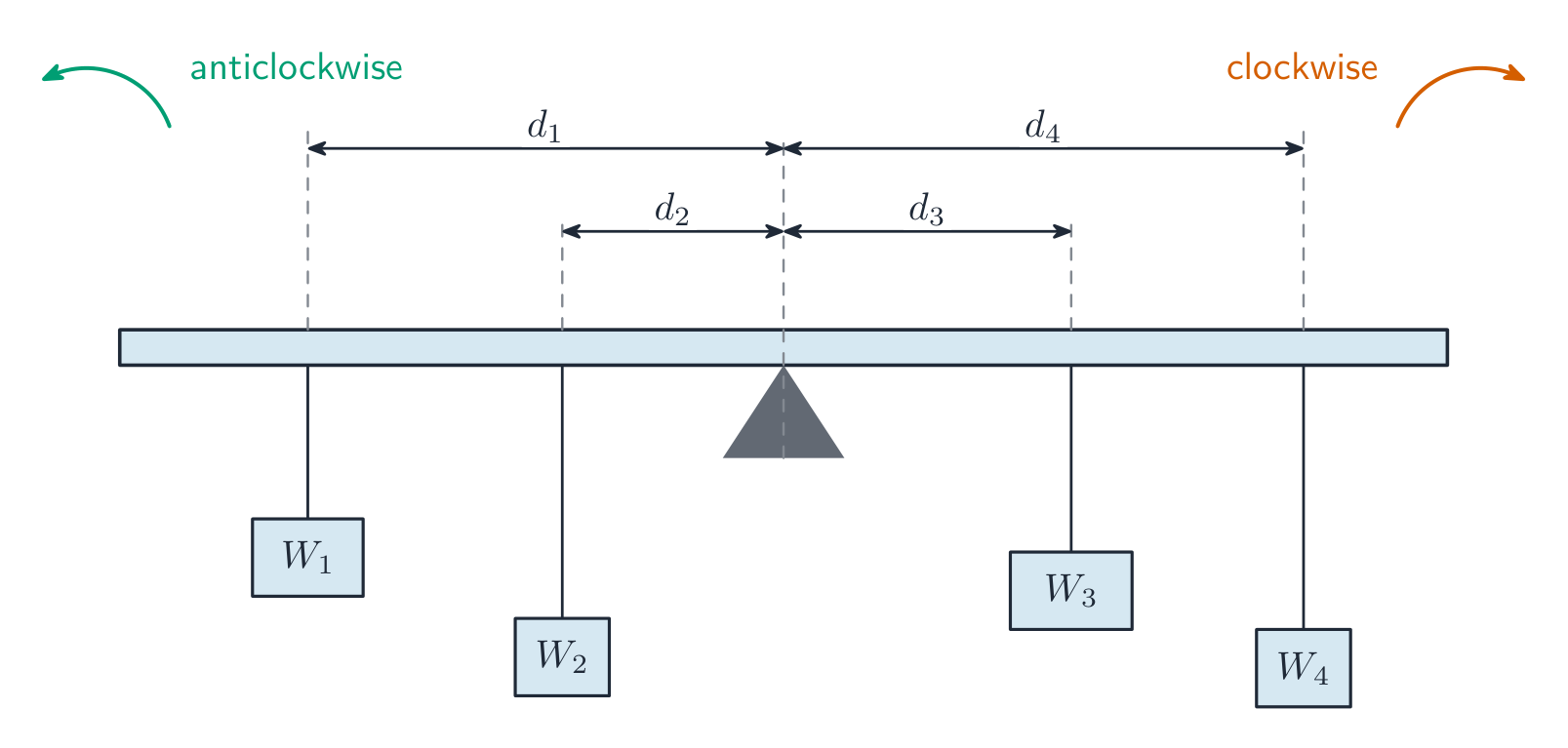
An object is in rotational equilibrium 转动平衡 when the net torque is zero, so its angular velocity stays constant. For a balanced (static) object, both the net force and the net torque are zero. Choosing the axis at an unknown force's location removes it from the torque equation – a useful trick for beam and ladder problems.

Worked example. A $30\ \text{kg}$ child sits $2.0\ \text{m}$ from the pivot of a seesaw. Where must a $40\ \text{kg}$ child sit on the other side to balance it? Set the clockwise torque equal to the anticlockwise torque (the $g$'s cancel):

$$30\times2.0=40\times d\;\Rightarrow\;d=\frac{60}{40}=1.5\ \text{m}.$$
The heavier child sits closer to the pivot – less distance, same torque.

Bahasa Indonesia

Suatu objek berada dalam kesetimbangan rotasi ketika torsi bersih adalah nol, sehingga kecepatannya sudut tetap konstan. Untuk objek seimbang (statis), baik gaya bersih dan torsi bersih adalah nol. Memilih sumbu di lokasi gaya yang tidak diketahui akan menghilangkan gaya tersebut dari persamaan torsi – trik berguna untuk masalah balok dan tangga.

At balance the clockwise and anticlockwise moments about the pivot are equal

Contoh terpecahkan. Seorang anak berat $30\ \text{kg}$ duduk pada jarak $2.0\ \text{m}$ dari engsel ayunan. Di mana seorang anak berat $40\ \text{kg}$ harus duduk di sisi lain untuk menyeimbangkannya? Samakan torsi searah jarum jam dengan torsi berlawanan arah jarum jam ($g$ saling menghilangkan):

$$30\times2.0=40\times d\;\Rightarrow\;d=\frac{60}{40}=1.5\ \text{m}.$$
Anak yang lebih berat duduk lebih dekat ke engsel – jarak lebih pendek, torsi yang sama.

Explore · ⁨Jelajahi⁩

Find the balance point · ⁨Temukan titik keseimbangan⁩

For rotational equilibrium the total clockwise torque equals the total anticlockwise torque. Move the forces and distances until the beam balances. · ⁨Untuk keseimbangan rotasi, total torsi searah jarum jam sama dengan total torsi berlawanan arah jarum jam. Gerakkan gaya dan jarak hingga balok seimbang.⁩

5.6

Newton's Second Law in Rotational Form · ⁨Hukum Kedua Newton dalam Bentuk Rotasi⁩

Syllabus · ⁨Silabus⁩
English

Learning Objective 5.6.A: Describe the conditions under which a system's angular velocity changes.

  • 5.6.A.1 Angular velocity changes when the net torque exerted on the object or system is not equal to zero.
  • 5.6.A.2 The rate at which the angular velocity of a rigid system changes is directly proportional to the net torque exerted on the rigid system and is in the same direction. The angular acceleration of the rigid system is inversely proportional to the rotational inertia of the rigid system.
    • Equation: $\alpha_{\text{sys}} = \dfrac{\sum \tau}{I_{\text{sys}}} = \dfrac{\tau_{\text{net}}}{I_{\text{sys}}}$
  • 5.6.A.3 To fully describe a rotating rigid system, linear and rotational analyses may need to be performed independently.
Bahasa Indonesia

Tujuan Pembelajaran 5.6.A: Jelaskan kondisi di mana kecepatan sudut sistem berubah.

  • 5.6.A.1 Kecepatan sudut berubah ketika resultan torsi yang diberikan pada objek atau sistem tidak sama dengan nol.
  • 5.6.A.2 Laju perubahan kecepatan sudut sistem kaku berbanding lurus dengan resultan torsi yang diberikan pada sistem kaku dan berarah sama. Percepatan sudut sistem kaku berbanding terbalik dengan inersia rotasi sistem kaku.
    • Persamaan: $\alpha_{\text{sys}} = \dfrac{\sum \tau}{I_{\text{sys}}} = \dfrac{\tau_{\text{net}}}{I_{\text{sys}}}$
  • 5.6.A.3 Untuk mendeskripsikan sepenuhnya sistem kaku yang berotasi, analisis linear dan rotasi mungkin perlu dilakukan secara independen.

Source: College Board AP Course and Exam Description · ⁨Sumber: Deskripsi Kursus dan Ujian College Board AP⁩

English

Net torque produces angular acceleration, in direct analogy with $F=ma$:

$$\sum\tau = I\alpha.$$
So a larger net torque, or a smaller rotational inertia, gives a larger angular acceleration. Solve rotation problems just like translation problems, with $\tau\leftrightarrow F$, $I\leftrightarrow m$, and $\alpha\leftrightarrow a$.

Worked example. A net torque of $12\ \text{N m}$ acts on a wheel with rotational inertia $I=3.0\ \text{kg m}^2$. Its angular acceleration is $\alpha=\tau/I=12/3.0=4.0\ \text{rad/s}^2$ – the exact rotational twin of $a=F/m$.

Bahasa Indonesia

Torsi bersih menghasilkan percepatan sudut, sebagai analogi langsung dengan $F=ma$:

$$\sum\tau = I\alpha.$$
Jadi torsi bersih yang lebih besar, atau inersia rotasi yang lebih kecil, menghasilkan percepatan sudut yang lebih besar. Selesaikan masalah rotasi persis seperti masalah translasi, dengan $\tau\leftrightarrow F$, $I\leftrightarrow m$, dan $\alpha\leftrightarrow a$.

Contoh terpecahkan. Torsi bersih sebesar $12\ \text{N m}$ bekerja pada roda dengan inersia rotasi $I=3.0\ \text{kg m}^2$. Percepatan sudutnya adalah $\alpha=\tau/I=12/3.0=4.0\ \text{rad/s}^2$ – kembar rotasi yang tepat dari $a=F/m$.

5.6

Exam tips · ⁨Tips ujian⁩

English
  • Torque $\tau=Fr_\perp$ uses the perpendicular distance from the pivot; a force through the pivot gives zero torque.
  • For balance, set clockwise torque = anticlockwise torque; choosing the pivot at an unknown force removes it from the equation.
  • Use the rotational analogues: $\tau\leftrightarrow F$, $I\leftrightarrow m$, $\alpha\leftrightarrow a$, so $\sum\tau=I\alpha$ mirrors $\sum F=ma$.
  • Rotational inertia depends on how far the mass sits from the axis, not just its amount — a hoop resists spinning more than a disc of equal mass.
  • Convert angles to radians and link linear to angular with $v=r\omega$, $a_t=r\alpha$.
Bahasa Indonesia
  • Torsi $\tau=Fr_\perp$ menggunakan jarak tegak lurus dari engsel; gaya yang melalui engsel menghasilkan torsi nol.
  • Untuk kesetimbangan, tetapkan torsi searah jarum jam = torsi berlawanan arah jarum jam; memilih titik tumpu pada gaya yang tidak diketahui akan menghilangkan gaya tersebut dari persamaan.
  • Gunakan analogi rotasi: $\tau\leftrightarrow F$, $I\leftrightarrow m$, $\alpha\leftrightarrow a$, sehingga $\sum\tau=I\alpha$ merupakan cerminan dari $\sum F=ma$.
  • Inersia rotasi bergantung pada sejauh mana massa berada dari sumbu, bukan hanya pada jumlahnya — sebuah cincin lebih resisten terhadap putaran dibandingkan cakram dengan massa yang sama.
  • Ubah sudut menjadi radian dan hubungkan gerak linear dengan sudut menggunakan $v=r\omega$, $a_t=r\alpha$.

Interactive lessons on this topic · ⁨Pelajaran interaktif untuk topik ini⁩

Work through it step by step, with instant-check exercises. · ⁨Kerjakan langkah demi langkah, dengan latihan pengecekan instan.⁩

Past Papers · ⁨Soal-Soil Masa Lalu⁩

More topics in AP Physics 1 · ⁨AP Fisika 1⁩ · ⁨Topik lain dalam AP Physics 1 · ⁨AP Fisika 1⁩⁩

Log in or create account · ⁨Masuk atau buat akun⁩

IGCSE, A-Level & AP