Skip to content · ⁨Lompat ke konten⁩

Acids and Bases · ⁨Asam dan Basa⁩

AP Chemistry · ⁨AP Kimia⁩ · Topic 8 · ⁨Topik 8⁩

Video lesson for this topic · ⁨Pelajaran video untuk topik ini⁩ Open the video page · ⁨Buka halaman video⁩
8:24

Asam dan Basa

Dua strip kertas — satu merah, satu biru. Celupkan ke dalam cairan dan warnanya berubah; warna tersebut memberi tahu apakah cairan itu adalah asam atau basa.…

English narration · English + 中文 subtitles burned in · ⁨Narasi bahasa Inggris · Subtitle bahasa Inggris + 中文 disematkan langsung⁩

8.1

Introduction to Acids and Bases · ⁨Pengenalan Asam dan Basa⁩

Syllabus · ⁨Silabus⁩
English

Learning Objective 8.1.A: Calculate the values of $\mathrm{pH}$ and $\mathrm{pOH}$, based on $K_w$ and the concentration of all species present in a neutral solution of water.

  • 8.1.A.1 The concentrations of hydronium ion and hydroxide ion are often reported as $\mathrm{pH}$ and $\mathrm{pOH}$, respectively.
    • Equation: $\mathrm{pH} = -\log[\mathrm{H_3O^+}]$
    • Equation: $\mathrm{pOH} = -\log[\mathrm{OH^-}]$
    • The terms "hydrogen ion" and "hydronium ion" and the symbols $\mathrm{H^+}(aq)$ and $\mathrm{H_3O^+}(aq)$ are often used interchangeably for the aqueous ion of hydrogen. Hydronium ion and $\mathrm{H_3O^+}(aq)$ are preferred, but $\mathrm{H^+}(aq)$ is also accepted on the AP Exam.
  • 8.1.A.2 Water autoionizes with an equilibrium constant $K_w$.
    • Equation: $K_w = [\mathrm{H_3O^+}][\mathrm{OH^-}] = 1.0 \times 10^{-14}$ at 25°C
  • 8.1.A.3 In pure water, $\mathrm{pH} = \mathrm{pOH}$ is called a neutral solution. At 25°C, $\mathrm{p}K_w = 14.0$ and thus $\mathrm{pH} = \mathrm{pOH} = 7.0$.
    • Equation: $\mathrm{p}K_w = 14 = \mathrm{pH} + \mathrm{pOH}$ at 25°C
  • 8.1.A.4 The value of $K_w$ is temperature dependent, so the pH of pure, neutral water will deviate from 7.0 at temperatures other than 25°C.
Bahasa Indonesia

Tujuan Pembelajaran 8.1.A: Menghitung nilai $\mathrm{pH}$ dan $\mathrm{pOH}$, berdasarkan $K_w$ dan konsentrasi semua spesies yang hadir dalam larutan netral air.

  • 8.1.A.1 Konsentrasi ion hidronium dan ion hidroksida sering dilaporkan sebagai $\mathrm{pH}$ dan $\mathrm{pOH}$, masing-masing.
    • Persamaan: $\mathrm{pH} = -\log[\mathrm{H_3O^+}]$
    • Persamaan: $\mathrm{pOH} = -\log[\mathrm{OH^-}]$
    • Istilah "ion hidrogen" dan "ion hidronium" serta simbol $\mathrm{H^+}(aq)$ dan $\mathrm{H_3O^+}(aq)$ sering digunakan secara bergantian untuk ion akuatik hidrogen. Ion hidronium dan $\mathrm{H_3O^+}(aq)$ lebih disukai, tetapi $\mathrm{H^+}(aq)$ juga diterima dalam Ujian AP.
  • 8.1.A.2 Air berautointonisasi dengan tetapan kesetimbangan $K_w$.
    • Persamaan: $K_w = [\mathrm{H_3O^+}][\mathrm{OH^-}] = 1.0 \times 10^{-14}$ pada suhu 25°C
  • 8.1.A.3 Dalam air murni, $\mathrm{pH} = \mathrm{pOH}$ disebut larutan netral. Pada 25°C, $\mathrm{p}K_w = 14.0$ dan karenanya $\mathrm{pH} = \mathrm{pOH} = 7.0$.
    • Persamaan: $\mathrm{p}K_w = 14 = \mathrm{pH} + \mathrm{pOH}$ pada suhu 25°C
  • 8.1.A.4 Nilai $K_w$ bergantung pada suhu, sehingga pH air murni netral akan menyimpang dari 7.0 pada suhu selain 25°C.
Source: College Board AP Course and Exam Description · ⁨Sumber: Deskripsi Kursus dan Ujian College Board AP⁩

English

By the Brønsted–Lowry definition, an acid 酸 is a proton ($\text{H}^+$) donor and a base 碱 is a proton acceptor. When an acid donates a proton it becomes its conjugate base 共轭碱; a base gaining a proton becomes its conjugate acid 共轭酸. Water is amphoteric – it can act as either.

Bahasa Indonesia
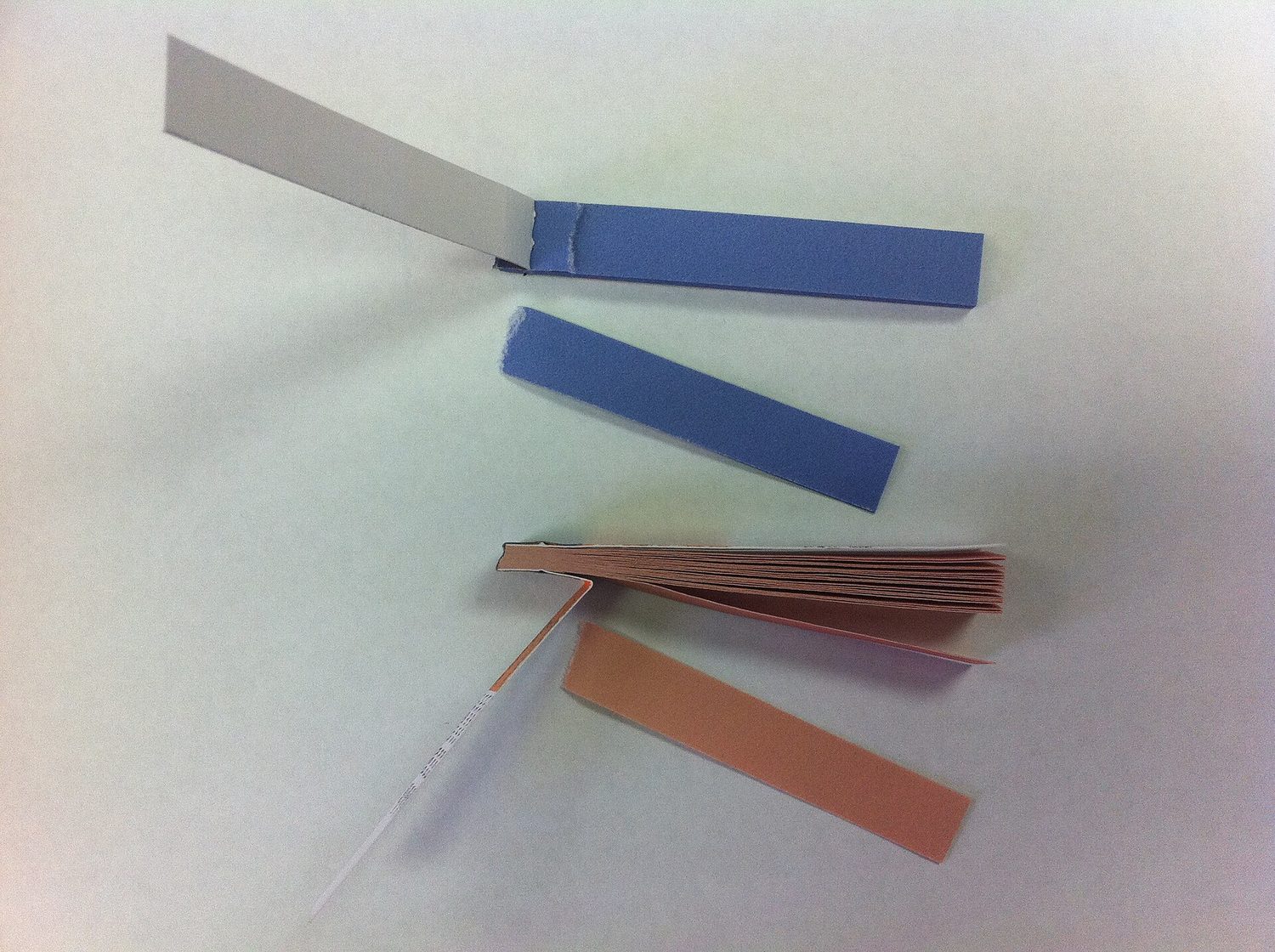
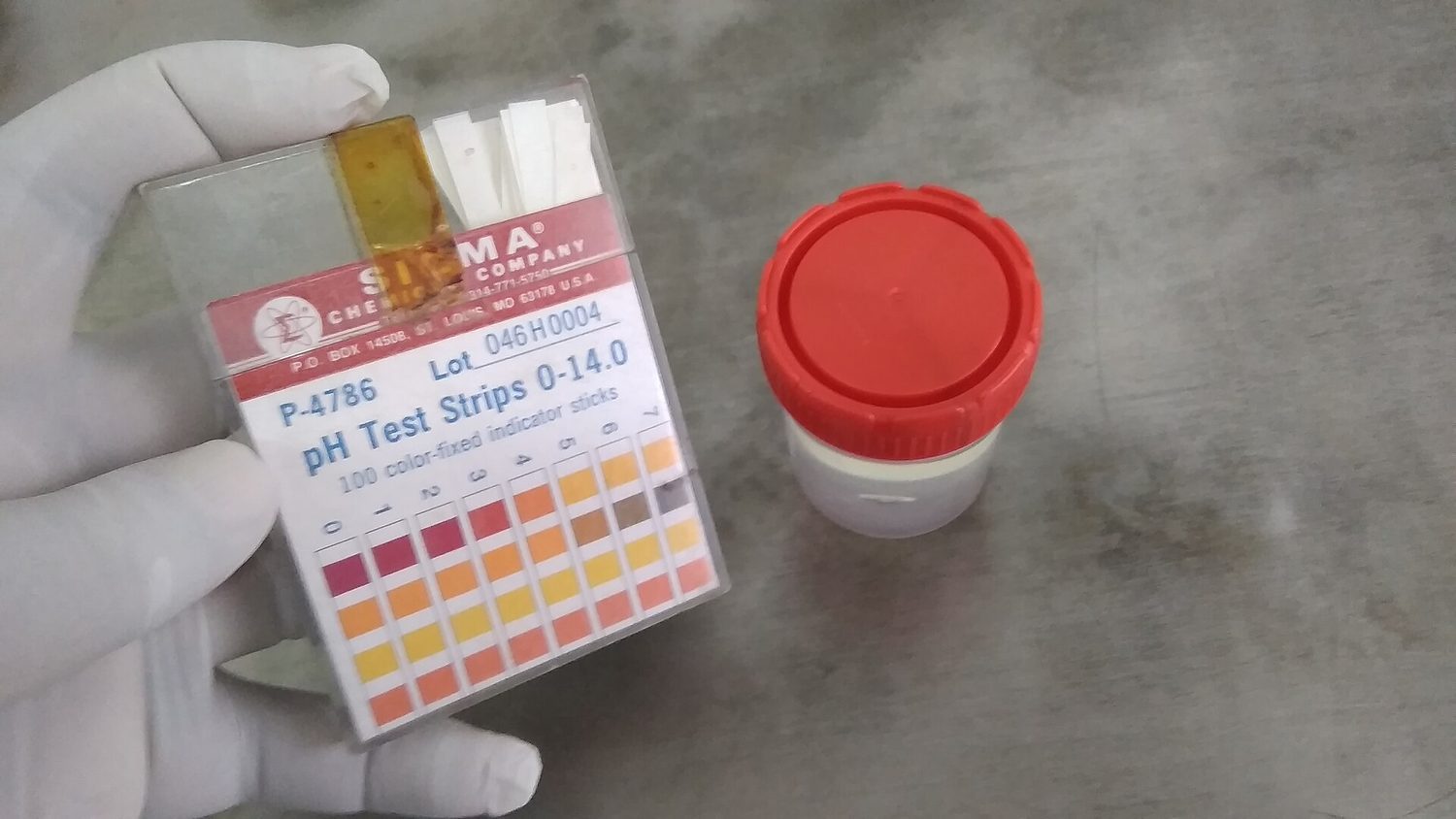
Kertas lakmus: indikator asam-basa berubah warna dengan konsentrasi H⁺ (pH)

Berdasarkan definisi Brønsted–Lowry, asam adalah pendonor proton ($\text{H}^+$) dan basa adalah penerima proton. Ketika asam mendonorkan proton, ia menjadi basa konjugatnya; basa yang menerima proton menjadi asam konjugatnya. Air bersifat amfoterik – dapat bertindak sebagai salah satunya.

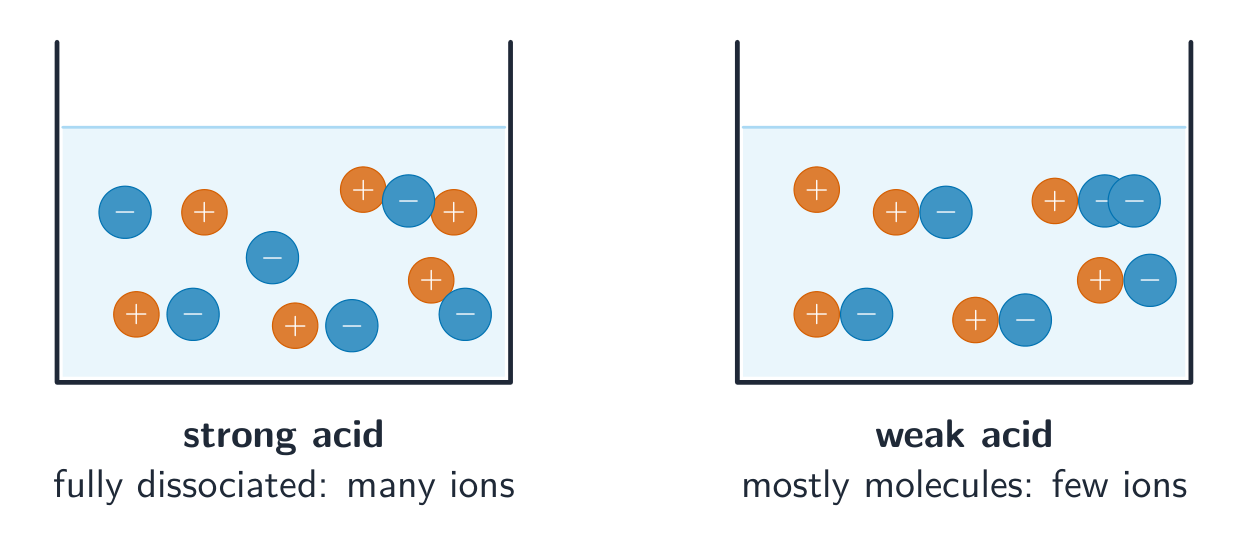
Asam kuat terurai penuh; asam lemah hanya terurai sebagian
Kertas uji pH: kekuatan dan konsentrasi asam-basa menentukan pH yang Anda ukur
stripes uji pH: kekuatan dan konsentrasi asam-basa menentukan pH yang Anda ukur
Vocabulary · ⁨Kosa kata⁩ Train · ⁨Latih⁩
English Bahasa Indonesia
acid/ˈæsɪd/ asam
base/beɪs/ basis
conjugate base/ˈkɒndʒuːɡeɪt beɪs/ basa konjugasi
conjugate acid/ˈkɒndʒuːɡeɪt ˈæsɪd/ asid konjugat
autoionization/ˌɔːtəʊˌaɪənaɪˈzeɪʃn/ autoionisasi
hydronium ion/haɪˈdrəʊnɪəm ˈaɪɒn/ ion hidronium
ion-product constant of water/ˈaɪɒn ˈprɒdʌkt ˈkɒnstənt ɒv ˈwɔːtə/ konstanta hasil kali ion air
neutral/ˈnjuːtrəl/ netral
pH/piː eɪtʃ/ pH
strong acid/strɒŋ ˈæsɪd/ asam kuat
strong base/strɒŋ beɪs/ basa kuat
weak acid/wiːk ˈæsɪd/ asam lemah
8.1

The Autoionization of Water · ⁨Autoionisasi Air⁩

Syllabus · ⁨Silabus⁩
English

Learning Objective 8.1.A: Calculate the values of $\mathrm{pH}$ and $\mathrm{pOH}$, based on $K_w$ and the concentration of all species present in a neutral solution of water.

  • 8.1.A.1 The concentrations of hydronium ion and hydroxide ion are often reported as $\mathrm{pH}$ and $\mathrm{pOH}$, respectively.
    • Equation: $\mathrm{pH} = -\log[\mathrm{H_3O^+}]$
    • Equation: $\mathrm{pOH} = -\log[\mathrm{OH^-}]$
    • The terms "hydrogen ion" and "hydronium ion" and the symbols $\mathrm{H^+}(aq)$ and $\mathrm{H_3O^+}(aq)$ are often used interchangeably for the aqueous ion of hydrogen. Hydronium ion and $\mathrm{H_3O^+}(aq)$ are preferred, but $\mathrm{H^+}(aq)$ is also accepted on the AP Exam.
  • 8.1.A.2 Water autoionizes with an equilibrium constant $K_w$.
    • Equation: $K_w = [\mathrm{H_3O^+}][\mathrm{OH^-}] = 1.0 \times 10^{-14}$ at 25°C
  • 8.1.A.3 In pure water, $\mathrm{pH} = \mathrm{pOH}$ is called a neutral solution. At 25°C, $\mathrm{p}K_w = 14.0$ and thus $\mathrm{pH} = \mathrm{pOH} = 7.0$.
    • Equation: $\mathrm{p}K_w = 14 = \mathrm{pH} + \mathrm{pOH}$ at 25°C
  • 8.1.A.4 The value of $K_w$ is temperature dependent, so the pH of pure, neutral water will deviate from 7.0 at temperatures other than 25°C.
Bahasa Indonesia

Tujuan Pembelajaran 8.1.A: Menghitung nilai $\mathrm{pH}$ dan $\mathrm{pOH}$, berdasarkan $K_w$ dan konsentrasi semua spesies yang hadir dalam larutan netral air.

  • 8.1.A.1 Konsentrasi ion hidronium dan ion hidroksida sering dilaporkan sebagai $\mathrm{pH}$ dan $\mathrm{pOH}$, masing-masing.
    • Persamaan: $\mathrm{pH} = -\log[\mathrm{H_3O^+}]$
    • Persamaan: $\mathrm{pOH} = -\log[\mathrm{OH^-}]$
    • Istilah "ion hidrogen" dan "ion hidronium" serta simbol $\mathrm{H^+}(aq)$ dan $\mathrm{H_3O^+}(aq)$ sering digunakan secara bergantian untuk ion akuatik hidrogen. Ion hidronium dan $\mathrm{H_3O^+}(aq)$ lebih disukai, tetapi $\mathrm{H^+}(aq)$ juga diterima dalam Ujian AP.
  • 8.1.A.2 Air berautointonisasi dengan tetapan kesetimbangan $K_w$.
    • Persamaan: $K_w = [\mathrm{H_3O^+}][\mathrm{OH^-}] = 1.0 \times 10^{-14}$ pada suhu 25°C
  • 8.1.A.3 Dalam air murni, $\mathrm{pH} = \mathrm{pOH}$ disebut larutan netral. Pada 25°C, $\mathrm{p}K_w = 14.0$ dan karenanya $\mathrm{pH} = \mathrm{pOH} = 7.0$.
    • Persamaan: $\mathrm{p}K_w = 14 = \mathrm{pH} + \mathrm{pOH}$ pada suhu 25°C
  • 8.1.A.4 Nilai $K_w$ bergantung pada suhu, sehingga pH air murni netral akan menyimpang dari 7.0 pada suhu selain 25°C.
Source: College Board AP Course and Exam Description · ⁨Sumber: Deskripsi Kursus dan Ujian College Board AP⁩

English

Even pure water conducts a tiny current, because water molecules react with each other in a reaction called autoionization 自偶电离:

$$2\text{H}_2\text{O} \rightleftharpoons \text{H}_3\text{O}^+ + \text{OH}^-.$$
One water molecule passes a proton to another, making a hydronium ion 水合氢离子 ($\text{H}_3\text{O}^+$, the ion we loosely write as $\text{H}^+$) and a hydroxide ion. This equilibrium has its own constant, the ion-product constant of water 水的离子积:
$$K_w = [\text{H}_3\text{O}^+][\text{OH}^-] = 1.0\times10^{-14}$$
at 25 °C. Defining $\text{pOH}=-\log[\text{OH}^-]$ and taking $-\log$ of the $K_w$ expression gives the rule the rest of this topic leans on:
$$\text{pH} + \text{pOH} = \text{p}K_w = 14.0$$
(again at 25 °C). Know one of pH or pOH and you get the other by subtracting from 14.

In pure water the two ions form in equal numbers, so $[\text{H}_3\text{O}^+]=[\text{OH}^-]$ and $\text{pH}=\text{pOH}=7.0$. This is what neutral 中性 means. Acidic means $[\text{H}_3\text{O}^+]>[\text{OH}^-]$ (pH below 7); basic is the reverse.

Worked example. A solution has $[\text{H}_3\text{O}^+]=2.0\times10^{-3}\ \text{M}$. Find $[\text{OH}^-]$. Because $K_w$ always holds in water,

$$[\text{OH}^-]=\frac{K_w}{[\text{H}_3\text{O}^+]}=\frac{1.0\times10^{-14}}{2.0\times10^{-3}}=5.0\times10^{-12}\ \text{M}.$$
The hydroxide concentration is far smaller than the hydronium, confirming the solution is acidic.

$K_w$ is temperature dependent: autoionization is endothermic, so heating water shifts it forward and raises $K_w$. At 50 °C, $K_w>1.0\times10^{-14}$, so neutral water has $\text{pH}=\text{pOH}<7.0$. It is still neutral, because the ion concentrations are still equal – neutral means equal ions, not a pH of exactly 7.

Bahasa Indonesia

Bahkan air murni menghantarkan arus sangat kecil, karena molekul air bereaksi satu sama lain dalam reaksi yang disebut autoionisasi:

$$2\text{H}_2\text{O} \rightleftharpoons \text{H}_3\text{O}^+ + \text{OH}^-.$$
Satu molekul air mentransfer proton ke molekul lain, membentuk ion hidronium ($\text{H}_3\text{O}^+$, ion yang kita tulis secara longgar sebagai $\text{H}^+$) dan ion hidroksida. Kesetimbangan ini memiliki konstantanya sendiri, yaitu konstanta hasil kali ion air:
$$K_w = [\text{H}_3\text{O}^+][\text{OH}^-] = 1.0\times10^{-14}$$
pada 25 °C. Mendefinisikan $\text{pOH}=-\log[\text{OH}^-]$ dan mengambil logaritma $-\log$ dari ekspresi $K_w$ memberikan aturan yang digunakan topik lainnya:
$$\text{pH} + \text{pOH} = \text{p}K_w = 14.0$$
(lagi pada 25 °C). Ketahui salah satu dari pH atau pOH, dan Anda mendapatkan yang lain dengan menguranginya dari 14.

Dalam air murni, kedua ion terbentuk dalam jumlah yang sama, sehingga $[\text{H}_3\text{O}^+]=[\text{OH}^-]$ dan $\text{pH}=\text{pOH}=7.0$. Inilah yang dimaksud dengan netral. Asam berarti $[\text{H}_3\text{O}^+]>[\text{OH}^-]$ (pH di bawah 7); basa adalah sebaliknya.

Contoh terpecahkan. Sebuah larutan memiliki $[\text{H}_3\text{O}^+]=2.0\times10^{-3}\ \text{M}$. Temukan $[\text{OH}^-]$. Karena $K_w$ selalu berlaku dalam air,

$$[\text{OH}^-]=\frac{K_w}{[\text{H}_3\text{O}^+]}=\frac{1.0\times10^{-14}}{2.0\times10^{-3}}=5.0\times10^{-12}\ \text{M}.$$
Konsentrasi hidroksida jauh lebih kecil daripada hidronium, mengkonfirmasi bahwa larutan tersebut bersifat asam.

$K_w$ bergantung pada suhu: autoionisasi bersifat endoterm, sehingga memanaskan air menggeserke ke arah maju dan menaikkan $K_w$. Pada 50 °C, $K_w>1.0\times10^{-14}$, sehingga air netral memiliki $\text{pH}=\text{pOH}<7.0$. Itu tetap netral, karena konsentrasi ion masih sama – netral berarti ion yang setara, bukan pH tepat 7.

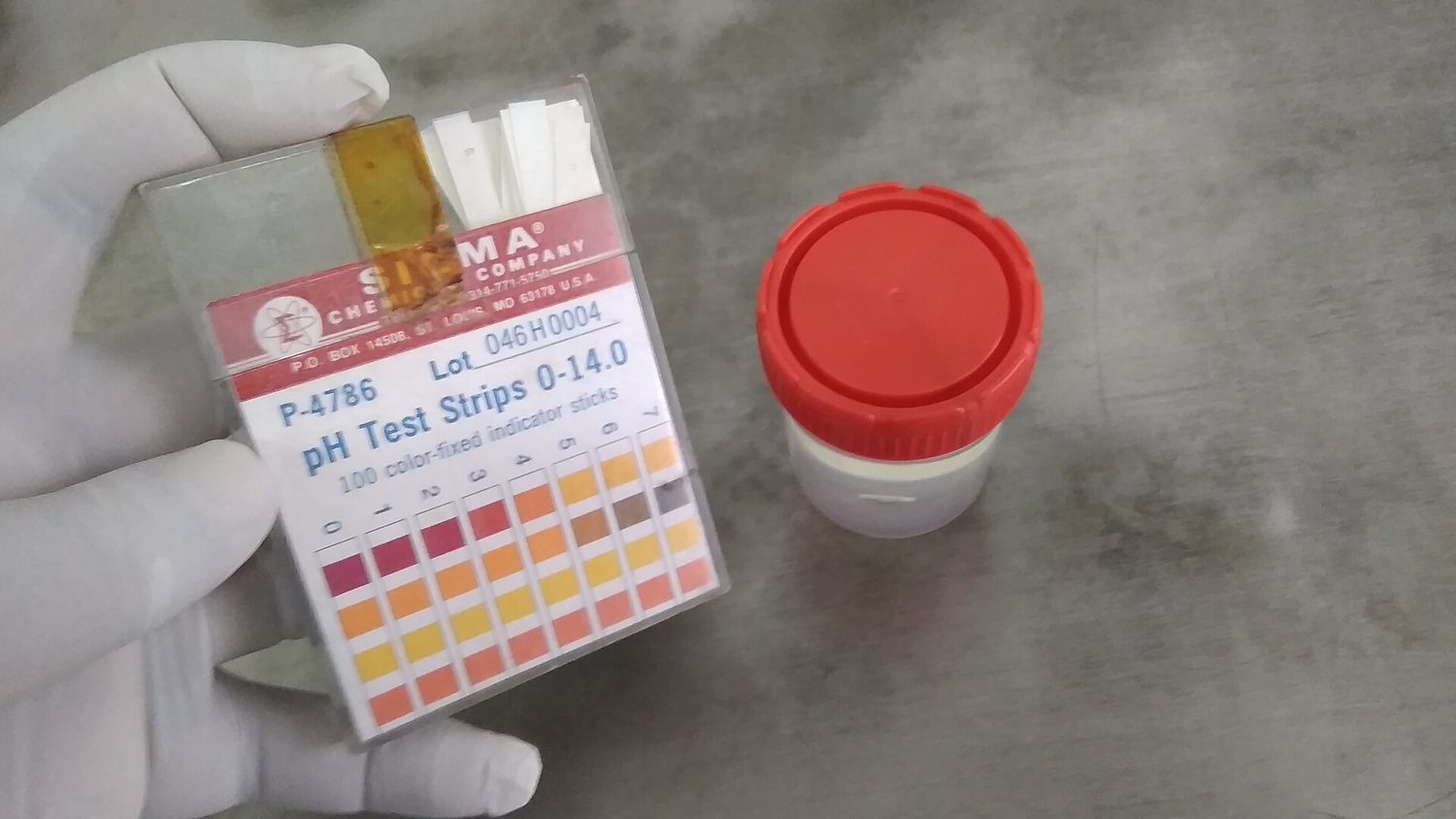
Kertas pH: air mengionisasi diri sehingga air murni memiliki pH 7; asam dan basa menggeser H+ dan OH-
stripes pH: air berautionisasi sehingga air murni memiliki pH 7; asam dan basa menggeser H+ dan OH-
8.2

pH and pOH of Strong Acids and Bases · ⁨pH dan pOH Asam Kuat dan Basa Kuat⁩

Syllabus · ⁨Silabus⁩
English

Learning Objective 8.2.A: Calculate $\mathrm{pH}$ and $\mathrm{pOH}$ based on concentrations of all species in a solution of a strong acid or a strong base.

  • 8.2.A.1 Molecules of a strong acid (e.g., $\mathrm{HCl}$, $\mathrm{HBr}$, $\mathrm{HI}$, $\mathrm{HClO_4}$, $\mathrm{H_2SO_4}$, and $\mathrm{HNO_3}$) will completely ionize in aqueous solution to produce hydronium ions and the conjugate base of the acid. As such, the concentration of $\mathrm{H_3O^+}$ in a strong acid solution is equal to the initial concentration of the strong acid, and thus the $\mathrm{pH}$ of the strong acid solution is easily calculated.
  • 8.2.A.2 When dissolved in solution, strong bases (e.g., group I and II hydroxides) completely dissociate to produce hydroxide ions. As such, the concentration of $\mathrm{OH^-}$ in a strong base solution is equal to the initial concentration of a group I hydroxide and double the initial concentration of a group II hydroxide, and thus the $\mathrm{pOH}$ (and $\mathrm{pH}$) of the strong base solution is easily calculated.
Bahasa Indonesia

Tujuan Pembelajaran 8.2.A: Menghitung $\mathrm{pH}$ dan $\mathrm{pOH}$ berdasarkan konsentrasi semua spesies dalam larutan asam kuat atau basa kuat.

  • 8.2.A.1 Molekul asam kuat (mis., $\mathrm{HCl}$, $\mathrm{HBr}$, $\mathrm{HI}$, $\mathrm{HClO_4}$, $\mathrm{H_2SO_4}$, dan $\mathrm{HNO_3}$) akan terionisasi sepenuhnya dalam larutan akuatik untuk menghasilkan ion hidronium dan basa konjugat dari asam tersebut. Oleh karena itu, konsentrasi $\mathrm{H_3O^+}$ dalam larutan asam kuat sama dengan konsentrasi awal asam kuat, dan karenanya $\mathrm{pH}$ larutan asam kuat mudah dihitung.
  • 8.2.A.2 Saat dilarutkan dalam larutan, basa kuat (mis., hidroksida golongan I dan II) terdisosiasi sepenuhnya untuk menghasilkan ion hidroksida. Oleh karena itu, konsentrasi $\mathrm{OH^-}$ dalam larutan basa kuat sama dengan konsentrasi awal hidroksida golongan I dan dua kali konsentrasi awal hidroksida golongan II, dan karenanya $\mathrm{pOH}$ (dan $\mathrm{pH}$) larutan basa kuat mudah dihitung.

Source: College Board AP Course and Exam Description · ⁨Sumber: Deskripsi Kursus dan Ujian College Board AP⁩

English

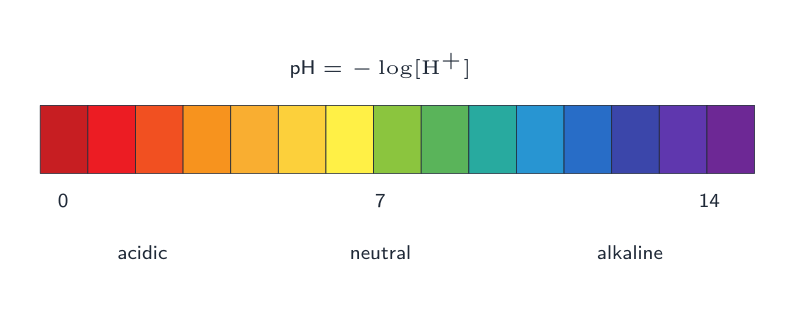
The pH pH值 scale measures acidity: $\text{pH}=-\log[\text{H}^+]$, with $\text{pH}+\text{pOH}=14$ at 25 °C. A strong acid 强酸 or strong base 强碱 dissociates completely, so its ion concentration equals its concentration – read pH directly. Lower pH means more acidic.

Worked example. Find the pH of $0.010\ \text{M}$ HCl. Because HCl is a strong acid it is fully dissociated, so $[\text{H}^+]=0.010\ \text{M}$ and

$$\text{pH}=-\log(0.010)=2.0.$$
For a strong base like $0.010\ \text{M}$ NaOH, $\text{pOH}=2.0$, so $\text{pH}=14-2.0=12.0$.

Bahasa Indonesia

Skala pH mengukur keasaman: $\text{pH}=-\log[\text{H}^+]$, dengan $\text{pH}+\text{pOH}=14$ pada 25 °C. Asam kuat atau basa kuat terdisosiasi secara lengkap, sehingga konsentrasi ionnya sama dengan konsentrasinya – baca pH langsung. pH yang lebih rendah berarti lebih asam.

Skala pH: pH adalah logaritma negatif dari konsentrasi ion hidrogen
skala pH: pH adalah logaritma negatif dari konsentrasi ion hidrogen

Contoh terpecahkan. Temukan pH dari $0.010\ \text{M}$ HCl. Karena HCl adalah asam kuat, ia terdisosiasi sepenuhnya, sehingga $[\text{H}^+]=0.010\ \text{M}$ dan

$$\text{pH}=-\log(0.010)=2.0.$$
Untuk basa kuat seperti $0.010\ \text{M}$ NaOH, $\text{pOH}=2.0$, sehingga $\text{pH}=14-2.0=12.0$.

Explore · ⁨Jelajahi⁩

Move along the pH scale · ⁨Gerakkan skala pH⁩

pH measures hydrogen-ion concentration on a log scale: each unit is a tenfold change. Strong acids sit low, strong bases high, 7 is neutral. · ⁨pH mengukur konsentrasi ion hidrogen pada skala logaritma: setiap satuan adalah perubahan sepuluh kali lipat. Asam kuat berada di bawah, basa kuat di atas, 7 netral.⁩

8.3

Weak Acid and Base Equilibria · ⁨Kesetimbangan Asam Lemah dan Basa Lemah⁩

Syllabus · ⁨Silabus⁩
Learning ObjectiveEssential Knowledge

8.3.A
Explain the relationship among $\mathrm{pH}$, $\mathrm{pOH}$, and concentrations of all species in a solution of a monoprotic weak acid or weak base.

  • 8.3.A.1 Weak acids react with water to produce hydronium ions. However, only a small percentage of molecules of a weak acid will ionize in this way. Thus, the concentration of $\mathrm{H_3O^+}$ is much less than the initial concentration of the molecular acid, and the vast majority of the acid molecules remain un-ionized.
  • 8.3.A.2 A solution of a weak acid involves equilibrium between an un-ionized acid and its conjugate base. The equilibrium constant for this reaction is $K_a$, often reported as $\mathrm{p}K_a$. The pH of a weak acid solution can be determined from the initial acid concentration and the $\mathrm{p}K_a$.
    • Equation: $K_a = \dfrac{[\mathrm{H_3O^+}][\mathrm{A^-}]}{[\mathrm{HA}]}$
    • Equation: $\mathrm{p}K_a = -\log K_a$
  • 8.3.A.3 Weak bases react with water to produce hydroxide ions in solution. However, ordinarily just a small percentage of the molecules of a weak base in solution will ionize in this way. Thus, the concentration of $\mathrm{OH^-}$ in the solution does not equal the initial concentration of the base, and the vast majority of the base molecules remain un-ionized.
  • 8.3.A.4 A solution of a weak base involves equilibrium between an un-ionized base and its conjugate acid. The equilibrium constant for this reaction is $K_b$, often reported as $\mathrm{p}K_b$. The $\mathrm{pH}$ of a weak base solution can be determined from the initial base concentration and the $\mathrm{p}K_b$.
    • Equation: $K_b = \dfrac{[\mathrm{OH^-}][\mathrm{HB^+}]}{[\mathrm{B}]}$
    • Equation: $\mathrm{p}K_b = -\log K_b$
  • 8.3.A.5 The percent ionization of a weak acid (or base) can be calculated from its $\mathrm{p}K_a$ ($\mathrm{p}K_b$) and the initial concentration of the acid (base). The percent ionization can also be calculated from the initial concentration of the acid (base) and the equilibrium concentration of any of the species in the equilibrium expression.
  • 8.3.A.6 For any conjugate acid-base pair, the acid ionization constant and base ionization constant are related by $K_w$:
    • Equation: $K_w = K_a \times K_b$
    • Equation: $\mathrm{p}K_w = \mathrm{p}K_a + \mathrm{p}K_b$

Source: College Board AP Course and Exam Description · ⁨Sumber: Deskripsi Kursus dan Ujian College Board AP⁩

English

A weak acid 弱酸 only partly dissociates, described by an equilibrium constant $K_a$ (larger $K_a$ = stronger weak acid); a weak base has $K_b$. For any conjugate acid–base pair the two are linked through water, $K_a\times K_b = K_w$, so $\text{p}K_a+\text{p}K_b=14$ – a stronger acid always has a weaker conjugate base. Because dissociation is small, find $[\text{H}^+]$ with an ICE table and the $K_a$ expression, often using the small-$x$ approximation.

Worked example. Find the pH of $0.10\ \text{M}$ acetic acid, $K_a=1.8\times10^{-5}$. Let $x=[\text{H}^+]$ at equilibrium; the ICE table gives $K_a=\dfrac{x^2}{0.10-x}\approx\dfrac{x^2}{0.10}$ (small-$x$ approximation), so

$$x=\sqrt{K_a\times0.10}=\sqrt{1.8\times10^{-6}}=1.3\times10^{-3}\ \text{M}\;\Rightarrow\;\text{pH}=-\log(1.3\times10^{-3})=2.9.$$
The weak acid is far less acidic than a strong acid of the same concentration (which would be pH $1.0$).

Bahasa Indonesia

Asam lemah hanya terdisosiasi sebagian, dijelaskan oleh konstanta kesetimbangan $K_a$ ($K_a$ lebih besar = asam lemah lebih kuat); basa lemah memiliki $K_b$. Untuk pasangan asam-basa konjugat apa pun, keduanya terhubung melalui air, $K_a\times K_b = K_w$, sehingga $\text{p}K_a+\text{p}K_b=14$ – asam yang lebih kuat selalu memiliki basa konjugat yang lebih lemah. Karena disosiasi kecil, temukan $[\text{H}^+]$ dengan tabel ICE dan ekspresi $K_a$, sering menggunakan pendekatan kecil-$x$.

Contoh terpecahkan. Temukan pH $0.10\ \text{M}$ asam asetat, $K_a=1.8\times10^{-5}$. Misalkan $x=[\text{H}^+]$ pada kesetimbangan; tabel ICE memberikan $K_a=\dfrac{x^2}{0.10-x}\approx\dfrac{x^2}{0.10}$ (aproksimasi kecil-$x$), sehingga

$$x=\sqrt{K_a\times0.10}=\sqrt{1.8\times10^{-6}}=1.3\times10^{-3}\ \text{M}\;\Rightarrow\;\text{pH}=-\log(1.3\times10^{-3})=2.9.$$
Asam lemah jauh kurang asam dibandingkan asam kuat dengan konsentrasi yang sama (yang akan memiliki pH $1.0$).

8.4

Acid-Base Reactions and Buffers · ⁨Reaksi Asam-Basa dan Penyangga⁩

Syllabus · ⁨Silabus⁩
English

Learning Objective 8.4.A: Explain the relationship among the concentrations of major species in a mixture of weak and strong acids and bases.

  • 8.4.A.1 When a strong acid and a strong base are mixed, they react quantitatively in a reaction represented by the equation: $\mathrm{H^+}(aq) + \mathrm{OH^-}(aq) \rightarrow \mathrm{H_2O}(l)$. The pH of the resulting solution may be determined from the concentration of excess reagent.
  • 8.4.A.2 When a weak acid and a strong base are mixed, they react quantitatively in a reaction represented by the equation: $\mathrm{HA}(aq) + \mathrm{OH^-}(aq) \rightleftarrows \mathrm{A^-}(aq)\ \mathrm{H_2O}(l)$. If the weak acid is in excess, then a buffer solution is formed, and the $\mathrm{pH}$ can be determined from the Henderson-Hasselbalch (H–H) equation (see 8.9.A.1). If the strong base is in excess, then the $\mathrm{pH}$ can be determined from the moles of excess hydroxide ion and the total volume of solution. If they are equimolar, then the (slightly basic) $\mathrm{pH}$ can be determined from the equilibrium represented by the equation: $\mathrm{A^-}(aq) + \mathrm{H_2O}(l) \rightleftarrows \mathrm{HA}(aq) + \mathrm{OH^-}(aq)$.
  • 8.4.A.3 When a weak base and a strong acid are mixed, they will react quantitatively in a reaction represented by the equation: $\mathrm{B}(aq) + \mathrm{H_3O^+}(aq) \rightleftarrows \mathrm{HB^+}(aq) + \mathrm{H_2O}(l)$. If the weak base is in excess, then a buffer solution is formed, and the $\mathrm{pH}$ can be determined from the H–H equation. If the strong acid is in excess, then the $\mathrm{pH}$ can be determined from the moles of excess hydronium ion and the total volume of solution. If they are equimolar, then the (slightly acidic) $\mathrm{pH}$ can be determined from the equilibrium represented by the equation: $\mathrm{HB^+}(aq) + \mathrm{H_2O}(l) \rightleftarrows \mathrm{B}(aq) + \mathrm{H_3O^+}(aq)$.
  • 8.4.A.4 When a weak acid and a weak base are mixed, they will react to an equilibrium state whose reaction may be represented by the equation: $\mathrm{HA}(aq) + \mathrm{B}(aq) \rightleftarrows \mathrm{A^-}(aq) + \mathrm{HB^+}(aq)$.
Bahasa Indonesia

Tujuan Pembelajaran 8.4.A: Jelaskan hubungan antar konsentrasi spesies utama dalam campuran asam lemah dan kuat serta basa.

  • 8.4.A.1 Ketika asam kuat dan basa kuat dicampur, mereka bereaksi secara kuantitatif dalam reaksi yang direpresentasikan oleh persamaan: $\mathrm{H^+}(aq) + \mathrm{OH^-}(aq) \rightarrow \mathrm{H_2O}(l)$. pH larutan yang terbentuk dapat ditentukan dari konsentrasi pereaksi berlebih.
  • 8.4.A.2 Ketika asam lemah dan basa kuat dicampur, mereka bereaksi secara kuantitatif dalam reaksi yang direpresentasikan oleh persamaan: $\mathrm{HA}(aq) + \mathrm{OH^-}(aq) \rightleftarrows \mathrm{A^-}(aq)\ \mathrm{H_2O}(l)$. Jika asam lemah berlebih, maka larutan penyangga terbentuk, dan $\mathrm{pH}$ dapat ditentukan dari persamaan Henderson-Hasselbalch (H–H) (lihat 8.9.A.1). Jika basa kuat berlebih, maka $\mathrm{pH}$ dapat ditentukan dari mol ion hidroksida berlebih dan total volume larutan. Jika keduanya ekuimolar, maka (sedikit basa) $\mathrm{pH}$ dapat ditentukan dari kesetimbangan yang direpresentasikan oleh persamaan: $\mathrm{A^-}(aq) + \mathrm{H_2O}(l) \rightleftarrows \mathrm{HA}(aq) + \mathrm{OH^-}(aq)$.
  • 8.4.A.3 Ketika basa lemah dan asam kuat dicampur, mereka akan bereaksi secara kuantitatif dalam reaksi yang direpresentasikan oleh persamaan: $\mathrm{B}(aq) + \mathrm{H_3O^+}(aq) \rightleftarrows \mathrm{HB^+}(aq) + \mathrm{H_2O}(l)$. Jika basa lemah berlebih, maka larutan penyangga terbentuk, dan $\mathrm{pH}$ dapat ditentukan dari persamaan H–H. Jika asam kuat berlebih, maka $\mathrm{pH}$ dapat ditentukan dari mol ion hidronium berlebih dan total volume larutan. Jika keduanya ekuimolar, maka (sedikit asam) $\mathrm{pH}$ dapat ditentukan dari kesetimbangan yang direpresentasikan oleh persamaan: $\mathrm{HB^+}(aq) + \mathrm{H_2O}(l) \rightleftarrows \mathrm{B}(aq) + \mathrm{H_3O^+}(aq)$.
  • 8.4.A.4 Ketika asam lemah dan basa lemah dicampur, mereka akan bereaksi menuju keadaan kesetimbangan yang reaksinya dapat direpresentasikan oleh persamaan: $\mathrm{HA}(aq) + \mathrm{B}(aq) \rightleftarrows \mathrm{A^-}(aq) + \mathrm{HB^+}(aq)$.

Source: College Board AP Course and Exam Description · ⁨Sumber: Deskripsi Kursus dan Ujian College Board AP⁩

English

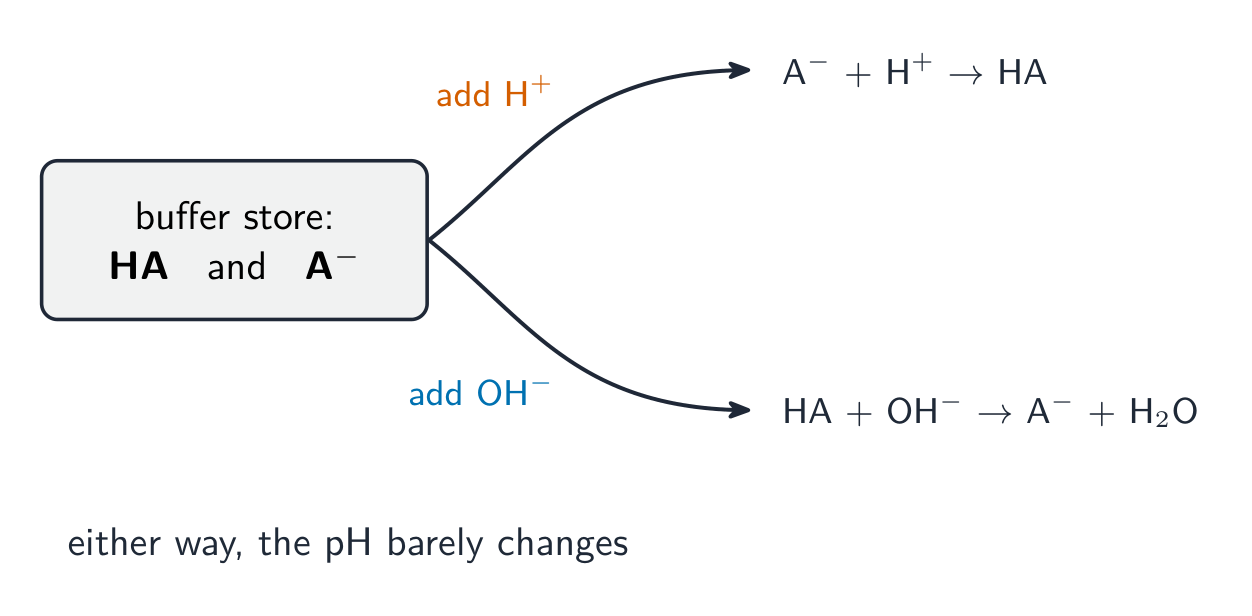
A buffer 缓冲溶液 resists pH change. It contains a weak acid and its conjugate base (or a weak base and its conjugate acid) in comparable amounts. Added acid is neutralized by the conjugate base, and added base by the weak acid, so pH barely moves.

Bahasa Indonesia

Penyangga menahan perubahan pH. Ia mengandung asam lemah dan basa konjugatnya (atau basa lemah dan asam konjugatnya) dalam jumlah yang sebanding. Asam yang ditambahkan dinetralkan oleh basa konjugat, dan basa yang ditambahkan dinetralkan oleh asam lemah, sehingga pH hampir tidak bergerak.

8.5

Acid-Base Titrations · ⁨Titrasi Asam-Basa⁩

Syllabus · ⁨Silabus⁩
English

Learning Objective 8.5.A: Explain results from the titration of a mono- or polyprotic acid or base solution, in relation to the properties of the solution and its components.

  • 8.5.A.1 An acid-base reaction can be carried out under controlled conditions in a titration. A titration curve, plotting $\mathrm{pH}$ against the volume of titrant added, is useful for summarizing results from a titration.
  • 8.5.A.2 At the equivalence point for titrations of monoprotic acids or bases, the number of moles of titrant added is equal to the number of moles of analyte originally present. This relationship can be used to obtain the concentration of the analyte. This is the case for titrations of strong acids/bases and weak acids/bases.
  • 8.5.A.3 For titrations of weak acids/bases, it is useful to consider the point halfway to the equivalence point, that is, the half-equivalence point. At this point, there are equal concentrations of each species in the conjugate acid-base pair, for example, for a weak acid $[\mathrm{HA}] = [\mathrm{A^-}]$. Because $\mathrm{pH} = \mathrm{p}K_a$ when the conjugate acid and base have equal concentrations, the $\mathrm{p}K_a$ can be determined from the $\mathrm{pH}$ at the half-equivalence point in a titration.
  • 8.5.A.4 At the equivalence point, pH is determined by the major species in solution. Strong acid and strong base titrations result in neutral pH at the equivalence point. However, in titrations of weak acids (weak bases), the conjugate base of the weak acid (conjugate acid of the weak base) is present at the equivalence point and can undergo proton-transfer reactions with the surrounding water, producing basic (acidic) solutions.
  • 8.5.A.5 For polyprotic acids, titration curves can be used to determine the number of acidic protons. In doing so, the major species present at any point along the curve can be identified, along with the $\mathrm{p}K_a$ associated with each proton in a weak polyprotic acid.
    • Exclusion statement: Computation of the concentration of each species present in the titration curve for polyprotic acids will not be assessed on the AP Exam. Such computations for titration of monoprotic acids are within the scope of the course (see 8.4.A.2 and 8.4.A.3), as is qualitative reasoning regarding what species are present in large versus small concentrations at any point in a titration of a polyprotic acid.
Bahasa Indonesia

Tujuan Pembelajaran 8.5.A: Jelaskan hasil titrasi larutan asam atau basa mono- atau poliprotik, terkait dengan sifat larutan dan komponen-komponennya.

  • 8.5.A.1 Reaksi asam-basa dapat dilakukan di bawah kondisi terkendali dalam titrasi. Kurva titrasi, yang memplot $\mathrm{pH}$ terhadap volume titeran yang ditambahkan, berguna untuk merangkum hasil dari titrasi.
  • 8.5.A.2 Pada titik ekivalensi untuk titrasi asam monoprotik atau basa, jumlah mol titeran yang ditambahkan sama dengan jumlah mol analit yang awalnya ada. Hubungan ini dapat digunakan untuk mendapatkan konsentrasi analit. Hal ini berlaku untuk titrasi asam/basa kuat dan asam/basa lemah.
  • 8.5.A.3 Untuk titrasi asam/basa lemah, berguna untuk mempertimbangkan titik setengah menuju titik ekivalensi, yaitu titik setengah ekivalensi. Pada titik ini, terdapat konsentrasi yang sama dari setiap spesies dalam pasangan asam-basa konjugat, misalnya, untuk asam lemah $[\mathrm{HA}] = [\mathrm{A^-}]$. Karena $\mathrm{pH} = \mathrm{p}K_a$ ketika asam konjugat dan basa memiliki konsentrasi yang sama, maka $\mathrm{p}K_a$ dapat ditentukan dari $\mathrm{pH}$ pada titik setengah ekivalensi dalam titrasi.
  • 8.5.A.4 Pada titik ekivalensi, pH ditentukan oleh spesies utama dalam larutan. Titrasi asam kuat dan basa kuat menghasilkan pH netral pada titik ekivalensi. Namun, dalam titrasi asam lemah (basa lemah), basa konjugat dari asam lemah (asam konjugat dari basa lemah) hadir pada titik ekivalensi dan dapat mengalami reaksi transfer proton dengan air di sekitarnya, menghasilkan larutan basa (asam).
  • 8.5.A.5 Untuk asam poliprotik, kurva titrasi dapat digunakan untuk menentukan jumlah proton asam. Dalam melakukannya, spesies utama yang hadir pada setiap titik sepanjang kurva dapat diidentifikasi, bersama dengan $\mathrm{p}K_a$ yang terkait dengan setiap proton dalam asam poliprotik lemah.
    • Pernyataan Pengecualian: Perhitungan konsentrasi setiap spesies yang hadir dalam kurva titrasi untuk asam poliprotik tidak akan dinilai pada Ujian AP. Perhitungan semacam itu untuk titrasi asam monoprotik berada dalam cakupan kursus (lihat 8.4.A.2 dan 8.4.A.3), begitu pula penalaran kualitatif mengenai spesies apa yang hadir dalam konsentrasi besar versus kecil pada setiap titik dalam titrasi asam poliprotik.

Source: College Board AP Course and Exam Description · ⁨Sumber: Deskripsi Kursus dan Ujian College Board AP⁩

English
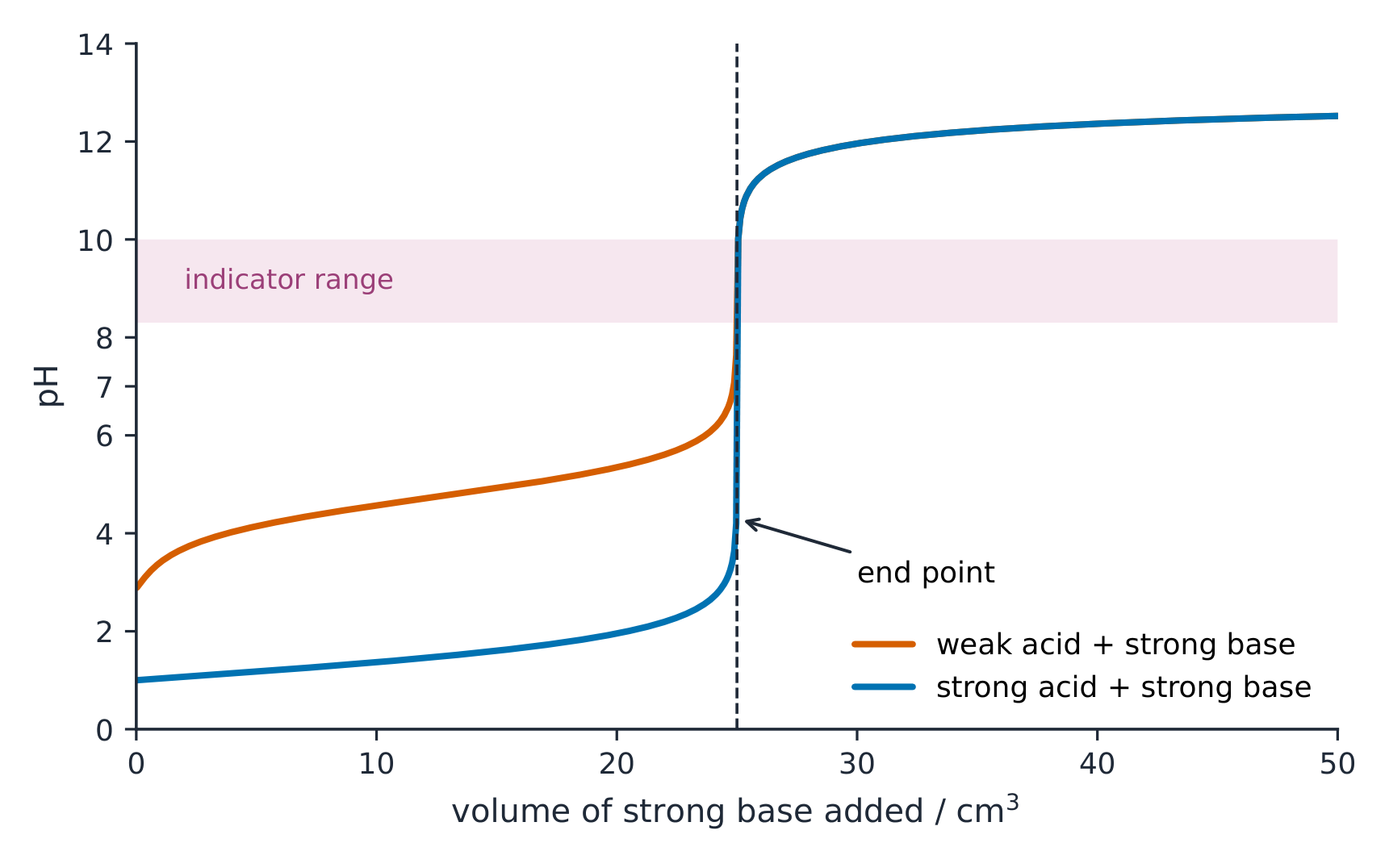
An acid–base titration curve

A titration curve 滴定曲线 plots pH as base (or acid) is added. Key points: the equivalence point 等当点 (moles of acid = moles of base – a steep jump), and the half-equivalence point, where $\text{pH}=\text{p}K_a$ (half the weak acid is converted, so a buffer is at its center).

An acid-base indicator 酸碱指示剂 is itself a weak acid whose protonated and deprotonated forms have different colours, so its colour responds to pH. You pick an indicator whose colour change happens near the titration's equivalence-point pH, so the colour flips just as the reaction completes.

Bahasa Indonesia
Kurva titrasi asam-basa

Kurva titrasi memplot pH saat basa (atau asam) ditambahkan. Titik kunci: titik ekuivalensi (mol asam = mol basa – lonjakan tajam), dan titik setengah ekuivalensi, di mana $\text{pH}=\text{p}K_a$ (setengah asam lemah dikonversi, sehingga penyangga berada di tengahnya).

Indikator asam-basa itu sendiri adalah asam lemah yang bentuk protonasinya dan deprotonasinya memiliki warna berbeda, sehingga warnanya merespons terhadap pH. Anda memilih indikator yang perubahan warnanya terjadi dekat dengan titik ekuivalensi titrasi, sehingga warna berubah tepat saat reaksi selesai.

Kurva titrasi memiliki lonjakan curam di dekat titik ekuivalen
kurva titrasi memiliki lonjakan tajam dekat titik ekuivalensi
Explore · ⁨Jelajahi⁩

Titrate to the equivalence point · ⁨Titrasi hingga titik ekuivalen⁩

A titration curve rises gently, then sharply at the equivalence point where moles of acid and base match. The steep jump pinpoints that volume. · ⁨Kurva titrasi naik perlahan, lalu tajam di titik ekuivalen di mana mol asam dan basa setara. Lonjakan curam ini pinpoint volume tersebut.⁩

Vocabulary · ⁨Kosa kata⁩ Train · ⁨Latih⁩
English Bahasa Indonesia
titration curve/taɪˈtreɪʃn kɜːv/ kurva titrasi
equivalence point/ɪˈkwɪvələns pɔɪnt/ titik kesetaraan
acid-base indicator/ˈæsɪd beɪs ˈɪndɪkeɪtə/ Indikator asam-basa
Buffer capacity/ˈbʌfə kəˈpæsɪti/ Kapasitas penyangga
8.6

Molecular Structure of Acids and Bases · ⁨Struktur Molekul Asam dan Basa⁩

Syllabus · ⁨Silabus⁩
English

Learning Objective 8.6.A: Explain the relationship between the strength of an acid or base and the structure of the molecule or ion.

  • 8.6.A.1 The protons on a molecule that will participate in acid-base reactions, and the relative strength of these protons, can be inferred from the molecular structure.
    • i. Strong acids (such as $\mathrm{HCl}$, $\mathrm{HBr}$, $\mathrm{HI}$, $\mathrm{HClO_4}$, $\mathrm{H_2SO_4}$, and $\mathrm{HNO_3}$) have very weak conjugate bases that are stabilized by electronegativity, inductive effects, resonance, or some combination thereof.
    • ii. Carboxylic acids are one common class of weak acid.
    • iii. Strong bases (such as group I and II hydroxides) have very weak conjugate acids.
    • iv. Common weak bases include nitrogenous bases such as ammonia as well as carboxylate ions.
    • v. Electronegative elements tend to stabilize the conjugate base relative to the conjugate acid, and so increase acid strength.
Bahasa Indonesia

Tujuan Pembelajaran 8.6.A: Jelaskan hubungan antara kekuatan asam atau basa dengan struktur molekul atau ionnya.

  • 8.6.A.1 Proton-proton pada molekul yang akan berpartisipasi dalam reaksi asam-basa, dan kekuatan relatif proton-proton tersebut, dapat disimpulkan dari struktur molekul.
    • i. Asam kuat (seperti $\mathrm{HCl}$, $\mathrm{HBr}$, $\mathrm{HI}$, $\mathrm{HClO_4}$, $\mathrm{H_2SO_4}$, dan $\mathrm{HNO_3}$) memiliki basa konjugat yang sangat lemah yang distabilkan oleh keelektronegatifan, efek induktif, resonansi, atau kombinasi di antaranya.
    • ii. Asam karboksilat adalah salah satu kelas asam lemah yang umum.
    • iii. Basa kuat (seperti hidroksida golongan I dan II) memiliki asam konjugat yang sangat lemah.
    • iv. Basa lemah yang umum termasuk basa nitrogen seperti amonia serta ion karboksilat.
    • v. Elemen elektronegatif cenderung menstabilkan basa konjugat relatif terhadap asam konjugatnya, sehingga meningkatkan kekuatan asam.

Source: College Board AP Course and Exam Description · ⁨Sumber: Deskripsi Kursus dan Ujian College Board AP⁩

English

Strength has structural roots. An acid is stronger when its conjugate base is more stable – for example, more electronegative atoms or resonance spreading the negative charge stabilize it. For oxoacids, more oxygen atoms on the central atom means a stronger acid.

Bahasa Indonesia

Kekuatan memiliki akar struktural. Suatu asam lebih kuat ketika basis konjugasinya lebih stabil – misalnya, atom yang lebih elektronegatif atau resonansi yang menyebarkan muatan negatif menstabilkannya. Untuk asam okso, semakin banyak atom oksigen pada atom pusat berarti asam tersebut lebih kuat.

8.7

pH and pKa · ⁨pH dan pKa⁩

Syllabus · ⁨Silabus⁩
English

Learning Objective 8.7.A: Explain the relationship between the predominant form of a weak acid or base in solution at a given $\mathrm{pH}$ and the $\mathrm{p}K_a$ of the conjugate acid or the $\mathrm{p}K_b$ of the conjugate base.

  • 8.7.A.1 The protonation state of an acid or base (i.e., the relative concentrations of $\mathrm{HA}$ and $\mathrm{A^-}$) can be predicted by comparing the $\mathrm{pH}$ of a solution to the $\mathrm{p}K_a$ of the acid in that solution. When solution $\mathrm{pH} < \mathrm{acid}\ \mathrm{p}K_a$, the acid form has a higher concentration than the base form. When solution $\mathrm{pH} > \mathrm{acid}\ \mathrm{p}K_a$, the base form has a higher concentration than the acid form.
  • 8.7.A.2 Acid-base indicators are substances that exhibit different properties (such as color) in their protonated versus deprotonated state, making that property respond to the $\mathrm{pH}$ of a solution.
  • 8.7.A.3 To ensure accurate results in a titration experiment, acid-base indicators should be selected that have a $\mathrm{p}K_a$ close to the $\mathrm{pH}$ at the equivalence point.
Bahasa Indonesia

Tujuan Pembelajaran 8.7.A: Jelaskan hubungan antara bentuk dominan asam lemah atau basa dalam larutan pada $\mathrm{pH}$ tertentu dengan $\mathrm{p}K_a$ dari asam konjugasi atau $\mathrm{p}K_b$ dari basa konjugasi.

  • 8.7.A.1 Status protonasi asam atau basa (yaitu, konsentrasi relatif $\mathrm{HA}$ dan $\mathrm{A^-}$) dapat diprediksi dengan membandingkan $\mathrm{pH}$ larutan dengan $\mathrm{p}K_a$ asam dalam larutan tersebut. Ketika larutan $\mathrm{pH} < \mathrm{acid}\ \mathrm{p}K_a$, bentuk asam memiliki konsentrasi lebih tinggi daripada bentuk basa. Ketika larutan $\mathrm{pH} > \mathrm{acid}\ \mathrm{p}K_a$, bentuk basa memiliki konsentrasi lebih tinggi daripada bentuk asam.
  • 8.7.A.2 Indikator asam-basa adalah zat yang menunjukkan sifat berbeda (seperti warna) pada keadaan terprotonasi dibandingkan tidak terprotonasi, membuat sifat tersebut merespons $\mathrm{pH}$ larutan.
  • 8.7.A.3 Untuk memastikan hasil yang akurat dalam eksperimen titrasi, indikator asam-basa harus dipilih yang memiliki $\mathrm{p}K_a$ dekat dengan $\mathrm{pH}$ pada titik ekuivalen.

Source: College Board AP Course and Exam Description · ⁨Sumber: Deskripsi Kursus dan Ujian College Board AP⁩

English

$\text{p}K_a=-\log K_a$: a smaller $\text{p}K_a$ means a stronger acid. Comparing pH to $\text{p}K_a$ tells you the dominant form: below $\text{p}K_a$ the acid form dominates; above it, the conjugate base form dominates.

Bahasa Indonesia

$\text{p}K_a=-\log K_a$: lebih kecil $\text{p}K_a$ berarti asam lebih kuat. Membandingkan pH dengan $\text{p}K_a$ memberi tahu bentuk dominan: di bawah $\text{p}K_a$ bentuk asam mendominasi; di atasnya, bentuk basis konjugat mendominasi.

8.8

Properties of Buffers · ⁨Sifat Penyangga⁩

Syllabus · ⁨Silabus⁩
English

Learning Objective 8.8.A: Explain the relationship between the ability of a buffer to stabilize $\mathrm{pH}$ and the reactions that occur when an acid or a base is added to a buffered solution.

  • 8.8.A.1 A buffer solution contains a large concentration of both members in a conjugate acid-base pair. The conjugate acid reacts with added base and the conjugate base reacts with added acid. These reactions are responsible for the ability of a buffer to stabilize $\mathrm{pH}$.
Bahasa Indonesia

Tujuan Pembelajaran 8.8.A: Jelaskan hubungan antara kemampuan buffer untuk menstabilkan $\mathrm{pH}$ dan reaksi yang terjadi ketika asam atau basa ditambahkan ke larutan terbuffer.

  • 8.8.A.1 Larutan buffer mengandung konsentrasi besar dari kedua anggota pasangan asam-basa konjugasi. Asam konjugasi bereaksi dengan basa yang ditambahkan dan basa konjugasi bereaksi dengan asam yang ditambahkan. Reaksi-reaksi ini bertanggung jawab atas kemampuan buffer untuk menstabilkan $\mathrm{pH}$.

Source: College Board AP Course and Exam Description · ⁨Sumber: Deskripsi Kursus dan Ujian College Board AP⁩

English
How a buffer resists pH change

A buffer works best when the weak acid and conjugate base concentrations are similar (pH near $\text{p}K_a$). Choose a buffer whose $\text{p}K_a$ is close to the target pH. Diluting a buffer barely changes its pH, because the acid-to-base ratio stays the same.

Bahasa Indonesia
Bagaimana penyangga menahan perubahan pH

Penyangga bekerja paling baik ketika konsentrasi asam lemah dan basis konjugat serupa (pH mendekati $\text{p}K_a$). Pilihlah penyangga whose $\text{p}K_a$ dekat dengan pH target. Mengencerkan penyangga hampir tidak mengubah pH-nya, karena rasio asam-ke-bas tetap sama.

Penyangga menahan perubahan pH dengan menyerap asam atau basa yang ditambahkan
Vocabulary · ⁨Kosa kata⁩ Train · ⁨Latih⁩
English Bahasa Indonesia
buffer/ˈbʌfə/ penyangga
8.9

The Henderson-Hasselbalch Equation · ⁨Persamaan Henderson-Hasselbalch⁩

Syllabus · ⁨Silabus⁩
English

Learning Objective 8.9.A: Identify the $\mathrm{pH}$ of a buffer solution based on the identity and concentrations of the conjugate acid-base pair used to create the buffer.

  • 8.9.A.1 The $\mathrm{pH}$ of the buffer is related to the $\mathrm{p}K_a$ of the acid and the concentration ratio of the conjugate acid-base pair. This relation is a consequence of the equilibrium expression associated with the dissociation of a weak acid, and is described by the Henderson-Hasselbalch equation. Adding small amounts of acid or base to a buffered solution does not significantly change the ratio of $[\mathrm{A^-}]/[\mathrm{HA}]$ and thus does not significantly change the solution $\mathrm{pH}$. The change in $\mathrm{pH}$ on addition of acid or base to a buffered solution is therefore much less than it would have been in the absence of the buffer.
    • Equation: $\mathrm{pH} = \mathrm{p}K_a + \log\dfrac{[\mathrm{A^-}]}{[\mathrm{HA}]}$
    • Exclusion statement: Computation of the change in pH resulting from the addition of an acid or a base to a buffer will not be assessed on the AP Exam.
    • Exclusion statement: Derivation of the Henderson-Hasselbalch equation will not be assessed on the AP Exam.
Bahasa Indonesia

Tujuan Pembelajaran 8.9.A: Identifikasi $\mathrm{pH}$ larutan buffer berdasarkan identitas dan konsentrasi pasangan asam-basa konjugasi yang digunakan untuk membuat buffer.

  • 8.9.A.1 $\mathrm{pH}$ buffer berkaitan dengan $\mathrm{p}K_a$ asam dan rasio konsentrasi pasangan asam-basa konjugasi. Hubungan ini merupakan konsekuensi dari ekspresi kesetimbangan yang terkait dengan disosiasi asam lemah, dan dijelaskan oleh persamaan Henderson-Hasselbalch. Menambahkan jumlah kecil asam atau basa ke larutan terbuffer tidak secara signifikan mengubah rasio $[\mathrm{A^-}]/[\mathrm{HA}]$ dan demikian pula tidak secara signifikan mengubah $\mathrm{pH}$ larutan. Perubahan pada $\mathrm{pH}$ saat penambahan asam atau basa ke larutan terbuffer menjadi jauh lebih kecil daripada yang akan terjadi tanpa adanya buffer.
    • Persamaan: $\mathrm{pH} = \mathrm{p}K_a + \log\dfrac{[\mathrm{A^-}]}{[\mathrm{HA}]}$
    • Pernyataan pengecualian: Perhitungan perubahan pH akibat penambahan asam atau basa ke buffer tidak akan diujikan dalam Ujian AP.
    • Pernyataan pengecualian: Penurunan rumus persamaan Henderson-Hasselbalch tidak akan diujikan dalam Ujian AP.

Source: College Board AP Course and Exam Description · ⁨Sumber: Deskripsi Kursus dan Ujian College Board AP⁩

English

For a buffer, the pH follows from the acid-to-base ratio:

$$\text{pH}=\text{p}K_a+\log\frac{[\text{A}^-]}{[\text{HA}]}.$$
When the concentrations are equal, the log is zero and $\text{pH}=\text{p}K_a$. Use it to design a buffer or find its pH quickly.

Worked example. A buffer holds $0.20\ \text{M}$ acetic acid ($\text{p}K_a=4.74$) and $0.30\ \text{M}$ acetate. Its pH is

$$\text{pH}=4.74+\log\frac{0.30}{0.20}=4.74+\log(1.5)=4.74+0.18=4.92.$$
A little more conjugate base than acid pushes the pH just above $\text{p}K_a$, as the equation predicts.

Bahasa Indonesia

Untuk penyangga, pH dapat dihitung dari rasio asam-ke-bas:

$$\text{pH}=\text{p}K_a+\log\frac{[\text{A}^-]}{[\text{HA}]}.$$
Ketika konsentrasinya sama, logaritmanya nol dan $\text{pH}=\text{p}K_a$. Gunakan ini untuk merancang penyangga atau menemukan pH-nya dengan cepat.

Contoh terpecahkan. Sebuah penyangga mengandung $0.20\ \text{M}$ asam asetat ($\text{p}K_a=4.74$) dan $0.30\ \text{M}$ asetat. pH-nya adalah

$$\text{pH}=4.74+\log\frac{0.30}{0.20}=4.74+\log(1.5)=4.74+0.18=4.92.$$
Sedikit lebih banyak basis konjugat daripada asam mendorong pH sedikit di atas $\text{p}K_a$, seperti yang diprediksi oleh persamaan.

8.10

Buffer Capacity · ⁨Kapasitas Penyangga⁩

Syllabus · ⁨Silabus⁩
English

Learning Objective 8.10.A: Explain the relationship between the buffer capacity of a solution and the relative concentrations of the conjugate acid and conjugate base components of the solution.

  • 8.10.A.1 Increasing the concentration of the buffer components (while keeping the ratio of these concentrations constant) keeps the $\mathrm{pH}$ of the buffer the same but increases the capacity of the buffer to neutralize added acid or base.
  • 8.10.A.2 When a buffer has more conjugate acid than base, it has a greater buffer capacity for addition of added base than acid. When a buffer has more conjugate base than acid, it has a greater buffer capacity for addition of added acid than base.
Bahasa Indonesia

Tujuan Pembelajaran 8.10.A: Menjelaskan hubungan antara kapasitas penyangga suatu larutan dan konsentrasi relatif komponen asam konjugat dan basa konjugat dari larutan tersebut.

  • 8.10.A.1 Meningkatkan konsentrasi komponen penyangga (sambil mempertahankan rasio konsentrasi ini tetap) menjaga $\mathrm{pH}$ penyangga tetap sama tetapi meningkatkan kapasitas penyangga untuk menetralkan asam atau basa yang ditambahkan.
  • 8.10.A.2 Ketika penyangga memiliki lebih banyak asam konjugat daripada basa, penyangga tersebut memiliki kapasitas penyangga yang lebih besar untuk penambahan basa dibandingkan asam. Ketika penyangga memiliki lebih banyak basa konjugat daripada asam, penyangga tersebut memiliki kapasitas penyangga yang lebih besar untuk penambahan asam dibandingkan basa.

Source: College Board AP Course and Exam Description · ⁨Sumber: Deskripsi Kursus dan Ujian College Board AP⁩

English

Buffer capacity 缓冲容量 is how much acid or base a buffer can absorb before its pH changes sharply. It is greatest when the components are concentrated and in roughly equal amounts. Once one component is used up, the buffer fails.

Bahasa Indonesia

Kapasitas penyangga adalah seberapa banyak asam atau basa yang dapat diserap penyangga sebelum pH-nya berubah tajam. Ini paling besar ketika komponen-komponennya konsentrasi dan dalam jumlah kira-kira sama. once salah satu komponen habis, penyangga gagal.

8.11

pH and Solubility · ⁨pH dan Kelarutan⁩

Syllabus · ⁨Silabus⁩
English

Learning Objective 8.11.A: Identify the qualitative effect of changes in pH on the solubility of a salt.

  • 8.11.A.1 The solubility of a salt is pH sensitive when one of the constituent ions is a weak acid, a weak base, or the hydroxide ion. These effects can be understood qualitatively using Le Châtelier's principle.
    • Exclusion statement: Computations of solubility as a function of pH will not be assessed on the AP Exam.
Bahasa Indonesia

Tujuan Pembelajaran 8.11.A: Mengidentifikasi efek kualitatif dari perubahan pH terhadap kelarutan garam.

  • 8.11.A.1 Kelarutan garam sensitif terhadap pH ketika salah satu ion penyusunnya merupakan asam lemah, basa lemah, atau ion hidroksida. Efek-efek ini dapat dipahami secara kualitatif menggunakan prinsip Le Châtelier.
    • Pernyataan Pengecualian: Perhitungan kelarutan sebagai fungsi pH tidak akan diujikan pada Ujian AP.

Source: College Board AP Course and Exam Description · ⁨Sumber: Deskripsi Kursus dan Ujian College Board AP⁩

English

The solubility of a salt with a basic anion rises in acidic solution: the added $\text{H}^+$ reacts with the anion, removing it from the solubility equilibrium and pulling more solid to dissolve (Le Chatelier applied to $K_{sp}$). So pH can control whether an ionic solid dissolves.

Bahasa Indonesia

Kelarutan garam dengan anion basa meningkat dalam larutan asam: $\text{H}^+$ yang ditambahkan bereaksi dengan anion, mengeluarkannya dari kesetimbangan kelarutan dan menarik lebih banyak zat padat untuk melarut (Hukum Le Chatelier diterapkan pada $K_{sp}$). Oleh karena itu, pH dapat mengontrol apakah suatu padatan ionik akan melarut.

8.11

Exam tips · ⁨Tips ujian⁩

English
  • Neutral means equal ions, not pH 7. In pure water $[\text{H}_3\text{O}^+]=[\text{OH}^-]$; since $K_w$ rises with temperature, neutral pH drifts below 7 above 25 °C. Use $K_w=[\text{H}_3\text{O}^+][\text{OH}^-]=1.0\times10^{-14}$ (25 °C) to convert between $[\text{OH}^-]$ and $[\text{H}_3\text{O}^+]$.
  • $\text{pH}=-\log[\text{H}^+]$ is logarithmic — each unit is a ten-fold change in $[\text{H}^+]$.
  • A strong acid/base dissociates completely (so $[\text{H}^+]$ = concentration); a weak one only partly, needing $K_a$.
  • A buffer contains a weak acid and its conjugate base together; it resists pH change by mopping up added acid or base.
  • On a titration curve the equivalence point is the steep jump; the half-equivalence point has $\text{pH}=\text{p}K_a$.
  • A smaller $\text{p}K_a$ means a stronger acid.
Bahasa Indonesia
  • Netral berarti ion yang sama, bukan pH 7. Dalam air murni $[\text{H}_3\text{O}^+]=[\text{OH}^-]$; karena $K_w$ meningkat seiring suhu, pH netral bergeser ke bawah 7 di atas 25 °C. Gunakan $K_w=[\text{H}_3\text{O}^+][\text{OH}^-]=1.0\times10^{-14}$ (25 °C) untuk konversi antara $[\text{OH}^-]$ dan $[\text{H}_3\text{O}^+]$.
  • Skala $\text{pH}=-\log[\text{H}^+]$ bersifat logaritmik—setiap kenaikan satu unit berarti perubahan sepuluh kali lipat pada konsentrasi $[\text{H}^+]$.
  • Asam/basa kuat terdisosiasi sepenuhnya (sehingga konsentrasi $[\text{H}^+]$ = konsentrasi awal); sedangkan yang lemah hanya terdisosiasi sebagian, sehingga memerlukan $K_a$.
  • Larutan penyangga (buffer) mengandung asam lemah dan basa konjugasinya sekaligus; ia menahan perubahan pH dengan menetralkan asam atau basa yang ditambahkan.
  • Pada kurva titrasi, titik ekuivalen adalah lonjakan curam; pada titik setengah ekuivalen, berlaku $\text{pH}=\text{p}K_a$.
  • Nilai $\text{p}K_a$ yang lebih kecil berarti asam yang lebih kuat.

Interactive lessons on this topic · ⁨Pelajaran interaktif untuk topik ini⁩

Work through it step by step, with instant-check exercises. · ⁨Kerjakan langkah demi langkah, dengan latihan pengecekan instan.⁩

Past Papers · ⁨Soal-Soil Masa Lalu⁩

More topics in AP Chemistry · ⁨AP Kimia⁩ · ⁨Topik lain dalam AP Chemistry · ⁨AP Kimia⁩⁩

Log in or create account · ⁨Masuk atau buat akun⁩

IGCSE, A-Level & AP