Skip to content · ⁨Lompat ke konten⁩

Equilibrium · ⁨Kesetimbangan⁩

AP Chemistry · ⁨AP Kimia⁩ · Topic 7 · ⁨Topik 7⁩

Video lesson for this topic · ⁨Pelajaran video untuk topik ini⁩ Open the video page · ⁨Buka halaman video⁩
8:24

Kesetimbangan

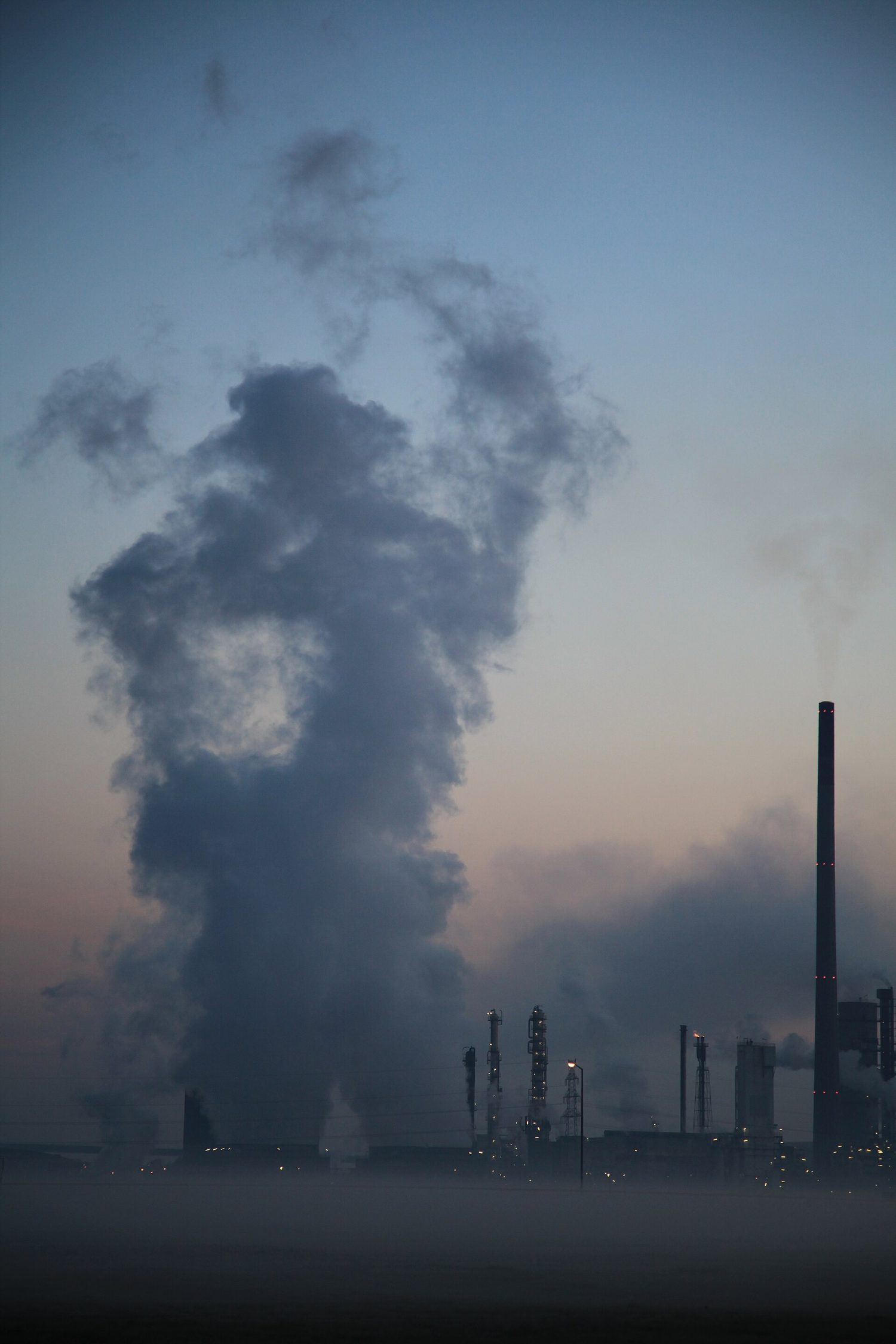
Pabrik kimia saat senja. Di dalamnya, nitrogen dari udara diubah menjadi amonia — pupuk yang menyuplai makanan bagi sekitar setengah manusia yang hidup hari ini. Namun…

English narration · English + 中文 subtitles burned in · ⁨Narasi bahasa Inggris · Subtitle bahasa Inggris + 中文 disematkan langsung⁩

7.1

Introduction to Equilibrium · ⁨Pengantar Kesetimbangan⁩

Syllabus · ⁨Silabus⁩
English

Learning Objective 7.1.A: Explain the relationship between the occurrence of a reversible chemical or physical process, and the establishment of equilibrium, to experimental observations.

  • 7.1.A.1 Many observable processes are reversible. Examples include evaporation and condensation of water, absorption and desorption of a gas, or dissolution and precipitation of a salt. Some important reversible chemical processes include the transfer of protons in acid-base reactions and the transfer of electrons in redox reactions.
  • 7.1.A.2 When equilibrium is reached, no observable changes occur in the system. Reactants and products are simultaneously present, and the concentrations or partial pressures of all species remain constant.
  • 7.1.A.3 The equilibrium state is dynamic. The forward and reverse processes continue to occur at equal rates, resulting in no net observable change.
  • 7.1.A.4 Graphs of concentration, partial pressure, or rate of reaction versus time for simple chemical reactions can be used to understand the establishment of chemical equilibrium.
Bahasa Indonesia

Tujuan Pembelajaran 7.1.A: Jelaskan hubungan antara terjadinya proses kimia atau fisik yang reversibel, dan pen establishment kesetimbangan, terhadap pengamatan eksperimen.

  • 7.1.A.1 Banyak proses yang dapat diamati bersifat reversibel. Contohnya meliputi penguapan dan kondensasi air, penyerapan dan desorpsi gas, atau pelarutan dan presipitasi garam. Beberapa proses kimia reversibel yang penting meliputi transfer proton dalam reaksi asam-basa dan transfer elektron dalam reaksi redoks.
  • 7.1.A.2 Ketika kesetimbangan tercapai, tidak ada perubahan yang dapat diamati terjadi pada sistem. Reaktan dan produk hadir secara bersamaan, dan konsentrasi atau tekanan parsial dari semua spesies tetap konstan.
  • 7.1.A.3 Keadaan kesetimbangan bersifat dinamis. Proses maju dan mundur terus terjadi pada laju yang sama, menghasilkan tidak adanya perubahan yang dapat diamati secara netto.
  • 7.1.A.4 Grafik konsentrasi, tekanan parsial, atau laju reaksi terhadap waktu untuk reaksi kimia sederhana dapat digunakan untuk memahami pembentukan kesetimbangan kimia.
Source: College Board AP Course and Exam Description · ⁨Sumber: Deskripsi Kursus dan Ujian College Board AP⁩

English
Dynamic equilibrium

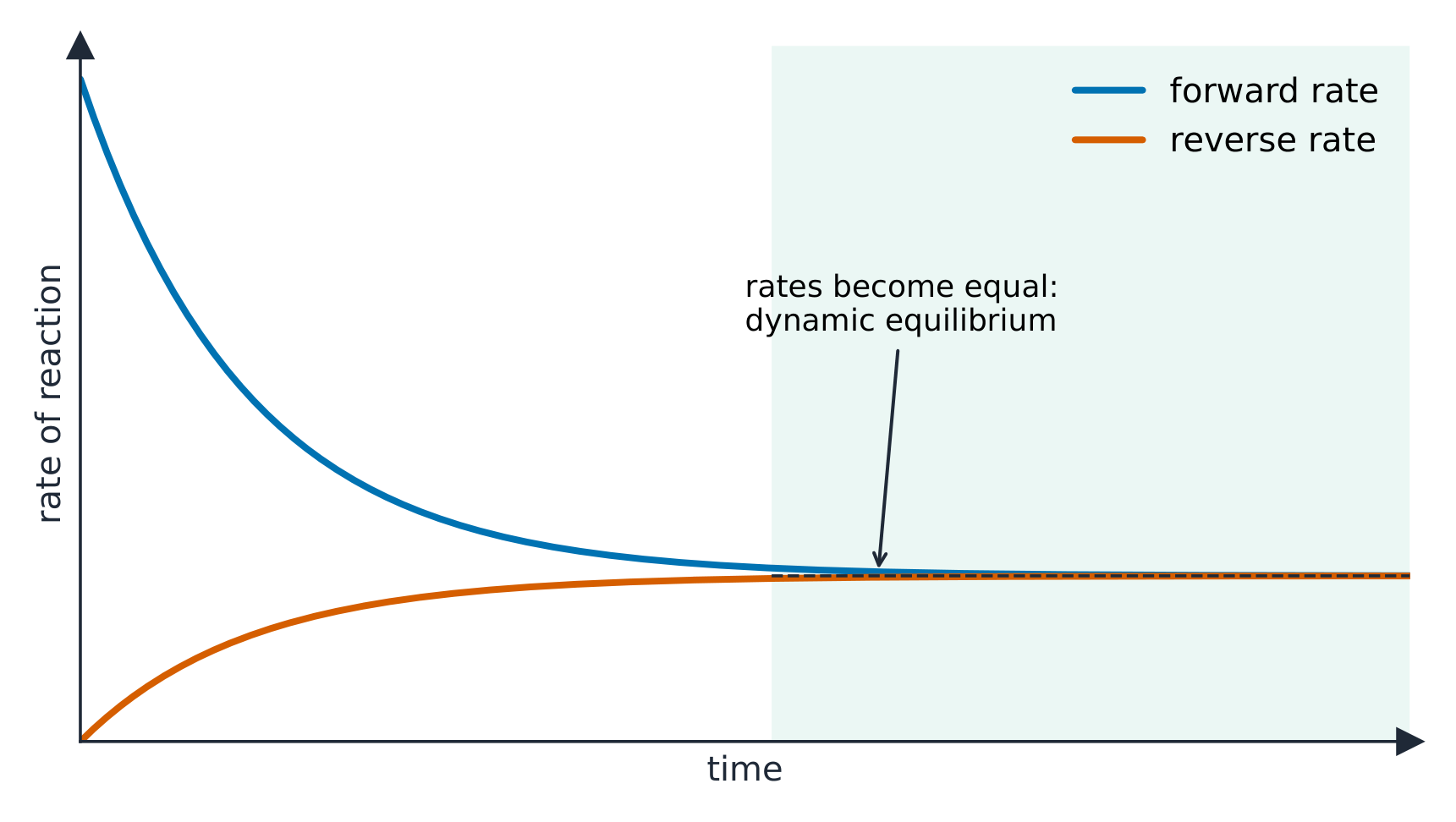
A reversible reaction 可逆反应 runs both ways. Chemical equilibrium 化学平衡 is reached when the forward and reverse rates become equal, so concentrations stop changing. Equilibrium is dynamic – both reactions continue, but at matching rates, so nothing appears to change.

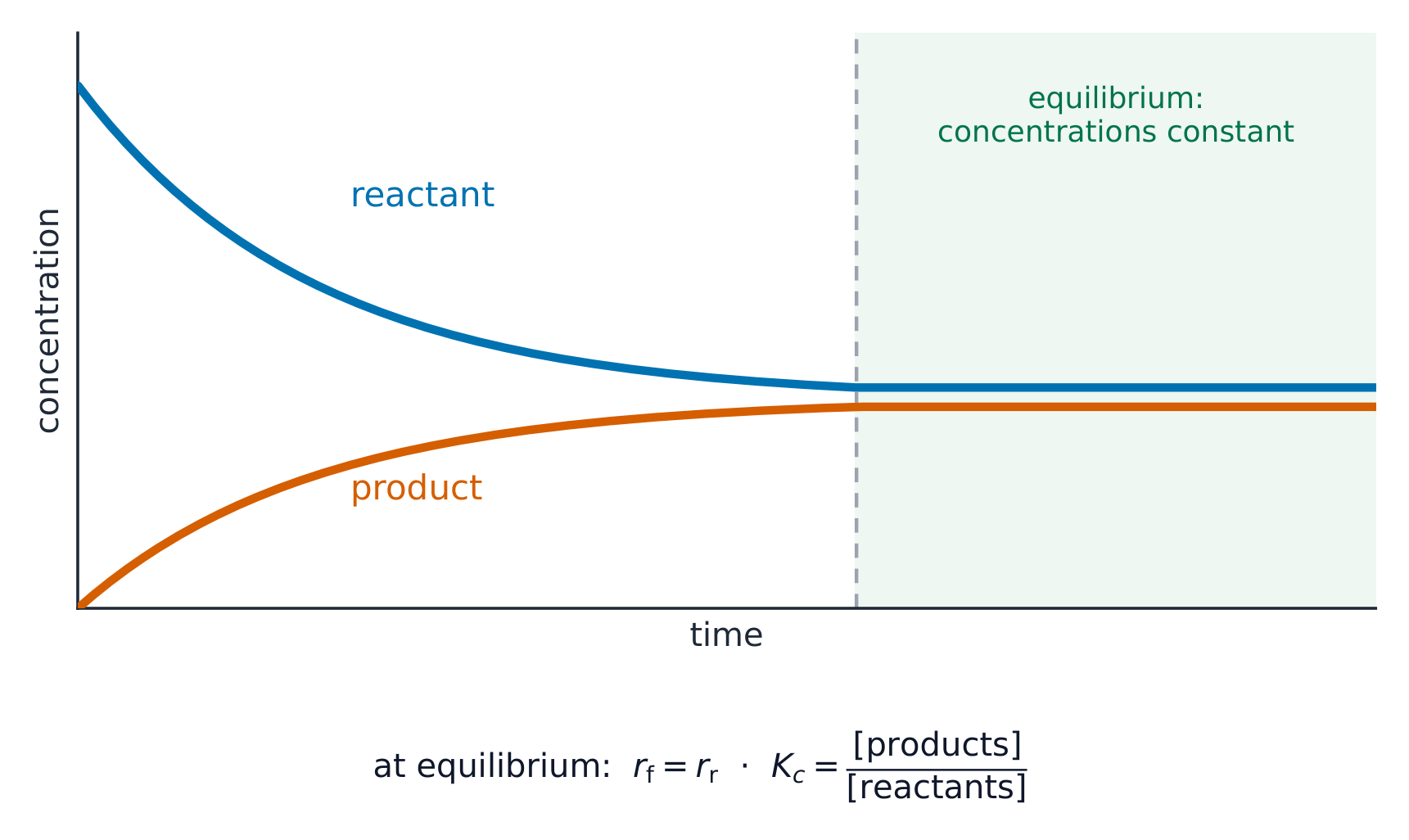
The rates graph above explains why concentrations settle; this next graph shows what the concentrations do – reactants fall and products rise until, once the rates match, both hold constant (they need not be equal).

Bahasa Indonesia
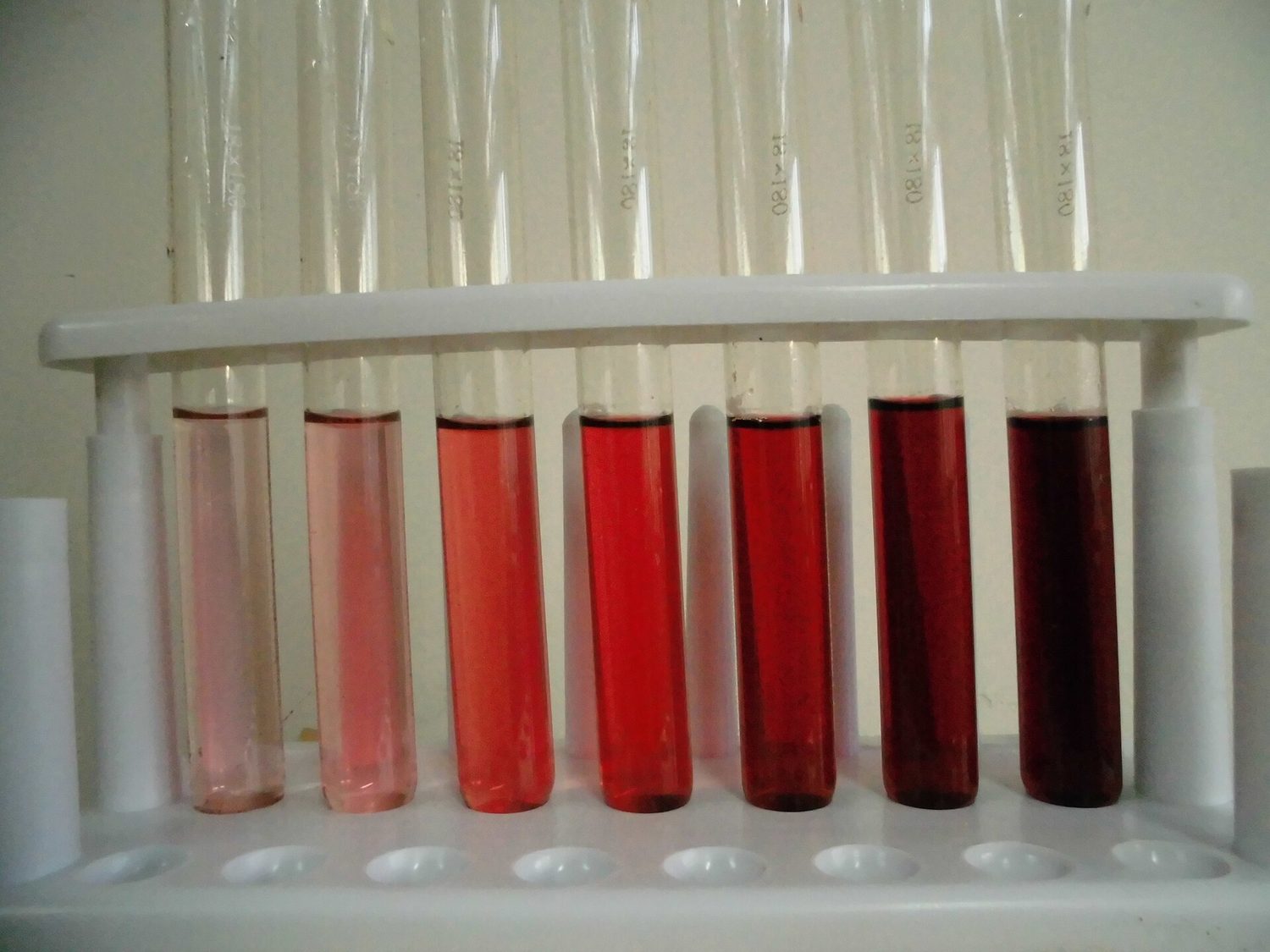
Larutan kobalt klorida: sistem kesetimbangan bergeser ketika kondisi berubah (Le Chatelier)
Kesetimbangan dinamis

Reaksi reversibel berjalan dua arah. Kesetimbangan kimia tercapai ketika laju maju dan mundur menjadi sama, sehingga konsentrasi berhenti berubah. Kesetimbangan bersifat dinamis – kedua reaksi terus berlangsung, namun pada laju yang seimbang, sehingga tidak ada perubahan yang terlihat.

Kesetimbangan dinamis: laju maju dan mundur menjadi sama

Graf laju di atas menjelaskan mengapa konsentrasi stabil; grafik berikutnya menunjukkan apa yang terjadi pada konsentrasi – reaktan turun dan produk naik hingga, setelah laju setara, keduanya tetap konstan (tidak harus sama besar).

Konsentrasi reaktan dan produk berubah, lalu tetap konstan setelah kesetimbangan tercapai
Vocabulary · ⁨Kosa kata⁩ Train · ⁨Latih⁩
English Bahasa Indonesia
reversible reaction/rɪˈvɜːsɪbl rɪˈækʃn/ reaksi boleh balik
Chemical equilibrium/ˈkemɪkl ˌiːkwɪˈlɪbrɪəm/ Kesetimbangan kimia
reaction quotient/rɪˈækʃn ˈkwəʊʃənt/ kuotient reaksi
equilibrium constant/ˌiːkwɪˈlɪbrɪəm ˈkɒnstənt/ pemalar keseimbangan
Le Chatelier's principle/lə ˈtʃeɪtlɪəz ˈprɪnsɪpl/ Prinsip Le Chatelier
solubility product/ˌsɒljuːˈbɪlɪti ˈprɒdʌkt/ hasil darab kebolehlarutan
7.2

Direction of Reversible Reactions · ⁨Arah Reaksi Reversibel⁩

Syllabus · ⁨Silabus⁩
English

Learning Objective 7.2.A: Explain the relationship between the direction in which a reversible reaction proceeds and the relative rates of the forward and reverse reactions.

  • 7.2.A.1 If the rate of the forward reaction is greater than the reverse reaction, then there is a net conversion of reactants to products. If the rate of the reverse reaction is greater than that of the forward reaction, then there is a net conversion of products to reactants. An equilibrium state is reached when these rates are equal.
Bahasa Indonesia

Tujuan Pembelajaran 7.2.A: Jelaskan hubungan antara arah reaksi reversibel berlangsung dan laju relatif reaksi maju dan balik.

  • 7.2.A.1 Jika laju reaksi maju lebih besar daripada reaksi balik, maka terjadi konversi bersih reaktan menjadi produk. Jika laju reaksi balik lebih besar daripada laju reaksi maju, maka terjadi konversi bersih produk menjadi reaktan. Keadaan kesetaraan tercapai ketika laju-laju ini sama.

Source: College Board AP Course and Exam Description · ⁨Sumber: Deskripsi Kursus dan Ujian College Board AP⁩

English

At equilibrium the amounts of reactants and products are fixed but usually not equal. Whether the mixture favors products or reactants depends on the reaction; you compare the current state to the equilibrium condition to predict which way it shifts.

Bahasa Indonesia

Pada kesetimbangan jumlah reaktan dan produk tetap tetapi biasanya tidak sama. Apakah campuran lebih condong ke produk atau reaktan bergantung pada reaksi; Anda membandingkan keadaan saat ini dengan kondisi kesetimbangan untuk memprediksi arah pergeseran.

7.3

The Reaction Quotient and Equilibrium Constant · ⁨Kuosien Reaksi dan Konstanta Kesetimbangan⁩

Syllabus · ⁨Silabus⁩
English

Learning Objective 7.3.A: Represent the reaction quotient $Q_c$ or $Q_p$, for a reversible reaction, and the corresponding equilibrium expressions $K_c = Q_c$ or $K_p = Q_p$.

  • 7.3.A.1 The reaction quotient $Q_c$ describes the relative concentrations of reaction species at any time. For gas phase reactions, the reaction quotient may instead be written in terms of partial pressures as $Q_p$. The reaction quotient tends toward the equilibrium constant such that at equilibrium $K_c = Q_c$ and $K_p = Q_p$. As examples, for the reaction

    $$a\,\mathrm{A} + b\,\mathrm{B} \rightleftarrows c\,\mathrm{C} + d\,\mathrm{D}$$
    the law of mass action indicates that the equilibrium expression for $(K_c, Q_c)$ is

    • Equation: $K_c = \dfrac{[\mathrm{C}]^c [\mathrm{D}]^d}{[\mathrm{A}]^a [\mathrm{B}]^b}$

    and that for $(K_p, Q_p)$ is

    • Equation: $K_p = \dfrac{(P_\mathrm{C})^c (P_\mathrm{D})^d}{(P_\mathrm{A})^a (P_\mathrm{B})^b}$
    • Exclusion statement: Conversion between $K_c$ and $K_p$ will not be assessed on the AP Exam. Students should be aware of the conceptual differences and pay attention to whether $K_c$ or $K_p$ is used in an exam question.
    • Exclusion statement: Equilibrium calculations on systems where a dissolved species is in equilibrium with that species in the gas phase will not be assessed on the AP Exam.
  • 7.3.A.2 The reaction quotient does not include substances whose concentrations (or partial pressures) are independent of the amount, such as for solids and pure liquids.

Bahasa Indonesia

Tujuan Pembelajaran 7.3.A: Representasikan kuosien reaksi $Q_c$ atau $Q_p$, untuk reaksi reversibel, dan ekspresi kesetaraan yang sesuai $K_c = Q_c$ atau $K_p = Q_p$.

  • 7.3.A.1 Kuosien reaksi $Q_c$ menggambarkan konsentrasi relatif spesies reaksi pada waktu apa pun. Untuk reaksi fase gas, kuosien reaksi dapat ditulis dalam bentuk tekanan parsial sebagai $Q_p$. Kuosien reaksi cenderung menuju konstanta kesetaraan sehingga pada kesetaraan $K_c = Q_c$ dan $K_p = Q_p$. Sebagai contoh, untuk reaksi

    $$a\,\mathrm{A} + b\,\mathrm{B} \rightleftarrows c\,\mathrm{C} + d\,\mathrm{D}$$
    hukum massa menunjukkan bahwa ekspresi kesetaraan untuk $(K_c, Q_c)$ adalah

    • Persamaan: $K_c = \dfrac{[\mathrm{C}]^c [\mathrm{D}]^d}{[\mathrm{A}]^a [\mathrm{B}]^b}$

    dan untuk $(K_p, Q_p)$ adalah

    • Persamaan: $K_p = \dfrac{(P_\mathrm{C})^c (P_\mathrm{D})^d}{(P_\mathrm{A})^a (P_\mathrm{B})^b}$
    • Pernyataan Pengecualian: Konversi antara $K_c$ dan $K_p$ tidak akan diujikan dalam Ujian AP. Siswa harus menyadari perbedaan konseptual dan memperhatikan apakah $K_c$ atau $K_p$ digunakan dalam soal ujian.
    • Pernyataan Pengecualian: Perhitungan kesetaraan pada sistem di mana spesies terlarut berada dalam kesetaraan dengan spesies tersebut dalam fase gas tidak akan diujikan dalam Ujian AP.
  • 7.3.A.2 Kuosien reaksi tidak mencakup zat-zat yang konsentrasinya (atau tekanan parsialnya) tidak bergantung pada jumlah, seperti untuk padat dan cairan murni.

Source: College Board AP Course and Exam Description · ⁨Sumber: Deskripsi Kursus dan Ujian College Board AP⁩

English

The reaction quotient 反应商 $Q$ has the same form as the equilibrium expression but uses current concentrations:

$$Q=\frac{[\text{products}]}{[\text{reactants}]}\ \text{(each raised to its coefficient)}.$$
At equilibrium $Q$ equals the equilibrium constant 平衡常数 $K$. Comparing them predicts direction: $Q shifts forward (toward products); $Q>K$ shifts reverse; $Q=K$ means already at equilibrium.

Bahasa Indonesia

Kuosien reaksi $Q$ memiliki bentuk yang sama dengan ekspresi kesetimbangan tetapi menggunakan konsentrasi saat ini:

$$Q=\frac{[\text{products}]}{[\text{reactants}]}\ \text{(each raised to its coefficient)}.$$
Pada kesetimbangan $Q$ sama dengan konstanta kesetimbangan $K$. Membandingkannya memprediksi arah: $Q bergeser maju (ke arah produk); $Q>K$ bergeser mundur; $Q=K$ berarti sudah berada pada kesetimbangan.

7.4

Calculating the Equilibrium Constant · ⁨Menghitung Konstanta Kesetimbangan⁩

Syllabus · ⁨Silabus⁩
English

Learning Objective 7.4.A: Calculate $K_c$ or $K_p$ based on experimental observations of concentrations or pressures at equilibrium.

  • 7.4.A.1 Equilibrium constants can be determined from experimental measurements of the concentrations or partial pressures of the reactants and products at equilibrium.
Bahasa Indonesia

Tujuan Pembelajaran 7.4.A: Hitung $K_c$ atau $K_p$ berdasarkan pengamatan eksperimental terhadap konsentrasi atau tekanan pada kesetaraan.

  • 7.4.A.1 Konstanta kesetaraan dapat ditentukan dari pengukuran eksperimental terhadap konsentrasi atau tekanan parsial reaktan dan produk pada kesetaraan.

Source: College Board AP Course and Exam Description · ⁨Sumber: Deskripsi Kursus dan Ujian College Board AP⁩

English

Write $K$ from the balanced equation (pure solids and liquids are left out). From equilibrium concentrations (or partial pressures for $K_p$), plug in and compute. $K_c$ uses molarities; $K_p$ uses pressures.

Worked example. For $\text{N}_2\text{O}_4\rightleftharpoons2\text{NO}_2$, the equilibrium concentrations are $[\text{N}_2\text{O}_4]=0.20\ \text{M}$ and $[\text{NO}_2]=0.10\ \text{M}$. Then

$$K_c=\frac{[\text{NO}_2]^2}{[\text{N}_2\text{O}_4]}=\frac{(0.10)^2}{0.20}=0.050.$$
The NO$_2$ coefficient of $2$ becomes the power; N$_2$O$_4$ (coefficient $1$) is just to the first power.

Bahasa Indonesia

Tulis $K$ dari persamaan setara (padatan murni dan cairan dicantumkan). Dari konsentrasi kesetimbangan (atau tekanan parsial untuk $K_p$), masukkan nilai dan hitung. $K_c$ menggunakan molaritas; $K_p$ menggunakan tekanan.

Contoh terpecahkan. Untuk $\text{N}_2\text{O}_4\rightleftharpoons2\text{NO}_2$, konsentrasi kesetimbangannya adalah $[\text{N}_2\text{O}_4]=0.20\ \text{M}$ dan $[\text{NO}_2]=0.10\ \text{M}$. Maka

$$K_c=\frac{[\text{NO}_2]^2}{[\text{N}_2\text{O}_4]}=\frac{(0.10)^2}{0.20}=0.050.$$
Koefisien NO$_2$ dari $2$ menjadi pangkat; N$_2$O$_4$ (koefisien $1$) hanya dipangkatkan satu.

7.5

Magnitude of the Equilibrium Constant · ⁨Besaran Konstanta Kesetimbangan⁩

Syllabus · ⁨Silabus⁩
English

Learning Objective 7.5.A: Explain the relationship between very large or very small values of $K$ and the relative concentrations of chemical species at equilibrium.

  • 7.5.A.1 Some equilibrium reactions have very large $K$ values and proceed essentially to completion. Others have very small $K$ values and barely proceed at all.
Bahasa Indonesia

Tujuan Pembelajaran 7.5.A: Jelaskan hubungan antara nilai sangat besar atau sangat kecil dari $K$ dan konsentrasi relatif spesies kimia pada kesetaraan.

  • 7.5.A.1 Beberapa reaksi kesetaraan memiliki nilai $K$ yang sangat besar dan berlangsung hampir sampai selesai. Yang lain memiliki nilai $K$ yang sangat kecil dan hampir tidak berlangsung sama sekali.

Source: College Board AP Course and Exam Description · ⁨Sumber: Deskripsi Kursus dan Ujian College Board AP⁩

English
  • $K\gg 1$: products strongly favored (reaction nearly complete).
  • $K\ll 1$: reactants favored (little reaction).
  • $K\approx 1$: significant amounts of both.

The size of $K$ tells you where the equilibrium "sits."

Bahasa Indonesia
  • $K\gg 1$: produk sangat didominasi (reaksi hampir selesai).
  • $K\ll 1$: reaktan didominasi (sedikit reaksi).
  • $K\approx 1$: jumlah signifikan dari keduanya.

Besar $K$ memberi tahu Anda di mana kesetimbangan "berada".

7.6

Properties of the Equilibrium Constant · ⁨Sifat Konstanta Kesetimbangan⁩

Syllabus · ⁨Silabus⁩
English

Learning Objective 7.6.A: Represent a multistep process with an overall equilibrium expression, using the constituent $K$ expressions for each individual reaction.

  • 7.6.A.1 When a reaction is reversed, $K$ is inverted.
  • 7.6.A.2 When the stoichiometric coefficients of a reaction are multiplied by a factor $c$, $K$ is raised to the power $c$.
  • 7.6.A.3 When reactions are added together, the $K$ of the resulting overall reaction is the product of the $K$'s for the reactions that were summed.
  • 7.6.A.4 Since the expressions for $K$ and $Q$ have identical mathematical forms, all valid algebraic manipulations of $K$ also apply to $Q$.
Bahasa Indonesia

Tujuan Pembelajaran 7.6.A: Representasikan proses bertahap dengan ekspresi kesetaraan keseluruhan, menggunakan ekspresi $K$ penyusun untuk setiap reaksi individu.

  • 7.6.A.1 Ketika reaksi dibalik, $K$ dibalik.
  • 7.6.A.2 Ketika koefisien stoikiometri dari suatu reaksi dikalikan dengan faktor $c$, $K$ dipangkatkan dengan pangkat $c$.
  • 7.6.A.3 Ketika reaksi ditambahkan bersama-sama, $K$ dari reaksi keseluruhan yang dihasilkan adalah hasil kali dari $K$'s untuk reaksi yang dijumlahkan.
  • 7.6.A.4 Karena ekspresi untuk $K$ dan $Q$ memiliki bentuk aljabar yang identik, semua manipulasi aljabar yang valid dari $K$ juga berlaku untuk $Q$.

Source: College Board AP Course and Exam Description · ⁨Sumber: Deskripsi Kursus dan Ujian College Board AP⁩

English

$K$ changes in predictable ways: reversing a reaction inverts $K$ ($1/K$); multiplying coefficients by $n$ raises $K$ to the $n$th power; adding reactions multiplies their $K$ values. Only temperature changes the value of $K$ itself.

Bahasa Indonesia

$K$ berubah secara teratur: membalikkan reaksi membalik $K$ (menjadi $1/K$); mengalikan koefisien dengan $n$ menaikkan $K$ ke pangkat $n$; menjumlahkan reaksi mengalikan nilai $K$-nya. Hanya suhu yang mengubah nilai $K$ itu sendiri.

7.7

Calculating Equilibrium Concentrations · ⁨Menghitung Konsentrasi Kesetimbangan⁩

Syllabus · ⁨Silabus⁩
English

Learning Objective 7.7.A: Identify the concentrations or partial pressures of chemical species at equilibrium based on the initial conditions and the equilibrium constant.

  • 7.7.A.1 The concentrations or partial pressures of species at equilibrium can be predicted given the balanced reaction, initial concentrations, and the appropriate $K$.
  • 7.7.A.2 When $Q < K$, the reaction will proceed with a net consumption of reactants and generation of products. When $Q > K$, the reaction will proceed with a net consumption of products and generation of reactants. When $Q = K$, the system is at dynamic equilibrium; both forward and reverse reactions proceed at the same rate, and the proportion of reactants and products remains constant.
Bahasa Indonesia

Tujuan Pembelajaran 7.7.A: Identifikasi konsentrasi atau tekanan parsial spesies kimia pada kesetaraan berdasarkan kondisi awal dan konstanta kesetaraan.

  • 7.7.A.1 Konsentrasi atau tekanan parsial spesies pada kesetaraan dapat diprediksi mengingat reaksi setara, konsentrasi awal, dan $K$ yang sesuai.
  • 7.7.A.2 Ketika $Q < K$, reaksi akan berlangsung dengan konsumsi bersih reaktan dan pembentukan produk. Ketika $Q > K$, reaksi akan berlangsung dengan konsumsi bersih produk dan pembentukan reaktan. Ketika $Q = K$, sistem berada dalam kesetimbangan dinamis; baik reaksi maju maupun balik berlangsung pada laju yang sama, dan proporsi reaktan dan produk tetap konstan.

Source: College Board AP Course and Exam Description · ⁨Sumber: Deskripsi Kursus dan Ujian College Board AP⁩

English

Use an ICE table (Initial, Change, Equilibrium): fill in starting amounts, express the change with $x$ using the mole ratios, then substitute into the $K$ expression and solve for $x$. When $K$ is small, the approximation "$x$ is negligible" often simplifies the algebra.

Worked example. For $\text{H}_2+\text{I}_2\rightleftharpoons2\text{HI}$ with $K_c=50$, start with $0.100\ \text{M}$ each of H$_2$ and I$_2$. The ICE table gives equilibrium $[\text{H}_2]=[\text{I}_2]=0.100-x$ and $[\text{HI}]=2x$. Substitute:

$$K_c=\frac{(2x)^2}{(0.100-x)^2}=50\;\Rightarrow\;\frac{2x}{0.100-x}=\sqrt{50}=7.07\;\Rightarrow\;x=0.078,$$
so $[\text{HI}]=2x=0.156\ \text{M}$. Taking the square root of both sides works here because the expression is a perfect square.

Bahasa Indonesia

Gunakan tabel ICE (Awal, Perubahan, Kesetimbangan): isi jumlah awal, nyatakan perubahan menggunakan $x$ berdasarkan rasio mol, kemudian substitusikan ke dalam ekspresi $K$ dan selesaikan untuk $x$. Ketika $K$ kecil, pendekatan "$x$ dapat diabaikan" sering menyederhanakan aljabar.

Contoh kerja. Untuk $\text{H}_2+\text{I}_2\rightleftharpoons2\text{HI}$ dengan $K_c=50$, mulai dengan $0.100\ \text{M}$ masing-masing H$_2$ dan I$_2$. Tabel ICE memberikan kesetimbangan $[\text{H}_2]=[\text{I}_2]=0.100-x$ dan $[\text{HI}]=2x$. Substitusikan:

$$K_c=\frac{(2x)^2}{(0.100-x)^2}=50\;\Rightarrow\;\frac{2x}{0.100-x}=\sqrt{50}=7.07\;\Rightarrow\;x=0.078,$$
sehingga $[\text{HI}]=2x=0.156\ \text{M}$. Mengakarkan kedua sisi berfungsi di sini karena ekspresinya merupakan kuadrat sempurna.

7.8

Representations of Equilibrium · ⁨Representasi Kesetimbangan⁩

Syllabus · ⁨Silabus⁩
English

Learning Objective 7.8.A: Represent a system undergoing a reversible reaction with a particulate model.

  • 7.8.A.1 Particulate representations can be used to describe the relative numbers of reactant and product particles present prior to and at equilibrium, and the value of the equilibrium constant.
Bahasa Indonesia

Tujuan Pembelajaran 7.8.A: Mewakili sistem yang mengalami reaksi reversibel dengan model partikel.

  • 7.8.A.1 Representasi partikel dapat digunakan untuk menggambarkan jumlah relatif partikel reaktan dan produk yang ada sebelum dan saat kesetimbangan, serta nilai tetapan kesetimbangan.

Source: College Board AP Course and Exam Description · ⁨Sumber: Deskripsi Kursus dan Ujian College Board AP⁩

English

A particulate picture at equilibrium shows a fixed mix of reactant and product particles. Graphs of concentration vs time level off (never reaching zero) once equilibrium is reached – both curves flatten at the same moment.

Bahasa Indonesia

Gambar partikulat pada kesetimbangan menunjukkan campuran tetap antara partikel reaktan dan produk. Grafik konsentrasi terhadap waktu mendatar (tidak pernah mencapai nol) setelah kesetimbangan tercapai – kedua kurva melandai pada momen yang sama.

7.9

Introduction to Le Chatelier's Principle · ⁨Pengantar Prinsip Le Chatelier⁩

Syllabus · ⁨Silabus⁩
English

Learning Objective 7.9.A: Identify the response of a system at equilibrium to an external stress, using Le Châtelier's principle.

  • 7.9.A.1 Le Châtelier's principle can be used to predict the response of a system to stresses such as addition or removal of a chemical species, change in temperature, change in volume/pressure of a gas-phase system, or dilution of a reaction system.
  • 7.9.A.2 Le Châtelier's principle can be used to predict the effect that a stress will have on experimentally measurable properties such as pH, temperature, and color of a solution.
Bahasa Indonesia

Tujuan Pembelajaran 7.9.A: Mengidentifikasi respons sistem pada kesetimbangan terhadap tegangan eksternal, menggunakan prinsip Le Châtelier.

  • 7.9.A.1 Prinsip Le Châtelier dapat digunakan untuk memprediksi respons sistem terhadap tegangan seperti penambahan atau penghilangan spesies kimia, perubahan suhu, perubahan volume/tekanan sistem fase gas, atau pengenceran sistem reaksi.
  • 7.9.A.2 Prinsip Le Châtelier dapat digunakan untuk memprediksi efek yang ditimbulkan oleh suatu tegangan terhadap sifat yang terukur secara eksperimental seperti pH, suhu, dan warna larutan.

Source: College Board AP Course and Exam Description · ⁨Sumber: Deskripsi Kursus dan Ujian College Board AP⁩

English
Le Chatelier's principle

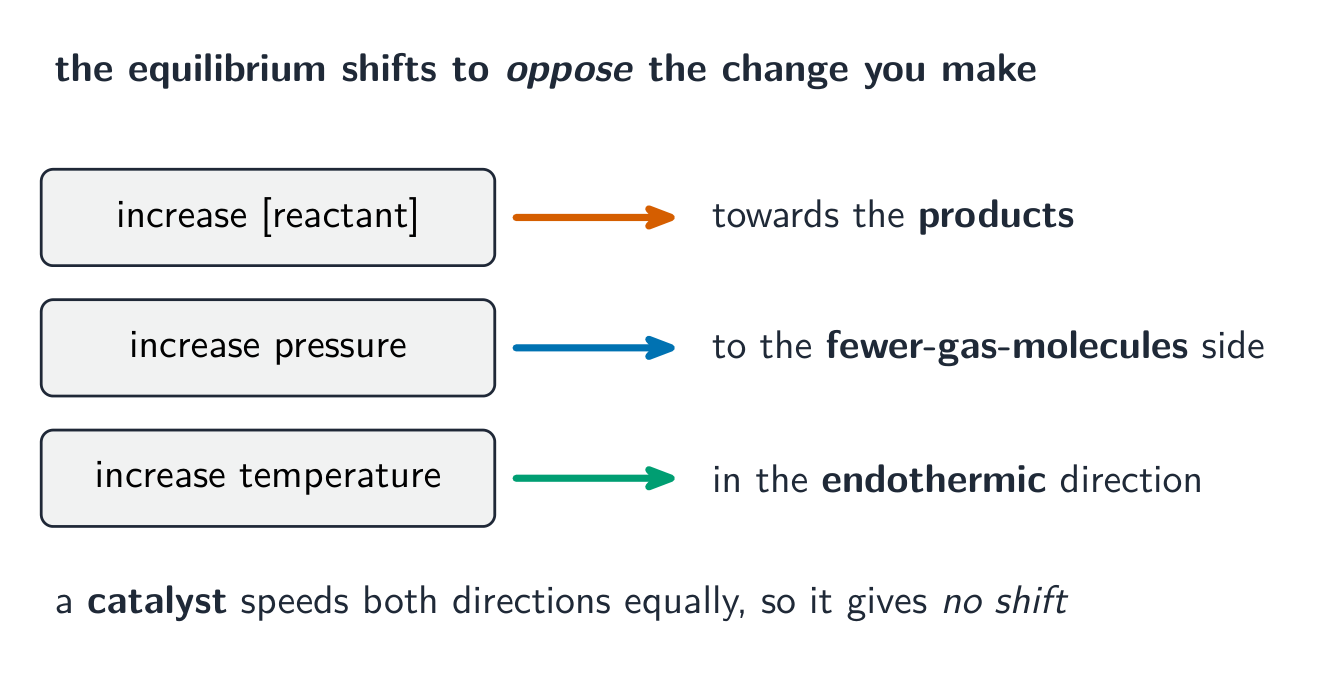
Le Chatelier's principle 勒沙特列原理: if you disturb a system at equilibrium, it shifts to partly counteract the change. Adding a reactant shifts forward; removing product shifts forward; increasing pressure (by reducing volume) shifts toward the side with fewer gas moles; raising temperature shifts in the endothermic direction.

Bahasa Indonesia
Prinsip Le Chatelier

Prinsip Le Chatelier: jika Anda mengganggu sistem pada kesetimbangan, sistem akan bergeser untuk sebagian menentang perubahan tersebut. Menambahkan reaktan bergeser maju; menghilangkan produk bergeser maju; meningkatkan tekanan (dengan mengurangi volume) bergeser ke sisi dengan jumlah mol gas lebih sedikit; menaikkan suhu bergeser ke arah endoterm.

Prinsip Le Chatelier: kesetimbangan bergeser untuk melawan perubahan yang terjadi
Prinsip Le Chatelier: kesetimbangan bergeser untuk menentang perubahan yang dibuat
Pabrik amonia: kesetimbangan industri seperti proses Haber didorong oleh tekanan, suhu, dan katalis
Pabrik amonia: kesetimbangan industri seperti proses Haber dikendalikan oleh tekanan, suhu dan katalis
Explore · ⁨Jelajahi⁩

Disturb an equilibrium · ⁨Gangguan kesetimbangan⁩

Le Chatelier's principle: an equilibrium shifts to oppose a change. Add reactant, change pressure or temperature and watch the position of equilibrium move. · ⁨Prinsip Le Chatelier: kesetimbangan bergeser untuk melawan perubahan. Tambah reaktan, ubah tekanan atau suhu, dan lihat posisi kesetimbangan berpindah.⁩

7.10

The Reaction Quotient and Le Chatelier's Principle · ⁨Kuosien Reaksi dan Prinsip Le Chatelier⁩

Syllabus · ⁨Silabus⁩
English

Learning Objective 7.10.A: Explain the relationships between $Q$, $K$, and the direction in which a reversible reaction will proceed to reach equilibrium.

  • 7.10.A.1 A disturbance to a system at equilibrium causes $Q$ to differ from $K$, thereby taking the system out of equilibrium. The system responds by bringing $Q$ back into agreement with $K$, thereby establishing a new equilibrium state.
  • 7.10.A.2 Some stresses, such as changes in concentration, cause a change in $Q$ only. A change in temperature causes a change in $K$. In either case, the concentrations or partial pressures of species redistribute to bring $Q$ and $K$ back into equality.
Bahasa Indonesia

Tujuan Pembelajaran 7.10.A: Jelaskan hubungan antara $Q$, $K$, dan arah di mana reaksi reversibel akan berlangsung untuk mencapai kesetimbangan.

  • 7.10.A.1 Gangguan terhadap sistem pada kesetimbangan menyebabkan $Q$ berbeda dari $K$, sehingga membawa sistem keluar dari kesetimbangan. Sistem merespons dengan membawa $Q$ kembali selaras dengan $K$, sehingga menetapkan keadaan kesetimbangan baru.
  • 7.10.A.2 Beberapa tegangan, seperti perubahan konsentrasi, menyebabkan perubahan $Q$ saja. Perubahan suhu menyebabkan perubahan $K$. Dalam kedua kasus, konsentrasi atau tekanan parsial dari spesies mendistribusikan ulang untuk mengembalikan $Q$ dan $K$ ke dalam kesetaraan.

Source: College Board AP Course and Exam Description · ⁨Sumber: Deskripsi Kursus dan Ujian College Board AP⁩

English

You can justify every Le Chatelier shift with $Q$ versus $K$: a disturbance changes $Q$, and the system reacts to bring $Q$ back to $K$. This quantitative view backs up the qualitative rule and is the fuller answer on the exam.

Bahasa Indonesia

Setiap pergeseran Le Chatelier dapat dibenarkan dengan $Q$ dibandingkan $K$: gangguan mengubah $Q$, dan sistem bereaksi untuk mengembalikan $Q$ ke $K$. Pandangan kuantitatif ini mendukung aturan kualitatif dan merupakan jawaban lengkap dalam ujian.

Explore · ⁨Jelajahi⁩

Compare Q with K · ⁨Bandingkan Q dengan K⁩

If the reaction quotient $Q the forward reaction is favoured; $Q>K$ favours the reverse. Perturb the system and watch it move back toward $Q=K$. · ⁨Jika kuota reaksi $Q reaksi maju disukai; $Q>K$ menyukai reaksi mundur. Ganggu sistem dan lihat ia bergerak kembali menuju $Q=K$.⁩

7.11 7.12

Introduction to Solubility Equilibria · ⁨Pengenalan Kesetimbangan Kelarutan⁩

Syllabus · ⁨Silabus⁩
English

Learning Objective 7.11.A: Calculate the solubility of a salt based on the value of $K_{sp}$ for the salt.

  • 7.11.A.1 The dissolution of a salt is a reversible process whose extent can be described by $K_{sp}$, the solubility-product constant.
  • 7.11.A.2 The solubility of a substance can be calculated from the $K_{sp}$ for the dissolution process. This relationship can also be used to predict the relative solubility of different substances.
  • 7.11.A.3 The solubility rules (see 4.7.A.5) can be quantitatively related to $K_{sp}$, in which $K_{sp}$ values $>1$ correspond to soluble salts.
  • 7.11.A.4 The molar solubility of one or more species in a saturated solution can be used to calculate the $K_{sp}$ of a substance.
Bahasa Indonesia

Tujuan Pembelajaran 7.11.A: Hitung kelarutan garam berdasarkan nilai $K_{sp}$ untuk garam tersebut.

  • 7.11.A.1 Pelarutan garam adalah proses reversibel yang extent-nya dapat dijelaskan oleh $K_{sp}$, konstanta hasil kali kelarutan.
  • 7.11.A.2 Kelarutan suatu zat dapat dihitung dari $K_{sp}$ untuk proses pelarutan. Hubungan ini juga dapat digunakan untuk memprediksi kelarutan relatif berbagai zat.
  • 7.11.A.3 Aturan kelarutan (lihat 4.7.A.5) dapat dikaitkan secara kuantitatif dengan $K_{sp}$, di mana $K_{sp}$ bernilai $>1$ sesuai dengan garam yang larut.
  • 7.11.A.4 Kelarutan molar satu atau lebih spesies dalam larutan jenuh dapat digunakan untuk menghitung $K_{sp}$ suatu zat.
English

Learning Objective 7.12.A: Identify the solubility of a salt, and/or the value of $K_{sp}$ for the salt, based on the concentration of a common ion already present in solution.

  • 7.12.A.1 The solubility of a salt is reduced when it is dissolved into a solution that already contains one of the ions present in the salt. The impact of this "common-ion effect" on solubility can be understood qualitatively using Le Châtelier's principle or calculated from the $K_{sp}$ for the dissolution process.
Bahasa Indonesia

Tujuan Pembelajaran 7.12.A: Identifikasi kelarutan garam, dan/atau nilai $K_{sp}$ untuk garam tersebut, berdasarkan konsentrasi ion umum yang sudah ada dalam larutan.

  • 7.12.A.1 Kelarutan garam berkurang ketika dilarutkan ke dalam larutan yang sudah mengandung salah satu ion yang ada dalam garam tersebut. Dampak "efek ion umum" ini pada kelarutan dapat dipahami secara kualitatif menggunakan Prinsip Le Châtelier atau dihitung dari $K_{sp}$ untuk proses pelarutan.

Source: College Board AP Course and Exam Description · ⁨Sumber: Deskripsi Kursus dan Ujian College Board AP⁩

English

For a slightly soluble salt, the solubility product 溶度积 $K_{sp}$ is the equilibrium constant for its dissolving:

$$\text{M}_a\text{X}_b(s)\rightleftharpoons a\,\text{M}^{b+}+b\,\text{X}^{a-},\qquad K_{sp}=[\text{M}^{b+}]^a[\text{X}^{a-}]^b.$$
A smaller $K_{sp}$ means less soluble. The common-ion effect – adding an ion already in the salt – pushes the equilibrium back and lowers solubility.

Worked example. Silver chloride has $K_{sp}=1.8\times10^{-10}$. If its molar solubility is $s$, then $[\text{Ag}^+]=[\text{Cl}^-]=s$, so $K_{sp}=s^2$ and

$$s=\sqrt{1.8\times10^{-10}}=1.3\times10^{-5}\ \text{M}.$$
Adding NaCl (a common ion) would raise $[\text{Cl}^-]$, forcing $s$ down – far less AgCl would dissolve.

Bahasa Indonesia

Untuk garam yang sedikit larut, konstanta hasil kali kelarutan $K_{sp}$ adalah konstanta kesetimbangan untuk pelarutannya:

$$\text{M}_a\text{X}_b(s)\rightleftharpoons a\,\text{M}^{b+}+b\,\text{X}^{a-},\qquad K_{sp}=[\text{M}^{b+}]^a[\text{X}^{a-}]^b.$$
$K_{sp}$ yang lebih kecil berarti kelarutan lebih rendah. Efek ion sepenuh – penambahan ion yang sudah ada dalam garam – mendorong kesetimbangan ke arah reaktan dan menurunkan kelarutan.

Contoh terpecahkan. Perak klorida memiliki $K_{sp}=1.8\times10^{-10}$. Jika kelarutan molernya adalah $s$, maka $[\text{Ag}^+]=[\text{Cl}^-]=s$, sehingga $K_{sp}=s^2$ dan

$$s=\sqrt{1.8\times10^{-10}}=1.3\times10^{-5}\ \text{M}.$$
Menambahkan NaCl (ion sepenuh) akan meningkatkan $[\text{Cl}^-]$, memaksa $s$ turun – jauh lebih sedikit AgCl yang akan larut.

7.11 7.12

Exam tips · ⁨Tips ujian⁩

English
  • At equilibrium the forward and reverse rates are equal, but the amounts are usually not.
  • Leave pure solids and liquids out of the $K$ expression; a large $K$ favours products, a small $K$ favours reactants.
  • Apply Le Chatelier: add reactant → shift forward; raise pressure → shift toward fewer gas moles; raise temperature → shift in the endothermic direction.
  • A catalyst does not shift the position of equilibrium — it only speeds the approach.
  • Use an ICE table for equilibrium concentrations, and the small-$x$ approximation when $K$ is small.
Bahasa Indonesia
  • Pada kesetimbangan, laju maju dan mundur sama, tetapi jumlahnya biasanya tidak sama.
  • Biarkan padatan murni dan cairan keluar dari ekspresi $K$; $K$ yang besar favore produk, $K$ yang kecil favore reaktan.
  • Terapkan Le Chatelier: tambah reaktan → geser maju; tingkatkan tekanan → geser menuju jumlah mol gas lebih sedikit; tingkatkan suhu → geser ke arah endoterm.
  • Katalisator tidak menggeser posisi kesetimbangan – ia hanya mempercepat pendekatan.
  • Gunakan tabel ICE untuk konsentrasi kesetimbangan, dan pendekatan kecil-$x$ ketika $K$ kecil.

Interactive lessons on this topic · ⁨Pelajaran interaktif untuk topik ini⁩

Work through it step by step, with instant-check exercises. · ⁨Kerjakan langkah demi langkah, dengan latihan pengecekan instan.⁩

Past Papers · ⁨Soal-Soil Masa Lalu⁩

More topics in AP Chemistry · ⁨AP Kimia⁩ · ⁨Topik lain dalam AP Chemistry · ⁨AP Kimia⁩⁩

Log in or create account · ⁨Masuk atau buat akun⁩

IGCSE, A-Level & AP