AP Biologi dibangun atas empat ide besar: evolusi, energetika, penyimpanan dan transmisi informasi, serta interaksi sistem. Isinya sangat luas, namun ujian tidak menguji hafalan. Ujian ini menguji kemampuan Anda untuk menggunakan biologi pada kasus yang tidak familiar—spesies yang belum pernah ditemui, atau eksperimen yang belum pernah dilihat.
Praktik sains adalah kurikulum sejatinya: membaca grafik, merancang eksperimen, mengidentifikasi kontrol, dan memberikan justifikasi klaim dengan bukti. Ini persis seperti yang diminta dalam bagian respons bebas.
Statistik diujikan.Chi-square, kesalahan standar, dan garis kesalahan muncul secara rutin, dan membawa nilai poin yang tidak dapat dicapai oleh sekadar pengulangan materi konten murni.
Catatan mencakup semua delapan unit, dengan diagram untuk proses-proses yang lebih mudah dipahami melalui visual daripada teks. Perpustakaan menyediakan soal-soal respons bebas yang telah dirilis; rubrik biologi memberikan poin untuk menghubungkan struktur dengan fungsi serta penanganan data yang benar, sehingga jawaban contoh disusun dengan pendekatan tersebut.
Big Idea 4 — Systems Interactions: Biological systems interact, and these systems and their interactions exhibit complex properties.
Learning Objective 1.1.A: Explain how the properties of water that result from its polarity and hydrogen bonding affect its biological function.
1.1.A.1 Living systems depend on the properties of water to sustain life.
1.1.A.1.i Water has polarity, because of the formation of polar covalent bonds between hydrogen and oxygen within water molecules. This polarity contributes to hydrogen bonding between and within biological molecules.
1.1.A.1.ii Water has a high specific heat capacity, which allows for the maintenance of homeostatic body temperature within living organisms.
1.1.A.1.iii Water has a high heat of vaporization, which allows for the evaporative cooling of the surrounding environment. In living organisms, this property allows for body temperature to be maintained.
1.1.A.2 The hydrogen bonds between adjacent polar water molecules result in cohesion, adhesion, and surface tension.
Bahasa Indonesia
Ide Besar 4 — Interaksi Sistem: Sistem biologis berinteraksi, dan sistem serta interaksinya menunjukkan sifat kompleks.
Tujuan Pembelajaran 1.1.A: Jelaskan bagaimana sifat air yang dihasilkan dari polaritas dan ikatan hidrogen mempengaruhi fungsi biologisnya.
1.1.A.1 Sistem hidup bergantung pada sifat air untuk mempertahankan kehidupan.
1.1.A.1.i Air memiliki polaritas, karena terbentuknya ikatan kovalen polar antara hidrogen dan oksigen di dalam molekul air. Polaritas ini berkontribusi pada ikatan hidrogen antar dan di dalam molekul biologis.
1.1.A.1.ii Air memiliki kapasitas kalor spesifik yang tinggi, yang memungkinkan pemeliharaan suhu tubuh homeostatis dalam organisme hidup.
1.1.A.1.iii Air memiliki kalor penguapan yang tinggi, yang memungkinkan pendinginan penguapan lingkungan sekitar. Dalam organisme hidup, sifat ini memungkinkan suhu tubuh tetap terjaga.
1.1.A.2 Ikatan hidrogen antar molekul air polar yang berdekatan menghasilkan kohesi, adhesi, dan tegangan permukaan.
Source: College Board AP Course and Exam Description · Sumber: Deskripsi Kursus dan Ujian College Board AP
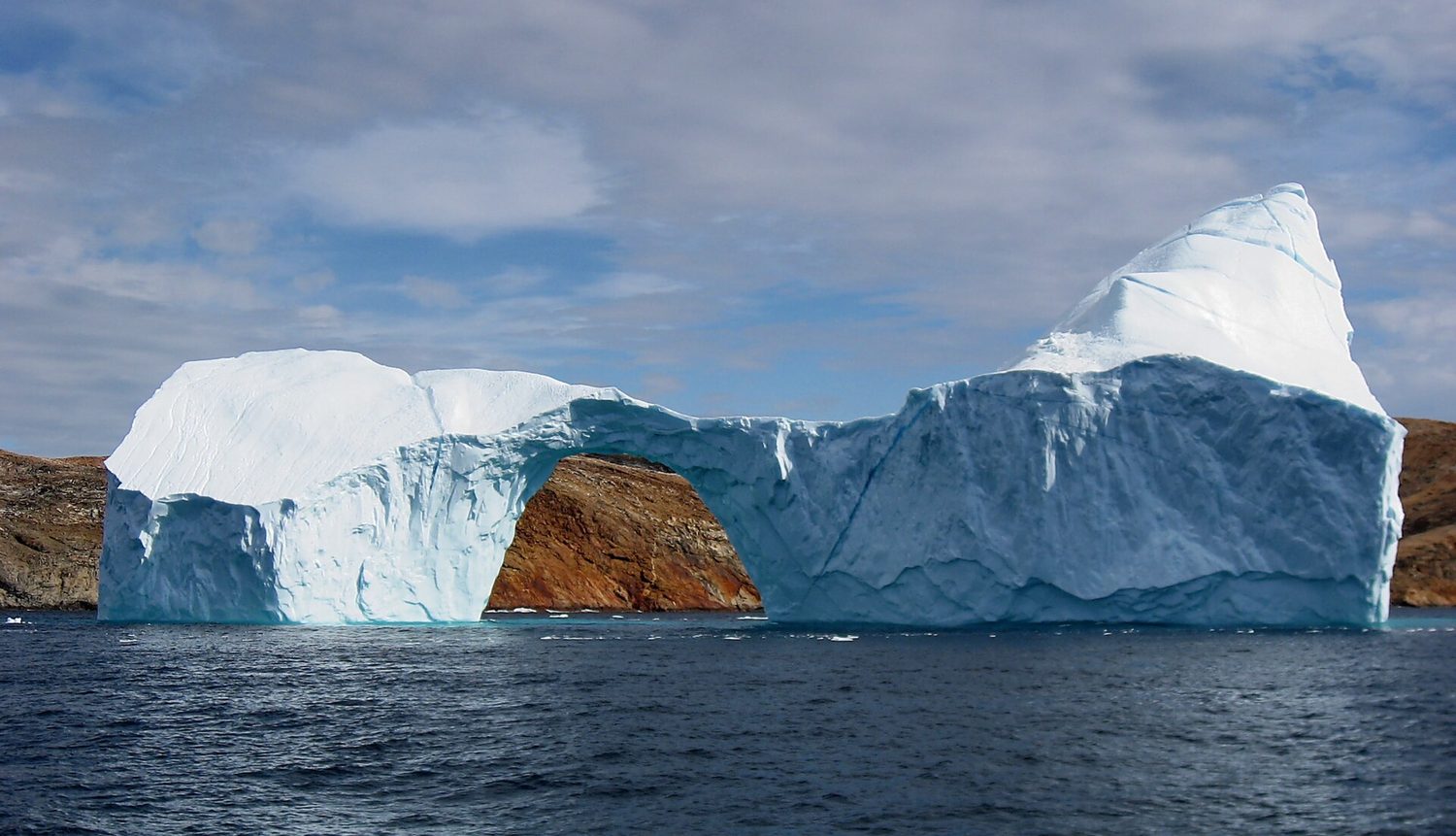
Ice floats on water because hydrogen bonding makes solid water less dense than liquid water
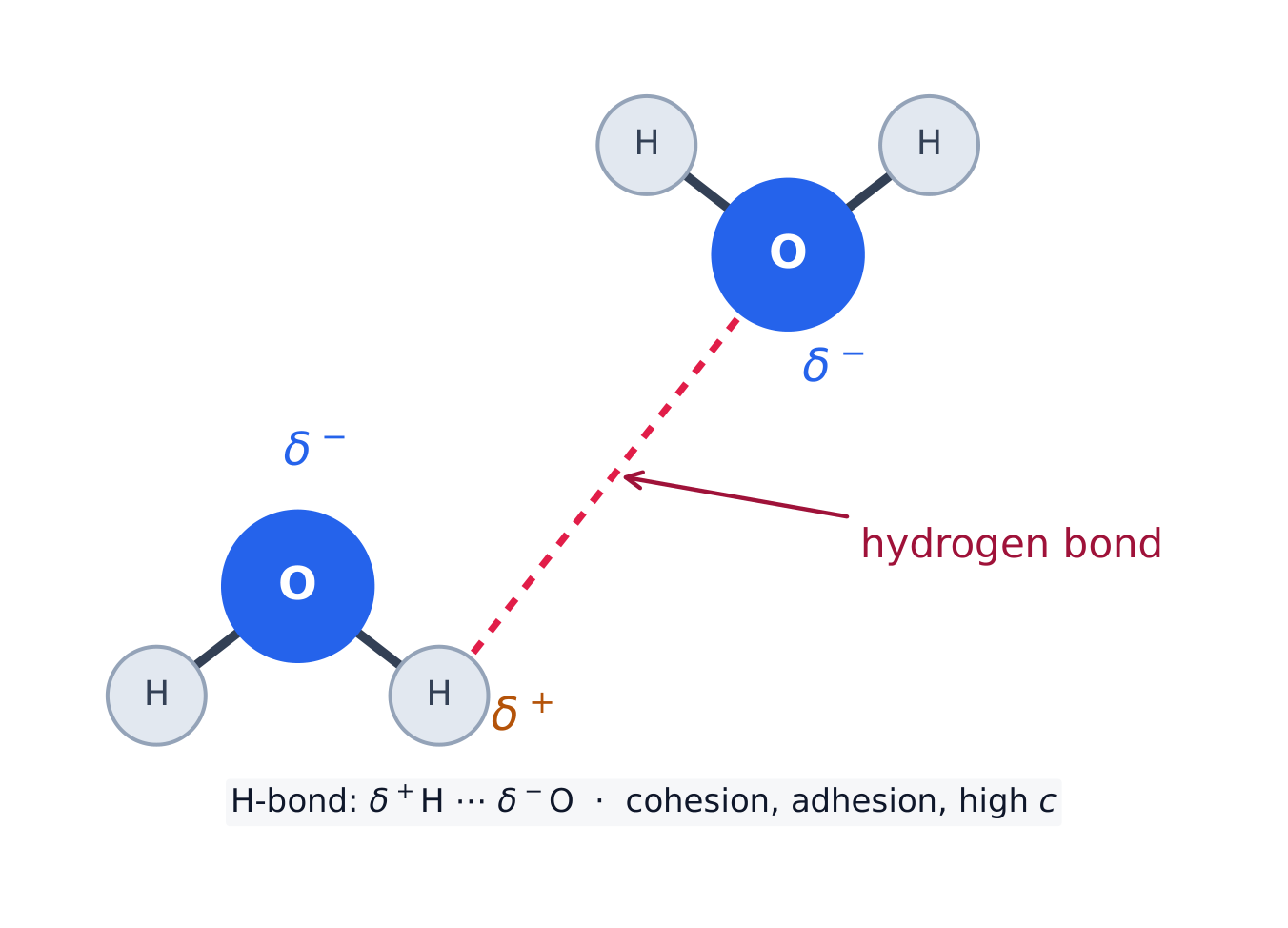
Water is polar 极性: its oxygen pulls electrons more strongly than its hydrogens, giving a slightly negative O and slightly positive H. This lets water molecules form hydrogen bonds 氢键 with each other, which explains water's life-supporting properties:
Cohesion 内聚力 and adhesion 附着力 (surface tension, capillary action, water rising in plants),
high specific heat 比热容 (resists temperature change, stabilizing organisms),
high heat of vaporization (evaporative cooling),
ice floating (less dense solid), and being a great solvent for polar and ionic substances.
A hydrogen bond between two polar water molecules
Explore · Jelajahi
Explore how a covalent bond shares electrons · Jelajahi bagaimana ikatan kovalen berbagi elektron
Step through two atoms overlapping to share a pair of electrons so each reaches a full shell. In $\text{H}_2$ the two atoms pull equally, so the bond is non-polar — the contrast that makes water's unequal sharing (and its $\delta^+/\delta^-$ dipole) so important. · Langkah demi langkah dua atom saling tumpang tindih untuk berbagi sepasang elektron agar masing-masing mencapai kulit penuh. Dalam $\text{H}_2$ dua atom menarik sama kuat, sehingga ikatannya non-polar — kontras yang membuat pembagian tidak setara pada air (dan dipol $\delta^+/\delta^-$-nya) begitu penting.
Big Idea 2 — Energetics: Biological systems use energy and molecular building blocks to grow, reproduce, and maintain dynamic homeostasis.
Learning Objective 1.2.A: Describe the composition of macromolecules required by living organisms.
1.2.A.1 Atoms and molecules from the environment are necessary to build new molecules. Carbon, hydrogen, and oxygen are the most prevalent elements used to build biological molecules such as carbohydrates, proteins, lipids, and nucleic acids. Additionally:
1.2.A.1.i Sulfur is used in the building of proteins.
1.2.A.1.ii Phosphorus is used in the building of phospholipids (a type of lipid) and nucleic acids.
1.2.A.1.iii Nitrogen is used in the building of nucleic acids.
Bahasa Indonesia
Ide Besar 2 — Energetika: Sistem biologis menggunakan energi dan blok bangunan molekuler untuk tumbuh, bereproduksi, dan mempertahankan homeostasis dinamis.
Tujuan Pembelajaran 1.2.A: Deskripsikan komposisi makromolekul yang dibutuhkan oleh organisme hidup.
1.2.A.1 Atom dan molekul dari lingkungan diperlukan untuk membangun molekul baru. Karbon, hidrogen, dan oksigen adalah elemen paling umum yang digunakan untuk membangun molekul biologis seperti karbohidrat, protein, lipid, dan asam nukleat. Selain itu:
1.2.A.1.i Belerang digunakan dalam pembentukan protein.
1.2.A.1.ii Fosfor digunakan dalam pembentukan fosfolipid (sejenis lipid) dan asam nukleat.
1.2.A.1.iii Nitrogen digunakan dalam pembentukan asam nukleat.
Source: College Board AP Course and Exam Description · Sumber: Deskripsi Kursus dan Ujian College Board AP
Living matter is built mostly from a few elements – carbon, hydrogen, oxygen, nitrogen, phosphorus, and sulfur. Carbon 碳 is central because it forms four stable covalent bonds, building long chains, branches, and rings – the skeletons of all biological molecules.
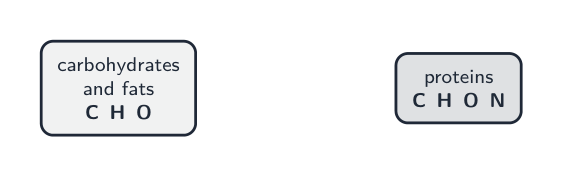
Carbohydrates and fats contain carbon, hydrogen, and oxygen; proteins also contain nitrogen
Big Idea 4 — Systems Interactions: Biological systems interact, and these systems and their interactions exhibit complex properties.
Learning Objective 1.3.A: Describe the chemical reactions that build and break biological macromolecules.
1.3.A.1 Hydrolysis is a chemical reaction involving the cleaving of covalent bonds. This type of reaction breaks down molecules into smaller molecules. When water is added to the bond between monomers in a polymer, the bond is broken. The hydrogen ion from a water molecule is added to one monomer and the hydroxyl group of the water molecule is added to the other monomer, completing the reaction.
1.3.A.2 Dehydration synthesis occurs when two smaller molecules are joined together through covalent bonding. A hydrogen ion is removed from one monomer and a hydroxyl group is removed from the other. This causes the loss of the equivalent of a water molecule from the reactants and the connection of the two remaining monomers. The connection of many monomers is known as polymerization.
Bahasa Indonesia
Ide Besar 4 — Interaksi Sistem: Sistem biologis berinteraksi, dan sistem serta interaksinya menunjukkan sifat kompleks.
Tujuan Pembelajaran 1.3.A: Deskripsikan reaksi kimia yang membangun dan memecah makromolekul biologis.
1.3.A.1 Hidrolisis adalah reaksi kimia yang melibatkan pemutusan ikatan kovalen. Jenis reaksi ini memecah molekul menjadi molekul yang lebih kecil. Ketika air ditambahkan ke ikatan antara monomer dalam polimer, ikatan tersebut putus. Ion hidrogen dari molekul air ditambahkan ke satu monomer dan gugus hidroksil dari molekul air ditambahkan ke monomer lainnya, menyelesaikan reaksi.
1.3.A.2 Sintesis dehidrasi terjadi ketika dua molekul kecil digabungkan melalui pengikatan kovalen. Ion hidrogen dilepaskan dari satu monomer dan gugus hidroksil dilepaskan dari monomer lainnya. Hal ini menyebabkan hilangnya setara dengan molekul air dari reaktan dan penggabungan dua monomer yang tersisa. Penggabungan banyak monomer dikenal sebagai polimerisasi.
Source: College Board AP Course and Exam Description · Sumber: Deskripsi Kursus dan Ujian College Board AP
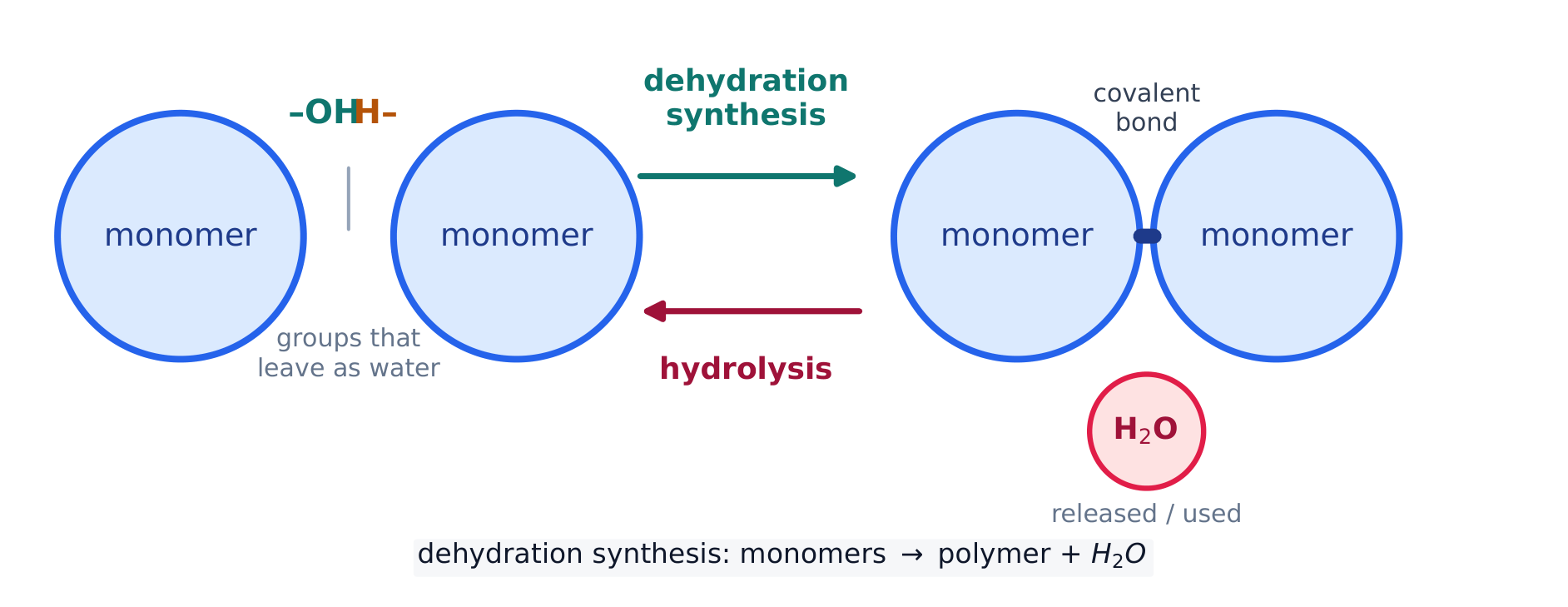
Large biological molecules – macromolecules 大分子 – are polymers 聚合物 built from repeating monomers 单体. Cells join monomers by dehydration synthesis 脱水缩合 (removing water to form a bond) and break polymers by hydrolysis 水解 (adding water). Four classes: carbohydrates, lipids, nucleic acids, and proteins.
Dehydration synthesis builds polymers and releases water; hydrolysis reverses it
Explore · Jelajahi
Explore the four classes of macromolecule by their monomer · Jelajahi empat kelas makromolekul berdasarkan monomernya
Sort each clue into the right macromolecule class by matching the monomer that builds it — sugars, nucleotides or amino acids — and notice that lipids are the odd one out that are not true polymers. · Kelompokkan setiap petunjuk ke dalam kelas makromolekul yang tepat dengan mencocokkan monomer pembentuknya — gula, nukleotida, atau asam amino — dan perhatikan bahwa lipid adalah pengecualian yang bukan polimer sejati.
Big Idea 4 — Systems Interactions: Biological systems interact, and these systems and their interactions exhibit complex properties.
Learning Objective 1.4.A: Describe the structure and function of carbohydrates.
1.4.A.1 Monosaccharides (simple sugars) are the monomers for polysaccharides (complex carbohydrates). These monomers are connected by covalent bonds to form polymers such as complex carbohydrates, which may be linear or branched.
Illustrative examples for 1.4.A.1:
Cellulose
Starch
Glycogen
Exclusion statement: The molecular structure of specific carbohydrate polymers is beyond the scope of the AP Exam.
Bahasa Indonesia
Ide Besar 4 — Interaksi Sistem: Sistem biologis berinteraksi, dan sistem serta interaksinya menunjukkan sifat kompleks.
Tujuan Pembelajaran 1.4.A: Jelaskan struktur dan fungsi karbohidrat.
1.4.A.1 Monosakarida (gula sederhana) adalah monomer untuk polisakarida (karbohidrat kompleks). Monomer-monomer ini dihubungkan oleh ikatan kovalen untuk membentuk polimer seperti karbohidrat kompleks, yang dapat bersifat linear atau bercabang.
Contoh ilustratif untuk 1.4.A.1:
Selulosa
Amilum
Glikogen
Pengecualian: Struktur molekuler dari polimer karbohidrat tertentu berada di luar cakupan Ujian AP.
Source: College Board AP Course and Exam Description · Sumber: Deskripsi Kursus dan Ujian College Board AP
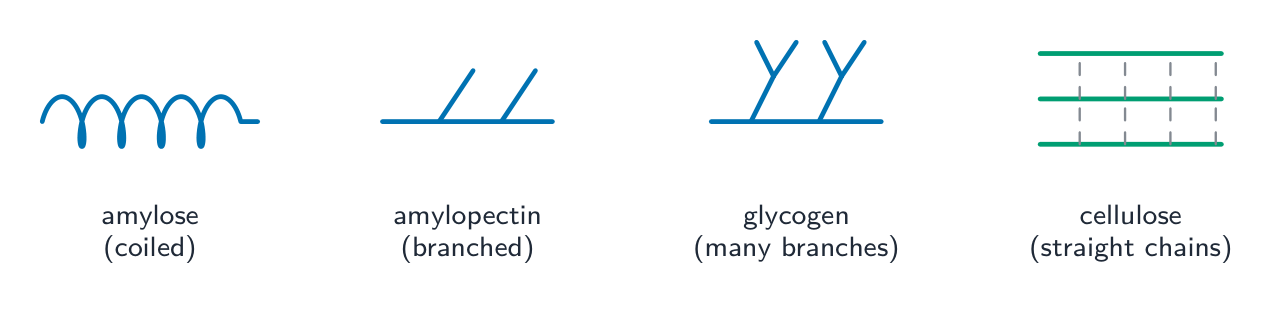
Carbohydrates 碳水化合物 are made of sugar monomers (monosaccharides 单糖 like glucose). They store energy (starch, glycogen) and provide structure (cellulose 纤维素 in plant walls). Their many hydroxyl groups make them polar and water-soluble.
The shapes of storage polysaccharides (starch, glycogen) and structural cellulose
Big Idea 4 — Systems Interactions: Biological systems interact, and these systems and their interactions exhibit complex properties.
Learning Objective 1.5.A: Describe the structure and function of lipids.
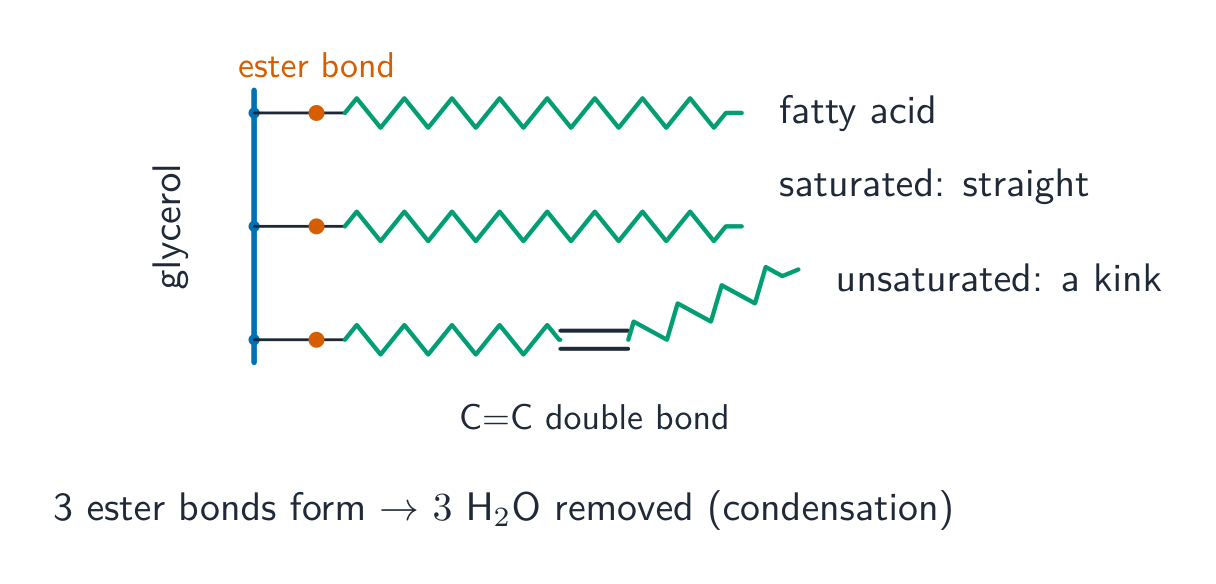
1.5.A.1 Lipids are typically nonpolar, hydrophobic molecules whose structure and function are derived from the way their subcomponents are assembled. Fatty acids can be described as either saturated or unsaturated.
1.5.A.1.i Saturated fatty acids contain only single bonds between carbon atoms.
1.5.A.1.ii Unsaturated fatty acids contain at least one double bond between carbon atoms, which causes the carbon chain to kink.
1.5.A.1.iii The more double bonds in a fatty acid tail, the more unsaturated the lipid becomes.
1.5.A.1.iv The more unsaturated a lipid is, the more liquid it is at room temperature.
1.5.A.2 Lipids provide a variety of functions for living organisms. Some examples of lipids are fats, steroids including cholesterol, and phospholipids.
1.5.A.2.i Fats provide energy storage and support cell function. In some cases, they can also provide insulation to help keep mammals warm.
1.5.A.2.ii Steroids are hormones that support physiological functions including growth and development, energy metabolism, and homeostasis.
1.5.A.2.iii Cholesterol provides essential structural stability to animal cell membranes.
1.5.A.2.iv Phospholipids group together to form the lipid bilayers found in plasma and cell membranes.
Exclusion statement: The molecular structure of specific lipids is beyond the scope of the AP Exam.
Bahasa Indonesia
Ide Besar 4 — Interaksi Sistem: Sistem biologis berinteraksi, dan sistem serta interaksinya menunjukkan sifat kompleks.
Tujuan Pembelajaran 1.5.A: Jelaskan struktur dan fungsi lipid.
1.5.A.1 Lipid biasanya merupakan molekul nonpolar dan hidrofobik whose struktur dan fungsinya berasal dari cara subkomponennya dirakit. Asam lemak dapat digambarkan sebagai jenuh atau tak jenuh.
1.5.A.1.i Asam lemak jenuh hanya mengandung ikatan tunggal antar atom karbon.
1.5.A.1.ii Asam lemak tak jenuh mengandung setidaknya satu ikatan rangkap antar atom karbon, yang menyebabkan rantai karbon mengalami tekukan.
1.5.A.1.iii Semakin banyak ikatan rangkap pada ekor asam lemak, semakin tak jenuh lipid tersebut.
1.5.A.1.iv Semakin tak jenuh suatu lipid, semakin cair lipid tersebut pada suhu ruang.
1.5.A.2 Lipid menyediakan berbagai fungsi bagi organisme hidup. Beberapa contoh lipid adalah lemak, steroid termasuk kolesterol, dan fosfolipid.
1.5.A.2.i Lemak menyediakan penyimpanan energi dan mendukung fungsi sel. Dalam beberapa kasus, mereka juga dapat memberikan isolasi untuk membantu menjaga mamalia tetap hangat.
1.5.A.2.ii Steroid adalah hormon yang mendukung fungsi fisiologis termasuk pertumbuhan dan perkembangan, metabolisme energi, dan homeostasis.
1.5.A.2.iii Kolesterol memberikan stabilitas struktural esensial pada membran sel hewan.
1.5.A.2.iv Fosfolipid mengelompokkan diri untuk membentuk bilayer lipid yang ditemukan dalam membran plasma dan sel.
Pengecualian: Struktur molekuler dari lipid tertentu berada di luar cakupan Ujian AP.
Source: College Board AP Course and Exam Description · Sumber: Deskripsi Kursus dan Ujian College Board AP
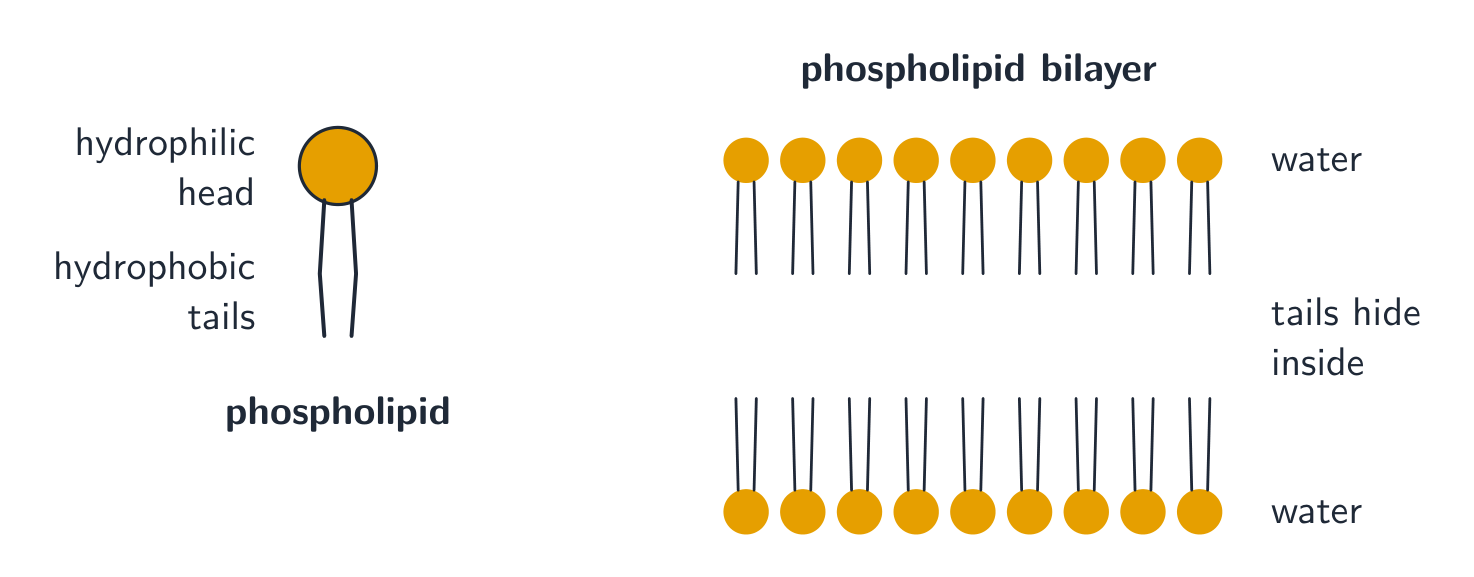
Lipids 脂质 are nonpolar and do not mix with water (hydrophobic 疏水). They include fats (long-term energy storage), phospholipids 磷脂 (which build membranes), and steroids. A phospholipid has a polar "head" and nonpolar "tails," the key to the cell membrane.
A phospholipid has a polar head and two nonpolar tails, so phospholipids form a bilayerA triglyceride: glycerol joined to three fatty acids
Big Idea 3 — Information Storage and Transmission: Living systems store, retrieve, transmit, and respond to information essential to life processes.
Learning Objective 1.6.A: Describe the structure and function of DNA and RNA.
1.6.A.1 In nucleic acids (DNA and RNA), biological information is encoded in sequences of nucleotide monomers. Each nucleotide has the following structural components: a five-carbon sugar (deoxyribose or ribose), a phosphate, and a nitrogenous base (adenine, thymine, guanine, cytosine, or uracil).
1.6.A.2 Nucleic acids have a linear sequence of nucleotides that have ends, defined by the 3' (three prime) hydroxyl and 5' (five prime) phosphates of the sugar in the nucleotide. During nucleic acid synthesis, nucleotides are added to the 3' end of the growing strand, resulting in the formation of covalent bonds between nucleotides.
Exclusion statement: The molecular structure of specific nucleotides is beyond the scope of the AP Exam.
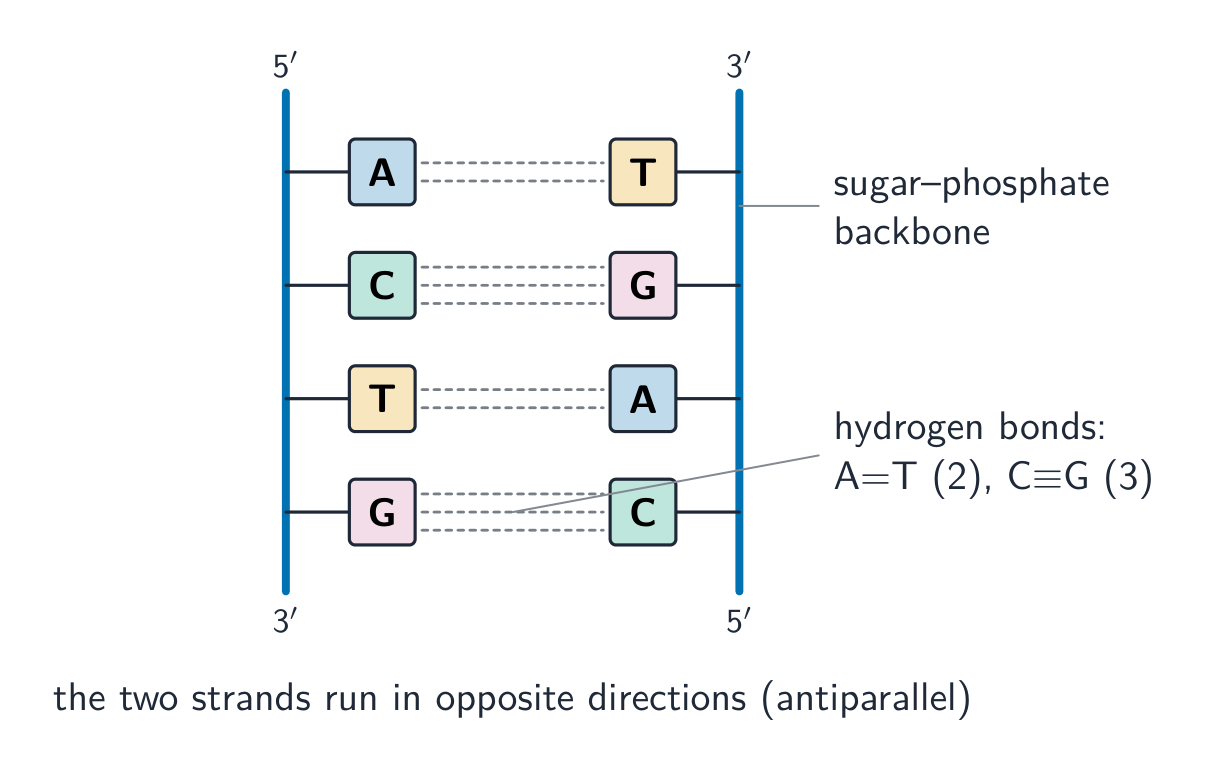
1.6.A.3 DNA is structured as an antiparallel double helix, with two strands of nucleotides running in opposite 5' to 3' orientation. In DNA, adenine nucleotides pair with thymine nucleotides via hydrogen bonds (A-T), and cytosine nucleotides pair with guanine nucleotides via hydrogen bonds (C-G). In RNA, adenine pairs with uracil (A-U).
1.6.A.4 Structural differences between DNA and RNA include:
1.6.A.4.i DNA contains the sugar deoxyribose, and RNA contains the sugar ribose.
1.6.A.4.ii DNA contains the nitrogenous base thymine, and RNA contains the nitrogenous base uracil.
1.6.A.4.iii DNA is typically double stranded, while RNA is typically single stranded.
Bahasa Indonesia
Ide Besar 3 — Penyimpanan dan Transmisi Informasi: Sistem hidup menyimpan, mengambil, mentransmisikan, dan merespons informasi yang penting bagi proses kehidupan.
Tujuan Pembelajaran 1.6.A: Jelaskan struktur dan fungsi DNA dan RNA.
1.6.A.1 Dalam asam nukleat (DNA dan RNA), informasi biologis dikodekan dalam urutan monomer nukleotida. Setiap nukleotida memiliki komponen struktural berikut: gula lima karbon (deoksiribosa atau ribosa), fosfat, dan basa nitrogen (adenin, timin, guanin, sitosin, atau urasil).
1.6.A.2 Asam nukleat memiliki urutan linier nukleotida yang memiliki ujung, didefinisikan oleh gugus hidroksil 3' (tiga prime) dan fosfat 5' (lima prime) dari gula dalam nukleotida. Selama sintesis asam nukleat, nukleotida ditambahkan ke ujung 3' dari untai yang sedang tumbuh, menghasilkan pembentukan ikatan kovalen antara nukleotida.
Pengecualian: Struktur molekuler dari nukleotida tertentu berada di luar cakupan Ujian AP.
1.6.A.3 DNA berstruktur sebagai heliks ganda antiparalel, dengan dua untai nukleotida berjalan dalam orientasi 5' ke 3' yang berlawanan. Dalam DNA, nukleotida adenin berpasangan dengan nukleotida timin melalui ikatan hidrogen (A-T), dan nukleotida sitosin berpasangan dengan nukleotida guanin melalui ikatan hidrogen (C-G). Dalam RNA, adenin berpasangan dengan urasil (A-U).
1.6.A.4 Perbedaan struktural antara DNA dan RNA meliputi:
1.6.A.4.i DNA mengandung gula deoksiribosa, dan RNA mengandung gula ribosa.
1.6.A.4.ii DNA mengandung basa nitrogen timin, dan RNA mengandung basa nitrogen urasil.
1.6.A.4.iii DNA biasanya untai ganda, sementara RNA biasanya untai tunggal.
Source: College Board AP Course and Exam Description · Sumber: Deskripsi Kursus dan Ujian College Board AP
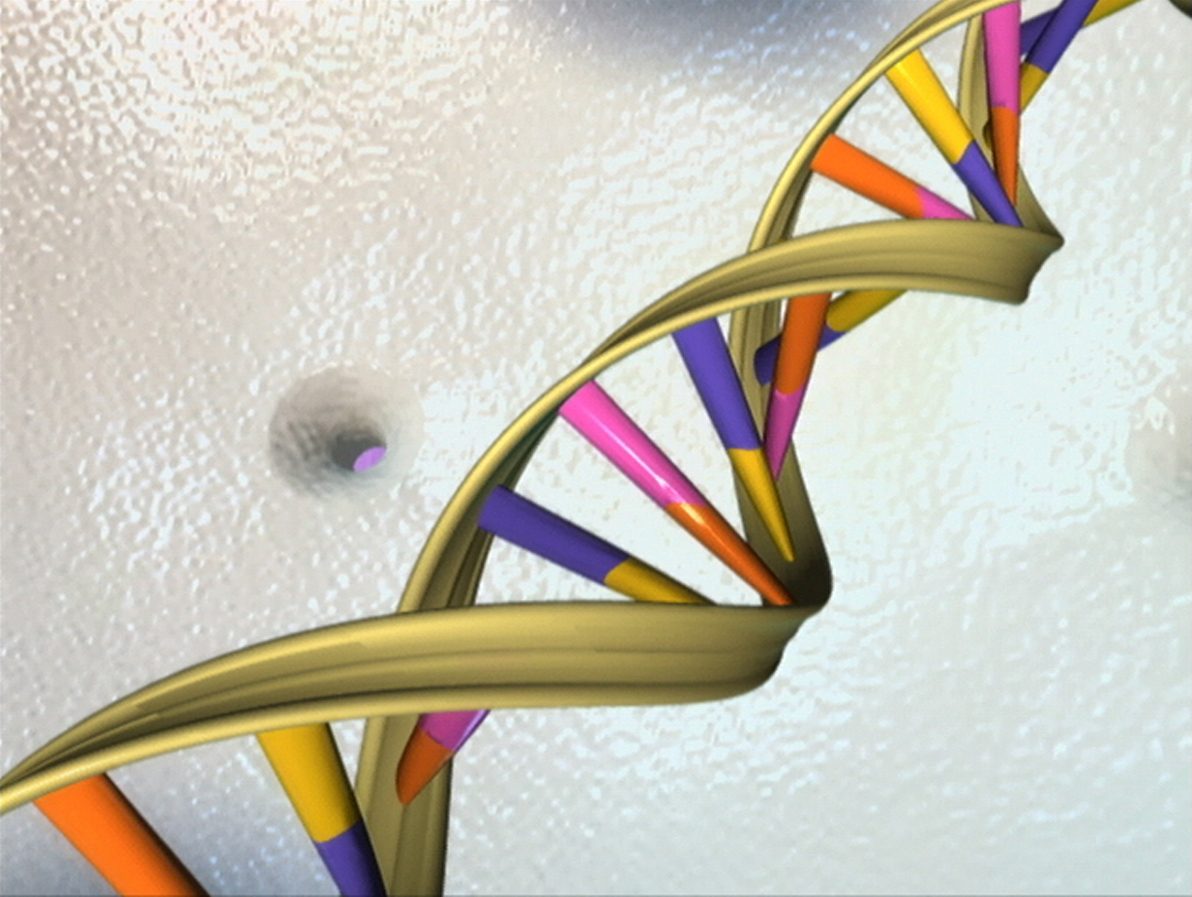
Space-filling model of the DNA double helix (NHGRI)
Nucleic acids 核酸 (DNA and RNA) store and carry genetic information. Their monomers are nucleotides 核苷酸, each a sugar, a phosphate, and a nitrogen base. The base sequence encodes instructions; DNA is double-stranded, RNA single-stranded.
Complementary base pairing holds the two antiparallel strands of DNA together
Explore · Jelajahi
Explore complementary base pairing · Jelajahi pasangan basa komplementer
Step along a DNA template and watch each base pair to its partner by complementary base pairing ($A$ with $T$, $G$ with $C$) — the rule that lets either strand act as a template to rebuild the other. · Langkahkan sepanjang cetakan DNA dan lihat setiap basa berpasangan dengan pasangannya melalui pasangan basa komplementer ($A$ dengan $T$, $G$ dengan $C$) — aturan yang memungkinkan salah satu untai bertindak sebagai cetakan untuk membangun kembali untai lainnya.
Big Idea 3 — Information Storage and Transmission: Living systems store, retrieve, transmit, and respond to information essential to life processes.
Learning Objective 1.7.A: Describe the structure and function of proteins.
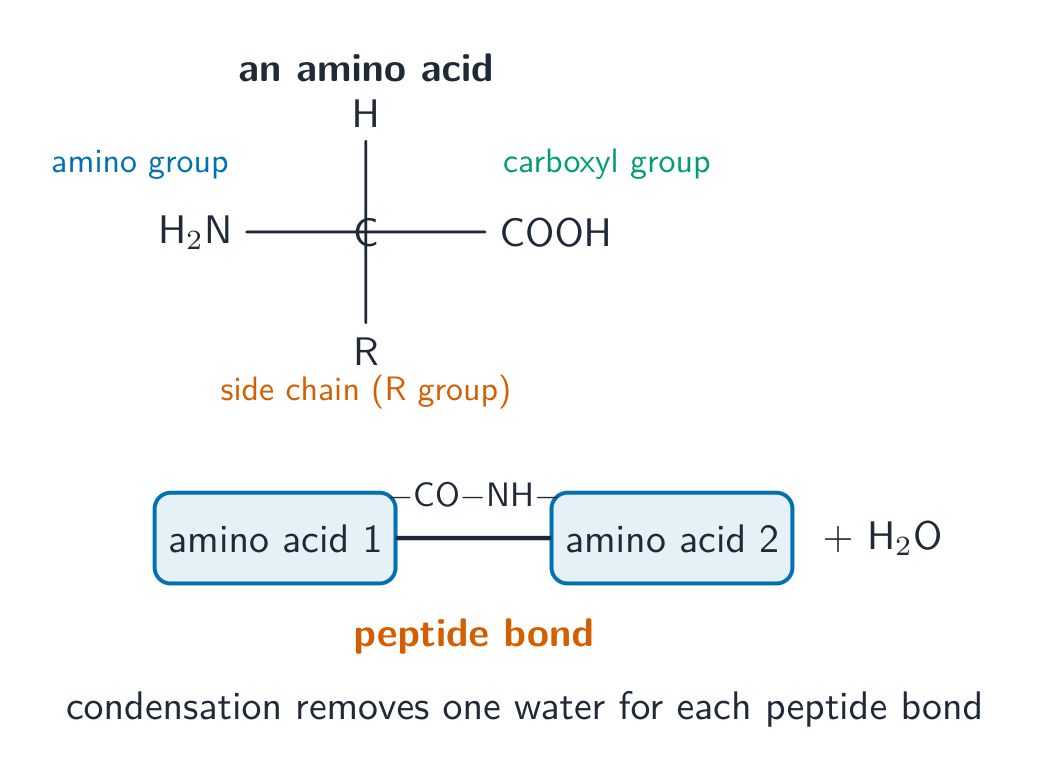
1.7.A.1 Proteins comprise linear chains of amino acids connected by the formation of covalent (peptide) bonds that form between a carboxyl group ($-\text{COOH}$) of one amino acid and an amine group ($-\text{NH}_2$) of the next amino acid, resulting in a growing peptide chain.
1.7.A.2 Amino acids are composed of a central carbon atom with a hydrogen atom, a carboxyl group, an amine group, and a variable R group covalently bound to it. The R group of an amino acid can be categorized by three possible chemical properties: hydrophobic/nonpolar, hydrophilic/polar, or ionic. The interactions of these R groups determine the structure and function of that region of the protein.
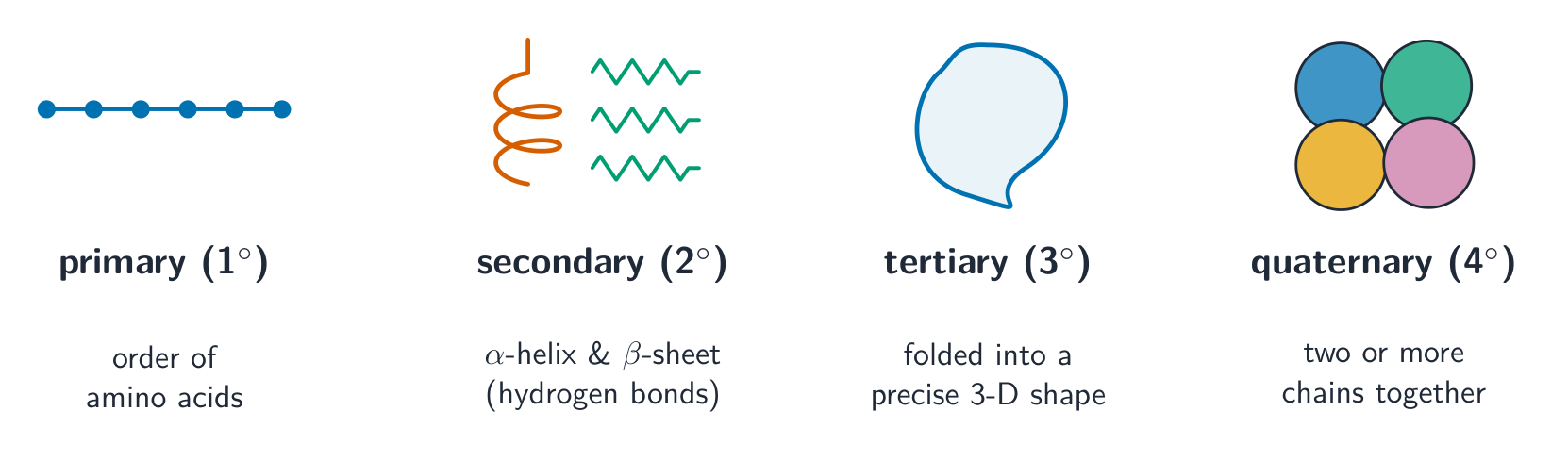
1.7.A.3 The specific sequence of amino acids in proteins determines the primary structure of a polypeptide as well as the overall shape of the protein.
Exclusion statement: The molecular structure of amino acids is beyond the scope of the AP Exam.
1.7.A.4 Secondary structures of proteins are made through the local folding that forms from interactions between atoms of the polypeptide backbone of the amino acid chain. Hydrogen bonding forms shapes such as alpha-helices and beta-pleated sheets.
1.7.A.5 The three-dimensional shape of the tertiary structure of a protein results from the formation of hydrogen bonds, hydrophobic interactions, ionic interactions, or disulfide bridges.
1.7.A.6 The quaternary structure arises from interactions between multiple polypeptides. All four levels of a protein structure determine the function of a protein.
Bahasa Indonesia
Ide Besar 3 — Penyimpanan dan Transmisi Informasi: Sistem hidup menyimpan, mengambil, mentransmisikan, dan merespons informasi yang penting bagi proses kehidupan.
Tujuan Pembelajaran 1.7.A: Jelaskan struktur dan fungsi protein.
1.7.A.1 Protein terdiri dari rantai linear asam amino yang dihubungkan oleh pembentukan ikatan kovalen (peptida) yang terbentuk antara gugus karboksil ($-\text{COOH}$) dari satu asam amino dan gugus amina ($-\text{NH}_2$) dari asam amino berikutnya, menghasilkan rantai peptida yang terus tumbuh.
1.7.A.2 Asam amino terdiri dari atom karbon pusat dengan atom hidrogen, gugus karboksil, gugus amina, dan gugus R variabel yang terikat secara kovalen dengannya. Gugus R dari asam amino dapat dikategorikan berdasarkan tiga kemungkinan sifat kimia: hidrofobik/nonpolar, hidrofilik/polar, atau ionik. Interaksi dari gugus-gugus R ini menentukan struktur dan fungsi area protein tersebut.
1.7.A.3 Urutan spesifik asam amino dalam protein menentukan struktur primer polipeptida serta bentuk keseluruhan protein.
Pengecualian: Struktur molekuler dari asam amino berada di luar cakupan Ujian AP.
1.7.A.4 Struktur sekunder protein terbentuk melalui lipatan lokal yang muncul dari interaksi antara atom-atom tulang belakang polipeptida dari rantai asam amino. Ikatan hidrogen membentuk bentuk seperti heliks alfa dan lembaran beta-pleated.
1.7.A.5 Bentuk tiga dimensi dari struktur tersier protein dihasilkan dari pembentukan ikatan hidrogen, interaksi hidrofobik, interaksi ionik, atau jembatan disulfida.
1.7.A.6 Struktur kuaterner muncul dari interaksi antara beberapa polipeptida. Keempat tingkat struktur protein menentukan fungsi protein.
Source: College Board AP Course and Exam Description · Sumber: Deskripsi Kursus dan Ujian College Board AP
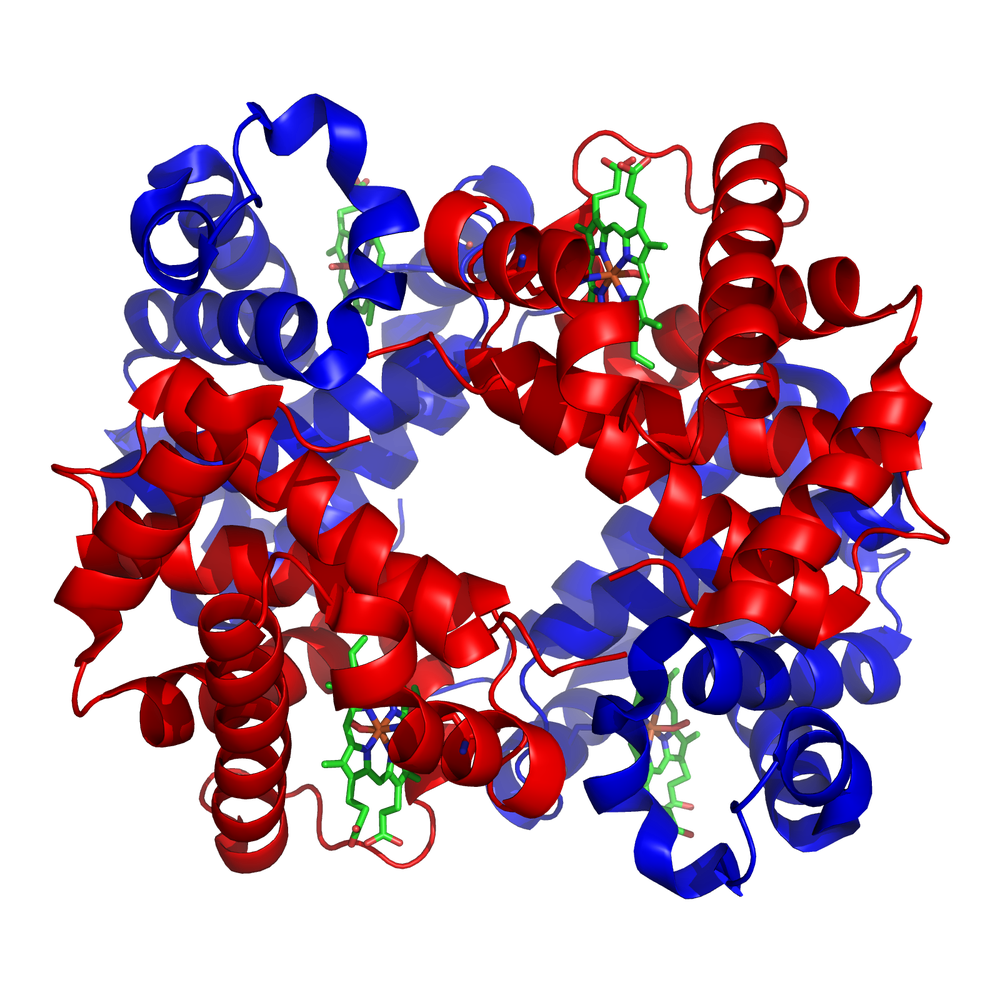
Haemoglobin quaternary structure: four folded polypeptide chains, each holding a haem group
Proteins 蛋白质 are polymers of amino acids 氨基酸 joined by peptide bonds 肽键. Their sequence folds into a specific 3-D shape at four levels (primary, secondary, tertiary, quaternary), and shape determines function – as enzymes, transporters, receptors, and structural parts. Changing the environment (heat, pH) can denature 变性 a protein, unfolding it and stopping its function.
An amino acid, and the peptide bond formed by condensationThe four levels of protein structure
Worked example. Building a polymer from 10 monomers by dehydration synthesis forms 9 bonds and releases 9 water molecules — one per bond, so $N$ monomers release $N-1$ waters. Hydrolysis reverses this exactly: adding those 9 waters breaks the polymer back into 10 monomers. This is why biosynthesis (dehydration) and digestion (hydrolysis) are chemical opposites.
Organelles and the Endomembrane System · Organel dan Sistem Endomembran
Syllabus · Silabus
English
Big Idea 4 — Systems Interactions (SYI): Biological systems interact, and these systems and their interactions exhibit complex properties.
Learning Objective 2.1.A: Explain how the structure and function of subcellular components and organelles contribute to the function of cells.
2.1.A.1 Ribosomes are comprised of ribosomal RNA (rRNA) and protein. These non-membrane, subcellular structures are found in cells in all forms of life and reflect the common ancestry in all known life. Ribosomes synthesize proteins according to messenger RNA (mRNA) sequences.
2.1.A.2 The endomembrane system consists of a group of membrane-bound organelles and subcellular components (endoplasmic reticulum (ER), Golgi complex, lysosomes, vacuoles and transport vesicles, the nuclear envelope, and the plasma membrane) that work together to modify, package, and transport polysaccharides, lipids, and proteins intercellularly.
2.1.A.3 Endoplasmic reticulum provides mechanical support by helping cells maintain shape and plays a role in intracellular transport.
i. Rough ER is associated with membrane-bound ribosomes, allows for the compartmentalization of cells, and helps carry out protein synthesis.
ii. Smooth ER functions include the detoxification of cells and lipid synthesis.
Exclusion statement: Knowledge of the specific functions of smooth ER in specialized cells is beyond the scope of the AP Exam.
2.1.A.4 The Golgi complex is a membrane-bound structure that consists of a series of flattened membrane sacs. Functions of the Golgi include:
i. Correctly folding and chemically modifying newly synthesized cellular products
ii. Packaging proteins for trafficking
Exclusion statement: Knowledge of the role of Golgi in the synthesis of specific phospholipids and packaging of specific enzymes for lysosomes, peroxisomes, and secretory vesicles is beyond the scope of the AP Exam.
Illustrative examples for 2.1.A.4:
Glycosylation and other chemical modifications of proteins that take place within the Golgi and determine protein function or targeting
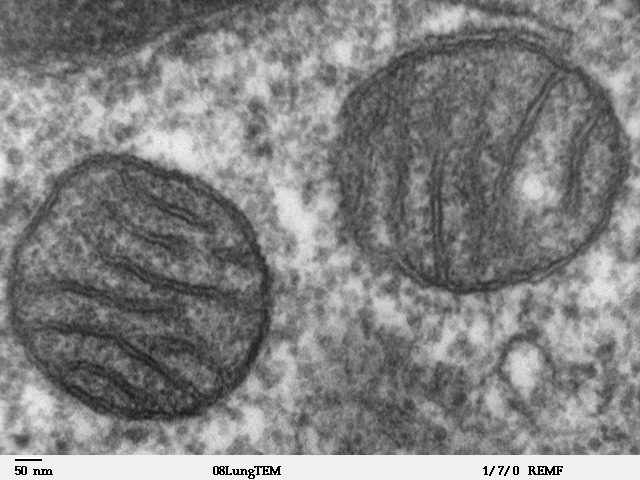
2.1.A.5 Mitochondria have a double membrane that provides compartments for different metabolic reactions involved in aerobic cellular respiration. The outer membrane is smooth, while the inner membrane is highly convoluted, forming folds that enable ATP to be synthesized more efficiently.
2.1.A.6 Lysosomes are membrane-enclosed sacs that contain hydrolytic enzymes that digest material. Lysosomes also play a role in programmed cell death (apoptosis).
2.1.A.7 Vacuoles are membrane-bound sacs that play many different roles.
i. In plant cells, a specialized large vacuole maintains turgor pressure through nutrient and water storage.
ii. In animal cells, vacuoles are smaller in size, are more plentiful than in plant cells, and store cellular materials.
2.1.A.8 Chloroplasts are specialized organelles that are found in plants and photosynthetic algae. Chloroplasts contain a double membrane and serve as the location for photosynthesis.
Bahasa Indonesia
Ide Besar 4 — Interaksi Sistem (SYI): Sistem biologis berinteraksi, dan sistem serta interaksinya menunjukkan sifat yang kompleks.
Tujuan Pembelajaran 2.1.A: Jelaskan bagaimana struktur dan fungsi komponen subseluler dan organel berkontribusi terhadap fungsi sel.
2.1.A.1 Ribosom terdiri dari RNA ribosom (rRNA) dan protein. Struktur subseluler tanpa membran ini terdapat pada sel di semua bentuk kehidupan dan mencerminkan nenek moyang bersama dalam semua kehidupan yang diketahui. Ribosom mensintesis protein sesuai dengan urutan messenger RNA (mRNA).
2.1.A.2 Sistem endomembran terdiri dari sekelompok organel dan komponen subseluler yang terbungkus membran (retikulum endoplasma (RE), kompleks Golgi, lisosom, vakuola dan vesikel transport, selubung nukleus, dan membran plasma) yang bekerja sama untuk memodifikasi, mengemas, dan mentransportasikan polisakarida, lipid, dan protein secara inter-seluler.
2.1.A.3 Retikulum endoplasma menyediakan dukungan mekanis dengan membantu sel mempertahankan bentuk dan berperan dalam transportasi intraseluler.
i. RE kasar terkait dengan ribosom yang terbungkus membran, memungkinkan kompartementalisasi sel, dan membantu melakukan sintesis protein.
ii. Fungsi retikulum endoplasma halus meliputi detoksifikasi sel dan sintesis lipid.
Pernyataan pengecualian: Pengetahuan tentang fungsi spesifik retikulum endoplasma halus pada sel khusus berada di luar cakupan Ujian AP.
2.1.A.4 Kompleks Golgi adalah struktur terbungkus membran yang terdiri dari serangkaian kantung membran pipih. Fungsi kompleks Golgi meliputi:
i. Melipat dengan benar dan memodifikasi secara kimiawi produk seluler yang baru disintesis
ii. Mengemas protein untuk trafficking
Pernyataan pengecualian: Pengetahuan tentang peran Golgi dalam sintesis fosfolipid tertentu dan pengemasan enzim tertentu untuk lisosom, peroksisom, dan vesikel sekretori berada di luar cakupan Ujian AP.
Contoh ilustratif untuk 2.1.A.4:
Glikosilasi dan modifikasi kimia lainnya pada protein yang terjadi di dalam Golgi dan menentukan fungsi atau penargetan protein
2.1.A.5 Mitokondria memiliki membran ganda yang menyediakan kompartemen untuk berbagai reaksi metabolik yang terlibat dalam respirasi seluler aerob. Membran luar licin, sedangkan membran dalam sangat berlipat, membentuk lipatan yang memungkinkan ATP disintesis lebih efisien.
2.1.A.6 Lisosom adalah kantung yang dibungkus membran yang mengandung enzim hidrolitik untuk mendigesti materi. Lisosom juga berperan dalam kematian sel terprogram (apoptosis).
2.1.A.7 Vakuola adalah kantung yang terbungkus membran yang memainkan banyak peran yang berbeda.
i. Pada sel tumbuhan, vakuola besar yang terspesialisasi menjaga tekanan turgor melalui penyimpanan nutrisi dan air.
ii. Pada sel hewan, vakuola ukurannya lebih kecil, lebih banyak daripada pada sel tumbuhan, dan menyimpan material seluler.
2.1.A.8 Kloroplas adalah organel khusus yang ditemukan pada tumbuhan dan alga fotosintetik. Kloroplas mengandung membran ganda dan berfungsi sebagai lokasi fotosintesis.
Source: College Board AP Course and Exam Description · Sumber: Deskripsi Kursus dan Ujian College Board AP
English
A eukaryotic cell divides its work among organelles 细胞器. The endomembrane system 内膜系统 is a connected set that makes, modifies, and ships molecules: the nucleus 细胞核 (holds DNA), rough and smooth endoplasmic reticulum 内质网 (protein and lipid synthesis), the Golgi 高尔基体 (modifies and packages), lysosomes 溶酶体 (digestion), and vesicles that carry material between them. Mitochondria 线粒体 (respiration) and chloroplasts 叶绿体 (photosynthesis) have their own membranes.
What each organelle actually does
The exam asks you to name a structure and say what it does, so learn them as pairs.
Ribosomes 核糖体 are made of ribosomal RNA 核糖体核糖核酸 (rRNA) and protein. They have no membrane, and they are found in every form of life — bacteria, archaea and eukaryotes alike. That shared presence is evidence of common ancestry: a structure this central was already present in the last common ancestor of all living things. A ribosome reads messenger RNA 信使核糖核酸 (mRNA) and builds the protein it codes for. Free ribosomes make proteins for use inside the cell; ribosomes bound to the rough endoplasmic reticulum make proteins for export or for the membrane.
The Golgi complex 高尔基复合体 is a series of flattened, membrane-bound sacs. A protein arriving from the endoplasmic reticulum is passed through them, and three things happen to it:
it is folded correctly and chemically modified — most often by glycosylation 糖基化, the attachment of short sugar chains;
it is sorted and targeted, so the modified sugar or phosphate tag decides which compartment the protein is sent to;
it is packaged into a vesicle for transport.
So the Golgi is not storage: it is the cell's finishing and dispatch department, and its modifications determine what a protein does and where it ends up.
Lysosomes are membrane-enclosed sacs of hydrolytic enzymes 水解酶 that digest material — worn-out organelles, engulfed bacteria, and food particles taken in by the cell. Their enzymes work best at a low pH, which the lysosome maintains inside itself; keeping them enclosed protects the rest of the cell. Lysosomes also take part in apoptosis 细胞凋亡, programmed cell death, in which a cell is dismantled deliberately, for example to sculpt fingers from a webbed embryonic hand.
Vacuoles 液泡 are membrane-bound sacs with many different roles: storing water, ions, nutrients or waste, and in a plant cell the large central vacuole also presses outwards on the cell wall to keep the cell firm.
Mitochondria and chloroplasts each have a double membrane and their own circular DNA and ribosomes — the evidence behind endosymbiotic theory below.
Bahasa Indonesia
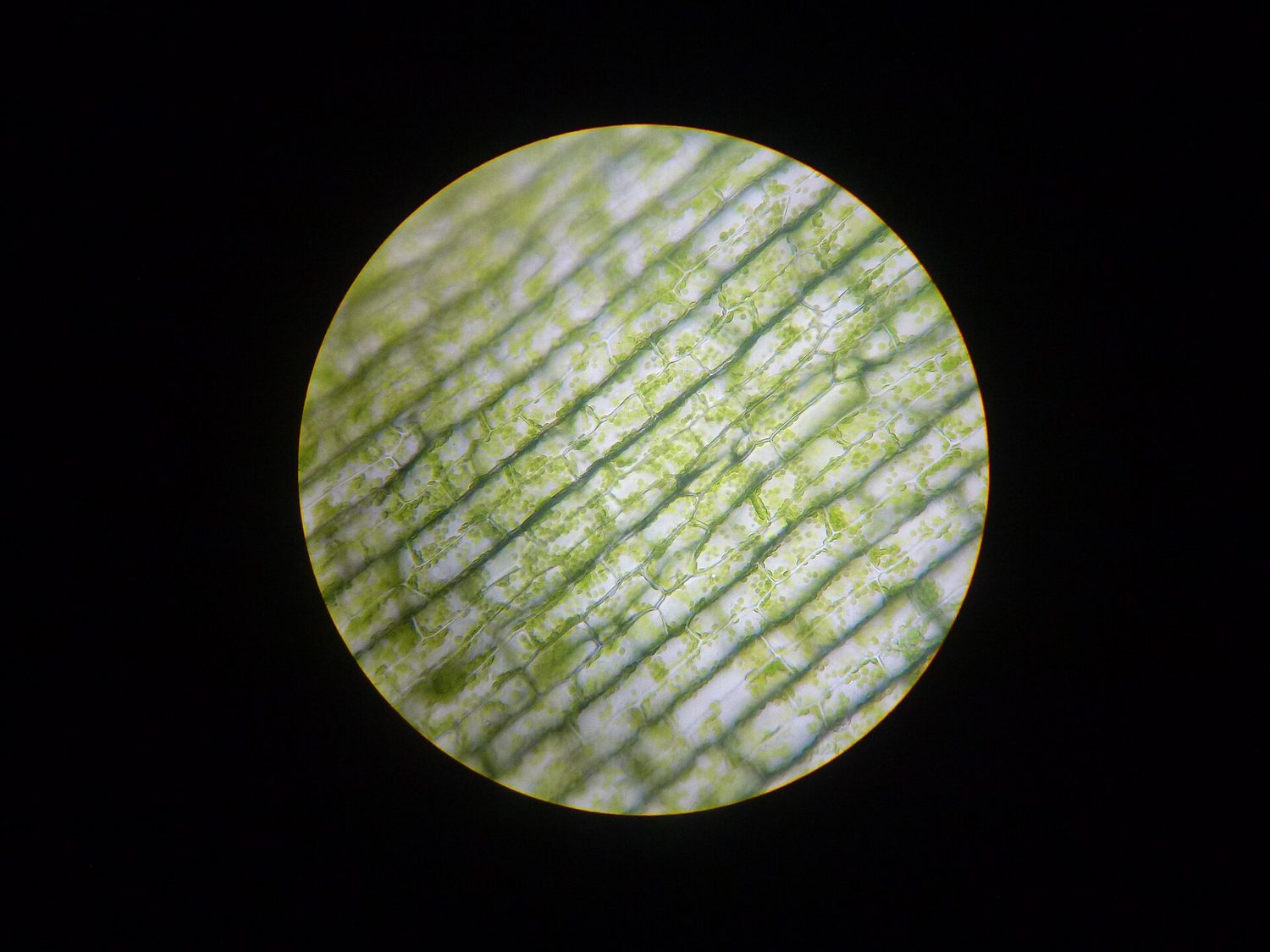
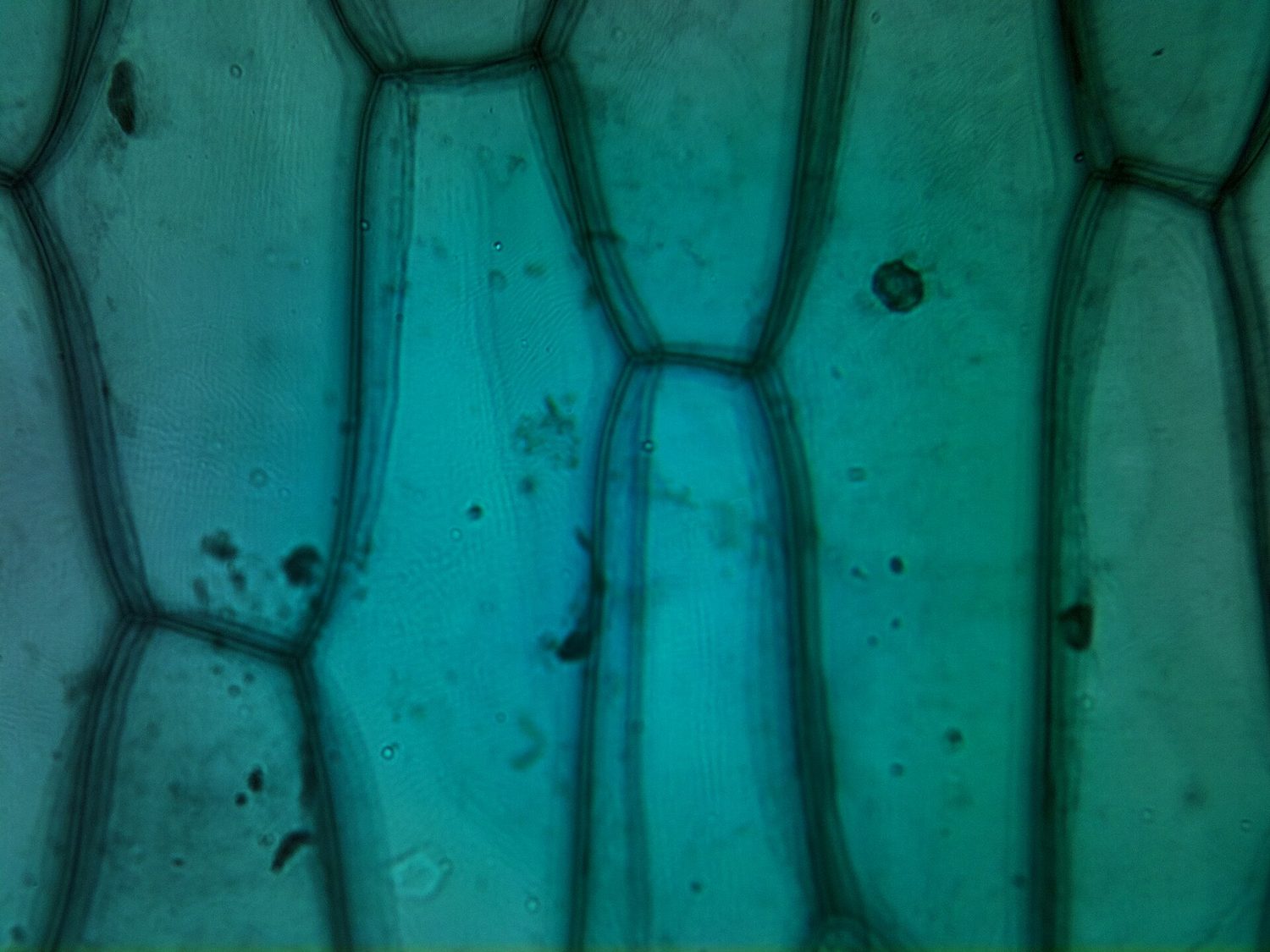
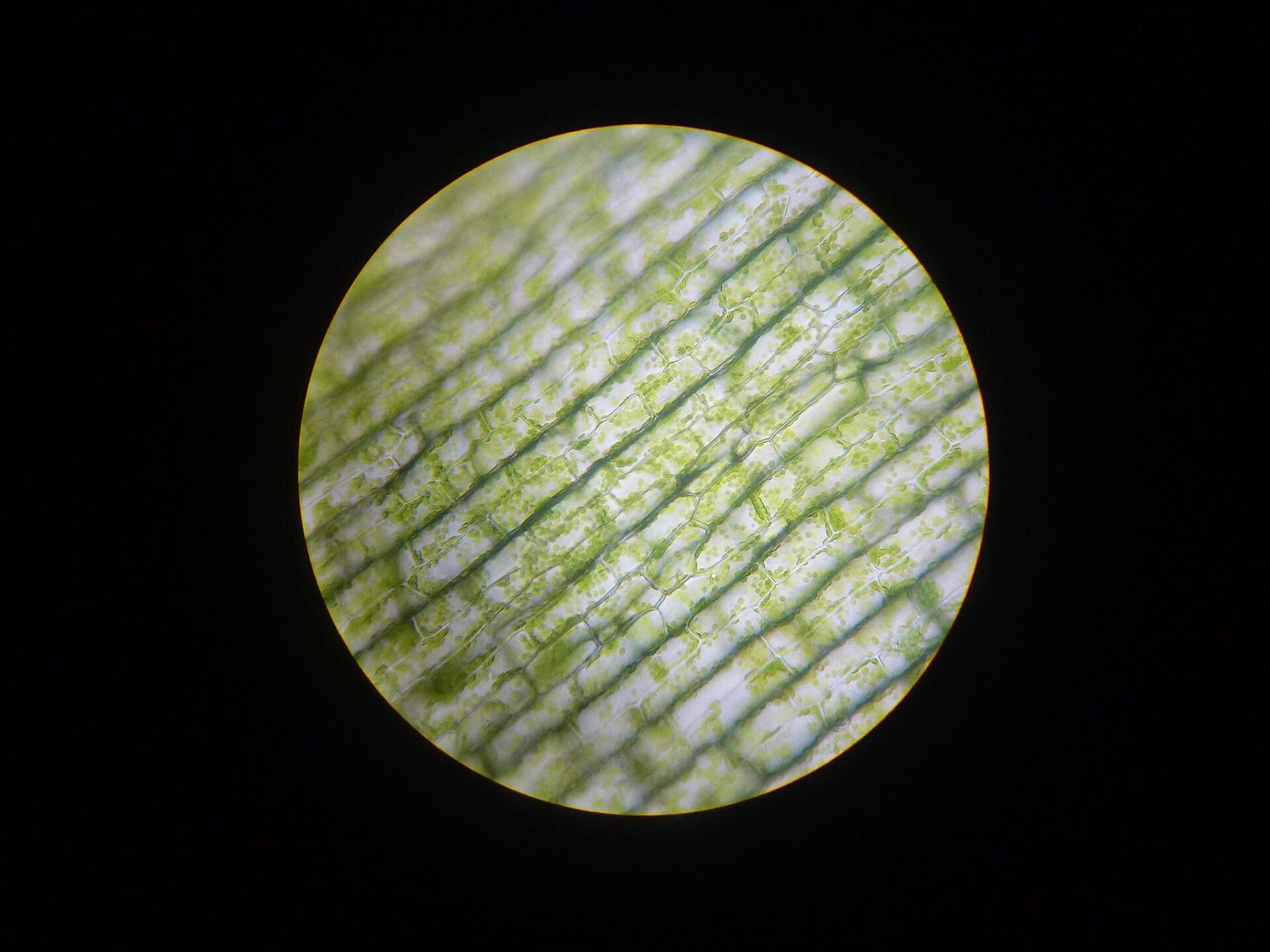
Sel daun Elodea yang penuh dengan kloroplas hijau (mikrograf cahaya)Epidermis bawang di bawah mikroskop cahaya — dinding sel dan inti terlihat jelas
Sel eukariotik membagi kerjanya antar organel. Sistem endomembran adalah kumpulan terhubung yang memproduksi, memodifikasi, dan mengirimkan molekul: inti sel (menyimpan DNA), retikulum endoplasma kasar dan halus (sintesis protein dan lipid), Golgi (memodifikasi dan mengemas), lisosom (pencernaan), serta vesikel yang membawa materi di antaranya. Mitokondria (respirasi) dan kloroplas (fotosintesis) memiliki membran sendiri.
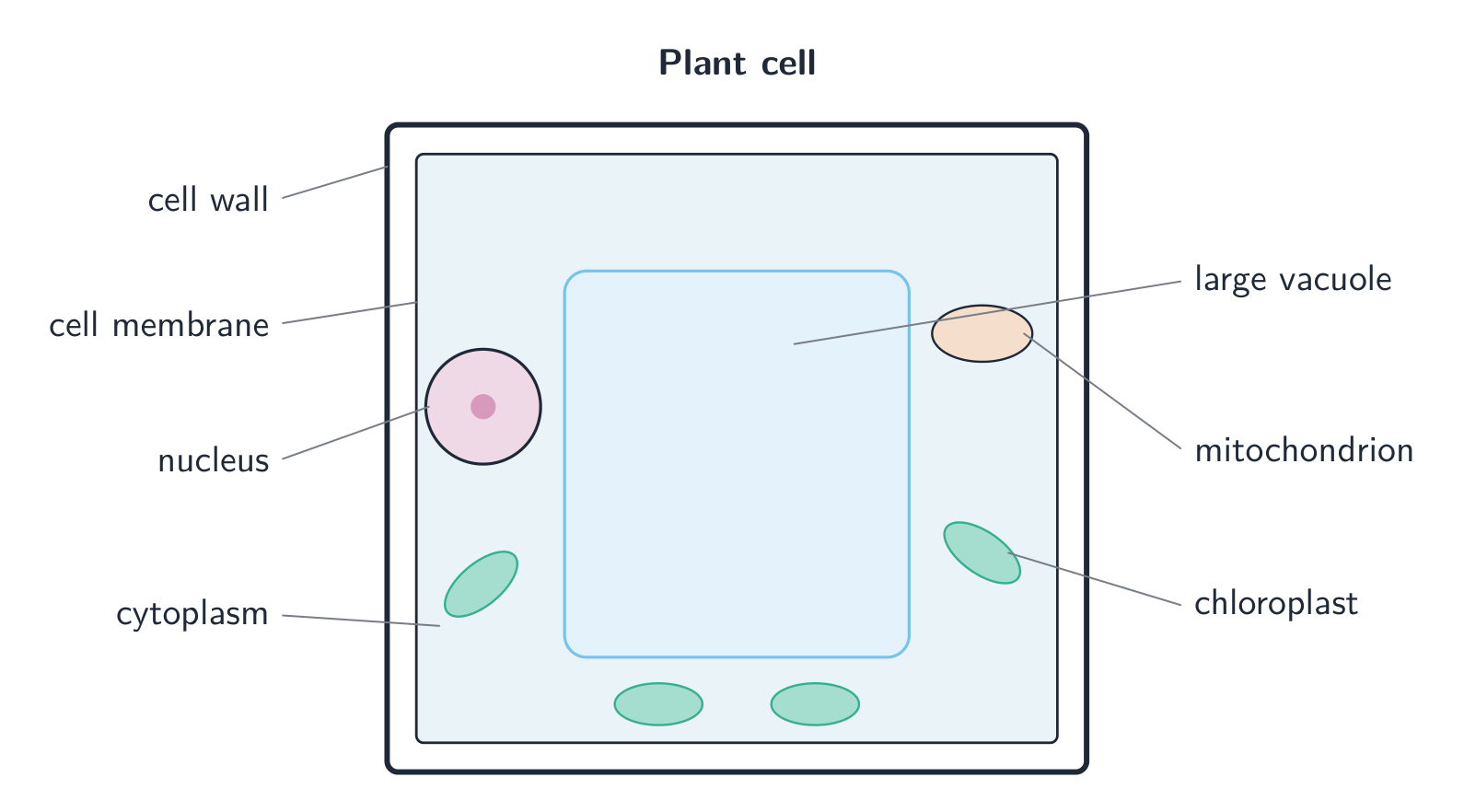
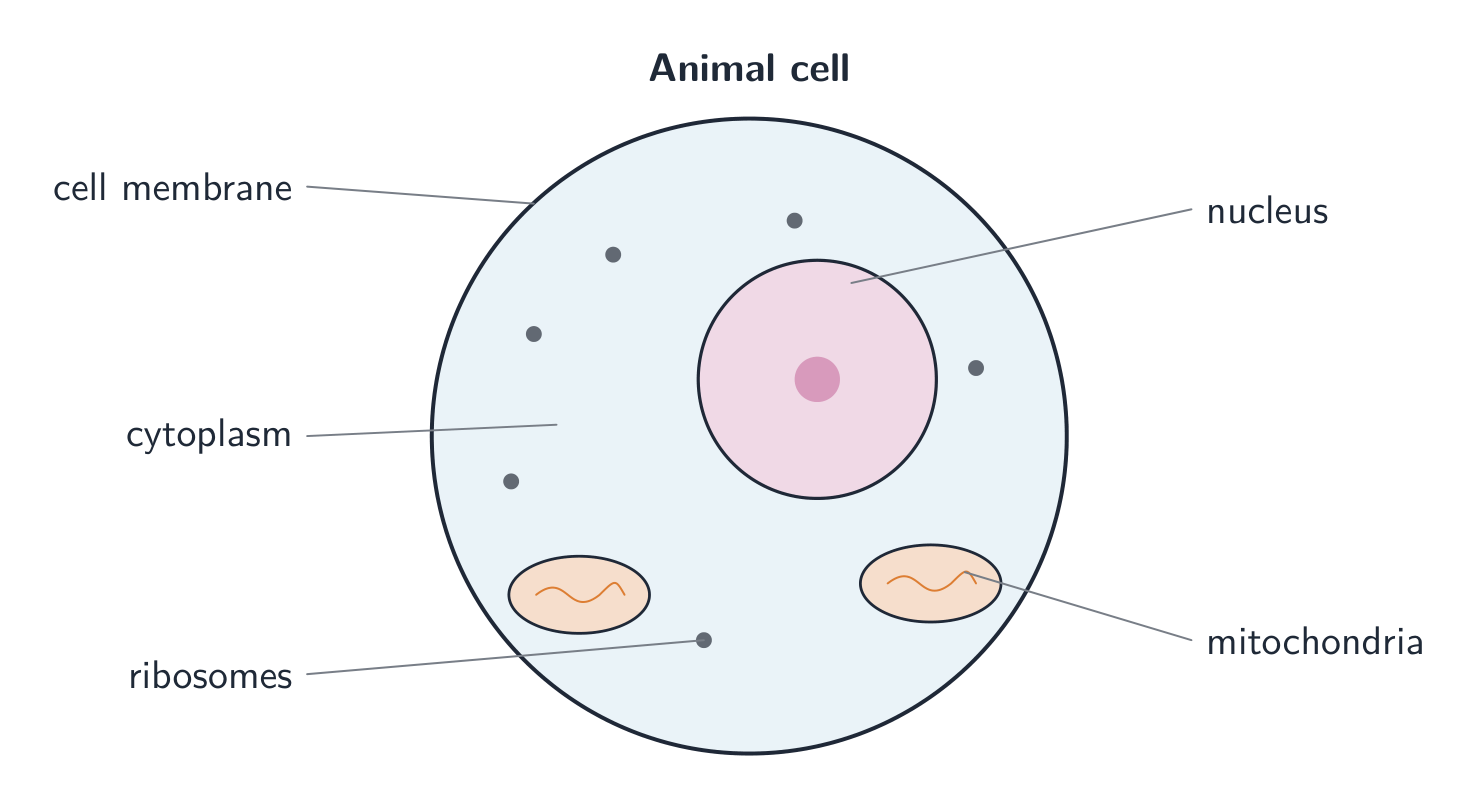
Sel tumbuhan juga memiliki dinding sel, vakuola besar, dan kloroplasSel hewan umum dan organel-organelnya
Apa fungsi sebenarnya setiap organel
Ujian meminta Anda menyebutkan struktur dan menjelaskan fungsinya, jadi pelajari keduanya sebagai pasangan.
Ribosom terdiri dari RNA ribosom (rRNA) dan protein. Mereka tidak bermembran, dan ditemukan dalam setiap bentuk kehidupan — bakteri, arkaea, dan eukariota sama-sama. Keberadaan bersama ini merupakan bukti nenek moyang bersama: struktur sedasentral ini sudah ada pada nenek moyang bersama terakhir semua makhluk hidup. Ribosom membaca messenger RNA (mRNA) dan membangun protein yang dikodekannya. Ribosom bebas membuat protein untuk penggunaan di dalam sel; ribosom yang melekat pada retikulum endoplasma kasar membuat protein untuk ekspor atau untuk membran.
Kompleks Golgi adalah serangkaian saku datar yang dibatasi membran. Protein yang tiba dari retikulum endoplasma dilewatkan melalui saku-saku ini, dan tiga hal terjadi padanya:
ia dilipat dengan benar dan dimodifikasi secara kimia — paling sering melalui glikosilasi, yaitu pengikatan rantai gula pendek;
ia disortir dan ditargetkan, sehingga label gula atau fosfat yang telah dimodifikasi menentukan kompartemen mana protein tersebut dikirim;
ia dikemas ke dalam vesikel untuk transportasi.
Jadi Golgi bukan tempat penyimpanan: ia adalah departemen penyelesaian dan pengiriman sel, dan modifikasinya menentukan apa yang dilakukan protein dan ke mana akhirnya protein itu berakhir.
Lisosom adalah saku yang dibungkus membran berisi enzim hidrolitik yang mencerna material — organel usang, bakteri yang tertelan, dan partikel makanan yang diambil oleh sel. Enzim mereka bekerja paling baik pada pH rendah, yang dipertahankan lisosom di dalamnya; menyimpannya terbungkus melindungi bagian sel lainnya. Lisosom juga terlibat dalam apoptosis, kematian sel terprogram, di mana sel dibongkar secara sengaja, misalnya untuk membentuk jari dari tangan embrio yang berselaput.
Vakuola adalah saku yang dibungkus membran dengan berbagai peran: menyimpan air, ion, nutrisi, atau limbah, dan pada sel tumbuhan, vakuola sentral yang besar juga mendorong keluar terhadap dinding sel untuk menjaga kekakuan sel.
Mitokondria dan kloroplas masing-masing memiliki membran ganda dan DNA sirkuler serta ribosom sendiri — bukti di balik teori endosimbiosis di bawah ini.
Big Idea 2 — Energetics (ENE): Biological systems use energy and molecular building blocks to grow, reproduce, and maintain dynamic homeostasis.
Learning Objective 2.2.A: Explain the effect of surface area-to-volume ratios on the exchange of materials between cells or organisms and the environment.
2.2.A.1 Surface area-to-volume ratios affect the ability of a biological system to obtain necessary nutrients, eliminate waste products, acquire or dissipate thermal energy, and otherwise exchange chemicals and energy with the environment.
Relevant equations:
Volume of a Sphere: $V = \dfrac{4}{3}\pi r^3$
Volume of a Cube: $V = s^3$
Volume of a Rectangular Solid: $V = lwh$
Volume of a Cylinder: $V = \pi r^2 h$
Surface Area of a Sphere: $SA = 4\pi r^2$
Surface Area of a Cube: $SA = 6s^2$
Surface Area of a Rectangular Solid: $SA = 2lh + 2lw + 2wh$
Surface Area of a Cylinder: $SA = 2\pi rh + 2\pi r^2$
$r$ = radius
$l$ = length
$h$ = height
$w$ = width
$s$ = length of one side of a cube
Illustrative examples for 2.2.A.1:
SA/V Ratios and Exchanges
Root hairs
Guard cells
Gut epithelial cells
Cilia
Stomata
2.2.A.2 The surface area of the plasma membrane must be large enough to adequately exchange materials.
i. The surface area-to-volume ratio can restrict cell size and shape. Smaller cells typically have a higher surface area-to-volume ratio as well as a more efficient exchange of materials with the environment than do larger cells.
ii. As cells increase in volume, the surface area-to-volume ratio decreases and the demand for internal resources increases.
iii. More complex cellular structures (e.g., membrane folds) are necessary to adequately exchange materials with the environment.
iv. As organisms increase in size, their surface area-to-volume ratio decreases, affecting properties like rate of heat exchange with the environment. Smaller amounts of mass exchange proportionally more heat with the ambient environment than do larger masses. As mass increases, both the surface area-to-volume ratio and the rate of heat exchange decrease.
v. There is a relationship between metabolic rate per unit body mass and the size of multicellular organisms; typically, the smaller the organism, the higher the metabolic rate per unit body mass.
Bahasa Indonesia
Ide Besar 2 — Energetika (ENE): Sistem biologis menggunakan energi dan blok bangunan molekuler untuk tumbuh, bereproduksi, dan mempertahankan homeostasis dinamis.
Tujuan Pembelajaran 2.2.A: Jelaskan efek rasio luas permukaan-terhadap-volume terhadap pertukaran materi antara sel atau organisme dengan lingkungan.
2.2.A.1 Rasio luas permukaan-terhadap-volume mempengaruhi kemampuan sistem biologis untuk mendapatkan nutrisi yang diperlukan, menghilangkan produk limbah, memperoleh atau melepaskan energi termal, dan bertukar bahan kimia serta energi dengan lingkungan.
Persamaan relevan:
Volume Bola: $V = \dfrac{4}{3}\pi r^3$
Volume Kubus: $V = s^3$
Volume Balok: $V = lwh$
Volume Silinder: $V = \pi r^2 h$
Luas Permukaan Bola: $SA = 4\pi r^2$
Luas Permukaan Kubus: $SA = 6s^2$
Luas Permukaan Balok: $SA = 2lh + 2lw + 2wh$
Luas Permukaan Silinder: $SA = 2\pi rh + 2\pi r^2$
$r$ = jari-jari
$l$ = panjang
$h$ = tinggi
$w$ = lebar
$s$ = panjang salah satu sisi kubus
Contoh ilustratif untuk 2.2.A.1:
Rasio LA/V dan Pertukaran
Rambut akar
Sel penjaga
Sel epitel usus
Sitilia
Stoma
2.2.A.2 Luas permukaan membran plasma harus cukup besar untuk bertukar materi secara memadai.
i. Rasio luas permukaan-terhadap-volume dapat membatasi ukuran dan bentuk sel. Sel yang lebih kecil biasanya memiliki rasio luas permukaan-terhadap-volume yang lebih tinggi serta pertukaran materi yang lebih efisien dengan lingkungan dibandingkan sel yang lebih besar.
ii. Seiring bertambahnya volume sel, rasio luas permukaan-terhadap-volume menurun dan kebutuhan akan sumber daya internal meningkat.
iii. Struktur seluler yang lebih kompleks (misalnya, lipatan membran) diperlukan untuk bertukar materi dengan lingkungan secara memadai.
iv. Saat organisme membesar, rasio luas permukaan terhadap volumenya menurun, yang memengaruhi sifat seperti laju pertukaran panas dengan lingkungan. Massa yang lebih kecil bertukar panas secara proporsional lebih banyak dengan lingkungan sekitar dibandingkan massa yang lebih besar. Seiring bertambahnya massa, baik rasio luas permukaan terhadap volume maupun laju pertukaran panas menurun.
v. Terdapat hubungan antara laju metabolik per satuan massa tubuh dan ukuran organisme multiseluler; umumnya, semakin kecil organisme, semakin tinggi laju metabolik per satuan massa tubuhnya.
Source: College Board AP Course and Exam Description · Sumber: Deskripsi Kursus dan Ujian College Board AP
English
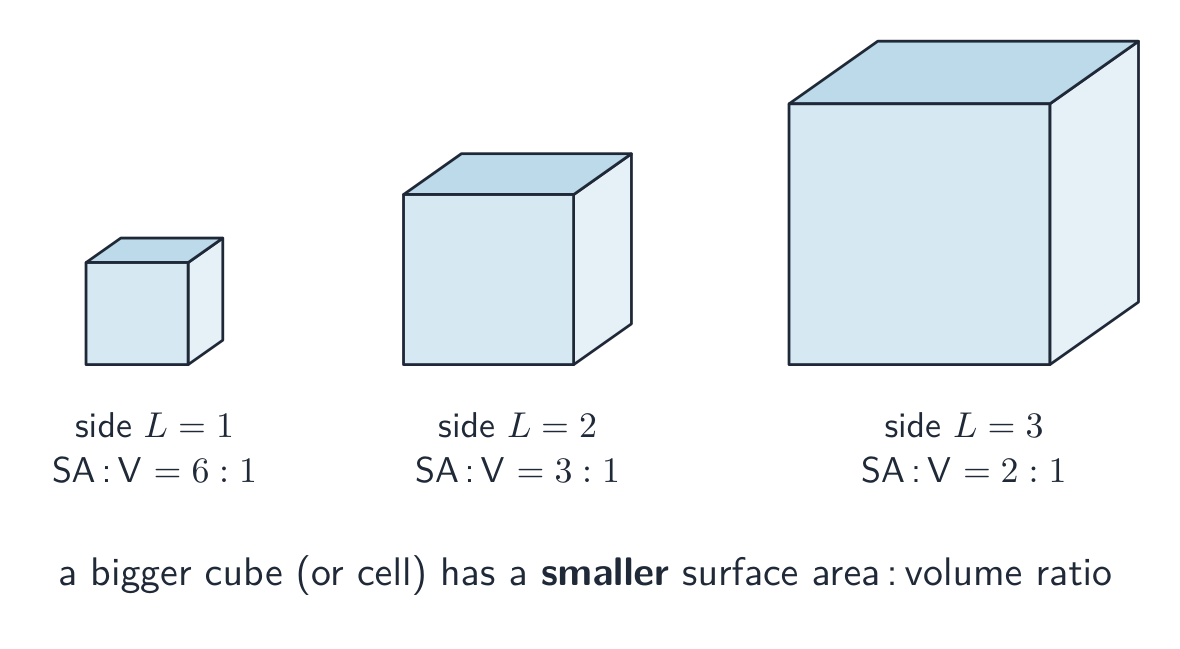
Cells stay small because of the surface-area-to-volume ratio 表面积与体积比. As a cell grows, its volume rises faster than its surface area, so its membrane cannot exchange materials fast enough for the interior. Staying small (or being flat or folded) keeps enough surface to serve the volume.
Worked example. A cube-shaped cell $2\ \mu\text{m}$ on a side has surface area $6\times2^2=24\ \mu\text{m}^2$ and volume $2^3=8\ \mu\text{m}^3$, so its surface-area-to-volume ratio is $\tfrac{24}{8}=3$. Double the side to $4\ \mu\text{m}$: surface area $=6\times4^2=96$, volume $=4^3=64$, ratio $=\tfrac{96}{64}=1.5$. Doubling the size halved the ratio – the larger cell has far less membrane per unit of interior, which is why cells stay small.
Bahasa Indonesia
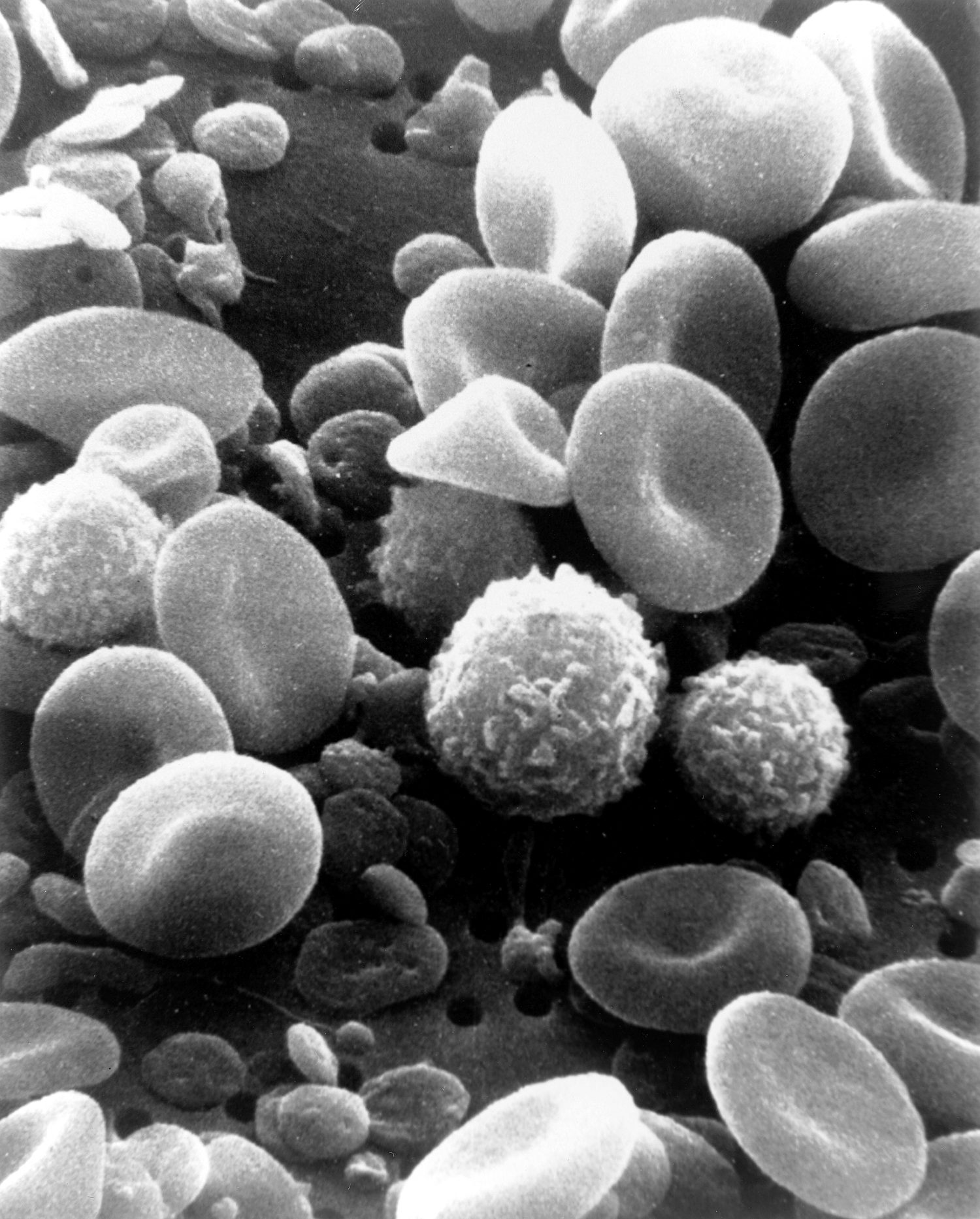
Mikrograf elektron pemindaian sel darah merah — tanpa inti, luas permukaan tinggi untuk pertukaran gas
Sel tetap kecil karena rasio luas permukaan-terhadap-volume. Saat sel membesar, volumenya meningkat lebih cepat daripada luas permukaannya, sehingga membrannya tidak dapat menukar materi cukup cepat untuk bagian dalamnya. Tetap kecil (atau menjadi datar atau berlipat) mempertahankan cukup luas permukaan untuk melayani volume.
Rasio luas permukaan-terhadap-volume menurun saat sel membesar
Contoh terpecahkan. Sel berbentuk kubus $2\ \mu\text{m}$ pada sisi memiliki luas permukaan $6\times2^2=24\ \mu\text{m}^2$ dan volume $2^3=8\ \mu\text{m}^3$, sehingga rasio luas permukaan-terhadap-volumenya adalah $\tfrac{24}{8}=3$. Gandakan sisi menjadi $4\ \mu\text{m}$: luas permukaan $=6\times4^2=96$, volume $=4^3=64$, rasio $=\tfrac{96}{64}=1.5$. Menggandakan ukuran mengurangi separuh rasio – sel yang lebih besar memiliki jauh lebih sedikit membran per unit isi, yang menjelaskan mengapa sel tetap kecil.
Explore · Jelajahi
See surface area vs volume as a cube grows · Lihat luas permukaan terhadap volume saat kubus membesar
As a cell grows, volume rises faster than surface area, so the surface-area-to-volume ratio falls. A small cell keeps enough membrane to exchange materials fast enough. · Saat sel membesar, volume meningkat lebih cepat daripada luas permukaan, sehingga rasio luas permukaan terhadap volume menurun. Sel kecil mempertahankan membran yang cukup untuk menukar materi dengan cukup cepat.
2.3
The Fluid Mosaic Model of the Membrane · Model Mosaik Cair Membran
Syllabus · Silabus
English
Big Idea 2 — Energetics (ENE): Biological systems use energy and molecular building blocks to grow, reproduce, and maintain dynamic homeostasis.
Learning Objective 2.3.A: Describe the roles of each of the components of the cell membrane in maintaining the internal environment of the cell.
2.3.A.1 Phospholipids have both hydrophilic and hydrophobic regions. The polar hydrophilic phosphate regions of the phospholipids are oriented toward the aqueous external or internal environment, while the nonpolar hydrophobic fatty acid regions face each other within the interior of the membrane.
2.3.A.2 Embedded proteins can be hydrophilic (with charged and polar side groups), hydrophobic (with nonpolar side groups), or both.
i. Hydrophilic regions of the proteins are either inside the interior of the protein or exposed to the cytosol (cytoplasm).
ii. Hydrophobic regions of proteins make up the protein surface that interacts with the fatty acids in the interior membrane.
Learning Objective 2.3.B: Describe the fluid mosaic model of cell membranes.
2.3.B.1 Plasma membranes consist of a structural framework of phospholipid molecules embedded with proteins, steroids (such as cholesterol in vertebrate animals), glycoproteins, and glycolipids. All of these can move around the surface of the cell within the membrane, as illustrated by the fluid mosaic model.
Bahasa Indonesia
Ide Besar 2 — Energetika (ENE): Sistem biologis menggunakan energi dan blok bangunan molekuler untuk tumbuh, bereproduksi, dan mempertahankan homeostasis dinamis.
Tujuan Pembelajaran 2.3.A: Jelaskan peran setiap komponen membran sel dalam mempertahankan lingkungan internal sel.
2.3.A.1 Fosfolipid memiliki wilayah hidrofilik dan hidrofobik. Wilayah fosfat polar yang hidrofilik dari fosfolipid diorientasikan menuju lingkungan luar atau dalam yang berair, sedangkan wilayah asam lemak nonpolar yang hidrofobik saling menghadap di bagian dalam membran.
2.3.A.2 Protein tertanam dapat bersifat hidrofilik (dengan gugus samping bermuatan dan polar), hidrofobik (dengan gugus samping nonpolar), atau keduanya.
i. Wilayah hidrofilik dari protein berada di dalam interior protein atau terekspos ke sitosol (sitoplasma).
ii. Wilayah hidrofobik dari protein membentuk permukaan protein yang berinteraksi dengan asam lemak di bagian dalam membran.
Tujuan Pembelajaran 2.3.B: Jelaskan model mosaik cair pada membran sel.
2.3.B.1 Membran plasma terdiri dari kerangka struktural molekul fosfolipid yang tertanam dengan protein, steroid (seperti kolesterol pada hewan vertebrata), glikoprotein, dan glikolipid. Semua ini dapat bergerak di sekitar permukaan sel di dalam membran, sebagaimana diilustrasikan oleh model mosaik cair.
Source: College Board AP Course and Exam Description · Sumber: Deskripsi Kursus dan Ujian College Board AP
English
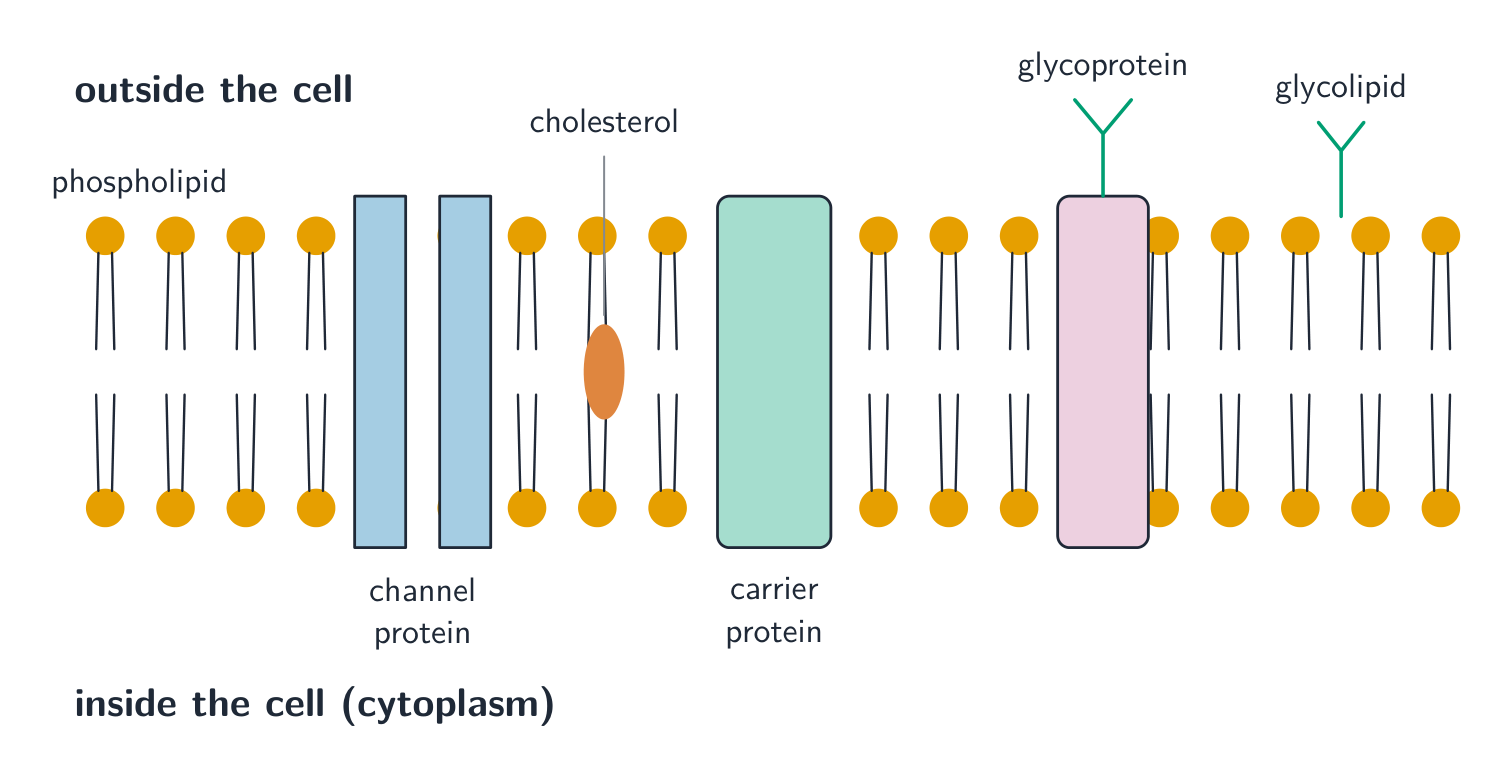
The cell membrane is a phospholipid bilayer 磷脂双分子层 – polar heads facing the water, nonpolar tails inside – studded with proteins. The fluid mosaic model 流动镶嵌模型 pictures it as a fluid sheet in which lipids and proteins drift. Cholesterol and the degree of unsaturation tune its fluidity.
Bahasa Indonesia
Membran sel adalah bilayer fosfolipid – kepala polar menghadap air, ekor nonpolar di dalam – yang dihiasi protein. Model mosaik cair menggambarkan membran sebagai lembaran cair di mana lipid dan protein bergerak liar. Kolesterol dan tingkat ketidakjenuhan menyesuaikan kelikirannya.
Model mosaik cair membran sel
2.4
What Can Cross the Membrane · Apa yang Dapat Melintas Membran
Syllabus · Silabus
English
Big Idea 2 — Energetics (ENE): Biological systems use energy and molecular building blocks to grow, reproduce, and maintain dynamic homeostasis.
Learning Objective 2.4.A: Explain how the structure of biological membranes influences selective permeability.
2.4.A.1 Plasma membranes separate the internal environment of the cell from the external environment. Selective permeability is the result of the plasma membrane having a hydrophobic interior.
2.4.A.2 Small nonpolar molecules, including $\mathrm{N_2}$, $\mathrm{O_2}$, and $\mathrm{CO_2}$, freely pass across the membrane. Hydrophilic substances, such as large polar molecules and ions, move across the membrane through embedded channels and transport proteins.
2.4.A.3 The nonpolar hydrocarbon tails of phospholipids prevent the movement of ions and polar molecules across the membrane. Small polar, uncharged molecules, like $\mathrm{H_2O}$ or $\mathrm{NH_3}$ (ammonia), pass through the membrane in small amounts.
Learning Objective 2.4.B: Describe the role of the cell wall in maintaining cell structure and function.
2.4.B.1 Cell walls of Bacteria, Archaea, Fungi, and plants provide a structural boundary as well as a permeability barrier for some substances to the internal or external cellular environments and protection from osmotic lysis.
Bahasa Indonesia
Ide Besar 2 — Energetika (ENE): Sistem biologis menggunakan energi dan blok bangunan molekuler untuk tumbuh, bereproduksi, dan mempertahankan homeostasis dinamis.
Tujuan Pembelajaran 2.4.A: Jelaskan bagaimana struktur membran biologis memengaruhi permeabilitas selektif.
2.4.A.1 Membran plasma memisahkan lingkungan internal sel dari lingkungan eksternal. Permeabilitas selektif merupakan hasil dari membran plasma yang memiliki interior hidrofobik.
2.4.A.2 Molekul nonpolar kecil, termasuk $\mathrm{N_2}$, $\mathrm{O_2}$, dan $\mathrm{CO_2}$, dapat melewati membran dengan bebas. Zat hidrofilik, seperti molekul polar besar dan ion, melintasi membran melalui saluran tertanam dan protein pengangkut.
2.4.A.3 Ekor hidrokarbon nonpolar dari fosfolipid mencegah pergerakan ion dan molekul polar melintasi membran. Molekul polar kecil yang tidak bermuatan, seperti $\mathrm{H_2O}$ atau $\mathrm{NH_3}$ (amonia), dapat melewati membran dalam jumlah kecil.
Tujuan Pembelajaran 2.4.B: Jelaskan peran dinding sel dalam mempertahankan struktur dan fungsi sel.
2.4.B.1 Dinding sel Bakteri, Arkea, Fungi, dan tumbuhan menyediakan batas struktural serta penghalang permeabilitas untuk beberapa zat terhadap lingkungan seluler internal atau eksternal, dan perlindungan dari lisis osmotik.
Source: College Board AP Course and Exam Description · Sumber: Deskripsi Kursus dan Ujian College Board AP
English
The membrane is selectively permeable 选择透过性. Small nonpolar molecules ($\text{O}_2$, $\text{CO}_2$) and water cross easily; large or charged/polar particles (ions, glucose) cannot pass the nonpolar core without help. This selectivity lets the cell control its internal environment.
Bahasa Indonesia
Membran bersifat selektif permeabel. Molekul nonpolar kecil ($\text{O}_2$, $\text{CO}_2$) dan air melintas dengan mudah; partikel besar atau bermuatan/polar (ion, glukosa) tidak dapat melewati inti nonpolar tanpa bantuan. Selektivitas ini memungkinkan sel mengendalikan lingkungan internalnya.
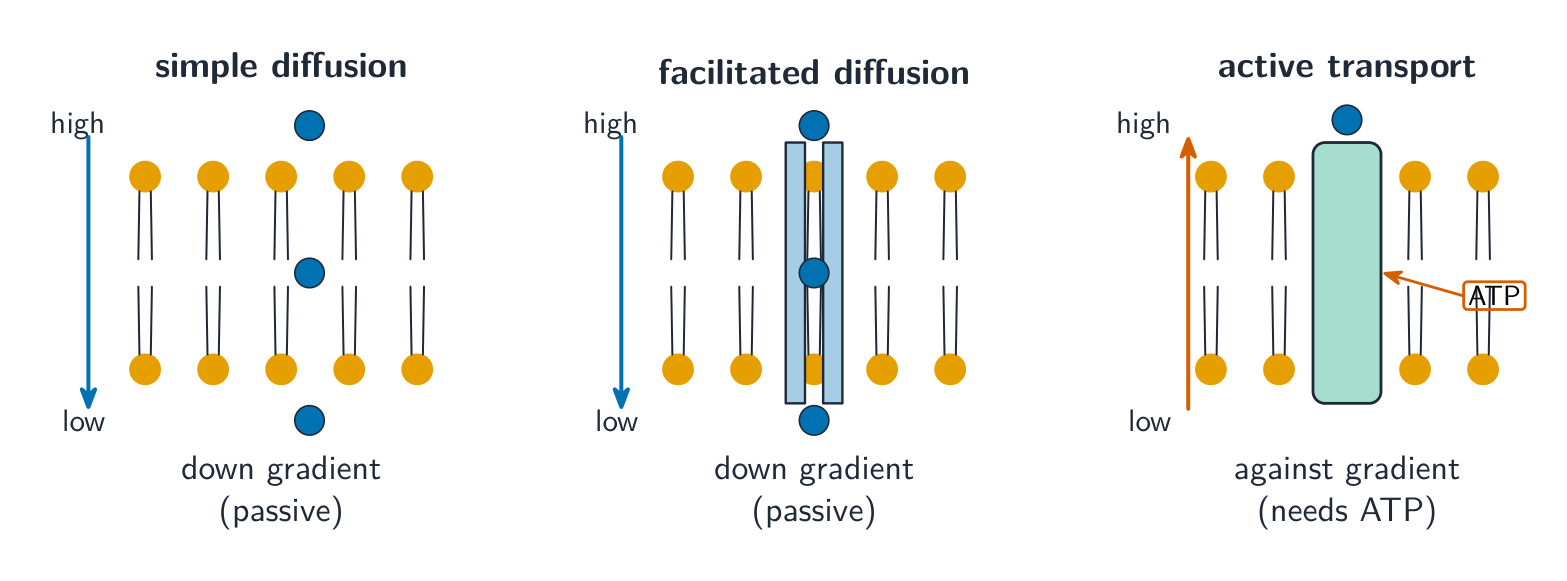
Tiga cara zat melintas membran
2.5
Passive and Active Transport · Transportasi Pasif dan Aktif
Syllabus · Silabus
English
Big Idea 2 — Energetics (ENE): Biological systems use energy and molecular building blocks to grow, reproduce, and maintain dynamic homeostasis.
Learning Objective 2.5.A: Describe the mechanisms that organisms use to maintain solute and water balance.
2.5.A.1 The selective permeability of membranes allows for the formation of concentration gradients of solutes across the membrane.
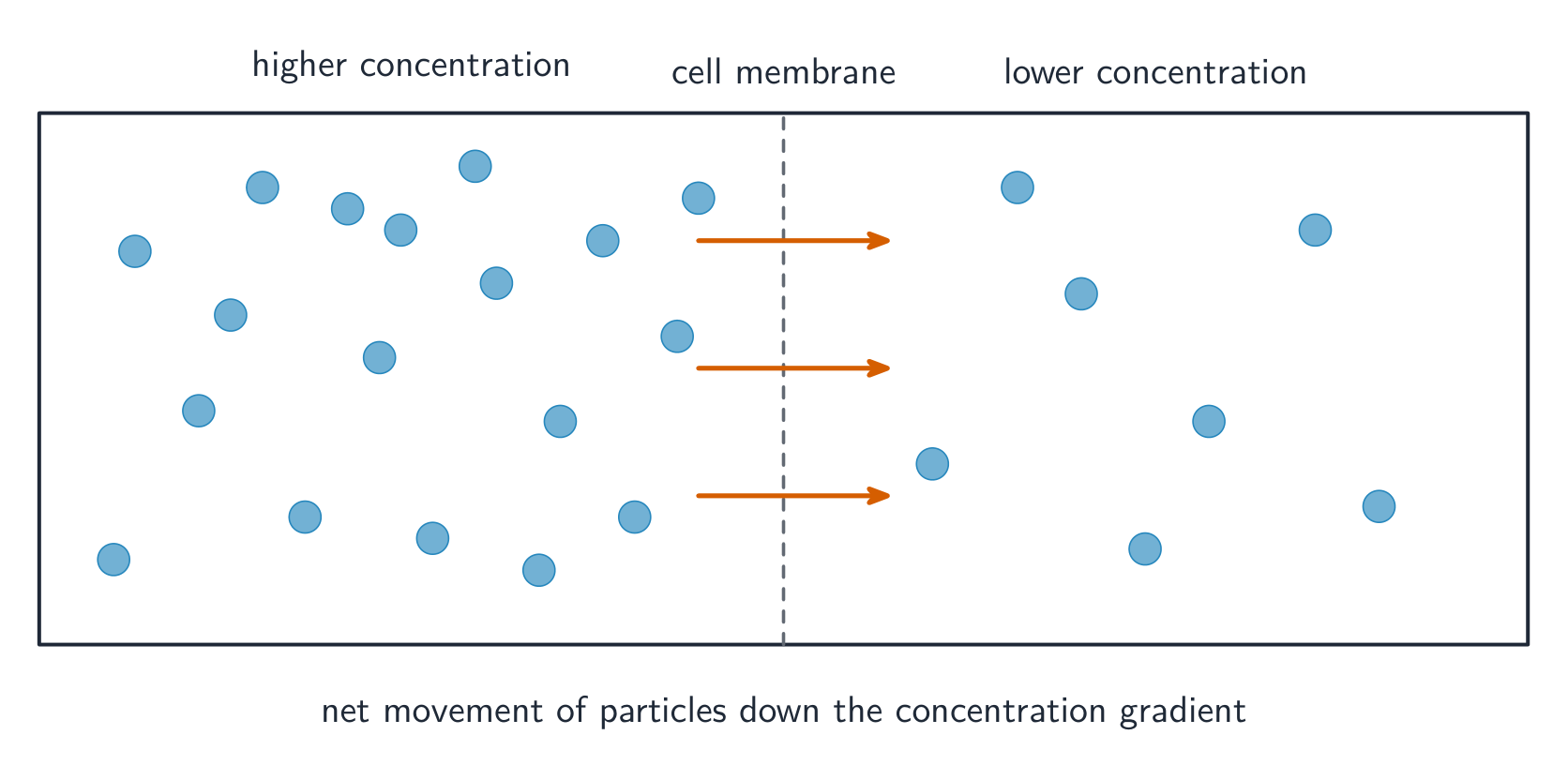
2.5.A.2 Passive transport is the net movement of molecules from regions of high concentration to regions of low concentration without the direct input of metabolic energy.
2.5.A.3 Active transport requires the direct input of energy to move molecules. In some cases, active transport is utilized to move molecules from regions of low concentration to regions of high concentration.
Learning Objective 2.5.B: Describe the mechanisms that organisms use to transport large molecules across the plasma membrane.
2.5.B.1 The processes of endocytosis and exocytosis require energy to move large substances or large amounts of substances into and out of cells.
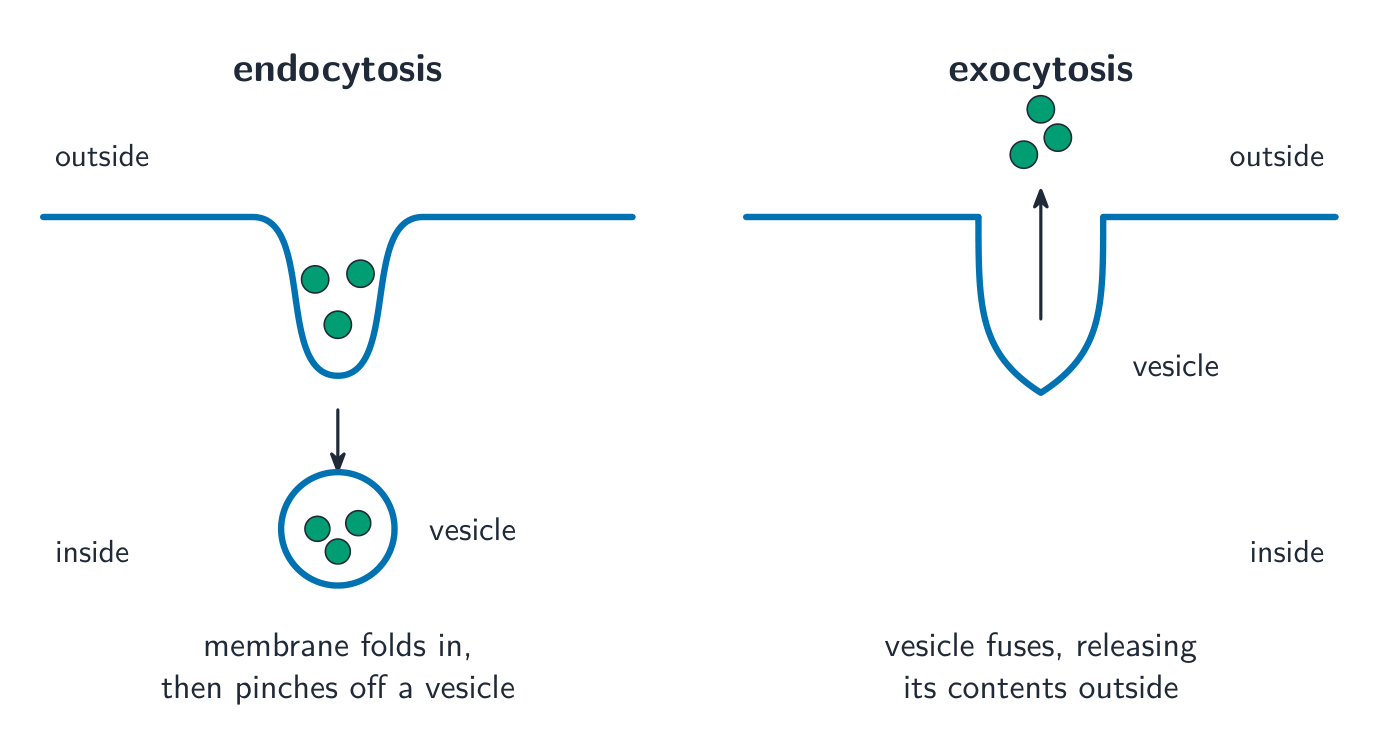
i. In endocytosis, the cell takes in large molecules and particulate matter by folding the plasma membrane in on itself and forming new (small) vesicles that engulf material from the external environment.
ii. In exocytosis, internal vesicles release material from cells by fusing with the plasma membrane and secreting large molecules from the cell.
Bahasa Indonesia
Ide Besar 2 — Energetika (ENE): Sistem biologis menggunakan energi dan blok bangunan molekuler untuk tumbuh, bereproduksi, dan mempertahankan homeostasis dinamis.
Tujuan Pembelajaran 2.5.A: Jelaskan mekanisme yang digunakan organisme untuk menjaga keseimbangan zat terlarut dan air.
2.5.A.2 Transportasi pasif adalah pergerakan bersih molekul dari daerah berkonsentrasi tinggi ke daerah berkonsentrasi rendah tanpa input energi metabolik langsung.
2.5.A.3 Transportasi aktif memerlukan input energi langsung untuk menggerakkan molekul. Dalam beberapa kasus, transportasi aktif digunakan untuk memindahkan molekul dari daerah berkonsentrasi rendah ke daerah berkonsentrasi tinggi.
Tujuan Pembelajaran 2.5.B: Jelaskan mekanisme yang digunakan organisme untuk mengangkut molekul besar melintasi membran plasma.
2.5.B.1 Proses endositosis dan eksositosis memerlukan energi untuk memindahkan zat besar atau jumlah zat besar masuk dan keluar dari sel.
i. Pada endositosis, sel menyerap molekul besar dan materi partikulat dengan melipat membran plasma ke dalam dan membentuk vesikel baru (kecil) yang membungkus materi dari lingkungan eksternal.
ii. Pada eksositosis, vesikel internal melepaskan materi dari sel dengan cara berfusi dengan membran plasma dan mensekresi molekul besar keluar dari sel.
Source: College Board AP Course and Exam Description · Sumber: Deskripsi Kursus dan Ujian College Board AP
English
Passive transport 被动运输 moves substances down their concentration gradient (high → low) with no energy – diffusion 扩散.
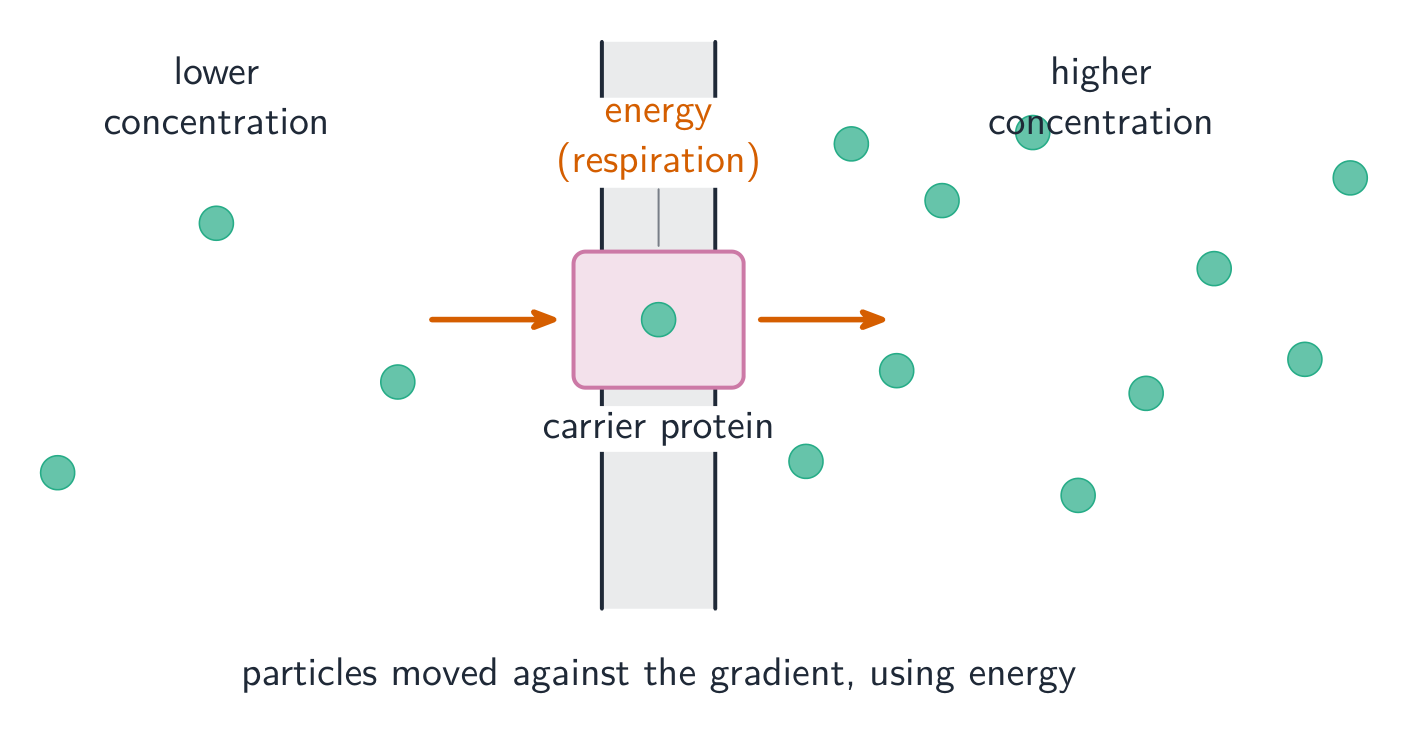
Active transport 主动运输 moves substances against the gradient (low → high), requiring energy (ATP), via protein pumps like the sodium–potassium pump.
Bahasa Indonesia
Transportasi pasif memindahkan zat turun gradien konsentrasinya (tinggi → rendah) dengan tanpa energi – difusi.
Transportasi aktif memindahkan zat melawan gradien (rendah → tinggi), memerlukan energi (ATP), melalui pompa protein seperti pompa natrium–kalium.
Transportasi aktif memindahkan partikel melawan gradien, menggunakan ATP dan protein pembawa
Explore · Jelajahi
Pump a solute against its gradient · Pompa zat terlarut melawan gradiennya
Passive transport moves solutes down their gradient for free; active transport uses ATP to pump them the other way, from low to high concentration. · Transpor pasif menggerakkan zat terlarut turun searah gradien secara gratis; transpor aktif menggunakan ATP untuk memompanya ke arah sebaliknya, dari konsentrasi rendah ke tinggi.
Big Idea 2 — Energetics (ENE): Biological systems use energy and molecular building blocks to grow, reproduce, and maintain dynamic homeostasis.
Learning Objective 2.6.A: Explain how the structure of a molecule affects its ability to pass through the plasma membrane.
2.6.A.1 Facilitated diffusion requires transport or channel proteins to enable the movement of charged ions across the membrane.
i. Membranes may become polarized by the movement of ions across the membrane.
ii. Charged ions, including $\mathrm{Na^+}$ (sodium) and $\mathrm{K^+}$ (potassium), require channel proteins to move through the membrane.
2.6.A.2 Facilitated diffusion enables the movement of large polar molecules through membranes with no energy input. In this type of diffusion, substances move down the concentration gradient.
2.6.A.3 Aquaporins transport large quantities of water across membranes.
Bahasa Indonesia
Ide Besar 2 — Energetika (ENE): Sistem biologis menggunakan energi dan blok bangunan molekuler untuk tumbuh, bereproduksi, dan mempertahankan homeostasis dinamis.
Tujuan Pembelajaran 2.6.A: Jelaskan bagaimana struktur molekul memengaruhi kemampuannya untuk menembus membran plasma.
2.6.A.1 Difusi terfasilitasi memerlukan protein transpor atau protein saluran untuk memungkinkan pergerakan ion bermuatan melintasi membran.
i. Membran dapat menjadi terpolarisasi oleh pergerakan ion melintasi membran.
ii. Ion bermuatan, termasuk $\mathrm{Na^+}$ (natrium) dan $\mathrm{K^+}$ (kalium), memerlukan protein saluran untuk bergerak melalui membran.
2.6.A.2 Difusi terfasilitasi memungkinkan pergerakan molekul polar besar melalui membran tanpa input energi. Dalam jenis difusi ini, zat-zat bergerak searah dengan gradien konsentrasi.
2.6.A.3 Akuaporin mengangkut sejumlah besar air melintasi membran.
Source: College Board AP Course and Exam Description · Sumber: Deskripsi Kursus dan Ujian College Board AP
English
Facilitated diffusion 易化扩散 is passive transport through a membrane protein – a channel or carrier 载体 – for particles that cannot cross the lipid alone. It still goes down the gradient and needs no energy, but its rate can saturate when all the proteins are busy.
Bahasa Indonesia
Difusi terfasilitasi adalah transportasi pasif melalui protein membran – sebuah saluran atau pembawa – untuk partikel yang tidak dapat melintasi lipid sendiri. Proses ini tetap bergerak menurun gradien dan tidak memerlukan energi, namun lajunya dapat jenuh ketika semua protein sedang sibuk.
Difusi: partikel menyebar dari konsentrasi tinggi ke rendah, menuruni gradien
Tonicity, Water Potential, and Osmoregulation · Tonusitas, Potensial Air, dan Osmoregulasi
Syllabus · Silabus
English
Big Idea 2 — Energetics (ENE): Biological systems use energy and molecular building blocks to grow, reproduce, and maintain dynamic homeostasis.
Learning Objective 2.7.A: Explain how concentration gradients affect the movement of molecules across membranes.
2.7.A.1 External environments can be hypotonic, hypertonic, or isotonic to internal environments of cells. Movement of water can also be described as moving from hypotonic to hypertonic regions. Water moves by osmosis from regions of high water potential to regions of low water potential.
Learning Objective 2.7.B: Explain how osmoregulatory mechanisms contribute to the health and survival of organisms.
2.7.B.1 Growth and homeostasis are maintained by the constant movement of molecules across membranes.
2.7.B.2 Osmoregulation maintains water balance and allows organisms to control their internal solute composition and water potential. Water moves from regions of low osmolarity or solute concentration to regions of high osmolarity or solute concentration.
Equation (Solute Potential of a Solution):$\psi_s = -iCRT$
Ide Besar 2 — Energetika (ENE): Sistem biologis menggunakan energi dan blok bangunan molekuler untuk tumbuh, bereproduksi, dan mempertahankan homeostasis dinamis.
Tujuan Pembelajaran 2.7.A: Jelaskan bagaimana gradien konsentrasi memengaruhi pergerakan molekul melintasi membran.
2.7.A.1 Lingkungan eksternal dapat bersifat hipotonik, hipertonik, atau isotonic terhadap lingkungan internal sel. Pergerakan air juga dapat dijelaskan sebagai bergerak dari daerah hipotonik ke daerah hipertonik. Air bergerak melalui osmosis dari daerah potensial air tinggi ke daerah potensial air rendah.
Tujuan Pembelajaran 2.7.B: Jelaskan bagaimana mekanisme osmoregulasi berkontribusi terhadap kesehatan dan kelangsungan hidup organisme.
2.7.B.1 Pertumbuhan dan homeostasis dipertahankan oleh perpindahan molekul yang terus-menerus melintasi membran.
2.7.B.2 Osmoregulasi menjaga keseimbangan air dan memungkinkan organisme mengontrol komposisi zat terlarut serta potensial air internalnya. Air bergerak dari daerah dengan osmolaritas rendah atau konsentrasi zat terlarut rendah ke daerah dengan osmolaritas tinggi atau konsentrasi zat terlarut tinggi.
Persamaan (Potensial Zat Terlarut Larutan):$\psi_s = -iCRT$
Source: College Board AP Course and Exam Description · Sumber: Deskripsi Kursus dan Ujian College Board AP
English
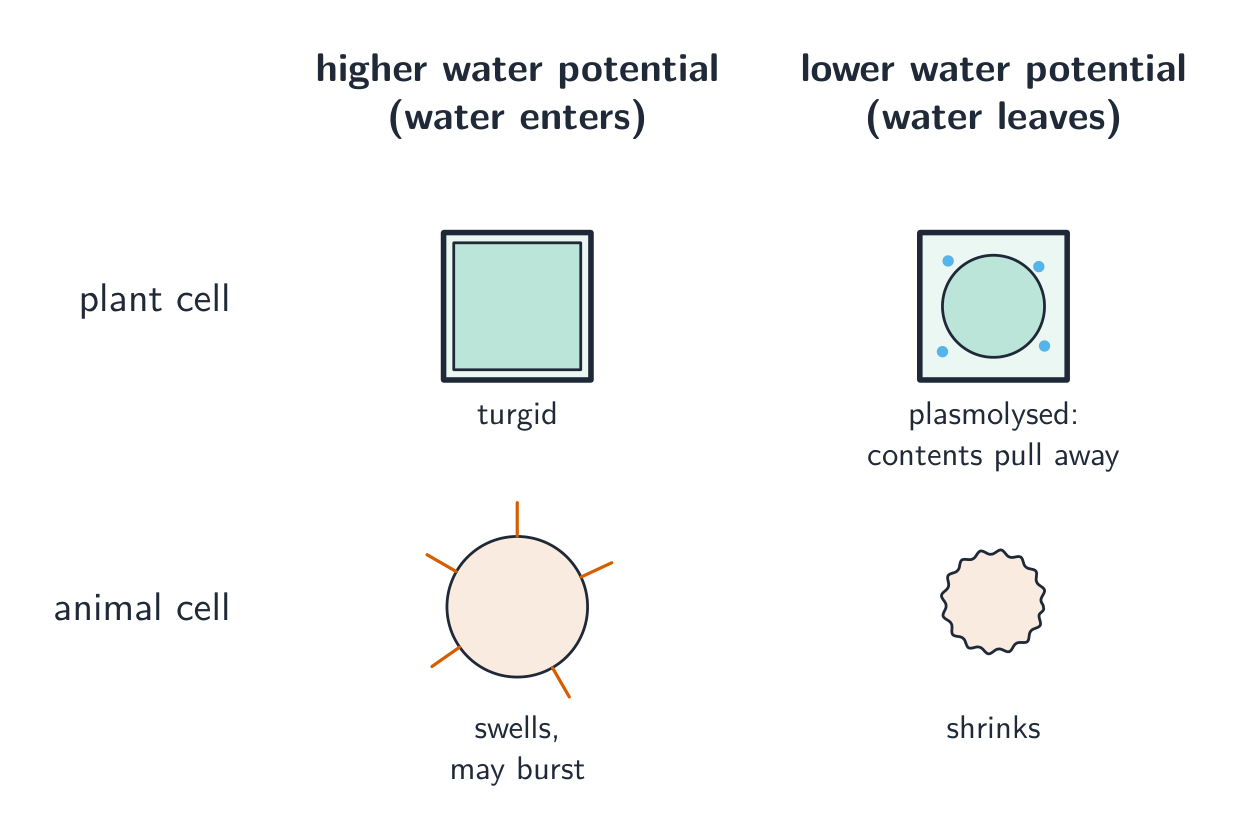
Osmosis 渗透 is the diffusion of water across a membrane. Tonicity 张力 compares solute concentrations: in a hypotonic 低渗 solution a cell gains water (may burst); in a hypertonic 高渗 one it loses water (shrinks); in an isotonic 等渗 one there is no net change. Water potential 水势 predicts the direction of water movement (water moves to lower water potential), and is the sum of a pressure term and a solute term: $\Psi=\Psi_p+\Psi_s$, where the solute potential $\Psi_s=-iCRT$. Osmoregulation 渗透调节 is how organisms control this balance.
Worked example. For a $0.1\,\text{M}$ sucrose solution ($i=1$) in an open beaker (so pressure potential $\Psi_p=0$) at $25\,°\text{C}$ ($T=298\,\text{K}$, $R=0.0831\ \text{L}\cdot\text{bar/mol}\cdot\text{K}$): $\Psi_s=-iCRT=-(1)(0.1)(0.0831)(298)\approx-2.48\ \text{bar}$, so $\Psi\approx-2.48\ \text{bar}$. A plant cell whose interior is $\Psi=-1.0\ \text{bar}$ sits in this solution: since the solution is more negative, water moves out of the cell into the solution, and the cell loses turgor.
Bahasa Indonesia
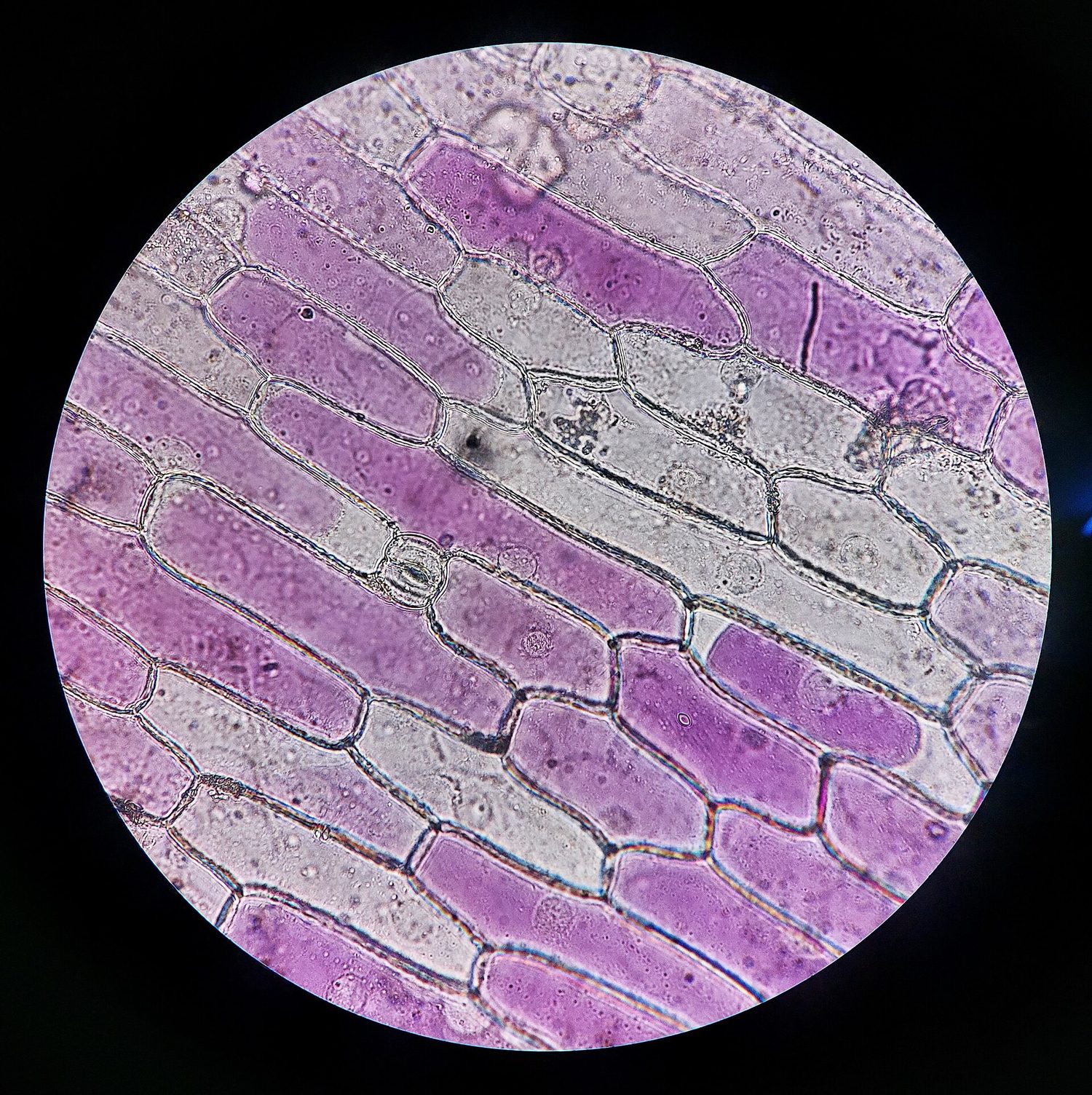
Sel bawang merah dalam larutan hipertonik: membran tertarik menjauhi dinding (plasmolisis)
Osmosis adalah difusi air melintasi membran. Tonusitas membandingkan konsentrasi zat terlarut: dalam larutan hipotonik, sel memperoleh air (dapat pecah); dalam larutan hipertonik, sel kehilangan air (menyusut); dalam larutan isotonik, tidak ada perubahan bersih. Potensial air memprediksi arah pergerakan air (air bergerak menuju potensial air yang lebih rendah), dan merupakan jumlah dari suku tekanan dan suku zat terlarut: $\Psi=\Psi_p+\Psi_s$, di mana potensial zat terlarut $\Psi_s=-iCRT$. Osmoregulasi adalah cara organisme mengendalikan keseimbangan ini.
Bagaimana sel tumbuhan dan hewan merespons larutan dengan potensial air berbeda
Contoh pengerjaan. Untuk larutan sukrosa $0.1\,\text{M}$ ($i=1$) dalam beaker terbuka (sehingga potensial tekanan $\Psi_p=0$) pada suhu $25\,°\text{C}$ ($T=298\,\text{K}$, $R=0.0831\ \text{L}\cdot\text{bar/mol}\cdot\text{K}$): $\Psi_s=-iCRT=-(1)(0.1)(0.0831)(298)\approx-2.48\ \text{bar}$, sehingga $\Psi\approx-2.48\ \text{bar}$. Sel tumbuhan yang bagian dalamnya $\Psi=-1.0\ \text{bar}$ berada dalam larutan ini: karena larutannya lebih negatif, air bergerak keluar dari sel ke dalam larutan, dan sel kehilangan turgor.
Explore · Jelajahi
Watch water move by osmosis · Saksikan pergerakan air melalui osmosis
Water moves across the membrane from high water potential to low, toward the more concentrated (hypertonic) side. Set the concentrations and watch which way the cell swells or shrinks. · Air bergerak melintasi membran dari potensial air tinggi ke rendah, menuju sisi yang lebih pekat (hipertonik). Atur konsentrasinya dan saksikan apakah sel membengkak atau menyusut.
Mechanisms of Membrane Transport · Mekanisme Transportasi Membran
Syllabus · Silabus
English
Big Idea 2 — Energetics (ENE): Biological systems use energy and molecular building blocks to grow, reproduce, and maintain dynamic homeostasis.
Learning Objective 2.8.A: Describe the processes that allow ions and other molecules to move across membranes.
2.8.A.1 Metabolic energy (such as that from ATP) is required for active transport of molecules across the membrane and to establish and maintain electrochemical gradients.
i. Membrane proteins are necessary for active transport.
ii. The $\mathrm{Na^+}/\mathrm{K^+}$ pump and ATPase contribute to the maintenance of the membrane potential.
Bahasa Indonesia
Ide Besar 2 — Energetika (ENE): Sistem biologis menggunakan energi dan blok bangunan molekuler untuk tumbuh, bereproduksi, dan mempertahankan homeostasis dinamis.
Tujuan Pembelajaran 2.8.A: Jelaskan proses-proses yang memungkinkan ion dan molekul lain bergerak melintasi membran.
2.8.A.1 Energi metabolik (seperti dari ATP) diperlukan untuk transportasi aktif molekul melintasi membran serta untuk membentuk dan mempertahankan gradien elektrokimia.
i. Protein membran diperlukan untuk transportasi aktif.
ii. Pompa $\mathrm{Na^+}/\mathrm{K^+}$ dan ATPase berkontribusi pada pemeliharaan potensial membran.
Source: College Board AP Course and Exam Description · Sumber: Deskripsi Kursus dan Ujian College Board AP
English
Large materials move in bulk by vesicles: endocytosis 内吞 brings material in (the membrane engulfs it), and exocytosis 外排 sends material out (a vesicle fuses with the membrane). Both require energy and let cells import and secrete large molecules.
Bahasa Indonesia
Bahan besar bergerak secara massal melalui vesikel: endositosis membawa material masuk (membran membungkusnya), dan eksitosis mengirim material keluar (vesikel berfusi dengan membran). Keduanya memerlukan energi dan memungkinkan sel mengimpor serta mensekresi molekul besar.
Endositosis membawa materi masuk; ekositosis mengeluarkannya
Compartmentalization Inside the Cell · Kompartementalisasi di Dalam Sel
Syllabus · Silabus
English
Big Idea 2 — Energetics (ENE): Biological systems use energy and molecular building blocks to grow, reproduce, and maintain dynamic homeostasis.
Learning Objective 2.9.A: Describe the membrane-bound structures of the eukaryotic cell.
2.9.A.1 Membranes and membrane-bound organelles in eukaryotic cells compartmentalize intracellular metabolic processes and specific enzymatic reactions.
Learning Objective 2.9.B: Explain how internal membranes and membrane-bound organelles contribute to compartmentalization of eukaryotic cell functions.
2.9.B.1 Internal membranes facilitate cellular processes by minimizing competing interactions and by increasing the surface area where reactions can occur.
Bahasa Indonesia
Ide Besar 2 — Energetika (ENE): Sistem biologis menggunakan energi dan blok bangunan molekuler untuk tumbuh, bereproduksi, dan mempertahankan homeostasis dinamis.
Tujuan Pembelajaran 2.9.A: Jelaskan struktur bermembran pada sel eukariotik.
2.9.A.1 Membran dan organel bermembran pada sel eukariotik mengkompartementalkan proses metabolik intraseluler dan reaksi enzimatis spesifik.
Tujuan Pembelajaran 2.9.B: Jelaskan bagaimana membran internal dan organel bermembran berkontribusi terhadap kompartementalisasi fungsi sel eukariotik.
2.9.B.1 Membran internal memfasilitasi proses seluler dengan meminimalkan interaksi yang saling bersaing dan meningkatkan luas permukaan tempat reaksi dapat terjadi.
Source: College Board AP Course and Exam Description · Sumber: Deskripsi Kursus dan Ujian College Board AP
English
Membranes create separate compartments 区室 so incompatible reactions can run at once and conditions (pH, ion levels) can be tuned locally. This organization boosts efficiency – the internal membranes also add surface area for reactions.
Bahasa Indonesia
Membran menciptakan kompartemen terpisah agar reaksi yang tidak kompatibel dapat berjalan bersamaan dan kondisi (pH, kadar ion) dapat disesuaikan secara lokal. Organisasi ini meningkatkan efisiensi – membran internal juga menambah luas permukaan untuk reaksi.
2.10
The Origins of Cell Compartmentalization · Asal Usul Kompartementalisasi Sel
Syllabus · Silabus
English
Big Idea 1 — Evolution (EVO): The process of evolution drives the diversity and unity of life.
Learning Objective 2.10.A: Describe similarities and/or differences in compartmentalization between prokaryotic and eukaryotic cells.
2.10.A.1 Membrane-bound organelles such as mitochondria and chloroplasts evolved from once free-living prokaryotic cells via endosymbiosis.
2.10.A.2 Prokaryotes typically lack internal membrane-bound organelles but have internal regions with specialized structures and functions.
2.10.A.3 Eukaryotic cells maintain internal membranes that partition the cell into specialized regions.
Bahasa Indonesia
Ide Besar 1 — Evolusi (EVO): Proses evolusi mendorong keanekaragaman dan kesatuan kehidupan.
Tujuan Pembelajaran 2.10.A: Deskripsikan kemiripan dan/atau perbedaan dalam kompartementalisasi antara sel prokariotik dan eukariotik.
2.10.A.1 Organel terbungkus membran seperti mitokondria dan kloroplas berevolusi dari sel prokariotik yang sebelumnya hidup bebas melalui endosimbiosis.
2.10.A.2 Prokariot biasanya tidak memiliki organel terbungkus membran internal tetapi memiliki wilayah internal dengan struktur dan fungsi khusus.
2.10.A.3 Sel eukariotik mempertahankan membran internal yang mempartisi sel menjadi wilayah-wilayah yang terspesialisasi.
Source: College Board AP Course and Exam Description · Sumber: Deskripsi Kursus dan Ujian College Board AP
English
The endosymbiotic theory 内共生学说 explains mitochondria and chloroplasts: they arose when a larger cell engulfed free-living prokaryotes that then lived inside it. The evidence – their own circular DNA, their own ribosomes, and double membranes – supports this shared evolutionary origin.
Bahasa Indonesia
Teori endosimbiosis menjelaskan mitokondria dan kloroplas: keduanya muncul ketika sel yang lebih besar menelan prokariota bebas hidup yang kemudian tinggal di dalamnya. Bukti – DNA sirkular mereka sendiri, ribosom mereka sendiri, dan membran ganda – mendukung asal-usul evolusioner bersama ini.
2.10
Exam tips · Tips ujian
English
Use the two AP-formula skills: surface-area-to-volume ratio (why cells stay small) and water potential$\Psi=\Psi_p+\Psi_s$ ($\Psi_s=-iCRT$).
Water moves toward the lower (more negative) water potential; predict swelling or shrinking from tonicity (hypo/hyper/isotonic).
Passive transport and osmosis need no energy (down the gradient); active transport needs ATP (against the gradient).
Distinguish diffusion, facilitated diffusion (a channel/carrier protein), and active transport.
Explain membrane selectivity from the phospholipid bilayer — small non-polar molecules cross, large/charged ones need help.
Bahasa Indonesia
Gunakan dua keterampilan rumus AP: rasio luas permukaan terhadap volume (mengapa sel tetap kecil) dan potensial air$\Psi=\Psi_p+\Psi_s$ ($\Psi_s=-iCRT$).
Air bergerak menuju potensial air yang lebih rendah (lebih negatif); prediksikan pembengkakan atau penyusutan berdasarkan tonusitas (hipo/hiper/isotonik).
Transportasi pasif dan osmosis tidak memerlukan energi (searah gradien); transportasi aktif memerlukan ATP (melawan gradien).
Bedakan difusi, difusi terfasilitasi (protein saluran/pembawa), dan transport aktif.
Jelaskan selektivitas membran dari bilayer fosfolipid – molekul non-polar kecil melintas, molekul besar/berbobot butuh bantuan.
Enzymes as Biological Catalysts · Enzim sebagai Katalis Biologis
Syllabus · Silabus
English
Big Idea 2 — Energetics: Biological systems use energy and molecular building blocks to grow, reproduce, and maintain dynamic homeostasis.
Learning Objective 3.1.A: Explain how enzymes affect the rate of biological reactions.
3.1.A.1 The structure and function of enzymes contribute to the regulation of biological processes. Enzymes are proteins that are biological catalysts that facilitate chemical reactions in cells by lowering the activation energy.
3.1.A.2 For an enzyme-mediated chemical reaction to occur, the shape and charge of the substrate must be compatible with the active site of the enzyme. This is illustrated by the enzyme-substrate complex model.
Bahasa Indonesia
Ide Besar 2 — Energetika: Sistem biologis menggunakan energi dan blok bangunan molekuler untuk tumbuh, bereproduksi, dan mempertahankan homeostasis dinamis.
Tujuan Pembelajaran 3.1.A: Jelaskan bagaimana enzim mempengaruhi laju reaksi biologis.
3.1.A.1 Struktur dan fungsi enzim berkontribusi pada regulasi proses biologis. Enzim adalah protein yang berfungsi sebagai katalis biologis yang memfasilitasi reaksi kimia di dalam sel dengan menurunkan energi aktivasi.
3.1.A.2 Agar reaksi kimia yang dimediasi enzim terjadi, bentuk dan muatan substrat harus kompatibel dengan situs aktif enzim. Hal ini diilustrasikan oleh model kompleks enzim-substrat.
Source: College Board AP Course and Exam Description · Sumber: Deskripsi Kursus dan Ujian College Board AP
English
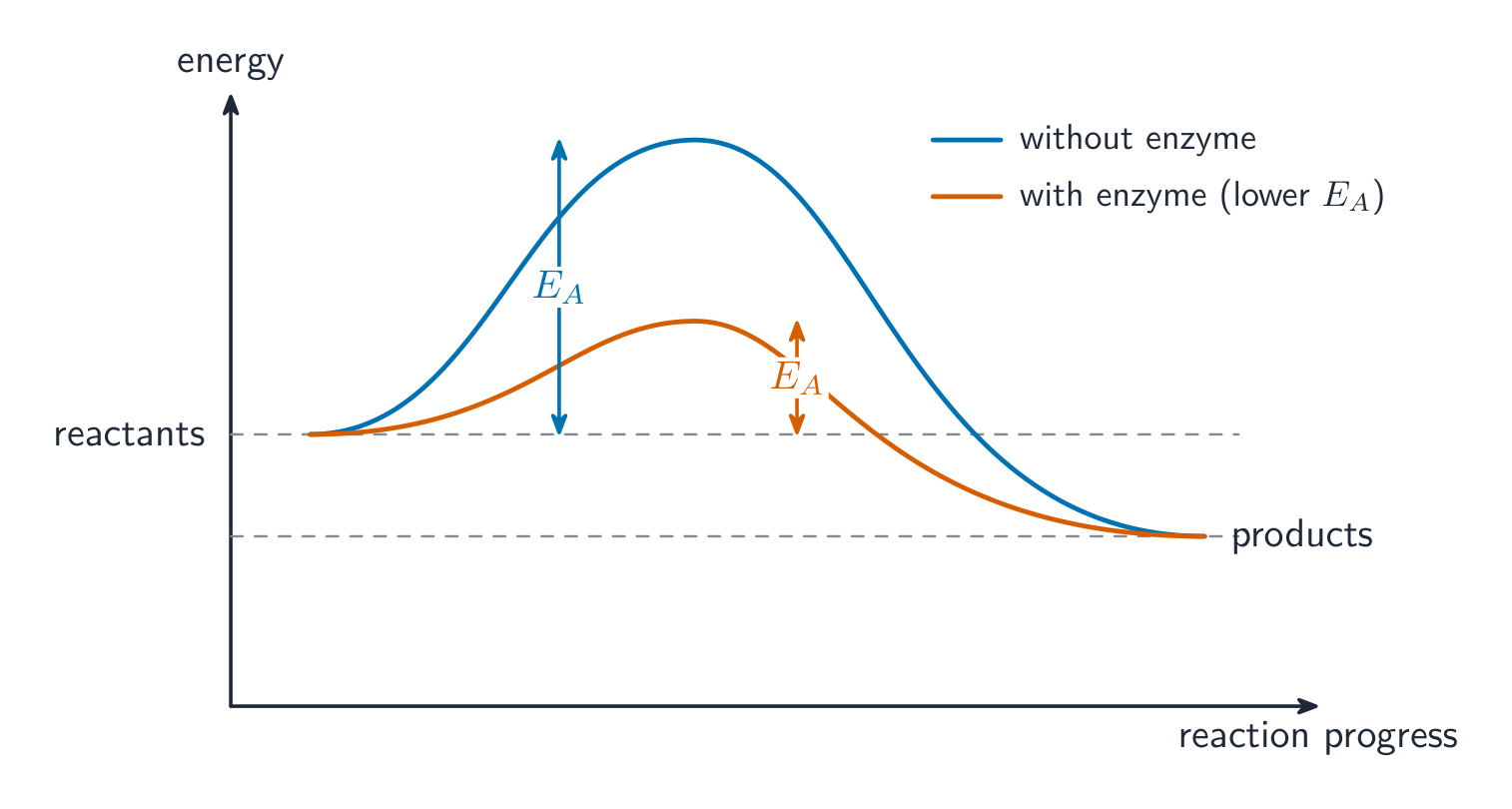
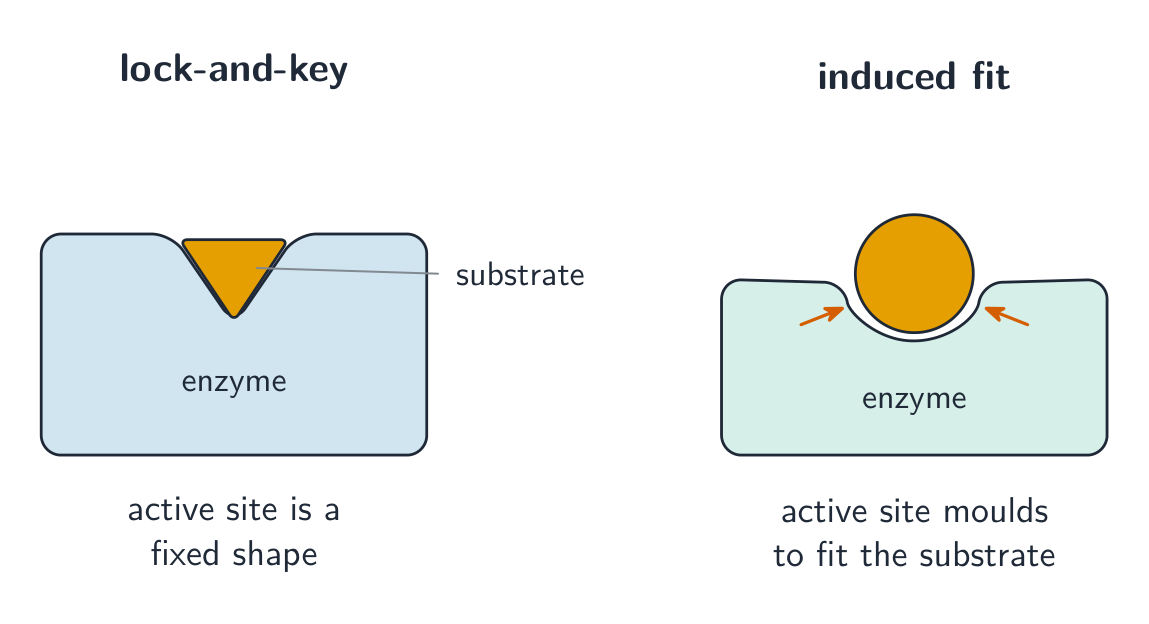
An enzyme 酶 is a protein catalyst 催化剂 that speeds a reaction by lowering its activation energy 活化能, without being used up. Each enzyme has an active site 活性位点 that binds a specific substrate 底物 (the "lock and key" or induced fit), so enzymes are highly specific. They do not change whether a reaction is favorable – only how fast it goes.
Bahasa Indonesia
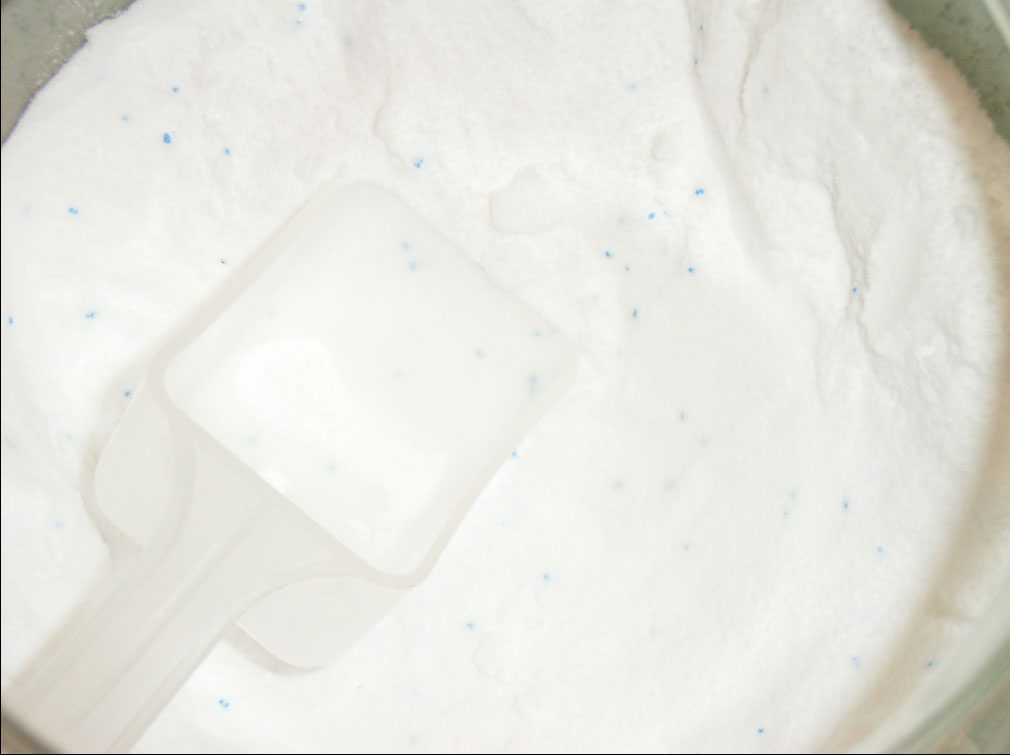
Bubuk cucian biologis menggunakan enzim yang bekerja pada suhu dan pH sedang
Enzim adalah katalis protein yang mempercepat reaksi dengan menurunkan energi aktivasi-nya, tanpa habis terpakai. Setiap enzim memiliki situs aktif yang mengikat substrat spesifik (model "kunci dan gembok" atau ikatan terinduksi), sehingga enzim sangat spesifik. Enzim tidak mengubah apakah suatu reaksi menguntungkan – hanya seberapa cepat reaksi itu berlangsung.
Enzim menurunkan energi aktivasi suatu reaksiModel kunci-gembok dan ikatan terinduksi dari kerja enzim
Explore · Jelajahi
Raise substrate and watch the rate saturate · Naikkan substrat dan saksikan laju mencapai titik jenuh
An enzyme speeds a reaction by lowering activation energy. As substrate rises the rate climbs, then levels off once every active site is busy (saturation). · Sebuah enzim mempercepat reaksi dengan menurunkan energi aktivasi. Saat substrat naik, laju meningkat, lalu mendatar sekali semua situs aktif sibuk (jenuh).
constant input of free energy/ˈkɒnstənt ˈɪnpʊt ɒv friː ˈenədʒi/
input energi bebas konstan
Photosynthesis/ˌfəʊtəʊˈsɪnθəsɪs/
Fotosintesis
Calvin cycle/ˈkælvɪn ˈsaɪkl/
siklus Calvin
prokaryotes/ˈprɒkərɪəʊts/
prokariota
cyanobacteria/ˌsaɪəˌnɒbəkˈtɪərɪə/
sianobakteri
oxygenated atmosphere/ˈɒksɪdʒeneɪtɪd ˈætməsfɪə/
atmosfer beroksigen
banded iron formations/ˈbændɪd ˈaɪən fɔːˈmeɪʃnz/
formasi besi bertingkat
Cellular respiration/ˈseljʊlə ˌrespɪˈreɪʃn/
Respirasi seluler
Glycolysis/ɡlaɪˈkɒləsɪs/
Glikolisis
Krebs cycle/krebz ˈsaɪkl/
siklus Krebs
electron transport chain/ɪˈlektrɒn ˈtrænspɔːt tʃeɪn/
rantai transpor elektron
fermentation/fɜːmənˈteɪʃn/
fermentasi
3.2
Environmental Impacts on Enzyme Function · Dampak Lingkungan pada Fungsi Enzim
Syllabus · Silabus
English
Big Idea 2 — Energetics: Biological systems use energy and molecular building blocks to grow, reproduce, and maintain dynamic homeostasis.
Learning Objective 3.2.A: Explain how changes to the structure of an enzyme may affect its function.
3.2.A.1 Change to the molecular structure of a component in an enzymatic system may result in a change to its function or efficiency.
i. Denaturation of proteins, such as enzymes, occurs when the protein structure is disrupted by a change in temperature, pH, or chemical environment, eliminating the ability to catalyze reactions.
ii. Environmental temperatures and pH outside the optimal range for a given enzyme will cause changes to its structure (by disrupting the hydrogen bonds), altering the efficiency with which it catalyzes reactions.
3.2.A.2 In some cases, enzyme denaturation is reversible, allowing the enzyme to regain activity.
Learning Objective 3.2.B: Explain how the cellular environment affects enzyme activity.
3.2.B.1 The relative concentrations of substrates and products determine how efficiently an enzymatic reaction proceeds.
Bahasa Indonesia
Ide Besar 2 — Energetika: Sistem biologis menggunakan energi dan blok bangunan molekuler untuk tumbuh, bereproduksi, dan mempertahankan homeostasis dinamis.
Tujuan Pembelajaran 3.2.A: Jelaskan bagaimana perubahan pada struktur enzim dapat mempengaruhi fungsinya.
3.2.A.1 Perubahan pada struktur molekuler komponen dalam sistem enzimatik dapat mengakibatkan perubahan pada fungsinya atau efisiensinya.
i. Denaturasi protein, seperti enzim, terjadi ketika struktur protein terganggu akibat perubahan suhu, pH, atau lingkungan kimiawi, sehingga menghilangkan kemampuan untuk mengkatalisis reaksi.
ii. Suhu lingkungan dan pH di luar rentang optimal untuk suatu enzim tertentu akan menyebabkan perubahan pada strukturnya (dengan mengganggu ikatan hidrogen), mengubah efisiensi dengan mana enzim tersebut mengkatalisis reaksi.
3.2.A.2 Dalam beberapa kasus, denaturasi enzim bersifat reversibel, memungkinkan enzim memperoleh kembali aktivitasnya.
Tujuan Pembelajaran 3.2.B: Jelaskan bagaimana lingkungan seluler mempengaruhi aktivitas enzim.
3.2.B.1 Konsentrasi relatif substrat dan produk menentukan seberapa efisien reaksi enzimatik berlangsung.
Source: College Board AP Course and Exam Description · Sumber: Deskripsi Kursus dan Ujian College Board AP
English
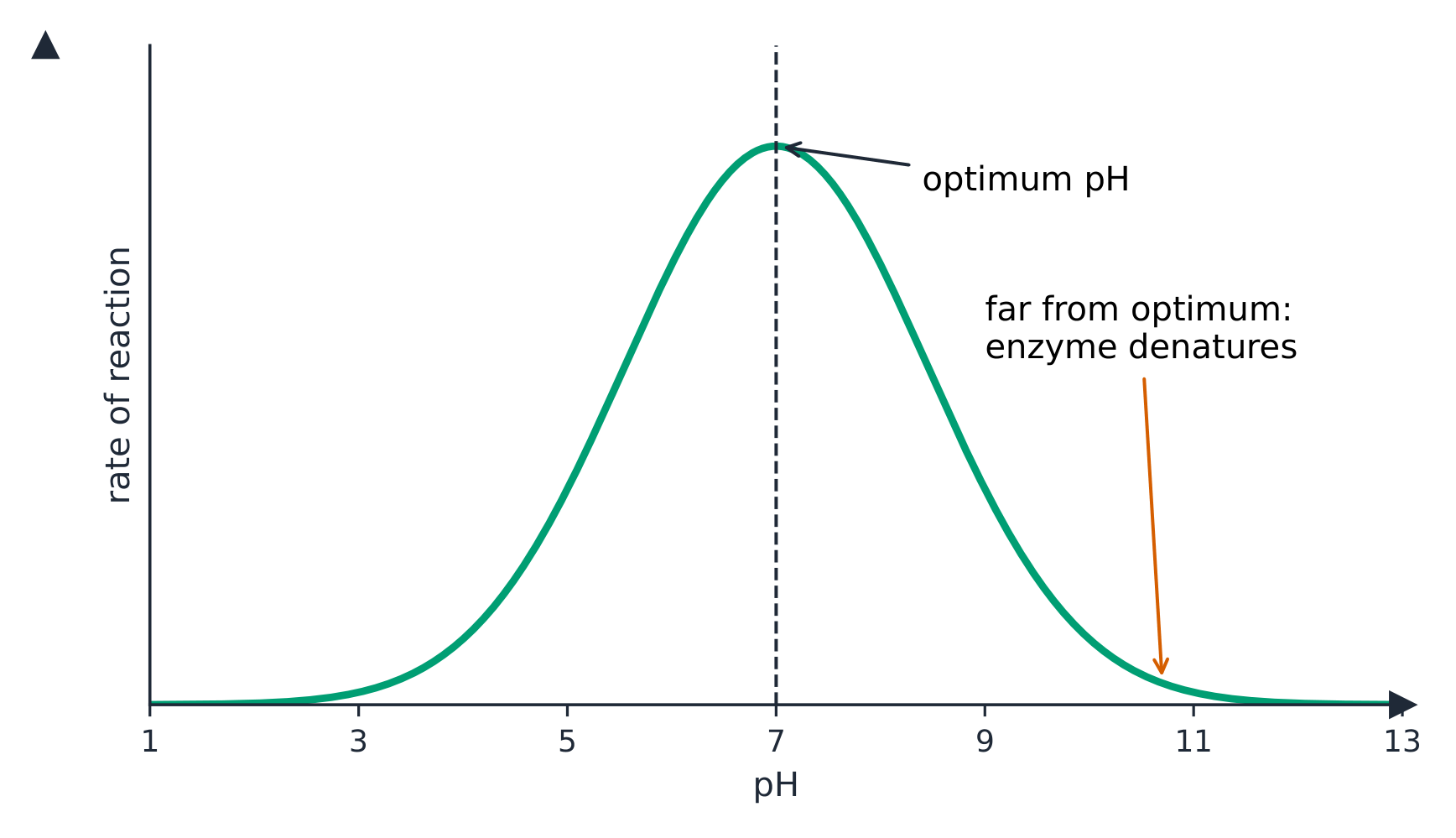
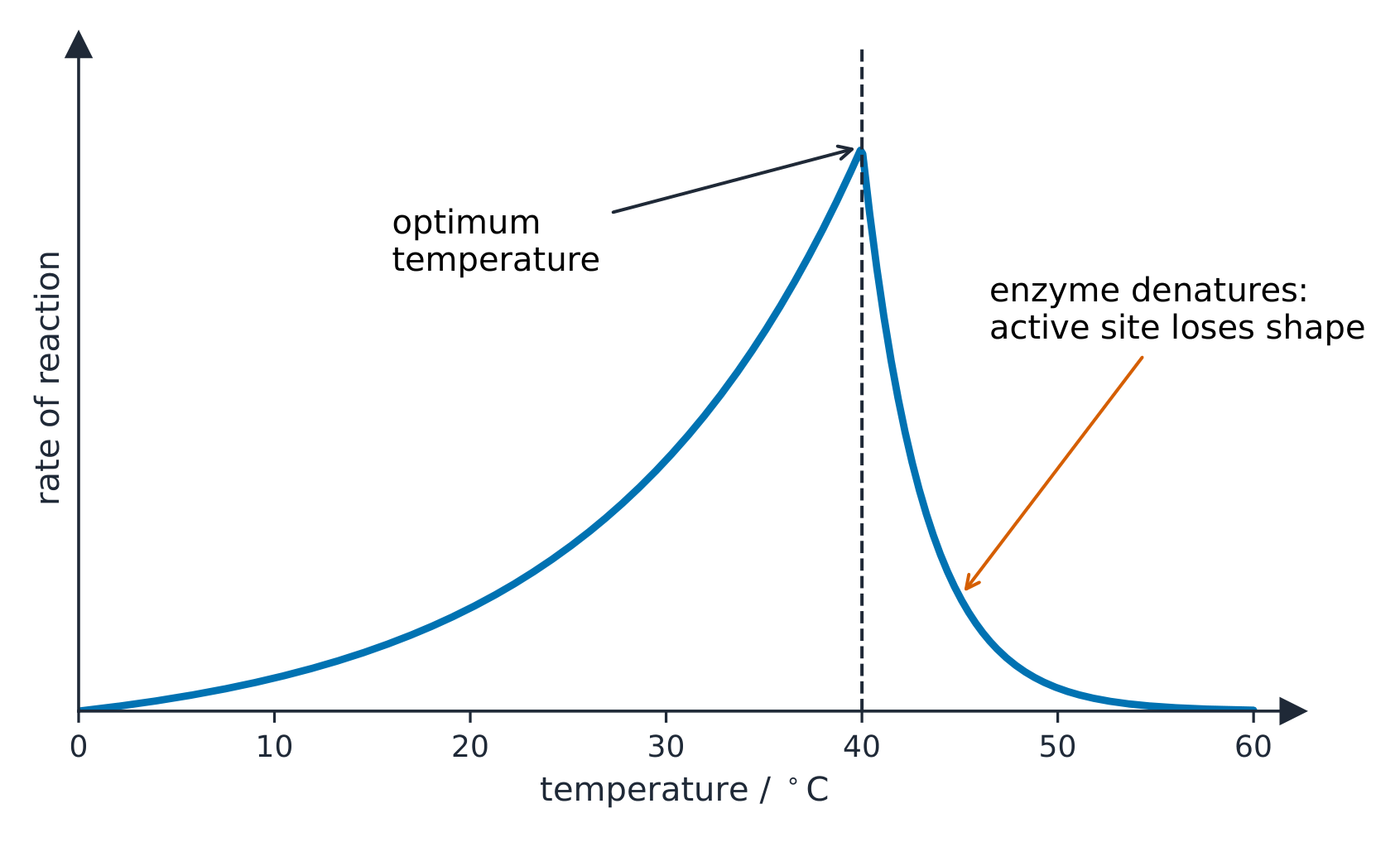
Enzyme activity depends on conditions. Each enzyme has an optimal temperature and pH; beyond it, the protein denatures 变性 (loses shape) and stops working. Substrate concentration raises the rate until the enzyme saturates. Inhibitors 抑制剂 slow enzymes – competitive ones block the active site, noncompetitive ones bind elsewhere and change the shape.
Bahasa Indonesia
Aktivitas enzim bergantung pada kondisi. Setiap enzim memiliki suhu dan pH optimal; melampaui titik tersebut, protein terdenaturasi (kehilangan bentuk) dan berhenti bekerja. Konsentrasi substrat meningkatkan laju hingga enzim jenuh. Inhibitor memperlambat enzim – kompetitif memblokir situs aktif, nonkompetitif berikatan di tempat lain dan mengubah bentuk.
Setiap enzim memiliki pH optimumLaju naik mencapai suhu optimum, lalu turun saat enzim terdenaturasi
Explore · Jelajahi
Change temperature and watch enzyme activity · Ubah suhu dan saksikan aktivitas enzim
Each enzyme has an optimum temperature and pH. Too cold is slow; too hot denatures the enzyme so its active site loses shape and activity crashes. · Setiap enzim memiliki suhu dan pH optimum. Terlalu dingin membuatnya lambat; terlalu panas men-denaturasi enzim sehingga situs aktif kehilangan bentuk dan aktivitas anjlok.
3.3
Cellular Energy and ATP · Energi Seluler dan ATP
Syllabus · Silabus
English
Big Idea 2 — Energetics: Biological systems use energy and molecular building blocks to grow, reproduce, and maintain dynamic homeostasis.
Learning Objective 3.3.A: Describe the role of energy in living organisms.
3.3.A.1 All living systems require an input of energy.
3.3.A.2 Life requires a highly ordered system and does not violate the first and second laws of thermodynamics.
i. Energy input must exceed energy loss to maintain order and to power cellular processes.
ii. Cellular processes that release energy may be coupled with cellular processes that require energy.
iii. Significant loss of order or energy flow results in death.
Exclusion statement: Students will need to understand the concept of energy, but the equation for Gibbs free energy is beyond the scope of the AP Exam.
3.3.A.3 Energy-related pathways in biological systems are sequential to allow for a more controlled transfer of energy. A product of a reaction in a metabolic pathway is typically the reactant for the subsequent step in the pathway.
Learning Objective 3.3.B: Explain how shared, conserved, and fundamental processes and features support the concept of common ancestry for all organisms.
3.3.B.1 Core metabolic pathways (e.g., glycolysis, oxidative phosphorylation) are conserved across all currently recognized domains (Archaea, Bacteria, and Eukarya).
Bahasa Indonesia
Ide Besar 2 — Energetika: Sistem biologis menggunakan energi dan blok bangunan molekuler untuk tumbuh, bereproduksi, dan mempertahankan homeostasis dinamis.
Tujuan Pembelajaran 3.3.A: Jelaskan peran energi dalam organisme hidup.
3.3.A.1 Semua sistem hidup memerlukan input energi.
3.3.A.2 Kehidupan memerlukan sistem yang sangat teratur dan tidak melanggar hukum termodinamika pertama dan kedua.
i. Input energi harus melebihi kehilangan energi untuk mempertahankan keteraturan dan powering proses seluler.
ii. Proses seluler yang melepaskan energi dapat dikopel dengan proses seluler yang membutuhkan energi.
iii. Hilangnya keteraturan atau aliran energi yang signifikan mengakibatkan kematian.
Pernyataan pengecualian: Siswa perlu memahami konsep energi, namun persamaan energi bebas Gibbs berada di luar ruang lingkup Ujian AP.
3.3.A.3 Jalur terkait energi dalam sistem biologis bersifat berurutan agar memungkinkan transfer energi yang lebih terkendali. Produk dari suatu reaksi dalam jalur metabolisme biasanya merupakan reaktan untuk langkah berikutnya dalam jalur tersebut.
Tujuan Pembelajaran 3.3.B: Jelaskan bagaimana proses dan fitur yang bersama, terkonservasi, dan fundamental mendukung konsep nenek moyang bersama bagi semua organisme.
3.3.B.1 Jalur metabolisme inti (misalnya, glikolisis, fosforilasi oksidatif) terkonservasi di seluruh domain yang diakui saat ini (Arkea, Bakteri, dan Eukarya).
Source: College Board AP Course and Exam Description · Sumber: Deskripsi Kursus dan Ujian College Board AP
English
ATP (adenosine triphosphate) is the cell's energy currency. Energy is stored in its phosphate bonds; breaking off a phosphate (ATP → ADP) releases energy to power cellular work, and reattaching one stores energy. Cells constantly recycle ATP, coupling energy-releasing reactions to energy-requiring ones.
Life and the laws of thermodynamics
A living cell is highly ordered, and that order is often mistaken for a violation of physics. It is not.
The first law 热力学第一定律 says energy is conserved: it changes form but is never created or destroyed. A cell does not make energy — it transforms the chemical energy of glucose, or the light energy of the Sun, into the chemical energy of ATP.
The second law 热力学第二定律 says that in any energy transfer, some energy is lost as heat and the entropy 熵 of the universe increases. A cell builds order inside itself, but only by releasing more disorder to its surroundings, mostly as heat.
So life requires a constant input of free energy 自由能 from outside. This is why an organism cut off from its energy source dies: maintaining order is not free, and the moment the input stops, the ordered system runs down.
Bahasa Indonesia
ATP (adenosin trifosfat) adalah mata uang energi sel. Energi tersimpan dalam ikatan fosfatnya; memutuskan satu fosfat (ATP → ADP) melepaskan energi untuk powering kerja seluler, dan menyambungkannya kembali menyimpan energi. Sel terus-menerus mendaur ulang ATP, menggabungkan reaksi pelepas energi dengan reaksi yang membutuhkan energi.
Siklus ATP-ADP menyimpan dan melepaskan energi
Kehidupan dan hukum termodinamika
Sel hidup sangat teratur, dan ketertiban itu sering dianggap sebagai pelanggaran fisika. Namun, itu bukan pelanggaran.
Hukum pertama menyatakan energi kekal: berubah bentuk tetapi tidak diciptakan atau dimusnahkan. Sel tidak membuat energi — ia mengubah energi kimia glukosa, atau energi cahaya Matahari, menjadi energi kimia ATP.
Hukum kedua menyatakan bahwa dalam setiap perpindahan energi, sebagian energi hilang sebagai panas dan entropi alam semesta meningkat. Sel membangun keteraturan di dalamnya, tetapi hanya dengan melepaskan lebih banyak ketidakteraturan ke lingkungannya, sebagian besar sebagai panas.
Jadi kehidupan memerlukan masukan energi bebas yang konstan dari luar. Inilah mengapa organisme yang terputus dari sumber energinya mati: mempertahankan keteraturan tidak gratis, dan begitu masukan berhenti, sistem yang teratur akan runtuh.
3.4
Photosynthesis · Fotosintesis
Syllabus · Silabus
English
Big Idea 2 — Energetics: Biological systems use energy and molecular building blocks to grow, reproduce, and maintain dynamic homeostasis.
Learning Objective 3.4.A: Describe the photosynthetic processes and structural features of the chloroplast that allow organisms to capture and store energy.
3.4.A.1 Photosynthesis is the series of reactions that use carbon dioxide $(\mathrm{CO_2})$, water $(\mathrm{H_2O})$, and light energy to make carbohydrates and oxygen $(\mathrm{O_2})$.
i. Photosynthetic organisms capture energy from the sun and produce sugars that can be used in biological processes or stored.
ii. Photosynthesis first evolved in prokaryotic organisms.
iii. Scientific evidence supports the claim that prokaryotic (cyanobacterial) photosynthesis was responsible for the production of an oxygenated atmosphere.
iv. Prokaryotic photosynthetic pathways were the foundation of eukaryotic photosynthesis.
Exclusion statement: Memorization of the steps in the Calvin cycle, the structure of the molecules, and the names of the enzymes involved, with the exception of ATP synthase, is beyond the scope of the AP Exam.
3.4.A.2 Stroma and thylakoids are found within the chloroplast.
i. The stroma is the fluid within the inner chloroplast membrane and outside the thylakoid. The carbon fixation (Calvin cycle) reactions of photosynthesis occur in the stroma.
ii. The thylakoid membranes contain chlorophyll pigments organized into two photosystems, as well as electron transport proteins.
iii. Thylakoids are organized in stacks called grana. The light reactions of photosynthesis occur in the grana.
3.4.A.3 The light reactions of photosynthesis in eukaryotes involve a series of coordinated reaction pathways that capture energy present in light to yield ATP and NADPH, which power the production of organic molecules in the Calvin cycle. This provides energy for metabolic processes.
Learning Objective 3.4.B: Explain how cells capture energy from light and transfer it to biological molecules for storage and use.
3.4.B.1 Electron transport chain (ETC) reactions occur in chloroplasts, in mitochondria, and across prokaryotic plasma membranes. In photosynthesis, electrons that pass through the thylakoid membrane are picked up and ultimately transferred to $\mathrm{NADP^+}$ reducing it to NADPH in photosystem I.
Exclusion statement: The full names of the specific electron carriers in the electron transport chain are beyond the scope of the AP Exam.
Exclusion statement: Specific steps, names of enzymes, and intermediates of the pathways for these processes are beyond the scope of this course and the AP Exam.
3.4.B.2 During photosynthesis, chlorophylls absorb energy from light, boosting electrons to a higher energy level in photosystems I and II. Water then splits, supplying electrons to replace those lost from photosystem II.
3.4.B.3 Photosystems I and II are embedded in the thylakoid membranes of chloroplasts and are connected by the transfer of electrons through an ETC.
3.4.B.4 When electrons are transferred between molecules in a series of oxidation/reduction reactions as they pass through the ETC, an electrochemical gradient of protons (hydrogen ions) is established across the thylakoid membrane. The membrane separates a region of low proton concentration outside the thylakoid membrane from a region of high proton concentration inside the thylakoid membrane.
3.4.B.5 The formation of the proton gradient is linked to the synthesis of ATP from ADP and inorganic phosphate via ATP synthase. The flow of protons back through membrane-bound ATP synthase by chemiosmosis drives the formation of ATP from ADP and inorganic phosphate; this is known as photophosphorylation.
3.4.B.6 The energy captured in the light reactions and transferred to ATP and NADPH powers the production of carbohydrates from carbon dioxide in the Calvin cycle. This occurs in the stroma of the chloroplast.
Bahasa Indonesia
Ide Besar 2 — Energetika: Sistem biologis menggunakan energi dan blok bangunan molekuler untuk tumbuh, bereproduksi, dan mempertahankan homeostasis dinamis.
Tujuan Pembelajaran 3.4.A: Jelaskan proses fotosintesis dan fitur struktural kloroplas yang memungkinkan organisme menangkap dan menyimpan energi.
3.4.A.1 Fotosintesis adalah serangkaian reaksi yang menggunakan karbon dioksida $(\mathrm{CO_2})$, air $(\mathrm{H_2O})$, dan energi cahaya untuk membuat karbohidrat dan oksigen $(\mathrm{O_2})$.
i. Organisme fotosintetik menangkap energi dari matahari dan menghasilkan gula yang dapat digunakan dalam proses biologis atau disimpan.
ii. Fotosintesis pertama kali berevolusi pada organisme prokariotik.
iii. Bukti ilmiah mendukung klaim bahwa fotosintesis prokariotik (sianobakteri) bertanggung jawab atas produksi atmosfer yang kaya oksigen.
iv. Jalur fotosintesis prokariotik menjadi fondasi fotosintesis eukariotik.
Pengecualian: Menghafal langkah-langkah siklus Calvin, struktur molekul, dan nama enzim yang terlibat, dengan pengecualian ATP sintase, berada di luar cakupan Ujian AP.
3.4.A.2 Stroma dan tilakoid ditemukan di dalam kloroplas.
i. Strom adalah cairan di dalam membran kloroplas bagian dalam dan di luar tilakoid. Reaksi fiksasi karbon (siklus Calvin) fotosintesis terjadi di stroma.
ii. Membran tilakoid mengandung pigmen klorofil yang tersusun menjadi dua sistem fotosis, serta protein rantai transpor elektron.
iii. Tilakoid tersusun dalam tumpukan yang disebut granum. Reaksi terang fotosintesis terjadi di granum.
3.4.A.3 Reaksi terang fotosintesis pada eukariot melibatkan serangkaian jalur reaksi terkoordinasi yang menangkap energi yang terdapat dalam cahaya untuk menghasilkan ATP dan NADPH, yang menggerakkan produksi molekul organik dalam siklus Calvin. Hal ini menyediakan energi untuk proses metabolik.
Tujuan Pembelajaran 3.4.B: Jelaskan bagaimana sel menangkap energi dari cahaya dan mentransfernya ke molekul biologis untuk penyimpanan dan penggunaan.
3.4.B.1 Reaksi rantai transpor elektron (ETC) terjadi di kloroplas, mitokondria, dan melintasi membran plasma prokariotik. Dalam fotosintesis, elektron yang melewati membran tilakoid ditangkap dan akhirnya ditransfer ke $\mathrm{NADP^+}$ yang mereduksinya menjadi NADPH di fotosistem I.
Pengecualian: Nama lengkap pembawa elektron spesifik dalam rantai transpor elektron berada di luar cakupan Ujian AP.
Pengecualian: Langkah-langkah spesifik, nama enzim, dan perantara jalur untuk proses-proses ini berada di luar cakupan kursus ini dan Ujian AP.
3.4.B.2 Selama fotosintesis, klorofil menyerap energi dari cahaya, meningkatkan elektron ke tingkat energi yang lebih tinggi di fotosistem I dan II. Air kemudian terpecah, menyediakan elektron untuk menggantikan elektron yang hilang dari fotosistem II.
3.4.B.3 Fotosistem I dan II tertanam di membran tilakoid kloroplas dan terhubung melalui transfer elektron melalui ETC.
3.4.B.4 Ketika elektron ditransfer antar molekul dalam serangkaian reaksi oksidasi/reduksi saat mereka melewati ETC, gradien elektrokimia proton (ion hidrogen) terbentuk melintasi membran tilakoid. Membran memisahkan wilayah dengan konsentrasi proton rendah di luar membran tilakoid dari wilayah dengan konsentrasi proton tinggi di dalam membran tilakoid.
3.4.B.5 Pembentukan gradien proton terkait dengan sintesis ATP dari ADP dan fosfat anorganik melalui ATP sintase. Aliran proton kembali melalui ATP sintase yang terikat membran secara kemiosmosis menggerakkan pembentukan ATP dari ADP dan fosfat anorganik; hal ini dikenal sebagai fotofosforilasi.
3.4.B.6 Energi yang ditangkap dalam reaksi terang dan ditransfer ke ATP dan NADPH menggerakkan produksi karbohidrat dari karbon dioksida dalam siklus Calvin. Hal ini terjadi di stroma kloroplas.
Source: College Board AP Course and Exam Description · Sumber: Deskripsi Kursus dan Ujian College Board AP
English
Photosynthesis 光合作用 captures light energy to build sugar from $\text{CO}_2$ and water, releasing $\text{O}_2$. It has two stages:
The light reactions (in the thylakoid membranes) use light to make ATP and NADPH and split water, releasing oxygen.
The Calvin cycle 卡尔文循环 (in the stroma) uses that ATP and NADPH to fix $\text{CO}_2$ into sugar.
So light energy becomes chemical energy stored in glucose.
Where the oxygen in the air came from
Photosynthesis did not only feed the first organisms; it changed the planet. Scientific evidence supports the claim that photosynthesis by prokaryotes 原核生物 — specifically cyanobacteria 蓝细菌 — produced the oxygen that built Earth's oxygenated atmosphere 含氧大气.
The evidence is physical: banded iron formations 条带状铁建造 in rocks about 2.4 billion years old record iron dissolved in the ocean being oxidised and precipitating out, which needs free oxygen. Before that event, called the Great Oxidation Event, the atmosphere held almost none.
Two consequences matter for the rest of the course. Free oxygen made aerobic respiration possible, which releases far more ATP per glucose than anaerobic pathways do. And it was lethal to much of the anaerobic life already present, so it counts as one of the largest extinction events in Earth's history — an early example of organisms changing their own environment.
Bahasa Indonesia
Kloroplas mengisi sel mesofil tumbuhan — organel fotosintesis
Fotosintesis menangkap energi cahaya untuk membangun gula dari $\text{CO}_2$ dan air, serta melepaskan $\text{O}_2$. Proses ini memiliki dua tahap:
Dua tahap fotosintesis saling terhubung oleh ATP dan NADPH
Reaksi terang (di membran tilakoid) menggunakan cahaya untuk menghasilkan ATP dan NADPH serta memecah air, sehingga melepaskan oksigen.
Siklus Calvin (di stroma) menggunakan ATP dan NADPH tersebut untuk mengikat $\text{CO}_2$ menjadi gula.
Dengan demikian, energi cahaya berubah menjadi energi kimia yang tersimpan dalam glukosa.
Asal-usul oksigen di udara
Fotosintesis tidak hanya memberi makan organisme pertama; ia juga mengubah planet ini. Bukti ilmiah mendukung klaim bahwa fotosintesis oleh prokariota — khususnya sianobakteri — menghasilkan oksigen yang membentuk atmosfer beroksigen Bumi.
Bukti tersebut bersifat fisik: formasi besi banded dalam batuan berumur sekitar 2.4 miliar tahun mencatat besi terlarut di lautan yang teroksidasi dan mengendap, yang memerlukan oksigen bebas. Sebelum peristiwa itu, yang disebut Peristiwa Oksidasi Besar, atmosfer hampir tidak mengandung oksigen.
Dua konsekuensi penting bagi sisa materi kursus. Oksigen bebas memungkinkan respirasi aerobik, yang menghasilkan jauh lebih banyak ATP per glukosa dibandingkan jalur anaerobik. Selain itu, oksigen bersifat letal bagi sebagian besar kehidupan anaerobik yang sudah ada, sehingga hal ini dihitung sebagai salah satu peristiwa kepunahan terbesar dalam sejarah Bumi — sebuah contoh awal organisme mengubah lingkungan mereka sendiri.
3.5
Cellular Respiration · Respirasi Seluler
Syllabus · Silabus
English
Big Idea 2 — Energetics: Biological systems use energy and molecular building blocks to grow, reproduce, and maintain dynamic homeostasis.
Learning Objective 3.5.A: Describe the processes and structural features of mitochondria that allow organisms to use energy stored in biological macromolecules.
3.5.A.1 Cellular respiration uses energy from biological macromolecules to synthesize ATP. Respiration and fermentation are characteristic of all forms of life.
3.5.A.2 Aerobic cellular respiration in eukaryotes involves a series of coordinated enzyme-catalyzed reactions that capture energy from biological macromolecules.
3.5.A.3 The ETC transfers electrons in a series of oxidation-reduction reactions that establish an electrochemical gradient across membranes.
i. In cellular respiration, electrons delivered by NADH and $\mathrm{FADH_2}$ are passed to a series of electron acceptors as they move toward the terminal electron acceptor, oxygen. Aerobic prokaryotes use oxygen as a terminal electron acceptor, while anaerobic prokaryotes use other molecules.
ii. The transfer of electrons, through the ETC, is accompanied by the formation of a proton gradient across the inner mitochondrial membrane, with the membrane(s) separating a region of high proton concentration outside the membrane from a region of low proton concentration inside the membrane. The folding of the inner membrane increases the surface area, which allows for more ATP to be synthesized. In prokaryotes, the passage of electrons is accompanied by the movement of protons across the plasma membrane.
iii. The flow of protons back through membrane-bound ATP synthase by chemiosmosis drives the formation of ATP from ADP and inorganic phosphate. This is known as oxidative phosphorylation in aerobic cellular respiration.
iv. In aerobic cellular respiration, decoupling oxidative phosphorylation from electron transport generates heat. This heat can be used by endothermic organisms to regulate body temperature.
Exclusion statement: The full names of the specific electron carriers in the electron transport chain are beyond the scope of the AP Exam.
Exclusion statement: Specific steps, names of enzymes, and intermediates of the pathways for these processes are beyond the scope of this course and the AP Exam.
Learning Objective 3.5.B: Explain how cells obtain energy from biological macromolecules in order to power cellular functions.
3.5.B.1 Glycolysis is a biochemical pathway that releases the energy in glucose molecules to form ATP (from ADP and inorganic phosphate), NADH (from $\mathrm{NAD^+}$), and pyruvate.
3.5.B.2 Pyruvate is transported from the cytosol to the mitochondrion where oxidation occurs. This process releases electrons during the Krebs (citric acid) cycle, reducing $\mathrm{NAD^+}$ to NADH and FAD to $\mathrm{FADH_2}$, and releasing $\mathrm{CO_2}$.
3.5.B.3 The Krebs cycle takes place in the mitochondrial matrix. During the Krebs cycle, carbon dioxide is released from organic intermediates, ATP is synthesized from ADP and inorganic phosphate, and electrons are transferred by the coenzymes $\mathrm{NAD^+}$ and FAD.
3.5.B.4 Electrons extracted in glycolysis and Krebs cycle reactions are transferred by NADH and $\mathrm{FADH_2}$ to the ETC in the inner mitochondrial membrane.
3.5.B.5 When electrons are transferred between molecules in a sequence of reactions as they pass through the ETC, an electrochemical gradient of protons (hydrogen ions) across the inner mitochondrial membrane is established. The pH inside the mitochondrial matrix is higher than in the intermembrane space.
3.5.B.6 Fermentation allows glycolysis to proceed in the absence of oxygen and produces organic molecules such as alcohol and lactic acid.
Exclusion statement: Memorization of the steps in glycolysis and the Krebs cycle, and of the structures of the molecules and the names of the enzymes involved, is beyond the scope of this course and the AP Exam.
Bahasa Indonesia
Ide Besar 2 — Energetika: Sistem biologis menggunakan energi dan blok bangunan molekuler untuk tumbuh, bereproduksi, dan mempertahankan homeostasis dinamis.
Tujuan Pembelajaran 3.5.A: Deskripsikan proses dan fitur struktural mitokondria yang memungkinkan organisme menggunakan energi yang tersimpan dalam makromolekul biologis.
3.5.A.1 Respirasi seluler menggunakan energi dari makromolekul biologis untuk mensintesis ATP. Respirasi dan fermentasi merupakan karakteristik semua bentuk kehidupan.
3.5.A.2 Respirasi seluler aerobik pada eukariot melibatkan serangkaian reaksi berantai enzim yang terkoordinasi yang menangkap energi dari makromolekul biologis.
3.5.A.3 ETC mentransfer elektron dalam serangkaian reaksi oksidasi-reduksi yang membentuk gradien elektrokimia melintasi membran.
i. Dalam respirasi seluler, elektron yang disalurkan oleh NADH dan $\mathrm{FADH_2}$ diteruskan ke serangkaian penerima elektron saat mereka bergerak menuju penerima elektron terminal, yaitu oksigen. Prokariota aerob menggunakan oksigen sebagai penerima elektron terminal, sedangkan prokariota anaerob menggunakan molekul lain.
ii. Transfer elektron, melalui Rantai Transpor Elektron (ETC), disertai pembentukan gradien proton melintasi membran mitokondria bagian dalam, dengan membran memisahkan area konsentrasi proton tinggi di luar membran dari area konsentrasi proton rendah di dalam membran. Lipatan membran bagian dalam meningkatkan luas permukaan, yang memungkinkan lebih banyak ATP disintesis. Pada prokariota, perpindahan elektron disertai pergerakan proton melintasi membran plasma.
iii. Aliran proton kembali melalui sintase ATP yang terikat membran secara kemiosmosis mendorong pembentukan ATP dari ADP dan fosfat anorganik. Ini dikenal sebagai fosforilasi oksidatif dalam respirasi seluler aerob.
iv. Dalam respirasi seluler aerob, pemisahan fosforilasi oksidatif dari transpor elektron menghasilkan panas. Panas ini dapat digunakan oleh organisme endotermik untuk mengatur suhu tubuh.
Pengecualian: Nama lengkap pembawa elektron spesifik dalam rantai transpor elektron berada di luar cakupan Ujian AP.
Pengecualian: Langkah-langkah spesifik, nama enzim, dan perantara jalur untuk proses-proses ini berada di luar cakupan kursus ini dan Ujian AP.
Tujuan Pembelajaran 3.5.B: Jelaskan bagaimana sel memperoleh energi dari makromolekul biologis guna menggerakkan fungsi seluler.
3.5.B.1 Glikolisis adalah jalur biokimia yang melepaskan energi dalam molekul glukosa untuk membentuk ATP (dari ADP dan fosfat anorganik), NADH (dari $\mathrm{NAD^+}$), dan piruvat.
3.5.B.2 Piruvat diangkut dari sitosol ke mitokondria tempat oksidasi terjadi. Proses ini melepaskan elektron selama siklus Krebs (asam sitrat), mengurangi $\mathrm{NAD^+}$ menjadi NADH dan FAD menjadi $\mathrm{FADH_2}$, serta melepaskan $\mathrm{CO_2}$.
3.5.B.3 Siklus Krebs berlangsung di matriks mitokondria. Selama siklus Krebs, karbon dioksida dilepaskan dari intermediet organik, ATP disintesis dari ADP dan fosfat anorganik, dan elektron ditransfer oleh koenzim $\mathrm{NAD^+}$ dan FAD.
3.5.B.4 Elektron yang diekstrak dalam reaksi glikolisis dan siklus Krebs ditransfer oleh NADH dan $\mathrm{FADH_2}$ ke Rantai Transpor Elektron (ETC) di membran dalam mitokondria.
3.5.B.5 Ketika elektron dipindahkan antar molekul dalam serangkaian reaksi saat melewati ETC, gradien elektrokimia proton (ion hidrogen) melintasi membran dalam mitokondria terbentuk. pH di dalam matriks mitokondria lebih tinggi daripada di ruang antarmembran.
3.5.B.6 Fermentasi memungkinkan glikolisis berjalan tanpa oksigen dan menghasilkan molekul organik seperti alkohol dan asam laktat.
Pernyataan pengecualian: Hafalan langkah-langkah dalam glikolisis dan siklus Krebs, serta struktur molekul dan nama enzim yang terlibat, berada di luar cakupan kursus ini dan Ujian AP.
Source: College Board AP Course and Exam Description · Sumber: Deskripsi Kursus dan Ujian College Board AP
English
Cellular respiration 细胞呼吸 releases the energy in glucose to make ATP, mostly using oxygen. Its stages:
Glycolysis 糖酵解 (in the cytoplasm) splits glucose, making a little ATP.
The Krebs cycle 克雷布斯循环 (mitochondrial matrix) releases $\text{CO}_2$ and loads electron carriers.
The electron transport chain 电子传递链 (inner membrane) uses those electrons to pump protons and make most of the ATP, with oxygen as the final electron acceptor.
Without oxygen, cells use fermentation 发酵 to keep glycolysis running, making far less ATP. Photosynthesis and respiration are complementary – the products of one are the reactants of the other.
Worked example. Aerobic respiration of one glucose nets about 2 ATP from glycolysis, 2 ATP from the Krebs cycle, and about 28 ATP from oxidative phosphorylation, for $\approx$32 ATP total. With no oxygen only glycolysis runs, so fermentation nets just 2 ATP per glucose — roughly 16 times less energy, which is why aerobic pathways dominate in oxygen-rich cells.
Bahasa Indonesia
TEM mitokondria: membran dalam berlipat (kristae) memperbanyak permukaan untuk respirasi
Respirasi seluler melepaskan energi dalam glukosa untuk membuat ATP, sebagian besar menggunakan oksigen. Tahapannya:
Tahapan respirasi aerobik dan lokasi terjadinya di dalam sel
Glikolisis (di sitoplasma) memecah glukosa, menghasilkan sedikit ATP.
Siklus Krebs (matriks mitokondria) melepaskan $\text{CO}_2$ dan memuat pembawa elektron.
Rantai transpor elektron (membran dalam) menggunakan elektron-elektron tersebut untuk memompa proton dan menghasilkan sebagian besar ATP, dengan oksigen sebagai penerima elektron terakhir.
Tanpa oksigen, sel menggunakan fermentasi agar glikolisis tetap berjalan, namun menghasilkan jauh lebih sedikit ATP. Fotosintesis dan respirasi saling melengkapi — produk dari satu proses adalah reaktan dari proses lainnya.
Contoh pengerjaan. Respirasi aerobik satu molekul glukosa menghasilkan bersih sekitar 2 ATP dari glikolisis, 2 ATP dari Siklus Krebs, dan sekitar 28 ATP dari fosforilasi oksidatif, sehingga totalnya $\approx$32 ATP. Tanpa oksigen, hanya glikolisis yang berjalan, sehingga fermentasi menghasilkan bersih hanya 2 ATP per glukosa — kira-kira 16 kali lebih sedikit energi, itulah sebabnya jalur aerobik mendominasi di sel yang kaya oksigen.
3.5
Exam tips · Tips ujian
English
An enzyme lowers the activation energy and is not used up; its active site is specific to one substrate (lock and key).
Rate rises with temperature only up to the optimum — beyond it the enzyme denatures and the rate falls (unlike an ordinary reaction).
Know the ATP↔ADP cycle: breaking a phosphate releases energy to power the cell.
Write the overall equations: photosynthesis stores energy (builds glucose); respiration releases it (breaks glucose down) — they are opposites.
Match each stage to its location and whether it needs oxygen.
Bahasa Indonesia
Enzim menurunkan energi aktivasi dan tidak habis digunakan; situs aktif-nya spesifik terhadap satu substrat (gagang kunci dan lubang kunci).
Laju meningkat seiring kenaikan suhu hanya hingga titik optimum — setelah melewati titik tersebut enzim terdenaturasi dan laju menurun (berbeda dengan reaksi biasa).
Pahami siklus ATP↔ADP: pemutusan gugus fosfat melepaskan energi untuk menggerakkan sel.
Tulis persamaan keseluruhan: fotosintesis menyimpan energi (membangun glukosa); respirasi melepaskan energi (mengurai glukosa) — keduanya merupakan kebalikan.
Cocokkan setiap tahap dengan lokasinya dan apakah tahap tersebut membutuhkan oksigen.
4
Cell Communication and Cell Cycle · Komunikasi Sel dan Siklus Sel
Big Idea 3 — Information Storage and Transmission: Living systems store, retrieve, transmit, and respond to information essential to life processes.
Learning Objective 4.1.A: Describe the ways that cells can communicate with one another.
4.1.A.1 Cells communicate with one another through direct contact with other cells or from a distance via chemical signaling.
Illustrative examples for 4.1.A.1:
Immune cells interact through cell-to-cell contact, antigen-presenting cells (APCs), helper T-cells, and killer T-cells.
Learning Objective 4.1.B: Explain how cells communicate with one another over short and long distances.
4.1.B.1 Cells communicate over short distances by using local regulators that target cells in the vicinity of the signal-emitting cell.
Illustrative examples for 4.1.B.1:
Neurotransmitters
Plant immune response
Quorum sensing in bacteria
Morphogens in embryonic development
4.1.B.2 Signals released by one cell type can travel long distances to target cells of another type.
Illustrative examples for 4.1.B.2:
Insulin
Human growth hormone
Thyroid hormones
Testosterone
Estrogen
Bahasa Indonesia
Ide Besar 3 — Penyimpanan dan Transmisi Informasi: Sistem hidup menyimpan, mengambil, mentransmisikan, dan merespons informasi yang penting bagi proses kehidupan.
Tujuan Pembelajaran 4.1.A: Jelaskan cara sel dapat berkomunikasi satu sama lain.
4.1.A.1 Sel berkomunikasi satu sama lain melalui kontak langsung dengan sel lain atau dari jarak jauh melalui sinyal kimia.
*Contoh ilustratif untuk 4.1.A.1:
Sel imun berinteraksi melalui kontak sel-ke-sel, sel penyaji antigen (APCs), sel T helper, dan sel T pembunuh.
Tujuan Pembelajaran 4.1.B: Jelaskan bagaimana sel berkomunikasi satu sama lain dalam jarak pendek dan panjang.
4.1.B.1 Sel berkomunikasi dalam jarak pendek dengan menggunakan regulator lokal yang menargetkan sel di sekitar sel pengirim sinyal.
*Contoh ilustratif untuk 4.1.B.1:
Neurotransmiter
Respons imun tumbuhan
Sinyal kuantum pada bakteri
Morfogen dalam perkembangan embrio
4.1.B.2 Sinyal yang dilepaskan oleh satu jenis sel dapat menempuh jarak jauh menuju sel target dari jenis lain.
*Contoh ilustratif untuk 4.1.B.2:
Insulin
Hormon pertumbuhan manusia
Hormon tiroid
Testosteron
Estrogen
Source: College Board AP Course and Exam Description · Sumber: Deskripsi Kursus dan Ujian College Board AP
English
Cells coordinate by sending and receiving chemical signals 信号. A signaling cell releases a ligand 配体 that binds a receptor 受体 on a target cell. Signals travel over different ranges: direct contact (cell junctions), local signaling (nearby cells, like neurotransmitters), and long-distance signaling (hormones 激素 through the blood).
Bahasa Indonesia
Sel berkoordinasi dengan mengirimkan dan menerima sinyal kimiawi. Sel pemberi sinyal melepaskan ligan yang mengikat reseptor pada sel target. Sinyal menempuh jarak berbeda: kontak langsung (sambungan sel), sinyal lokal (sel tetangga, seperti neurotransmiter), dan sinyal jarak jauh (hormon melalui darah).
Molekul sinyal (ligan) mengikat reseptor yang sesuai pada sel target
4.2
Introduction to Signal Transduction · Pengantar Transduksi Sinyal
Syllabus · Silabus
English
Big Idea 3 — Information Storage and Transmission: Living systems store, retrieve, transmit, and respond to information essential to life processes.
Learning Objective 4.2.A: Describe the components of a signal transduction pathway.
4.2.A.1 Signal transduction pathways link signal receptions with cellular responses.
4.2.A.2 Many signal transduction pathways include protein modifications and involve phosphorylation cascades.
Learning Objective 4.2.B: Describe the role of components of a signal transduction pathway in producing a cellular response.
4.2.B.1 Signaling begins with the recognition of a chemical messenger—a ligand—by a receptor protein in a target cell.
i. The ligand-binding domain of a receptor recognizes a specific chemical messenger, which can be a peptide (protein) or a small molecule.
ii. G protein-coupled receptors are an example of a receptor protein in eukaryotes.
iii. Receptors may be located on the surface of a target cell or in the cytoplasm or nucleus of the target cell.
4.2.B.2 Signaling cascades relay signals from receptors to cell targets, often amplifying the incoming signals, resulting in the appropriate responses by the cell. Responses could include cell growth, secretion of molecules, or gene expression.
i. After the ligand binds, the intracellular domain of a receptor protein changes shape, initiating transduction of the signal.
ii. Enzymes and second messengers such as cyclic AMP (cAMP) relay and amplify the intracellular signal.
iii. Hormones are an example of a signaling messenger that can travel long distances in the bloodstream.
iv. The binding of ligands to ligand-gated channels can cause the channel to open or close.
Bahasa Indonesia
Ide Besar 3 — Penyimpanan dan Transmisi Informasi: Sistem hidup menyimpan, mengambil, mentransmisikan, dan merespons informasi yang penting bagi proses kehidupan.
Tujuan Pembelajaran 4.2.A: Jelaskan komponen jalur transduksi sinyal.
4.2.A.1 Jalur transduksi sinyal menghubungkan penerimaan sinyal dengan respons seluler.
4.2.A.2 Banyak jalur transduksi sinyal mencakup modifikasi protein dan melibatkan kaskade fosforilasi.
Tujuan Pembelajaran 4.2.B: Jelaskan peran komponen jalur transduksi sinyal dalam menghasilkan respons seluler.
4.2.B.1 Sinyal dimulai dengan pengenalan pesan kimia—ligan—oleh protein reseptor di sel target.
i. Domain pengikat ligan pada reseptor mengenali pesan kimia spesifik, yang bisa berupa peptida (protein) atau molekul kecil.
ii. Reseptor terikat protein G adalah contoh protein reseptor pada eukariota.
iii. Reseptor dapat terletak di permukaan sel target atau di sitoplasma atau inti sel target.
4.2.B.2 Kaskade sinyal meneruskan sinyal dari reseptor ke target sel, sering kali memperbesar sinyal masuk, menghasilkan respons yang sesuai oleh sel. Respons bisa meliputi pertumbuhan sel, sekresi molekul, atau ekspresi gen.
i. Setelah ligan berikatan, domain intraseluler protein reseptor berubah bentuk, memulai transduksi sinyal.
ii. Enzim dan pesan kedua seperti siklik AMP (cAMP) meneruskan dan memperbesar sinyal intraseluler.
iii. Hormon adalah contoh pesan sinyal yang dapat menempuh jarak jauh dalam aliran darah.
iv. Pengikatan ligan ke saluran yang dikendalikan ligan dapat menyebabkan saluran terbuka atau tertutup.
Source: College Board AP Course and Exam Description · Sumber: Deskripsi Kursus dan Ujian College Board AP
English
Signal transduction 信号转导 converts an outside signal into a cellular response in three stages: reception (ligand binds receptor), transduction (a relay of molecules inside the cell), and response (a change in the cell's activity, such as switching on a gene). Receptors are specific, so a cell only responds to signals it can receive.
Bahasa Indonesia
Transduksi sinyal mengubah sinyal eksternal menjadi respons seluler dalam tiga tahap: penerimaan (ligan mengikat reseptor), transduksi (relai molekul di dalam sel), dan respons (perubahan aktivitas sel, seperti menyalakan gen). Reseptor bersifat spesifik, sehingga sel hanya merespons sinyal yang dapat diterimanya.
Sinaps kimiawi: transduksi sinyal menyampaikan pesan melintasi celah dengan ligan dan reseptor
4.3
Signal Transduction Pathways · Jalur Transduksi Sinyal
Syllabus · Silabus
English
Big Idea 3 — Information Storage and Transmission: Living systems store, retrieve, transmit, and respond to information essential to life processes.
Learning Objective 4.3.A: Describe the different types of cellular responses elicited by a signal transduction pathway.
4.3.A.1 Signal transduction may result in changes in gene expressions and cell function, which may alter phenotype or result in programmed cell death (apoptosis).
Illustrative examples for 4.3.A.1:
Use of chemical messengers by microbes to communicate with other nearby cells and to regulate specific pathways in response to population density (quorum sensing)
Epinephrine stimulation of glycogen breakdown in mammals
Learning Objective 4.3.B: Explain how a change in the structure of any signaling molecule affects the activity of the signaling pathway.
4.3.B.1 Changes in signal transduction pathways can alter cellular responses. Mutations in any domain of the receptor protein or in any component of the signaling pathway may affect the downstream components by altering the subsequent transduction of the signal.
Illustrative examples for 4.3.B.1:
Cytokines regulate gene expression to allow for cell replication and division.
Mating pheromones in yeast trigger mating gene expression.
Ethylene levels cause changes in the production of different enzymes allowing fruits to ripen.
HOX genes regulate animal body plans during embryonic development.
4.3.B.2 Chemicals that interact with any component of the signaling pathway may activate or inhibit the pathway.
Bahasa Indonesia
Ide Besar 3 — Penyimpanan dan Transmisi Informasi: Sistem hidup menyimpan, mengambil, mentransmisikan, dan merespons informasi yang penting bagi proses kehidupan.
Tujuan Pembelajaran 4.3.A: Jelaskan berbagai jenis respons seluler yang dipicu oleh jalur transduksi sinyal.
4.3.A.1 Transduksi sinyal dapat mengakibatkan perubahan ekspresi gen dan fungsi sel, yang dapat mengubah fenotipe atau menyebabkan kematian sel terprogram (apoptosis).
*Contoh ilustratif untuk 4.3.A.1:
Penggunaan pesan kimia oleh mikroba untuk berkomunikasi dengan sel tetangga lainnya dan mengatur jalur spesifik sebagai respons terhadap kepadatan populasi (sinyal kuantum)
Stimulasi epinefrin terhadap pemecahan glikogen pada mamalia
Tujuan Pembelajaran 4.3.B: Jelaskan bagaimana perubahan struktur pada molekul sinyal apa pun memengaruhi aktivitas jalur sinyal.
4.3.B.1 Perubahan dalam jalur transduksi sinyal dapat mengubah respons seluler. Mutasi pada domain apa pun dari protein reseptor atau pada komponen apa pun dari jalur sinyal dapat memengaruhi komponen hilir dengan mengubah transduksi sinyal selanjutnya.
*Contoh ilustratif untuk 4.3.B.1:
Sitokin mengatur ekspresi gen untuk memungkinkan replikasi dan pembelahan sel.
Pheromone perkawinan pada ragi memicu ekspresi gen perkawinan.
Kadar etilen menyebabkan perubahan produksi enzim berbeda yang memungkinkan buah matang.
Gen HOX mengatur pola tubuh hewan selama perkembangan embrio.
4.3.B.2 Zat kimia yang berinteraksi dengan komponen apa pun dari jalur sinyal dapat mengaktifkan atau menghambat jalur tersebut.
Source: College Board AP Course and Exam Description · Sumber: Deskripsi Kursus dan Ujian College Board AP
English
In the transduction stage, the signal passes through a pathway – often a cascade of proteins that activate one another, frequently amplifying the signal so a few ligands trigger a large response. Second messengers (like cyclic AMP or calcium ions) spread the signal quickly through the cell. A change in one step can alter the whole outcome.
Bahasa Indonesia
Pada tahap transduksi, sinyal melewati jalur — seringkali berupa kaskade protein yang saling mengaktifkan, sering kali mengamplifikasi sinyal sehingga beberapa ligan memicu respons besar. Pesan kedua (seperti AMP siklik atau ion kalsium) menyebarkan sinyal dengan cepat di seluruh sel. Perubahan pada satu tahap dapat mengubah seluruh hasil akhir.
Kaskade sinyal mengamplifikasi pesan di dalam sel
4.4
Feedback · Umpan Balik
Syllabus · Silabus
English
Big Idea 2 — Energetics: Biological systems use energy and molecular building blocks to grow, reproduce, and maintain dynamic homeostasis.
Learning Objective 4.4.A: Explain how positive and negative feedback helps maintain homeostasis.
4.4.A.1 Organisms use feedback mechanisms to maintain their internal environments in response to internal and external changes.
i. Negative feedback mechanisms maintain homeostasis by reducing the initial stimulus to regulate physiological processes. If a system is perturbed or disrupted, negative feedback mechanisms return the system back to its target set point. These processes operate at the molecular, cellular, and organismal levels.
Illustrative examples for 4.4.A.1.i:
Blood sugar regulation by insulin/glucagon
ii. Positive feedback mechanisms amplify responses and processes in biological organisms. The variable initiating the response is moved further away from the initial set point. Amplification occurs when the stimulus is further intensified, which, in turn, initiates an additional response that produces system change.
Illustrative examples for 4.4.A.1.ii:
Lactation in mammals
Onset of labor in childbirth
Ripening of fruit
Bahasa Indonesia
Ide Besar 2 — Energetika: Sistem biologis menggunakan energi dan blok bangunan molekuler untuk tumbuh, bereproduksi, dan mempertahankan homeostasis dinamis.
Tujuan Pembelajaran 4.4.A: Jelaskan bagaimana umpan balik positif dan negatif membantu mempertahankan homeostasis.
4.4.A.1 Organisme menggunakan mekanisme umpan balik untuk menjaga lingkungan internal mereka sebagai respons terhadap perubahan internal dan eksternal.
i. Mekanisme umpan balik negatif mempertahankan homeostasis dengan mengurangi stimulus awal untuk mengatur proses fisiologis. Jika suatu sistem terganggu atau tidak seimbang, mekanisme umpan balik negatif akan mengembalikan sistem ke titik setel targetnya. Proses ini beroperasi pada tingkat molekuler, seluler, dan organisme.
Contoh ilustratif untuk 4.4.A.1.i:
Pengaturan gula darah oleh insulin/glukagon
ii. Mekanisme umpan balik positif memperkuat respons dan proses dalam organisme biologis. Variabel yang memulai respons dipindahkan semakin jauh dari titik setel awal. Penguatan terjadi ketika stimulus diperintensifikasi lebih lanjut, yang pada gilirannya memicu respons tambahan yang menghasilkan perubahan sistem.
Contoh ilustratif untuk 4.4.A.1.ii:
Laktasi pada mamalia
Awal persalinan dalam melahirkan
Pematangan buah
Source: College Board AP Course and Exam Description · Sumber: Deskripsi Kursus dan Ujian College Board AP
English
Feedback 反馈 keeps systems balanced:
Negative feedback 负反馈 counteracts a change to restore a set point (like a thermostat) – it maintains homeostasis 稳态.
Positive feedback 正反馈 amplifies a change to push a process to completion (like childbirth contractions or blood clotting).
Bahasa Indonesia
Umpan balik menjaga keseimbangan sistem:
Umpan balik negatif mendeteksi dan memperbaiki perubahan
Umpan balik negatif melawan perubahan untuk mengembalikan titik setel (seperti termostat) — hal ini mempertahankan homeostasis.
Umpan balik positif memperbesar perubahan untuk mendorong proses hingga selesai (seperti kontraksi persalinan atau pembekuan darah).
Explore · Jelajahi
Negative feedback keeps things steady · Umpan balik negatif menjaga kestabilan
Negative feedback senses a change and reverses it, holding a variable (like blood glucose) near a set point. Push it away and watch the system correct. · Umpan balik negatif mendeteksi perubahan dan membalikkannya, menjaga variabel (seperti glukosa darah) dekat dengan titik setel. Dorong menjauh dan saksikan sistem melakukan koreksi.
Big Idea 3 — Information Storage and Transmission: Living systems store, retrieve, transmit, and respond to information essential to life processes.
Learning Objective 4.5.A: Describe the events that occur in the cell cycle.
4.5.A.1 The cell cycle is a highly regulated series of events that controls the growth and reproduction of eukaryotic cells.
i. The cell cycle consists of sequential stages of interphase (G1, S, G2), mitosis, and cytokinesis.
ii. G1 phase: The cell is metabolically active, duplicating organelles and cytosolic components.
iii. S phase: DNA is in the form of chromatin and replicates to form two sister chromatids connected at a centromere.
iv. G2 phase: Protein synthesis occurs, ATP is produced in large quantities, and centrosomes replicate.
v. A cell can enter a stage (G0) in which it no longer divides, but it can reenter the cell cycle in response to appropriate cues.
vi. Nondividing cells may exit the cell cycle or be held at a particular stage in the cell cycle.
Learning Objective 4.5.B: Explain how mitosis results in the transmission of chromosomes from one generation of cells to the next.
4.5.B.1 Mitosis is a process that ensures the transfer of a complete genome from a parent cell to two genetically identical daughter cells in eukaryotes.
i. Mitosis plays a role in growth, tissue repair, and asexual reproduction.
ii. Mitosis occurs in sequential steps (prophase, metaphase, anaphase, telophase) and alternates with interphase in the cell cycle.
iii. Prophase: Sister chromatids condense, mitotic spindle begins to form, and centrosomes move to opposite poles of the cell.
iv. Metaphase: Spindle fibers align chromosomes along the equator of the cell.
v. Anaphase: Paired sister chromatids separate as spindle fibers pull chromatids toward poles.
vi. Telophase: Mitotic spindle breaks down, a new nuclear envelope develops, and then the cytoplasm divides.
vii. Cytokinesis: A cleavage furrow forms in animal cells or a cell plate forms in plant cells, resulting in two new daughter cells.
Bahasa Indonesia
Ide Besar 3 — Penyimpanan dan Transmisi Informasi: Sistem hidup menyimpan, mengambil, mentransmisikan, dan merespons informasi yang penting bagi proses kehidupan.
Tujuan Pembelajaran 4.5.A: Deskripsikan peristiwa-peristiwa yang terjadi dalam siklus sel.
4.5.A.1 Siklus sel adalah serangkaian peristiwa yang sangat teratur yang mengontrol pertumbuhan dan reproduksi sel eukariotik.
i. Siklus sel terdiri dari tahap-tahap berurutan interphase (G1, S, G2), mitosis, dan sitokinesis.
ii. Fase G1: Sel aktif secara metabolik, menduplikasi organel dan komponen sitosolik.
iii. Fase S: DNA berada dalam bentuk kromatin dan bereplikasi untuk membentuk dua kromatid saudara yang terhubung di sentromer.
iv. Fase G2: Sintesis protein terjadi, ATP diproduksi dalam jumlah besar, dan sentrosom bereplikasi.
v. Sel dapat memasuki tahap (G0) di mana ia tidak lagi membelah, tetapi dapat masuk kembali ke siklus sel sebagai respons terhadap isyarat yang sesuai.
vi. Sel yang tidak membelah dapat keluar dari siklus sel atau ditahan pada tahap tertentu dalam siklus sel.
Tujuan Pembelajaran 4.5.B: Jelaskan bagaimana mitosis menghasilkan transmisi kromosom dari satu generasi sel ke generasi berikutnya.
4.5.B.1 Mitosis adalah proses yang memastikan transfer genom lengkap dari sel induk ke dua sel anak yang ident secara genetik pada eukariota.
i. Mitosis berperan dalam pertumbuhan, perbaikan jaringan, dan reproduksi aseksual.
ii. Mitosis terjadi melalui langkah-langkah berurutan (profase, metafase, anafase, telofase) dan bergantian dengan interphase dalam siklus sel.
iii. Profase: Kromatid saudara memadat, gelendong mitosis mulai terbentuk, dan sentrosom bergerak ke kutub berlawanan sel.
iv. Metafase: Serat gelendong sejajarkan kromosom di sepanjang ekuator sel.
v. Anafase: Kromatid saudara yang berpasangan terpisah saat serat gelendong menarik kromatid menuju kutub.
vi. Telofase: Gelendong mitosis runtuh, selubung inti baru berkembang, kemudian sitoplasma terbagi.
vii. Sitokinesis: Furva pembelahan terbentuk pada sel hewan atau pelat sel terbentuk pada sel tumbuhan, menghasilkan dua sel anak baru.
Source: College Board AP Course and Exam Description · Sumber: Deskripsi Kursus dan Ujian College Board AP
English
The cell cycle 细胞周期 is the life of a cell from one division to the next: interphase 间期 (G1 growth, S DNA replication, G2 preparation) followed by mitosis 有丝分裂 (M) and cytokinesis, which produce two identical daughter cells. Interphase takes most of the time; DNA is copied only in S phase.
Bahasa Indonesia
Sel ujung akar bawang pada berbagai tahap mitosis (mikroskop cahaya)
Siklus sel adalah kehidupan sel dari satu pembelahan ke pembelahan berikutnya: interfase (pertumbuhan G1, replikasi DNA S, persiapan G2) diikuti oleh mitosis (M) dan sitokinesis, yang menghasilkan dua sel anak identik. Interfase memakan waktu paling lama; DNA hanya disalin pada fase S.
Siklus sel: interfase, kemudian mitosis dan sitokinesisFibroblast sedang membelah: sitokinesis membagi satu sel menjadi dua setelah mitosis selesaiUjung akar bawang pada metafase: kromosom berbaris sebelum kromatid saudara terpisah
Explore · Jelajahi
Step through the cell cycle · Langkahkan siklus sel
The cell cycle copies the DNA (S phase) then splits it evenly in mitosis, producing two identical cells. Step through the stages. · Siklus sel menyalin DNA (fase S) lalu membaginya secara merata dalam mitosis, menghasilkan dua sel identik. Langkahkan tahap-tahapnya.
Big Idea 3 — Information Storage and Transmission: Living systems store, retrieve, transmit, and respond to information essential to life processes.
Learning Objective 4.6.A: Describe the role of checkpoints in regulating the cell cycle.
4.6.A.1 A number of internal controls or checkpoints regulate progression through the cell cycle.
4.6.A.2 Interactions between cyclins and cyclin-dependent kinases control the cell cycle.
Exclusion statement: Knowledge of specific cyclin-CdK pairs or growth factors is beyond the scope of the AP Exam.
Learning Objective 4.6.B: Describe the effects of disruptions to the cell cycle on the cell or organism.
4.6.B.1 Disruptions to the cell cycle may result in cancer or apoptosis (programmed cell death).
Bahasa Indonesia
Ide Besar 3 — Penyimpanan dan Transmisi Informasi: Sistem hidup menyimpan, mengambil, mentransmisikan, dan merespons informasi yang penting bagi proses kehidupan.
Tujuan Pembelajaran 4.6.A: Deskripsikan peran pemeriksaan (checkpoints) dalam mengatur siklus sel.
4.6.A.1 Sejumlah kontrol internal atau pemeriksaan mengatur progresi melalui siklus sel.
4.6.A.2 Interaksi antara siklin dan kinase bergantung-siklin mengontrol siklus sel.
Pernyataan pengecualian: Pengetahuan tentang pasangan siklin-CdK spesifik atau faktor pertumbuhan berada di luar cakupan Ujian AP.
Tujuan Pembelajaran 4.6.B: Deskripsikan efek gangguan pada siklus sel terhadap sel atau organisme.
4.6.B.1 Gangguan pada siklus sel dapat menyebabkan kanker atau apoptosis (kematian sel terprogram).
Source: College Board AP Course and Exam Description · Sumber: Deskripsi Kursus dan Ujian College Board AP
English
The cycle is controlled at checkpoints 检查点 that verify conditions before proceeding (Is the DNA intact? Are chromosomes attached?). Internal signals (cyclins and their kinases) and external signals drive the cycle forward. When this control fails – for example, a mutation that ignores a checkpoint – cells divide uncontrollably, which underlies cancer 癌症.
Worked example. Signal amplification in a cascade: one hormone activates one receptor, which switches on about 100 relay proteins, and each of those makes about 1,000 second-messenger molecules — so a single signal produces roughly $100 \times 1000 = 10^{5}$ product molecules. This is why a hormone concentration as low as $10^{-9}\,\text{M}$ can trigger a large cellular response.
Bahasa Indonesia
Siklus dikendalikan pada titik periksa yang memverifikasi kondisi sebelum melanjutkan (Apakah DNA utuh? Apakah kromosom terpasang?). Sinyal internal (silin dan kinases-nya) dan sinyal eksternal mendorong siklus berjalan. Ketika kontrol ini gagal – misalnya, mutasi yang mengabaikan titik periksa – sel membelah secara tak terkendali, yang merupakan dasar dari kanker.
Pembelahan tak terkendali dari titik periksa yang gagal membentuk tumor
Contoh pengerjaan. Amplifikasi sinyal dalam kaskade: satu hormon mengaktifkan satu reseptor, yang mengaktifkan sekitar 100 protein relay, dan masing-masing dari mereka menghasilkan sekitar 1,000 molekul penyampai kedua — sehingga satu sinyal tunggal menghasilkan sekitar $100 \times 1000 = 10^{5}$ molekul produk. Inilah sebabnya konsentrasi hormon serendah $10^{-9}\,\text{M}$ dapat memicu respons seluler yang besar.
4.6
Exam tips · Tips ujian
English
In signal transduction name the three stages: reception → transduction → response.
Negative feedback reverses a change to keep conditions steady (homeostasis); positive feedback amplifies a change to completion (childbirth, clotting).
Order the cell cycle: interphase (grow, copy DNA in S phase) then mitosis → two identical daughter cells.
The DNA is copied once, in S phase, so each daughter gets a full copy.
Dalam transduksi sinyal sebutkan tiga tahap: penerimaan → transduksi → respons.
Umpan balik negatif membalikkan perubahan agar kondisi tetap stabil (homeostasis); umpan balik positif memperbesar perubahan hingga selesai (persalinan, pembekuan darah).
Urutkan siklus sel: interfase (tumbuh, salin DNA di fase S) kemudian mitosis → dua sel anak identik.
DNA disalin sekali, di fase S, sehingga setiap sel anak mendapatkan salinan penuh.
Titik periksa yang gagal memungkinkan pembelahan tak terkendali → kanker.
Enduring Understanding (BIG IDEA 3 — Information Storage and Transmission): Living systems store, retrieve, transmit, and respond to information essential to life processes.
Learning Objective 5.1.A: Explain how meiosis results in the transmission of chromosomes from one generation to the next.
5.1.A.1 Meiosis is a process that ensures the formation of haploid gamete cells, sometimes referred to as daughter cells, in sexually reproducing diploid organisms.
5.1.A.2 Meiosis I involves the following steps:
i. Prophase I: Homologous chromosomes pair up and condense, synapsis occurs and then chiasmata may form, meiotic spindle begins to form, centrosomes move to opposite poles of the cell, and the nuclear envelope breaks down.
ii. Metaphase I: Meiotic spindle fibers align homologous pairs of chromosomes along the equator of the cell at the metaphase plate.
iii. Anaphase I: Homologous chromosomes separate, while sister chromatids remain attached, as meiotic spindle fibers pull chromosomes toward poles.
iv. Telophase I: Meiotic spindle breaks down, a new nuclear envelope develops, a cleavage furrow (animal cell) or cell plate (plant cell) forms, and cytokinesis occurs. Two haploid daughter cells are formed (at the end of meiosis I).
5.1.A.3 Meiosis II involves the following steps:
i. Prophase II: Meiotic spindle forms; sister chromatids connected at the centromere attach to meiotic spindle.
ii. Metaphase II: Chromosomes align along the metaphase plate; the kinetochore of each chromatid is attached to a microtubule extending from the poles.
iii. Anaphase II: Proteins at the centromeres break down, and sister chromatids are pulled apart and toward opposite poles in the cell.
iv. Telophase II: Meiotic spindle breaks down, a new nuclear envelope develops, a cleavage furrow (animal cell) or a cell plate (plant cell) forms, chromatids begin to decondense, and cytokinesis occurs. Four haploid daughter cells are formed, each with an unduplicated chromatid.
Learning Objective 5.1.B: Describe similarities and differences between the phases and outcomes of mitosis and meiosis.
5.1.B.1 Mitosis and meiosis are similar in the use of a spindle apparatus to move chromosomes but differ in the number of cells produced and the genetic content of the daughter cells.
Bahasa Indonesia
Pemahaman Abadi (GAGASAN BESAR 3 — Penyimpanan dan Transmisi Informasi): Sistem hidup menyimpan, mengambil, mentransmisikan, dan merespons informasi yang penting bagi proses kehidupan.
Tujuan Pembelajaran 5.1.A: Jelaskan bagaimana meiosis menghasilkan transmisi kromosom dari satu generasi ke generasi berikutnya.
5.1.A.1 Meiosis adalah proses yang memastikan pembentukan sel gamet haploid, kadang-kadang disebut sel anak, pada organisme diploid yang bereproduksi secara seksual.
5.1.A.2 Meiosis I melibatkan langkah-langkah berikut:
i. Profase I: Kromosom homolog berpasangan dan memadat, sinapsis terjadi, dan kemudian kiasmata dapat terbentuk, gelendong meiosis mulai terbentuk, sentrosom bergerak ke kutub berlawanan sel, dan selubung inti runtuh.
ii. Metafase I: Serat gelendong meosis sejajarkan pasangan kromosom homolog di sepanjang ekuator sel pada pelat metafase.
iii. Anafase I: Kromosom homolog terpisah, sementara kromatid saudara tetap terhubung, saat serat gelendong meosis menarik kromosom menuju kutub.
iv. Telofase I: Gelendong meosis runtuh, selubung inti baru berkembang, furva pembelahan (sel hewan) atau pelat sel (sel tumbuhan) terbentuk, dan sitokinesis terjadi. Dua sel anak haploid terbentuk (pada akhir meiosis I).
5.1.A.3 Meiosis II melibatkan langkah-langkah berikut:
i. Profase II: Gelendong meosis terbentuk; kromatid saudara yang terhubung di sentromer menempel pada gelendong meosis.
ii. Metafase II: Kromosom berbaris sepanjang pelat metafase; kinetokor setiap kromatid melekat pada mikrotubulus yang membentang dari kutub.
iii. Anafase II: Protein di sentromer terurai, dan kromatid saudara ditarik terpisah serta bergerak menuju kutub yang berlawanan dalam sel.
iv. Telofase II: Spindel meiotik terurai, selaput inti baru terbentuk, celah pembelahan (sel hewan) atau pelat sel (sel tumbuhan) terbentuk, kromatid mulai mengalami dekondensasi, dan sitokinesis terjadi. Empat sel anak haploid terbentuk, masing-masing dengan satu kromatid tidak duplikat.
Tujuan Pembelajaran 5.1.B: Jelaskan kemiripan dan perbedaan antara fase-fase dan hasil mitosis dan meiosis.
5.1.B.1 Mitosis dan meiosis memiliki kesamaan dalam penggunaan alat spindel untuk memindahkan kromosom, tetapi berbeda dalam jumlah sel yang dihasilkan dan konten genetik dari sel anak.
Source: College Board AP Course and Exam Description · Sumber: Deskripsi Kursus dan Ujian College Board AP
English
Meiosis 减数分裂 makes gametes 配子 (eggs and sperm) with half the chromosome number, so fertilization restores the full set. One diploid cell divides twice to give four haploid cells. Meiosis I separates homologous chromosomes 同源染色体 (reducing the number); meiosis II separates sister chromatids (like mitosis).
Bahasa Indonesia
Kariotipe manusia: 22 pasang autosom plus kromosom seks
Meiosis menghasilkan gamet (sel telur dan sperma) dengan setengah jumlah kromosom, sehingga pembuahan mengembalikan set lengkap. Satu sel diploid membelah dua kali untuk menghasilkan empat sel haploid. Meiosis I memisahkan kromosom homolog (mengurangi jumlah); meiosis II memisahkan kromatid saudara (seperti mitosis).
Meiosis mengurangi setengah jumlah kromosom dalam dua pembelahan
Explore · Jelajahi
Divide a cell's chromosomes · Bagikan kromosom sel
Meiosis halves the chromosome number and shuffles genes, making four genetically varied gametes. Step through to see the divisions. · Meiosis menggandakan setengah jumlah kromosom dan mengacak gen, menghasilkan empat gamet yang bervariasi secara genetik. Langkahkan untuk melihat pembelahan-pembelahannya.
Meiosis and Genetic Diversity · Meiosis dan Keragaman Genetik
Syllabus · Silabus
English
Enduring Understanding (BIG IDEA 3 — Information Storage and Transmission): Living systems store, retrieve, transmit, and respond to information essential to life processes.
Learning Objective 5.2.A: Explain how the process of meiosis generates genetic diversity.
5.2.A.1 Correct separation of the homologous chromosomes in meiosis I and sister chromatids in meiosis II ensures that each gamete receives a haploid (1n) set of chromosomes that comprises an assortment of both maternal and paternal chromosomes. When incorrect separation occurs (nondisjunction), gametes are no longer haploid.
5.2.A.2 During prophase I of meiosis, non-sister chromatids exchange genetic material via a process called crossing over (recombination), which increases genetic diversity among the resultant gametes.
5.2.A.3 Sexual reproduction in eukaryotes increases genetic variation, including crossing over, random assortment of chromosomes during meiosis, and subsequent fertilization of gametes.
Exclusion statement: Knowledge of the details of sexual reproduction cycles in various plants and animals is beyond the scope of the AP Exam.
Bahasa Indonesia
Pemahaman Abadi (GAGASAN BESAR 3 — Penyimpanan dan Transmisi Informasi): Sistem hidup menyimpan, mengambil, mentransmisikan, dan merespons informasi yang penting bagi proses kehidupan.
Tujuan Pembelajaran 5.2.A: Jelaskan bagaimana proses meiosis menghasilkan keragaman genetik.
5.2.A.1 Pemisahan yang benar dari kromosom homolog pada meiosis I dan kromatid saudara pada meiosis II memastikan bahwa setiap gamet menerima set kromosom haploid (1n) yang terdiri dari kombinasi kromosom maternal dan paternal. Ketika pemisahan terjadi secara salah (nondisjunction), gamet不再 lagi bersifat haploid.
5.2.A.2 Selama profase I meiosis, kromatid non-saudara bertukar materi genetik melalui proses yang disebut crossing over (rekombinasi), yang meningkatkan keragaman genetik di antara gamet yang dihasilkan.
5.2.A.3 Reproduksi seksual pada eukariota meningkatkan variasi genetik, termasuk crossing over, pengelompokan kromosom secara acak selama meiosis, dan fertilisasi berikutnya dari gamet.
Pernyataan Pengecualian: Pengetahuan tentang detail siklus reproduksi seksual pada berbagai tanaman dan hewan berada di luar cakupan Ujian AP.
Source: College Board AP Course and Exam Description · Sumber: Deskripsi Kursus dan Ujian College Board AP
English
Meiosis shuffles genes three ways, so offspring differ from parents and each other:
Crossing over 交叉互换: homologous chromosomes swap segments in meiosis I.
Independent assortment 自由组合: each homologous pair lines up and separates randomly.
Random fertilization: any sperm can meet any egg.
Together these create enormous variation – the raw material for evolution.
Bahasa Indonesia
Meiosis mengacak gen dengan tiga cara, sehingga keturunan berbeda dari orang tua dan sesama mereka:
Asumsi bebas menghasilkan banyak kombinasi gametCrossing over menukar segmen antar kromosom homolog
Crossing over: kromosom homolog menukar segmen pada meiosis I.
Asumsi bebas: setiap pasangan homolog berbaris dan terpisah secara acak.
Pembuahan acak: sperm manapun dapat bertemu dengan telur manapun.
Bersama-sama hal ini menciptakan variasi yang sangat besar – bahan baku untuk evolusi.
Enduring Understanding (BIG IDEA 1 — Evolution): The process of evolution drives the diversity and unity of life.
Enduring Understanding (BIG IDEA 3 — Information Storage and Transmission): Living systems store, retrieve, transmit, and respond to information essential to life processes.
Learning Objective 5.3.A: Explain the inheritance of genes and traits as described by Mendel's laws.
5.3.A.1 Mendel's laws of segregation and independent assortment can be applied to genes that are on different chromosomes.
5.3.A.2 In most cases, fertilization involves the fusion of two haploid gametes, restoring the diploid number of chromosomes and increasing genetic variation in populations by creating new combinations of alleles in the zygote.
i. Rules of probability can be applied to analyze the passing of single-gene traits from parent to offspring.
ii. Monohybrid, dihybrid, and test crosses can be used to determine whether alleles are dominant or recessive.
iii. An organism's genotype is the set of alleles inherited for one or more genes by an individual organism. An organism's genotype can be homozygous or heterozygous for each gene.
iv. An organism's phenotype is the observable expression of the inherited traits.
v. Patterns of inheritance (autosomal, genetically linked, sex-linked) and whether an allele is dominant or recessive can often be predicted from data, including pedigrees. Punnett squares can be used to predict the genotypes and phenotypes of parents and offspring.
Equation (Laws of Probability): If $A$ and $B$ are mutually exclusive, then: $P(A \text{ or } B) = P(A) + P(B)$
Equation (Laws of Probability): If $A$ and $B$ are independent, then: $P(A \text{ and } B) = P(A) \times P(B)$
Bahasa Indonesia
Pemahaman Abadi (GAGASAN BESAR 1 — Evolusi): Proses evolusi mendorong keanekaragaman dan kesatuan kehidupan.
Pemahaman Abadi (GAGASAN BESAR 3 — Penyimpanan dan Transmisi Informasi): Sistem hidup menyimpan, mengambil, mentransmisikan, dan merespons informasi yang penting bagi proses kehidupan.
Tujuan Pembelajaran 5.3.A: Jelaskan pewarisan gen dan sifat seperti yang dijelaskan oleh hukum-hukum Mendel.
5.3.A.1 Hukum segregasi dan assortmen independen Mendel dapat diterapkan pada gen-gen yang terletak pada kromosom yang berbeda.
5.3.A.2 Dalam kebanyakan kasus, pembuahan melibatkan peleburan dua gamet haploid, mengembalikan jumlah kromosom diploid dan meningkatkan keragaman genetik dalam populasi dengan menciptakan kombinasi alel baru dalam zigot.
i. Aturan probabilitas dapat diterapkan untuk menganalisis pewarisan sifat gen tunggal dari orang tua ke keturunan.
ii. Persilangan monohibrid, dihibrid, dan uji dapat digunakan untuk menentukan apakah alel bersifat dominan atau resesif.
iii. Genotipe organisme adalah kumpulan alel yang diwariskan untuk satu atau lebih gen oleh individu tertentu. Genotipe organisme dapat homozigot atau heterozigot untuk setiap gen.
iv. Fenotipe organisme adalah ekspresi yang terlihat dari sifat yang diwariskan.
v. Pola pewarisan (autosomal, terkait genetik, terkait jenis kelamin) dan apakah suatu alel bersifat dominan atau resesif sering dapat diprediksi dari data, termasuk silsilah. Kotak Punnett dapat digunakan untuk memprediksi genotipe dan fenotipe orang tua dan keturunan.
Persamaan (Hukum Probabilitas): Jika $A$ dan $B$ saling lepas, maka: $P(A \text{ or } B) = P(A) + P(B)$
Persamaan (Hukum Probabilitas): Jika $A$ dan $B$ saling bebas, maka: $P(A \text{ and } B) = P(A) \times P(B)$
Source: College Board AP Course and Exam Description · Sumber: Deskripsi Kursus dan Ujian College Board AP
English
A gene's alternative versions are alleles 等位基因. An organism's genotype 基因型 (its alleles) produces its phenotype 表型 (its traits). Mendel's rules: a dominant 显性 allele masks a recessive 隐性 one; the two alleles segregate into different gametes (law of segregation); genes for different traits assort independently. A Punnett square 庞纳特方格 predicts offspring ratios (a heterozygous cross gives 3:1). Homozygous 纯合 means two identical alleles; heterozygous 杂合 means two different.
Worked example. For a dihybrid cross of two independent genes, $AaBb\times AaBb$, use the multiplication rule instead of a $16$-box square. Each gene alone gives $\tfrac34$ dominant, so the chance an offspring shows both dominant traits is $\tfrac34\times\tfrac34=\tfrac{9}{16}$, and the chance of the fully recessive $aabb$ is $\tfrac14\times\tfrac14=\tfrac{1}{16}$. Multiplying two independent $3{:}1$ ratios is what produces the classic $9{:}3{:}3{:}1$ pattern.
Bahasa Indonesia
Variasi alami dalam pola pita cangkang siput – perbedaan yang dapat diwariskan yang dapat ditindaklanjuti seleksi
Versi alternatif suatu gen adalah alel. Genotipe organisme (alel-nya) menghasilkan fenotipe-nya (sifat-sifatnya). Aturan Mendel: alel dominan menutupi alel resesif; dua alel bersegregasi ke gamet yang berbeda (hukum segregasi); gen untuk sifat yang berbeda berasortir secara independen. Kotak Punnett memprediksi rasio keturunan (persilangan heterozigot menghasilkan 3:1). Homozygous berarti dua alel identik; heterozygous berarti dua alel berbeda.
Kotak Punnett monohybrid yang menghasilkan rasio 3:1
Contoh terarah. Untuk persilangan dihybrid dari dua gen independen, $AaBb\times AaBb$, gunakan aturan perkalian alih-alih kotak $16$. Setiap gen sendiri menghasilkan $\tfrac34$ dominan, sehingga peluang keturunan menunjukkan kedua sifat dominan adalah $\tfrac34\times\tfrac34=\tfrac{9}{16}$, dan peluang resesif penuh $aabb$ adalah $\tfrac14\times\tfrac14=\tfrac{1}{16}$. Mengalikan dua rasio independen $3{:}1$ adalah apa yang menghasilkan pola klasik $9{:}3{:}3{:}1$.
Explore · Jelajahi
Cross two parents · Silangkan dua orang tua
A Punnett square combines each parent's alleles to predict the offspring ratios. Set the parent genotypes and read off the expected proportions. · Kotak Punnett menggabungkan alel masing-masing orang tua untuk memprediksi rasio keturunan. Atur genotipe orang tua dan baca proporsi yang diharapkan.
Enduring Understanding (BIG IDEA 3 — Information Storage and Transmission): Living systems store, retrieve, transmit, and respond to information essential to life processes.
Learning Objective 5.4.A: Explain deviations from Mendel's model of the inheritance of traits.
5.4.A.1 Patterns of inheritance of many traits do not follow the ratios predicted by Mendel's laws and can be identified by quantitative analysis, when the observed phenotypic ratios statistically differ from the predicted ratios.
i. Genes located on the same chromosome are referred to as being genetically linked. The probability that these linked genes segregate together during meiosis can be used to calculate the map distance (or map units) between them on a chromosome. This calculation is called gene or genetic mapping.
ii. Codominance occurs when the phenotype from both alleles is expressed such that the heterozygote would have a different phenotype than either homozygote.
iii. Incomplete dominance occurs when neither allele of a gene can mask the other, so the phenotype of the heterozygote is a blended version of the dominant and recessive phenotypes.
5.4.A.2 Some traits, known as sex-linked traits (X- or Y-linked), are determined by genes on sex chromosomes. The pattern of inheritance of sex-linked traits can often be predicted from data, including pedigrees, indicating the genotypes and phenotypes of both parents and offspring.
Illustrative examples for EK 5.4.A.2:
Sex-linked traits (X- or Y-linked) reside on sex chromosomes.
Sex-linked traits (X- or Y-linked) are inherited at higher rates in XY individuals than they are in XX individuals.
In certain species, the chromosomal basis of sex determination is not based on X and Y chromosomes (e.g., ZW in birds, haplodiploidy in bees).
5.4.A.3 Pleiotropy is a phenomenon in which the expression of a single gene results in multiple traits or effects; these traits therefore do not segregate independently.
5.4.A.4 Some traits result from non-nuclear inheritance.
i. Chloroplasts and mitochondria are randomly assorted to gametes and daughter cells; thus, traits determined by chloroplast and mitochondrial DNA do not follow simple Mendelian rules.
ii. In animals, mitochondria are usually transmitted by the egg and not by sperm; thus, traits determined by the mitochondrial DNA are typically maternally inherited.
iii. In plants, mitochondria and chloroplasts are transmitted in the ovule and not in the pollen; as such, mitochondria-determined and chloroplast-determined traits are typically maternally inherited.
Bahasa Indonesia
Pemahaman Abadi (GAGASAN BESAR 3 — Penyimpanan dan Transmisi Informasi): Sistem hidup menyimpan, mengambil, mentransmisikan, dan merespons informasi yang penting bagi proses kehidupan.
Tujuan Pembelajaran 5.4.A: Jelaskan penyimpangan dari model Mendel mengenai pewarisan sifat.
5.4.A.1 Pola pewarisan banyak sifat tidak mengikuti rasio yang diprediksi oleh hukum Mendel dan dapat diidentifikasi melalui analisis kuantitatif, ketika rasio fenotipe yang diamati secara statistik berbeda dari rasio yang diprediksi.
i. Gen yang terletak pada kromosom yang sama disebut memiliki keterkaitan genetik. Probabilitas bahwa gen-gen terkait ini terpisahkan bersama selama meiosis dapat digunakan untuk menghitung jarak peta (atau unit peta) di antara mereka pada sebuah kromosom. Perhitungan ini disebut pemetaan gen atau pemetaan genetik.
ii. Kodominansi terjadi ketika fenotipe dari kedua alel diekspresikan sedemikian rupa sehingga heterozigot akan memiliki fenotipe yang berbeda dari keduanya homozigot.
iii. Dominansi tidak lengkap terjadi ketika neither alel dari suatu gen dapat menyingkirkan yang lain, sehingga fenotipe heterozigot adalah versi campuran dari fenotipe dominan dan resesif.
5.4.A.2 Beberapa sifat, yang dikenal sebagai sifat terkait jenis kelamin (terikat-X atau terikat-Y), ditentukan oleh gen pada kromosom jenis kelamin. Pola pewarisan sifat terkait jenis kelamin sering dapat diprediksi dari data, termasuk silsilah, yang menunjukkan genotipe dan fenotipe baik orang tua maupun keturunan.
*Contoh Ilustratif untuk EK 5.4.A2:
Sifat terkait jenis kelamin (terikat-X atau terikat-Y) terletak pada kromosom jenis kelamin.
Sifat terkait jenis kelamin (terikat-X atau terikat-Y) diwariskan pada tingkat yang lebih tinggi pada individu XY dibandingkan dengan individu XX.
Pada beberapa spesies, dasar kromosom penentuan jenis kelamin tidak didasarkan pada kromosom X dan Y (misalnya, ZW pada burung, haplodiploidi pada lebah).
5.4.A.3 Pleiotropi adalah fenomena di mana ekspresi satu gen menghasilkan beberapa sifat atau efek; oleh karena itu sifat-sifat ini tidak tersegregasi secara independen.
5.4.A.4 Beberapa sifat berasal dari pewarisan non-nuklear.
i. Kloroplas dan mitokondria dialokasikan secara acak ke gamet dan sel anak; dengan demikian, sifat yang ditentukan oleh DNA kloroplas dan mitokondria tidak mengikuti aturan Mendel sederhana.
ii. Pada hewan, mitokondria biasanya ditransmisikan melalui telur dan bukan melalui sperma; sehingga, sifat yang ditentukan oleh DNA mitokondria umumnya diwariskan secara maternal.
iii. Pada tumbuhan, mitokondria dan kloroplas ditransmisikan dalam bakal biji (ovule) dan bukan dalam serbuk sari; oleh karena itu, sifat yang ditentukan oleh mitokondria dan kloroplas umumnya diwariskan secara maternal.
Source: College Board AP Course and Exam Description · Sumber: Deskripsi Kursus dan Ujian College Board AP
English
Many traits do not follow simple dominance:
Incomplete dominance 不完全显性: heterozygotes are a blend (red × white → pink).
Codominance 共显性: both alleles show fully (AB blood type).
Multiple alleles, polygenic 多基因 traits (many genes, like height), pleiotropy (one gene, many effects), and sex-linked 伴性 genes (on the X chromosome) all give more complex ratios.
Worked example (chi-square test). To check whether real data fit a predicted ratio, use $\chi^2=\sum\dfrac{(o-e)^2}{e}$. A monohybrid cross predicts $3{:}1$, so of $80$ offspring you expect $60$ dominant and $20$ recessive, but you observe $55$ and $25$. Then $\chi^2=\dfrac{(55-60)^2}{60}+\dfrac{(25-20)^2}{20}=\dfrac{25}{60}+\dfrac{25}{20}=0.42+1.25=1.67$. With $1$ degree of freedom the critical value at $p=0.05$ is $3.84$; since $1.67<3.84$, we fail to reject the null hypothesis – the deviation is within chance.
Bahasa Indonesia
Banyak sifat tidak mengikuti dominasi sederhana:
Pengikatan jenis kelamin memberikan hasil berbeda untuk putra dan putri
Dominansi tidak lengkap: heterozigot adalah campuran (merah × putih → merah muda).
Kodominansi: kedua alel muncul sepenuhnya (golongan darah AB).
Alel majemuk, sifat poligenik (banyak gen, seperti tinggi badan), pleiotropi (satu gen, banyak efek), dan gen terikat jenis kelamin (pada kromosom X) semuanya menghasilkan rasio yang lebih kompleks.
Contoh terpecahkan (uji chi-square). Untuk memeriksa apakah data riil sesuai dengan rasio yang diprediksi, gunakan $\chi^2=\sum\dfrac{(o-e)^2}{e}$. Persilangan monohibrid memprediksi $3{:}1$, sehingga dari $80$ keturunan Anda mengharapkan $60$ dominan dan $20$ resesif, tetapi Anda mengamati $55$ dan $25$. Maka $\chi^2=\dfrac{(55-60)^2}{60}+\dfrac{(25-20)^2}{20}=\dfrac{25}{60}+\dfrac{25}{20}=0.42+1.25=1.67$. Dengan $1$ derajat kebebasan, nilai kritis pada $p=0.05$ adalah $3.84$; karena $1.67<3.84$, kita gagal menolak hipotesis nol – penyimpangan berada dalam batas kebetulan.
5.5
Environmental Effects on Phenotype · Pengaruh Lingkungan terhadap Fenotipe
Syllabus · Silabus
English
Enduring Understanding (BIG IDEA 4 — Systems Interactions): Biological systems interact, and these systems and their interactions exhibit complex properties.
Learning Objective 5.5.A: Explain how the same genotype can result in multiple phenotypes under different environmental conditions.
5.5.A.1 Environmental conditions influence gene expression and can lead to phenotypic plasticity (e.g., the ability of individual genotypes to produce different phenotypes).
Illustrative examples for EK 5.5.A.1:
Height and weight in humans
Flower color based on soil pH
Seasonal fur color in arctic animals
Sex determination in reptiles
Effect of increased UV on melanin production in animals
Presence of the opposite mating type on pheromone production in yeast and other fungi
Bahasa Indonesia
Pemahaman Abadi (GAGASAN BESAR 4 — Interaksi Sistem): Sistem biologis saling berinteraksi, dan sistem serta interaksinya menunjukkan sifat-sifat yang kompleks.
Tujuan Pembelajaran 5.5.A: Jelaskan bagaimana genotipe yang sama dapat menghasilkan beberapa fenotipe di bawah kondisi lingkungan yang berbeda.
5.5.A.1 Kondisi lingkungan memengaruhi ekspresi gen dan dapat menyebabkan plastisitas fenotipik (misalnya, kemampuan genotipe individu untuk menghasilkan fenotipe yang berbeda).
Contoh ilustratif untuk EK 5.5.A.1:
Tinggi badan dan berat badan pada manusia
Warna bunga berdasarkan pH tanah
Warna bulu musiman pada hewan kutub
Penentuan jenis kelamin pada reptil
Efek peningkatan radiasi UV terhadap produksi melanin pada hewan
Keberadaan tipe kawin yang berlawanan pada produksi feromon pada ragi dan jamur lainnya
Source: College Board AP Course and Exam Description · Sumber: Deskripsi Kursus dan Ujian College Board AP
English
Phenotype is not set by genes alone – the environment also matters. Temperature, nutrition, and other factors can change how genes are expressed (a Himalayan rabbit's dark fur where it is cold, a plant's height with more sunlight). So identical genotypes can give different phenotypes in different conditions.
Bahasa Indonesia
Fenotipe tidak ditentukan oleh gen saja – lingkungan juga berperan. Suhu, nutrisi, dan faktor lain dapat mengubah bagaimana gen diekspresikan (bulu gelap kelinci Himalaya di daerah dingin, tinggi tanaman dengan lebih banyak cahaya matahari). Jadi, genotipe identik dapat menghasilkan fenotipe berbeda dalam kondisi yang berbeda.
5.5
Exam tips · Tips ujian
English
Contrast mitosis (2 identical, full chromosome number) with meiosis (4 non-identical gametes, half the number).
Explain variation from crossing over, independent assortment, and random fertilisation.
Use the multiplication rule for dihybrid crosses (each gene's $3{:}1$ multiplied), and a chi-square test ($\chi^2=\sum\frac{(o-e)^2}{e}$) to judge observed vs expected ratios.
Keep genotype (the alleles) separate from phenotype (what you see) — $AA$ and $Aa$ can look the same.
Recognise non-Mendelian patterns: incomplete dominance, codominance, and sex linkage.
Bahasa Indonesia
Bandingkan mitosis (2 identik, jumlah kromosom penuh) dengan meiosis (4 gamet non-identik, setengah jumlahnya).
Jelaskan variasi akibat pindah silang, pengelompokan bebas, dan pembuahan acak.
Gunakan aturan perkalian untuk persilangan dihibrid (probabilitas setiap gene $3{:}1$ dikalikan), dan uji chi-square ($\chi^2=\sum\frac{(o-e)^2}{e}$) untuk menilai rasio yang diamati vs yang diharapkan.
Pisahkan genotipe (alel) dari fenotipe (apa yang terlihat) — $AA$ dan $Aa$ bisa tampak sama.
Kenali pola non-Mendelian: dominasi tidak lengkap, kodominansi, dan keterkaitan seks.
6
Gene Expression and Regulation · Ekspresi dan Regulasi Gen
Enduring Understanding (BIG IDEA 3 — Information Storage and Transmission): Living systems store, retrieve, transmit, and respond to information essential to life processes.
Learning Objective 6.1.A: Describe the structures involved in passing hereditary information from one generation to the next.
6.1.A.1 Genetic information is stored in and passed to subsequent generations through DNA molecules and, in some cases, RNA molecules.
6.1.A.1.i Prokaryotic organisms typically have circular chromosomes.
6.1.A.1.ii Eukaryotic organisms typically have multiple linear chromosomes that are comprised of DNA. These chromosomes are condensed using histones and associated proteins.
6.1.A.2 Prokaryotes and eukaryotes can contain plasmids, which are extra-chromosomal circular molecules of DNA.
Learning Objective 6.1.B: Describe the characteristics of DNA that allow it to be used as hereditary material.
6.1.B.1 Nucleic acids exhibit specific nucleotide base pairing that is conserved through evolution.
6.1.B.1.i Purines (guanine and adenine) have a double ring structure.
6.1.B.1.ii Pyrimidines (cytosine, thymine, and uracil) have a single ring structure.
6.1.B.1.iii Purines pair with pyrimidines: adenine with thymine (or uracil in RNA) and guanine with cytosine.
Bahasa Indonesia
Pemahaman Abadi (GAGASAN BESAR 3 — Penyimpanan dan Transmisi Informasi): Sistem hidup menyimpan, mengambil, mentransmisikan, dan merespons informasi yang penting bagi proses kehidupan.
Tujuan Pembelajaran 6.1.A: Deskripsikan struktur yang terlibat dalam pewarisan informasi genetik dari satu generasi ke generasi berikutnya.
6.1.A.1 Informasi genetik disimpan dalam dan diwariskan kepada generasi berikutnya melalui molekul DNA dan, dalam beberapa kasus, molekul RNA.
6.1.A.1.i Organisme prokariotik biasanya memiliki kromosom berbentuk lingkaran.
6.1.A.1.ii Organisme eukariotik biasanya memiliki banyak kromosom linear yang tersusun atas DNA. Kromosom-kromosom ini dikondensasikan menggunakan histon dan protein terkait.
6.1.A.2 Prokariotik dan eukariotik dapat mengandung plasmid, yaitu molekul DNA ekstra-kromosom berbentuk lingkaran.
Tujuan Pembelajaran 6.1.B: Deskripsikan karakteristik DNA yang memungkinkannya digunakan sebagai materi genetik.
6.1.B.1 Asam nukleat menunjukkan pasangan basa nukleotida spesifik yang dilestarikan melalui evolusi.
6.1.B.1.i Purin (guanin dan adenin) memiliki struktur cincin ganda.
6.1.B.1.ii Pirimidin (sitosin, timin, dan urasil) memiliki struktur cincin tunggal.
6.1.B.1.iii Purin berpasangan dengan pirimidin: adenin dengan timin (atau urasil pada RNA) dan guanin dengan sitosin.
Source: College Board AP Course and Exam Description · Sumber: Deskripsi Kursus dan Ujian College Board AP
English
DNA carries genetic information as a double helix 双螺旋 of two strands. Its nucleotides 核苷酸 pair by rule – A with T, G with C (complementary base pairing 互补配对) – so one strand specifies the other. The strands run antiparallel 反平行. RNA is single-stranded, uses uracil (U) instead of thymine, and has ribose sugar.
How the DNA is packaged differs between the domains, and the CED asks for both.
Prokaryotic organisms typically have a single circular chromosome 环状染色体 in the cytoplasm, often with extra small circles called plasmids.
Eukaryotic organisms typically have multiple linear chromosomes 线性染色体, and each is condensed by wrapping around proteins called histones 组蛋白. That packing is what fits two metres of DNA into a nucleus a few micrometres across — and because a tightly wound region is hard for the transcription machinery to reach, the packing is itself a level of gene regulation.
Bahasa Indonesia
Memutar DNA yang mengendap dari ekstrak sel — DNA adalah molekul nyata yang terlihat
DNA membawa informasi genetik sebagai heliks ganda dua untai. Nukleotida-nya berpasang menurut aturan – A dengan T, G dengan C (pasangan basa komplementer) – sehingga satu untai menentukan untai lainnya. Untai-untai tersebut berjalan antiparalel. RNA untainya tunggal, menggunakan urasil (U) menggantikan timin, dan memiliki gula ribosa.
DNA: dua untai antiparalel yang diikat oleh pasangan basa komplementer
Cara pengemasan DNA berbeda antara domain, dan CED meminta keduanya.
Organisme prokariotik biasanya memiliki satu kromosom sirkular di sitoplasma, sering kali dengan lingkaran kecil tambahan yang disebut plasmid.
Organisme eukariotik biasanya memiliki beberapa kromosom linear, dan masing-masing dikondensasi dengan cara melilit pada protein yang disebut histon. Pengemasan inilah yang membuat dua meter DNA muat dalam inti berukuran beberapa mikrometer — dan karena wilayah yang tergulung rapat sulit dijangkau mesin transkripsi, pengemasan itu sendiri merupakan tingkat regulasi gen.
6.2
DNA Replication · Replikasi DNA
Syllabus · Silabus
English
Enduring Understanding (BIG IDEA 3 — Information Storage and Transmission): Living systems store, retrieve, transmit, and respond to information essential to life processes.
Learning Objective 6.2.A: Describe the mechanisms by which genetic information is copied for transmission between generations.
6.2.A.1 DNA replication ensures continuity of hereditary information.
6.2.A.1.i DNA is synthesized in the 5' to 3' direction.
6.2.A.1.ii Replication is a semiconservative process, meaning one strand of DNA serves as the template for a new strand of complementary DNA.
6.2.A.1.iii Helicase unwinds the DNA strands.
6.2.A.1.iv Topoisomerase relaxes supercoiling in front of the replication fork.
6.2.A.1.v DNA polymerase requires RNA primers to initiate DNA synthesis.
6.2.A.1.vi DNA polymerase synthesizes new strands of DNA continuously on the leading strand and discontinuously on the lagging strand.
6.2.A.1.vii Ligase joins the fragments on the lagging strand.
Exclusion statement: The names of the steps and particular enzymes involved, excluding DNA polymerase, ligase, RNA polymerase, helicase, and topoisomerase, are beyond the scope of the AP Exam.
Bahasa Indonesia
Pemahaman Abadi (GAGASAN BESAR 3 — Penyimpanan dan Transmisi Informasi): Sistem hidup menyimpan, mengambil, mentransmisikan, dan merespons informasi yang penting bagi proses kehidupan.
Tujuan Pembelajaran 6.2.A: Deskripsikan mekanisme penyalinan informasi genetik untuk transmisi antar generasi.
6.2.A.1 Replikasi DNA memastikan kesinambungan informasi genetik.
6.2.A.1.i DNA disintesis dalam arah 5' ke 3'.
6.2.A.1.ii Replikasi adalah proses semikonservatif, artinya satu untai DNA berfungsi sebagai cetakan untuk untai DNA komplementer baru.
6.2.A.1.iii Helikase membuka untai-untai DNA.
6.2.A.1.iv Topoisomerase merilekskan superkoiling di depan garpu replikasi.
6.2.A.1.v Polimerase DNA memerlukan primer RNA untuk memulai sintesis DNA.
6.2.A.1.vi Polimerase DNA mensintesis untai DNA baru secara kontinu pada untai pelindung dan secara diskontinu pada untai yang tertinggal.
6.2.A.1.vii Ligase menggabungkan fragmen pada untai yang tertinggal.
Pernyataan pengecualian: Nama-nama langkah-langkah dan enzim tertentu yang terlibat, kecuali DNA polimerase, ligase, RNA polimerase, helikase, dan topoisomerase, berada di luar cakupan Ujian AP.
Source: College Board AP Course and Exam Description · Sumber: Deskripsi Kursus dan Ujian College Board AP
English
Before a cell divides, DNA is copied semiconservatively 半保留复制: the helix unwinds and each old strand templates a new one, so each daughter helix has one old and one new strand. DNA polymerase 聚合酶 adds nucleotides following base-pairing rules, building the new strand and proofreading as it goes.
Bahasa Indonesia
Sebelum sel membelah, DNA disalin secara semikonserfatif: heliks membuka dan setiap untai lama menjadi cetakan untuk untai baru, sehingga setiap heliks anak memiliki satu untai lama dan satu untai baru. DNA polimerase menambahkan nukleotida mengikuti aturan pasangan basa, membangun untai baru sambil melakukan proofreading.
Replikasi DNA semikonserfatif di garpu replikasi
6.3
Transcription and RNA Processing · Transkripsi dan Pemrosesan RNA
Syllabus · Silabus
English
Enduring Understanding (BIG IDEA 3 — Information Storage and Transmission): Living systems store, retrieve, transmit, and respond to information essential to life processes.
Learning Objective 6.3.A: Describe the mechanisms by which genetic information flows from DNA to RNA to protein.
6.3.A.1 The sequence of the RNA bases, together with the structure of the RNA molecule, determines RNA function.
6.3.A.1.i Messenger RNA (mRNA) molecules carry information from DNA in the nucleus to the ribosome in the cytoplasm.
6.3.A.1.ii Distinct transfer RNA (tRNA) molecules bind specific amino acids and have anticodon sequences that base pair with the codons of mRNA. tRNA is recruited to the ribosome during translation to generate the primary peptide sequence based on the mRNA sequence.
6.3.A.1.iii Ribosomal RNA (rRNA) molecules are functional building blocks of ribosomes.
6.3.A.2 RNA polymerases use a single template strand of DNA to direct the inclusion of bases in the newly formed RNA molecule. This process is known as transcription.
6.3.A.3 The enzyme RNA polymerase synthesizes mRNA molecules in the 5' to 3' direction by reading the template DNA strand in the 3' to 5' direction.
6.3.A.4 In eukaryotic cells the mRNA transcript undergoes a series of enzyme-mediated modifications.
6.3.A.4.i The addition of a poly-A tail makes mRNA more stable.
6.3.A.4.ii The addition of a GTP cap helps with ribosomal recognition.
6.3.A.4.iii The excision of introns, along with the splicing and retention of exons, generates different versions of the resulting mature mRNA molecule. This process is known as alternative splicing.
Bahasa Indonesia
Pemahaman Abadi (GAGASAN BESAR 3 — Penyimpanan dan Transmisi Informasi): Sistem hidup menyimpan, mengambil, mentransmisikan, dan merespons informasi yang penting bagi proses kehidupan.
Tujuan Pembelajaran 6.3.A: Deskripsikan mekanisme aliran informasi genetik dari DNA ke RNA ke protein.
6.3.A.1 Urutan basa RNA, bersama dengan struktur molekul RNA, menentukan fungsi RNA.
6.3.A.1.i Molekul RNA messenger (mRNA) membawa informasi dari DNA di inti sel ke ribosom di sitoplasma.
6.3.A.1.ii Molekul transfer RNA (tRNA) yang berbeda mengikat asam amino spesifik dan memiliki urutan antikodon yang berpasangan basa dengan kodon mRNA. tRNA direkrut ke ribosom selama translasi untuk menghasilkan urutan peptida primer berdasarkan urutan mRNA.
6.3.A.1.iii Molekul RNA ribosomal (rRNA) merupakan blok pembangun fungsional ribosom.
6.3.A.2 RNA polimerase menggunakan satu untai cetakan DNA untuk mengarahkan penyisipan basa dalam molekul RNA yang baru terbentuk. Proses ini dikenal sebagai transkripsi.
6.3.A.3 Enzim RNA polimerase mensintesis molekul mRNA dalam arah 5' ke 3' dengan membaca untai cetakan DNA dalam arah 3' ke 5'.
6.3.A.4 Dalam sel eukariotik, transkrip mRNA mengalami serangkaian modifikasi yang dimediasi oleh enzim.
6.3.A.4.i Penambahan ekor poly-A membuat mRNA lebih stabil.
6.3.A.4.ii Penambahan kap GTP membantu pengenalan ribosomal.
6.3.A.4.iii Eksisi intron, bersama dengan splicing dan retensi ekson, menghasilkan berbagai versi molekul mRNA matang yang dihasilkan. Proses ini dikenal sebagai splicing alternatif.
Source: College Board AP Course and Exam Description · Sumber: Deskripsi Kursus dan Ujian College Board AP
English
Transcription 转录 copies a gene's DNA into messenger RNA 信使RNA (mRNA). RNA polymerase reads the template strand and builds a complementary RNA. In eukaryotes the mRNA is then processed: a cap and tail are added, and introns 内含子 (non-coding parts) are spliced out, leaving the exons 外显子.
The 5′ cap added during processing is a modified guanine nucleotide — a GTP cap — and its job is recognition: it helps the ribosome recognise and bind the mRNA, as well as protecting the transcript from degradation as it leaves the nucleus.
Bahasa Indonesia
Transkripsi menyalin DNA gen menjadi messenger RNARNA (mRNA). RNA polimerase membaca untai cetakan dan membangun RNA komplementer. Pada eukariot, mRNA kemudian diproses: kap dan ekor ditambahkan, serta intron (bagian non-koding) disangkutkan keluar, menyisakan ekson.
Intron dihapus dan ekson digabungkan untuk membuat mRNA matang
Kap 5′ yang ditambahkan selama pemrosesan adalah nukleotida guanin termodifikasi — sebuah kap GTP — dan fungsinya adalah pengenalan: ia membantu ribosom mengenali dan mengikat mRNA, serta melindungi transkrip dari degradasi saat meninggalkan inti.
Explore · Jelajahi
Transcribe DNA into messenger RNA · Transkripsikan DNA menjadi mRNA
Transcription copies a DNA template into mRNA, pairing A→U, T→A, C→G, G→C. Step through to build the RNA strand base by base. · Transkripsi menyalin cetakan DNA menjadi mRNA, berpasangan A→U, T→A, C→G, G→C. Langkahkan untuk membangun untaian RNA basa demi basa.
complementary base pairing/ˌkɒmplɪˈmentəri beɪs ˈpeərɪŋ/
pasangan basa komplementer
antiparallel/ˌæntɪˈpærəlel/
antiparalel
single circular chromosome/ˈsɪŋɡl ˈsɜːkjʊlə ˈkrəʊməsəʊm/
kromosom sirkular tunggal
multiple linear chromosomes/ˈmʌltɪpl ˈlɪnɪə ˈkrəʊməsəʊmz/
kromosom linear ganda
condensed by wrapping around proteins called histones/kənˈdenst baɪ ˈræpɪŋ əˈraʊnd ˈprəʊtiːnz kɔːld ˈhɪstəʊnz/
memadatkan dengan melilit pada protein yang disebut histon
semiconservatively/ˌsemɪkənˈsɜːvətɪvli/
semikonservatif
DNA polymerase/ˌdiː en ˈeɪ ˌpɒlɪməˈreɪz/
DNA polimerase
Transcription/trænˈskrɪpʃn/
Transkripsi
messenger RNA/ˈmesɪndʒə ˌɑː en ˈeɪ/
RNA messenger
introns/ɪnˈtrɒnz/
intron
exons/eɡˈzɒnz/
ekson
Translation/trænˈsleɪʃn/
Terjemahan
ribosome/ˈriːbəʊsəʊm/
ribosom
codons/ˈkəʊdɒnz/
kodons
6.4
Translation · Terjemahan
Syllabus · Silabus
English
Enduring Understanding (BIG IDEA 3 — Information Storage and Transmission): Living systems store, retrieve, transmit, and respond to information essential to life processes.
Learning Objective 6.4.A: Explain how the phenotype of an organism is determined by its genotype.
6.4.A.1 Translation of the mRNA to generate a polypeptide occurs on ribosomes that are present in the cytoplasm of both prokaryotic and eukaryotic cells, as well as the cytoplasmic surface of the rough ER of eukaryotic cells.
6.4.A.2 In prokaryotic organisms, translation of the mRNA molecule occurs while it is being transcribed.
6.4.A.3 Translation involves many sequential steps, including initiation, elongation, and termination. The salient features of translation include:
6.4.A.3.i Translation is initiated when the rRNA in the ribosome interacts with the mRNA at the start codon (AUG, coding for the amino acid methionine).
6.4.A.3.ii The sequence of nucleotides on the mRNA is read in triplets, called codons.
6.4.A.3.iii Each codon encodes a specific amino acid, which can be deduced by using a genetic code chart. Many amino acids are encoded by more than one codon.
6.4.A.3.iv Nearly all living organisms use the same genetic code, which is evidence for the common ancestry of all living organisms.
6.4.A.3.v tRNA brings the correct amino acid to the place specified by the codon on the mRNA.
6.4.A.3.vi The amino acid is transferred to the growing polypeptide chain.
6.4.A.3.vii The process continues along the mRNA until a stop codon is reached.
6.4.A.3.viii Translation terminates with the release of the newly synthesized protein.
Exclusion statement: The details and names of the enzymes and factors involved in each of these steps are beyond the scope of the AP Exam.
Exclusion statement: Memorization of the genetic code, with the exception of the start codon AUG, is beyond the scope of the AP Exam.
6.4.A.4 Genetic information in retroviruses is a special case and has an alternate flow of information: from RNA to DNA, made possible by reverse transcriptase, an enzyme that copies the viral RNA genome into DNA. This DNA integrates into the host genome and is transcribed and translated for the assembly of new viral progeny.
Bahasa Indonesia
Pemahaman Abadi (GAGASAN BESAR 3 — Penyimpanan dan Transmisi Informasi): Sistem hidup menyimpan, mengambil, mentransmisikan, dan merespons informasi yang penting bagi proses kehidupan.
Tujuan Pembelajaran 6.4.A: Jelaskan bagaimana fenotipe organisme ditentukan oleh genotipenya.
6.4.A.1 Translasi mRNA untuk menghasilkan polipeptida terjadi pada ribosom yang terdapat di sitoplasma baik sel prokariotik maupun eukariotik, serta pada permukaan sitoplasmika retikulum endoplasma kasar sel eukariotik.
6.4.A.2 Pada organisme prokariotik, translasi molekul mRNA terjadi saat sedang ditranskripsi.
6.4.A.3 Translasi melibatkan banyak langkah berurutan, termasuk inisiasi, elongasi, dan terminasi. Fitur utama translasi meliputi:
6.4.A.3.i Translasi diinisiasi ketika rRNA dalam ribosom berinteraksi dengan mRNA pada kodon awal (AUG, yang mengkode asam amino metionin).
6.4.A.3.ii Urutan nukleotida pada mRNA dibaca dalam triplet, yang disebut kodon.
6.4.A.3.iii Setiap kodon mengkodekan asam amino spesifik, yang dapat diturunkan dengan menggunakan tabel kode genetik. Banyak asam amino dikodekan oleh lebih dari satu kodon.
6.4.A.3.iv Hampir semua organisme hidup menggunakan kode genetik yang sama, yang merupakan bukti untuk nenek moyang bersama seluruh organisme hidup.
6.4.A.3.v tRNA membawa asam amino yang benar ke tempat yang ditentukan oleh kodon pada mRNA.
6.4.A.3.vi Asam amino ditransfer ke rantai polipeptida yang sedang tumbuh.
6.4.A.3.vii Proses ini berlanjut sepanjang mRNA hingga mencapai kodon berhenti.
6.4.A.3.viii Translasi berakhir dengan pelepasan protein yang baru disintesis.
Pengecualian: Detail dan nama enzim serta faktor yang terlibat dalam setiap langkah ini berada di luar cakupan Ujian AP.
Pengecualian: Menghafal kode genetik, dengan pengecualian kodon awal AUG, berada di luar cakupan Ujian AP.
6.4.A.4 Informasi genetik pada retrovirus merupakan kasus khusus dan memiliki aliran informasi alternatif: dari RNA ke DNA, yang dimungkinkan oleh transkriptase balik, sebuah enzim yang menyalin genom RNA virus menjadi DNA. DNA ini terintegrasi ke dalam genom inang dan ditranskripsi serta diterjemahkan untuk perakisan keturunan virus baru.
Source: College Board AP Course and Exam Description · Sumber: Deskripsi Kursus dan Ujian College Board AP
English
Translation 翻译 builds a protein from the mRNA at the ribosome 核糖体. The mRNA is read in three-base codons 密码子, each specifying one amino acid (the genetic code). Transfer RNA 转运RNA brings the matching amino acid, and the ribosome links them into a polypeptide until a stop codon ends it. This is the "central dogma": DNA → RNA → protein.
Bahasa Indonesia
Terjemahan membangun protein dari mRNA di ribosom. mRNA dibaca dalam kodon tiga basa, masing-masing menentukan satu asam amino (kode genetik). Transfer RNARNA membawa asam amino yang sesuai, dan ribosom menghubungkannya menjadi polipeptida hingga kodon stop mengakhiri proses. Ini adalah "dogma sentral": DNA → RNA → protein.
mRNA dibaca oleh ribosom untuk membangun protein dari asam amino
Regulation of Gene Expression · Regulasi Ekspresi Gen
Syllabus · Silabus
English
Enduring Understanding (BIG IDEA 3 — Information Storage and Transmission): Living systems store, retrieve, transmit, and respond to information essential to life processes.
Learning Objective 6.5.A: Describe the types of interactions that regulate gene expression.
6.5.A.1 Regulatory sequences are stretches of DNA that interact with regulatory proteins to control transcription. Some genes are constitutively expressed, and others are inducible.
6.5.A.2 Epigenetic changes can affect gene expression through reversible modifications of DNA or histones.
6.5.A.3 The phenotype of a cell or an organism is determined by the combination of genes that are expressed and the levels at which they are expressed.
6.5.A.3.i Observable cell differentiation results from the expression of genes for tissue-specific proteins.
6.5.A.3.ii Induction of transcription factors during development results in sequential gene expression.
6.5.A.3.iii The function and amount of gene products determine the phenotype of organisms.
Learning Objective 6.5.B: Explain how the location of regulatory sequences relates to their function.
6.5.B.1 Both prokaryotes and eukaryotes have groups of genes that are coordinately regulated.
6.5.B.1.i Prokaryotes regulate operons in an inducible or repressible system.
6.5.B.1.ii In eukaryotes, groups of genes may be influenced by the same transcription factors to coordinately regulate expression.
Bahasa Indonesia
Pemahaman Abadi (GAGASAN BESAR 3 — Penyimpanan dan Transmisi Informasi): Sistem hidup menyimpan, mengambil, mentransmisikan, dan merespons informasi yang penting bagi proses kehidupan.
Tujuan Pembelajaran 6.5.A: Jelaskan jenis-jenis interaksi yang mengatur ekspresi gen.
6.5.A.1 Urutan regulasi adalah rentang DNA yang berinteraksi dengan protein regulasi untuk mengontrol transkripsi. Beberapa gen diekspresikan secara konstitutif, sementara yang lain bersifat induksibel.
6.5.A.2 Perubahan epigenetik dapat memengaruhi ekspresi gen melalui modifikasi reversibel pada DNA atau histon.
6.5.A.3 Fenotipe sel atau organisme ditentukan oleh kombinasi gen yang diekspresikan dan tingkat ekspresinya.
6.5.A.3.i Diferensiasi sel yang terlihat terjadi akibat ekspresi gen untuk protein spesifik jaringan.
6.5.A.3.ii Induksi faktor transkripsi selama perkembangan menghasilkan ekspresi gen secara berurutan.
6.5.A.3.iii Fungsi dan jumlah produk gen menentukan fenotipe organisme.
Tujuan Pembelajaran 6.5.B: Jelaskan bagaimana lokasi urutan regulasi berkaitan dengan fungsinya.
6.5.B.1 Baik prokariota maupun eukariota memiliki kelompok gen yang diregulasi secara koordinat.
6.5.B.1.i Prokariota meregulasi operon dalam sistem induksibel atau repressibel.
6.5.B.1.ii Pada eukariota, kelompok gen mungkin dipengaruhi oleh faktor transkripsi yang sama untuk meregulasi ekspresi secara koordinat.
Source: College Board AP Course and Exam Description · Sumber: Deskripsi Kursus dan Ujian College Board AP
English
Cells control which genes are expressed and when. In prokaryotes, operons 操纵子 switch groups of genes on or off. In eukaryotes, regulation happens at many levels – which genes are transcribed (transcription factors, promoters, enhancers), RNA processing, and after translation. This lets a cell respond to its environment without changing its DNA.
Bahasa Indonesia
Sel mengatur gen mana yang diekspresikan dan kapan. Pada prokariot, operon menghidupkan atau mematikan kelompok gen. Pada eukariot, regulasi terjadi di banyak level – gen mana yang ditranskripsi (faktor transkripsi, promotor, enhancer), pemrosesan RNA, dan pasca-translasi. Ini memungkinkan sel merespons lingkungannya tanpa mengubah DNA-nya.
Operon lac menghidupkan gen hanya ketika laktosa hadir
6.6
Gene Expression and Cell Specialization · Ekspresi Gen dan Spesialisasi Sel
Syllabus · Silabus
English
Enduring Understanding (BIG IDEA 3 — Information Storage and Transmission): Living systems store, retrieve, transmit, and respond to information essential to life processes.
Learning Objective 6.6.A: Explain how the binding of transcription factors to promoter regions affects gene expression and the phenotype of the organism.
6.6.A.1 RNA polymerase and transcription factors bind to promoter or enhancer DNA sequences to initiate transcription. These sequences can be upstream or downstream of the transcription start site.
6.6.A.2 Negative regulatory molecules inhibit gene expression by binding to DNA and blocking transcription.
Learning Objective 6.6.B: Explain the connection between the regulation of gene expression and phenotypic differences in cells and organisms.
6.6.B.1 Gene regulation results in differential gene expression and influences cell products and functions.
6.6.B.2 Certain small RNA molecules have roles in regulating gene expression.
Bahasa Indonesia
Pemahaman Abadi (GAGASAN BESAR 3 — Penyimpanan dan Transmisi Informasi): Sistem hidup menyimpan, mengambil, mentransmisikan, dan merespons informasi yang penting bagi proses kehidupan.
Tujuan Pembelajaran 6.6.A: Jelaskan bagaimana pengikatan faktor transkripsi ke daerah promotor memengaruhi ekspresi gen dan fenotipe organisme.
6.6.A.1 RNA polimerase dan faktor transkripsi berikatan dengan urutan DNA promotor atau enhancer untuk menginisiasi transkripsi. Urutan ini dapat berada di hulu atau hilir titik mulai transkripsi.
6.6.A.2 Molekul regulasi negatif menghambat ekspresi gen dengan berikatan pada DNA dan memblokir transkripsi.
Tujuan Pembelajaran 6.6.B: Jelaskan hubungan antara regulasi ekspresi gen dan perbedaan fenotipe pada sel dan organisme.
6.6.B.1 Regulasi gen menghasilkan ekspresi gen diferensial dan memengaruhi produk serta fungsi sel.
6.6.B.2 Molekul RNA kecil tertentu memiliki peran dalam mengatur ekspresi gen.
Source: College Board AP Course and Exam Description · Sumber: Deskripsi Kursus dan Ujian College Board AP
English
Every cell in a body has the same DNA, yet cells differ because they express different genes – differential gene expression 差异表达. This is how one fertilized egg produces many specialized cell types (muscle, nerve, skin); signals during development turn specific genes on and off.
Bahasa Indonesia
Setiap sel dalam tubuh memiliki DNA yang sama, namun sel berbeda karena mereka mengekspresikan gen yang berbeda – ekspresi gen diferensial. Inilah cara satu sel telur yang dibuahi menghasilkan banyak jenis sel terspesialisasi (otot, saraf, kulit); sinyal selama perkembangan menghidupkan dan mematikan gen tertentu.
Stem sel berdiferensiasi menjadi jenis sel terspesialisasi
6.7
Mutations · Mutasi
Syllabus · Silabus
Big Idea
Learning Objective
Essential Knowledge
Big Idea 3 — Information Storage and Transmission
Living systems store, retrieve, transmit, and respond to information essential to life processes.
6.7.A
Describe the various types of mutation.
6.7.A.1 Alterations in a DNA sequence are mutations that can cause changes in the type or amount of the protein produced and the consequent phenotype. DNA mutations can be beneficial, detrimental, or neutral based on the effect or the lack of effect they have on the resulting nucleic acid or protein and the phenotypes that are conferred by the protein.
6.7.A.1.i Point mutations occur when one nucleotide has been substituted for a different nucleotide.
6.7.A.1.ii Frameshift mutations occur when one or more nucleotides are inserted or deleted, causing the reading frame to be shifted.
6.7.A.1.iii Nonsense mutations occur when there is a point mutation that causes a premature stop.
6.7.A.1.iv Silent mutations occur when the change in the nucleotide sequence has no effect on the amino acid sequence.
Illustrative examples for 6.7.A.1:
Mutations in the CFTR gene disrupt ion transport and result in cystic fibrosis.
Mutations in the MC1R gene give adaptive melanism in pocket mice.
Exclusion statement: Knowledge of specific mutations and their effects is beyond the scope of the AP Exam.
6.7.B
Explain how changes in genotype may result in changes in phenotype.
6.7.B.1 Errors in DNA replication or DNA repair mechanisms as well as external factors, including radiation and reactive chemicals, can cause random mutations in the DNA.
6.7.B.1.i Whether a mutation is beneficial, detrimental, or neutral depends on the environmental context.
6.7.B.1.ii Mutations are a source of genetic variation.
6.7.B.2 Errors in mitosis or meiosis can result in changes in phenotype.
6.7.B.2.i Changes in chromosome number resulting from nondisjunction often result in new phenotypes caused by triploidy (aneuploidy).
6.7.B.2.ii Changes in chromosome number often result in disorders with developmental limitations.
6.7.B.2.iii Alterations in chromosome structure lead to genetic disorders.
Exclusion statement: Knowledge of specific disorders related to changes in chromosome number is beyond the scope of the AP Exam.
6.7.C
Explain how alterations in DNA sequences contribute to variation that can be subject to natural selection.
6.7.C.1 Changes in genotype may affect phenotypes that are subject to natural selection. Genetic changes that enhance survival and reproduction can be selected for by environmental conditions.
6.7.C.1.i The horizontal acquisitions of genetic information in prokaryotes via transformation (uptake of DNA), transduction (viral transmission of genetic information), conjugation (cell-to-cell transfer of DNA), and transposition (movement of DNA segments within and between DNA molecules) increase genetic variation.
6.7.C.1.ii Related viruses can recombine genetic information if they infect the same host cell.
6.7.C.1.iii Reproductive processes that increase genetic variation are evolutionarily conserved and are shared by various organisms.
Illustrative examples for 6.7.C.1: Sickle cell anemia
Source: College Board AP Course and Exam Description · Sumber: Deskripsi Kursus dan Ujian College Board AP
English
A mutation 突变 is a change in the DNA sequence. Point mutations change one base (silent, missense, or nonsense); insertions/deletions can cause a frameshift 移码 that garbles everything downstream. Mutations in gametes are heritable; they may be harmful, neutral, or beneficial – and beneficial ones supply the variation for natural selection.
Whole-chromosome errors change the phenotype too. Mutation is not only a change of base: errors in mitosis or meiosis can result in changes in phenotype. If chromosomes fail to separate — nondisjunction 不分离 — a gamete receives an extra copy or none, and the resulting zygote has an abnormal chromosome number (aneuploidy 非整倍性). Trisomy 21 is the familiar example. Because a whole chromosome carries hundreds of genes, the phenotypic effect is far broader than a point mutation's.
Bahasa Indonesia
Mutasi adalah perubahan dalam urutan DNA. Mutasi titik mengubah satu basa (diam, missense, atau nonsense); insersi/delesi dapat menyebabkan pergeseran kerangka yang merusak semua bagian downstream. Mutasi pada gamet dapat diwariskan; mungkin berbahaya, netral, atau menguntungkan – dan yang menguntungkan menyediakan variasi untuk seleksi alam.
Mutasi substitusi, delesi, dan insersi
Kesalahan kromosom utuh juga mengubah fenotipe. Mutasi bukan hanya perubahan basa: kesalahan pada mitosis atau meiosis dapat menghasilkan perubahan fenotipe. Jika kromosom gagal berpisah — nondisjunction — gamet menerima salinan tambahan atau tidak sama sekali, dan zigot yang terbentuk memiliki jumlah kromosom abnormal (aneuploidi). Trisomi 21 adalah contoh yang umum dikenal. Karena satu kromosom utuh membawa ratusan gen, efek fenotipik jauh lebih luas daripada mutasi titik.
Big Idea 3 — Information Storage and Transmission
Living systems store, retrieve, transmit, and respond to information essential to life processes.
6.8.A
Explain the use of genetic engineering techniques in analyzing or manipulating DNA.
6.8.A.1 Genetic engineering techniques can be used to analyze and manipulate DNA and RNA.
6.8.A.1.i Gel electrophoresis is a process that separates DNA fragments by size and charge.
6.8.A.1.ii During polymerase chain reaction (PCR), DNA fragments are amplified by denaturing DNA, annealing primers to the original strand, and extending the new DNA molecule.
6.8.A.1.iii Bacterial transformation introduces foreign DNA into bacterial cells.
6.8.A.1.iv DNA sequencing technology determines the order of nucleotides in a DNA molecule. Typically, these techniques result in a DNA fingerprint that allows for the comparison of DNA sequences from various samples.
Illustrative examples for 6.8.A.1:
Amplified DNA fragments can be used to identify organisms and perform phylogenetic analysis.
Analysis of DNA can be used for forensic identification.
Genetically modified organisms include transgenic animals.
Gene cloning allows propagation of DNA fragments.
Exclusion statement: Knowledge of the details of each of these genetic engineering techniques is beyond the scope of the AP Exam.
Source: College Board AP Course and Exam Description · Sumber: Deskripsi Kursus dan Ujian College Board AP
English
Biotechnology 生物技术 tools manipulate genetic material: PCR 聚合酶链反应 copies DNA, gel electrophoresis 凝胶电泳 separates DNA fragments by size, restriction enzymes and cloning move genes between organisms, and CRISPR edits sequences. These techniques enable genetic testing, engineered organisms, and medical treatments.
Worked example. A template DNA strand 3'-TAC GGA TTC-5' is transcribed into mRNA 5'-AUG CCU AAG-3'. A ribosome reads three codons: AUG = Met (start), CCU = Pro, AAG = Lys — coding for Met–Pro–Lys. Changing the third base of a codon often gives the same amino acid, because the genetic code is degenerate, which softens the effect of many mutations.
Reading DNA identifies individuals. Because the number of repeats at certain non-coding loci varies from person to person, analysis of DNA can be used for forensic identification: amplify those regions by PCR, separate the fragments by gel electrophoresis, and compare the pattern of band positions with a reference sample. A match is a statement about probability rather than certainty, which is why several loci are tested rather than one.
Bahasa Indonesia
Termal cycler memanaskan dan mendinginkan sampel berulang kali untuk memperbanyak DNA (PCR)Gel agarosa di bawah cahaya UV: fragmen DNA terpisah berdasarkan ukuran sebagai pita terang
Alat bioteknologi memanipulasi materi genetik: PCR menyalin DNA, elektroforesis gel memisahkan fragmen DNA berdasarkan ukuran, enzim restriksi dan kloning memindahkan gen antar organisme, dan CRISPR mengedit urutan. Teknik-teknik ini memungkinkan pengujian genetik, organisme rekayasa, dan pengobatan medis.
Elektroforesis gel memisahkan fragmen DNA berdasarkan panjangReaksi berantai polimerase menggandakan DNA setiap siklus
Contoh terpecahkan. Untai DNA template 3'-TAC GGA TTC-5' ditranskripsi menjadi mRNA 5'-AUG CCU AAG-3'. Ribosom membaca tiga kodon: AUG = Met (awal), CCU = Pro, AAG = Lys — mengkode Met–Pro–Lys. Mengubah basa ketiga dari sebuah kodon sering memberikan asam amino yang sama, karena kode genetik bersifat degenerate, yang meredam efek banyak mutasi.
Membaca DNA mengidentifikasi individu. Karena jumlah pengulangan pada lokus non-pengkode tertentu bervariasi dari orang ke orang, analisis DNA dapat digunakan untuk identifikasi forensik: perbanyak daerah tersebut dengan PCR, pisahkan fragmennya dengan elektroforesis gel, dan bandingkan pola posisi pita dengan sampel referensi. Kecocokan adalah pernyataan tentang probabilitas bukan kepastian, itulah sebabnya beberapa lokus diuji bukan hanya satu.
Introduction to Natural Selection · Pengantar Seleksi Alam
Syllabus · Silabus
English
Enduring Understanding (BIG IDEA 1 — Evolution): The process of evolution drives the diversity and unity of life.
Learning Objective 7.1.A: Describe the causes of natural selection.
7.1.A.1 Natural selection is a major mechanism of evolution.
7.1.A.2 According to Darwin's theory of natural selection, competition for limited resources results in differential survival. Individuals with more favorable phenotypes are more likely to survive and produce more offspring, thus passing on those favorable traits to subsequent generations.
Learning Objective 7.1.B: Explain how natural selection affects populations.
7.1.B.1 Evolutionary fitness is measured by reproductive success.
7.1.B.2 Biotic and abiotic environments can fluctuate, affecting the rate and direction of evolution. Different genetic variations can be selected in each generation.
Bahasa Indonesia
Pemahaman Abadi (GAGASAN BESAR 1 — Evolusi): Proses evolusi mendorong keanekaragaman dan kesatuan kehidupan.
Tujuan Pembelajaran 7.1.A: Deskripsikan penyebab seleksi alam.
7.1.A.1 Seleksi alam merupakan mekanisme utama evolusi.
7.1.A.2 Menurut teori seleksi alam Darwin, kompetisi untuk sumber daya yang terbatas menghasilkan kelangsungan hidup yang berbeda. Individu dengan fenotipe yang lebih menguntungkan memiliki kemungkinan lebih besar untuk bertahan hidup dan menghasilkan lebih banyak keturunan, sehingga mewariskan sifat-sifat menguntungkan tersebut ke generasi berikutnya.
Tujuan Pembelajaran 7.1.B: Jelaskan bagaimana seleksi alam memengaruhi populasi.
7.1.B.1 Kebugaran evolusioner diukur dari keberhasilan reproduksi.
7.1.B.2 Lingkungan biotik dan abiotik dapat berfluktuasi, memengaruhi laju dan arah evolusi. Variasi genetik yang berbeda dapat dipilih pada setiap generasi.
Source: College Board AP Course and Exam Description · Sumber: Deskripsi Kursus dan Ujian College Board AP
English
Evolution 进化 is a change in the heritable traits of a population over generations. Natural selection 自然选择 is its main driver: individuals vary, some variations are heritable, more offspring are produced than survive, and those with traits better suited to the environment survive and reproduce more. Over time, helpful traits become more common.
Bahasa Indonesia
Evolusi adalah perubahan sifat yang dapat diwariskan pada suatu populasi selama generasi. Seleksi alam adalah penggerak utamanya: individu bervariasi, beberapa variasi dapat diwariskan, lebih banyak keturunan diproduksi daripada yang bertahan hidup, dan mereka yang memiliki sifat lebih sesuai dengan lingkungan bertahan hidup dan bereproduksi lebih banyak. Seiring waktu, sifat-sifat yang membantu menjadi lebih umum.
Seleksi alam: yang paling beradaptasi bertahan hidup, bereproduksi, dan mewariskan alel mereka
Enduring Understanding (BIG IDEA 1 — Evolution): The process of evolution drives the diversity and unity of life.
Learning Objective 7.2.A: Describe the importance of phenotypic variation in a population.
7.2.A.1 Natural selection acts on phenotypic variations in populations.
7.2.A.2 Environments change and apply selective pressures to populations.
Illustrative examples for 7.2.A.2: Flowering time in relation to global climate change
7.2.A.3 Some phenotypic variations can increase or decrease the fitness of an organism in particular environments.
Illustrative examples for 7.2.A.3: Sickle cell anemia; DDT resistance in insects
Learning Objective 7.2.B: Explain how variation in molecules within cells connects to the fitness of an organism.
7.2.B.1 Variation in the number and types of molecules within cells can provide populations a greater ability to survive and reproduce in different environments.
Bahasa Indonesia
Pemahaman Abadi (GAGASAN BESAR 1 — Evolusi): Proses evolusi mendorong keanekaragaman dan kesatuan kehidupan.
Tujuan Pembelajaran 7.2.A: Jelaskan pentingnya variasi fenotip dalam suatu populasi.
7.2.A.1 Seleksi alami bekerja pada variasi fenotip dalam populasi.
7.2.A.2 Lingkungan berubah dan menerapkan tekanan seleksi kepada populasi.
Contoh ilustratif untuk 7.2.A.2: Waktu berbungu terkait dengan perubahan iklim global
7.2.A.3 Beberapa variasi fenotip dapat meningkatkan atau menurunkan kebugaran organisme dalam lingkungan tertentu.
Contoh ilustratif untuk 7.2.A.3: Anemia sel sabit; resistensi DDT pada serangga
Tujuan Pembelajaran 7.2.B: Jelaskan bagaimana variasi molekul di dalam sel terhubung dengan kebugaran organisme.
7.2.B.1 Variasi dalam jumlah dan jenis molekul di dalam sel dapat memberikan populasi kemampuan lebih besar untuk bertahan hidup dan bereproduksi di lingkungan yang berbeda.
Source: College Board AP Course and Exam Description · Sumber: Deskripsi Kursus dan Ujian College Board AP
English
Selection acts on variation 变异. Fitness 适合度 means reproductive success, not strength. Selection comes in modes: directional (favors one extreme), stabilizing (favors the average), and disruptive (favors both extremes). The environment does the "selecting," so a trait that helps in one setting may not in another. Well-suited traits are adaptations 适应.
Bahasa Indonesia
Kupu-kupu lada bentuk gelap (carbonaria) — melanisme industri adalah studi kasus seleksi alam klasik
Seleksi bekerja pada variasi. Fitness berarti keberhasilan reproduksi, bukan kekuatan. Seleksi datang dalam mode: directional (mendukung satu ekstrem), stabilizing (mendukung rata-rata), dan disruptive (mendukung kedua ekstrem). Lingkungan melakukan "pemilihan", sehingga sifat yang membantu dalam satu setting mungkin tidak dalam yang lain. Sifat yang sangat cocok disebut adaptasi.
Seleksi stabilisasi, directional, dan disruptif
Explore · Jelajahi
Watch selection shift a population · Sahkan seleksi mengubah populasi
Natural selection: individuals better suited to the environment survive and reproduce more, so helpful traits spread. Change the environment and watch the population adapt. · Seleksi alam: individu yang lebih sesuai dengan lingkungan bertahan hidup dan bereproduksi lebih banyak, sehingga sifat bermanfaat menyebar. Ubah lingkungannya dan saksikan populasi beradaptasi.
Enduring Understanding (BIG IDEA 1 — Evolution): The process of evolution drives the diversity and unity of life.
Learning Objective 7.3.A: Explain how humans can affect diversity within a population.
7.3.A.1 Through artificial selection, humans affect variation in other species.
Bahasa Indonesia
Pemahaman Abadi (GAGASAN BESAR 1 — Evolusi): Proses evolusi mendorong keanekaragaman dan kesatuan kehidupan.
Tujuan Pembelajaran 7.3.A: Jelaskan bagaimana manusia dapat memengaruhi keragaman dalam suatu populasi.
7.3.A.1 Melalui seleksi buatan, manusia memengaruhi variasi pada spesies lain.
Source: College Board AP Course and Exam Description · Sumber: Deskripsi Kursus dan Ujian College Board AP
English
In artificial selection 人工选择, humans – not nature – choose which individuals breed, selecting for desired traits (crops, livestock, dogs). It works the same way as natural selection and, being fast and visible, is strong evidence that selection can reshape populations.
Bahasa Indonesia
Dalam seleksi buatan, manusia – bukan alam – memilih individu mana yang kawin, memilih untuk sifat yang diinginkan (tanaman pangan, ternak, anjing). Ini bekerja sama seperti seleksi alam dan, karena cepat dan terlihat jelas, merupakan bukti kuat bahwa seleksi dapat membentuk ulang populasi.
Pembiakan terpilih membuat fitur yang diinginkan menjadi lebih umum sepanjang generasi
7.4
Population Genetics · Genetika Populasi
Syllabus · Silabus
English
Enduring Understanding (BIG IDEA 1 — Evolution): The process of evolution drives the diversity and unity of life.
Learning Objective 7.4.A: Explain how random occurrences affect the genetic makeup of a population.
7.4.A.1 Evolution is also driven by random occurrences.
i. Mutation is a random process that adds new genetic variation to a population.
ii. Genetic drift is a change in allele frequencies attributable to a nonselective process occurring in small populations.
iii. The bottleneck effect is a type of genetic drift that occurs when a population size is reduced to a small number of individuals for at least one generation.
iv. The founder effect is a type of genetic drift that occurs when a population is separated from other members of the population. The frequency of genes and traits will shift based on the genes in this new founder population.
v. Migration can result in gene flow (the addition or removal of alleles from a population).
Learning Objective 7.4.B: Describe the role of random processes in the evolution of specific populations.
7.4.B.1 Random processes can lead to changes in allele frequencies in a population.
i. Mutations result in genetic variation, which provides phenotypes on which natural selection acts.
ii. Genetic drift can allow a small population to diverge from other populations of the same species.
iii. Gene flow between two populations prevents them from diverging into separate species.
Learning Objective 7.4.C: Describe the change in the genetic makeup of a population over time.
7.4.C.1 Changes in allele frequencies provide evidence for the occurrence of evolution in a population.
Bahasa Indonesia
Pemahaman Abadi (GAGASAN BESAR 1 — Evolusi): Proses evolusi mendorong keanekaragaman dan kesatuan kehidupan.
Tujuan Pembelajaran 7.4.A: Jelaskan bagaimana kejadian acam memengaruhi susunan genetik suatu populasi.
7.4.A.1 Evolusi juga didorong oleh kejadian acak.
i. Mutasi adalah proses acak yang menambah variasi genetik baru ke dalam populasi.
ii. Drift genetik adalah perubahan frekuensi alel yang disebabkan oleh proses non-selektif yang terjadi pada populasi kecil.
iii. Efek bottleneck adalah jenis drift genetik yang terjadi ketika ukuran populasi berkurang menjadi sedikit individu selama setidaknya satu generasi.
iv. Efek pendiri adalah jenis drift genetik yang terjadi ketika suatu populasi terpisah dari anggota populasi lainnya. Frekuensi gen dan sifat akan bergeser berdasarkan gen-gen dalam populasi pendiri baru ini.
v. Migrasi dapat menyebabkan aliran gen (penambahan atau penghapusan alel dari suatu populasi).
Tujuan Pembelajaran 7.4.B: Jelaskan peran proses acak dalam evolusi populasi spesifik.
7.4.B.1 Proses acak dapat menyebabkan perubahan frekuensi alel dalam populasi.
i. Mutasi menghasilkan variasi genetik, yang menyediakan fenotipe tempat seleksi alam bekerja.
ii. Drift genetik dapat memungkinkan populasi kecil menyimpang dari populasi lain dari spesies yang sama.
iii. Aliran gen antara dua populasi mencegah mereka menyimpang menjadi spesies terpisah.
Tujuan Pembelajaran 7.4.C: Jelaskan perubahan susunan genetik suatu populasi seiring waktu.
7.4.C.1 Perubahan frekuensi alel memberikan bukti terjadinya evolusi dalam suatu populasi.
Source: College Board AP Course and Exam Description · Sumber: Deskripsi Kursus dan Ujian College Board AP
English
Population genetics 群体遗传学 studies the pool of alleles in a population. Evolution is a change in allele frequencies 等位基因频率 over time. Besides natural selection, allele frequencies change through mutation (new alleles), gene flow 基因流 (migration), and genetic drift 遗传漂变 (random change, strongest in small populations – the bottleneck and founder effects).
Bahasa Indonesia
Genetika populasi mempelajari kumpulan alel dalam suatu populasi. Evolusi adalah perubahan frekuensi alel seiring waktu. Selain seleksi alam, frekuensi alel berubah melalui mutasi (alel baru), aliran gen (migrasi), dan hanyutan genetik (perubahan acak, terkuat dalam populasi kecil – efek bottleneck dan pendiri).
Enduring Understanding (BIG IDEA 1 — Evolution): The process of evolution drives the diversity and unity of life.
Learning Objective 7.5.A: Describe the conditions under which allele and genotype frequencies will change in populations.
7.5.A.1 The Hardy–Weinberg Equilibrium is a model for describing and predicting allele frequencies in a non-evolving population. Conditions for a population or an allele to be in Hardy–Weinberg equilibrium are:
i. A large population size
ii. No migration
iii. No new mutations
iv. Random mating
v. No natural selection
These conditions are never met, but they provide a valuable null hypothesis.
7.5.A.2 Allele frequencies in a nonevolving population can be calculated from genotype frequencies.
Equation: Hardy–Weinberg Equation— $p^2 + 2pq + q^2 = 1$; $p + q = 1$, where: $p$ = frequency of allele 1 in the population; $q$ = frequency of allele 2 in the population
Illustrative examples for 7.5.A.2: Graphic analysis of allele frequencies in a population
Bahasa Indonesia
Pemahaman Abadi (GAGASAN BESAR 1 — Evolusi): Proses evolusi mendorong keanekaragaman dan kesatuan kehidupan.
Tujuan Pembelajaran 7.5.A: Jelaskan kondisi di mana frekuensi alel dan genotipe akan berubah dalam populasi.
7.5.A.1 Kesetimbangan Hardy–Weinberg adalah model untuk menggambarkan dan memprediksi frekuensi alel dalam populasi yang tidak berevolusi. Kondisi agar suatu populasi atau alel berada dalam kesetimbangan Hardy–Weinberg adalah:
i. Ukuran populasi yang besar
ii. Tidak ada migrasi
iii. Tidak ada mutasi baru
iv. Perkawinan acak
v. Tidak ada seleksi alami
Kondisi-kondisi ini tidak pernah terpenuhi sepenuhnya, namun menyediakan hipotesis nol yang berharga.
7.5.A.2 Frekuensi alel dalam populasi yang tidak berevolusi dapat dihitung dari frekuensi genotipe.
Persamaan: Persamaan Hardy–Weinberg— $p^2 + 2pq + q^2 = 1$; $p + q = 1$, di mana: $p$ = frekuensi alel 1 dalam populasi; $q$ = frekuensi alel 2 dalam populasi
Contoh ilustratif untuk 7.5.A.2: Analisis grafik frekuensi alel dalam suatu populasi
Source: College Board AP Course and Exam Description · Sumber: Deskripsi Kursus dan Ujian College Board AP
English
The Hardy–Weinberg 哈迪-温伯格 model gives the allele and genotype frequencies expected when a population is not evolving. With allele frequencies $p$ and $q$ ($p+q=1$):
$$p^2 + 2pq + q^2 = 1,$$
where $p^2$ and $q^2$ are the homozygotes and $2pq$ the heterozygotes. It holds only under five conditions (no selection, no mutation, no migration, random mating, large population); when real data differ from the prediction, the population is evolving.
Worked example. In a population, $16\%$ of individuals show the recessive phenotype, so $q^2=0.16$ and $q=\sqrt{0.16}=0.4$. Then $p=1-q=0.6$. The predicted carrier frequency (heterozygotes) is $2pq=2(0.6)(0.4)=0.48$, i.e. $48\%$, and the homozygous dominants are $p^2=0.6^2=0.36$, i.e. $36\%$. As a check, $0.36+0.48+0.16=1$. This is the standard route: recessive phenotype $\to q^2\to q\to p\to$ everything else.
Bahasa Indonesia
Model Hardy–Weinberg memberikan frekuensi alel dan genotipe yang diharapkan ketika suatu populasi tidak sedang berevolusi. Dengan frekuensi alel $p$ dan $q$ ($p+q=1$):
$$p^2 + 2pq + q^2 = 1,$$
di mana $p^2$ dan $q^2$ adalah homozigot dan $2pq$ adalah heterozigot. Hal ini hanya berlaku di bawah lima kondisi (tidak ada seleksi, tidak ada mutasi, tidak ada migrasi, perkawinan acak, populasi besar); ketika data nyata berbeda dari prediksi, populasi sedang berevolusi.
Contoh terpecahkan. Dalam suatu populasi, $16\%$ individu menunjukkan fenotipe resesif, sehingga $q^2=0.16$ dan $q=\sqrt{0.16}=0.4$. Maka $p=1-q=0.6$. Frekuensi pembawa yang diprediksi (heterozigot) adalah $2pq=2(0.6)(0.4)=0.48$, yaitu $48\%$, dan homozigot dominan adalah $p^2=0.6^2=0.36$, yaitu $36\%$. Sebagai pengecekan, $0.36+0.48+0.16=1$. Ini adalah alur standar: fenotipe resesif $\to q^2\to q\to p\to$ semua yang lainnya.
Hardy–Weinberg: frekuensi alel p dan q menghasilkan frekuensi genotipe p², 2pq, q²
Explore · Jelajahi
Allele frequencies across a cross · Frekuensi alel lintas silang
Hardy-Weinberg predicts genotype frequencies ($p^2+2pq+q^2$) in a population that isn't evolving. A Punnett square shows the same allele combining at the population scale. · Hardy-Weinberg memprediksi frekuensi genotipe ($p^2+2pq+q^2$) dalam populasi yang tidak berevolusi. Kotak Punnett menunjukkan penggabungan alel yang sama pada skala populasi.
Enduring Understanding (BIG IDEA 1 — Evolution): The process of evolution drives the diversity and unity of life.
Learning Objective 7.6.A: Describe the types of data that provide evidence for evolution.
7.6.A.1 Evolution is supported by scientific evidence from many disciplines (geographical, geological, physical, biochemical, and mathematical data).
Learning Objective 7.6.B: Explain how morphological, biochemical, and geological data provide evidence that organisms have changed over time.
7.6.B.1 Molecular, morphological, and genetic evidence from extant and extinct organisms adds to our understanding of evolution.
i. Fossils can be dated by a variety of methods. These include 1) the age of the rocks where a fossil is found; 2) the rate of decay of isotopes including carbon-14; and 3) geographical data.
ii. Morphological homologies, including vestigial structures, provide evidence of common ancestry.
7.6.B.2 A comparison of DNA nucleotide sequences and protein amino acid sequences provides evidence for evolution and common ancestry.
Bahasa Indonesia
Pemahaman Abadi (GAGASAN BESAR 1 — Evolusi): Proses evolusi mendorong keanekaragaman dan kesatuan kehidupan.
Tujuan Pembelajaran 7.6.A: Jelaskan jenis-jenis data yang memberikan bukti evolusi.
7.6.A.1 Evolusi didukung oleh bukti ilmiah dari banyak disiplin ilmu (data geografis, geologis, fisik, biokimia, dan matematis).
Tujuan Pembelajaran 7.6.B: Jelaskan bagaimana data morfologi, biokimia, dan geologi memberikan bukti bahwa organisme telah berubah sepanjang waktu.
7.6.B.1 Bukti molekuler, morfologi, dan genetik dari organisme yang masih hidup maupun yang sudah punah menambah pemahaman kita tentang evolusi.
i. Fosil dapat ditanggalai dengan berbagai metode. Metode-metode ini meliputi 1) usia batuan tempat fosil ditemukan; 2) tingkat peluruhan isotop termasuk karbon-14; dan 3) data geografis.
ii. Homologi morfologi, termasuk struktur vestigial, memberikan bukti asal-usul bersama.
7.6.B.2 Perbandingan sekuens nukleotida DNA dan sekuens asam amino protein memberikan bukti evolusi dan asal-usul bersama.
Source: College Board AP Course and Exam Description · Sumber: Deskripsi Kursus dan Ujian College Board AP
English
Multiple independent lines support evolution: the fossil record 化石记录, homologous structures 同源结构 (shared anatomy from common ancestry), vestigial structures 痕迹器官, shared embryology, and molecular evidence – the near-universal genetic code and matching DNA/protein sequences.
Bahasa Indonesia
Fosil Archaeopteryx: bulu ditambah ciri reptil — bukti nenek moyang bersama
Garis bukti independen yang ganda mendukung evolusi: rekaman fosil, struktur homolog (anatomi bersama dari nenek moyang bersama), struktur vestigial, embriologi bersama, dan bukti molekuler—kode genetik yang hampir universal serta urutan DNA/protein yang cocok.
7.7
Common Ancestry · Nenek Moyang Bersama
Syllabus · Silabus
English
Enduring Understanding (BIG IDEA 1 — Evolution): The process of evolution drives the diversity and unity of life.
Learning Objective 7.7.A: Describe structural and functional evidence on cellular and molecular levels that provides evidence for the common ancestry of all eukaryotes.
7.7.A.1 Structural and functional evidence indicates common ancestry of all eukaryotes. This evidence includes:
i. Membrane-bound organelles
ii. Linear chromosomes
iii. Genes that contain introns
Bahasa Indonesia
Pemahaman Abadi (GAGASAN BESAR 1 — Evolusi): Proses evolusi mendorong keanekaragaman dan kesatuan kehidupan.
Tujuan Pembelajaran 7.7.A: Jelaskan bukti struktural dan fungsional pada tingkat seluler dan molekuler yang memberikan bukti asal-usul bersama semua eukariota.
7.7.A.1 Bukti struktural dan fungsional menunjukkan asal-usul bersama semua eukariota. Bukti-bukti ini mencakup:
i. Organel terikat membran
ii. Kromosom linier
iii. Gen yang mengandung intron
Source: College Board AP Course and Exam Description · Sumber: Deskripsi Kursus dan Ujian College Board AP
English
All life shares a common ancestor 共同祖先, shown by universal features: the same DNA/RNA machinery, the same genetic code, ribosomes, and core metabolic pathways in all organisms. The more features and sequences two species share, the more recently they diverged.
Bahasa Indonesia
Semua kehidupan memiliki nenek moyang bersama, ditunjukkan oleh fitur universal: mesin DNA/RNA yang sama, kode genetik yang sama, ribosom, dan jalur metabolik inti pada semua organisme. Semakin banyak fitur dan urutan yang dibagikan dua spesies, semakin baru mereka bercabang.
Archaeopteryx: fosil transisi menghubungkan kelompok utama dan mendukung nenek moyang bersama
7.8
Continuing Evolution · Evolusi Berkelanjutan
Syllabus · Silabus
English
Enduring Understanding (BIG IDEA 1 — Evolution): The process of evolution drives the diversity and unity of life.
Learning Objective 7.8.A: Explain how evolution is an ongoing process in all living organisms.
7.8.A.1 All species have evolved and continue to evolve. Examples include:
i. Genomic changes over time
ii. Continuous change in the fossil record
iii. Evolution of resistance to antibiotics, pesticides, herbicides, or chemotherapy drugs
iv. Pathogens evolving and causing emergent diseases
Bahasa Indonesia
Pemahaman Abadi (GAGASAN BESAR 1 — Evolusi): Proses evolusi mendorong keanekaragaman dan kesatuan kehidupan.
Tujuan Pembelajaran 7.8.A: Jelaskan bagaimana evolusi adalah proses yang terus berlangsung pada semua organisme hidup.
7.8.A.1 Semua spesies telah berevolusi dan terus berevolusi. Contohnya meliputi:
i. Perubahan genom seiring waktu
ii. Perubahan berkelanjutan dalam rekaman fosil
iii. Evolusi resistensi terhadap antibiotik, pestisida, herbisida, atau obat kemoterapi
iv. Patogen berevolusi dan menyebabkan penyakit baru yang muncul
Source: College Board AP Course and Exam Description · Sumber: Deskripsi Kursus dan Ujian College Board AP
English
Evolution is ongoing and observable: antibiotic-resistant bacteria, pesticide-resistant insects, and rapid changes in fast-breeding species. Because environments keep changing, selection keeps acting – evolution has no endpoint.
Bahasa Indonesia
Pelat sensitivitas antibiotik: zona jernih menunjukkan antibiotik mana yang membunuh bakteri
Evolusi sedang berlangsung dan dapat diamati: bakteri resisten antibiotik, serangga resisten pestisida, dan perubahan cepat pada spesies yang berkembang biak dengan cepat. Karena lingkungan terus berubah, seleksi terus bekerja—evolusi tidak memiliki akhir.
Bagaimana resistensi antibiotik menyebar melalui populasi oleh seleksi alam
7.9
Phylogeny · Filogeni
Syllabus · Silabus
English
Enduring Understanding (BIG IDEA 1 — Evolution): The process of evolution drives the diversity and unity of life.
Learning Objective 7.9.A: Describe the types of evidence that can be used to infer an evolutionary relationship.
7.9.A.1 Phylogenetic trees and cladograms show hypothetical evolutionary relationships among lineages that can be tested.
7.9.A.2 Phylogenetic trees show the amount of change over time calibrated by fossils or a molecular clock, whereas cladograms do not show time scale or the evolutionary difference between groups.
7.9.A.3 Traits that are either gained or lost during evolution can be used to construct phylogenetic trees and cladograms. The out-group represents the lineage that is least closely related to the remainder of the organisms in the phylogenetic tree or cladogram.
i. Shared derived characters can be present in more than one lineage and indicate common ancestry. These are informative for the construction of phylogenetic trees and cladograms.
ii. Molecular data typically provide more accurate and reliable evidence than morphological traits in the construction of phylogenetic trees or cladograms.
Learning Objective 7.9.B: Explain how phylogenetic trees and cladograms can be used to infer evolutionary relatedness.
7.9.B.1 Phylogenetic trees and cladograms can be used to illustrate speciation that has occurred. The nodes on a tree represent the most recent common ancestor of any two groups or lineages.
7.9.B.2 Phylogenetic trees and cladograms can be constructed from morphological similarities of living or fossil species and from DNA and protein sequence similarities.
7.9.B.3 Phylogenetic trees and cladograms represent hypotheses that are constantly being revised based on evidence.
Bahasa Indonesia
Pemahaman Abadi (GAGASAN BESAR 1 — Evolusi): Proses evolusi mendorong keanekaragaman dan kesatuan kehidupan.
Tujuan Pembelajaran 7.9.A: Jelaskan jenis-jenis bukti yang dapat digunakan untuk menyimpulkan hubungan evolusi.
7.9.A.1 Pohon filogeni dan kladogram menunjukkan hubungan evolusi hipotetis antar garis keturunan yang dapat diuji.
7.9.A.2 Pohon filogeni menunjukkan besarnya perubahan sepanjang waktu yang dikalibrasi oleh fosil atau jam molekuler, sedangkan kladogram tidak menampilkan skala waktu atau perbedaan evolusi antar kelompok.
7.9.A.3 Sifat-sifat yang diperoleh atau hilang selama evolusi dapat digunakan untuk menyusun pohon filogeni dan kladogram. Kelompok luar mewakili garis keturunan yang paling tidak erat hubungannya dengan sisa organisme dalam pohon filogeni atau kladogram.
i. Karakter turunan bersama dapat ada pada lebih dari satu garis keturunan dan menandakan asal-usul bersama. Hal ini informatif untuk penyusunan pohon filogeni dan kladogram.
ii. Data molekuler biasanya memberikan bukti yang lebih akurat dan dapat diandalkan daripada sifat morfologi dalam penyusunan pohon filogeni atau kladogram.
Tujuan Pembelajaran 7.9.B: Jelaskan bagaimana pohon filogeni dan kladogram dapat digunakan untuk menyimpulkan kekerabatan evolusi.
7.9.B.1 Pohon filogeni dan kladogram dapat digunakan untuk mengilustrasikan spesiasi yang telah terjadi. Simpul pada sebuah pohon mewakili nenek moyang bersama terbaru dari dua kelompok atau garis keturunan apa pun.
7.9.B.2 Pohon filogeni dan kladogram dapat disusun berdasarkan kesamaan morfologi spesies yang masih hidup atau fosil, serta kesamaan sekuens DNA dan protein.
7.9.B.3 Pohon filogeni dan kladogram merepresentasikan hipotesis yang terus-menerus direvisi berdasarkan bukti.
Source: College Board AP Course and Exam Description · Sumber: Deskripsi Kursus dan Ujian College Board AP
English
A phylogenetic tree 系统发育树 (cladogram) diagrams evolutionary relationships, with branch points marking common ancestors and shared derived traits grouping related species. Trees are hypotheses, revised as new (especially molecular) data arrive.
Bahasa Indonesia
Pohon filogenetik (kladogram) memetakan hubungan evolusi, dengan percabangan menandai nenek moyang bersama dan sifat turunan bersama yang mengelompokkan spesies terkait. Pohon adalah hipotesis yang direvisi saat data baru (terutama molekuler) datang.
Pohon kehidupan: filogeni mengelompokkan organisme berdasarkan nenek moyang bersama dari asal-usul bersama
7.10
Speciation · Spesiasi
Syllabus · Silabus
English
Enduring Understanding (BIG IDEA 1 — Evolution): The process of evolution drives the diversity and unity of life.
Learning Objective 7.10.A: Describe the conditions under which new species may arise.
7.10.A.1 Speciation occurs when two populations become reproductively isolated from each other.
7.10.A.2 The biological species concept provides a commonly used definition of a species for sexually reproducing organisms. It states that species can be defined as a group capable of interbreeding and exchanging genetic information to produce viable, fertile offspring.
Learning Objective 7.10.B: Describe the rate of evolution and speciation under different ecological conditions.
7.10.B.1 Punctuated equilibrium is when evolution occurs rapidly after a long period of stasis. Gradualism is when evolution occurs slowly over hundreds of thousands or millions of years.
7.10.B.2 Divergent evolution occurs when adaptation to new habitats results in phenotypic diversification. Speciation rates can be especially rapid during times of adaptive radiation as new habitats become available.
7.10.B.3 Convergent evolution occurs when similar selective pressures result in similar phenotypic adaptations in different populations or species.
Learning Objective 7.10.C: Explain the processes and mechanisms that drive speciation.
7.10.C.1 Sympatric speciation occurs in populations with geographic overlap. Allopatric speciation occurs in populations that are geographically isolated.
7.10.C.2 Various pre-zygotic and post-zygotic mechanisms can maintain reproductive isolation and prevent gene flow between populations.
Illustrative examples for 7.10.C: Hawaiian Drosophila; Caribbean Anolis; Apple maggot Rhagoletis
Bahasa Indonesia
Pemahaman Abadi (GAGASAN BESAR 1 — Evolusi): Proses evolusi mendorong keanekaragaman dan kesatuan kehidupan.
Tujuan Pembelajaran 7.10.A: Deskripsikan kondisi di mana spesies baru dapat muncul.
7.10.A.1 Spesiasi terjadi ketika dua populasi menjadi terisolasi secara reproduktif satu sama lain.
7.10.A.2 Konsep spesies biologis menyediakan definisi spesies yang umum digunakan untuk organisme yang bereproduksi secara seksual. Konsep ini menyatakan bahwa spesies dapat didefinisikan sebagai kelompok yang mampu kawin silang dan bertukar informasi genetik untuk menghasilkan keturunan yang viabel dan fertile.
Tujuan Pembelajaran 7.10.B: Deskripsikan laju evolusi dan spesiasi di bawah kondisi ekologi yang berbeda.
7.10.B.1 Kesetimbangan punctuated adalah ketika evolusi terjadi secara cepat setelah periode stasis yang panjang. Gradualisme adalah ketika evolusi terjadi secara perlahan selama ratusan ribu atau jutaan tahun.
7.10.B.2 Evolusi divergen terjadi ketika adaptasi terhadap habitat baru menghasilkan diversifikasi fenotipe. Laju spesiasi dapat terutama cepat selama masa radiasi adaptif saat habitat baru tersedia.
7.10.B.3 Evolusi konvergen terjadi ketika tekanan seleksi yang serupa menghasilkan adaptasi fenotipe yang serupa pada populasi atau spesies yang berbeda.
Tujuan Pembelajaran 7.10.C: Jelaskan proses dan mekanisme yang mendorong spesiasi.
7.10.C.1 Spesiasi simpatrik terjadi pada populasi dengan tumpang tindih geografis. Spesiasi alopatrik terjadi pada populasi yang terisolasi secara geografis.
7.10.C.2 Berbagai mekanisme pre-zygotik dan post-zygotik dapat mempertahankan isolasi reproduktif dan mencegah aliran gen antar populasi.
Source: College Board AP Course and Exam Description · Sumber: Deskripsi Kursus dan Ujian College Board AP
English
Speciation 物种形成 is the origin of new species, usually when populations become reproductively isolated 生殖隔离 and diverge. Allopatric speciation follows a geographic split; sympatric speciation happens without one. Once populations can no longer interbreed, they are separate species.
Bahasa Indonesia
Spesiasi adalah asal-usul spesies baru, biasanya ketika populasi menjadi terisolasi secara reproduktif dan berdivergensi. Spesiasi allopatric mengikuti pemisahan geografis; spesiasi sympatric terjadi tanpanya. Setelah populasi tidak lagi dapat kawin silang, mereka adalah spesies terpisah.
Variations in Populations · Variasi dalam Populasi
Syllabus · Silabus
English
Enduring Understanding (BIG IDEA 4 — Systems Interactions): Biological systems interact, and these systems and their interactions exhibit complex properties.
Learning Objective 7.11.A: Explain how the genetic diversity of a species or population affects its ability to withstand environmental pressures.
7.11.A.1 The level of variation in a population affects population dynamics.
i. The ability of a population to respond to changes in the environment is influenced by genetic diversity. Species and populations with little genetic diversity are at risk of decline or extinction.
ii. Genetically diverse populations are more resilient to environmental perturbation because they are more likely to contain individuals that can withstand the environmental pressure.
iii. Alleles that are adaptive in one environmental condition may be deleterious in another because of different selective pressures.
Illustrative examples for 7.11.A.1: California condors; Black-footed ferrets; Prairie chickens; Potato blight; Corn rust; Genetic diversity and selective pressures; Antibiotic resistance in bacteria (not all individuals in a diverse population are susceptible to a disease outbreak)
Bahasa Indonesia
Pemahaman Abadi (GAGASAN BESAR 4 — Interaksi Sistem): Sistem biologis saling berinteraksi, dan sistem serta interaksinya menunjukkan sifat-sifat yang kompleks.
Tujuan Pembelajaran 7.11.A: Jelaskan bagaimana keragaman genetik suatu spesies atau populasi memengaruhi kemampuannya untuk menahan tekanan lingkungan.
7.11.A.1 Tingkat variasi dalam suatu populasi memengaruhi dinamika populasi.
i. Kemampuan populasi untuk merespons perubahan lingkungan dipengaruhi oleh keragaman genetik. Spesies dan populasi dengan keragaman genetik yang rendah berisiko mengalami penurunan atau kepunahan.
ii. Populasi yang memiliki keragaman genetik lebih tangguh terhadap gangguan lingkungan karena kemungkinan besar mengandung individu yang mampu bertahan dari tekanan lingkungan tersebut.
iii. Alel yang adaptif pada satu kondisi lingkungan tertentu dapat bersifat merugikan pada kondisi lain akibat adanya tekanan seleksi yang berbeda.
Contoh ilustratif untuk 7.11.A.1: Burung elang California; musang hitam; ayam prairie; penyakit karat kentang; karat jagung; keragaman genetik dan tekanan seleksi; resistensi antibiotik pada bakteri (tidak semua individu dalam populasi yang beragam rentan terhadap wabah penyakit)
Source: College Board AP Course and Exam Description · Sumber: Deskripsi Kursus dan Ujian College Board AP
English
Genetic diversity 多样性 helps a population survive change – if conditions shift, some variants may already be suited to them. Low diversity (as in an endangered species) leaves a population vulnerable. Variation arises from mutation and the reshuffling of meiosis and sexual reproduction.
Bahasa Indonesia
Diversitas genetik membantu populasi bertahan dari perubahan—jika kondisi bergeser, beberapa varian mungkin sudah sesuai dengannya. Diversitas rendah (seperti pada spesies terancam punah) membuat populasi rentan. Variasi muncul dari mutasi dan pengacakan kembali selama meiosis dan reproduksi seksual.
Origins of Life on Earth · Asal Usul Kehidupan di Bumi
Syllabus · Silabus
English
Enduring Understanding (BIG IDEA 4 — Systems Interactions): Biological systems interact, and these systems and their interactions exhibit complex properties.
Learning Objective 7.12.A: Describe the scientific evidence that supports models of the origin of life on Earth.
7.12.A.1 The origin of life on Earth is supported by scientific evidence.
i. Geological evidence reinforces models of the origin of life on Earth.
ii. Earth formed approximately 4.6 billion years ago (bya). The environment was too hostile for life until about 3.9 bya, and the earliest fossil evidence for life dates to 3.5 bya. Taken together, this evidence provides a plausible range of dates for the origin of life.
7.12.A.2 The RNA world hypothesis proposes that RNA could have been the earliest genetic material. There are three assumptions:
i. At some point in time, genetic continuity was assured by the replication of RNA.
ii. Base-pairing is necessary for replication.
iii. Genetically encoded proteins were not involved as catalysts.
Bahasa Indonesia
Pemahaman Abadi (GAGASAN BESAR 4 — Interaksi Sistem): Sistem biologis saling berinteraksi, dan sistem serta interaksinya menunjukkan sifat-sifat yang kompleks.
Tujuan Pembelajaran 7.12.A: Jelaskan bukti ilmiah yang mendukung model asal-usul kehidupan di Bumi.
7.12.A.1 Asal-usul kehidupan di Bumi didukung oleh bukti ilmiah.
i. Bukti geologi memperkuat model asal-usul kehidupan di Bumi.
ii. Bumi terbentuk sekitar 4.6 miliar tahun lalu (bya). Lingkungan terlalu tidak ramah bagi kehidupan hingga sekitar 3.9 bya, dan bukti fosil terawal kehidupan berasal dari 3.5 bya. Secara bersama-sama, bukti-bukti ini memberikan kisaran tanggal yang masuk akal untuk asal-usul kehidupan.
7.12.A.2 Hipotesis dunia RNA mengusulkan bahwa RNA mungkin merupakan materi genetik paling awal. Terdapat tiga asumsi:
i. Pada suatu titik waktu, kontinuitas genetik dijamin melalui replikasi RNA.
ii. Pasangan basa diperlukan untuk replikasi.
iii. Protein yang dikodekan secara genetik tidak terlibat sebagai katalisator.
Source: College Board AP Course and Exam Description · Sumber: Deskripsi Kursus dan Ujian College Board AP
English
Evidence suggests early Earth's conditions could form simple organic molecules (the Miller–Urey type experiments), which assembled into polymers, then self-replicating RNA (the "RNA world"), and eventually membrane-bound cells. The first cells were prokaryotes; eukaryotes arose later through endosymbiosis 内共生.
Bahasa Indonesia
Bukti menunjukkan kondisi Bumi awal dapat membentuk molekul organik sederhana (eksperimen tipe Miller–Urey), yang kemudian terkumpul menjadi polimer, lalu RNA yang bereplikasi sendiri ("dunia RNA"), dan akhirnya sel yang dibungkus membran. Sel pertama adalah prokariota; eukariota muncul kemudian melalui endosimbiosis.
Stromatolit: mat mikroba berlapis adalah salah satu bukti tertua kehidupan di BumiLubang hidrotermal: air panas kaya kimia mungkin telah menggerakkan metabolisme awal pada asal-usul kehidupan
7.12
Exam tips · Tips ujian
English
State natural selection cleanly: variation → differential survival and reproduction → helpful traits become common.
Fitness = reproductive success, not strength or health.
Evolution is a change in allele frequencies in a population — individuals do not evolve.
Use Hardy–Weinberg ($p^2+2pq+q^2=1$): start from the recessive phenotype $q^2\to q\to p$.
Cite independent evidence (fossils, homologous structures, DNA) and explain speciation via reproductive isolation.
Bahasa Indonesia
Nyatakan seleksi alam dengan jelas: variasi → kelangsungan hidup dan reproduksi diferensial → sifat membantu menjadi umum.
Kebugaran = keberhasilan reproduktif, bukan kekuatan atau kesehatan.
Evolusi adalah perubahan dalam frekuensi alel dalam sebuah populasi—individu tidak berevolusi.
Gunakan Hardy–Weinberg ($p^2+2pq+q^2=1$): mulai dari fenotipe resesif $q^2\to q\to p$.
Kutip bukti independen (fosil, struktur homolog, DNA) dan jelaskan spesiasi melalui isolasi reproduktif.
Big Idea 2 — Energetics: Biological systems use energy and molecular building blocks to grow, reproduce, and maintain dynamic homeostasis.
Learning Objective 8.1.A: Explain how the behavioral and physiological response of an organism is related to changes in internal or external environment.
8.1.A.1 Organisms respond to changes in their environment through behavioral and physiological mechanisms.
Exclusion statement: Knowledge of specific behavioral or physiological mechanisms is beyond the scope of the AP Exam.
Illustrative examples for 8.1.A.1:
Photoperiodism and phototropism in plants
Taxis and kinesis in animals
Nocturnal and diurnal activity
8.1.A.2 Organisms exchange information with one another in response to internal changes and external cues, which can change behavior.
Illustrative examples for 8.1.A.2:
Fight-or-flight response
Predator warnings
Plant responses to herbivory
Big Idea 3 — Information Storage and Transmission: Living systems store, retrieve, transmit, and respond to information essential to life processes.
Learning Objective 8.1.B: Explain how the behavioral responses of organisms affect their overall fitness and may contribute to the success of a population.
8.1.B.1 Organisms communicate through various mechanisms (visual, audible, tactile, electrical, and/or chemical signals).
i. Organisms have a variety of signaling behaviors that produce changes in the behavior of other organisms and can result in differential reproductive success.
ii. Animals use signals to indicate dominance, find food, establish territory, and ensure reproductive success.
Exclusion statement: Knowledge of specific mechanisms of communication is beyond the scope of the AP Exam.
Illustrative examples for 8.1.B.1:
Territorial marking in mammals
Coloration in flowering plants and animals
Bird songs
Pack behaviors in animals
Predatory warnings
8.1.B.2 Responses to information and communication of information are vital to natural selection and evolution.
i. Fitness favors innate and learned behaviors that increase survival and reproductive success.
ii. Cooperative behavior tends to increase the fitness of the individual and the survival of the population.
Exclusion statement: The details of the various communications and community behavioral systems are beyond the scope of the AP Exam.
Illustrative examples for 8.1.B.2.i:
Parent and offspring interactions
Courtship and mating behaviors
Foraging by bees and other animals
Illustrative examples for 8.1.B.2.ii:
Pack behavior in animals
Herd, flock, and schooling behavior in animals
Predator warnings
Colony and swarming behavior in insects
Kin selection
Bahasa Indonesia
Ide Besar 2 — Energetika: Sistem biologis menggunakan energi dan blok bangunan molekuler untuk tumbuh, bereproduksi, dan mempertahankan homeostasis dinamis.
Tujuan Pembelajaran 8.1.A: Jelaskan bagaimana respons perilaku dan fisiologis organisme berkaitan dengan perubahan lingkungan internal atau eksternal.
8.1.A.1 Organisme merespons perubahan lingkungannya melalui mekanisme perilaku dan fisiologis.
Pernyataan pengecualian: Pengetahuan tentang mekanisme perilaku atau fisiologis tertentu berada di luar cakupan Ujian AP.
Contoh ilustratif untuk 8.1.A.1:
Fotoperiodisme dan fototropisme pada tumbuhan
Taksis dan kinesis pada hewan
Aktivitas nocturnal dan diurnal
8.1.A.2 Organisme bertukar informasi satu sama lain sebagai respons terhadap perubahan internal dan rangsangan eksternal, yang dapat mengubah perilaku.
Contoh ilustratif untuk 8.1.A.2:
Respons fight-or-flight
Peringatan predator
Respons tumbuhan terhadap herbivori
Ide Besar 3 — Penyimpanan dan Transmisi Informasi: Sistem hidup menyimpan, mengambil, mentransmisikan, dan merespons informasi yang penting bagi proses kehidupan.
Tujuan Pembelajaran 8.1.B: Jelaskan bagaimana respons perilaku organisme memengaruhi kebugaran keseluruhan mereka dan mungkin berkontribusi pada keberhasilan suatu populasi.
8.1.B.1 Organisme berkomunikasi melalui berbagai mekanisme (sinyal visual, auditori, taktil, listrik, dan/atau kimia).
i. Organisme memiliki beragam perilaku sinyal yang menghasilkan perubahan perilaku pada organisme lain dan dapat mengakibatkan keberhasilan reproduksi yang berbeda.
ii. Hewan menggunakan sinyal untuk menunjukkan dominansi, mencari makanan, menetapkan wilayah, dan memastikan keberhasilan reproduksi.
Pernyataan pengecualian: Pengetahuan tentang mekanisme komunikasi tertentu berada di luar cakupan Ujian AP.
Contoh ilustratif untuk 8.1.B.1:
Penandaan wilayah pada mamalia
Pewarnaan pada tumbuhan berbunga dan hewan
Nyanyian burung
Perilaku kawanan pada hewan
Peringatan pemangsa
8.1.B.2 Respons terhadap informasi dan komunikasi informasi sangat penting bagi seleksi alam dan evolusi.
i. Kebugaran mendukung perilaku bawaan dan yang dipelajari yang meningkatkan kelangsungan hidup dan keberhasilan reproduksi.
ii. Perilaku kooperatif cenderung meningkatkan kebugaran individu dan kelangsungan hidup populasi.
Pernyataan pengecualian: Detail dari berbagai sistem komunikasi dan perilaku komunitas berada di luar cakupan Ujian AP.
Contoh ilustratif untuk 8.1.B.2.i:
Interaksi antara orang tua dan anak
Perilaku kawin dan perkawinan
Pencarian makanan oleh lebah dan hewan lainnya
Contoh ilustratif untuk 8.1.B.2.ii:
Perilaku kawanan pada hewan
Perilaku kawanan, kawanan burung, dan pengelompokan ikan pada hewan
Peringatan predator
Perilaku koloni dan penggerombolan pada serangga
Seleksi kerabat
Source: College Board AP Course and Exam Description · Sumber: Deskripsi Kursus dan Ujian College Board AP
Organisms sense and respond to their surroundings in ways that aid survival and reproduction. Behaviors may be innate (inherited, like reflexes and instincts) or learned. Responses such as migration, hibernation, and phototropism, and signals between organisms, are shaped by natural selection because they improve fitness.
Sunflowers face the light: organisms detect and respond to environmental stimuli
The behaviours the CED lists by name
These are the illustrative behaviours an exam question builds its scenario from, so learn what each one is and what it buys the organism:
Behaviour
What it is
Why it aids fitness
taxis 趋性
movement directed towards or away from a stimulus
reaches food, light or moisture, or escapes a hazard
kinesis 动性
a change in the rate of random movement, with no direction
keeps the animal in favourable conditions by moving less there and more elsewhere
nocturnal and diurnal activity 夜行性与昼行性
being active at night, or by day
avoids predators or heat, and matches activity to when food is available
territorial marking 领域标记
scent, sound or visual marks that claim an area
secures food, nesting sites and mates without repeated fighting
coloration 体色
pigmentation in animals and flowering plants
warning, camouflage, mate attraction — and in flowers, attracting pollinators
foraging 觅食 by bees and others
searching for and collecting food
efficient foraging returns more energy than it costs, which is what selection acts on
⚠️ Taxis and kinesis are the pair most often confused. Taxis has a direction: the woodlouse walks towards the damp. Kinesis has only a rate: the woodlouse moves quickly and turns often in dry air and slows down in damp air, so it ends up in the damp without ever steering there.
Life-history strategy 生活史策略 is the pattern of when an organism grows, reproduces and dies, and it too is shaped by selection: a biennial plant stores resources in its first year and flowers in its second; reproductive diapause pauses development until conditions improve, so offspring arrive when they can survive. Both trade the timing of reproduction against the chance that it succeeds.
nocturnal and diurnal activity/nɒkˈtɜːnl ænd ˈdɪɜːnl ækˈtɪvɪti/
aktivitas nocturnal dan diurnal
territorial marking/ˌterɪˈtɔːrɪəl ˈmɑːkɪŋ/
penandaan wilayah
coloration/ˌkʌləˈreɪʃn/
warnanya
foraging/ˈfɒrɪdʒɪŋ/
mencari makan
Life-history strategy/laɪf ˈhɪstəri ˈstrætədʒi/
strategi sejarah hidup
8.2
Energy Flow Through Ecosystems
Syllabus · Silabus
English
Big Idea 2 — Energetics: Biological systems use energy and molecular building blocks to grow, reproduce, and maintain dynamic homeostasis.
Learning Objective 8.2.A: Describe the strategies organisms use to acquire and use energy.
8.2.A.1 Organisms use energy to organize, grow, reproduce, and maintain homeostasis.
i. Organisms use different strategies to regulate body temperature and metabolism. Endotherms use thermal energy generated by metabolism to maintain homeostatic body temperatures. Ectotherms lack efficient internal mechanisms for maintaining body temperature, although they may regulate their temperature behaviorally by moving into the sun or shade or by aggregating with other individuals.
ii. A net gain in energy results in energy storage, the growth of an organism, and increased reproductive output.
iii. A net loss of energy results in loss of mass, a decrease in reproductive output, and, eventually, the death of an organism.
8.2.A.2 Different organisms use various reproductive strategies in response to energy availability. Some organisms alternate between asexual and sexual reproduction in response to energy availability.
Learning Objective 8.2.B: Explain how energy flows and matter cycles through trophic levels.
8.2.B.1 Ecological levels of organization include populations, communities, ecosystems, and biomes.
8.2.B.2 Energy flows through ecosystems, while matter and nutrients cycle between the environment and organisms via biogeochemical cycles. The cycles are essential for life, and each cycle demonstrates the conservation of matter. The cycles are interdependent.
8.2.B.3 Biogeochemical cycles include abiotic and biotic reservoirs, as well as processes that cycle matter between reservoirs.
8.2.B.4 The hydrologic (water) cycle involves water movement and storage within the hydrosphere. Reservoirs include oceans, surface water, the atmosphere, and living organisms. Processes include evaporation, condensation, precipitation, and transpiration.
8.2.B.5 The carbon cycle involves recycling carbon atoms through Earth's biosphere into organisms as carbohydrates and back into the atmosphere as carbon dioxide $\left(\mathrm{CO_2}\right)$. At the highest levels of organization, the carbon cycle can be simplified into four parts: photosynthesis, cellular respiration, decomposition, and combustion.
8.2.B.6 The nitrogen cycle involves several steps, including nitrogen fixation, assimilation, ammonification, nitrification, and denitrification. These steps are performed by microorganisms in the soil. The largest reservoir of nitrogen is the atmosphere. In nitrogen fixation, nitrogen gas $\left(\mathrm{N_2}\right)$ is fixed into ammonia $\left(\mathrm{NH_3}\right)$, which ionizes to ammonium $\left(\mathrm{NH_4^+}\right)$ by acquiring hydrogen ions from the soil solution.
8.2.B.7 The phosphorus cycle involves weathering rocks releasing phosphate $\left(\mathrm{PO_4^{3-}}\right)$ into soil and groundwater. Producers take in phosphate, which is incorporated into biological molecules; consumers eat producers, transferring phosphate to animals. Phosphorus returns to the soil via decomposition of biomass, or excretion. Phosphate can also be incorporated back into the environment via decomposition of decaying organic matter.
Learning Objective 8.2.C: Explain how changes in energy availability affect populations, communities, and ecosystems.
8.2.C.1 Changes in energy availability can result in changes in population size.
8.2.C.2 Changes in energy availability can result in disruptions to an ecosystem.
i. A change in energy resources such as sunlight can affect the number and size of the trophic levels. Trophic levels include producers; primary, secondary, tertiary, and quaternary consumers; and decomposers.
ii. A change in the biomass or number of producers in a given geographic area can affect the number and size of other trophic levels.
Learning Objective 8.2.D: Explain how the activities of autotrophs and heterotrophs enable the flow of energy within an ecosystem.
8.2.D.1 Autotrophs capture energy from physical or chemical sources in the environment.
i. Photosynthetic organisms capture energy present in sunlight contributing to primary productivity.
ii. Chemosynthetic organisms capture energy from small inorganic molecules present in their environment, which can occur in the absence of oxygen.
8.2.D.2 Heterotrophs, which include carnivores, herbivores, omnivores, decomposers, and scavengers, metabolize carbohydrates, lipids, and proteins as sources of energy. Heterotrophs capture the energy present in carbon compounds by consuming organic matter derived from autotrophs incorporating matter into their tissues.
Bahasa Indonesia
Ide Besar 2 — Energetika: Sistem biologis menggunakan energi dan blok bangunan molekuler untuk tumbuh, bereproduksi, dan mempertahankan homeostasis dinamis.
Tujuan Pembelajaran 8.2.A: Jelaskan strategi yang digunakan organisme untuk memperoleh dan menggunakan energi.
8.2.A.1 Organisme menggunakan energi untuk mengorganisasi, tumbuh, bereproduksi, dan mempertahankan homeostasis.
i. Organisme menggunakan berbagai strategi untuk mengatur suhu tubuh dan metabolisme. Endoterm menggunakan energi termal yang dihasilkan oleh metabolisme untuk mempertahankan suhu tubuh homeostatik. Ektoterm tidak memiliki mekanisme internal yang efisien untuk mempertahankan suhu tubuh, meskipun mereka dapat mengatur suhunya secara perilaku dengan berpindah ke tempat terkena sinar matahari atau teduh, atau dengan berkumpul bersama individu lain.
ii. Peningkatan energi bersih menghasilkan penyimpanan energi, pertumbuhan organisme, dan peningkatan output reproduksi.
iii. Penurunan energi bersih mengakibatkan hilangnya massa, penurunan output reproduksi, dan pada akhirnya kematian organisme.
8.2.A.2 Organisme berbeda menggunakan berbagai strategi reproduksi sebagai respons terhadap ketersediaan energi. Beberapa organisme bergantian antara reproduksi aseksual dan seksual sebagai respons terhadap ketersediaan energi.
Contoh ilustratif untuk 8.2.A:
Reproduksi musiman pada hewan dan tumbuhan
Strategi sejarah kehidupan (tumbuhan biennial, diapaue reproduktif)
Tujuan Pembelajaran 8.2.B: Jelaskan bagaimana energi mengalir dan materi berputar melalui tingkat trofik.
8.2.B.1 Tingkat organisasi ekologis meliputi populasi, komunitas, ekosistem, dan bioma.
8.2.B.2 Energi mengalir melalui ekosistem, sementara materi dan nutrisi berputar antara lingkungan dan organisme melalui siklus biogeokimia. Siklus ini penting bagi kehidupan, dan setiap siklus menunjukkan konservasi materi. Siklus-siklus ini saling bergantung.
8.2.B.3 Siklus biogeokimia mencakup reservoir abiotik dan biotik, serta proses yang memutar materi antar reservoir.
8.2.B.4 Siklus hidrologis (air) melibatkan pergerakan dan penyimpanan air dalam hidrosfer. Reservoir termasuk lautan, air permukaan, atmosfer, dan organisme hidup. Proses-prosesnya meliputi penguapan, kondensasi, presipitasi, dan transpirasi.
8.2.B.5 Siklus karbon melibatkan daur ulang atom karbon melalui biosfer Bumi ke dalam organisme sebagai karbohidrat dan kembali ke atmosfer sebagai karbon dioxide $\left(\mathrm{CO_2}\right)$. Pada tingkat organisasi tertinggi, siklus karbon dapat disederhanakan menjadi empat bagian: fotosintesis, respirasi seluler, dekomposisi, dan pembakaran.
8.2.B.6 Siklus nitrogen melibatkan beberapa tahap, termasuk fiksasi nitrogen, asimilasi, amonifikasi, nitrifikasi, dan denitrifikasi. Tahap-tahap ini dilakukan oleh mikroorganisme di tanah. Reservoir nitrogen terbesar adalah atmosfer. Dalam fiksasi nitrogen, gas nitrogen $\left(\mathrm{N_2}\right)$ difiksasi menjadi amonia $\left(\mathrm{NH_3}\right)$, yang terionisasi menjadi ammonium $\left(\mathrm{NH_4^+}\right)$ dengan mendapatkan ion hidrogen dari larutan tanah.
8.2.B.7 Siklus fosfat melibatkan pelapukan batuan yang melepaskan fosfat $\left(\mathrm{PO_4^{3-}}\right)$ ke dalam tanah dan air tanah. Produsen menyerap fosfat, yang diintegrasikan ke dalam molekul biologis; konsumen memakan produsen, mentransfer fosfat ke hewan. Fosfat kembali ke tanah melalui dekomposisi biomassa, atau ekskresi. Fosfat juga dapat diintegrasikan kembali ke lingkungan melalui dekomposisi bahan organik yang membusuk.
Tujuan Pembelajaran 8.2.C: Jelaskan bagaimana perubahan ketersediaan energi mempengaruhi populasi, komunitas, dan ekosistem.
8.2.C.1 Perubahan ketersediaan energi dapat mengakibatkan perubahan ukuran populasi.
8.2.C.2 Perubahan ketersediaan energi dapat mengakibatkan gangguan pada ekosistem.
i. Perubahan sumber daya energi seperti cahaya matahari dapat mempengaruhi jumlah dan ukuran tingkat trofik. Tingkat trofik meliputi produsen; konsumen primer, sekunder, tersier, dan kuaterner; serta dekomposer.
ii. Perubahan biomassa atau jumlah produsen di suatu wilayah geografis tertentu dapat mempengaruhi jumlah dan ukuran tingkat trofik lainnya.
Tujuan Pembelajaran 8.2.D: Jelaskan bagaimana aktivitas autotrof dan heterotrof memungkinkan aliran energi di dalam ekosistem.
8.2.D.1 Autotrof menangkap energi dari sumber fisik atau kimia di lingkungan.
i. Organisme fotosintetik menangkap energi yang ada di dalam sinar matahari yang berkontribusi pada produktivitas primer.
ii. Organisme kemosintetik menangkap energi dari molekul anorganik kecil yang ada di lingkungan mereka, yang dapat terjadi tanpa oksigen.
8.2.D.2 Heterotrof, yang mencakup karnivor, herbivor, omnivor, dekomposer, dan pemangsa bangkai, memetabolisme karbohidrat, lipid, dan protein sebagai sumber energi. Heterotrof menangkap energi yang ada dalam senyawa karbon dengan mengonsumsi bahan organik yang berasal dari autotrof dan mengintegrasikan materi ke dalam jaringan mereka.
Source: College Board AP Course and Exam Description · Sumber: Deskripsi Kursus dan Ujian College Board AP
Energy enters most ecosystems 生态系统 as sunlight, is captured by producers 生产者 (photosynthesizers), and passes to consumers 消费者 along a food chain 食物链. Each level is a trophic level 营养级. Only about 10% of energy transfers up each level (the rest is lost as heat), so food chains are short and producers are the most abundant. Energy flows through and is lost, while matter (carbon, nitrogen) cycles.
Only about 10% of the energy passes to the next trophic level
Worked example. Suppose producers capture $10{,}000\ \text{kcal}$. Applying the $10\%$ rule, primary consumers receive about $1{,}000\ \text{kcal}$, secondary consumers $100\ \text{kcal}$, and tertiary consumers only $10\ \text{kcal}$. Losing $90\%$ as heat at every step is exactly why food chains rarely exceed four or five levels – there is too little energy left to support another.
Explore · Jelajahi
Energy up a food chain · Energi naik dalam rantai makanan
Only about 10% of energy passes to the next trophic level; the rest is lost as heat. That's why food chains are short and top predators are few. · Hanya sekitar 10% energi berpindah ke tingkat trofik berikutnya; sisanya hilang sebagai panas. Itulah mengapa rantai makanan pendek dan predator puncak sedikit.
Big Idea 3 — Information Storage and Transmission: Living systems store, retrieve, transmit, and respond to information essential to life processes.
Learning Objective 8.3.A: Describe factors that influence growth dynamics of populations.
8.3.A.1 Populations comprise individual organisms of the same species that interact with one another and with the environment in complex ways.
8.3.A.2 Many adaptations in organisms are related to obtaining and using energy and matter in a particular environment.
i. Population growth dynamics depend on birth rate, death rate, and population size.
Equation: Population Growth — $\dfrac{dN}{dt} = B - D$
where $dt$ = chage in time; $B$ = birth rate; $D$ = death rate; $N$ = population size; $dN$ = change in population size
ii. Reproduction without constraints results in the exponential growth of a population.
Equation: Exponential Growth — $\dfrac{dN}{dt} = r_{max} N$
where $dt$ = change in time; $N$ = population size; $dN$ = change in population size; $r_{max}$ = maximum per capita growth rate of population
Bahasa Indonesia
Ide Besar 3 — Penyimpanan dan Transmisi Informasi: Sistem hidup menyimpan, mengambil, mentransmisikan, dan merespons informasi yang penting bagi proses kehidupan.
Tujuan Pembelajaran 8.3.A: Jelaskan faktor-faktor yang memengaruhi dinamika pertumbuhan populasi.
8.3.A.1 Populasi terdiri dari individu-individu organisme dari spesies yang sama yang berinteraksi satu sama lain dan dengan lingkungan secara kompleks.
8.3.A.2 Banyak adaptasi pada organisme berkaitan dengan perolehan dan penggunaan energi serta materi di lingkungan tertentu.
i. Dinamika pertumbuhan populasi bergantung pada tingkat kelahiran, tingkat kematian, dan ukuran populasi.
Persamaan: Pertumbuhan Populasi — $\dfrac{dN}{dt} = B - D$
di mana $dt$ = perubahan waktu; $B$ = tingkat kelahiran; $D$ = tingkat kematian; $N$ = ukuran populasi; $dN$ = perubahan ukuran populasi
ii. Reproduksi tanpa batasan menghasilkan pertumbuhan eksponensial suatu populasi.
Persamaan: Pertumbuhan Eksponensial — $\dfrac{dN}{dt} = r_{max} N$
di mana $dt$ = perubahan waktu; $N$ = ukuran populasi; $dN$ = perubahan ukuran populasi; $r_{max}$ = tingkat pertumbuhan per kapita maksimum populasi
Source: College Board AP Course and Exam Description · Sumber: Deskripsi Kursus dan Ujian College Board AP
A population 种群 is the individuals of one species in an area. Its growth depends on birth, death, immigration, and emigration. Exponential growth 指数增长 ($J$-shaped) happens with unlimited resources; logistic growth 逻辑斯蒂增长 ($S$-shaped) levels off at the carrying capacity 环境容纳量$K$ – the maximum the environment can sustain – following $\dfrac{dN}{dt}=r_{\max}N\dfrac{K-N}{K}$.
Population growth: lag, exponential, then levelling off at the carrying capacity
Worked example. A population has $r_{\max}=0.5\ \text{yr}^{-1}$, carrying capacity $K=1000$, and current size $N=400$. Then $\dfrac{dN}{dt}=0.5\times400\times\dfrac{1000-400}{1000}=0.5\times400\times0.6=120$ individuals per year. The $\frac{K-N}{K}$ term is why growth is fastest near $N=K/2$ and slows toward zero as $N$ approaches $K$.
Explore · Jelajahi
Grow a population to carrying capacity · Tumbuhkan populasi hingga kapasitas dukung
A population grows fast when small, then slows as it nears its carrying capacity$K$ — logistic growth. Raise the growth rate and watch it level off. · Populasi tumbuh cepat saat kecil, lalu melambat saat mendekati kapasitas dukung$K$ — pertumbuhan logistik. Naikkan laju pertumbuhan dan saksikan ia mendatar.
Big Idea 4 — Systems Interactions: Biological systems interact, and these systems and their interactions exhibit complex properties.
Learning Objective 8.4.A: Explain how the density of a population affects and is determined by resource availability in the environment.
8.4.A.1 Carrying capacity is the sustainable abundance of a species that can be supported by the ecosystem's total available resources.
8.4.A.2 As limits to growth attributable to density-dependent and density-independent factors are imposed, a logistic growth model typically ensues.
Equation: Logistical Growth — $\dfrac{dN}{dt} = r_{max} N \left( \dfrac{K - N}{K} \right)$
where $dt$ = change in time; $N$ = population size; $dN$ = change in population size; $r_{max}$ = maximum per capita growth rate of population; $K$ = carrying capacity
Bahasa Indonesia
Ide Besar 4 — Interaksi Sistem: Sistem biologis berinteraksi, dan sistem serta interaksinya menunjukkan sifat kompleks.
Tujuan Pembelajaran 8.4.A: Jelaskan bagaimana kepadatan populasi memengaruhi dan ditentukan oleh ketersediaan sumber daya di lingkungan.
8.4.A.1 Kapasitas dukung adalah kelimpahan berkelanjutan dari suatu spesies yang dapat didukung oleh total sumber daya yang tersedia dalam ekosistem.
8.4.A.2 Sebatas pertumbuhan yang disebabkan oleh faktor-faktor yang bergantung pada kepadatan dan tidak bergantung pada kepadatan diterapkan, model pertumbuhan logistik biasanya terjadi.
Persamaan: Pertumbuhan Logistik — $\dfrac{dN}{dt} = r_{max} N \left( \dfrac{K - N}{K} \right)$
di mana $dt$ = perubahan waktu; $N$ = ukuran populasi; $dN$ = perubahan ukuran populasi; $r_{max}$ = tingkat pertumbuhan per kapita maksimum populasi; $K$ = kapasitas dukung
Source: College Board AP Course and Exam Description · Sumber: Deskripsi Kursus dan Ujian College Board AP
Some factors depend on crowding, others do not:
Density-dependent 密度制约 factors intensify as a population grows – competition, predation, disease.
Density-independent 非密度制约 factors act regardless of density – weather, natural disasters.
These factors regulate population size around the carrying capacity.
A dense deer herd: density-dependent factors such as disease and food competition intensify as numbers rise
Big Idea 2 — Energetics: Biological systems use energy and molecular building blocks to grow, reproduce, and maintain dynamic homeostasis.
Learning Objective 8.5.A: Describe the structure of a community according to its species composition and diversity.
8.5.A.1 The structure of a community is measured and described in terms of species composition and species diversity.
Equation: Simpson's Diversity Index — $\text{Diversity Index} = 1 - \sum \left( \dfrac{n}{N} \right)^2$
where $n$ = total number of organisms of a particular species; $N$ = total number of organisms of all species
Learning Objective 8.5.B: Explain how interactions within and among populations influence community structure.
8.5.B.1 Communities are groups of interacting populations of different species that change over time based on the interactions between those populations.
8.5.B.2 Interactions among populations determine how they access energy and matter within a community.
8.5.B.3 Relationships among interacting populations can be characterized by positive and negative effects and can be modeled. Examples include predator/prey interactions, cooperation, trophic cascades, and niche partitioning.
8.5.B.4 Competition, predation, and symbioses, including parasitism, mutualism, and commensalism, can drive population dynamics.
Bahasa Indonesia
Ide Besar 2 — Energetika: Sistem biologis menggunakan energi dan blok bangunan molekuler untuk tumbuh, bereproduksi, dan mempertahankan homeostasis dinamis.
Tujuan Pembelajaran 8.5.A: Jelaskan struktur komunitas berdasarkan komposisi spesies dan keanekaragamannya.
8.5.A.1 Struktur komunitas diukur dan dijelaskan berdasarkan komposisi spesies dan keanekaragaman spesies.
Persamaan: Indeks Keanekaragaman Simpson — $\text{Diversity Index} = 1 - \sum \left( \dfrac{n}{N} \right)^2$
di mana $n$ = total jumlah organisme dari spesies tertentu; $N$ = total jumlah organisme dari semua spesies
Tujuan Pembelajaran 8.5.B: Jelaskan bagaimana interaksi dalam dan antar populasi memengaruhi struktur komunitas.
8.5.B.1 Komunitas adalah kelompok populasi dari berbagai spesies yang berinteraksi dan berubah seiring waktu berdasarkan interaksi antar populasi tersebut.
8.5.B.2 Interaksi antar populasi menentukan bagaimana mereka mengakses energi dan materi di dalam komunitas.
8.5.B.3 Hubungan antar populasi yang berinteraksi dapat dikarakterisasi oleh efek positif dan negatif, dan dapat dimodelkan. Contohnya meliputi interaksi predator/prey, kerja sama, kaskade trofik, dan pembagian niche.
8.5.B.4 Kompetisi, predasi, dan simbiosis, termasuk parasitisme, mutualisme, dan komensalisme, dapat mendorong dinamika populasi.
Source: College Board AP Course and Exam Description · Sumber: Deskripsi Kursus dan Ujian College Board AP
Clownfish among sea-anemone tentacles — a textbook mutualism
A community 群落 is all the interacting populations in an area. Key interactions: competition 竞争 (for shared resources), predation 捕食, symbiosis 共生 – mutualism (both benefit), commensalism (one benefits, other unaffected), and parasitism (one benefits, other harmed). These relationships shape which species coexist.
Big Idea 4 — Systems Interactions: Biological systems interact, and these systems and their interactions exhibit complex properties.
Learning Objective 8.6.A: Describe the relationship between ecosystem diversity and its resilience to changes in the environment.
8.6.A.1 Natural and artificial ecosystems with fewer component parts, and with little diversity among the parts, are often less resilient to changes in the environment.
8.6.A.2 Keystone species, producers, and essential abiotic and biotic factors contribute to maintaining the diversity of an ecosystem.
Learning Objective 8.6.B: Explain how the addition or removal of any component of an ecosystem will affect its overall short-term and long-term structure.
8.6.B.1 The effects of keystone species on the ecosystem are disproportionate relative to their abundance in the ecosystem. When they are removed from the ecosystem, it often collapses.
Bahasa Indonesia
Ide Besar 4 — Interaksi Sistem: Sistem biologis berinteraksi, dan sistem serta interaksinya menunjukkan sifat kompleks.
Tujuan Pembelajaran 8.6.A: Jelaskan hubungan antara keanekaragaman ekosistem dan ketahanannya terhadap perubahan lingkungan.
8.6.A.1 Ekosistem alami dan buatan dengan komponen yang lebih sedikit, serta memiliki sedikit variasi di antara bagian-bagiannya, sering kali kurang tangguh terhadap perubahan lingkungan.
8.6.A.2 Spesies kunci, produsen, dan faktor abiotik serta biotik esensial berkontribusi dalam mempertahankan keanekaragaman ekosistem.
Tujuan Pembelajaran 8.6.B: Jelaskan bagaimana penambahan atau penghapusan komponen apa pun dari ekosistem akan memengaruhi struktur jangka pendek dan jangka panjangnya secara keseluruhan.
8.6.B.1 Efek spesies kunci terhadap ekosistem tidak sebanding dengan kelimpahannya di dalam ekosistem. Ketika mereka dihilangkan dari ekosistem, ekosistem sering kali runtuh.
Source: College Board AP Course and Exam Description · Sumber: Deskripsi Kursus dan Ujian College Board AP
Coral reef outcrop: high biodiversity in a productive marine ecosystem
Biodiversity 生物多样性 is the variety of life – genes, species, and ecosystems. Higher diversity generally makes a community more resilient 有韧性, better able to withstand and recover from disturbance. A keystone species 关键种 has an outsized effect, so losing it can collapse the community.
Biodiversity at three levels: genetic, species, and habitat
Big Idea 1 — Evolution: The process of evolution drives the diversity and unity of life.
Learning Objective 8.7.A: Explain the interaction between the environment and random or preexisting variations in populations.
8.7.A.1 An adaptation is a genetic variation that is favored by selection and manifests as a trait that provides an advantage to an organism in a particular environment.
8.7.A.2 Heterozygote advantage is when the heterozygous genotype has a higher relative fitness than either the homozygous dominant or homozygous recessive genotype.
8.7.A.3 Mutations are not directed by specific environmental pressures.
Big Idea 4 — Systems Interactions: Biological systems interact, and these systems and their interactions exhibit complex properties.
Learning Objective 8.7.B: Explain how invasive species affect ecosystem dynamics.
8.7.B.1 The intentional or unintentional introduction of an invasive species can allow the species to exploit a new niche free of predators or competitors or to outcompete native species for resources.
Illustrative examples for 8.7.B.1:
Kudzu
Zebra mussels
Learning Objective 8.7.C: Describe human activities that lead to changes in ecosystem structure and dynamics.
8.7.C.1 Human impact accelerates changes at local and global levels. These activities can drive changes in ecosystems, such as the following, that cause extinctions to occur:
i. Biomagnification
ii. Eutrophication
Illustrative examples for 8.7.C.1:
Dutch elm disease
Potato blight
Learning Objective 8.7.D: Explain how geological and meteorological activity leads to changes in ecosystem structure and dynamics.
8.7.D.1 Geological and meteorological events affect habitat change and ecosystem distribution. Biogeographical studies illustrate these changes.
Illustrative examples for 8.7.D.1:
Global climate change
Logging
Urbanization
Monocropping
El Nino
Continental drift
Meteor impact on dinosaurs
Bahasa Indonesia
Ide Besar 1 — Evolusi: Proses evolusi mendorong keberagaman dan kesatuan kehidupan.
Tujuan Pembelajaran 8.7.A: Jelaskan interaksi antara lingkungan dan variasi acak atau yang sudah ada sebelumnya dalam populasi.
8.7.A.1 Adaptasi adalah variasi genetik yang dipilih oleh seleksi dan bermanifestasi sebagai sifat yang memberikan keuntungan bagi organisme di lingkungan tertentu.
8.7.A.2 Keuntungan heterozigot adalah ketika genotipe heterozigot memiliki kebugaran relatif yang lebih tinggi daripada genotipe homozigot dominan atau homozigot resesif.
8.7.A.3 Mutasi tidak diarahkan oleh tekanan lingkungan spesifik.
Ide Besar 4 — Interaksi Sistem: Sistem biologis berinteraksi, dan sistem serta interaksinya menunjukkan sifat kompleks.
Tujuan Pembelajaran 8.7.B: Jelaskan bagaimana spesies invasif memengaruhi dinamika ekosistem.
8.7.B.1 Pengenalan spesies invasif secara sengaja maupun tidak sengaja dapat memungkinkan spesies tersebut mengeksploitasi niche baru bebas dari predator atau kompetitor, atau mengalahkan spesies asli untuk mendapatkan sumber daya.
Contoh ilustratif untuk 8.7.B.1:
Kudzu
Kerang zebra
Tujuan Pembelajaran 8.7.C: Jelaskan aktivitas manusia yang menyebabkan perubahan struktur dan dinamika ekosistem.
8.7.C.1 Dampak manusia mempercepat perubahan pada tingkat lokal dan global. Aktivitas ini dapat memicu perubahan dalam ekosistem, seperti berikut, yang menyebabkan kepunahan terjadi:
i. Biomagnifikasi
ii. Eutrofikasi
Contoh ilustratif untuk 8.7.C.1:
Penyakit elm Belanda
Blight kentang
Tujuan Pembelajaran 8.7.D: Jelaskan bagaimana aktivitas geologis dan meteorologi menyebabkan perubahan struktur dan dinamika ekosistem.
8.7.D.1 Peristiwa geologis dan meteorologi memengaruhi perubahan habitat dan distribusi ekosistem. Studi biogeografi mengilustrasikan perubahan ini.
Contoh ilustratif untuk 8.7.D.1:
Perubahan iklim global
Penebangan hutan
Urbanisasi
Monokultur
El Niño
Pergeseran benua
Dampak meteorit terhadap dinosaurus
Source: College Board AP Course and Exam Description · Sumber: Deskripsi Kursus dan Ujian College Board AP
Deforested landscape — habitat loss is a major disruption to ecosystems
Ecosystems change from natural and human causes – climate shifts, invasive species, habitat loss, and pollution. A disturbance can trigger ecological succession 生态演替 (the community rebuilds over time). Because species are interconnected, a change to one – especially a keystone or a trophic level – can ripple through the whole ecosystem.
Deforestation lowers biodiversity and causes erosion, flooding, and higher CO2
Pick one and the site follows you — notes, papers, videos and practice all open on it. · Pilih satu dan situs mengikuti Anda — catatan, kertas, video, dan latihan semua terbuka di sana.
Type to search notes, lessons, code, vocabulary and past-paper questions across every subject. · Ketik untuk mencari catatan, pelajaran, kode, kosakata, dan pertanyaan soal lama di setiap mata pelajaran.