Berikut reaksi nyata: hidrogen peroksida bereaksi dengan ion iodida dalam suasana asam. Perhatikan persamaan setara. Reaksi ini menggunakan dua ion iodida dan dua ion hidrogen…
English narration · English + 中文 subtitles burned in · Narasi bahasa Inggris · Subtitle bahasa Inggris + 中文 disematkan langsung
26.1
Rate equations and orders · Persamaan laju dan orde
Syllabus · Silabus
English
explain and use the terms rate equation, order of reaction, overall order of reaction, rate constant, half-life, rate-determining step and intermediate
(a) understand and use rate equations of the form $\text{rate} = k [\text{A}]^m[\text{B}]^n$ (for which $m$ and $n$ are 0, 1 or 2) (b) deduce the order of a reaction from concentration–time graphs or from experimental data relating to the initial rates method and half-life method (c) interpret experimental data in graphical form, including concentration–time and rate–concentration graphs (d) calculate an initial rate using concentration data (e) construct a rate equation
(a) show understanding that the half-life of a first-order reaction is independent of concentration (b) use the half-life of a first-order reaction in calculations
calculate the numerical value of a rate constant, for example by: (a) using the initial rates and the rate equation (b) using the half-life, $t_{\frac{1}{2}}$, and the equation $k = 0.693/t_{\frac{1}{2}}$
for a multi-step reaction: (a) suggest a reaction mechanism that is consistent with the rate equation and the equation for the overall reaction (b) predict the order that would result from a given reaction mechanism and rate-determining step (c) deduce a rate equation using a given reaction mechanism and rate-determining step for a given reaction (d) identify an intermediate or catalyst from a given reaction mechanism (e) identify the rate determining step from a rate equation and a given reaction mechanism
describe qualitatively the effect of temperature change on the rate constant and hence the rate of a reaction
Bahasa Indonesia
menjelaskan dan menggunakan istilah persamaan laju, orde reaksi, orde reaksi total, konstanta laju, waktu paruh, langkah penentu laju dan intermediet
(a) memahami dan menggunakan persamaan laju berbentuk $\text{rate} = k [\text{A}]^m[\text{B}]^n$ (di mana $m$ dan $n$ bernilai 0, 1, atau 2) (b) menyimpulkan orde reaksi dari grafik konsentrasi–waktu atau dari data eksperimen yang berkaitan dengan metode laju awal dan metode waktu paruh (c) menafsirkan data eksperimen dalam bentuk grafik, termasuk grafik konsentrasi–waktu dan laju–konsentrasi (d) menghitung laju awal menggunakan data konsentrasi (e) menyusun persamaan laju
(a) menunjukkan pemahaman bahwa waktu paruh reaksi orde satu tidak bergantung pada konsentrasi (b) menggunakan waktu paruh reaksi orde satu dalam perhitungan
hitung nilai numerik konstanta laju, misalnya dengan: (a) menggunakan laju awal dan persamaan laju (b) menggunakan waktu paruh, $t_{\frac{1}{2}}$, dan persamaan $k = 0.693/t_{\frac{1}{2}}$
untuk reaksi bertahap: (a) usulkan mekanisme reaksi yang konsisten dengan persamaan laju dan persamaan reaksi keseluruhan (b) prediksi urutan yang akan dihasilkan dari mekanisme reaksi dan langkah penentu laju tertentu (c) turunkan persamaan laju menggunakan mekanisme reaksi dan langkah penentu laju tertentu untuk suatu reaksi (d) identifikasi intermediet atau katalis dari mekanisme reaksi tertentu (e) identifikasi langkah penentu laju dari persamaan laju dan mekanisme reaksi tertentu
deskripsikan secara kualitatif pengaruh perubahan suhu terhadap konstanta laju dan karenanya laju reaksi
Source: Cambridge International syllabus · Sumber: Silabus Cambridge International
English
A rate equation 速率方程 shows how the rate depends on the concentrations of the reactants:
$$\text{rate} = k\,[\text{A}]^m[\text{B}]^n$$
$m$ is the order of reaction 反应级数 with respect to A, and $n$ the order with respect to B. Each is $0$, $1$ or $2$.
the overall order of reaction 总反应级数 is $m + n$.
$k$ is the rate constant 速率常数. The rate equation can only be found by experiment, not from the balanced equation.
Finding the order
initial rates method: change one concentration at a time and see how the starting rate changes. If doubling $[\text{A}]$ doubles the rate, the order in A is 1; if it quadruples the rate, the order is 2; if the rate is unchanged, the order is 0.
Worked example. In experiments on $\text{A} + \text{B} \rightarrow$ products, doubling $[\text{A}]$ (with $[\text{B}]$ fixed) doubles the rate, and doubling $[\text{B}]$ (with $[\text{A}]$ fixed) quadruples the rate. Write the rate equation and give the overall order.
Doubling $[\text{A}]$ doubles the rate, so first order in A. Doubling $[\text{B}]$ quadruples ($2^2$) the rate, so second order in B. Hence
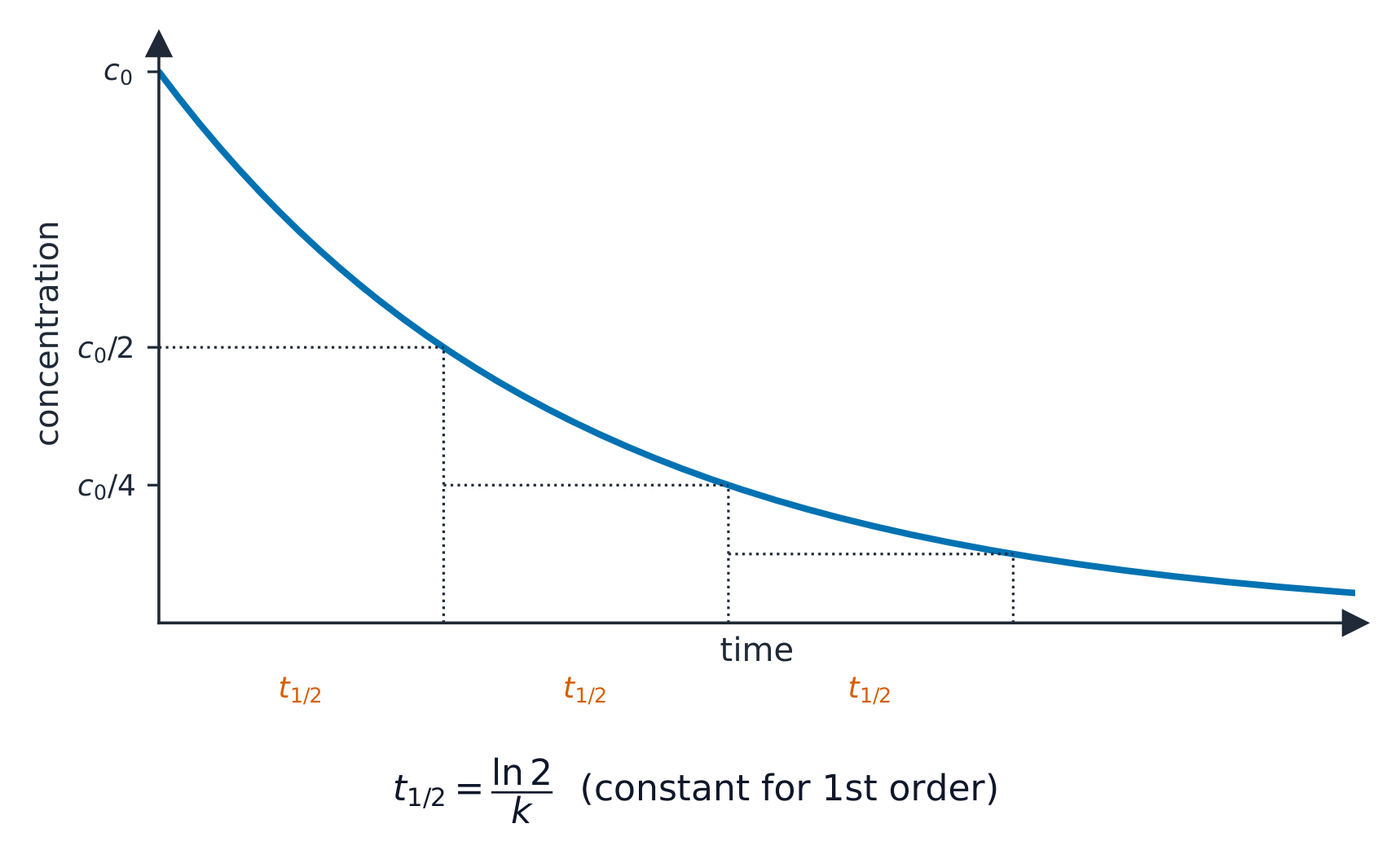
graphs: a concentration–time graph for a first-order reaction has a constant half-life 半衰期 (the time for the concentration to halve). A rate–concentration graph is a straight line through the origin for first order, and a curve for second order.
Half-life and the rate constant
For a first-order reaction the half-life is constant — it does not depend on the concentration. You can find the rate constant from it:
$$k = \frac{0.693}{t_{\frac{1}{2}}}$$
Worked example. A first-order reaction has a half-life of $120\ \text{s}$. Find its rate constant.
You can also find $k$ by putting initial-rate data into the rate equation.
Bahasa Indonesia
Sebuah persamaan laju menunjukkan bagaimana laju bergantung pada konsentrasi reaktan:
$$\text{rate} = k\,[\text{A}]^m[\text{B}]^n$$
$m$ adalah orde reaksi terhadap A, dan $n$ orde terhadap B. Masing-masing adalah $0$, $1$ atau $2$.
orde reaksi keseluruhan adalah $m + n$.
$k$ adalah konstanta laju. Persamaan laju hanya dapat ditemukan melalui eksperimen, bukan dari persamaan yang setara.
Jarum suntik gas mengukur volume gas yang dihasilkan seiring waktu, yang memberikan laju reaksi
Menentukan orde
metode laju awal: ubah satu konsentrasi sekaligus dan lihat bagaimana laju awal berubah. Jika menggandakan $[\text{A}]$ menggandakan laju, orde terhadap A adalah 1; jika melipatgandakan laju empat kali, ordernya 2; jika laju tidak berubah, ordernya 0.
Contoh terpecahkan. Dalam eksperimen pada $\text{A} + \text{B} \rightarrow$ produk, menggandakan $[\text{A}]$ (dengan $[\text{B}]$ tetap) menggandakan laju, dan menggandakan $[\text{B}]$ (dengan $[\text{A}]$ tetap) melipatgandakan laju empat kali. Tuliskan persamaan laju dan berikan orde keseluruhan.
Menggandakan $[\text{A}]$ menggandakan laju, sehingga orde pertama terhadap A. Menggandakan $[\text{B}]$ melipatgandakan ($2^2$) laju, sehingga orde kedua terhadap B. Oleh karena itu
grafik: grafik konsentrasi–waktu untuk reaksi orde pertama memiliki waktu paruh yang konstan (waktu yang dibutuhkan agar konsentrasi menjadi setengah). Grafik laju–konsentrasi berupa garis lurus melalui titik asal untuk orde pertama, dan kurva untuk orde kedua.
Laju terhadap konsentrasi: orde nol adalah garis datar, orde pertama adalah garis lurus melalui titik asal, orde kedua adalah kurva naik
Waktu paruh dan konstanta laju
Untuk reaksi orde pertama, waktu paruhnya konstan — tidak bergantung pada konsentrasi. Anda dapat menemukan konstanta laju darinya:
$$k = \frac{0.693}{t_{\frac{1}{2}}}$$
Reaksi orde pertama memiliki waktu paruh yang konstan: konsentrasi menjadi setengah dalam waktu yang sama $t_{1/2}$ lagi dan lagi, apa pun nilai awalnya
Contoh terpecahkan. Reaksi orde pertama memiliki waktu paruh $120\ \text{s}$. Temukan konstanta lajunya.
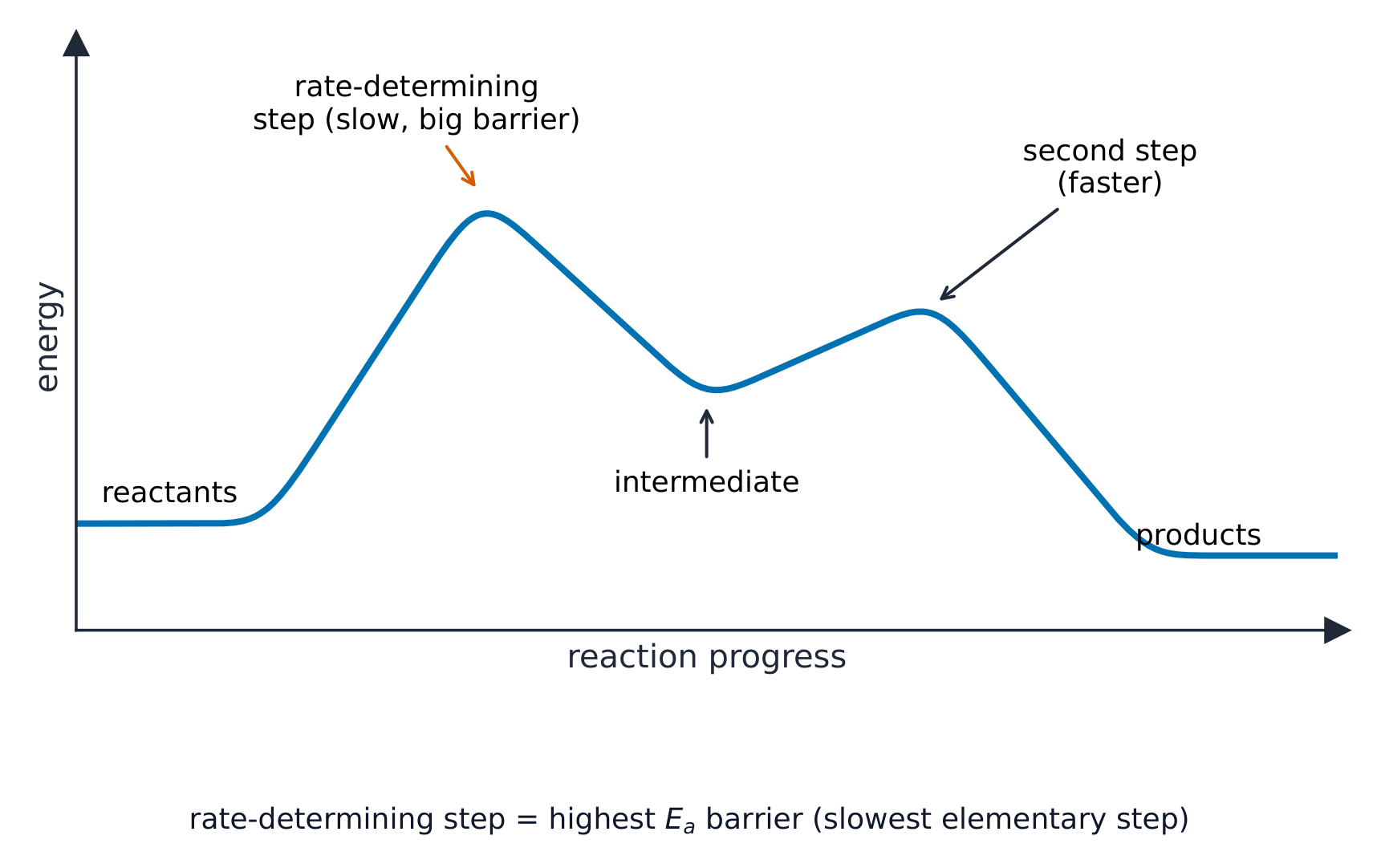
Most reactions happen in several steps. The slowest step is the rate-determining step 决速步骤, and it controls the overall rate. Only the species involved up to and including this step appear in the rate equation.
an intermediate 中间体 is a species made in one step and then used up in a later step. It is not in the overall equation.
you can suggest a mechanism that fits both the rate equation and the overall equation, predict the order from a given mechanism, or pick out the rate-determining step.
If you compare the initial rate 初始速率 of different mixtures, you can deduce the rate equation, and from that work out the mechanism.
Effect of temperature
Raising the temperature increases the rate constant $k$ (more molecules pass the activation energy), so the rate goes up.
Bahasa Indonesia
Kebanyakan reaksi terjadi dalam beberapa langkah. Langkah paling lambat adalah langkah penentu laju, dan ia mengontrol laju keseluruhan. Hanya spesies yang terlibat hingga dan termasuk langkah ini yang muncul dalam persamaan laju.
Profil dua langkah: langkah yang lebih lambat memiliki penghalang yang lebih besar dan merupakan penentu laju; lembah di antara dua penghalang adalah intermediat
intermediat adalah spesies yang terbentuk dalam satu langkah dan kemudian habis digunakan dalam langkah berikutnya. Ia tidak ada dalam persamaan keseluruhan.
Anda dapat mengusulkan mekanisme yang sesuai dengan persamaan laju dan persamaan keseluruhan, memprediksi orde dari mekanisme yang diberikan, atau mengidentifikasi langkah penentu laju.
Jika Anda membandingkan laju awal dari campuran yang berbeda, Anda dapat menyimpulkan persamaan laju, dan dari sana menentukan mekanismenya.
Pengaruh suhu
Menaikkan suhu meningkatkan konstanta laju $k$ (lebih banyak molekul melewati energi aktivasi), sehingga laju meningkat.
explain that catalysts can be homogeneous or heterogeneous
describe the mode of action of a heterogeneous catalyst to include adsorption of reactants, bond weakening and desorption of products, for example: (a) iron in the Haber process (b) palladium, platinum and rhodium in the catalytic removal of oxides of nitrogen from the exhaust gases of car engines
describe the mode of action of a homogeneous catalyst by being used in one step and reformed in a later step, for example: (a) atmospheric oxides of nitrogen in the oxidation of atmospheric sulfur dioxide (b) $\text{Fe}^{2+}$ or $\text{Fe}^{3+}$ in the $\text{I}^- / \text{S}_2\text{O}_8^{2-}$ reaction
Bahasa Indonesia
jelaskan bahwa katalis dapat bersifat homogen atau heterogen
deskripsikan cara kerja katalis heterogen yang mencakup adsorpsi reaktan, melemahnya ikatan dan desorpsi produk, misalnya: (a) besi dalam proses Haber (b) palladium, platinum dan rhodium dalam penghilangan oksida nitrogen dari gas knalpot mesin mobil melalui katalitik
deskripsikan cara kerja katalis homogen dengan digunakan dalam satu tahap dan terbentuk kembali pada tahap kemudian, misalnya: (a) oksida nitrogen atmosfer dalam oksidasi sulfur dioksida atmosfer (b) $\text{Fe}^{2+}$ atau $\text{Fe}^{3+}$ dalam reaksi $\text{I}^- / \text{S}_2\text{O}_8^{2-}$
Source: Cambridge International syllabus · Sumber: Silabus Cambridge International
English
Catalysts 催化剂 can be homogeneous or heterogeneous.
Heterogeneous catalysts
A heterogeneous catalyst 多相催化剂 is in a different physical state from the reactants (usually a solid with gases). It works in three stages:
adsorption 吸附: reactant molecules stick to the catalyst surface.
the bonds in the reactants are weakened, so they react more easily.
desorption 脱附: the product molecules leave the surface.
Examples are iron in the Haber process, and platinum, palladium and rhodium in a catalytic converter.
Homogeneous catalysts
A homogeneous catalyst 均相催化剂 is in the same physical state as the reactants. It is used up in one step and then reformed in a later step, so it comes back unchanged. Examples are oxides of nitrogen helping to oxidise atmospheric sulfur dioxide, and $\text{Fe}^{2+}$ or $\text{Fe}^{3+}$ speeding up the reaction between $\text{I}^-$ and $\text{S}_2\text{O}_8^{2-}$.
Bahasa Indonesia
Katalis bisa bersifat homogen atau heterogen.
Katalis heterogen
Katalis heterogen berada dalam wujud fisik yang berbeda dari reaktan (biasanya padat dengan gas). Ia bekerja dalam tiga tahap:
adsorpsi: molekul reaktan menempel pada permukaan katalis.
ikatan dalam reaktan melemah, sehingga mereka bereaksi lebih mudah.
desorpsi: molekul produk meninggalkan permukaan.
Katalis heterogen bekerja dalam tiga tahap: reaktan beradsorpsi ke permukaan, ikatan yang melemah memungkinkan mereka bereaksi, kemudian produk berdesorpsiKatalis heterogen nyata dibuat sebagai pelet berbentuk kecil, cincin, dan cakram berlubang, yang memberikan luas permukaan besar agar reaktan dapat menempel
Contohnya adalah besi dalam proses Haber, serta platinum, palladium, dan rhodium dalam konverter katalitik.
Katalis homogen
Katalis homogen berada dalam wujud fisik yang sama dengan reaktan. Ia dikonsumsi dalam satu langkah dan kemudian dibentuk kembali dalam langkah berikutnya, sehingga kembali tidak berubah. Contohnya adalah oksida nitrogen membantu mengoksidasi sulfur dioksida atmosfer, dan $\text{Fe}^{2+}$ atau $\text{Fe}^{3+}$ mempercepat reaksi antara $\text{I}^-$ dan $\text{S}_2\text{O}_8^{2-}$.
Explore · Jelajahi
How a catalyst speeds a reaction · Bagaimana pemangkin mempercepatkan tindak balas
Turn the catalyst on and watch the rate jump — it gives more successful collisions per second by offering a lower-energy path. · Hidupkan pemangkin dan lihat lonjakan kadar — ia memberikan lebih banyak perlanggaran berjaya setiap saat dengan menyediakan laluan berenergi rendah.
Find orders from initial-rate data: doubling a concentration that doubles the rate is first order, quadruples it is second order, no change is zero order.
Write $\text{rate} = k[\text{A}]^m[\text{B}]^n$ and work out the units of $k$ from it.
The rate-determining step contains the species (and orders) in the rate equation — use this to test a mechanism.
A constant half-life means first order.
Bahasa Indonesia
Temukan orde dari data laju awal: menggandakan konsentrasi yang menggandakan laju adalah orde pertama, melipatgandakan empat kali adalah orde kedua, tidak ada perubahan adalah orde nol.
Tulis $\text{rate} = k[\text{A}]^m[\text{B}]^n$ dan tentukan unit bagi $k$ daripadanya.
Langkah penentu laju mengandung spesies (dan orde) dalam persamaan laju — gunakan ini untuk menguji mekanisme.
Waktu paruh konstan berarti orde pertama.
Interactive lessons on this topic · Pelajaran interaktif untuk topik ini
Work through it step by step, with instant-check exercises. · Kerjakan langkah demi langkah, dengan latihan pengecekan instan.
Pick one and the site follows you — notes, papers, videos and practice all open on it. · Pilih satu dan situs mengikuti Anda — catatan, kertas, video, dan latihan semua terbuka di sana.
Type to search notes, lessons, code, vocabulary and past-paper questions across every subject. · Ketik untuk mencari catatan, pelajaran, kode, kosakata, dan pertanyaan soal lama di setiap mata pelajaran.