English
- describe the relationship between the structure of chloroplasts, as shown in diagrams and electron micrographs, and their function
- explain that energy transferred as ATP and reduced NADP from the light-dependent stage is used during the light-independent stage (Calvin cycle) of photosynthesis to produce complex organic molecules
- state that within a chloroplast, the thylakoids (thylakoid membranes and thylakoid spaces), which occur in stacks called grana, are the site of the light-dependent stage and the stroma is the site of the light-independent stage
- describe the role of chloroplast pigments (chlorophyll a, chlorophyll b, carotene and xanthophyll) in light absorption in thylakoids
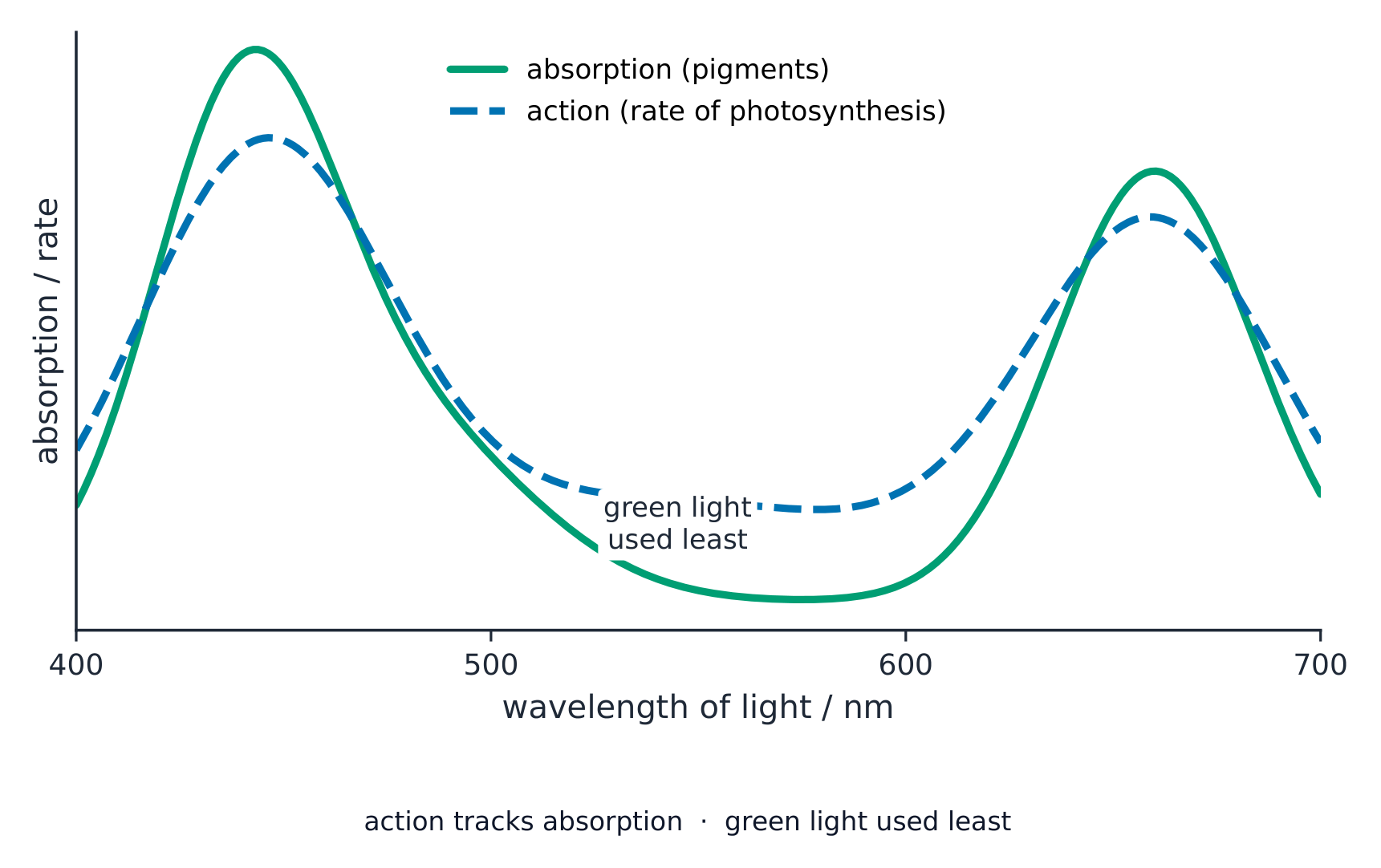
- interpret absorption spectra of chloroplast pigments and action spectra for photosynthesis
- describe and use chromatography to separate and identify chloroplast pigments (reference should be made to $R_f$ values in identification of chloroplast pigments)
- state that cyclic photophosphorylation and non-cyclic photophosphorylation occur during the light-dependent stage of photosynthesis
- explain that in cyclic photophosphorylation: • only photosystem I (PSI) is involved • photoactivation of chlorophyll occurs • ATP is synthesised
- explain that in non-cyclic photophosphorylation: • photosystem I (PSI) and photosystem II (PSII) are both involved • photoactivation of chlorophyll occurs • the oxygen-evolving complex catalyses the photolysis of water • ATP and reduced NADP are synthesised
- explain that during photophosphorylation: • energetic electrons release energy as they pass through the electron transport chain (details of carriers are not expected) • the released energy is used to transfer protons across the thylakoid membrane • protons return to the stroma from the thylakoid space by facilitated diffusion through ATP synthase, providing energy for ATP synthesis (details of ATP synthase are not expected)
- outline the three main stages of the Calvin cycle: • rubisco catalyses the fixation of carbon dioxide by combination with a molecule of ribulose bisphosphate (RuBP), a 5C compound, to yield two molecules of glycerate 3-phosphate (GP), a 3C compound • GP is reduced to triose phosphate (TP) in reactions involving reduced NADP and ATP • RuBP is regenerated from TP in reactions that use ATP
- state that Calvin cycle intermediates are used to produce other molecules, limited to GP to produce some amino acids and TP to produce carbohydrates, lipids and amino acids
Bahasa Indonesia
- deskripsikan hubungan antara struktur kloroplas, seperti yang ditunjukkan dalam diagram dan mikrofotografi elektron, dengan fungsinya
- jelaskan bahwa energi yang ditransfer sebagai ATP dan NADP tereduksi dari tahap bergantung cahaya digunakan selama tahap tidak bergantung cahaya (Siklus Calvin) fotosintesis untuk menghasilkan molekul organik kompleks
- nyatakan bahwa di dalam kloroplas, tilakoid (membran tilakoid dan ruang tilakoid), yang terjadi dalam tumpukan yang disebut granum, adalah tempat tahap bergantung cahaya dan stroma adalah tempat tahap tidak bergantung cahaya
- deskripsikan peran pigmen kloroplas (klorofil a, klorofil b, karoten dan xantofil) dalam penyerapan cahaya di tilakoid
- interpretasikan spektrum serap pigmen kloroplas dan spektrum aksi untuk fotosintesis
- deskripsikan dan gunakan kromatografi untuk memisahkan dan mengidentifikasi pigmen kloroplas (referensi harus diberikan kepada $R_f$ nilai dalam identifikasi pigmen kloroplas)
- nyatakan bahwa fotofosforilasi siklik dan fotofosforilasi non-siklik terjadi selama tahap bergantung cahaya fotosintesis
- jelaskan bahwa dalam fotofosforilasi siklik: • hanya fotosistem I (PSI) yang terlibat • fotoaktivasi klorofil terjadi • ATP disintesis
- jelaskan bahwa dalam fotofosforilasi non-siklik: • fotosistem I (PSI) dan fotosistem II (PSII) keduanya terlibat • fotoaktivasi klorofil terjadi • kompleks pelepasan oksigen mengkatalisis fotolisis air • ATP dan NADP tereduksi disintesis
- jelaskan bahwa selama fotofosforilasi: • elektron berenergi tinggi melepaskan energi saat melewati rantai transpor elektron (rincian pembawa tidak diharapkan) • energi yang dilepaskan digunakan untuk mentransfer proton melintasi membran tilakoid • proton kembali ke stroma dari ruang tilakoid melalui difusi terfasilitasi melalui ATP sintase, menyediakan energi untuk sintesis ATP (rincian ATP sintase tidak diharapkan)
- uraikan tiga tahap utama Siklus Calvin: • rubisco mengkatalisis fiksasi karbon dioksida dengan kombinasi dengan molekul ribulosa bifosfat (RuBP), senyawa 5C, untuk menghasilkan dua molekul gliserat 3-fosfat (GP), senyawa 3C • GP direduksi menjadi triosa fosfat (TP) dalam reaksi yang melibatkan NADP tereduksi dan ATP • RuBP diregenerasi dari TP dalam reaksi yang menggunakan ATP
- nyatakan bahwa intermediat Siklus Calvin digunakan untuk menghasilkan molekul lain, terbatas dari GP untuk menghasilkan beberapa asam amino dan TP untuk menghasilkan karbohidrat, lipid dan asam amino