הסתכלו בלילה ברור ותראו כאלף כוכבים. אבל זה כמעט כלום. השמש שלנו היא רק כוכב אחד מתוך מאה מיליארד בגלקסיה שלנו…
English narration · English + 中文 subtitles burned in · קריאת קול באנגלית · תרגום אנגלי + סינית שרוף בתוך הסרטון
6.1
The Earth, the Sun and the Moon · כדור הארץ, השמש והירח
Syllabus · סיילבוס
English
6.1.1 The Earth
Core
Supplement
1 Know that the Earth is a planet that rotates on its axis, which is tilted, once in approximately 24 hours, and use this to explain observations of the apparent daily motion of the Sun and the periodic cycle of day and night
2 Know that the Earth orbits the Sun once in approximately 365 days and use this to explain the periodic nature of the seasons
4 Define average orbital speed from the equation $v = \frac{2\pi r}{T}$ where $r$ is the average radius of the orbit and $T$ is the orbital period; recall and use this equation
3 Know that it takes approximately one month for the Moon to orbit the Earth and use this to explain the periodic nature of the Moon’s cycle of phases
6.1.2 The Solar System
Core
Supplement
1 Describe the Solar System as containing: (a) one star, the Sun (b) the eight named planets and know their order from the Sun (c) minor planets that orbit the Sun, including dwarf planets such as Pluto and asteroids in the asteroid belt (d) moons, that orbit the planets (e) smaller Solar System bodies, including comets and natural satellites
7 Know that planets, minor planets and comets have elliptical orbits, and recall that the Sun is not at the centre of the elliptical orbit, except when the orbit is approximately circular
8 Analyse and interpret planetary data about orbital distance, orbital duration, density, surface temperature and uniform gravitational field strength at the planet’s surface
2 Know that, in comparison to each other, the four planets nearest the Sun are rocky and small and the four planets furthest from the Sun are gaseous and large, and explain this difference by referring to an accretion model for Solar System formation, to include: (a) the model’s dependence on gravity (b) the presence of many elements in interstellar clouds of gas and dust (c) the rotation of material in the cloud and the formation of an accretion disc
3 Know that the strength of the gravitational field (a) at the surface of a planet depends on the mass of the planet (b) around a planet decreases as the distance from the planet increases
4 Calculate the time it takes light to travel a significant distance such as between objects in the Solar System
5 Know that the Sun contains most of the mass of the Solar System and this explains why the planets orbit the Sun
6 Know that the force that keeps an object in orbit around the Sun is the gravitational attraction of the Sun
9 Know that the strength of the Sun’s gravitational field decreases and that the orbital speeds of the planets decrease as the distance from the Sun increases
10 Know that an object in an elliptical orbit travels faster when closer to the Sun and explain this using the conservation of energy
עברית
6.1.1 כדור הארץ
ליבה
תוספת
1 לדעת כי כדור הארץ הוא כוכב לכת שמסתובב סביב צירו, שנוטה, פעם אחת בכל כ-24 שעות, ולהשתמש במידע זה כדי להסביר את התנועה היומית apparent של השמש ואת המחזוריות של יום ולילה
2 לדעת כי כדור הארץ מקיף את השמש פעם אחת בכל כ-365 ימים ולהשתמש במידע זה כדי להסביר את הטבע המחזורי של העונות
4 הגדר מהירות מסלול ממוצעת מהמשוואה $v = \frac{2\pi r}{T}$ כאשר $r$ הוא רדיוס המסלול הממוצע ו$T$ הוא תקופת המסלול; לשנן ולשמש במשוואה זו
3 לדעת כי לוקח לכדור הירח כחודש אחד כדי לקפות את כדור הארץ ולהשתמש במידע זה כדי להסביר את הטבע המחזורי של מחזור הפאזות של הירח
6.1.2 מערכת השמש
ליבה
תוספת
1 תאר את מערכת השמש המכילה: (א) כוכב אחד, השמש (ב) שמונת כוכבי הלכת המנוסים ודע את סדרם מהשמש (ג) כוכבי לכת קטנים המקיפים את השמש, כולל כוכבי לכת ננסיים כמו פלוטו ואסטרואידים באזור האסטרואידים (ד) ירחים, המקיפים את כוכבי הלכת (ה) גופי מערכת שמש קטנים יותר, כולל שביטים וכוכבי לכת ננסיים טבעיים
7 לדעת שכוכבי לכת, כוכבי לכת קטנים ושביטים בעלי מסלולים אליפטיים, ולשנן כי השמש אינה במרכז המסלול האליפטיי, אלא רק כאשר המסלול דומה לעיגול
8 ניתוח ופרשנות נתונים כוכבי לכת בנוגע למרחק מסלולי, משך מסלולי, צפיפות, טמפרטורת פני שטח וחוזק שדה כבידה אחיד בפני השטח של הכוכב לכת
2 לדעת כי, בהשוואה זה לזה, ארבעת כוכבי הלכת הקרובים ביותר לשמש הם סלעיים וקטנים וארבעת כוכבי הלכת הרחוקים ביותר מהשמש הם גזיים וגדולים, ולהסביר הבדל זה על ידי התייחסות למודל הדמייה ליצירת מערכת השמש, הכולל: (א) התלות המודל בכבידה (ב) נוכחות של אלמנטים רבים בענני גז ואבק בין-כוכביים (ג) סיבוב החומר בענן ויצירת דיסק הדמיה
3 לדעת כי חוזק השדה הכבידתי (א) בפני השטח של כוכב לכת תלוי במסת כוכב הלכת (ב) סביב כוכב לכת יורד ככל שהמרחק מכוכב הלכת עולה
4 לחשב את הזמן הנדרש לאור לנסוע מרחק משמעותי כגון בין גופים במערכת השמש
5 לדעת כי השמש מכילה את רוב המסה של מערכת השמש ודבר זה מסביר מדוע כוכבי הלכת מקיפים את השמש
6 לדעת כי הכוח ששומר על גוף במסלול סביב השמש הוא המשיכה הכבידתית של השמש
9 לדעת כי חוזק השדה הכבידתי של השמש יורד וכי מהירויות המסלול של כוכבי הלכת יורדות ככל שהמרחק מהשמש עולה
10 לדעת כי גוף במסלול אליפטיי נע מהר יותר כאשר הוא קרוב יותר לשמש ולהסביר זאת באמצעות שימור האנרגיה
Source: Cambridge International syllabus · מקור: הסיילבוס הבינלאומי של קמבריד'ג'
English
The Earth spins (rotates 自转) on its axis 轴 once in about $24$ hours. The axis is tilted 倾斜 (not straight up). This spin gives us day and night, and makes the Sun 太阳 appear to move across the sky each day.
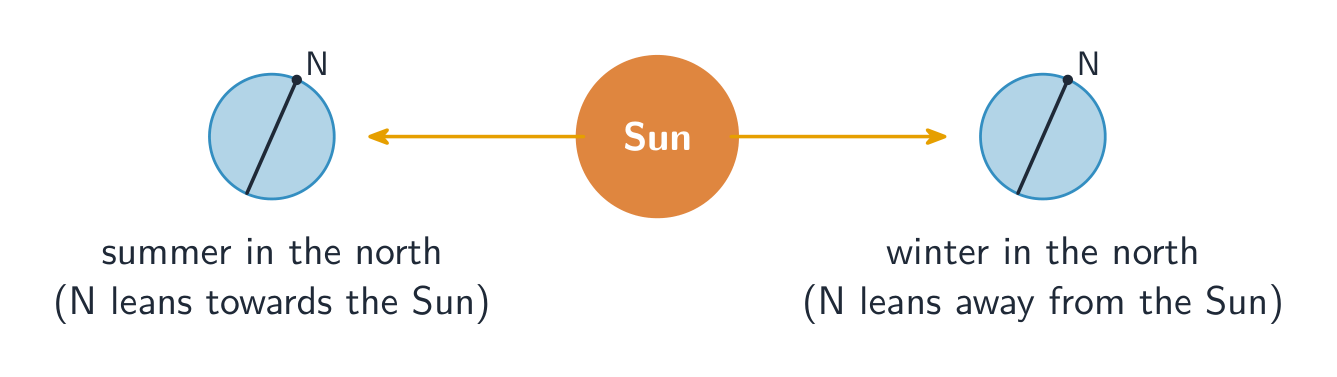
The Earth also moves around the Sun in an orbit 轨道, once in about $365$ days (one year). Because the axis is tilted, different parts of the Earth lean towards the Sun at different times of the year. This gives the seasons 季节: it is summer in the half of the Earth that leans towards the Sun.
The Moon 月球 orbits the Earth once in about one month. As it goes round, we see different amounts of its lit side, which gives the phases 月相 of the Moon (new moon, half moon, full moon).
So, from shortest to longest: one day (Earth's spin) < one month (Moon's orbit) < one year (Earth's orbit).
עברית
כדור הארץ מסתובב (מתרסק) סביב צירו פעם אחת כל כ-$24$ שעות. הציר מוטה (לא אנכי לגמרי). סיבוב זה גורם לנו לימים וללילות, וגורם לשמש להראות כאילו נעה בשמיים כל יום.
כדור הארץ גם נע סביב השמש במסלול, פעם אחת כל כ-$365$ ימים (שנה אחת). מכיוון שהציר מוטה, חלקים שונים של כדור הארץ נוטים לעבר השמש בזמנים שונים בשנה. זה גורם לעונות: החצי מכדור הארץ שנוטה לעבר השמש הוא בקיץ.
הציר שומר על אותה הטיה לאורך כל השנה, כך שכל חצי כדור הארץ נוטה לעבר השמש לחצי מהמסלול ולהרחיק ממנה לחצי השני
הירח מקיף את כדור הארץ פעם אחת כל כחודש. בזמן שהיא נעה, אנו רואים כמויות שונות של החלק המואר שלה, וזה נותן את שלבי הירח (ירח חדש, ירח חצי, ירח מלא).
החלק המואר של הירח תמיד פונה לשמש, כך שבזמן שהיא מקיפה את כדור הארץ אנו רואים כמויות שונות: ירח חדש בינינו ובין השמש, ירח מלא מול השמש, וירחי חצי במרכז
לכן, מקצר לארוך: יום אחד (סיבוב כדור הארץ) < חודש אחד (מסלול הירח) < שנה אחת (מסלול כדור הארץ).
ירח מלא, הלוויין הטבעי של כדור הארץ
Explore · חקור
Why the Moon changes shape · מדוע הירח משנה את צורתו
The Sun always lights half the Moon; the phase is simply how much of that lit half faces us as the Moon orbits — it is not Earth's shadow. · השמש תמיד מאירה חצי מהירח; הפזה היא פשוט כמות החצי המואר הנפנה אלינו כאשר הירח מקיף – זו אינה הצל הארץ.
For an object going round a circle, the distance for one full orbit is the circumference 周长$2\pi r$, where $r$ is the radius of the orbit. The orbital speed 轨道速率 is this distance divided by the period 周期$T$ (the time for one orbit):
$$v = \frac{2\pi r}{T}$$
The same equation works for planets, moons and satellites.
Worked example. A space station orbits the Earth at a radius of $r = 7000\ \text{km}$ and takes $T = 5800\ \text{s}$ for one orbit. Find its orbital speed.
First convert the radius to metres: $7000\ \text{km} = 7.0 \times 10^6\ \text{m}$. Then
The Solar System 太阳系 has one star, the Sun, at its centre. Around it move the eight planets 行星. In order from the Sun they are: Mercury, Venus, Earth, Mars, Jupiter, Saturn, Uranus and Neptune.
The four planets nearest the Sun are small and rocky 岩石.
The four planets furthest from the Sun are large and gaseous 气态 — they are made mostly of gas 气体, with no solid surface to stand on.
The two nearer giants, Jupiter and Saturn, are gas giants 气态巨行星. The two outer giants, Uranus and Neptune, are ice giants 冰巨行星: they hold much more ice, so they are not true gas giants.
The Solar System also contains:
minor planets, such as dwarf planets 矮行星 like Pluto, and asteroids 小行星 (most lie in the asteroid belt between Mars and Jupiter);
moons (natural satellites 卫星) that orbit the planets;
comets 彗星 and other small bodies.
Orbits and gravity
The Sun holds most of the mass of the Solar System. Its gravity 引力 (gravitational pull) reaches out and keeps the planets in their orbits. This force is the gravitational attraction of the Sun.
The gravitational field strength 重力场强度 tells you how strong gravity is:
at the surface of a planet it is bigger for a planet with more mass;
around a planet it gets weaker as you move further away.
In the same way, the Sun's gravity gets weaker further out, so the outer planets move more slowly (smaller orbital speed) than the inner ones.
Planetary data
Exam questions often give a table like this one and ask you to read a pattern from it.
Planet
Distance from Sun / million km
Orbital period
Density / g/cm³
Surface temperature / °C
Surface $g$ / N/kg
Mercury
58
88 days
5.4
170
3.7
Venus
108
225 days
5.2
460
8.9
Earth
150
365 days
5.5
15
9.8
Mars
228
687 days
3.9
−60
3.7
Jupiter
779
11.9 years
1.3
−110
23
Saturn
1430
29.5 years
0.7
−140
9.0
Uranus
2870
84 years
1.3
−195
8.7
Neptune
4500
165 years
1.6
−200
11
Patterns to notice: the further a planet is from the Sun, the longer its orbital period and the lower its surface temperature. The four inner planets are dense (rock and metal), while the four outer planets have low densities (gas and ice). The gravitational field strength at the surface depends on the planet's mass and size, not on its distance from the Sun.
Elliptical orbits
Most orbits are not perfect circles but ellipses 椭圆 (a stretched circle), and the Sun is not at the centre of the ellipse. A comet has a very stretched orbit. An object in an elliptical orbit moves faster when it is closer to the Sun. We explain this with the conservation of energy 能量守恒 — the total energy 能量 stays the same, so as the object's gravitational potential energy 重力势能 falls (coming closer), its kinetic energy 动能 rises (it speeds up).
Light travel time
Distances in space are huge, so we often work out how long light takes to cross them. Light travels at $3.0 \times 10^8\ \text{m/s}$. Using $\text{time} = \dfrac{\text{distance}}{\text{speed}}$, light from the Sun (about $1.5 \times 10^{11}\ \text{m}$ away) takes about $500\ \text{s}$, which is roughly $8$ minutes, to reach the Earth.
עברית
מערכת השמש מכילה כוכב אחד, השמש, במרכזה. סביבו נעים שמונה כוכבי לכת. בסדר מהשמש הם: כוכב החמה, נוגה, כדור הארץ, מאדים, צדק, שבתאי, אורנוס ונפטון.
ארבעת כוכבי הלכת הקרובים ביותר לשמש הם קטנים וסלעיים.
ארבעת כוכבי הלכת הרחוקים ביותר מהשמש הם גדולים וגזרי — הם עשויים בעיקר מגז, וללא פני שטח מוצקים לעמוד עליהם.
שני הענקים הקרובים יותר, צדק ושבתאי, הם ענקי גז. שני הענקים החיצוניים, אורנוס ונפטון, הם ענקי קרח: הם מכילים הרבה יותר קרח, ולכן אינם ענקי גז אמיתיים.
השמש ושמונה כוכבי הלכת בסדר: ארבעה כוכבי לכת סלעיים קטנים, ולאחר מכן פס האסטרואידים, ואז ארבעה כוכבי לכת גזריים גדולים — ענקי הגז צדק ושבתאי וענקי הקרח אורנוס ונפטון (לא בקנה מידה)מאדים, הכוכב האדום, אחד מכוכבי הלכת הפנימיים הסלעייםצדק, כוכב הלכת הגדול ביותר, עם רצועות הגז המסתובבות שלושבתאי והטבעות שלו, מצולם על ידי חללית קאסיני
מערכת השמש מכילה גם:
כוכבי לכת מינוריים, כמו כוכבי לכת ננסיים כמו פלוטו, ואסטרואידים (רובם נמצאים בפס האסטרואידים בין מאדים לצדק);
ירחים (לוויינים טבעיים) המקיפים את כוכבי הלכת;
שביטים וגופים קטנים אחרים.
מסלולים וכוח משיכה
השמש מחזיקה ברוב המסה של מערכת השמש. הכוח הכבידתי שלה נמתח ומחזיק את כוכבי הלכת במסלוליהם. כוח זה הוא המשיכה הכבידתית של השמש.
עוצמת השדה הכבידתי מראה כמה הכביד חזק:
על פני כוכב לכת, היא גדולה יותר לכוכב לכת עם מסה גבוהה יותר;
סביב כוכב לכת, היא הופכת לחלשה ככל שמתקרבים ממנו.
באותו אופן, הכביד של השמש הופך לחלש יותר ככל שמרחקים אותו, ולכן כוכבי הלכת החיצונים נעים לאט יותר (מהירות מסלולית נמוכה יותר) מאשר הפנימיים.
נתוני כוכבי לכת
שאלות בבחינות נוהגות לתת טבלה כמו זו ולבקש לקרוא דפוס מהטבלה.
כוכב לכת
מרחק משמש / מיליון ק"מ
תקופת מסלול
צפיפות / ג'/ס"מ³
טמפרטורת פני השטח / °C
עוצמת שדה כביד / N/kg $g$
כוכב חמה
58
88 ימים
5.4
170
3.7
ונوس
108
225 ימים
5.2
460
8.9
כדור הארץ
150
365 ימים
5.5
15
9.8
מאדים
228
687 ימים
3.9
−60
3.7
צדק
779
11.9 שנים
1.3
−110
23
שבתאי
1430
29.5 שנים
0.7
−140
9.0
אורנוס
2870
84 שנים
1.3
−195
8.7
נפטון
4500
165 שנים
1.6
−200
11
דפוסים להבחין: ככל שכוכב לכת רחוק יותר מהשמש, כך תקופת המסלול שלו ארוכה יותר וטמפרטורת פני השטח נמוכה יותר. ארבעת כוכבי הלכת הפנימיים הם צפופים (סלע ומתכת), בעוד שארבעת כוכבי הלכת החיצונים הם בעלי צפיפות נמוכה (גז וקרח). עוצמת השדה הכבידתי בפני השטח תלויה במסת כוכב הלכת ובגודלו, ולא במרחק משמש.
מסלולים אלפטיים
רוב המסלולים אינם עיגולים מושלמים אלא אלפסיות (עיגול מאורך), והשמש אינה במרכז האלפסיה. למטהורית יש מסלול מאורך מאוד. גוף במסלול אלפטי נע מהר יותר כשהוא קרוב יותר לשמש. אנו מסבירים זאת בשימור האנרגיה: האנרגיה הכוללת נשארת זהה, ולכן כאשר האנרגיה הפוטנציאלית הכבידתית של הגוף יורדת (ככל שהוא מתקרב), האנרגיה הקינטית שלו עולה (הוא מהיר).
השמש נמצאת באחד ממיקודי האלפסיה; הכוכב לכת מהיר ככל שהוא מתקרב ואט ככל שהרחוק
זמן נסיעת האור
מרחקים בחלל הם עצומים, ולכן לעיתים קרובות מחשבים כמה זמן לוקח לאור לחצות אותם. אור נע במהירות של $3.0 \times 10^8\ \text{m/s}$. באמצעות $\text{time} = \dfrac{\text{distance}}{\text{speed}}$, אור מהשמש (הנמצאת במרחק של כ-$1.5 \times 10^{11}\ \text{m}$) לוקח כ-$500\ \text{s}$ כדי להגיע לכדור הארץ, כלומר כ-$8$ דקות.
Explore · חקור
Watch the planets race · צפה במירוץ הכוכבים
The closer a planet is to the Sun, the faster it orbits — Mercury in 88 days, Jupiter in 12 years — because the Sun's gravity is stronger close in. · ככל שכוכב לכת קרוב יותר לשמש, כך הוא מקיף מהר יותר — כוכב חמה ב-88 ימים, צדק ב-12 שנים — בגלל שהמשיכה של השמש חזקה יותר בקרבתו.
How the Solar System formed · כיצד נוצר מערכת השמש
English
The planets formed from a giant cloud of gas and dust 尘埃 in space, which contained many chemical elements 元素. This is the accretion 吸积 model:
gravity pulled the cloud together;
the cloud was spinning, so it flattened into a spinning accretion disc 吸积盘;
most of the matter fell to the centre and became the Sun, while the planets grew from the leftover material in the disc.
Near the hot young Sun, only rock and metal could stay solid, so the inner planets are rocky. Far out, where it was cold, gases could also collect, so the outer planets grew large and gaseous.
עברית
הכוכבי לכת נוצרו מענן ענק של גז ואבק בחלל, שכלל מגוון יסודות כימיים. זהו הדגם של הצטברות:
הכבידה משיכה את הענן יחד;
הענן סובב, ולכן התשטח לתוך דיסק הצטברות סובב;
רוב החומר צנח למרכז והפך לשמש, בעוד שהכוכבי לכת גדלו מהחומר שנותר בדיסק.
קרוב לשמש הצעירה והחמה, רק סלע ומתכות יכולים היו להישאר מוצקים, ולכן הכוכבי לכת הפנימיים הם סלעיים. הרחק, במקום שבו היה קר, גם גזים יכולים היו להתכנס, ולכן הכוכבי לכת החיצוניים גדלו וגדלו והיו גזיים.
דיסק הצטברות אמיתי סביב הכוכב הצעיר HL Tauri: החריצים הכהים הם המקום שבו כוכבי לכת חדשים אוספים את האבק – מערכת השמש שלנו החלה באותו אופן
1 Know that the Sun is a star of medium size, consisting mostly of hydrogen and helium, and that it radiates most of its energy in the infrared, visible light and ultraviolet regions of the electromagnetic spectrum
2 Know that stars are powered by nuclear reactions that release energy and that in stable stars the nuclear reactions involve the fusion of hydrogen into helium
6.2.2 Stars
Core
Supplement
1 State that: (a) galaxies are each made up of many billions of stars (b) the Sun is a star in the galaxy known as the Milky Way (c) other stars that make up the Milky Way are much further away from the Earth than the Sun is from the Earth (d) astronomical distances can be measured in light-years, where one light-year is the distance travelled in (the vacuum of) space by light in one year
2 Know that one light-year is equal to $9.5 \times 10^{15}$ m
3 Describe the life cycle of a star: (a) a star is formed from interstellar clouds of gas and dust that contain hydrogen (b) a protostar is an interstellar cloud collapsing and increasing in temperature as a result of its internal gravitational attraction (c) a protostar becomes a stable star when the inward force of gravitational attraction is balanced by an outward force due to the high temperature in the centre of the star (d) all stars eventually run out of hydrogen as fuel for the nuclear reaction (e) most stars expand to form red giants and more massive stars expand to form red supergiants when most of the hydrogen in the centre of the star has been converted to helium (f) a red giant from a less massive star forms a planetary nebula with a white dwarf star at its centre (g) a red supergiant explodes as a supernova, forming a nebula containing hydrogen and new heavier elements, leaving behind a neutron star or a black hole at its centre (h) the nebula from a supernova may form new stars with orbiting planets
6.2.3 The Universe
Core
Supplement
1 Know that the Milky Way is one of many billions of galaxies making up the Universe and that the diameter of the Milky Way is approximately 100 000 light-years
2 Describe redshift as an increase in the observed wavelength of electromagnetic radiation emitted from receding stars and galaxies
3 Know that the light emitted from distant galaxies appears redshifted in comparison with light emitted on the Earth
4 Know that redshift in the light from distant galaxies is evidence that the Universe is expanding and supports the Big Bang Theory
5 Know that microwave radiation of a specific frequency is observed at all points in space around us and is known as cosmic microwave background radiation (CMBR)
6 Explain that the CMBR was produced shortly after the Universe was formed and that this radiation has been expanded into the microwave region of the electromagnetic spectrum as the Universe expanded
7 Know that the speed $v$ at which a galaxy is moving away from the Earth can be found from the change in wavelength of the galaxy’s starlight due to redshift
8 Know that the distance $d$ of a far galaxy can be determined using the brightness of a supernova in that galaxy
9 Define the Hubble constant$H_0$ as the ratio of the speed at which the galaxy is moving away from the Earth to its distance from the Earth; recall and use the equation
$$H_0 = \frac{v}{d}$$
10 Know that the current estimate for $H_0$ is $2.2 \times 10^{-18}$ per second
11 Know that the equation
$$\frac{d}{v} = \frac{1}{H_0}$$
represents an estimate for the age of the Universe and that this is evidence for the idea that all the matter in the Universe was present at a single point
עברית
6.2.1 השמש ככוכב
ליבה
תוספת
1 לדעת כי השמש היא כוכב בגודל בינוני, המורכב בעיקר ממימן והליום, ושומרת רוב האנרגיה שלה באזורים האינפרא אדום, האור הנראה והאולטרה סגול של הספקטרום האלקטרומגנטי
2 לדעת כי כוכבים מופעלים על ידי תגובות גרעיניות המשחררות אנרגיה ובכוכבים יציבות התגובות הגרעיניות מעורבות בהיתוך מימן לליום
6.2.2 כוכבים
ליבה
תוספת
1 ציין כי: (א) גלקסיות מורכבות כל אחת ממיליארדי כוכבים רבים (ב) השמש היא כוכב בגלקסיה הידועה בשם הדרך הח乳בית (ג) כוכבים אחרים המרכיבים את הדרך הח乳בית נמצאים הרבה רחוק מכדור הארץ מאשר השמש נמצאת מכדור הארץ (ד) מרחקים אסטרונומיים יכולים להיות נמדדים בשנות אור, כאשר שנת אור היא המרחק שעובר אור ב(הריקון של) החלל בשנה אחת
2 דעו ששנה אורית אחת שווה ל $9.5 \times 10^{15}$ מטר
3 תארו את מחזור החיים של כוכב: (א) כוכב נוצר מעננים אינטר-סטריים של גז ואבק המכילים מימן (ב) פרוטוכוכב הוא ענן אינטר-סטרי מתכווץ ועולה בטמפרטורה כתוצאה מהמשיכה הכבידתית הפנימית שלו (ג) פרוטוכוכב הופך לכוכב יציב כאשר הכוח הכבידתי הפנימי מאוזן על ידי כוח חיצוני הנובע מטמפרטורה גבוהה במרכז הכוכב (ד) כל הכוכבים יסיימו בסוף את המימן כדלק לתגובה הגרעינית (ה) רוב הכוכבים מתרחבים ליצירת ענק אדום, וכוכבים בעלי מסה גבוהה יותר מתרחבים ליצירת ענק סופר אדום כאשר רוב המימן במרכז הכוכב הוסב למיליון (ו) ענק אדום הנובע מכוכב בעל מסה נמוכה יוצר ערפילית כוכבית עם כוכב לבן במרכזה (ז) ענק סופר אדום מתפוצץ כסופרנובה, ויוצר ערפילית המכילה מימן ומסות כבדות חדשות, ומשאיר מאחוריו כוכב ניטרונים או חור שחור במרכזה (ח) הערפילית הנוצרת מסופרנובה עשויה ליצור כוכבים חדשים עם כוכבי לכת המקיפים אותם
6.2.3 היקום
ליבה
תוספת
1 לדעת שהדרכה שבכוכבים היא אחת מכמיליארדים של גלקסיות המרכיבות את היקום, ושהקוטר שלה הוא כ-100 000 שנות אור
2 תארו הזזה לאדום כעלייה באורך הגל הנצפה של קרינה אלקטרומגנטית הנפלטת מכוכבים וגלאקסיות הרחקות
3 דעו שקרינה האור הנפלטת מגלאקסיות רחוקות נראית מוזזת לאדום בהשוואה לקרינת האור הנפלטת על כדור הארץ
4 דעו שההזזה לאדום בקרינת האור מגלאקסיות רחוקות היא עדות לכך שהיקום מתרחב ותומכת בתיאוריית המהדק הגדול
5 דעו שקרינת מיקרוגלים בתדר ספציפי נצפתה בכל נקודה בחלל סביבנו, והיא ידועה כקרינת רקע המיקרוגלים הקוסמית (CMBR)
6 הסבירו שקרינת CMBR נוצרה זמן קצר לאחר היוון היקום, וקרינה זו התרחבה לתחום המיקרוגלים במבנה הספקטרלי האלקטרומגנטי כשהיקום התרחב
7 דעו שמהירות $v$ שבה גלאקסיה מתרחקת מכדור הארץ ניתן למצוא מתוך השינוי באורך הגל של אור הכוכבים בגלאקסיה בשל ההזזה לאדום
8 דע כי ניתן לקבוע את המרחק $d$ של גלקסיה רחוקה באמצעות בהירות סופרנובה הנמצאת בגלקסיה זו
9 הגדר את קבוע הלוב$H_0$ כחסר המהירות שבה הגלקסיה מתרחקת מהכדור הארץ ליחסה מהכדור הארץ; זכור ושתמש במשוואה
$$H_0 = \frac{v}{d}$$
10 דע שההערכה הנוכחית עבור $H_0$ היא $2.2 \times 10^{-18}$ לשנייה
11 דע שמשוואה
$$\frac{d}{v} = \frac{1}{H_0}$$
מייצגת הערכה לגיל היקום, ועובדה זו מהווה עדות לכך שכל החומר ביקום היה קיים בנקודה אחת
Source: Cambridge International syllabus · מקור: הסיילבוס הבינלאומי של קמבריד'ג'
English
The Sun is a star 恒星 of medium size, made mostly of hydrogen 氢 and helium 氦. It radiates most of its energy in the infrared, visible light and ultraviolet 紫外线 parts of the electromagnetic spectrum 电磁波谱.
A star is powered by nuclear reactions 核反应 in its core. In a stable star, the reaction is nuclear fusion 核聚变: hydrogen nuclei join to make helium, releasing huge amounts of energy.
עברית
השמש היא כוכב בגודל בינוני, העשוי ברובו ממימן והליום. היא פולטת את רוב האנרגיה שלה בתחומי אינפרה אדום, אור נראה ואולטרה סגול בספקטר האלקטרומגנטי.
כוכב מופעל על ידי תגובות גרעיניות בהליבתו. בכוכב יציב, התגובה היא היתוך גרעיני: גרעיני מימן מתחברים ליצירת הליום, ומשחררים כמות עצומה של אנרגיה.
השמש, הכוכב הקרוב ביותר שלנו, הנראה באור אולטרבהיולט
Stars, galaxies and the Universe · כוכבים, גלקסיות והיקום
English
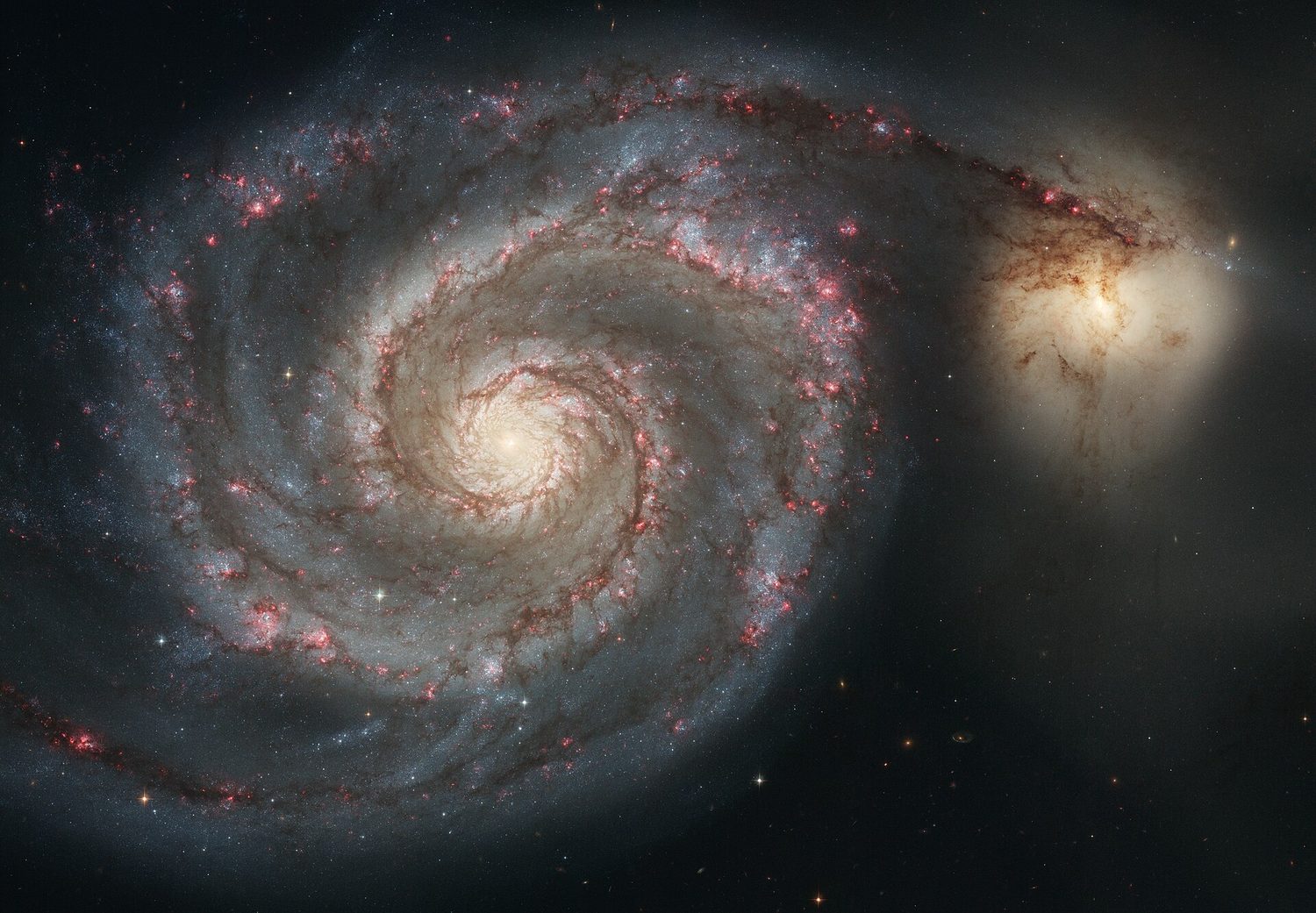
A galaxy 星系 is a group of many billions of stars held together by gravity. Our Sun is one star in the galaxy called the Milky Way 银河系. All the other stars in the Milky Way are very much further from the Earth than the Sun is.
Distances between stars are so big that we measure them in light-years 光年. One light-year is the distance light travels in one year (in the vacuum of space), which is about $9.5 \times 10^{15}\ \text{m}$.
The Milky Way is about $100\,000$ light-years across (its diameter 直径). It is just one of many billions of galaxies. All of these galaxies together make up the Universe 宇宙.
עברית
גלקסיה היא קבוצה של מיליארדים רבים של כוכבים שמחזיקים אותם יחד הכבידה. השמש שלנו היא כוכב אחד בגלקסיה הנקראת שביל החלב. כל שאר הכוכבים בשביל החלב נמצאים הרבה יותר רחוק מכדור הארץ מאשר השמש.
גלקסיה ספירלית: מיליארדי כוכבים המוחזקים יחד על ידי משיכה כבידתית
המרחקים בין כוכבים גדולים מאוד כך שאנו מדד אותם בשנתי אור. שנתי אור היא המרחק שהאור עובר בשנה אחת (בוואקום החלל), שהוא בערך $9.5 \times 10^{15}\ \text{m}$.
הכוח האווירי הוא בערך $100\,000$ שנתי אור בקוטרו (קוטר). זו רק אחת מכמה מיליארדי גלקסיות. כל הגלקסיות הללו יחד יוצרות את יקום.
טלסקופ ענק לומד את שמי הלילה; הלייזר עוזר לו ליצור תמונות חדשות של כוכבים רחוקים
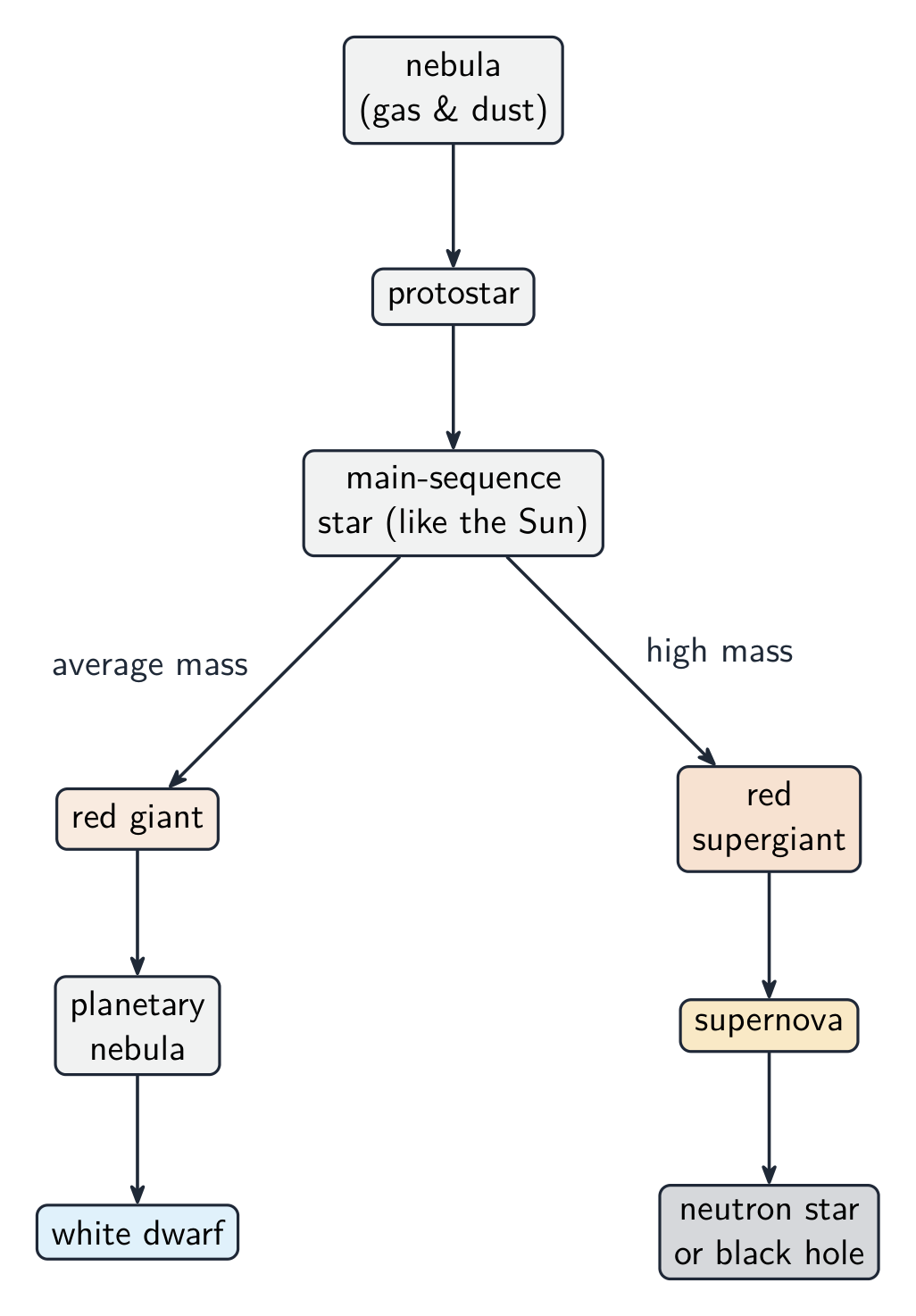
A star is born, lives and dies over a very long time:
A star forms from an interstellar cloud 星际云 of gas and dust that contains hydrogen.
Gravity pulls the cloud inwards, and it heats up. This collapsing, heating cloud is a protostar 原恒星.
The protostar becomes a stable 稳定 star when the inward pull of gravity is balanced by an outward push caused by the very high temperature in its centre.
In time, every star runs out of hydrogen fuel 燃料 for fusion.
What happens next depends on the mass of the star:
A medium star (like the Sun) swells into a red giant 红巨星. It then throws off its outer layers as a glowing cloud called a planetary nebula 星云, leaving a small, hot white dwarf 白矮星 at the centre.
A much heavier star swells into a red supergiant 红超巨星 and then explodes as a supernova 超新星. This blast spreads out a nebula containing hydrogen and new, heavier elements, and leaves behind a neutron star 中子星 or a black hole 黑洞.
The nebula from a supernova can later form new stars, with planets orbiting them — so our own Solar System came from earlier stars.
עברית
כוכב נולד, חי ומת לאורך זמן ארוך מאוד:
כוכב נוצר מתוך ענן אינטרה-סטריאלי של גז ואבק שמכיל מימן.
כבידה מושכת את הענן פנימה, והוא מתחמם. ענן זה הצונח והמתחמם הוא פרוטוכוכב.
הפרוטוכוכב הופך לכוכב יציב כאשר הכוח הפנימי של הכבידה מאוזן בדחיפה החיצונית הנגרמת מטמפרטורה גבוהה מאוד במרכזו.
לאורך זמן, לכל כוכב נגמר הדלק למימן דלק להיתוך.
מה שקורה לאחר מכן תלוי במסת הכוכב:
כוכב בינוני (כמו השמש) מתנפח לענק אדום. הוא אז משליך את שכבותיו החיצוניות כענן זוהר הנקרא ניבולה פלנטרית, ומשאיר נאד לבן קטן וחם במרכז.
כוכב כבד יותר מתנפח לענק על אדום ואז מתפוצץ כסופרנובה. פיצוץ זה מפיץ ניבולה המכילה מימן ואלמנטים כבדים וחדשים, ומשאיר מאחור כוכב נייטרונים או חור שחור.
כל כוכב מתחיל בניבולה; סיומו תלוי במסתו
הניבולה מהסופרנובה יכולה ליצור מאוחר כוכבים חדשים, עם כוכבי לכת המקיפים אותם – כך שהמערכת השמש שלנו נוצרה מכוכבים קודמים.
Explore · חקור
The life cycle of a star · מחזור החיים של כוכב
Gravity pulls a gas cloud together; fusion lights the star; when its fuel runs low it swells and finally fades. · כוח הכבידה מושך ענן גז יחד; מיזוג מדליק את הכוכב; כאשר הדלק נגמר, הוא מתנפח ולבסוף דוהה.
Explore · חקור
The life cycle of a Sun-like star · מחזור החיים של כוכב כמו השמש
Step through how a star like our Sun is born, lives and dies. · עברו שלבים איך כוכב כמו השמש שלנו נולד, חי ומת.
When a star or galaxy moves away from us (it is receding 退行), the light we receive from it has a longer wavelength 波长 than normal — it is shifted towards the red end of the spectrum. This is redshift 红移.
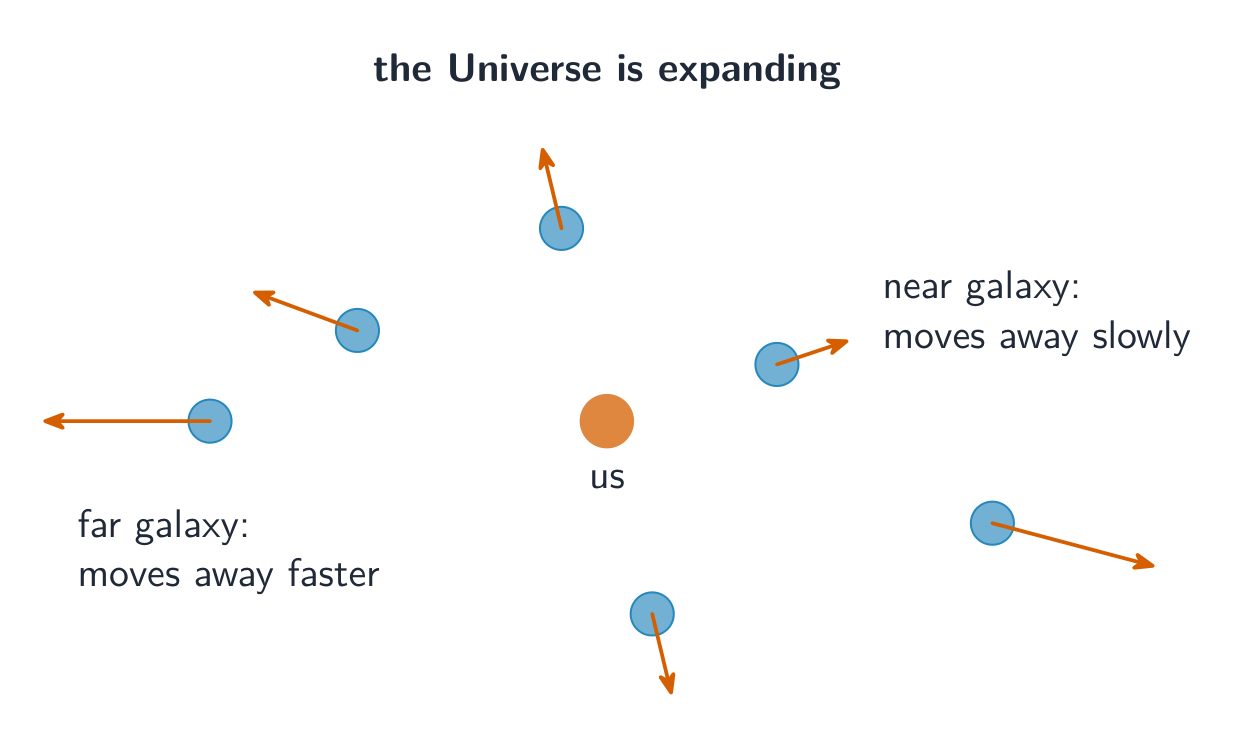
The light from distant galaxies is redshifted, and the further away a galaxy is, the bigger its redshift. This tells us that the galaxies are moving apart: the Universe is expanding 膨胀. Running this backwards, everything was once together at a single point — this is the evidence for the Big Bang 大爆炸 theory.
More evidence and the age of the Universe
Faint microwave 微波radiation 辐射 is found coming from every direction in space. This is the cosmic microwave background radiation 宇宙微波背景辐射 (CMBR). It was made as high-energy radiation soon after the Big Bang, and has been stretched out into the microwave part of the spectrum as the Universe expanded.
For a distant galaxy:
its speed $v$ of moving away can be found from the redshift of its starlight;
its distance $d$ can be found from the brightness of a supernova seen in it.
The Hubble constant 哈勃常数$H_0$ links these two:
$$H_0 = \frac{v}{d}$$
Its value today is about $2.2 \times 10^{-18}$ per second. Turning this around gives an estimate for the age of the Universe:
$$\frac{d}{v} = \frac{1}{H_0}$$
Worked example. The Hubble constant is about $H_0 = 2.2 \times 10^{-18}$ per second. Estimate the age of the Universe.
This works because every galaxy seems to have started from the same single point at the same time — more support for the Big Bang.
עברית
כאשר כוכב או גלקסיה נעמק away from us (הוא נסוג), האור שאנו מקבלים ממנו יש אורך גל ארוך יותר מהרגיל – הוא מוזז אל הקצה האדום של הספקטרום. זהו הזזה לאדום.
הקווים הכהים בספקטרום של גלקסיה מרוחקת מוזזים לעבר הקצה האדום — זהו הזזה לאדום
האור מגלקסיות מרוחקות חשף להזזה לאדום, וככל שהגלקסיה רחוקה יותר, כך ההזזה לאדום שלה גדולה יותר. הדבר מעיד על כך שגלקסיות מתרחקות זו מזו: היקום מתפשט. אם נחזור אחורה, כל דבר היה פעם יחד בנקודה אחת — זהו העדות לתיאוריית המפץ הגדול.
כל גלקסיה נמצאת במרחק מאיתנו, והרחוקות ביותר מתרחקות מהר יותר — היקום מתפשט
עדות נוספת וגיל היקום
מציאים קרינה מיקרוגלית חלשה הפונה מכל כיוון בחלל. זוי הקרינת הרקע המיקרוגלית הקוסמית (CMBR). היא נוצרה כקרינה בעלת אנרגיה גבוהה זמן קצר לאחר המפץ הגדול, והתארכה לחלק המיקרוגלי של הספקטרום כאשר היקום התפשט.
שמיים כולם ממופים במיקרוגלים: זוהר חלש זה מגיע אלינו מכל כיוון כתוצרת לווחה שנותרה מהיקום הצעיר — עדות חזקה למפץ הגדול
לגלקסיה מרוחקת:
מהירותה $v$ של התרחקות יכולה להיות נמצאת מתוך ההזזה לאדום של אור כוכביה;
מרחקה $d$ יכולה להיות נמצאת מתוך בהירותו של סופרנובה הנצפה בה.
קבוע האבל$H_0$ מקשר בין שני אלו:
$$H_0 = \frac{v}{d}$$
ערכו היום הוא כ-$2.2 \times 10^{-18}$ לשנייה. הפיכת זאת נותנת הערכה לגיל היקום:
$$\frac{d}{v} = \frac{1}{H_0}$$
דוגמה פתורה. קבוע האבל הוא כ-$H_0 = 2.2 \times 10^{-18}$ לשנייה. העריך את גיל היקום.
דבר זה עובד כי לכל גלקסיה נראה שהתחילה מאותה נקודה אחת באותו זמן — תמיכה נוספת במפץ הגדול.
Explore · חקור
The expanding Universe · היקום הנפשע
v = H₀·d
Galaxies recede faster the farther they are — speed is proportional to distance. · גלקסיות הרחקות מהר יותר ככל שהן רחוקות יותר — המהירות פרופורציונלית למרחק.
In $v = \dfrac{2\pi r}{T}$, $r$ is the orbit radius and $T$ is the time for one full orbit in seconds — convert km to m and hours to seconds first.
Planets closer to the Sun feel stronger gravity, so they orbit faster and take less time. In an elliptical orbit a body speeds up as it nears the Sun (gravitational potential energy turns into kinetic energy).
A light-year is a distance, not a time — how far light travels in one year.
A star is stable when the inward pull of gravity is balanced by the outward push from the energy released by fusion in its core. What it becomes when its fuel runs out depends on its mass.
Redshift — light from distant galaxies shifted to longer (redder) wavelengths, with a bigger shift the further away — is the evidence that the Universe is expanding, which supports the Big Bang.
עברית
ב-$v = \dfrac{2\pi r}{T}$, $r$ הוא רדיוס המסלול ו-$T$ הוא הזמן למסלול מלא בשניות — יש להמיר ק"מ למטר ושעות לשניות קודם.
כוכבי לכת קרובים יותר לשמש מרגישים כבידה חזקה יותר, ולכן הם מקיפים מהר יותר ולוקח פחות זמן. במסלול אלפטי גוף מאיץ כשהוא מתקרב לשמש (אנרגיה פוטנציאלית כבידתית הופכת לאנרגיה קינטית).
שנת אור היא מרחק, ולא זמן – כמה אור עובר בשנה אחת.
כוכב הוא יציב כאשר המשיכה הפנימית של הכבידה מאוזנת על ידי הדחיפה החיצונית של האנרגיה המשתחררת מהיתוך בגרעינו. מה שהוא יהפוך כאשר הדלק שלו ייגמר תלוי ב-מסתו.
הזזה לאדום – אור מגלקסיות מרוחקות המוזז לאורך גלים ארוכים יותר (אדומים יותר), עם הזזה גדולה יותר ככל שהמרחק רחוק יותר – היא העדות לכך שהיקום מתפשט, ותומך במפץ הגדול.
Interactive lessons on this topic · שיעורים אינטראקטיביים בנושא זה
Work through it step by step, with instant-check exercises. · לעבור על הדברים צעד אחר צעד, עם תרגילים לבדיקה מיידית.
Pick one and the site follows you — notes, papers, videos and practice all open on it. · בחרו נושא אחד והאתר יעקוב אחריו — הערות, מסמכים, וידאו ותרגולים פתוחים בו.
Type to search notes, lessons, code, vocabulary and past-paper questions across every subject. · הקלד כדי לחפש הערות, שיעורים, קוד, אוצר מילים ושאלות מבחנים בכל הנושאים.