הכל סביבנו עשוי מאטומים — ואולם אטום הוא כמעט ריק לחלוטין. אם הגרעין היה בגודל חרוז, האטום כולו היה בגודל…
English narration · English + 中文 subtitles burned in · קריאת קול באנגלית · תרגום אנגלי + סינית שרוף בתוך הסרטון
5.1
The atom · האטום
Syllabus · סיילבוס
English
5.1.1 The atom
Core
Supplement
1 Describe the structure of an atom in terms of a positively charged nucleus and negatively charged electrons in orbit around the nucleus
3 Describe how the scattering of alpha ($\alpha$) particles by a sheet of thin metal supports the nuclear model of the atom, by providing evidence for: (a) a very small nucleus surrounded by mostly empty space (b) a nucleus containing most of the mass of the atom (c) a nucleus that is positively charged
2 Know how atoms may form positive ions by losing electrons or form negative ions by gaining electrons
5.1.2 The nucleus
Core
Supplement
1 Describe the composition of the nucleus in terms of protons and neutrons
6 Describe the processes of nuclear fission and nuclear fusion as the splitting or joining of nuclei, to include the nuclide equation and qualitative description of mass and energy changes without values
2 State the relative charges of protons, neutrons and electrons as +1, 0 and –1 respectively
3 Define the terms proton number (atomic number) $Z$ and nucleon number (mass number) $A$ and be able to calculate the number of neutrons in a nucleus
7 Know the relationship between the proton number and the relative charge on a nucleus
8 Know the relationship between the nucleon number and the relative mass of a nucleus
4 Use the nuclide notation $^{A}_{Z}\text{X}$
5 Explain what is meant by an isotope and state that an element may have more than one isotope
עברית
5.1.1 האטום
ליבה
תוספת
1 תאר את מבנה האטום על בסיס גרעין טעון בחיוב ו-אלקטרונים טעונים במינוס הנעים במסלול סביב הגרעין
3 תאר כיצד פיזור חלקיקי אלפא ($\alpha$) על ידי דף מתכת דק תומך במודל הגרעיני של האטום, על ידי מתן עדות ל: (א) גרעין קטן מאוד surrounded by mostly empty space (ב) גרעין המכיל את רוב מסת האטום (ג) גרעין הטעון בחיוב
2 דע כיצד אטומים יכולים ליצור יונים חיוביים באמצעות איבוד אלקטרונים או יונים שליליים באמצעות רכישת אלקטרונים
5.1.2 הגרעין
ליבה
תוספת
1 תאר את הרכב הגרעין במונחי פרוטונים וניטרונים
6 תאר את תהליכי פיצול גרעיני ומיזוג גרעיני כפיצול או חיבור של גרעינים, כולל משוואת Nuclide ותיאור איכותי של שינויים במסה ואנרגיה ללא ערכים
2 נסח את המטענים היחסיים של פרוטונים, ניטרונים ואלקטרונים כ-+1, 0 ו–1 בהתאמה
3 הגדר את המונחים מספר אטומי (מספר פרוטונים) $Z$ ומספר מסה (מספר נוקליאונים) $A$ ויכול לחשב את מספר הניטרונים בגרעין
7 דע את הקשר בין מספר הפרוטונים למטען היחסי של הגרעין
8 דע את הקשר בין מספר המסה למסה היחסית של גרעין
4 השתמש בסימון Nuclide $^{A}_{Z}\text{X}$
5 הסבר מה מתכוונים לאיזוטופ וצין שאלמנט עשוי להיות בעל יותר מאיזוטופ אחד
Source: Cambridge International syllabus · מקור: הסיילבוס הבינלאומי של קמבריד'ג'
English
An atom 原子 is made of a tiny central nucleus 原子核 with electrons 电子 moving around it (in orbit 轨道, like planets around the Sun).
The nucleus has a positive charge 电荷.
The electrons have a negative charge.
The atom as a whole is neutral, because the positive and negative charges are equal.
Almost all the mass 质量 is in the nucleus, but the nucleus is very small compared with the whole atom. So an atom is mostly empty space.
Ions
An atom is neutral, but it can gain or lose electrons to become an ion 离子.
Lose one or more electrons → a positive ion (now there are more protons than electrons).
Gain one or more electrons → a negative ion.
The alpha-scattering experiment
This experiment gave the evidence for the nuclear model. Alpha particles α粒子 (small, fast, positive) were fired at a very thin gold foil 金箔, and the scattering 散射 (the way they bounced off) was watched.
The results and what they tell us:
Almost all the alpha particles went straight through. → The atom is mostly empty space.
A few were deflected 偏转 (bent) through small angles. → The nucleus has a positive charge, which pushes the positive alpha particles away.
A very few bounced almost straight back. → The nucleus is very small and very heavy, and holds most of the mass of the atom.
עברית
אטום מורכב מגרעין מרכזי קטן עם אלקטרונים הנעים סביבו (במסלול, כמו כוכבי לכת סביב השמש).
לגרעין יש מטען חיובי.
לאלקטרונים יש מטען שלילי.
האטום ככלל הוא ניטרלי, משום שמטעני החיוביים והשליליים שווים זה לזה.
כמעט כל המסה נמצאת בגרעין, אך הגרעין קטן מאוד ביחס לאטום כולו. לכן אטום מורכב בעיקר מחלל ריק.
האטום הגרעיני: גרעין צפוף וקטן של פרוטונים וניטרונים, עם אלקטרונים במסלולים סביבו
יונים
אטום הוא ניטרלי, אך יכול להפוך ליון על ידי רכישת או איבוד אלקטרונים.
איבוד אלקטרון אחד או יותר → יון חיובי (כעת ישנם יותר פרוטונים מאשר אלקטרונים).
רכישת אלקטרון אחד או יותר → יון שלילי.
ניסוי פיזור אלפא
ניסוי זה סיפק את המצער לדגם הגרעיני. חלקיקי אלפא α (קטנים, מהירים וחיוביים) הושלכו לעבר דף זהב דק מאוד, והפיזור (הדרך בה הם בוזזו החוצה) נצפה.
התוצאות ומה שהן מעידות עליהן:
כמעט כל חלקיקי האלפא עברו ישר דרך הדף. → האטום מורכב בעיקר מחלל ריק.
מספר מעט נסחפו (שברו כיוון) בזוויות קטנות. → לגרעין יש מטען חיובי, הדוחה את חלקיקי האלפא החיוביים.
מספר זעיר בוזז几乎 חזרה ישרה. → הגרעין קטן מאוד וכבד מאוד, ומכיל את רוב מסת האטום.
רוב חלקיקי אלפא עוברים ישר דרכם; מעטים מתכופפים ומועטים מאוד קופצים אחורה מהגרעין הקטן והצפוף
Explore · חקור
Inside the atom · בתוך האטום
A tiny dense nucleus sits at the centre with electrons in shells around it — drag the proton number and watch the shells fill outward. · ליבה קטנה וצפופה יושבת במרכז עם אלקטרונים בשכבות סביבה — גרור את מספר הפרוטונים והצפה את השכבות החוצה.
The nucleus is made of two kinds of particle, together called nucleons 核子:
protons 质子, which have a relative 相对 charge of $+1$;
neutrons 中子, which have a relative charge of $0$ (they are neutral).
An electron has a relative charge of $-1$. A proton and a neutron each have a relative mass of about $1$; an electron is almost massless in comparison.
Two numbers describe a nucleus:
the proton number 质子数$Z$ (also called the atomic number) — the number of protons;
the nucleon number 核子数$A$ (also called the mass number) — the number of protons plus neutrons.
So the number of neutrons is $A - Z$.
We write a nucleus in nuclide 核素 notation:
$$^{A}_{Z}\text{X}$$
where X is the chemical symbol. For example, $^{197}_{\ 79}\text{Au}$ has $79$ protons and $197 - 79 = 118$ neutrons. The relative charge of the whole nucleus is just $+Z$ (here $+79$), and its relative mass is about $A$.
Isotopes
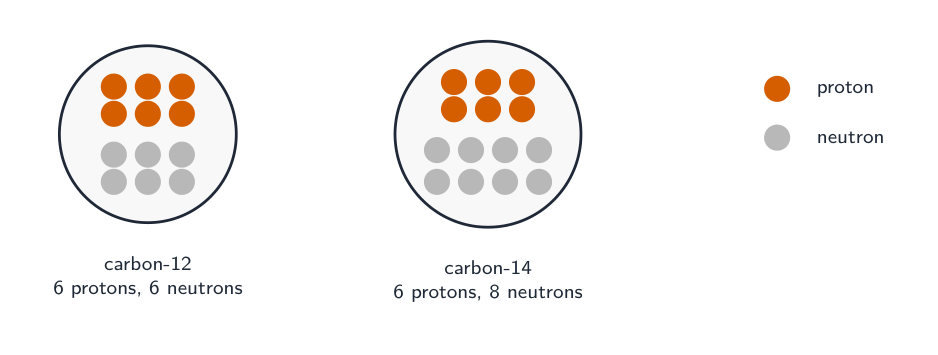
Isotopes 同位素 are atoms of the same element (the same $Z$) but with different numbers of neutrons (different $A$). They behave the same in chemistry but differently in the nucleus. For example, $^{12}_{\ 6}\text{C}$ and $^{14}_{\ 6}\text{C}$ are both carbon.
Nuclear fission and fusion
In nuclear fission 核裂变, a heavy nucleus absorbs a neutron and then splits into two smaller nuclei, giving out two or three neutrons and a lot of energy 能量:
The top numbers (nucleon numbers) balance on both sides, and so do the bottom numbers (proton numbers). You can use this to find a missing number — for example, how many neutrons are released.
In nuclear fusion 核聚变, two light nuclei join to make a heavier one, also giving out energy. This is how the Sun makes its energy, joining hydrogen 氢 nuclei to make helium 氦. The reaction below — two heavy forms of hydrogen (deuterium and tritium) joining into helium — is the one used in fusion reactors on Earth:
In both fission and fusion, a small amount of mass is lost and turned into energy.
עברית
הגרעין מורכב משני סוגים של חלקיקים, המכונים יחד נוקלאונים:
פרוטונים, שיש להם מטען יחסי של $+1$;
ניטרונים, שיש להם מטען יחסי של $0$ (הם ניטרליים).
לאלקטרון יש מטען יחסי של $-1$. לפרוטון ולניטרון יש כל אחד מסה יחסית של כ-$1$; אלקטרון הוא כמעט חסר מסה בהשוואה.
שתי מספרים מתארים גרעין:
מספר האטומי$Z$ (נקרא גם מספר האטום) — מספר הפרוטונים;
מספר הנוקלאונים$A$ (נקרא גם מספר המסה) — מספר הפרוטונים פלוס הניטרונים.
לכן, מספר הנוטרונים הוא $A - Z$.
אנו כותבים גרעין בתווית נוקליד:
$$^{A}_{Z}\text{X}$$
כאשר X הוא הסמל הכימי. לדוגמה, $^{197}_{\ 79}\text{Au}$ יש לו $79$ פרוטונים ו$197 - 79 = 118$ נייטרונים. המטען היחסי של כל הגרעין הוא בדיוק $+Z$ (כאן $+79$), ומסתו היחסית היא כ-$A$.
איזוטופים
איזוטופים הם אטומים מאותו יסוד (אותו $Z$) אך עם מספרים שונים של נייטרונים ($A$ שונה). הם מתנהגים זהה בכימיה אך שונה בגרעין. לדוגמה, $^{12}_{\ 6}\text{C}$ ו$^{14}_{\ 6}\text{C}$ הם שניהם פחמן.
איזוטופים של פחמן יש להם אותם שישה פרוטונים אך מספרים שונים של נייטרונים, ולכן הם אותו יסוד אך עם מסה שונה
פיזור ומיזוג גרעיני
בפיזור גרעיני, גרעין כבד סופג נייטרון ואז מתפצל לשני גרעינים קטנים יותר, ושולח שני או שלושה נייטרונים וכמות רבה של אנרגיה:
*נייטרון מפצל גרעין U-235 לשני גרעינים קטנים יותר, ומשחרר נייטרונים ואנרגיה נוספים
המספרים העליונים (מספרי הנוקלאונים) מאוזנים בשני הצדדים, כמו גם המספרים התחתונים (מספרי האטום). ניתן להשתמש בזה כדי למצוא מספר חסר — לדוגמה, כמה נייטרונים משוחררים.
במיזוג גרעיני, שני גרעינים קלים מתחברים ליצירת גרעין כבד יותר, וגם כאן משתחררת אנרגיה. כך השמש מייצרת את אנרגיותיה, על ידי חיבור גרעיני מימן ליצירת הליום. התגובה למטה — שני צורות כבדות של מימן (דאוטריום וטרציום) מתחברות להליום — זו התגובה המשמשת במגהלי מיזוג על כדור הארץ:
בהיתוך שני גרעינים קלים מתחברים לגרעין כבד יותר, ומשחררים ניוטרון ואנרגיה — תגובת הדאוטריום-טרציום המשמשת במ反应רי היתוך
בכל פיזור ומיזוג, כמות קטנה של מסה מאבדת ועוברת לאנרגיה.
תחנת כוח גרעינית משתמשת באנרגיה מפיצול גרעיני ליצירת חשמל; המגדלים משחררים חום פסולת בצורת אדים
Explore · חקור
The fission chain reaction · תגובת הסדירה הגרעינית
A neutron splits a uranium nucleus, which releases energy AND more neutrons — those split more nuclei, and so on. · ניטרון מפצל ליבת אורניום, שמשחררת אנרגיה AND יותר ניטרונים — אלו מפצלים עוד ליבות, וכך הלאה.
2 Know the sources that make a significant contribution to background radiation including: (a) radon gas (in the air) (b) rocks and buildings (c) food and drink (d) cosmic rays
3 Know that ionising nuclear radiation can be measured using a detector connected to a counter
4 Use count rate measured in counts / s or counts / minute
5 Use measurements of background radiation to determine a corrected count rate
5.2.2 The three types of nuclear emission
Core
Supplement
1 Describe the emission of radiation from a nucleus as spontaneous and random in direction
2 Identify alpha ($\alpha$), beta ($\beta$) and gamma ($\gamma$) emissions from the nucleus by recalling: (a) their nature (b) their relative ionising effects (c) their relative penetrating abilities ($\beta^+$ are not included, $\beta$-particles will be taken to refer to $\beta^-$)
3 Describe the deflection of $\alpha$-particles, $\beta$-particles and $\gamma$-radiation in electric fields and magnetic fields
4 Explain their relative ionising effects with reference to: (a) kinetic energy (b) electric charge
5.2.3 Radioactive decay
Core
Supplement
1 Know that radioactive decay is a change in an unstable nucleus that can result in the emission of $\alpha$-particles or $\beta$-particles and/or $\gamma$-radiation and know that these changes are spontaneous and random
3 Know that isotopes of an element may be radioactive due to an excess of neutrons in the nucleus and/or the nucleus being too heavy
2 State that during $\alpha$-decay or $\beta$-decay, the nucleus changes to that of a different element
4 Describe the effect of $\alpha$-decay, $\beta$-decay and $\gamma$-emissions on the nucleus, including an increase in stability and a reduction in the number of excess neutrons; the following change in the nucleus occurs during $\beta$-emission neutron $\rightarrow$ proton + electron
5 Use decay equations, using nuclide notation, to show the emission of $\alpha$-particles, $\beta$-particles and $\gamma$-radiation
5.2.4 Half-life
Core
Supplement
1 Define the half-life of a particular isotope as the time taken for half the nuclei of that isotope in any sample to decay; recall and use this definition in simple calculations, which might involve information in tables or decay curves (calculations will not include background radiation)
2 Calculate half-life from data or decay curves from which background radiation has not been subtracted
3 Explain how the type of radiation emitted and the half-life of an isotope determine which isotope is used for applications including: (a) household fire (smoke) alarms (b) irradiating food to kill bacteria (c) sterilisation of equipment using gamma rays (d) measuring and controlling thicknesses of materials with the choice of radiations used linked to penetration and absorption (e) diagnosis and treatment of cancer using gamma rays
5.2.5 Safety precautions
Core
Supplement
1 State the effects of ionising nuclear radiations on living things, including cell death, mutations and cancer
2 Describe how radioactive materials are moved, used and stored in a safe way
3 Explain safety precautions for all ionising radiation in terms of reducing exposure time, increasing distance between source and living tissue and using shielding to absorb radiation
עברית
5.2.1 גילוי רדיואקטיביות
ליבה
תוספת
1 לדעת מהו רדיציה רקעית
2 לדעת את המקורות התורמים משמעותית לרדיציה רקעית, כולל: (א) גז רדון (באוויר) (ב) סלעים ובניינים (ג) מזון ומשקאות (ד) קרניים קוסמיות
3 לדעת שרדיציה גרעינית יוניזציה ניתנת למדידה באמצעות גלאי המחובר לספן
4 להשתמש בקצב ספירה הנמדד ביחידות counts / s או counts / דקה
5 להשתמש במדידות של רדיציה רקעית כדי לקבוע קצב סירה מותאם
5.2.2 שלושת סוגי הפליטות הגרעينية
ליבה
תוספת
1 לתאר את פליטת הרדיציה מגרעין כתהליך ספונטני ואקראי בכיוונו
2 לזהות אלפא ($\alpha$), בטה ($\beta$) ו-גאמא ($\gamma$) כפליטות מגרעין על ידי זכירת: (א) טבען (ב) השפעות היוניזציה היחסיות שלהן (ג) יכולות החדירה היחסיות שלהן ($\beta^+$ אינן כלולות, חלקיקי $\beta$ ייחשבו כמתייחסים ל$\beta^-$)
3 לתאר את הכיפוף של חלקיקי $\alpha$, חלקיקי $\beta$ ורדיציה $\gamma$ בשדות חשמליים ומגנטיים
4 להסביר את השפעות היוניזציה היחסיות בהתייחס ל: (א) אנרגיה קינטית (ב) מטען חשמלי
5.2.3 דעיכה רדיואקטיבית
ליבה
תוספת
1 לדעת שדעיכה רדיואקטיבית היא שינוי בגרעין לא יציב שיכול לגרום לפליטת חלקיקי $\alpha$ או חלקיקי $\beta$ ו/או רדיציה $\gamma$ ולדעת ששינויים אלו הם ספונטניים ואקראיים
3 לדעת שאיזוטופים של אלמנט עשויים להיות רדיואקטיביים בשל עודף נייטרונים בגרעין ו/או בגלל שהגרעין כבד מדי
2 ציין כי במהלך דעיכת $\alpha$ או דעיכת $\beta$, הגרעין משתנה לזה של אלמנט שונה
4 תאר את השפעת פליטת $\alpha$, פליטת $\beta$ ופליטת $\gamma$ על הגרעין, כולל עלייה ביציבות והפחתה במספר הניטרונים העודפים; השינוי הבא מתרחש בגרעין במהלך פליטת $\beta$: נייטרון $\rightarrow$ פרוטון + אלקטרון
5 להשתמש במשוואות דעיכה, באמצעות סימון נוקליד, כדי להציג פליטת חלקיקי $\alpha$, חלקיקי $\beta$ ורדיציה $\gamma$
5.2.4 מחצית חיים
ליבה
תוספת
1 להגדיר את מחצית החיים של איזוטופ מסוים כזמן הנדרש לכך שחצי מגרעיני האיזוטופ הזה בכל דגימה ידעכו; לזכור ולהשתמש בהגדרה זו בחישובים פשוטים, שעשויים לכלול מידע בטבלאות או בעקומי דעיכה (חישובים לא יכללו רדיציה רקעית)
2 לחשב את מחצית החיים ממידע או מעקומי דעיכה מהם לא הופחתה רדיציה רקעית
3 להסביר כיצד סוג הרדיציה הנפלטת ומחצית החיים של איזוטופ קובעים את האיזוטופ המתאים ליישומים כגון: (א) אזעקות עשן ביתיות (ב) עיבוד מזון להריסת חיידקים (ג) חיטוי ציוד באמצעות קרני גאמא (ד) מדידה ושליטה בעובי חומרים עם בחירת הקרניים המתאימה בהתאם לחדירה ולספיגה (ה) אבחון וטיפול בסרטן באמצעות קרני גאמא
5.2.5 אמצעי בטיחות
ליבה
תוספת
1 לציין את ההשפעות של רדיציות גרעיניות יוניזציה על בעלי חיים, כולל מוות תאי, מוטציות וסרטן
2 תאר כיצד חומרים רדיואקטיביים מועברים, משמשים ומוחזקים באופן בטוח
3 הסבר אמצעי בטיחות לכל סוגי הקרינה האיינית בהתבסס על צמצום זמן החשיפה, הגדלת המרחק בין המקור לבין הרקמה החיה והשתמשות בחומרי הגנה לספיגת הקרינה
Source: Cambridge International syllabus · מקור: הסיילבוס הבינלאומי של קמבריד'ג'
English
Radioactive decay & half-life
A nucleus that is unstable 不稳定 will sooner or later break down and give out radiation 辐射. This is radioactive 放射性decay 衰变. A nucleus may be unstable because it has too many neutrons, or because it is too heavy.
Decay is spontaneous 自发 (it happens on its own, and you cannot speed it up or slow it down) and random 随机 (you cannot say which nucleus will decay next, or exactly when).
Background radiation
Some radiation is around us all the time. This is background radiation 背景辐射. Its main sources are:
radon 氡 gas in the air (usually the biggest source);
rocks and buildings;
food and drink;
cosmic rays 宇宙射线 from space.
Measuring radiation
Radiation can be measured with a detector 探测器 joined to a counter 计数器. The count rate 计数率 is the number of counts each second (or each minute).
To find the true count rate from a source, first measure the background count rate on its own, then subtract it. The answer is the corrected 修正 count rate:
Worked example. A detector placed next to a source reads $250$ counts/min. With the source taken away, the background count rate is $30$ counts/min. Find the corrected count rate.
$$250 - 30 = 220\ \text{counts/min}$$
עברית
פירוק רדיואקטיבי ומחצית חיים
גרעין שהוא לא יציב יתפרק בהכרח בעתיד וישחרר קרניים. תהליך זה נקרא פירוק רדיואקטיבי. גרעין עשוי להיות לא יציב בגלל מספר ניטרונים מוגזם, או משום שהוא כבד מדי.
הפירוק הוא ספונטני (מתרחש מעצמו ואי אפשר להאיץ אותו או להאט אותו) ואקראי (לא ניתן לנקות איזה גרעין יתפרק הבא, או מתי בדיו).
קרינה רקע
חלק מהקרנה נמצאת סביבנו בכל עת. זוהי קרנת רקע. המקורות העיקריים שלה הם:
גז רדון באוויר (בדרך כלל המקור הגדול ביותר);
סלעים ובניינים;
מזון ומשקאות;
קרנים קוסמיות מחלל.
מדידת קרינה
ניתן למדוד קרינה באמצעות גלאי המחובר לסופר. קצב הספירה הוא מספר הספירות בכל שניה (או בכל דקה).
כדי למצוא את קצב הספירה האמיתי ממקור, יש למדוד תחילה את קצב הספירה ברקע לבדו, ולאחר מכן לחסרו. התוצאה היא קצב הספירה המתוקן:
The radiation can be one of three types. Each type is ionising 电离, which means it can knock electrons off atoms in its path.
Type
What it is
Ionising effect
Stopped by
alpha (α)
a helium nucleus: 2 protons + 2 neutrons, charge $+2$
strongest
a sheet of paper, or a few cm of air
beta (β)
a fast-moving electron, charge $-1$
medium
a few mm of aluminium 铝
gamma (γ)
a high-energy electromagnetic wave 电磁波, no charge
weakest
thick lead 铅 or concrete (only reduced, never fully stopped)
So an alpha particle is the most ionising but the least penetrating 穿透 (it is easily absorbed 吸收). A beta particle β粒子 is in the middle. Gamma radiation γ射线 is the least ionising but the most penetrating.
We can explain the ionising effects from charge and kinetic energy 动能: an alpha particle has a large charge ($+2$) and is slow and heavy, so it pulls strongly on the electrons it passes and ionises a lot. A beta particle has a smaller charge and moves faster, so it ionises less.
Deflection in fields
Because alpha and beta particles are charged, they are deflected by an electric field 电场 and by a magnetic field 磁场. They bend in opposite directions, because their charges have opposite signs, and the lighter beta particle bends more. Gamma rays have no charge, so they are not deflected at all.
עברית
הקרנה יכולה להיות אחד משלושה סוגים. לכל סוג יש יכולת מיינות, כלומר הוא יכול לשלוח אלקטרונים ממסילות האטומים הנמצאים בדרך שלו.
סוג
מהו
אפקט מיינות
מופסק על ידי
אלפא (α)
גרעין הליום: 2 פרוטונים + 2 נייטרונים, מטען $+2$
החזק ביותר
דף נייר או כמה ס"מ של אוויר
בטא (β)
אלקטרון הנע במהירות, מטען $-1$
בינוני
מספר מ"מ של אלומיניום
גמא (γ)
גל אלקטרומגנטי בעל אנרגיה גבוהה, ללא מטען
החלש ביותר
עופרת עבה או בטון (רק מופחת, לעולם לא עצור לחלוטין)
לכן חלקיק אלפא הוא המיוין ביותר אך החדירה הפחותה ביותר (הוא נספג בקלות). חלקיק בטא β נמצא באמצע. קרני גמא γ הן המיוינות הפחותות אך בעלות החדירה הגבוהה ביותר.
נייר מעצור את האלפא, מספר מילימטרים של אלומיניום מעצור את הבטא, ועופרת עבה רק מפחיתה את הגמא
ניתן להסביר את ההשפעות המיוינות לפי מטען ואנרגיה קינטית: חלקיק אלפא יש לו מטען גדול ($+2$) והוא איטי וכבד, ולכן הוא מושך בחוזקה את האלקטרונים שחוצים ומייין הרבה. חלקיק בטא יש לו מטען קטן יותר ונע מהר יותר, ולכן הוא פחות מיוין.
הסטה בשדות
מכיוון שחלקיקי אלפא ובטא טעונים, הם מוסטים על ידי שדה חשמלי ועל ידי שדה מגנטי. הם מתכופפים בכיוונים מנוגדים, מכיוון שמטעניהם סימנים הפוכים, וחלקיק הבטא הקל יותר מתכופף יותר. קרני גמא אין להן מטען, ולכן הן אינן מוסטות כלל.
אלפא ובטא מתכופפים בכיוונים מנוגדים; הבטא הקל יותר מתכופף יותר, וגמא שאינו טעון אינו מוסט
5.2
Decay equations · משוואות דעיכה
English
When a nucleus decays, the nucleon and proton numbers must balance on both sides.
Alpha decay — the nucleus loses 2 protons and 2 neutrons, so $A$ falls by $4$ and $Z$ falls by $2$. It becomes a different element:
Gamma emission — the nucleus loses only energy, so $A$ and $Z$ do not change. Alpha and beta decay leave the nucleus more stable 稳定; gamma is often given out at the same time to carry away spare energy.
עברית
כאשר גרעין דועך, מספרי Nuclon ופרוטון חייבים להתאזן בשני הצדדים.
עיפוין אלפא – הגרעין מאבד 2 פרוטונים ו2 נייטרונים, ולכן $A$ יורד ב$4$ ו$Z$ יורד ב$2$. הוא הופך ליסוד שונה:
פליטת גמא — הגרעין מאבד רק אנרגיה, ולכן $A$ ו$Z$ אינם משתנים. דעיכות אלפא ובטא משאירות את הגרעין יותר יציב; גמא משתחרר לעיתים קרובות בו זמנית כדי לשאת את האנרגיה העודפת.
Because decay is random, we cannot follow one nucleus. Instead we describe a large sample 样品 using its half-life.
The half-life 半衰期 of an isotope is the time taken for half the unstable nuclei in a sample to decay. After each half-life, the count rate (or the number of unstable nuclei left) falls to half.
For example, if a source has a count rate of $800$ counts/min and a half-life of $3$ hours:
Time / hours
0
3
6
9
Count rate / (counts/min)
800
400
200
100
After $6$ hours (two half-lives) the count rate has halved twice: $800 \to 400 \to 200$. You can read a half-life off a decay graph by finding the time for the count rate to drop from any value to half of it. If the readings include background radiation, subtract the background count rate from every reading first, then find the half-life from the corrected values.
Worked example. The activity of a source falls from $800$ counts/min to $100$ counts/min. Its half-life is $5$ days. How long did this take?
Count the halvings: $800 \to 400 \to 200 \to 100$ is three half-lives, so the time is $3 \times 5 = 15\ \text{days}$.
עברית
מכיוון שדעיכה היא אקראית, לא ניתן לעקוב אחרי גרעין בודד. במקום זאת, מתארים דגימה גדולה באמצעות מחצית החיים שלה.
מחצית החיים של איזוטופ היא הזמן הנדרש כדי שחצי מהגרעינים הלא יציבים בדגימה ידעכו. לאחר כל מחצית חיים, קצב הספירה (או מספר הגרעינים הלא יציבים שנותרו) יורד לחצי.
לדוגמה, אם מקור בעל קצב ספירה של $800$ ספירות/דקה ומחצית חיים של $3$ שעות:
זמן / שעות
0
3
6
9
קצב ספירה / (ספירות/דקה)
800
400
200
100
לאחר $6$ שעות (שתי מחציות חיים), קצב הספירה צומצם פעמיים: $800 \to 400 \to 200$. ניתן לקרוא מחצית חיים מגרף הדעיכה על ידי מציאת הזמן שבו קצב הספירה יורד מכל ערך כלשהו לחציו. אם הקריאות כוללות קרינת רקע, יש להפחית את קצב הספירה ברקע מכל קריאה תחילה, ולאחר מכן למצוא את מחצית החיים מהערכים המתוקנים.
דוגמה מפורטת. הפעילות של מקור יורדת מ-$800$ ספירות/דקה ל-$100$ ספירות/דקה. מחצית החיים שלו היא $5$ ימים. כמה זמן נדרש לכך?
סופרים את הצמצומים: $800 \to 400 \to 200 \to 100$ משמעותו שלוש מחציות חיים, ולכן הזמן הוא $3 \times 5 = 15\ \text{days}$.
בכל מחצית חיים $T$ קצב הספירה מצטמצם בחצי: $N_0 \to N_0/2 \to N_0/4 \to N_0/8$
Each nucleus has a fixed chance of decaying, at random. Move time forward: about half the remaining nuclei decay every half-life — so the count halves, then halves again. · לכל גרעין יש סיכוי קבוע לדעיכה, באופן אקראי. קדימה בזמן: כחצי מהגרעינים הנותרים דועכים בכל זמן מחצית — ולכן הספירה מכפלת, ואז מכפלת שוב.
Uses of radioactivity · שימושים בקרינה רדיואקטיבית
English
The isotope chosen for a job depends on its type of radiation and its half-life:
smoke alarms 烟雾报警器 use an alpha source (alpha is easily blocked, so it is safe outside the alarm, and a long half-life means it lasts for years);
using radiation on food, or on equipment, kills bacteria 细菌 and germs — this needs penetrating gamma rays to sterilise 消毒 the sealed item;
measuring and controlling the thickness of paper or metal sheets uses a beta source (the amount that passes through changes with the thickness);
a medical tracer 医用示踪剂 is a small amount of a gamma-emitting isotope with a short half-life, injected into the body: a detector outside the body follows where it goes, gamma rays escape from the body easily, and the activity soon falls to a safe level;
gamma rays are used to find and to treat cancer 癌症 inside the body, because they can pass out of (or into) the body.
עברית
האיזוטופ הנבחר למשימה תלויה בסוג הקרינה ובמחצית החיים שלו:
גלאי עשן משתמשים במקור אלפא (אלפא חוסם בקלות, ולכן הוא בטוח מחוץ לגלאי, ומחצית חיים ארוכה פירונו הוא שהוא יחזיק שנים);
שימוש בקרינה במזון או בציוד, הורג בקטריות ומיקרובים — דבר זה דורש קרני גאמא חודרות כדי להסטריליזציה של הפריט האטום;
מדידה ושליטה בעובי של דפי נייר או לוחות מתכת משתמש במקור בטא (כמות החומר שעובר דרכו משתנה בהתאם לעובי);
סימן רפואי הוא כמות קטנה של איזוטופ פולט גאמא עם מחצית חיים קצרה, המוזרק לגוף: גלאי מחוץ לגוף עוקב אחר המקום שבו הוא הולך, קרני גאמא יוצאות בקלות מהגוף, והפעילות יורדת מהר לרמת בטיחות;
קרני גאמא משמשות לאיתור ולטיפול ב-סרטן בתוך הגוף, מכיוון שהן יכולות לצאת מ(או להיכנס ל)גוף.
רדיוטרפיה: מסכת רשת מחזיקה את החולה בשקט בזמן שלייזרים ליישור מכוונים קרני גאמא בדיוק לעבר גידום כדי לטפל בסרטן
5.2
Safety · בטיחות
English
Ionising radiation harms living cells 细胞. It can cause cell death, mutations 突变 (changes to the genes) and cancer.
When working with radioactive sources, keep the dose 剂量 (the amount of radiation received) low by:
reducing the exposure 照射 time — spend as little time near the source as possible;
increasing the distance between you and the source;
using shielding 屏蔽, such as lead, between the source and your body.
Radioactive sources should be handled with tongs (not bare hands), kept pointing away from people, and stored in a lead-lined box.
עברית
קרינה יונית פוגעת בתאים חיים. היא עלולה לגרום למות תאי, מוטציות (שינויים בגנים) ולסרטן.
בעת עבודה עם מקורות רדיואקטיביים, שמרו על מינון (כמות הקרינה שהתקבלה) נמוך באמצעות:
הפחתת זמן חשיפה — הבלו זמן ככל האפשר ליד המקור;
הגדלת המרחק ביניכם לבין המקור;
שימוש בעיכוב, כמו עופרת, בין המקור לגוף שלך.
מקורות רדיואקטיביים יש להחזיק במלקחיים (לא ביד חשופה), לשמור אותם מכוונים הרחק מאנשים, ולאחסנם בקופסה מצופת עופרת.
5.2
Exam tips · טיפים לבחינות
English
The nucleon number (top) is protons + neutrons; the proton number (bottom) is protons only. Number of neutrons = nucleon number − proton number.
Isotopes have the same proton number but different nucleon numbers — the same element with a different number of neutrons.
Rank the radiations two ways: alpha is the most ionising but least penetrating (stopped by paper); gamma is the least ionising but most penetrating (needs thick lead). Beta is in between (stopped by a few mm of aluminium).
In every decay equation the top numbers must balance and the bottom numbers must balance. Alpha decay: $A-4$, $Z-2$. Beta decay: $A$ unchanged, $Z+1$.
Always subtract the background count rate before using a source's readings. After $n$ half-lives the count rate has halved $n$ times — count the halvings rather than guessing from the total time.
עברית
מספר Nuclidic (למעלה) הוא סך הפרוטונים והניטרונים; מספר אטומי (למטה) הוא סך הפרוטונים בלבד. מספר הניטרונים = מספר Nuclidic − מספר אטומי.
איזוטופים הם בעלי אותו מספר אטומי אך מספרי Nuclidic שונים — אותו יסוד עם מספר ניטרונים שונה.
מדרגו את הקרניים בשתי דרכים: אלפא היא המיונית ביותר אך הנפצה פחות (עוצרה על ידי נייר); גاما היא המיונית פחות אך הנפוצה ביותר (דורשת עופרת עבה). בטא נמצאת במרכז (עוצרה על ידי כמה מ"מ אלומיניום).
בכל משוואת דעכה הסכומים העליונים צריכים להתאזן והסכומים התחתונים צריכים להתאזן. דעכת אלפא: $A-4$, $Z-2$. דעכת בטא: $A$ נשמר, $Z+1$.
תמיד לחסר את קצב הרקע לפני השימוש בקריאות של מקור. לאחר $n$ מחצית חיים, קצב הספירה ירד בחצי $n$ פעמים — ספרו את ההורדות לחצי במקום לנחש מהזמן הכולל.
Interactive lessons on this topic · שיעורים אינטראקטיביים בנושא זה
Work through it step by step, with instant-check exercises. · לעבור על הדברים צעד אחר צעד, עם תרגילים לבדיקה מיידית.
Pick one and the site follows you — notes, papers, videos and practice all open on it. · בחרו נושא אחד והאתר יעקוב אחריו — הערות, מסמכים, וידאו ותרגולים פתוחים בו.
Type to search notes, lessons, code, vocabulary and past-paper questions across every subject. · הקלד כדי לחפש הערות, שיעורים, קוד, אוצר מילים ושאלות מבחנים בכל הנושאים.


 *נייטרון מפצל גרעין U-235 לשני גרעינים קטנים יותר, ומשחרר נייטרונים ואנרגיה נוספים