Half-life, uses and safety
Introduced| English | Meaning |
|---|---|
| half-life/hɑːf laɪf/ | The time for the number of undecayed nuclei in a radioactive sample to halve. |
| isotope/ˈaɪsətəʊp/ | An atom of an element with the same proton number but a different neutron number from another atom of that element. |
| mutations/mjuːˈteɪʃnz/ | A change in genetic material, such as a DNA sequence or chromosome structure. |
| dose/dəʊs/ | An amount of a substance or radiation received by an organism or material. |
| shielding/ˈʃiːldɪŋ/ | Reducing the effect of radiation or a field by placing suitable material or a barrier between its source and the protected region. |
Counting down
- We cannot say when one nucleus will decay — but a large sample is very predictable.
- That predictability is measured by the half-life 半衰期.
- It lets us date ancient bones, run smoke alarms, and treat cancer.
Half-life
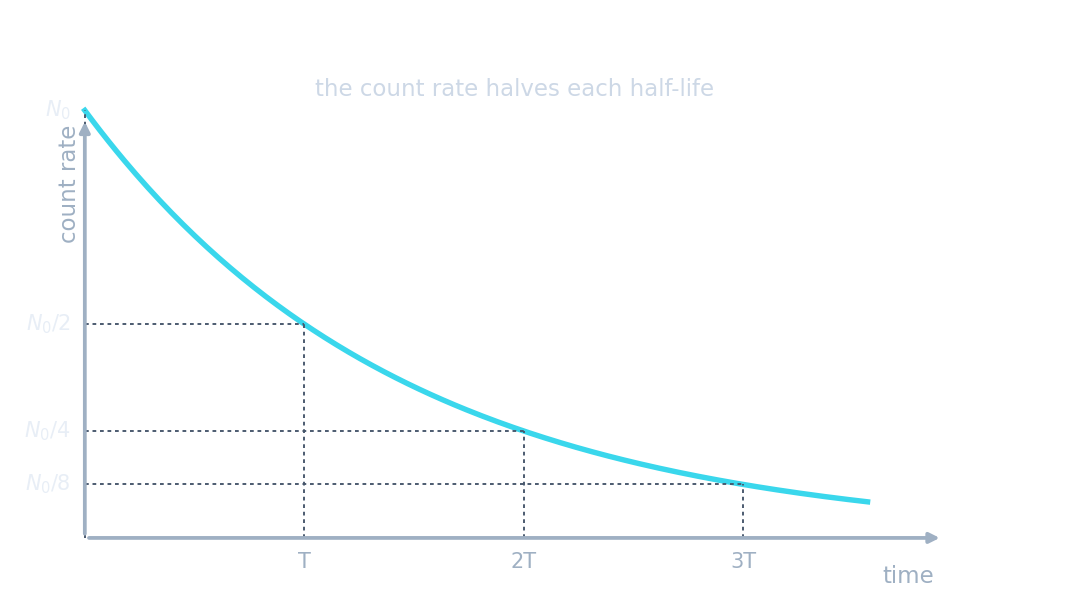
- The half-life is the time for half the unstable nuclei in a sample to decay.
- After each half-life, the count rate (and the number of unstable nuclei) falls to half.
Half-life — watch the nuclei decay
Each nucleus has a fixed chance of decaying, at random. Move time forward: about half the remaining nuclei decay every half-life — so the count halves, then halves again.
The half-life of a radioactive isotope is the time taken for:
Difficulty 1/5 · 100 coins + a small bonus on first completion today
Each half-life, half of the remaining unstable nuclei decay, so the count rate halves.
Using half-life
- After $n$ half-lives, the count rate has halved $n$ times.
- Example: a source of $800$ counts/min with a half-life of $3$ hours → after $6$ hours (two half-lives): $800 \to 400 \to 200$ counts/min.
- You can read a half-life off a graph: the time for the count rate to fall from any value to half of it.
A source reads $800$ counts/min and has a half-life of $3$ hours. What is the count rate after $6$ hours, in counts/min?
Difficulty 2/5 · 140 coins + a small bonus on first completion today
6 hours is two half-lives: $800 \to 400 \to 200$ counts/min.
What fraction of the unstable nuclei remain after 3 half-lives? (Give a decimal.)
Difficulty 2/5 · 140 coins + a small bonus on first completion today
Each half-life halves the number: $\left(\tfrac{1}{2}\right)^3 = \tfrac{1}{8} = 0.125$.
Uses of radioactivity
- The choice of isotope 同位素 depends on its radiation type and half-life:
- Smoke alarms — an alpha source (easily blocked, so safe; long half-life lasts for years).
- Sterilising equipment and food — penetrating gamma kills bacteria through sealed packaging.
- Thickness gauges for paper or metal — a beta source (the amount passing through changes with thickness).
- Finding and treating cancer — gamma rays can pass into (or out of) the body.

Radioactive decay and half-life
Match each radioactive source to its use.
Difficulty 2/5 · 140 coins + a small bonus on first completion today
Alpha (easily blocked) suits smoke alarms; beta passes through thin sheets for thickness gauges; penetrating gamma sterilises sealed items.
Why is an alpha source used in a smoke alarm?
Difficulty 1/5 · 100 coins + a small bonus on first completion today
Alpha is stopped by a little air or the alarm casing (safe), and a long half-life means it works for years.
Safety
- Ionising radiation harms living cells — it can cause cell death, mutations 突变 and cancer.
- Keep the dose 剂量 low by: less time near the source, more distance from it, and shielding 屏蔽 (such as lead).
- Handle sources with tongs, point them away from people, and store them in a lead-lined box.
Select all the ways to reduce the radiation dose you receive.
Difficulty 2/5 · 140 coins + a small bonus on first completion today
Less time, more distance and shielding all cut the dose. Handling a source with bare hands does the opposite — always use tongs.
Worked examples
1. A sample has a count rate of $800$ counts per minute and a half-life of $6$ hours. After $24$ hours, which is $4$ half-lives, the rate is $800 \div 2^4 = 50$ counts per minute.
2. A count rate falls from $1200$ to $300$ counts per minute in $10$ days. $1200 \to 600 \to 300$ is two halvings, so the half-life is $10 \div 2 = 5$ days. Subtract any background count before halving.
A source reads 640 counts per minute and its half-life is 2 hours. What is the rate after 6 hours, and which radiation does a smoke alarm use?
Three halvings of 640 give 80. Alpha ionises the air in the smoke-alarm gap.
What is the count rate after 6 hours?
Difficulty 1/5 · 100 coins + a small bonus on first completion today
640 halved three times is 80 counts per minute. Other options — 200 counts per minute (the lesson example's result for 800 counts after two 3-hour half-lives); 160 counts per minute (which is only two halvings).
You've got it
- half-life = time for half the nuclei (or the count rate) to halve
- after $n$ half-lives the count rate has halved $n$ times
- uses: α smoke alarms · β thickness gauges · γ sterilising and cancer treatment
- safety: cut the dose with less time, more distance, and shielding
Write from 80 counts per minute
- A source reads 640 counts per minute and has a half-life of 2 hours.
- Find the rate after 6 hours. A smoke alarm uses alpha radiation.