Radioactive decay and the three radiations
Introduced| English | Meaning |
|---|---|
| radioactivity/ˌreɪdɪəʊækˈtɪvɪti/ | radioactivity |
| radioactive decay/ˌreɪdɪəʊˈæktɪv dɪˈkeɪ/ | The spontaneous, random change of an unstable nucleus with the emission of radiation. |
| spontaneous/spɒnˈteɪnɪəs/ | Happening randomly and without external trigger, as radioactive decay does. |
| background radiation/ˈbækɡraʊnd ˌreɪdɪˈeɪʃn/ | Ionising radiation present in the surroundings from natural and artificial sources. |
| radon/ˈreɪdɒn/ | A radioactive noble-gas element produced in natural decay chains. |
| cosmic rays/ˈkɒzmɪk reɪz/ | High-energy particles from space that contribute to background radiation. |
| count rate/kaʊnt reɪt/ | The number of events registered by a detector per unit time. |
| alpha/ˈælfə/ | alpha |
| ionising/ˈaɪənaɪzɪŋ/ | Able to remove electrons from atoms or molecules and thereby form ions. |
| beta/ˈbiːtə/ | beta |
| gamma/ˈɡæmə/ | gamma |
Unstable nuclei
- Some nuclei are unstable — sooner or later they break down and shoot out radiation.
- A Geiger counter clicks as it detects each burst.
- This is radioactivity 放射性, and it comes in three types.
Radioactive decay 放射性衰变
- An unstable nucleus breaks down and gives out radiation — radioactive decay.
- A nucleus may be unstable because it has too many neutrons or is too heavy.
- Decay is spontaneous 自发 (you cannot speed it up or slow it down) and random (you cannot say which nucleus is next, or exactly when).
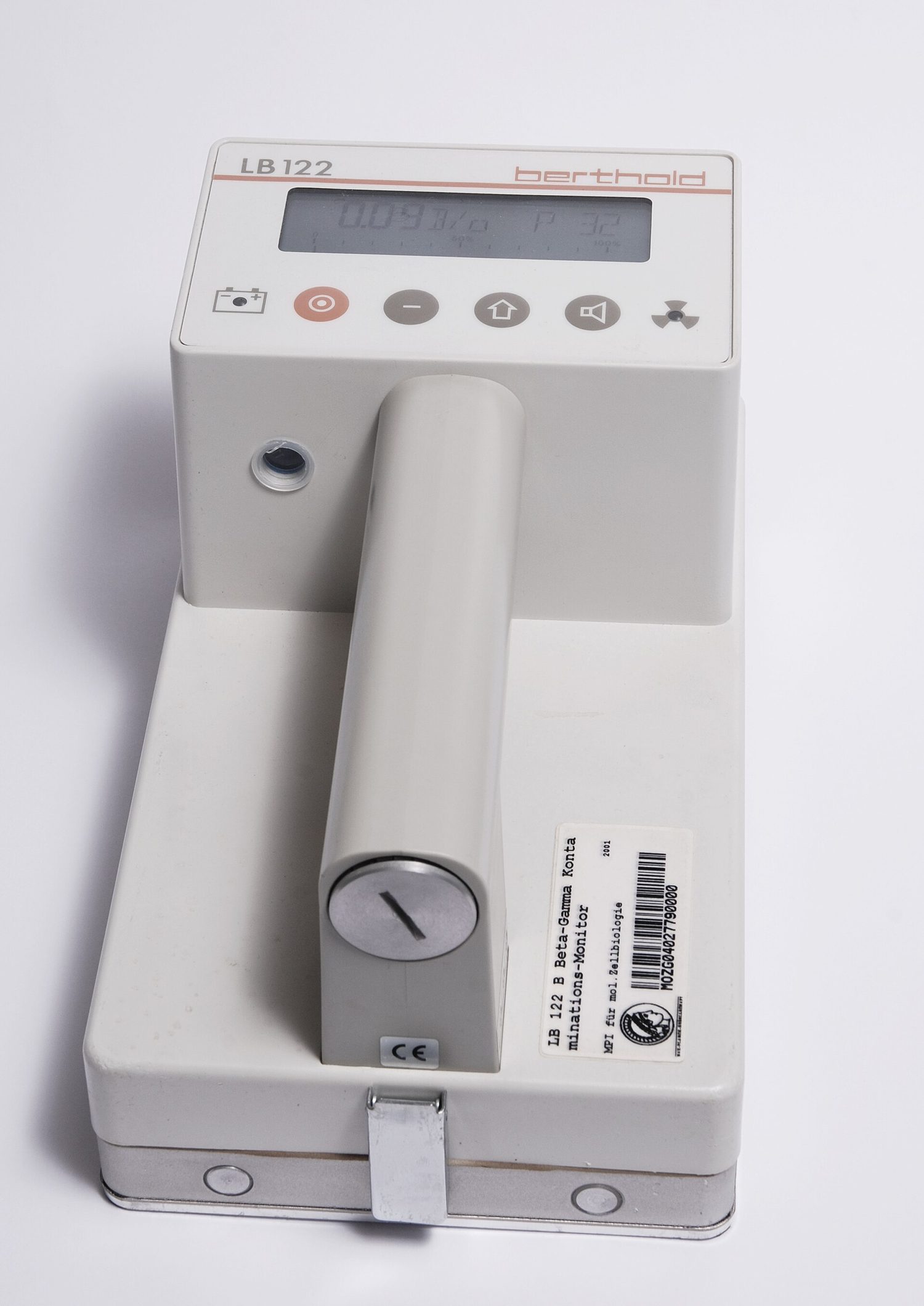
A Geiger counter detects and counts radiation
Radioactive decay
N = N₀·bᵗ
The number of unstable nuclei decays exponentially.
Radioactive decay is spontaneous and random. This means:
Difficulty 1/5 · 100 coins + a small bonus on first completion today
Spontaneous = not triggered and not controllable; random = you cannot say which nucleus decays next or exactly when.
Background radiation 背景辐射 and measuring
- Some radiation is around us all the time — background radiation.
- Main sources: radon 氡 gas (usually the biggest), rocks and buildings, food and drink, cosmic rays 宇宙射线 from space.
- A detector and counter give the count rate 计数率 (counts per second or minute).
- To find a source's true rate, subtract the background:

Deflection of radiation in an electric field
A source reads $250$ counts/min. The background is $30$ counts/min. What is the corrected count rate, in counts/min?
Difficulty 2/5 · 140 coins + a small bonus on first completion today
Corrected = measured − background = $250 - 30 = 220$ counts/min.
The three types of radiation
- Alpha α粒子 (α) — a helium nucleus (charge $+2$): most ionising 电离, least penetrating — stopped by paper.
- Beta β粒子 (β) — a fast electron (charge $-1$): medium — stopped by a few mm of aluminium.
- Gamma γ射线 (γ) — a high-energy EM wave (no charge): least ionising, most penetrating — only reduced by thick lead.

Match each radiation to what stops it.
Difficulty 2/5 · 140 coins + a small bonus on first completion today
Alpha is least penetrating (paper), beta is medium (aluminium), gamma is most penetrating (thick lead only reduces it).
Which radiation is the most ionising but the least penetrating?
Difficulty 1/5 · 100 coins + a small bonus on first completion today
Alpha is the most ionising (big +2 charge, slow and heavy) but is easily absorbed — the least penetrating.
Deflection and decay equations
- Because α and β are charged, fields deflect them — in opposite directions (the lighter β bends more). Gamma (no charge) is not deflected.
- Alpha decay: lose 2 protons + 2 neutrons, so $A$ falls by 4 and $Z$ by 2.
- Beta decay: a neutron becomes a proton + the emitted electron, so $A$ stays the same and $Z$ rises by 1, e.g. $^{24}_{11}\text{Na} \rightarrow {}^{24}_{12}\text{Mg} + {}^{\ \ 0}_{-1}\beta$.
- Gamma: only energy leaves, so $A$ and $Z$ are unchanged.
When a nucleus emits an alpha particle, the nucleon number A and proton number Z change by:
Difficulty 1/5 · 100 coins + a small bonus on first completion today
An alpha particle is 2 protons + 2 neutrons, so A drops by 4 and Z drops by 2.
Gamma radiation is deflected by a magnetic field.
Difficulty 1/5 · 100 coins + a small bonus on first completion today
Gamma rays have no charge, so they are not deflected. Only the charged alpha and beta particles bend in fields.
You've got it
- decay is spontaneous and random; corrected rate = measured − background
- α (He nucleus, +2): most ionising, stopped by paper
- β (electron, −1): medium, stopped by aluminium; γ (EM wave): most penetrating, lead
- α decay: $A{-}4$, $Z{-}2$ · β decay: $A$ same, $Z{+}1$ · γ: no change; only α and β are deflected