| Learning Objective | Essential Knowledge |
|---|---|
15.1.A |
|
Modern Physics · פיזיקה מודרנית
AP Physics 2 · פיזיקה AP 2 · Topic 15 · נושא 15
 9:32
9:32
פיזיקה מודרנית
עד שנת 1900, הפיזיקה נראתה כמלאה. אז שלושה ניסויים פיצצו את התפיסה הזו. גוף חם וזוהר קרן צבעים לא נכונים. אור שנופל על מתכת…
English narration · English + 中文 subtitles burned in · קריאת קול באנגלית · תרגום אנגלי + סינית שרוף בתוך הסרטון
15.1
Quantum Theory and Wave-Particle Duality · תורת הקוונטים ודואליות גל-חלקיק
Syllabus · סיילבוס
Source: College Board AP Course and Exam Description · מקור: תיאור הקורס והמבחן של College Board AP
English
At tiny scales, energy comes in discrete packets called quanta 量子. Light is carried by photons 光子, each with energy set by its frequency:
$$E=hf,$$
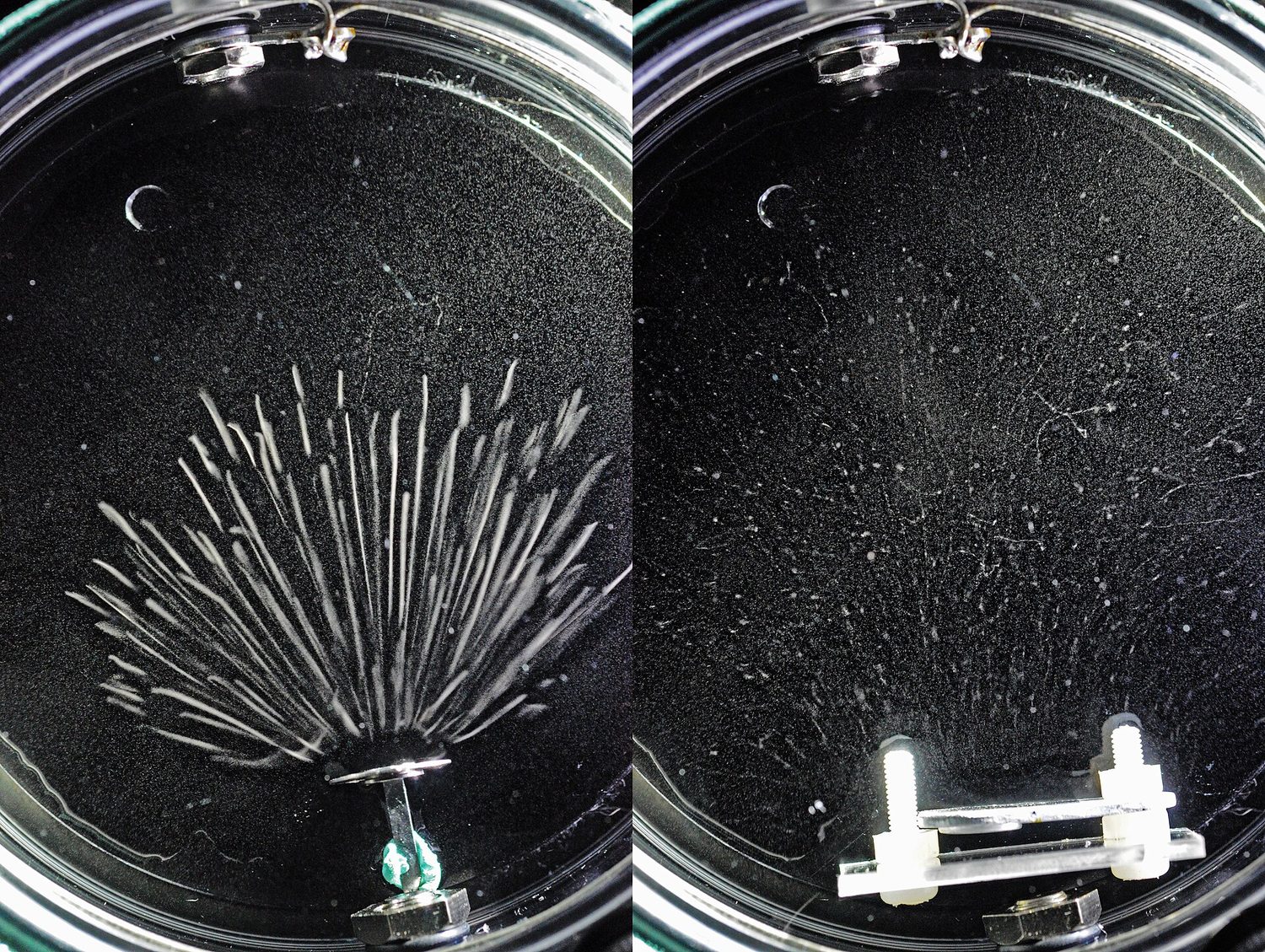
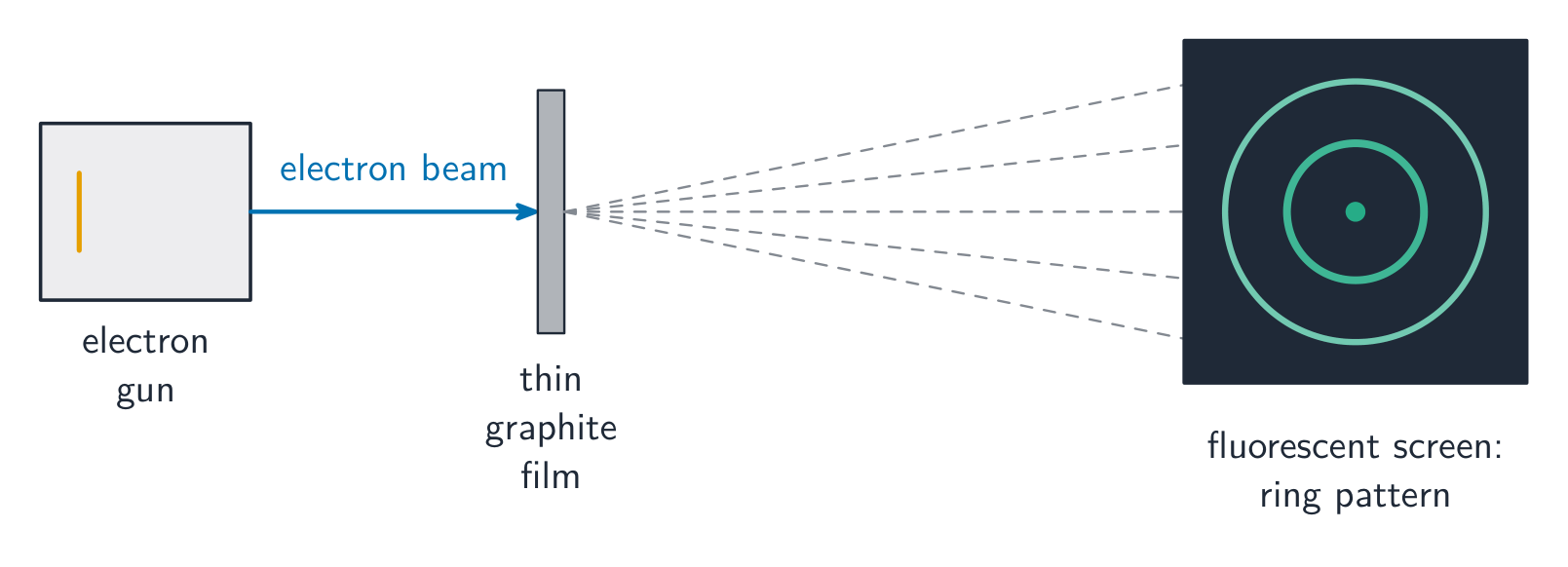
where $h$ is Planck's constant. Wave–particle duality 波粒二象性: light and matter each show both wave behavior (interference, diffraction) and particle behavior (photons, electrons as localized hits). A particle also has a matter wavelength $\lambda=\dfrac{h}{p}$, and particles genuinely produce interference - a variation of Young's double-slit experiment 双缝实验 done with electrons builds up the same fringe pattern as light.
Worked example. Find the energy of a photon of orange light with frequency $5.0\times10^{14}\ \text{Hz}$ ($h=6.63\times10^{-34}\ \text{J s}$): $E=hf=6.63\times10^{-34}\times5.0\times10^{14}=3.3\times10^{-19}\ \text{J}$, which is about $2.1\ \text{eV}$ (dividing by $1.6\times10^{-19}$). Visible-light photons carry a few electronvolts – just right to trigger the chemistry of vision and photosynthesis.
עברית
בגישורים מיcroscopic, אנרגיה מגיעה בחבילות בדידות הנקראות קוונטים. אור מועבר על ידי פוטונים, שכל אחד מהם בעל אנרגיה הנקבעת לפי תדרו:
$$E=hf,$$
שבו $h$ הוא קבוע פלאנק. דואליות גל-חלקיק: לאור ולחומר יש גם התנהגות גלית (התאבכות, הרצה) וגם התנהגות חלקיקית (פוטונים, אלקטרונים כפגיעות ממוקדות). לחלקיק יש גם אורך גל חומר $\lambda=\dfrac{h}{p}$, וחלקיקים באמת יוצרים התאבכות - גרסה של ניסוי החרייציים של Young שנעשה עם אלקטרונים בונה את אותו דפוס פסים כמו אור.
דוגמה מופרזת. חשב את האנרגיה של פוטון של אור כתום בתדר $5.0\times10^{14}\ \text{Hz}$ ($h=6.63\times10^{-34}\ \text{J s}$): $E=hf=6.63\times10^{-34}\times5.0\times10^{14}=3.3\times10^{-19}\ \text{J}$, שהוא בקירוב $2.1\ \text{eV}$ (חלוקה ב-$1.6\times10^{-19}$). פוטונים באור נראה נושאים מספר מעט אלקטרון-וולטים – בדיוק כמות הנדרשה כדי להפעיל את הכימיה של הראייה והפוטוסינתזה.
15.2
The Bohr Model of Atomic Structure · המודל של בוהר למבנה האטומי
Syllabus · סיילבוס
English
Learning Objective 15.2.A: Describe the properties of an atom.
- 15.2.A.1 Atoms have internal structure.
- 15.2.A.1.i Atoms consist of a small, positively charged nucleus surrounded by one or more negatively charged electrons.
- 15.2.A.1.ii The nucleus of an atom is made up of protons and neutrons.
- 15.2.A.1.iii The number of neutrons and protons in an atom can be represented using nuclear notation.
- 15.2.A.1.iv An ion is an atom with a nonzero net electric charge.
- 15.2.A.2 Each atomic element has a unique number of protons.
- 15.2.A.2.i The number and arrangements of electrons affects how atoms interact.
- 15.2.A.2.ii The total number of neutrons and protons identifies the isotope of an element.
- 15.2.A.2.iii The mass of an atom is dominated by the total mass of the protons and neutrons in its nucleus.
- 15.2.A.3 The Bohr model of the atom is based on classical physics and was the historical representation of the atom that led to the description of the hydrogen atom in terms of discrete energy states.
- 15.2.A.3.i In the Bohr model of the atom, electrons are modeled as moving around the nucleus in circular orbits determined by the electron's charge and mass, as well as the electric force between the electron and the nucleus.
- Relevant equations:
- $F_e = k\dfrac{q_1 q_2}{r^2}$
- $F_{\text{net}} = m\dfrac{v^2}{r}$
- 15.2.A.3.ii The standing wave model of electrons accounts for the existence of specific allowed energy states of an electron in an atom, because the electron orbit's circumference must be an integer multiple of the electron's de Broglie wavelength.
- 15.2.A.3.i In the Bohr model of the atom, electrons are modeled as moving around the nucleus in circular orbits determined by the electron's charge and mass, as well as the electric force between the electron and the nucleus.
Boundary statement: The analysis and description of electron structure is limited to energy levels and will not include such advanced descriptions as orbitals, orbital shapes, or probability functions.
עברית
מטרת הלמידה 15.2.A: לתאר את מאפייני האטום.
- 15.2.A.1 לאטומים יש מבנה פנימי.
- 15.2.A.1.i אטומים מורכבים מגרעין קטן וחיובי המוקף באחד או יותר אלקטרונים טעונים במטען שלילי.
- 15.2.A.1.ii גרעין האטום מורכב מפרוטונים וניטרונים.
- 15.2.A.1.iii מספר הניטרונים והפרוטונים באטום ניתן לייצוג באמצעות סימון גרעיני.
- 15.2.A.1.iv יון הוא אטום בעל מטען חשמלי נטו שאינו אפס.
- 15.2.A.2 לכל אלמנט אטומי יש מספר ייחודי של פרוטונים.
- 15.2.A.2.i המספר וההתארגנות של האלקטרונים משפיעים על אופן האינטראקציה בין אטומים.
- 15.2.A.2.ii הסכום הכולל של הניטרונים והפרוטונים מזהה את האיזוטופ של האלמנט.
- 15.2.A.2.iii מסת האטום נשלטת על ידי הסכום הכולל של מסת הפרוטונים והניטרונים בגרעין שלו.
- 15.2.A.3 דגם בור של האטום מבוסס על פיזיקה קלאסית ונציג את ההצגה ההיסטורית של האטום שהובילה לתיאור אטום המימן בתנאי אנרגיה בדידים.
- 15.2.A.3.i בדגם בור של האטום, האלקטרונים מתוארים כנעים סביב הגרעין במסילות מעגליות הנקבעות על ידי המטען והמסה של האלקטרון, כמו גם הכוח החשמלי בין האלקטרון לגרעין.
- משוואות רלוונטיות:
- $F_e = k\dfrac{q_1 q_2}{r^2}$
- $F_{\text{net}} = m\dfrac{v^2}{r}$
- 15.2.A.3.ii דגם גל עומד של אלקטרונים מסביר את קיומם של תנאי אנרגיה מותרים ספציפיים לאלקטרון באטום, מכיוון שצף המסילה צריך להיות כפולה שלמה מאורך הגל של דה-ברוליי של האלקטרון.
- 15.2.A.3.i בדגם בור של האטום, האלקטרונים מתוארים כנעים סביב הגרעין במסילות מעגליות הנקבעות על ידי המטען והמסה של האלקטרון, כמו גם הכוח החשמלי בין האלקטרון לגרעין.
הצהרת גבול: ניתוח ותיאור מבנה האלקטרונים מוגבלים לרמות אנרגיה ולא יכללו תיאורים מתקדמים יותר כגון אורביטלים, צורות אורביטלים או פונקציות סיכום
Source: College Board AP Course and Exam Description · מקור: תיאור הקורס והמבחן של College Board AP
English
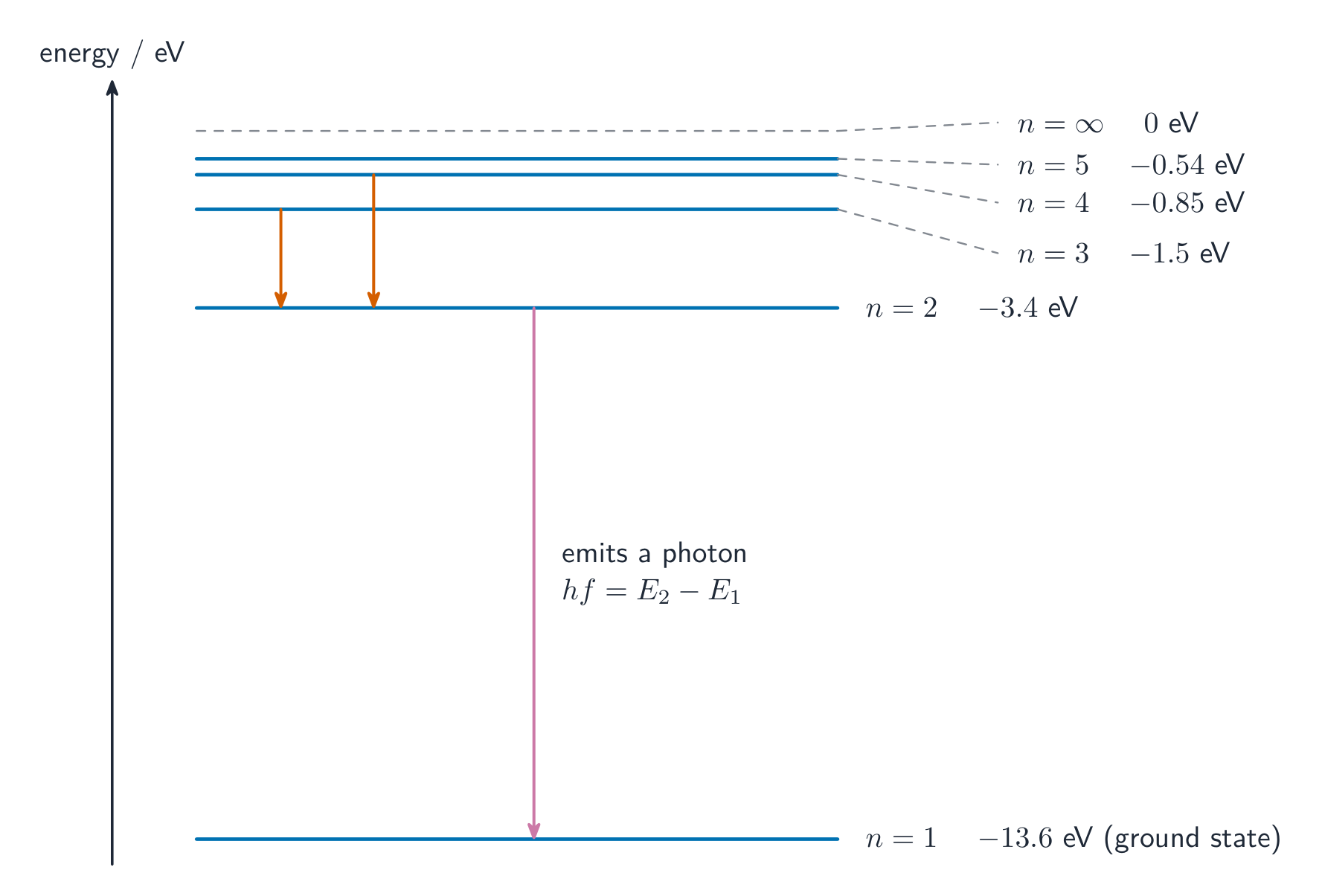
The Bohr model 玻尔模型 pictures electrons orbiting the nucleus only in certain allowed energy levels 能级. An electron can jump between levels only by absorbing or emitting a photon whose energy exactly matches the gap:
$$E_{\text{photon}}=|E_{\text{final}}-E_{\text{initial}}|.$$
Because the levels are discrete, only specific photon energies are allowed.
עברית
המודל של בוהר מתאר אלקטרונים המקיפים את הגרעין רק ברמות אנרגיה מותרות מסוימות. אלקטרון יכול לקפוץ בין רמות רק על ידי ספיגה או פליטה של פוטון שאנרגייתו תואמת בדיוק את הפער:
$$E_{\text{photon}}=|E_{\text{final}}-E_{\text{initial}}|.$$
מכיוון שרמות האנרגיה הן דיסקרטיות, מותרות רק אנרגיות פוטון ספציפיות.
15.3
Emission and Absorption Spectra · ספקטרום פליטה וספקטרום ספיגה
Syllabus · סיילבוס
English
Learning Objective 15.3.A: Describe the emission or absorption of photons by atoms.
- 15.3.A.1 Energy transfer occurs when photons are absorbed or emitted by an atom, which is modeled as a system consisting of a nucleus and an electron.
- 15.3.A.2 Energy can only be absorbed or emitted by an atom if the amount of energy being absorbed or emitted corresponds to the energy difference between two atomic energy states.
- 15.3.A.2.i An atom in a given energy state may absorb a photon of the appropriate energy and transition to a higher energy state.
- 15.3.A.2.ii An atom in an excited energy state may emit a photon of the appropriate energy to spontaneously move to a lower energy state.
- 15.3.A.2.iii Because an atom is modeled as a system consisting of an electron and a nucleus, a change in the energy state of an atom corresponds to a change in the interaction energy between the electron and the nucleus.
- 15.3.A.3 Transitions between two energy states of an atom correspond to the absorption or emission of a photon of a single frequency and, therefore, a single wavelength.
- 15.3.A.4 Atoms of each element have a unique set of allowed energy levels and thereby a unique set of absorption and emission frequencies. The unique set of frequencies determines the element's spectrum.
- 15.3.A.4.i An emission spectrum can be used to determine the elements in a source of light.
- 15.3.A.4.ii An absorption spectrum can be used to determine the elements composing a substance by observing what light the substance has absorbed.
- 15.3.A.4.iii Energy level diagrams are commonly used to visually represent the energy states of an atom.
- 15.3.A.5 Binding energy is the energy required to remove an electron from an atom, causing the atom to become ionized. An atom in the lowest energy level (ground state) will require the greatest amount of energy to remove the electron from the atom.
Boundary statement: In AP Physics 2, only energy level diagrams of single-electron atoms will be considered.
עברית
מטרות למידה 15.3.A: לתאר פליטה או ספיגה של פוטונים על ידי אטומים.
- 15.3.A.1 העברת אנרגיה מתרחשת כאשר פוטונים נספגים או נפלטים על ידי אטום, הממודל כמערכת המורכבת מגרעין ואלקטרון.
- 15.3.A.2 אנרגיה יכולה לספוג או לפלוט רק אם כמות האנרגיה המתקבלת או המופקת תואמת להפרש האנרגיה בין שני מצבי אנרגיה אטומיים.
- 15.3.A.2.i אטום במצב אנרגיה נתון עשוי לספוג פוטון באנרגיה המתאימה ולעבור למצב אנרגיה גבוה יותר.
- 15.3.A.2.ii אטום במצב אנרגיה מופעל עשוי לפלוט פוטון באנרגיה המתאימה כדי לעבור באופן ספונטני למצב אנרגיה נמוך יותר.
- 15.3.A.2.iii מכיוון שאטום ממודל כמערכת המורכבת מאלקטרון וגרעין, שינוי במצב האנרגיה של אטום תואם לשינוי באנרגיית האינטראקציה בין האלקטרון לגרעין.
- 15.3.A.3 מעברים בין שני מצבי אנרגיה של אטום תואמים לספיגה או פליטה של פוטון בתדר יחיד, ולכן באורך גל יחיד.
- 15.3.A.4 לאטומים של כל אלמנט יש סט ייחודי של רמות אנרגיה מותרות, ולכן סט ייחודי של תדרים לספיגה ופליטה. הסט הייחודי של התדרים קובע את הספקטרום של האלמנט.
- 15.3.A.4.i ניתן להשתמש בספקטרום פליטה כדי לקבוע את האלמנטים המקור של אור.
- 15.3.A.4.ii ניתן להשתמש בספקטרום ספיגה כדי לקבוע את האלמנטים המרכיבים חומר על ידי התבוננות באור שהחומר ספג.
- 15.3.A.4.iii דיאגרמות רמות אנרגיה משמשות לעיתים קרובות להציג ויזואלית את מצבי האנרגיה של אטום.
- 15.3.A.5 אנרגיית הקשירה היא האנרגיה הנדרשת להוצאת אלקטרון מאטום, מה שגורם לאטום להתיון. אטום ברמת אנרגיה נמוכה ביותר (מצב יסוד) ידורש כמות אנרגיה מרבית להוצאת האלקטרון ממנו.
ניסוח גבול: בפיזיקה AP 2, רק דיאגרמות רמות אנרגיה של אטומים בעלי אלקטרון אחד ייחשבו.
Source: College Board AP Course and Exam Description · מקור: תיאור הקורס והמבחן של College Board AP
English
- An emission spectrum 发射光谱 is the set of bright lines given off when electrons drop to lower levels – each line a specific wavelength.
- An absorption spectrum 吸收光谱 is the set of dark lines where those same wavelengths are absorbed from a continuous source.
The line pattern is a fingerprint of the element, since every element has its own energy levels.
עברית
- ספקטרום פליטה הוא סט הקווים בהירים הפולטים כאשר אלקטרונים צונחים לרמות נמוכות יותר – כל קו מייצג אורך גל ספציפי.
- ספקטרום ספיגה הוא סט הקווים הכהים שבהם אותם אורכים גל נספגים ממקור רציף.
הדפוס הקווי הוא חתימת אצבע של היסוד, מכיוון שכל יסוד בעל רמות אנרגיה משלו.

Explore · חקור
See an element's line spectrum · ראו ספקטרום קווים של אלמנט
Electrons jump between fixed energy levels, emitting or absorbing photons of exact wavelengths — a line spectrum that fingerprints the element. · אלקטרונים קופצים בין רמות אנרגיה קבועות, פולטים או בולעים פוטונים בעלות אורכי גל מדויקים — ספקטרום קווי המשמש כחתימה הייחודית של האלמנט.
Vocabulary · מילון מונחים
Train · אימון
| English | עברית |
|---|---|
| quanta/ˈkwɒntə/ | קוונטים |
| photons/ˈfəʊtɒnz/ | פוטונים |
| Wave–particle duality/weɪv ˈpɑːtɪkl djuːˈælɪti/ | דואליות גל-חלקיק |
| double-slit experiment/ˈdʌbl slɪt ekˈsperɪmənt/ | ניסוי הסדק הכפול |
| Bohr model/ˈbəʊə ˈmɒdl/ | מודל בור |
| energy levels/ˈenədʒi ˈlevlz/ | רמות אנרגיה |
| emission spectrum/ɪˈmɪʃn ˈspektrəm/ | ספקטר פליטה |
| absorption spectrum/əbˈsɔːpʃn ˈspektrəm/ | ספקטרום ספיגה |
15.4
Blackbody Radiation · קריעת גוף שחור
Syllabus · סיילבוס
English
Learning Objective 15.4.A: Describe the electromagnetic radiation emitted by an object due to its temperature.
- 15.4.A.1 Matter will spontaneously convert some of its internal thermal energy into electromagnetic energy.
- 15.4.A.2 A blackbody is an idealized model of matter that absorbs all radiation that falls on the body. If the body is in equilibrium at a constant temperature, then it must in turn emit energy.
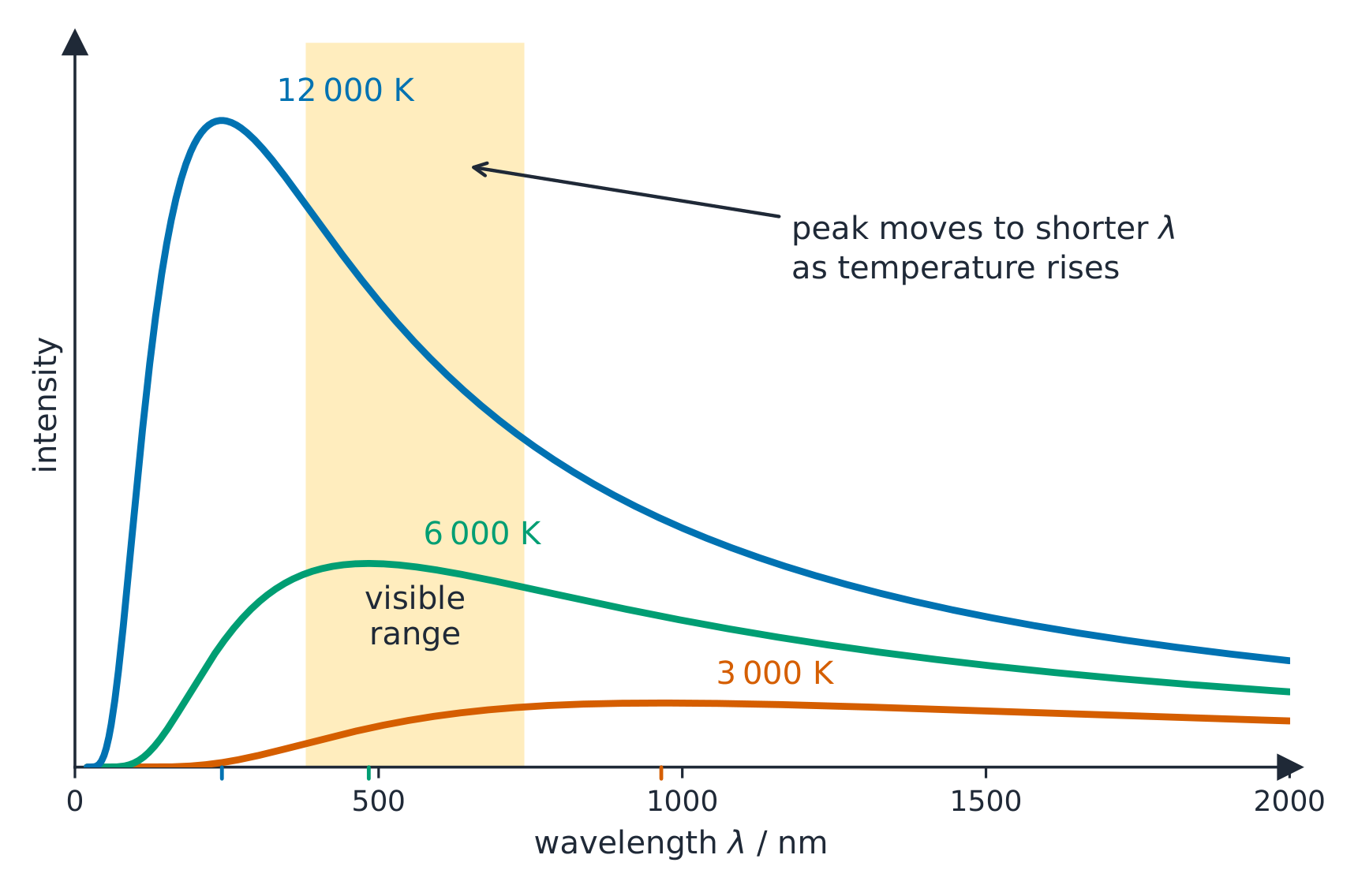
- 15.4.A.3 A blackbody will emit a continuous spectrum that only depends on the body's temperature. The radiation emitted by a blackbody is often modeled by plotting intensity per unit wavelength as a function of wavelength.
- 15.4.A.3.i The distribution of the intensity of a blackbody's spectrum as a function of temperature cannot be modeled using only classical physics concepts. A blackbody's spectrum is described by Planck's law, which assumes that the energy of light is quantized.
- 15.4.A.3.ii The peak wavelength emitted by a blackbody (the wavelength at which the blackbody emits the greatest amount of radiation per unit wavelength) decreases with increasing temperature, as described by Wien's law.
- Relevant equation:
- $\lambda_{\max} = \dfrac{b}{T}$
- 15.4.A.3.iii The rate at which energy is emitted (power) by a blackbody is proportional to the surface area of the body and to the temperature of the body raised to the fourth power, as described by the Stefan-Boltzmann law.
- Relevant equation:
- $P = A\sigma T^4$
עברית
מטרת למידה 15.4.A: תאר את הקריעה האלקטרומגנטית המופקת על ידי חפץ בשל טמפרטורתו.
- 15.4.A.1 חומר יהפוך ספונטנית חלק מאנרגייתו התרמית הפנימית לאנרגיה אלקטרומגנטית.
- 15.4.A.2 גוף שחור הוא דגם אידיאלי של חומר שסופג כל קריעה הנופלת עליו. אם הגוף נמצא באיזון בטמפרטורה קבועה, אזי הוא בהכרח יפלוט אנרגיה.
- 15.4.A.3 גוף שחור יפלוט ספקטרום רציף שתלוי רק בטמפרטורת הגוף. קריעה המופקת על ידי גוף שחור מתמודלה לעיתים קרובות על ידי ציור העוצמה ליחידת אורך גל כפונקציה של אורך הגל.
- 15.4.A.3.i החלוקה של עוצמת הספקטרום של גוף שחור כפונקציה של טמפרטורה לא יכולה להיות מתמודלת רק באמצעות מושגי פיזיקה קלאסית. ספקטרום של גוף שחור מתואר על ידי חוק פלאנק, שמניח שהאנרגיה של האור מכונהנת.
- 15.4.A.3.ii אורך הגל המקסימלי המופלט על ידי גוף שחור (אורך הגל בו הגוף מפיק את כמות הקריעה הגדולה ביותר ליחידת אורך גל) קטן עם עליית הטמפרטורה, כפי שמתואר בחוק ויין.
- משוואה רלוונטית:
- $\lambda_{\max} = \dfrac{b}{T}$
- 15.4.A.3.iii קצב פליטת האנרגיה (ההספק) על ידי גוף שחור פרופורציונלי לשטח השטח של הגוף ולטמפרטורת הגוף מעורבת בריבוע, כפי שמתואר בחוק סטפן-בולצמן.
- משוואה רלוונטית:
- $P = A\sigma T^4$
Source: College Board AP Course and Exam Description · מקור: תיאור הקורס והמבחן של College Board AP
English
A blackbody 黑体 emits a continuous spectrum that depends only on its temperature. Hotter objects glow brighter and peak at shorter wavelengths (red-hot to white-hot to blue-hot). Explaining this spectrum required quantized energy – a founding problem of quantum theory.
עברית
גוף שחור פולט ספקטרום רציף התלוי רק בטמפרטורה שלו. גופים חמים זוהרים בחוזקה רבה יותר ומקדם את השיא לאורכי גל קצרים יותר (אדום-חם לבן-חם לכחול-חם). הסבר ספקטרום זה דרש אנרגיה מקוונתית – בעיית יסוד בתורת הקוונטים.
Vocabulary · מילון מונחים
Train · אימון
| English | עברית |
|---|---|
| blackbody/ˈblækbɒdi/ | גוף שחור |
| photoelectric effect/ˌfəʊtəʊɪˈlektrɪk ɪˈfekt/ | אפקט הפוטואלקטרי |
| work function/wɜːk ˈfʌŋkʃn/ | פונקציית עבודה |
| Compton scattering/ˈkɒmptn ˈskætərɪŋ/ | פיזור קומפטון |
| nucleus/ˈnjuːklɪəs/ | ליבה |
| Fission/ˈfɪʃn/ | ספיטה גרעינית |
| Fusion/ˈfjuːʒn/ | היתוך |
15.5
The Photoelectric Effect · האפקט הפוטואלקטרי
Syllabus · סיילבוס
English
Learning Objective 15.5.A: Describe an interaction between photons and matter using the photoelectric effect.
- 15.5.A.1 The photoelectric effect is the emission of electrons when electromagnetic radiation is incident upon a photoactive material.
- 15.5.A.2 The emission of electrons via the photoelectric effect requires a minimum frequency of incident light, called the threshold frequency.
- 15.5.A.2.i Light that is incident on a material and is at the threshold frequency or higher will induce electron emission, regardless of the number of photons that strike the material.
- 15.5.A.2.ii The energy of the emitted electrons is not dependent on the number of photons that are incident upon the material, which provides evidence that light is a collection of discrete, quantized energy packets called photons.
- 15.5.A.3 The maximum kinetic energy of an emitted electron is related to the frequency of the incident light and the work function of the material, $\phi$.
- 15.5.A.3.i The work function of a material is the minimum energy required to emit an electron from atoms in the material.
- 15.5.A.3.ii The maximum kinetic energy of an emitted electron is given by the equation $K_{\max} = hf - \phi$.
- 15.5.A.3.iii In a typical experimental setup to demonstrate the photoelectric effect and determine the work function of a metal, two metal plates are placed in a vacuum chamber and connected to a variable source of potential difference. One of the plates is illuminated by monochromatic light that causes electrons to be ejected and the potential difference between the plates is adjusted until no current is measured in the circuit.
Boundary statement: Where applicable, work functions for materials will be provided on the exam; students are not expected to know values of work functions or variables of a material that influence the magnitude of its work function.
עברית
מטרת למידה 15.5.A: תאר אינטראקציה בין פוטונים וחומר באמצעות האפקט הפוטואלקטרי.
- 15.5.A.1 האפקט הפוטואלקטרי הוא שחרור אלקטרונים כאשר קריעה אלקטרומגנטית פוגעת בחומר פעיל פוטו-אלקטרית.
- 15.5.A.2 שחרור אלקטרונים באמצעות האפקט הפוטואלקטרי דורש תדר מינימלי של אור פוגע, הנקרא תדר סף.
- 15.5.A.2.i אור הפוגע בחומר ובתדר הסף או גבוה יותר יגרום לשחרור אלקטרונים, ללא קשר לכמות הפוטונים הפוגעים בחומר.
- 15.5.A.2.ii אנרגיית האלקטרונים המשוחררים אינה תלויה בכמות הפוטונים הפוגעים בחומר, מה שמספק ראיה לכך שאור הוא אוסף של חבילות אנרגיה בדידות ומכונהנות הנקראות פוטונים.
- 15.5.A.3 האנרגיה הקינטית המקסימלית של אלקטרון מופקת קשורה לתדר האור הפוגע ולפונקציית העבודה של החומר, $\phi$.
- 15.5.A.3.i פונקציית העבודה של חומר היא האנרגיה המינימלית הנדרשת לשחרור אלקטרון מאטומים בחומר.
- 15.5.A.3.ii האנרגיה הקינטית המקסימלית של אלקטרון מופקת נתונה על ידי המשוואה $K_{\max} = hf - \phi$.
- 15.5.A.3.iii במתקן ניסויי סטנדרטי להדגמת האפקט הפוטואלקטרי ולמדידת פונקציית העבודה של מתכת, שתי צלעות מתכת מונחות בתא ואקום ומחוברות למקור מתח משתנה. אחת הצלעות מופעלת באור מונוכרומטי הגורם לשחרור אלקטרונים, והמתח בין הצלעות מכוון עד שאין זורם הנמדד במעגל החשמלי.
הצהרת גבול: כאשר רלוונטי, ערכים של פונקציות עבודה לחומרים יסופקו במבחן; תלמידים אינם מצופים לדעת ערכים של פונקציות עבודה או משתנים של חומר המשפיעים על גודל פונקציית העבודה שלו.
Source: College Board AP Course and Exam Description · מקור: תיאור הקורס והמבחן של College Board AP
English
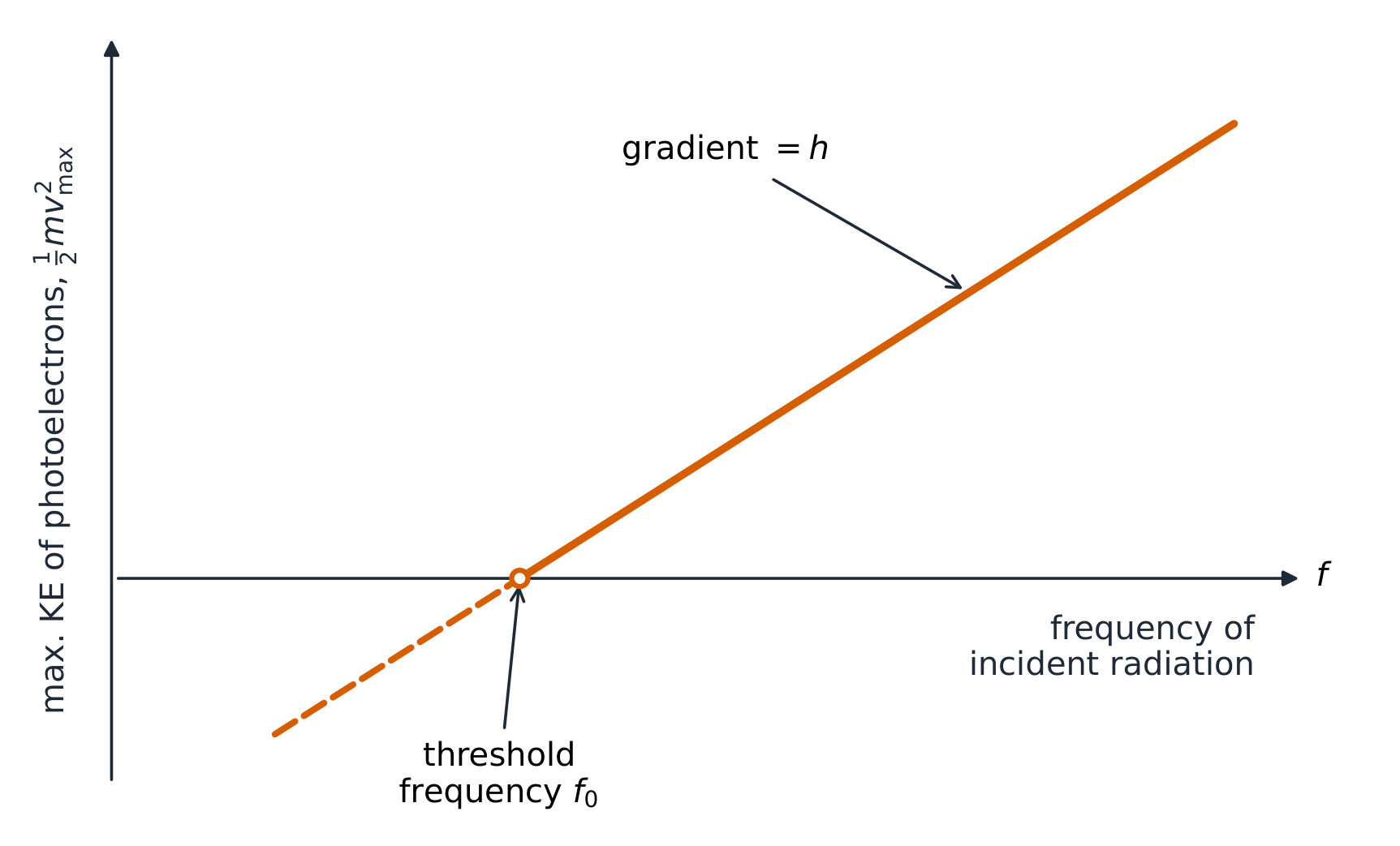
Shining light on a metal can eject electrons – the photoelectric effect 光电效应. Key facts (which only the photon picture explains): electrons come out only if the photon's frequency exceeds a threshold, no matter how bright a dimmer, lower-frequency light is. Energy conservation gives
$$K_{\max}=hf-\phi,$$
where $\phi$ is the metal's work function 逸出功 (the energy to free an electron).
Worked example. Light of frequency $8.0\times10^{14}\ \text{Hz}$ falls on a metal with work function $\phi=3.0\times10^{-19}\ \text{J}$. The most energetic electrons come off with
$$K_{\max}=hf-\phi=(6.63\times10^{-34}\times8.0\times10^{14})-3.0\times10^{-19}=5.3\times10^{-19}-3.0\times10^{-19}=2.3\times10^{-19}\ \text{J}.$$
Below the threshold frequency $\phi/h$, $K_{\max}$ would be negative – meaning no electrons escape at all, however bright the light.
עברית
הארת מתכת באור גורמת לשחרור אלקטרונים – זהו האפקט הפוטואלקטרי. עובדות מפתח (שתיאוריה הלייזרית בלבד מסבירה): אלקטרונים משתחררים רק אם תדר הפוטון עולה על סף מסוים, ללא קשר לעוצמת האור. שימור אנרגיה נותן
$$K_{\max}=hf-\phi,$$
כאן $\phi$ הוא פונקציית העבודה של המתכת (האנרגיה הנדרשת לשחרור אלקטרון).
*האנרגיה הקינטית המקסימלית של פוטואלקטרונים עולה ליניארית עם התדר
דוגמה מפורטת. אור בתדר $8.0\times10^{14}\ \text{Hz}$ פוגע במתכת בעלת פונקציית עבודה $\phi=3.0\times10^{-19}\ \text{J}$. האלקטרונים המהירים ביותר יוצאים עם
$$K_{\max}=hf-\phi=(6.63\times10^{-34}\times8.0\times10^{14})-3.0\times10^{-19}=5.3\times10^{-19}-3.0\times10^{-19}=2.3\times10^{-19}\ \text{J}.$$
מתחת לתדר הסף $\phi/h$, $K_{\max}$ היה שלילי – כלומר לא יצאו אלקטרונים בכלל, ללא קשר לעוצמת האור.
15.6
Compton Scattering · פיזור קומפטון
Syllabus · סיילבוס
English
Learning Objective 15.6.A: Describe the interaction between photons and matter using Compton scattering.
- 15.6.A.1 In Compton scattering, a photon interacts with a free electron. The Compton effect is when a photon that emerges from the interaction has a lower energy and longer wavelength than the incoming photon. The magnitude of the change is related to the direction of the photon after the collision.
- 15.6.A.2 Compton scattering provides evidence that light is a collection of discrete, quantized energy packets called photons.
- 15.6.A.2.i Compton scattering can be explained by treating a photon as a particle and applying conservation of energy and conservation of momentum to the collision between the photon and electron.
- 15.6.A.2.ii The transfer of a photon's energy to an electron results in the energy, momentum, frequency, and wavelength of the photon changing.
- Relevant equations:
- $E = hf$
- $\lambda = \dfrac{h}{p}$
- 15.6.A.3 The change in wavelength experienced by a photon after colliding with an electron is related to how much the photon's direction changes.
- Relevant equation:
- $\Delta\lambda = \dfrac{h}{m_e c}(1 - \cos\theta)$
Boundary statement: AP Physics 2 includes full quantitative and qualitative treatments of conservation of momentum in two dimensions.
עברית
מטרת הלמידה 15.6.A: לתאר את האינטראקציה בין פוטונים לחומר באמצעות פיזור קומפטון.
- 15.6.A.1 בפיזור קומפטון, פוטון אינטראקטיבי עם אלקטרון חופשי. אפקט קומפטון הוא כאשר פוטון היוצא מהאינטראקציה בעל אנרגיה נמוכה ואורך גל ארוך יותר מהפוטון הנכנס. הגודל של השינוי קשור לכיוון הפוטון לאחר ההתנגשות.
- 15.6.A.2 פיזור קומפטון מספק ראיה לכך שהאור הוא סדרה של חבלי אנרגיה דיסקרטיים וכמותיים הנקראים פוטונים.
- 15.6.A.2.i פיזור קומפטון ניתן להסבר על ידי התנהגות הפוטון כחלקיק וחלת שימור האנרגיה ושימור התנע להתנגשות בין הפוטון לאלקטרון.
- 15.6.A.2.ii העברת אנרגיה מפוטון לאלקטרון מובילה לשינוי באנרגיה, תנע, תדר ואורך הגל של הפוטון.
- משוואות רלוונטיות:
- $E = hf$
- $\lambda = \dfrac{h}{p}$
- 15.6.A.3 השינוי באורך הגל שעבר פוטון לאחר התנגשות עם אלקטרון קשור לכמה כיוון הפוטון משתנה.
- *משוואה רלוונטית:
- $\Delta\lambda = \dfrac{h}{m_e c}(1 - \cos\theta)$
הצהרת גבול: AP Physics 2 כולל טיפולים כמותיים ואיכותיים מלאים של שימור תנע בשתי מידות.
Source: College Board AP Course and Exam Description · מקור: תיאור הקורס והמבחן של College Board AP
English
In Compton scattering 康普顿散射, a photon collides with an electron like two particles, transferring some energy and momentum. The scattered photon comes out with less energy (longer wavelength). This is direct evidence that photons carry momentum and behave as particles.
עברית
בפיזור קומפטון, פוטון מתנגש באלקטרון כמו שני חלקיקים ומעביר חלק מאנרגייתו ותנועתו. הפוטון המפוץ יוצא עם אנרגיה פחותה (אורך גל ארוך יותר). זהו ראיה ישירה לכך לפוטונים נושאים תנע ופעולות כחלקיקים.
15.7
Fission, Fusion, and Nuclear Decay · fissión, סינתזה, ודעיכה גרעينية
Syllabus · סיילבוס
English
Learning Objective 15.7.A: Describe the physical properties that constrain the behavior of interacting nuclei, subatomic particles, and nucleons.
- 15.7.A.1 The strong force is exerted at nuclear scales and dominates the interactions of nucleons (protons or neutrons).
- 15.7.A.2 Possible nuclear reactions are constrained by the law of conservation of nucleon number.
- 15.7.A.3 The behavior of the constituent particles of a nuclear reaction is constrained by laws of conservation of energy, energy-mass equivalence, and conservation of momentum.
- 15.7.A.4 For all nuclear reactions, mass and energy may be exchanged due to mass-energy equivalence.
- Relevant equation:
- $E = mc^2$
- 15.7.A.5 Energy may be released in nuclear processes in the form of kinetic energy of the products or as photons.
- 15.7.A.6 Nuclear fusion is the process by which two or more smaller nuclei combine to form a larger nucleus, as well as subatomic particles.
- 15.7.A.7 Nuclear fission is the process by which the nucleus of an atom splits into two or more smaller nuclei, as well as subatomic particles.
- 15.7.A.8 Nuclear fission may occur spontaneously or may require an energy input, depending on the binding energy of the nucleus.
Learning Objective 15.7.B: Describe the radioactive decay of a given sample of material consisting of a finite number of nuclei.
- 15.7.B.1 Radioactive decay is the spontaneous transformation of a nucleus into one or more different nuclei.
- 15.7.B.1.i The time at which an individual nucleus undergoes radioactive decay is indeterminable, but decay rates can be described using probability
- 15.7.B.1.ii The half-life, $t_{1/2}$, of a radioactive material is the time it takes for half of the initial number of radioactive nuclei to have spontaneously decayed.
- 15.7.B.1.iii The decay constant $\lambda$ can be related to the half-life of a radioactive material with the equation $\lambda = \dfrac{\ln 2}{t_{1/2}}$.
- 15.7.B.2 A material's decay constant may be used to predict the number of nuclei remaining in a sample after a period of time, or the age of a material if the initial amount of material is known.
- Relevant equation:
- $N = N_0 e^{-\lambda t}$
- Derived equation:
- $\ln\left(\dfrac{N}{N_0}\right) = -\lambda t$
- 15.7.B.3 Different unstable elements and isotopes may have vastly different half-lives, ranging from fractions of a second to billions of years.
עברית
מטרת הלמידה 15.7.A: לתאר את התכונות הפיזיקליות שמגבילות את התנהגות הגרעינים המתאימים, חלקיקים תת-גרעיתיים ונוקליונים.
- 15.7.A.1 הכוח החזק פועל בקנה מידה גרעיני ושולט באינטראקציות של נוקליונים (פרוטונים או נייטרונים).
- 15.7.A.2 תגובות גרעיניות אפשריות מוגבלות על ידי חוק שימור מספר הנוקליונים.
- 15.7.A.3 התנהגות החלקיקים המרכיבים של תגובה גרעינית מוגבלת על ידי חוקי שימור האנרגיה, השוויון אנרגיה-מסה, ושימור התנע.
- 15.7.A.4 עבור כל תגובה גרעינית, מסה ואנרגיה יכולות להיות מוחלפות עקב השוויון אנרגיה-מסה.
- *משוואה רלוונטית:
- $E = mc^2$
- 15.7.A.5 אנרגיה עשויה לשחרר בתהליכים גרעניים בצורת אנרגיה קינטית של המוצרים או כפוטונים.
- 15.7.A.6 היתוך גרעיני הוא התהליך שבו שני גרעינים או יותר קטנים מתאחדים ליצירת גרעין גדול יותר, כמו גם חלקיקים תת-גרעיתיים.
- 15.7.A.7 גרעינות היא התהליך שבו גרעין של אטום נסד לשני גרעינים או יותר קטנים, כמו גם חלקיקים תת-גרעיתיים.
- 15.7.A.8 סדקת גרעין עשויה להתרחש באופן ספונטני או לדורש הזנת אנרגיה, תלוי באנרגיית הקישור של הגרעין.
מטרות למידה 15.7.B: לתאר את הדעיכה הרדיואקטיבית של דוגמה נתונה לחומר המורכבת ממספר סופי של גרעינים.
- 15.7.B.1 דעיכה רדיואקטיבית היא שינוי ספונטני של גרעין לגרעין אחד או יותר שונים.
- 15.7.B.1.i הזמן שבו גרעין יחיד יעבור דעיכה רדיואקטיבית אינו ניתן לקביעה, אך קצבי הדעיכה יכולים להתואר באמצעות הסתברות
- 15.7.B.1.ii מחצית החיים, $t_{1/2}$, של חומר רדיואקטיבי הוא הזמן הדרוש לכך שמחצית מהמספר ההתחלתי של גרעינים רדיואקטיביים ידעכו באופן ספונטני.
- 15.7.B.1.iii קבוע הדעיכה $\lambda$ יכול לקשר למחצית החיים של חומר רדיואקטיבי באמצעות המשוואה $\lambda = \dfrac{\ln 2}{t_{1/2}}$.
- 15.7.B.2 קבוע הדעיכה של חומר יכול לשמש לחיזוי מספר הגרעינים שנותרו בדוגמה לאחר תקופת זמן כלשהי, או לגיל החומר אם כמות החומר ההתחלתית ידועה.
- *משוואה רלוונטית:
- $N = N_0 e^{-\lambda t}$
- משוואה נגזרת:
- $\ln\left(\dfrac{N}{N_0}\right) = -\lambda t$
- 15.7.B.3 אלמנטים ואיזוטופים לא יציבים שונים עשויים להיות בעלי מחציות חיים שונות מאוד, הנעות משברירים של שנייה ועד מיליארדי שנים.
Source: College Board AP Course and Exam Description · מקור: תיאור הקורס והמבחן של College Board AP
English
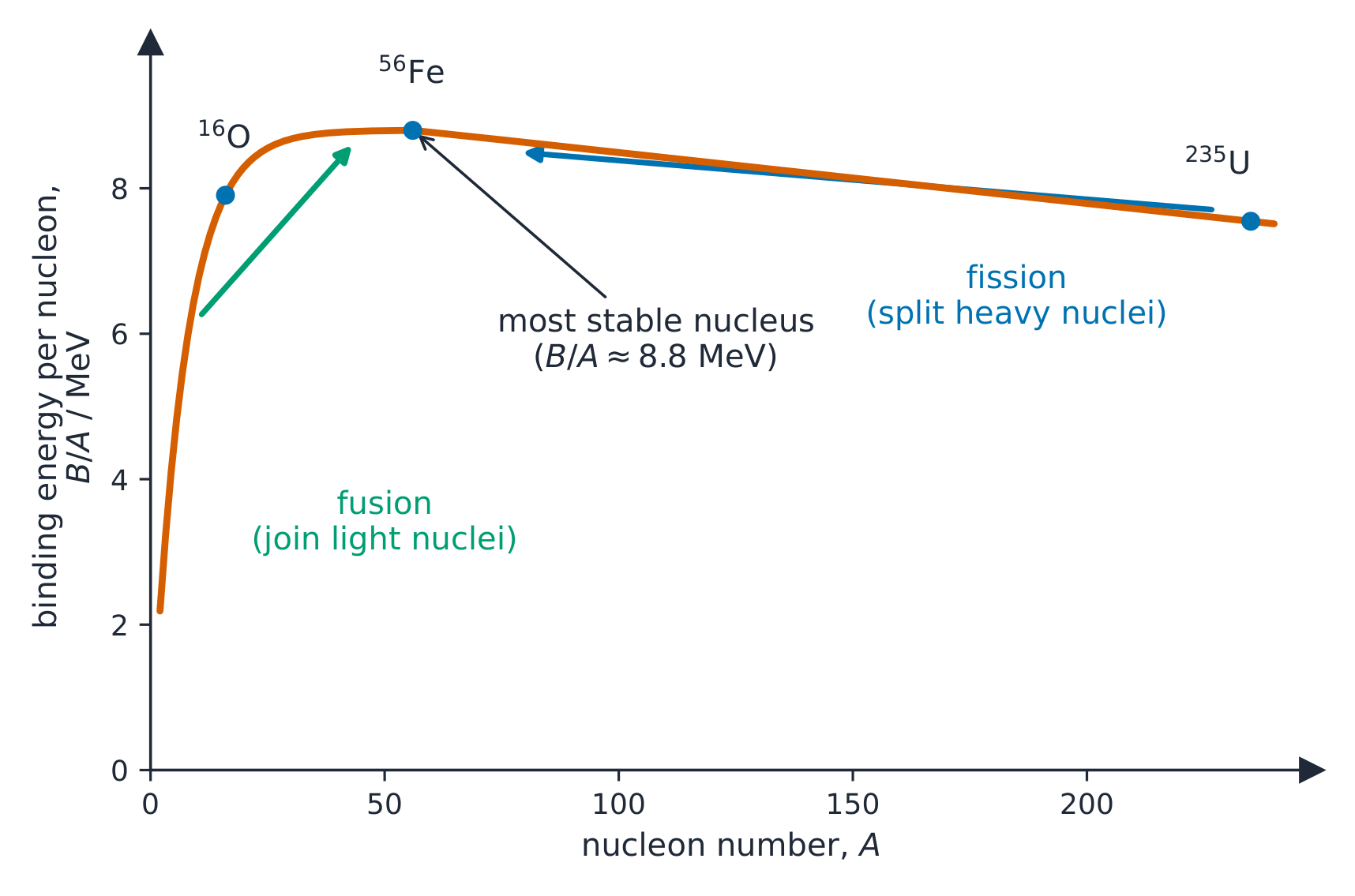
The nucleus 原子核 stores enormous energy. Fission 裂变 splits a heavy nucleus into lighter ones, releasing energy (nuclear reactors, bombs). Fusion 聚变 joins light nuclei into a heavier one (the Sun's power). Both release energy because the products have slightly less mass, converted by $E=mc^2$.
Worked example. Even a tiny mass converts to a huge energy. If a nuclear reaction loses $1.0\times10^{-3}\ \text{kg}$ of mass, it releases $E=mc^2=1.0\times10^{-3}\times(3.0\times10^{8})^2=9.0\times10^{13}\ \text{J}$ – roughly the energy of $20\,000$ tonnes of TNT.
עברית
הגרעין מאחסן אנרגיה עצומה. פישיון מפצל גרעין כבד לגרעינים קלים יותר, משחרר אנרגיה (מסדי כוח גרעיניים, פצצות). סינתזה מחברת גרעינים קלים לגרעין כבד יותר (הכוח של השמש). שניהם משחררים אנרגיה מכיוון שהמוצרים הם בעלי מסה מעט פחותה, המוסבת על ידי $E=mc^2$.
*אנרגיית קישור לכל נוקלאון מגיעה לשיאה בסביבות ברזל, ולכן גם סינתזה וגם פישיון יכולים לשחרר אנרגיה
דוגמה מפורטת. אפילו מסה זעירה הופכת לאנרגיה עצומה. אם תגובה גרעינית מאבדת $1.0\times10^{-3}\ \text{kg}$ ממסה, היא משחררת $E=mc^2=1.0\times10^{-3}\times(3.0\times10^{8})^2=9.0\times10^{13}\ \text{J}$ – בערך האנרגיה של $20\,000$ טון TNT.
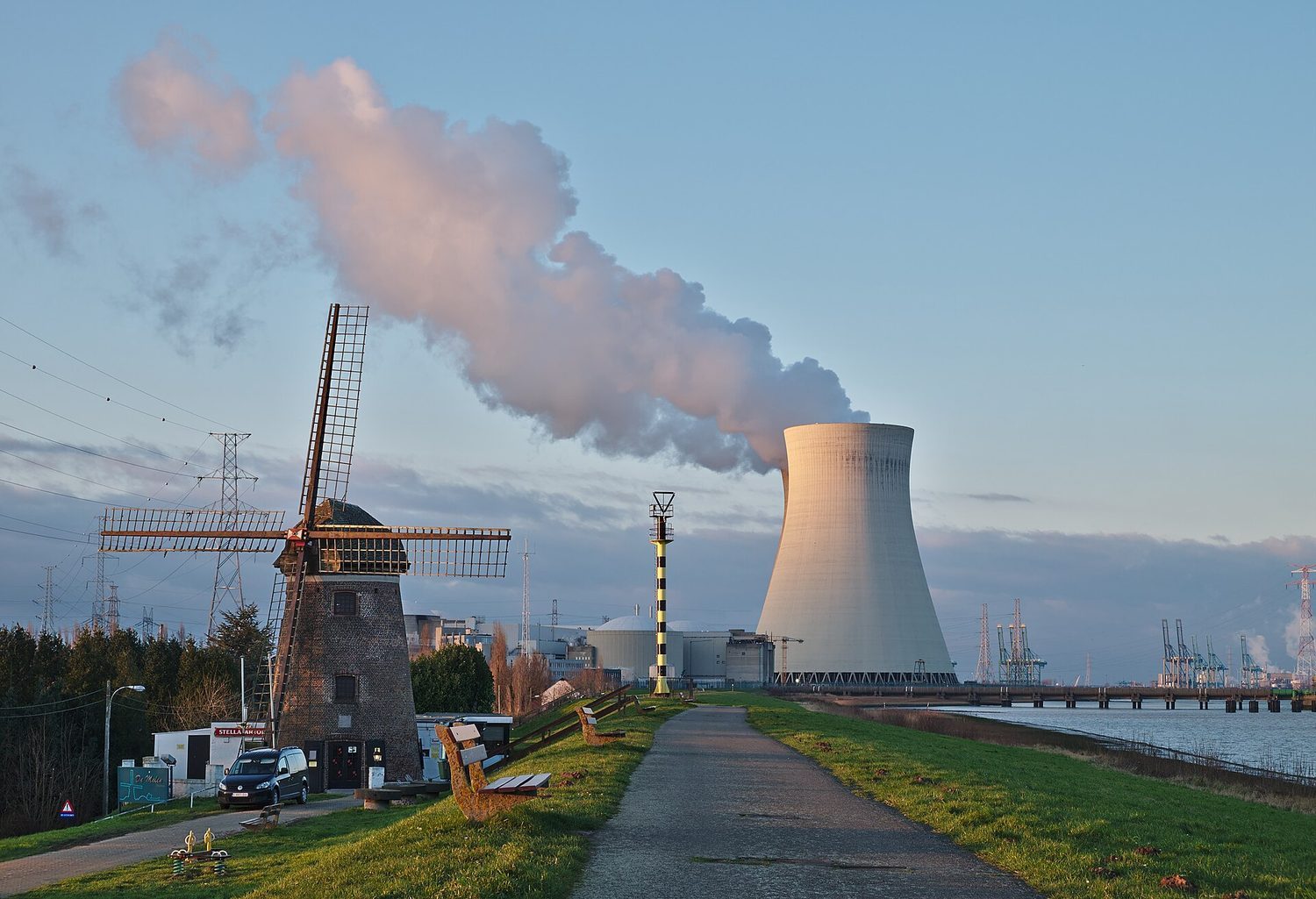 *תחנת כוח גרעינית: פישיון של גרעינים כבדים משחרר את האנרגיה המניעה את התחנה
Explore · חקור
Balance a nuclear decay equation · איזנו משוואת דעיכה גרעינית
In alpha, beta and gamma decay, nucleon and charge numbers must balance. Pick a mode and see how the parent turns into the daughter nuclide. · בדעיכות אלפא, בטה ו-גמא, מספרי Nuclon ומטען חייבים להיות מאוזנים. בחרו מצב וראו כיצד הגרעין ההורה הופך לגרעין בת.
15.8
Types of Radioactive Decay · סוגי דעיכה רادیולוגית
Syllabus · סיילבוס
English
Learning Objective 15.8.A: Describe the processes by which individual nuclei decay.
- 15.8.A.1 Some processes by which nuclei decay emit subatomic particles with unique properties.
- 15.8.A.1.i An alpha particle, or helium nucleus, consists of two neutrons and two protons and is symbolized by $\alpha$ or $\text{He}^{2+}$. (In Physics 2, only He-4 nuclei will be considered.)
- 15.8.A.1.ii Neutrinos and antineutrinos are subatomic particles that have no electrical charge, have negligible mass, and are symbolized by $\nu$ and $\bar{\nu}$, respectively.
- 15.8.A.1.iii Neutrinos and antineutrinos only interact with matter via the weak force and the gravitational force, which results in very little interaction with normal matter.
- 15.8.A.1.iv Positrons, or antielectrons, are subatomic particles that have an electric charge opposite that of an electron, have the same mass as an electron, and are symbolized by $e^+$ or $\beta^+$.
- 15.8.A.2 Nuclei can undergo radioactive decay via alpha decay, beta-minus decay ($\beta^-$), beta-plus decay ($\beta^+$), and gamma decay ($\gamma$).
- 15.8.A.2.i In all nuclear decays, nucleon number (the number of neutrons and protons), lepton number (the number of electrons and neutrinos), and charge are conserved.
- 15.8.A.2.ii Alpha decay occurs when a nucleus ejects an alpha particle.
- 15.8.A.2.iii Beta-minus decay occurs when a neutron changes to a proton by emitting an electron and antineutrino.
- 15.8.A.2.iv Beta-plus decay occurs when a proton changes to a neutron by emitting a positron and neutrino.
- 15.8.A.2.v Gamma decay occurs after a nucleus has undergone alpha or beta decay and the excited nucleus decays to a lower energy state by emitting a photon.
- 15.8.A.3 The type of decay exhibited by a given nucleus is determined by the isotope of the element.
Boundary statement: AP Physics 2 does not expect students to memorize the processes by which specific isotopes decay or the half-lives of specific isotopes. Neutron emission and electron capture are not included in the AP Physics 2 curriculum framework. Additionally, types of neutrinos, the characteristics that distinguish neutrinos and antineutrinos, and an explanation or application of the weak force are not within the scope of this course.
עברית
מטרות למידה 15.8.A: לתאר את התהליכים על ידי גרעינים בודדים עוברים דעיכה.
- 15.8.A.1 חלק מתהליכי הדעיכה של גרעינים פולטים חלקיקים תת-אטומיים עם מאפיינים ייחודיים.
- 15.8.A.1.i חלקיק אלפא, או גרעין הליום, מורכב משני ניוטרונים ושני פרוטונים ומסומן ב $\alpha$ או $\text{He}^{2+}$. (בפיזיקה 2, ייחשבו רק גרעיני He-4.)
- 15.8.A.1.ii ניטרינו ואנטי-ניטרינו הם חלקיקים תת-אטומיים שאין להם מטען חשמלי, יש להם מסה זניחה, ומסומנים ב $\nu$ ו $\bar{\nu}$ בהתאמה.
- 15.8.A.1.iii ניטרינו ואנטי-ניטרינו מגיבים עם חומר רק באמצעות הכוח החלש והכוח הכבישתי, מה שגרור אינטראקציה מינימלית עם חומר רגיל.
- 15.8.A.1.iv פוזיטרונים, או אנטי-אלקטרונים, הם חלקיקים תת-אטומיים שיש להם מטען חשמלי הפוך לזה של אלקטרון, יש להם אותה מסה כמו אלקטרון, ומסומנים ב $e^+$ או $\beta^+$.
- 15.8.A.2 גרעינים יכולים לעבור דעיכה רדיואקטיבית דרך דעיכת אלפא, דעיכת בטא-מינוס ($\beta^-$), דעיכת בטא-פלוס ($\beta^+$), ודעיכת גמא ($\gamma$).
- 15.8.A.2.i בכל דעיכות גרעينية, מספר נוקלאונים (מספר הניוטרונים והפרוטונים), מספר לפטונים (מספר האלקטרונים והניטרינו) ומטען חשמלי נשמרים.
- 15.8.A.2.ii דעיכת אלפא מתרחשת כאשר גרעין פולט חלקיק אלפא.
- 15.8.A.2.iii דעיכת בטא-מינוס מתרחשת כאשר ניוטרון הופך לפרוטון על ידי פליטת אלקטרון ואנטי-ניטרינו.
- 15.8.A.2.iv דעיכת בטא-פלוס מתרחשת כאשר פרוטון הופך לניטרון על ידי פליטת פוזיטרון וניטרينو.
- 15.8.A.2.v דעיכת גמא מתרחשת לאחר לגרעין עברה דעיכת אלפא או בטא, והגרעין המוגרה דועכת למצב אנרגטי נמוך יותר על ידי פליטת פוטון.
- 15.8.A.3 סוג הדעיכה המוצג על ידי גרעין נתון נקבע לפי האיזוטופ של היסוד.
*הצהרת גבול: AP Physics 2 אינו מצפה מהתלמידים לשנן את התהליכים באמצעותם איזוטופים ספציפיים דועכים או את מחציות החיים שלהם. פליטת ניטרונים וכליאת אלקטרונים אינם כלולים במסגרת הלימודים של AP Physics 2. בנוסף, סוגי הניטרינו, המאפיינים המבדילים ביניהם לבין אנטי-ניטרינו, והסבר או יישום הכוח החלש אינם בתחום ההשקעה של הקורס הזה.
Source: College Board AP Course and Exam Description · מקור: תיאור הקורס והמבחן של College Board AP
English
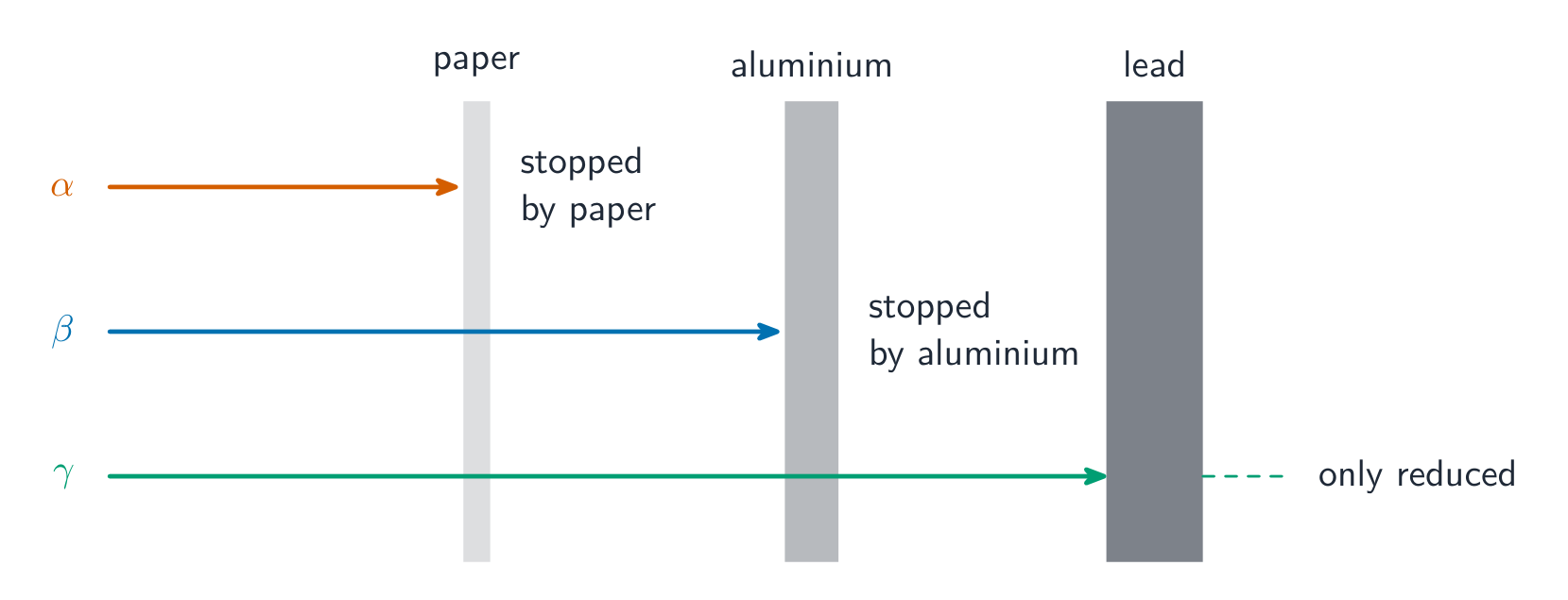
Unstable nuclei undergo radioactive decay 放射性衰变, emitting:
- Alpha decay 阿尔法衰变 ($\alpha$): a helium nucleus – mass number drops by 4.
- Beta decay 贝塔衰变 ($\beta$) comes in two kinds. In beta-minus ($\beta^-$) a neutron becomes a proton, emitting an electron and an antineutrino 反中微子: $n\rightarrow p+e^-+\bar{\nu}$. In beta-plus ($\beta^+$) a proton becomes a neutron, emitting a positron 正电子 and a neutrino 中微子: $p\rightarrow n+e^++\nu$.
- Gamma decay 伽马衰变 ($\gamma$): a high-energy photon – the nucleus sheds excess energy.
The neutrino and antineutrino (symbols $\nu$, $\bar{\nu}$) are tiny, chargeless, almost-massless particles that carry off energy and keep beta decay balanced. Decay is random, but a sample halves every half-life 半衰期: after each half-life, half of the remaining nuclei have decayed. Every decay equation conserves three quantities: nucleon number (mass number), charge, and lepton number 轻子数 – an electron or neutrino counts as $+1$ lepton, a positron or antineutrino as $-1$, and the totals must match on both sides.
Worked example. A radioactive sample has a half-life of $8.0$ days. What fraction is left after $24$ days? That is $24/8.0=3$ half-lives, so the fraction remaining is $\left(\tfrac12\right)^3=\tfrac18$ – about $12.5\%$. In an alpha decay of uranium-238 ($^{238}_{\ 92}\text{U}$), the daughter has mass number $238-4=234$ and atomic number $92-2=90$: thorium-234.
עברית
גרעינים לא יציבים עוברים דעיכה רادیולוגית, פולטים:
*כוח החדירה של קרינה אלפא, בטא וגמא
- פירוק אלפא ($\alpha$): גרעין הליום – מספר המסה יורד ב-4.
- פירוק בטא ($\beta$) בא בשני סוגים. ב-בטא מינוס ($\beta^-$) ניוטרון הופך לפרוטון, פולט אלקטרון ו-אנטרינו: $n\rightarrow p+e^-+\bar{\nu}$. ב-בטא פלוס ($\beta^+$) פרוטון הופך לניוטרון, פולט פוזיטרון ו-נרינו: $p\rightarrow n+e^++\nu$.
- פירוק גמא ($\gamma$): פוטון בעל אנרגיה גבוהה – הגרעין משחרר עודף אנרגיה.
הנרינו והאנטרינו (סימנים $\nu$, $\bar{\nu}$) הם חלקיקים קטנים, ללא מטען וכמעט ללא מסה, שמובילים אנרגיה ומאזנים את הפירוק הבטאי. הפירוק הוא אקראי, אך לדוגמה יש מחצית חיים: לאחר כל מחצית חיים, מחצית מגרעינים הנותרים מתפרקים. בכל משוואת פירוק נשמרים שלושה גדלים: מספר נוקליאונים (מספר המסה), מטען, ומספר להפטונים – אלקטרון או נרינו נחשבים כ$+1$ להפטון, פוזיטרון או אנטרינו כ$-1$, והסכומים צריכים להתאים בשני האגפים.
דוגמא מופת. לדוגמה רדיואקטיבית יש זמן מחצית חיים של $8.0$ ימים. מהו השבר שנותר לאחר $24$ ימים? כלומר, זהו $24/8.0=3$ זמני מחצית חיים, ולכן השבר הנותר הוא $\left(\tfrac12\right)^3=\tfrac18$ – כ-$12.5\%$. בפירוק אלפא של אורן-238 ($^{238}_{\ 92}\text{U}$), למוצר הבת יש מספר מסה $238-4=234$ ומספר אטומי $92-2=90$: תוריום-234.
Explore · חקור
Watch a sample decay · צפו בדעיכת דגימה
Radioactive nuclei decay randomly with a fixed half-life: each half-life halves the number remaining. Step forward and watch the sample shrink. · גרעינים רדיואקטיביים דועכים אקראית עם חצי חיים קבוע: בכל חצי חיים, מספר הגרעינים שנותרים יורד לחציו. צעדו קדימה וצפו כיצד הדגימה מתכווצת.
Vocabulary · מילון מונחים
Train · אימון
| English | עברית |
|---|---|
| radioactive decay/ˌreɪdɪəʊˈæktɪv dɪˈkeɪ/ | דעיכת רדיואקטיבית |
| Alpha decay/ˈælfə dɪˈkeɪ/ | קרינה אלפא |
| Beta decay/ˈbiːtə dɪˈkeɪ/ | קרינת בטא |
| antineutrino/ˌæntɪnjuːˈtriːnəʊ/ | אנטי-נוטרינו |
| positron/ˈpɒzɪtrɒn/ | פוזיטרון |
| neutrino/njuːˈtriːnəʊ/ | ניטרינו |
| Gamma decay/ˈɡæmə dɪˈkeɪ/ | קרינת גמא |
| half-life/hɑːf laɪf/ | זמן מחצית חיים |
| lepton number/ˈleptɒn ˈnʌmbə/ | מספר לפטונים |
15.8
Exam tips · טיפים לבחינות
English
- Photon energy is $E=hf$; below the threshold frequency no electrons are emitted however bright the light (the photoelectric effect).
- Use $K_{\max}=hf-\phi$ for the fastest photoelectrons ($\phi$ = work function).
- Electrons jump between discrete energy levels by absorbing/emitting a photon whose energy equals the level gap — the source of line spectra.
- In fission and fusion the small mass lost becomes energy via $E=mc^2$.
- Balance decay equations by conserving mass number, charge, and lepton number (write the antineutrino in $\beta^-$, the neutrino in $\beta^+$), and halve the sample every half-life ($(\tfrac12)^n$ after $n$ half-lives).
עברית
- אנרגיית הפוטון היא $E=hf$; מתחת לתדר הסף לא יופלטו אלקטרונים בכל התיירות התאורה (אפקט הפוטואלקטרי).
- השתמש ב$K_{\max}=hf-\phi$ עבור האלקטרונים הפוטואלקטריים המהירים ביותר ($\phi$ = פונקציית העבודה).
- אלקטרונים דוהרים בין רמות אנרגיה דיסקרטיות על ידי ספיגה/פליטה של פוטון whose אנרגיה שווה למרווח הרמות – המקור לספקטרי הקווים.
- בפיצול ובמיזוג המסה הקטנה האבוד הופכת לאנרגיה לפי $E=mc^2$.
- איזון משוואות פירוק על ידי שמירה על מספר המסה, המטען ומספר ההלפטונים (כתוב את האנטרינו ב$\beta^-$, את הנרינו ב$\beta^+$), וחלק את הדוגמה במחצית בכל מחצית חיים ($(\tfrac12)^n$ לאחר $n$ מחציות חיים).
Interactive lessons on this topic · שיעורים אינטראקטיביים בנושא זה
Work through it step by step, with instant-check exercises. · לעבור על הדברים צעד אחר צעד, עם תרגילים לבדיקה מיידית.
- Quantum Theory and Wave-Particle Duality · תיאוריית הקוונטים ודואליות גל-חלקיק
- The Bohr Model of Atomic Structure · מודל בור למבנה האטום
- Emission and Absorption Spectra · ספקטרום פליטה וספקטרום בליעה
- Blackbody Radiation · קריעת גוף שחור
- The Photoelectric Effect · האפקט הפוטואלקטרי
- Compton Scattering · פיזור קומפטון
- Fission, Fusion, and Nuclear Decay · ביצועים, היסות ודעיכה גרעינית
- Types of Radioactive Decay · סוגי דעיכה רדיואקטיבית