Skip to content · ⁨דלג לתוכן⁩

Torque and Rotational Dynamics · ⁨מומנט וכוח ודינמיקה סיבובית⁩

AP Physics 1 · ⁨פיזיקה AP 1⁩ · Topic 5 · ⁨נושא 5⁩

Video lesson for this topic · ⁨שיעור וידאו לנושא זה⁩ Open the video page · ⁨פתח את עמוד הוידאו⁩
7:41

מומנט וכוח ודינמיקה סיבובית

דחוף דלת כבדה מיד ליד הציר, ככל שאתה יכול. היא barely נערת. עכשיו דחף באותו כוח, מחוץ ליד הידית — והיא נפתחת לחלוטין. אותו…

English narration · English + 中文 subtitles burned in · ⁨קריאת קול באנגלית · תרגום אנגלי + סינית שרוף בתוך הסרטון⁩

5.1

Rotational Kinematics · ⁨קינמטיקה סיבובית⁩

Syllabus · ⁨סיילבוס⁩
English

Learning Objective 5.1.A: Describe the rotation of a system with respect to time using angular displacement, angular velocity, and angular acceleration.

  • 5.1.A.1 Angular displacement is the measurement of the angle, in radians, through which a point on a rigid system rotates about a specified axis.
    • Equation: $\Delta\theta = \theta - \theta_0$
    • 5.1.A.1.i A rigid system is one that holds its shape but in which different points on the system move in different directions during rotation. A rigid system cannot be modeled as an object.
    • 5.1.A.1.ii One direction of angular displacement about an axis of rotation—clockwise or counterclockwise—is typically indicated as mathematically positive, with the other direction becoming mathematically negative.
    • 5.1.A.1.iii If the rotation of a system about an axis may be well described using the motion of the system's center of mass, the system may be treated as a single object. For example, the rotation of Earth about its axis may be considered negligible when considering the revolution of Earth about the center of mass of the Earth–Sun system.
  • 5.1.A.2 Average angular velocity is the average rate at which angular position changes with respect to time.
    • Equation: $\omega_{\text{avg}} = \dfrac{\Delta\theta}{\Delta t}$
  • 5.1.A.3 Average angular acceleration is the average rate at which the angular velocity changes with respect to time.
    • Equation: $\alpha_{\text{avg}} = \dfrac{\Delta\omega}{\Delta t}$
  • 5.1.A.4 Angular displacement, angular velocity, and angular acceleration around one axis are analogous to linear displacement, velocity, and acceleration in one dimension and demonstrate the same mathematical relationships.
    • 5.1.A.4.i For constant angular acceleration, the mathematical relationships between angular displacement, angular velocity, and angular acceleration can be described with the following equations:
      • Equation: $\omega = \omega_0 + \alpha t$
      • Equation: $\theta = \theta_0 + \omega_0 t + \dfrac{1}{2}\alpha t^2$
      • Equation: $\omega^2 = \omega_0^2 + 2\alpha(\theta - \theta_0)$
    • 5.1.A.4.ii Graphs of angular displacement, angular velocity, and angular acceleration as functions of time can be used to find the relationships between those quantities.

Boundary statement: Descriptions of the directions of rotation for a point or object are limited to clockwise and counterclockwise with respect to a given axis of rotation.

עברית

מטרת למידה 5.1.A: תאר את הסיבוב של מערכת ביחס לזמן באמצעות הזזה זוויתית, מהירות זוויתית ותאוצה זוויתית.

  • 5.1.A.1 הזזה זוויתית היא מדידת הזווית, ברדיאנים, דרך נקודה מערכת קשיחה מסתובבת סביב ציר מסוים.
    • משוואה: $\Delta\theta = \theta - \theta_0$
    • 5.1.A.1.i מערכת קשיחה היא אחת ששומרת על צורה אך שבה נקודות שונות במערכת נעות בכיוונים שונים בזמן הסיבוב. מערכת קשיחה לא ניתן לדמות כגוף.
    • 5.1.A.1.ii כיוון אחד של הזזה זוויתית סביב ציר סיבוב – עם כיוון השעון או נגד כיוון השעון – מצוין בדרך כלל כחיובי מתמטית, כאשר הכיוון השני הופך לשלילי מתמטית.
    • 5.1.A.1.iii אם סיבוב מערכת סביב ציר ניתן לתאר היטב באמצעות תנועת מרכז המסה שלה, ניתן להתייחס למערכת כגוף בודד. לדוגמה, סיבוב כדור הארץ סביב צירו יכול להיחשב לזניח בעת בחינת החצייה של כדור הארץ סביב מרכז המסה של מערכת כדור הארץ-שמש.
  • 5.1.A.2 מהירות זוויתית ממוצעת היא קצב השינוי הממוצע של המיקום הזוויתי ביחס לזמן.
    • משוואה: $\omega_{\text{avg}} = \dfrac{\Delta\theta}{\Delta t}$
  • 5.1.A.3 תאוצה זוויתית ממוצעת היא קצב השינוי הממוצע של המהירות הזוויתית ביחס לזמן.
    • משוואה: $\alpha_{\text{avg}} = \dfrac{\Delta\omega}{\Delta t}$
  • 5.1.A.4 הזזה זוויתית, מהירות זוויתית ותאוצה זוויתית סביב ציר אחד הם אנלוגיים להזזה, מהירות ותאצה ליניאריות בממד אחד ומדגימים את אותן קשרים מתמטיים.
    • 5.1.A.4.i עבור תאוצה זוויתית קבועה, הקשרים המתמטיים בין הזזה זוויתית, מהירות זוויתית ותאוצה זוויתית ניתן לתאר באמצעות המשוואות הבאות:
      • משוואה: $\omega = \omega_0 + \alpha t$
      • משוואה: $\theta = \theta_0 + \omega_0 t + \dfrac{1}{2}\alpha t^2$
      • משוואה: $\omega^2 = \omega_0^2 + 2\alpha(\theta - \theta_0)$
    • 5.1.A.4.ii גרפים של הזזה זוויתית, מהירות זוויתית ותאוצה זוויתית כפונקציות של זמן יכולים לשמש למציאת הקשרים בין כמותות אלו.

הצהרת גבול: תיאורי כיווני הסיבוב עבור נקודה או גוף מוגבלים לכיוון השעון ונגד כיוון השעון ביחס לציר סיבוב נתון.
Source: College Board AP Course and Exam Description · ⁨מקור: תיאור הקורס והמבחן של College Board AP⁩

English

Rotation is described by angular quantities that mirror the linear ones:

  • angular displacement 角位移 $\theta$ (in radians 弧度),
  • angular velocity 角速度 $\omega=\dfrac{\Delta\theta}{\Delta t}$,
  • angular acceleration 角加速度 $\alpha=\dfrac{\Delta\omega}{\Delta t}$.

For constant $\alpha$, the rotational kinematic equations have the same form as the linear ones, with $\theta,\omega,\alpha$ replacing $x,v,a$: $\omega=\omega_0+\alpha t$, $\theta=\omega_0 t+\tfrac12\alpha t^2$, and $\omega^2=\omega_0^2+2\alpha\theta$.

Worked example. A wheel starts from rest and speeds up uniformly to $30\ \text{rad/s}$ in $6.0\ \text{s}$. Find its angular acceleration and the total angle turned:

$$\alpha=\frac{\Delta\omega}{\Delta t}=\frac{30}{6.0}=5.0\ \text{rad/s}^2,\qquad \theta=\tfrac12\alpha t^2=\tfrac12\times5.0\times6.0^2=90\ \text{rad}.$$

עברית
התנגשות מבחן: כוחות ומומנטומים גדולים גורמים לשינויים מהירים בתנועה ליניארית וסיבובית
התנגשות מבחן פגיעה: כוחות ומומנטומים גדולים גורמים לשינויים מהירים בתנועה ליניארית וסיבובית
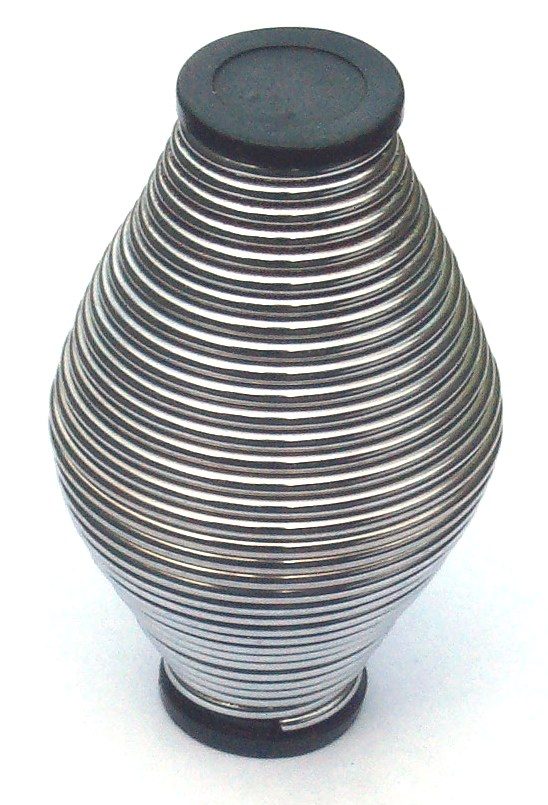
קפיץ בעומס: חוק הוק קושר כוח להרחבה – הקשר רלוונטי לאנרגיה במערכ סיבוביות
קפיץ תחת עומס: חוק הוק מקשר כוח למתיחה – רלוונטי להבנת אנרגיה במערכות סיבוביות

הסיבוב מתואר על ידי גודלים זוויתיים המשקפים את הגודלים הליניאריים:

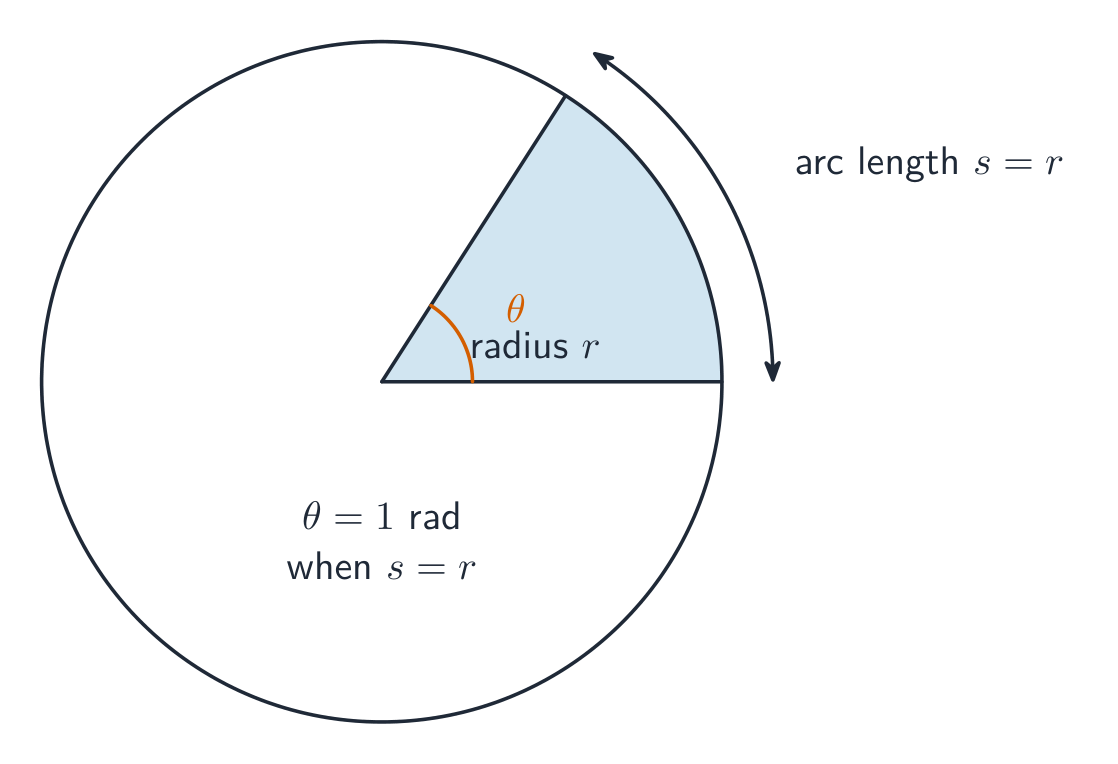
רדיאן אחד הוא הזווית שבה אורך הקשת שווה לרדיוס
  • הזזה זוויתית $\theta$ (ברדיאנים),
  • מהירות זוויתית $\omega=\dfrac{\Delta\theta}{\Delta t}$,
  • תאוצה זוויתית $\alpha=\dfrac{\Delta\omega}{\Delta t}$.

עבור תאוצה זוויתית קבועה $\alpha$, משוואות הקינמטיקה הסיבוביות נוהגות באותה צורה כמו הליניאריות, כאשר $\theta,\omega,\alpha$ מחליף את $x,v,a$: $\omega=\omega_0+\alpha t$, $\theta=\omega_0 t+\tfrac12\alpha t^2$ ו$\omega^2=\omega_0^2+2\alpha\theta$.

דוגמא מופתרת. גלגל מתחיל ממצב רגע ומאיץ באופן אחיד ל$30\ \text{rad/s}$ בתוך $6.0\ \text{s}$. מצאו את התאוצה הזוויתית ואת זווית הסיבול הכוללת:

$$\alpha=\frac{\Delta\omega}{\Delta t}=\frac{30}{6.0}=5.0\ \text{rad/s}^2,\qquad \theta=\tfrac12\alpha t^2=\tfrac12\times5.0\times6.0^2=90\ \text{rad}.$$

Vocabulary · ⁨מילון מונחים⁩ Train · ⁨אימון⁩
English עברית
angular displacement/ˈæŋɡjʊlə dɪˈspleɪsmənt/ הזזה זוויתית
radians/ˈreɪdɪənz/ רדיאנים
angular velocity/ˈæŋɡjʊlə vəˈlɒsɪti/ מהירות זוויתית
angular acceleration/ˈæŋɡjʊlə əkˌseləˈreɪʃn/ תאוצה זוויתית
Torque/tɔːk/ מומנט
moment arm/ˈməʊmənt ɑːm/ זרוע מומנט
Rotational inertia/rəʊˈteɪʃənl ɪˈnɜːʃə/ אינרציה סיבובית
rotational equilibrium/rəʊˈteɪʃənl ˌiːkwɪˈlɪbrɪəm/ איזון סיבובי
5.2

Connecting Linear and Rotational Motion · ⁨חיבור בין תנועה ליניארית לתנועה סיבובית⁩

Syllabus · ⁨סיילבוס⁩
English

Learning Objective 5.2.A: Describe the linear motion of a point on a rotating rigid system that corresponds to the rotational motion of that point, and vice versa.

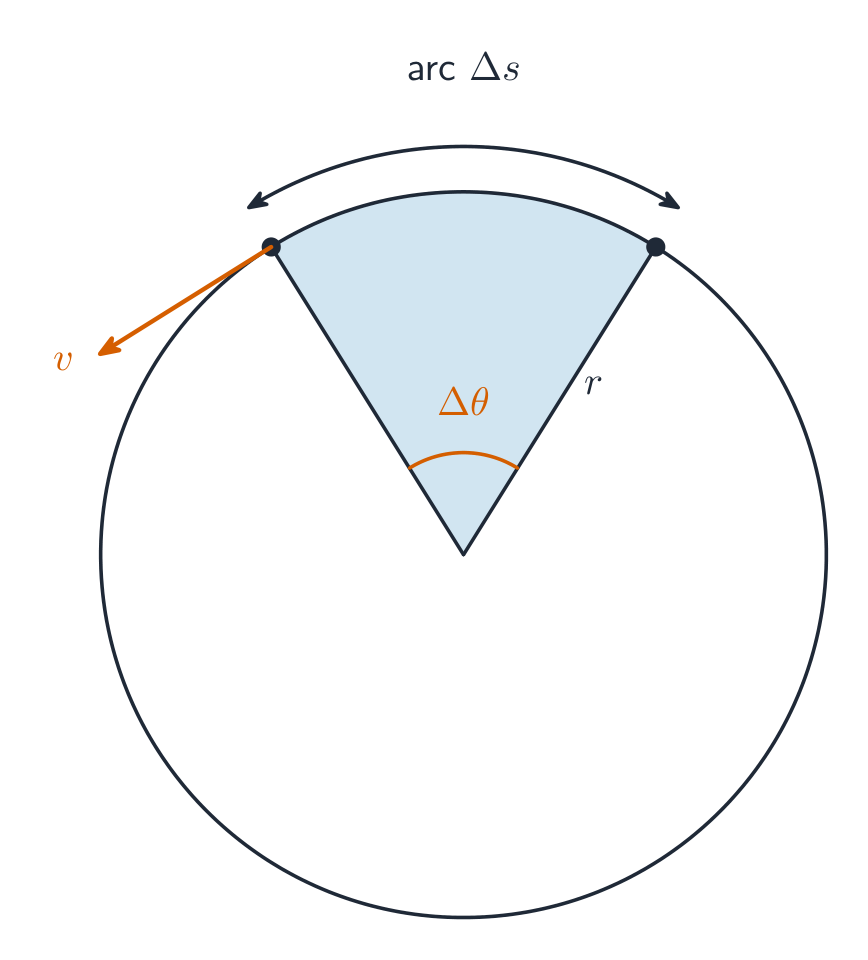
  • 5.2.A.1 For a point at a distance $r$ from a fixed axis of rotation, the linear distance $s$ traveled by the point as the system rotates through an angle $\Delta\theta$ is given by the equation $\Delta s = r\Delta\theta$.
  • 5.2.A.2 Derived relationships of linear velocity and of the tangential component of acceleration to their respective angular quantities are given by the following equations:
    • Equation: $s = r\theta$
    • Equation: $v = r\omega$
    • Equation: $a_T = r\alpha$
  • 5.2.A.3 For a rigid system, all points within that system have the same angular velocity and angular acceleration.

Boundary statement: Descriptions of the directions of rotation for a point or object are limited to clockwise and counterclockwise with respect to a given axis of rotation.

עברית

מטרת למידה 5.2.A: תאר את התנועה הליניארית של נקודה על מערכת קשיחה מסתובבת העוקבת אחר התנועה הסיבובית של הנקודה, ולהפך.

  • 5.2.A.1 עבור נקודה במרחק $r$ ממסב סיבוב קבוע, המרחק הליניירי $s$ שעברה הנקודה כאשר המערכת מסתובבת בזווית $\Delta\theta$ נתון על ידי המשוואה $\Delta s = r\Delta\theta$.
  • 5.2.A.2 הקשרים הגזורים מהמהירות הליניארית ומרכיב המשיק של התאוצה לגודלים האנגולריים המתאימים שלהם נתונים על ידי המשוואות הבאות:
    • משוואה: $s = r\theta$
    • משוואה: $v = r\omega$
    • משוואה: $a_T = r\alpha$
  • 5.2.A.3 עבור מערכת קשיחה, לכל הנקודות בתוך המערכת יש אותה מהירות זוויתית ואותה תאוצה זוויתית.

הצהרת גבול: תיאורי כיווני הסיבוב עבור נקודה או גוף מוגבלים לכיוון השעון ונגד כיוון השעון ביחס לציר סיבוב נתון.
Source: College Board AP Course and Exam Description · ⁨מקור: תיאור הקורס והמבחן של College Board AP⁩

English

A point at radius $r$ from the axis has linear quantities tied to the angular ones:

$$s=r\theta,\qquad v=r\omega,\qquad a_t=r\alpha.$$
Points farther from the axis move faster. This link lets you switch between "how fast the wheel spins" and "how fast a point on its rim moves."

Worked example. A bicycle wheel of radius $0.35\ \text{m}$ spins at $12\ \text{rad/s}$. A point on the rim (and so the bike) moves at $v=r\omega=0.35\times12=4.2\ \text{m/s}$. A point halfway to the axis moves at half that speed.

עברית

נקודה הממוקמת במרחק $r$ מהציר מחוברת לכמויות ליניאריות הקשורות לזוויתיות:

$$s=r\theta,\qquad v=r\omega,\qquad a_t=r\alpha.$$
נקודות הרחוקות יותר מהציר נעות מהר יותר. קשר זה מאפשר מעבר בין "כמה הגלגל מסתובב" לבין "כמה נקודה על שפתו נעה."

כאשר הרדיוס מסתובב בזווית, נקודה נעה לאורך קשת במהירות v

דוגמא מופתרת. גלגל אופניים ברדיוס $0.35\ \text{m}$ מסתובב ב$12\ \text{rad/s}$. נקודה על השפה (ועל כן האופניים) נעה ב$v=r\omega=0.35\times12=4.2\ \text{m/s}$. נקודה בחצי המרחק לציר נעה במחצית המהירות הזו.

5.3

Torque · ⁨מומנט (Torque)⁩

Syllabus · ⁨סיילבוס⁩
English

Learning Objective 5.3.A: Identify the torques exerted on a rigid system.

  • 5.3.A.1 Torque results only from the force component perpendicular to the position vector from the axis of rotation to the point of application of the force.
  • 5.3.A.2 The lever arm is the perpendicular distance from the axis of rotation to the line of action of the exerted force.

Learning Objective 5.3.B: Describe the torques exerted on a rigid system.

  • 5.3.B.1 Torques can be described using force diagrams.
    • 5.3.B.1.i Force diagrams are similar to free-body diagrams and are used to analyze the torques exerted on a rigid system.
    • 5.3.B.1.ii Similar to free-body diagrams, force diagrams represent the relative magnitude and direction of the forces exerted on a rigid system. Force diagrams also depict the location at which those forces are exerted relative to the axis of rotation.
  • 5.3.B.2 The magnitude of the torque exerted on a rigid system by a force is described by the following equation, where $\theta$ is the angle between the force vector and the position vector from the axis of rotation to the point of application of the force.
    • Equation: $\tau = rF_{\perp} = rF\sin\theta$

Boundary statement: While AP Physics 1 expects students to mathematically manipulate the magnitude of torque using vector conventions, the direction of torque is beyond the scope of the course.

עברית

מטרת למידה 5.3.A: לזהות את מומנטי הכוח הפועלים על מערכת קשיחה.

  • 5.3.A.1 מומנט כוח נובע רק מהרכיב האנכי לכוח ביחס לווקטור המיקום ממסב הסיבוב לנקודת יישום הכוח.
  • 5.3.A.2 רדיוס המנוף הוא המרחק האנכי ממסב הסיבוב לקו פעולת הכוח המופעל.

מטרת למידה 5.3.B: לתאר את מומנטי הכוח הפועלים על מערכת קשיחה.

  • 5.3.B.1 ניתן לתאר מומנטי כוח באמצעות דיאגרמות כוח.
    • 5.3.B.1.i דיאגרמות כוח דומות לדיאגרמות גוף חופשי ומשמשות לניתוח מומנטי הכוח הפועלים על מערכת קשיחה.
    • 5.3.B.1.ii כמו דיאגרמות גוף חופשי, דיאגרמות כוח מייצגות את הגודל היחסי והכיוון של הכוחות הפועלים על מערכת קשיחה. דיאגרמות כוח מציגות גם את המיקום בו הכוחות פועלים ביחס למסב הסיבוב.
  • 5.3.B.2 גודל המומנט הפועל על מערכת קשיחה על ידי כוח נתון על ידי המשוואה הבאה, כאשר $\theta$ היא הזווית בין וקטור הכוח לבין וקטור המיקום ממסב הסיבוב לנקודת יישום הכוח.
    • משוואה: $\tau = rF_{\perp} = rF\sin\theta$

הצהרת גבול: בעוד שב-AP Physics 1 מצופה מתלמידים לבצע עיבוד מתמטי בגודל המומנט באמצעות קונבנציות וקטוריות, הכיוון של המומנט אינו כלול בתוכנית הלימודים.

Source: College Board AP Course and Exam Description · ⁨מקור: תיאור הקורס והמבחן של College Board AP⁩

English
The principle of moments (torque)

Torque 力矩 is the rotational effect of a force – how effectively it turns an object about an axis:

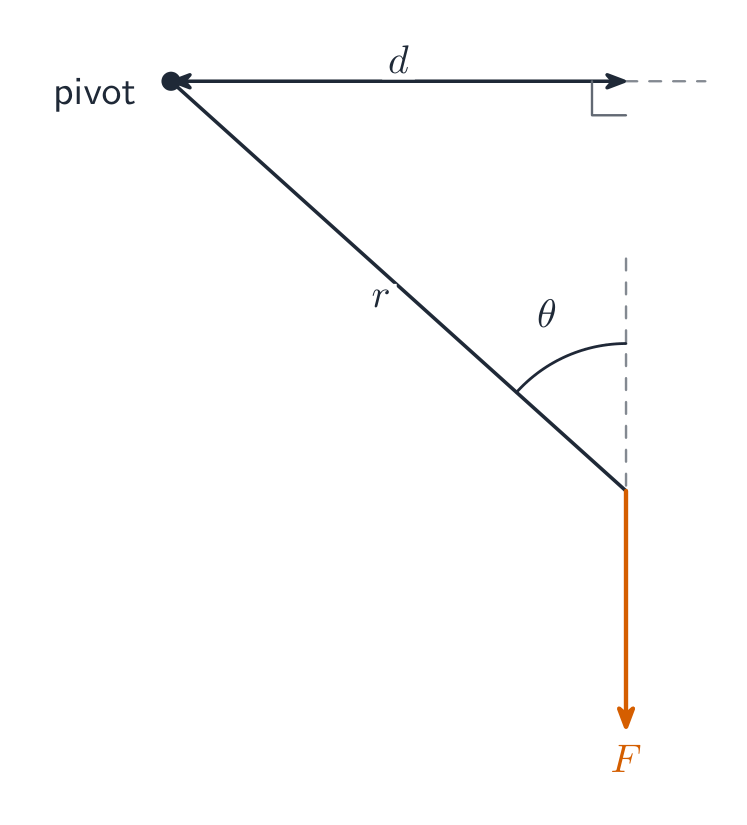
$$\tau=r F\sin\theta = F\cdot r_\perp,$$
where $r_\perp$ is the moment arm 力臂 (the perpendicular distance from the axis to the force's line of action). A force applied farther out, or more perpendicular, produces more torque. Torque has a sign (clockwise vs counterclockwise).

Worked example. You push with $20\ \text{N}$ at the end of a $0.30\ \text{m}$ wrench. Perpendicular to the wrench the torque is $\tau=rF=0.30\times20=6.0\ \text{N m}$. If you push at $60^{\circ}$ to the wrench instead, only the perpendicular part counts: $\tau=rF\sin 60^{\circ}=0.30\times20\times0.87=5.2\ \text{N m}$ – which is why you push at a right angle for the most turning effect.

עברית
עקרון המומנטים (מומנט)

מומנט הוא ההשפעה הסיבובית של כוח – עד כמה הוא יעיל בהפיכת גוף סביב ציר:

$$\tau=r F\sin\theta = F\cdot r_\perp,$$
כאשר $r_\perp$ הוא זרוע המומנט (המרחק האנכי מהציר לקו פעולת הכוח). כוח המופעל רחוק יותר או בצורה מאונכת יותר מייצר מומנט גדול יותר. למומנט יש סימן (שעון/נגד כיוון השעון).

מומנט הכוח תלוי במרחק האנכי מהציר

דוגמא מופתרת. אתם דוחקים בכוח של $20\ \text{N}$ בקצה מפתח של $0.30\ \text{m}$. אם הדחיפה מאונכת למפתח, המומנט הוא $\tau=rF=0.30\times20=6.0\ \text{N m}$. אם אתם דוחקים בزاوية $60^{\circ}$ למפתח במקום זאת, רק החלק המאונך נחשב: $\tau=rF\sin 60^{\circ}=0.30\times20\times0.87=5.2\ \text{N m}$ – ולכן דוחקים בזווית ישרה כדי להשיג את אפקט הסיבול המקסימלי.

Explore · ⁨חקור⁩

Balance torques on a beam · ⁨איזון מומנטים בקורה⁩

Torque is force times perpendicular distance, $\tau=Fd$. The beam is in rotational equilibrium when the torques on each side are equal. · ⁨מומנט הוא כוח כפול במרחק האנכי, $\tau=Fd$. הקורה נמצאת באיזון סיבובי כשהמומנטים בשני הצדדים שווים.⁩

5.4

Rotational Inertia · ⁨אינרציה סיבובית⁩

Syllabus · ⁨סיילבוס⁩
English

Learning Objective 5.4.A: Describe the rotational inertia of a rigid system relative to a given axis of rotation.

  • 5.4.A.1 Rotational inertia measures a rigid system's resistance to changes in rotation and is related to the mass of the system and the distribution of that mass relative to the axis of rotation.
  • 5.4.A.2 The rotational inertia of an object rotating a perpendicular distance $r$ from an axis is described by the equation
    • Equation: $I = mr^2$
  • 5.4.A.3 The total rotational inertia of a collection of objects about an axis is the sum of the rotational inertias of each object about that axis:
    • Equation: $I_{\text{tot}} = \sum I_i = \sum m_i r_i^2$

Learning Objective 5.4.B: Describe the rotational inertia of a rigid system rotating about an axis that does not pass through the system's center of mass.

  • 5.4.B.1 A rigid system's rotational inertia in a given plane is at a minimum when the rotational axis passes through the system's center of mass.
  • 5.4.B.2 The parallel axis theorem uses the following equation to relate the rotational inertia of a rigid system about any axis that is parallel to an axis through its center of mass:
    • Equation: $I' = I_{\text{cm}} + Md^2$

Boundary statement: AP Physics 1 only expects students to calculate the rotational inertia for systems of five or fewer objects arranged in a two-dimensional configuration.

Boundary statement: Students do not need to know the rotational inertia of extended rigid systems, as these will be provided within the exam. Students should have a qualitative understanding of the factors that affect rotational inertia; for example, how rotational inertia is greater when mass is farther from the axis of rotation, which is why a hoop has more rotational inertia than a solid disk of the same mass and radius.

עברית

מטרת למידה 5.4.A: לתאר את האינרציה הסיבובית של מערכת קשיחה ביחס למסב סיבוב נתון.

  • 5.4.A.1 האינרציה הסיבובית מודדת את התנגדותה של מערכת קשיחה לשינויים בסיבוב והיא קשורה למסת המערכת ולחלוקת המסה ביחס למסב הסיבוב.
  • 5.4.A.2 האינרציה הסיבובית של גוף מסתובב במרחק אנכי $r$ ממסב נתונה על ידי המשוואה
    • משוואה: $I = mr^2$
  • 5.4.A.3 האינרציה הסיבובית הכוללת של אוסף אובייקטים סביב ציר היא הסכום של האינרציות הסיבוביות של כל אובייקט סביב הציר ההוא:
    • משוואה: $I_{\text{tot}} = \sum I_i = \sum m_i r_i^2$

מטרת למידה 5.4.B: לתאר את האינרציה הסיבובית של מערכת קשיחה מסתובבת סביב ציר שאינו עובר דרך מרכז הכובד של המערכת.

  • 5.4.B.1 האינרציה הסיבובית של מערכת קשיחה במישור נתון מינימלית כאשר ציר הסיבוב עובר דרך מרכז הכובד של המערכת.
  • 5.4.B.2 משפט ציר מקביל משתמש במשוואה הבאה כדי לקשר את המומנט האינרציה של מערכת קשיחה סביב כל ציר המקביל לציר העובר דרך מרכז הכובד שלה:
    • משוואה: $I' = I_{\text{cm}} + Md^2$

גבול תוכן: AP Physics 1 מצפה רק מהתלמידים לחשב את המומנט האינרציה עבור מערכות של חמישה עצמים או פחות המסודרים בתצורת דו-ממדית.

גבול תוכן: התלמידים אינם זקוקים למידע על המומנט האינרציה של מערכות קשיחות מורחבות, שכן יסופק להם במהלך המבחן. עליהם להבין באופן איכותי את הגורמים המשפיעים על המומנט האינרציה; לדוגמה, כיצד המומנט האינרציה גדול יותר כאשר המסה נמצאת רחוק יותר מציר הסיבוב, ולכן לעיגול יש מומנט אינרציה גבוה יותר מאשר לדיסק מוצק בעל אותה מסה ואותו רדיוס.

Source: College Board AP Course and Exam Description · ⁨מקור: תיאור הקורס והמבחן של College Board AP⁩

English

Rotational inertia 转动惯量 (moment of inertia) $I$ measures how hard it is to change an object's rotation – the rotational version of mass. It depends on both the mass and how far that mass sits from the axis: mass spread farther out gives a larger $I$. For a point mass, $I=mr^2$; for extended bodies, standard formulas are provided (a hoop is $mR^2$, a solid disk $\tfrac12 mR^2$). This is why a figure skater spins faster when she pulls her arms in – she reduces $I$.

עברית

אינרציה סיבובית (מומנט אינרציה) $I$ מדד את הקושי לשנות את סיבול הגוף – הגרסה הסיבובית של המסה. היא תלויה גם במסה וגם בכמה המסה מרוחקת מהציר: חלוקת מסה רחוקה יותר נותנת מומנט אינרציה גדול יותר $I$. עבור נקודת חומר, $I=mr^2$; לגופים מורכבים מסופקות נוסחות סטנדרטיות (למשאלה עיגול הוא $mR^2$, דיסק מוצק הוא $\tfrac12 mR^2$). זוהי הסיבה שהמחולצת מסתובבת מהר יותר כשהיא מכנסת את הידיים – היא מפחיתה את $I$.

5.5

Rotational Equilibrium · ⁨איזון סיבובי⁩

Syllabus · ⁨סיילבוס⁩
English

Learning Objective 5.5.A: Describe the conditions under which a system's angular velocity remains constant.

  • 5.5.A.1 A system may exhibit rotational equilibrium (constant angular velocity) without being in translational equilibrium, and vice versa.
    • 5.5.A.1.i Free-body and force diagrams describe the nature of the forces and torques exerted on an object or rigid system.
    • 5.5.A.1.ii Rotational equilibrium is a configuration of torques such that the net torque exerted on the system is zero.
      • Equation: $\sum \tau_i = 0$
    • 5.5.A.1.iii The rotational analog of Newton's first law is that a system will have a constant angular velocity only if the net torque exerted on the system is zero.
  • 5.5.A.2 A rotational corollary to Newton's second law states that if the torques exerted on a rigid system are not balanced, the system's angular velocity must be changing.

Boundary statement: AP Physics 1 does not expect students to simultaneously analyze rotation in multiple planes.

עברית

מטרת לימוד 5.5.A: לתאר את התנאים שבהם מהירות הזוויתית של מערכת נשארת קבועה.

  • 5.5.A.1 מערכת עשויה להציג איזון סיבובי (מהירות זוויתית קבועה) מבלי להיות באיזון תרגולי, ולהפך.
    • 5.5.A.1.i דיאגרמות גוף חופשי ודיאגרמות כוח מתארות את אופי הכוחות והמומנטים הפועלים על גוף או מערכת קשיחה.
    • 5.5.A.1.ii איזון סיבובי הוא מצב של מומנטים כך שהמומנט הכולל הפועל על המערכת הוא אפס.
      • משוואה: $\sum \tau_i = 0$
    • 5.5.A.1.iii האנלוג הסיבובי לחוק ראשון של ניוטון קובע שמערכת תהיה בעלת מהירות זוויתית קבועה רק אם המומנט הכולל הפועל עליה הוא אפס.
  • 5.5.A.2 קורולרי סיבובי לחוק השני של ניוטון קובע שאם המומנטים הפועלים על מערכת קשיחה אינם מאוזנים, מהירות הזוויתית של המערכת חייבתשתנות.

גבול תוכן: AP Physics 1 לא מצפה מהתלמידים לבצע ניתוח סיבובי בו-זמנית במספר מישורים.

Source: College Board AP Course and Exam Description · ⁨מקור: תיאור הקורס והמבחן של College Board AP⁩

English

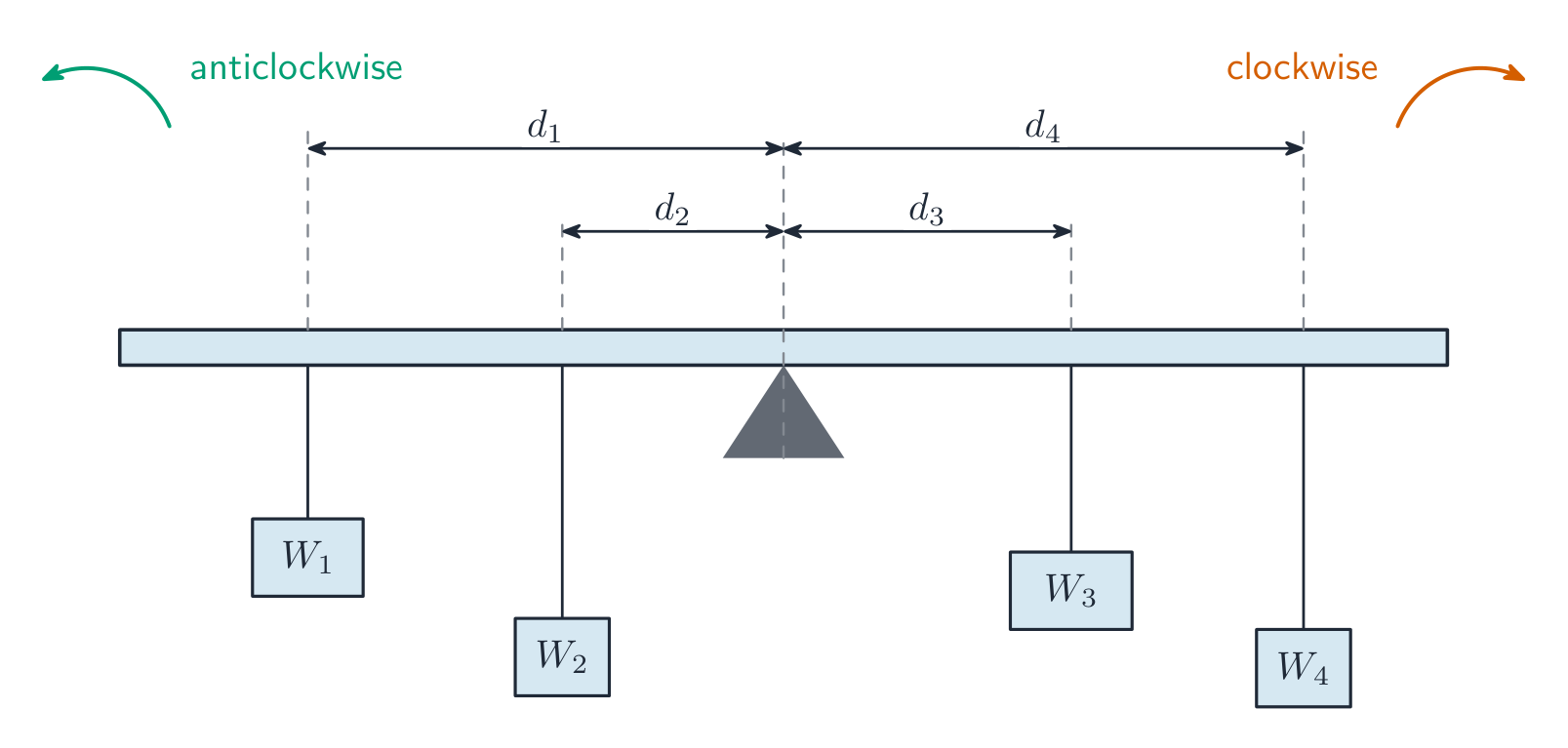
An object is in rotational equilibrium 转动平衡 when the net torque is zero, so its angular velocity stays constant. For a balanced (static) object, both the net force and the net torque are zero. Choosing the axis at an unknown force's location removes it from the torque equation – a useful trick for beam and ladder problems.

Worked example. A $30\ \text{kg}$ child sits $2.0\ \text{m}$ from the pivot of a seesaw. Where must a $40\ \text{kg}$ child sit on the other side to balance it? Set the clockwise torque equal to the anticlockwise torque (the $g$'s cancel):

$$30\times2.0=40\times d\;\Rightarrow\;d=\frac{60}{40}=1.5\ \text{m}.$$
The heavier child sits closer to the pivot – less distance, same torque.

עברית

גוף נמצא באיזון סיבובי כאשר המומנט הכולל הוא אפס, כך שהמהירות הזוויתית נשארת קבועה. עבור גוף מאוזן (סטטי), גם הכוח הכולל וגם המומנט הכולל הם אפס. בחירת הציר במיקום כוח לא ידוע מבטלת אותו ממשוואת המומנט – טריק שימושי לבעיות קורות ומדרגות.

באיזון, המומנטים השעוניים והנגד-שעוניים סביב הציר שווים
במצב איזון, המומנטים השעון-הידי ונגד-שעון סביב ציר הסיב שווים זה לזה

דוגמה מוצגת. ילד בן $30\ \text{kg}$ יושב במרחק $2.0\ \text{m}$ מציר הסיב של משחוק. היכן על הצד השני יצטרף ילד בן $40\ \text{kg}$ לשמור על האיזון? נשווה את המומנט השעון-הידי למומנט נגד-שעון (ה-$g$'ים מתאפסות):

$$30\times2.0=40\times d\;\Rightarrow\;d=\frac{60}{40}=1.5\ \text{m}.$$
הילד הכבד יותר יושב קרוב יותר לציר הסיב – מרחק פחות, אותו מומנט.

Explore · ⁨חקור⁩

Find the balance point · ⁨מצא את נקודת האיזון⁩

For rotational equilibrium the total clockwise torque equals the total anticlockwise torque. Move the forces and distances until the beam balances. · ⁨עבור איזון סיבובי, סך המומנטים השעוניים שווה לסך המומנטים נגד השעון. הזז את הכוחות והמרחקים עד שקורה מאוזנת.⁩

5.6

Newton's Second Law in Rotational Form · ⁨חוק השני של ניוטון בצורה סיבובית⁩

Syllabus · ⁨סיילבוס⁩
English

Learning Objective 5.6.A: Describe the conditions under which a system's angular velocity changes.

  • 5.6.A.1 Angular velocity changes when the net torque exerted on the object or system is not equal to zero.
  • 5.6.A.2 The rate at which the angular velocity of a rigid system changes is directly proportional to the net torque exerted on the rigid system and is in the same direction. The angular acceleration of the rigid system is inversely proportional to the rotational inertia of the rigid system.
    • Equation: $\alpha_{\text{sys}} = \dfrac{\sum \tau}{I_{\text{sys}}} = \dfrac{\tau_{\text{net}}}{I_{\text{sys}}}$
  • 5.6.A.3 To fully describe a rotating rigid system, linear and rotational analyses may need to be performed independently.
עברית

מטרת לימוד 5.6.A: לתאר את התנאים שבהם מהירות הזוויתית של מערכת משתנה.

  • 5.6.A.1 מהירות זוויתית משתנה כאשר המומנט הכולל הפועל על הגוף או המערכת אינו שווה לאפס.
  • 5.6.A.2 הקצב שבו מהירות הזוויתית של מערכת קשיחה משתנה פרופורציונלי ישירות למומנט הכולל הפועל על המערכת הקשיחה ובאותו כיוון. התאוצה הזוויתית של המערכת הקשיחה פרופורציונלית הפוכה למומנט האינרציה הסיבובי שלה.
    • משוואה: $\alpha_{\text{sys}} = \dfrac{\sum \tau}{I_{\text{sys}}} = \dfrac{\tau_{\text{net}}}{I_{\text{sys}}}$
  • 5.6.A.3 כדי לתאר במלואו מערכת קשיחה מסתובבת, ייתכן שיש לבצע ניתוחים ליניאריים וסיבוביים בנפרד.

Source: College Board AP Course and Exam Description · ⁨מקור: תיאור הקורס והמבחן של College Board AP⁩

English

Net torque produces angular acceleration, in direct analogy with $F=ma$:

$$\sum\tau = I\alpha.$$
So a larger net torque, or a smaller rotational inertia, gives a larger angular acceleration. Solve rotation problems just like translation problems, with $\tau\leftrightarrow F$, $I\leftrightarrow m$, and $\alpha\leftrightarrow a$.

Worked example. A net torque of $12\ \text{N m}$ acts on a wheel with rotational inertia $I=3.0\ \text{kg m}^2$. Its angular acceleration is $\alpha=\tau/I=12/3.0=4.0\ \text{rad/s}^2$ – the exact rotational twin of $a=F/m$.

עברית

מומנט נטו גורם לתאוצה זוויתית, באנלוגיה ישירה עם $F=ma$:

$$\sum\tau = I\alpha.$$
לכן, מומנט נטו גדול יותר, או עיקבות סיבובית קטנה יותר, נותנים תאוצה זוויתית גדולה יותר. פותרים בעיות סיבוב בדיוק כמו בעברתה, עם $\tau\leftrightarrow F$, $I\leftrightarrow m$, ו-$\alpha\leftrightarrow a$.

דוגמה מוצגת. מומנט נטו של $12\ \text{N m}$ פועל על גלגל בעל עיקבות סיבובית של $I=3.0\ \text{kg m}^2$. התאוצה הזוויתית שלו היא $\alpha=\tau/I=12/3.0=4.0\ \text{rad/s}^2$ – העתיק הסיבובי המדויק של $a=F/m$.

5.6

Exam tips · ⁨טיפים לבחינות⁩

English
  • Torque $\tau=Fr_\perp$ uses the perpendicular distance from the pivot; a force through the pivot gives zero torque.
  • For balance, set clockwise torque = anticlockwise torque; choosing the pivot at an unknown force removes it from the equation.
  • Use the rotational analogues: $\tau\leftrightarrow F$, $I\leftrightarrow m$, $\alpha\leftrightarrow a$, so $\sum\tau=I\alpha$ mirrors $\sum F=ma$.
  • Rotational inertia depends on how far the mass sits from the axis, not just its amount — a hoop resists spinning more than a disc of equal mass.
  • Convert angles to radians and link linear to angular with $v=r\omega$, $a_t=r\alpha$.
עברית
  • מומנט $\tau=Fr_\perp$ משתמש במרחק אנכי מציר הסיב; כוח הפועל דרך ציר הסיב נותן מומנט אפס.
  • בשביל איזון, נשווה מומנט שעון-הידי למומנט נגד-שעון; בחירת ציר הסיב בכוח לא ידוע מחלקת אותו מהמשוואה.
  • השתמש באנלוגיות הסיבוביות: $\tau\leftrightarrow F$, $I\leftrightarrow m$, $\alpha\leftrightarrow a$, כך ש-$\sum\tau=I\alpha$ משקפת את $\sum F=ma$.
  • עיקבות סיבובית תלויות ב-איך רחוק המסה נמצאת מהציר, ולא רק בכמותה – טבעת עמידה יותר לסובב מאשר דיסק באותו מסה.
  • ממיר זוויות ל-רדיאנים וחבר ליניאר לזוויתי באמצעות $v=r\omega$, $a_t=r\alpha$.

Interactive lessons on this topic · ⁨שיעורים אינטראקטיביים בנושא זה⁩

Work through it step by step, with instant-check exercises. · ⁨לעבור על הדברים צעד אחר צעד, עם תרגילים לבדיקה מיידית.⁩

Past Papers · ⁨מבחני עבר⁩

More topics in AP Physics 1 · ⁨פיזיקה AP 1⁩ · ⁨נושאים נוספים בAP Physics 1 · ⁨פיזיקה AP 1⁩⁩

Log in or create account · ⁨היכנס או צור חשבון⁩

IGCSE, A-Level & AP