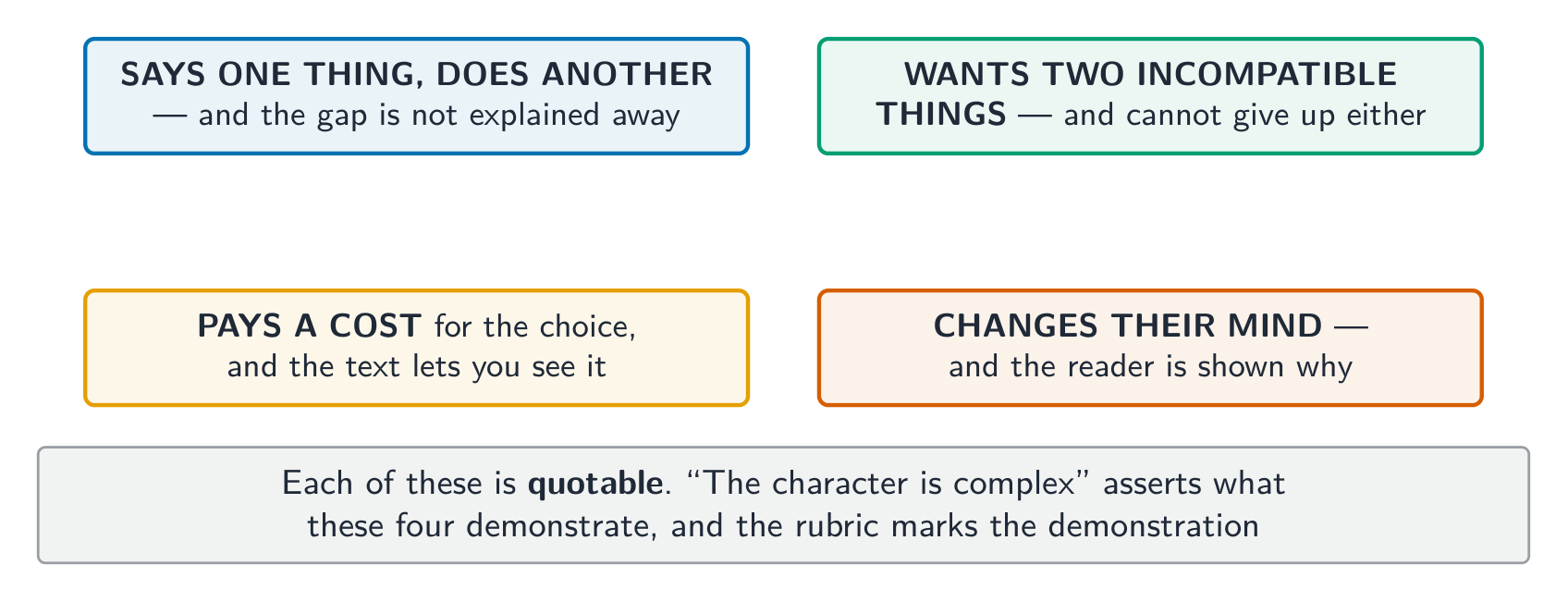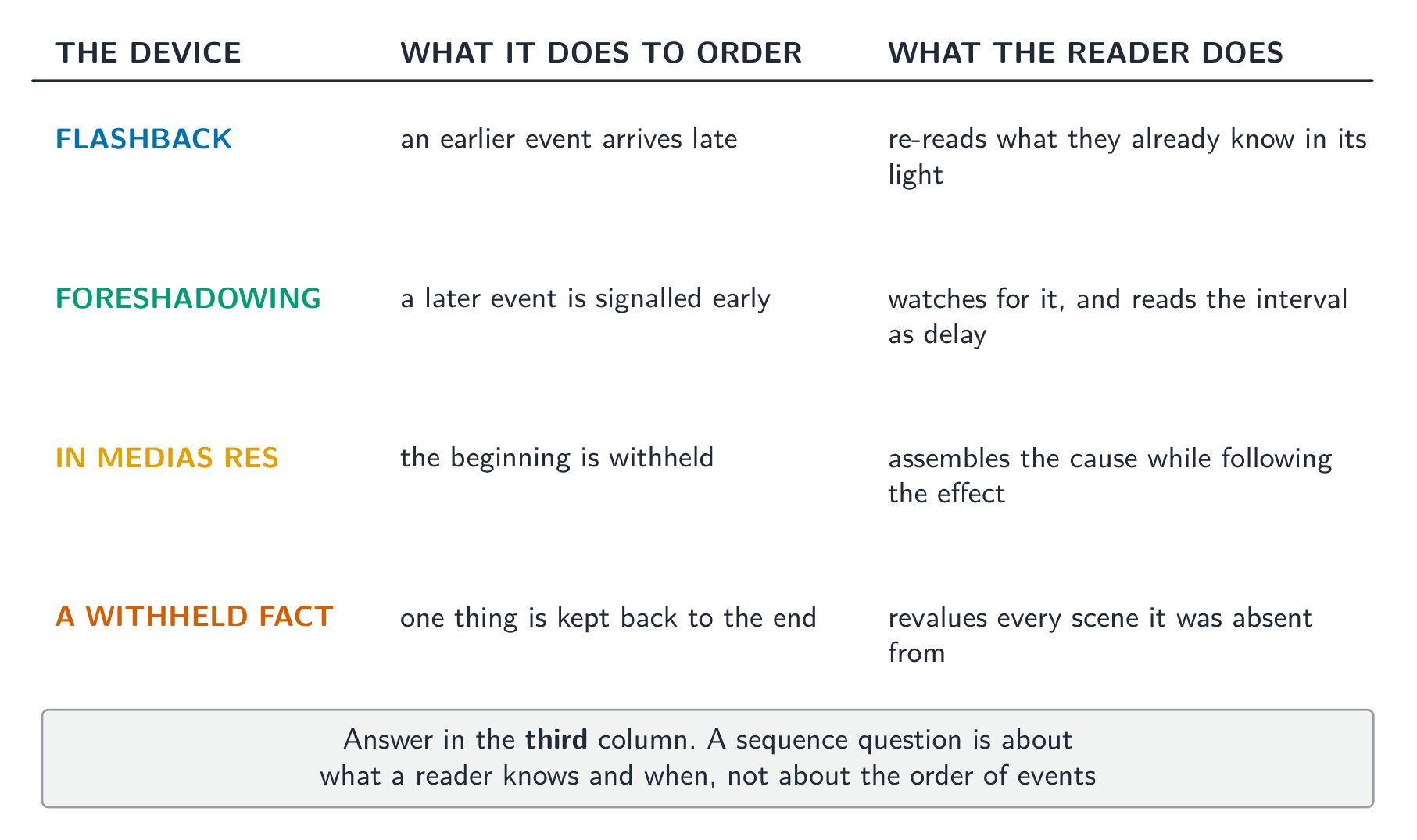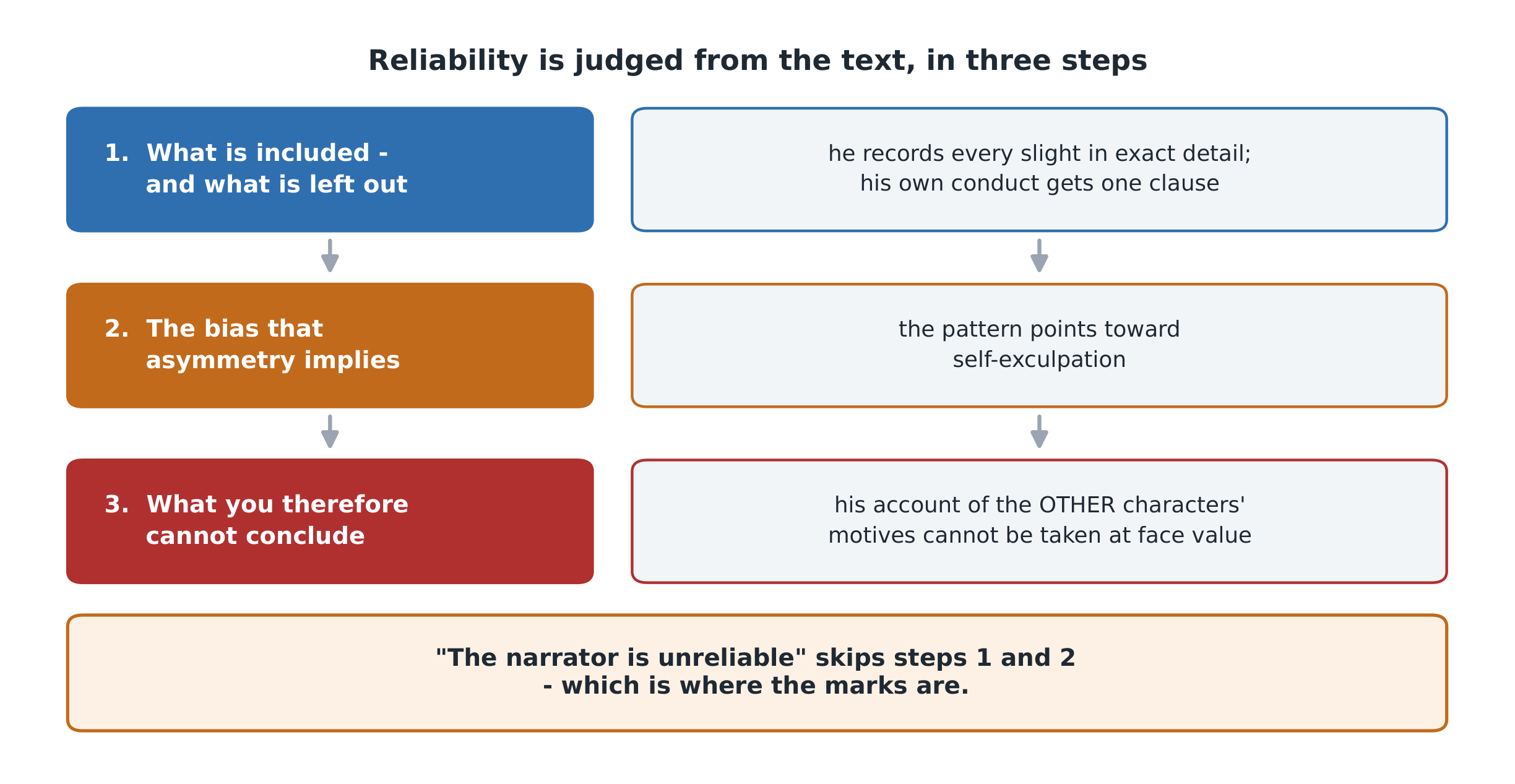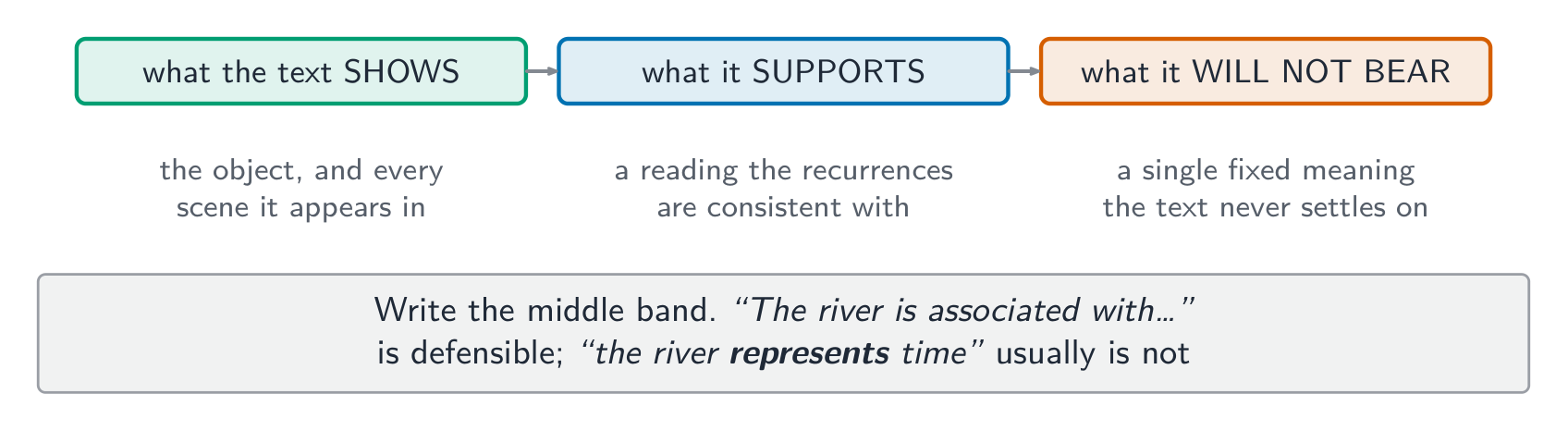
Skip to content · ⁨דלג לתוכן⁩
Subjects · ⁨נושאים⁩

AP English Literature and Composition · ⁨ספרות אנגלית וכתיבה יצירתית - AP⁩

Tips · ⁨טיפים⁩

AP English Literature and Composition מלמד קריאה מקיפה ומאמרים ספרתיים בשלושה סוגי טקסטים, כל אחד מהם נבקר שלוש פעמים: פרוזה קצרה, שירה, ופרוזה ארוכה או דרמה. היחידות ספירליות, כך שמיומנויות זהות חוזרות בעומק גדול יותר.

הקורס מאורגן סביב אלמנט ספרתי: דמות, רקע, מבנה, narrating, לשון ספרתית, ומאמרים ספרתיים. לכל אלמנט יש מיומנויות משלו, וכל אחד שואל את אותה שאלה בסיסית – מה that בחירה *עושה* בטקסט?

"הפונקציה של" היא הביטוי שצריך לשים לב אליו. ה框架 שואל שוב ושוב על הפונקציה של סמל, ניגוד, שינוי ב-narrating. זיהוי כלי הוא השלב הראשון; הסבר על העבודה שהוא מבצע הוא התשובה.

הפרשנות חייבת להיות הגננית, ולא רק אישית. קריאה מקבלת נקודות כאשר היא נתמכת בפרטים מהטקסט ומפותחת באמצעות היגיון, ולכן מאמרים ספרתיים רצים לצד כל אלמנט.

ההערות למטה עוקבות אחרי התשע יחידות בסדרה שהCollege Board קובע, כך שפרוזה קצרה, שירה ועבודות ארוכות מתחלפות בדיוק כפי שקורס עושה.

  • 1

    Short Fiction I · ⁨פרוזה קצרה I⁩

    Watch lesson · ⁨צפה בשיעור⁩
    1.1

    What Textual Details Reveal About a Character · ⁨מה פרטים טקסטואליים חושפים לגבי דמות⁩

    Syllabus · ⁨סיילבוס⁩
    English

    Enduring Understanding (CHR-1): Characters in literature allow readers to study and explore a range of values, beliefs, assumptions, biases, and cultural norms represented by those characters.

    Learning Objective 1.A: Identify and describe what specific textual details reveal about a character, that character’s perspective, and that character’s motives.

    • CHR-1.A Description, dialogue, and behavior reveal characters to readers.
    • CHR-1.B Descriptions of characters may come from a speaker, narrator, other characters, or the characters themselves.
    • CHR-1.C Perspective is how narrators, characters, or speakers understand their circumstances, and is informed by background, personality traits, biases, and relationships.
    • CHR-1.D A character’s perspective is both shaped and revealed by relationships with other characters, the environment, the events of the plot, and the ideas expressed in the text.
    עברית

    הבנה מתמשכת (CHR-1): דמויות בספרות מאפשרות לקוראים לעסוק בחקר ובחינוך מגוון ערכים, אמונות, הנחות בסיס, גיויים ונורמות תרבותיים המייצגות הדמויות הללו.

    מטרות למידה 1.A: לזהות ולתאר מה פרטים טקסטואליים ספציפיים חושפים על דמות, על מבטא של הדמות ועל מנימיה של הדמות.

    • CHR-1.A תיאור, דיאלוג והתנהגות חושפים דמויות לקוראים.
    • CHR-1.B תיאורים של דמויות יכולים להתקבל מקריין, מספר, דמויות אחרות או מהדמויות עצמן.
    • CHR-1.C מבט הוא האופן שבו מספרים, דמויות או קרינים מבינים את מצבם, והוא מושפע מרקע, תכונות אישיות, גיויים ויחסים.
    • CHR-1.D מבטא של דמות מעוצב ומתגלה גם על ידי יחסים עם דמויות אחרות, הסביבה, אירועי העלילה והרעיונות המבוארים בטקסט.
    Source: College Board AP Course and Exam Description · ⁨מקור: תיאור הקורס והמבחן של College Board AP⁩

    English

    AP English Literature reads texts in three genres across nine units - short fiction, poetry, and longer fiction or drama, each visited three times at increasing difficulty. Unit 1 installs the tools for all of them.

    Character 人物 is revealed by three things, and the CED names them exactly:

    • Description, dialogue, and behaviour 描写、对话与行为 reveal characters to readers.
    • Descriptions may come from a speaker, narrator, other characters, or the characters themselves - so who is describing is part of the evidence.
    • Perspective 视角 is how narrators, characters, or speakers understand their circumstances, informed by background, experience, and values.
    • A character's perspective is both shaped and revealed by relationships with other characters, the environment, and events.

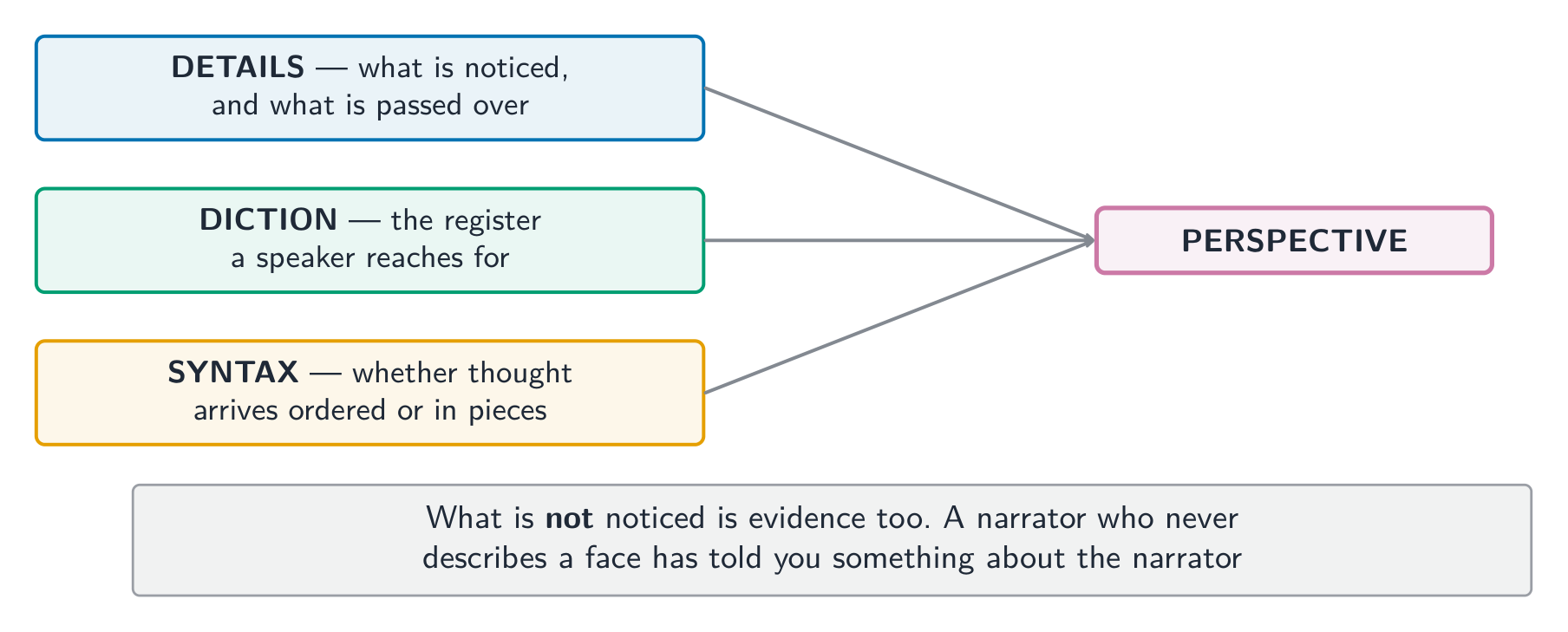
    That last point is the one that turns character notes into analysis. A character is not a list of adjectives; a character is a way of seeing, which becomes visible in what they notice, what they misread, and how they respond.

    עברית

    AP English Literature קורא טקסטים בשלושה סוגים בתוך תשע יחידות - פרוזה קצרה, שירה ופרוזה ארוכה או דרמה, כל אחד מהם נדון שלוש פעמים ברמת קושי עולה. יחידה 1 מציבה את הכלים לכל אלו.

    דמות 人物 נחשפת על ידי שלושה דברים, ו-CED מציין אותם במדויק:

    • תיאור, דיאלוג והתנהגות 描写、对话与行为 חושפים דמויות לקוראים.
    • תיאורים עשויים לבוא מדובר, מספר, דמויות אחרות או הדמויות עצמן - כך שמי שמתאר הוא חלק מהעדויות.
    • Perspective 视角 הוא האופן שבו מספרים, דמויות או דיבורנים מבינים את נסיבותיהם, תוך השפעת רקע, ניסיון וערכים.
    • פרספקטיבה של דמות נעצבת ומתגלת באמצעות היחסים שלה עם דמויות אחרות, הסביבה והאירועים.

    נקודה זו היא מה שהופכת הערות לדמות לניתוח. דמות אינה רשימת תארים; דמות היא סוג של ראיה, הפך לגלוי במה שהיא שומרת לב, במה שהיא טועה בו ובאיך היא מגיבה.

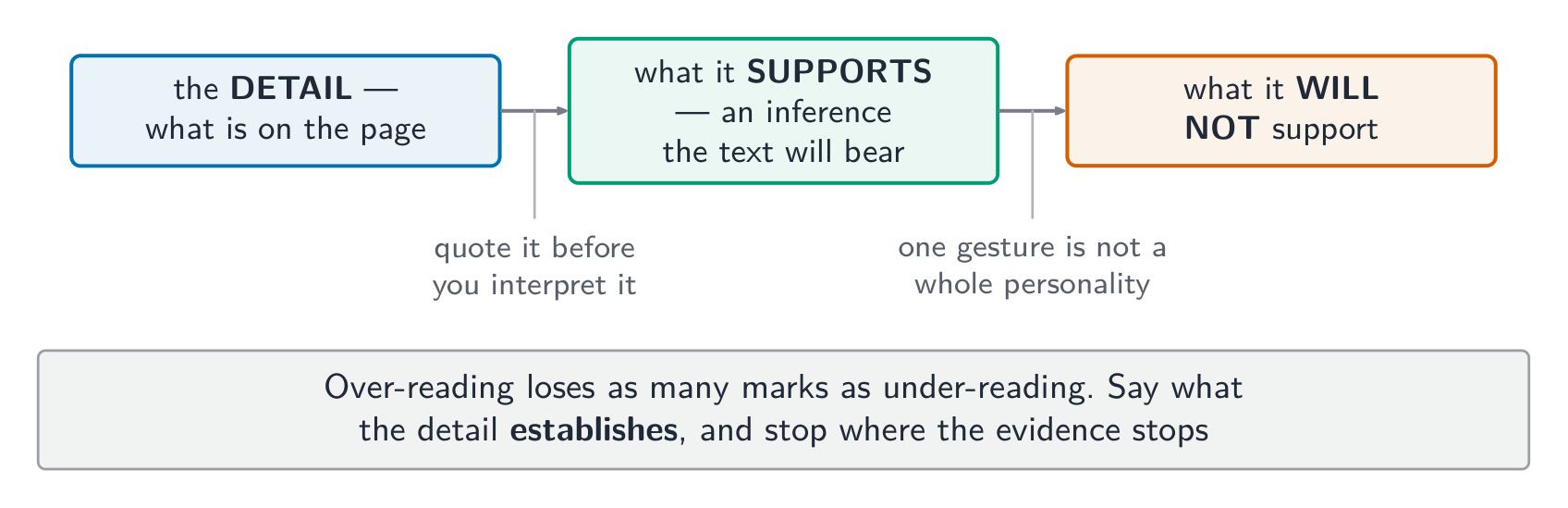
    Say what the detail establishes, and stop where the evidence stops
    Explore · ⁨חקור⁩

    Take a detail exactly as far as it goes · ⁨קח פרט בדיוק עד הגבול שבו הוא חל⁩

    Over-reading loses as many marks as under-reading: say what the detail establishes, and stop where the evidence stops. · ⁨קריאה יתר מאבדת אותם רבים מהנקודות כמו קריאה חסרה: אמור מה הפרט מקיים, ועצור כאשר הממצאים נפסקים.⁩

    Vocabulary · ⁨מילון מונחים⁩ Train · ⁨אימון⁩
    English עברית
    Character/ˈkærɪktə/ דמות
    Description, dialogue, and behaviour/dɪˈskrɪpʃn ˈdaɪəlɒɡ ænd bɪˈheɪvjə/ תיאור, דיאלוג והתנהגות
    Perspective/pəˈspektɪv/ נקודת מבט
    1.2

    Textual Details That Convey Setting · ⁨פרטים טקסטואליים המעבירים את הסביבה⁩

    Syllabus · ⁨סיילבוס⁩
    English

    Enduring Understanding (SET-1): Setting and the details associated with it not only depict a time and place, but also convey values associated with that setting.

    Learning Objective 2.A: Identify and describe specific textual details that convey or reveal a setting.

    • SET-1.A Setting includes the time and place during which the events of the text occur.
    עברית

    הבנה מתמשכת (SET-1): הסביבה והפרטים הקשורים אליה לא רק מתארים זמן ומקום, אלא גם משדרים ערכים הקשורים לסביבה זו.

    מטרות למידה 2.A: לזהות ולתאר פרטים טקסטואליים ספציפיים המשדרים או חושפים סביבה.

    • SET-1.A הסביבה כוללת את הזמן והמקום שבהם מתרחשים אירועי הטקסט.

    Source: College Board AP Course and Exam Description · ⁨מקור: תיאור הקורס והמבחן של College Board AP⁩

    English

    Setting 背景 includes the time and place during which the events of the text occur.

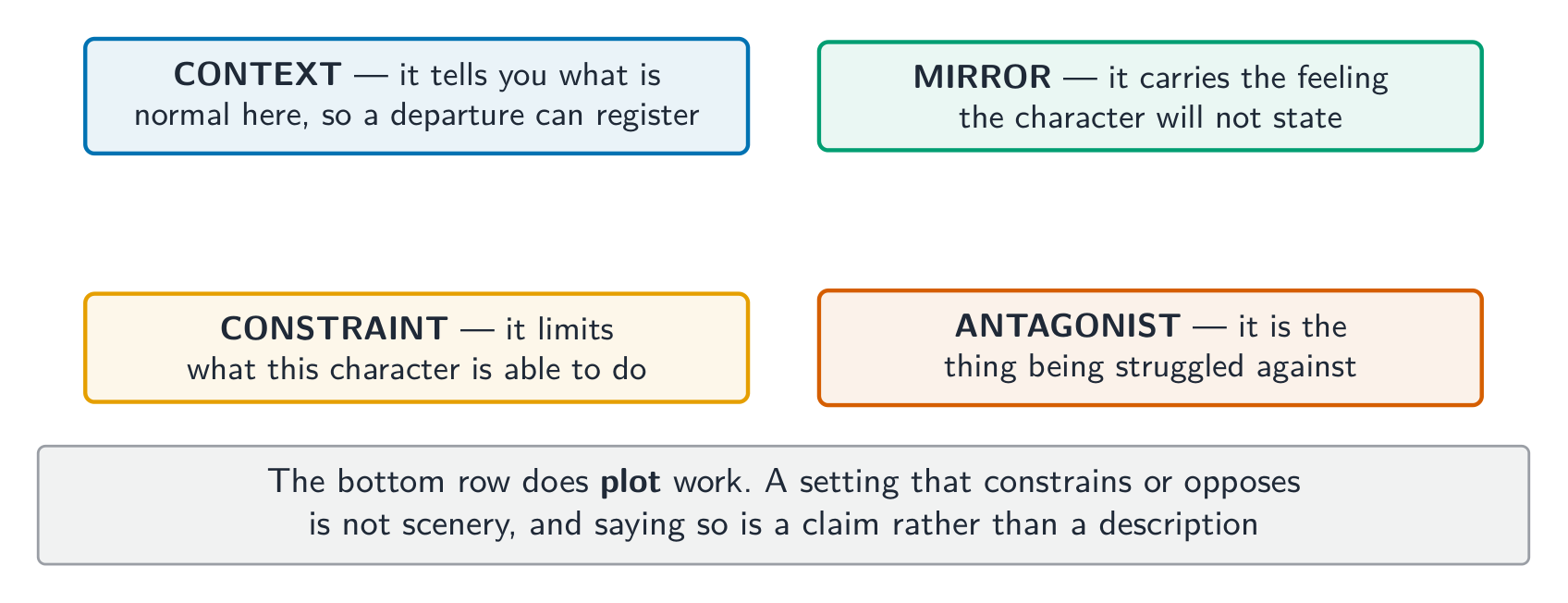
    The CED's definition is deliberately minimal, and that is the trap. Setting earns marks not when it is described but when it is shown doing something - constraining a character, explaining a value, or contrasting with an interior state. A paragraph that establishes where a story happens has not yet made a claim.

    עברית

    Setting 背景 כולל את הזמן והמקום בהם מתרחשים אירועי הטקסט.

    ההגדרה של ה-CED היא מינימליסטית במתכונתה, וזהו המלכודת. סביבה מיינת נקודות לא כאשר היא מתוארת, אלא כאשר היא מוצגת בפעולה - הגבלת דמות, הסבר על ערך, או ניגוד למצב פנימי. פרק שמציב את המקום שבו סיפור מתרחש, עדיין לא העלה טענה.

    Vocabulary · ⁨מילון מונחים⁩ Train · ⁨אימון⁩
    English עברית
    Setting/ˈsetɪŋ/ הגדרת זמן ומקום
    1.3

    How Plot Orders Events · ⁨כיצד תוכנית האירועים מסדרת אירועים⁩

    Syllabus · ⁨סיילבוס⁩
    English

    Enduring Understanding (STR-1): The arrangement of the parts and sections of a text, the relationship of the parts to each other, and the sequence in which the text reveals information are all structural choices made by a writer that contribute to the reader’s interpretation of a text.

    Learning Objective 3.A: Identify and describe how plot orders events in a narrative.

    • STR-1.A Plot is the sequence of events in a narrative; events throughout a narrative are connected, with each event building on the others, often with a cause-and-effect relationship.
    • STR-1.B The dramatic situation of a narrative includes the setting and action of the plot and how that narrative develops to place characters in conflict(s), and often involves the rising or falling fortunes of a main character or set of characters.
    עברית

    הבנה מתמשכת (STR-1) סידור החלקים והפרקים של טקסט, היחס בין החלקים זה לזה, והרצף שבו הטקסט חושף מידע הם כולם בחירות מבניות שנעשו על ידי סופר ותורמים לפירוש הטקסט על ידי הקורא.

    מטרות למידה 3.A: לזהות ולתאר כיצד עלילה מסדרת אירועים בעלילת סיפור.

    • STR-1.A העלילה היא סדר האירועים בסיפור; אירועים לאורך הסיפור קשורים זה לזה, כאשר כל אירוע נבנה על הקודם לו, לעיתים קרובות באמצעות יחס סיבה-תוצאה.
    • STR-1.B המצב הדרמטי של סיפור כולל את הסטאוס והפעולה של העלילה, וכיצד הסיפור מתפתח כדי למקם דמויות בסכסוך (או סכסוכים), ולעיתים כרוך בהתגברות או במורידה של גורלו של דמות מרכזית או קבוצת דמויות.

    Source: College Board AP Course and Exam Description · ⁨מקור: תיאור הקורס והמבחן של College Board AP⁩

    English
    • Plot 情节 is the sequence of events in a narrative; events are connected, each building on those before it.
    • The dramatic situation 戏剧情境 includes the setting and action of the plot and how the narrative develops to place characters in conflict.

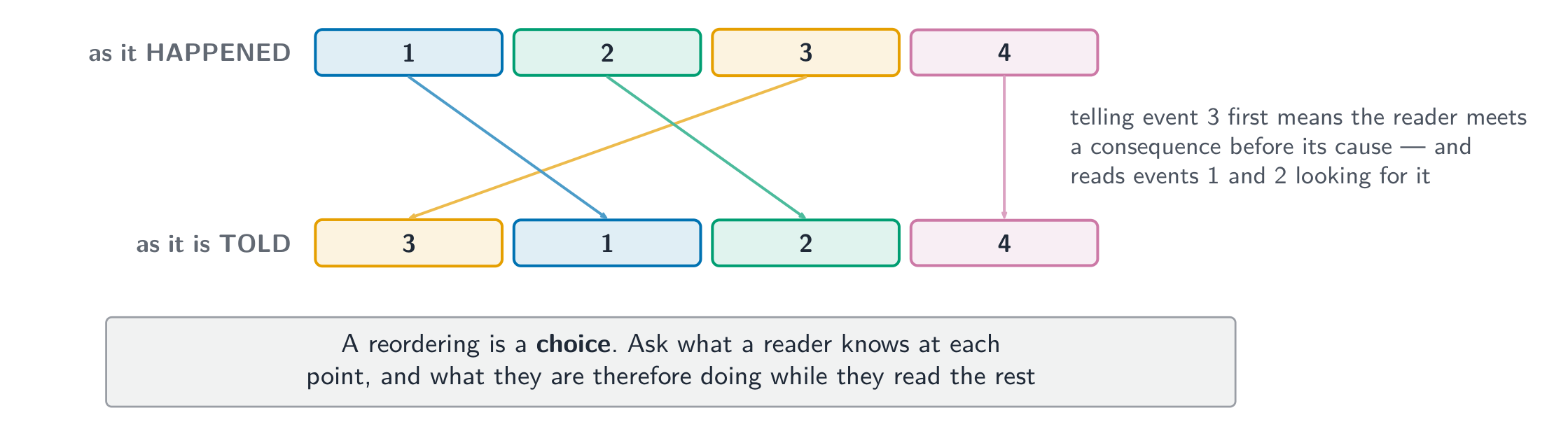
    The word sequence is doing work. Plot is not the events but their order - and an author who reveals something late that happened early has made a choice you can analyse.

    עברית
    • Plot 情节 הוא רצף האירועים בסטוריה; האירועים קשורים זה לזה, כל אחד בונה על הקודמים לו.
    • המצב הדרמטי 戏剧情境 כולל את העלילה והפעולה ואת האופן שבו הסיפור מתפתח כדי לייצר קונפליקט בין הדמויות.

    המילה סדר עושה עבודה. העלילה אינה אלא האירועים עצמם, אלא הסדר שבו הם מופיעים - וכך סופר חושף דבר שהתרחש מוקדם אך נגלה מאוחר יותר, הוא מבצע בחירה שאפשר לנתח אותה.

    הסדר שבו האירועים התרחשו לעומת הסדר שבו סופרו לנו - ההפרש הוא בחירה
    Vocabulary · ⁨מילון מונחים⁩ Train · ⁨אימון⁩
    English עברית
    Plot/plɒt/ עלילה
    dramatic situation/drəˈmætɪk ˌsɪtʃuːˈeɪʃn/ מצב דרמטי
    1.4

    The Function of a Sequence of Events · ⁨פונקציית רצף האירועים⁩

    Syllabus · ⁨סיילבוס⁩
    English

    Enduring Understanding (STR-1): The arrangement of the parts and sections of a text, the relationship of the parts to each other, and the sequence in which the text reveals information are all structural choices made by a writer that contribute to the reader’s interpretation of a text.

    Learning Objective 3.B: Explain the function of a particular sequence of events in a plot.

    • STR-1.C Plot and the exposition that accompanies it focus readers’ attention on the parts of the narrative that matter most to its development, including characters, their relationships, and their roles in the narrative, as well as setting and the relationship between characters and setting.
    עברית

    הבנה מתמשכת (STR-1) סידור החלקים והפרקים של טקסט, היחס בין החלקים זה לזה, והרצף שבו הטקסט חושף מידע הם כולם בחירות מבניות שנעשו על ידי סופר ותורמים לפירוש הטקסט על ידי הקורא.

    מטרת למידה 3.B: הסביר את הפונקציה של סדר אירועים מסוים בעלילה.

    • STR-1.C העלילה וההצגה המלווה אותה מכוונים את תשומת הלב של הקוראים לחלקים מהסיפור החשובים ביותר להתפתחותו, כולל הדמויות, היחסים ביניהן, התפקידים שלהן בסיפור, כמו גם הסטאוס והיחס בין הדמויות לבין הסטאוס.

    Source: College Board AP Course and Exam Description · ⁨מקור: תיאור הקורס והמבחן של College Board AP⁩

    English

    Plot and the exposition that accompanies it focus readers' attention on the parts of the narrative that matter most to the text's meaning.

    That sentence is the whole method for prose analysis: proportion is evidence. What the text lingers over, and what it passes in a clause, is the author telling you where to look.

    עברית

    העלילה וההקדמה המלווה אותה ממקדים את תשומת לב הקוראים באלה מהחשוב ביותר במשמעות הטקסט.

    משפט זה הוא השיטה כולה לניתוח נפרוזה: היחס היא העדות. מה עליון הטקסט ומתייחד בו, ומה שהוא עובר עליו בקלסה אחת, הוא הסופר שמכוון אותך לאן להסתכל.

    1.5

    Identifying the Narrator or Speaker · ⁨זיהוי המספר או הדובר⁩

    Syllabus · ⁨סיילבוס⁩
    English

    Enduring Understanding (NAR-1): A narrator’s or speaker’s perspective controls the details and emphases that affect how readers experience and interpret a text.

    Learning Objective 4.A: Identify and describe the narrator or speaker of a text.

    • NAR-1.A Narrators or speakers relate accounts to readers and establish a relationship between the text and the reader.
    • NAR-1.B Perspective refers to how narrators, characters, or speakers see their circumstances, while point of view refers to the position from which a narrator or speaker relates the events of a narrative.
    • NAR-1.C A speaker or narrator is not necessarily the author.
    עברית

    הבנה מתמשכת (NAR-1): נקודת מבט של מספר או דובר שולטת בפרטים ובדגשים המשפיעים על כך כיצד קוראים חווים ומפרשים טקסט.

    מטרת למידה 4.A: זיהה ותיאר את המספר או הדובר בטקסט.

    • NAR-1.A מספרים או דוברים מעבירים חשבונות לקוראים ומקימים יחס בין הטקסט לבין הקורא.
    • NAR-1.B נקודת מבט מתייחסת לכך כיצד מספרים, דמויות או דוברים רואים את נסיבותיהם, בעוד שנקודת מבט מתייחסת למיקום ממנו מספר או דובר משתף את אירועי הסיפור.
    • NAR-1.C דובר או מספר אינם בהכרח המחבר.

    Source: College Board AP Course and Exam Description · ⁨מקור: תיאור הקורס והמבחן של College Board AP⁩

    English
    • Narrators or speakers relate accounts and establish a relationship between the text and the reader.
    • Perspective refers to how narrators, characters, or speakers see their circumstances; point of view 叙述视点 refers to the position from which they relate the account.
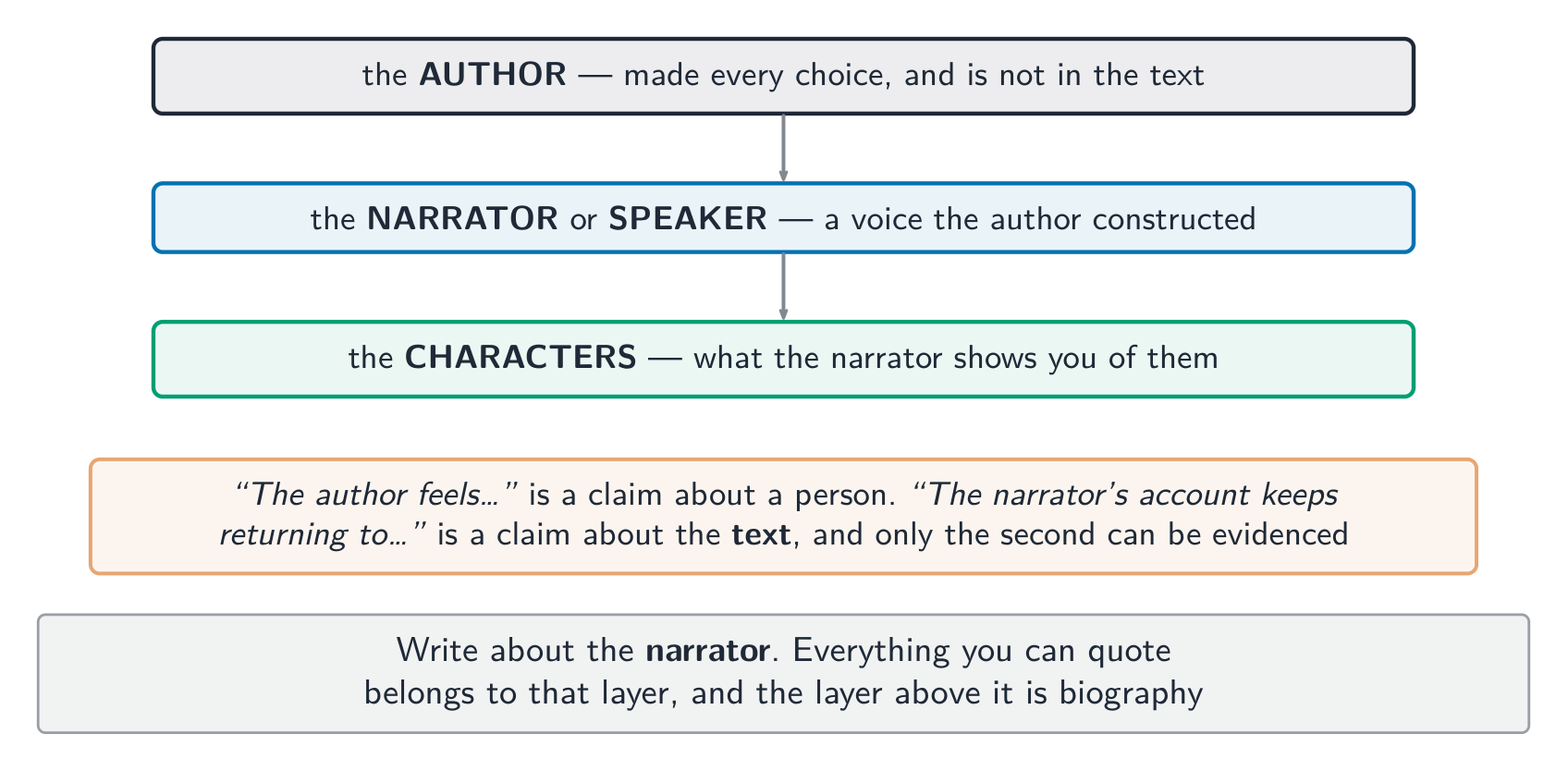
    • A speaker or narrator is not necessarily the author. Never write "the author feels" about a first-person narrator.
    עברית
    מה כל נקודת מבט יכולה ואינה יכולה לתת לך - וגבול זה הוא הניתוח
    זווית הראייה היא האופן שבו הם רואים; נקודת מבט היא המקום שבו הם עומדים. ה-CED מפריד ביניהם, ולכן גם עליך להפריד.
    • מספרים או דברים מספרים סיפורים ויוצרים קשר בין הטקסט לקורא.
    • זווית ראיה מתייחסת לאופן שבו מספרים, דמויות או דברים רואים את מצבם; נקודת מבט 叙述视点 מתייחסת להמיקום שממנו הם מספרים את הסיפור.
    • דובר או מספר אינם בהכרח הסופר. לעולם אל תכתוב "הסופר מרגיש" לגבי מספר בגוף ראשון.
    כתוב על המספר: כל מה שניתן לצטט שייך לשכבה זו
    Explore · ⁨חקור⁩

    Sort each statement by the layer it belongs to · ⁨סדרו כל משפט לפי השכבה שבה הוא מופיע⁩

    Everything you can quote belongs to the narrator's layer. The layer above it is biography. · ⁨הכל מה שניתן להצטט בו שייך לשכבת המספר. השכבה שמעליה היא הביוגרפיה.⁩

    Vocabulary · ⁨מילון מונחים⁩ Train · ⁨אימון⁩
    English עברית
    point of view/pɔɪnt ɒv vjuː/ נקודת מבט
    observational to all-knowing/ɒbzəˈveɪʃənl tʊ ɔːl ˈnəʊɪŋ/ מצפיין לידען
    1.6

    The Function of Point of View · ⁨פונקציית נקודת מבט⁩

    Syllabus · ⁨סיילבוס⁩
    English

    Enduring Understanding (NAR-1): A narrator’s or speaker’s perspective controls the details and emphases that affect how readers experience and interpret a text.

    Learning Objective 4.B: Identify and explain the function of point of view in a narrative.

    • NAR-1.D The point of view contributes to what narrators, characters, or speakers can and cannot provide in a text based on their level of involvement and intimacy with the details, events, or characters.
    • NAR-1.E Narrators may also be characters, and their role as characters may influence their perspective.
    • NAR-1.F First-person narrators are involved in the narrative; their relationship to the events of the plot and the other characters shapes their perspective.
    • NAR-1.G Third-person narrators are outside observers.
    • NAR-1.H Third-person narrators’ knowledge about events and characters may range from observational to all-knowing, which shapes their perspective.
    • NAR-1.I The outside perspective of third-person narrators may not be affected by the events of the narrative.
    עברית

    הבנה מתמשכת (NAR-1): נקודת מבט של מספר או דובר שולטת בפרטים ובדגשים המשפיעים על כך כיצד קוראים חווים ומפרשים טקסט.

    מטרת למידה 4.B: זיהה והסביר את הפונקציה של נקודת מבט בסיפור.

    • NAR-1.D נקודת המבט תורמת לכך שהמספרים, הדמויות או הדוברים יכולים ולא יכולים לספק בטקסט, בהתבסס על רמת ההשתתפות והאינטימיות שלהם עם הפרטים, האירועים או הדמויות.
    • NAR-1.E מספרים עשויים להיות גם דמויות, ותפקידם כדמויות עשוי להשפיע על נקודת המבט שלהם.
    • NAR-1.F מספרים ברמה ראשונה משתתפים בסיפור; היחס שלהם לאירועי העלילה ולדמויות האחרות מעצב את נקודת המבט שלהם.
    • NAR-1.G מספרים ברמה שלישית הם צופים מחוץ.
    • NAR-1.H הידע של מספרים ברמה שלישית לגבי אירועים ודמויות עשוי להשתנות מצפייה ועד ידע כולל, מה שמעצב את נקודת המבט שלהם.
    • NAR-1.I נקודת המבט החיצונית של מספרים ברמה שלישית עשויה שלא להיות מושפעת מאירועי הסיפור.

    Source: College Board AP Course and Exam Description · ⁨מקור: תיאור הקורס והמבחן של College Board AP⁩

    English
    • Point of view contributes to what narrators can and cannot provide in a text, based on their position.
    • Narrators may also be characters, and that role may influence their perspective.
    • First-person narrators are involved in the narrative; their relationship to events and to other characters shapes what they can tell you.
    • Third-person narrators are outside observers, and their knowledge may range from observational to all-knowing 全知.
    • The outside perspective of a third-person narrator may not be affected by the events of the narrative.

    The analytical payoff is the cannot. A first-person narrator cannot report what they did not witness or will not admit, and every gap is meaningful. A limited third-person narrator confines you to one consciousness, which is a choice about whose experience counts.

    עברית
    • נקודת מבט תורמת למה שמספרים יכולים ואינם יכולים לספק בטקסט, בהתבסס על מיקומם.
    • מספרים יכולים להיות גם דמויות, ותפקיד זה עשוי להשפיע על זווית הראייה שלהם.
    • מספרים בגוף ראשון מעורבים בסיפור; הקשר שלהם לאירועים ולדמויות אחרות קובע מה הם יכולים לספר לך.
    • מספרים בגוף שלישי הם צופים מחוץ, והידע שלהם עשוי להשתנות מצפייה עד כל-ידע 全知.
    • הזווית החיצונית של מספר גוף שלישי עשויה לא להיות מושפעת מאירועי הסיפור.

    התוצאה האנליטית טמונה ב-אינו יכול. מספר בגוף ראשון אינו יכול לדווח על מה שלא ראה או לא יודה בו, וכל רווח משמעותי. מספר בגוף שלישי מוגבל מצמצם אותך לקונסציה אחת, וזהו בחירה לגבי מיניחוויה חשובה.

    1.7

    Developing a Paragraph with Claim and Evidence · ⁨פיתוח פרק עם טענה ועדות⁩

    Syllabus · ⁨סיילבוס⁩
    English

    Enduring Understanding (LAN-1): Readers establish and communicate their interpretations of literature through arguments supported by textual evidence.

    Learning Objective 7.A: Develop a paragraph that includes 1) a claim that requires defense with evidence from the text and 2) the evidence itself.

    • LAN-1.A In literary analysis, writers read a text closely to identify details that, in combination, enable them to make and defend a claim about an aspect of the text.
    • LAN-1.B A claim is a statement that requires defense with evidence from the text.
    • LAN-1.C In literary analysis, the initial components of a paragraph are the claim and textual evidence that defends the claim.
    עברית

    הבנה מתמשכת (LAN-1): קוראים בונים ומגדירים את פרשנותם לספרות באמצעות טענות התומכות בעדויות מטקסט.

    מטרת למידה 7.A: פתח פראגרף הכולל 1) טענה הדורשת הגנה באמצעות עדות מהטקסט ו-2) העדות עצמה.

    • LAN-1.A בניתוח ספרותי, כותבים קוראים טקסט בקפידה כדי לזהות פרטים שמאפשרים להם, בשילוב, לנסח ולהגן על טענה לגבי היבט כלשהו בטקסט.
    • LAN-1.B טענה היא הצהרה הדורשת הגנה באמצעות עדות מהטקסט.
    • LAN-1.C בניתוח ספרותי, המרכיבים ההתחלתיים של פראגרף הם הטענה והעדות הטקסטואלית התומכות בה.

    Source: College Board AP Course and Exam Description · ⁨מקור: תיאור הקורס והמבחן של College Board AP⁩

    English
    • In literary analysis, writers read a text closely to identify details that, in combination, enable them to make and defend a claim.
    • A claim is a statement that requires defence with evidence from the text.
    • The initial components of a paragraph are the claim and the textual evidence that defends it.

    Note in combination. A single detail rarely supports an interpretive claim; two or three details that point the same way do.

    Worked example (a real AP exam task). The AP Literature free-response section has three questions - poetry analysis, prose fiction analysis, and a literary argument on a work you choose - all marked on a six-point rubric: thesis 1, evidence and commentary 4, sophistication 1. For a prose fiction prompt asking how the author uses narrative techniques to reveal a character's attitude, a weak answer writes "the narrator is first-person, which makes it personal." A scoring answer uses the cannot: "Because the narrator is a participant recounting events years later, the account gives us his present judgement of his younger self and withholds what the other characters thought - so the reader receives his self-criticism as the only available evidence, and must decide whether the harshness of it is accuracy or performance." Point of view, its limit, and the effect on the reader.

    עברית
    • במחקר ספרותי, כותבים קוראים טקסט בקפדנות כדי לזהות פרטים שבהשלבם מאפשרים להם לעצב ולהגן על טענה.
    • טענה היא הצהרה הדורשת הגנה באמצעות עדויות מהטקסט.
    • המרכיבים ההתחלתיים של פסקה הם ה-טענה והעדויות הטקסטואליות שמגנות עליה.

    שים לב להשלב. פרט בודד נדיר שתומך בטענת פרשנית; שני או שלושה פרטים המכוונים לכיוון אחד כן תומכים.

    דוגמה מפורטת (משימת בוחן AP אמיתית). חלק הבחינה הפתוח בספרות AP מכיל שלוש שאלות – ניתוח שירה, ניתוח סיפור קצר וטענה ספרותית על יצירה שאתה בוחר – כולן מוערכות לפי סכאלת דירוג בת 6 נקודות: תזיסה 1, עדויות ומעורבות 4, עמקות 1. עבור הנחיה בסיפור קצר השואלת כיצד הכותב משתמש בטכניקות נרטיב לחשיפת גיסת דמות, תשובה חלשה כותבת "המספר הוא בגוף ראשון, מה שהופך את הסיפור לאישית." תשובה שקובעת נקודות משתמשת ב-לא יכול: "מכיוון שהמספר הוא שותף מספר אירועים בשנים שלאחר מכן, הסיפוק מעניק לנו את שיפוטו הנוכחי של עצמו צעיר ומחזיק בחסר את מה שאנשים אחרים חשבו – כך שהקורה מקבל את הביקורת העצמית שלו כעדויה היחידה הזמינה, ועליו להחליט האם הקשיות שלה היא דיוק או ביצוע." נקודת מבט, הגבולות שלה והאפקט על הקורא.

    1.7

    Exam tips · ⁨טיפים לבחינות⁩

    English
    • Character is a way of seeing, not a list of adjectives. Analyse what they notice and misread.
    • Setting must do something. Describing where a story happens is not yet a claim.
    • Plot is the order of events. A late revelation of an early event is an authorial choice worth analysing.
    • Proportion is evidence. What the text lingers over is where the meaning is.
    • The narrator is not the author. Never write "the author feels" about a first-person narrator.
    • The analytical gold in point of view is what the narrator cannot provide.
    עברית
    • אישיות היא דרך ראייה, ולא רשימת תארים. ניתח מה הם מבחינים ומה הם מפרשים לאורך.
    • המקום חייב לעשות משהו. תיאור המקום בו הסיפור מתרחש אינו טענה עוד.
    • עלילה היא ה-סדר האירועים. גילוי מאוחר של אירוע מוקדם הוא בחירת מחבר ששווה לניתוח.
    • יחס הוא עדות. מה שהטקסט מתמקד בו הוא המקום בו הטמון המשמעות.
    • המספר אינו הכותב. לעולם אל תכתוב "הכותב מרגיש" לגבי מספר בגוף ראשון.
    • הזהב האנליטי בנקודת מבט הוא מה שהמספר לא יכול לספק.
  • 2

    Poetry I · ⁨שירה I⁩

    Watch lesson · ⁨צפה בשיעור⁩
    2.1

    What Textual Details Reveal About a Character · ⁨מה פרטים טקסטואליים חושפים לגבי דמות⁩

    Syllabus · ⁨סיילבוס⁩
    English

    Enduring Understanding (CHR-1): Characters in literature allow readers to study and explore a range of values, beliefs, assumptions, biases, and cultural norms represented by those characters.

    Learning Objective 1.A: Identify and describe what specific textual details reveal about a character, that character’s perspective, and that character’s motives.

    • CHR-1.E Characters reveal their perspectives and biases through the words they use, the details they provide in the text, the organization of their thinking, the decisions they make, and the actions they take.
    עברית

    הבנה מתמשכת (CHR-1): דמויות בספרות מאפשרות לקוראים לעסוק בחקר ובחינוך מגוון ערכים, אמונות, הנחות בסיס, גיויים ונורמות תרבותיים המייצגות הדמויות הללו.

    מטרות למידה 1.A: לזהות ולתאר מה פרטים טקסטואליים ספציפיים חושפים על דמות, על מבטא של הדמות ועל מנימיה של הדמות.

    • CHR-1.E דמויות חושפות את זווית הראייה והנטייה שלהן באמצעות המילים שהן משתמשות בהן, הפרטים שהן מספקות בטקסט, הארגון של מחשבתן, ההחלטות שהן מקבלות והפעולות שהן מבצעות.

    Source: College Board AP Course and Exam Description · ⁨מקור: תיאור הקורס והמבחן של College Board AP⁩

    English

    Unit 2 is the course's first poetry unit, and it adds two things to Unit 1's toolkit: structure as an object of analysis, and figurative language 比喻性语言 handled precisely rather than by name-dropping.

    One addition on character first: characters reveal their perspectives and biases through the words they use, the details they provide, and the details they omit.

    That last item is the analytical opening. What a speaker does not mention, in a poem where everything is chosen, is evidence.

    עברית

    יחידה 2 היא היחידה הראשונה בספרה לימוד השירה, והיא מוסיפה כלים ליחידה 1: מבנה כאובייקט לניתוח, ושפה סמנטית 比喻性语言 מטופלת בדיוק ולא רק על ידי ציון שמותיה.

    הוספה אחת בנושא אישיות תחילה: דמויות חושפות את נקודות המבט והשיפוטיות שלהן דרך המילים שהן משתמשות בהן, הפרטים שהן מספקות והפרטים שהן מתעלמות מהם.

    הפריט האחרון הוא הפתיחה האנליטית. מה שדובר לא מזכיר, בשירה שבה הכל נבחר, הוא עדות.

    2.2

    The Function of Structure in a Text · ⁨תפקיד המבנה בטקסט⁩

    Syllabus · ⁨סיילבוס⁩
    English

    Enduring Understanding (STR-1): The arrangement of the parts and sections of a text, the relationship of the parts to each other, and the sequence in which the text reveals information are all structural choices made by a writer that contribute to the reader’s interpretation of a text.

    Learning Objective 3.C: Explain the function of structure in a text.

    • STR-1.D Line and stanza breaks contribute to the development and relationship of ideas in a poem.
    • STR-1.E The arrangement of lines and stanzas contributes to the development and relationship of ideas in a poem.
    • STR-1.F A text’s structure affects readers’ reactions and expectations by presenting the relationships among the ideas of the text via their relative positions and their placement within the text as a whole.
    עברית

    הבנה מתמשכת (STR-1) סידור החלקים והפרקים של טקסט, היחס בין החלקים זה לזה, והרצף שבו הטקסט חושף מידע הם כולם בחירות מבניות שנעשו על ידי סופר ותורמים לפירוש הטקסט על ידי הקורא.

    מטרת למידה 3.C: הסבר תפקיד המבנה בטקסט.

    • STR-1.D שבירת שורה ושברת בת יוצרים תמיכה בהתפתחות ובקשר בין רעיונות בשירה.
    • STR-1.E סידור השורות והבתים תומך בהתפתחות ובקשר בין רעיונות בשירה.
    • STR-1.F המבנה של טקסט משפיע על תגובותיו וציפיות הקוראים על ידי הצגת הקשרים בין רעיונות הטקסט דרך מיקוםם היחסי והמיקום שלהם בתוך הטקסט ככלל.

    Source: College Board AP Course and Exam Description · ⁨מקור: תיאור הקורס והמבחן של College Board AP⁩

    English
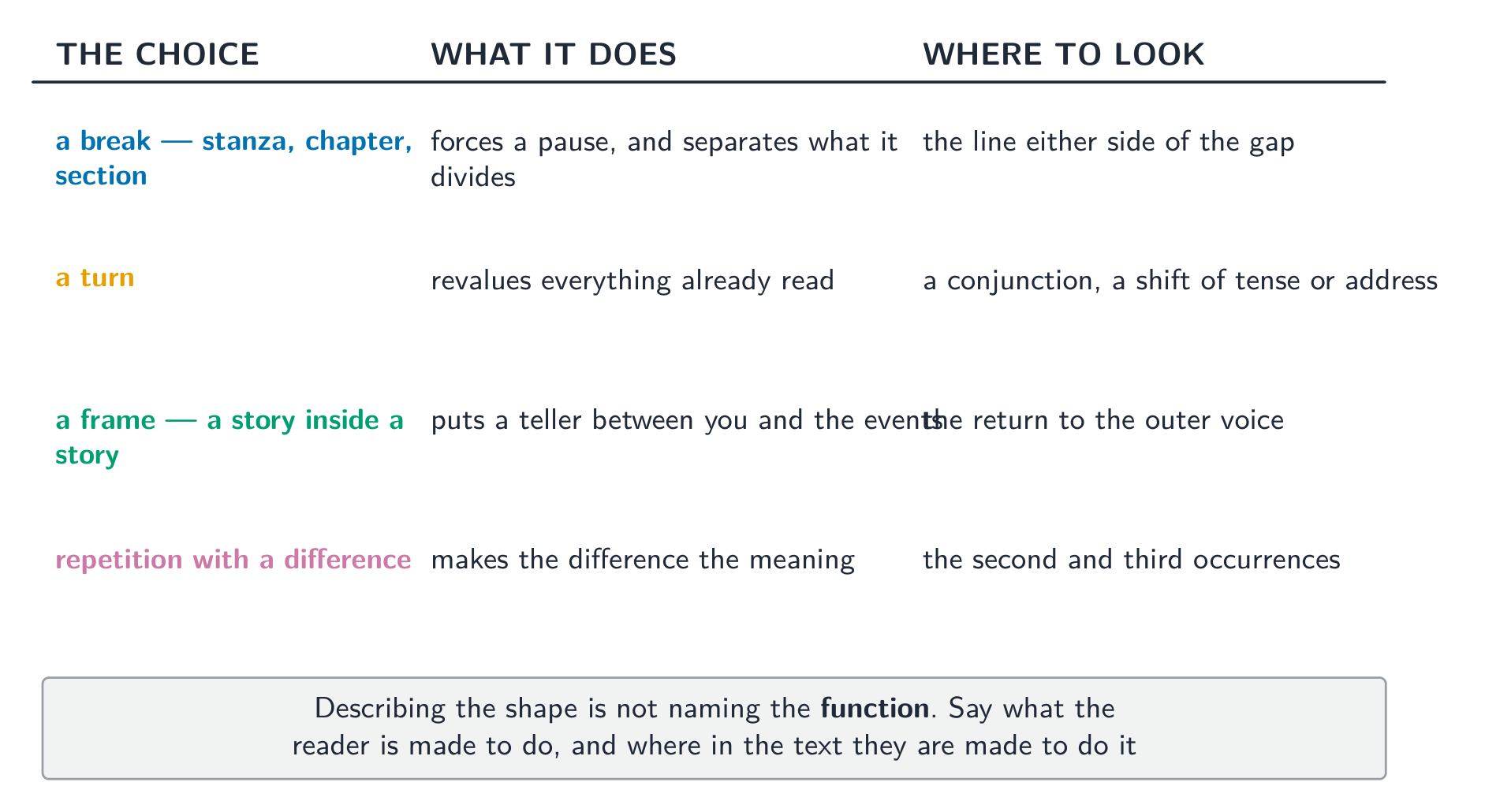
    • Line and stanza breaks 行与诗节的断开 contribute to the development and relationship of ideas in a poem.
    • The arrangement of lines and stanzas contributes to that development.
    • A text's structure affects readers' reactions and expectations by presenting the relationships among ideas.

    Structure in poetry is not decoration; it is punctuation for thought. Where a line breaks decides which words sit at the ends of lines, and the end of a line is the most emphatic position available. A sentence that runs past a line break asks the reader to hold something unresolved; one that stops at the break closes it.

    עברית
    • שבירי שורה ושורות 行与诗节的断开 תורמים לפיתוח ולקשר בין רעיונות בשירה.
    • סידור השורות והשורות תורם לפיתוח זה.
    • מבנה הטקסט משפיע על תגובות וציפיות הקוראים על ידי הצגת הקשרים בין רעיונות.

    מבנה בשירה אינו קישוט; הוא ניקוד לחשיבה. איפה שורה נשברת קובעת אילו מילים יושבות בקצוות השורות, וקצה שורה הוא המיקום המודגש ביותר הזמין. משפט שנמשך מעבר לשביר שורה מבקש מהקורא להחזיק משהו בלתי פתור; אחד שנעצר בשביר סוגר אותו.

    Describing the shape is not naming the function - say what the reader is made to do
    דף המכיל את ההערה שלו בשוליים - קריאה מעמיקה, מספר מאות שנים לפני זמנה
    Explore · ⁨חקור⁩

    Match each structural choice to its function · ⁨התאמו כל בחירה מבנית לתפקידה⁩

    Describing the shape is not naming the function. Say what the reader is made to do, and where. · ⁨תיאור הצורה אינו שיווי תפקוד. יש לומר מה הקורא נדרש לעשות, ואיפה.⁩

    2.3

    The Function of Contrasts Within a Text · ⁨תפקיד ההבדלים בתוך הטקסט⁩

    Syllabus · ⁨סיילבוס⁩
    English

    Enduring Understanding (STR-1): The arrangement of the parts and sections of a text, the relationship of the parts to each other, and the sequence in which the text reveals information are all structural choices made by a writer that contribute to the reader’s interpretation of a text.

    Learning Objective 3.D: Explain the function of contrasts within a text.

    • STR-1.G Contrast can be introduced through focus; tone; point of view; character, narrator, or speaker perspective; dramatic situation or moment; settings or time; or imagery.
    • STR-1.H Contrasts are the result of shifts or juxtapositions or both.
    • STR-1.I Shifts may be signaled by a word, a structural convention, or punctuation.
    • STR-1.J Shifts may emphasize contrasts between particular segments of a text.
    עברית

    הבנה מתמשכת (STR-1) סידור החלקים והפרקים של טקסט, היחס בין החלקים זה לזה, והרצף שבו הטקסט חושף מידע הם כולם בחירות מבניות שנעשו על ידי סופר ותורמים לפירוש הטקסט על ידי הקורא.

    מטרת למידה 3.D: הסבר תפקיד הניגודים בתוך טקסט.

    • STR-1.G ניגודים יכולים להיות מובאים באמצעות דגש; טון; נקודת מבט; דמות, מספר או דמות המרץ; מצב דרמטי או רגע; עיצובים או זמן; או ציוריות.
    • STR-1.H ניגודים הם תוצאה של מעברים או juxtapositions (הצבה צמודה) או שניהם יחד.
    • STR-1.I מעברים עשויים להיות מסומנים במילה, במסורת מבנית או בפיסוק.
    • STR-1.J מעברים עשויים להדגיש ניגודים בין חלקים ספציפיים של טקסט.

    Source: College Board AP Course and Exam Description · ⁨מקור: תיאור הקורס והמבחן של College Board AP⁩

    English
    • Contrast 对照 can be introduced through focus, tone, point of view, character or speaker perspective, and dramatic situation.
    • Contrasts are the result of shifts or juxtapositions or both.
    • Shifts may be signalled by a word, a structural convention, or punctuation.
    • Shifts may emphasise contrasts between particular segments of a text.

    This is the most reliable route into an unseen poem. Find the shift - a but, a stanza break, a change of tense or address - and the poem divides into a before and an after. What changed, and what the change costs or gains, is very often the poem's argument.

    עברית
    • הבדל (对照) יכול להופיע דרך דגש, גוון, נקודת מבט, דמות או נקודת מבט של הרואה, ומצב דרמטי.
    • הבדלים הם תוצאה של שינויים או הצבה זה לצד זה או שניהם יחד.
    • שינויים עשויים להיות מסומנים על ידי מילה, קונבנציה מבנית או פיסוק.
    • שינויים עשויים להדגיש הבדלים בין חלקים מסוימים בטקסט.
    זוהי הדרך האמינה ביותר לקריאת שיר בלתי נראה. מצאו את השינוי – מילה "אבל", סיום בית משור, שינוי בזמן או בהפנייה – והשיר מתחלק ל"לפני" ו"אחרי". מה השתנה, ומה השינוי עולה או מרוויח ממנו, הוא לעיתים קרובות הטיעון של השיר.

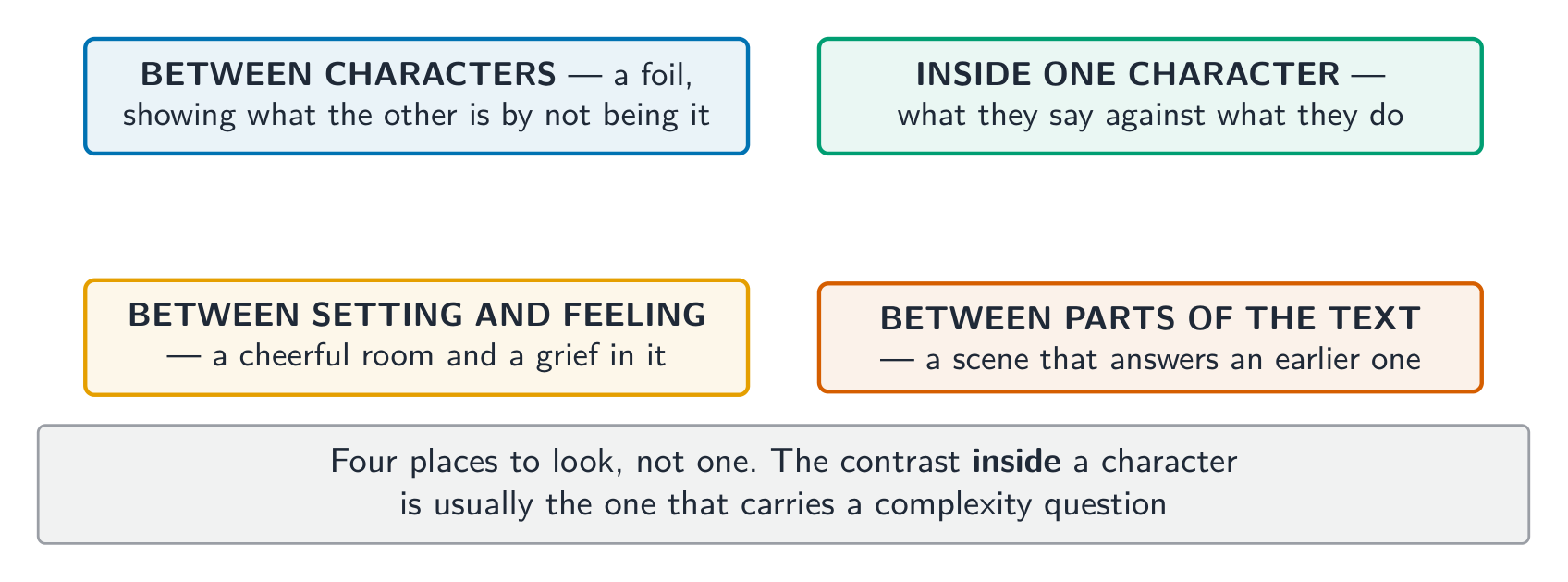
    ארבע מקומות לחפש בהם הבדל, ולא רק אחד
    Explore · ⁨חקור⁩

    Find the contrast in four places, not one · ⁨מצאו את ההבדל בארבע מקומות, ולא במקום אחד⁩

    Students find the obvious pairing and stop — and the contrast inside a character usually carries the complexity question. · ⁨התלמידים מוצאים את הזוגיות הגלויה ועוצרים — וההבדל בתוך דמות בדרך כלל מכיל את שאלת המורכבות.⁩

    Vocabulary · ⁨מילון מונחים⁩ Train · ⁨אימון⁩
    English עברית
    figurative language/ˈfɪɡjərətɪv ˈlæŋɡwɪdʒ/ שפה טבעית
    Line and stanza breaks/laɪn ænd ˈstænzə breɪks/ שבירת שורה ופרק
    Contrast/ˈkɒntræst/ ניגוד
    antecedent/ˌæntɪˈsiːdənt/ קודם
    affects interpretation/əˈfekts ɪnˌtɜːprɪˈteɪʃn/ משפיע על הפרשנות
    Alliteration/əˌlɪtəˈreɪʃn/ אלליטרציה
    2.4

    The Function of Specific Words and Phrases · ⁨תפקיד מילים וביטויים ספציפיים⁩

    Syllabus · ⁨סיילבוס⁩
    English

    Enduring Understanding (FIG-1): Comparisons, representations, and associations shift meaning from the literal to the figurative and invite readers to interpret a text.

    Learning Objective 5.B: Explain the function of specific words and phrases in a text.

    • FIG-1.A An antecedent is a word, phrase, or clause that precedes its referent. Referents may include pronouns, nouns, phrases, or clauses.
    • FIG-1.B Referents are ambiguous if they can refer to more than one antecedent, which affects interpretation.
    • FIG-1.C Words or phrases may be repeated to emphasize ideas or associations.
    • FIG-1.D Alliteration is the repetition of the same letter sound at the beginning of adjacent or nearby words to emphasize those words and their associations or representations.
    עברית

    הבנה מתמשכת (FIG-1): השוואות, נציגויות וקישורים ממירים משמעות מהפשוט לפigurative ומזמינים לקוראים לפרש טקסט.

    מטרת הלמידה 5.B: הסבר תפקידם של מילים וביטויים ספציפיים בטקסט.
    • FIG-1.A מקור (antecedent) הוא מילה, ביטוי או משפט שקדמו למפנה. המפניםות עשויות לכלול pronouns, שמות עצם, ביטויים או משפטים.
    • FIG-1.B מפנותות הן מעורבות אם הן יכולות להתייחס למקור אחד או יותר, מה שמשפיע על הפרשנות.
    • FIG-1.C ייתכן שיש חזרה על מילים או ביטויים כדי להדגיש רעיונות או קשרים.
    • FIG-1.D אללירציה היא חזרה על אותה צליל בראש מילים סמוכות או נספחות כדי להדגיש את המילים ואת הקשרים או ההצגות שלהן.

    Source: College Board AP Course and Exam Description · ⁨מקור: תיאור הקורס והמבחן של College Board AP⁩

    English
    • An antecedent 先行词 is a word, phrase, or clause that precedes its referent.
    • Referents are ambiguous if they can refer to more than one antecedent, which affects interpretation 影响阐释.
    • Words or phrases may be repeated to emphasise ideas or associations.
    • Alliteration 头韵 is the repetition of the same initial sound in adjacent or nearby words, emphasising those words.

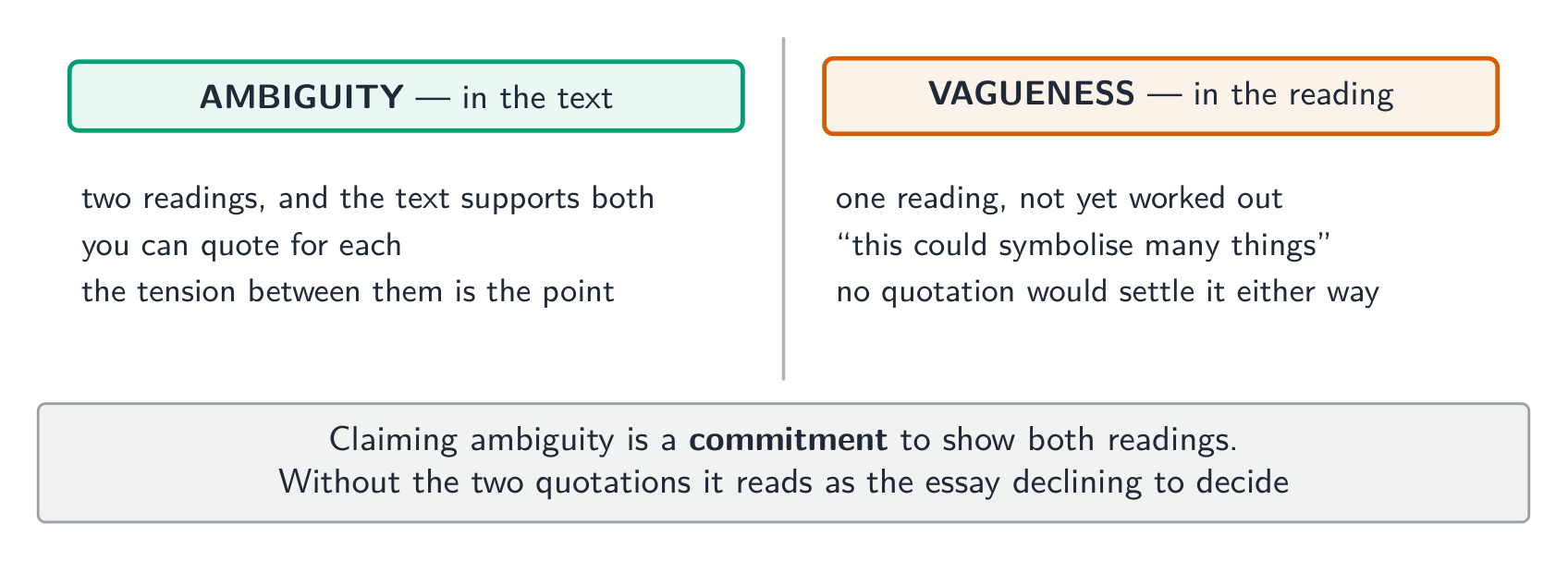
    Ambiguous reference is worth special attention. In prose it is usually a fault; in poetry it is often a device, and a pronoun that could point two ways may be holding both meanings deliberately.

    עברית
    • מקדם (先行词) הוא מילה, ביטוי או משפט שאינו את הנרדף שלו.
    • הנרדפים הם מטושטשים אם הם יכולים להתייחס ליותר ממקדם אחד, מה שמשפיע על הפרשנות (影响阐释).
    • ייתכן שמילים או ביטויים יוחזרו כדי להדגיש רעיונות או קשרים.
    • אלליתרציה (头韵) היא חזרת אותו צליל ראשוני במילים סמוכות או קרובות, ומדגישה מילים אלו.

    התייחסות מטושטמת שווה תשומת לב מיוחדת. בפרזה זהו לרוב פגם; בשירה זו לעיתים קרובות טכניקה, וה pronoun שעשוי להפנות לשני כיוונים עשוי לשאת שני המשמעויות באופן מכוון.

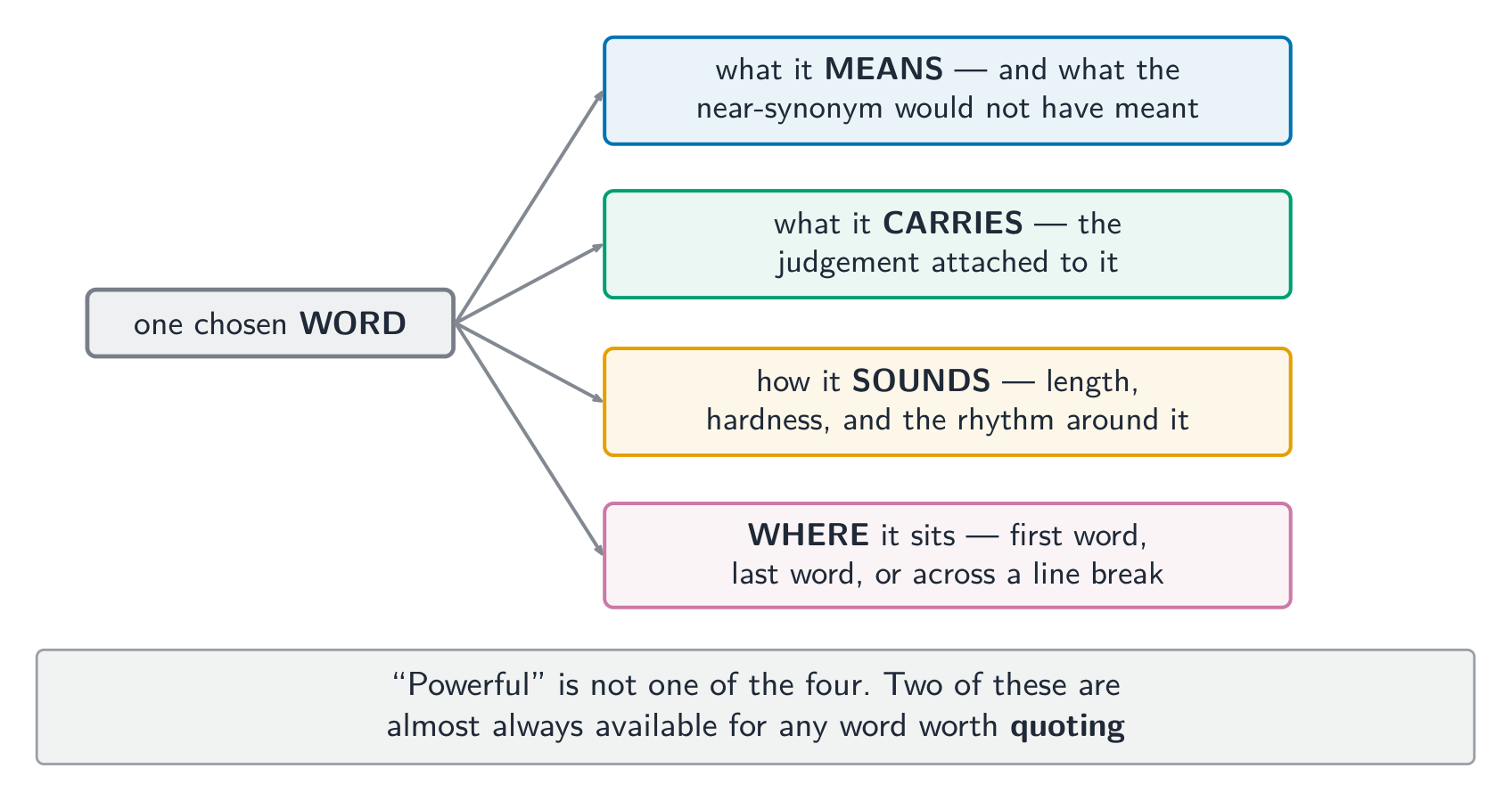
    מילה אחת שנבחרת עושה עד ארבע דברים – 'עוצמתי' אינה אחת מהן
    2.5

    The Function of a Simile · ⁨תפקיד הדמיון⁩

    Syllabus · ⁨סיילבוס⁩
    English

    Enduring Understanding (FIG-1): Comparisons, representations, and associations shift meaning from the literal to the figurative and invite readers to interpret a text.

    Learning Objective 6.A: Identify and explain the function of a simile.

    • FIG-1.E A simile uses the words “like” or “as” to liken two objects or concepts to each other.
    • FIG-1.F Similes liken two different things to transfer the traits or qualities of one to the other.
    • FIG-1.G In a simile, the thing being compared is the main subject; the thing to which it is being compared is the comparison subject.
    עברית

    הבנה מתמשכת (FIG-1): השוואות, נציגויות וקישורים ממירים משמעות מהפשוט לפigurative ומזמינים לקוראים לפרש טקסט.

    מטרת הלמידה 6.A: זיהוי והסבר תפקידו של דמיון.

    • FIG-1.E דמיון משתמש במילים "like" או "as" כדי ליישר בין שני אובייקטים או רעיונות זה עם זה.
    • FIG-1.F דמיון מיישר בין שני דברים שונים כדי להעביר מאפיינים או תכונות האחד לשני.
    • FIG-1.G בדמיון, הדבר הנשווה הוא הנושא הראשי; הדבר אליו הוא מושווה הוא נושא ההשוואה.

    Source: College Board AP Course and Exam Description · ⁨מקור: תיאור הקורס והמבחן של College Board AP⁩

    English
    • A simile 明喻 uses "like" or "as" to liken two objects or concepts.
    • Similes liken two different things to transfer the traits or qualities of one to the other.
    • In a simile, the thing being compared is the main subject; the thing to which it is compared is the comparison subject.

    Those two terms are the whole method. A scoring answer names the main subject, names the comparison subject, and then says which quality was transferred - because that quality is the claim the poem is making.

    עברית

    המונחים של CED עצמו – וההעברה מתרחשת רק בכיוון אחד ציינו את הנושא הראשי, ציינו את נושא ההשוואה, ואז אמרו איזה תכונה עברת.

    • דמיון (明喻) משתמש ב**"כמו" או "כ"** כדי להשוות בין שני אובייקטים או מושגים.
    • דמיון משווה בין שני דברים שונים כדי להעביר את התכונות או המאפיינים של אחד לשני.
    • בדמיון, הדבר הנשווה הוא הנושא הראשי; הדבר אליו הוא מושווה הוא הנושא המשווה.

    שני מושגים אלו הם כל השיטה. תשובה המיינת נקודות מזהה את הנושא הראשי, מזהה את נושא ההשוואה, ואז אומר איזה איכות הועברה - משום שאיכות זו היא הטענה שהשיר מעלה.

    Vocabulary · ⁨מילון מונחים⁩ Train · ⁨אימון⁩
    English עברית
    simile/ˈsɪmɪlɪ/ דמיון
    2.6

    The Function of a Metaphor · ⁨הפונקציה של מטאפורה⁩

    Syllabus · ⁨סיילבוס⁩
    English

    Enduring Understanding (FIG-1): Comparisons, representations, and associations shift meaning from the literal to the figurative and invite readers to interpret a text.

    Learning Objective 6.B: Identify and explain the function of a metaphor.

    • FIG-1.H A metaphor implies similarities between two (usually unrelated) concepts or objects in order to reveal or emphasize one or more things about one of them, though the differences between the two may also be revealing.
    • FIG-1.I In a metaphor, as in a simile, the thing being compared is the main subject; the thing to which it is being compared is the comparison subject.
    • FIG-1.J Comparisons between objects or concepts draw on the experiences and associations readers already have with those objects and concepts.
    • FIG-1.K Interpretation of a metaphor may depend on the context of its use; that is, what is happening in a text may determine what is transferred in the comparison.
    עברית

    הבנה מתמשכת (FIG-1): השוואות, נציגויות וקישורים ממירים משמעות מהפשוט לפigurative ומזמינים לקוראים לפרש טקסט.

    מטרת הלמידה 6.B: זיהוי והסבר תפקידו של מטאפרה.

    • FIG-1.H מטאפרה מרמזת על דמיון בין שני (בדרך כלל לא קשורים) רעיונות או אובייקטים כדי לחשוף או להדגיש משהו אחד או יותר על האחד מהם, אף שההבדלים בין השניים עשויים להיות גם הם חושפים.
    • FIG-1.I במטאפרה, כמו בדמיון, הדבר הנשווה הוא הנושא הראשי; הדבר אליו הוא מושווה הוא נושא ההשוואה.
    • FIG-1.J השוואות בין אובייקטים או רעיונות נשענות על ניסיונות ועמיתים שהקוראים כבר יש להם כלפי אובייקטים ורעיונות אלו.
    • FIG-1.K פרשנות של מטאפרה עשויה להסתמך על ההקשר של השימוש בה; כלומר, מה שקורה בטקסט עשוי לקבוע מה מועבר בהשוואה.

    Source: College Board AP Course and Exam Description · ⁨מקור: תיאור הקורס והמבחן של College Board AP⁩

    English
    • A metaphor 隐喻 implies similarities between two usually unrelated concepts to reveal or emphasise qualities of the main subject.
    • The same main-subject and comparison-subject structure applies.
    • Comparisons draw on the experiences and associations readers already have with the comparison subject - which is why a metaphor can fail with an audience that lacks those associations.
    • Interpretation of a metaphor may depend on the context of its use: what is happening in the text may determine which of the comparison subject's qualities is meant.

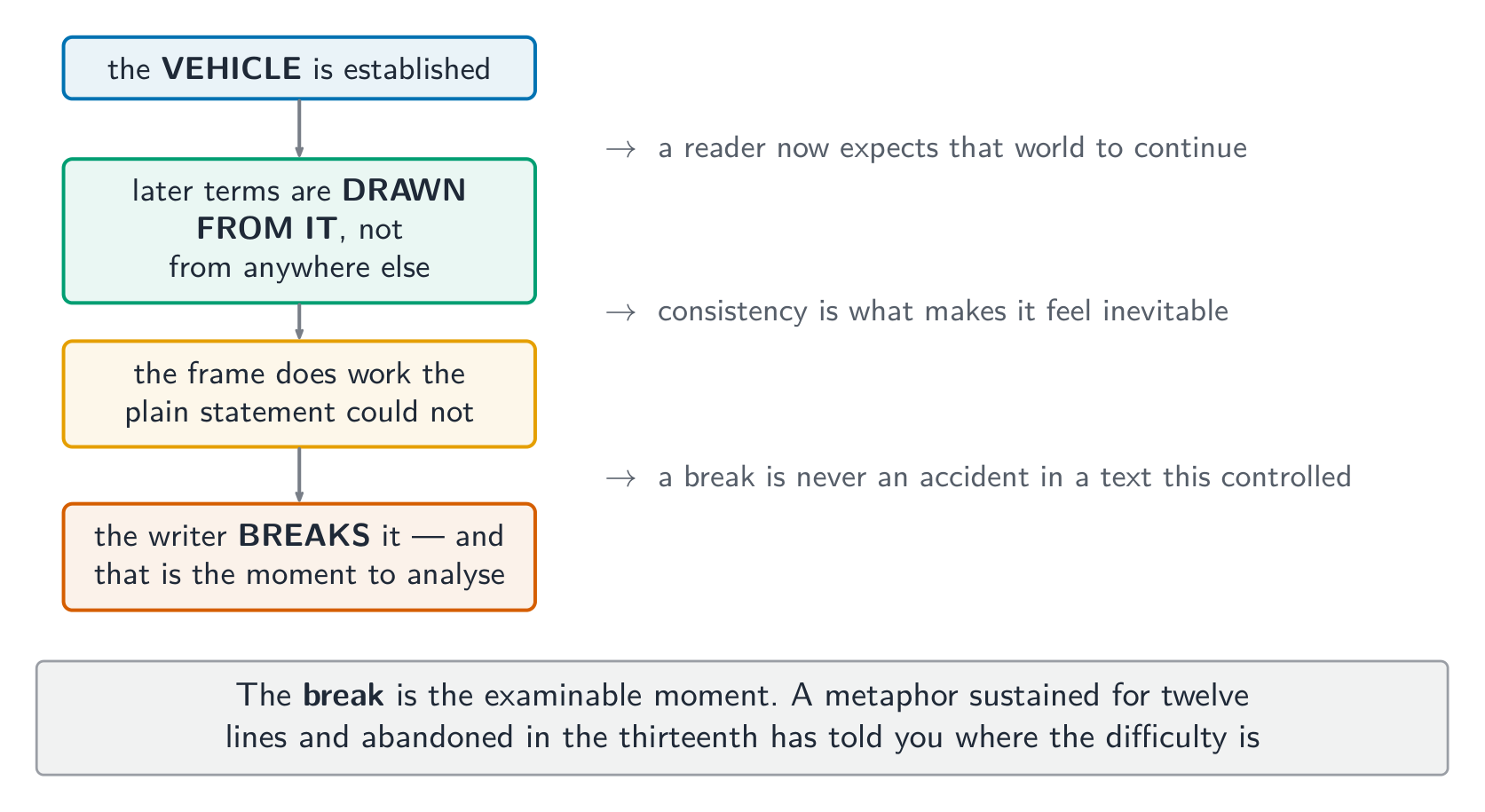
    That last point protects you from the commonest error, which is importing every association a word has. If a poem calls grief a house, the relevant quality might be shelter, or confinement, or the fact that one must live inside it. The text decides which.

    עברית
    • A metaphor 隐喻 מעלה השערה על דמיונות בין שני מושגים שאינם קשורים בדרך כלל כדי לחשוף או להדגיש איכויות של נושא ראשי.
    • אותו מבנה נושא ראשי ונושא השוואה חל גם כאן.
    • השוואות מושכות חלקן מהניסיונות והקשרים שהקוראים כבר יש להם בנושא ההשוואה - ולכן מטאפורה יכולה לכשל בקהל קוראים שאינו בעל קשרים אלו.
    • פרשנות של מטאפורה עשויה לתלות בהקשר שימושה: מה שקורה בטקסט עשוי לקבוע איזה מאפיין של נושא ההשוואה הכוונה.

    נקודה זו מגנה עליך מהטעות הנפוצה ביותר, והיא ייבוא כל הקשר שכל מילה מחזיקה. אם שיר מכנה צער בית, האיכות הרלוונטית עשויה להיות מחסה, או גבילה, או העובדה שחיים בתוכו. הטקסט קובע את זה.

    Vocabulary · ⁨מילון מונחים⁩ Train · ⁨אימון⁩
    English עברית
    metaphor/ˈmetəfɔː/ מטאפורה
    2.7

    Developing a Paragraph with Claim and Evidence · ⁨פיתוח פרק עם טענה ועדות⁩

    Syllabus · ⁨סיילבוס⁩
    English

    Enduring Understanding (LAN-1): Readers establish and communicate their interpretations of literature through arguments supported by textual evidence.

    Learning Objective 7.A: Develop a paragraph that includes 1) a claim that requires defense with evidence from the text and 2) the evidence itself.

    • LAN-1.A In literary analysis, writers read a text closely to identify details that, in combination, enable them to make and defend a claim about an aspect of the text.
    • LAN-1.B A claim is a statement that requires defense with evidence from the text.
    • LAN-1.C In literary analysis, the initial components of a paragraph are the claim and textual evidence that defends the claim.
    עברית

    הבנה מתמשכת (LAN-1): קוראים בונים ומגדירים את פרשנותם לספרות באמצעות טענות התומכות בעדויות מטקסט.

    מטרת למידה 7.A: פתח פראגרף הכולל 1) טענה הדורשת הגנה באמצעות עדות מהטקסט ו-2) העדות עצמה.

    • LAN-1.A בניתוח ספרותי, כותבים קוראים טקסט בקפידה כדי לזהות פרטים שמאפשרים להם, בשילוב, לנסח ולהגן על טענה לגבי היבט כלשהו בטקסט.
    • LAN-1.B טענה היא הצהרה הדורשת הגנה באמצעות עדות מהטקסט.
    • LAN-1.C בניתוח ספרותי, המרכיבים ההתחלתיים של פראגרף הם הטענה והעדות הטקסטואלית התומכות בה.

    Source: College Board AP Course and Exam Description · ⁨מקור: תיאור הקורס והמבחן של College Board AP⁩

    English

    Same three components as Unit 1: a claim requiring textual defence, the textual evidence, and details identified in combination.

    Worked example (a real AP exam task). A poetry-analysis prompt asks how the speaker's use of comparison conveys their attitude. A weak answer: "The poet uses a metaphor comparing memory to a house, which is effective." A scoring answer uses the CED's terms and the context rule: "The main subject is memory and the comparison subject a house, but the poem withholds warmth from the comparison: the house has 'rooms she no longer enters'. The quality transferred is therefore not shelter but confinement by a structure one built oneself - so the speaker's attitude to her own past is presented as inhabiting something she can neither leave nor fully occupy." Main subject, comparison subject, transferred quality, and the attitude it conveys.

    עברית

    אותו שלושה רכיבים כמו ביחידה 1: טענה הדורשת הגנה טקסטואלית, הראיה הטקסטואלית, ופרטים שזוהו בשילוב.

    Worked example (a real AP exam task). A poetry-analysis prompt asks how the speaker's use of comparison conveys their attitude. A weak answer: "The poet uses a metaphor comparing memory to a house, which is effective." A scoring answer uses the CED's terms and the context rule: "The main subject is memory and the comparison subject a house, but the poem withholds warmth from the comparison: the house has 'rooms she no longer enters'. The quality transferred is therefore not shelter but confinement by a structure one built oneself - so the speaker's attitude to her own past is presented as inhabiting something she can neither leave nor fully occupy." Main subject, comparison subject, transferred quality, and the attitude it conveys.

    2.7

    Exam tips · ⁨טיפים לבחינות⁩

    English
    • What a speaker omits is evidence. In a poem, everything present was chosen.
    • Find the shift first. A but, a stanza break, a change of tense - the poem divides there.
    • Line endings are the emphatic position. Say which words the poet put there.
    • An ambiguous referent in poetry is usually a device, not an error.
    • Always name main subject and comparison subject, then the quality transferred. That quality is the claim.
    • Context decides which quality a metaphor imports. Do not list every association the word has.
    עברית
    • מה שדיבור מחייך הוא ראיה. בשיר, כל מה שנמצא שם נבחר.
    • מצא את ההזזה קודם. נקודת חולש, הפסקת סטופה, שינוי בזמן - השיר מתחלק שם.
    • סופי שורות הם המיקום המדגיש. אמור אילו מילים הניח בהן המשורר.
    • מיוחס משמעותי כפול בשירה הוא לרוב מכשיר, לא טעות.
    • תמיד ציין את הנושא הראשי ואת נושא ההשוואה, ולאחר כך את האיכות המועברת. איכות זו היא הטענה.
    • ההקשר קובע איזה איכות המטאפורה מייבאת. אל תפרט כל הקשר שמילה זו עולה בראשך.
  • 3

    Longer Fiction or Drama I · ⁨פרוזה ארוכה או תיאטרון I⁩

    Watch lesson · ⁨צפה בשיעור⁩
    3.1

    What Textual Details Reveal About a Character · ⁨מה פרטים טקסטואליים חושפים לגבי דמות⁩

    Syllabus · ⁨סיילבוס⁩
    English

    Enduring Understanding (CHR-1): Characters in literature allow readers to study and explore a range of values, beliefs, assumptions, biases, and cultural norms represented by those characters.

    Learning Objective 1.A: Identify and describe what specific textual details reveal about a character, that character’s perspective, and that character’s motives.

    • CHR-1.F The description of a character creates certain expectations for that character’s behaviors; how a character does or does not meet those expectations affects a reader’s interpretation of that character.
    • CHR-1.G Details associated with a character and/or used to describe a character contribute to a reader’s interpretation of that character.
    • CHR-1.H Readers’ understanding of a character’s perspective may depend on the perspective of the narrator or speaker.
    • CHR-1.I A character’s perspective may shift during the course of a narrative.
    • CHR-1.J When narrators, characters, or speakers compare another character to something or someone else, they reveal their perspective on the compared character and may also reveal something innate about the compared character.
    • CHR-1.K Readers can infer a character’s motives from that character’s actions or inactions.
    עברית

    הבנה מתמשכת (CHR-1): דמויות בספרות מאפשרות לקוראים לעסוק בחקר ובחינוך מגוון ערכים, אמונות, הנחות בסיס, גיויים ונורמות תרבותיים המייצגות הדמויות הללו.

    מטרות למידה 1.A: לזהות ולתאר מה פרטים טקסטואליים ספציפיים חושפים על דמות, על מבטא של הדמות ועל מנימיה של הדמות.

    • CHR-1.F התיאור של דמות יוצר ציפויים מסוימים להתנהגותה; כך שהדמות עונה או אינה עונה על ציפויים אלו משפיע על פרשנות הקורא עבור הדמות.
    • CHR-1.G פרטים הקשורים לדמות ו/או המשמשים לתאר אותה תורמים לפרשנות הקורא עבור הדמות.
    • CHR-1.H הבנת הקוראים לגבי נקודת מבט של דמות עשויה להיות תלויה בנקודת המבט של המספר או הדובר.
    • CHR-1.I נקודת מבט של דמות עשויה להשתנות לאורך מהלך הסיפור.
    • CHR-1.J כאשר מספרים, דמויות או דוברים משווים דמות אחרת למשהו או למישהו אחר, הם חושפים את נקודת המבט שלהם כלפי הדמות המשווה וייתכן שהם חושפים גם מידע אינטואיטיבי כללי על הדמות המשווה.
    • CHR-1.K קוראים יכולים להסיק את מניעתן של דמויות מתוך פעולותיהן או הימנעותן מפעולה.

    Source: College Board AP Course and Exam Description · ⁨מקור: תיאור הקורס והמבחן של College Board AP⁩

    English

    Unit 3 is the first longer-fiction-or-drama unit, and the length changes what is analysable: characters can now change, conflicts can intersect, and setting acquires a social and historical dimension.

    The CED's additions on character:

    • The description of a character creates expectations for that character's behaviour, and how a character meets or fails those expectations is meaningful.
    • Details associated with a character contribute to a reader's interpretation of them.
    • A reader's understanding of a character's perspective may depend on the perspective of the narrator.
    • A character's perspective may shift during the narrative.
    • When narrators or characters compare another character to something else, they reveal their own perspective as much as the compared character's.
    • Readers can infer motive from a character's actions or inactions.

    That last word - inactions - is the one worth keeping. What a character declines to do is evidence, and it is usually more revealing than what they do.

    עברית

    יחידה 3 היא היחידה הראשונה לספרות או דרמה ארוכה יותר, והאורך משנה מה ניתן לניתוח: הדמויות יכולות להשתנות, הסכסוכים יכולים להתנגש, והמיקום רוכש מימד חברתי והיסטורי.

    ההוספות של CED לגבי דמות:

    • תיאור דמות יוצר ציפיות לגבי התנהגותה, ואופן בוו דמות מקיימת או שוברת ציפיות אלו הוא בעל משמעות.
    • פרטים הקשורים לדמות תרומים לפרשנות הקורא עליה.
    • הבנת הקורא של זווית המבט של הדמות עשויה לתלות בזווית המבט של המספר.
    • נקודת מבט של דמות עשויה להשתנות לאורך הסיפור.
    • כאשר מספרים או דמויות משווים דמות אחרת לדבר אחר, הן חושפות את נקודת המבט שלהן באותה מידה כפי שהן חושפות את נקודת המבט של הדמות המשווה.
    • קוראים יכולים להסיק מניע מעשייתם או מאי-פעולם של דמות.

    המילה האחרונה - אי-פעול - היא זו שראוי לשמור עליה. מה שדמות סורבת לעשות הוא עדות, והוא לרוב גלוי יותר ממה שהיא עושה בפועל.

    3.2

    Characters Who Change or Remain Unchanged · ⁨דמויות משתנות או שנשארות ללא שינוי⁩

    Syllabus · ⁨סיילבוס⁩
    English

    Enduring Understanding (CHR-1): Characters in literature allow readers to study and explore a range of values, beliefs, assumptions, biases, and cultural norms represented by those characters.

    Learning Objective 1.B: Explain the function of a character changing or remaining unchanged.

    • CHR-1.L A dynamic character who develops over the course of the narrative often makes choices that directly or indirectly affect the climax and/or the resolution of that narrative.
    • CHR-1.M Character changes can be visible and external, such as changes to health or wealth, or can be internal, psychological, or emotional changes; external changes can lead to internal changes, and vice versa.
    • CHR-1.N Some characters remain unchanged or are largely unaffected by the events of the narrative.
    עברית

    הבנה מתמשכת (CHR-1): דמויות בספרות מאפשרות לקוראים לעסוק בחקר ובחינוך מגוון ערכים, אמונות, הנחות בסיס, גיויים ונורמות תרבותיים המייצגות הדמויות הללו.

    מטרות לימוד 1.B: להסביר את התפקיד של דמות השתנה או שנשארה ללא שינוי.

    • CHR-1.L דמות דינמית שמתפתחת לאורך מהלך הסיפור נוטה לבצע בחירות המשפיעות ישירות או עקיפות על השיא וה/או הפתרון של הסיפור.
    • CHR-1.M שינויים בדמות יכולים להיות גלויים וחיצוניים, כגון שינויים במצב בריאותי או בעושר, או יכולים להיות פנימיים, פסיכולוגיים או רגשיים; שינויים חיצוניים יכולים להוביל לשינויים פנימיים, ולהפך.
    • CHR-1.N חלק מהדמויות נשארות ללא שינוי או שאינן מושפעות ברובו מענייני הסיפור.

    Source: College Board AP Course and Exam Description · ⁨מקור: תיאור הקורס והמבחן של College Board AP⁩

    English
    • A dynamic character 动态人物 develops over the narrative and often makes choices that directly or indirectly cause change.
    • Character change can be visible and external - health, wealth, circumstance - or internal, in belief, value, or understanding.
    • Some characters remain unchanged 静态人物 or are largely unaffected by events.

    The unchanged character is not a failure of characterisation; it is often the measure by which the change in others is visible.

    עברית
    • דמות דינמית מתפתחת לאורך הסיפור ולעיתים קרובות עושה בחירות הגורמות ישירות או עקיבות לשינוי.
    • שינוי בדמות יכול להיות גלוי וחיצוני - בבריאות, בעושר, במצבים - או פנימי, באמונה, בערכים או בהבנה.
    • חלק מדמויות נשארות ללא שינוי או אינן מושפעות משמעותית מאירועים.

    הדמות שאינה משתנה אינה כשל בייצוג הדמות; היא לעיתים קרובות המדד על פיו השינוי באחרים נראה לעין.

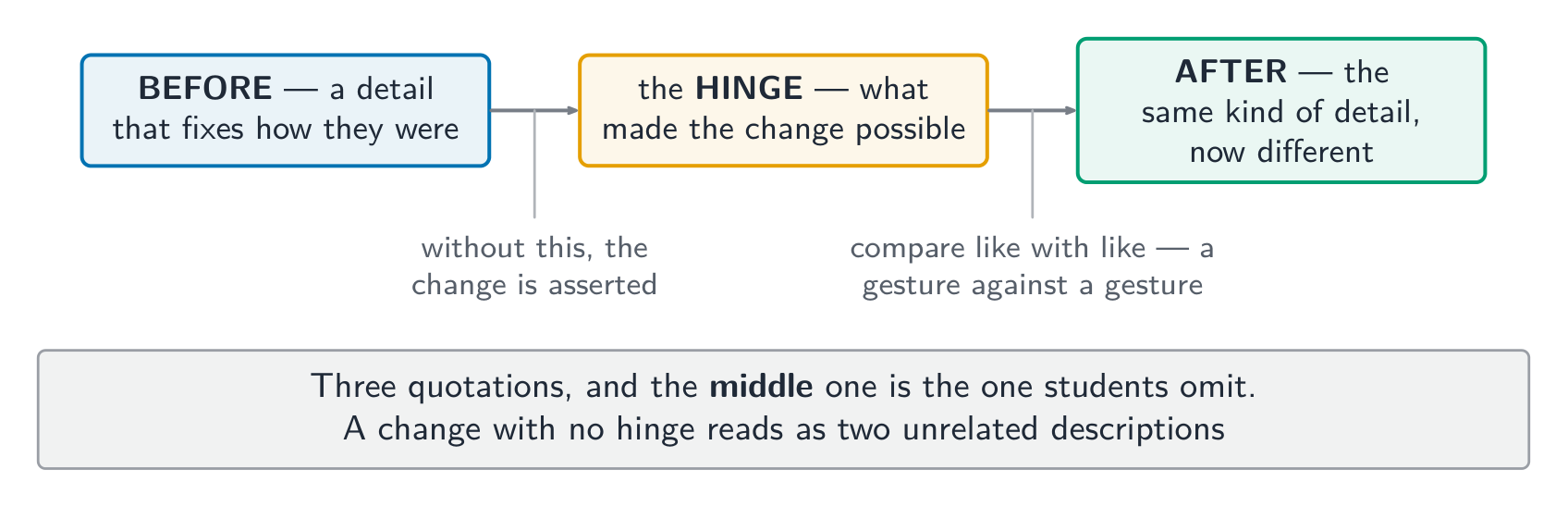
    שלוש ציטטים, והאמצעי הוא זה שמסתרים התלמידים
    Explore · ⁨חקור⁩

    Prove a change with three quotations · ⁨להוכיח שינוי עם שלוש ציטוטים⁩

    Before, hinge, after — and the hinge is the one students omit, which leaves the change asserted. · ⁨לפני, צירוף, אחר כך — והצירוף הוא מה שהתלמידים מתעלמים ממנו, וכתוצאה מכך השינוי מועמד.⁩

    3.3

    Textual Details That Convey Setting · ⁨פרטים טקסטואליים המעבירים את הסביבה⁩

    Syllabus · ⁨סיילבוס⁩
    English

    Enduring Understanding (SET-1): Setting and the details associated with it not only depict a time and place, but also convey values associated with that setting.

    Learning Objective 2.A: Identify and describe specific textual details that convey or reveal a setting.

    • SET-1.B Setting includes the social, cultural, and historical situation during which the events of the text occur.
    עברית

    הבנה מתמשכת (SET-1): הסביבה והפרטים הקשורים אליה לא רק מתארים זמן ומקום, אלא גם משדרים ערכים הקשורים לסביבה זו.

    מטרות למידה 2.A: לזהות ולתאר פרטים טקסטואליים ספציפיים המשדרים או חושפים סביבה.

    • SET-1.B הסביבה כוללת את המצב החברתי, התרבותי וההיסטורי שבו מתרחשים אירועי הטקסט.

    Source: College Board AP Course and Exam Description · ⁨מקור: תיאור הקורס והמבחן של College Board AP⁩

    English

    Setting now includes the social, cultural, and historical situation in which the events occur - not only time and place.

    This widens what setting can do. A social setting supplies the constraints a character must act within, and constraint is what turns a choice into a revealing one.

    עברית

    המקום כולל כעת גם את המצב החברתי, התרבותי וההיסטורי בו מתרחשים האירועים - ולא רק את הזמן והמקום הפיזי.

    דבר זה רוחב את מה שניתן למקום לעשות. מקום חברתי מספק את המגבלות בתוךיהן הדמות חייבת לפעול, ומגבלה היא מה הופך בחירה לחשיפה אמיתית.

    3.4

    Significant Events in a Plot · ⁨אירועים משמעותיים בסדרת העלילה⁩

    Syllabus · ⁨סיילבוס⁩
    English

    Enduring Understanding (STR-1): The arrangement of the parts and sections of a text, the relationship of the parts to each other, and the sequence in which the text reveals information are all structural choices made by a writer that contribute to the reader’s interpretation of a text.

    Learning Objective 3.E: Explain the function of a significant event or related set of significant events in a plot.

    • STR-1.K A story, or narrative, is delivered through a series of events that relate to a conflict.
    • STR-1.L Events include episodes, encounters, and scenes in a narrative that can introduce and develop a plot.
    • STR-1.M The significance of an event depends on its relationship to the narrative, the conflict, and the development of characters.
    עברית

    הבנה מתמשכת (STR-1) סידור החלקים והפרקים של טקסט, היחס בין החלקים זה לזה, והרצף שבו הטקסט חושף מידע הם כולם בחירות מבניות שנעשו על ידי סופר ותורמים לפירוש הטקסט על ידי הקורא.

    מטרות לימוד 3.E: להסביר את התפקיד של אירוע משמעותי או קבוצה קשורה של אירועים משמעותיים בתוכנית.

    • STR-1.K סיפור, או נרטיב, מועבר באמצעות סדרה של אירועים הקשורים לסכסוך.
    • STR-1.L אירועים כוללים תקופות, פגישות וסצנות בנרטיב שיכולות להציג ולפתח תוכנית.
    • STR-1.M המשמעות של אירוע תלויה בקשר שלו לנרטיב, לסכסוך ולפיתוח הדמויות.

    Source: College Board AP Course and Exam Description · ⁨מקור: תיאור הקורס והמבחן של College Board AP⁩

    English
    • A narrative is delivered through a series of events that relate to a conflict.
    • Events include episodes, encounters, and scenes that introduce and develop plot.
    • The significance of an event depends on its relationship to the narrative, the conflict, and character development.

    That third statement is the test for essay selection: an event matters to your argument only if you can say what it does to the conflict or to a character. Retelling a striking scene that does neither is plot summary, which earns nothing.

    עברית
    • סיפור מסופר דרך סדרה של אירועים הקשורים לסכסוך.
    • האירועים כוללים אפוסודים, מפגשים וסצנות המציגים ומפתחים את העלילה.
    • המשמעות של אירוע תלויה בקשר שלו לסיפור, לסכסוך ולפיתוח הדמויות.

    ההצהרה השלישית היא המבחן לבחירת אירועים: אירוע רלוונטי לטיעון שלך רק אם תוכל לומר מה הוא עושה לסכסוך או לדמות. סיפור סצנה מרתקת שלא עושה שום אחת מהן הוא סיכום עלילה שאינו מניב דברים.

    3.5

    The Function of Conflict in a Text · ⁨תפקיד הסכסוך בטקסט⁩

    Syllabus · ⁨סיילבוס⁩
    English

    Enduring Understanding (STR-1): The arrangement of the parts and sections of a text, the relationship of the parts to each other, and the sequence in which the text reveals information are all structural choices made by a writer that contribute to the reader’s interpretation of a text.

    Learning Objective 3.F: Explain the function of conflict in a text.

    • STR-1.N Conflict is tension between competing values either within a character, known as internal or psychological conflict, or with outside forces that obstruct a character in some way, known as external conflict.
    • STR-1.O A text may contain multiple conflicts. Often two or more conflicts in a text intersect.
    • STR-1.P A primary conflict can be heightened by the presence of additional conflicts that intersect with it.
    • STR-1.Q Inconsistencies in a text may create contrasts that represent conflicts of values or perspectives.
    עברית

    הבנה מתמשכת (STR-1) סידור החלקים והפרקים של טקסט, היחס בין החלקים זה לזה, והרצף שבו הטקסט חושף מידע הם כולם בחירות מבניות שנעשו על ידי סופר ותורמים לפירוש הטקסט על ידי הקורא.

    מטרה לימודית 3.F: הסבר על תפקידו של הניגוד בטקסט.
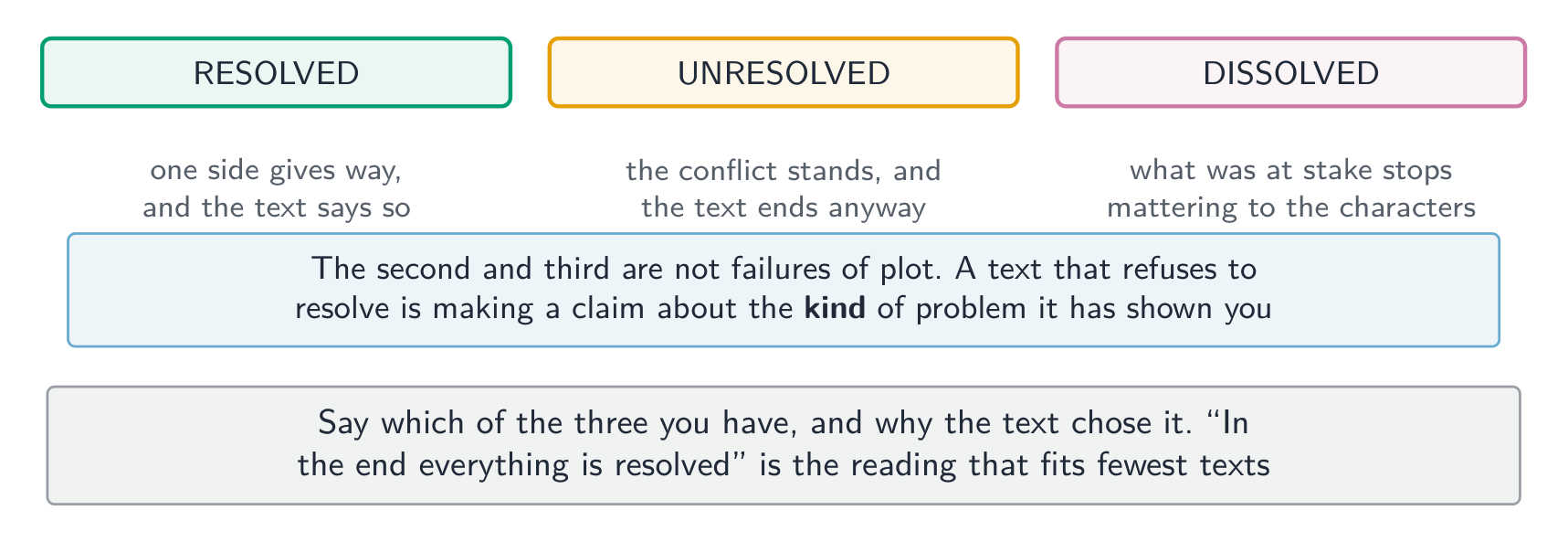
    • STR-1.N ניגוד הוא מתח בין ערכים המתחרים זה בזה, בין אם בתוך דמות (ניגוד פנימי או נפשי), ובין אם מול כוחות חיצוניים המעכבים את הדמות במשהו (ניגוד חיצוני).
    • STR-1.O טקסט עשוי להכיל מספר ניגודים. לעיתים קרובות שני ניגודים או יותר בטקסט נפגשים.
    • STR-1.P ניגוד ראשוני יכול להיות מחוזק בנוכחותם של ניגודים נוספים הנפגשים איתו.
    • STR-1.Q אי-התאמות בטקסט עשויות ליצור ניגודים המייצגים קונפליקטים של ערכים או זוויות מבט.

    Source: College Board AP Course and Exam Description · ⁨מקור: תיאור הקורס והמבחן של College Board AP⁩

    English
    • Conflict 冲突 is tension between competing values, either within a character - internal or psychological conflict - or between a character and an external force.
    • A text may contain multiple conflicts, and often two or more intersect 交叉.
    • A primary conflict can be heightened by additional conflicts that intersect with it.
    • Inconsistencies in a text may create contrasts that represent conflicts of values or perspectives.

    Note the definition: conflict is between competing values, not merely between people. Two characters who want the same object are in a dispute; two characters who want incompatible goods are in a conflict, and only the second produces meaning.

    עברית
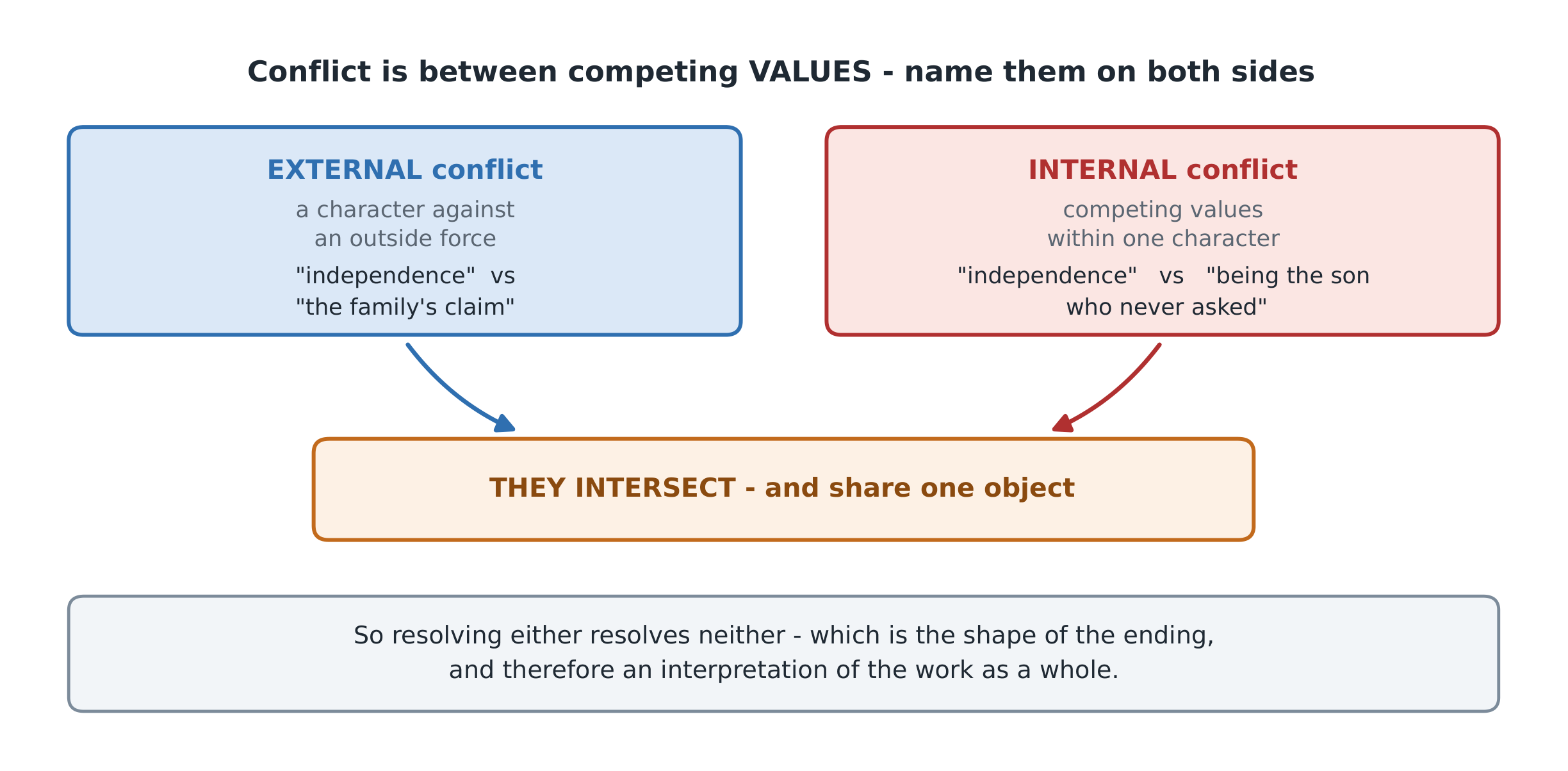
    לסכסוך יש שני מיקומים והם מחזקים זה את זה - וזה מה שמאפשר ניתוח של פרוזה ארוכה
    סכסוך ראשוני המחוזק על ידי סכסוך חוצה הוא הצורה הסטנדרטית של רומן או מחזה
    • סכסוך 冲突 הוא מתח בין ערכים מתחרים, הן בתוך דמות - סכסוך פנימי או פסיכולוגי - והן בין דמות לכוח חיצוני.
    • טקסט עשוי להכיל מספר סכסוכים, ולעיתים קרובות שניים או יותר נפגשים 交叉.
    • סכסוך ראשוני יכול להיות מחוזק על ידי סכסוכים נוספים הנפגעים איתו.
    • אי-התאמות בטקסט עשויות ליצור ניגודים המייצגים סכסוכי ערכים או זוויות ראייה.

    שימו לב להגדרה: סכסוך הוא בין ערכים מתחרים, לא רק בין אנשים. שתי דמויות שרוצות את אותו חפץ נמצאות במחלוקת; שתי דמויות שרוצות טובים בלתי תואמים נמצאות בסכסוך, ורק השני יוצר משמעות.

    Vocabulary · ⁨מילון מונחים⁩ Train · ⁨אימון⁩
    English עברית
    dynamic character/daɪˈnæmɪk ˈkærɪktə/ מאפיין דינמי
    Some characters remain unchanged/sʌm ˈkærɪktəz rɪˈmeɪn ʌnˈtʃeɪndʒd/ חלק מהדמויות נשארות ללא שינוי
    Conflict/ˈkɒnflɪkt/ מתח
    intersect/ˌɪntəˈsekt/ נחתך
    line of reasoning/laɪn ɒv ˈriːzənɪŋ/ קו חשיבה
    3.6

    Developing a Paragraph with Claim and Evidence · ⁨פיתוח פרק עם טענה ועדות⁩

    Syllabus · ⁨סיילבוס⁩
    English

    Enduring Understanding (LAN-1): Readers establish and communicate their interpretations of literature through arguments supported by textual evidence.

    Learning Objective 7.A: Develop a paragraph that includes 1) a claim that requires defense with evidence from the text and 2) the evidence itself.

    • LAN-1.A In literary analysis, writers read a text closely to identify details that, in combination, enable them to make and defend a claim about an aspect of the text.
    • LAN-1.B A claim is a statement that requires defense with evidence from the text.
    • LAN-1.C In literary analysis, the initial components of a paragraph are the claim and textual evidence that defends the claim.
    עברית

    הבנה מתמשכת (LAN-1): קוראים בונים ומגדירים את פרשנותם לספרות באמצעות טענות התומכות בעדויות מטקסט.
    מטרת למידה 7.A: פתח פראגרף הכולל 1) טענה הדורשת הגנה באמצעות עדות מהטקסט ו-2) העדות עצמה.

    • LAN-1.A בניתוח ספרותי, כותבים קוראים טקסט בקפידה כדי לזהות פרטים שמאפשרים להם, בשילוב, לנסח ולהגן על טענה לגבי היבט כלשהו בטקסט.
    • LAN-1.B טענה היא הצהרה הדורשת הגנה באמצעות עדות מהטקסט.
    • LAN-1.C בניתוח ספרותי, המרכיבים ההתחלתיים של פראגרף הם הטענה והעדות הטקסטואלית התומכות בה.

    Source: College Board AP Course and Exam Description · ⁨מקור: תיאור הקורס והמבחן של College Board AP⁩

    English

    Unchanged from Units 1 and 2: a claim requiring textual defence, textual evidence, and details identified in combination.

    עברית

    לא משתנה מהיחידות 1 ו-2: טענה הדורשת הגנה טקסטואלית, ראיות טקסטואליות, ופרטים המזוהים בשילוב.‬

    3.7

    Developing a Literary Thesis Statement · ⁨פיתוח הצהרת תזה ספרותית⁩

    Syllabus · ⁨סיילבוס⁩
    English

    Enduring Understanding (LAN-1): Readers establish and communicate their interpretations of literature through arguments supported by textual evidence.

    Learning Objective 7.B: Develop a thesis statement that conveys a defensible claim about an interpretation of literature and that may establish a line of reasoning.

    • LAN-1.D A thesis statement expresses an interpretation of a literary text and requires a defense through use of textual evidence and a line of reasoning, both of which are explained in an essay through commentary.
    • LAN-1.E A thesis statement may preview the development or line of reasoning of an interpretation. This is not to say that a thesis statement must list the points of an interpretation, literary elements to be analyzed, or specific evidence to be used in the argument.
    עברית

    הבנה מתמשכת (LAN-1): קוראים בונים ומגדירים את פרשנותם לספרות באמצעות טענות התומכות בעדויות מטקסט.

    מטרה לימודית 7.B: פיתוח משפט תזיסה המעביר טענה הגנתית לגבי פרשנות ספרותית ועלול לקבוע קו רעיוני.

    • LAN-1.D משפט תזיסה מבטא פרשנות של טקסט ספרותי ודורש הגנה באמצעות שימוש בעדויות מטקסט ובקו רעיוני, שניהם מוסברים במאמר באמצעות הערות.
    • LAN-1.E משפט תזיסה עשוי להציג מראש את הפיתוח או את קו הרעיוני של הפרשנות. דבר זה אינו אומר שמשפט תזיסה חייב לרשום את נקודותיה של הפרשנות, את האלמנטים הספרותיים שעומדים להתanalize, או את העדויות הספציפיות שהשתמש בהן במסגרת הטענה.

    Source: College Board AP Course and Exam Description · ⁨מקור: תיאור הקורס והמבחן של College Board AP⁩

    English
    • A thesis statement expresses an interpretation of a literary text and requires defence through textual evidence.
    • It may preview the development or line of reasoning of that interpretation - but is not required to list the reasons.

    The key word is interpretation. A thesis that states what happens in the text is not a thesis; it is a summary. A thesis must say what the text means or does, which is by definition arguable.

    עברית
    • הצהרת תזה מבטאת פרשנות של טקסט ספרותי ודורשת הגנה באמצעות ראיות טקסטואליות.
    • היא עשויה לעלות מראש על הפיתוח או הקו ההיסטי של הפרשנות הזו - אך אינה מחויבת לרשום את הסיבות.

    המילה המפתחית היא פרשנות. תזה שאומרת מה קורה בטקסט אינה תזה; זו סיכום. תזה חייבת לומר מה הטקסט משמעו או עושה, מה שמגדיר אותה כנושא למחלוקת.

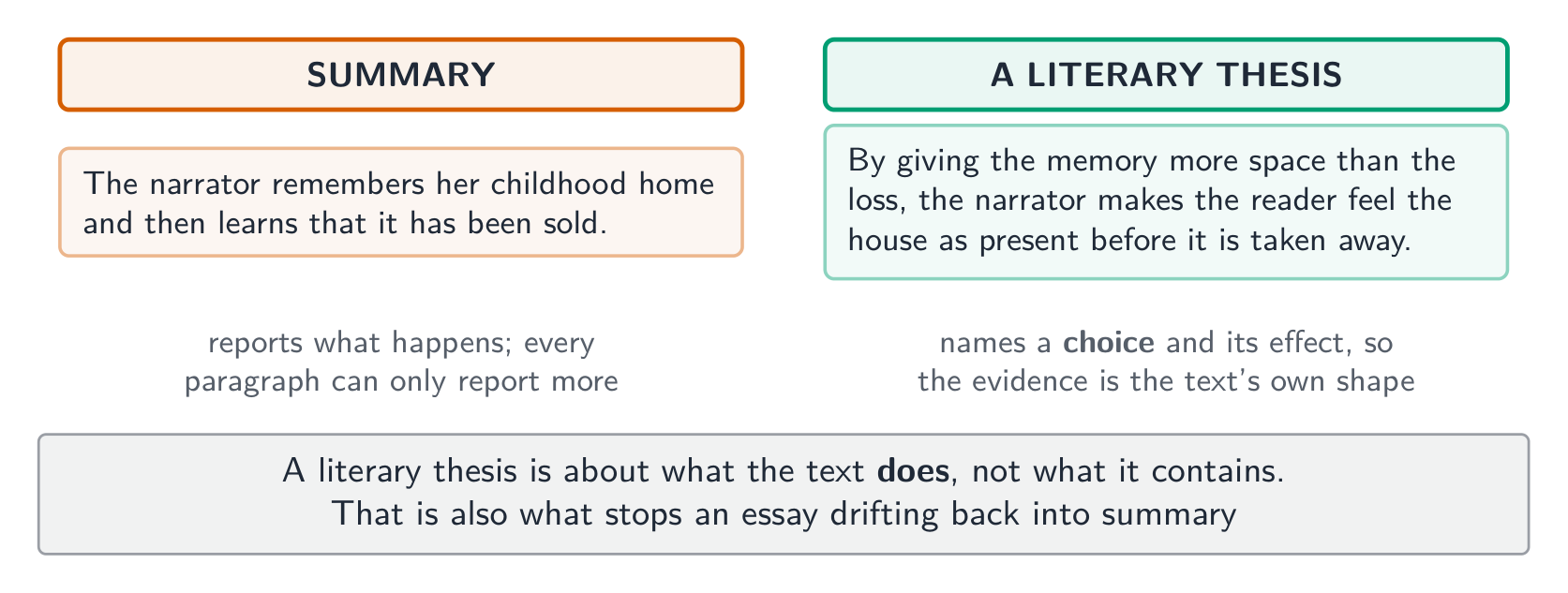
    תזה ספרותית עוסקת במה שהטקסט עושה, ולא במה שהוא מכיל
    Explore · ⁨חקור⁩

    Sort summary from a literary thesis · ⁨לסדר סיכום מתוך עבודת סמינריונית ספרותית⁩

    A literary thesis is about what the text does, not what it contains — which is also what stops an essay drifting into summary. · ⁨עבודת סמינריונית ספרותית עוסקת במה שהטקסט עושה, לא במה שהוא מכיל — וזה גם מה שעוצר עריכה מההחלקה לתקציר.⁩

    3.8

    Developing Commentary · ⁨פיתוח הערות (Commentary)⁩

    Syllabus · ⁨סיילבוס⁩
    English

    Enduring Understanding (LAN-1): Readers establish and communicate their interpretations of literature through arguments supported by textual evidence.

    Learning Objective 7.C: Develop commentary that establishes and explains relationships among textual evidence, the line of reasoning, and the thesis.

    • LAN-1.F A line of reasoning is the logical sequence of claims that work together to defend the overarching thesis statement.
    • LAN-1.G A line of reasoning is communicated through commentary that explains the logical relationship between the overarching thesis statement and the claims/evidence within the body of an essay.
    עברית

    הבנה מתמשכת (LAN-1): קוראים בונים ומגדירים את פרשנותם לספרות באמצעות טענות התומכות בעדויות מטקסט.

    מטרה לימודית 7.C: פיתוח הערות המקבעות ומסבירות את הקשרים בין עדויות מטקסט, קו רעיוני ותזיסה.

    • LAN-1.F קו רעיוני הוא הסדר הלוגי של טענות הפועלות יחד כדי להגן על משפט התזיסה הכללי.
    • LAN-1.G קו רעיוני מעביר את עצמו באמצעות הערות המסבירות את הקשר הלוגי בין משפט התזיסה הכללי לבין הטענות/העדויות בתוך גוף המאמר.

    Source: College Board AP Course and Exam Description · ⁨מקור: תיאור הקורס והמבחן של College Board AP⁩

    English
    • A line of reasoning 推理线索 is the logical sequence of claims that together defend the overarching thesis.
    • It is communicated through commentary explaining the logical relationship between evidence and claim.
    עברית
    • קו היסטי 推理线索 הוא הסדר הלוגי של טענות שמגינות יחד על התזה הכללית.
    • הוא מועבר דרך הערות המסבירות את הקשר הלוגי בין הראיות לטענה.
    3.9

    Selecting Relevant and Sufficient Evidence · ⁨בחירת ראיות רלוונטיות ומספקות⁩

    Syllabus · ⁨סיילבוס⁩
    English

    Enduring Understanding (LAN-1): Readers establish and communicate their interpretations of literature through arguments supported by textual evidence.

    Learning Objective 7.D: Select and use relevant and sufficient evidence to both develop and support a line of reasoning.

    • LAN-1.H Writers use evidence strategically and purposefully to illustrate, clarify, exemplify, associate, amplify, or qualify a point.
    • LAN-1.I Evidence is effective when the writer of the essay uses commentary to explain a logical relationship between the evidence and the claim.
    • LAN-1.J Evidence is sufficient when its quantity and quality provide apt support for the line of reasoning.
    • LAN-1.K Developing and supporting an interpretation of a text is a recursive process; an interpretation can emerge from analyzing evidence and then forming a line of reasoning, or the interpretation can emerge from forming a line of reasoning and then identifying relevant evidence to support that line of reasoning.
    עברית

    הבנה מתמשכת (LAN-1): קוראים בונים ומגדירים את פרשנותם לספרות באמצעות טענות התומכות בעדויות מטקסט.

    מטרה לימודית 7.D: בחירה והשתמש בעדויות רלוונטיות ומספקות כדי לפתח ולתמוך בקו רעיוני.

    • LAN-1.H סופרים משתמשים בעדויות בצורה אסטרטגית ומטופחת כדי להמחיש, להבהיר, להמחיש, לקשר, להרחיב או לייחס נקודה.
    • LAN-1.I עדויות יעילות כאשר סופר המאמר משתמש בהערות כדי להסביר קשר לוגי בין העדויות לטענה.
    • LAN-1.J עדויות מספקות כאשר הכמות והאיכות שלהן מספקות תמיכה מתאימה לקו הרעיוני.
    • LAN-1.K פיתוח ותמיכה בפרשנות של טקסט הם תהליך מחזורי; פרשנות עשויה להיווצר מאנליזה של עדויות ולאחר כך יצירת קו רעיוני, או הפרשנות עשויה להיווצר מאיחוד קו רעיוני ולאחר כך זיהוי עדויות רלוונטיות לתמיכה בקו רעיוני זה.

    Source: College Board AP Course and Exam Description · ⁨מקור: תיאור הקורס והמבחן של College Board AP⁩

    English
    • Writers use evidence strategically - to illustrate, clarify, exemplify, associate, or amplify.
    • Evidence is effective when commentary explains its logical relationship to the claim.
    • Evidence is sufficient when its quantity and quality provide apt support.
    • Developing an interpretation is a recursive process: an interpretation can emerge, and change, as you read and write.

    That last point is permission worth taking. If your reading changes while you draft, revise the thesis to match it.

    עברית
    • סופרים משתמשים בראיות אסטרטגית - כדי להמחיש, להבהיר, לדגמן, לקשר או לחזק.
    • ראיות הן יעילות כאשר ההערות מסבירות את הקשר הלוגי שלהן לטענה.
    • ראיות הן מספקות כאשר כמותהן ואיכותן מספקות תמיכה מתאימה.
    • פיתוח פרשנות הוא תהליך חוזר: פרשנות יכולה להיוולד ולהשתנות בזמן הקריאה והכתיבה.

    נקודה זו היא הרשאה ששווה לקחת. אם הקריאה שלך משתנה בזמן הכתיבה, עדכן את התזה כדי להתאים לה.

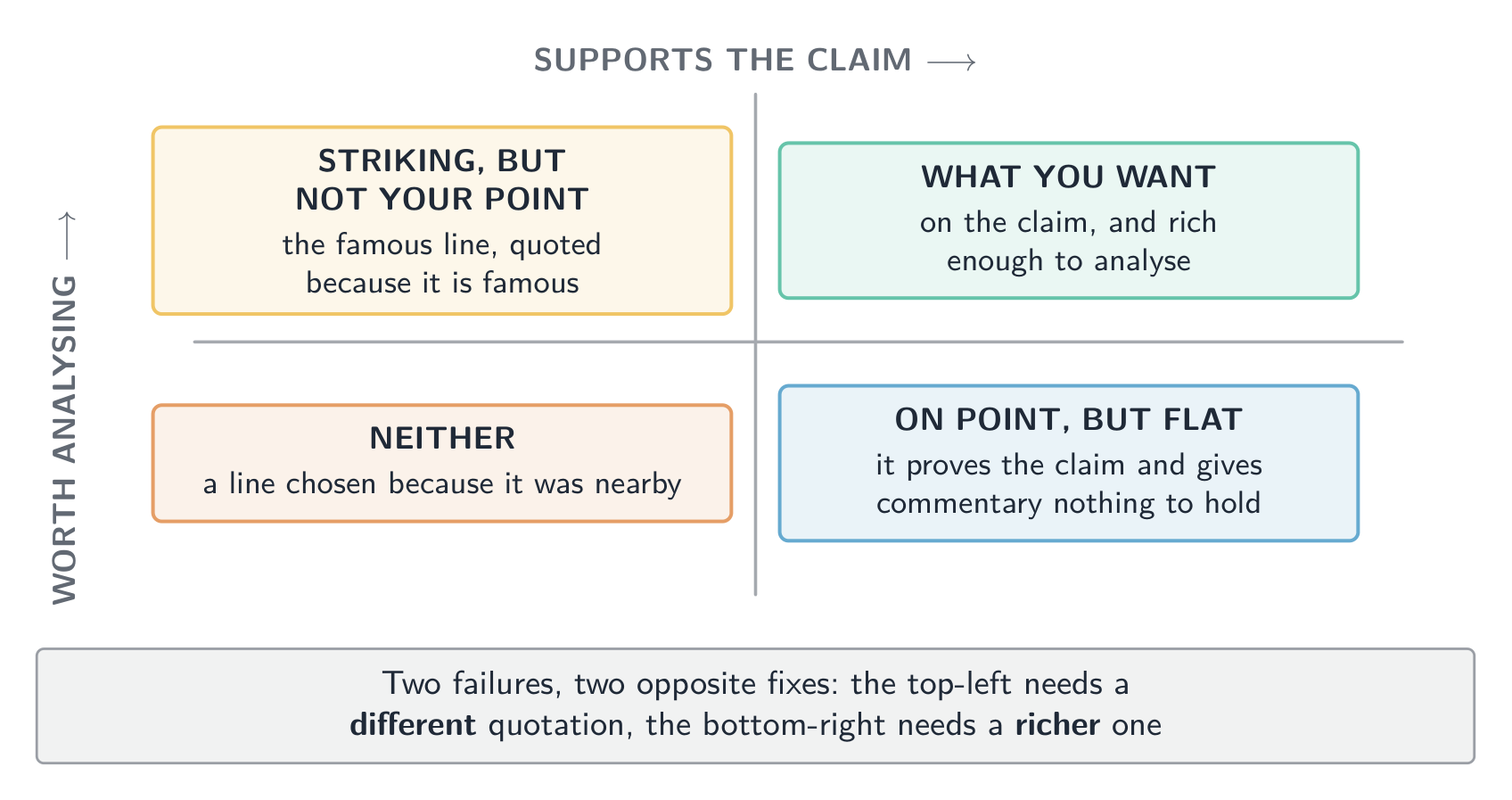
    שתי כישלונות עם שתי פתרונות מנוגדים: ציטוט אחר, או עשיר יותר
    3.10

    Control Over the Elements of Composition · ⁨שליטה על רכיבי ההרכבה⁩

    Syllabus · ⁨סיילבוס⁩
    English

    Enduring Understanding (LAN-1): Readers establish and communicate their interpretations of literature through arguments supported by textual evidence.

    Learning Objective 7.E: Demonstrate control over the elements of composition to communicate clearly.

    • LAN-1.L Grammar and mechanics that follow established conventions of language allow writers to clearly communicate their interpretation of a text.
    עברית

    הבנה מתמשכת (LAN-1): קוראים בונים ומגדירים את פרשנותם לספרות באמצעות טענות התומכות בעדויות מטקסט.

    מטרות לימוד 7.E: להראות שליטה על אלמנטים של הרכב כדי לתקשר בבירור.

    • LAN-1.L דקדוק ומכניקה העוקבים בקפדנות מקובלות לשפה מאפשרים לכתיבים לתקשר בבירור את פרשנותם של טקסט.

    Source: College Board AP Course and Exam Description · ⁨מקור: תיאור הקורס והמבחן של College Board AP⁩

    English

    Grammar and mechanics that follow established conventions allow writers to communicate clearly. On this exam, control of language is not a separate mark but a condition of the others: an unclear sentence cannot deliver commentary a reader can credit.

    Worked example (a real AP exam task). A Question 3 literary-argument prompt asks you to choose a work and analyse how a character's conflict contributes to an interpretation of the work as a whole. A weak answer narrates the plot around the conflict. A scoring answer identifies competing values and lets them intersect: "The protagonist's external conflict with his family over the inheritance is heightened by an internal one: he wants the independence the money would buy, and he wants to remain the son who never asked for it. Because the two conflicts share a single object, resolving either resolves neither - which is why the novel ends with a choice that satisfies no one, including him." Two conflicts, named as values, and an interpretation of the whole.

    עברית

    דקדוק ומכניקה העוקבים בקפדנות אחר קונבנציות מקובלות מאפשרים לכותבים לתקשר בבירור. במבחן זה, שליטה בשפה אינה נקודת תצפית עצמאית, אלא תנאי למעבר: משפט לא ברור לא יכול להעביר התייחסות שהקורא יוכל לקבל כסבירה.

    דוגמה מופת (משימת מבחן AP אמיתית). סעיף שאלה 3 בדרישת ארגומנט ספרתי דורש ממך לבחור יצירה ולנתוח כיצד הקונפליקט של דמות תורם לפרשנות היצירה ככלל. תשובה חלשה מספרת את עלילת הקונפליקט. תשובה זוכה בנקודות מזהה ערכים מתחרים ומאפשרת להם לחתוך זה את זה: "הקונפליקט החיצוני של הגיבור עם משפחתו בנוגע לירושה מחוזק על ידי קונפליקט פנימי: הוא רוצה את החופש שהכסף היה קונה לו, והוא רוצה להישאר הבן שמעולם לא ביקש אותו. מכיוון לשני הקונפליקטים ישנם מטרה משותפת אחת, פתרון כל אחד מהם לא פותר כלום - ולכן הרומן מסתיים בחירה שאין בה סיפוק לאף אחד, כולל לו." שני קונפליקטים, המוגדרים כערכים, ופרשנות של הכלל.

    3.10

    Exam tips · ⁨טיפים לבחינות⁩

    English
    • Inactions reveal motive. What a character declines to do is often the strongest evidence available.
    • The unchanged character is the measure by which change in others becomes visible.
    • Setting now includes the social and historical situation - it supplies the constraint that makes choices meaningful.
    • Conflict is between competing values, not merely between people. Name the values.
    • An event matters only if you can say what it does to the conflict or to a character. Otherwise it is plot summary.
    • A thesis must state an interpretation, not what happens. Summary cannot be defended.
    עברית
    • היעדר פעולה חושף מotivation. מה שדמות מוותרת לעשות הוא לעיתים הקשר החזק ביותר הזמין.
    • הדמות שאינה משתנה היא המדד שבו שינוי באחרים נעשה גלוי.
    • הסביבה כוללת כיום גם את המצב החברתי וההיסטורי – היא מספקת את האילוץ שהופך בחירות למשמעותיות.
    • הקונפליקט הוא בין ערכים מתחרים, ולא רק בין אנשים. ציין את הערכים.
    • אירוע חשוב רק אם תוכל לומר מה הוא עושה לקונפליקט או לדמות. אחרת זה סיכום עלילה.
    • טוענה חייבת לציין פרשנות, לא מה קורה. סיכום אינו ניתן להגנה.
  • 4

    Short Fiction II · ⁨פרוזה קצרה II⁩

    Watch lesson · ⁨צפה בשיעור⁩
    4.1

    What Textual Details Reveal About a Character · ⁨מה פרטים טקסטואליים חושפים לגבי דמות⁩

    Syllabus · ⁨סיילבוס⁩
    English

    Enduring Understanding (CHR-1): Characters in literature allow readers to study and explore a range of values, beliefs, assumptions, biases, and cultural norms represented by those characters.

    Learning Objective 1.A: Identify and describe what specific textual details reveal about a character, that character’s perspective, and that character’s motives.

    • CHR-1.O The significance of characters is often revealed through their agency and through nuanced descriptions.
    • CHR-1.P Characters’ choices—in speech, action, and inaction— reveal what they value.
    עברית

    הבנה מתמשכת (CHR-1): דמויות בספרות מאפשרות לקוראים לעסוק בחקר ובחינוך מגוון ערכים, אמונות, הנחות בסיס, גיויים ונורמות תרבותיים המייצגות הדמויות הללו.

    מטרות למידה 1.A: לזהות ולתאר מה פרטים טקסטואליים ספציפיים חושפים על דמות, על מבטא של הדמות ועל מנימיה של הדמות.

    • CHR-1.O המשמעות של דמויות נחשפת לעיתים קרובות דרך סוכנותן ובאמצעות תיאורים מעודנים.
    • CHR-1.P בחירותיהן של הדמויות—בדיבור, במעשה ובאי-פעולה—חושפות את מה שהן מעריכות.

    Source: College Board AP Course and Exam Description · ⁨מקור: תיאור הקורס והמבחן של College Board AP⁩

    English

    Unit 4 returns to short fiction with a much larger toolkit. Its two most valuable additions are narrative distance and the idea that choices reveal values.

    • The significance of characters is often revealed through their agency 能动性 and through nuanced descriptions.
    • Characters' choices - in speech, action, and inaction - reveal what they value.

    That second statement is the most practical sentence in the whole course for essay-writing. Whenever you need a claim about a character, look at a choice and ask what it must be true for that choice to have made sense to them.

    עברית

    יחידה 4 חוזרת לספרות קצרה עם ערכת כלים גדולה הרבה יותר. שתי התוספות החשובות ביותר שלה הן מרחק narrative והרעיון ש-בחירות חושפים ערכים.

    • המשמעות של הדמויות נחשפת לעיתים קרובות דרך סוכנות agency她们的和通过תיאורים מעודנים.
    • בחירותיהן של הדמויות – דיבור, פעולה והיעדר פעולה – חושפות מה הן מעריכות.

    המשפט השני הוא המשפט המעשי ביותר בכל הקורס לכתיבת ערכונים. בכל פעם שאתה צריך טענה לגבי דמות, הצצה לבחירה ושאל מה חייב להיות נכון כדי שבחירה זו תעשה להם לוגיקה.

    Vocabulary · ⁨מילון מונחים⁩ Train · ⁨אימון⁩
    English עברית
    agency/ˈeɪdʒənsi/ סוכנות
    4.2

    The Function of Contrasting Characters · ⁨הפונקציה של דמויות מנוגדות⁩

    Syllabus · ⁨סיילבוס⁩
    English

    Enduring Understanding (CHR-1): Characters in literature allow readers to study and explore a range of values, beliefs, assumptions, biases, and cultural norms represented by those characters.

    Learning Objective 1.C: Explain the function of contrasting characters.

    • CHR-1.Q The main character in a narrative is the protagonist; the antagonist in the narrative opposes the protagonist and may be another character, the internal conflicts of the protagonist, a collective (such as society), or nature.
    • CHR-1.R Protagonists and antagonists may represent contrasting values.
    עברית

    הבנה מתמשכת (CHR-1): דמויות בספרות מאפשרות לקוראים לעסוק בחקר ובחינוך מגוון ערכים, אמונות, הנחות בסיס, גיויים ונורמות תרבותיים המייצגות הדמויות הללו.

    מטרות למידה 1.C: להסביר את הפונקציה של דמויות מנוגדות.

    • CHR-1.Q הדמות הראשית בנרטיב היא הגיבור; האנטגוניסט בנרטיב נגד את הגיבור ועשוי להיות דמות אחרת, הסכסוך הפנימי של הגיבור, קבוצה (כגון חברה), או הטבע.
    • CHR-1.R הגיבורים והאנטיגוניסטים עשויים לייצג ערכים מנוגדים.

    Source: College Board AP Course and Exam Description · ⁨מקור: תיאור הקורס והמבחן של College Board AP⁩

    English
    • The main character is the protagonist 主人公; the antagonist 对立者 opposes them.
    • Protagonists and antagonists may represent contrasting values.

    The word may is doing careful work. An antagonist is not necessarily a villain; the strongest antagonists hold a value the reader can also recognise as good, which is why the conflict is a conflict rather than a rout.

    עברית
    • הדמות הראשית היא ה-גיבור protagonist; ה-אנטגוניסט antagonist מתנגד להם.
    • הגיבורים והאנטגוניסטים יכולים לייצג ערכים מנוגדים.

    המילה ייתכן עושה עבודה מדוקדקת. האנטגוניסט אינו בהכרח רשע; האנטגוניסטים החזקים ביותר מחזיקים בערך שהקורא יכול גם כן להכיר כטוב, ולכן הקונפליקט הוא קונפליקט ולא התנתקות.

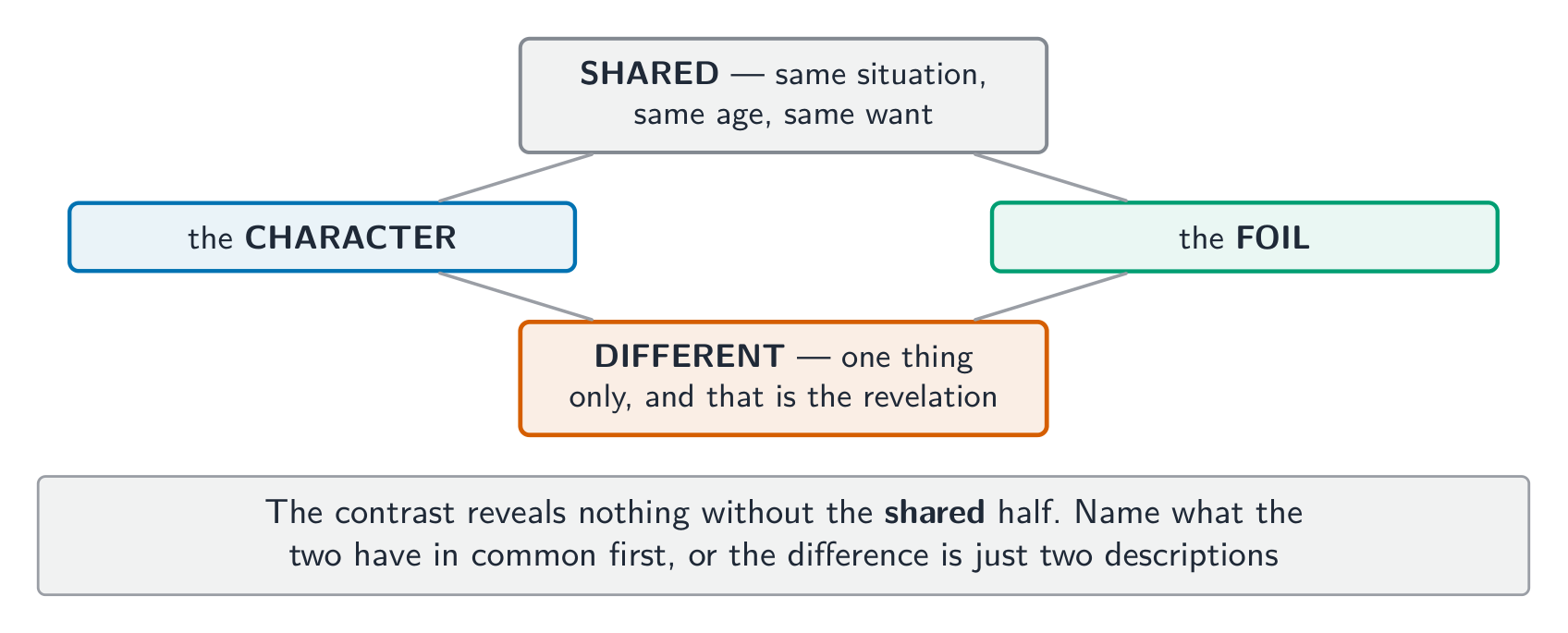
    ניגוד חושף כלום ללא החלק המשותף – ציין אותו קודם
    Vocabulary · ⁨מילון מונחים⁩ Train · ⁨אימון⁩
    English עברית
    protagonist/ˈprəʊtəɡənɪst/ גיבור ראשי
    antagonist/ænˈtæɡənɪst/ אנטגוניסט
    archetypes/ˈɑːkɪtaɪps/ ארקטייפים
    4.3

    Nuances in Characters' Relationships · ⁨ניסים ביחסים בין הדמויות⁩

    Syllabus · ⁨סיילבוס⁩
    English

    Enduring Understanding (CHR-1): Characters in literature allow readers to study and explore a range of values, beliefs, assumptions, biases, and cultural norms represented by those characters.

    Learning Objective 1.D: Describe how textual details reveal nuances and complexities in characters’ relationships with one another.

    • CHR-1.S Conflict among characters often arises from tensions generated by their different value systems.
    עברית

    הבנה מתמשכת (CHR-1): דמויות בספרות מאפשרות לקוראים לעסוק בחקר ובחינוך מגוון ערכים, אמונות, הנחות בסיס, גיויים ונורמות תרבותיים המייצגות הדמויות הללו.

    מטרת למידה 1.D: לתאר כיצד פרטי טקסט חושפים ניואנסים ומורכבויות ביחסים בין דמויות.

    • CHR-1.S קונפליקט בין דמויות נובע לעיתים מתוחכים שנובעים מערכי אמונה שונים שלהן.

    Source: College Board AP Course and Exam Description · ⁨מקור: תיאור הקורס והמבחן של College Board AP⁩

    English

    Conflict among characters often arises from tensions generated by their different value systems.

    This is Unit 3's definition applied to relationships. Two characters in a long-running disagreement usually disagree about something prior to the argument they are having.

    עברית

    קונפליקט בין דמויות נובע לעיתים קרובות ממתיחות שנובעות מערכי ערכים שונים שלהם.

    זוהי ההגדרה של יחידה 3 המיושמת על יחסים. שתי דמויות בסכסוך מתמשך בדרך כלל מחלוקת על דבר מה לפני הויכוח הנקיים.

    4.4

    The Function of Setting in a Narrative · ⁨פונקציית המקום במסר⁩

    Syllabus · ⁨סיילבוס⁩
    English

    Enduring Understanding (SET-1): Setting and the details associated with it not only depict a time and place, but also convey values associated with that setting.

    Learning Objective 2.B: Explain the function of setting in a narrative.

    • SET-1.C A setting may help establish the mood and atmosphere of a narrative.
    עברית

    הבנה מתמשכת (SET-1): הסביבה והפרטים הקשורים אליה לא רק מתארים זמן ומקום, אלא גם משדרים ערכים הקשורים לסביבה זו.

    מטרת למידה 2.B: להסביר את תפקיד הסביבה במסר.

    • SET-1.C סביבה עשויה לסייע בהקמת אווירה ורגש במסר.

    Source: College Board AP Course and Exam Description · ⁨מקור: תיאור הקורס והמבחן של College Board AP⁩

    English

    A setting may help establish the mood and atmosphere of a narrative.

    Mood is the reader's feeling; atmosphere is the quality the text creates around events. Both are produced by selection - which details of a place the text mentions, and which it does not.

    עברית

    מיקום עשוי לעזור לקבוע את האווירה והאטמוספירה של המסר.

    אווירה היא הרגשת הקורא; אטמוספירה היא האיכות שהטקסט יוצר סביב האירועים. שניהם מופקים מתוך בחירה - אילו פרטי מקום הטקסט מזכיר ואילו לא.

    המיקום מבצע ארבע תפקידים, והשורה התחתונה מבצע עבודת עלילה
    Explore · ⁨חקור⁩

    Sort each setting into the job it is doing · ⁨סווג כל סביבה לפי התפקיד שבו היא עושה⁩

    The bottom two do plot work: a setting that constrains or opposes a character is not scenery. · ⁨שתי הסביבות בתחתית מבצעות עבודת עלילה: סביבה המגבילה או מתנגדת לדמות אינה רק תפאורה.⁩

    4.5

    The Relationship Between Character and Setting · ⁨היחס בין דמות למיקום⁩

    Syllabus · ⁨סיילבוס⁩
    English

    Enduring Understanding (SET-1): Setting and the details associated with it not only depict a time and place, but also convey values associated with that setting.

    Learning Objective 2.C: Describe the relationship between a character and a setting.

    • SET-1.D The environment a character inhabits provides information about that character.
    עברית

    הבנה מתמשכת (SET-1): הסביבה והפרטים הקשורים אליה לא רק מתארים זמן ומקום, אלא גם משדרים ערכים הקשורים לסביבה זו.

    מטרת למידה 2.C: לתאר את הקשר בין דמות לסביבה.

    • SET-1.D הסביבה בה גרה דמות מסוימת מספקת מידע על הדמות עצמה.

    Source: College Board AP Course and Exam Description · ⁨מקור: תיאור הקורס והמבחן של College Board AP⁩

    English

    The environment a character inhabits provides information about that character.

    This is a second route into character that avoids the trap of psychologising. A room described through its neglect, its order, or its borrowed furniture tells you about the person who lives there, and it is textual evidence rather than speculation.

    עברית

    הסביבה שבה דמות חיה מספקת מידע על אותה דמות.

    זוהי דרך שנייה להבנת דמות שתמנע את החבלה בפסיכולוגיזציה. חדר המתואר דרך זנחתו, סדרו או רהיטיו המושאלים מספר לך על האדם הגר באותו מקום, והוא עדות טקסטואלית ולא ספקולציה.

    4.6

    How Plot Orders Events · ⁨כיצד תוכנית האירועים מסדרת אירועים⁩

    Syllabus · ⁨סיילבוס⁩
    English

    Enduring Understanding (STR-1): The arrangement of the parts and sections of a text, the relationship of the parts to each other, and the sequence in which the text reveals information are all structural choices made by a writer that contribute to the reader’s interpretation of a text.

    Learning Objective 3.A: Identify and describe how plot orders events in a narrative.

    • STR-1.R Some patterns in dramatic situations are so common that they are considered archetypes, and these archetypes create certain expectations for how the dramatic situations will progress and be resolved. Note: For the exam, students are not expected to identify or label archetypes.
    עברית

    הבנה מתמשכת (STR-1) סידור החלקים והפרקים של טקסט, היחס בין החלקים זה לזה, והרצף שבו הטקסט חושף מידע הם כולם בחירות מבניות שנעשו על ידי סופר ותורמים לפירוש הטקסט על ידי הקורא.

    מטרות למידה 3.A: לזהות ולתאר כיצד עלילה מסדרת אירועים בעלילת סיפור.

    • STR-1.R חלק מהתבניות במצבים דרמטיים נפוצות מאוד עד שהן נחשבות לארכיטיפים, וארכיטיפים אלו יוצרים ציפיות מסוימות לגבי האופן שבו המצבים הדרמטיים יתקדמו ויפתרו. הערה: לבחינה, אינם מצופים מהתלמידים לזהות או לכנות ארכיטיפים.

    Source: College Board AP Course and Exam Description · ⁨מקור: תיאור הקורס והמבחן של College Board AP⁩

    English

    Some patterns in dramatic situations are so common that they are considered archetypes 原型, and these archetypes carry associations readers bring with them.

    Use archetypes carefully: recognising one is a starting point, and the interesting analysis is almost always where a text departs from the pattern it invoked.

    עברית

    חלק מדפוסים במצבים דרמטי נפוצים מאוד עד שהם נחשבים לארכיטיפים 原型, וארכיטיפים אלו נושאים עמם הקשרים שקוראים מביאים איתם.

    השתמש בארכיטיפים בזהירות: זיהוי אחד הוא נקודת התחלה, והניתוח המעניין ביותר הוא כמעט תמיד במקום שבו טקסט סוטה מהדפוס שהפעיל.

    4.7

    The Function of Contrasts Within a Text · ⁨תפקיד ההבדלים בתוך הטקסט⁩

    Syllabus · ⁨סיילבוס⁩
    English

    Enduring Understanding (STR-1): The arrangement of the parts and sections of a text, the relationship of the parts to each other, and the sequence in which the text reveals information are all structural choices made by a writer that contribute to the reader’s interpretation of a text.

    Learning Objective 3.D: Explain the function of contrasts within a text.

    • STR-1.S The differences highlighted by a contrast emphasize the particular traits, aspects, or characteristics important for comparison of the things being contrasted.
    • STR-1.T Contrasts often represent conflicts in values related to character, narrator, or speaker perspectives on ideas represented by a text.
    עברית

    הבנה מתמשכת (STR-1) סידור החלקים והפרקים של טקסט, היחס בין החלקים זה לזה, והרצף שבו הטקסט חושף מידע הם כולם בחירות מבניות שנעשו על ידי סופר ותורמים לפירוש הטקסט על ידי הקורא.

    מטרת למידה 3.D: הסבר תפקיד הניגודים בתוך טקסט.

    • STR-1.S ההבדלים המודגשים על ידי ניגוד מדגישים תכונות, היבטים או מאפיינים ספציפיים חשובים להשוואה של הדברים המנוגדים.
    • STR-1.T ניגודים לעיתים מייצגים קונפליקטים בערכים הקשורים לדמויות, לראוי או לקריינים, בהתייחסותם לאידאות המיוצגות על ידי הטקסט.

    Source: College Board AP Course and Exam Description · ⁨מקור: תיאור הקורס והמבחן של College Board AP⁩

    English
    • The differences highlighted by a contrast emphasise particular traits or characteristics in the things contrasted.
    • Contrasts often represent conflicts in values related to character, narrator, or speaker perspectives.
    עברית
    • ההבדלים המודגשים על ידי ניגוד מדגישים מאפיינים או תכונות מסוימות בדברים המנוגדים.
    • ניגודים מייצגים לעיתים קרובות סתירות בערכים הקשורים לדמויות, למספרן או לנקודות מבט של הדיבור.
    4.8

    Identifying the Narrator or Speaker · ⁨זיהוי המספר או הדובר⁩

    Syllabus · ⁨סיילבוס⁩
    English

    Enduring Understanding (NAR-1): A narrator’s or speaker’s perspective controls the details and emphases that affect how readers experience and interpret a text.

    Learning Objective 4.A: Identify and describe the narrator or speaker of a text.

    • NAR-1.J Narrators may function as characters in the narrative who directly address readers and either recall events or describe them as they occur.
    עברית

    הבנה מתמשכת (NAR-1): נקודת מבט של מספר או דובר שולטת בפרטים ובדגשים המשפיעים על כך כיצד קוראים חווים ומפרשים טקסט.

    מטרת למידה 4.A: זיהה ותיאר את המספר או הדובר בטקסט.

    • NAR-1.J ראויים יכולים לפעול כדמויות במסר הפונים ישירות לקוראים וגם נזכרים באירועים או מתארים אותם כשהם מתרחשים.

    Source: College Board AP Course and Exam Description · ⁨מקור: תיאור הקורס והמבחן של College Board AP⁩

    English

    Narrators may function as characters who directly address readers, and who either recall events or relate them as they occur.

    That distinction - recalling versus relating as they occur - is the first axis of narrative distance below.

    עברית

    מספרים עשויים לפעול כדמויות הפונים ישירות לקוראים, ומזכירים אירועים או מתארים אותם בזמן התרחשותם.

    ההבחנה הזו – בין זיכרון לבין תיאור בזמן אמת – היא הציר הראשון במרחב הנרטיבי להלן.

    4.9

    The Function of Point of View · ⁨פונקציית נקודת מבט⁩

    Syllabus · ⁨סיילבוס⁩
    English

    Enduring Understanding (NAR-1): A narrator’s or speaker’s perspective controls the details and emphases that affect how readers experience and interpret a text.

    Learning Objective 4.B: Identify and explain the function of point of view in a narrative.

    • NAR-1.K Narrative distance refers to the physical distance, chronological distance, relationships, or emotional investment of the narrator to the events or characters of the narrative.
    • NAR-1.L Stream of consciousness is a type of narration in which a character’s thoughts are related through a continuous dialogue or description.
    עברית

    הבנה מתמשכת (NAR-1): נקודת מבט של מספר או דובר שולטת בפרטים ובדגשים המשפיעים על כך כיצד קוראים חווים ומפרשים טקסט.

    מטרת למידה 4.B: זיהה והסביר את הפונקציה של נקודת מבט בסיפור.

    • NAR-1.K מרחב רואי מתייחס למרחק פיזי, מרחק זמני, יחסים או השקעה רגשית של הראוי כלפי האירועים או הדמויות במסר.
    • NAR-1.L זרימת תודעה היא סוג של סיפוק בו מחשבותיה של דמות מוסברות דרך דיאלוג רציף או תיאור.

    Source: College Board AP Course and Exam Description · ⁨מקור: תיאור הקורס והמבחן של College Board AP⁩

    English
    • Narrative distance 叙述距离 refers to the physical distance, chronological distance, relationships, or emotional distance between the narrator and the events or characters.
    • Stream of consciousness 意识流 is narration in which a character's thoughts are related through a continuous flow, often with little conventional ordering.

    Narrative distance is the most powerful and least-used tool in this course. A narrator recounting their childhood forty years later is chronologically distant, and that distance supplies irony the child could not have had. Reduce the distance - a narrator relating events as they occur - and the irony vanishes, replaced by immediacy and unreliability.

    עברית

    ארבעה מרחבים בין המספר לאירועים - וכל אחד מהם הוא בחירה *מיקום המספר אינו עובדה אחת אלא ארבע, ואחת מכל אחת יכולה להיות הניתוח

    • מרחב נרטיבי 叙述距离 מתייחס ל-מרחב פיזי, מרחב כרונונלי, יחסי משפחה או מרחב רגשי בין המספר לבין האירועים או הדמויות.
    • זרימת תודעה 意识流 היא סיפוק שבו מחשבותיו של דמות מוסברות באמצעות זרימה רציפה, לעיתים עם מעט סדר מסורתי.

    המרחב הנרטיבי הוא הכלי החזק והכי פחות בשימוש בקורס זה. מספר שמספר על ילדותו ארבעים שנה מאוחר יותר נמצא במרחב כרונונלי, ומרחב זה מספק איirony שהילד לא יכול היה להישא. צמצום המרחב - מספר המתאר אירועים בזמן התרחשותם - גורם לאיirony להיעלם, והוא מוחלף על ידי מיידיות וחוסר אמינות.

    Vocabulary · ⁨מילון מונחים⁩ Train · ⁨אימון⁩
    English עברית
    Narrative distance/ˈnærətɪv ˈdɪstəns/ מרחב מסורתי
    Stream of consciousness/striːm ɒv ˈkɒnʃəsnəs/ זרם תודעה
    topic sentences/ˈtɒpɪk ˈsentənsɪz/ משפט פותח
    4.10

    Details, Diction, and Syntax Reveal Perspective · ⁨פרטים, דיקציה וסינטקס חושפים נקודת מבט⁩

    Syllabus · ⁨סיילבוס⁩
    English

    Enduring Understanding (NAR-1): A narrator’s or speaker’s perspective controls the details and emphases that affect how readers experience and interpret a text.

    Learning Objective 4.C: Identify and describe details, diction, or syntax in a text that reveal a narrator’s or speaker’s perspective.

    • NAR-1.M The narrators’, characters’, or speakers’ backgrounds and perspectives shape the tone they convey about subjects or events in the text.
    • NAR-1.N Descriptive words, such as adjectives and adverbs, not only qualify or modify the things they describe but also convey a perspective toward those things.
    • NAR-1.O The attitude of narrators, characters, or speakers toward an idea, character, or situation emerges from their perspective and may be referred to as tone.
    עברית

    הבנה מתמשכת (NAR-1): נקודת מבט של מספר או דובר שולטת בפרטים ובדגשים המשפיעים על כך כיצד קוראים חווים ומפרשים טקסט.

    מטרות למידה 4.C: לזהות ולתאר פרטים, מילים או סינטקס in בטקסט החושפים את זווית המבט של המספר או המדבר.

    • NAR-1.M הרקע והזוויות של המספרים, הדמויות או המדברים מעצבים את הטון שבהם הם מעבירים לגבי נושאים או אירועים בטקסט.
    • NAR-1.N מילים תיאוריות, כגון תארים ותולשים, לא רק מגדירות או משנות את הדברים שהן מתארות, אלא גם מעבירות זווית מבט כלפי דברים אלו.
    • NAR-1.O הגישה של מספרים, דמויות או מדברים כל רעיון, דמות או מצב נובעת מזווית המבט שלהם ועשויה להיות מכונה טון.

    Source: College Board AP Course and Exam Description · ⁨מקור: תיאור הקורס והמבחן של College Board AP⁩

    English
    • Narrators' and characters' backgrounds and perspectives shape the tone they convey.
    • Descriptive words not only qualify what they describe but convey a perspective toward it.
    • The attitude of a narrator or speaker toward an idea, character, or situation emerges from these choices.
    עברית
    • רקעם ונקודת מבטם של המספרים והדמויות מעצבים את הטון שהם מעבירים.
    • מילים תיאוריות לא רק מציגות את מה הן מתארות, אלא גם מעבירות נקודת מבט כלפי זה.
    • הגישה של מספר או דובר כלפי רעיון, דמות או מצב עולה מתוך בחירות אלו.
    נקודת מבט נבנית משלושה דברים הניתנים לצפייה - ומה שאינו נתפש סופר
    Explore · ⁨חקור⁩

    Build a perspective from three observables · ⁨לבנות פרספקטיבה משלושה מאפיינים נצפים⁩

    What is not noticed is evidence too: a narrator who never describes a face has told you something. · ⁨מה שלא מוערך הוא גם עדות: מספר שאינו מתאר פנים מעולם סיפר לך דבר מה.⁩

    4.11

    Developing a Literary Thesis Statement · ⁨פיתוח הצהרת תזה ספרותית⁩

    Syllabus · ⁨סיילבוס⁩
    English

    Enduring Understanding (LAN-1): Readers establish and communicate their interpretations of literature through arguments supported by textual evidence.

    Learning Objective 7.B: Develop a thesis statement that conveys a defensible claim about an interpretation of literature and that may establish a line of reasoning.

    • LAN-1.D A thesis statement expresses an interpretation of a literary text, and requires a defense, through use of textual evidence and a line of reasoning, both of which are explained in an essay through commentary.
    • LAN-1.E A thesis statement may preview the development or line of reasoning of an interpretation. This is not to say that a thesis statement must list the points of an interpretation, literary elements to be analyzed, or specific evidence to be used in the argument.
    עברית

    הבנה מתמשכת (LAN-1): קוראים בונים ומגדירים את פרשנותם לספרות באמצעות טענות התומכות בעדויות מטקסט.

    מטרה לימודית 7.B: פיתוח משפט תזיסה המעביר טענה הגנתית לגבי פרשנות ספרותית ועלול לקבוע קו רעיוני.

    • LAN-1.D משפט התיזה מבטא פרשנות של טקסט ספרותי, ודורש הגנה באמצעות שימוש בעדפי טקסט וקו הת reasoning, ששניהם מוסברים במאמר באמצעות תגובה (commentary).
    • LAN-1.E משפט תזיסה עשוי להציג מראש את הפיתוח או את קו הרעיוני של הפרשנות. דבר זה אינו אומר שמשפט תזיסה חייב לרשום את נקודותיה של הפרשנות, את האלמנטים הספרותיים שעומדים להתanalize, או את העדויות הספציפיות שהשתמש בהן במסגרת הטענה.

    Source: College Board AP Course and Exam Description · ⁨מקור: תיאור הקורס והמבחן של College Board AP⁩

    English

    Unchanged: a thesis expresses an interpretation and requires textual defence; it may preview the line of reasoning.

    עברית

    ללא שינוי: טענה מבטאת פרשנות ומדרשת הגנה טקסטואלית; היא עשויה להציג מראש את קו ההסבר.

    4.12

    Developing Commentary · ⁨פיתוח הערות (Commentary)⁩

    Syllabus · ⁨סיילבוס⁩
    English

    Enduring Understanding (LAN-1): Readers establish and communicate their interpretations of literature through arguments supported by textual evidence.

    Learning Objective 7.C: Develop commentary that establishes and explains relationships among textual evidence, the line of reasoning, and the thesis.

    • LAN-1.F A line of reasoning is the logical sequence of claims that work together to defend the overarching thesis statement.
    • LAN-1.G A line of reasoning is communicated through commentary that explains the logical relationship between the overarching thesis statement and the claims/evidence within the body of an essay.
    • LAN-1.M The body paragraphs of a written argument develop the reasoning and justify claims using evidence and providing commentary that links the evidence to the overall thesis.
    • LAN-1.N Effective paragraphs are cohesive and often use topic sentences to state a claim and explain the reasoning that connects the various claims and evidence that make up the body of an essay.
    עברית

    הבנה מתמשכת (LAN-1): קוראים בונים ומגדירים את פרשנותם לספרות באמצעות טענות התומכות בעדויות מטקסט.

    מטרה לימודית 7.C: פיתוח הערות המקבעות ומסבירות את הקשרים בין עדויות מטקסט, קו רעיוני ותזיסה.

    • LAN-1.F קו רעיוני הוא הסדר הלוגי של טענות הפועלות יחד כדי להגן על משפט התזיסה הכללי.
    • LAN-1.G קו רעיוני מעביר את עצמו באמצעות הערות המסבירות את הקשר הלוגי בין משפט התזיסה הכללי לבין הטענות/העדויות בתוך גוף המאמר.
    • LAN-1.M הפרקים בגוף של ארגומנט כתוב מפתחים את ההreasoning ומצדיקים טענות באמצעות עדות וספקים תגובה המקשרת את העדות לתיזה הכללית.
    • LAN-1.N פרקים יעילים הם קohesive ומשתמשים לעיתים קרובות במשפטי נושא כדי לנסח טענה ולהסביר את ההreasoning המקשרת בין טענות שונות ועדויות המרכבות את גוף המאמר.

    Source: College Board AP Course and Exam Description · ⁨מקור: תיאור הקורס והמבחן של College Board AP⁩

    English
    • A line of reasoning is the logical sequence of claims defending the thesis, communicated through commentary.
    • Body paragraphs develop the reasoning and justify claims using evidence.
    • Effective paragraphs are cohesive and often use topic sentences 主题句 to state a claim and explain the reasoning.
    עברית
    • קו הסבר הוא הרצף הלוגי של טענות המגנות על הטענה, המועבר דרך הערות/ביקורת טקסטואלית.
    • פרקי גוף מפתחים את ההסבר ומצדיקים טענות באמצעות עדות.
    • פרקים יעילים הם מחבריים ומשתמשים לעיתים קרובות במשפט פתיחה (主题句) כדי לנסח טענה ולהסיר את ההסבר.
    4.13

    Selecting Relevant and Sufficient Evidence · ⁨בחירת ראיות רלוונטיות ומספקות⁩

    Syllabus · ⁨סיילבוס⁩
    English

    Enduring Understanding (LAN-1): Readers establish and communicate their interpretations of literature through arguments supported by textual evidence.

    Learning Objective 7.D: Select and use relevant and sufficient evidence to both develop and support a line of reasoning.

    • LAN-1.H Writers use evidence strategically and purposefully to illustrate, clarify, exemplify, associate, amplify, or qualify a point.
    • LAN-1.I Evidence is effective when the writer of the essay uses commentary to explain a logical relationship between the evidence and the claim.
    • LAN-1.J Evidence is sufficient when its quantity and quality provide apt support for the line of reasoning.
    • LAN-1.K Developing and supporting an interpretation of a text is a recursive process; an interpretation can emerge from analyzing evidence and then forming a line of reasoning, or the interpretation can emerge from forming a line of reasoning and then identifying relevant evidence to support that line of reasoning.
    עברית

    הבנה מתמשכת (LAN-1): קוראים בונים ומגדירים את פרשנותם לספרות באמצעות טענות התומכות בעדויות מטקסט.

    מטרה לימודית 7.D: בחירה והשתמש בעדויות רלוונטיות ומספקות כדי לפתח ולתמוך בקו רעיוני.

    • LAN-1.H סופרים משתמשים בעדויות בצורה אסטרטגית ומטופחת כדי להמחיש, להבהיר, להמחיש, לקשר, להרחיב או לייחס נקודה.
    • LAN-1.I עדויות יעילות כאשר סופר המאמר משתמש בהערות כדי להסביר קשר לוגי בין העדויות לטענה.
    • LAN-1.J עדויות מספקות כאשר הכמות והאיכות שלהן מספקות תמיכה מתאימה לקו הרעיוני.
    • LAN-1.K פיתוח ותמיכה בפרשנות של טקסט הם תהליך מחזורי; פרשנות עשויה להיווצר מאנליזה של עדויות ולאחר כך יצירת קו רעיוני, או הפרשנות עשויה להיווצר מאיחוד קו רעיוני ולאחר כך זיהוי עדויות רלוונטיות לתמיכה בקו רעיוני זה.

    Source: College Board AP Course and Exam Description · ⁨מקור: תיאור הקורס והמבחן של College Board AP⁩

    English

    Same four points as Unit 3: evidence used strategically; effective when commentary explains the relationship; sufficient in quantity and quality; and interpretation as a recursive process.

    עברית

    אותם ארבע נקודות כמו ביחידה 3: עדות המשמשת באופן אסטרטגי; יעילה כאשר הערות/ביקורת טקסטואלית מסבירה את הקשר; מספקת בכמות ובאיכות; ופרשנות כתהליך מחזורי.

    4.14

    Control Over the Elements of Composition · ⁨שליטה על רכיבי ההרכבה⁩

    Syllabus · ⁨סיילבוס⁩
    English

    Enduring Understanding (LAN-1): Readers establish and communicate their interpretations of literature through arguments supported by textual evidence.

    Learning Objective 7.E: Demonstrate control over the elements of composition to communicate clearly.

    • LAN-1.O Coherence occurs at different levels in a piece of writing. In a sentence, the idea in one clause logically links to an idea in the next. In a paragraph, the idea in one sentence logically links to an idea in the next. In a text, the ideas in one paragraph logically link to the ideas in the next.
    • LAN-1.P Writers achieve coherence when the arrangement and organization of reasons, evidence, ideas, or details is logical. Writers may use transitions, repetition, synonyms, pronoun references, or parallel structure to indicate relationships between and among those reasons, evidence, ideas, or details.
    עברית

    הבנה מתמשכת (LAN-1): קוראים בונים ומגדירים את פרשנותם לספרות באמצעות טענות התומכות בעדויות מטקסט.

    מטרות לימוד 7.E: להראות שליטה על אלמנטים של הרכב כדי לתקשר בבירור.

    • LAN-1.O cohese מתרחשת ברמות שונות בעבודת כתיבה. במשפט, הרעיון בנתיב אחד מקושר לוגית לרעיון בנתיב הבא. בפרק, הרעיון במשפט אחד מקושר לוגית לרעיון במשפט הבא. בטקסט, הרעיונות בפרק אחד מקושרים לוגית לרעיונות בפרק הבא.
    • LAN-1.P כותבים מגיעים ל-cohese כאשר הסדר והארגון של הreasons, עדות, רעיונות או פרטים הם לוגיים. כותבים עשויים להשתמש במעברים, חזרה, מילים נרדפות, הפניות לניואמים או מבנה מקביל כדי להצביע על הקשרים בין ובין הreasons, עדות, רעיונות או פרטים אלו.

    Source: College Board AP Course and Exam Description · ⁨מקור: תיאור הקורס והמבחן של College Board AP⁩

    English

    Coherence occurs at different levels - within a sentence, between sentences, across the essay - and writers achieve it when the arrangement of reasons, evidence, and details makes the line of reasoning followable.

    Worked example (a real AP exam task). A prose fiction prompt asks how the author's narrative choices convey the narrator's attitude to a remembered event. A weak answer: "The narrator is nostalgic and uses descriptive language." A scoring answer uses narrative distance: "The narrator relates a single afternoon from a distance of decades, and the distance is doing the work: he describes his own excitement in the third person - 'the boy ran' - before returning to 'I' for the disappointment. Choosing where to close the chronological gap lets him withhold sympathy from his younger self while claiming the loss as his own." Distance, its variation, and the attitude it produces.

    עברית

    התאמה-תוכן (Coherence) מתרחשת ברמות שונות - בתוך משפט, בין משפטים, בכל הערך - וכך כותבים מגיעים אליה כאשר הסידור של סיבות, עדות ופרטים הופך את קו ההסבר לקריא.

    דוגמה מפורטת (משימת בוחן אמיתית של AP). שאלה בספרות פרוזה שואלת כיצד בחירות הניצול של המחבר מעבירות את גישתו של המספר כלפי אירוע זכור. תשובה חלשה: "המספר מרגיש נוסטלגיה ומשתמש בשפה תיאורית." תשובה עם ציון גבוהה משתמשת במרחק ניצול: "המספר מתאר אחה בודד ממרחק של עשורים, והמרחק עושה את העבודה: הוא מתאר את התעלות שלו בשלישי - 'הילד רץ' - לפני שהוא חוזר ל-'אני' עבור האכזבה. הבחירה במקום לסגור את הפער הזמני מאפשרת לו להסתיר רחמים מנפשו הצעירה בעוד הוא תופס את ההפסד כשלנו." מרחק, השתנתותו וגישה הנוצרת ממנו.

    4.14

    Exam tips · ⁨טיפים לבחינות⁩

    English
    • Choices reveal values. Ask what must have been true for the choice to make sense to that character.
    • An antagonist is not a villain. The strongest hold a value the reader can also recognise as good.
    • The environment tells you about the character - and it is textual evidence, not speculation.
    • Archetypes are a starting point. The analysis is where the text departs from the pattern.
    • Narrative distance has four kinds - physical, chronological, relational, emotional. It is the most underused tool here.
    • A narrator who closes or opens the distance mid-text has made a choice. Say what it produces.
    עברית
    • בחירות חושפות ערכים. שאלו מה חייב להיות נכון כדי שבחירה זו תהיה הגיונית עבור הדמות.
    • אנטגוניסט אינו רשע. החזקים נושאים ערך שהקורא יכול להכיר גם הוא כטוב.
    • הסביבה מספרת עליכם על הדמות - והיא עדות טקסטואלית, לא השערה.
    • ארכיטיפים הם נקודת התחלה. הניתוח מתרחש שם שבו הטקסט שונה מהדגם.
    • מרחק ניצול ישנם ארבעה מינים - פיזי, זמני, יחסי, רגשי. זהו הכלי used הכי פחות כאן.
    • מספר ש-סוגר או פותח את המרחק באמצע הטקסט ביצע בחירה. ציינו מה זה מייצר.
  • 5

    Poetry II · ⁨שירה II⁩

    Watch lesson · ⁨צפה בשיעור⁩
    5.1

    The Function of Structure in a Text · ⁨תפקיד המבנה בטקסט⁩

    Syllabus · ⁨סיילבוס⁩
    English

    Enduring Understanding (STR-1): The arrangement of the parts and sections of a text, the relationship of the parts to each other, and the sequence in which the text reveals information are all structural choices made by a writer that contribute to the reader’s interpretation of a text.

    Learning Objective 3.C: Explain the function of structure in a text.

    • STR-1.U Closed forms of poetry include predictable patterns in the structure of lines, stanzas, meter, and rhyme, which develop relationships among ideas in the poem. Note: The AP Exam will not require students to label or identify specific rhyme schemes, metrical patterns, or forms of poetry.
    • STR-1.V Open forms of poetry may not follow expected or predictable patterns in the structure of their lines or stanzas, but they may still have structures that develop relationships between ideas in the poem.
    • STR-1.W Structures combine in texts to emphasize certain ideas and concepts.
    עברית

    הבנה מתמשכת (STR-1) סידור החלקים והפרקים של טקסט, היחס בין החלקים זה לזה, והרצף שבו הטקסט חושף מידע הם כולם בחירות מבניות שנעשו על ידי סופר ותורמים לפירוש הטקסט על ידי הקורא.

    מטרת למידה 3.C: הסבר תפקיד המבנה בטקסט.

    • STR-1.U צורות סגורות בשירה כוללות דפוסים צפויים במבנה השורות, הבתים, המשקל והקריעה, המפתחים קשרים בין רעיונות בשיר. הערה: מבחן AP לא ידרוש מהתלמידים לתווך או לזהות תרשימי קריעה ספציפיים, דפוסים מטרליים או צורות שירה.
    • STR-1.V צורות פתוחות בשירה עשויות שלא לעקוב אחר דפוסים צפויים או מתוקפים במבנה השורות או הבתים שלהן, אך הן עשויות להכיל מבנים המפתחים קשרים בין רעיונות בשיר.
    • STR-1.W מבנים משולבים בטקסטים כדי להדגיש רעיונות ומושגים מסוימים.

    Source: College Board AP Course and Exam Description · ⁨מקור: תיאור הקורס והמבחן של College Board AP⁩

    English

    Unit 5 is the second poetry unit, and it does two things: it names the forms a poem can take, and it completes the figurative toolkit.

    • Closed forms 格律诗体 include predictable patterns in lines, stanzas, metre, and rhyme.
    • Open forms 自由诗体 may not follow expected or predictable patterns.
    • Structures combine in texts to emphasise certain ideas.

    The examinable question is never "which form is this?" but what the form does. In a closed form, the interesting moment is the departure - the line that runs long, the rhyme that fails to arrive. In an open form, the interesting moment is the imposition - the sudden regularity in a poem that has refused it.

    עברית

    יחידה 5 היא היחידה השנייה לשירה, והיא עושה שתי פעולות: היא מכנה את הצורות ששירה יכולה לקבל, ומשלימה את ערכת הכלים הפיגורטיבית.

    • צורות סגורות (格律诗体) כוללות דפוסים צפויים בשורות, ביתות, מטר וקריאה.
    • צורות פתוחות (自由诗体) עשויות שלא לעקוב בדפוסים צפויים או מצופים.
    • מבנים משולבים בטקסטים כדי להדגיש רעיונות מסוימים.

    השאלה הנבחנת לעולם אינה "איזה צורה זו?" אלא מה הצורה עושה. בצורה סגורה, הרגע המעניין הוא הסטייה - הפסוק הארוך, השירה שלא מגיעה. בצורה פתוחה, הרגע המעניין הוא ההטלה - הסדר הפתאומי בשיר שדחה אותו.

    5.2

    Literal and Figurative Meaning · ⁨משמעות מילולית ומטפורית⁩

    Syllabus · ⁨סיילבוס⁩
    English

    Enduring Understanding (FIG-1): Comparisons, representations, and associations shift meaning from the literal to the figurative and invite readers to interpret a text.

    Learning Objective 5.A: Distinguish between the literal and figurative meanings of words and phrases.

    • FIG-1.L Words with multiple meanings or connotations add nuance or complexity that can contribute to interpretations of a text.
    עברית

    הבנה מתמשכת (FIG-1): השוואות, נציגויות וקישורים ממירים משמעות מהפשוט לפigurative ומזמינים לקוראים לפרש טקסט.

    מטרת למידה 5.A: לבדל בין המשמעות המילולית למשמעות הסמלית של מילים וביטויים.

    • FIG-1.L מילים עם משמעויות מרובות או קונוטציות מוסיפות דיוק או מורכבות שיכולים לתרום לפרשנות טקסט.

    Source: College Board AP Course and Exam Description · ⁨מקור: תיאור הקורס והמבחן של College Board AP⁩

    English

    Words with multiple meanings or connotations add nuance or complexity that can contribute to interpretation.

    In poetry, a word that could mean two things frequently means both. Resist choosing.

    עברית

    מילים עם משמעויות או קונוטציות מרובות מוסיפות ניואנס או מורכבות שיכולים לתרום לפרשנות.

    בשירה, מילה שיכולה לשמוע כמשמעות אחת לעיתים קרובות משמעת שתיים. הימנע מבחירה חד-משמעית.

    5.3

    The Function of Specific Words and Phrases · ⁨תפקיד מילים וביטויים ספציפיים⁩

    Syllabus · ⁨סיילבוס⁩
    English

    Enduring Understanding (FIG-1): Comparisons, representations, and associations shift meaning from the literal to the figurative and invite readers to interpret a text.

    Learning Objective 5.B: Explain the function of specific words and phrases in a text.

    • FIG-1.M Descriptive words, such as adjectives and adverbs, qualify or modify the things they describe and affect readers’ interaction with the text.
    • FIG-1.N Hyperbole exaggerates while understatement minimizes. Exaggerating or minimizing an aspect of an object focuses attention on that trait and conveys a perspective about the object.
    עברית

    הבנה מתמשכת (FIG-1): השוואות, נציגויות וקישורים ממירים משמעות מהפשוט לפigurative ומזמינים לקוראים לפרש טקסט.

    מטרת הלמידה 5.B: הסבר תפקידם של מילים וביטויים ספציפיים בטקסט.

    • FIG-1.M מילים תיאוריות, כגון תארים וספנים, מקיימות או משנות את הדברים שהן מתארות ומשפיעות על אינטראקציית הקוראים עם הטקסט.
    • FIG-1.N היפרבולה מגזימה בעוד שמינימיזציה מצמצמת. הגזמה או מצמצום של היבט כלשהו באובייקט מכוונים את התשומת לב לסוגיה זו ומעבירים נקודת מבט לגבי האובייקט.

    Source: College Board AP Course and Exam Description · ⁨מקור: תיאור הקורס והמבחן של College Board AP⁩

    English
    • Descriptive words qualify or modify what they describe and affect how the reader perceives it.
    • Hyperbole 夸张 exaggerates while understatement 低调陈述 minimises. Exaggerating or minimising an aspect of a thing has an effect on how it is understood.

    Understatement is the more powerful of the pair and the more often missed by second-language readers. A poem that describes a catastrophe as inconvenient is not being calm; the gap between the event and the word is the poem's whole comment on it.

    עברית
    • מילים תיאוריות מקבעות או מתארות את מה שהן מתארות וגם משפיעות על כך כיצד הקורא תופס זאת.
    • היפרבולה (הגזמה) מרחיבה בעוד שמינון (הצנעה) מצמצם. הגזמה או הצנעה של היבט כלשהו במו thing יש לה השפעה על כך כיצד הוא נתפס.

    המינון הוא החזק יותר בזוג זה ומוחמץ לעיתים קרובות על ידי קוראים ששפתם אינה נטורה. שיר המתאר אסון כבלתי נוח אינו רגוע; הפער בין האירוע לבין המילה הוא הערות השיר כולה לגבי האירוע.

    5.4

    The Function of an Image or Imagery · ⁨התפקיד של תמונה או של דימוי⁩

    Syllabus · ⁨סיילבוס⁩
    English

    Enduring Understanding (FIG-1): Comparisons, representations, and associations shift meaning from the literal to the figurative and invite readers to interpret a text.

    Learning Objective 5.D: Identify and explain the function of an image or imagery.

    • FIG-1.O Descriptive words, such as adjectives and adverbs, contribute to sensory imagery.
    • FIG-1.P An image can be literal or it can be a form of a comparison that represents something in a text through associations with the senses.
    • FIG-1.Q A collection of images, known as imagery, may emphasize ideas in parts of or throughout a text.
    עברית

    הבנה מתמשכת (FIG-1): השוואות, נציגויות וקישורים ממירים משמעות מהפשוט לפigurative ומזמינים לקוראים לפרש טקסט.

    מטרת למידה 5.D: לזהות ולהסביר את פונקציית דימוי או תמונות.

    • FIG-1.O מילים תיאוריות, כגון תארים וספנים, תורמות לדימוי חושי.
    • FIG-1.P דימוי יכול להיות מילולי או יכול להיות סוג של השוואה המייצגת משהו בטקסט באמצעות קשרים עם החושים.
    • FIG-1.Q איסוף של דימויים, הנקרא דימוי (imagery), עשוי להדגיש רעיונות בחלקים או בכל הטקסט.

    Source: College Board AP Course and Exam Description · ⁨מקור: תיאור הקורס והמבחן של College Board AP⁩

    English
    • Descriptive words contribute to sensory imagery 感官意象.
    • An image can be literal, or a form of comparison representing something through another thing.
    • A collection of images - imagery - may emphasise ideas in parts of, or throughout, a text.

    The plural matters. A single image is a detail; a pattern of images running through a poem is a claim the poem is making without stating it.

    עברית
    כלי השירה II, מסודרים לפי מה שכל אחד מהם עושה לקורא
    הזכרת שם הכלי לא מניבה דבר. אמירת מה שהוא עושה לקורא היא הניתוח.
    • מילים תיאוריות תרומות לדימוי חושי (感官意象).
    • דימוי יכול להיות מילולי, או סוג של השוואה המייצגת משהו באמצעות דבר אחר.
    • **מאגר של דימויים - דימוי (imagery) עשוי להדגיש רעיונות בחלקים ממנו או בכל הטקסט.

    הריבוי חשוב. דימוי יחיד הוא פרט; דוגמה של דימויים החוזרים בשיר היא טענה השיר מעלה ללא ביטוי מפורש.

    סמל נוצר על ידי הטקסט, ולא על ידי הקורא
    Explore · ⁨חקור⁩

    Image or symbol? Apply the test · ⁨דימוי או סמל? יש לבדוק⁩

    A symbol is made by the text, not by the reader: the test is whether the text returns to it and gives it weight it does not need. · ⁨סמל נוצר על ידי הטקסט, לא על ידי הקורא: הבדיקה היא האם הטקסט חוזר אליו ומעניק לו משקל שאינו זקוק לו.⁩

    5.5

    The Function of a Metaphor · ⁨הפונקציה של מטאפורה⁩

    Syllabus · ⁨סיילבוס⁩
    English

    Enduring Understanding (FIG-1): Comparisons, representations, and associations shift meaning from the literal to the figurative and invite readers to interpret a text.

    Learning Objective 6.B: Identify and explain the function of a metaphor.

    • FIG-1.R Metaphorical comparisons do not focus solely on the objects being compared; they focus on the particular traits, qualities, or characteristics of the things being compared.
    • FIG-1.S Comparisons not only communicate literal meaning but may also convey figurative meaning or transmit a perspective.
    • FIG-1.T An extended metaphor is created when the comparison of a main subject and comparison subject persists through parts of or an entire text, and when the comparison is expanded through additional details, similes, and images.
    • FIG-1.U Interpretation of an extended metaphor may depend on the context of its use; that is, what is happening in a text may determine what is transferred in the comparison.
    עברית

    הבנה מתמשכת (FIG-1): השוואות, נציגויות וקישורים ממירים משמעות מהפשוט לפigurative ומזמינים לקוראים לפרש טקסט.

    מטרת הלמידה 6.B: זיהוי והסבר תפקידו של מטאפרה.

    • FIG-1.R השוואות מטפוריות אינן מתמקדות רק באובייקטים המשווים; הן מתמקדות בסוגיות, תכונות או מאפיינים ספציפיים של הדברים המשווים.
    • FIG-1.S השוואות אינן מעבירות רק משמעות מילולית, אלא עשויות גם להעביר משמעות סמלית או להעביר נקודת מבט.
    • FIG-1.T מטאפורה מורחבת נוצרת כאשר ההשוואה בין נושא ראשי לנושא השוואתי נמשכת לאורך חלקים או טקסט שלם, וכשההשוואה מורחבת על ידי פרטים נוספים, דמיונות ותמונות.
    • FIG-1.U הפרשנות של מטאפורה מורחבת עשויה להסתמך על הקשר השימוש בה; כלומר, מה שקורה בטקסט עשוי לקבוע מה מועבר בהשוואה.

    Source: College Board AP Course and Exam Description · ⁨מקור: תיאור הקורס והמבחן של College Board AP⁩

    English
    • Metaphorical comparisons do not focus solely on the objects compared; they focus on the particular qualities the comparison brings out.
    • Comparisons communicate literal meaning and may also convey figurative meaning.
    • An extended metaphor 延伸隐喻 is created when the comparison of a main subject and comparison subject persists across a passage or a whole text.
    • Interpretation of an extended metaphor may depend on the context of its use.

    An extended metaphor is the most rewarding thing to find in an unseen poem, because it gives you structure and meaning at once: you can trace how the comparison develops, and a comparison that changes as it extends is the poem's argument in motion.

    עברית
    • השוואות מטפוריות אינן מתמקדות אך ורק במוצרים המשווים; הן מתמקדות בתכונות הספציפיות שהשוואה חושפת.
    • השוואות מקשרות משמעות מילולית ועשויות גם להעביר משמעות מטפורית.
    • השוואה מורחבת (延伸隐喻) נוצרת כאשר ההשוואה של נושא ראשי לנושא המשווה נמשכת לאורך פסקה או טקסט שלם.
    • פרשנות של השוואה מורחבת עשויה להסתמך על ההקשר של השימוש בה.

    מטאפורה מורחבת היא הממצא הרווח ביותר בשירה שאינה ידועה, שכן היא מעניקה לך מבנה ומשמעות בו-זמנית: תוכל לעקוב אחר התפתחות ההשוואה, והשוואה שמתחלפת ככל שהיא מתרחבת היא הטיעון של השירה בפועל.

    5.6

    The Function of Personification · ⁨הפונקציה של האישום⁩

    Syllabus · ⁨סיילבוס⁩
    English

    Enduring Understanding (FIG-1): Comparisons, representations, and associations shift meaning from the literal to the figurative and invite readers to interpret a text.

    Learning Objective 6.C: Identify and explain the function of personification.

    • FIG-1.V Personification is a type of comparison that assigns a human trait or quality to a nonhuman object, entity, or idea, thus characterizing that object, entity, or idea.
    עברית

    הבנה מתמשכת (FIG-1): השוואות, נציגויות וקישורים ממירים משמעות מהפשוט לפigurative ומזמינים לקוראים לפרש טקסט.

    מטרות למידה 6.C: לזהות ולהסביר את פונקציית האישום.

    • FIG-1.V אישום הוא סוג של השוואה המייחס תכונה או מאפיין אנושי לחפץ, ישות או רעיון שאינם אנושיים, ובכך מתאר את החפץ, הישות או הרעיון.

    Source: College Board AP Course and Exam Description · ⁨מקור: תיאור הקורס והמבחן של College Board AP⁩

    English

    Personification 拟人 is a type of comparison that assigns a human trait or quality to a nonhuman object, animal, or idea.

    Treat it as a comparison with the same parts as any other: the main subject is the nonhuman thing, the comparison subject is a person, and the transferred quality is the human trait. Then ask the useful question - what does granting this thing agency do? A wind that decides is not the same claim as a wind that blows.

    עברית

    אישום拟人 הוא סוג של השוואה שמוסיף תכונה או מאפיין אנושי לחפץ בלתי-אנושי, בעלי חיים או רעיון.

    תפעלו אותו כהשוואה עם אותם חלקים כמו כל אחר: הנושא הראשי הוא הדבר הבלתי-אנושי, נושא ההשוואה הוא אדם, והתכונה המועברת היא המאפיין האנושי. לאחר מכן שאלו את השאלה המועילה - מה עושה הענקת סוכנות לדבר זה? רוח שמחליטה אינה טענה זהה לרוח שפוחה.

    'הוא מביא את החפץ לחיים' היא ההגדרה - העמודה השלישית היא ההערות
    Vocabulary · ⁨מילון מונחים⁩ Train · ⁨אימון⁩
    English עברית
    Closed forms/kləʊzd fɔːmz/ צורות סגורות
    Open forms/ˈəʊpən fɔːmz/ צורות פתוחות
    Hyperbole/haɪˈpɜːbəli/ היפרבולה
    understatement/ˌʌndəˈsteɪtmənt/ הקטנה
    contribute to sensory imagery/kənˈtrɪbjuːt tə ˈsensəri ˈɪmɪdʒri/ תרומות לתמונה חושית
    extended metaphor/ekˈstendɪd ˈmetəfɔː/ מטאפורה מורחבת
    Personification/pɜːˈsɒnɪfɪkeɪʃn/ אנומורפוזיס
    Allusions/əˈluːʒnz/ רמוזים
    5.7

    The Function of an Allusion · ⁨הפונקציה של אללוזיה⁩

    Syllabus · ⁨סיילבוס⁩
    English

    Enduring Understanding (FIG-1): Comparisons, representations, and associations shift meaning from the literal to the figurative and invite readers to interpret a text.

    Learning Objective 6.D: Identify and explain the function of an allusion.

    • FIG-1.W Allusions in a text can reference literary works including myths and sacred texts; other works of art including paintings and music; or people, places, or events outside the text.
    עברית

    הבנה מתמשכת (FIG-1): השוואות, נציגויות וקישורים ממירים משמעות מהפשוט לפigurative ומזמינים לקוראים לפרש טקסט.

    מטרות למידה 6.D: לזהות ולהסביר את פונקציית האללוזיה.

    • FIG-1.W אללוזיות בטקסט יכולות להפנות ליצירות ספרתיות כגון מיתוסים וטקסטים קדושים; ליצירות אמנות אחרות כגון ציורים ומוזיקה; או לאנשים, מקומות או אירועים מחוץ לטקסט.

    Source: College Board AP Course and Exam Description · ⁨מקור: תיאור הקורס והמבחן של College Board AP⁩

    English

    Allusions 典故 may reference literary works including myths and sacred texts, other works of art, and historical events.

    An allusion imports meaning the poem has not written. That is its efficiency and its risk: it works only for readers who recognise it. When you meet one you do not know, say what the poem does with it structurally - where it is placed, what it interrupts - rather than pretending to a recognition you lack.

    עברית

    אללוזיות典故 עשויות להתייחס לעבודות ספרותיות כולל אגדות וטקסטים קדושים, עבודות אמנות אחרות ואירועים היסטוריים.

    אללוזיה מייבאת משמעות שהשירה לא כתבה. זוהי יעילותה וסיכוןה: היא פועלת רק לקוראים המזהים אותה. כאשר נתקלים באחת שלא מכירים, אמרו מה השירה עושה עמה מבחינה מבנית - היכן היא ממוקמת, מה היא מפסקת - במקום לשחק במזויפות זיהוי שאין לכם.

    אללוזיה מייבאת מצב ושפט - וגם זה עולה על המנפה)
    Explore · ⁨חקור⁩

    Take an allusion past the source · ⁨לקחת רמז מעבר למקור⁩

    Naming the source is not the analysis. An allusion imports a situation and a judgement, and it costs something as well. · ⁨מינוי המקור אינו ניתוח. רמז מייבא מצב ודעה, וגם הוא מחייב תשלום.⁩

    5.8

    Developing a Literary Thesis Statement · ⁨פיתוח הצהרת תזה ספרותית⁩

    Syllabus · ⁨סיילבוס⁩
    English

    Enduring Understanding (LAN-1): Readers establish and communicate their interpretations of literature through arguments supported by textual evidence.

    Learning Objective 7.B: Develop a thesis statement that conveys a defensible claim about an interpretation of literature and that may establish a line of reasoning.

    • LAN-1.D A thesis statement expresses an interpretation of a literary text, and requires a defense, through use of textual evidence and a line of reasoning, both of which are explained in an essay through commentary.
    • LAN-1.E A thesis statement may preview the development or line of reasoning of an interpretation. This is not to say that a thesis statement must list the points of an interpretation, literary elements to be analyzed, or specific evidence to be used in the argument.
    עברית

    הבנה מתמשכת (LAN-1): קוראים בונים ומגדירים את פרשנותם לספרות באמצעות טענות התומכות בעדויות מטקסט.

    מטרה לימודית 7.B: פיתוח משפט תזיסה המעביר טענה הגנתית לגבי פרשנות ספרותית ועלול לקבוע קו רעיוני.

    • LAN-1.D משפט התיזה מבטא פרשנות של טקסט ספרותי, ודורש הגנה באמצעות שימוש בעדפי טקסט וקו הת reasoning, ששניהם מוסברים במאמר באמצעות תגובה (commentary).
    • LAN-1.E משפט תזיסה עשוי להציג מראש את הפיתוח או את קו הרעיוני של הפרשנות. דבר זה אינו אומר שמשפט תזיסה חייב לרשום את נקודותיה של הפרשנות, את האלמנטים הספרותיים שעומדים להתanalize, או את העדויות הספציפיות שהשתמש בהן במסגרת הטענה.

    Source: College Board AP Course and Exam Description · ⁨מקור: תיאור הקורס והמבחן של College Board AP⁩

    English

    Unchanged: an interpretation requiring textual defence, which may preview the line of reasoning.

    עברית

    לא משתנה: פרשנות דורשת הגנה טקסטואלית, שעשויה לתאר מראש את קו הטיעונים.

    5.9

    Developing Commentary · ⁨פיתוח הערות (Commentary)⁩

    Syllabus · ⁨סיילבוס⁩
    English

    Enduring Understanding (LAN-1): Readers establish and communicate their interpretations of literature through arguments supported by textual evidence.

    Learning Objective 7.C: Develop commentary that establishes and explains relationships among textual evidence, the line of reasoning, and the thesis.

    • LAN-1.F A line of reasoning is the logical sequence of claims that work together to defend the overarching thesis statement.
    • LAN-1.G A line of reasoning is communicated through commentary that explains the logical relationship between the overarching thesis statement and the claims/evidence within the body of an essay.
    עברית

    הבנה מתמשכת (LAN-1): קוראים בונים ומגדירים את פרשנותם לספרות באמצעות טענות התומכות בעדויות מטקסט.

    מטרה לימודית 7.C: פיתוח הערות המקבעות ומסבירות את הקשרים בין עדויות מטקסט, קו רעיוני ותזיסה.

    • LAN-1.F קו רעיוני הוא הסדר הלוגי של טענות הפועלות יחד כדי להגן על משפט התזיסה הכללי.
    • LAN-1.G קו רעיוני מעביר את עצמו באמצעות הערות המסבירות את הקשר הלוגי בין משפט התזיסה הכללי לבין הטענות/העדויות בתוך גוף המאמר.

    Source: College Board AP Course and Exam Description · ⁨מקור: תיאור הקורס והמבחן של College Board AP⁩

    English

    A line of reasoning is the logical sequence of claims defending the thesis, communicated through commentary explaining the relationship between evidence and claim.

    עברית

    קו טיעונים הוא הסדר הלוגי של טענות המגנות על התזת המחקר, המועבר דרך הערות המסבירות את הקשר בין עדות לטענה.

    5.10

    Selecting Relevant and Sufficient Evidence · ⁨בחירת ראיות רלוונטיות ומספקות⁩

    Syllabus · ⁨סיילבוס⁩
    English

    Enduring Understanding (LAN-1): Readers establish and communicate their interpretations of literature through arguments supported by textual evidence.

    Learning Objective 7.D: Select and use relevant and sufficient evidence to both develop and support a line of reasoning.

    • LAN-1.H Writers use evidence strategically and purposefully to illustrate, clarify, exemplify, associate, amplify, or qualify a point.
    • LAN-1.I Evidence is effective when the writer of the essay uses commentary to explain a logical relationship between the evidence and the claim.
    • LAN-1.J Evidence is sufficient when its quantity and quality provide apt support for the line of reasoning.
    • LAN-1.K Developing and supporting an interpretation of a text is a recursive process; an interpretation can emerge from analyzing evidence and then forming a line of reasoning, or the interpretation can emerge from forming a line of reasoning and then identifying relevant evidence to support that line of reasoning.
    עברית

    הבנה מתמשכת (LAN-1): קוראים בונים ומגדירים את פרשנותם לספרות באמצעות טענות התומכות בעדויות מטקסט.

    מטרה לימודית 7.D: בחירה והשתמש בעדויות רלוונטיות ומספקות כדי לפתח ולתמוך בקו רעיוני.

    • LAN-1.H סופרים משתמשים בעדויות בצורה אסטרטגית ומטופחת כדי להמחיש, להבהיר, להמחיש, לקשר, להרחיב או לייחס נקודה.
    • LAN-1.I עדויות יעילות כאשר סופר המאמר משתמש בהערות כדי להסביר קשר לוגי בין העדויות לטענה.
    • LAN-1.J עדויות מספקות כאשר הכמות והאיכות שלהן מספקות תמיכה מתאימה לקו הרעיוני.
    • LAN-1.K פיתוח ותמיכה בפרשנות של טקסט הם תהליך מחזורי; פרשנות עשויה להיווצר מאנליזה של עדויות ולאחר כך יצירת קו רעיוני, או הפרשנות עשויה להיווצר מאיחוד קו רעיוני ולאחר כך זיהוי עדויות רלוונטיות לתמיכה בקו רעיוני זה.

    Source: College Board AP Course and Exam Description · ⁨מקור: תיאור הקורס והמבחן של College Board AP⁩

    English

    Evidence used strategically, effective with commentary, sufficient in quantity and quality, and interpretation as a recursive process.

    עברית

    עדויות המשמשות באופן אסטרטגי, יעילות בהערות, מספיקות בכמות ובאיכות, ופרשנות כתהליך רקורסיבי.

    5.11

    Control Over the Elements of Composition · ⁨שליטה על רכיבי ההרכבה⁩

    Syllabus · ⁨סיילבוס⁩
    English

    Enduring Understanding (LAN-1): Readers establish and communicate their interpretations of literature through arguments supported by textual evidence.

    Learning Objective 7.E: Demonstrate control over the elements of composition to communicate clearly.

    • LAN-1.Q Transitional elements are words or other elements (phrases, clauses, sentences, or paragraphs) that assist in creating coherence between sentences and paragraphs by showing relationships between ideas.
    עברית

    הבנה מתמשכת (LAN-1): קוראים בונים ומגדירים את פרשנותם לספרות באמצעות טענות התומכות בעדויות מטקסט.

    מטרות לימוד 7.E: להראות שליטה על אלמנטים של הרכב כדי לתקשר בבירור.

    • LAN-1.Q אלמנטים מעבר הם מילים או אלמנטים אחרים (ביטויים, משפטונים, משפטים או פרagraf) המסייעים ליצירת הרמוניה בין משפטים ובין פרagraf על ידי הצגת הקשרים בין רעיונות.

    Source: College Board AP Course and Exam Description · ⁨מקור: תיאור הקורס והמבחן של College Board AP⁩

    English

    Transitional elements - words, phrases, clauses, sentences, or paragraphs - assist in creating coherence.

    Worked example (a real AP exam task). A poetry-analysis prompt asks how the poet's use of figurative language conveys the speaker's attitude. A weak answer catalogues: "The poet uses personification, imagery, and a metaphor." A scoring answer traces one device developing: "The extended comparison of the tide to a creditor runs the length of the poem, but the terms change: in the first stanza it 'asks', by the third it 'takes what was always owed'. The comparison subject stays constant while the speaker's account of the relationship hardens - so the attitude the poem conveys is not fear of loss but the recognition that the loss was never hers to prevent." One device, traced, with the attitude it produces.

    עברית

    אלמנטים מעבר - מילים, ביטויים, משפטים, פסקאות או פרקים - סייעים ליצירת הרצף.

    דוגמה עבודה (משימת בוחן AP אמיתית). הודעת משימה בניתוח שירה שואלת כיצד שימוש המשורר בשפה סמלית מעביר את גיסת המדובר. תשובה חלשה סותרת: "המשורר משתמש באישום, דימוי ומטאפורה." תשובה שקובעת נקודות עוקבת אחרי מכשיר אחד המתפתח: "ההשוואה המורחבת של הגאות למגביל נמשכת לאורך כל השירה, אך התנאים משתנים: בפסוק הראשון הוא 'בקש', ועד הפסוק השלישי הוא 'לקח מה שעליו תמיד'. נושא ההשוואה נשאר קבוע בעוד שהתיאור של המדבר לגבי הקשר מתחזק - כך שהגיסה שמעבירה השירה אינה פחד מאובדן אלא הכרה שאובדן זה מעולם לא היה שלה למנוע." מכשיר אחד, שעוקבים אחריו, עם הגיסה שהוא מייצר.

    5.11

    Exam tips · ⁨טיפים לבחינות⁩

    English
    • Never ask "which form is this?" Ask what the form does - and look for the departure or the imposition.
    • A word with two meanings often means both. Do not choose prematurely.
    • Understatement is the more powerful half of the pair, and the more often missed. The gap is the comment.
    • A pattern of images is a claim the poem makes without stating it. A single image is only a detail.
    • An extended metaphor that changes as it extends is the poem's argument in motion. Trace it.
    • Cataloguing devices earns nothing. One device traced beats four devices named.
    עברית
    • לעולם אל תשאלו "איזה צורה זו?" שאלו מה הצורה עושה - וחפשו את הסטייה או ההטלה.
    • למילה עם משמעות כפולה לעיתים קרובות יש שתי משמעויות. אל תבחרו בזריזות.
    • התמנעות היא החלק החזק יותר בזוג, והיא גם נפסרת לעיתים קרובות יותר. הפער הוא ההערה.
    • תבנית של דימויים היא טענה שהשירה מעלה ללא הצהרה. דימוי יחיד הוא רק פרט.
    • מטאפורה מורחבת שמתחלפת ככל שהיא מתרחשת היא הטיעון של השירה בפועל. עקבו אחריו.
    • סיווג מכשירים לא מביא נקודות. מכשיר אחד שעוקבים אחריו טוב יותר מארבעה מכשירים שנזכרים.
  • 6

    Longer Fiction or Drama II · ⁨פרוזה ארוכה או דרמה II⁩

    Watch lesson · ⁨צפה בשיעור⁩
    6.1

    What Textual Details Reveal About a Character · ⁨מה פרטים טקסטואליים חושפים לגבי דמות⁩

    Syllabus · ⁨סיילבוס⁩
    English

    Enduring Understanding (CHR-1): Characters in literature allow readers to study and explore a range of values, beliefs, assumptions, biases, and cultural norms represented by those characters.

    Learning Objective 1.A: Identify and describe what specific textual details reveal about a character, that character’s perspective, and that character’s motives.

    • CHR-1.T Different character, narrator, or speaker perspectives often reveal different information, develop different attitudes, and influence different interpretations of a text and the ideas in it.
    עברית

    הבנה מתמשכת (CHR-1): דמויות בספרות מאפשרות לקוראים לעסוק בחקר ובחינוך מגוון ערכים, אמונות, הנחות בסיס, גיויים ונורמות תרבותיים המייצגות הדמויות הללו.

    מטרות למידה 1.A: לזהות ולתאר מה פרטים טקסטואליים ספציפיים חושפים על דמות, על מבטא של הדמות ועל מנימיה של הדמות.

    • CHR-1.T נקודות מבט שונות של דמות, מספר או מדבר לעיתים חושפות מידע שונה, מפתחות יחסים שונים ומשפיעות על פרשניות שונות של הטקסט והרעיונות שבו.

    Source: College Board AP Course and Exam Description · ⁨מקור: תיאור הקורס והמבחן של College Board AP⁩

    English

    Unit 6 is the second longer-fiction-or-drama unit and it adds the two most sophisticated tools in the course: narrator reliability and the symbol.

    Different character, narrator, or speaker perspectives often reveal different information and develop different interpretations of the same events.

    In a long work with several perspectives, the discrepancies between them are not a problem to reconcile. They are the text's method.

    עברית

    יחידה 6 היא היחידה השנייה לסיפור ארוך או למחזה, והיא מוסיפה את שני הכלים המפותחים ביותר בקורס: אמינות המספר ו-הסמל.

    דמויות שונות, מספרים או דוברות נותנות לעיתים קרובות גילוי לא information שונה ומפתחות פרשנויות שונות של אותם אירועים.

    בעבודה ארוכה עם מספר נקודות מבט, אי-התאמות ביניהן אינן בעיה שיש לפתור. הן השיטה של הטקסט.

    6.2

    The Function of Contrasting Characters · ⁨הפונקציה של דמויות מנוגדות⁩

    Syllabus · ⁨סיילבוס⁩
    English

    Enduring Understanding (CHR-1): Characters in literature allow readers to study and explore a range of values, beliefs, assumptions, biases, and cultural norms represented by those characters.

    Learning Objective 1.C: Explain the function of contrasting characters.

    • CHR-1.U Foil characters (foils) serve to illuminate, through contrast, the traits, attributes, or values of another character.
    עברית

    הבנה מתמשכת (CHR-1): דמויות בספרות מאפשרות לקוראים לעסוק בחקר ובחינוך מגוון ערכים, אמונות, הנחות בסיס, גיויים ונורמות תרבותיים המייצגות הדמויות הללו.

    מטרות למידה 1.C: להסביר את הפונקציה של דמויות מנוגדות.

    • CHR-1.U דמויות נגד (Foil) משמשות להבהרת, באמצעות ניגוד, תכונות, מאפיינים או ערכים של דמות אחרת.

    Source: College Board AP Course and Exam Description · ⁨מקור: תיאור הקורס והמבחן של College Board AP⁩

    English

    Foil characters 陪衬人物 serve to illuminate, through contrast, the traits, attributes, or values of another character.

    A foil is not an antagonist. A foil may be an ally, a sibling, a friend - what makes them a foil is that they are similar enough for the difference to be visible. The useful question is always: what does this character have that the protagonist lacks, and what does the text do with that gap?

    עברית

    דמויות ניגודיות 陪衬人物 משמשות כדי להבהיר, באמצעות ניגוד, תכונות, מאפיינים או ערכים של דמות אחרת.

    דמות ניגודית אינה רעה. הדמות הניגודית עשויה להיות בן ברית, אח, אחיות או חבר - מה שהופך אותה לדמות ניגודית הוא שהיא דומה מספיק לכך שההבדל יהיה נראה לעין. השאלה המועילה היא תמיד: מה יש לדמות זו שאין לגיבור, ומה העושה הטקסט עם הפער הזה?

    6.3

    Choices, Actions, and Speech Reveal Complexity · ⁨בחירות, פעולות ודיבור חושפים מורכבות⁩

    Syllabus · ⁨סיילבוס⁩
    English

    Enduring Understanding (CHR-1): Characters in literature allow readers to study and explore a range of values, beliefs, assumptions, biases, and cultural norms represented by those characters.

    Learning Objective 1.E: Explain how a character’s own choices, actions, and speech reveal complexities in that character, and explain the function of those complexities.

    • CHR-1.V Inconsistencies between the private thoughts of characters and their actual behavior reveal tensions and complexities between private and professed values.
    • CHR-1.W A character’s competing, conflicting, or inconsistent choices or actions contribute to complexity in a text.
    עברית

    הבנה מתמשכת (CHR-1): דמויות בספרות מאפשרות לקוראים לעסוק בחקר ובחינוך מגוון ערכים, אמונות, הנחות בסיס, גיויים ונורמות תרבותיים המייצגות הדמויות הללו.

    מטרה לימודית 1.E: הסבר כיצד הבחירות, הפעולות והדיבור של דמות עצמה חושפים מורכבות בתוך אותה דמות, והסבר את הפונקציה של מורכבויות אלו.

    • CHR-1.V אי-התאמות בין מחשבותיו הפרטיות של הדמויות לבין התנהגותן בפועל חושפות מתחים ומורכבות בין ערכים פרטיים לערכים המוצהרים.
    • CHR-1.W בחירות או פעולות מתחרות, סותרות או לא הולכות יחד עם האופי של דמות תורמות למורכבות בטקסט.

    Source: College Board AP Course and Exam Description · ⁨מקור: תיאור הקורס והמבחן של College Board AP⁩

    English
    • Inconsistencies between the private thoughts of characters and their actual behaviour reveal tensions.
    • A character's competing, conflicting, or inconsistent choices contribute to complexity.

    This is where AP Literature parts company with simpler reading. Inconsistency is not a flaw in a character; it is the evidence that the character has an interior. A character who always acts on what they think is a position, not a person.

    עברית
    • אי-התאמות בין המחשבות הפרטיות של דמויות לבין התנהגותן בפועל חושפות מתחים.
    • הבחירות המתנגדות, המנוגדות או האי-עקביות של דמות תרומות למורכבות.

    כאן האדרינות ספרותית AP נפרדת מקריאה פשוטה יותר. אי-עקביות אינה פגם בדמות; היא ההוכחה לכך שיש לדמות עולם פנימי. דמות שתמיד פועלת לפי מה שהיא חושבת היא עמדה, ולא אדם.

    ארבעה דפוסי ציטוט כדאי להצטייט בהם - קריטריוני החישוב מציינים את ההדמיה, לא את ההצהרה
    Explore · ⁨חקור⁩

    Find the quotable sign of complexity · ⁨מצא את הסיטואציה המסובכת שניתן להעתיק אותה⁩

    The rubric marks the demonstration, not the assertion — and each of these is something you can quote. · ⁨המפתח מסמן את ההדגמה, לא את הטענה — וכל אחת מהן היא דבר שניתן להעתיק.⁩

    6.4

    How Plot Orders Events · ⁨כיצד תוכנית האירועים מסדרת אירועים⁩

    Syllabus · ⁨סיילבוס⁩
    English

    Enduring Understanding (STR-1): The arrangement of the parts and sections of a text, the relationship of the parts to each other, and the sequence in which the text reveals information are all structural choices made by a writer that contribute to the reader’s interpretation of a text.

    Learning Objective 3.A: Identify and describe how plot orders events in a narrative.

    • STR-1.X Some narrative structures interrupt the chronology of a plot; such structures include flashback, foreshadowing, in medias res, and stream of consciousness.
    עברית

    הבנה מתמשכת (STR-1) סידור החלקים והפרקים של טקסט, היחס בין החלקים זה לזה, והרצף שבו הטקסט חושף מידע הם כולם בחירות מבניות שנעשו על ידי סופר ותורמים לפירוש הטקסט על ידי הקורא.

    מטרות למידה 3.A: לזהות ולתאר כיצד עלילה מסדרת אירועים בעלילת סיפור.

    • STR-1.X חלק ממבני הסיפור מפריעים לסדר הכרונולוגי של הקשר; מבנים כאלו כוללים זיכרון חוזר, רמז, התחלה באמצע העלילה ורוח זרם.

    Source: College Board AP Course and Exam Description · ⁨מקור: תיאור הקורס והמבחן של College Board AP⁩

    English

    Some narrative structures interrupt the chronology of a plot: flashback 倒叙, foreshadowing 伏笔, and in medias res 从中间开始.

    עברית

    חלק ממבני הסיפור מפסקים את הסדר הכרונולוגי של העלילה: החזרות לאחור 倒叙, הצגת אירועים עתידיים 伏笔, ו-התחלה באמצע 从中间开始.

    6.5

    The Function of a Sequence of Events · ⁨פונקציית רצף האירועים⁩

    Syllabus · ⁨סיילבוס⁩
    English

    Enduring Understanding (STR-1): The arrangement of the parts and sections of a text, the relationship of the parts to each other, and the sequence in which the text reveals information are all structural choices made by a writer that contribute to the reader’s interpretation of a text.

    Learning Objective 3.B: Explain the function of a particular sequence of events in a plot.

    • STR-1.Y Narrative structures that interrupt the chronology of a plot, such as flashback, foreshadowing, in medias res, and stream of consciousness, can directly affect readers’ experiences with a text by creating anticipation or suspense or building tension.
    עברית

    הבנה מתמשכת (STR-1) סידור החלקים והפרקים של טקסט, היחס בין החלקים זה לזה, והרצף שבו הטקסט חושף מידע הם כולם בחירות מבניות שנעשו על ידי סופר ותורמים לפירוש הטקסט על ידי הקורא.

    מטרת למידה 3.B: הסביר את הפונקציה של סדר אירועים מסוים בעלילה.

    • STR-1.Y מבני סיפור המפריעים לסדר הכרונולוגי של קשר, כגון זיכרון חוזר, רמז, התחלה באמצע העלילה ורוח זרם, יכולים להשפיע ישירות על החוויות של הקוראים מהטקסט על ידי יצירת ציפייה או מתח או בניית tension.

    Source: College Board AP Course and Exam Description · ⁨מקור: תיאור הקורס והמבחן של College Board AP⁩

    English

    Those interrupting structures affect the reader's experience of the narrative - what is known when, and therefore what is felt when.

    The analytical move is always to ask what the reader knows at that moment. Foreshadowing gives the reader knowledge the characters lack, which converts suspense into dread. A flashback withholds until a later point, so the earlier scenes are read twice - once in ignorance and once in retrospect.

    עברית

    מבנים מפסקים אלו משפיעים על חווית הקורא מהסיפור - מה ידוע מתי, ולכן מה מורגש מתי.

    הפעולה האנליטית היא תמיד לשאול מה הקורא יודע ברגע זה. הצגת אירועים עתידיים מעניקה לקורא ידע שאין לדמויות, מה שממיר מתח לחשש. החזרה לאחור מחזיקה מידע עד נקודה מאוחרת יותר, כך שסצנות מוקדמות נקראות פעמיים - פעם ללא ידע ופעם בת回望 (ברטרוספקטיבה).

    תשובה בעמודה השלישית: מה קורא יודע, ומתי
    Explore · ⁨חקור⁩

    Match each device to what the reader then does · ⁨התאם כל מכשיר למה שהקורא עושה לאחר מכן⁩

    A sequence question is about what a reader knows and when, not about the order of events. · ⁨שאלה על סדרת אירועים עוסקת בידע של הקורא ובמועדו, ולא בסדר האירועים עצמו.⁩

    6.6

    The Function of Contrasts Within a Text · ⁨תפקיד ההבדלים בתוך הטקסט⁩

    Syllabus · ⁨סיילבוס⁩
    English

    Enduring Understanding (STR-1): The arrangement of the parts and sections of a text, the relationship of the parts to each other, and the sequence in which the text reveals information are all structural choices made by a writer that contribute to the reader’s interpretation of a text.

    Learning Objective 3.D: Explain the function of contrasts within a text.

    • STR-1.Z Contrasts often represent contradictions or inconsistencies that introduce nuance, ambiguity, or contradiction into a text. As a result, contrasts make texts more complex.
    עברית

    הבנה מתמשכת (STR-1) סידור החלקים והפרקים של טקסט, היחס בין החלקים זה לזה, והרצף שבו הטקסט חושף מידע הם כולם בחירות מבניות שנעשו על ידי סופר ותורמים לפירוש הטקסט על ידי הקורא.

    מטרת למידה 3.D: הסבר תפקיד הניגודים בתוך טקסט.

    • STR-1.Z ניגודים לרוב מייצגים סתירות או אי-התאמות שמכניסים עדינות, עמימות או סתירה לתוך הטקסט. כתוצאה מכך, ניגודים הופכים את הטקסטים למורכבים יותר.

    Source: College Board AP Course and Exam Description · ⁨מקור: תיאור הקורס והמבחן של College Board AP⁩

    English

    Contrasts often represent contradictions or inconsistencies that introduce nuance, ambiguity, or contradictory interpretations.

    Note the last phrase. The CED explicitly permits a text to support more than one reading. An essay that acknowledges a competing interpretation and shows why its own is better is doing exactly what the sophistication point rewards.

    עברית

    ניגודים מייצגים לעיתים קרובות סתירות או אי-עקביות שמכניסים דיוק, מטווח או פרשנויות מנוגדות.

    שימו לב לביטוי האחרון. CED מורה במפורש כי טקסט יכול לתמוך בקריאה אחת מעל האחרת. ערך שמתקבל על פרשנות מתחרה ומראה מדוע הפרשנות שלו טובה יותר עושה בדיוק מה שהנקודה המפותחת מעודדת.

    6.7

    Details, Diction, and Syntax Reveal Perspective · ⁨פרטים, דיקציה וסינטקס חושפים נקודת מבט⁩

    Syllabus · ⁨סיילבוס⁩
    English

    Enduring Understanding (NAR-1): A narrator’s or speaker’s perspective controls the details and emphases that affect how readers experience and interpret a text.

    Learning Objective 4.C: Identify and describe details, diction, or syntax in a text that reveal a narrator’s or speaker’s perspective.

    • NAR-1.P The narrator’s or speaker’s tone toward events or characters in a text influences readers’ interpretation of the ideas associated with those things.
    • NAR-1.Q The syntactical arrangement of phrases and clauses in a sentence can emphasize details or ideas and convey a narrator’s or speaker’s tone.
    • NAR-1.R Information included and/or not included in a text conveys the perspective of characters, narrators, and/ or speakers.
    • NAR-1.S A narrator’s or speaker’s perspective may influence the details and amount of detail in a text and may reveal biases, motivations, or understandings.
    עברית

    הבנה מתמשכת (NAR-1): נקודת מבט של מספר או דובר שולטת בפרטים ובדגשים המשפיעים על כך כיצד קוראים חווים ומפרשים טקסט.

    מטרות למידה 4.C: לזהות ולתאר פרטים, מילים או סינטקס in בטקסט החושפים את זווית המבט של המספר או המדבר.

    • NAR-1.P הגוון של המספר או הרואה כלפי אירועים או דמויות בטקסט משפיע על פרשנות הקוראים של הרעיונות הקשורים לדברים אלו.
    • NAR-1.Q הסידור הסינתקטי של ביטויים ותחילאות במשפט יכול להדגיש פרטים או רעיונות ולעביר גוון של המספר או הרואה.
    • NAR-1.R מידע שכלול ו/או שלא כלול בטקסט מעביר את זווית הדמויות, המספרים ו/או הרואים.
    • NAR-1.S זווית המספר או הרואה עשויה להשפיע על הפרטים וכמות הפרטים בטקסט ועשויה לחשוף שיפטים, מotivations או הבנות.

    Source: College Board AP Course and Exam Description · ⁨מקור: תיאור הקורס והמבחן של College Board AP⁩

    English
    • A narrator's or speaker's tone toward events or characters influences readers' interpretations.
    • The syntactical arrangement of phrases and clauses can emphasise details or ideas.
    • Information included and not included conveys the perspective of characters and narrators.
    • A narrator's perspective may influence the details and the amount of detail in a text.
    עברית
    • הגישה של מספר או דובר כלפי אירועים או דמויות משפיעה על פרשנויות הקוראים.
    • הסידור הסינטקטי של משפטים וביטויים יכול להדגיש פרטים או רעיונות.
    • מידע שנכלל ולא שנכלל מעביר את נקודת המבט של דמויות ומספרים.
    • נקודת מבט של מספר עשויה להשפיע על הפרטים ועל כמות הפרטים בטקסט.
    6.8

    How a Narrator's Reliability Affects a Narrative · ⁨כיצד אמינות המספר משפיעה על הסיפור⁩

    Syllabus · ⁨סיילבוס⁩
    English

    Enduring Understanding (NAR-1): A narrator’s or speaker’s perspective controls the details and emphases that affect how readers experience and interpret a text.

    Learning Objective 4.D: Explain how a narrator’s reliability affects a narrative.

    • NAR-1.T Readers can infer narrators’ biases by noting which details they choose to include in a narrative and which they choose to omit.
    • NAR-1.U Readers who detect bias in a narrator may find that narrator less reliable.
    • NAR-1.V The reliability of a narrator may influence a reader’s understanding of a character’s motives.
    עברית

    הבנה מתמשכת (NAR-1): נקודת מבט של מספר או דובר שולטת בפרטים ובדגשים המשפיעים על כך כיצד קוראים חווים ומפרשים טקסט.

    מטרה לימודית 4.D: הסבר כיצד אמינות המספר משפיעה על הסיפור.

    • NAR-1.T קוראים יכולים להסיק שיפטים של מספרים על ידי הצבת לבן אילו פרטים הם בוחרים לכלול בסיפור ואילו הם בוחרים לשלוח.
    • NAR-1.U קוראים שזיהו הטיה אצל מספרן עשויים למצוא את המספרן פחות אמין.
    • NAR-1.V האמינות של מספרן עשויה להשפיע על הבנתו של הקורא עבור מניעתיו של דמות.

    Source: College Board AP Course and Exam Description · ⁨מקור: תיאור הקורס והמבחן של College Board AP⁩

    English
    • Readers can infer narrators' biases by noting which details they choose to include and which they omit.
    • Readers who detect bias in a narrator may find that narrator less reliable.
    • The reliability of a narrator may influence a reader's understanding of a character's motives.

    The CED gives this as a chain, and reproducing the chain is what makes an answer analytical rather than impressionistic. You do not assert that a narrator is unreliable; you show the pattern of inclusion and omission, name the bias it implies, and then say what that bias prevents you from concluding.

    עברית
    כיצד נשקל האמון - והוא נשקל מהטקסט, לא מתחושה
    ניסיון עומד לביסוס מתוך מה שנכלל ומה שנותר בחוץ. ניסיון זיהוי מופחת את האמינות. אמינות מופחתת משנה את מה שניתן להסיק לגבי מניע
    • קוראים יכולים להסיק ניסיונות של מספרים על ידי הערה אילו פרטים הם בוחרים לכלול ואילו הם מוותרים עליהם.
    • קוראים שמזהים ניסיון אצל מספר עשויים למצוא אותו פחות אמין.
    • אמינות של מספר עשויה להשפיע על הבנתו של הקורא לגבי מניעותיו של דמות.

    ה-CED מציג זאת כשרשרת, והעתקת השרשרת היא מה שהופכת תשובה לניתוחית ולא אינטואיטיבית. אינך טוען שמספר הוא לא אמין; אתה מראה את הדפוס של הכללה ושליטה, קורא לניסיון שהוא מעלה, ואז אומר מה הניסיון הזה מונע אותך מלהסיק.

    6.9

    The Function of a Symbol · ⁨התפקיד של סמל⁩

    Syllabus · ⁨סיילבוס⁩
    English

    Enduring Understanding (FIG-1): Comparisons, representations, and associations shift meaning from the literal to the figurative and invite readers to interpret a text.

    Learning Objective 5.C: Identify and explain the function of a symbol.

    • FIG-1.AA When a character comes to represent, or stand for, an idea or concept, that character becomes symbolic; some symbolic characters have become so common they are archetypal. Note: The AP Exam will not require students to identify or label archetypes.
    • FIG-1.X When a material object comes to represent, or stand for, an idea or concept, it becomes a symbol.
    • FIG-1.Y A symbol is an object that represents a meaning, so it is said to be symbolic or representative of that meaning. A symbol can represent different things depending on the experiences of a reader or the context of its use in a text.
    • FIG-1.Z Certain symbols are so common and recurrent that many readers have associations with them prior to reading a text. Other symbols are more contextualized and only come to represent certain things through their use in a particular text.
    עברית

    הבנה מתמשכת (FIG-1): השוואות, נציגויות וקישורים ממירים משמעות מהפשוט לפigurative ומזמינים לקוראים לפרש טקסט.

    מטרת הלמידה 5.C: לזהות ולהסביר את הפונקציה של סמל.

    • FIG-1.AA כאשר דמות מגלמת או נמצאת בייצוג של רעיון או קונספט, הדמות הופכת לסמלית; חלק מדמויות סמליות הפכו כה נפוצות עד שהן נחשבות לארכיטיפיות. הערה: במבחן AP לא יתבקש מהתלמידים לזהות או לתווך ארכיטיפים.
    • FIG-1.X כאשר חפץ פיזי מגלם או נמצא בייצוג של רעיון או קונספט, הוא הופך לסמל.
    • FIG-1.Y סמל הוא חפץ שמייצג משמעות, ולכן נאמר שהוא סמלי או מייצג את המשמעות הזו. סמל יכול לייצג דברים שונים בהתאם לחוויותיו של הקורא או להקשר השימוש שלו בטקסט.
    • FIG-1.Z ישנם סמלים נפוצים וחוזרים כל כך שרבים מהקוראים מחזיקים בהם קשרים תוך-תרבותיים לפני קריאת הטקסט. סמלים אחרים הם יותר ממוקדים בהקשר ורק מגלמים דברים מסוימים דרך שימושם בטקסט ספציפי.

    Source: College Board AP Course and Exam Description · ⁨מקור: תיאור הקורס והמבחן של College Board AP⁩

    English
    • When a material object comes to represent an idea or concept, it becomes a symbol 象征.
    • When a character comes to represent an idea, that character becomes symbolic.
    • A symbol is an object that represents a meaning, so it is said to be symbolic or representative of that meaning.
    • Certain symbols are so common and recurrent that readers bring associations to them before reading.

    The last point is a warning. A conventional symbol arrives with meanings attached, and the text may be using them, refusing them, or inverting them. Check what the text does before importing the convention.

    עברית
    • כאשר חפץ חומרי מגלם רעיון או מושג, הוא הופך ל-סמל 象征.
    • כאשר דמות מגלמת רעיון, הדמות הופכת ל-סמלית.
    • סמל הוא חפץ ש-מייצג משמעות, ולכן נאמר שהוא סמלי או ייצוגי עבור המשמעות הזו.
    • סמלים מסוימים נפוצים וחוזרים כל כך שקוראים מביאים איתם קישורים אליהם לפני הקריאה.

    הנקודה האחרונה היא אזהרה. סמל קונבנציונלי מגיע עם משמעויות צמודות, והטקסט עשוי להשתמש בהן, לסרב להן או להפוך אותן. בדוק מה הטקסט עושה לפני שאתה מייבא את הקונבנציה.

    כתוב את הפס המרכזי - 'מוקשר ב-' הוא הגנה כשהיא 'מייצג' אינה נדרשת
    Vocabulary · ⁨מילון מונחים⁩ Train · ⁨אימון⁩
    English עברית
    Foil characters/fɔɪl ˈkærɪktəz/ דמויות ניגוד
    flashback/ˈflæʃbæk/ התייחסות לעבר
    foreshadowing/fɔːˈʃædəʊɪŋ/ foreshadowing
    in medias res/ɪn ˈmiːdiːəz rez/ in medias res
    symbol/ˈsɪmbl/ סמל
    6.10 6.11 6.12

    Developing a Literary Thesis, Commentary, and Evidence · ⁨פיתוח תזיסה ספרותית, דעה וממצא⁩

    Syllabus · ⁨סיילבוס⁩
    English

    Enduring Understanding (LAN-1): Readers establish and communicate their interpretations of literature through arguments supported by textual evidence.

    Learning Objective 7.B: Develop a thesis statement that conveys a defensible claim about an interpretation of literature and that may establish a line of reasoning.

    • LAN-1.D A thesis statement expresses an interpretation of a literary text, and requires a defense, through use of textual evidence and a line of reasoning, both of which are explained in an essay through commentary.
    • LAN-1.E A thesis statement may preview the development or line of reasoning of an interpretation. This is not to say that a thesis statement must list the points of an interpretation, literary elements to be analyzed, or specific evidence to be used in the argument.
    עברית

    הבנה מתמשכת (LAN-1): קוראים בונים ומגדירים את פרשנותם לספרות באמצעות טענות התומכות בעדויות מטקסט.

    מטרה לימודית 7.B: פיתוח משפט תזיסה המעביר טענה הגנתית לגבי פרשנות ספרותית ועלול לקבוע קו רעיוני.

    • LAN-1.D משפט התיזה מבטא פרשנות של טקסט ספרותי, ודורש הגנה באמצעות שימוש בעדפי טקסט וקו הת reasoning, ששניהם מוסברים במאמר באמצעות תגובה (commentary).
    • LAN-1.E משפט תזיסה עשוי להציג מראש את הפיתוח או את קו הרעיוני של הפרשנות. דבר זה אינו אומר שמשפט תזיסה חייב לרשום את נקודותיה של הפרשנות, את האלמנטים הספרותיים שעומדים להתanalize, או את העדויות הספציפיות שהשתמש בהן במסגרת הטענה.
    English

    Enduring Understanding (LAN-1): Readers establish and communicate their interpretations of literature through arguments supported by textual evidence.

    Learning Objective 7.C: Develop commentary that establishes and explains relationships among textual evidence, the line of reasoning, and the thesis.

    • LAN-1.F A line of reasoning is the logical sequence of claims that work together to defend the overarching thesis statement.
    • LAN-1.G A line of reasoning is communicated through commentary that explains the logical relationship between the overarching thesis statement and the claims/evidence within the body of an essay.
    עברית

    הבנה מתמשכת (LAN-1): קוראים בונים ומגדירים את פרשנותם לספרות באמצעות טענות התומכות בעדויות מטקסט.

    מטרה לימודית 7.C: פיתוח הערות המקבעות ומסבירות את הקשרים בין עדויות מטקסט, קו רעיוני ותזיסה.

    • LAN-1.F קו רעיוני הוא הסדר הלוגי של טענות הפועלות יחד כדי להגן על משפט התזיסה הכללי.
    • LAN-1.G קו רעיוני מעביר את עצמו באמצעות הערות המסבירות את הקשר הלוגי בין משפט התזיסה הכללי לבין הטענות/העדויות בתוך גוף המאמר.
    English

    Enduring Understanding (LAN-1): Readers establish and communicate their interpretations of literature through arguments supported by textual evidence.

    Learning Objective 7.D: Select and use relevant and sufficient evidence to both develop and support a line of reasoning.

    • LAN-1.H Writers use evidence strategically and purposefully to illustrate, clarify, exemplify, associate, amplify, or qualify a point.
    • LAN-1.I Evidence is effective when the writer of the essay uses commentary to explain a logical relationship between the evidence and the claim.
    • LAN-1.J Evidence is sufficient when its quantity and quality provide apt support for the line of reasoning.
    • LAN-1.K Developing and supporting an interpretation of a text is a recursive process; an interpretation can emerge from analyzing evidence and then forming a line of reasoning, or the interpretation can emerge from forming a line of reasoning and then identifying relevant evidence to support that line of reasoning.
    עברית

    הבנה מתמשכת (LAN-1): קוראים בונים ומגדירים את פרשנותם לספרות באמצעות טענות התומכות בעדויות מטקסט.

    מטרה לימודית 7.D: בחירה והשתמש בעדויות רלוונטיות ומספקות כדי לפתח ולתמוך בקו רעיוני.

    • LAN-1.H סופרים משתמשים בעדויות בצורה אסטרטגית ומטופחת כדי להמחיש, להבהיר, להמחיש, לקשר, להרחיב או לייחס נקודה.
    • LAN-1.I עדויות יעילות כאשר סופר המאמר משתמש בהערות כדי להסביר קשר לוגי בין העדויות לטענה.
    • LAN-1.J עדויות מספקות כאשר הכמות והאיכות שלהן מספקות תמיכה מתאימה לקו הרעיוני.
    • LAN-1.K פיתוח ותמיכה בפרשנות של טקסט הם תהליך מחזורי; פרשנות עשויה להיווצר מאנליזה של עדויות ולאחר כך יצירת קו רעיוני, או הפרשנות עשויה להיווצר מאיחוד קו רעיוני ולאחר כך זיהוי עדויות רלוונטיות לתמיכה בקו רעיוני זה.

    Source: College Board AP Course and Exam Description · ⁨מקור: תיאור הקורס והמבחן של College Board AP⁩

    English

    Unchanged from Units 3-5: an interpretation requiring textual defence; a line of reasoning of claims communicated through commentary; evidence used strategically, effective with commentary, sufficient in quantity and quality, developed recursively.

    עברית

    לא השתנה ביחידות 3-5: פרשנות המחייבת הגנה טקסטואלית; קו הסבר של טענות המועברות דרך דעה; ממצא המשמש אסטרטגית, יעיל לצד דעה, מספיק בכמות ובאיכות, מפותח רקורסיבית.

    6.13

    Control Over the Elements of Composition · ⁨שליטה על רכיבי ההרכבה⁩

    Syllabus · ⁨סיילבוס⁩
    English

    Enduring Understanding (LAN-1): Readers establish and communicate their interpretations of literature through arguments supported by textual evidence.

    Learning Objective 7.E: Demonstrate control over the elements of composition to communicate clearly.

    • LAN-1.R Writers convey their ideas in a sentence through strategic selection and placement of phrases and clauses. Writers may use coordination to illustrate a balance or equality between ideas or subordination to illustrate an imbalance or inequality.
    • LAN-1.S Writers use words that enhance the clear communication of an interpretation.
    • LAN-1.T Punctuation conveys relationships between and among parts of a sentence.
    עברית

    הבנה מתמשכת (LAN-1): קוראים בונים ומגדירים את פרשנותם לספרות באמצעות טענות התומכות בעדויות מטקסט.

    מטרות לימוד 7.E: להראות שליטה על אלמנטים של הרכב כדי לתקשר בבירור.

    • LAN-1.R סופרים מעבירים את רעיונותיהם במשפט באמצעות בחירה אסטרטגית והצבה של ביטויים ומשפטים. סופרים עשויים להשתמש בקישור כדי להמחיש איזון או שוויון בין רעיונות, או תלות כדי להמחיש אי-איזון או אי-שוויון.
    • LAN-1.S סופרים משתמשים במילים המגבירות את התקשורת הברורה של פרשנות.
    • LAN-1.T פיסוק מעביר קשרים בתוך ובין חלקי המשפט.

    Source: College Board AP Course and Exam Description · ⁨מקור: תיאור הקורס והמבחן של College Board AP⁩

    English
    • Writers convey ideas through the strategic selection and placement of phrases and clauses.
    • Writers use words that enhance the clear communication of an interpretation.
    • Punctuation conveys relationships between parts of a sentence.

    Worked example (a real AP exam task). A Question 3 literary-argument prompt asks how an unreliable narrator contributes to an interpretation of a work as a whole. A weak answer asserts: "The narrator is unreliable because he lies." A scoring answer runs the CED's chain: "The narrator records every slight he received in exact detail and summarises his own conduct in a clause - 'there was an argument, and I left'. The asymmetry of detail implies a bias toward self-exculpation, which means his account of the other characters' motives cannot be taken at face value. The novel therefore asks the reader to reconstruct a story the narrator is committed to not telling, and its subject is less the events than his need to arrange them." Inclusion and omission, the bias inferred, and what that bias prevents.

    עברית
    • סופרים מקדימים רעיונות דרך בחירה והצבה אסטרטגיים של phrases ו-clauses.
    • סופרים משתמשים ב-מילים המגבירות את התקשורת ברורה של פרשנות.
    • ניקוד מעביר קשרים בין חלקי משפט.

    דוגמה פתורה (משימה אמיתית במבחן AP). שאלה 3 עם הנחיה ספרותית-ארגומנטטיבית שוארת כיצד מספר לא אמין תורם לפרשנות של היצירה ככולה. תשובה חלשה טוענת: "המספר לא אמין כי הוא מזייף." תשובה הצוברת נקודות בתוך ה-CEDs שרשרת: "המספר מרחיב כל פגיעה שקבל בפרטים מדויקים ומסכם את התנהגותו באחד clause - 'היה ויכוח, ועזבתי'. הא-א-סימטריה של הפרטים מעלה ניסיון לעצום, מה שאומר שהחשבון שלו לגבי מניעים של דמויות אחרות לא ניתן לקבל במשמעותו המילולית. הרומן לכן מבקש מהקורא לבנות מחדש סיפור שבו המספר מחויב לא לספר, נושא היצירה פחות האירועים מאשר הצורך שלו לסדר אותם.". הכללה ושליטה, הניסיון שהוסק, ומה הניסיון הזה מונע.

    6.13

    Exam tips · ⁨טיפים לבחינות⁩

    English
    • Discrepancies between perspectives are the method, not a problem to reconcile.
    • A foil is similar enough for the difference to show. Ask what they have that the protagonist lacks.
    • Inconsistency is evidence of an interior. A perfectly consistent character is a position, not a person.
    • For any structural interruption, ask what the reader knows at that moment. That is the effect.
    • Reliability is a chain: inclusion and omission, then bias, then what you cannot conclude. Show all three.
    • With a conventional symbol, check whether the text uses, refuses, or inverts the association before importing it.
    עברית
    • חוסר התאמה בין נקודות מבט הן השיטה, לא בעיה לפתרון.
    • התבוננות דומה מספיק כדי שההבדל יהיה נראה. שאלו מה יש להם מה שהגיבור חסר.
    • אי-עקביות היא עדה לקיומו של פנימה. דמות אחידה באופן מושלם היא תפקיד, לא אדם.
    • עבור כל הפסקה מבנית, שאלו מה הקורא יודע ברגע זה. זהו ההשפעה.
    • אמינות היא שרשרת: כלול ונכלל, ואז שיפוטיות, ואז מה שאין להסיק. הצגו את שלושתם.
    • עם סמל מקובל, בדקו האם הטקסט משתמש בו, דוחה אותו או הופך את הקישור לפני היבואו.
  • 7

    Short Fiction III · ⁨פרוזה קצרה III⁩

    Watch lesson · ⁨צפה בשיעור⁩
    7.1

    Characters Who Change or Remain Unchanged · ⁨דמויות משתנות או שנשארות ללא שינוי⁩

    Syllabus · ⁨סיילבוס⁩
    English

    Enduring Understanding (CHR-1): Characters in literature allow readers to study and explore a range of values, beliefs, assumptions, biases, and cultural norms represented by those characters.

    Learning Objective 1.B: Explain the function of a character changing or remaining unchanged.

    • CHR-1.AA An epiphany may affect the plot by causing a character to act on his or her sudden realization.
    • CHR-1.X Often the change in a character emerges directly from a conflict of values represented in the narrative.
    • CHR-1.Y Changes in a character’s circumstances may lead to changes in that character.
    • CHR-1.Z While characters can change gradually over the course of a narrative, they can also change suddenly as the result of a moment of realization, known as an epiphany. An epiphany allows a character to see things in a new light and is often directly related to a central conflict of the narrative.
    עברית

    הבנה מתמשכת (CHR-1): דמויות בספרות מאפשרות לקוראים לעסוק בחקר ובחינוך מגוון ערכים, אמונות, הנחות בסיס, גיויים ונורמות תרבותיים המייצגות הדמויות הללו.

    מטרות לימוד 1.B: להסביר את התפקיד של דמות השתנה או שנשארה ללא שינוי.

    • CHR-1.AA אפيفания (התגלות) עשויה לשפוע על העלילה על ידי גרירה לדמות לפעול על בסיס ההבנה הפתאומית שלה.
    • CHR-1.X לעיתים קרובות השינוי בדמות נובע ישירות ממחלוקת ערכים המיוצגת במסר.
    • CHR-1.Y שינויים בתנאי החיים של דמות עשויים להוביל לשינויים באותה דמות.
    • CHR-1.Z בעוד שדמויות יכולות להשתנות בהדרגה לאורך המסר, הן יכולות גם להשתנות פתאומית כתוצאה מרגע של התגלות, הידוע כאפيفניה. אפيفניה מאפשרת לדמות לראות דברים באור חדש והיא לעיתים קרובות קשורה ישירות למחלוקת המרכזית של המסר.

    Source: College Board AP Course and Exam Description · ⁨מקור: תיאור הקורס והמבחן של College Board AP⁩

    English

    Unit 7 is the last short-fiction unit, and it sharpens two things: how change happens in a character, and pacing as a deliberate manipulation of time.

    • Often the change in a character emerges directly from a conflict of values represented in the narrative.
    • Changes in a character's circumstances may lead to changes in that character.
    • Characters can change gradually, but they can also change suddenly 骤然.
    • An epiphany 顿悟 may affect the plot by causing a character to act on a sudden realisation.

    The two axes are independent, which is what makes them useful. A change caused by a conflict of values can arrive gradually or in an instant, and an epiphany is only examinable when the character acts on it - a realisation that changes nothing has not affected the plot.

    עברית

    יחידה 7 היא יחידת הספרות הקצרה האחרונה, והיא מחדיקה שני דברים: כיצד מתרחש השינוי בדמות, וקצב כעריכה מכוונת של זמן.

    • לעיתים קרובות השינוי בדמות מתבטא ישירות מתוך סכסוך ערכים המוצג בסיפור.
    • שינויים בנסיבותיו של דמות עשויים להוביל לשינוי בדמות עצמה.
    • דמויות יכולות להשתנות בהדרגה, אך הן יכולות גם להשתנות פתאומית 骤然.
    • התגלות 顿悟 עלולה לשפוע על העלילה על ידי גרירה לדמות לפעול על בסיס הבנה פתאומית.
    מאה שינוי מגיע ומאי הוא מגיע - שתי שאלות בלתי תלויות
    שינוי ללא מקור הוא טענה; שינוי ללא השלכה בעלילה הוא קישוט

    הצירים הם בלתי תלויים, מה שמעניק להם את ערכם. שינוי הנגרם מסכסוך ערכים יכול להתרחש בהדרגה או ברגע, והתגלות נבחנת רק כאשר הדמות פועלת על בסיסה - הבנה שלא שינתה דבר לא השפיעה על העלילה.

    7.2

    Nuances in Characters' Relationships · ⁨ניסים ביחסים בין הדמויות⁩

    Syllabus · ⁨סיילבוס⁩
    English

    Enduring Understanding (CHR-1): Characters in literature allow readers to study and explore a range of values, beliefs, assumptions, biases, and cultural norms represented by those characters.

    Learning Objective 1.D: Describe how textual details reveal nuances and complexities in characters’ relationships with one another.

    • CHR-1.AB A group or force can function as a character.
    • CHR-1.AC When readers consider a character, they should examine how that character interacts with other characters, groups, or forces and what those interactions may indicate about the character.
    • CHR-1.AD The relationship between a character and a group, including the inclusion or exclusion of that character, reveals the collective attitude of the group toward that character and possibly the character’s attitude toward the group.
    עברית

    הבנה מתמשכת (CHR-1): דמויות בספרות מאפשרות לקוראים לעסוק בחקר ובחינוך מגוון ערכים, אמונות, הנחות בסיס, גיויים ונורמות תרבותיים המייצגות הדמויות הללו.

    מטרת למידה 1.D: לתאר כיצד פרטי טקסט חושפים ניואנסים ומורכבויות ביחסים בין דמויות.

    • CHR-1.AB קבוצה או כוח יכולים לפעול כדמות.
    • CHR-1.AC כאשר קוראים מנתחים דמות, עליהם לבחון כיצד הדמות מתאימה עם דמויות אחרות, קבוצות או כוחות ומה עלולים להעיד האינטראקציות הללו לגבי הדמות.
    • CHR-1.AD היחס בין דמות לקבוצה, כולל השתתפות או חסימת הדמות, חושף את גיסת הקבוצה כלפי הדמות ואולי גם את גישת הדמות כלפי הקבוצה.

    Source: College Board AP Course and Exam Description · ⁨מקור: תיאור הקורס והמבחן של College Board AP⁩

    English
    • A group or force can function as a character.
    • Readers should examine how a character interacts with other characters.
    • The relationship between a character and a group - including their inclusion in or exclusion from it - is significant.

    The group-as-character idea is worth taking literally. A town, a family, an institution can hold values, exert pressure, and oppose a protagonist exactly as an individual antagonist would, and reading it that way often unlocks a story with no obvious opponent.

    עברית
    • קבוצה או כוח יכולים לפעול כדמות.
    • הקוראים צריכים לבחון כיצד דמות אינטראקטיבית עם דמויות אחרות.
    • היחס בין דמות לקבוצה - כולל השתתפותה או בידודה ממנה - חשוב.

    רעיון הקבוצה כדמות שווה לקחת באופן אותנטי. עיר, משפחה או מוסד יכולים לחזיק בערכים, ל exert לחץ ולהתנגד לגיבור בדיוק כמו אנטגוניסט פרטני, וקריאה בכך לעיתים קרובות פותחת סיפור ללא יריב ברור.

    שינוי מוצג על ידי אותו דבר שנמדד פעמיים, הרחק זה מזה
    7.3

    The Function of Setting in a Narrative · ⁨פונקציית המקום במסר⁩

    Syllabus · ⁨סיילבוס⁩
    English

    Enduring Understanding (SET-1): Setting and the details associated with it not only depict a time and place, but also convey values associated with that setting.

    Learning Objective 2.B: Explain the function of setting in a narrative.

    • SET-1.E When a setting changes, it may suggest other movements, changes, or shifts in the narrative.
    • SET-1.F Settings may be contrasted in order to establish a conflict of values or ideas associated with those settings.
    עברית

    הבנה מתמשכת (SET-1): הסביבה והפרטים הקשורים אליה לא רק מתארים זמן ומקום, אלא גם משדרים ערכים הקשורים לסביבה זו.

    מטרת למידה 2.B: להסביר את תפקיד הסביבה במסר.

    • SET-1.E כאשר רקע משתנה, הוא עשוי להעיד על תנועות, שינויים או מעברים נוספים במסר.
    • SET-1.F ייתכן שהרקעים יוקבלו ניגוד כדי ליצור סכסוך ערכים או רעיונות הקשורים לרקעים אלו.

    Source: College Board AP Course and Exam Description · ⁨מקור: תיאור הקורס והמבחן של College Board AP⁩

    English
    • When a setting changes, it may suggest other movements, changes, or shifts in the narrative.
    • Settings may be contrasted to establish a conflict of values or ideas associated with them.

    Two settings placed against each other are rarely just two places. They usually carry the competing value systems the plot is testing.

    עברית
    • כאשר הגוף משתנה, הוא עשוי להצביע על תנועות אחרות, שינויים או מעברים בסיפור.
    • יכולים להיות מנוגדים כדי לקבוע סכסוך ערכים או רעיונות הקשורים אליהם.

    שני גופים המוצבים זה מול זה נדירות להיות רק שני מקומות. הם בדרך כלל נושאים את מערכות הערכים המתחרות שעלילה בוחנת.

    7.4

    The Relationship Between Character and Setting · ⁨היחס בין דמות למיקום⁩

    Syllabus · ⁨סיילבוס⁩
    English

    Enduring Understanding (SET-1): Setting and the details associated with it not only depict a time and place, but also convey values associated with that setting.

    Learning Objective 2.C: Describe the relationship between a character and a setting.

    • SET-1.G The way characters interact with their surroundings provides insights about those characters and the setting(s) they inhabit.
    • SET-1.H The way characters behave in or describe their surroundings reveals an attitude about those surroundings and contributes to the development of those characters and readers’ interpretations of them.
    עברית

    הבנה מתמשכת (SET-1): הסביבה והפרטים הקשורים אליה לא רק מתארים זמן ומקום, אלא גם משדרים ערכים הקשורים לסביבה זו.

    מטרת למידה 2.C: לתאר את הקשר בין דמות לסביבה.

    • SET-1.G האופן שבו דמויות מתאימות לסביבתן מספק מבט פנימי על הדמויות ועל הרקעים בהם הן נמצאות.
    • SET-1.H האופן שבו דמויות מתנהגות בסביבתן או מתארות אותה חושף גישה כלפי הסביבה ותורם לפיתוח הדמויות ולפרשנות הקוראים לגביהן.

    Source: College Board AP Course and Exam Description · ⁨מקור: תיאור הקורס והמבחן של College Board AP⁩

    English
    • The way characters interact with their surroundings provides insights about them.
    • The way characters behave in or describe their surroundings reveals an attitude toward those surroundings.
    עברית
    • הדרך שבה דמויות מתקשרות עם הסביבה מספקת ראייה לגביהן.
    • הדרך שבה דמויות **מתנהגות בתוך הסביבה או מתארות אותה חושפת גישה כלפי הסביבה הזו.
    7.5

    How Plot Orders Events · ⁨כיצד תוכנית האירועים מסדרת אירועים⁩

    Syllabus · ⁨סיילבוס⁩
    English

    Enduring Understanding (STR-1): The arrangement of the parts and sections of a text, the relationship of the parts to each other, and the sequence in which the text reveals information are all structural choices made by a writer that contribute to the reader’s interpretation of a text.

    Learning Objective 3.A: Identify and describe how plot orders events in a narrative.

    • STR-1.AA Pacing is the manipulation of time in a text. Several factors contribute to the pace of a narrative, including arrangement of details, frequency of events, narrative structures, syntax, the tempo or speed at which events occur, or shifts in tense and chronology in the narrative.
    עברית

    הבנה מתמשכת (STR-1) סידור החלקים והפרקים של טקסט, היחס בין החלקים זה לזה, והרצף שבו הטקסט חושף מידע הם כולם בחירות מבניות שנעשו על ידי סופר ותורמים לפירוש הטקסט על ידי הקורא.

    מטרות למידה 3.A: לזהות ולתאר כיצד עלילה מסדרת אירועים בעלילת סיפור.

    • STR-1.AA קצב היא עיבוד הזמן בטקסט. גורמים שונים תורמים לקצב המסר, כגון ארגון פרטים, תדירות אירועים, מבני מסר, סינטקס, הקצב או מהירות האירועים, או שינויים בזמן ובזמניות במסר.

    Source: College Board AP Course and Exam Description · ⁨מקור: תיאור הקורס והמבחן של College Board AP⁩

    English

    Pacing 节奏 is the manipulation of time in a text, and several factors contribute to it - the length given to an event, the compression of long periods, the interruption of chronology.

    עברית

    קצב (Pacing) הוא מעורבות בזמן בטקסט, ומספר גורמים תורמים אליו - האורך המוקדש לאירוע, הדחיסה של תקופות ארוכות והפרעת הכרונולוגיה.

    Vocabulary · ⁨מילון מונחים⁩ Train · ⁨אימון⁩
    English עברית
    suddenly/ˈsʌdənli/ פתאום
    epiphany/ɪˈpɪfənɪ/ אפيفניה
    Pacing/ˈpeɪsɪŋ/ קצב
    7.6

    The Function of a Sequence of Events · ⁨פונקציית רצף האירועים⁩

    Syllabus · ⁨סיילבוס⁩
    English

    Enduring Understanding (STR-1): The arrangement of the parts and sections of a text, the relationship of the parts to each other, and the sequence in which the text reveals information are all structural choices made by a writer that contribute to the reader’s interpretation of a text.

    Learning Objective 3.B: Explain the function of a particular sequence of events in a plot.

    • STR-1.AB Narrative pacing may evoke an emotional reaction in readers by the order in which information is revealed; the relationships between the information, when it is provided, and other parts of the narrative; and the significance of the revealed information to other parts of the narrative.
    עברית

    הבנה מתמשכת (STR-1) סידור החלקים והפרקים של טקסט, היחס בין החלקים זה לזה, והרצף שבו הטקסט חושף מידע הם כולם בחירות מבניות שנעשו על ידי סופר ותורמים לפירוש הטקסט על ידי הקורא.

    מטרת למידה 3.B: הסביר את הפונקציה של סדר אירועים מסוים בעלילה.

    • STR-1.AB קצב המסר עשוי לעורר תגובה רגשית בקוראים באמצעות סדר החשיפת המידע; הקשרים בין המידע, זמן אספקתו, וחלקים אחרים במסר; והחשיבות של המידע המופיע לחלקים אחרים במסר.

    Source: College Board AP Course and Exam Description · ⁨מקור: תיאור הקורס והמבחן של College Board AP⁩

    English

    Narrative pacing may evoke an emotional reaction in readers by the order in which information is revealed.

    Pacing is measurable and therefore very usable as evidence. Count the pages a text gives to an afternoon and to the following decade, and the disproportion is a claim about what mattered.

    עברית

    קצב נרטיבי עשוי לעורר תגובה רגשית בקוראים באמצעות הסדר שבו מידע נחשף.

    קצב ניתן למדידה ולכן שימושי מאוד כעדות. ספרו את העמודים שהטקסט מקדיש לצהריים ולא עשור הבא, והאי-היחסיות היא טענה לגבי מה היה חשוב.

    7.7

    How a Narrator's Reliability Affects a Narrative · ⁨כיצד אמינות המספר משפיעה על הסיפור⁩

    Syllabus · ⁨סיילבוס⁩
    English

    Enduring Understanding (NAR-1): A narrator’s or speaker’s perspective controls the details and emphases that affect how readers experience and interpret a text.

    Learning Objective 4.D: Explain how a narrator’s reliability affects a narrative.

    • NAR-1.W Some narrators or speakers may provide details and information that others do not or cannot provide. Multiple narrators or speakers may provide contradictory information in a text.
    עברית

    הבנה מתמשכת (NAR-1): נקודת מבט של מספר או דובר שולטת בפרטים ובדגשים המשפיעים על כך כיצד קוראים חווים ומפרשים טקסט.

    מטרה לימודית 4.D: הסבר כיצד אמינות המספר משפיעה על הסיפור.

    • NAR-1.W ייתכן שמספרים או דוברים מסוימים מספקים פרטים ומידע שאינם מסופקים או לא ניתן לספק על ידי אחרים. ייתכן שמספרים או דוברים מרובים מספקים מידע סותר בטקסט.

    Source: College Board AP Course and Exam Description · ⁨מקור: תיאור הקורס והמבחן של College Board AP⁩

    English

    Some narrators or speakers may provide details and information that others do not or cannot provide.

    Compare narrators where a text offers more than one. What one can say and another cannot is the clearest possible evidence of how the text is constructed.

    עברית

    לעיתים נרטורים או מדברים מספקים פרטים ומידע שאחרים אינם יכולים או אינם מספקים.

    השוו נרטורים כאשר הטקסט מציע יותר מאחד. מה שאחד יכול לומר ואחר לא יכול הוא העדות המשמעותית ביותר לכיצד הטקסט בנוי.

    7.8

    The Function of a Symbol · ⁨התפקיד של סמל⁩

    Syllabus · ⁨סיילבוס⁩
    English

    Enduring Understanding (FIG-1): Comparisons, representations, and associations shift meaning from the literal to the figurative and invite readers to interpret a text.

    Learning Objective 5.C: Identify and explain the function of a symbol.

    • FIG-1.AB A setting may become symbolic when it is, or comes to be, associated with abstractions such as emotions, ideologies, and beliefs.
    • FIG-1.AC Over time, some settings have developed certain associations such that they almost universally symbolize particular concepts.
    עברית

    הבנה מתמשכת (FIG-1): השוואות, נציגויות וקישורים ממירים משמעות מהפשוט לפigurative ומזמינים לקוראים לפרש טקסט.

    מטרת הלמידה 5.C: לזהות ולהסביר את הפונקציה של סמל.

    • FIG-1.AB רקע עשוי להפוך לסמלי כאשר הוא, או מגיע להיות, מקושר למושגים מופשטים כמו רגשות, אידאולוגיות ואמונות.
    • FIG-1.AC לאורך זמן, קבוצת הגדרות מסוימות פיתחה קשרים כלשהם כך שהן מסמלות כמעט תמיד מושגים ספציפיים.

    Source: College Board AP Course and Exam Description · ⁨מקור: תיאור הקורס והמבחן של College Board AP⁩

    English
    • A setting may become symbolic when it is associated with abstractions - emotions, ideas, times of life.
    • Over time, some settings have developed associations so strong that they almost universally symbolise something.
    עברית
    • הגדרה עשויה להפוך לסמל כאשר היא קשורה למושגים מופשטים - רגשות, רעיונות, תקופות חיים.
    • עם השנים, לחלק מההגדרות התפתחו קישורים חזקים כך שהן מסמלות כמעט באופן אוניברסלי דבר מה.
    לדבר אין סמל בהופעה הראשונה - ציטוט ההופעות החוזרות
    Explore · ⁨חקור⁩

    Watch repetition build a symbol · ⁨עקבו אחרי בניית הסמל באמצעות חזרה⁩

    Nothing is a symbol on its first appearance. Quote the recurrences and the claim is evidenced by the text's own structure. · ⁨לפני הופעתו הראשונה, אין לדבר זה סמל. ציטוט חוזר והטענה מאומת על ידי מבנה הטקסט עצמו.⁩

    Vocabulary · ⁨מילון מונחים⁩ Train · ⁨אימון⁩
    English עברית
    motif/məʊˈtiːf/ מוטיב
    7.9

    The Function of an Image or Imagery · ⁨התפקיד של תמונה או של דימוי⁩

    Syllabus · ⁨סיילבוס⁩
    English

    Enduring Understanding (FIG-1): Comparisons, representations, and associations shift meaning from the literal to the figurative and invite readers to interpret a text.

    Learning Objective 5.D: Identify and explain the function of an image or imagery.

    • FIG-1.AD A motif is a unified pattern of recurring objects or images used to emphasize a significant idea in large parts of or throughout a text.
    עברית

    הבנה מתמשכת (FIG-1): השוואות, נציגויות וקישורים ממירים משמעות מהפשוט לפigurative ומזמינים לקוראים לפרש טקסט.

    מטרת למידה 5.D: לזהות ולהסביר את פונקציית דימוי או תמונות.

    • FIG-1.AD מוטיב הוא דוגמה מאורגנת המורכבת מאובייקטים או תמונות חוזרות המשמשות להדגשת רעיון משמעותי בחלקים נרחבים או בכל הטקסט.

    Source: College Board AP Course and Exam Description · ⁨מקור: תיאור הקורס והמבחן של College Board AP⁩

    English

    A motif 母题 is a unified pattern of recurring objects or images used to emphasise a significant idea.

    A motif differs from a symbol in that it need not stand for one thing. It accumulates: each recurrence adds to what the pattern means, which is why noting the first and last appearance is usually more productive than listing them all.

    עברית

    מוטיב (Motif) הוא תבנית מאוחדת של אובייקטים או תמונות חוזרים המשמשת להדגשת רעיון משמעותי.

    מוטיב שונה מסמל בכך שהוא אינו חייב לייצג דבר אחד. הוא מצטבר: כל הופעה חוזרת מוסיפה למשמעות התבנית, ולכן הערה על ההופעה הראשונה והאחרונה היא בדרך כלל יעילה יותר מרשימה שלהם כולם.

    7.10

    The Function of a Simile · ⁨תפקיד הדמיון⁩

    Syllabus · ⁨סיילבוס⁩
    English

    Enduring Understanding (FIG-1): Comparisons, representations, and associations shift meaning from the literal to the figurative and invite readers to interpret a text.

    Learning Objective 6.A: Identify and explain the function of a simile.

    • FIG-1.AE The function of a simile relies on the selection of the objects being compared as well as the traits of the objects.
    עברית

    הבנה מתמשכת (FIG-1): השוואות, נציגויות וקישורים ממירים משמעות מהפשוט לפigurative ומזמינים לקוראים לפרש טקסט.

    מטרת הלמידה 6.A: זיהוי והסבר תפקידו של דמיון.

    • FIG-1.AE הפונקציה של משפט-השוואה מבוססת על בחירת החפצים הנשווים ainsi as על התכונות של החפצים.

    Source: College Board AP Course and Exam Description · ⁨מקור: תיאור הקורס והמבחן של College Board AP⁩

    English

    The function of a simile relies on the selection of the objects being compared as well as the traits transferred. Both halves are choices, and both can be analysed.

    עברית

    הפונקציה של类比 (Simile) מבוססת על בחירת האובייקטים הנשווים וגם על התכונות המועברות. שני החלקים הם בחירות, ושניהם ניתחים.

    שמו את הבסיס - רכב נושא הרבה דמיונות אפשריות
    Explore · ⁨חקור⁩

    Name the ground of the comparison · ⁨זיהוי הבסיס להשוואה⁩

    A vehicle carries many possible likenesses. Saying which one is operating is the whole of the commentary. · ⁨רכב דמות מכיל מספר אפשרויות רבות. אמירה אילו אחת מהן פועלת היא כל התפקוד של ההערות.⁩

    7.11

    The Function of Personification · ⁨הפונקציה של האישום⁩

    Syllabus · ⁨סיילבוס⁩
    English

    Enduring Understanding (FIG-1): Comparisons, representations, and associations shift meaning from the literal to the figurative and invite readers to interpret a text.

    Learning Objective 6.C: Identify and explain the function of personification.

    • FIG-1.AF By assigning the qualities of a nonhuman object, entity, or idea to a person or character, the narrator, character, or speaker communicates an attitude about that person or character.
    עברית

    הבנה מתמשכת (FIG-1): השוואות, נציגויות וקישורים ממירים משמעות מהפשוט לפigurative ומזמינים לקוראים לפרש טקסט.

    מטרות למידה 6.C: לזהות ולהסביר את פונקציית האישום.

    • FIG-1.AF על ידי ייחוס תכונות של חפץ, יצור או רעיון שאינו אנושי לאדם או לדמות, המספר, הדמות או המדבר משדר עמדה כלפי אותה דמות או אדם.

    Source: College Board AP Course and Exam Description · ⁨מקור: תיאור הקורס והמבחן של College Board AP⁩

    English

    The CED adds the reverse move here: assigning the qualities of a nonhuman object, entity, or idea to a person or character - describing a person as mechanical, as weather, as an animal.

    This is worth watching for, because it usually indicates a judgement. A character described in the vocabulary of machinery has been characterised, and by someone.

    עברית

    ה-CED מוסיף כאן את המהלך ההפוך: הקצאת תכונות של אובייקט, ישות או רעיון שאינו אנושי לאדם או לדמות - תיאור אדם כמכני, כמזג אוויר, כבעל חיים.

    זה שווה לשמור עליו, כי זה מעיד לרוב על שיפוט. דמות שתוארה באוצר המילים של מכונות תוכננה, ובידי מישהו.

    7.12 7.13 7.14

    Developing a Literary Thesis, Commentary, and Evidence · ⁨פיתוח תזיסה ספרותית, דעה וממצא⁩

    Syllabus · ⁨סיילבוס⁩
    English

    Enduring Understanding (LAN-1): Readers establish and communicate their interpretations of literature through arguments supported by textual evidence.

    Learning Objective 7.B: Develop a thesis statement that conveys a defensible claim about an interpretation of literature and that may establish a line of reasoning.

    • LAN-1.D A thesis statement expresses an interpretation of a literary text, and requires a defense, through use of textual evidence and a line of reasoning, both of which are explained in an essay through commentary.
    • LAN-1.E A thesis statement may preview the development or line of reasoning of an interpretation. This is not to say that a thesis statement must list the points of an interpretation, literary elements to be analyzed, or specific evidence to be used in the argument.
    עברית

    הבנה מתמשכת (LAN-1): קוראים בונים ומגדירים את פרשנותם לספרות באמצעות טענות התומכות בעדויות מטקסט.

    מטרה לימודית 7.B: פיתוח משפט תזיסה המעביר טענה הגנתית לגבי פרשנות ספרותית ועלול לקבוע קו רעיוני.

    • LAN-1.D משפט התיזה מבטא פרשנות של טקסט ספרותי, ודורש הגנה באמצעות שימוש בעדפי טקסט וקו הת reasoning, ששניהם מוסברים במאמר באמצעות תגובה (commentary).
    • LAN-1.E משפט תזיסה עשוי להציג מראש את הפיתוח או את קו הרעיוני של הפרשנות. דבר זה אינו אומר שמשפט תזיסה חייב לרשום את נקודותיה של הפרשנות, את האלמנטים הספרותיים שעומדים להתanalize, או את העדויות הספציפיות שהשתמש בהן במסגרת הטענה.
    English

    Enduring Understanding (LAN-1): Readers establish and communicate their interpretations of literature through arguments supported by textual evidence.

    Learning Objective 7.C: Develop commentary that establishes and explains relationships among textual evidence, the line of reasoning, and the thesis.

    • LAN-1.F A line of reasoning is the logical sequence of claims that work together to defend the overarching thesis statement.
    • LAN-1.G A line of reasoning is communicated through commentary that explains the logical relationship between the overarching thesis statement and the claims/evidence within the body of an essay.
    • LAN-1.U More sophisticated literary arguments may explain the significance or relevance of an interpretation within a broader context, discuss alternative interpretations of a text, or use relevant analogies to help an audience better understand an interpretation.
    עברית

    הבנה מתמשכת (LAN-1): קוראים בונים ומגדירים את פרשנותם לספרות באמצעות טענות התומכות בעדויות מטקסט.

    מטרה לימודית 7.C: פיתוח הערות המקבעות ומסבירות את הקשרים בין עדויות מטקסט, קו רעיוני ותזיסה.

    • LAN-1.F קו רעיוני הוא הסדר הלוגי של טענות הפועלות יחד כדי להגן על משפט התזיסה הכללי.
    • LAN-1.G קו רעיוני מעביר את עצמו באמצעות הערות המסבירות את הקשר הלוגי בין משפט התזיסה הכללי לבין הטענות/העדויות בתוך גוף המאמר.
    • LAN-1.U טענות ספרותיות מפותחות יותר עשויות להסביר את המשמעות או הרלוונטיות של פרשנות בתוך הקשר רחב, לדון בפרשנות חלופיות של טקסט, או להשתמש באנלוגיות רלוונטיות כדי לעזור לקהל להבין טוב יותר פרשנות.
    English

    Enduring Understanding (LAN-1): Readers establish and communicate their interpretations of literature through arguments supported by textual evidence.

    Learning Objective 7.D: Select and use relevant and sufficient evidence to both develop and support a line of reasoning.

    • LAN-1.H Writers use evidence strategically and purposefully to illustrate, clarify, exemplify, associate, amplify, or qualify a point.
    • LAN-1.I Evidence is effective when the writer of the essay uses commentary to explain a logical relationship between the evidence and the claim.
    • LAN-1.J Evidence is sufficient when its quantity and quality provide apt support for the line of reasoning.
    • LAN-1.K Developing and supporting an interpretation of a text is a recursive process; an interpretation can emerge from analyzing evidence and then forming a line of reasoning, or the interpretation can emerge from forming a line of reasoning and then identifying relevant evidence to support that line of reasoning.
    • LAN-1.V Textual evidence may require revision to an interpretation and a line of reasoning if the evidence does not sufficiently support the initial interpretation and line of reasoning.
    עברית

    הבנה מתמשכת (LAN-1): קוראים בונים ומגדירים את פרשנותם לספרות באמצעות טענות התומכות בעדויות מטקסט.

    מטרה לימודית 7.D: בחירה והשתמש בעדויות רלוונטיות ומספקות כדי לפתח ולתמוך בקו רעיוני.

    • LAN-1.H סופרים משתמשים בעדויות בצורה אסטרטגית ומטופחת כדי להמחיש, להבהיר, להמחיש, לקשר, להרחיב או לייחס נקודה.
    • LAN-1.I עדויות יעילות כאשר סופר המאמר משתמש בהערות כדי להסביר קשר לוגי בין העדויות לטענה.
    • LAN-1.J עדויות מספקות כאשר הכמות והאיכות שלהן מספקות תמיכה מתאימה לקו הרעיוני.
    • LAN-1.K פיתוח ותמיכה בפרשנות של טקסט הם תהליך מחזורי; פרשנות עשויה להיווצר מאנליזה של עדויות ולאחר כך יצירת קו רעיוני, או הפרשנות עשויה להיווצר מאיחוד קו רעיוני ולאחר כך זיהוי עדויות רלוונטיות לתמיכה בקו רעיוני זה.
    • LAN-1.V עדות טקסטואלית עשויה לדרוש שינוי בפרשנות ובקו ההסבר, אם העדות אינה תומכת באופן מספק בפרשנות ובקו ההסבר ההתחלתיים.

    Source: College Board AP Course and Exam Description · ⁨מקור: תיאור הקורס והמבחן של College Board AP⁩

    English
    • Unchanged: a thesis expresses an interpretation requiring textual defence.
    • New: more sophisticated literary arguments may explain the significance or relevance of an interpretation - why this reading matters, not only that it is supportable. This is the sophistication point stated directly.
    • New: textual evidence may require revision to an interpretation if the evidence does not support it.

    Worked example (a real AP exam task). A prose fiction prompt asks how the author's use of pacing conveys the significance of an event. A weak answer: "The story slows down at the important part." A scoring answer measures and interprets: "The story gives four pages to a conversation lasting minutes and a single sentence to the three years that follow. The disproportion refuses the reader the consolation of aftermath: we are held in the moment of the decision and then denied any account of whether it was right, so the story's subject becomes the irreversibility of the choice rather than its consequences." Pacing measured, and its effect on what the reader is allowed to know.

    עברית
    • ללא שינוי: תזת מביעה פרשנות הדורשת הגנה טקסטואלית.
    • חדש: טענות ספרותיות מפותחות יותר עשויות להסביר את המשמעות או הרלוונטיות של פרשנות - למה קריאה זו חשובה, לא רק שהיא נתמכת. זהו נקודת הפיתוח המבויאה במפורש.
    • חדש: עדות טקסטואלית עשויה להצריך עדכון לפרשנות אם העדות אינה תומכת בה.

    דוגמה פתורה (משימה אמיתית בבחינת AP). הנחיה בספרות נפרוזה שואלת כיצד השימוש של המחבר בקצב ממחיש את חשיבות אירוע. תשובה חלשה: "הסיפור מאט בחלק החשוב." תשובה זוכה ניקוד נמדדת ומפורשת: "הסיפור מקדיש ארבע עמודים לשיחה שנמשכה דקות ועטרה אחת לשלוש השנים שלאחר מכן. האי-היחסיות מונעת מהקורא את הנוחות של השלבים: אנחנו נתפסים ברגע ההחלטה ולאחר מכן מוחרגים מכל חשבון האריס או לא, כך שהנושא של הסיפור הופך להיות בלתי-הפיכות ההחלטה במקום התוצאות שלה." קצב שנמדד, והשפעתו על מה שקורא מותר לדעת.

    7.12 7.13 7.14

    Exam tips · ⁨טיפים לבחינות⁩

    English
    • A change needs a source (a conflict of values, or changed circumstances) and a consequence in the plot.
    • An epiphany is examinable when the character acts on it. A realisation that changes nothing is decoration.
    • A group can function as a character. Try it on any story with no obvious antagonist.
    • Two contrasted settings usually carry the competing values the plot is testing.
    • Pacing is measurable. Count what gets space and what gets a clause; the disproportion is a claim.
    • For a motif, compare the first and last appearance rather than listing every one.
    עברית
    • שינוי דורש מקור (מתח ערכים או תנאים משתנים) ותוצאה בעלילה.
    • התגלות נבחנת כאשר הדמות פועלת על בסיסה. הבנה שלא משנה דבר היא רק קישוט.
    • קבוצה יכולה לפעול כדמות. נסו זאת בכל סיפור שאין בו אנטגוניסט מובן.
    • שני ציורים מנוגדים נושאים לרוב את הערכים המתחרים שהעלילה בוחנת.
    • קצב הוא נמדד. ספרו מה מקבל מקום ומה מקבל פסקה; האי-התאמה היא טענה.
    • עבור מוטיף, השוו את ההופעה הראשונה והאחרונה במקום לספור כל הופעה.
  • 8

    Poetry III · ⁨שירה III⁩

    Watch lesson · ⁨צפה בשיעור⁩
    8.1

    The Function of Structure in a Text · ⁨תפקיד המבנה בטקסט⁩

    Syllabus · ⁨סיילבוס⁩
    English

    Enduring Understanding (STR-1): The arrangement of the parts and sections of a text, the relationship of the parts to each other, and the sequence in which the text reveals information are all structural choices made by a writer that contribute to the reader’s interpretation of a text.

    Learning Objective 3.C: Explain the function of structure in a text.

    • STR-1.AC Ideas and images in a poem may extend beyond a single line or stanza.
    • STR-1.AD Punctuation is often crucial to the understanding of a text.
    • STR-1.AE When structural patterns are created in a text, any interruption in the pattern creates a point of emphasis.
    עברית

    הבנה מתמשכת (STR-1) סידור החלקים והפרקים של טקסט, היחס בין החלקים זה לזה, והרצף שבו הטקסט חושף מידע הם כולם בחירות מבניות שנעשו על ידי סופר ותורמים לפירוש הטקסט על ידי הקורא.

    מטרת למידה 3.C: הסבר תפקיד המבנה בטקסט.

    • STR-1.AC רעיונות ודימויים בשירה עשויים לחלוף מעבר לקו בודד או לבית שיר אחד.
    • STR-1.AD ניקוד לרוב קריטי להבנת הטקסט.
    • STR-1.AE כאשר יוצרים דוגמאות מבניות בטקסט, כל הפרעה בדוגמה יוצרת נקודת הדגשה.

    Source: College Board AP Course and Exam Description · ⁨מקור: תיאור הקורס והמבחן של College Board AP⁩

    English

    Unit 8 is the last poetry unit and it handles the hardest material in the course: the family of devices built on contradiction.

    • Ideas and images in a poem may extend beyond a single line or stanza.
    • Punctuation is often crucial to understanding a text.
    • When structural patterns are created, any interruption in the pattern creates a point of emphasis.

    That third statement is the most efficient reading tool in the course. Establish what the poem has been doing, then find the moment it stops doing it. That moment is where the poem points.

    Punctuation deserves the emphasis it gets. In a poem, a semicolon and a full stop are different claims about how tightly two statements are joined, and a poem without punctuation has made a decision about how you must read it.

    עברית

    יחידה 8 היא יחידת השירה האחרונה ועוסקת בחומר הקשה ביותר בקורס: משפחת ההתקנים המבוססת על סתירה.

    • רעיונות ותמונות בשירה עשויות להשתלט על יותר מפסקה אחת או משורה אחת.
    • ניקוד הוא לעיתים קרובות קריטי להבנת הטקסט.
    • כאשר יצורים מבניים נוצרים, כל הפרעה בדפוס יוצרת נקודת הדגשה.

    המשפט השלישי הוא כלי הקריאה היעיל ביותר בקורס. קבעו מה השירה עשתה, ואז מצאו את הרגע שבו היא הפסיקה לעשות זאת. הרגע הזה הוא אליו השירה מצביעה.

    לניקוד יש להדגשה שמגיעה לה. בשירה, נקודת-פסיקה ונקודה הן טענות שונות לגבי כמה חזקות שתי הצהרות מחוברות זו לזו, ושירה ללא ניקוד קיבלה החלטה לגבי כיצד עליכם לקרוא אותה.

    ארבעות האותות שמציין היכן שירה משנה כיוון
    8.2

    The Function of Contrasts Within a Text · ⁨תפקיד ההבדלים בתוך הטקסט⁩

    Syllabus · ⁨סיילבוס⁩
    English

    Enduring Understanding (STR-1): The arrangement of the parts and sections of a text, the relationship of the parts to each other, and the sequence in which the text reveals information are all structural choices made by a writer that contribute to the reader’s interpretation of a text.

    Learning Objective 3.D: Explain the function of contrasts within a text.

    • STR-1.AF Juxtaposition may create or demonstrate an antithesis.
    • STR-1.AG Situational or verbal irony is created when events or statements in a text are inconsistent with either the expectations readers bring to a text or the expectations established by the text itself.
    • STR-1.AH Paradox occurs when seemingly contradictory elements are juxtaposed, but the contradiction—which may or may not be reconciled—can reveal a hidden or unexpected idea.
    עברית

    הבנה מתמשכת (STR-1) סידור החלקים והפרקים של טקסט, היחס בין החלקים זה לזה, והרצף שבו הטקסט חושף מידע הם כולם בחירות מבניות שנעשו על ידי סופר ותורמים לפירוש הטקסט על ידי הקורא.

    מטרת למידה 3.D: הסבר תפקיד הניגודים בתוך טקסט.

    • STR-1.AF השבה (Juxtaposition) עשויה ליצור או להמחיש אנטיתזה.
    • STR-1.AG אינרציה מצבית או ורבאלית נוצרת כאשר אירועים או אמירות בטקסט אינם תואמים את הצפיות שהקוראים מביאים לטקסט או את הצפיות שהוקמו על ידי הטקסט עצמו.
    • STR-1.AH פרדוקס מתרחש כאשר אלמנטים שנראים סותרים זה את זה מוצבים לצד זה, אך הסתירה – שעשויה או לא תתגלגל – יכולה לחשוף רעיון נסתר או בלתי צפוי.

    Source: College Board AP Course and Exam Description · ⁨מקור: תיאור הקורס והמבחן של College Board AP⁩

    English
    • Juxtaposition may create or demonstrate an antithesis.
    • Situational or verbal irony 情境反讽与言语反讽 is created when events or statements are inconsistent with what is expected.
    • Paradox 悖论 occurs when seemingly contradictory elements are juxtaposed, but the contradiction - which may be at odds with ordinary logic - reveals a deeper truth.

    The distinction matters and students routinely collapse it. An antithesis places two opposed things together, and both remain true in their own terms. An irony is a gap between the expected and the actual - and someone, the writer or the reader, is aware of the gap. A paradox looks like a contradiction and survives inspection: the contradiction is the point, not an error.

    עברית

    שלושה התקנים המבוססים על סתירה - והם אינם אותו התקן *אנטי-תזה שמה ניגודים זה לצד זה. איirony היא חוסר התאמה. פרדוקס סותר אך עדיין נכון

    • הצבה (Juxtaposition) עשויה ליצור או להמחיש אנטיתזה.
    • אירוניה מצבית או מילולית 情境反讽与言语反讽 נוצרת כאשר אירועים או אמירות הם לא תואמים למצופה.
    • פרדוקס 悖论 מתרחש כאשר אלמנטים שנראים סותרים זה את זה מוצבים זה לצד זה, אך הסתירה – שעשויה להיות בניגוד ללוגיקה רגילה – חושפת אמת עמוקה יותר.

    ההבדל חשוב והתלמידים נוטים לשלב ביניהם. אנטיתזה מניחה שני דברים מנוגדים יחד, ושניהם נשארים נכונים בתוך ההקשר שלהם. אירוניה היא פערה בין המצופה לבין המעשי – ומישהו, הכותב או הקורא, מודע לפערה. פרדוקס נראה כמו סתירה ועומד בבדיקה: הסתירה היא הנקודה, לא טעות.

    Vocabulary · ⁨מילון מונחים⁩ Train · ⁨אימון⁩
    English עברית
    Situational or verbal irony/ˌsɪtʃuːˈeɪʃənl ɔː ˈvɜːbl ˈaɪrəni/ אירוניה מצבית או ורבלית
    Paradox/ˈpærədɒks/ פרדוקס
    8.3

    The Function of Specific Words and Phrases · ⁨תפקיד מילים וביטויים ספציפיים⁩

    Syllabus · ⁨סיילבוס⁩
    English

    Enduring Understanding (FIG-1): Comparisons, representations, and associations shift meaning from the literal to the figurative and invite readers to interpret a text.

    Learning Objective 5.B: Explain the function of specific words and phrases in a text.

    • FIG-1.AG Ambiguity allows for different readings and understandings of a text by different readers.
    עברית

    הבנה מתמשכת (FIG-1): השוואות, נציגויות וקישורים ממירים משמעות מהפשוט לפigurative ומזמינים לקוראים לפרש טקסט.

    מטרת הלמידה 5.B: הסבר תפקידם של מילים וביטויים ספציפיים בטקסט.

    • FIG-1.AG אמיגואיטי (Ambiguity) מאפשרת קריאות והבנות שונות של טקסט על ידי קוראים שונים.

    Source: College Board AP Course and Exam Description · ⁨מקור: תיאור הקורס והמבחן של College Board AP⁩

    English

    Ambiguity allows for different readings and understandings of a text by different readers.

    In this course, ambiguity is a resource. An essay that identifies a genuinely ambiguous element, explores both readings, and then argues for one is doing exactly what the sophistication point rewards - far more than an essay that pretends the text is simpler than it is.

    עברית

    אי-בהירות מאפשרת קריאות והבנות שונות של טקסט על ידי קוראים שונים.

    בקורס זה, אי-הבהירות היא משאב. מאמר המזהה אלמנט אמיתי של אי-הבהירות, חוקר את שני הקריאות האפשריות ומציע ארגומנט לתמיכה באחת מהן, מבצע בדיוק את מה שהנקודה לשיפור מעודדת – הרבה יותר ממאמר שמנסה להציג את הטקסט כפשוט ממה שהוא.

    הצהרת אי-הבהירות מחייבת הוכחת שני קריאות אפשריות
    Explore · ⁨חקור⁩

    Ambiguity or vagueness? · ⁨אי-בהירות או מטענות?⁩

    Claiming ambiguity commits you to showing both readings. Without the two quotations it reads as declining to decide. · ⁨טענת אי-בהירות מחייבת להראות את שתי הקריאות. ללא שתי ההפניות, הטקסט נקרא כסירוב להחליט.⁩

    8.4

    The Function of a Symbol · ⁨התפקיד של סמל⁩

    Syllabus · ⁨סיילבוס⁩
    English

    Enduring Understanding (FIG-1): Comparisons, representations, and associations shift meaning from the literal to the figurative and invite readers to interpret a text.

    Learning Objective 5.C: Identify and explain the function of a symbol.

    • FIG-1.AH Symbols in a text and the way they are used may imply that a narrator, character, or speaker has a particular attitude or perspective.
    עברית

    הבנה מתמשכת (FIG-1): השוואות, נציגויות וקישורים ממירים משמעות מהפשוט לפigurative ומזמינים לקוראים לפרש טקסט.

    מטרת הלמידה 5.C: לזהות ולהסביר את הפונקציה של סמל.

    • FIG-1.AH סמלים בטקסט וכיצד הם משמשים עשויים להעיד כי לספרן, דמות או דובר יש גישה או פרספקטיבה מסוימת.

    Source: College Board AP Course and Exam Description · ⁨מקור: תיאור הקורס והמבחן של College Board AP⁩

    English

    Symbols in a text, and the way they are used, may imply that a narrator, character, or speaker has a particular perspective.

    A symbol is not free-floating. Someone in the text is treating that object as meaningful, and asking who attaches this meaning is often more productive than asking what the meaning is.

    עברית

    סימנים בטקסט, ודרך השימוש בהם, עשויים להעיד על נקודת מבט ספציפית של מספרן, דמות או דובר.

    סימן אינו צף בחופשיות. מישהו בטקסט מתנהל עם הפריט הזה כבעל משמעות, ושאלת מי מעניק לו משמעות זו לעיתים תכופר יוצרת תובנות רבות יותר מאשר השאלה מה המשמעות עצמה.

    8.5

    The Function of a Metaphor · ⁨הפונקציה של מטאפורה⁩

    Syllabus · ⁨סיילבוס⁩
    English

    Enduring Understanding (FIG-1): Comparisons, representations, and associations shift meaning from the literal to the figurative and invite readers to interpret a text.

    Learning Objective 6.B: Identify and explain the function of a metaphor.

    • FIG-1.AI A conceit is a form of extended metaphor that often appears in poetry. Conceits develop complex comparisons that present images, concepts, and associations in surprising or paradoxical ways.
    • FIG-1.AJ Often, conceits are used to make complex comparisons between the natural world and an individual.
    • FIG-1.AK Multiple comparisons, representations, or associations may combine to affect one another in complex ways.
    עברית

    הבנה מתמשכת (FIG-1): השוואות, נציגויות וקישורים ממירים משמעות מהפשוט לפigurative ומזמינים לקוראים לפרש טקסט.

    מטרת הלמידה 6.B: זיהוי והסבר תפקידו של מטאפרה.

    • FIG-1.AI קונסייט (Conceit) הוא סוג של מטאפורה מורחבת המופיעה לעיתים קרובות בשירה. קונסייטים פיתחו השוואות מורכבות המציגות דימויים, רעיונות וקשרים בצורה מפתיעה או פרדוקסלית.
    • FIG-1.AJ לעיתים קרובות, קונסייטים משמשים ליצירת השוואות מורכבות בין העולם הטבעי לאדם יחיד.
    • FIG-1.AK השוואות מרובות, נציגותים או קשרים עשויים לשלב זה עם זה באופן מורכב ולהשפיע זה על זה.

    Source: College Board AP Course and Exam Description · ⁨מקור: תיאור הקורס והמבחן של College Board AP⁩

    English
    • A conceit 奇喻 is a form of extended metaphor, common in poetry, developing complex comparisons.
    • Conceits are often used to make complex comparisons between the natural world and an individual.
    • Multiple comparisons, representations, or associations may combine to affect one another in complex ways.

    A conceit is an extended metaphor that has been pushed further than seems reasonable, and the strain is deliberate. When analysing one, follow how far the poet takes the comparison and where it starts to resist - the resistance is usually the poem's real subject.

    עברית
    • כנע (Conceit) הוא סוג של מטאפורה מורחבת, נפוץ בשירה, המפתח השוואות מורכבות.
    • כנעים משמשים לעיתים קרובות כדי ליצור השוואות מורכבות בין העולם הטבעי לבין אדם בודד.
    • השוואות מרובות, נציגויות או קישורים עשויים להתאחד ולהשפיע זה על זה בצורות מורכבות.

    כנע הוא מטאפורה מורחבת שהולכת והתרחקה מעבר לכך שנראה סביר, והמתח שנוצר הוא מתוכנן. בעת ניתוח כנע, עקבו עד לאיפה המשורר מרחיק את ההשוואה ואיפה היא מתחילה להתנגד – ההתנגדות היא לרוב הנושא האמיתי של השירה.

    השבירה היא הרגע הנבחן - טקסט מבוקר אינו שובר מסגרת באופן מקרי
    Explore · ⁨חקור⁩

    Follow an extended metaphor to its break · ⁨עקוב אחר מטאפורה מורחבת עד לשבירה שלה⁩

    An extended metaphor is a metaphor with obligations — and the place the writer breaks the frame is deliberate and analysable. · ⁨מטאפורה מורחבת היא מטאפורה עם התחייבויות — והמקום שבו הכותב שובר את המסגרת הוא מכוון וניתן לניתוח.⁩

    Vocabulary · ⁨מילון מונחים⁩ Train · ⁨אימון⁩
    English עברית
    conceit/kənˈsiːt/ מטאפורה מורחבת (קונצ'יט)
    8.6

    The Function of an Allusion · ⁨הפונקציה של אללוזיה⁩

    Syllabus · ⁨סיילבוס⁩
    English

    Enduring Understanding (FIG-1): Comparisons, representations, and associations shift meaning from the literal to the figurative and invite readers to interpret a text.

    Learning Objective 6.D: Identify and explain the function of an allusion.

    • FIG-1.AL Because of shared knowledge about a reference, allusions create emotional or intellectual associations and understandings.
    עברית

    הבנה מתמשכת (FIG-1): השוואות, נציגויות וקישורים ממירים משמעות מהפשוט לפigurative ומזמינים לקוראים לפרש טקסט.

    מטרות למידה 6.D: לזהות ולהסביר את פונקציית האללוזיה.

    • FIG-1.AL בשל ידע משותף לגבי ההתייחסות, רמזים יוצרים קשרים רגשיים או אינטלקטואליים והבנות.

    Source: College Board AP Course and Exam Description · ⁨מקור: תיאור הקורס והמבחן של College Board AP⁩

    English

    Because of shared knowledge about a reference, allusions create emotional or intellectual associations in readers who recognise them.

    Note the condition: shared knowledge. An allusion is a bet on the reader's memory, and a poem that alludes heavily has chosen its audience.

    עברית

    בשל ידע משותף לגבי הייחוס, אללויות יוצרות קישורים רגשיים או אינטלקטואליים בקוראים המזהות אותן.

    העירו את התנאי: ידע משותף. אללויה היא הימור על זיכרון הקורא, ושירה המשתמשת באללויות בכמות גדולה בחרה במודעות את הקהל שלה.

    8.7 8.8 8.9

    Developing a Literary Thesis, Commentary, and Evidence · ⁨פיתוח תזיסה ספרותית, דעה וממצא⁩

    Syllabus · ⁨סיילבוס⁩
    English

    Enduring Understanding (LAN-1): Readers establish and communicate their interpretations of literature through arguments supported by textual evidence.

    Learning Objective 7.B: Develop a thesis statement that conveys a defensible claim about an interpretation of literature and that may establish a line of reasoning.

    • LAN-1.D A thesis statement expresses an interpretation of a literary text, and requires a defense, through use of textual evidence and a line of reasoning, both of which are explained in an essay through commentary.
    • LAN-1.E A thesis statement may preview the development or line of reasoning of an interpretation. This is not to say that a thesis statement must list the points of an interpretation, literary elements to be analyzed, or specific evidence to be used in the argument.
    עברית

    הבנה מתמשכת (LAN-1): קוראים בונים ומגדירים את פרשנותם לספרות באמצעות טענות התומכות בעדויות מטקסט.

    מטרה לימודית 7.B: פיתוח משפט תזיסה המעביר טענה הגנתית לגבי פרשנות ספרותית ועלול לקבוע קו רעיוני.

    • LAN-1.D משפט התיזה מבטא פרשנות של טקסט ספרותי, ודורש הגנה באמצעות שימוש בעדפי טקסט וקו הת reasoning, ששניהם מוסברים במאמר באמצעות תגובה (commentary).
    • LAN-1.E משפט תזיסה עשוי להציג מראש את הפיתוח או את קו הרעיוני של הפרשנות. דבר זה אינו אומר שמשפט תזיסה חייב לרשום את נקודותיה של הפרשנות, את האלמנטים הספרותיים שעומדים להתanalize, או את העדויות הספציפיות שהשתמש בהן במסגרת הטענה.
    English

    Enduring Understanding (LAN-1): Readers establish and communicate their interpretations of literature through arguments supported by textual evidence.

    Learning Objective 7.C: Develop commentary that establishes and explains relationships among textual evidence, the line of reasoning, and the thesis.

    • LAN-1.F A line of reasoning is the logical sequence of claims that work together to defend the overarching thesis statement.
    • LAN-1.G A line of reasoning is communicated through commentary that explains the logical relationship between the overarching thesis statement and the claims/evidence within the body of an essay.
    • LAN-1.U More sophisticated literary arguments may explain the significance or relevance of an interpretation within a broader context, discuss alternative interpretations of a text, or use relevant analogies to help an audience better understand an interpretation.
    עברית

    הבנה מתמשכת (LAN-1): קוראים בונים ומגדירים את פרשנותם לספרות באמצעות טענות התומכות בעדויות מטקסט.

    מטרה לימודית 7.C: פיתוח הערות המקבעות ומסבירות את הקשרים בין עדויות מטקסט, קו רעיוני ותזיסה.

    • LAN-1.F קו רעיוני הוא הסדר הלוגי של טענות הפועלות יחד כדי להגן על משפט התזיסה הכללי.
    • LAN-1.G קו רעיוני מעביר את עצמו באמצעות הערות המסבירות את הקשר הלוגי בין משפט התזיסה הכללי לבין הטענות/העדויות בתוך גוף המאמר.
    • LAN-1.U טענות ספרותיות מפותחות יותר עשויות להסביר את המשמעות או הרלוונטיות של פרשנות בתוך הקשר רחב, לדון בפרשנות חלופיות של טקסט, או להשתמש באנלוגיות רלוונטיות כדי לעזור לקהל להבין טוב יותר פרשנות.
    English

    Enduring Understanding (LAN-1): Readers establish and communicate their interpretations of literature through arguments supported by textual evidence.

    Learning Objective 7.D: Select and use relevant and sufficient evidence to both develop and support a line of reasoning.

    • LAN-1.H Writers use evidence strategically and purposefully to illustrate, clarify, exemplify, associate, amplify, or qualify a point.
    • LAN-1.I Evidence is effective when the writer of the essay uses commentary to explain a logical relationship between the evidence and the claim.
    • LAN-1.J Evidence is sufficient when its quantity and quality provide apt support for the line of reasoning.
    • LAN-1.K Developing and supporting an interpretation of a text is a recursive process; an interpretation can emerge from analyzing evidence and then forming a line of reasoning, or the interpretation can emerge from forming a line of reasoning and then identifying relevant evidence to support that line of reasoning.
    עברית

    הבנה מתמשכת (LAN-1): קוראים בונים ומגדירים את פרשנותם לספרות באמצעות טענות התומכות בעדויות מטקסט.

    מטרה לימודית 7.D: בחירה והשתמש בעדויות רלוונטיות ומספקות כדי לפתח ולתמוך בקו רעיוני.

    • LAN-1.H סופרים משתמשים בעדויות בצורה אסטרטגית ומטופחת כדי להמחיש, להבהיר, להמחיש, לקשר, להרחיב או לייחס נקודה.
    • LAN-1.I עדויות יעילות כאשר סופר המאמר משתמש בהערות כדי להסביר קשר לוגי בין העדויות לטענה.
    • LAN-1.J עדויות מספקות כאשר הכמות והאיכות שלהן מספקות תמיכה מתאימה לקו הרעיוני.
    • LAN-1.K פיתוח ותמיכה בפרשנות של טקסט הם תהליך מחזורי; פרשנות עשויה להיווצר מאנליזה של עדויות ולאחר כך יצירת קו רעיוני, או הפרשנות עשויה להיווצר מאיחוד קו רעיוני ולאחר כך זיהוי עדויות רלוונטיות לתמיכה בקו רעיוני זה.

    Source: College Board AP Course and Exam Description · ⁨מקור: תיאור הקורס והמבחן של College Board AP⁩

    English
    • A thesis expresses an interpretation requiring textual defence.
    • More sophisticated literary arguments explain the significance or relevance of an interpretation - the sophistication point, stated by the CED.
    • Evidence: strategic, effective with commentary, sufficient in quantity and quality, developed recursively.
    עברית
    • תזיסה מבטאת פרשנות הדורשת הגנה בטקסט.
    • ארגומנטים ספרותיים מפותחים יותר מסבירים את החשיבות או הרלוונטיות של פרשנות – נקודת השיפור, כפי שנקבע על ידי CED.
    • ראיות: אסטרטגיות, יעילות עם פירוש, מספיקות בכמות ובאיכות, מפותחות בצורה רקורסיבית.
    8.10

    Control Over the Elements of Composition · ⁨שליטה על רכיבי ההרכבה⁩

    Syllabus · ⁨סיילבוס⁩
    English

    Enduring Understanding (LAN-1): Readers establish and communicate their interpretations of literature through arguments supported by textual evidence.

    Learning Objective 7.E: Demonstrate control over the elements of composition to communicate clearly.

    • LAN-1.W Writers must acknowledge words, ideas, images, texts, and other intellectual property of others through attribution, citation, or reference. Note: Students are not expected to use a specific attribution style (like MLA) within the timed essays on the AP Exam, but should follow such guidelines for any extended papers they develop in class through multiple revisions.
    עברית

    הבנה מתמשכת (LAN-1): קוראים בונים ומגדירים את פרשנותם לספרות באמצעות טענות התומכות בעדויות מטקסט.

    מטרות לימוד 7.E: להראות שליטה על אלמנטים של הרכב כדי לתקשר בבירור.

    • LAN-1.W סופרים חייבים להכיר במילים, רעיונות, דימויים, טקסטים ומימוש רוחני אחרים של אחרים על ידי ייחוס, ציטוט או התייחסות. הערה: סטודנטים אינם מצופים להשתמש בסגנון ייחוס ספציפי (כמו MLA) בתוך המאמרים בזמן נתון בבחינת AP, אך עליהם לעקוב אחרי הנחיות אלו לכל מאמרים מורחבים שמפתחים בכיתה דרך מספר עריכות.

    Source: College Board AP Course and Exam Description · ⁨מקור: תיאור הקורס והמבחן של College Board AP⁩

    English

    Writers must acknowledge the words, ideas, images, texts, and intellectual property of others through attribution and citation.

    Worked example (a real AP exam task). A poetry-analysis prompt asks how the poet's use of contrast conveys a complex attitude. A weak answer calls everything irony. A scoring answer separates the devices: "The poem places the harvest against the emptied village - an antithesis, in which both are simply true. But the speaker calls the year 'generous', and the surrounding stanzas have shown what the generosity cost; that mismatch is verbal irony. The final line is neither: 'the fuller the barn, the fewer to eat from it' is a paradox, and it is the only statement the poem does not undercut - the contradiction is exactly the truth the speaker has arrived at." Three devices, correctly distinguished, and an interpretation that needs all three.

    עברית

    סופרים חייבים להכיר במילים, ברעיונות, בתמונות, בטקסטים ובזכויות קניין רוחני של אחרים דרך ייחוס וציטוט.

    דוגמה מפורטת (משימה אמיתית מבחינת AP). שאלה לניתוח שירה שואלת כיצד שימוש המשורר בניגודים מעביר גישה מורכבת. תשובה חלשה מכנה הכל איירונה. תשובה שקבלה ציון גבוה מפרידה בין מכשירי הספרות: "השירה מניחה את הביצוע מול הכפר המרוקן – אנטיתיזה, שבה שניהם נכונים בפשטות. אך הדובר מכנה את השנה 'נדיבה', והבתים המקיפים הראו מה ערכה הנדיבות; הבדל זה הוא איירונה מילולית. הבית האחרון אינו שום אחד מהם: 'ככל שהמחסן מלא יותר, כך פחותים הם האוכלים ממנו' הוא פרדוקס, והוא ההצהרה היחידה שאין לשירה מערערת – ההתנגשות היא בדיוק האמת אליה הגיע הדובר." שלושה מכשירים, המופרדים נכון, ופרשנות הדורשת את כולם.

    8.10

    Exam tips · ⁨טיפים לבחינות⁩

    English
    • Establish the pattern, then find the interruption. The interruption is where the poem points.
    • Punctuation is a claim about how tightly statements are joined. A poem without it has made a decision too.
    • Antithesis, irony, paradox are not synonyms. Learn the three definitions precisely; conflating them costs marks.
    • Ambiguity is a resource. Explore both readings, then argue for one. That is the sophistication point.
    • Ask who attaches the meaning to a symbol. It is usually more productive than asking what it means.
    • A conceit is a comparison pushed past comfort. Follow it to where it resists - that is the subject.
    עברית
    • הגדירו את הדפוס, ולאחר מכן מצאו את ההפרעה. ההפרעה היא הרגע שבו השירה מצביעה.
    • ניקוד הוא טענה לגבי כמה הצהרות מחוברות זו לזו. שירה ללא ניקוד עשתה גם כן בחירה.
    • אנטיתיזה, איירונה ופרדוקס אינם סינונימים. יש ללמוד את שלושת ההגדרות במדויק; ערבוב ביניהן גורא אובדן נקודות.
    • אי-הבהירות היא משאב. חקרו את שתי הקריאות האפשריות, ולאחר מכן טענו עבור אחת מהן. זוהי נקודת השיפור.
    • שאלו מי נותן משמעות לסמל. לעיתים קרובות גישה זו יעילה יותר מבחינה פדגוגית מאשר השאלה "מה המשמעות?".
    • אנלוגיה מורחבת (conceit) היא הדמיה שהולכת מעבר לגבול הנוחות. עקבו אחריה עד לנקודה בה היא מתנגדת – זהו נושא העבודה.
  • 9

    Longer Fiction or Drama III · ⁨פרוזה ארוכה או דרמה III⁩

    Watch lesson · ⁨צפה בשיעור⁩
    9.1

    Characters Who Change or Remain Unchanged · ⁨דמויות משתנות או שנשארות ללא שינוי⁩

    Syllabus · ⁨סיילבוס⁩
    English

    Enduring Understanding (CHR-1): Characters in literature allow readers to study and explore a range of values, beliefs, assumptions, biases, and cultural norms represented by those characters.

    Learning Objective 1.B: Explain the function of a character changing or remaining unchanged.

    • CHR-1.AE Minor characters often remain unchanged because the narrative doesn’t focus on them. They may only be part of the narrative to advance the plot or to interact with major characters.
    • CHR-1.AF Readers’ interpretations of a text are often affected by a character changing—or not—and the meaning conveyed by such changes or lack thereof.
    עברית

    הבנה מתמשכת (CHR-1): דמויות בספרות מאפשרות לקוראים לעסוק בחקר ובחינוך מגוון ערכים, אמונות, הנחות בסיס, גיויים ונורמות תרבותיים המייצגות הדמויות הללו.

    מטרות לימוד 1.B: להסביר את התפקיד של דמות השתנה או שנשארה ללא שינוי.

    • CHR-1.AE דמויות משניות לעיתים נשארות ללא שינוי מכיוון שהסיפור אינו מתמקד בהן. הן עשויות להיות חלק מהסיפור רק כדי לקדם את העלילה או לקיים אינטראקציה עם דמויות ראשיות.
    • CHR-1.AF פרשנויות הקוראים לטקסט מושפעות לעיתים קרובות משינוי (או היעדר שינוי) בדמות, ובמשמעות המועברת על ידי שינויים אלו או היעדרם.

    Source: College Board AP Course and Exam Description · ⁨מקור: תיאור הקורס והמבחן של College Board AP⁩

    English

    Unit 9 is the final unit, and its subject is how texts end - and what an ending lets a reader conclude about the whole work.

    • Minor characters often remain unchanged because the narrative does not focus on them; they may serve other functions.
    • Readers' interpretations are often affected by a character changing - or not - and by the nature of that change.

    The second is the interpretive move the whole course has been building toward. Whether a character changes is not a fact to report; it is the ground on which a reading of the work stands.

    עברית

    יחידה 9 היא היחידה האחרונה, ונושא שלה הוא סיום הטקסט – ומה סיום כזה מאפשר לקורא להסיק לגבי העבודה כולה.

    • דמויות משניות נשארות לרוב ללא שינוי, מכיוון שהתסריט אינו מתמקד בהן; הן עשויות למלא פונקציות אחרות.
    • פרשנויות הקוראים מושפעות לעיתים קרובות מהשינוי של דמות או מחוסרה בו, וגם מאופי השינוי עצמו.

    השני הוא צעד פרשני כלפי כולו הקורס בונה. האם דמות משתנה או לא אינו עובדה שיש לדווח עליה; אלא הבסיס עליו עומדת קריאת העבודה.

    9.2

    Choices, Actions, and Speech Reveal Complexity · ⁨בחירות, פעולות ודיבור חושפים מורכבות⁩

    Syllabus · ⁨סיילבוס⁩
    English

    Enduring Understanding (CHR-1): Characters in literature allow readers to study and explore a range of values, beliefs, assumptions, biases, and cultural norms represented by those characters.

    Learning Objective 1.E: Explain how a character’s own choices, actions, and speech reveal complexities in that character, and explain the function of those complexities.

    • CHR-1.AG A character’s responses to the resolution of the narrative—in their words or in their actions—reveal something about that character’s own values; these responses may be inconsistent with the previously established behaviors or perspectives of that character.
    • CHR-1.AH Inconsistencies and unexpected developments in a character affect readers’ interpretation of that character; other characters; events in the plot; conflicts; the perspective of the narrator, character, or speaker; and/or setting.
    עברית

    הבנה מתמשכת (CHR-1): דמויות בספרות מאפשרות לקוראים לעסוק בחקר ובחינוך מגוון ערכים, אמונות, הנחות בסיס, גיויים ונורמות תרבותיים המייצגות הדמויות הללו.

    מטרה לימודית 1.E: הסבר כיצד הבחירות, הפעולות והדיבור של דמות עצמה חושפים מורכבות בתוך אותה דמות, והסבר את הפונקציה של מורכבויות אלו.

    • CHR-1.AG תגובות הדמות לפתרון הסיפור – במילים או בפעולות – חושפות משהו על ערכי הדמות עצמה; תגובות אלו עשויות להיות לא תואמות להתנהגויות או למבטים שנקבעו מראש עבור הדמות.
    • CHR-1.AH אי-התאמות והתפתחויות בלתי צפויות בדמות משפיעות על פרשנות הקוראים של הדמות; של דמויות אחרות; של אירועים בעלילה; של סכסוכים; של מבט הנרטיב, הדמות או המדבר; ועל/או הסביבה.

    Source: College Board AP Course and Exam Description · ⁨מקור: תיאור הקורס והמבחן של College Board AP⁩

    English
    • A character's responses to the resolution of the narrative - in words or in actions - are revealing.
    • Inconsistencies and unexpected developments in a character affect readers' interpretations.

    How a character behaves after the crisis is resolved is often the most compressed evidence in a text, and it is almost always overlooked, because by then the reader is finishing.

    עברית
    • תגובותיה של דמות לפתרון התסריט – במילים או בפעולות – חושפות ומבהירות.
    • אי-התאמות והתפתחויות בלתי צפויות בדמות משפיעות על פרשנויות הקוראים.

    התנהגותה של דמות לאחר פתרון המשבר היא לעיתים הקלל המצופף ביותר בטקסט, ולרוב מוזנמת לחלוטין, משום שבעודכן הקורא מסיים את הקריאה.

    9.3

    Significant Events in a Plot · ⁨אירועים משמעותיים בסדרת העלילה⁩

    Syllabus · ⁨סיילבוס⁩
    English

    Enduring Understanding (STR-1): The arrangement of the parts and sections of a text, the relationship of the parts to each other, and the sequence in which the text reveals information are all structural choices made by a writer that contribute to the reader’s interpretation of a text.

    Learning Objective 3.E: Explain the function of a significant event or related set of significant events in a plot.

    • STR-1.AI Significant events often illustrate competing value systems that relate to a conflict present in the text.
    • STR-1.AJ Events in a plot collide and accumulate to create a sense of anticipation and suspense.
    עברית

    הבנה מתמשכת (STR-1) סידור החלקים והפרקים של טקסט, היחס בין החלקים זה לזה, והרצף שבו הטקסט חושף מידע הם כולם בחירות מבניות שנעשו על ידי סופר ותורמים לפירוש הטקסט על ידי הקורא.

    מטרות לימוד 3.E: להסביר את התפקיד של אירוע משמעותי או קבוצה קשורה של אירועים משמעותיים בתוכנית.

    • STR-1.AI אירועים משמעותיים ממחישים לעיתים מערכות ערכים המתחרות אחת עם השנייה, הקשורות לסכסוך קיים בטקסט.
    • STR-1.AJ אירועים בעלילה מתנגשים ומצטברים ליצירת תחושת ציפייה ות suspense (מתח).

    Source: College Board AP Course and Exam Description · ⁨מקור: תיאור הקורס והמבחן של College Board AP⁩

    English
    • Significant events often illustrate competing value systems related to a conflict in the text.
    • Events collide and accumulate to create anticipation and suspense.

    Note accumulate. Suspense is not produced by a single event but by a series that narrows what can still happen.

    עברית
    • אירועים משמעותיים מדגימים לעיתים קרובות מערכות ערך תחרותיות הקשורות לסכסוך בטקסט.
    • אירועים מתנגשים וצוברים ליצירת תשוקה ומתח.

    הערה: צבור. מתח אינו נוצר מאירוע יחיד, אלא מסדרה שמצמצמת את מה שעדיין יכול לקרות.

    9.4

    The Function of Conflict in a Text · ⁨תפקיד הסכסוך בטקסט⁩

    Syllabus · ⁨סיילבוס⁩
    English

    Enduring Understanding (STR-1): The arrangement of the parts and sections of a text, the relationship of the parts to each other, and the sequence in which the text reveals information are all structural choices made by a writer that contribute to the reader’s interpretation of a text.

    Learning Objective 3.F: Explain the function of conflict in a text.

    • STR-1.AK The resolution of the anticipation, suspense, or central conflicts of a plot may be referred to as the moment of catharsis or emotional release.
    • STR-1.AL Sometimes things not actually shown in a narrative, such as an unseen character or a preceding action, may be in conflict with or result in conflict for a character.
    • STR-1.AM Although most plots end in resolution of the central conflicts, some have unresolved endings, and the lack of resolution may contribute to interpretations of the text.
    עברית

    הבנה מתמשכת (STR-1) סידור החלקים והפרקים של טקסט, היחס בין החלקים זה לזה, והרצף שבו הטקסט חושף מידע הם כולם בחירות מבניות שנעשו על ידי סופר ותורמים לפירוש הטקסט על ידי הקורא.

    מטרה לימודית 3.F: הסבר על תפקידו של הניגוד בטקסט.

    • STR-1.AK הפתרון של הצפייה, המתח או הסכסוכים המרכזיים בעלילה עשוי להי称作 רגע של קתארזה או שחרור רגשי.
    • STR-1.AL לעיתים דברים שלא מוצגים למעשה בסיפור, כגון דמות שאינה נראית או פעולה שקדמה, עשויים להיות בסכסוך עם הדמות או להוביל לסכסוך עבורה.
    • STR-1.AM למרות שהרוב בעלידות מסתיימים בפתרון הסכסוכים המרכזיים, ישנן עלילות עם סוף פתוח, והיעדך לפתרון עשוי לתרום לפרשנויות הטקסט.

    Source: College Board AP Course and Exam Description · ⁨מקור: תיאור הקורס והמבחן של College Board AP⁩

    English
    • The resolution of the anticipation, suspense, or central conflicts of a plot may be called the denouement 结局.
    • Sometimes things not actually shown in a narrative - an unseen character, a preceding action - affect the interpretation of what is shown.
    • Although most plots end in resolution, some have unresolved endings, and those affect interpretation too.

    The middle point is the least used and often the most powerful. What a text keeps offstage - a death that happened before the first page, a character who is discussed and never appears - shapes everything the reader is shown, and is textual evidence like any other.

    עברית
    שלושה דברים שחובה להבין בכל סיום - והשלישי הוא מה שרוב התשובות מחמיץ
    מה פתרונו, מה שלא הוצג לעולם, והאם הטקסט באמת מגיע לפתרון.
    • הפתרון של התשוקה, המתח או הסכסוכים המרכזיים בסדרת האירועים עשוי לכנות פתרון (denouement) 结局.
    • לעיתים דברים שלא הוצגו בפועל בתסריט – דמות שאינה נראית, פעולה שקדמה – משפיעים על הפרשנות של מה שהוצג.
    • למרות שרוב סדרות האירועים מסתיימות בפתרון, ישנן תסריות עם סיומים פתוחים, והן גם הן משפיעות על הפרשנות.

    הנקודה האמצעית היא המעט משתמשת בה, אך לעיתים הקיפה ביותר. מה שהטקסט משאיר מחוץ לבמה – מוות שהתרחש לפני העמוד הראשון, דמות שנזכרת ואינה מופיעה – מעצב את כל מה שמוצג לקורא, ומהווה עדות טקסטואלית כמו כל אחרת.

    שלושה דרכים בהן סתירה יכולה להסתיים, ורק אחת מהן היא פתרון
    Explore · ⁨חקור⁩

    Sort each ending by how the conflict closes · ⁨סדרו כל סיום לפי אופן הסגירה של העלילה⁩

    Only one of the three is resolution. A text that refuses to resolve is making a claim about the kind of problem it showed you. · ⁨רק אחד משלושת האפשרויות הוא פתרון. טקסט שמדחה מהתפתרנות מבצע טענה לגבי סוג הבעיה שהציג בפניכם.⁩

    Vocabulary · ⁨מילון מונחים⁩ Train · ⁨אימון⁩
    English עברית
    denouement/deɪˈnuːmɒ/ פתרון עניין
    9.5

    Details, Diction, and Syntax Reveal Perspective · ⁨פרטים, דיקציה וסינטקס חושפים נקודת מבט⁩

    Syllabus · ⁨סיילבוס⁩
    English

    Enduring Understanding (NAR-1): A narrator’s or speaker’s perspective controls the details and emphases that affect how readers experience and interpret a text.

    Learning Objective 4.C: Identify and describe details, diction, or syntax in a text that reveal a narrator’s or speaker’s perspective.

    • NAR-1.X Multiple, and even contrasting, perspectives can occur within a single text and contribute to the complexity of the text.
    • NAR-1.Y A narrator or speaker may change over the course of a text as a result of actions and interactions.
    • NAR-1.Z Changes and inconsistencies in a narrator’s or speaker’s perspective may contribute to irony or the complexity of the text.
    עברית

    הבנה מתמשכת (NAR-1): נקודת מבט של מספר או דובר שולטת בפרטים ובדגשים המשפיעים על כך כיצד קוראים חווים ומפרשים טקסט.

    מטרות למידה 4.C: לזהות ולתאר פרטים, מילים או סינטקס in בטקסט החושפים את זווית המבט של המספר או המדבר.

    • NAR-1.X ניתן למצוא בטקסט אחד מספר פרספקטיבות, ואף פרספקטיבות סותרות, הדורשות את המורכבות של הטקסט.
    • NAR-1.Y הסופר או המדבר עשויים להשתנות לאורך טקסט כתוצאה מפעולות ואינטראקציות.
    • NAR-1.Z שינויים ואי-התאמות בפרספקטיבה של הסופר או המדבר יכולים לתרום לאירוניה או למורכבות הטקסט.

    Source: College Board AP Course and Exam Description · ⁨מקור: תיאור הקורס והמבחן של College Board AP⁩

    English
    • Multiple, and even contrasting, perspectives can occur within a single text and contribute to its complexity.
    • A narrator or speaker may change over the course of a text as a result of actions and interactions.
    • Changes and inconsistencies in a narrator's or speaker's perspective may contribute to irony or to a reader's judgement of reliability.

    A narrator who changes is doubly analysable: as a character who developed, and as a lens that altered. When the lens changes, everything seen through it before is retrospectively re-lit.

    עברית
    • מספר זוויות ראייה, ואף זוויות ראייה סותרות, יכולות להתקיים בתוך טקסט אחד ותורמות למורכבותו.
    • המספר או הדובר עשויים להשתנות לאורך הטקסט כתוצאה מפעולות ואינטראקציות.
    • שינויים וחוסר התאמה במבט של המספר או הדובר עשויים לתרום לאירוניה או לשפוטו של הקורא לגבי אמינות הטקסט.

    מספר המשתנה ניתן לניתוח כפול: כדמות שצמחה, וכעדשה שהתעוותה. כאשר העדשה משתנה, כל מה שנראה דרכה קודם לכן מואר מחדש באופן רטרואקטיבי.

    9.6

    Developing a Literary Thesis Statement · ⁨פיתוח הצהרת תזה ספרותית⁩

    Syllabus · ⁨סיילבוס⁩
    English

    Enduring Understanding (LAN-1): Readers establish and communicate their interpretations of literature through arguments supported by textual evidence.

    Learning Objective 7.B: Develop a thesis statement that conveys a defensible claim about an interpretation of literature and that may establish a line of reasoning.

    • LAN-1.D A thesis statement expresses an interpretation of a literary text, and requires a defense, through use of textual evidence and a line of reasoning, both of which are explained in an essay through commentary.
    • LAN-1.E A thesis statement may preview the development or line of reasoning of an interpretation. This is not to say that a thesis statement must list the points of an interpretation, literary elements to be analyzed, or specific evidence to be used in the argument.
    עברית

    הבנה מתמשכת (LAN-1): קוראים בונים ומגדירים את פרשנותם לספרות באמצעות טענות התומכות בעדויות מטקסט.

    מטרה לימודית 7.B: פיתוח משפט תזיסה המעביר טענה הגנתית לגבי פרשנות ספרותית ועלול לקבוע קו רעיוני.

    • LAN-1.D משפט התיזה מבטא פרשנות של טקסט ספרותי, ודורש הגנה באמצעות שימוש בעדפי טקסט וקו הת reasoning, ששניהם מוסברים במאמר באמצעות תגובה (commentary).
    • LAN-1.E משפט תזיסה עשוי להציג מראש את הפיתוח או את קו הרעיוני של הפרשנות. דבר זה אינו אומר שמשפט תזיסה חייב לרשום את נקודותיה של הפרשנות, את האלמנטים הספרותיים שעומדים להתanalize, או את העדויות הספציפיות שהשתמש בהן במסגרת הטענה.

    Source: College Board AP Course and Exam Description · ⁨מקור: תיאור הקורס והמבחן של College Board AP⁩

    English

    Unchanged: an interpretation requiring textual defence, which may preview the line of reasoning. At this stage, the thesis you are aiming for is one that could not be written before reading the whole work - a claim about how the parts add up.

    עברית

    בלתי משתנה: פרשנות המחייבת הגנה טקסטואלית, שיכולה להציג את קו ההנחה. בשלב זה, התיזה שאליה אתה שואף היא זו שלא היה ניתן לכתוב לפני לקריאת היצירה כולה - טענה לגבי כיצד החלקים יוצרים את השלם.

    הזמנה לפי טענה, והסיכום הופך לקשה מבחינה מבנית
    9.7

    Developing Commentary · ⁨פיתוח הערות (Commentary)⁩

    Syllabus · ⁨סיילבוס⁩
    English

    Enduring Understanding (LAN-1): Readers establish and communicate their interpretations of literature through arguments supported by textual evidence.

    Learning Objective 7.C: Develop commentary that establishes and explains relationships among textual evidence, the line of reasoning, and the thesis.

    • LAN-1.F A line of reasoning is the logical sequence of claims that work together to defend the overarching thesis statement.
    • LAN-1.G A line of reasoning is communicated through commentary that explains the logical relationship between the overarching thesis statement and the claims/evidence within the body of an essay.
    • LAN-1.U More sophisticated literary arguments may explain the significance or relevance of an interpretation within a broader context, discuss alternative interpretations of a text, or use relevant analogies to help an audience better understand an interpretation.
    עברית

    הבנה מתמשכת (LAN-1): קוראים בונים ומגדירים את פרשנותם לספרות באמצעות טענות התומכות בעדויות מטקסט.

    מטרה לימודית 7.C: פיתוח הערות המקבעות ומסבירות את הקשרים בין עדויות מטקסט, קו רעיוני ותזיסה.

    • LAN-1.F קו רעיוני הוא הסדר הלוגי של טענות הפועלות יחד כדי להגן על משפט התזיסה הכללי.
    • LAN-1.G קו רעיוני מעביר את עצמו באמצעות הערות המסבירות את הקשר הלוגי בין משפט התזיסה הכללי לבין הטענות/העדויות בתוך גוף המאמר.
    • LAN-1.U טענות ספרותיות מפותחות יותר עשויות להסביר את המשמעות או הרלוונטיות של פרשנות בתוך הקשר רחב, לדון בפרשנות חלופיות של טקסט, או להשתמש באנלוגיות רלוונטיות כדי לעזור לקהל להבין טוב יותר פרשנות.

    Source: College Board AP Course and Exam Description · ⁨מקור: תיאור הקורס והמבחן של College Board AP⁩

    English
    • A line of reasoning is the sequence of claims defending the thesis, communicated through commentary.
    • More sophisticated literary arguments explain the significance or relevance of an interpretation.

    For the Question 3 literary argument in particular, the phrase in the prompt is almost always "an interpretation of the work as a whole". That phrase is a requirement: your claim must be about the whole, and the passage or character you analyse must be shown to bear on it.

    עברית
    • קו הנחה הוא הרצף של טענות המגנות על התיזה, המועבר דרך הערות/ביקורת ספרותית.
    • טענות ספרותיות מפותחות יותר מסבירות את המשמעות או הרלוונטיות של פרשנות.

    למשל, בקווי הנחה לשאלה 3, הביטוי בהנחיה הוא כמעט תמיד "פרשנות ליצירה כולה". ביטוי זה הוא חובה: הטענה שלך חייבת להיות על השלם, והמקטע או הדמות שתנתח חייבים להוכיח קשר אליה.

    ארבע הרגלים, והשינוי שבכל אחד מהם - אף אחד אינו דורש עדות חדשה
    Explore · ⁨חקור⁩

    Convert each losing habit into its revision · ⁨הפכו כל הרגל רסה לדגם תיקון⁩

    None of the four needs new evidence — only a different question asked of the evidence already there. · ⁨אף אחד מארבעת האפשרויות אינו זקוק להוכחות חדשות — רק שאלה אחרת שנשאלת מההוכחות קיימות כבר.⁩

    9.8

    Selecting Relevant and Sufficient Evidence · ⁨בחירת ראיות רלוונטיות ומספקות⁩

    Syllabus · ⁨סיילבוס⁩
    English

    Enduring Understanding (LAN-1): Readers establish and communicate their interpretations of literature through arguments supported by textual evidence.

    Learning Objective 7.D: Select and use relevant and sufficient evidence to both develop and support a line of reasoning.

    • LAN-1.H Writers use evidence strategically and purposefully to illustrate, clarify, exemplify, associate, amplify, or qualify a point.
    • LAN-1.I Evidence is effective when the writer of the essay uses commentary to explain a logical relationship between the evidence and the claim.
    • LAN-1.J Evidence is sufficient when its quantity and quality provide apt support for the line of reasoning.
    • LAN-1.K Developing and supporting an interpretation of a text is a recursive process; an interpretation can emerge from analyzing evidence and then forming a line of reasoning, or the interpretation can emerge from forming a line of reasoning and then identifying relevant evidence to support that line of reasoning.
    עברית

    הבנה מתמשכת (LAN-1): קוראים בונים ומגדירים את פרשנותם לספרות באמצעות טענות התומכות בעדויות מטקסט.

    מטרה לימודית 7.D: בחירה והשתמש בעדויות רלוונטיות ומספקות כדי לפתח ולתמוך בקו רעיוני.

    • LAN-1.H סופרים משתמשים בעדויות בצורה אסטרטגית ומטופחת כדי להמחיש, להבהיר, להמחיש, לקשר, להרחיב או לייחס נקודה.
    • LAN-1.I עדויות יעילות כאשר סופר המאמר משתמש בהערות כדי להסביר קשר לוגי בין העדויות לטענה.
    • LAN-1.J עדויות מספקות כאשר הכמות והאיכות שלהן מספקות תמיכה מתאימה לקו הרעיוני.
    • LAN-1.K פיתוח ותמיכה בפרשנות של טקסט הם תהליך מחזורי; פרשנות עשויה להיווצר מאנליזה של עדויות ולאחר כך יצירת קו רעיוני, או הפרשנות עשויה להיווצר מאיחוד קו רעיוני ולאחר כך זיהוי עדויות רלוונטיות לתמיכה בקו רעיוני זה.

    Source: College Board AP Course and Exam Description · ⁨מקור: תיאור הקורס והמבחן של College Board AP⁩

    English

    Evidence used strategically; effective with commentary; sufficient in quantity and quality; and interpretation developed recursively, revised when the evidence does not support it.

    Worked example (a real AP exam question). A Question 3 prompt asks you to select a work in which a character's response to the resolution contributes to an interpretation of the work as a whole. A weak answer describes the ending. A scoring answer uses the unresolved ending and the offstage: "The novel refuses a denouement: the trial's verdict is never given, and the brother whose death set the plot in motion never appears. What we are shown instead is the protagonist returning to work the following Monday. Because the text withholds both the verdict and the origin, that ordinary Monday becomes the only available measure of what has happened - and the interpretation the novel supports is that the loss was never going to be settled by an outcome, only absorbed." An unresolved ending, an offstage cause, and a claim about the whole.

    עברית

    עדויות המיועבות אסטרטגית; יעילות בהערות; מספקות בכמות ובאיכות; ופרשנות מפותחת רקורסיבית, מתוקנת כאשר העדות אינה תומכת בה.

    דוגמה מפורטת (שאלה אמיתית במבחן AP). הנחיה לשאלה 3 מבקשת לבחור ביצירה שבה תגובת הדמות לפתרון התורמת לפרשנות של היצירה כולה. תשובה חלשה מתארת את הסוף. תשובה זוכה נקודות משתמשת בסוף הפתוח ובמה שקורה מחוץ למסך: "הרומן דוחה פתרון: פסק הדין בדין לעולם לא נתון, והאח whose death set the plot in motion never appears. מה שמוצג במקום זאת הוא הגיבור חוזר לעבוד בשני. מכיוון שהטקסט מחזיק גם את פסק הדין וגם את המקור, יום שני רגיל זה הופך למידה היחידה הזמינה למה שקרה - והפרשנות שהרומן תומך בה היא שההפסד מעולם לא יהיה פתור על ידי תוצאה, אלא יספג." סוף פתוח, גורם מחוץ למסך, וטענה על השלם.

    9.8

    Exam tips · ⁨טיפים לבחינות⁩

    English
    • Whether a character changes is the ground of a reading, not a fact to report.
    • How a character behaves after the crisis is compressed evidence, and almost always overlooked.
    • Suspense accumulates. It comes from a series that narrows what can still happen, not from one event.
    • What is never shown - an unseen character, a prior action - is textual evidence. Use it.
    • An unresolved ending is a choice with meaning, not a failure to finish.
    • Question 3 asks for "the work as a whole". That is a requirement, and it is where most answers fall short.
    עברית
    • האם דמות משתנה הוא הבסיס לקריאה, ולא עובדה לדיווח.
    • כיצד דמות מתנהגת לאחר המשבר הוא עדות דחוסה, ולעיתים קרובות מוחרט.
    • מתח מצטבר. הוא נובע ממסדרה שמצמצמת מה עוד יכול לקרות, ולא מאירוע בודד.
    • מה שלא מוצג - דמות נסתרת, פעולה קודמת - הוא עדות טקסטואלית. השתמש בזה.
    • סוף פתוח הוא בחירה בעלת משמעות, ולא כשל בהשלמה.
    • שאלה 3 מבקשת "היצירה כולה". זו חובה, והיא שם שרוב התשובות נכשלות.

Log in or create account · ⁨היכנס או צור חשבון⁩

IGCSE, A-Level & AP