Skip to content · ⁨דלג לתוכן⁩

Chemical Reactions · ⁨תגובות כימיות⁩

AP Chemistry · ⁨כימיה AP⁩ · Topic 4 · ⁨נושא 4⁩

Video lesson for this topic · ⁨שיעור וידאו לנושא זה⁩ Open the video page · ⁨פתח את עמוד הוידאו⁩
7:42

תגובות כימיות

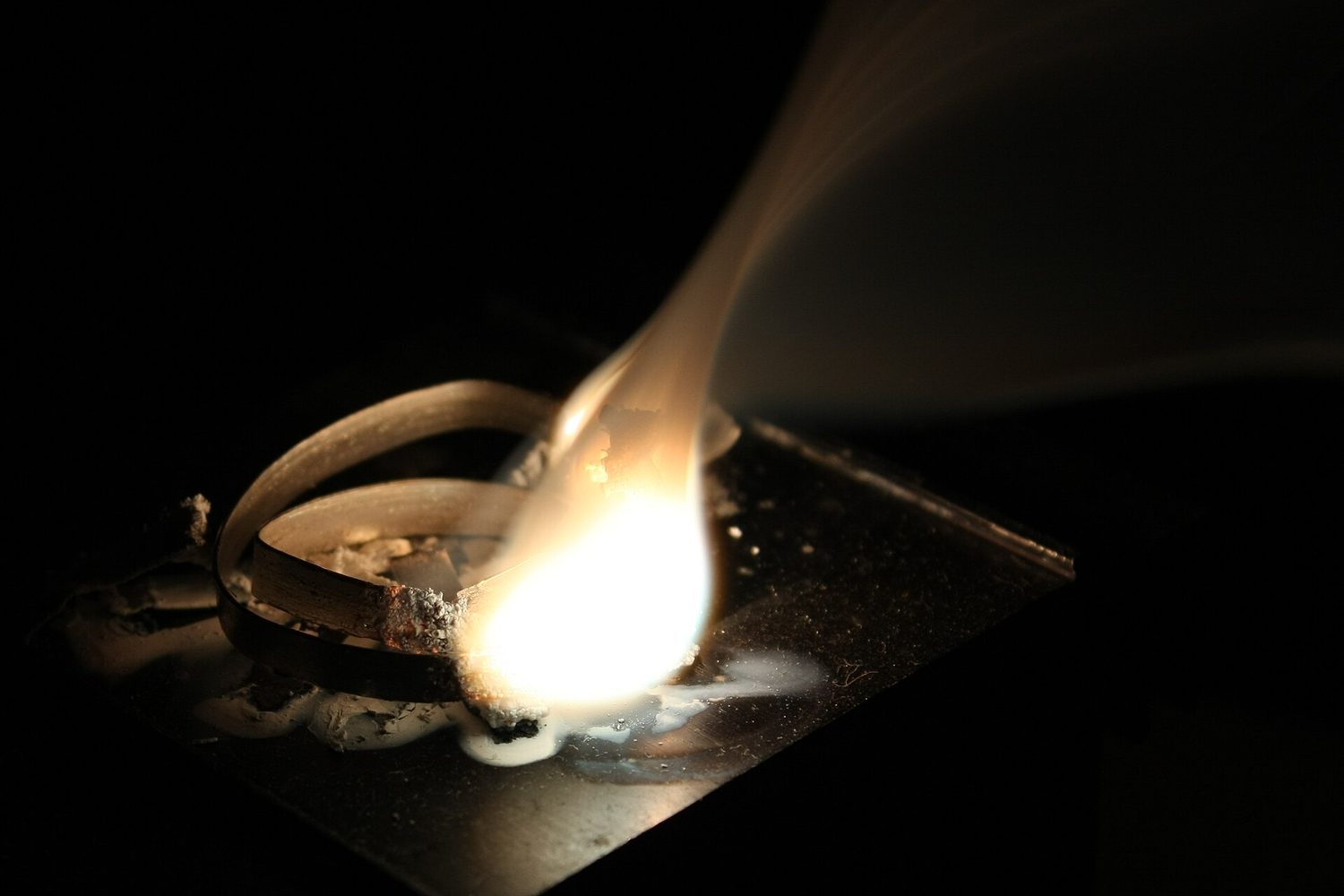
רצועת מגנזיום מתכת. נגיע אותה באש והיא תידלק — בעירה — באור בהיר מדי למבט ישירות. מה שנותר אינו יותר מגנזיום. זהו…

English narration · English + 中文 subtitles burned in · ⁨קריאת קול באנגלית · תרגום אנגלי + סינית שרוף בתוך הסרטון⁩

4.1

Recognizing a Chemical Reaction · ⁨זיהוי תגובה כימית⁩

Syllabus · ⁨סיילבוס⁩
English

Learning Objective 4.1.A: Identify evidence of chemical and physical changes in matter.

  • 4.1.A.1 A physical change occurs when a substance undergoes a change in properties but not a change in composition. Changes in the phase of a substance (solid, liquid, gas) or formation/separation of mixtures of substances are common physical changes.
  • 4.1.A.2 A chemical change occurs when substances are transformed into new substances, typically with different compositions. Production of heat or light, formation of a gas, formation of a precipitate, and/or color change provide possible evidence that a chemical change has occurred.
עברית

מטרת למידה 4.1.A: זיהוי עדות לשינויים כימיים ופיזיקליים בחומר.

  • 4.1.A.1 שינוי פיזי מתרחש כאשר חומר עובר שינוי בתכונותיו אך לא ברכיב הכימי שלו. שינויים במצב הצבירה של חומר (מוצק, נוזל, גז) או יצירת/הפרדה של תערובות הן שינויים פיזיים נפוצים.
  • 4.1.A.2 שינוי כימי מתרחש כאשר חומרים מועברים לחומרים חדשים, לרוב עם רכיב כימי שונה. ייצור חום או אור, היווצרות גז, היווצרות משקע ו/או שינוי צבע מספקים עדויות אפשריות לכך שהתרחש שינוי כימי.
Source: College Board AP Course and Exam Description · ⁨מקור: תיאור הקורס והמבחן של College Board AP⁩

English

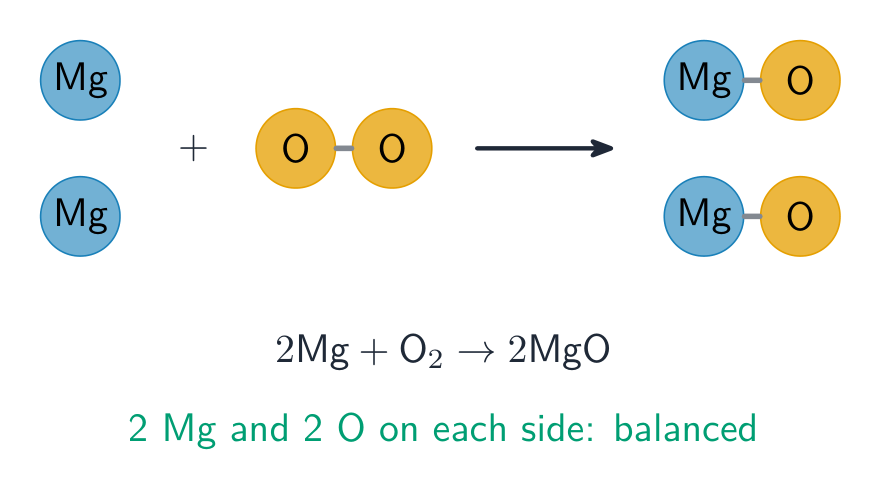
A chemical reaction 化学反应 rearranges atoms into new substances. Signs one has happened: a color change, a gas or precipitate 沉淀 forming, or a temperature change. Atoms are conserved, so an equation must be balanced – the same count of each element on both sides.

עברית
מגנזיום נשרף: תגובה כימית מעצבת מחדש אטומים ומשחררת אנרגיה כאור וחום

תגובה כימית מעצבת מחדש אטומים לחומרים חדשים. סימנים שהתרחשה: שינוי צבע, היווצרות גז או משקע, או שינוי בטמפרטורה. אטומים נשמרים, ולכן משוואה חייבת להיות מאוזנת – אותו מספר של כל אלמנט בשתי הצדדים.

4.2

Net Ionic Equations · ⁨משוואות יוניות נטו⁩

Syllabus · ⁨סיילבוס⁩
English

Learning Objective 4.2.A: Represent changes in matter with a balanced chemical or net ionic equation: i. For physical changes. ii. For given information about the identity of the reactants and/or product. iii. For ions in a given chemical reaction.

  • 4.2.A.1 All physical and chemical processes can be represented symbolically by balanced equations.
  • 4.2.A.2 Chemical equations represent chemical changes. These changes are the result of a rearrangement of atoms into new combinations; thus, any representation of a chemical change must contain equal numbers of atoms of every element before and after the change occurred. Equations thus demonstrate that mass and charge are conserved in chemical reactions.
  • 4.2.A.3 Balanced molecular, complete ionic, and net ionic equations are differing symbolic forms used to represent a chemical reaction. The form used to represent the reaction depends on the context in which it is to be used.
עברית

מטרות למידה 4.2.A: להציג שינויים בחומר באמצעות משוואה כימית מאוזנת או משוואה יונית נטו: i. עבור שינויים פיזיים. ii. עבור מידע נתון לגבי זהות המגיבים ו/או התוצרים. iii. עבור יונים בתגובה כימית נתונה.

  • 4.2.A.1 כל התהליכים הפיזיים והכימיים יכולים להיות מיוצגים סמלית על ידי משוואות מאוזנות.
  • 4.2.A.2 משוואות כימיות מייצגות שינויים כימיים. שינויים אלו הם תוצאה של ערבוב אטומים לקומבינציות חדשות; לכן, כל היצוג של שינוי כימי חייב להכיל מספר שווה של אטומים של כל אלמנט לפני ואחרי התרחשות השינוי. משוואות אלו מראות thus that mass and charge are conserved in chemical reactions.
  • 4.2.A.3 משוואות מולקולריות מאוזנות, משוואות יוניות מלאות ומשוואות יוניות נטו הן צורות סמליות שונות המשמשות להצגת תגובה כימית. הצורה הנבחרת להצגת התגובה תלויה בהקשר בו היא תשמש.

Source: College Board AP Course and Exam Description · ⁨מקור: תיאור הקורס והמבחן של College Board AP⁩

English

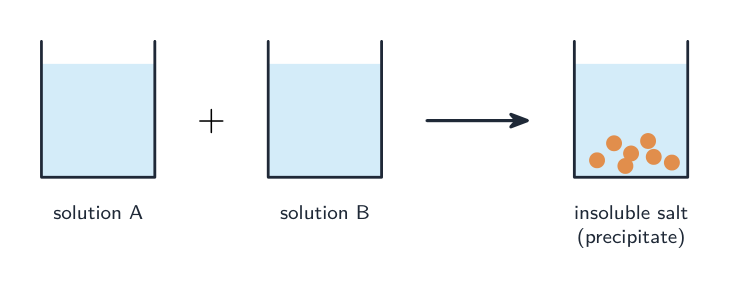
For reactions in water, ionic compounds split into ions. A net ionic equation 净离子方程式 shows only the species that actually change, leaving out the spectator ions 旁观离子 that appear unchanged on both sides. It captures the real chemistry (e.g. $\text{Ag}^+ + \text{Cl}^- \rightarrow \text{AgCl}(s)$).

עברית

לתגובות במים, תרכובות יוניות מתפרקות ליונים. משוואה יונית נטו מראה רק את המינים שנעשו שינוי בפועל, ומשאירה בחוץ את היונים הצופים שמופיעים ללא שינוי בשני האגפים. היא תופסת את הכימיה האמיתית (למשל, $\text{Ag}^+ + \text{Cl}^- \rightarrow \text{AgCl}(s)$).

ערבוב שתי תמיסות יכול ליצור משקע בלתי מומס
4.3

Three Ways to Represent a Reaction · ⁨שלוש דרכים לייצוג תגובה⁩

Syllabus · ⁨סיילבוס⁩
English

Learning Objective 4.3.A: Represent a given chemical reaction or physical process with a consistent particulate model.

  • 4.3.A.1 Balanced chemical equations in their various forms can be translated into symbolic particulate representations.
עברית

מטרות למידה 4.3.A: להציג תגובה כימית נתונה או תהליך פיזי באמצעות דגם חלקיקי עקבי.

  • 4.3.A.1 משוואות כימיות מאוזנות בצורותיהן השונות יכולות להיות מופקות להיטרוגנציה סמלית חלקיקית.

Source: College Board AP Course and Exam Description · ⁨מקור: תיאור הקורס והמבחן של College Board AP⁩

English

The same reaction can be shown as a symbolic equation, a particulate drawing (atoms and molecules), and a macroscopic observation (what you see). Moving between these levels – connecting the equation to the particles to the beaker – is a core skill.

עברית

אותה תגובה יכולה להיות מוצגת באמצעות משוואה סמלית, איור חלקיקי (אטומים ומולקולות), וצפייה מקרוסקופית (מה שרואים). מעבר בין רמות אלו – חיבור המשוואה לחלקיקים ולכוס המדידה – הוא מיומנות ליבה.

משוואה מאוזנת מכילה את אותו מספר של כל סוג אטום בשני האגפים
4.4

Physical Changes versus Chemical Changes · ⁨שינויים פיזיקליים לעומת שינויים כימיים⁩

Syllabus · ⁨סיילבוס⁩
English

Learning Objective 4.4.A: Explain the relationship between macroscopic characteristics and bond interactions for: i. Chemical processes. ii. Physical processes.

  • 4.4.A.1 Processes that involve the breaking and/or formation of chemical bonds are typically classified as chemical processes. Processes that involve only changes in intermolecular interactions, such as phase changes, are typically classified as physical processes.
  • 4.4.A.2 Sometimes physical processes involve the breaking of chemical bonds. For example, plausible arguments could be made for the dissolution of a salt in water, as either a physical or chemical process, involves breaking of ionic bonds, and the formation of ion-dipole interactions between ions and solvent.
עברית

מטרות למידה 4.4.A: להסביר את הקשר בין תכונות מקרוסקופיות לבין אינטראקציות קשר עבור: i. תהליכים כימיים. ii. תהליכים פיזיים.

  • 4.4.A.1 תהליכים המעורבים בהם שבירה ו/או יצירת קשרים כימיים מסווגים בדרך כלל כתהליכים כימיים. תהליכים המעורבים רק בשינויים באינטראקציות בין-מולקולריות, כמו שינוי מצב צבירה, מסווגים בדרך כלל כתהליכים פיזיים.
  • 4.4.A.2 לעיתים תהליכים פיזיים מעורבים בהם שבירת קשרים כימיים. לדוגמה, ניתן להטעין הסבר סביר לפירוק מלח במים, כפי שהוא יכול להתפרש גם כתהליך פיזי וגם כימי, כולל שבירת קשרים יוניים ויצירת אינטראקציות בין יון-דאניפל בין יונים לממס.

Source: College Board AP Course and Exam Description · ⁨מקור: תיאור הקורס והמבחן של College Board AP⁩

English

A physical change 物理变化 alters form but not identity (melting, dissolving); a chemical change 化学变化 makes new substances by breaking and forming bonds. Dissolving salt is physical; the salt is unchanged and recoverable.

עברית

שינוי פיזיקלי משנה צורה אך לא זהות (התכה, התמוססות); שינוי כימי יוצר חומרים חדשים על ידי שבירת ויצירת קשרים. התמוססות מלח היא שינוי פיזיקלי; המלח נשאר ללא שינוי ניתן לשחזור.

4.5

Stoichiometry · ⁨סטוכיומטריה⁩

Syllabus · ⁨סיילבוס⁩
English

Learning Objective 4.5.A: Explain changes in the amounts of reactants and products based on the balanced reaction equation for a chemical process.

  • 4.5.A.1 Because atoms must be conserved during a chemical process, it is possible to calculate product amounts by using known reactant amounts, or to calculate reactant amounts given known product amounts.
  • 4.5.A.2 Coefficients of balanced chemical equations contain information regarding the proportionality of the amounts of substances involved in the reaction. These values can be used in chemical calculations involving the mole concept.
  • 4.5.A.3 Stoichiometric calculations can be combined with the ideal gas law and calculations involving molarity to quantitatively study gases and solutions.
עברית

מטרת למידה 4.5.A: הסבר שינויים בכמויות המגיבים והתוצרים על בסיס משוואה כימית מאוזנת לתהליך כימי.

  • 4.5.A.1 מכיוון שאטומים חייבים להיות שמורים בתהליך כימי, ניתן לחשב כמויות תוצרים באמצעות כמות גיבוי ידועה של מגיבים, או לחשב כמויות מגיבים בהינתן כמויות תוצרים ידועות.
  • 4.5.A.2 מקדמים במשוואות כימיות מאוזנות מכילים מידע לגבי היחס הפרופורציונלי בין כמויות החומרים המעורבים בתגובה. ערכים אלו יכול לשמש בחישובים כימיים הכוללים את מושג המול.
  • 4.5.A.3 חישובים סטוכיומטריים יכולים להתמזג עם חוק הגז האידיאלי וחישובים הקשורים למואריות כדי לבצע מחקר כמותי של גזים ותמיסות.

Source: College Board AP Course and Exam Description · ⁨מקור: תיאור הקורס והמבחן של College Board AP⁩

English

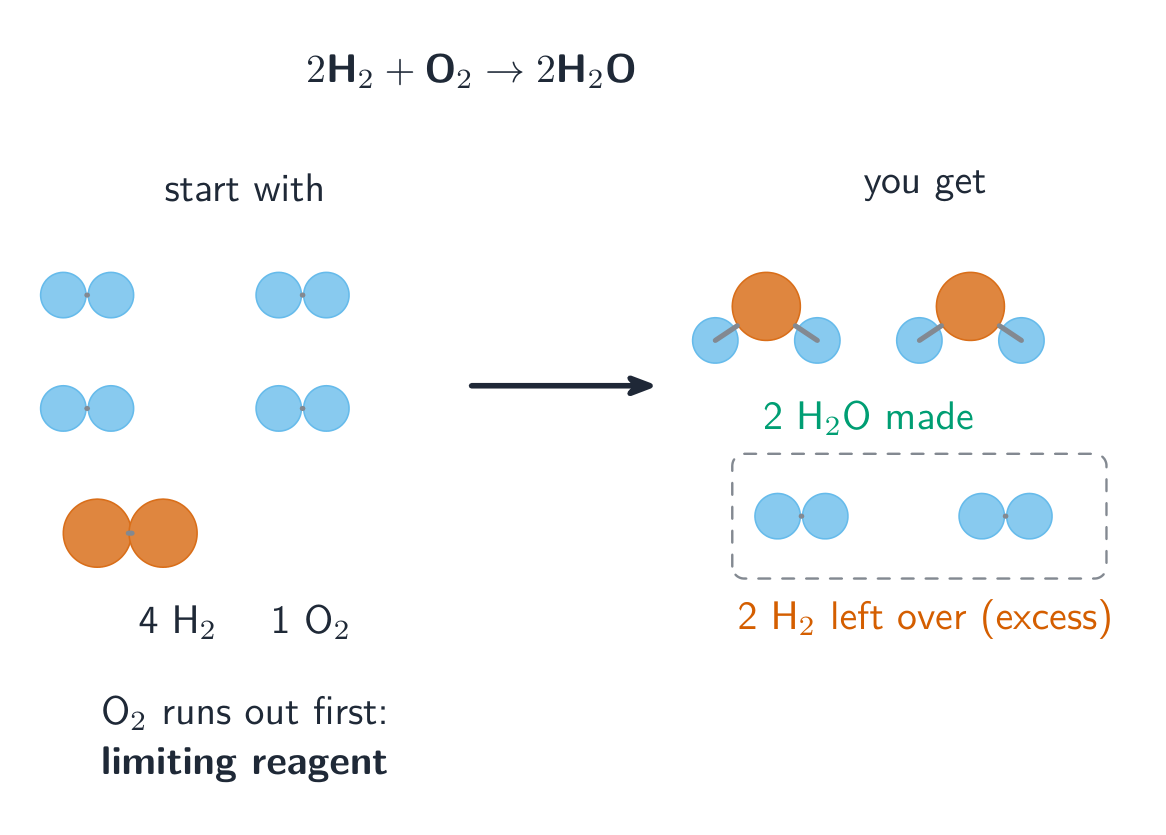
Stoichiometry 化学计量 uses the balanced equation's mole ratios to relate amounts of reactants and products. The path is always grams → moles → (mole ratio) → moles → grams. The limiting reactant 限量反应物 runs out first and sets the maximum product (the theoretical yield 理论产量); the percent yield compares actual to theoretical.

Worked example. How much water forms when $4.0\ \text{g}$ of hydrogen burns in excess oxygen? $2\text{H}_2+\text{O}_2\rightarrow2\text{H}_2\text{O}$. Convert to moles, cross the mole ratio ($2:2=1:1$ here), convert back:

$$n(\text{H}_2)=\frac{4.0}{2.0}=2.0\ \text{mol}\;\Rightarrow\;n(\text{H}_2\text{O})=2.0\ \text{mol}\;\Rightarrow\;m=2.0\times18=36\ \text{g}.$$

Worked example (limiting reactant). $10.0\ \text{g}$ of N$_2$ reacts with $5.0\ \text{g}$ of H$_2$ ($\text{N}_2+3\text{H}_2\rightarrow2\text{NH}_3$). Which runs out? Moles: $n(\text{N}_2)=10.0/28=0.36$, $n(\text{H}_2)=5.0/2=2.5$. The reaction needs $3$ H$_2$ per N$_2$; you have $2.5/0.36=7.0$, far more than $3$, so N$_2$ is limiting. It makes $2\times0.36=0.72\ \text{mol}$ of ammonia, with hydrogen left over.

עברית

סטוכיומטריה משתמשת ביחסים מולריים במשוואה מאוזנת לקשר בין כמות מגיבים לתוצרים. הדרך היא תמיד גרם → מולים → (יחס מולי) → מולים → גרם. ה-מגיב המגביל נגמר ראשון ומקבע את התוצר המקסימלי (התפוקה התאורטית); אחוז התפוקה משווה את הפועל למעשה והתאורטי.

המגיב המגביל נגמר ראשון וקובע כמה תוצר נוצר

דוגמה פתורה. כמה מים נוצרים כאשר $4.0\ \text{g}$ מימן נשרף בחמצן עודף? $2\text{H}_2+\text{O}_2\rightarrow2\text{H}_2\text{O}$. ממירים למולים, עוברים את היחס המולי ($2:2=1:1$ כאן), ממירים חזרה:

$$n(\text{H}_2)=\frac{4.0}{2.0}=2.0\ \text{mol}\;\Rightarrow\;n(\text{H}_2\text{O})=2.0\ \text{mol}\;\Rightarrow\;m=2.0\times18=36\ \text{g}.$$

דוגמה פתורה (מגיב מגביל). $10.0\ \text{g}$ N$_2$ מגיב עם $5.0\ \text{g}$ H$_2$ ($\text{N}_2+3\text{H}_2\rightarrow2\text{NH}_3$). מי נגמר? מולים: $n(\text{N}_2)=10.0/28=0.36$, $n(\text{H}_2)=5.0/2=2.5$. התגובה דורשת $3$ H$_2$ לכל N$_2$; יש לך $2.5/0.36=7.0$, הרבה יותר מ$3$, לכן N$_2$ הוא מגביל. הוא יוצר $2\times0.36=0.72\ \text{mol}$ אמونيا, עם מימן שנותר.

Explore · ⁨חקור⁩

Scale reactants and products by the mole ratio · ⁨קנה מילימולר של תגובה והכפלו ביחס המולי⁩

A balanced equation fixes the mole ratio between species. Product amount is proportional to the limiting reactant, scaled by that ratio. · ⁨משוואה מאוזנת קובעת את יחס המולי בין הסוגים. כמות התוצר היא פרופורציונלית למגיב המגביל, בהכפלה ביחס זה.⁩

4.6

Introduction to Titration · ⁨מבוא לסטרונטציה⁩

Syllabus · ⁨סיילבוס⁩
English

Learning Objective 4.6.A: Identify the equivalence point in a titration based on the amounts of the titrant and analyte, assuming the titration reaction goes to completion.

  • 4.6.A.1 Titrations may be used to determine the amount of an analyte in solution. The titrant has a known concentration of a species that reacts specifically and quantitatively with the analyte. The equivalence point of the titration occurs when the analyte is totally consumed by the reacting species in the titrant. The equivalence point is often indicated by a change in a property (such as color) that occurs when the equivalence point is reached. This observable event is called the endpoint of the titration.
עברית

מטרת למידה 4.6.A: זיהוי נקודת השוויון בטיטרציה על בסיס כמויות המומח (הטיטרנט) והאנלייט, בהנחה שהתגובה בטיטרציה מתרחשת עד סיום.

  • 4.6.A.1 טיטרציות יכולות לשמש לקביעת כמות אנלייט בתמיסה. המומח הוא בעל ריכוז ידוע של מין שמתגבה ספציפית וכמותית עם האנלייט. נקודת השוויון בטיטרציה מתרחשת כאשר האנלייט נצרך לחלוטין על ידי המין המגיב במומח. נקודת השוויון מצוין לעיתים קרובות על ידי שינוי במאפיין (כגון צבע) המתרחש כאשר נקודת השוויון מושגת. אירוע זה הניתן לצפייה נקרא נקודת סוף הטיטרציה.

Source: College Board AP Course and Exam Description · ⁨מקור: תיאור הקורס והמבחן של College Board AP⁩

English
An acid–base titration curve

A titration 滴定 finds an unknown concentration by reacting it with a solution of known concentration until they reach the equivalence point 等当点 (stoichiometrically equal). From the known volume and concentration, use the mole ratio to find the unknown. An indicator or a pH curve signals the endpoint.

Worked example. $25.0\ \text{mL}$ of hydrochloric acid is exactly neutralized by $30.0\ \text{mL}$ of $0.100\ \text{M}$ NaOH. Find the acid's concentration. The reaction is $1:1$, so the moles match:

$$n(\text{NaOH})=0.0300\times0.100=3.00\times10^{-3}\ \text{mol}=n(\text{HCl}),\qquad [\text{HCl}]=\frac{3.00\times10^{-3}}{0.0250}=0.120\ \text{M}.$$

עברית
עקומת סטרונטציה חומצה-בזה

סטרונטציה מוצאת ריכוז לא ידוע על ידי הגברה שלו עם פתרון בריכוז ידוע עד שהן מגיעות לנקודת השוויון (שוויון סטוכיומטרי). מהנפח והריכוז הידועים, משתמשים ביחס המולי כדי למצוא את הלא ידוע. אינדיקטור או עקומת pH מציינים את נקודת הסיום.

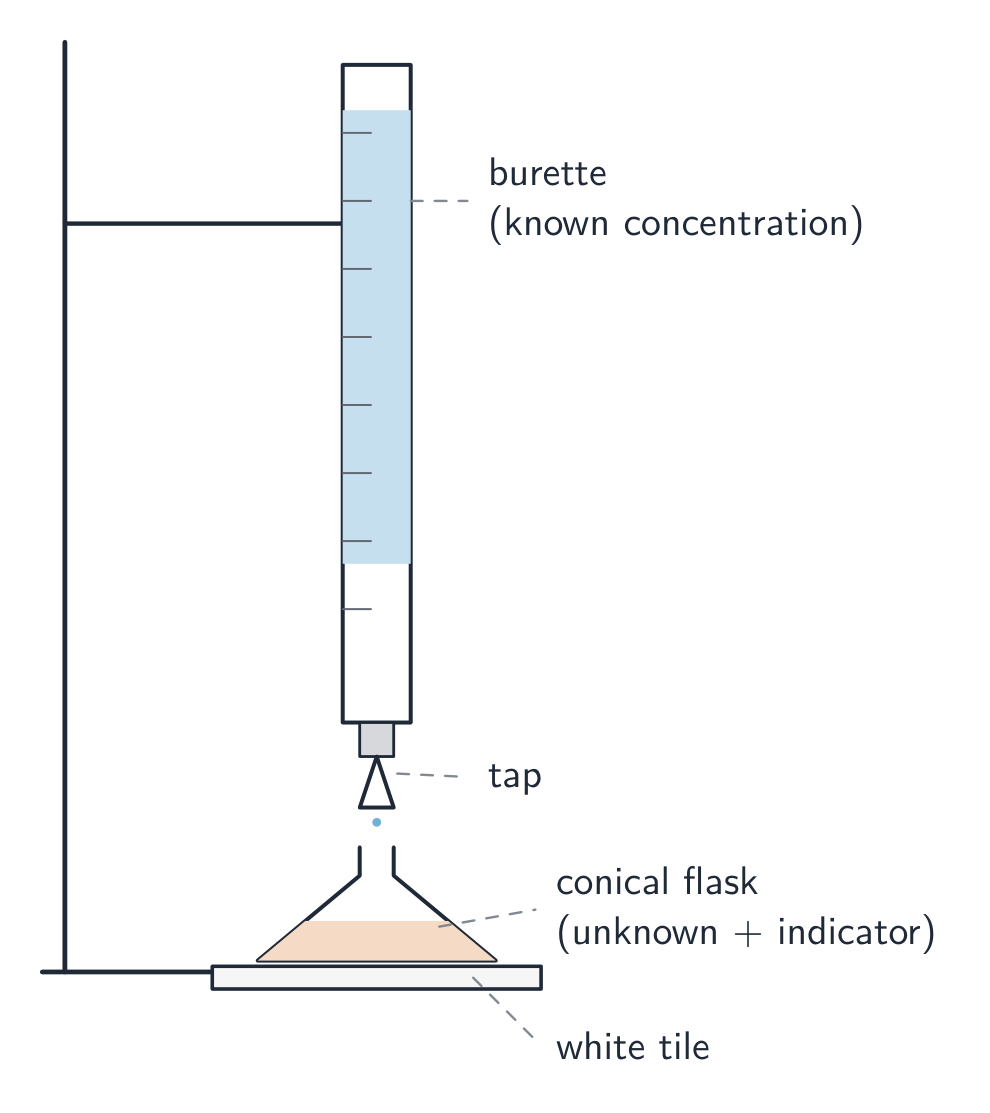
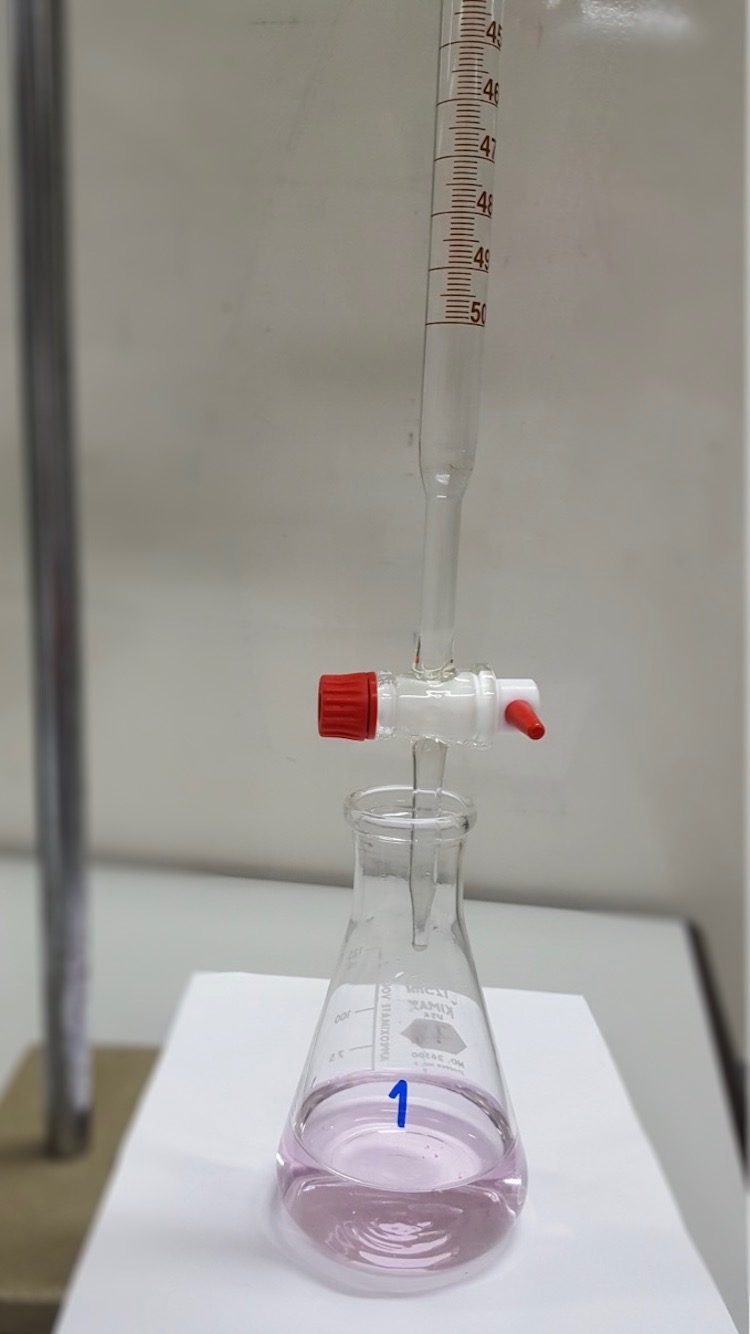
ציוד טיטרציה: ביורטה משחררת תמיסה ידועה לכוס קונית *ציוד סטרונטציה: ביורטה מזריקה פתרון ידוע לתוך בקבוק חרוט

דוגמה פתורה. $25.0\ \text{mL}$ חומצת הידרוכלורית ניטרול בדיוק על ידי $30.0\ \text{mL}$ של $0.100\ \text{M}$ NaOH. מצאו את הריכוז של החומצה. התגובה היא $1:1$, לכן המולים מתאימים:

$$n(\text{NaOH})=0.0300\times0.100=3.00\times10^{-3}\ \text{mol}=n(\text{HCl}),\qquad [\text{HCl}]=\frac{3.00\times10^{-3}}{0.0250}=0.120\ \text{M}.$$

התקנת סטרונטציה: נפחי הגברה מביורטה מוצאים את הריכוז של פתרון לא ידוע
Explore · ⁨חקור⁩

Titrate an acid and find the equivalence point · ⁨לבצע טיטרציה של חומצה ולמצוא את נקודת השוויון⁩

Adding base to acid raises the pH slowly, then sharply at the equivalence point where moles of acid and base are equal. The steep jump locates that volume. · ⁨הוספת בסיס לחומצה מעלה את ה-pH באיטו, ולאחר מכן בחדות ב-נקודת השוויון שבה מולי החומצה והבסיס שווים. הקפיצה החדה מייצבת נפח זה.⁩

Vocabulary · ⁨מילון מונחים⁩ Train · ⁨אימון⁩
English עברית
chemical reaction/ˈkemɪkl rɪˈækʃn/ תגובה כימית
precipitate/prɪˈsɪpɪteɪt/ משקע
net ionic equation/net aɪˈɒnɪk ɪˈkweɪʒn/ משוואה יוניטה נטו
spectator ions/spekˈteɪtə ˈaɪɒnz/ יונים ספקטטוריים
physical change/ˈfɪzɪkl tʃeɪndʒ/ שינוי פיזיקלי
chemical change/ˈkemɪkl tʃeɪndʒ/ שינוי כימי
Stoichiometry/ˌstəʊɪkɪˈɒmətri/ סטוכיומטריה
limiting reactant/ˈlɪmɪtɪŋ rɪˈæktənt/ תגובן מגביל
theoretical yield/θɪəˈretɪkl jiːld/ תפוקה תיאורטית
titration/taɪˈtreɪʃn/ טיטרציה
equivalence point/ɪˈkwɪvələns pɔɪnt/ נקודת שוויון
acid/ˈæsɪd/ חומצה
base/beɪs/ בסיס
4.7

Types of Chemical Reactions · ⁨סוגי תגובות כימיות⁩

Syllabus · ⁨סיילבוס⁩
English

Learning Objective 4.7.A: Identify a reaction as acid-base, oxidation-reduction, or precipitation.

  • 4.7.A.1 Acid-base reactions involve transfer of one or more protons ($\text{H}^+$ ions) between chemical species.
  • 4.7.A.2 Oxidation-reduction (redox) reactions involve transfer of one or more electrons between chemical species, as indicated by changes in oxidation numbers of the involved species. Combustion is an important subclass of oxidation-reduction reactions, in which a species reacts with oxygen gas. In the case of hydrocarbons, carbon dioxide and water are products of complete combustion.
  • 4.7.A.3 In a redox reaction, electrons are transferred from the species that is oxidized to the species that is reduced.
    • Exclusion statement: The meaning of the terms "reducing agent" and "oxidizing agent" will not be assessed on the AP Exam.
  • 4.7.A.4 Oxidation numbers may be assigned to each of the atoms in the reactants and products; this is often an effective way to identify the oxidized and reduced species in a redox reaction.
  • 4.7.A.5 Precipitation reactions frequently involve mixing ions in aqueous solution to produce an insoluble or sparingly soluble ionic compound. All sodium, potassium, ammonium, and nitrate salts are soluble in water.
    • Exclusion statement: Rote memorization of "solubility rules" other than those implied in 4.7.A.5 will not be assessed on the AP Exam.
עברית

מטרת למידה 4.7.A: זיהוי תגובה כתגובת חומצה-בסיס, חמצון-חיזור, או הצטברות.

  • 4.7.A.1 תגובות חומצה-בסיס מעורבות העברת פרוטון אחד או יותר ($\text{H}^+$ יונים) בין מינים כימיים.
  • 4.7.A.2 תגובות חמצון-חיזור (רדוקס) מעורבות העברת אלקטרון אחד או יותר בין מינים כימיים, כפי שמצוין על ידי שינויים במספרי חמצון של המינים המעורבים. בעירה היא תת-קבוצה חשובה בתגובות חמצון-חיזור, שבה מיन מגיב עם חמצן גזי. במקרה של חנקוטרנים, פחמן די-אוקסיד ומים הם תוצרים של בעירה מלאה.
  • 4.7.A.3 בתגובת רדוקס, אלקטרונים מועברים מהמין שעובר חמצון אל המין שעובר חיזור.
    • הערת אי-כלליות: המשמעות של המונחים "גורם מחזר" ו"גורם מחמצן" לא תיבחן בבחן AP.
  • 4.7.A.4 מספרי חמצון יכולים להיוות לכל אחד מאטומי המגיבים והתוצרים; זוהי לעיתים קרובות דרך יעילה לזהות את המינים שעברו חמצון וחיזור בתגובת רדוקס.
  • 4.7.A.5 תגובות הצטברות מעורבות לעיתים קרובות ערבוב יונים בתמיסה מימית ליצירת תרכובת יונית בלתי מומסת או במומסת במעט. כל מלחי נתרן, אשלגן, אמוניום וניטראט הם מומסים במים.
    • הערת אי-כלליות: שינון בעל-כוח של "חוקי המומסות" אחרים מאלו המשתמע מ-4.7.A.5 לא ייבחן בבחן AP.

Source: College Board AP Course and Exam Description · ⁨מקור: תיאור הקורס והמבחן של College Board AP⁩

English

Common patterns include synthesis (combining), decomposition (breaking apart), combustion (with oxygen, releasing energy), precipitation (forming an insoluble solid), acid–base (proton transfer), and redox (electron transfer). Recognizing the type helps predict the products.

עברית

תבניות נפוצות כוללות סינתזה (היתוך), פירוק (שבירה), בעירה (עם חמצן, שחרור אנרגיה), משקע (יוצרים מוצק בלתי מומס), חומצה-בסיס (העברת פרוטון) ואופו-רידוקס (העברת אלקטרונים). זיהוי הסוג עוזר לחזות את התוצרים.

4.8

Acid-Base Reactions · ⁨תגובות חומצה-בסיס⁩

Syllabus · ⁨סיילבוס⁩
English

Learning Objective 4.8.A: Identify species as Brønsted-Lowry acids, bases, and/or conjugate acid-base pairs, based on proton-transfer involving those species.

  • 4.8.A.1 By definition, a Brønsted-Lowry acid is a proton donor and a Brønsted-Lowry base is a proton acceptor.
  • 4.8.A.2 Only in aqueous solutions, water plays an important role in many acid-base reactions, as its molecular structure allows it to accept protons from and donate protons to dissolved species.
  • 4.8.A.3 When an acid or base ionizes in water, the conjugate acid-base pairs can be identified and their relative strengths compared.
    • Exclusion statement: Lewis acid-base concepts will not be assessed on the AP Exam. The emphasis in AP Chemistry is on reactions in aqueous solution.
עברית

מטרת למידה 4.8.A: זיהוי מינים כחומצות ברונסטד-לאורי, בסיסים ו/או זוגות חומצה-בסיס מוצקים, על בסיס העברת פרוטונים המעורבת במינים אלו.

  • 4.8.A.1 לפי ההגדרה, חומצה של ברונסטד-לאורי היא תורם פרוטון ובסיס של ברונסטד-לאורי הוא מקבל פרוטון.
  • 4.8.A.2 רק בתמיסות מימיות, למים ישנה חשיבות רבה בתגובות חומצה-בסיס רבות, בשל המבנה המולקולרי שלו המאפשר לו לקבל פרוטונים ולהעביר פרוטונים למינים המומסים.
  • 4.8.A.3 כאשר חומצה או בסיס מתיונים במים, ניתן לזהות את זוגות החומצה-בסיס המצוידים ולהשוות את עוצמתם היחסית.
    • הערה לגבי ייצוא: מושגי החומצה-בסיס של לויס לא ייבדקו בבחינת AP. הדגש בכימיה AP הוא על תגובות בתמיסה מימית.

Source: College Board AP Course and Exam Description · ⁨מקור: תיאור הקורס והמבחן של College Board AP⁩

English

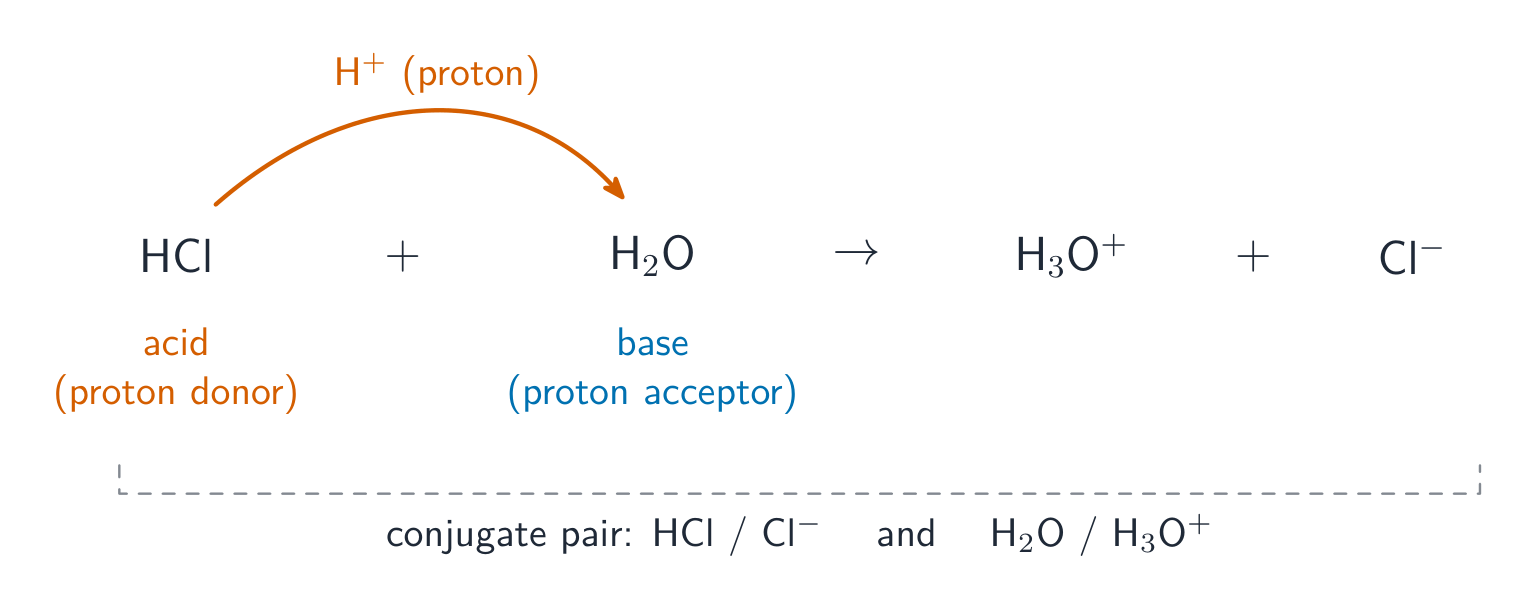
An acid 酸 donates a proton ($\text{H}^+$); a base 碱 accepts one (Brønsted–Lowry). They react to form water and a salt: $\text{H}^+ + \text{OH}^- \rightarrow \text{H}_2\text{O}$. Strong acids and bases dissociate completely; weak ones only partly.

עברית

חומצה נותנת פרוטון ($\text{H}^+$); בסיס מקבל אותו (ברונסטד-לאורי). הן מגיבות ליצירת מים ומלח: $\text{H}^+ + \text{OH}^- \rightarrow \text{H}_2\text{O}$. חומצות ובסיסים חזקים מתפרקים במלואם; חלשים רק חלקית.

ברונסטד-לאורי: חומצה נותנת פרוטון לבסיס, ויוצרת שני זוגות צמודים
Explore · ⁨חקור⁩

Move along the pH scale · ⁨נוע לצדדי סולם ה-pH⁩

pH measures how acidic or basic a solution is. Each step of 1 pH is a tenfold change in hydrogen-ion concentration; 7 is neutral, below is acidic, above is basic. · ⁨pH מדד עד כמה פתרון הוא חומצי או בסיסי. כל צעד של 1 ב-pH הוא שינוי פי עשר בריכוז יוני מימן; 7 הוא ניטרלי, מתחת הוא חומצי, מעל הוא בסיסי.⁩

4.9

Oxidation-Reduction (Redox) Reactions · ⁨תגובות אופו-רידוקס (Redox)⁩

Syllabus · ⁨סיילבוס⁩
English

Learning Objective 4.9.A: Represent a balanced redox reaction equation using half-reactions.

  • 4.9.A.1 Balanced chemical equations for redox reactions can be constructed from half-reactions.
עברית

מטרת למידה 4.9.A: להציג משוואת תגובת Redox מאוזנת באמצעות מחצית-תגובה.

  • 4.9.A.1 ניתן לבנות משוואות כימיות מאוזנות לתגובות Redox מתוך מחצית-תגובה.

Source: College Board AP Course and Exam Description · ⁨מקור: תיאור הקורס והמבחן של College Board AP⁩

English

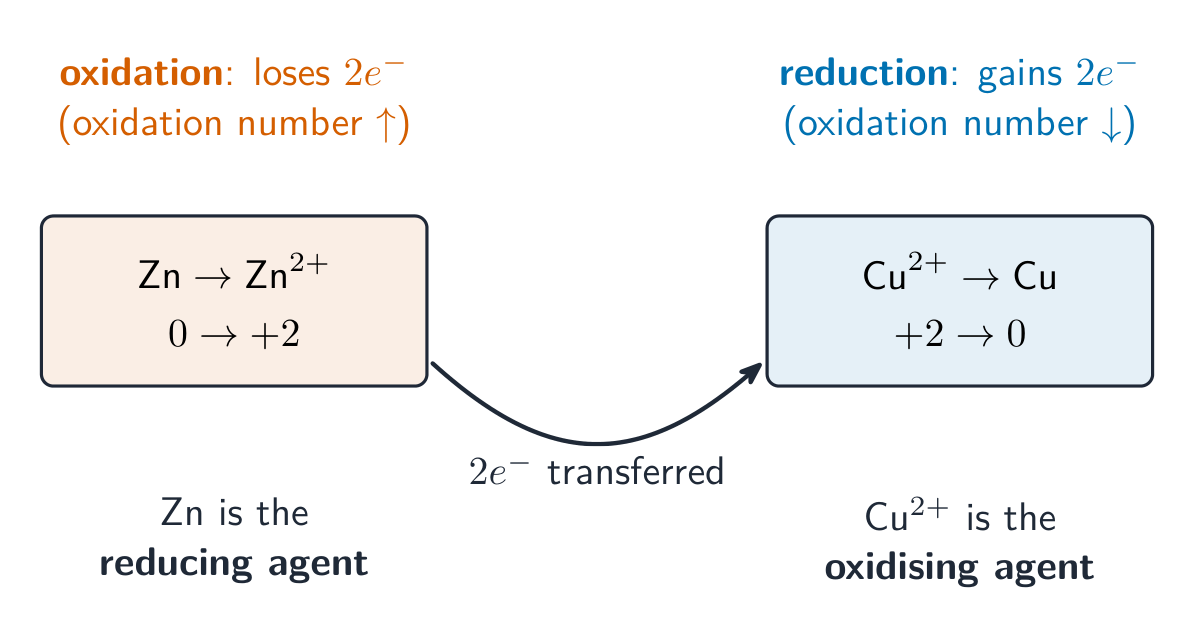
In a redox 氧化还原 reaction, electrons transfer between species. Oxidation 氧化 is loss of electrons (oxidation number rises); reduction 还原 is gain (oxidation number falls). Track changes with oxidation numbers, and remember every oxidation is paired with a reduction – the electrons lost equal the electrons gained.

Worked example. Find the oxidation number of manganese in permanganate, $\text{KMnO}_4$. Potassium is $+1$ and each oxygen is $-2$ (four of them, $-8$). The whole formula is neutral, so $(+1)+\text{Mn}+(-8)=0$, giving $\text{Mn}=+7$ – its maximum, which is why permanganate is a powerful oxidizing agent (it can only gain electrons).

עברית

בתגובת רידוקס, אלקטרונים עוברים בין מינים. אופo היא איבוד אלקטרונים (מספר חמצון עולה); רידוקציה היא קבלת אלקטרונים (מספר חמצון יורד). עקבו אחרי השינויים עם מספרי חמצון, וזכרו שכל אופo מלווה ברידוקציה – האלקטרונים שאבדו שווים לאלקטרונים שהתקבלו.

רידוקס הוא העברת אלקטרונים: החומר המכחל הוא מחומץ, החומר המכחל הוא מורד

דוגמה מופת. מצא את מספר החמצון של מנגן בפרמנגנט, $\text{KMnO}_4$. אשלוח הוא $+1$ וכל חמצן הוא $-2$ (ארבעה מהם, $-8$). הנוסחה כולה ניטרלית, לכן $(+1)+\text{Mn}+(-8)=0$, מה שמעניק $\text{Mn}=+7$ – המקסימום שלה, והסיבה לכך שפרמנגנט הוא מחמצן חזק (יכול רק לקבל אלקטרונים).

Explore · ⁨חקור⁩

Watch electrons transfer in a redox reaction · ⁨עקוב אחר העברת אלקטרונים בתגובת חמצון-היכרות⁩

In a redox reaction one species is oxidised (loses electrons) and another is reduced (gains them). Follow the electrons move from the metal to the non-metal. · ⁨בתגובת חמצון-היכרות סוג אחד מתחמצן (אובד אלקטרונים) וסוג אחר מתכחש (קונה אותם). עקוב אחר התנועה של האלקטרונים מהמתכת אל הלא-מתכת.⁩

Vocabulary · ⁨מילון מונחים⁩ Train · ⁨אימון⁩
English עברית
redox/rɪˈdɒks/ חמצון-חיזור
Oxidation/ˌɒksɪˈdeɪʃn/ חמצון
reduction/rɪˈdʌkʃn/ חיזור
4.9

Exam tips · ⁨טיפים לבחינות⁩

English
  • Balance every equation and work in moles — convert grams→moles, cross the mole ratio, then convert back.
  • Find the limiting reactant by comparing mole ratios; it sets the maximum product (theoretical yield).
  • In redox, remember OIL RIG: oxidation is loss of electrons, reduction is gain; every oxidation is paired with a reduction.
  • For titrations use the balanced ratio to link the known and unknown at the equivalence point.
  • A net ionic equation shows only the species that change; leave out spectator ions.
עברית
  • איזן כל משוואה ועבוד במול — הפוך גרמים למול, עבר את יחס המול, ואז הפוך בחזרה.
  • מצאו את התגובה המגבילה על ידי השוואת יחסי מולים; היא קובעת את התוצר המקסימלי (תפוקה תיאורטית).
  • ברידוקס, זכרו OIL RIG: אופo היא איבוד אלקטרונים, רידוקציה היא קבלת; כל אופo מלווה ברידוקציה.
  • עבור טיטרציות השתמשו ביחס המאוזן לקשר בין הידוע והלא ידוע בנקודת שוויון.
  • משוואה יונית נטו מראה רק את המיניםשתתפו; השאירו את היונים הצופים.

Interactive lessons on this topic · ⁨שיעורים אינטראקטיביים בנושא זה⁩

Work through it step by step, with instant-check exercises. · ⁨לעבור על הדברים צעד אחר צעד, עם תרגילים לבדיקה מיידית.⁩

Past Papers · ⁨מבחני עבר⁩

More topics in AP Chemistry · ⁨כימיה AP⁩ · ⁨נושאים נוספים בAP Chemistry · ⁨כימיה AP⁩⁩

Log in or create account · ⁨היכנס או צור חשבון⁩

IGCSE, A-Level & AP