משליכים מתג, והאור נדלק מיד. אז האלקטרונים חייבים לרוץ בחוט במהירות האור — נכון? לא. בתוך חוט נחושת…
English narration · English + 中文 subtitles burned in · קריאת קול באנגלית · תרגום אנגלי + סינית שרוף בתוך הסרטון
9.1
Electric current · זרם חשמלי
Syllabus · סיילבוס
English
understand that an electric current is a flow of charge carriers
understand that the charge on charge carriers is quantised
recall and use $Q = It$
use, for a current-carrying conductor, the expression $I = Anvq$, where $n$ is the number density of charge carriers
עברית
הבנה כי זרם חשמלי הוא זרימה של נושאי מטען
הבנה כי המטען על נושאי המטען הוא כמותני
זיכרון ושימוש ב$Q = It$
שימוש, עבור מוליך הנושא זרם, בביטוי $I = Anvq$, כאשר $n$ הוא צפיפות מספרית של נושאי מטען
Source: Cambridge International syllabus · מקור: הסיילבוס הבינלאומי של קמבריד'ג'
English
An electric current 电流 is a flow of charge carriers 载流子. In a metal the carriers are negative conduction electrons 电子; in an electrolyte 电解质 they are positive and negative ions 离子; in a semiconductor 半导体 they may be electrons or "holes" 空穴. The conventional current 常规电流 direction is the way positive charge would flow — opposite to the real flow of electrons in a wire.
Charge
Charge is quantised 量子化: the smallest free unit of charge is the elementary charge 基本电荷
$$e = 1.60 \times 10^{-19}\ \text{C}.$$
Every free charge in this syllabus is a whole-number multiple of $e$. The unit of charge is the coulomb 库仑, $\text{C}$.
So a particle can carry $4.8 \times 10^{-19}\ \text{C}$ (three electrons' worth) or $-2.4 \times 10^{-18}\ \text{C}$ (fifteen), but never $1.1 \times 10^{-19}\ \text{C}$ or $6.4 \times 10^{-20}\ \text{C}$; a set of measurements that gives a charge carrier $2.5 \times 10^{-19}\ \text{C}$ cannot be right, because that is not a multiple of $e$. For the one-mark definitions: an electric current is a flow of charge carriers; the coulomb is the charge that passes a point in one second when the current is one ampere (an ampere multiplied by a second); a charge carrier can be an electron, a proton, an ion or an $\alpha$-particle, but never a neutron.
Current as the rate of flow of charge
If charge $Q$ passes a point in time $t$, the current is
$$I = \frac{Q}{t}, \qquad Q = It.$$
Unit of current: ampere, $\text{A}$ ($= \text{C s}^{-1}$). For a changing current, the charge that has flowed in a time is the area under an $I$–$t$ graph.
Worked example. A current of $0.50\ \text{A}$ flows for $2.0$ minutes. Find the charge that passes, and how many electrons this represents. ($e = 1.60 \times 10^{-19}\ \text{C}$.)
The same two lines answer "how many electrons pass in $10$ hours at $4.0\ \text{mA}$" (convert the time to seconds: $N = It/e = 4.0 \times 10^{-3} \times 36\,000 / (1.60 \times 10^{-19}) = 9.0 \times 10^{20}$) and, the other way round, "the average current when $6.0 \times 10^{23}$ electrons pass in $24$ hours" ($I = Ne/t = 1.1\ \text{A}$). A beam of $\alpha$-particles carries a current too: each carries $2e$, so a beam current of $6.9 \times 10^{-9}\ \text{A}$ is $6.9 \times 10^{-9} / (2 \times 1.60 \times 10^{-19}) = 2.2 \times 10^{10}$ particles per second. A lightning strike that transfers $1 \times 10^{20}$ electrons in $30\ \mu\text{s}$ is a current of $Ne/t = 5.3 \times 10^{5}\ \text{A}$.
Drift velocity equation
For a uniform conductor of cross-section area $A$, with $n$ charge carriers per unit volume (the number density 数密度), each carrying charge $q$, moving with average drift velocity 漂移速度$v$:
$$I = A n v q.$$
Worked example. A copper wire of cross-sectional area $1.0 \times 10^{-6}\ \text{m}^{2}$ carries a current of $5.0\ \text{A}$. Copper has $n = 8.5 \times 10^{28}$ free electrons per $\text{m}^{3}$. Find the drift velocity. ($e = 1.60 \times 10^{-19}\ \text{C}$.)
The electrons drift very slowly — less than a millimetre per second.
Two "show that" steps that often precede this calculation. The number density of a metal with one free electron per atom is $n = \dfrac{\text{density} \times N_{\text{A}}}{\text{molar mass}}$: for copper, $8.9 \times 10^{3} \times 6.02 \times 10^{23} / 0.0635 = 8.5 \times 10^{28}\ \text{m}^{-3}$. And the time for an electron to drift the length of a wire is $t = L / v$: at $3.7 \times 10^{-4}\ \text{m s}^{-1}$ a $2.0\ \text{m}$ wire takes $5\,400\ \text{s}$, an hour and a half, even though the current is established almost instantly. Between them, the equation $I = Anvq$ is used as a ratio far more often than as a calculation:
two wires in series carry the same current; if wire Y has twice the diameter of X (four times the area) and the same metal, its electrons drift at a quarter of the speed. Two wires of the same length and diameter but different metals have drift speeds in the inverse ratio of their number densities.
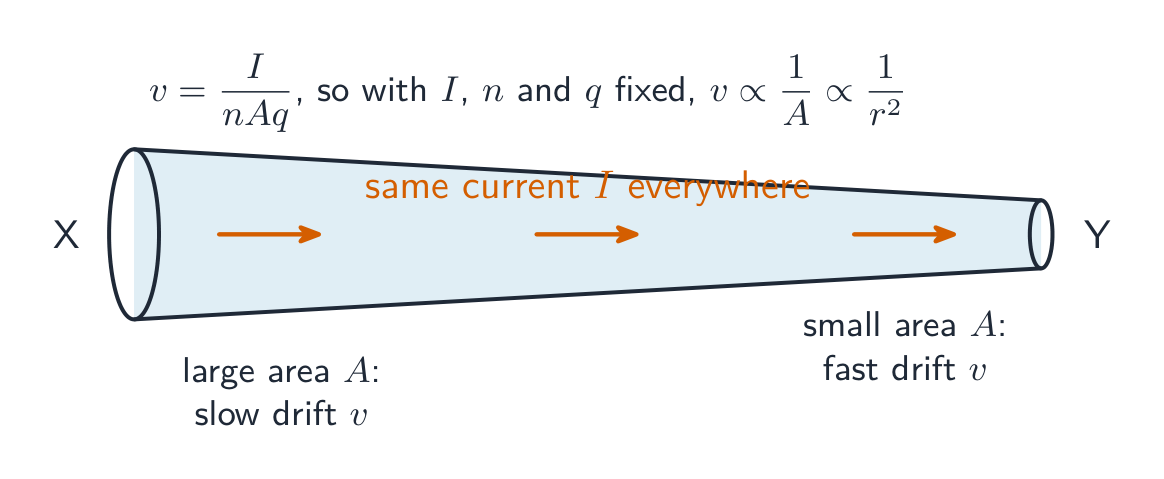
a wire that narrows (a wedge, a tapered rod, a cable of thick and thin strands) carries the same current at every cross-section, so the drift speed rises where the area falls: $v \propto 1/A \propto 1/r^{2}$. A sketch of $v$ against distance along a tapering wire is a curve that rises more and more steeply towards the narrow end, not a straight line.
the p.d. across a uniform wire is proportional to its length at fixed current, because $V = IR = I\rho L / A$ with $I$, $\rho$ and $A$ constant.
Use this to compare currents:
a thinner wire (smaller $A$) at the same $I$ needs a faster drift $v$.
a semiconductor has far fewer free carriers than a metal (smaller $n$), so for the same $I$ the drift velocity is much larger.
in series 串联 components, $I$ is the same everywhere, so if $A$ stays the same but the material changes, $nv$ changes the other way.
עברית
זרם חשמלי הוא זרימת נושאי מטען. במתכת הנושאים הם אלקטרונות מוליכים שליליים; באלקטרוליט הם יונים חיוביים ושליליים; במוصע חצי-מוליך הם עשויים להיות אלקטרונים או "חורים". כיוון הזרם המקובל הוא הכיוון שבו זורם מטען חיובי — נגד לכיוון האמיתי של זרימת האלקטרונים בחוט.
מטען
מטען הוא כמותי: היחידה החופשית הקטנה ביותר היא מטען יסודי
$$e = 1.60 \times 10^{-19}\ \text{C}.$$
כל מטען חופשי בסילבוס זה הוא כפל שלם של $e$. יחידת המטען היא קולון, $\text{C}$.
לכן חלקיק יכול לשאת $4.8 \times 10^{-19}\ \text{C}$ (שווה לשלושה אלקטרונים) או $-2.4 \times 10^{-18}\ \text{C}$ (שווה לחמש), אך לעולם לא $1.1 \times 10^{-19}\ \text{C}$ או $6.4 \times 10^{-20}\ \text{C}$; סט מדידות שנותן נושא מטען עם $2.5 \times 10^{-19}\ \text{C}$ אינו נכון, משום שהוא אינו כפל של $e$. להגדרות בעלות נקודה אחת: זרם חשמלי הוא זרימת נושאי מטען; קולון הוא המטען העובר בנקודה בתוך שנייה אחת כאשר הזרם הוא אמפר אחד (אמפר כפול שנייה); נושא מטען יכול להיות אלקטרון, פרוטון, יון או חלקיק $\alpha$, אך לעולם לא נייטרון.
זרם כקצב זרימת המטען
אם מטען $Q$ עובר בנקודה בזמן $t$, הזרם הוא
$$I = \frac{Q}{t}, \qquad Q = It.$$
יחידת זרם: אמפר, $\text{A}$ ($= \text{C s}^{-1}$). עבור זרם משתנה, המטען שעבר בזמן נתון הוא ה-שטח מתחת לגרף של $I$–$t$.
דוגמה פותרת. זרם של $0.50\ \text{A}$ זורם למשך $2.0$ דקות. מצאו את המטען שעבר, וכמה אלקטרונים זה מייצג. ($e = 1.60 \times 10^{-19}\ \text{C}$.)
אותן שתי שורות מענות על השאלה "כמה אלקטרונים עוברים ב$10$ שעות ב$4.0\ \text{mA}$" (ממירים את הזמן לשניות: $N = It/e = 4.0 \times 10^{-3} \times 36\,000 / (1.60 \times 10^{-19}) = 9.0 \times 10^{20}$) ועל השאלה ההפוכה, "הזרם הממוצע כאשר $6.0 \times 10^{23}$ אלקטרונים עוברים ב$24$ שעות" ($I = Ne/t = 1.1\ \text{A}$). קרן חלקיקי $\alpha$ גם כן נשאת זרם: כל חלקיק נושא $2e$, ולכן זרם קרן של $6.9 \times 10^{-9}\ \text{A}$ הוא $6.9 \times 10^{-9} / (2 \times 1.60 \times 10^{-19}) = 2.2 \times 10^{10}$ חלקיקים בשנייה. פגיעת ברק שמעבירה $1 \times 10^{20}$ אלקטרונים ב$30\ \mu\text{s}$ היא זרם של $Ne/t = 5.3 \times 10^{5}\ \text{A}$.
משוואת מהירות הדיפה
עבור מוליך אחיד בעל שטח חתך $A$, עם $n$ נושאי מטען ליחידת נפח (צפיפות מספרית), כל אחד מהם נושא מטען $q$, ונעים בממוצע במהירות דיפה$v$:
$$I = A n v q.$$
נושאי מטען נעים בתוך מוליך: נושאי מטען חיוביים נעים עם $I$, אלקטרונים נגדו
דוגמה פותרת. חוט נחושת בעל שטח חתך $1.0 \times 10^{-6}\ \text{m}^{2}$ נושא זרם של $5.0\ \text{A}$. לנחושת יש $n = 8.5 \times 10^{28}$ אלקטרונים חופשיים ל$\text{m}^{3}$. מצאו את מהירות הדיפה. ($e = 1.60 \times 10^{-19}\ \text{C}$.)
שני שלבי "הראו כי" שמגיעים לעיתים קרובות לפני חישוב זה. צפיפות המספרים של מתכת עם אלקטרון חופשי אחד לסוגרית היא $n = \dfrac{\text{density} \times N_{\text{A}}}{\text{molar mass}}$: עבור נחושת, $8.9 \times 10^{3} \times 6.02 \times 10^{23} / 0.0635 = 8.5 \times 10^{28}\ \text{m}^{-3}$. וה-זמן שאלקטרון לוקח להחליק לאורך חוט הוא $t = L / v$: ב-$3.7 \times 10^{-4}\ \text{m s}^{-1}$ חוט ב-$2.0\ \text{m}$ לוקח $5\,400\ \text{s}$, שעה וחצי, גם אם הזרם מתקיים כמעט מיד. ביניהם, המשוואה $I = Anvq$ משמשת כיחס הרבה יותר מאשר כחישוב:
שני חוטים בסדרה נושאים אותו זרם; אם לחוט Y יש קוטר כפול מזה של X (ארבע פעמים השטח) והוא עשוי מאותו מתכת, האלקטרונים בו ינועו במהירות של רביע מהמהירות. לשני חוטים באותו אורך ואותו קוטר אך מתכות שונות, מהירויות הריחוף יהיו ביחס הפוך לצפיפויות המספר שלהן.
חוט הצר (משולש, מוט מחודד, כבל בעל גידולים עבים ודקים) נושא אותו זרם בכל חתך, ולכן מהירות הריחוף עולה כשהשטח יורד: $v \propto 1/A \propto 1/r^{2}$. תרשים של $v$ כנגד המרחק לאורך חוט צר הוא עקומה העולה בקצב תמיד גדול יותר לכיוון הקצה הצר, ולא קו ישר.
המתח על חוט אחיד פרופורציונלי לאורכו בזרם קבוע, מכיוון ש-$V = IR = I\rho L / A$ עם $I$, $\rho$ ו-$A$ קבועים.
אותו זרם בכל מקום, ולכן האלקטרונים נעים מהר יותר כשהחוט צר
השתמש בזה כדי להשוות זרמים:
חוט צר יותר (שטח $A$ קטן יותר) באותו $I$ דורש מהירות ריחוף $v$ מהירה יותר.
למוליך למחצה יש הרבה פחות נשאים חופשיים מאשר למתכת (שטח $n$ קטן יותר), ולכן עבור אותו $I$, מהירות הריחוף היא הרבה גדולה יותר.
בסדרה רכיבים, $I$ זהה בכל מקום, כך שאם $A$ נשאר זהה אך החומר משתנה, $nv$ משתנה בכיוון ההפוך.
Explore · חקור
Current, voltage and resistance · זרם, מתח והתנגדות
Current is the rate of flow of charge. Raise the voltage and current rises; raise the resistance and it falls — I = V / R. · זרם הוא קצב הזרימת המטען. העלאת המתח מגדילה את הזרם; העלאת ההתנגדות מקטינה אותו — I = V / R.
Source: Cambridge International syllabus · מקור: הסיילבוס הבינלאומי של קמבריד'ג'
English
The potential difference 电势差 (p.d.) across a component is the energy 能量 transferred per unit charge as that charge passes through it:
$$V = \frac{W}{Q}.$$
Unit: volt 伏特, $\text{V}$ ($= \text{J C}^{-1}$).
If $1\ \text{J}$ of electrical energy changes into other forms (thermal, light, kinetic, …) when $1\ \text{C}$ of charge passes through a component, the p.d. across it is $1\ \text{V}$.
The electromotive force 电动势 (e.m.f.) of a source is the energy given per unit charge by the source. The formula is the same as for p.d.; the difference is direction: e.m.f. is energy given to the charge by the change; p.d. is energy given up by the charge to the component.
The definitions the examiner accepts: the potential difference across a component is the energy transferred (from electrical to other forms) per unit charge passing through it; the e.m.f. of a source is the energy transferred from other forms (chemical, in a cell) to electrical energy per unit charge in driving the charge round a complete circuit; one volt is one joule per coulomb. A battery "marked $9.0\ \text{V}$" therefore gives each coulomb $9.0\ \text{J}$ of electrical energy for the whole circuit, and the product of charge and p.d. is the energy transferred.
עברית
הפרש הפוטנציאל (p.d.) על רכיב הוא האנרגיה המועברת ליחידת מטען כאשר מטען זה עובר דרכו:
$$V = \frac{W}{Q}.$$
יחידה: וולט, $\text{V}$ ($= \text{J C}^{-1}$).
אם $1\ \text{J}$ של אנרגיה חשמלית משתנה לצורות אחרות (תרמיות, אור, קינטית, …) כאשר $1\ \text{C}$ של מטען עובר דרך רכיב, המתח עליו הוא $1\ \text{V}$.
כוח אלקטרומגנטי (e.m.f.) של מקור הוא האנרגיה הנתונה ליחידת מטען על ידי המקור. הנוסחה זהה לזו של p.d.; ההבדל הוא בכיוון: e.m.f. הוא אנרגיה הנתונה למטען על ידי השינוי; p.d. הוא אנרגיה הנתונה לעלות על ידי המטען לרכיב.
ההגדרות שקורא הקבלה מקבל: הפרש הפוטנציאל על רכיב הוא האנרגיה המועברת (מחשמל לצורות אחרות) ליחידת מטען העוברת דרכו; הכוח האלקטרומגנטי של מקור הוא האנרגיה המועברת מצורות אחרות (כימית, בתא) לאנרגיה חשמלית ליחידת מטען בדחיפת המטען סביב מעגל שלם; וולט אחד הוא ג'ול אחד לקולון. סוללה "מתווה $9.0\ \text{V}$" לכן נותנת לכל קולון $9.0\ \text{J}$ של אנרגיה חשמלית למעגל כולו, והמכפלה של המטען והמתח היא האנרגיה המועברת.
Pick the form with the quantities you know. Examples:
two heaters of equal resistance — the one with the larger current gives more power 功率 ($P = I^{2}R$).
two resistors in parallel 并联 across the same voltage 电压 — the one with smaller $R$ gives more power ($P = V^{2}/R$).
a kettle marked "$2.4\ \text{kW}, 240\ \text{V}$" draws $I = P/V = 10\ \text{A}$ and has resistance $R = V^{2}/P = 24\ \Omega$.
Energy transferred in time $t$ is $E = P t$.
Worked example. Two lamps, P rated $250\ \text{V}$, $50\ \text{W}$ and Q rated $250\ \text{V}$, $200\ \text{W}$, are connected in series to a $250\ \text{V}$ supply. Which is brighter?
Their resistances at the rated p.d. are $R = V^{2}/P$: $1250\ \Omega$ for P and $313\ \Omega$ for Q. In series they carry the same current, so $P = I^{2}R$ makes the larger resistance, lamp P, dissipate more power: the "weaker" lamp is the brighter one. In parallel the p.d. is the same across both and $P = V^{2}/R$ favours the smaller resistance: Q. "State and explain which resistor dissipates more power" is answered by naming the quantity the two share (current in series, p.d. in parallel) and the form of the power equation that uses it.
Worked example. A supply delivers $2.4\ \text{kW}$ at $240\ \text{V}$ to a kettle through two cables of resistance $0.10\ \Omega$ each. Find the power lost in the cables.
The current is $I = P/V = 10\ \text{A}$, so the cables dissipate $I^{2}R = 10^{2} \times 0.20 = 20\ \text{W}$, and the kettle receives $2380\ \text{W}$. The efficiency of a circuit that exists to power one component is that component's power divided by the total power from the supply: with $6.0\ \text{V}$ across a $0.86\ \Omega$ series resistor and $4.5\ \text{V}$ across the component at the same current, the efficiency is $4.5 / (6.0 + 4.5) = 43\%$. A thermistor across a fixed p.d. dissipates $P = V^{2}/R$, so as its temperature rises and $R$ falls, the power rises. A kettle draws about $10\ \text{A}$ from a $250\ \text{V}$ supply; a mobile phone charger a fraction of an ampere.
עברית
קווי מתח גבוה מובילים אנרגיה חשמלית בכל רחבי הארץ.
שילוב $V = W/Q$ ו$I = Q/t$:
$$P = \frac{W}{t} = V I.$$
שימוש בחוק אום $V = IR$:
$$P = V I = I^{2} R = \frac{V^{2}}{R}.$$
בחר את הצורה עם הכמויות הידועות לך. דוגמאות:
שני מחממים בעלי התנגדות שווה — זה עם הזרם הגדול יותר מספק הספק גבוה יותר ($P = I^{2}R$).
שני נגדים בפנייה על אותו מתח — זה עם התנגדות קטנה יותר $R$ מספק הספק גבוה יותר ($P = V^{2}/R$).
סיר מים המסומן "$2.4\ \text{kW}, 240\ \text{V}$" צורך $I = P/V = 10\ \text{A}$ ויש לו התנגדות $R = V^{2}/P = 24\ \Omega$.
אנרגיה המועברת בזמן $t$ היא $E = P t$.
דוגמה פתרה. שתי נורות, P מדורגת ב-$250\ \text{V}$, $50\ \text{W}$ ו-Q מדורגת ב-$250\ \text{V}$, $200\ \text{W}$, מחוברות בסדרה לספק כוח ב-$250\ \text{V}$. איזו נורה תבהיק יותר?
ההתנגדות שלהן במתח הנורמלי היא $R = V^{2}/P$: $1250\ \Omega$ עבור P ו-$313\ \Omega$ עבור Q. בסדרה הן מעבירות אותו זרם, ולכן $P = I^{2}R$ גורמת להתנגדות הגדולה יותר, נורת P, לפזר יותר הספק: הנורה "החלשה" היא זו שהבהיק יותר. בפנייה המתח זהה בשתי הנורות ו-$P = V^{2}/R$ תורמת להתנגדות הקטנה יותר: Q. השאלה "צין והסבר איזה נגד מפזר יותר הספק" עונה על ידי ציון הכמות המשותפת ביניהן (זרם בסדרה, מתח בפנייה) ובצורת משוואת ההספק שמשתמשת בה.
דוגמה פתרה. ספק מספק $2.4\ \text{kW}$ ב-$240\ \text{V}$ לסיר מים דרך שני כבלים בעלי התנגדות של $0.10\ \Omega$ כל אחד. מצא את ההספק האבוד בכבלים.
הזרם הוא $I = P/V = 10\ \text{A}$, ולכן הכבלים מפזרים $I^{2}R = 10^{2} \times 0.20 = 20\ \text{W}$, וסיר המים מקבל $2380\ \text{W}$. היעילות של מעגל המשמש להפעלת רכיב אחד היא הספק הרכיב חלקי הספק הכולל מהספק: כאשר יש $6.0\ \text{V}$ על נגד בסדרה ב-$0.86\ \Omega$ ו-$4.5\ \text{V}$ על הרכיב באותו זרם, היעילות היא $4.5 / (6.0 + 4.5) = 43\%$. תרמיסטור על מתח קבוע מפזר $P = V^{2}/R$, ולכן כשטמפרטורת עולה והתנגדות $R$ יורדת, ההספק עולה. סיר מים צורך כ-$10\ \text{A}$ מספק ב-$250\ \text{V}$; מטען לטלפון נייד חלק מאמפר.
Explore · חקור
Electrical power · הספק חשמלי
P = VI
At a fixed voltage, power is proportional to the current it drives. · במתח קבוע, ההספק פרופורציונלי לזרם שהוא מדריך.
sketch the $I\text{--}V$ characteristics of a metallic conductor at constant temperature, a semiconductor diode and a filament lamp
explain that the resistance of a filament lamp increases as current increases because its temperature increases
state Ohm's law
recall and use $R = \rho L/A$
understand that the resistance of a light-dependent resistor (LDR) decreases as the light intensity increases
understand that the resistance of a thermistor decreases as the temperature increases (it will be assumed that thermistors have a negative temperature coefficient)
עברית
הגדר התנגדות
תזכור ושימוש ב$V = IR$
שרטט את $I\text{--}V$ המאפיינים של מוליך מתכתי בטמפרטורה קבועה, דיודה למחצית מוליך ונורת להב
הסבר שההתנגדות של נורת להב עולה ככל שהזרם עולה בשל עליית הטמפרטורה שלה
ציין את חוק אוהם
זכור והשתמש ב-$R = \rho L/A$
הבן שההתנגדות של נגד תלוי-אור (LDR) יורדת ככל שהעוצמת האור עולה
הבן שההתנגדות של תרמיסטור יורדת ככל שהטמפרטורה עולה (יהיה מוסכם כי לתרמיסטורים יש מקדם טמפרטורה שלילי)
Source: Cambridge International syllabus · מקור: הסיילבוס הבינלאומי של קמבריד'ג'
English
The resistance 电阻$R$ of a component is
$$R = \frac{V}{I}.$$
Unit: ohm 欧姆, $\Omega$ ($= \text{V A}^{-1}$). Resistance depends on the conditions (such as temperature) when it is measured.
Ohm's law
A conductor obeys Ohm's law 欧姆定律 when the current through it is proportional to the p.d. across it, as long as the conditions (especially temperature) stay constant. For such a conductor $R$ is constant and the $I$–$V$ graph is a straight line through the origin.
Ohm's law is an experimental result, not a definition. The definition $R = V/I$ works for any component; only ohmic ones have constant $R$.
For the marks: resistance is the ratio of the potential difference across a component to the current in it; the ohm is the resistance of a component in which a p.d. of one volt produces a current of one ampere (a volt per ampere); Ohm's law states that the current in a metallic conductor is directly proportional to the potential difference across it, provided that its temperature (and other physical conditions) remains constant. Of several $I$–$V$ graphs, only a straight line through the origin obeys Ohm's law; a straight line that misses the origin, or any curve, does not.
$I$–$V$ characteristics
You should be able to sketch these:
metal wire at constant temperature — a straight line through the origin (constant $R$). Reversing the p.d. drives the current the other way, giving a straight line in both directions.
filament lamp 灯丝灯泡 — through the origin, steep at first, then flatter as $V$ (and $I$) grow. Reason: more current heats the filament, so its resistance rises and the gradient $1/R$ falls.
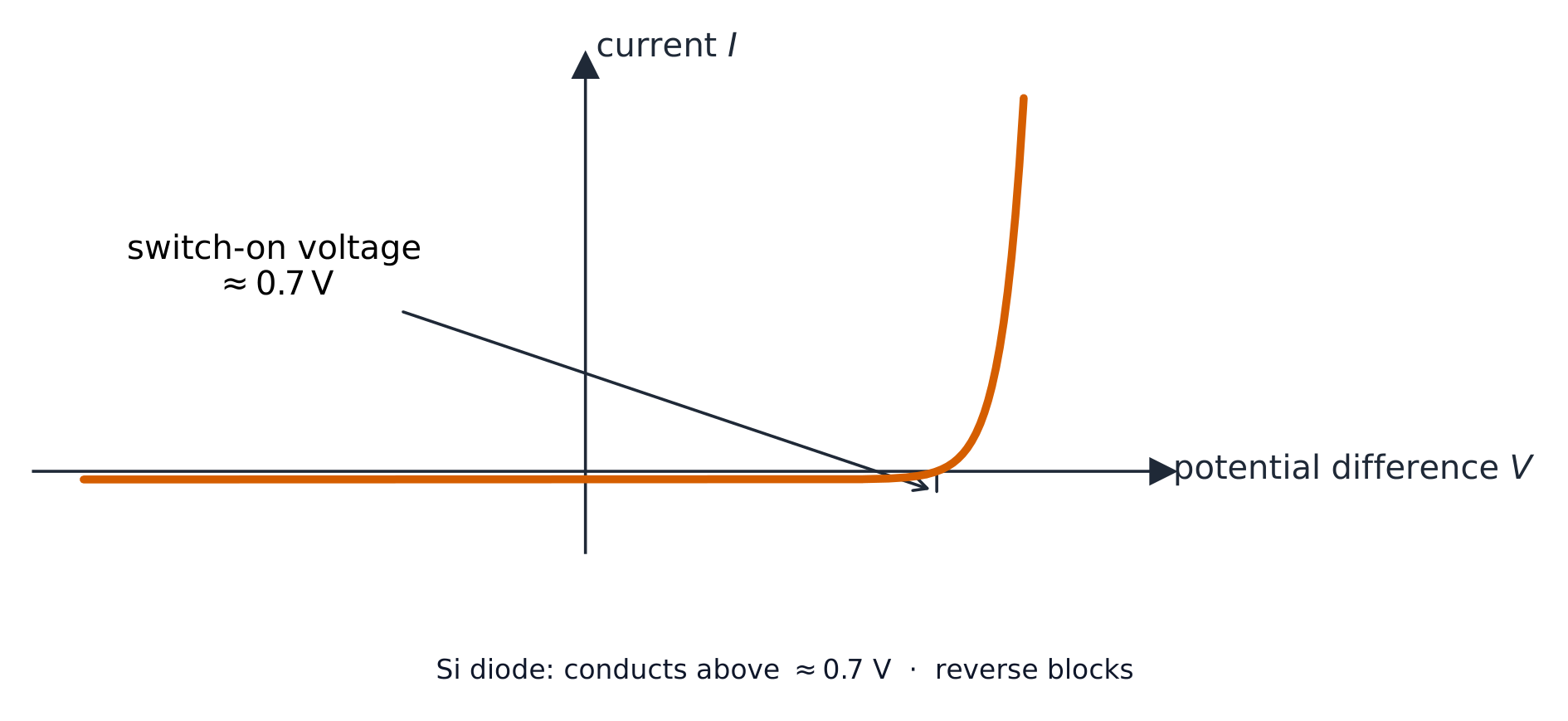
semiconductor diode 二极管 — almost no current for negative $V$ or small positive $V$. Above a "switch-on" voltage (about $0.7\ \text{V}$ for silicon), the current rises sharply.
Explain the shape of the filament lamp's line (three marks): as the current increases the filament's temperature rises; the lattice ions vibrate with larger amplitude, so the free electrons collide with them more often; each collision takes energy from the electrons, so the resistance increases; on the graph the ratio $V/I$ grows and the gradient falls. Run backwards for "the current decreases": the temperature falls, so the resistance falls. Two things to read off any characteristic. The resistance at a point is $V/I$ for that point, never the gradient of a curve, so a diode's resistance is very large (infinite, in practice) up to the switch-on p.d. and then falls steeply as $V$ rises further, and of four components at the same p.d. the one with the smallest current has the greatest resistance. And when a lamp (or a diode) is in series with a resistor, the two carry the same current and their p.d.s add: read the current from the component's curve at its own p.d., then use $V = IR$ for the resistor, and the supply p.d. is the sum.
Resistivity
For a uniform conductor of length $L$ and cross-section area $A$,
$$R = \frac{\rho L}{A}.$$
$\rho$ is the resistivity 电阻率, a property of the material, with unit $\Omega\ \text{m}$. Doubling the length doubles $R$; doubling the area halves it; halving the diameter quarters the area and so makes $R$ four times bigger.
Worked example. A copper wire of length $2.0\ \text{m}$ and cross-sectional area $1.7 \times 10^{-7}\ \text{m}^{2}$ has resistivity $1.7 \times 10^{-8}\ \Omega\ \text{m}$. Find its resistance.
Typical values: copper at room temperature $\rho \sim 1.7 \times 10^{-8}\ \Omega\ \text{m}$; an insulator 绝缘体$\rho \sim 10^{15}\ \Omega\ \text{m}$ or more.
The resistivity of a metal rises with temperature (more lattice vibration 晶格振动scatters 散射 the electrons), which is why the filament lamp's $I$–$V$ line curves.
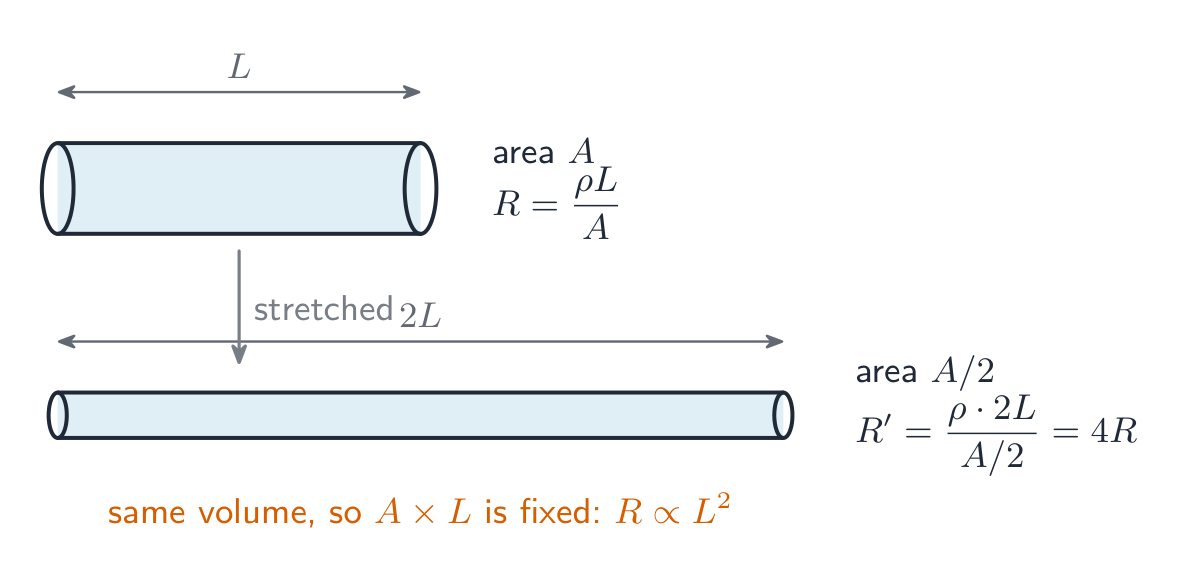
Most resistivity questions are ratios. Stretching a wire keeps its volume ($A \times L$) constant, so if the length becomes $k$ times longer the area becomes $k$ times smaller and $R = \rho L / A$ becomes $k^{2}$ times larger: a wire three times as long (same mass, same metal) has nine times the resistance, and a wire whose diameter falls to $0.940$ of its value has its area multiplied by $0.884$, its length divided by $0.884$, and its resistance multiplied by $1/0.884^{2} = 1.28$.
Worked example. A copper lightning rod of resistance $9.6\ \Omega$ and length $20\ \text{m}$ has resistivity $1.7 \times 10^{-8}\ \Omega\ \text{m}$. Find its radius.
$A = \rho L / R = 1.7 \times 10^{-8} \times 20 / 9.6 = 3.5 \times 10^{-8}\ \text{m}^{2}$, and $r = \sqrt{A / \pi} = 1.1 \times 10^{-4}\ \text{m}$. Doubling the radius (same length) quarters the resistance. The other standard ratios: strands in parallel — seven identical strands share the current, so the cable's resistance is one seventh of one strand's; two wires of the same resistance where one metal has twice the resistivity need the second wire to have twice the area (a diameter $\sqrt{2}$ times larger) for the same length; a wire's resistance per unit length, $0.92\ \Omega\ \text{m}^{-1}$, multiplied by its area, $5.3 \times 10^{-7}\ \text{m}^{2}$, is its resistivity, $4.9 \times 10^{-7}\ \Omega\ \text{m}$; and a cylinder of conducting putty $60\ \text{mm}$ long and $20\ \text{mm}$ across, or a cube of side $a$ ($R = \rho a / a^{2} = \rho / a$), uses the same $R = \rho L / A$ with the shape's own length and end area. When the wire is held under tension, $R_{0} = \rho L / A$ still gives its resistance, and a stretch that lengthens it and thins it raises $R$ for both reasons. Because $\rho = RA/L = R\pi d^{2}/(4L)$, the percentage uncertainty in a measured resistivity is the sum of the percentage uncertainties in $R$ and $L$ plus twice that in $d$.
עברית
ההתנגדות$R$ של רכיב היא
$$R = \frac{V}{I}.$$
יחידה: אוהם, $\Omega$ ($= \text{V A}^{-1}$). ההתנגדות תלויה בתנאים (כגון טמפרטורה) בזמן המדידה.
נגדים קבועים אמיתיים — הפסים הצבעוניים מקודדים את ההתנגדות באוהמים
חוק אוהם
מוליך מקיים חוק אוהם כאשר הזרם העובר דרכו ישר פרופורציה ל-B.D.P. (הפרש הפוטנציאלים) לאורךיו, כל עוד התנאים (במיוחד הטמפרטורה) נשארים קבועים. עבור מוליך כזה $R$ הוא קבוע והגרף $I$–$V$ הוא ישר העובר דרך הראשית.
חוק אוהם הוא תוצאה ניסויית, ולא הגדרה. ההגדרה $R = V/I$ עובדת לכל רכיב; רק למוליכים אומיים יש $R$ קבוע.
לעניין הציונים: התנגדות היא היחס בין הפרש הפוטנציאלים על רכיב לבין הזרם העובר דרכו; אום הוא התנגדות של רכיב שבו B.D.P. של וולט אחד גורם לזרם של אמפר אחד (וולט per אמפר); חוק אוהם קובע שהזרם במוליך מתכתי נמצא ביחס ישיר להפרש הפוטנציאלים על פניו, בתנאי שטמפרטורתו (ותנאים פיזיקליים אחרים) נשארת קבועה. מבין מספר גרפי $I$–$V$, רק ישר העובר דרך הראשית מקיים את חוק אוהם; ישר שלא עובר דרך הראשית או כל כיפוף אינם מקיימים אותו.
מאפייני $I$–$V$
עליכם להיות יכולים לערוך סקיצה של אלו:
חוט מתכת בטמפרטורה קבועה – ישר העובר דרך הראשית ($R$ קבוע). הפוך את ה-B.D.P. והזרם יזרום בכיוון השני, מה שמניב ישר בשני הכיוונים.
מנורת להב – עובר דרך הראשית, תחילה תלול ואז משטח יותר ככל שה-$V$ (וגם ה-$I$) גדלים. הסיבה: זרם רב מחמם את הלהב, ולכן התנגדותו עולה והשיפוע $1/R$ יורד.
דיוד מוליך למחצה – כמעט אין זרם עבור $V$ שלילי או $V$ חיובי קטן. מעל מתח "הפעלה" (כ-$0.7\ \text{V}$ לסיליקון), הזרם עולה בחוד.
הסברו את צורת הקו במנורת הלהב (שלושה ציונים): ככל שהזרם עולה, טמפרטורת הלהב עולה; יוני הרשת רוטים עם תנודה בעלת אמפליטודה גדולה יותר, ולכן האלקטרונים החופשיים מתנגשים בהם תדירות רבה יותר; כל התנגשות לוקחת אנרגיה מהאלקטרונים, ולכן התנגדות עולה; בגרף היחס $V/I$ גדל והשיפוע יורד. ניתן לקרוא גם הפוך עבור "כאשר הזרם יורד": הטמפרטורה יורדת, ולכן התנגדות יורדת. שני דברים שקוראים ממאפיין כלשהו. ההתנגדות בנקודה היא $V/I$ עבור הנקודה הזו, לעולם לא השיפוע של הכיפוף, ולכן ההתנגדות של דיוד היא גדולה מאוד (אינסופית בפועל) עד ל-B.D.P. ההפעלה, ואז יורדת בחוד ככל שה-$V$ עולה יותר, ומבין ארבעה רכיבים באותו B.D.P., זה עם הזרם הקטן ביותר הוא בעל ההתנגדות הגדולה ביותר. וכאשר מנורה (או דיוד) מחוברת בסדר עם נגד, לשניהם זרם זהה וה-B.D.P.s שלהם מתחברים: קראו את הזרם מעקומת הרכיב ב-B.D.P. שלו, ואז השתמשו ב-$V = IR$ עבור הנגד, ו-B.D.P. המקור הוא הסכום.
מאפיין $I$–$V$ של מוליך אומי (חוט מתכת בטמפרטורה קבועה)מאפיין $I$–$V$ של מנורת להבמאפיין $I$–$V$ של דיוד מוליך למחצה
התנגדות סגולית
עבור מוליך אחיד באורך $L$ ובשטח חוצה $A$,
$$R = \frac{\rho L}{A}.$$
$\rho$ היא התנגדות סגולית, מאפיין של החומר, עם יחידת מידה $\Omega\ \text{m}$. הכפלת האורך מכפילה את ה-$R$; הכפלת השטח מחציתה אותו; חציית הקוטר מרבע את השטח ולכן גורמת ל-$R$ להיות ארבע פעמים גדול יותר.
דוגמה מפורטת. חוט נחושת באורך $2.0\ \text{m}$ ובשטח חתך $1.7 \times 10^{-7}\ \text{m}^{2}$ בעל התנגדות סגולית $1.7 \times 10^{-8}\ \Omega\ \text{m}$. מצאו את ההתנגדות שלו.
ערכים טיפסיים: נחושת בטמפרטורת החדר $\rho \sim 1.7 \times 10^{-8}\ \Omega\ \text{m}$; מבודד$\rho \sim 10^{15}\ \Omega\ \text{m}$ או יותר.
מוליך ארוך יותר יש לו התנגדות גדולה יותר — הכפלת $L$ מכפילה פי שניים את $R$מוליך רחב יותר יש לו התנגדות פחותה — הכפלת $A$ מפחיתה לחצי את $R$
ההתנגדות הסגולית של מתכת עולה עם הטמפרטורה (יותר תנודות רשתמפיצות את האלקטרונים), והסיבה לכך שהקו $I$–$V$ של נורת להט עקומה.
רוב שאלות ההתנגדות הסגולית הן יחסים. מתיחה של חוט שומר על נפחו ($A \times L$) קבועה, כך שאם האורך הופך ל-$k$ פעמים ארוך יותר, השטח הופך ל-$k$ פעמים קטן יותר וה-$R = \rho L / A$ הופך ל-$k^{2}$ פעמים גדול יותר: חוט ארוך פי שלושה (אותו מסה, אותו מתכת) יש לו התנגדות פי תשע, וחוט שבו הקוטר יורד ל-$0.940$ מערכו יש לו שטח שמוכפל ב-$0.884$, אורך שמחולק ב-$0.884$, והתנגדות שמוכפלת ב-$1/0.884^{2} = 1.28$.
נמתח בנפח קבוע: פי שניים באורך, מחצית בשטח, ארבע פעמים ההתנגדות
דוגמה מפורטת. מקל ברקים מנחושת בהתנגדות $9.6\ \Omega$ ובאורך $20\ \text{m}$ יש לו התנגדות סגולית $1.7 \times 10^{-8}\ \Omega\ \text{m}$. מצאו את הרדיוס שלו.
$A = \rho L / R = 1.7 \times 10^{-8} \times 20 / 9.6 = 3.5 \times 10^{-8}\ \text{m}^{2}$, ו-$r = \sqrt{A / \pi} = 1.1 \times 10^{-4}\ \text{m}$. הכפלת הרדיוס (אותו אורך) מפחיתה את ההתנגדות לרבע. היחסים הסטנדרטיים האחרים: סיבים במקביל — שבעה סיבים זהים מחלקים את הזרם, ולכן ההתנגדות של הכבל היא שביעית מההתנגדות של סיב אחד; שני חוטים באותה התנגדות כאשר אחד מהם עשוי מתכת עם התנגדות סגולית כפולה דורשים מהחוט השני להיות בעל שטח כפול (קוטר $\sqrt{2}$ פעמים גדול יותר) עבור אותו אורך; ההתנגדות ליחידת אורך של חוט, $0.92\ \Omega\ \text{m}^{-1}$, כפול בשטחו, $5.3 \times 10^{-7}\ \text{m}^{2}$, הם ההתנגדות הסגולית שלו, $4.9 \times 10^{-7}\ \Omega\ \text{m}$; וגליל של חומר מוליך אורך $60\ \text{mm}$ וקוטר $20\ \text{mm}$, או קובייה בצד $a$ ($R = \rho a / a^{2} = \rho / a$), משתמש באותה $R = \rho L / A$ עם האורך והשטח של הקצה של הצורה עצמו. כאשר החוט מוחזק במתח, $R_{0} = \rho L / A$ עדיין נותן את ההתנגדות שלו, ומתיחה שמארכת אותו ומדקת אותו מעלה את $R$ משתי הסיבות. מכיוון ש-$\rho = RA/L = R\pi d^{2}/(4L)$, אי-הוודאות האחוזית בהתנגדות סגולית הנמדדת היא סך אי-הוודאויות האחוזיות ב-$R$ ו-$L$ פלוס פי שניים מאותה ב-$d$.
Explore · חקור
What resistance depends on: R = ρL/A · מהי התנגדות תלויה: R = ρL/A
A longer wire has more resistance; a thicker one (bigger area) has less. Change the length, area and metal. · חוט ארוך יותר בעל התנגדות גבוהה יותר; חוט עבה יותר (שטח גדול יותר) בעל התנגדות נמוכה יותר. שינוי האורך, השטח והמתכת.
Explore · חקור
Resistance (Ohm's law) · התנגדות (חוק אוהם)
V = R·I
Ohm's law: voltage is proportional to current — the gradient is the resistance R. · חוק אוהם: המתח פרופורציונלי לזרם — השיפוע הוא ההתנגדות R.
Explore · חקור
Ohm's law: V = IR · חוק אום: V = IR
V = aI
Drag the resistance. For an ohmic conductor voltage is proportional to current — a straight line whose gradient is the resistance. · גרור את ההתנגדות. עבור מוליך אומי מתח פרופורציונלי לזרם — קו ישר שמשיפוע שלו הוא ההתנגדות.
Light-dependent resistor (LDR) · נגד תלוי אור (LDR)
English
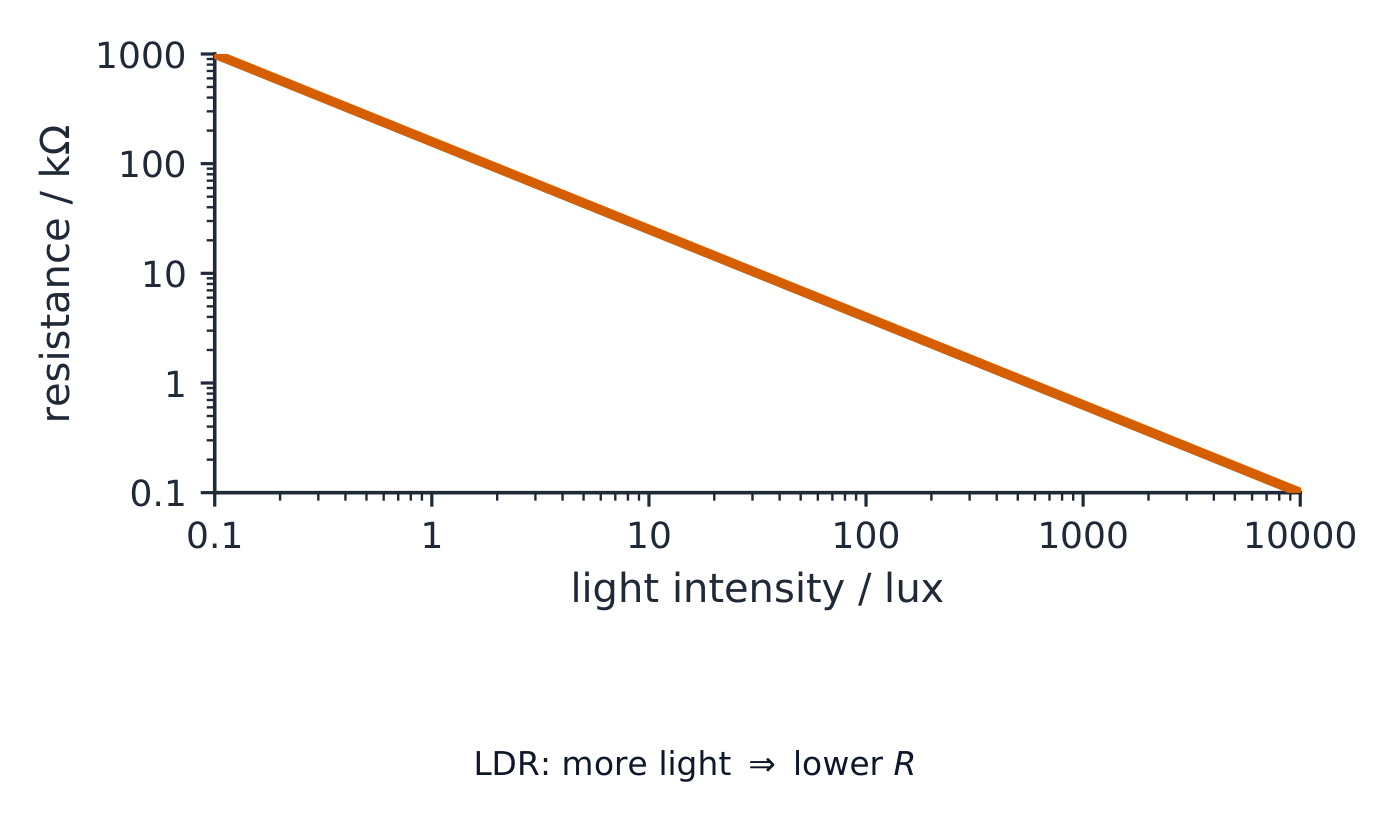
A light-dependent resistor 光敏电阻 (LDR) is a semiconductor whose resistance falls as the light intensity rises. In bright light $R$ may be a few hundred $\Omega$; in the dark it can be in the megaohms. LDRs are used in light-sensing circuits (street lamps, camera light meters). Here the light intensity 光强 controls the resistance.
עברית
נגד תלוי אור (LDR) הוא מוליך למחצה שבו ההתנגדות יורדת ככל שהעוצמת האור עולה. באור בהיר $R$ עשויה להיות במאות מעטים $\Omega$; בחושך היא יכולה להיות במגה-אום. LDRs משמשים במעגלי זיהוי אור (מנורות רחוב, מד-אור במצלמות). כאן עוצמת האור שולטת בהתנגדות.
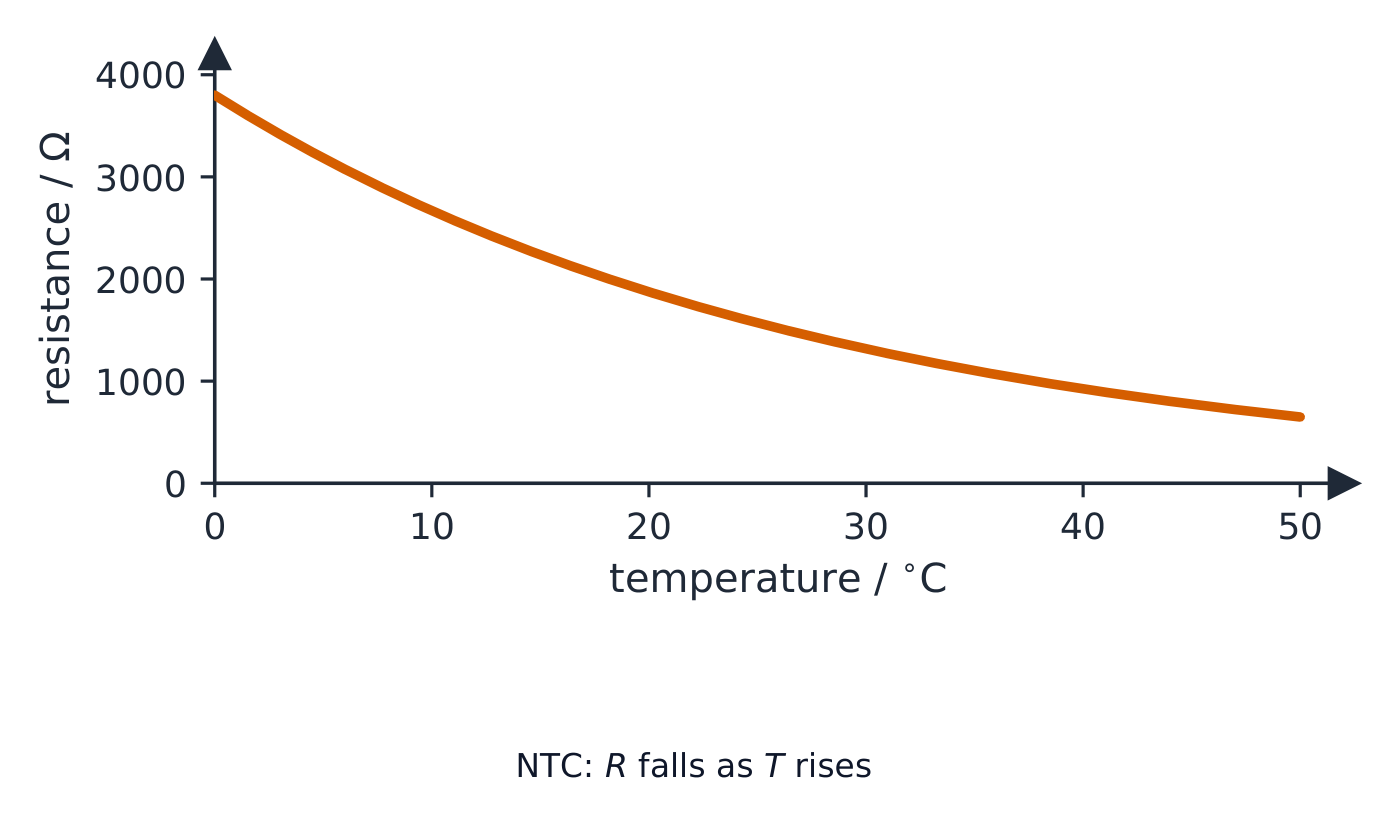
In this syllabus a thermistor 热敏电阻 has a negative temperature coefficient 负温度系数: its resistance falls as its temperature rises. This is useful for sensing temperature — put it in a potential divider 分压器 and the output voltage changes with temperature.
This is the opposite of a metal: in a semiconductor, more thermal energy frees more charge carriers, and this matters more than the extra scattering.
A sketch of a thermistor's resistance against temperature starts at $R_{0}$ at $0\ °\text{C}$ and falls along a curve that flattens: the fall is not linear, which is the disadvantage of a thermistor as a thermometer (its scale is not uniform, so it needs calibrating). When the light on an LDR is increased, or a thermistor is warmed, its resistance falls, the current in its circuit rises, and the p.d. across it (in series with a fixed resistor) falls while the p.d. across the resistor rises; a fixed resistor and a metal wire at constant temperature keep their resistance, and a filament lamp's rises with current.
עברית
במערכת זו תרמיסטור יש לו מקדם טמפרטורה שלילי: ההתנגדות יורדת כשהטמפרטורה שלו עולה. זה שימושי לזיהוי טמפרטורה — יש להכניס אותו למחלקת מתח והמתח ביציאה משתנה לפי הטמפרטורה.
התנגדות של תרמיסטור יורדת כשהטמפרטורה עולה
זוהי ההפוכה למתכת: במחצית מוליך, יותר אנרגיה תרמלית משחררת יותר נשאי מטען, והדבר חשוב יותר מהפיזור הנוסף.
טיוטה של התנגדות טרמיסטור כנגד הטמפרטורה מתחילה ב$R_{0}$ ב$0\ °\text{C}$ ויורדת לאורך עקומה שהופכת לשטוחה: הירידה אינה ליניארית, מה שמייצג את החיסרון של טרמיסטור כמדחום (הסולם שלו אינו אחיד, ולכן הוא זקוק לקליברציה). כאשר האור על LDR מוגבר, או שטרמיסטור מחומם, התנגדותו יורדת, הזרם במעגלו עולה, וההפרש הפוטנציאלי על פיו (בסדרה עם נגד קבוע) יורד בעוד ההפרש הפוטנציאלי על פני הנגד עולה; נגד קבוע וחוט מתכתי בטמפרטורה קבועה שומרים על התנגדותם, והתנגדות נורת להב עולה עם הזרם.
Definitions the examiner accepts · הגדרות מקובלות בקורס
English
A definition question is marked against fixed wording. Learn these exactly, and give one answer only.
Term
Definition
electric current
a flow of charge carriers
coulomb
the charge passing a point in one second when the current is one ampere
potential difference
the energy transferred from electrical to other forms per unit charge passing through a component
electromotive force (e.m.f.)
the energy transferred from other forms to electrical energy per unit charge, by a source driving charge round a complete circuit
volt
one joule per coulomb
resistance
the ratio of the potential difference across a component to the current in it
ohm
the resistance of a component in which a potential difference of one volt produces a current of one ampere
Ohm's law
the current in a metallic conductor is directly proportional to the potential difference across it, provided its temperature remains constant
resistivity
the constant $\rho$ in $R = \rho L / A$, a property of the material with unit $\Omega\ \text{m}$
number density
the number of charge carriers per unit volume of the conductor
עברית
שאלת הגדרה מוקדמת לפי טקסט קבוע. לימודן במדויק, ותן תשובה אחת בלבד.
מונח
הגדרה
זרם חשמלי
זרימת נשאי מטען
קולון
המטען העובר דרך נקודה בשנייה אחת כאשר הזרם הוא אמפר אחד
הפרש פוטנציאלים
האנרגיה המועברת מ电能 לצורות אחרות ליחידת מטען העוברת דרך רכיב
כוח חשמלי (e.m.f.)
האנרגיה המועברת מצורות אחרות לאנרגיה חשמלית ליחידת מטען, על ידי מקור המניע מטענים מסביב למעגל סגור
וולט
ג'ול אחד לכל קולון
התנגדות
היחס בין ההפרש הפוטנציאלי על פני רכיב לבין הזרם שעובר בו
אוהם
התנגדותו של רכיב שבו הפרש פוטנציאלים של וולט אחד מייצר זרם של אמפר אחד
חוק אום
הזרם במוצי מתכתי פרופורציוני ישירות להפרש הפוטנציאלים על פיו, בתנאי שהטמפרטורה נשארת קבועה
התנגדות סגולית
הקבוע $\rho$ ב$R = \rho L / A$, מאפיין של החומר עם יחידת $\Omega\ \text{m}$
צפיפות מספרית
מספר נשאי המטען ליחידת נפח של המוליך
9.3
Exam tips · טיפים לבחינות
English
Use $I = Q/t$, $V = W/Q$ (energy per unit charge) and $P = VI = I^2 R = V^2/R$.
Ohm's law ($V = IR$) applies only to an ohmic conductor at constant temperature — a filament lamp is non-ohmic.
Sketch and interpret the $I$-$V$ characteristics of a resistor, filament lamp and diode.
An LDR's resistance falls with light; a thermistor's falls as temperature rises.
Common mistakes
Taking the resistance from the gradient of a curved $I$–$V$ graph. Resistance is $V/I$ at the point; only for a straight line through the origin is it the reciprocal of the gradient.
Leaving a time in minutes or hours in $Q = It$. Convert to seconds first.
Saying the filament lamp's resistance rises "because of the voltage". The chain is current, temperature, ion vibration, more collisions, more resistance.
Forgetting that a stretched wire changes in two ways. At constant volume the area falls as the length rises, so $R \propto L^{2}$.
Using the diameter as the radius in $A = \pi r^{2}$, or leaving $\text{mm}^{2}$ unconverted.
Comparing powers with the wrong form. Series components share the current, so use $I^{2}R$; parallel components share the p.d., so use $V^{2}/R$.
עברית
השתמש ב$I = Q/t$, $V = W/Q$ (אנרגיה ליחידת מטען) וב$P = VI = I^2 R = V^2/R$.
חוק אום ($V = IR$) חל רק על מוליך אומי בטמפרטורה קבועה — נורת להב היא לא-אומית.
צייר ומפרש את האופייניות $I$-$V$ של נגד, נורת להב ודיודה.
התנגדות LDR יורדת עם האור; התנגדות טרמיסטור יורדת כשהטמפרטורה עולה.
טעויות נפוצות
לקיחת ההתנגדות מהשיפוע של גרף מעוקל $I$–$V$. ההתנגדות היא $V/I$ בנקודה; רק עבור קו ישר העובר דרך הראשית היא ההפוך של השיפוע.
השארת זמן בדקות או שעות ב-$Q = It$. המירו לשניות קודם.
טענה שהתנגדות נורת הלהב עולה "בגלל המתח". הרצף הוא: זרם, טמפרטורה, רעידת יונים, יותר התנגשויות, יותר התנגדות.
לשכוח שחוט מתיחה משתנה בשתי דרכים. בנפח קבוע השטח יורד כאשר האורך עולה, כך ש-$R \propto L^{2}$.
השימוש בקוטר כרדיוס ב$A = \pi r^{2}$, או השארת $\text{mm}^{2}$ ללא המרה.
השוואת הספקים בצורה שגויה. רכיבי סדרה משנים את הזרם, לכן יש להשתמש ב$I^{2}R$; רכיבים מקבילים משנים את ההפרש הפוטנציאלי, לכן יש להשתמש ב$V^{2}/R$.
Interactive lessons on this topic · שיעורים אינטראקטיביים בנושא זה
Work through it step by step, with instant-check exercises. · לעבור על הדברים צעד אחר צעד, עם תרגילים לבדיקה מיידית.
Pick one and the site follows you — notes, papers, videos and practice all open on it. · בחרו נושא אחד והאתר יעקוב אחריו — הערות, מסמכים, וידאו ותרגולים פתוחים בו.
Type to search notes, lessons, code, vocabulary and past-paper questions across every subject. · הקלד כדי לחפש הערות, שיעורים, קוד, אוצר מילים ושאלות מבחנים בכל הנושאים.