Potential difference and power
Introduced| English | Meaning |
|---|---|
| potential difference/pəˈtenʃl ˈdɪfrəns/ | The energy transferred per unit charge between two points. |
| volt/vəʊlt/ | The SI unit of potential difference, equal to one joule of energy transferred per coulomb of charge. |
| electromotive force/ɪˌlektrəʊˈməʊtɪv fɔːs/ | The energy supplied by a source per unit charge passing through it. |
| electrical power/ɪˈlektrɪkl ˈpaʊə/ | The rate at which an electrical system transfers or converts energy. |
| Ohm's law/əʊmz lɔː/ | The rule that current is proportional to potential difference across an ohmic conductor when physical conditions such as temperature are constant. |
What "voltage" really means
- A 240 V supply is dangerous; a 1.5 V cell is harmless.
- The difference is the energy each coulomb of charge carries.
- That energy-per-charge is the potential difference 电势差.
Potential difference
- p.d. is the energy transferred per unit charge: $V = \dfrac{W}{Q}$.
- Unit: the volt 伏特, $1\ \text{V} = 1\ \dfrac{\text{J}}{\text{C}}$.
- The exam definition needs both halves: "the energy transferred from electrical to other forms per unit charge passing through the component".
Potential difference is the energy transferred per unit:
Difficulty 1/5 · 100 coins + a small bonus on first completion today
$V = \dfrac{W}{Q}$ — energy per unit charge, in joules per coulomb (volts).
One volt equals one joule per ____.
Difficulty 1/5 · 100 coins + a small bonus on first completion today
$1\ \text{V} = 1\ \dfrac{\text{J}}{\text{C}}$ — one joule of energy moved per coulomb of charge.
e.m.f. vs p.d.
- e.m.f. (electromotive force 电动势) = energy a source gives to each coulomb (from chemical or other forms into electrical).
- p.d. = energy a coulomb gives up to a component (from electrical into other forms). Same unit, opposite roles.
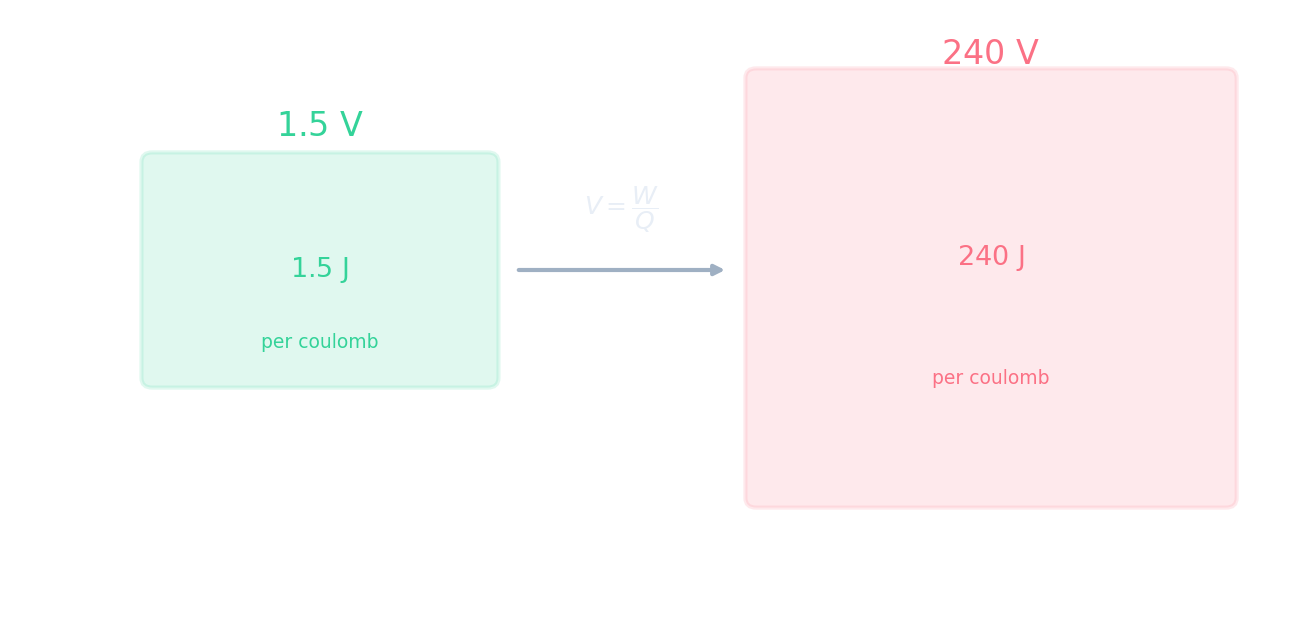
Voltage is energy per charge. A 240 V supply gives each coulomb 160 times more energy than a 1.5 V cell — that's why it's dangerous.
Both e.m.f. and potential difference are measured in volts.
Difficulty 1/5 · 100 coins + a small bonus on first completion today
Yes — both are energy per unit charge (J/C). The difference is whether energy is given to, or taken from, the charge.
Worked example: charge, energy, power
A battery drives $0.50\ \text{A}$ through a lamp for $4.0$ minutes. The p.d. across the lamp is $6.0\ \text{V}$.
- Charge: $Q = It = 0.50 \times 240 = 120\ \text{C}$ (minutes → seconds).
- Energy transferred in the lamp: $W = VQ = 6.0 \times 120 = 720\ \text{J}$.
- Power: $P = \dfrac{W}{t} = \dfrac{720}{240} = 3.0\ \text{W}$ — the same as $VI = 6.0 \times 0.50$.
- Check: each coulomb delivers $6\ \text{J}$, and $120$ coulombs pass, so $720\ \text{J}$; the two routes to the power must agree.
A p.d. of $9.0\ \text{V}$ drives $40\ \text{C}$ of charge through a resistor. How much energy is transferred in the resistor, in J?
Difficulty 2/5 · 140 coins + a small bonus on first completion today
$W = VQ = 9.0 \times 40 = 360\ \text{J}$ — nine joules for every coulomb.
Electrical power 电功率
- Combining $V = \dfrac{W}{Q}$ and $I = \dfrac{Q}{t}$ gives $P = VI$.
- Energy transferred in a time is $E = Pt$.
Electrical power
P = VI
At a fixed voltage, power is proportional to the current it drives.
A device runs at $12\ \text{V}$ and draws $2.0\ \text{A}$. What is its power?
Difficulty 2/5 · 140 coins + a small bonus on first completion today
$P = VI = 12 \times 2.0 = 24\ \text{W}$.
Three forms of power
- With Ohm's law 欧姆定律 ($V = IR$): $P = VI = I^{2}R = \dfrac{V^{2}}{R}$.
- Choose the form that uses the quantities you already know.
Which form of electrical power uses only the voltage and the resistance?
Difficulty 1/5 · 100 coins + a small bonus on first completion today
$P = \dfrac{V^{2}}{R}$ needs only $V$ and $R$ — handy when you do not know the current.
A $100\ \text{W}$ lamp is on for $60\ \text{s}$. How much energy does it transfer?
Difficulty 2/5 · 140 coins + a small bonus on first completion today
$E = Pt = 100 \times 60 = 6000\ \text{J}$.
Worked example: which form to use
A $12\ \text{V}$ heater draws $5.0\ \text{A}$. Find its power and resistance, the power if it were run from $6.0\ \text{V}$ instead, and the energy it transfers in $10$ minutes at full power.
- Power: $P = VI = 12 \times 5.0 = 60\ \text{W}$.
- Resistance: $R = \dfrac{V}{I} = \dfrac{12}{5.0} = 2.4\ \Omega$.
- On $6.0\ \text{V}$: with $R$ unchanged, $P = \dfrac{V^{2}}{R} = \dfrac{6.0^{2}}{2.4} = 15\ \text{W}$ — halving the voltage quarters the power.
- Energy: $E = Pt = 60 \times 600 = 3.6 \times 10^{4}\ \text{J} = 36\ \text{kJ}$.
- Check: $I^{2}R$ gives the same $60\ \text{W}$: $5.0^{2} \times 2.4 = 60$. All three forms agree because $R$ is fixed.
A fixed resistor is moved from a $12\ \text{V}$ supply to a $6.0\ \text{V}$ supply. Which statements are true? Select all that apply.
Difficulty 2/5 · 140 coins + a small bonus on first completion today
With $R$ fixed, $I = \dfrac{V}{R}$ halves and $P = \dfrac{V^{2}}{R}$ falls to a quarter. The resistance itself does not change.
$I^{2}R$ and $\dfrac{V^{2}}{R}$ only agree when $R$ is constant. For a filament lamp $R$ rises as it heats, so doubling the voltage gives less than four times the power. Convert minutes to seconds before $E = Pt$. And a volt is a joule per coulomb — not a joule per second, which is a watt.
One volt is one joule per second.
Difficulty 1/5 · 100 coins + a small bonus on first completion today
One volt is one joule per coulomb — energy per charge. One joule per second is one watt, a power.
You've got it
- p.d. is energy transferred per unit charge: $V = \dfrac{W}{Q}$ (volt = joule per coulomb)
- e.m.f. is energy given to charge by the source; p.d. is energy given up by charge
- power $P = VI = I^{2}R = \dfrac{V^{2}}{R}$ (the last two need constant $R$); energy $E = Pt$