Electric current
Introduced| English | Meaning |
|---|---|
| current/ˈkʌrənt/ | The rate of flow of electric charge. |
| charge carriers/tʃɑːdʒ ˈkærɪəz/ | A particle that transports electric charge, such as an electron or a mobile ion. |
| conventional current/kənˈvenʃənl ˈkʌrənt/ | Electric current defined in the direction that positive charge would move. |
| quantised/ˈkwɒntaɪzd/ | Restricted to particular discrete values rather than any value in a continuous range. |
| elementary charge/ˌelɪˈmentəri tʃɑːdʒ/ | The magnitude of the electric charge carried by a proton, equal in magnitude to the charge of an electron. |
| coulomb/ˈkuːlɒm/ | The SI unit of electric charge, equal to the charge transferred by a current of one ampere in one second. |
| drift velocity/drɪft vəˈlɒsɪti/ | The average velocity of charge carriers due to an applied electric field. |
| number density/ˈnʌmbə ˈdensɪti/ | number density |
| semiconductor/ˌsemɪkənˈdʌktə/ | A material whose electrical conductivity can be controlled and is generally between that of a conductor and an insulator. |
Slower than a snail
- Flip a switch and the light comes on instantly.
- Yet the electrons themselves drift through the wire slower than a snail.
- The push (the electric field) travels fast; the charges crawl.
What current 电流 is
- An electric current is a flow of charge carriers 载流子 (electrons in a metal, ions in a liquid).
- Conventional current 常规电流 points the way positive charge would flow — opposite to the electrons.

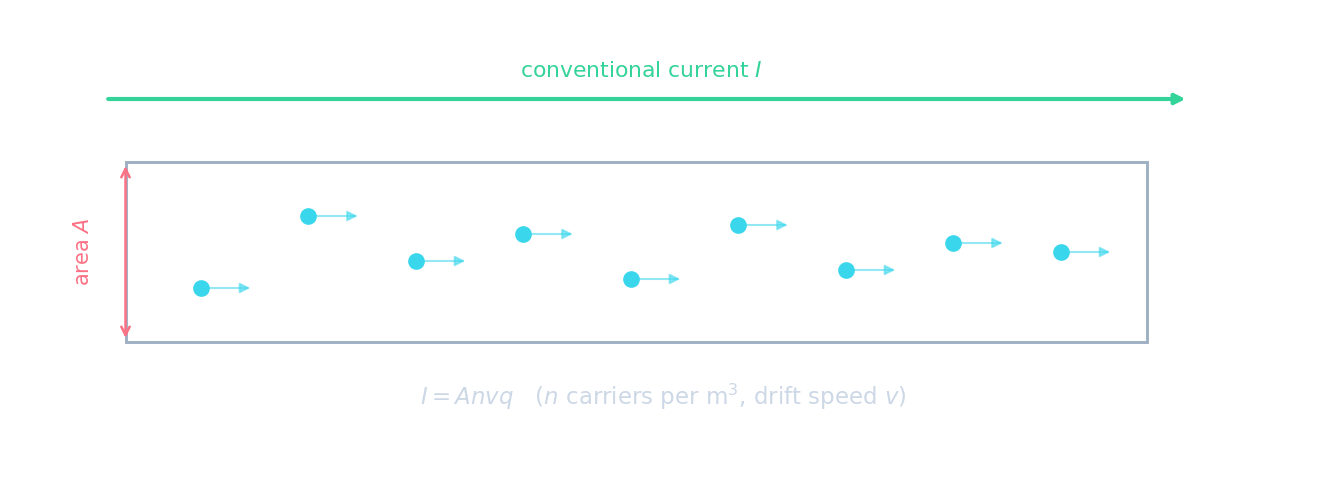
Charge carriers drifting inside a conductor
Current, voltage and resistance
Current is the rate of flow of charge. Raise the voltage and current rises; raise the resistance and it falls — I = V / R.
Conventional current points in the direction that:
Difficulty 1/5 · 100 coins + a small bonus on first completion today
Conventional current is the flow of positive charge — opposite to the electron drift in a metal wire.
Charge comes in lumps
- Charge is quantised 量子化: the smallest free unit is the elementary charge 基本电荷 $e = 1.60 \times 10^{-19}\ \text{C}$.
- Every free charge is a whole-number multiple of $e$. Unit of charge: the coulomb 库仑 (C).
The smallest free unit of charge is the ____ charge, $e = 1.6 \times 10^{-19}\ \text{C}$.
Difficulty 1/5 · 100 coins + a small bonus on first completion today
All free charges are whole-number multiples of the elementary charge $e$.
Current = charge per second
- $I = \dfrac{Q}{t}$, so $Q = It$. Unit: the ampere ($1\ \text{A} = 1\ \dfrac{\text{C}}{\text{s}}$).
- For a changing current, the charge is the area under an $I$–$t$ graph.
- Time must be in seconds — a question that says "minutes" is testing exactly that.
A current of $2.0\ \text{A}$ flows for $5.0\ \text{s}$. How much charge passes?
Difficulty 2/5 · 140 coins + a small bonus on first completion today
$Q = It = 2.0 \times 5.0 = 10\ \text{C}$.
The charge that has flowed equals the area under an $I$–$t$ graph.
Difficulty 1/5 · 100 coins + a small bonus on first completion today
Yes — current is the rate of flow of charge, so the area (current × time) gives the total charge.
Worked example: how many electrons?
A current of $0.25\ \text{A}$ flows in a wire for $4.0$ minutes. How much charge passes, and how many electrons is that?
- Seconds first: $t = 4.0 \times 60 = 240\ \text{s}$.
- Charge: $Q = It = 0.25 \times 240 = 60\ \text{C}$.
- Electrons: $N = \dfrac{Q}{e} = \dfrac{60}{1.60 \times 10^{-19}} = 3.8 \times 10^{20}$.
- Check: a huge number from a small current — that is normal, because each electron carries so little charge.
A current of $0.50\ \text{A}$ flows for $2.0$ minutes. How many electrons pass a point in the wire? Give your answer as a multiple of $10^{20}$.
Difficulty 2/5 · 140 coins + a small bonus on first completion today
$Q = It = 0.50 \times 120 = 60\ \text{C}$, so $N = \dfrac{60}{1.60 \times 10^{-19}} = 3.75 \times 10^{20}$. Minutes must become seconds first.
Drift velocity 漂移速度
- $I = Anvq$ — area $A$, carrier number density 数密度 $n$, drift speed $v$, charge $q$ each.
- Same current in a thinner wire → faster drift; a semiconductor 半导体 (small $n$) → much faster drift.
Which equation gives the current in terms of the drift velocity?
Difficulty 1/5 · 100 coins + a small bonus on first completion today
Current = (area)(number density)(drift speed)(charge per carrier) $= Anvq$.
In a thinner wire carrying the same current, the electrons drift faster.
Difficulty 1/5 · 100 coins + a small bonus on first completion today
From $I = Anvq$, a smaller area $A$ at the same $I$ needs a larger drift speed $v$.
Match each quantity in $I = Anvq$ to its SI unit.
Difficulty 2/5 · 140 coins + a small bonus on first completion today
Multiply the units out: $\text{m}^{2} \times \text{m}^{-3} \times \dfrac{\text{m}}{\text{s}} \times \text{C} = \dfrac{\text{C}}{\text{s}} = \text{A}$, which is the check that the equation makes sense.
Where $n$ comes from
- In a metal, each atom gives up about one free electron, so $n$ is simply the number of atoms per cubic metre.
- Atoms per $\text{m}^{3}$ = $\dfrac{\text{density} \times N_{\text{A}}}{\text{molar mass}}$. For copper: $n = \dfrac{(8.9 \times 10^{3})(6.02 \times 10^{23})}{0.0635} = 8.4 \times 10^{28}\ \text{m}^{-3}$.
- Metals sit around $10^{28}$–$10^{29}\ \text{m}^{-3}$; semiconductors are many powers of ten lower.
Worked example: drift speed in a copper wire
A copper wire of diameter $1.3\ \text{mm}$ carries $2.0\ \text{A}$. Using $n = 8.4 \times 10^{28}\ \text{m}^{-3}$, find the drift speed. The wire then narrows to half the diameter.
- Area: $A = \pi r^{2} = \pi (0.65 \times 10^{-3})^{2} = 1.3 \times 10^{-6}\ \text{m}^{2}$.
- Drift speed: $v = \dfrac{I}{nAe} = \dfrac{2.0}{(8.4 \times 10^{28})(1.3 \times 10^{-6})(1.60 \times 10^{-19})} = 1.1 \times 10^{-4}\ \dfrac{\text{m}}{\text{s}}$ — about a tenth of a millimetre per second.
- Narrow section: the current is the same everywhere along the wire, so $v \propto \dfrac{1}{A} \propto \dfrac{1}{r^{2}}$. Half the diameter → a quarter of the area → four times the drift speed.
- Check: the electrons speed up in the narrow part for the same reason water speeds up in a narrow pipe — the same flow has to get through a smaller opening.
A wire of cross-sectional area $2.0 \times 10^{-6}\ \text{m}^{2}$ carries $3.2\ \text{A}$. The number density of free electrons is $1.0 \times 10^{29}\ \text{m}^{-3}$. What is the drift speed, in mm/s?
Difficulty 2/5 · 140 coins + a small bonus on first completion today
$v = \dfrac{I}{nAe} = \dfrac{3.2}{(1.0 \times 10^{29})(2.0 \times 10^{-6})(1.60 \times 10^{-19})} = 1.0 \times 10^{-4}\ \dfrac{\text{m}}{\text{s}} = 0.10\ \dfrac{\text{mm}}{\text{s}}$.
Three slips cost marks here. $A$ must be in $\text{m}^{2}$: a diameter in mm gives an area in $\text{mm}^{2}$, and $1\ \text{mm}^{2} = 10^{-6}\ \text{m}^{2}$. Use the radius in $\pi r^{2}$, not the diameter. And a narrower part of a wire does not carry less current — the current is the same all along a series path; the drift speed is what changes.
You've got it
- current is a flow of charge; conventional current = direction of positive flow
- $I = \dfrac{Q}{t}$ (seconds!), and charge is the area under an $I$–$t$ graph; electrons $= \dfrac{Q}{e}$
- drift: $I = Anvq$; $n \approx 10^{29}\ \text{m}^{-3}$ for a metal; same current, smaller area → faster drift