Source: Cambridge International syllabus · מקור: הסיילבוס הבינלאומי של קמבריד'ג'
English
A wave 波 carries energy 能量 from one place to another without moving matter overall. The particles of the medium 介质oscillate 振动 about fixed rest positions; only the disturbance (and its energy) propagates 传播. Examples: a transverse wave 横波 on a rope, a longitudinal wave 纵波 on a slinky spring, ripples on water, and sound in air. A wave that travels and carries energy is a progressive wave 行波.
Wave motion 波动 is a series of oscillations of the particles of a medium, each passing the disturbance on to the next: shake one end of a rope, push one end of a spring, or touch the surface of the water in a ripple tank 水波槽, and the oscillation travels away from where it started. For the one-mark definition, a progressive wave transfers energy from one place to another without transferring matter; the particles only oscillate about their rest positions.
Key terms
displacement 位移$y$ — how far a particle has moved from its rest position at a moment. A vector 矢量.
amplitude 振幅$A$ — the largest displacement from the rest position.
wavelength 波长$\lambda$ — the shortest distance along the wave between two points that move in phase 同相 (for example, two next-door crests 波峰).
period 周期$T$ — the time for one full oscillation of a particle.
frequency 频率$f$ — the number of full oscillations per second; $f = 1/T$. Unit: hertz 赫兹, $\text{Hz}$.
speed 速率$v$ — how fast a crest travels along the medium.
phase difference 相位差 — the fraction of a cycle by which one oscillation leads or lags another. Given in radians 弧度 (a full cycle is $2\pi$) or degrees (a full cycle is $360°$).
Two points one wavelength apart are in phase (phase difference 0 or $2\pi$). Two points half a wavelength apart are exactly out of phase (phase difference $\pi$).
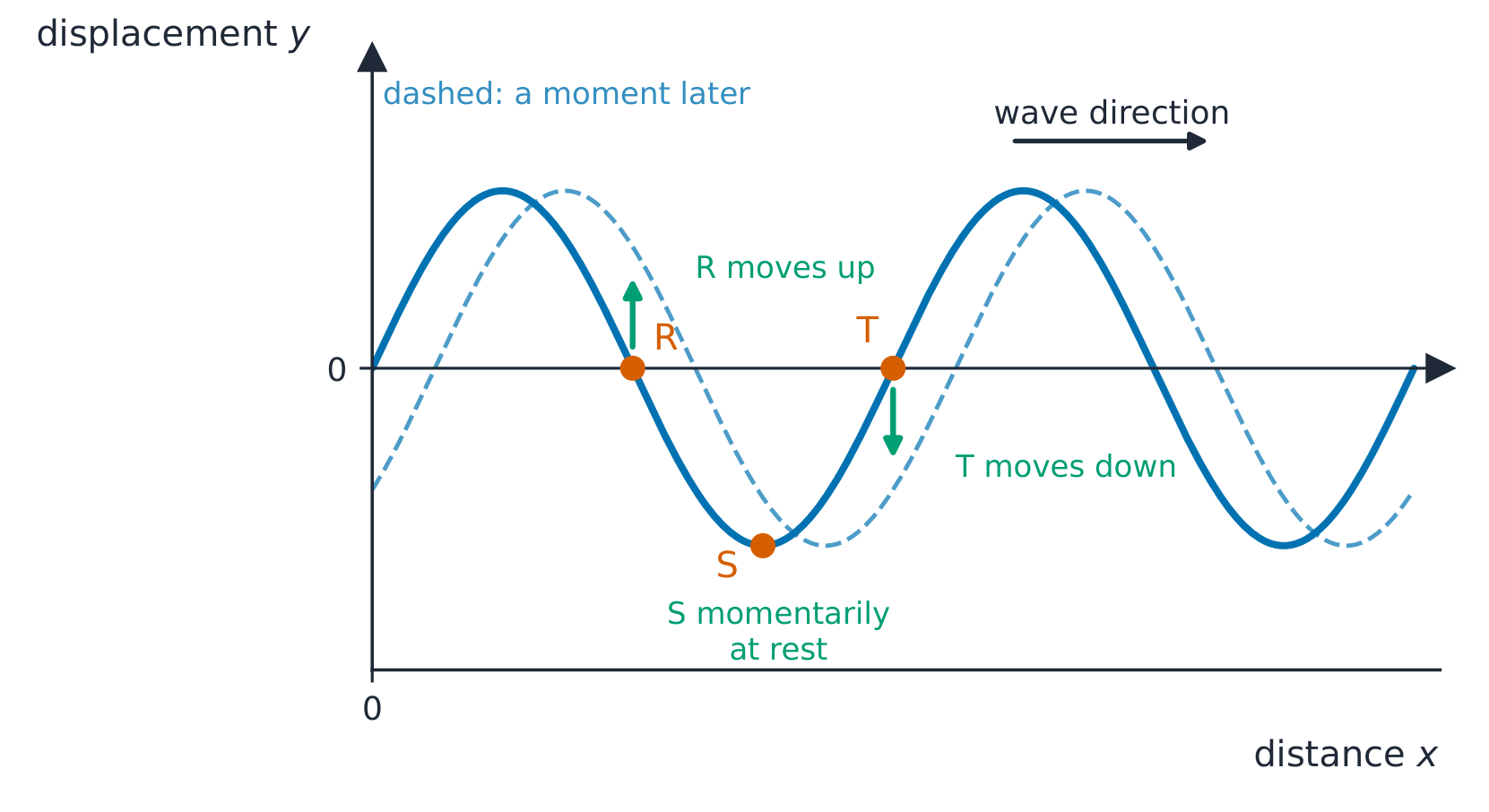
To find the phase difference between two points from a displacement–distance graph, divide their separation by the wavelength and multiply by $360°$ (or $2\pi$): two points $0.50\ \text{m}$ apart on a wave of wavelength $2.0\ \text{m}$ ($v = 600\ \text{m s}^{-1}$, $f = 300\ \text{Hz}$) differ in phase by $0.25 \times 360° = 90°$. Only the fraction of a cycle matters, so $450°$ is the same as $90°$. From two displacement–time graphs, read the time shift between the peaks as a fraction of the period. Which way is a point moving at the instant a graph shows? The whole profile moves along, so each point takes up the displacement that its neighbour on the side the wave comes from has now; a point at a crest or a trough is momentarily at rest.
Worked example. Points R and T on a string are $0.62\ \text{cm}$ apart and a quarter of a cycle out of phase. The wave speed is $0.27\ \text{m s}^{-1}$. Find the frequency.
A quarter of a cycle is a quarter of a wavelength, so $\lambda = 4 \times 0.62 = 2.5\ \text{cm}$ and $f = v / \lambda = 0.27 / 0.025 = 11\ \text{Hz}$.
The wave equation
In one period $T$, the wave moves forward by one wavelength $\lambda$. So speed $= \text{distance} / \text{time} = \lambda / T = \lambda f$:
$$v = f \lambda.$$
This comes straight from the definitions of speed, frequency and wavelength, and works for every progressive wave. For the two-mark derivation write both steps: in one period $T$ the wave travels one wavelength $\lambda$, so $v = \lambda / T$; and $f = 1/T$, so $v = f\lambda$. Because $v$ is fixed by the medium, a higher frequency means a shorter wavelength. A period question is the same equation the other way round: light of wavelength $460\ \text{nm}$ has $f = c / \lambda = 6.5 \times 10^{14}\ \text{Hz}$ and $T = 1/f = 1.5 \times 10^{-15}\ \text{s}$.
Reading a CRO trace
A cathode-ray oscilloscope 示波器 (CRO) draws a voltage signal — for sound, the output of a microphone — against time. Two controls matter:
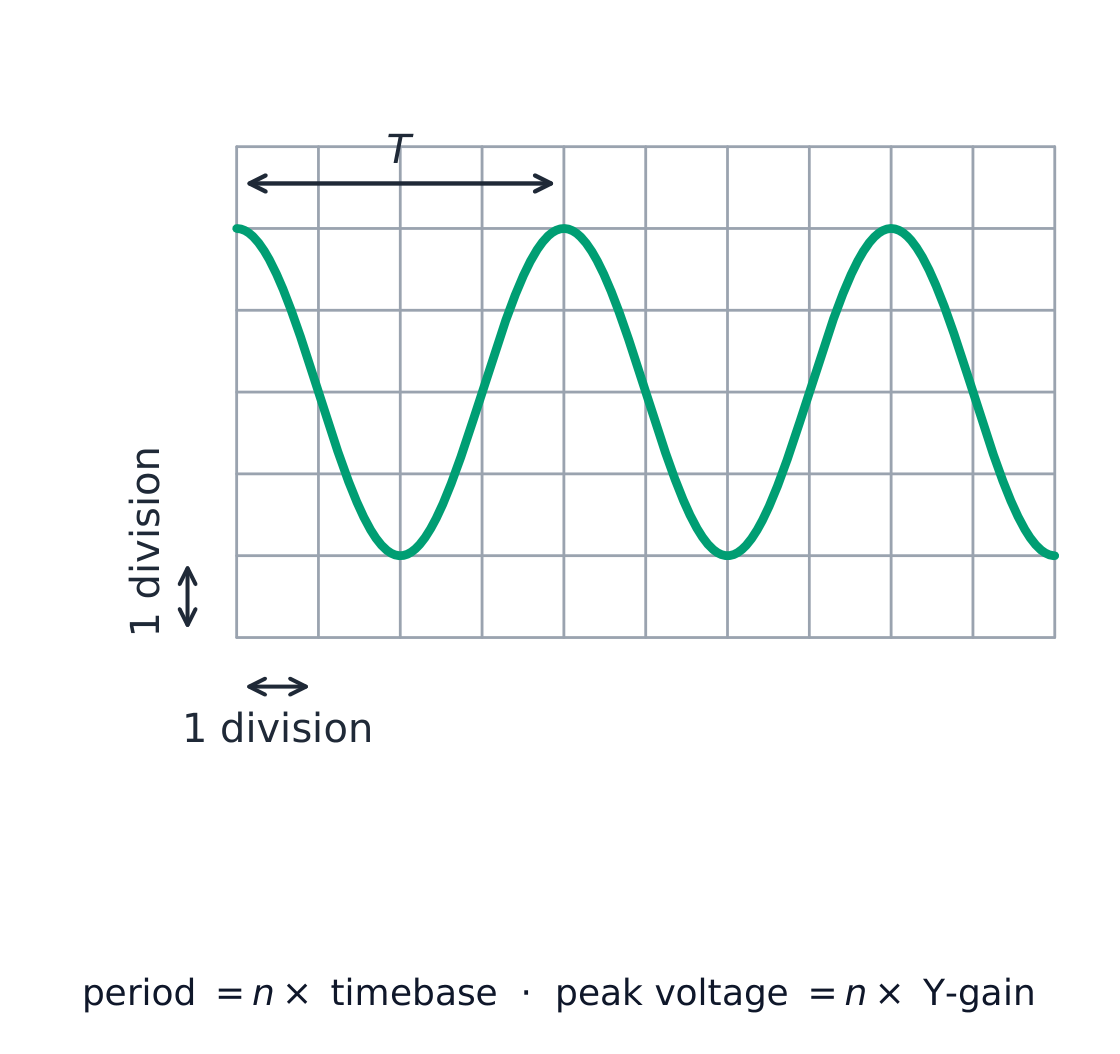
time-base 时基 (seconds per division across): turns horizontal distance on the screen into time. Read the period $T$ as the distance between two next-door peaks, then $f = 1/T$.
y-gain 垂直增益 (volts per division up): turns vertical distance into voltage. The amplitude in volts is the peak height from the centre line.
If the time-base is $5\ \text{ms}/\text{div}$ and one full cycle takes $4$ divisions, then $T = 4 \times 5\ \text{ms} = 20\ \text{ms}$ and $f = 50\ \text{Hz}$.
The time-base is the time represented by one division (or one centimetre) across the screen, in $\text{s}\ \text{div}^{-1}$. To set it for a given signal, work backwards: a $2000\ \text{Hz}$ sound has $T = 0.50\ \text{ms}$, so for one cycle to span $2.5\ \text{cm}$ the time-base must be $0.50 / 2.5 = 0.20\ \text{ms cm}^{-1}$. For the amplitude, multiply the peak height in divisions by the y-gain: $2.0$ divisions at $3.5\ \text{mV cm}^{-1}$ is $7.0\ \text{mV}$. When the intensity of the sound is reduced to a quarter at the same frequency, the trace keeps its period and its peaks halve in height, because $I \propto A^{2}$.
Intensity of a wave
A wave carries energy. The intensity 强度 at a point is the power 功率 passing through unit area at right angles to the direction of travel:
$$I = \frac{P}{A}.$$
Unit: $\text{W m}^{-2}$.
Intensity is proportional to the square of the amplitude:
$$I \propto A^{2}.$$
For a point source 点源 sending out energy equally in all directions, the wavefronts 波前 are spheres; the surface area at distance $r$ is $4\pi r^{2}$, so
$$I = \frac{P}{4\pi r^{2}}, \qquad I \propto \frac{1}{r^{2}}.$$
Doubling the distance cuts the intensity to a quarter, which means the amplitude is halved (since $I \propto A^{2}$).
Worked example. A lamp emits $60\ \text{W}$ of light equally in all directions. Find the intensity of the light $2.0\ \text{m}$ away.
Worked example. Light of power $750\ \text{W}$ falls at right angles on a square solar panel of side $1.2\ \text{m}$. Find the intensity.
$I = P/A = 750 / 1.2^{2} = 520\ \text{W m}^{-2}$. A smaller panel in the same light receives the same intensity but less power, in proportion to its area. The other way round, a magnifying glass of radius $r$ collects a power $I \times \pi r^{2}$ and concentrates it on a small spot.
Two rules the multiple-choice questions turn on. Because $I \propto A^{2}$, the ratio of two intensities is the square of the ratio of the amplitudes: waves of amplitude $3.0\ \text{cm}$ and $2.0\ \text{cm}$ have intensities in the ratio $2.25$, and when an amplitude falls to a half the intensity falls to a quarter. For a point source, $I \propto 1/r^{2}$ means $A \propto 1/r$, so a sketch of $A/A_{0}$ against $d/x_{0}$ is a curve falling as $1/d$, not a straight line. The one-line statement the scheme wants: intensity is proportional to the amplitude squared.
עברית
גלי ריכוז המתפשטים על פני המים הם גלים פרצסיביים המעבירים אנרגיה החוצה.שני גלים באותה תדר, המוזזים בהפרש פאזה
גל מעביר אנרגיה ממקום למקום ללא הזזת מסה כוללת. חלקיקי התווךמתנדדים סביב נקודות איזון קבועות; רק ההפרעה (והאנרגיה שלה) מתפשטת. דוגמאות: גל רוחבי על חבל, גל אורכי על קפיץ סלינקי, גלי ריכוז במים וצליל באוויר. גל הנע ומעביר אנרגיה הוא גל פרצסיבי.
תנועת גל היא סדרת תנודות של חלקיקי תווך, כאשר כל חלקיק מעביר את ההפרעה לחלקיק הבא: לנער קצה אחד של חבל, לדחוף קצה אחד של קפיץ, או לגעת בפני המים בבריכת גלים, והתנודה נעלמת מהמקום בו החלה. עבור הגדרה של סימן אחד, גל פרצסיבי מעביר אנרגיה ממקום למקום ללא העברת מסה; החלקיקים רק מתנדדים סביב נקודות האיזון שלהם.
מונחים מרכזיים
הזזה$y$ — כמה חלקיק זז ממקום האיזון שלו ברגע נתון. ווקטור.
משרעת$A$ — ההסטה הגדולה ביותר מהמנוחה.
אורך גל$\lambda$ — המרחק הקצר ביותר לאורך הגל בין שני נקודות הנעות בפזה (למשל, שני שיאים סמוכים זה לזה).
הפרש פזה — השבר מתוך מחזור על ידי כך שהתנודה האחת מובילה או מאחורי את השנייה. נתון ברדיאנים (מחזור מלא הוא $2\pi$) או במעלות (מחזור מלא הוא $360°$).
שתי נקודות המרוחקות אורך גל אחת זו מזו נמצאות בפזה (הפרש פזה 0 או $2\pi$). שתי נקודות המרוחקות מחצית אורך גל זו מזו נמצאות בדיוק מחוצ לפזה (הפרש פזה $\pi$).
כדי למצוא את הפרש הפזה בין שתי נקודות ממגרף הסטה-מרחק, לחלק את המרווח ביניהן באורך הגל והכפל ב$360°$ (או ב$2\pi$): שתי נקודות המרוחקות $0.50\ \text{m}$ זו מזו בגל בעל אורך גל $2.0\ \text{m}$ ($v = 600\ \text{m s}^{-1}$, $f = 300\ \text{Hz}$) שונות בפזה ב-$0.25 \times 360° = 90°$. רק השבר בתוך המחזור משנה, ולכן $450°$ זהה ל-$90°$. ממגרפי הסטה-זמן, קרא את ההזזת הזמן בין השיאים כשבר מתוך התקופה. באיזה כיוון נעה נקודה ברגע שמגרף מראה זאת? כל הפרופיל זז לאורך, ולכן כל נקודה לוקחת את ההסטה שיש לשכנה בצד ממנו הגל מגיע עכשיו; נקודה בשיא או בקער היא רגעית במנוחה.
כיוון תנועתם של כל נקודה: לעבר ההסטה שיש לשכנה בצד הנכנס עכשיו; שיא או קער הם רגעיים במנוחה
דוגמה מולחנת. הנקודות R ו-T על מיתר נפרדות ב-$0.62\ \text{cm}$ ומפוזות ברבע מחזור זו מזו. מהירות הגל היא $0.27\ \text{m s}^{-1}$. מצא את התדירות.
רבע מחזור הוא רבע מאורך גל, ולכן $\lambda = 4 \times 0.62 = 2.5\ \text{cm}$ ו-$f = v / \lambda = 0.27 / 0.025 = 11\ \text{Hz}$.
משוואת הגל
בתקופה אחת $T$, הגל נע קדימה באורך גל אחד $\lambda$. לכן מהירות $= \text{distance} / \text{time} = \lambda / T = \lambda f$:
$$v = f \lambda.$$
משוואה זו נובעת ישירות מההגדרות של מהירות, תדירות ואורך גל, ועובדת לכל גל קדמי. עבור גזירה של שתי נקודות כתוב את שני השלבים: בתקופה אחת $T$ הגל עובר אורך גל אחד $\lambda$, ולכן $v = \lambda / T$; וגם $f = 1/T$, ולכן $v = f\lambda$. מכיוון ש-$v$ קבוע על ידי התווך, תדירות גבוהה יותר פירושה אורך גל קצר יותר. שאלת תקופה היא אותה משוואה הפוכה: אור בעל אורך גל $460\ \text{nm}$ יש לו $f = c / \lambda = 6.5 \times 10^{14}\ \text{Hz}$ ו-$T = 1/f = 1.5 \times 10^{-15}\ \text{s}$.
קריאת עקב CRO
אוסילוסקופ קרן קטיודה (CRO) מצייר אות מתח — עבור קול, יציאת המיקרופון — מול הזמן. שני בקרים חשובים:
בסיס זמן (שניות לכל חלוקה לאורך): ממיר מרחק אופקי במסך לזמן. קרא את התקופה $T$ כמרחק בין שני שיאים סמוכים זה לזה, ולאחר מכן $f = 1/T$.
הגברת Y (וולט לכל חלוקה למעלה): ממיר מרחק אנכי למתח. המשרעת בוולטים היא גובה השיא מקו המרכז.
אם בסיס הזמן הוא $5\ \text{ms}/\text{div}$ ומחזור מלא לוקח $4$ חלוקות, אזי $T = 4 \times 5\ \text{ms} = 20\ \text{ms}$ ו$f = 50\ \text{Hz}$.
בסיס הזמן הוא הזמן המיוצג על ידי חלוקה אחת (או סנטימטר אחד) לאורך המסך, ב$\text{s}\ \text{div}^{-1}$. כדי להגדיר אותו עבור אות נתון, נעשה בחזרה: צליל בעל תדר $2000\ \text{Hz}$ מתאים לתקופה $T = 0.50\ \text{ms}$, ולכן כדי שמחזור אחד יכסה $2.5\ \text{cm}$, בסיס הזמן חייב להיות $0.50 / 2.5 = 0.20\ \text{ms cm}^{-1}$. עבור האמפליטודה, נכפיל את גובה הפיק בחלוקות במגנון Y: $2.0$ חלוקות ב$3.5\ \text{mV cm}^{-1}$ הן $7.0\ \text{mV}$. כאשר עוצמת הצליל מצטמצמת לרביעית באותו תדר, העקובת משמרת את תקופתה ואת פיקיה מחלקים בגובה, מכיוון ש$I \propto A^{2}$.
קריאת התקופה T מעקובת CRO באמצעות הרשת ובסיס הזמןאוסקילוסקופ אמיתי: הרשת מאפשרת לקרוא את התקופה ואת האמפליטודה
עוצמת גל
גל נושא אנרגיה. העוצמה בנקודה היא ה-הספק העובר דרך יחידת שטח אנכית לכיוון ההתפשטות:
$$I = \frac{P}{A}.$$
יחידה: $\text{W m}^{-2}$.
העוצמה פרופורציונלית לריבוע האמפליטודה:
$$I \propto A^{2}.$$
עבור מקור נקודתי הפולט אנרגיה באופן שווה בכל הכיוונים, חזית הגל היא כדורים; שטח השטח במרחק $r$ הוא $4\pi r^{2}$, לכן
$$I = \frac{P}{4\pi r^{2}}, \qquad I \propto \frac{1}{r^{2}}.$$
הכפלת המרחק מפחיתה את העוצמה לרביעית, מה שאומר שהאמפליטודה מחלקה (מכיוון ש$I \propto A^{2}$).
דוגמה פותרת. נורת ליבה פולטת $60\ \text{W}$ של אור באופן שווה בכל הכיוונים. מצא את עוצמת האור במרחק $2.0\ \text{m}$.
דוגמה פותרת. אור בהספק $750\ \text{W}$ פוגע אנכית בפאנל סולארי מרובע בצד $1.2\ \text{m}$. מצא את העוצמה.
$I = P/A = 750 / 1.2^{2} = 520\ \text{W m}^{-2}$. פאנל קטן יותר באותו אור מקבל את אותה עוצמה אך פחות הספק, ביחס לשטחו. באופן הפוך, עדשת מגדלת ברדיוס $r$ אוספת הספק $I \times \pi r^{2}$ ומרכזת אותו על נקודה קטנה.
שני כללים שעליהם מבוססים השאלות רבות-הבחירה. מכיוון ש$I \propto A^{2}$, היחס בין שתי עוצמות הוא ה-ריבוע של היחס בין האמפליטודות: גלים בעלי אמפליטודה $3.0\ \text{cm}$ ו$2.0\ \text{cm}$ יש להם עוצמות ביחס $2.25$, וכשאמפליטודה יורדת לחצי, העוצמה יורדת לרביעית. עבור מקור נקודתי, $I \propto 1/r^{2}$ פירושו $A \propto 1/r$, ולכן טריס של $A/A_{0}$ מול $d/x_{0}$ הוא עקומה הולכת ויורדת כ$1/d$, ולא קו ישר. הביטוי בקו אחד שהמפתח דורש: עוצמה פרופורציונלית לריבוע האמפליטודה.
Explore · חקור
Progressive waves · גלים קדמיים
y = a sin(bx + c)
A wave: a is amplitude, b sets the wavelength, c the phase. · לגל: a הוא המשרעת, b קובע את אורך הגל, c את הפזה.
Transverse and longitudinal waves · גלים רוחביים וגלאליים
Syllabus · סיילבוס
English
compare transverse and longitudinal waves
analyse and interpret graphical representations of transverse and longitudinal waves
עברית
להשוות בין גלים רוחביים לגלים אורכיים
לנתח ולפרש ייצוגים גרפיים של גלים רוחביים ואורכיים
Source: Cambridge International syllabus · מקור: הסיילבוס הבינלאומי של קמבריד'ג'
English
Transverse vs longitudinal waves
Transverse waves
The particles oscillate perpendicular 垂直 to the direction the energy travels. A wave on a rope, all electromagnetic waves, and S-waves in the Earth are transverse.
Longitudinal waves
The particles oscillate parallel to the direction the energy travels. Sound in any medium, P-waves in the Earth, and the squashes on a slinky are longitudinal. The wave is made of compressions 压缩 (higher pressure, particles close together) and rarefactions 稀疏 (lower pressure, particles spread out).
Graphs of waves
A graph of particle displacement against position at one moment looks like a sine curve 正弦曲线 for both kinds of wave. The difference: for a transverse wave the displacement axis is the real sideways displacement; for a longitudinal wave it is the small back-and-forth displacement along the direction of travel (positive one way, negative the other).
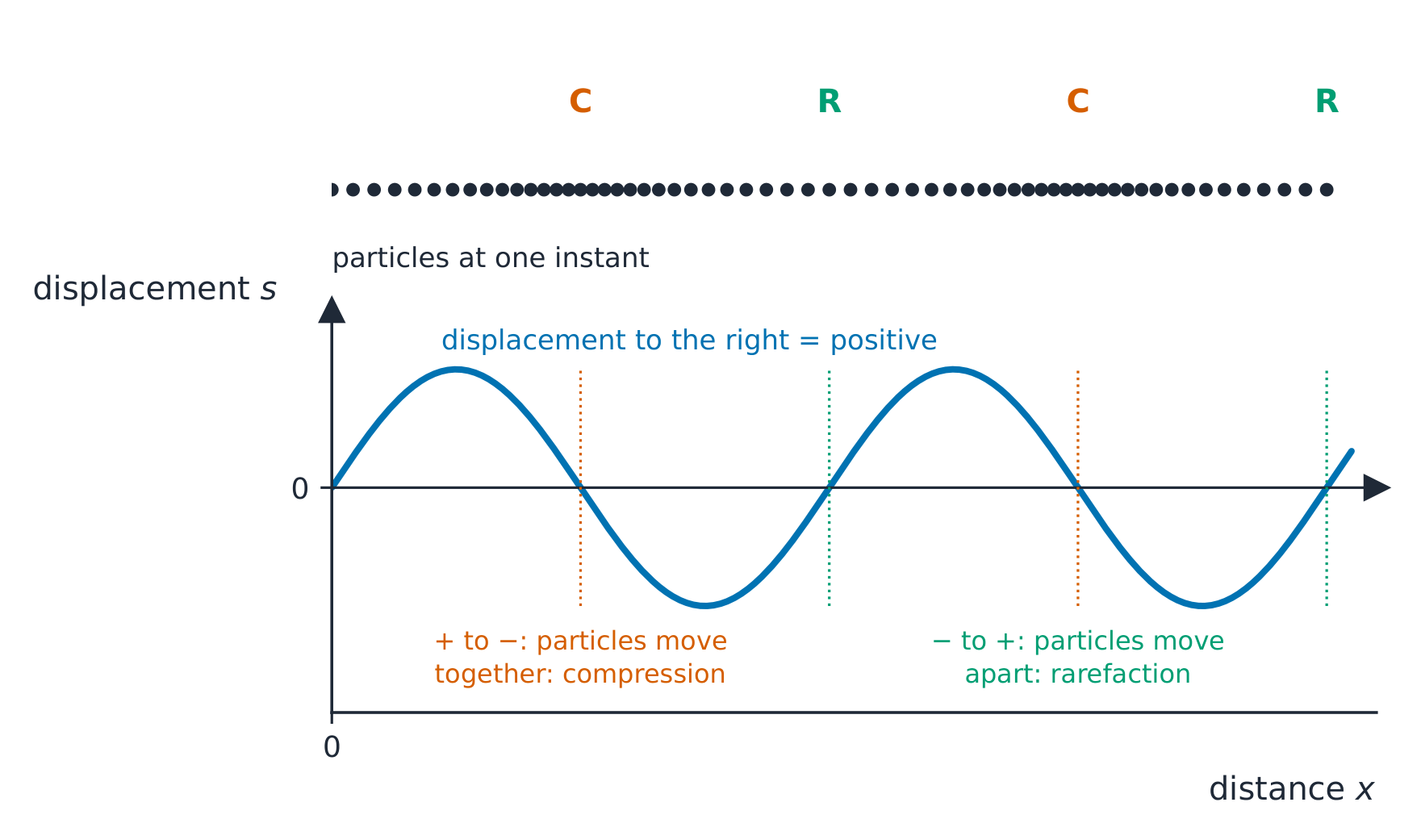
For a longitudinal wave take displacement to the right as positive. Where the graph crosses zero going from positive to negative, the particles on either side have moved towards that point, so it is a compression; where it crosses from negative to positive they have moved apart, a rarefaction. Two neighbouring compressions are one wavelength apart, and a compression and the next rarefaction are half a wavelength apart. The direction of motion of a particle follows the same rule as for a transverse wave: it moves towards the displacement of its neighbour on the side the wave comes from.
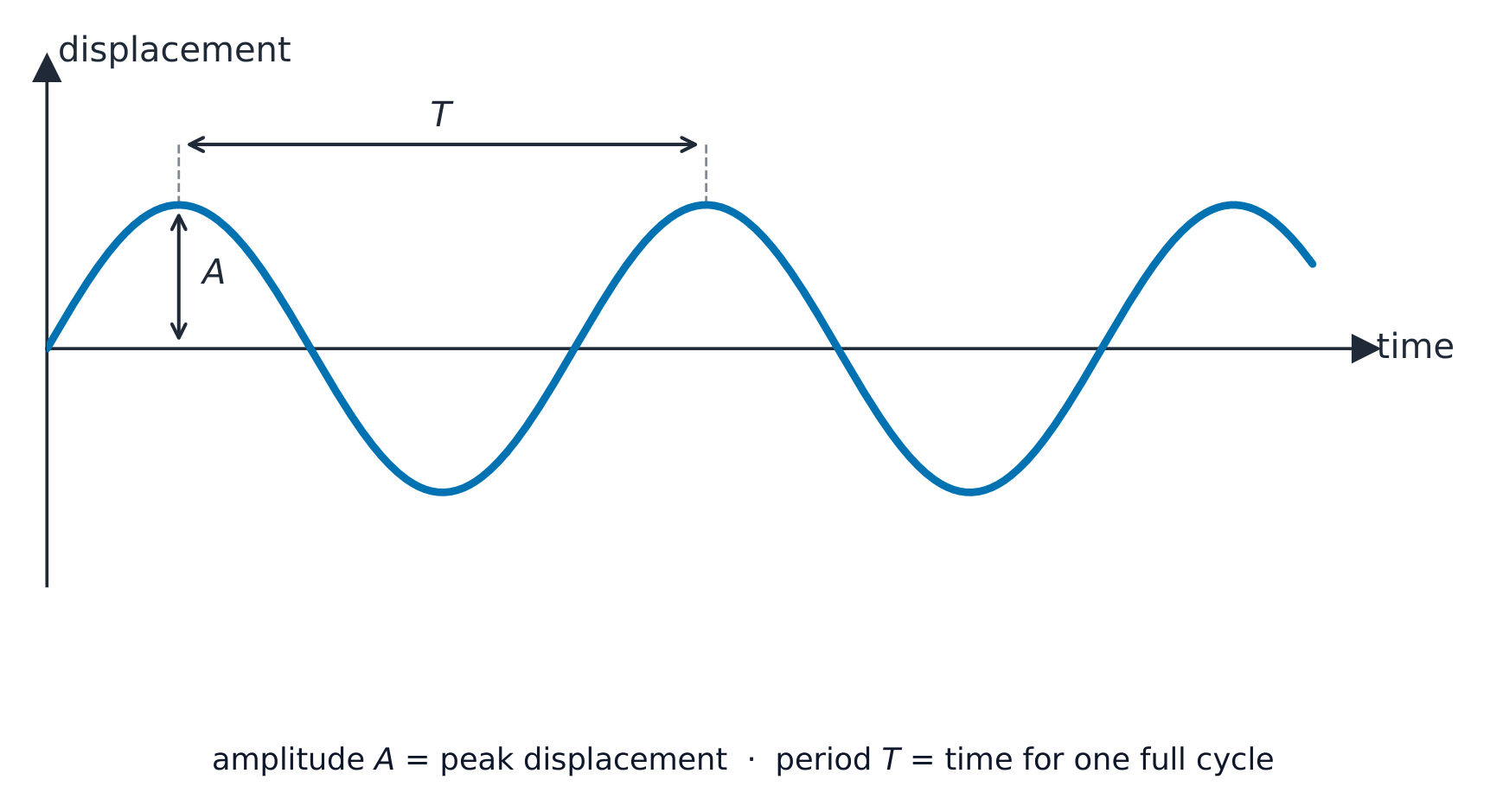
A graph of particle displacement against time at one point in space is also a sine curve for both kinds. Read the period $T$ from this graph.
The two-mark comparison, with reference to the direction of energy transfer: in a transverse wave the oscillations are perpendicular to the direction of energy transfer; in a longitudinal wave they are parallel to it. Both kinds transfer energy without transferring matter, both can be reflected, refracted and diffracted, and both can form stationary waves (topic 8). Only transverse waves can be polarised, and only electromagnetic waves, which are all transverse, can travel through a vacuum; sound needs a medium. Reading the two graphs together: the displacement–distance graph gives $\lambda$, the displacement–time graph gives $T$, and $v = \lambda / T$.
עברית
גלים רוחביים מול אורכיים
גלים רוחביים
החלקיקים מתנודדים בניצוב לכיוון שבו האנרגיה עוברת. גל על חבל, כל הגלים האלקטרומגנטיים וגלי S באדמה הם גלים רוחביים.
גל רוחבי על חבל
גלים אורכיים
החלקיקים מתנודדים במקביל לכיוון שבו האנרגיה עוברת. קול בכל תווך, גלי P באדמה והעיסוקים בקפיץ סלנג'י הם גלים אורכיים. הגל מורכב מדחסינות (לחץ גבוה יותר, חלקיקים קרובים זה לזה) ודילולים (לחץ נמוך יותר, חלקיקים פרוסים זה מזה).
גל אורי על ספרינג
גרפים של גלים
גרף של הזזת חלקיקים מול מיקום ברגע נתון נראה כמו עקום סינוס לשני סוגי הגלים. ההבדל: עבור גל רוחבי ציר ההזזה הוא ההזזה הצדדית האמיתית; עבור גל אורכי הוא ההזזה הקטנה ימינה ושמאלה לאורך כיוון התנועה (חיובי בצד אחד, שלילי באחר).
עבור גל אורכי נחשב את ההזזה ימינה לחיובית. שם הגרף חותך אפס מחיובי לשלילי, החלקיקים משני צדיו נעו כלפי הנקודה זו, ולכן מדובר בדחסינות; שם הוא חותך משלילי לחיובי הם התרחקו זה מזה, דילול. שתי דחסינות סמוכות נפרדות במרחק של גל-אחד, ודחסינות ודילול הבאים נפרדים במרחק של מחצית גל-אחד. כיוון התנועה של חלקיק נשלט על ידי אותה כלל כשלגל רוחבי: הוא נע כלפי ההזזה של השכן שלו מצד שבו הגל מגיע.
אותו גל אורכי כחלקיקים וכגרף: דחסינות שם שבה ההזזה משתנה מחיובי לשלילי, דילול שם שהוא משתנה משלילי לחיוביגרף של הזזה-מרחק מראה את המשרעת ואורך הגל
גרף של הזזת חלקיקים מול זמן בנקודה אחת במרחב הוא גם כן עקום סינוס לשני סוגי הגלים. קראו את התקופה $T$ מגרף זה.
גרף של הזזה-זמן מראה את המשרעת והתקופה של הגל
השוואה בשתי נקודות, בהתייחס לכיוון העברת האנרגיה: בגל רוחבי התנודות הן בניצוב לכיוון העברת האנרגיה; בגל אורכי הן במקביל אליו. שני סוגי הגלים מעבירים אנרגיה מבלי להעביר חומר, שניהם יכולים להשתקף, להתעוות ולהסתדר, ושניהם יכולים ליצור גלים עצומים (נושא 8). רק גלים רוחביים יכולים להיות מקוטבים, ורק גלים אלקטרומגנטיים, כולם רוחביים, יכולים לנוע בוואקום; קול זקוק לתווך. קריאה משותפת של שני הגרפים: גרף ההזזה-מרחק נותן $\lambda$, גרף ההזזה-זמן נותן $T$, ו$v = \lambda / T$.
Explore · חקור
Transverse waves · גלי רוחביים
y = a sin(bx + c)
Change the amplitude and wavelength of the wave. · שנו את המשרעת והאורך של הגל.
understand that when a source of sound waves moves relative to a stationary observer, the observed frequency is different from the source frequency (understanding of the Doppler effect for a stationary source and a moving observer is not required)
use the expression $f_{\text{o}} = f_{\text{s}} v / (v \pm v_{\text{s}})$ for the observed frequency when a source of sound waves moves relative to a stationary observer
עברית
להבין שכאשר מקור גלי קול נע ביחס לצופה שרוקן, התדר הנצפה שונה מהתדר המקור (הבנת אפקט דופלר למקור שרוקן ולצופה נע אינה נדרשת)
להשתמש בביטוי $f_{\text{o}} = f_{\text{s}} v / (v \pm v_{\text{s}})$ לתדר הנצפה כאשר מקור גלי קול נע ביחס לצופה שרוקן
Source: Cambridge International syllabus · מקור: הסיילבוס הבינלאומי של קמבריד'ג'
English
When the source 波源 of a sound moves relative to a stationary 静止observer 观察者, the heard frequency is different from the source frequency. This is the Doppler effect 多普勒效应.
source moving towards the observer: the wavefronts in front are squashed, so the wavelength is shorter and the heard frequency is higher.
source moving away from the observer: the wavefronts behind are spread out, so the wavelength is longer and the heard frequency is lower.
The formula (source moving at speed $v_{\text{s}}$ along the line to the observer; wave speed $v$, source frequency $f_{\text{s}}$, heard frequency $f_{\text{o}}$):
minus sign on the bottom when the source moves towards the observer ($f_{\text{o}} > f_{\text{s}}$),
plus sign when the source moves away ($f_{\text{o}} < f_{\text{s}}$).
You only need the case of a stationary observer.
Worked example. A car horn at $f_{\text{s}} = 800\ \text{Hz}$ moves at $30\ \text{m s}^{-1}$ towards a still listener. Speed of sound $v = 340\ \text{m s}^{-1}$:
Moving away at the same speed, the listener hears $340 \times 800 / (340 + 30) = 735\ \text{Hz}$: the frequency is constant while the car approaches, drops as it passes, and is constant again, lower, as it recedes. A sketch of observed frequency against time for a source passing at constant speed is two level lines joined by a fall. Working backwards, a source of $1200\ \text{Hz}$ heard as $960\ \text{Hz}$ is moving away ($f_{\text{o}} < f_{\text{s}}$): $960 = 1200 \times 340 / (340 + v_{\text{s}})$ gives $v_{\text{s}} = 85\ \text{m s}^{-1}$. A buzzer swung in a horizontal circle at $25\ \text{m s}^{-1}$ while emitting $846\ \text{Hz}$ is heard between $846 \times 330 / 355 = 786\ \text{Hz}$ (moving directly away) and $846 \times 330 / 305 = 915\ \text{Hz}$ (moving directly towards), once each per revolution. If the period of a CRO trace of the sound rises continuously, the observed frequency is falling: the source is moving away with increasing speed. The Doppler effect happens for all waves, light included (topic 25); only the sound formula is examined here.
עברית
כאשר המקור של קול נע ביחס לצופהשקט, התדר הנשמע שונה מתדר המקור. זהו אפקט דופלר.
מקור הנע לעבר הצופה: חזית הגל הקדמית צפוץ, ולכן אורך הגל קצר יותר והתדר הנשמע גבוה יותר.
מקור הנע הרחק מהצופה: חזית הגל האחורית מרווחת, ולכן אורך הגל ארוך יותר והתדר הנשמע נמוך יותר.
מקור נע דוחס את חזיתות הגל לפניו, ומרים את התדר הנצפה
הנוסחה (מקור הנע במהירות $v_{\text{s}}$ לאורך הקו אל הצופה; מהירות הגל $v$, תדר המקור $f_{\text{s}}$, תדר הנשמע $f_{\text{o}}$):
בהתרחקות באותה מהירות, המאזין שומע $340 \times 800 / (340 + 30) = 735\ \text{Hz}$: התדר קבוע בזמן שהמכונית מתקרבת, יורד כשהיא עוברת, וקבוע שוב, נמוך יותר, כשהיא מתרחקת. סקיצה של תדר שנצפה כנגד הזמן עבור מקור העובר במהירות קבועה היא שתי קווים אופקיים המחוברים על ידי ירידה. בעבודה הפוכה, מקור ב-$1200\ \text{Hz}$ שנשמע כ-$960\ \text{Hz}$ נע הרחק ($f_{\text{o}} < f_{\text{s}}$): $960 = 1200 \times 340 / (340 + v_{\text{s}})$ נותן $v_{\text{s}} = 85\ \text{m s}^{-1}$. צ'יקר המוסב במעגל אופקי ב-$25\ \text{m s}^{-1}$ ומפליט $846\ \text{Hz}$ נשמע בין $846 \times 330 / 355 = 786\ \text{Hz}$ (נע ישירות הרחק) לבין $846 \times 330 / 305 = 915\ \text{Hz}$ (נע ישירות לעבר), פעם אחת בכל סיבוב. אם תקופת עקומת CRO של הקול עולה ברציפות, התדר הנצפה יורד: המקור נע הרחק במהירות הולכת וגוברת. אפקט דופלר מתרחש לכל הגלים, כולל אור (נושא 25); כאן נבחן רק נוסחת הקול.
Explore · חקור
Doppler effect · אפקט דופלר
Send the source moving and watch the wavefronts bunch up ahead (higher pitch) and stretch out behind — the siren effect, controlled by the source's speed. · שלח את המקור לנוע והצפה את חזית הגלים צופפות קדימה (גובה צלילי גבוה יותר) ומתיחות אחורה — אפקט הסירנה, המבוקר על ידי מהירות המקור.
state that all electromagnetic waves are transverse waves that travel with the same speed $c$ in free space
recall the approximate range of wavelengths in free space of the principal regions of the electromagnetic spectrum from radio waves to $\gamma$-rays
recall that wavelengths in the range 400–700 nm in free space are visible to the human eye
עברית
לציין כי כל הגלים האלקטרומגנטיים הם גלים רוחביים הנעים במהירות זהה $c$ בחלל פנוי
להיזכר בטווח המשוער של אורכי הגל בחלל פנוי של האזורים העיקריים של המבנה האלקטרומגנטי החל מגלי רדיו ועד לקרני $\gamma$
להיזכר שאורכי גל בטווח 400–700 ננומטר בחלל פנוי הם נראים לעין האדם
Source: Cambridge International syllabus · מקור: הסיילבוס הבינלאומי של קמבריד'ג'
English
All electromagnetic waves 电磁波 (EM waves) are transverse and travel in a vacuum 真空 at the same speed:
$$c = 3.00 \times 10^{8}\ \text{m s}^{-1}.$$
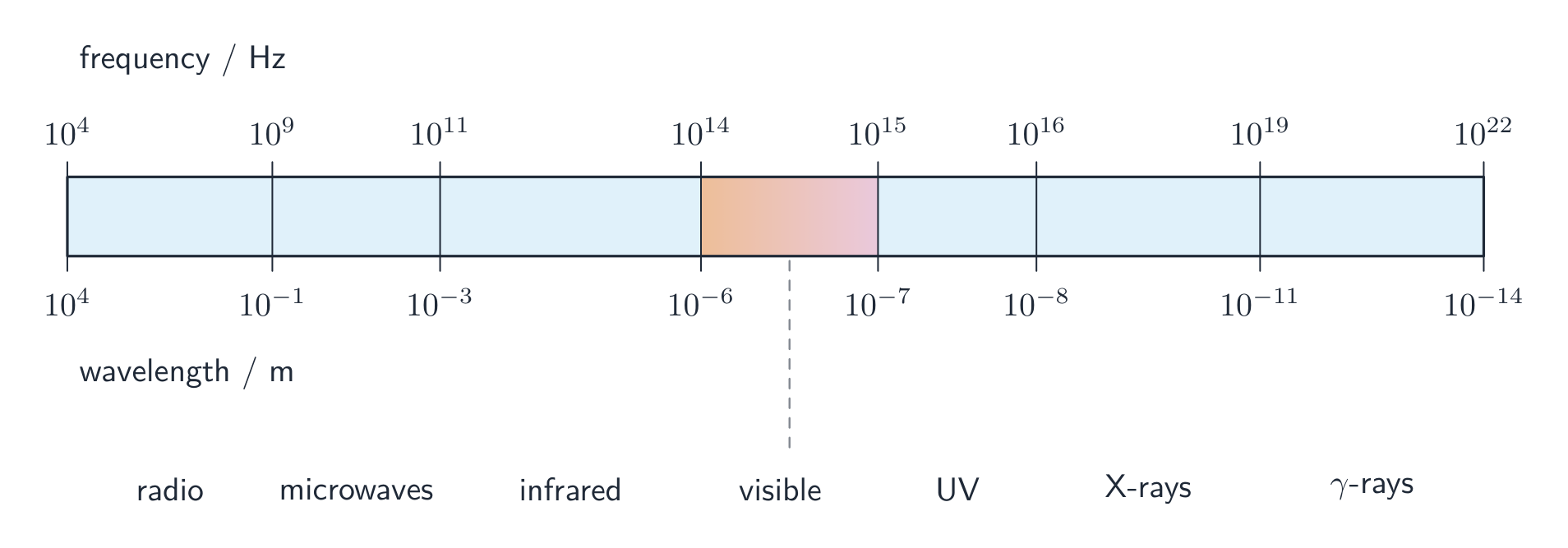
The electromagnetic spectrum 电磁波谱 includes radio waves, microwaves 微波, infrared 红外线, visible light, ultraviolet 紫外线, X-rays X射线 and $\gamma$-rays γ射线.
Approximate wavelength ranges in free space (learn the orders of magnitude):
radio waves: $> 10^{-1}\ \text{m}$ (up to many km).
microwaves: $10^{-3}\ \text{m}$ to $10^{-1}\ \text{m}$.
infrared: $\sim 7 \times 10^{-7}\ \text{m}$ to $10^{-3}\ \text{m}$.
visible light: $400\ \text{nm}$ (violet) to $700\ \text{nm}$ (red), i.e. $4 \times 10^{-7}\ \text{m}$ to $7 \times 10^{-7}\ \text{m}$.
ultraviolet: $\sim 10^{-8}\ \text{m}$ to $4 \times 10^{-7}\ \text{m}$.
X-rays: $\sim 10^{-11}\ \text{m}$ to $10^{-8}\ \text{m}$.
$\gamma$-rays: $< 10^{-11}\ \text{m}$.
The boundaries between regions are not sharp. Use $c = f\lambda$ to change between wavelength and frequency. Only light with wavelengths $400$–$700\ \text{nm}$ can be seen.
To identify a region, convert to a wavelength with $\lambda = c / f$ and compare with the ranges: $2.1\ \text{cm}$ is a microwave; $138\ \text{pm} = 1.4 \times 10^{-10}\ \text{m}$ is an X-ray; $30\ \text{THz}$ gives $\lambda = 1.0 \times 10^{-5}\ \text{m}$, infrared; $3.0 \times 10^{16}\ \text{Hz}$ gives $1.0 \times 10^{-8}\ \text{m}$, ultraviolet. Visible light spans frequencies of about $4.3 \times 10^{14}$ to $7.5 \times 10^{14}\ \text{Hz}$, so a wave of $5.0 \times 10^{14}\ \text{Hz}$ can be seen and one of wavelength $5.0 \times 10^{-6}\ \text{m}$ (infrared) cannot. Red light has a longer wavelength and a lower frequency than green. A list "in order of increasing wavelength" runs $\gamma$-rays, X-rays, ultraviolet, visible, infrared, microwaves, radio waves. A pulse of light reflected from a wall $150\ \text{m}$ away returns after $2 \times 150 / (3.00 \times 10^{8}) = 1.0\ \mu\text{s}$.
עברית
כל הגלים האלקטרומגנטיים (גלי EM) הם רוחביים ונסעים בוואקום באותה מהירות:
$$c = 3.00 \times 10^{8}\ \text{m s}^{-1}.$$
הספקטר האלקטרומגנטי כולל גלי רדיו, מיקרוגלים, אינפרא אדום, אור נראה, אולטרה סגול, רנטגן X ו-$\gamma$-קרניים γ.
הספקטרום האלקטרומגנטי
טווחי אורך גל מקורבים בחלל פנוי (למד את סדרות הגודל):
גלי רדיו: $> 10^{-1}\ \text{m}$ (עד למספרים רבים של ק"מ).
גלי מיקרו: $10^{-3}\ \text{m}$ עד $10^{-1}\ \text{m}$.
אינפרא אדום: $\sim 7 \times 10^{-7}\ \text{m}$ עד $10^{-3}\ \text{m}$.
אור נראה: $400\ \text{nm}$ (סגול) עד $700\ \text{nm}$ (אדום), כלומר $4 \times 10^{-7}\ \text{m}$ עד $7 \times 10^{-7}\ \text{m}$.
אולטרה סגול: $\sim 10^{-8}\ \text{m}$ עד $4 \times 10^{-7}\ \text{m}$.
רנטיגן: מ-$\sim 10^{-11}\ \text{m}$ עד ל-$10^{-8}\ \text{m}$.
קרני $\gamma$: $< 10^{-11}\ \text{m}$.
הגבולות בין האזורים אינם חדים. השתמש ב-$c = f\lambda$ כדי להמיר בין אורך גל לתדר. רק לאור בעל אורכי גל $400$–$700\ \text{nm}$ ניתן לראות.
כדי לזהות אזור, המר לאורך גל ב-$\lambda = c / f$ והשווה עם הטווחים: $2.1\ \text{cm}$ הוא גל מיקרו; $138\ \text{pm} = 1.4 \times 10^{-10}\ \text{m}$ היא קרינת X; $30\ \text{THz}$ נותן $\lambda = 1.0 \times 10^{-5}\ \text{m}$, אינפרא אדום; $3.0 \times 10^{16}\ \text{Hz}$ נותן $1.0 \times 10^{-8}\ \text{m}$, אולטרה סגול. אור נראה מכסה תדרים של כ-$4.3 \times 10^{14}$ עד $7.5 \times 10^{14}\ \text{Hz}$, ולכן גל בעל תדר של $5.0 \times 10^{14}\ \text{Hz}$ ניתן לראייה ואחד באורך גל של $5.0 \times 10^{-6}\ \text{m}$ (אינפרא אדום) אינו ניתן לראייה. לאור אדום יש אורך גל ארוך יותר ותדר נמוך יותר מאשר לאור ירוק. רשימה "בהתאם לעליית אורך הגל" היא: קרני $\gamma$, קרני X, אולטרה סגול, אור נראה, אינפרא אדום, גלי מיקרו, גלי רדיו. פולסת אור שנחזרה מקיר הנמצא במרחק $150\ \text{m}$ חוזרת לאחר זמן של $2 \times 150 / (3.00 \times 10^{8}) = 1.0\ \mu\text{s}$.
Explore · חקור
Slide across the spectrum · החלקה לאורך הספקטרום
Radio waves, visible light and gamma rays are all the same wave — only the wavelength changes, and with it the frequency, photon energy and everyday use. · גלי רדיו, אור נראה וגרעיניים הם אותו סוג של גל — רק אורך הגל משתנה, ועמם התדירות, אנרגיית הפוטון והשימוש היומיומי.
7.5
Polarisation · קיטוב
Syllabus · סיילבוס
English
understand that polarisation is a phenomenon associated with transverse waves
recall and use Malus’s law ($I = I_0 \cos^2\theta$) to calculate the intensity of a plane-polarised electromagnetic wave after transmission through a polarising filter or a series of polarising filters (calculation of the effect of a polarising filter on the intensity of an unpolarised wave is not required)
עברית
להבין שקיטוב הוא תופעה הקשורה לגלים רוחביים
להיזכר בחוק מאלוס ($I = I_0 \cos^2\theta$) ולשתמש בו לחישוב העוצמה של גל אלקטרומגנטי קטוב-מיסורי לאחר מעבר דרך מסנן קיטוב או סדרה של מסנני קיטוב (חישוב ההשפעה של מסנן קיטוב על עוצמת גל לא-קטוב אינה נדרשת)
Source: Cambridge International syllabus · מקור: הסיילבוס הבינלאומי של קמבריד'ג'
English
Polarisation 偏振 means making a transverse wave oscillate in one plane only.
Only transverse waves can be polarised — the oscillation is perpendicular to the direction of travel, so different perpendicular planes are real choices.
Longitudinal waves (sound) cannot be polarised — the oscillation is along the direction of travel, so there is no other plane.
So polarisation is a test: if a wave can be polarised, it must be transverse.
Malus's law
Plane-polarised 平面偏振 light of intensity $I_{0}$ passes through a polarising filter 偏振片 whose transmission axis 透光轴 is at angle $\theta$ to the plane of polarisation. The transmitted intensity is given by Malus's law 马吕斯定律:
$$I = I_{0} \cos^{2}\theta.$$
$\theta = 0°$: filter lined up with the polarisation, $I = I_{0}$, all passes through.
$\theta = 90°$: filter at right angles, $I = 0$, all blocked.
Worked example. Plane-polarised light of intensity $12\ \text{W m}^{-2}$ meets a polarising filter whose axis is at $30°$ to the plane of polarisation. Find the transmitted intensity.
For two filters in a row, use Malus's law twice with the angle between each pair. Be careful with the angle each time — after the first filter the polarisation is along that filter's axis, and the second filter's angle is measured from there.
(You do not need to work out the effect of a polarising filter on an unpolarised wave.)
When a filter is rotated through $360°$ in front of plane-polarised light, the transmitted intensity varies as $\cos^{2}\theta$: it is a maximum when the transmission axis is parallel to the plane of polarisation ($0°$ and $180°$), zero when perpendicular ($90°$ and $270°$), and never negative. Because $I \propto A^{2}$, the transmitted amplitude is $A_{0}\cos\theta$: at $45°$ the intensity halves and the amplitude falls to $0.71$ of its value. For two filters, the first sets the plane of polarisation along its own axis, so the second filter's angle is measured from that: vertically polarised light through filters at $50°$ and then $80°$ to the vertical keeps $\cos^{2} 50° \times \cos^{2} 30° = 0.31$ of its intensity. The one-mark definitions: polarisation is the oscillation of a transverse wave in a single plane, which contains the direction of travel; sound cannot be polarised because its oscillations are along the direction of travel, so there is no plane to select.
עברית
קיטוב הוא הופעת גל רוחבי למתנודות במישור בלבד.
רק גלים רוחביים ניתנים לקיטוב — המתנודה מאונכת לכיוון ההתפשטות, ולכן מישורי ניצוב שונים הם אפשרויות אמיתיות.
גלים אורכיים (קול) אינם ניתנים לקיטוב — המתנודה היא לאורך כיוון ההתפשטות, ולכן אין מישור אחר לבחירה.
לכן קיטוב מהווה מבחן: אם גל ניתן לקיטוב, הוא חייב להיות רוחבי.
גלים לא מקוטבים רועמים במספר מישורים; גל מקוטב רועם במישור אחדמדחוק פלסטיק שקוף המוצב בין שני מסנני קיטוב צולבים. אור מגיע לעיניך רק בגלל שהפלסטיק המתוח מסובב את מישור הקיטוב שלו — הצבעים מפתחים את המקומות בהם הפלסטיק לחוץ ביותר. עם אור רגיל זה היה נראה פשוט שקוף
חוק מלוס
אור מקוטב במישור בעוצמת $I_{0}$ עובר דרך מסנן קיטוב whose ציר העברת נמצא בזווית $\theta$ למישור הקיטוב. העוצמה המועברת נתונה על ידי חוק מלוס:
$$I = I_{0} \cos^{2}\theta.$$
$\theta = 0°$: המסנן מיושר עם הכיוון הקיבוצי, $I = I_{0}$, הכל עובר.
*מסננים מצלבים (א) חוסמים את האור; מסננים מקבילים (ב) מאפשרים מעבר
לשני מסננים ברצף, השתמשו בחוק מאלוס פעמיים עם הזווית בין כל זוג. שמרו על הזווית בכל פעם – לאחר המסנן הראשון הקיטוב הוא לאורך ציר המסנן, וזווית המסנן השני נמדדת משם.
(אינכם צריכים לחשב את השפעת מסנן מקטב על גל לא מקוטב.)
כאשר פילטר מסובב בזווית $360°$ מול אור מקוטב מישורית, העוצמה המעבירה משתנה לפי $\cos^{2}\theta$: היא מקסימלית כאשר ציר ההעברה מקביל למישור הקיטוב ($0°$ ו-$180°$), אפס כאשר מאונך ($90°$ ו-$270°$), לעולם לא שלילית. מכיוון שה-$I \propto A^{2}$, ה-אמפליטודה המעבירה היא $A_{0}\cos\theta$: ב-$45°$ העוצמה מחצייה והאמפליטודה יורדת ל-$0.71$ מערכה. בשני פילטרים, הראשון קובע את מישור הקיטוב לאורך צירו, כך שהזווית של הפילטר השני נמדדת ממנו: אור מקוטב אנכית העובר דרך פילטרים ב-$50°$ ואז ב-$80°$ לציר האנכי משמר $\cos^{2} 50° \times \cos^{2} 30° = 0.31$ מעוצמתו. ההגדרות בעלות סימן אחד: קיטוב הוא תנודת גל רוחבי במישור יחיד, המכיל את כיוון ההתפשטות; קול לא יכול להיות מקוטב כי התנודות שלו הן לאורך כיוון ההתפשטות, ולכן אין מישהו לבחור.
intensity changes with polariser angle · העוצמה משתנה בהתאם לזווית הפולריזר
Rotate a polariser and see why only transverse waves can be polarised. · סובבו פולריזר ותראו מדוע רק גלים צולבים יכולים להיות מקוטבים.
7.5
Definitions the examiner accepts · הגדרות מקובלות בקורס
English
A definition question is marked against fixed wording. Learn these exactly, and give one answer only.
Term
Definition
progressive wave
a wave that transfers energy from one place to another without transferring matter
transverse wave
a wave whose oscillations are perpendicular to the direction of energy transfer
longitudinal wave
a wave whose oscillations are parallel to the direction of energy transfer
displacement
the distance of a particle from its equilibrium (rest) position, in a stated direction
amplitude
the maximum displacement of a particle from its equilibrium position
wavelength
the minimum distance between two points on the wave that are in phase (for example, adjacent crests)
period
the time for one complete oscillation of a particle (or for the wave to travel one wavelength)
frequency
the number of oscillations per unit time (or the number of wavefronts passing a point per unit time)
phase difference
the fraction of a cycle, as an angle, by which one oscillation leads or lags another
intensity
the power per unit area, at right angles to the direction of travel
Doppler effect
the change in the observed frequency of a wave when the source moves relative to the observer
polarisation
the oscillations of a transverse wave are in one plane only, containing the direction of travel
time-base
the time represented by one division across the screen of a CRO
עברית
שאלת הגדרה מוקדמת לפי טקסט קבוע. לימודן במדויק, ותן תשובה אחת בלבד.
מונח
הגדרה
גל קדמי
גל המעביר אנרגיה ממקום למקום אחר ללא העברת חומר
גל רוחבי
גל שבו תנודותיו מאונכות לכיוון העברת האנרגיה
גל אורכי
גל שבו תנודותיו מקבילות לכיוון העברת האנרגיה
הסטה
המרחק של חלקיק ממנווח האיזון (המנוחה) שלו, בכיוון נתון
משרעת
ההסטה המקסימלית של חלקיק ממנווח האיזון שלו
אורך גל
המרחק המינימלי בין שתי נקודות בגל הנמצאות בפזה זהה (למשל, שיאים סמוכים)
תקופה
הזמן לתנודה מלאה אחת של חלקיק (או כדי לגל לעבור אורך גל אחד)
תדר
מספר התנודות ליחידת זמן (או מספר חזיתות הגל העוברות נקודה ליחידת זמן)
הפרשי פזה
השבר של מחזור, כזווית, בו תנודה אחת מקדימה או מאחרת אחרת
עוצמה
ההספק ליחידת שטח, בזווית ישרה לכיוון התפשטותו
אפקט דופלר
השינוי בתדר הנצפה של גל כאשר המקור נע ביחס לצופה
קיטוב
תנודות גל רוחבי הן רק במישור אחד, הכולל את כיוון התפשטותו
בסיס זמן
הזמן המיוצג על כל חלוקה באורך מסך CRO
7.5
Exam tips · טיפים לבחינות
English
Define terms precisely (displacement, amplitude, wavelength, period, frequency) and use $v = f\lambda$.
Distinguish transverse (vibration perpendicular to travel) from longitudinal (parallel); only transverse waves can be polarised.
For the Doppler effect, the observed frequency rises as the source approaches and falls as it recedes.
Learn the electromagnetic spectrum order; all its waves travel at $c$ in a vacuum.
Common mistakes
A phase difference bigger than one cycle, or degrees where radians were asked. Only the fraction of a cycle matters: $450°$ is $90°$, and $90°$ is $\pi/2$.
Reading the wavelength from a displacement–time graph. That graph gives the period; the wavelength comes from the displacement–distance graph.
Doubling the amplitude and "doubling" the intensity. Intensity goes as the amplitude squared: four times.
Choosing the Doppler sign by feel. Towards means minus on the bottom (frequency up); away means plus (frequency down). Check that the answer lies on the right side of $f_{\text{s}}$.
Using the first filter's angle for the second. After a filter the light is polarised along that filter's axis, and the next angle is measured from there.
Saying that sound can be polarised. Only transverse waves can.
עברית
הגדירו מושגים במדויק (הסטה, משרעת, אורך גל, תקופה, תדר) והשתמשו ב-$v = f\lambda$.
להבדיל בין צליל רוחבי (רעידה מאונכת לכיוון התפשטות) לבין צליל אורכי (מקביל); רק גלי רוחביים יכולים להיות מקוטבים.
עבור אפקט דופלר, התדר הנצפה עולה כאשר המקור מתקרב ויורד כאשר הוא מתרחק.
ללמוד את סדרת הספקטרום האלקטרומגנטי; כל הגלים בו נעים במהירות $c$ בוואקום.
טעויות נפוצות
הפרש פאזה גדול יותר מחוגה אחת, או מעלות במקום שדרשו רדיאנים. רק השבר של החוגה חשוב: $450°$ שווה ל$90°$, ו$90°$ שווה ל$\pi/2$.
קריאת אורך הגל ממגרף הסטה-זמן. גרף זה נותן את התקופה; אורך הגל מגיע ממגרף ההסה-מרחק.
הכפלת המשרעת והכפלת "העוצמה". העוצמה תלויה בריבוע המשרעת: פי ארבע.
בחירת סימן אפקט דופלר לפי הבנה. לקראת פירושו מינוס בתחתית (תדר עולה); הרחוק פירושו פלוס (תדר יורד). ודאו שהתשובה נמצאת בצד הניצוב של $f_{\text{s}}$.
שימוש בזווית הפילטר הראשון לשני. לאחר פילטר האור מקוטב לאורך ציר הפילטר, והזווית הבאה נמדדת מכאן.
טענה שקול יכול להיות מקוטב. רק גלי רוחביים יכולים.
Interactive lessons on this topic · שיעורים אינטראקטיביים בנושא זה
Work through it step by step, with instant-check exercises. · לעבור על הדברים צעד אחר צעד, עם תרגילים לבדיקה מיידית.
Pick one and the site follows you — notes, papers, videos and practice all open on it. · בחרו נושא אחד והאתר יעקוב אחריו — הערות, מסמכים, וידאו ותרגולים פתוחים בו.
Type to search notes, lessons, code, vocabulary and past-paper questions across every subject. · הקלד כדי לחפש הערות, שיעורים, קוד, אוצר מילים ושאלות מבחנים בכל הנושאים.








 *מסננים מצלבים (א) חוסמים את האור; מסננים מקבילים (ב) מאפשרים מעבר