הנה תגובה אמיתית: מי חמצן מגיבים עם יוני יוד בחומצה. תסתכל על המשוואה מאוזנת. היא משתמשת בשני יוני יוד ושני יוני מימן…
English narration · English + 中文 subtitles burned in · קריאת קול באנגלית · תרגום אנגלי + סינית שרוף בתוך הסרטון
26.1
Rate equations and orders · משוואות קצב ודרגות תגובה
Syllabus · סיילבוס
English
explain and use the terms rate equation, order of reaction, overall order of reaction, rate constant, half-life, rate-determining step and intermediate
(a) understand and use rate equations of the form $\text{rate} = k [\text{A}]^m[\text{B}]^n$ (for which $m$ and $n$ are 0, 1 or 2) (b) deduce the order of a reaction from concentration–time graphs or from experimental data relating to the initial rates method and half-life method (c) interpret experimental data in graphical form, including concentration–time and rate–concentration graphs (d) calculate an initial rate using concentration data (e) construct a rate equation
(a) show understanding that the half-life of a first-order reaction is independent of concentration (b) use the half-life of a first-order reaction in calculations
calculate the numerical value of a rate constant, for example by: (a) using the initial rates and the rate equation (b) using the half-life, $t_{\frac{1}{2}}$, and the equation $k = 0.693/t_{\frac{1}{2}}$
for a multi-step reaction: (a) suggest a reaction mechanism that is consistent with the rate equation and the equation for the overall reaction (b) predict the order that would result from a given reaction mechanism and rate-determining step (c) deduce a rate equation using a given reaction mechanism and rate-determining step for a given reaction (d) identify an intermediate or catalyst from a given reaction mechanism (e) identify the rate determining step from a rate equation and a given reaction mechanism
describe qualitatively the effect of temperature change on the rate constant and hence the rate of a reaction
עברית
להסביר ולשתמש במונחים משוואת קצב, סדר תגובה, סדר כולל של תגובה, קבוע קצב, מחצית חיים, שלב קובע קצב ו**ביניים
(א) להבין ולשתמש במשוואות קצב בצורה $\text{rate} = k [\text{A}]^m[\text{B}]^n$ (עבוריהן $m$ ו$n$ הם 0, 1 או 2) (ב) לגזור את סדר התגובה ממדידי ריכוז-זמן או ממדידים ניסויים הקשורים לשיטת הקצבים ההתחלתיים ושיטת מחצית החיים (ג) לפרש מדידים ניסויים בצורת גרף, כולל גרפי ריכוז-זמן וגרפי קצב-ריכוז (ד) לחשב קצב התחלתי באמצעות מדידי ריכוז (ה) לבנות משוואת קצב
(א) להראות הבנה שהמחצית החיים של תגובה מסדר ראשון אינה תלויה בריכוז (ב) להשתמש במחצית החיים של תגובה מסדר ראשון בחישובים
לחשב את הערך המספרי של קבוע קצב, לדוגמה על ידי: (א) שימוש בקצבים ההתחלתיים ובמשוואת הקצב (ב) שימוש במחצית החיים, $t_{\frac{1}{2}}$, ובמשוואה $k = 0.693/t_{\frac{1}{2}}$
בתגובה רב-שלבים: (א) הצע מנגנון תגובה התואם למשוואת הקצב ולמשוואת התגובה הכוללת (ב) חזה את סדר התגובה שייגרם ממנגנון תגובה ושלב קובע קצב נתונים (ג) נקה משוואת קצב באמצעות מנגנון תגובה ושלב קובע קצב נתונים לתגובה מסוימת (ד) זיהה ביניים או מזרם מתוך מנגנון תגובה נתון (ה) זיהה את השלב הקובע קצב מתוך משוואת קצב ומנגנון תגובה נתון
תאר באופן איכותי את השפעת שינוי הטמפרטורה על קבוע הקצב, ועל כן על קצב התגובה
Source: Cambridge International syllabus · מקור: הסיילבוס הבינלאומי של קמבריד'ג'
English
A rate equation 速率方程 shows how the rate depends on the concentrations of the reactants:
$$\text{rate} = k\,[\text{A}]^m[\text{B}]^n$$
$m$ is the order of reaction 反应级数 with respect to A, and $n$ the order with respect to B. Each is $0$, $1$ or $2$.
the overall order of reaction 总反应级数 is $m + n$.
$k$ is the rate constant 速率常数. The rate equation can only be found by experiment, not from the balanced equation.
Finding the order
initial rates method: change one concentration at a time and see how the starting rate changes. If doubling $[\text{A}]$ doubles the rate, the order in A is 1; if it quadruples the rate, the order is 2; if the rate is unchanged, the order is 0.
Worked example. In experiments on $\text{A} + \text{B} \rightarrow$ products, doubling $[\text{A}]$ (with $[\text{B}]$ fixed) doubles the rate, and doubling $[\text{B}]$ (with $[\text{A}]$ fixed) quadruples the rate. Write the rate equation and give the overall order.
Doubling $[\text{A}]$ doubles the rate, so first order in A. Doubling $[\text{B}]$ quadruples ($2^2$) the rate, so second order in B. Hence
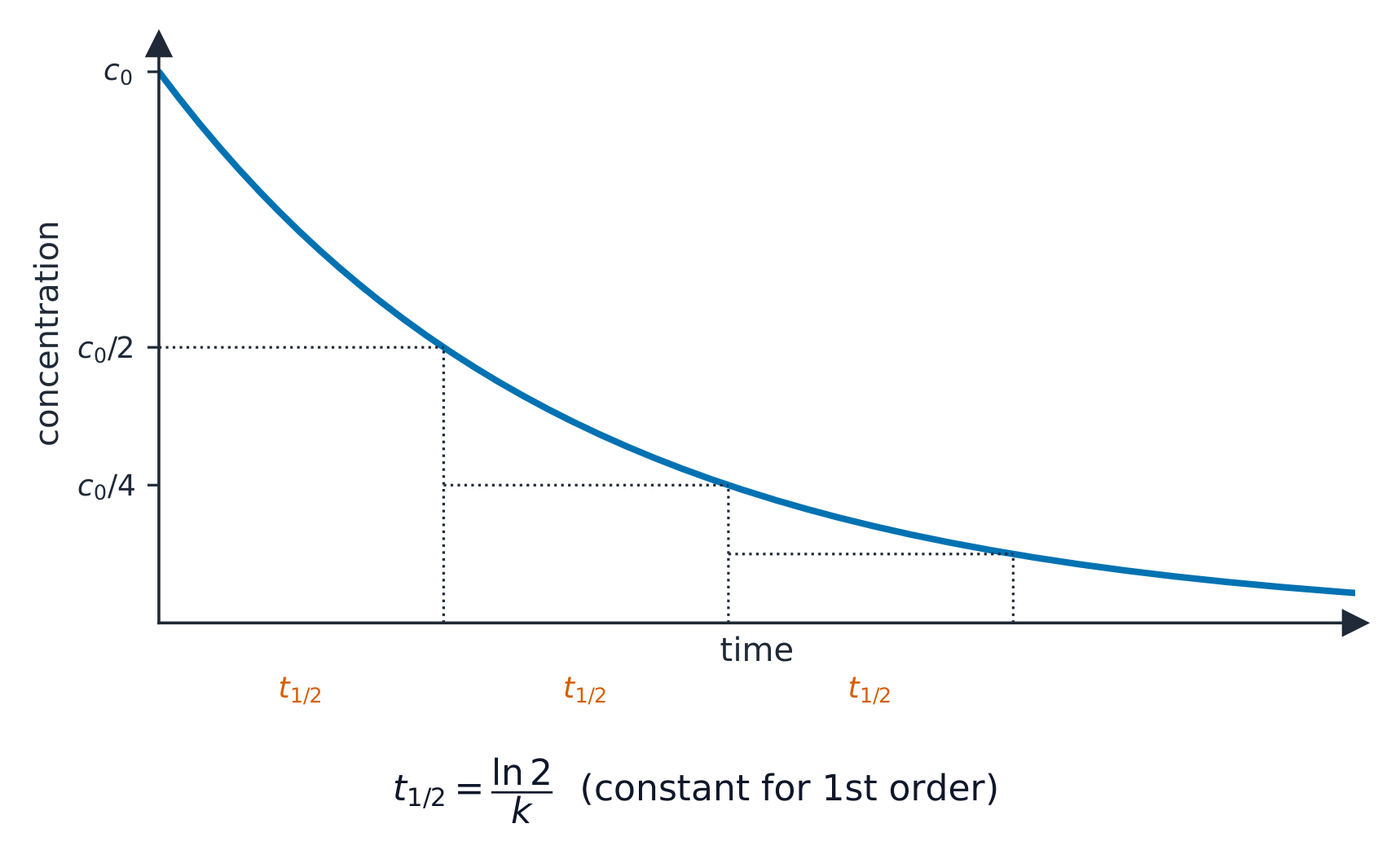
graphs: a concentration–time graph for a first-order reaction has a constant half-life 半衰期 (the time for the concentration to halve). A rate–concentration graph is a straight line through the origin for first order, and a curve for second order.
Half-life and the rate constant
For a first-order reaction the half-life is constant — it does not depend on the concentration. You can find the rate constant from it:
$$k = \frac{0.693}{t_{\frac{1}{2}}}$$
Worked example. A first-order reaction has a half-life of $120\ \text{s}$. Find its rate constant.
You can also find $k$ by putting initial-rate data into the rate equation.
עברית
משוואת קצב מראה כיצד הקצב תלוי בריכוזי המגיבים:
$$\text{rate} = k\,[\text{A}]^m[\text{B}]^n$$
$m$ היא דרגת התגובה ביחס ל-A, ו-$n$ דרגת התגובה ביחס ל-B. כל אחת מהן היא $0$, $1$ או $2$.
דרגת התגובה הכוללת היא $m + n$.
$k$ הוא קבוע הקצב. ניתן למצוא את משוואת הקצב רק באמצעות ניסוי, ולא מהמשוואה המאוזנת.
צינור הגז מדוד את נפח הגז הנוצר לאורך הזמן, מה שמספק את קצב התגובה
מציאת הדרגה
שיטת הקצבים ההתחלתיים: שינה ריכוז אחד בכל פעם וראה כיצד הקצב ההתחלתי משתנה. אם הכפל את $[\text{A}]$ והקצב כפול, הדרגה ב-A היא 1; אם הרבעה את הקצב, הדרגה היא 2; אם הקצב לא השתנה, הדרגה היא 0.
דוגמה פותרת. בניסויים על מוצרי $\text{A} + \text{B} \rightarrow$, הכפל את $[\text{A}]$ (כאשר $[\text{B}]$ קבוע) והקצב כפול, והכפל את $[\text{B}]$ (כאשר $[\text{A}]$ קבוע) והקצב הרבעה. כתוב את משוואת הקצב ותן את הדרגה הכוללת.
הכפל את $[\text{A}]$ והקצב כפול, לכן דרגה ראשונה ב-A. הכפל את $[\text{B}]$ והקצב הרבעה ($2^2$), לכן דרגה שנייה ב-B. מכאן
גרפים: גרף ריכוז–זמן לתגובה דרגה ראשונה בעל מחצית חיים קבוע (הזמן שבו הריכוז יורד לחציו). גרף קצב–ריכוז הוא קו ישר העובר באפס לתגובה דרגה ראשונה, ועקומה לתגובה דרגה שנייה.
קצב מול ריכוז: דרגה אפס היא קו אופקי, דרגה ראשונה קו ישר העובר באפס, דרגה שנייה עקומה עולה
מחצית חיים וקבוע הקצב
לתגובה מדרגה ראשונה, מחצית החיים היא קבועה — היא אינה תלויה בריכוז. ניתן למצוא את קבוע הקצב ממנה:
$$k = \frac{0.693}{t_{\frac{1}{2}}}$$
לתגובה מדרגה ראשונה יש מחצית חיים קבועה: הריכוז מצטמצם למחצה באותו זמן $t_{1/2}$ שוב ושוב, ללא קשר לערך ההתחלתי
דוגמא פותרת. לתגובה מדרגה ראשונה יש מחצית חיים של $120\ \text{s}$. מצאו את קבוע הקצב שלה.
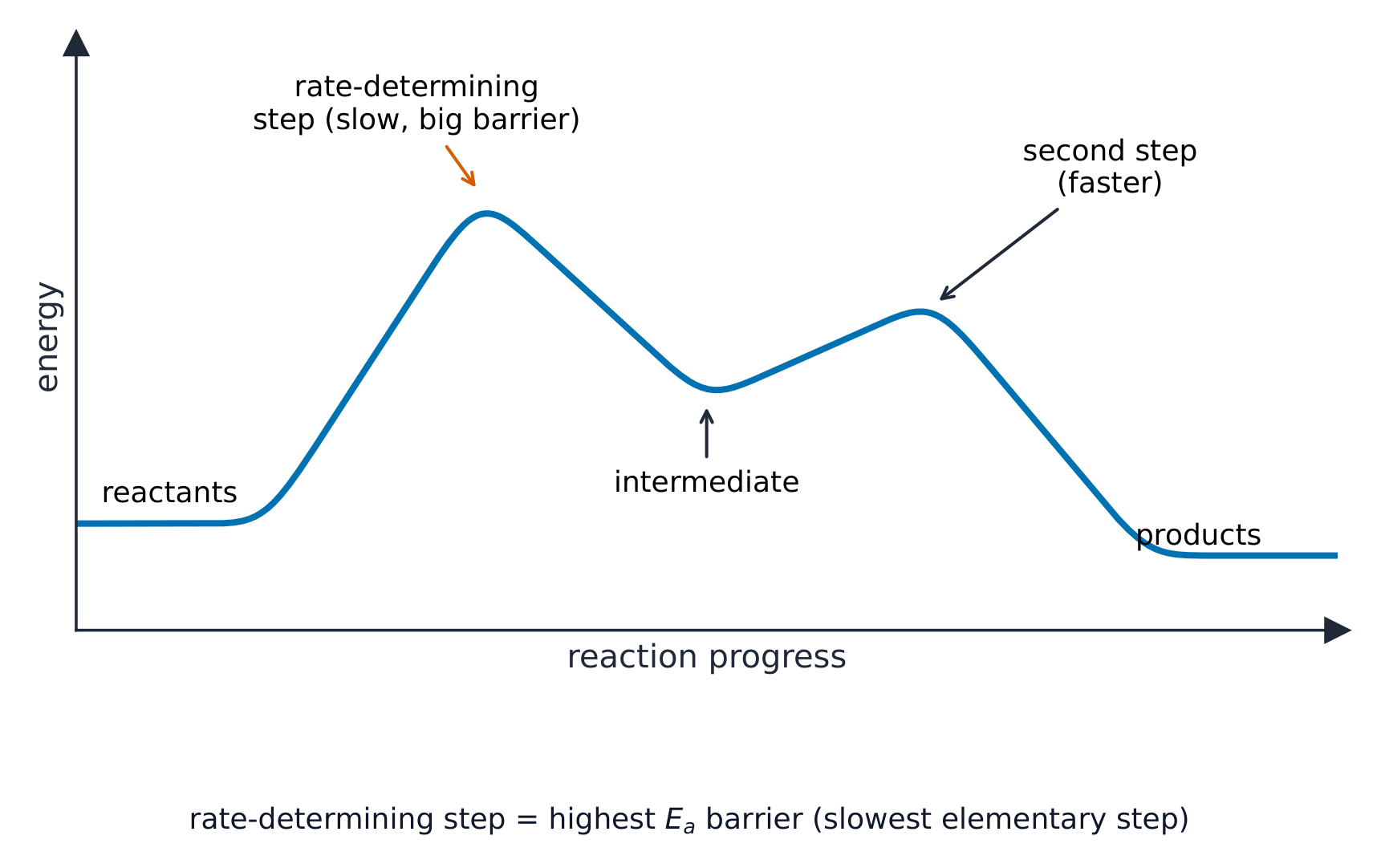
Most reactions happen in several steps. The slowest step is the rate-determining step 决速步骤, and it controls the overall rate. Only the species involved up to and including this step appear in the rate equation.
an intermediate 中间体 is a species made in one step and then used up in a later step. It is not in the overall equation.
you can suggest a mechanism that fits both the rate equation and the overall equation, predict the order from a given mechanism, or pick out the rate-determining step.
If you compare the initial rate 初始速率 of different mixtures, you can deduce the rate equation, and from that work out the mechanism.
Effect of temperature
Raising the temperature increases the rate constant $k$ (more molecules pass the activation energy), so the rate goes up.
עברית
רוב התגובות מתרחשות בשלבים מספר. השלב האיטי הוא שלב קובע הקצב, והוא מבוקר את הקצב הכולל. רק המינים המעורבים עד לשלב זה ובכללם מופיעים במשוואת הקצב.
פרופיל דו-שלבי: השלב האיטי הוא בעל המכשול הגדול וקובע את הקצב; השקע בין שני המכשולים הוא מיצר
מיצר הוא מין הנוצר בשלב אחד ואז נצרך בשלב מאוחר יותר. הוא אינו מופיע במשוואה הכוללת.
ניתן להציע מנגנון שתואם גם למשוואת הקצב וגם למשוואה הכוללת, לחזות את הדרגה ממנגנון נתון, או לזהות את שלב קובע הקצב.
אם משווים את קצב ההתחלה של ערכות שונות, ניתן להסיק את משוואת הקצב, וממנה לחשב את המנגנון.
השפעת טמפרטורה
העלאת הטמפרטורה מגבירה את קבוע הקצב $k$ (יותר מולקולות עוברות את אנרגיית הפעולה), ולכן הקצב עולה.
Explore · חקור
Organic mechanism route · מסלול מנגנון אורגני
Trace electron-pair movement from reagent to product. · עקוב את תנועת זוג האלקטרונים מהתגובים למוצרים.
explain that catalysts can be homogeneous or heterogeneous
describe the mode of action of a heterogeneous catalyst to include adsorption of reactants, bond weakening and desorption of products, for example: (a) iron in the Haber process (b) palladium, platinum and rhodium in the catalytic removal of oxides of nitrogen from the exhaust gases of car engines
describe the mode of action of a homogeneous catalyst by being used in one step and reformed in a later step, for example: (a) atmospheric oxides of nitrogen in the oxidation of atmospheric sulfur dioxide (b) $\text{Fe}^{2+}$ or $\text{Fe}^{3+}$ in the $\text{I}^- / \text{S}_2\text{O}_8^{2-}$ reaction
עברית
הסבר כי הזרמים יכולים להיות הומוגניים או הטרוגניים
תאר את אופן הפעולה של זרם הטרוגני המכיל ספיחה של תחליפים, החלשת קשרים ונשירה של מוצרים, לדוגמה: (א) ברזל בתהליך האבר (ב) פלדיום, פלטינה ורודיום בהסרת תחליפי חנקן מפלי העישון של מנועי רכבים
תאר את אופן הפעולה של זרם הומוגני הנמצא בשלב אחד ומיוצר מחדש בשלב מאוחר, לדוגמה: (א) תחליפי חנקן באטמוספירה בחמצון דו-חמצן גופרית באטמוספירה (ב) $\text{Fe}^{2+}$ או $\text{Fe}^{3+}$ בתגובה $\text{I}^- / \text{S}_2\text{O}_8^{2-}$
Source: Cambridge International syllabus · מקור: הסיילבוס הבינלאומי של קמבריד'ג'
English
Catalysts 催化剂 can be homogeneous or heterogeneous.
Heterogeneous catalysts
A heterogeneous catalyst 多相催化剂 is in a different physical state from the reactants (usually a solid with gases). It works in three stages:
adsorption 吸附: reactant molecules stick to the catalyst surface.
the bonds in the reactants are weakened, so they react more easily.
desorption 脱附: the product molecules leave the surface.
Examples are iron in the Haber process, and platinum, palladium and rhodium in a catalytic converter.
Homogeneous catalysts
A homogeneous catalyst 均相催化剂 is in the same physical state as the reactants. It is used up in one step and then reformed in a later step, so it comes back unchanged. Examples are oxides of nitrogen helping to oxidise atmospheric sulfur dioxide, and $\text{Fe}^{2+}$ or $\text{Fe}^{3+}$ speeding up the reaction between $\text{I}^-$ and $\text{S}_2\text{O}_8^{2-}$.
עברית
מזרזים יכולים להיות הומוגניים או הטרוגניים.
מזרזים הטרוגניים
מזרז הטרוגני נמצא במצב פיזי שונה מהתגובים (בדרך כלל מוצק עם גזים). הוא פועל בשלושה שלבים:
ספיסה: מולקולות התגובים נדבקות לפני המשטח של המזרז.
הקשרים בתגובים מתחלשים, כך שהם מגיבים בקלות.
התנתקות: מולקולות המוצר עוזבות את המשטח.
חומר זר הוטרוגני עובד בשלושה שלבים: התגובה נספחת על פני השטח, הקשרים המופעלים מאפשרים להם להגיב, ולאחר מכן המוצר מתנתקחומרי זר הוטרוגניים אמיתיים מיוצרים כגרגירים מעוצבים קטנים, טבעות ודיסקים מחוררים, המעניקים שטח פנים גדול כדי שהתגובה תיצמד אליהם
למשל ברזל בתהליך האבר, ופלטינה, פלדיום ורודיום בממיר גזי.
חומרי זר הומוגניים
קטליזטור הומוגני נמצא באותו מצב פיזיקלי כמו המגיבים. הוא נצרך בשלב אחד ואז מושרה בשלב מאוחר יותר, ולכן חוזר ללא שינוי. הדוגמאות הן חומצות חנקן המסייעות בחמצון סולפיד האטמוספרי, ו-$\text{Fe}^{2+}$ או $\text{Fe}^{3+}$ המאיצים את התגובה בין $\text{I}^-$ ל-$\text{S}_2\text{O}_8^{2-}$.
Explore · חקור
How a catalyst speeds a reaction · כיצד זרז מאיץ תגובה
Turn the catalyst on and watch the rate jump — it gives more successful collisions per second by offering a lower-energy path. · הפעל את הזרז והצפה את הקצב — הוא מספק התנגשויות מוצלחות יותר לשנייה על ידי הצעת דרך בעלת אנרגיה נמוכה יותר.
Find orders from initial-rate data: doubling a concentration that doubles the rate is first order, quadruples it is second order, no change is zero order.
Write $\text{rate} = k[\text{A}]^m[\text{B}]^n$ and work out the units of $k$ from it.
The rate-determining step contains the species (and orders) in the rate equation — use this to test a mechanism.
A constant half-life means first order.
עברית
למצוא סדרים מתוך נתוני קצב התחלתי: הכפלת ריכוז שמכפילה את הקצב היא סדר ראשון, הכפלתה ארבע פעמים היא סדר שני, ללא שינוי היא סדר אפס.
כתוב $\text{rate} = k[\text{A}]^m[\text{B}]^n$ וחשב את היחידות של $k$ ממנו.
ה-שלב הקובע קצב מכיל את המינים (והסדרים) במשוואת הקצב — השתמש בזה לבדיקת מנגנון.
חצי חיים קבוע משמעו סדר ראשון.
Interactive lessons on this topic · שיעורים אינטראקטיביים בנושא זה
Work through it step by step, with instant-check exercises. · לעבור על הדברים צעד אחר צעד, עם תרגילים לבדיקה מיידית.
Pick one and the site follows you — notes, papers, videos and practice all open on it. · בחרו נושא אחד והאתר יעקוב אחריו — הערות, מסמכים, וידאו ותרגולים פתוחים בו.
Type to search notes, lessons, code, vocabulary and past-paper questions across every subject. · הקלד כדי לחפש הערות, שיעורים, קוד, אוצר מילים ושאלות מבחנים בכל הנושאים.