Skip to content · ⁨דלג לתוכן⁩

Selection and evolution · ⁨בחירה ואבולוציה⁩

A-Level Biology · ⁨ביולוגיה A-Level⁩ · Topic 17 · ⁨נושא 17⁩

Video lesson for this topic · ⁨שיעור וידאו לנושא זה⁩ Open the video page · ⁨פתח את עמוד הוידאו⁩
8:23

התגוונות ואבולוציה

בראשית שנות השמונים, כמעט כל פרפר הכתמים באנגליה היה בהיר ומנוקד, מה שהסתיר אותו בצורה יפה על גזעי עצים מכוסים בשחלים. אז הגיע…

English narration · English + 中文 subtitles burned in · ⁨קריאת קול באנגלית · תרגום אנגלי + סינית שרוף בתוך הסרטון⁩

17.1

Variation · ⁨מגוון⁩

Syllabus · ⁨סיילבוס⁩
English
  1. explain, with examples, that phenotypic variation is due to genetic factors or environmental factors or a combination of genetic and environmental factors
  2. explain what is meant by discontinuous variation and continuous variation
  3. explain the genetic basis of discontinuous variation and continuous variation
  4. use the t-test to compare the means of two different samples (the formula for the t-test will be provided, as shown in the Mathematical requirements)
עברית
  1. הסבר, עם דוגמאות, כי מגוון פנוטיפי נובע מגורמים גנטיים או מגורמים סביבתיים או משילוב של גורמים גנטיים וסביבתיים
  2. הסבר מה מתכוונים למגוון לא רציף ולמגוון רציף
  3. הסבר את הבסיס הגנטי של מגוון לא רציף ומגוון רציף
  4. השתמש במבחן t להשוואת ממוצעים של שני דגימות שונות (הנוסחה למבחן t תסופק, כפי שמוצג בדרישות המתמטיות)
Source: Cambridge International syllabus · ⁨מקור: הסיילבוס הבינלאומי של קמבריד'ג'⁩

English

Variation 变异 means the differences between individuals. It has three possible causes:

  • genetic factors only — set by the alleles 等位基因 you inherit (for example human blood group).
  • environmental factors 环境因素 only — set by your surroundings (for example a scar, or the language you speak).
  • a combination of both — most features, such as height and body mass, depend on genes and on diet and lifestyle.

There are two patterns of variation:

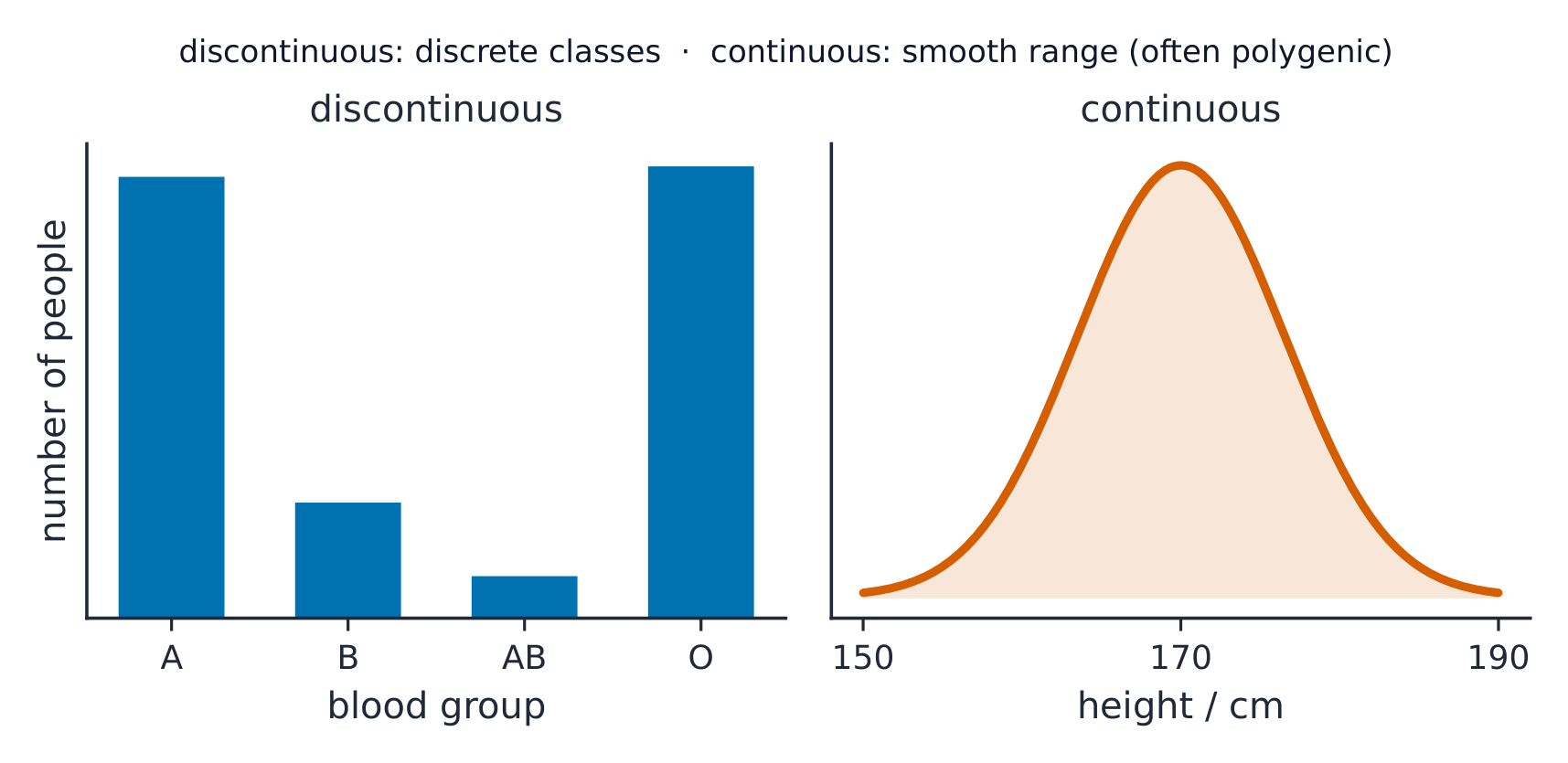
  • discontinuous variation 不连续变异 — clear, separate groups with nothing in between (for example blood group A, B, AB or O). It is usually controlled by one or a few genes 基因, with little effect from the environment.
  • continuous variation 连续变异 — a smooth range from one extreme to the other (for example height). It is controlled by many genes together, plus the environment.

To compare the means of two samples (for example the heights of plants in sun and in shade), you use the t-test, which tells you whether the difference is large enough to be real, or just due to chance.

עברית

מגוון מתאר את ההבדלים בין פרטים. ישנם שלושה סיבות אפשריות לכך:

  • רק גורמים גנטיים – נקבעים על ידי אללים שקיבלת (למשל, קבוצת הדם האנושית).
  • רק גורמים סביבתיים – נקבעים על ידי הסביבה שלך (למשל, צלקת, או השפה שאתה דובר).
  • שילוב של שניהם – רוב תכונות, כגון גובה ומשקל גוף, תלויות גם בגנים וגם בתזונה ובסגנון חיים.
שני חילזונים עם פסים בעלי מעטפות בצבעים ובפסים שונים
חילזונים מצולעים (Cepaea nemoralis) מראים מגוון מרשים בצבע המעטפת ובפסים

ישנם שני סוגי מגוון:

  • מגוון לא רציף – קבוצות נפרדות וברורות ללא דבר באמצע (למשל, קבוצת דם A, B, AB או O). היא נשלטת בדרך כלל על ידי גן אחד או מעט גנים, עם השפעה מינימלית מהסביבה.
  • מגוון רציף – טווח חלק ממקצה אחד לאחר (למשל, גובה). היא נשלטת על ידי הרבה גנים יחד, בנוסף לסביבה.
שני גרפים: גרף עמודות של קבוצות דם עם עמודות נפרדות (לא רציף), ועקומת פעמון חלקה של גובה (רציף)
מגוון לא רציף מתחלק לקבוצות נפרדות; מגוון רציף הוא טווח חלק

כדי להשוות ממוצעים של דגימות שתיים (למשל, גובה הצמחים בשמש ובצל), משתמשים ב-bדיקת t, שמספקת מידע אם ההבדל גדול מספיק להיות אמיתי, או שהוא פשוט תוצאה של מקרה.

Explore · ⁨חקור⁩

The t-distribution behind the t-test · ⁨התפלגות t המעומדת מאחורי מבחן t⁩

The t-test compares two sample means against a critical value you look up in a t-table. This is that table made live: the value depends on the degrees of freedom (here $n_1+n_2-2$). Drag df and watch the critical value change — small samples have heavier tails, so they need a larger difference to count as real. · ⁨מבחן t משווה שני ממוצעים מדגימה נגד ערך קריטי שמחפש בטבלת t. זהו הטבלה הזו שהפכה לחיה: הערך תלוי בדרגות החירות (כאן $n_1+n_2-2$). גרור df וצפה בערך הקריטי משתנה — דגימות קטנות יש להן זנבות כבדים יותר, אז הן זקוקות להפרש גדול יותר כדי להיחשב אמיתי.⁩

Explore · ⁨חקור⁩

Variation type lab · ⁨מעבדת סוגי השונות⁩

Classify examples by the source and pattern of variation. · ⁨מיון דוגמאות לפי המקור והתבנית של השונות.⁩

Vocabulary · ⁨מילון מונחים⁩ Train · ⁨אימון⁩
English עברית
variation/ˌveərɪˈeɪʃn/ וריאות
allele/əˈliːl/ אלל
environmental factor/enˌvaɪrənˈmentl ˈfæktə/ גורם סביבתי
discontinuous variation/dɪskənˈtɪnjuːəs ˌveərɪˈeɪʃn/ וריאות לא-רציפה
gene/dʒiːn/ גן
continuous variation/kənˈtɪnjuːəs ˌveərɪˈeɪʃn/ וריאות רציפה
population/ˌpɒpjʊˈleɪʃn/ אוכלוסייה
offspring/ˈɒfsprɪŋ/ צאצאים
compete/kəmˈpiːt/ מתחרים
adapted/əˈdæptɪd/ מותאם
reproduce/rɪprəˈdjuːs/ להשכפיל
17.2

Natural selection · ⁨בחירה טבעית⁩

Syllabus · ⁨סיילבוס⁩
English
  1. explain that natural selection occurs because populations have the capacity to produce many offspring that compete for resources; in the ‘struggle for existence’, individuals that are best adapted are most likely to survive to reproduce and pass on their alleles to the next generation
  2. explain how environmental factors can act as stabilising, disruptive and directional forces of natural selection
  3. explain how selection, the founder effect and genetic drift, including the bottleneck effect, may affect allele frequencies in populations
  4. outline how bacteria become resistant to antibiotics as an example of natural selection
  5. use the Hardy–Weinberg principle to calculate allele and genotype frequencies in populations and state the conditions when this principle can be applied (the two equations for the Hardy–Weinberg principle will be provided, as shown in the Mathematical requirements)
  6. describe the principles of selective breeding (artificial selection)
  7. outline the following examples of selective breeding: • the introduction of disease resistance to varieties of wheat and rice • inbreeding and hybridisation to produce vigorous, uniform varieties of maize • improving the milk yield of dairy cattle
עברית
  1. הסבר כי בחירה טבעית מתרחשת מכיוון שמ populations יש יכולת לייצר צאצאים רבים המתחרים על משאבים; במאבק הקיום, פרטים המותאמים ביותר הם האפשרויות הגבוהות ביותר לשרוד ולהתרבות ולהעביר את אלליהם לדור הבא
  2. הסבר כיצד גורמים סביבתיים יכולים לפעול ככוחות ייצוב, פירוק וכיווני של בחירה טבעית
  3. הסבר כיצד בחירה, אפקט מייסדים ושינוי גנטי אקראי, כולל אפקט הצוואר, עשויים להשפיע על תדירות אללים באוכלוסיות
  4. תאר כיצד חיידקים הופכים לעמידים בפני אנטיביוטיקות כדוגמה לבחירה טבעית
  5. השתמש בעקרון הרדי–וווינברג לחישוב תדירות אללים וגנוטיפים באוכלוסיות וציין את התנאים שבהם עקרון זה ניתן ליישום (שתי המשוואות לעקרון הרדי–וווינברג יסופקו, כפי שמוצג בדרישות המתמטיות)
  6. תאר את עקרונותההתרבה הבחירה (הבחירה האומנותית)"
  7. תאר את הדוגמאות הבאות להתרבה בחירה: • הכנסת עמידות למחלות לגני חיטה ואורז • זיווג עצמי והיברידיזציה ליצירת גני תירס חזקים ואחידים • שיפור תפוקת החלב בקר חלבי

Source: Cambridge International syllabus · ⁨מקור: הסיילבוס הבינלאומי של קמבריד'ג'⁩

English
Natural selection: the peppered moth

A population 种群 produces far more offspring 后代 than can survive, so the offspring must compete 竞争 for resources such as food and space. This is the "struggle for existence". The individuals that are best adapted 适应 are most likely to survive, reproduce 繁殖, and pass on their alleles to the next generation. Over many generations, the helpful alleles become more common in the population. This is natural selection 自然选择.

Environmental conditions can push selection in three ways:

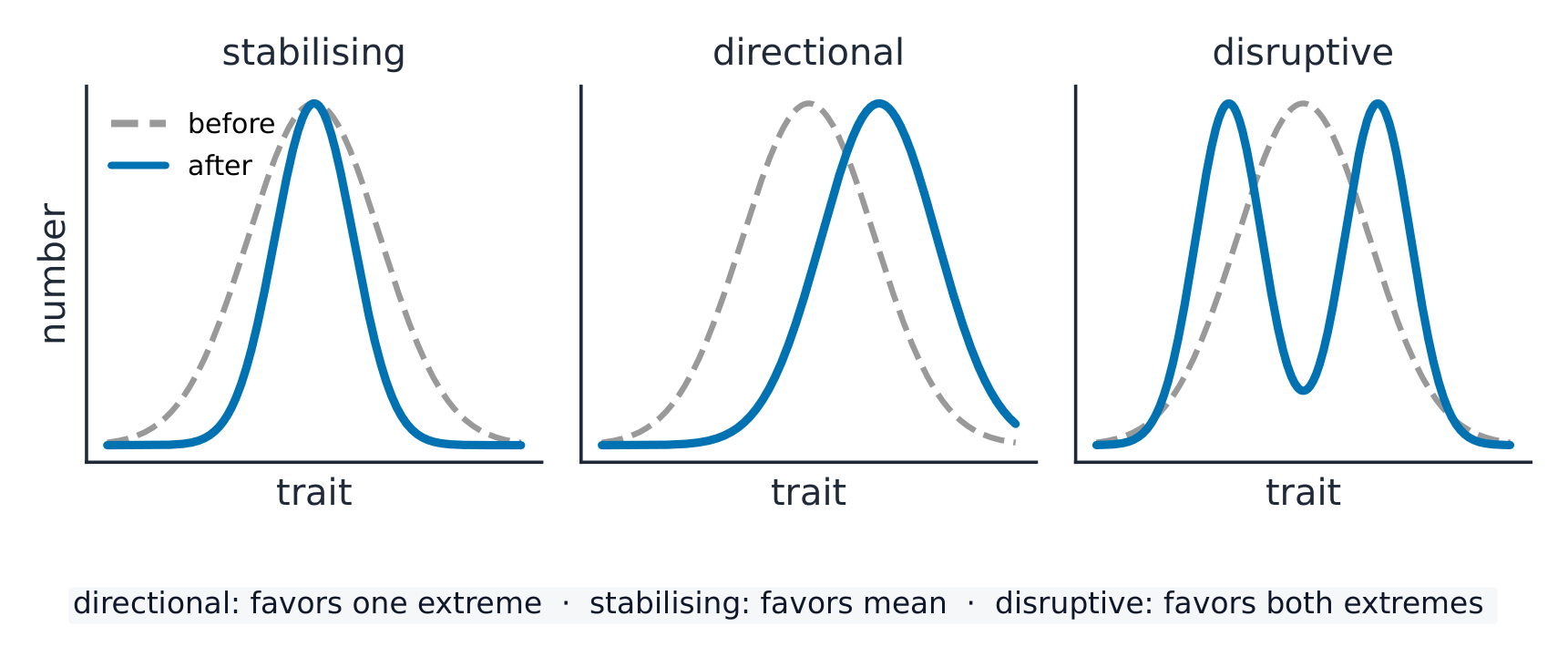
  • stabilising selection 稳定选择 favours the average and removes the extremes (the population stays the same).
  • directional selection 定向选择 favours one extreme, so the mean shifts that way.
  • disruptive selection 分裂选择 favours both extremes and removes the average.

Allele frequencies can also change in other ways:

  • the founder effect 奠基者效应 — a few individuals start a new population, so they carry only some of the alleles of the original group.
  • genetic drift 遗传漂变 — in a small population, allele frequencies change by chance from generation to generation.
  • the bottleneck effect 瓶颈效应 — a sudden fall in population size leaves few survivors, reducing the variety of alleles.

Antibiotic resistance as natural selection

A chance mutation 突变 makes a few bacteria resistant to an antibiotic 抗生素. When the antibiotic is used, the non-resistant bacteria die, but the resistant ones survive and reproduce. Over time the resistance 耐药性 spreads through the population. This is natural selection in action.

עברית
בחירה טבעית: פרפר המזמורה

אוכלוסייה מייצרת צאצאים רבים יותר מאשר יכולים לשרוד, ולכן הצאצאים חייבים להתחרות על משאבים כמו מזון ומרחב. זהו ה"קרב למען הקיום". הפרטים שמתאימים ביותר הם הסבירים ביותר לשרוד, להתרבות ולהעביר את האללים שלהם לדור הבא. לאורך דורות רבים, האללים המועילים נפוצים יותר באוכלוסייה. זהו בחירה טבעית.

שני פרפרי מזמורה יושבים על גזע עץ: פרפר כהה, כמעט שחור, על קליפת העץ בהירה המכוסה בשיחורים בצד שמאל, ופרפר בהיר עם כתמים על קליפה כהה יותר בצד ימין
פרפר המזמורה מדגים בחירה טבעית: הגוף הכהה מסתתר על קליפה כהה ושחומה, בעוד שהגוף בהיר עם כתמים מסתתר על שיחורים בהירים — ציפורים אוכלות כל אחד מהם שעומד בולט

תנאי הסביבה יכולים להפעיל בחירה בשלושה כיוונים:

  • בחירה יציבה מעדיפה את הממוצע ומסירה את הקיצוניות (האוכלוסייה נשארת כפי שהייתה).
  • בחירה כוונית מעדיפה קצה אחד, ולכן הממוצע זז לכיוון זה.
  • בחירה מפרידה מעדיפה את שני הקצוות ומסירה את הממוצע.
שלושה גרפים המשווים התפלגות תכונה לפני ואחרי בחירה: בחירה יציבה הופכת אותה לצרה יותר, כוונית מזיזה אותה לצד אחד, והפרידה מחלקת אותה לשני שיאים
בחירה יציבה מצמצמת את הטווח, כוונית מזיזה את הממוצע, הפרידה מחלקת אותו לשניים

תדירות אללים יכולה להשתנות גם בדרכים אחרות:

  • אפקט המייסדים — מספר מועט של פרטים מתחילים אוכלוסייה חדשה, ולכן הם נושאים רק חלק מהאללים של הקבוצה המקורית.
  • הטיית גנטית — באוכלוסייה קטנה, תדירות אללים משתנה באקראיות מדור לדור.
  • אפקט הבקבוק — ירידה פתאומית בגודל האוכלוסייה משאירה מעט ניצולים, ומצמצמת את מגוון האללים.
אוכלוסייה גדולה עם צבעים רבים עוברת דרך אסון שבו רק מעטים שורדים, ולכן האוכלוסייה שתתחדש תכלול רק צבעים בודדים
בקבוק צוואר: רק מעטים שורדים אסון, ולכן האוכלוסייה שנמשחת תהיה בעלת מגוון גנטי פחות

עמידות לאנטיביוטיקה כבחירה טבעית

מוטציה אקראית גורמת לחלק מהחיידקים להיות עמידים לאנטיביוטיק. כאשר משתמשים באנטיביוטיק, החיידכים שאינם עמידים מתים, אך העמידים שורדים ומתרבים. לאורך הזמן העמידות נפוצה בכל האוכלוסייה. זוהי בחירה טבעית בפעולה.

Explore · ⁨חקור⁩

Natural selection · ⁨בחירה טבעית⁩

Step through Darwin's idea: variation + a selection pressure means the best-adapted survive and pass on their alleles. · ⁨שלב אחר שלב ברעיון של דארווין: מגוון + לחץ בחירה פירושו שהפרטים המותאמים ביותר נשארים בחיים ומעבירים את האללים שלהם.⁩

Vocabulary · ⁨מילון מונחים⁩ Train · ⁨אימון⁩
English עברית
natural selection/ˈnætʃərəl sɪˈlekʃn/ בחירה טבעית
stabilising selection/ˈsteɪbəlaɪzɪŋ sɪˈlekʃn/ בחירה מייצבת
directional selection/daɪˈrekʃənl sɪˈlekʃn/ בחירה כוונית
disruptive selection/dɪsˈrʌptɪv sɪˈlekʃn/ בחירה מפרעתית
founder effect/ˈfaʊndə ɪˈfekt/ אפקט המייסד
genetic drift/dʒɪˈnetɪk drɪft/ נדיפת גנטית
bottleneck effect/ˈbɒtəlnek ɪˈfekt/ אפקט צוואר הבקבוק
mutation/mjuːˈteɪʃn/ מוטציה
antibiotic/ˌæntɪbaɪˈɒtɪk/ אנטיביוטיק
resistance/rɪˈzɪstəns/ התנגדות
Hardy–Weinberg principle/ˈhɑːdi ˈwaɪnbɜːɡ ˈprɪnsɪpl/ עקרון הרדי-וויינברג
allele frequency/əˈliːl ˈfriːkwənsi/ תדירות אלל
genotype/ˈdʒenətaɪp/ גנוטיפ
Watch lesson · ⁨צפה בשיעור⁩
17.2

The Hardy–Weinberg principle · ⁨עקרון הרדי-ויינברג⁩

English

The Hardy–Weinberg principle 哈迪-温伯格原理 lets you calculate the allele frequencies 等位基因频率 and genotype 基因型 frequencies in a population. It only holds true when there is a large population, mating is random, and there is no mutation, no migration and no natural selection.

Call the frequency of the dominant allele $p$ and the frequency of the recessive allele $q$. There are only two alleles, so:

$$p + q = 1.$$

The genotype frequencies then add up to 1, where $p^2$ is homozygous dominant, $2pq$ is heterozygous (the carriers), and $q^2$ is homozygous recessive:

$$p^2 + 2pq + q^2 = 1.$$

Worked example. A recessive condition affects $1$ in every $100$ people. Find the frequency of carriers.

Only the homozygous recessive genotype ($q^2$) shows the condition, so $q^2 = \tfrac{1}{100} = 0.01$, giving $q = \sqrt{0.01} = 0.1$. Then $p = 1 - q = 0.9$. The carriers are the heterozygotes:

$$2pq = 2 \times 0.9 \times 0.1 = 0.18.$$

So about $18\%$ of the population are carriers — far more than the $1\%$ who show the condition.

עברית

עקרון הרדי-ווינברג מאפשר לחשב את תדירות האללים ותדירות הגנוטיפים באוכלוסייה. הוא תקף רק כאשר האוכלוסייה גדולה, הזיווג אקראי ואין מוטציות, הגירה או בחירה טבעית.

נסמן את תדירות האלל הדומיננטי ב$p$ ואת תדירות האלל הרצסיבי ב$q$. ישנם רק שני אללים, לכן:

$$p + q = 1.$$

תדירויות הגנוטיפים סוכמות לסך של 1, כאשר $p^2$ הוא הומוזיגוט דומיננטי, $2pq$ הוא הטרוזיגוט (נשאים), ו$q^2$ הוא הומוזיגוט רצסיבי:

$$p^2 + 2pq + q^2 = 1.$$

דוגמה פתורה. מצב רצסיבי פוגע ב$1$ מכל $100$ אנשים. מצאו את תדירות הנשאים.

רק גנוטיפ ההומוזיגוט הרצסיבי ($q^2$) מבטא את המצב, ולכן $q^2 = \tfrac{1}{100} = 0.01$, מה שמוביל ל$q = \sqrt{0.01} = 0.1$. לאחר מכן $p = 1 - q = 0.9$. הנשאים הם ההטרוזיגוטים:

$$2pq = 2 \times 0.9 \times 0.1 = 0.18.$$

לכן כ-$18\%$ מאוכלוסיית האנשים הם נשאים — הרבה יותר מהמספר $1\%$ שמבטא את המצב.

עקרון הרדי-ווינברג: תדירות אללים p ו-q נותנות תדירות גנוטיפים p², 2pq, q²
17.2

Selective breeding (artificial selection) · ⁨גידול נבחר (בחירה מלאכותית)⁩

English

In selective breeding 选择育种, also called artificial selection 人工选择, humans (not nature) choose which organisms breed, so that useful features are passed on. Examples:

  • breeding disease resistance 抗病性 into varieties of wheat and rice.
  • using inbreeding 近交 and hybridisation 杂交 (crossing different lines) to make vigorous, uniform maize.
  • breeding dairy cattle to improve their milk yield 产量.
עברית

בגידול נבחר, הנקרא גם בחירה מלאכותית, בני אדם (ולא הטבע) בוחרים אילו אורגניזמים יתרבו, כדי שהמאפיינים המועילים יועברו לדור הבא. דוגמאות:

  • הבראת עמידות למחלות בזני חיטה ואורז.
  • שימוש באינברידינג ובהיברידיזציה (חציבה בין קווים שונים) ליצירת תירס חזק ואחיד.
  • הבראת בקר חלבי כדי לשפר את התפוקה של החלב שלהם.

שלושה דורות של פרטים: בכל פעם רק אלו עם המאפיין הרצוי (ירוק) מתרבים, ולכן אחוז הירוק עולה עד שכל הגוון מקבל את המאפיין *גידול נבחר: בחירה רק בטובים ביותר להתרבות בכל דור הופכת את המאפיין הרצוי לתכונה נפוצה越来越

Explore · ⁨חקור⁩

Selective breeding · ⁨הבראה מובחרת⁩

Step through it. Humans take the role of the environment — choosing the breeders, generation after generation. · ⁨צעדו תהליך זה. בני האדם לוקחים על עצמם את תפקיד הסביבה — בוחרים את המכפילים, דור אחר דור.⁩

Vocabulary · ⁨מילון מונחים⁩ Train · ⁨אימון⁩
English עברית
selective breeding/sɪˈlektɪv ˈbriːdɪŋ/ הbreeding בחירה
artificial selection/ˌɑːtɪˈfɪʃl sɪˈlekʃn/ בחירה מלאכותית
disease resistance/dɪˈziːz rɪˈzɪstəns/ עמידות למחלות
inbreeding/ˈɪnbriːdɪŋ/ אינסול
hybridisation/ˌhaɪbrɪdaɪˈzeɪʃn/ היברידיזציה
yield/jiːld/ תפוקה
evolution/ɪvəˈluːʃn/ אבולוציה
species/ˈspiːsiːz/ מין
gene pool/dʒiːn puːl/ מאגר גנים
sequence/ˈsiːkwəns/ רצף
17.3

Evolution · ⁨התפתחות⁩

Syllabus · ⁨סיילבוס⁩
English
  1. outline the theory of evolution as a process leading to the formation of new species from pre-existing species over time, as a result of changes to gene pools from generation to generation
  2. discuss how DNA sequence data can show evolutionary relationships between species
  3. explain how speciation may occur as a result of genetic isolation by: • geographical separation (allopatric speciation) • ecological and behavioural separation (sympatric speciation)
עברית
  1. תאר את תורת האבולוציה כתהליך המוביל ליצירת מינים חדשים ממינים קיימים לאורך זמן, כתוצאה משינויים במאגרי הגנים מדור לדור
  2. דן כיצבנתוני רצף DNA יכולים להציג קשרים אבולוציוניים בין מינים
  3. הסבר כיצד סוגינה עשויה להתרחש כתוצאה מבידוד גנטי על ידי: • הפרדה גיאוגרפית (סוגינה אלופטרית) • הפרדה אקולוגית והתנהגותית (סוגינה סימטרית)

Source: Cambridge International syllabus · ⁨מקור: הסיילבוס הבינלאומי של קמבריד'ג'⁩

English

Evolution 进化 is the slow formation of new species 物种 from earlier ones, as the gene pool 基因库 (all the alleles in a population) changes from generation to generation.

DNA sequence 序列 data can show how closely related two species are: the more similar their DNA sequences, the more recently they shared a common ancestor.

Speciation 物种形成 happens when two populations become genetically separated, so they can no longer breed together. This genetic isolation 隔离 can come about in two ways:

  • allopatric speciation 异域物种形成 — the populations are kept apart by a geographical separation 地理隔离, such as a sea or a mountain range.
  • sympatric speciation 同域物种形成 — the populations live in the same area but are separated by differences in behaviour or way of life.
עברית

התפתחות היא יצירה איטית של מינים חדשים ממינים קודמים, כאשר בנק האללים (כל האללים באוכלוסייה) משתנה מדור לדור.

נתוני רצף DNA יכולים להראות כמה שני מינים קרובים זה לזה: ככל שהרצפים שלהם דומים יותר, כך שיתפו אב קדמון משותף לפני זמן קצר יותר.

ספציאציה מתרחשת כאשר שתי אוכלוסיות הופכות מבודדות גנטית, כך שהן לא יכולות עוד להתרבות זו עם זו. בידוד גנטי זה יכול לקרות בשתי דרכים:

  • ספציאציה אלופטרית — האוכלוסיות מופרדות על ידי הפרדה גיאוגרפית, כמו ים או רכס הרים.
  • ספציאציה סימטרית — האוכלוסיות חיות באזור אחד אך מופרדות על ידי הבדלים בהתנהגות או בסגנון חיים.
שתי דרכים למינים חדשים: אלופטרית, שבה מחסום פיזי מפריד את האוכלוסייה, וסימטרית, שבה אוכלוסייה באותו אזור מתפצלת לפי התנהגות
המיון אלו-פטרי דורש מחסום פיזי; המיון סימפטרי מתרחש באותו אזור
Explore · ⁨חקור⁩

Allopatric speciation · ⁨ספיציאציה אלופטרית⁩

Step through it. A barrier splits one population; the two halves diverge until they can no longer interbreed. · ⁨צעדו דרכה. מכשול מפצל אוכלוסייה אחת; השתיים מתפצלים עד שאין יכולות להשתמש בביטוי 'interbreed' יותר.⁩

Vocabulary · ⁨מילון מונחים⁩ Train · ⁨אימון⁩
English עברית
speciation/ˌspiːʃɪˈeɪʃn/ סיווג מינים
isolation/ˌaɪsəˈleɪʃn/ בידוד
allopatric speciation/ˌæləˈpætrɪk ˌspiːʃɪˈeɪʃn/ סיווג מינים אלופטרי
geographical separation/ˌdʒɪəˈɡræfɪkl ˌsepəˈreɪʃn/ הפרדה גיאוגרפית
sympatric speciation/ˈsɪmpətrɪk ˌspiːʃɪˈeɪʃn/ סיווג מינים סימפטרי
Watch lesson · ⁨צפה בשיעור⁩
17.3

Exam tips · ⁨טיפים לבחינות⁩

English
  • Explain natural selection as a sequence: variation → selection pressure → the better-adapted survive and reproduce → allele frequency changes.
  • Use the Hardy–Weinberg equations ($p+q=1$, $p^2+2pq+q^2=1$); $q^2$ is the recessive-phenotype frequency — a common calculation.
  • Distinguish stabilising, directional and disruptive selection with an example of each.
  • Distinguish allopatric vs sympatric speciation (geographic vs reproductive isolation).
עברית
  • הסבר את הבחירה הטבעית כסדרה: מגוון → לחץ בחירה → הטובים בהתאמה חיים ומתבגרים → תדירות האללים משתנה.
  • השתמש במשוואות הרדי-ויינברג ($p+q=1$, $p^2+2pq+q^2=1$); $q^2$ היא תדורת הפנוטיפ הרצסיבי — חישוב נפוץ.
  • הבדל בין בחירה יציבה, כוונית ומוערת עם דוגמה לכל אחת.
  • הבדל בין מיון אלו-פטרי מול סימפטרי (בידוד גיאוגרפי מול רפרודוקטיבי).

Interactive lessons on this topic · ⁨שיעורים אינטראקטיביים בנושא זה⁩

Work through it step by step, with instant-check exercises. · ⁨לעבור על הדברים צעד אחר צעד, עם תרגילים לבדיקה מיידית.⁩

Past Papers · ⁨מבחני עבר⁩

More topics in A-Level Biology · ⁨ביולוגיה A-Level⁩ · ⁨נושאים נוספים בA-Level Biology · ⁨ביולוגיה A-Level⁩⁩

Log in or create account · ⁨היכנס או צור חשבון⁩

IGCSE, A-Level & AP