English
- describe the relationship between the structure of chloroplasts, as shown in diagrams and electron micrographs, and their function
- explain that energy transferred as ATP and reduced NADP from the light-dependent stage is used during the light-independent stage (Calvin cycle) of photosynthesis to produce complex organic molecules
- state that within a chloroplast, the thylakoids (thylakoid membranes and thylakoid spaces), which occur in stacks called grana, are the site of the light-dependent stage and the stroma is the site of the light-independent stage
- describe the role of chloroplast pigments (chlorophyll a, chlorophyll b, carotene and xanthophyll) in light absorption in thylakoids
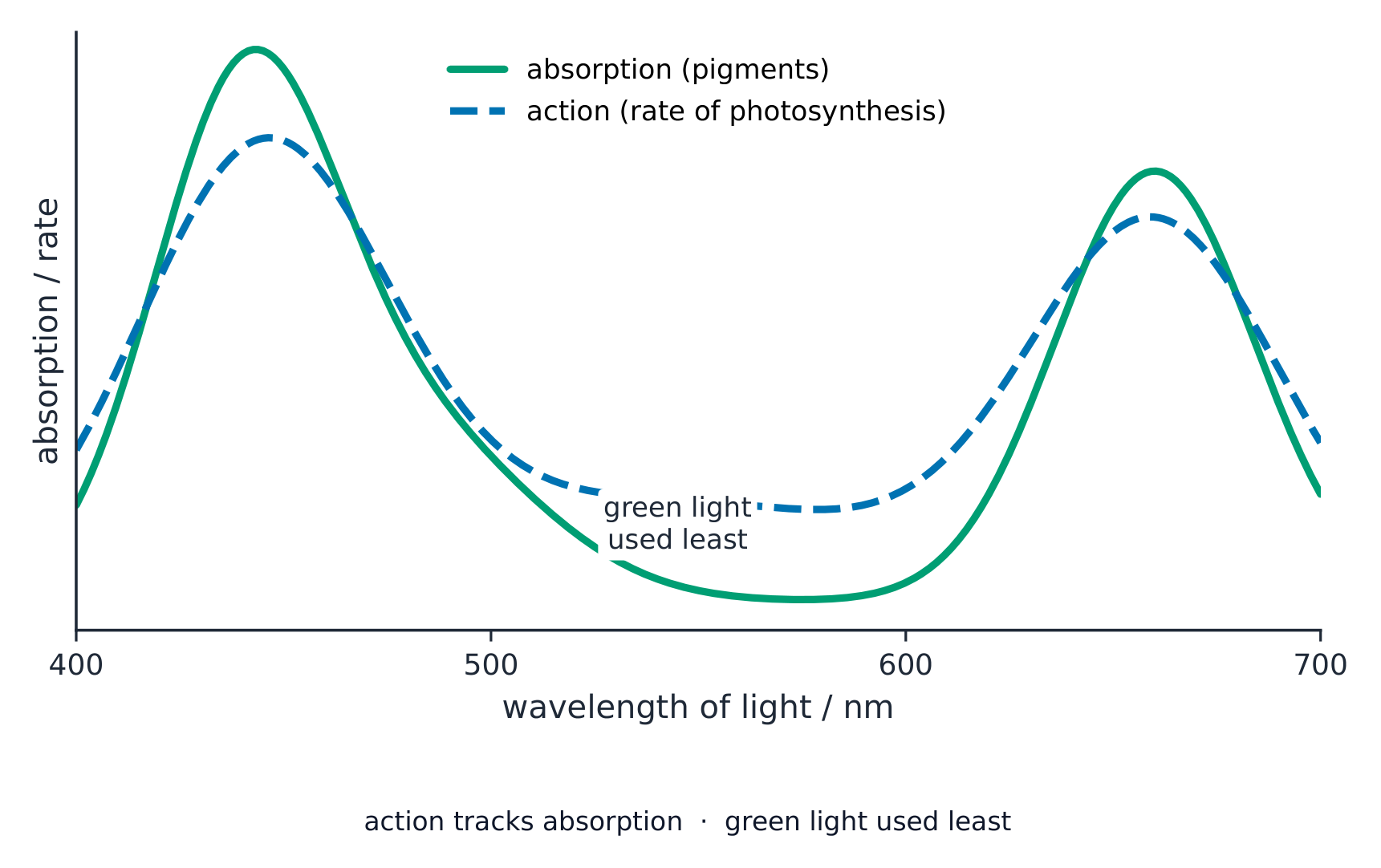
- interpret absorption spectra of chloroplast pigments and action spectra for photosynthesis
- describe and use chromatography to separate and identify chloroplast pigments (reference should be made to $R_f$ values in identification of chloroplast pigments)
- state that cyclic photophosphorylation and non-cyclic photophosphorylation occur during the light-dependent stage of photosynthesis
- explain that in cyclic photophosphorylation: • only photosystem I (PSI) is involved • photoactivation of chlorophyll occurs • ATP is synthesised
- explain that in non-cyclic photophosphorylation: • photosystem I (PSI) and photosystem II (PSII) are both involved • photoactivation of chlorophyll occurs • the oxygen-evolving complex catalyses the photolysis of water • ATP and reduced NADP are synthesised
- explain that during photophosphorylation: • energetic electrons release energy as they pass through the electron transport chain (details of carriers are not expected) • the released energy is used to transfer protons across the thylakoid membrane • protons return to the stroma from the thylakoid space by facilitated diffusion through ATP synthase, providing energy for ATP synthesis (details of ATP synthase are not expected)
- outline the three main stages of the Calvin cycle: • rubisco catalyses the fixation of carbon dioxide by combination with a molecule of ribulose bisphosphate (RuBP), a 5C compound, to yield two molecules of glycerate 3-phosphate (GP), a 3C compound • GP is reduced to triose phosphate (TP) in reactions involving reduced NADP and ATP • RuBP is regenerated from TP in reactions that use ATP
- state that Calvin cycle intermediates are used to produce other molecules, limited to GP to produce some amino acids and TP to produce carbohydrates, lipids and amino acids
עברית
- תאר את הקשר בין מבנה כלורופלאסטים, כפי שמוצג בתרשימים ובתמונות מיקרוסקופ אלקטרונים, לתפקודם
- הסבר כי האנרגיה המועברת כ-ATP ו-NADP מופחת מהשלב התלוי באור משמשת במהלך השלב הבלתי תלוי באור (מחזור קלבין) בפוטוסינתזה ליצירת מולקולות אורגניות מורכבות
- ציין כי בתוך כלורופלאסט, ה-תילאקואידים (ממברנות תילאקואיד וחללי תילאקואיד), הנמצאים בערימות הנקראות גרנות, הם המקום של השלב התלוי באור וה-סטרמה היא המקום של השלב הבלתי תלוי באור
- תאר את תפקיד הפיגמנטים בכלורופלאסט (כלורופיל a, כלורופיל b, קרוטן ו-קסנטופיל) בקליטת אור בתילאקואידים
- פרש ספקטרומי ספיגה של פיגמנטים בכלורופלאסט וספקטרומי פעולה לפוטוסינתזה
- תאר ונצל בכרומטוגרפיה להפרדה ולזיהוי פיגמנטים בכלורופלאסט (יש להתייחס לערכי $R_f$ בזיהוי פיגמנטים בכלורופלאסט)
- ציין כי פוספורילציה פוטונית מחזורית ופוספורילציה פוטונית לא-מחזורית מתרחשות במהלך השלב התלוי באור בפוטוסינתזה
- הסבר כי בפוספורילציה פוטונית מחזורית: • רק פוטוסיסטמה I (PSI) מעורבת • מתרחשת פוטואקטיבציה של כלורופיל • ATP מיוצר
- הסביר כי בפוספורילציה פוטו-לא-סיקלית: • פוטוסיסטמה I (PSI) ופוטוסיסטמה II (PSII) מעורבות בשתייה • מתרחשת פוטואקטיבציה של כלורופיל • הקומפלקס המייצר חמצן ממריץ את הפוטוליזה של מים • ATP ו-NADP מצומצם מסונתזות
- הסביר כי במהלך הפוספורילציה הפוטו-אנרגטית: • אלקטרונים אנרגטיים משחררים אנרגיה כאשר הם עוברים לאורך שרשרת הובלת האלקטרונים (פרטי הנשאים אינם נדרשים) • האנרגיה המשוחררת משמשת להעברת פרוטונים דרך ממברנת התילקואיד • פרוטונים חוזרים לסטרומה מהחלל התילקואידי באמצעות דיפוזיה מופעלת דרך ATP סינתאזה, ומספקים אנרגיה לסינתזת ATP (פרטי ה-ATP סינתאזה אינם נדרשים)
- סקור את שלושת השלבים העיקריים של מחזור קלווין: • רוביסקו ממריץ את קיבוע פחמן dioxide על ידי התחברות עם מולקולה של ריבוזול bisphosphate (RuBP), תרכובת בעלת 5C, כדי לייצר שני מולקולות של גליצראט 3-פוספט (GP), תרכובת בעלת 3C • GP מוצמצם לתריוז פוספט (TP) בתגובות המעורבות ב-NADP מצומצם וב-ATP • RuBP מוחזר מאת TP בתגובות המשתמשות ב-ATP
- ציין שאמצעי מחזור קלווין משמשים ליצירת מולקולות אחרות, מוגבלים ל-GP ליצירת מספר חומצות אמינו ול-TP ליצירת פחמימות, ליפידים וחומצות אמינו