Skip to content · ⁨Passer au contenu⁩
Subjects · ⁨Sujets⁩
  • 1 The verb to be · ⁨Le verbe to be⁩
    1.1

    am / is / are

    English

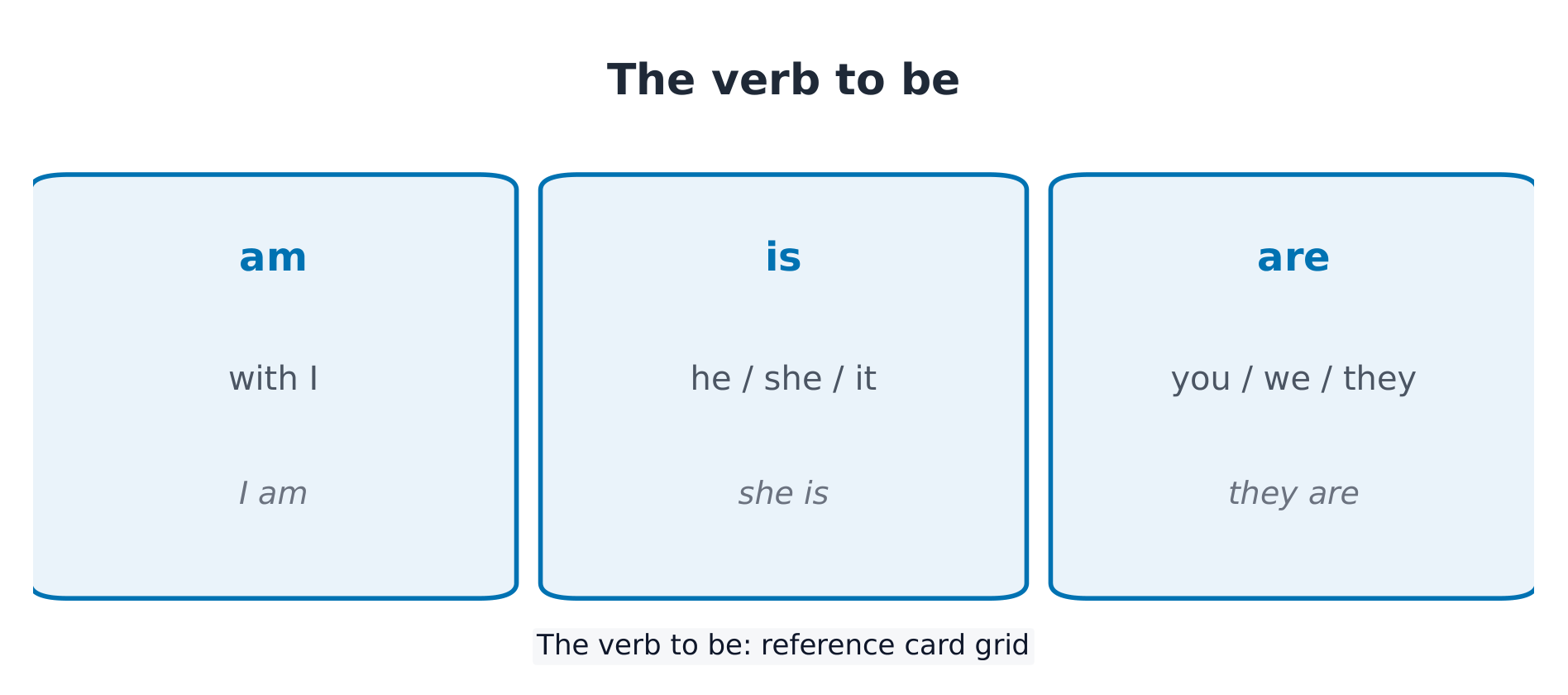
    The verb "to be" means "is / am / are." It changes according to the subject and has three forms:

    • I → am
    • he / she / it → is
    • you / we / they → are

    我I 是am 一名a 学生student.

    I am a student.

    她She 是is 开心happy.

    She is happy.

    他们They (是)are 来自from 中国China.

    They are from China.

    Note: Common spoken contractions: I'm, you're, he's, she's, it's, we're, they're.

    Français
    verbe to be : am / is / are varient selon le sujet

    Le verbe to be (le verbe être) signifie "être / se trouver". Il varie selon le sujet et possède trois formes :

    • I → am
    • he / she / it → is
    • you / we / they → are

    我I 是am 一名a 学生student.

    我是一名学生。

    她She 是is 开心happy.

    她很开心。

    他们They (是)are 来自from 中国China.

    他们来自中国。

    Remarque Les contractions courantes à l'oral sont : I'm, you're, he's, she's, it's, we're, they're.
    1.2

    否定与疑问

    English

    Negation: Add not after the be verb (often contracted).

    他He 不是is not 一名a 老师teacher.

    He is not a teacher. (= He isn't a teacher.)

    Interrogative: Place the be verb before the subject.

    (是吗)Are 你you 准备好ready?

    Are you ready?

    Short answers: Yes, I am. / No, I'm not.

    Note: Negative contractions: is not → isn't, are not → aren't; but am not is only contracted to I'm not (there is no ~~amn't~~).

    Common Errors

    • ❌ ~~He busy.~~ → ✓ He is busy. — In Chinese, "He is very busy" can exist without a verb, but an English sentence must have a verb. Use be to link when the predicative is an adjective or noun and there are no other verbs in the sentence (He is busy); do not add be if the sentence already contains an ordinary verb (I go to school).
    • ❌ ~~I am go to school.~~ → ✓ I go to school. — Do not use be and ordinary verbs together; "go" alone suffices for "to go."
    • ❌ ~~They is my friends.~~ → ✓ They are my friends. — Plural subjects (you / we / they) take are.
    • ❌ ~~I am agree.~~ → ✓ I agree. — agree is itself a verb; do not add am before it.
    • ❌ ~~Are you ready? — Yes, I'm.~~ → ✓ Yes, I am. — Contractions cannot be used at the end of affirmative short answers (say Yes, I am); however, negative short answers typically end with a negative contraction (No, he isn't / No, I can't; first person is No, I'm not, as there is no amn't).
    Français

    Négation : ajoutez not après le verbe to be (souvent abrégé).

    他He 不是is not 一名a 老师teacher.

    Il n'est pas professeur. (= He isn't a teacher.)

    Question : placez le verbe to be avant le sujet.

    (是吗)Are 你you 准备好ready?

    你准备好了吗?

    Réponses courtes :Yes, I am. / No, I'm not.

    Remarque Contractions négatives : is not → isn't, are not → aren't ; mais am not ne s'abrège qu'en I'm not (pas ~~amn't~~).

    常见错误

    • ❌ ~~He busy.~~ → ✓ He is busy. — En chinois, "il est très occupé" peut exister sans verbe, mais une phrase anglaise doit en avoir un. On utilise to be pour relier un attribut adjectival ou nominal quand il n'y a pas d'autre verbe (He is busy) ; si la phrase contient déjà un verbe ordinaire, on n'ajoute pas to be (I go to school).
    • ❌ ~~I am go to school.~~ → ✓ I go to school. — to be et un verbe ordinaire ne peuvent pas s'empiler ; "aller" se dit simplement go.
    • ❌ ~~They is my friends.~~ → ✓ They are my friends. — Les sujets pluriels (you / we / they) prennent are.
    • ❌ ~~I am agree.~~ → ✓ I agree. — agree (s'accorder) est déjà un verbe, on n'ajoute pas am devant.
    • ❌ ~~Are you ready? — Yes, I'm.~~ → ✓ Yes, I am. — La fin d'une réponse courte affirmative ne prend pas de contraction (on dit Yes, I am) ; mais la fin d'une réponse courte négative prend généralement une contraction négative (No, he isn't / No, I can't ; pour la première personne, c'est No, I'm not, car il n'existe pas de amn't).
  • 2 Subject pronouns · ⁨Pronoms sujets⁩
    2.1

    I, you, he, she, it, we, they

    English

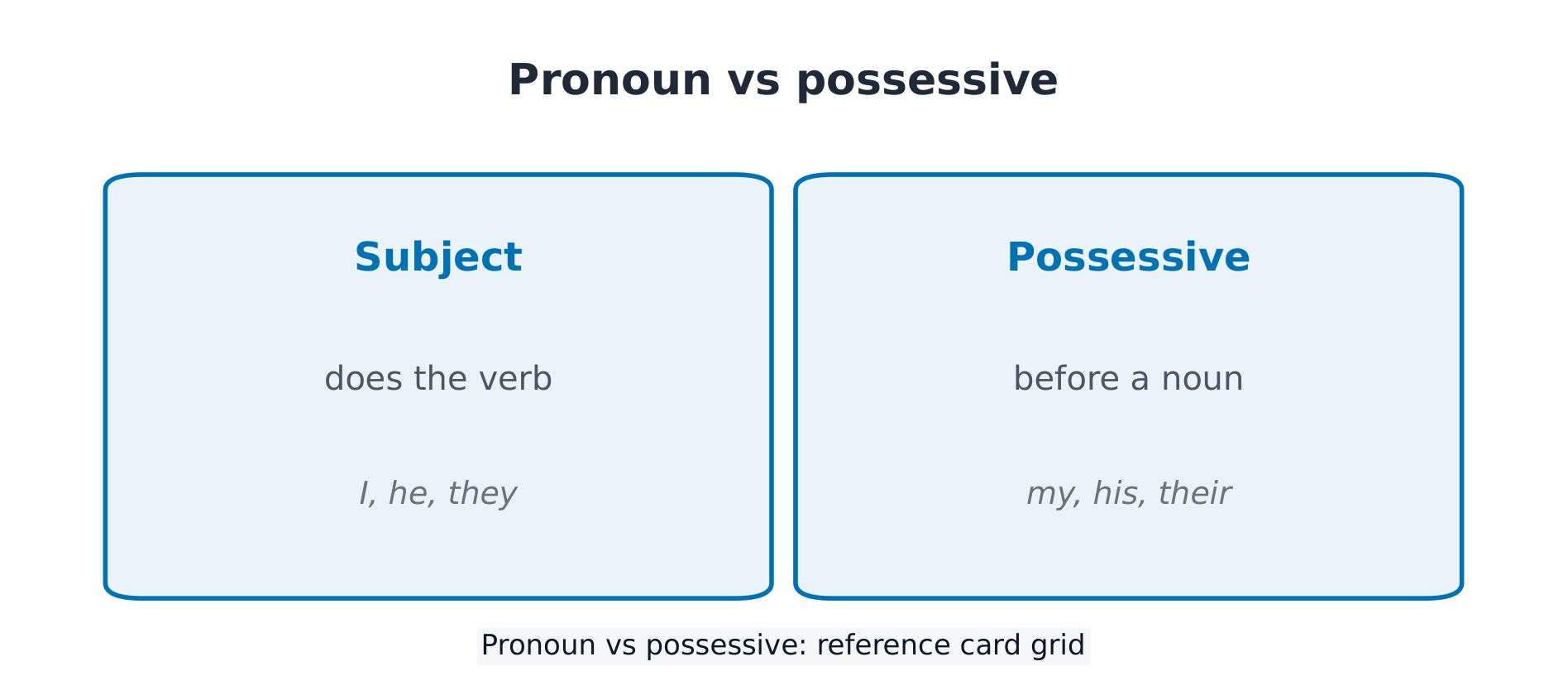
    Subject pronouns replace the subject and are placed before the verb:

    • I(I), you(you), he(he), she(she)
    • it(it), we(we), they(they)

    他He 是is 我的my 哥哥brother.

    He is my brother.

    我们We 喜欢like 音乐music.

    We like music.

    Key Usage Points:

    • I is always capitalized, regardless of its position in the sentence.
    • Things and animals commonly use it: This is my bag. It is new.(This is my bag. It is new.)*
    • Plural people or things both use they: The books are here. They are mine.(The books are here. They are mine.)*

    Note: Subject pronouns are followed by verbs; do not confuse them with object pronouns (me, him, her...) which will be learned later.

    Common Errors

    • ❌ ~~My mother is a doctor. He is very kind.~~ → ✓ She is very kind. — In colloquial Chinese, "he/she" sounds identical, but in English, he and she must be clearly distinguished.
    • ❌ ~~Me am a student.~~ → ✓ I am a student. — Use I for the subject, not me.
    • ❌ ~~My friend he is tall.~~ → ✓ My friend is tall. — The subject needs to be mentioned only once; avoid repeating "noun + pronoun" (the Chinese habit of saying "my friend he..." does not apply in English).
    • ❌ ~~Is raining.~~ → ✓ It is raining. — English sentences must have a subject; weather, time, and dates begin with it.
    Français
    主语代词与物主词

    Les pronoms sujets (subject pronouns) remplacent le sujet et se placent devant le verbe :

    • I(je), you(tu / vous), he(il), she(elle)
    • it(il/elle pour animaux/choses), we(nous), they(ils/elles)

    他He 是is 我的my 哥哥brother.

    他是我哥哥。

    我们We 喜欢like 音乐music.

    我们喜欢音乐。

    用法要点:

    • I 永远大写,不管在句子哪里。
    • Pour les objets et les animaux, on utilise souvent it :This is my bag. It is new.(C'est mon sac. C'est neuf.)*
    • Pour les personnes ou objets pluriels, on utilise toujours they:The books are here. They are mine.(Les livres sont ici. Ce sont les miens.)*

    Remarque Le pronom sujet est suivi d'un verbe ; ne pas le confondre avec le pronom objet (me, him, her...) que vous apprendrez plus tard.

    常见错误

    • ❌ ~~My mother is a doctor. He is very kind.~~ → ✓ She is very kind. — À l'oral chinois, "il/elle" se prononce de la même manière, mais en anglais, il faut distinguer clairement he et she.
    • ❌ ~~Me am a student.~~ → ✓ I am a student. — Pour faire office de sujet, utilisez I, pas me.
    • ❌ ~~My friend he is tall.~~ → ✓ My friend is tall. — Le sujet ne se dit qu'une fois ; évitez la répétition "nom + pronom" (l'habitude chinoise de dire "mon ami il..." ne se traduit pas en anglais).
    • ❌ ~~Is raining.~~ → ✓ It is raining. — Une phrase anglaise doit avoir un sujet ; pour le temps, l'heure ou la date, commencez par it.
  • 3 Possessive adjectives · ⁨Adjectifs possessifs⁩
    3.1

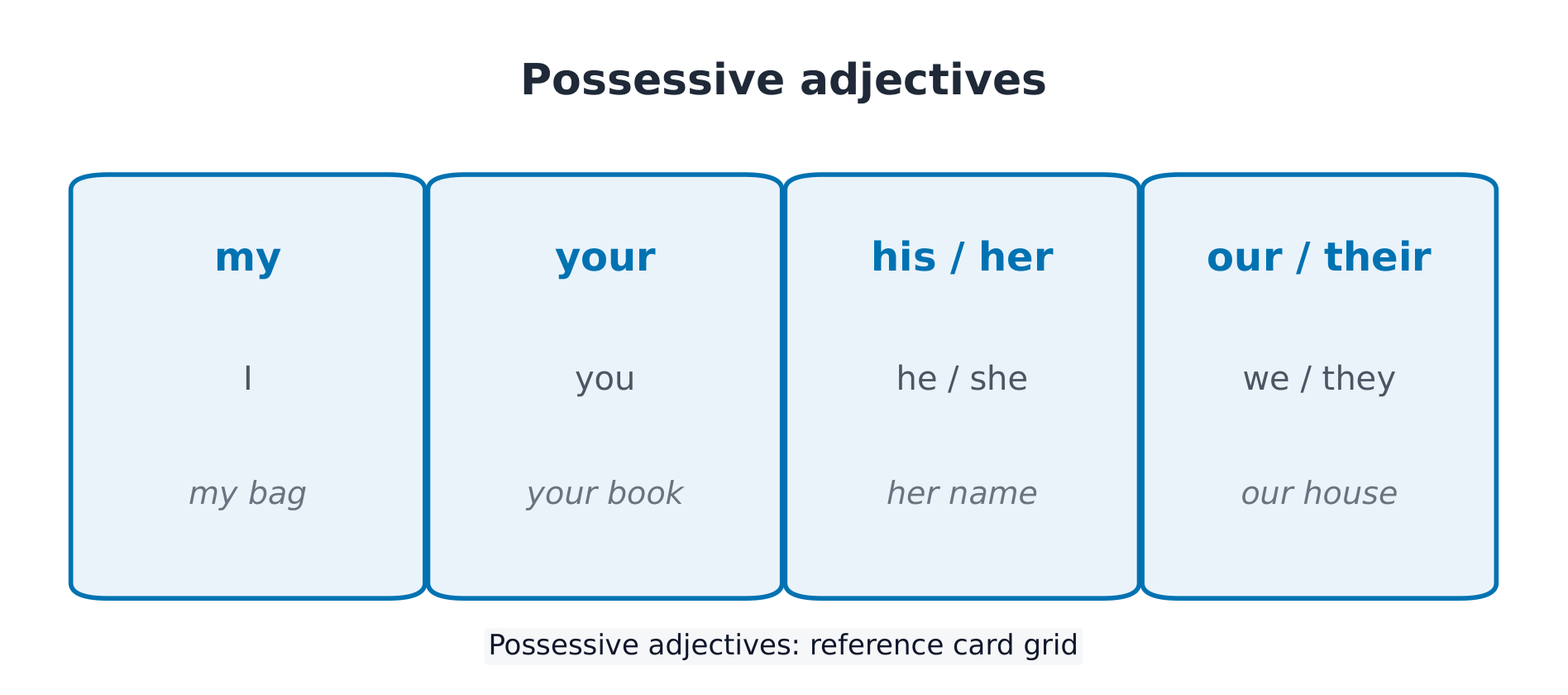
    my, your, his, her, our, their

    English

    Possessive adjectives indicate "whose" and are placed before the noun:

    • I → my(my), you → your(your), he → his(his)
    • she → her(her), it → its(its), we → our(our), they → their(their)

    这This 是is 我的my 包bag.

    This is my bag.

    她的Her 名字name 是is 露西Lucy.

    Her name is Lucy.

    Key Usage Points:

    • Possessive adjectives are always followed by a noun: my book, their house.
    • They do not change with noun number: my book, my books(my remains unchanged).

    Note: Be careful to distinguish its (its, no apostrophe) and it's (= it is). For example: The dog wags its tail.(The dog wags its tail.)*

    Common Errors

    • ❌ ~~This is she book.~~ → ✓ This is her book. — A possessive form must precede a noun: he → his, she → her.
    • ❌ ~~He is me friend.~~ → ✓ He is my friend. — The possessive form of I is my.
    • ❌ ~~The dog wags it's tail.~~ → ✓ …wags its tail. — it's = it is; "its" (possessive) has no apostrophe.
    • ❌ ~~Their is a park near here.~~ → ✓ There is a park near here. — their (their) and there (there/here) sound identical; do not mix them up in writing.
    Français
    adjectifs possessifs : my / your / his / her

    Les adjectifs possessifs (possessive adjectives) signifient "à qui" et se placent devant le nom :

    • I → my(mon/ma), you → your(ton/ta/votre), he → his(son/sa)
    • she → her(sa), it → its(son/sa), we → our(notre/nos), they → their(leur/leurs)

    这This 是is 我的my 包bag.

    这是我的包。

    她的Her 名字name 是is 露西Lucy.

    她的名字叫露西。

    用法要点:

    • Un adjectif possessif est toujours suivi d'un nom : my book, their house.
    • Il ne change pas selon le nombre du nom : my book, my books (my reste inchangé).

    Remarque Faites attention à bien distinguer its(son/sa, sans apostrophe) et it's(= it is). Exemple :The dog wags its tail.(Le chien remue sa queue.)*

    常见错误

    • ❌ ~~This is she book.~~ → ✓ This is her book. — Devant un nom, utilisez la forme possessive : he → his, she → her.
    • ❌ ~~He is me friend.~~ → ✓ He is my friend. — La forme possessive de I est my.
    • ❌ ~~The dog wags it's tail.~~ → ✓ …wags its tail. — it's = it is ; "sa/son" s'écrit its, sans apostrophe.
    • ❌ ~~Their is a park near here.~~ → ✓ There is a park near here. — their (leur/leurs) et there (il y a / là-bas) ont la même prononciation, ne les mélangez pas à l'écrit.
  • 4 this, that, these, those
    4.1

    this et that

    English

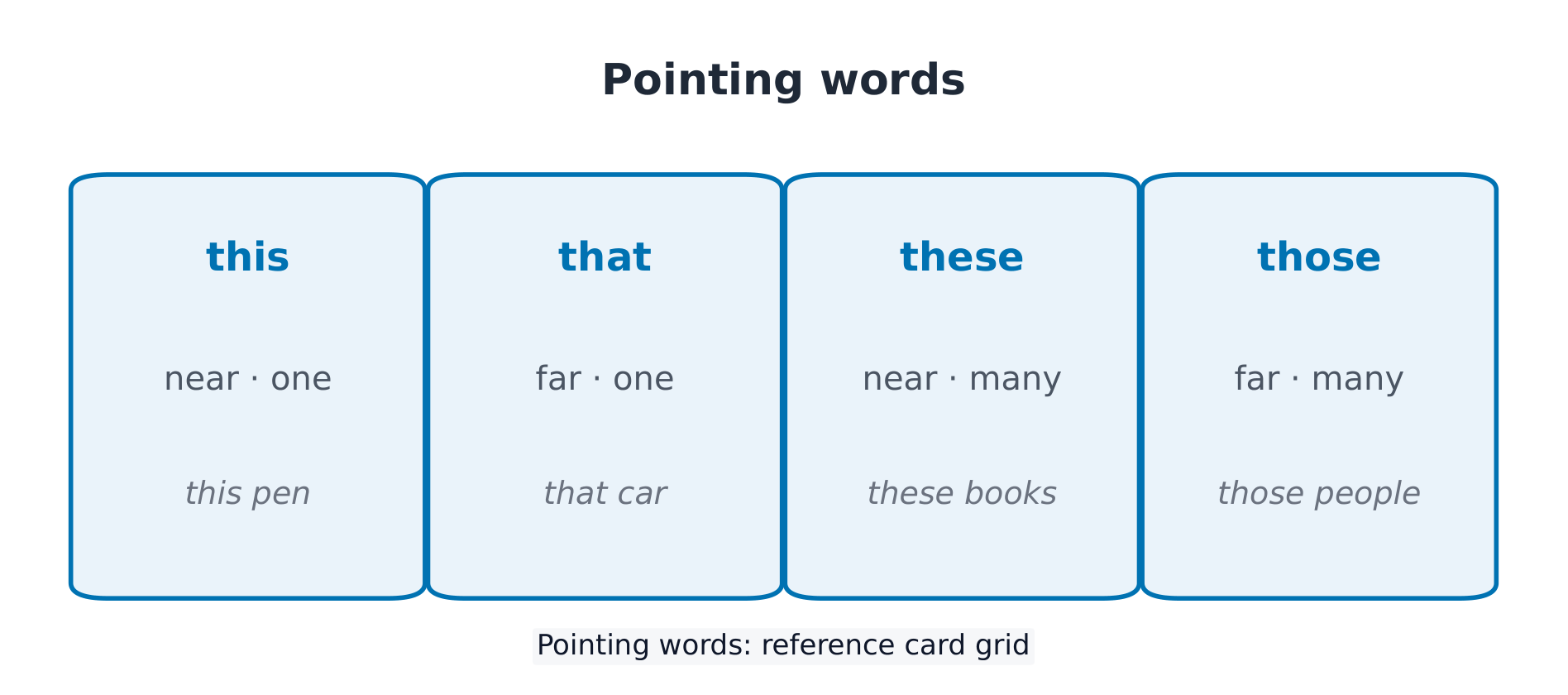
    Demonstratives point out "which one." Use this and that for singular:

    • this(this): Close to the speaker.
    • that(that): Far from the speaker.

    这This 是is 我的my 手机phone.

    This is my phone. (Close)

    那That 是is 你的your 车car.

    That is your car. (Far)

    Français
    proximité/éloignement × singulier/pluriel : this / that / these / those

    Les démonstratifs (demonstratives) indiquent "lequel". Au singulier, on utilise this et that :

    • this(ceci/cette-ci) : proche de celui qui parle.
    • that(cela/celle-là) : éloigné de celui qui parle.

    这This 是is 我的my 手机phone.

    这是我的手机。(近)

    那That 是is 你的your 车car.

    那是你的车。(远)

    4.2

    these et those

    English

    Use these and those for plural:

    • these(these): Close. those(those): Far.

    这些These 是are 我的my 书books.

    These are my books.

    那些Those 是are 她的her 朋友friends.

    Those are her friends.

    Contrastive Memory:

    • Near → this (singular) / these (plural).
    • Far → that (singular) / those (plural).

    Note: These / those are followed by plural nouns: these books, not ~~these book~~.

    Common Errors

    • ❌ ~~these book~~ → ✓ these books — Plural nouns must follow these / those.
    • ❌ ~~This books are mine.~~ → ✓ These books are mine. — If the noun is plural, the demonstrative must also be plural.
    • ❌ When introducing yourself on the phone, say ~~I am Tom.~~ → ✓ This is Tom. — In English, introduce yourself on the phone using this is.
    • Remember pairs: Near this / these are often used with here; far that / those are often used with there.
    Français

    Au pluriel, on utilise these et those :

    • these(ceux-ci/celles-ci) : proche. those(ceux-là/celles-là) : éloigné.

    这些These 是are 我的my 书books.

    这些是我的书。

    那些Those 是are 她的her 朋友friends.

    那些是她的朋友。

    对照记忆:

    • Proche → this (sing.) / these (pl.).
    • Loin → that (sing.) / those (pl.).

    Remarque these / those sont suivis d'un nom pluriel : these books, pas ~~these book~~.

    常见错误

    • ~~these book~~ → ✓ these books — after these / those, on doit toujours mettre un nom au pluriel.
    • ❌ ~~This books are mine.~~ → ✓ These books are mine. — Si le nom est pluriel, le démonstratif doit aussi être au pluriel.
    • ❌ Quand on se présente au téléphone, on ne dit pas ~~I am Tom.~~ → ✓ This is Tom. — En anglais, on se présente au téléphone avec this is.
    • Retenez les paires : this / these (proche) s'utilisent souvent avec here, et that / those (loin) s'utilisent souvent avec there.
  • 5 a, an and plurals · ⁨a, an et pluriels⁩
    5.1

    a et an

    English

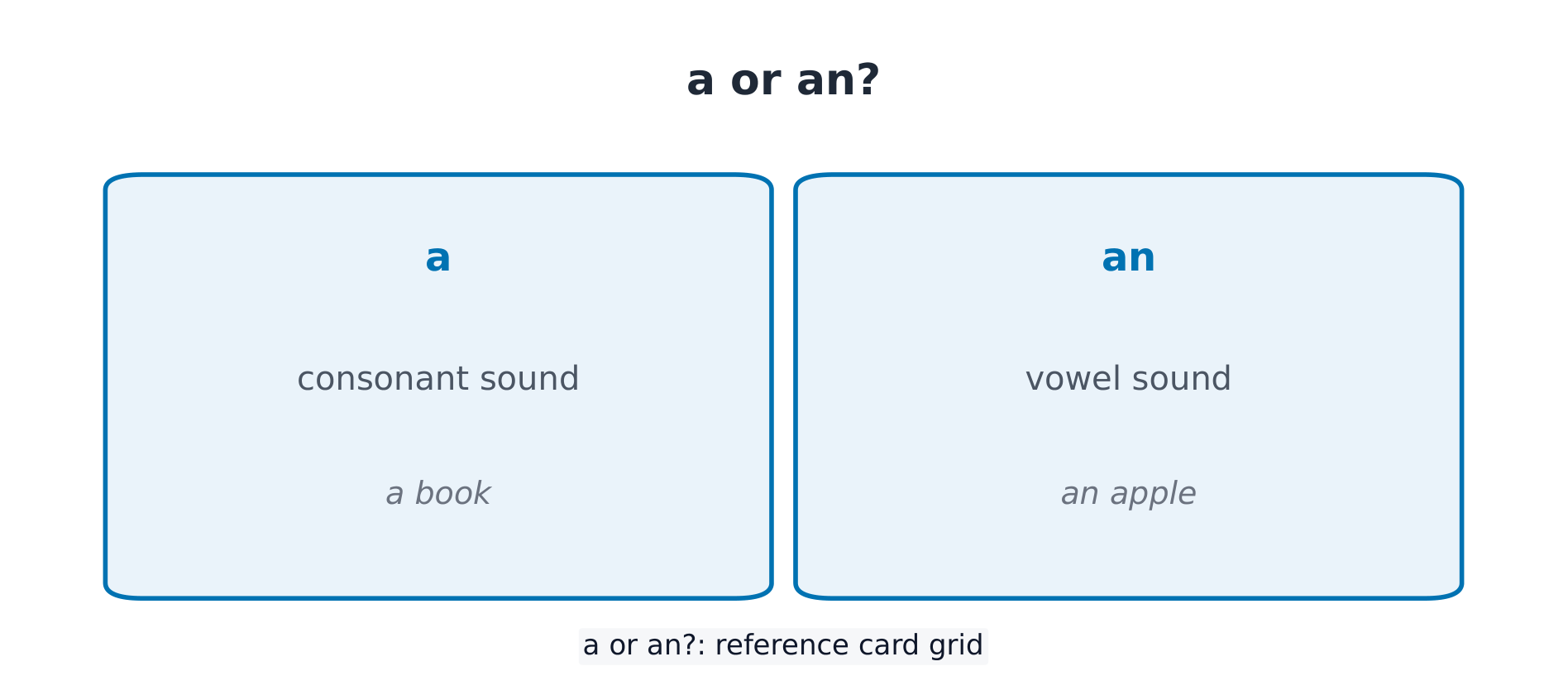
    a and an mean "one" and are used before singular countable nouns. How to choose depends on pronunciation:

    • a + consonant sound: a book, a dog, a cat.
    • an + vowel sound: an apple, an egg, an orange.

    我I 有have 一个a 笔pen.

    I have a pen.

    她She 吃eats 一个an 苹果apple.

    She eats an apple.

    Note: Look at the sound, not the letter: an hour (h is silent), a university (pronounced "yu-").

    Français
    a / an : selon la prononciation (consonne vs voyelle)

    a et an signifient "un/une" et précèdent un nom comptable singulier. Pour choisir, regardez la prononciation :

    • a + son initial consonne : a book, a dog, a cat.
    • an + son initial voyelle : an apple, an egg, an orange.

    我I 有have 一个a 笔pen.

    我有一支笔。

    她She 吃eats 一个an 苹果apple.

    她吃一个苹果。

    Remarque Regardez le son, pas la lettre : an hour (h muet), a university (se prononce "yu-").

    5.2

    名词复数

    English

    To indicate "more than one," use the plural form of the noun, usually adding -s:

    • Generally add -s: book → books, car → cars.
    • Words ending in -s / -sh / -ch / -x add -es: bus → buses, box → boxes.
    • Consonant + y ending: change y to i and add -es: baby → babies, city → cities.

    我I 有have 两two 猫cats.

    I have two cats.

    Irregular plurals (must memorize):

    • man → men, woman → women, child → children.
    • foot → feet, tooth → teeth, person → people.

    Note: Do not use a / an before plural nouns: ~~a books~~ ✗ → books / two books ✓.

    Common Errors

    • ❌ ~~I have dog.~~ → ✓ I have a dog. — In Chinese you can say "I have dogs," but singular countable nouns in English must have a / an (or my, the, etc.) before them.
    • ❌ ~~an university~~ → ✓ a university; ❌ ~~a hour~~ → ✓ an hour — Look at pronunciation, not spelling: university starts with a consonant sound /j/, and h is silent in hour.
    • ❌ ~~two book~~ → ✓ two books — Chinese nouns do not change for plurality, but nouns after numbers in English require -s; this is easily forgotten.
    • ❌ ~~three childs~~ → ✓ three children — Irregular plurals must be memorized separately: men, women, children, feet, teeth, people.
    • ❌ ~~a people~~ → ✓ a person (one person) / people (many people) — people is inherently plural.
    Français

    表示"不止一个"时,名词用复数,通常加 -s:

    • Pluriel régulier avec -s : book → books, car → cars.
    • Se terminant par -s / -sh / -ch / -x / -o, on ajoute -es : bus → buses, box → boxes.
    • Consonne + y final, le y devient i puis on ajoute -es : baby → babies, city → cities.

    我I 有have 两two 猫cats.

    我有两只猫。

    不规则复数(要背):

    • man → men, woman → women, child → children.
    • foot → feet, tooth → teeth, person → people.

    Remarque Ne mettez jamais a / an devant un nom pluriel : ~~a books~~ ✗ → books / two books ✓.

    常见错误

    • ❌ ~~I have dog.~~ → ✓ I have a dog. — En chinois, on peut dire "j'ai un chien", mais en anglais, avant un nom comptable singulier, il faut impérativement a / an (ou my, the, etc.).
    • ❌ ~~an university~~ → ✓ a university ; ❌ ~~a hour~~ → ✓ an hour — Regardez la prononciation, pas l'orthographe : university commence par une consonne /j/, h est muet dans hour.
    • ❌ ~~two book~~ → ✓ two books — Les noms chinois ne changent pas au pluriel, mais en anglais, les noms après un chiffre doivent prendre -s, c'est l'oubli le plus fréquent.
    • ❌ ~~three childs~~ → ✓ three children — Les pluriels irréguliers doivent être appris par cœur : men, women, children, feet, teeth, people.
    • ❌ ~~a people~~ → ✓ a person(une personne) / people(pluriel : des personnes) — people est déjà un pluriel.
  • 6 there is and there are
    6.1

    单数与复数

    English

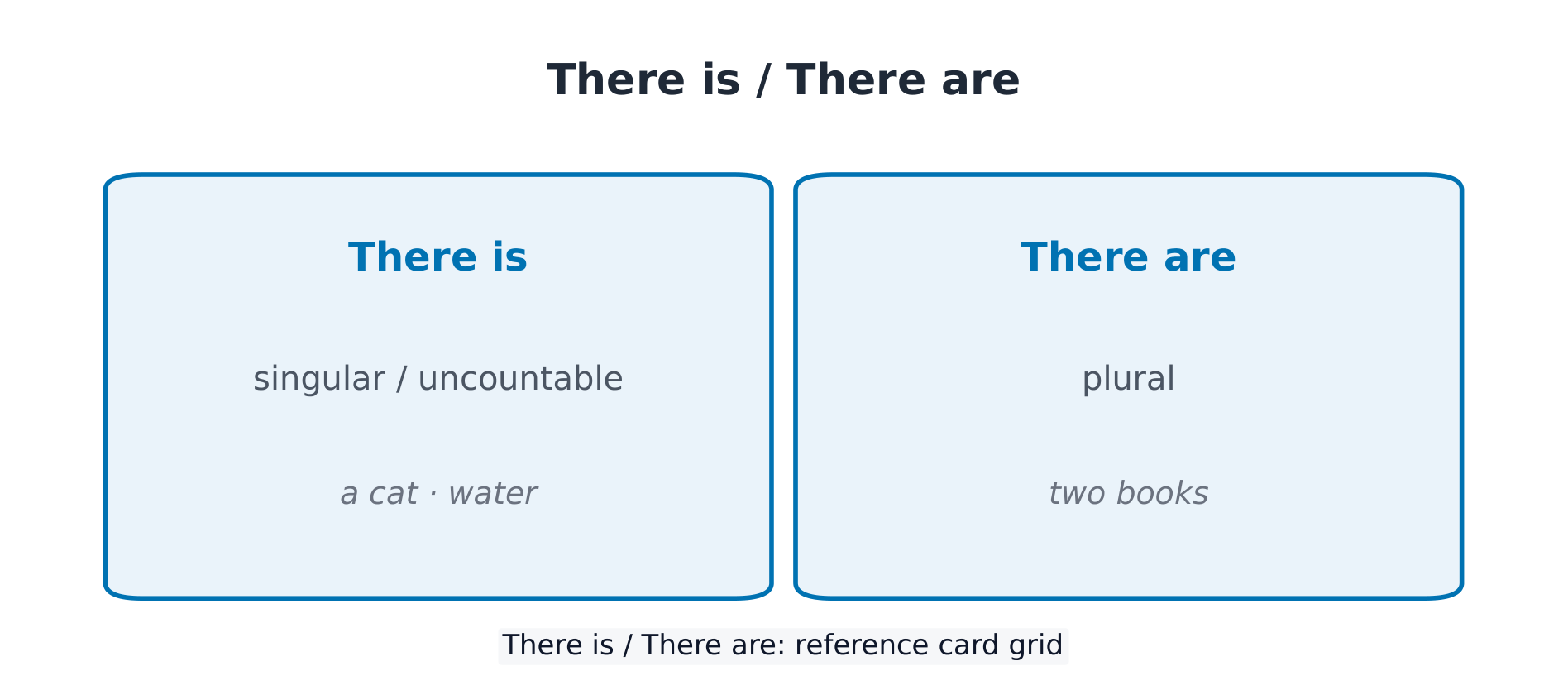
    there is / there are means "there exists" (something exists somewhere).

    • There is + singular / uncountable noun: There is a book.
    • There are + plural noun: There are two books.

    (有)There 有is 一只a 猫cat 在on (冠词)the 沙发上sofa.

    There is a cat on the sofa.

    (有)There 有are 三three 书books 在on (冠词)the 桌上desk.

    There are three books on the table.

    Note: In spoken English, there is is often contracted to there's: There's a problem.

    Français
    There is (singulier) / There are (pluriel)

    there is / there are signifie "il y a" (existence de quelque part).

    • There is + nom singulier / non comptable : There is a book.
    • There are + nom pluriel : There are two books.

    (有)There 有is 一只a 猫cat 在on (冠词)the 沙发上sofa.

    沙发上有一只猫。

    (有)There 有are 三three 书books 在on (冠词)the 桌上desk.

    桌上有三本书。

    Remarque À l'oral, there is est souvent abrégé en there's : There's a problem.

    6.2

    否定与疑问

    English

    Negative: there is not / there are not (contracted as there isn't / there aren't).

    (有)There 没有isn't 任何any 牛奶milk.

    There is no milk left.

    Question: Move is / are to the front of there.

    (有吗)Is (有)there 一家a 银行bank 附近near 这里here?

    Is there a bank nearby?

    Short answer: Yes, there is. / No, there isn't.

    Note: Use any frequently in negative / question sentences: Is there any water? (Is there any water?)

    Common Errors

    • ❌ ~~Here has many people.~~ → ✓ There are many people here. — The "have" in the Chinese "There are many people here" indicates existence; use there is / there are in English, do not translate literally as have.
    • ❌ ~~There have a book on the desk.~~ → ✓ There is a book on the desk. — Use is / are after there; there have does not exist.
    • ❌ ~~There is two cats.~~ → ✓ There are two cats. — If the following noun is plural, use are.
    • ❌ ~~There are a milk.~~ → ✓ There is some milk. — milk is uncountable: use there is + some, do not use a.
    Français

    Négation : there is not / there are not (abréviations : there isn't / there aren't).

    (有)There 没有isn't 任何any 牛奶milk.

    没有牛奶了。

    Question : placez is / are devant there.

    (有吗)Is (有)there 一家a 银行bank 附近near 这里here?

    这附近有银行吗?

    Réponses courtes :Yes, there is. / No, there isn't.

    Remarque Dans les phrases négatives et interrogatives, on utilise souvent any : Is there any water?(Y a-t-il de l'eau ?)

    常见错误

    • ❌ ~~Here has many people.~~ → ✓ There are many people here. — Le "y a" chinois indique l'existence, en anglais on utilise there is / there are, pas de traduction littérale avec have.
    • ❌ ~~There have a book on the desk.~~ → ✓ There is a book on the desk. — Après there, on utilise is / are, il n'existe pas de construction "there have".
    • ❌ ~~There is two cats.~~ → ✓ There are two cats. — Si le nom qui suit est pluriel, utilisez are.
    • ❌ ~~There are a milk.~~ → ✓ There is some milk. — milk est non comptable : utilisez there is + some, jamais a.
  • 7 have got
    7.1

    have got / has got

    English

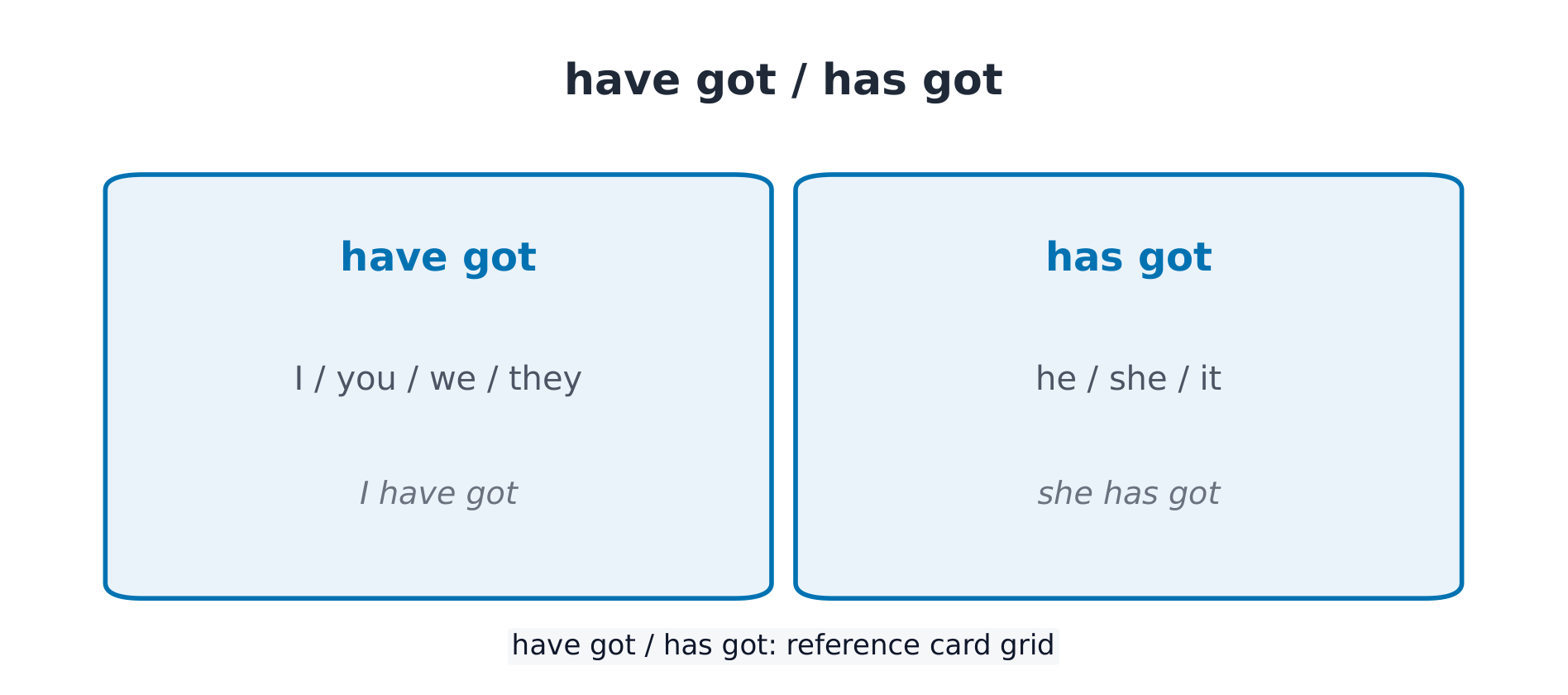
    have got means "to possess" (= have), common in British English.

    • I / you / we / they → have got
    • he / she / it → has got

    我I 有have got 一个a 兄弟brother.

    I have a brother. (= I have a brother.)

    她She 有has got 蓝色blue 眼睛eyes.

    She has blue eyes.

    Note: Often contracted in spoken language: I've got, she's got, they've got. Same meaning as have / has.

    Français
    have got / has got

    have got signifie "avoir" (= have), très courant dans l'anglais britannique.

    • I / you / we / they → have got
    • he / she / it → has got

    我I 有have got 一个a 兄弟brother.

    J'ai un frère. (= I have a brother.)

    她She 有has got 蓝色blue 眼睛eyes.

    她有一双蓝眼睛。

    Remarque À l'oral, on abrège souvent : I've got, she's got, they've got. Sens identique à have / has.

    7.2

    否定与疑问

    English

    Negative: haven't got / hasn't got.

    他He 没有hasn't got 一辆a 车car.

    He doesn't have a car.

    Question: Move Have / Has to the front of the subject.

    (有吗)Have 你you 有got 一支a 笔pen?

    Do you have a pen?

    Short answer: Yes, I have. / No, I haven't.

    Note: have got is mostly used for current possession; for past or habits, use regular have / had.

    Common Errors

    • ❌ ~~She have got long hair.~~ → ✓ She has got long hair. — Use has got for he / she / it.
    • ❌ ~~I have got not a car.~~ → ✓ I haven't got a car. — Place not after have / has, then contract.
    • ❌ ~~Do you have got a pen?~~ → ✓ Have you got a pen? / Do you have a pen? — Both question forms are correct, but never mix them.
    • ❌ ~~Yes, I have got.~~ → ✓ Yes, I have. — Short answers end at have / has, without got.
    Français

    Négation : haven't got / hasn't got.

    他He 没有hasn't got 一辆a 车car.

    他没有车。

    Question : placez Have / Has devant le sujet.

    (有吗)Have 你you 有got 一支a 笔pen?

    你有笔吗?

    Réponses courtes :Yes, I have. / No, I haven't.

    Remarque have got sert surtout pour l'état actuel de possession ; pour parler du passé ou d'une habitude, utilisez plutôt have / had.

    常见错误

    • ❌ ~~She have got long hair.~~ → ✓ She has got long hair. — he / she / it prend has got.
    • ❌ ~~I have got not a car.~~ → ✓ I haven't got a car. — not se place après have / has, puis on abrège.
    • ❌ ~~Do you have got a pen?~~ → ✓ Have you got a pen ? / Do you have a pen ? — Les deux tournures sont correctes, mais on ne peut pas les mélanger.
    • ❌ ~~Yes, I have got.~~ → ✓ Yes, I have. — La réponse courte s'arrête à have / has, sans rajouter got.
  • 8 Present simple · ⁨Présent simple⁩
    8.1

    习惯与第三人称 -s

    English

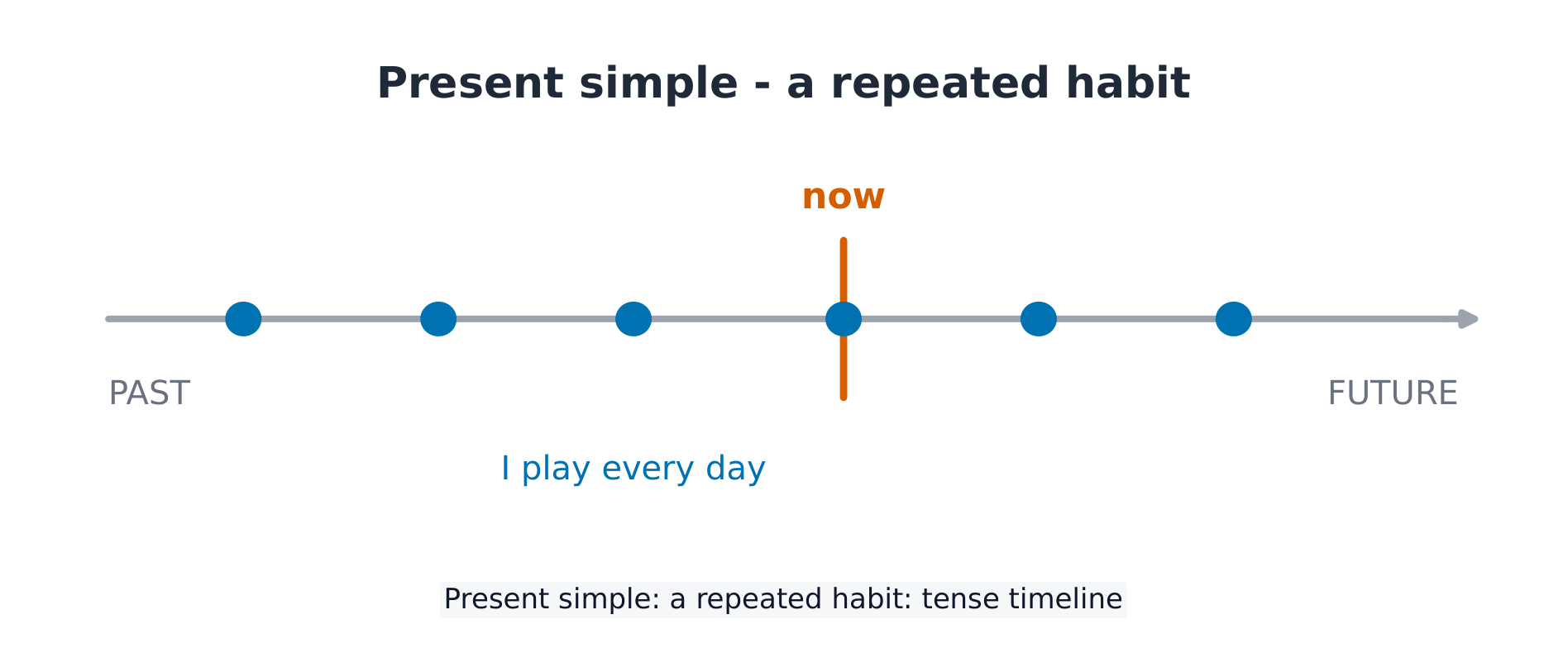
    Present simple (present simple) describes habits and facts. The base form is the infinitive (base verb).

    我I 喜欢like 茶tea.

    I like tea.

    When the subject is he / she / it, add -s to the verb:

    他He 踢plays 足球football.

    He plays football.

    Spelling rules:

    • Generally add -s: like → likes.
    • Words ending in -s / -sh / -ch / -x / -o add -es: go → goes, watch → watches.
    • Consonant + y ending: change y to i and add -es: study → studies.

    Note: Only he / she / it take -s; I / you / we / they use the base form: They like tea.

    Français
    一般现在时:反复的习惯

    Le présent simple (present simple) exprime des habitudes et des faits. La forme de base est le verbe à l'infinitif.

    我I 喜欢like 茶tea.

    我喜欢茶。

    Quand le sujet est he / she / it, on ajoute -s au verbe :

    他He 踢plays 足球football.

    他踢足球。

    拼写:

    • Pluruel régulier avec -s : like → likes.
    • Se terminant par -s / -sh / -ch / -x / -o, on ajoute -es : go → goes, watch → watches.
    • Consonne + y final, le y devient i puis on ajoute -es : study → studies.

    Remarque Seul he / she / it prend -s ; I / you / we / they gardent la forme de base : They like tea.

    8.2

    否定与疑问

    English

    For negatives and questions, use auxiliary verbs do / does (does for he / she / it).

    Negative: Subject + don't / doesn't + base verb.

    我I 不don't 喜欢like 咖啡coffee.

    I don't like coffee.

    Question: Do / Does + Subject + base verb ?

    (助动词)Does 她she 住live 这里here?

    Does she live here?

    Note: When using do / does, the verb returns to its base form (no -s): ~~Does she lives~~ ✗ → Does she live ✓.

    Common Errors

    • ❌ ~~He go to school by bus.~~ → ✓ He goes to school by bus. — Forgetting to add -s in third person singular is the most frequent error; check your work afterwards.
    • ❌ ~~She doesn't likes coffee.~~ → ✓ She doesn't like coffee. — When using does / doesn't, the verb returns to its base form.
    • ❌ ~~I very like English.~~ → ✓ I like English very much. — "Very much" in Chinese cannot be translated literally; very cannot directly modify a verb.
    • ❌ ~~You like tea?~~ → ✓ Do you like tea? — Questions must start with do / does; rising intonation alone is insufficient.
    Français
    Habitudes quotidiennes : I have breakfast every morning.

    Pour la négation et les questions, utilisez l'auxiliaire do / does (il / elle / cela utilise does).

    Négation : Sujet + don't / doesn't + verbe à l'infinitif.

    我I 不don't 喜欢like 咖啡coffee.

    我不喜欢咖啡。

    Question : Do / Does + sujet + verbe à l'infinitif ?

    (助动词)Does 她she 住live 这里here?

    她住在这里吗?

    Attention : avec do / does, le verbe revient à sa forme originale(sans -s) : ~~Does she lives~~ ✗ → Does she live ✓.

    常见错误

    • ❌ ~~He go to school by bus.~~ → ✓ Il va à l'école en bus. — 忘加 -s 是最高频的错误,写完回头检查一遍。
    • ❌ ~~She doesn't likes coffee.~~ → ✓ Elle ne aime pas le café. — 用了 does / doesn't,动词就回到原形。
    • ❌ ~~I very like English.~~ → ✓ J'aime beaucoup l'anglais. — 中文"很喜欢"不能直译;very 不能直接修饰动词。
    • ❌ ~~You like tea?~~ → ✓ Aimes-tu du thé ? — 疑问句要用 do / does 开头,不能只靠语调上扬。
  • 9 can
    9.1

    能力与请求

    English

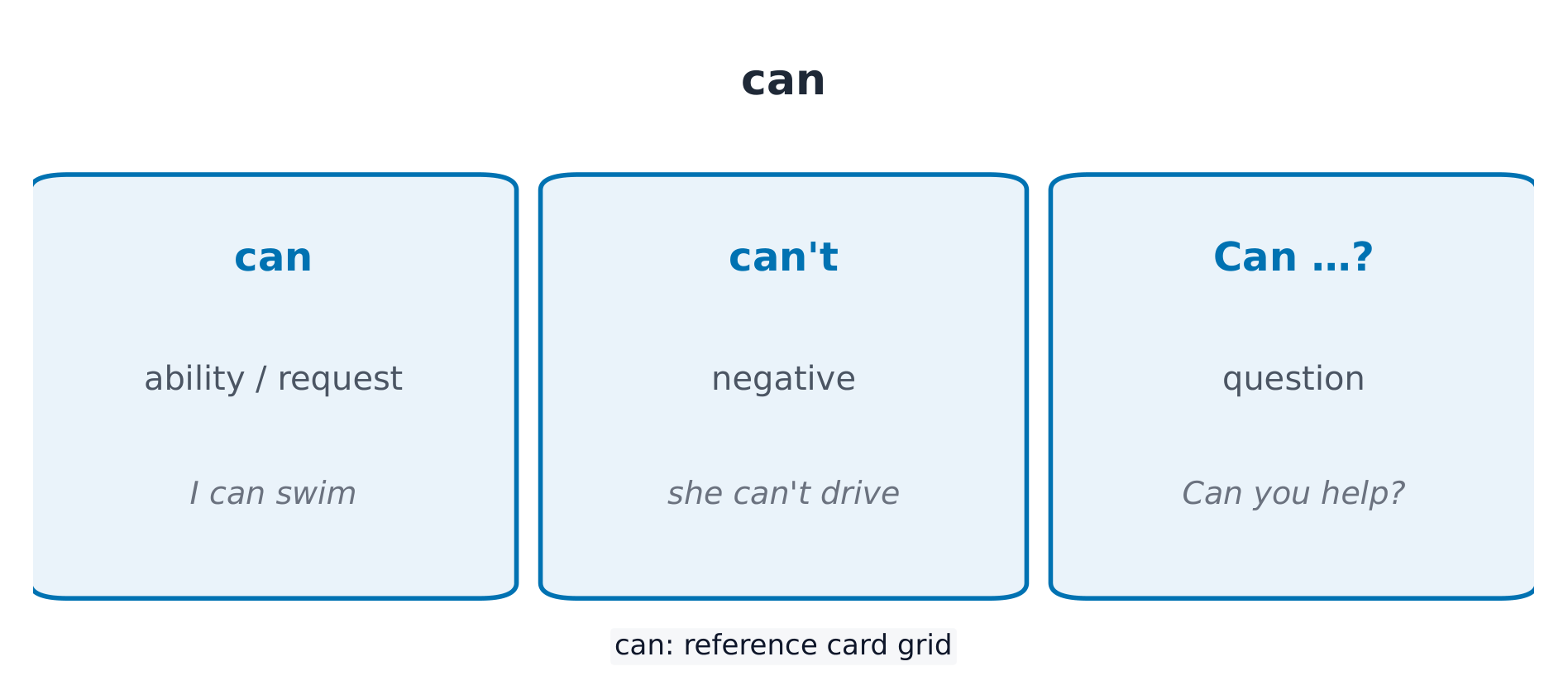
    can expresses ability ("know how to / be able to") or is used for requests. It is followed by the base form of the verb, and remains the same for all persons.

    我I 会can 游泳swim.

    I can swim.

    能Can 你you 帮help 我me?

    Can you help me?

    Note: Use the base form after can: ~~can to swim~~ ✗, ~~can swims~~ ✗ → can swim ✓.

    Français
    can:能力、否定、疑问

    can 表示能力("会 / 能")或用来请求。它后面跟动词原形,所有人称都一样。

    我I 会can 游泳swim.

    我会游泳。

    能Can 你you 帮help 我me?

    你能帮我一下吗?

    注意 can 后面用原形:~~can to swim~~ ✗、~~can swims~~ ✗ → can swim ✓。

    9.2

    否定与疑问

    English

    Negative: cannot (abbreviation can't) + base form of the verb.

    她She 不会can't 开车drive.

    She cannot drive.

    Question: Place Can before the subject.

    能Can 他he 做饭cook?

    Can he cook?

    Short answer: Yes, I can. / No, I can't.

    Note: can has no -s and does not use do/does: ask directly with Can he…?, not ~~Does he can…?~~

    Common Errors

    • ❌ ~~She cans drive.~~ → ✓ She can drive. — can has no third-person singular -s; it is the same for all persons.
    • ❌ ~~I don't can swim.~~ → ✓ I can't swim. — The negative of can is formed directly with not (can't), without using don't.
    • ❌ ~~He can sings very good.~~ → ✓ He can sing very well. — Use the base form of the verb after can; use the adverb well to modify a verb, not good.
    • ❌ ~~You can help me?~~ → ✓ Can you help me? — When making a request, place can before the subject.
    Français

    Négation : cannot(缩写 can't) + verbe à l'infinitif。

    她She 不会can't 开车drive.

    她不会开车。

    Question : Placez Can devant le sujet。

    能Can 他he 做饭cook?

    他会做饭吗?

    Réponse courte : Yes, I can. / No, I can't.

    注意 can 没有 -s、没有 do / does:疑问直接用 Can he…?,不是 ~~Does he can…?~~

    常见错误

    • ❌ ~~She cans drive.~~ → ✓ Elle peut conduire. — can 没有第三人称 -s,所有人称同形。
    • ❌ ~~I don't can swim.~~ → ✓ Je ne peux pas nager. — can 的否定直接加 not(can't),不用 don't。
    • ❌ ~~He can sings very good.~~ → ✓ Il peut chanter très bien. — can 后用动词原形;修饰动词用副词 well,不用 good。
    • ❌ ~~You can help me?~~ → ✓ Peux-tu m'aider ? — 请求别人时,把 can 提到主语前面。
  • 10 Imperatives · ⁨Impératifs⁩
    10.1

    命令与指示

    English

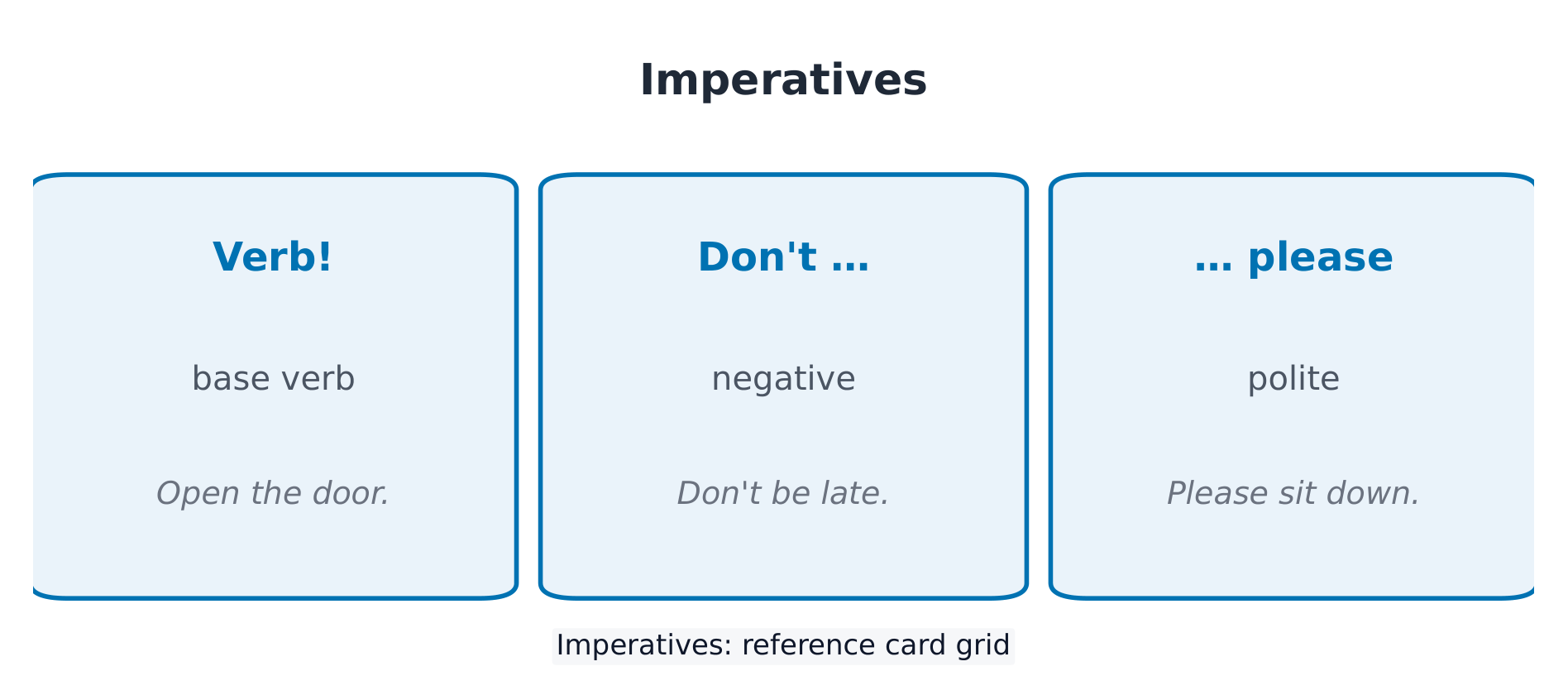
    Imperatives are used to give commands, provide instructions, or make requests. Start directly with the base form of the verb, without a subject.

    打开Open (冠词)the 门door 请, please.

    Please open the door.

    坐Sit 下down.

    Sit down.

    Negative: Add Don't at the beginning.

    不要Don't (是)be 迟到late.

    Don't be late.

    Key Usage Points:

    • Add please to be more polite: Please come in.
    • Also used for directions and instructions: Turn left. Mix the eggs.

    Note: Do not write a subject in imperatives: ~~You open the door~~ (for a command) → Open the door.

    Common Errors

    • ❌ ~~Please open door.~~ → ✓ Please open the door. — Articles must still be included in imperatives.
    • ❌ ~~Don't to touch it.~~ → ✓ Don't touch it. — Follow don't directly with the base form of the verb; do not add to.
    • ❌ ~~No talk in class!~~ → ✓ Don't talk in class! / No talking! — To prohibit an action, use don't + base form; after no, use -ing or a noun.
    • ❌ ~~You sit down!~~ → ✓ Sit down, please. — Adding you to a command sounds angry; add please for politeness, or change to Can you…?
    Français
    祈使句:命令、否定、请求

    祈使句 (imperatives) 用来下命令、给指示或提请求。直接用动词原形开头,不要主语。

    打开Open (冠词)the 门door 请, please.

    请把门打开。

    坐Sit 下down.

    坐下。

    Négation : 前面加 Don't。

    不要Don't (是)be 迟到late.

    别迟到。

    用法要点:

    • 加 please 更礼貌:Please come in.(请进。)
    • 也用于路线、说明:Turn left.(向左转。)Mix the eggs.(把鸡蛋打匀。)

    注意 祈使句不写主语:~~You open the door~~(命令时)→ Open the door。

    常见错误

    • ❌ ~~Please open door.~~ → ✓ Please open la porte. — 祈使句里冠词照样不能丢。
    • ❌ ~~Don't to touch it.~~ → ✓ Ne touchez pas ça. — don't 后面直接跟动词原形,不加 to。
    • ❌ ~~No talk in class!~~ → ✓ Ne parlez pas en classe ! / No parlant ! — 禁止做某事用 don't + 原形;no 后面要用 -ing 或名词。
    • ❌ ~~You sit down!~~ → ✓ Asseyez-vous, s'il vous plaît. — 加了 you 的命令听起来很生气;想礼貌就加 please,或改问 Can you…?
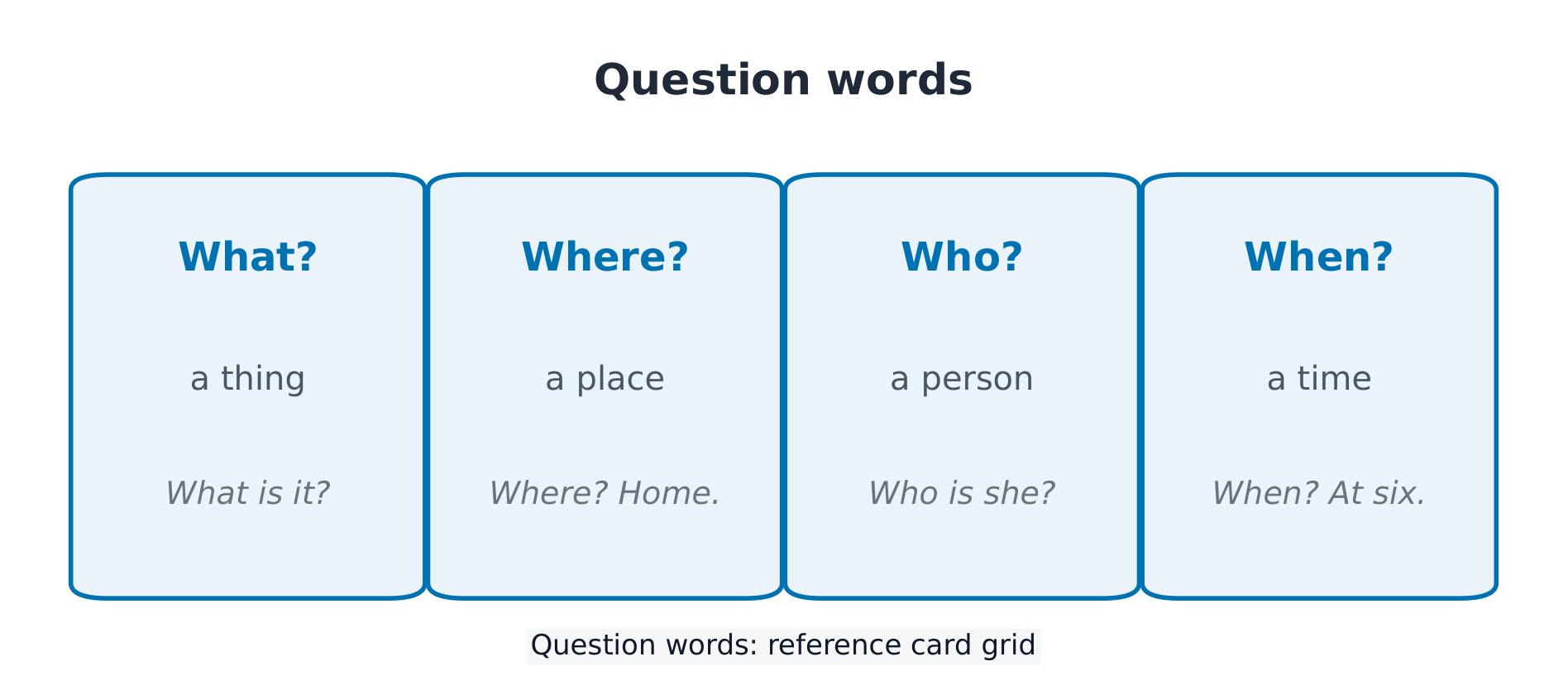
  • 11 Question words · ⁨Mots interrogatifs⁩
    11.1

    what, where, who

    English

    Question words are placed at the beginning of a question to ask for specific information.

    • what (what), where (where), who (who)

    什么What 是is 你的your 名字name?

    What's your name?

    哪里Where (助动词)do 你you 住live?

    Where do you live?

    谁Who 是is 那个that 男人man?

    Who is that man?

    Note: A be verb or auxiliary do/does often follows the question word: Where do you work?

    Français
    疑问词:问事物/地点/人/时间

    疑问词 (question words) 放在问句开头,用来问具体信息。

    • what(什么)、where(哪里)、who(谁)

    什么What 是is 你的your 名字name?

    你叫什么名字?

    哪里Where (助动词)do 你you 住live?

    你住在哪里?

    谁Who 是is 那个that 男人man?

    那个男人是谁?

    注意 疑问词后面常跟 be 动词或助动词 do / does:Where do you work?

    11.2

    when, why, how

    English
    • when (when), why (why), how (how / in what way)

    什么时候When 是is (冠词)the 派对party?

    When is the party?

    为什么Why (是)are 你you 难过sad?

    Why are you sad?

    怎么How (助动词)do 你you 拼写spell 它it?

    How do you spell this?

    Note: how can also combine with adjectives to ask about degree: How old are you? How much is it?

    Common Errors

    • ❌ ~~Where you live?~~ → ✓ Where do you live? — After the question word, you still need do/does or be; you cannot follow directly with the subject.
    • ❌ ~~What means this word?~~ → ✓ What does this word mean? — mean is an ordinary verb: question word + does + subject + base form.
    • ❌ ~~Why you are late?~~ → ✓ Why are you late? — When there is a be verb in the sentence, move be before the subject.
    • ❌ ~~How to spell it?~~ → ✓ How do you spell it? — A literal translation of "How to spell?" loses the subject and auxiliary verb; these must be added.
    Français
    • when(什么时候)、why(为什么)、how(怎样 / 如何)

    什么时候When 是is (冠词)the 派对party?

    派对什么时候?

    为什么Why (是)are 你you 难过sad?

    你为什么难过?

    怎么How (助动词)do 你you 拼写spell 它it?

    这个怎么拼?

    注意 how 还能和形容词搭配问程度:How old are you?(你多大?)How much is it?(多少钱?)

    常见错误

    • ❌ ~~Where you live?~~ → ✓ Où vives-tu ? — 疑问词后面还需要 do / does 或 be,不能直接跟主语。
    • ❌ ~~What means this word?~~ → ✓ Que signifie ce mot ? — mean 是普通动词:疑问词 + does + 主语 + 原形。
    • ❌ ~~Why you are late?~~ → ✓ Pourquoi es-tu en retard ? — 句子里有 be 动词时,把 be 提到主语前面。
    • ❌ ~~How to spell it?~~ → ✓ Comment épicés-tu ça ? — 中文"怎么拼?"直译会丢掉主语和助动词,要补全。
  • 12 Prepositions of place · ⁨Prépositions de lieu⁩
    12.1

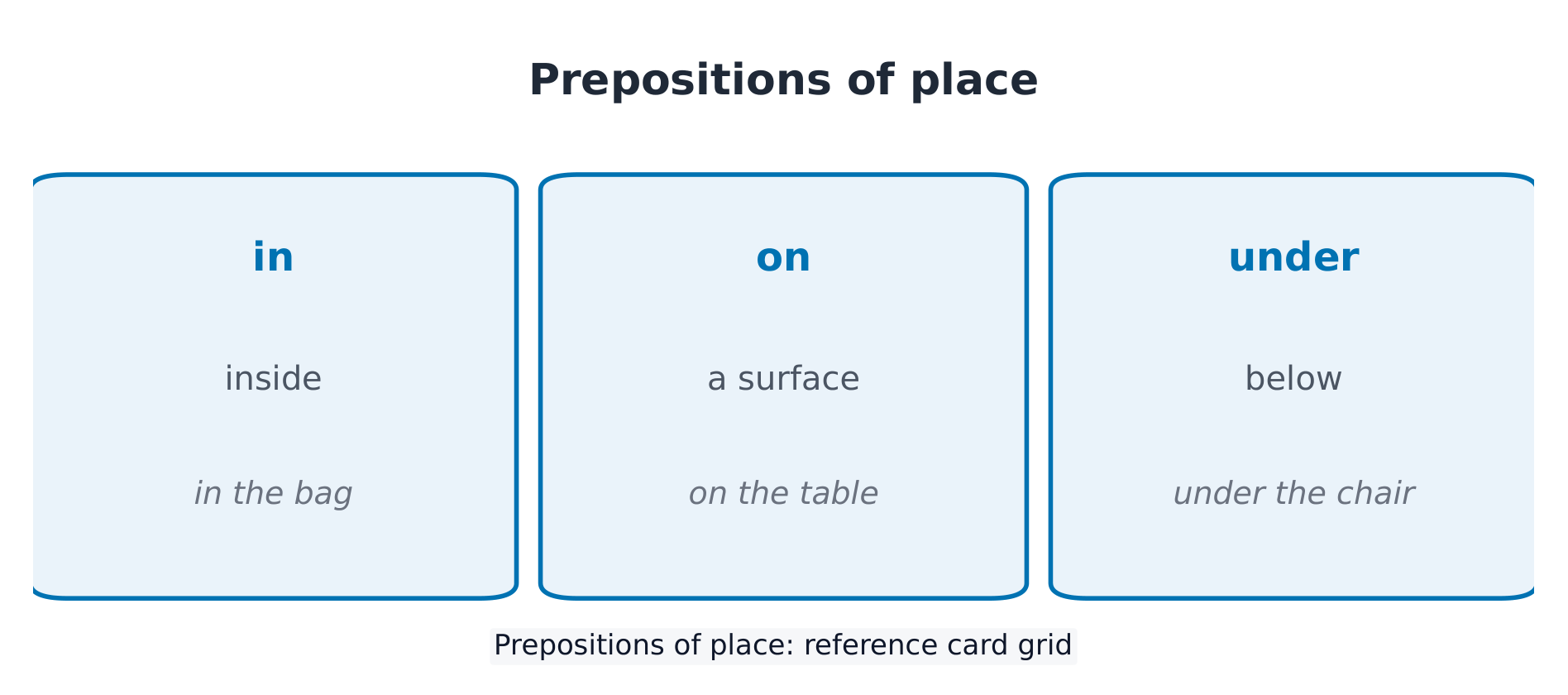
    in, on, under

    English

    Prepositions of place indicate where something is located.

    • in (inside...), on (on top of... / surface), under (below...)

    (冠词)The 钥匙keys 在are 在...里in (冠词)the 包里bag.

    The key is in the bag.

    (冠词)The 书book 在is 在...上on (冠词)the 桌上table.

    The book is on the table.

    (冠词)The 猫cat 在is 在...下under (冠词)the 椅子下chair.

    The cat is under the chair.

    Français
    地点介词:in / on / under

    地点介词 (prepositions of place) 说明东西在哪里。

    • in(在……里面)、on(在……上面 / 表面)、under(在……下面)

    (冠词)The 钥匙keys 在are 在...里in (冠词)the 包里bag.

    钥匙在包里。

    (冠词)The 书book 在is 在...上on (冠词)the 桌上table.

    书在桌上。

    (冠词)The 猫cat 在is 在...下under (冠词)the 椅子下chair.

    猫在椅子下面。

    12.2

    next to, between, behind

    English
    • next to (beside...), between (between...), behind (behind...), in front of (in front of...)

    (冠词)The 商店shop 在is 旁边next to (冠词)the 银行bank.

    The shop is next to the bank.

    她She 坐sits 之间between 汤姆Tom 和and 萨姆Sam.

    She sits between Tom and Sam.

    Note: between means "between two," and is usually followed by A and B: between the door and the window.

    Common Errors

    • ❌ ~~The picture is in the wall.~~ → ✓ The picture is on the wall. — Hanging "on" the wall involves surface contact, so use on.
    • ❌ ~~I read it on the book.~~ → ✓ ...in the book. — Content "inside" a book uses in; people in photos also use in the photo.
    • ❌ ~~The shop is next the bank.~~ → ✓ next to the bank — next to is two words; to cannot be omitted.
    • ❌ ~~between the door with the window~~ → ✓ between the door and the window — between takes the fixed collocation A and B.
    Français
    • next to(在……旁边)、between(在……之间)、behind(在……后面)、in front of(在……前面)

    (冠词)The 商店shop 在is 旁边next to (冠词)the 银行bank.

    商店在银行旁边。

    她She 坐sits 之间between 汤姆Tom 和and 萨姆Sam.

    她坐在汤姆和萨姆之间。

    注意 between 表示"两者之间",后面常用 A and B:between the door and the window。

    常见错误

    • ❌ ~~The picture is in the wall.~~ → ✓ Le tableau est sur le mur. — 挂在墙"上"是表面接触,用 on。
    • ❌ ~~I read it on the book.~~ → ✓ …dans le livre. — 书"里"的内容用 in;照片里的人也用 in the photo。
    • ❌ ~~The shop is next the bank.~~ → ✓ à côté de la banque — next to 是两个词,to 不能丢。
    • ❌ ~~between the door with the window~~ → ✓ entre la porte et la fenêtre — between 固定搭配 A and B。

Log in or create account · ⁨Se connecter ou créer un compte⁩

IGCSE, A-Level & AP