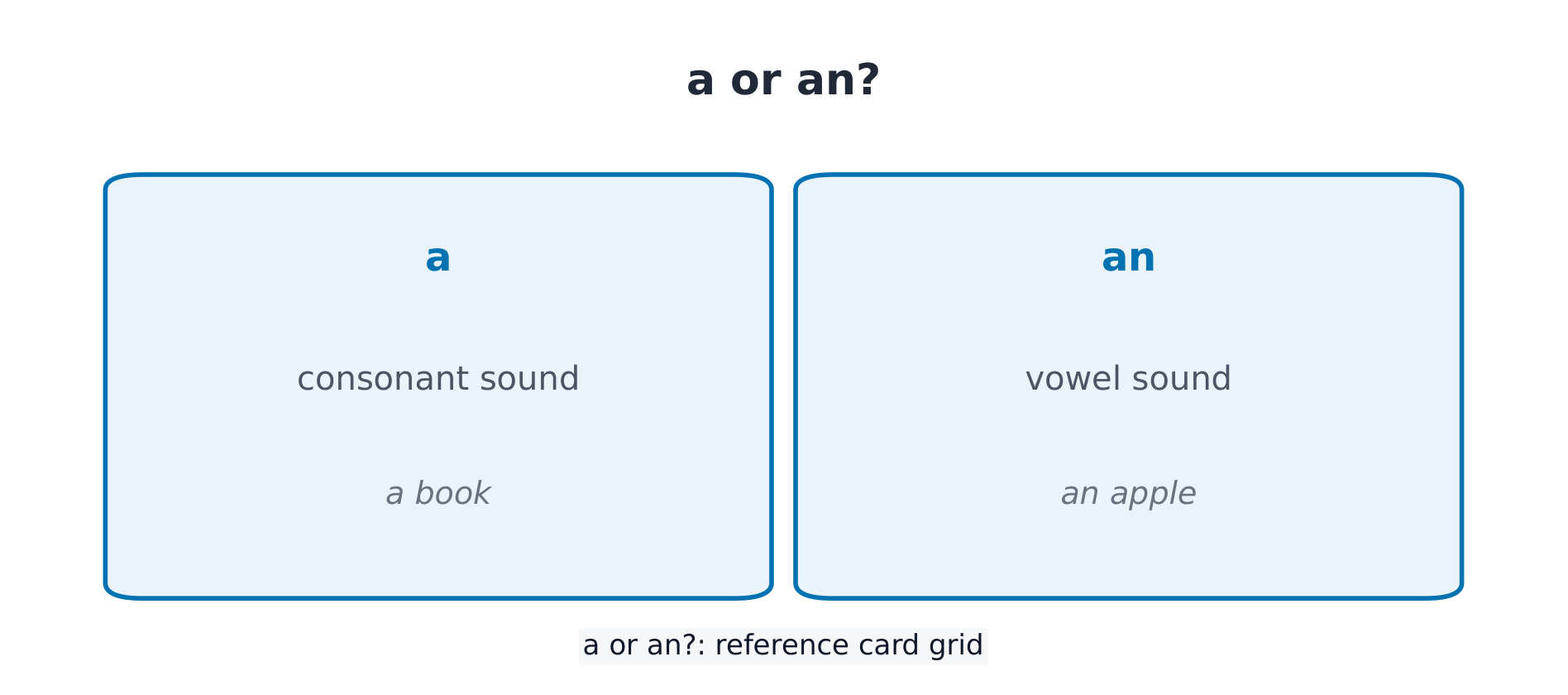
Pour indiquer « plus d'un », le nom prend le pluriel, généralement en ajoutant -s :
- Pluriel régulier avec -s : book → books, car → cars.
- Se terminant par -s / -sh / -ch / -x / -o, on ajoute -es : bus → buses, box → boxes.
- Consonne + y final, le y devient i puis on ajoute -es : baby → babies, city → cities.
我I 有have 两two 猫cats.
J'ai deux chats.
Pluriels irréguliers (à mémoriser) :
- man → men, woman → women, child → children.
- foot → feet, tooth → teeth, person → people.
Remarque Ne mettez jamais a / an devant un nom pluriel : ~~a books~~ ✗ → books / two books ✓.
Erreurs fréquentes
- ❌ ~~I have dog.~~ → ✓ I have a dog. — En chinois, on peut dire "j'ai un chien", mais en anglais, avant un nom comptable singulier, il faut impérativement a / an (ou my, the, etc.).
- ❌ ~~an university~~ → ✓ a university ; ❌ ~~a hour~~ → ✓ an hour — Regardez la prononciation, pas l'orthographe : university commence par une consonne /j/, h est muet dans hour.
- ❌ ~~two book~~ → ✓ two books — Les noms chinois ne changent pas au pluriel, mais en anglais, les noms après un chiffre doivent prendre -s, c'est l'oubli le plus fréquent.
- ❌ ~~three childs~~ → ✓ three children — Les pluriels irréguliers doivent être appris par cœur : men, women, children, feet, teeth, people.
- ❌ ~~a people~~ → ✓ a person(une personne) / people(pluriel : des personnes) — people est déjà un pluriel.