انظر إلى السماء في ليلة صافية، وقد ترى بضعة آلاف من النجوم. لكن هذا شبه لا شيء. شمسنا هي مجرد نجم واحد بين مائة مليار نجم في مجرتنا…
English narration · English + 中文 subtitles burned in · سرد باللغة الإنجليزية · ترجمة مدمجة بالإنجليزية + الصينية
6.1
The Earth, the Sun and the Moon · الأرض والشمس والقمر
Syllabus · المنهج
English
6.1.1 The Earth
Core
Supplement
1 Know that the Earth is a planet that rotates on its axis, which is tilted, once in approximately 24 hours, and use this to explain observations of the apparent daily motion of the Sun and the periodic cycle of day and night
2 Know that the Earth orbits the Sun once in approximately 365 days and use this to explain the periodic nature of the seasons
4 Define average orbital speed from the equation $v = \frac{2\pi r}{T}$ where $r$ is the average radius of the orbit and $T$ is the orbital period; recall and use this equation
3 Know that it takes approximately one month for the Moon to orbit the Earth and use this to explain the periodic nature of the Moon’s cycle of phases
6.1.2 The Solar System
Core
Supplement
1 Describe the Solar System as containing: (a) one star, the Sun (b) the eight named planets and know their order from the Sun (c) minor planets that orbit the Sun, including dwarf planets such as Pluto and asteroids in the asteroid belt (d) moons, that orbit the planets (e) smaller Solar System bodies, including comets and natural satellites
7 Know that planets, minor planets and comets have elliptical orbits, and recall that the Sun is not at the centre of the elliptical orbit, except when the orbit is approximately circular
8 Analyse and interpret planetary data about orbital distance, orbital duration, density, surface temperature and uniform gravitational field strength at the planet’s surface
2 Know that, in comparison to each other, the four planets nearest the Sun are rocky and small and the four planets furthest from the Sun are gaseous and large, and explain this difference by referring to an accretion model for Solar System formation, to include: (a) the model’s dependence on gravity (b) the presence of many elements in interstellar clouds of gas and dust (c) the rotation of material in the cloud and the formation of an accretion disc
3 Know that the strength of the gravitational field (a) at the surface of a planet depends on the mass of the planet (b) around a planet decreases as the distance from the planet increases
4 Calculate the time it takes light to travel a significant distance such as between objects in the Solar System
5 Know that the Sun contains most of the mass of the Solar System and this explains why the planets orbit the Sun
6 Know that the force that keeps an object in orbit around the Sun is the gravitational attraction of the Sun
9 Know that the strength of the Sun’s gravitational field decreases and that the orbital speeds of the planets decrease as the distance from the Sun increases
10 Know that an object in an elliptical orbit travels faster when closer to the Sun and explain this using the conservation of energy
العربية
6.1.1 الأرض
أساسي
تكميلي
1 عرّف أن الأرض كوكب يدور حول محوره الذي يميل، دورة واحدة كل حوالي 24 ساعة، واستخدم ذلك لشرح ملاحظات الحركة اليومية الظاهرية للشمس والدورة الدورية لليل والنهار
2 عرّف أن الأرض تدور حول الشمس دورة واحدة كل حوالي 365 يوماً، واستخدم ذلك لشرح الطبيعة الدورية للفصول
4 عرّف السرعة المدارية المتوسطة من المعادلة $v = \frac{2\pi r}{T}$ حيث $r$ هو نصف القطر المتوسط للمدار و$T$ هو الفترة المدارية؛ تذكر هذه المعادلة واستخدمها
3 عرّف أن القمر يحتاج حوالي شهر واحد لإكمال دورة حول الأرض، واستخدم ذلك لشرح الطبيعة الدورية لدورة أطوار القمر
6.1.2 النظام الشمسي
أساسي
تكميلي
1 صف النظام الشمسي على أنه يحتوي على: (أ) نجم واحد وهو الشمس (ب) الكواكب الثمانية المسمّاة وعرف ترتيبها من الشمس (ج) الكواكب الصغيرة التي تدور حول الشمس، بما في ذلك الكواكب القزمة مثل بلوتو والكويكبات في حزام الكويكبات (د) الأقمار التي تدور حول الكواكب (هـ) أجسام النظام الشمسي الأصغر، بما في ذلك المذنبات والأقمار الطبيعية
7 عرّف أن الكواكب والكواكب الصغيرة والمذنبات لها مدارات إهليلجية، وتذكر أن الشمس ليست في مركز المدار الإهليلجي، إلا عندما يكون المدار دائرياً تقريباً
8 حلّل وفسّر بيانات الكواكب المتعلقة بالمسافة المدارية، والمدة المدارية، والكثافة، ودرجة حرارة السطح، وقوة المجال الجاذبي المنتظم عند سطح الكوكب
2 عرّف أنه مقارنة ببعضها البعض، فإن الكواكب الأربعة الأقرب إلى الشمس صخرية وصغيرة، والكواكب الأربعة الأبعد عن الشمس غازية وكبيرة، واشرح هذا الفرق بالإشارة إلى نموذج التجمع لتكوين النظام الشمسي، بما في ذلك: (أ) اعتماد النموذج على الجاذبية (ب) وجود عناصر عديدة في السحب بين النجمية من الغاز والغبار (ج) دوران المادة في السحبة وتشكيل قرص تجمع
3 عرّف أن قوة المجال الجاذبي (أ) عند سطح كوكب تعتمد على كتلة الكوكب (ب) حول كوكب تتناقص كلما ابتعدت المسافة عن الكوكب
4 احسب الوقت الذي تستغرقه الضوء لقطع مسافة كبيرة مثل المسافات بين الأجسام في النظام الشمسي
5 عرّف أن الشمس تحتوي على معظم كتلة النظام الشمسي وهذا يفسر لماذا تدور الكواكب حول الشمس
6 عرّف أن القوة التي تحافظ على جسم في مدار حول الشمس هي التجاذب الجاذبي للشمس
9 عرّف أن قوة المجال الجاذبي للشمس تتناقص وأن سرعات مدار الكواكب تتناقص كلما زادت المسافة عن الشمس
10 عرّف أن الجسم في مدار إهليلجي يتحرك بسرعة أكبر عندما يقترب من الشمس واشرح ذلك باستخدام مبدأ حفظ الطاقة
Source: Cambridge International syllabus · المصدر: منهج كامبريدج الدولي
English
The Earth spins (rotates 自转) on its axis 轴 once in about $24$ hours. The axis is tilted 倾斜 (not straight up). This spin gives us day and night, and makes the Sun 太阳 appear to move across the sky each day.
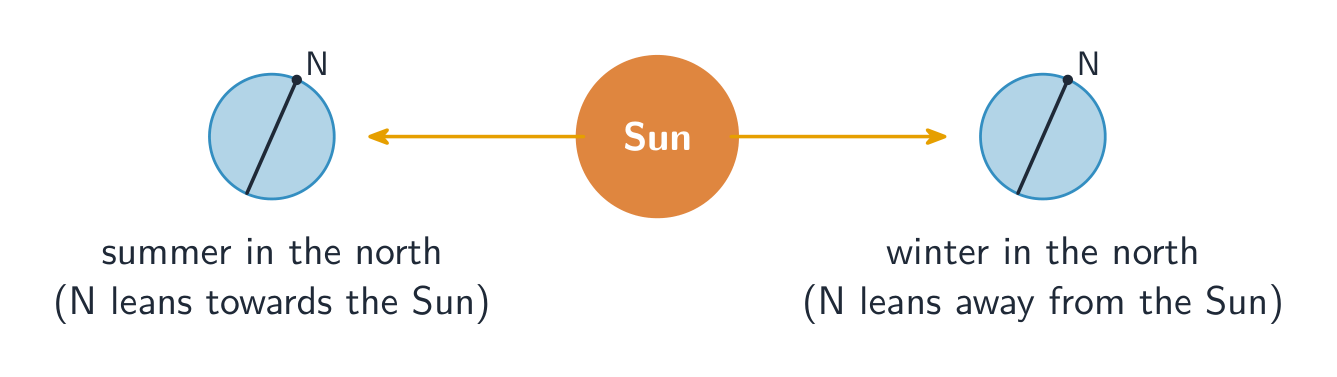
The Earth also moves around the Sun in an orbit 轨道, once in about $365$ days (one year). Because the axis is tilted, different parts of the Earth lean towards the Sun at different times of the year. This gives the seasons 季节: it is summer in the half of the Earth that leans towards the Sun.
The Moon 月球 orbits the Earth once in about one month. As it goes round, we see different amounts of its lit side, which gives the phases 月相 of the Moon (new moon, half moon, full moon).
So, from shortest to longest: one day (Earth's spin) < one month (Moon's orbit) < one year (Earth's orbit).
العربية
تدور الأرض (تدور) حول محورها مرة واحدة في حوالي $24$ ساعات. المحور مائل (ليس عمودياً تماماً). هذا الدوران يعطينا النهار والليل، ويجعل الشمس تبدو وكأنها تتحرك عبر السماء كل يوم.
تتحرك الأرض أيضاً حول الشمس في مدار، مرة واحدة في حوالي $365$ يوماً (سنة واحدة). وبسبب ميل المحور، تنحرف أجزاء مختلفة من الأرض نحو الشمس في أوقات مختلفة من السنة. وهذا يعطي الفصول: يكون الصيف في نصف الكرة الذي ينحرف نحو الشمس.
المحور يحافظ على نفس الميل طوال العام، لذا ينحرف كل نصف كرة نحو الشمس لنصف المدار ويبعد عن الآخر للنصف المتبقي
يدور القمر حول الأرض مرة واحدة في حوالي شهر واحد. أثناء دورانه، نرى كميات مختلفة من جانبه المضاء، مما يعطي أطوار القمر (القمر الجديد، القمر النصف، القمر الكامل).
النصف المضاء للقمر يواجه الشمس دائماً، لذا أثناء دورانه نرى كميات مختلفة منه: قمر جديد بيننا وبين الشمس، وقمر كامل مقابل الشمس، وأقمار نصفية بينهما
لذا، من الأقصر إلى الأطول: يوم واحد (دوران الأرض) < شهر واحد (مدار القمر) < سنة واحدة (مدار الأرض).
القمر الكامل، قمر الأرض الطبيعي
Explore · استكشف
Why the Moon changes shape · لماذا يتغير شكل القمر
The Sun always lights half the Moon; the phase is simply how much of that lit half faces us as the Moon orbits — it is not Earth's shadow. · الشمس تضيء دائماً نصف القمر؛ الطور هو ببساطة مقدار هذا النصف المضاء الذي يواجهنا أثناء دوران القمر — إنه ليس ظل الأرض.
For an object going round a circle, the distance for one full orbit is the circumference 周长$2\pi r$, where $r$ is the radius of the orbit. The orbital speed 轨道速率 is this distance divided by the period 周期$T$ (the time for one orbit):
$$v = \frac{2\pi r}{T}$$
The same equation works for planets, moons and satellites.
Worked example. A space station orbits the Earth at a radius of $r = 7000\ \text{km}$ and takes $T = 5800\ \text{s}$ for one orbit. Find its orbital speed.
First convert the radius to metres: $7000\ \text{km} = 7.0 \times 10^6\ \text{m}$. Then
لجسم يدور في دائرة، المسافة لدورة كاملة هي محيط$2\pi r$، حيث $r$ هو نصف قطر المدار. السرعة المدارية هي هذه المسافة مقسومة على الفترة$T$ (الوقت لدورة واحدة):
$$v = \frac{2\pi r}{T}$$
ينطبق نفس المعادلة على الكواكب والأقمار والأقمار الصناعية.
مثال محلول. تدور محطة فضائية حول الأرض على نصف قطر $r = 7000\ \text{km}$ وتأخذ $T = 5800\ \text{s}$ لدورة واحدة. أوجد سرعتها المدارية.
أولاً حوّل نصف القطر إلى أمتار: $7000\ \text{km} = 7.0 \times 10^6\ \text{m}$. ثم
The Solar System 太阳系 has one star, the Sun, at its centre. Around it move the eight planets 行星. In order from the Sun they are: Mercury, Venus, Earth, Mars, Jupiter, Saturn, Uranus and Neptune.
The four planets nearest the Sun are small and rocky 岩石.
The four planets furthest from the Sun are large and gaseous 气态 — they are made mostly of gas 气体, with no solid surface to stand on.
The two nearer giants, Jupiter and Saturn, are gas giants 气态巨行星. The two outer giants, Uranus and Neptune, are ice giants 冰巨行星: they hold much more ice, so they are not true gas giants.
The Solar System also contains:
minor planets, such as dwarf planets 矮行星 like Pluto, and asteroids 小行星 (most lie in the asteroid belt between Mars and Jupiter);
moons (natural satellites 卫星) that orbit the planets;
comets 彗星 and other small bodies.
Orbits and gravity
The Sun holds most of the mass of the Solar System. Its gravity 引力 (gravitational pull) reaches out and keeps the planets in their orbits. This force is the gravitational attraction of the Sun.
The gravitational field strength 重力场强度 tells you how strong gravity is:
at the surface of a planet it is bigger for a planet with more mass;
around a planet it gets weaker as you move further away.
In the same way, the Sun's gravity gets weaker further out, so the outer planets move more slowly (smaller orbital speed) than the inner ones.
Planetary data
Exam questions often give a table like this one and ask you to read a pattern from it.
Planet
Distance from Sun / million km
Orbital period
Density / g/cm³
Surface temperature / °C
Surface $g$ / N/kg
Mercury
58
88 days
5.4
170
3.7
Venus
108
225 days
5.2
460
8.9
Earth
150
365 days
5.5
15
9.8
Mars
228
687 days
3.9
−60
3.7
Jupiter
779
11.9 years
1.3
−110
23
Saturn
1430
29.5 years
0.7
−140
9.0
Uranus
2870
84 years
1.3
−195
8.7
Neptune
4500
165 years
1.6
−200
11
Patterns to notice: the further a planet is from the Sun, the longer its orbital period and the lower its surface temperature. The four inner planets are dense (rock and metal), while the four outer planets have low densities (gas and ice). The gravitational field strength at the surface depends on the planet's mass and size, not on its distance from the Sun.
Elliptical orbits
Most orbits are not perfect circles but ellipses 椭圆 (a stretched circle), and the Sun is not at the centre of the ellipse. A comet has a very stretched orbit. An object in an elliptical orbit moves faster when it is closer to the Sun. We explain this with the conservation of energy 能量守恒 — the total energy 能量 stays the same, so as the object's gravitational potential energy 重力势能 falls (coming closer), its kinetic energy 动能 rises (it speeds up).
Light travel time
Distances in space are huge, so we often work out how long light takes to cross them. Light travels at $3.0 \times 10^8\ \text{m/s}$. Using $\text{time} = \dfrac{\text{distance}}{\text{speed}}$, light from the Sun (about $1.5 \times 10^{11}\ \text{m}$ away) takes about $500\ \text{s}$, which is roughly $8$ minutes, to reach the Earth.
العربية
تحتوي المجموعة الشمسية على نجم واحد، وهو الشمس، في مركزها. حولها تدور الكواكب الثمانية. بالترتيب من الشمس هي: عطارد، الزهرة، الأرض، المريخ، المشتري، زحل، أورانوس ونبتون.
الكواكب الأربعة الأقرب للشمس صغيرة وصخرية.
الكواكب الأبعد عن الشمس كبيرة وغازية — تتكون أساساً من الغاز، بدون سطح صلب يمكن الوقوف عليه.
العملاقان الأقربان، المشتري وزحل، هما عمالقة غازية. العملاقان الخارجيان، أورانوس ونبتون، هما عمالقة جليدية: يحتويان على الكثير من الجليد، لذا فهما ليسا عمالقة غازية حقيقية.
الشمس وكواكبها الثمانية بالترتيب: أربعة كواكب صخرية صغيرة، ثم حزام الكويكبات، ثم أربعة كواكب غازية كبيرة — العمالقة الغازية المشتري وزحل والعمالقة الجليدية أورانوس ونبتون (غير مقياس)المريخ، الكوكب الأحمر، أحد الكواكب الداخلية الصخريةالمشتري، أكبر كوكب، مع أحزامه الغازية الدوارةزحل وحلقاته، مصورة بواسطة مركبة كاسيني الفضائية
تحتوي المجموعة الشمسية أيضاً على:
كواكب صغيرة، مثل الكواكب القزمة مثل بلوتو، والكويكبات (معظمها يقع في حزام الكويكبات بين المريخ والمشتري);
أقمار (أقمار طبيعية) تدور حول الكواكب;
مذنبات وأجسام صغيرة أخرى.
المدارات والجاذبية
تمتلك الشمس معظم كتلة المجموعة الشمسية. جاذبيتها (قوة الجذب الثقالي) تمتد وتحافظ على الكواكب في مداراتها. هذه القوة هي التجاذب الثقالي للشمس.
قوة المجال الثقالي تخبرك بمدى قوة الجاذبية:
عند سطح الكوكب تكون أكبر للكوكب الذي له كتلة أكبر;
حول الكوكب تصبح أضعف كلما ابتعدت.
وبالمثل، تصبح جاذبية الشمس أضعف كلما ابتعدنا عنها، لذلك تتحرك الكواكب الخارجية ببطء أكبر (سرعة مدارية أقل) من الكواكب الداخلية.
بيانات كوكبية
غالبًا ما تقدم أسئلة الامتحانات جدولًا مثل هذا وتطلب منك قراءة نمط منه.
الكوكب
المسافة عن الشمس / مليون كم
الفترة المدارية
الكثافة / جم/سم³
درجة حرارة السطح / °C
شدة الحقل الجذب $g$ / N/kg
عطارد
58
88 يومًا
5.4
170
3.7
الزهرة
108
225 يومًا
5.2
460
8.9
الأرض
150
365 يومًا
5.5
15
9.8
المريخ
228
687 يومًا
3.9
−60
3.7
المشتري
779
11.9 سنة
1.3
−110
23
زحل
1430
29.5 سنة
0.7
−140
9.0
أورانوس
2870
84 سنة
1.3
−195
8.7
نبتون
4500
165 سنة
1.6
−200
11
أنماط يجب ملاحظتها: كلما ابتعد كوكب عن الشمس، زادت فترته المدارية وانخفضت درجة حرارة سطحه. الكواكب الأربعة الداخلية كثيفة (صخر ومعدن)، بينما الكواكب الأربعة الخارجية ذات كثافات منخفضة (غاز وجليد). تعتمد شدة الحقل الجذب على السطح على كتلة الكوكب وحجمه، وليس على مسافته عن الشمس.
المدارات الإهليلجية
معظم المدارات ليست دوائر مثالية بل إهليلجات (دائرة ممدودة)، والشمس لا تكون في مركز الإهليلج. لدى المذنب مدار ممدود جدًا. يتحرك الجسم في مدار إهليلجي بشكل أسرع عندما يكون أقرب إلى الشمس. نشرح ذلك باستخدام حفظ الطاقة — فالطاقة الكلية تظل ثابتة، لذا فإن انخفاض الطاقة الكامنة الجذب للجسم (قربه) يؤدي إلى زيادة طاقته الحركية (زيادة سرعته).
تقع الشمس عند أحد بؤرتي الإهليلج؛ يسارع الكوكب عند الاقتراب ويشتت عند الابتعاد
زمن سفر الضوء
المسافات في الفضاء ضخمة، لذا نحسب غالبًا الوقت الذي يستغرقه الضوء ليقطعها. يسافر الضوء بسرعة $3.0 \times 10^8\ \text{m/s}$. باستخدام $\text{time} = \dfrac{\text{distance}}{\text{speed}}$، يستغرق الضوء الصادر عن الشمس (على بعد نحو $1.5 \times 10^{11}\ \text{m}$) حوالي $500\ \text{s}$، وهو ما يعادل تقريبًا $8$ دقائق، ليصل إلى الأرض.
Explore · استكشف
Watch the planets race · شاهد سباق الكواكب
The closer a planet is to the Sun, the faster it orbits — Mercury in 88 days, Jupiter in 12 years — because the Sun's gravity is stronger close in. · كلما كان الكوكب أقرب إلى الشمس، كان أسرع في مداره — عطارد في 88 يوماً، المشتري في 12 عاماً — لأن جاذبية الشمس أقوى بالقرب منها.
How the Solar System formed · كيفية تشكل النظام الشمسي
English
The planets formed from a giant cloud of gas and dust 尘埃 in space, which contained many chemical elements 元素. This is the accretion 吸积 model:
gravity pulled the cloud together;
the cloud was spinning, so it flattened into a spinning accretion disc 吸积盘;
most of the matter fell to the centre and became the Sun, while the planets grew from the leftover material in the disc.
Near the hot young Sun, only rock and metal could stay solid, so the inner planets are rocky. Far out, where it was cold, gases could also collect, so the outer planets grew large and gaseous.
العربية
تشكلت الكواكب من سحابة عملاقة من الغاز والغبار في الفضاء، تحتوي على العديد من العناصر الكيميائية. هذا هو نموذج التراكم:
جذبت الجاذبية السحابة نحو بعضها البعض;
كانت السحابة تدور، مما جعلها تسطح لتصبح قرص تراكم دواراً;
سقط معظم المادة في المركز وأصبحت الشمس، بينما نشأت الكواكب من المواد المتبقية في القرص.
بالقرب من الشمس الشابة الساخنة، لم يتمكن سوى الصخر والمعدن من البقاء صلبين، لذا كانت الكواكب الداخلية صخرية. بعيدًا في الخارج، حيث كان الجو باردًا، يمكن أيضًا تجمع الغازات، لذا كبرت الكواكب الخارجية وأصبحت غازية.
قرص تراكم حقيقي حول النجم الصغير HL Tauri: الفجوات الداكنة هي حيث تجمع الكواكب الجديدة الغبار — بدأ نظامنا الشمسي بنفس الطريقة
1 Know that the Sun is a star of medium size, consisting mostly of hydrogen and helium, and that it radiates most of its energy in the infrared, visible light and ultraviolet regions of the electromagnetic spectrum
2 Know that stars are powered by nuclear reactions that release energy and that in stable stars the nuclear reactions involve the fusion of hydrogen into helium
6.2.2 Stars
Core
Supplement
1 State that: (a) galaxies are each made up of many billions of stars (b) the Sun is a star in the galaxy known as the Milky Way (c) other stars that make up the Milky Way are much further away from the Earth than the Sun is from the Earth (d) astronomical distances can be measured in light-years, where one light-year is the distance travelled in (the vacuum of) space by light in one year
2 Know that one light-year is equal to $9.5 \times 10^{15}$ m
3 Describe the life cycle of a star: (a) a star is formed from interstellar clouds of gas and dust that contain hydrogen (b) a protostar is an interstellar cloud collapsing and increasing in temperature as a result of its internal gravitational attraction (c) a protostar becomes a stable star when the inward force of gravitational attraction is balanced by an outward force due to the high temperature in the centre of the star (d) all stars eventually run out of hydrogen as fuel for the nuclear reaction (e) most stars expand to form red giants and more massive stars expand to form red supergiants when most of the hydrogen in the centre of the star has been converted to helium (f) a red giant from a less massive star forms a planetary nebula with a white dwarf star at its centre (g) a red supergiant explodes as a supernova, forming a nebula containing hydrogen and new heavier elements, leaving behind a neutron star or a black hole at its centre (h) the nebula from a supernova may form new stars with orbiting planets
6.2.3 The Universe
Core
Supplement
1 Know that the Milky Way is one of many billions of galaxies making up the Universe and that the diameter of the Milky Way is approximately 100 000 light-years
2 Describe redshift as an increase in the observed wavelength of electromagnetic radiation emitted from receding stars and galaxies
3 Know that the light emitted from distant galaxies appears redshifted in comparison with light emitted on the Earth
4 Know that redshift in the light from distant galaxies is evidence that the Universe is expanding and supports the Big Bang Theory
5 Know that microwave radiation of a specific frequency is observed at all points in space around us and is known as cosmic microwave background radiation (CMBR)
6 Explain that the CMBR was produced shortly after the Universe was formed and that this radiation has been expanded into the microwave region of the electromagnetic spectrum as the Universe expanded
7 Know that the speed $v$ at which a galaxy is moving away from the Earth can be found from the change in wavelength of the galaxy’s starlight due to redshift
8 Know that the distance $d$ of a far galaxy can be determined using the brightness of a supernova in that galaxy
9 Define the Hubble constant$H_0$ as the ratio of the speed at which the galaxy is moving away from the Earth to its distance from the Earth; recall and use the equation
$$H_0 = \frac{v}{d}$$
10 Know that the current estimate for $H_0$ is $2.2 \times 10^{-18}$ per second
11 Know that the equation
$$\frac{d}{v} = \frac{1}{H_0}$$
represents an estimate for the age of the Universe and that this is evidence for the idea that all the matter in the Universe was present at a single point
العربية
6.2.1 الشمس كنجم
أساسي
تكميلي
1 عرّف أن الشمس نجم متوسط الحجم، يتكون بشكل رئيسي من الهيدروجين والهيليوم، إشعاع معظم طاقته في مناطق الأشعة تحت الحمراء والضوء المرئي والأشعة فوق البنفسجية من الطيف الكهرومغناطيسي
2 عرّف أن النجوم تعمل بفاعلية بسبب تفاعلات نووية تطلق طاقة، وفي النجوم المستقرة تتضمن التفاعلات النووية اندماج الهيدروجين إلى هيليوم
6.2.2 النجوم
أساسي
تكميلي
1 نصّ على ما يلي: (أ) المجرات تتكون كل منها من عشرات المليارات من النجوم (ب) الشمس نجم في المجرة المعروفة بـ التبانة (ج) نجوم أخرى构成 التبانة تبعد عن الأرض مسافات أكبر بكثير مما تبعد عنه الشمس (د) يمكن قياس المسافات الفلكية بـ السنة الضوئية، حيث السنة الضوئية هي المسافة التي يقطعها الضوء في (فراغ) الفضاء خلال سنة واحدة
2 عرّف أن السنة الضوئية تساوي $9.5 \times 10^{15}$ متر
3 صف دورة حياة النجم: (أ) يتشكل النجم من سحابات بين نجمية من الغاز والغبار تحتوي على الهيدروجين (ب) النجم الأولي هو سحابة بين نجمية تنهار وترتفع حرارتها نتيجة لجاذبيتها الداخلية (ج) يصبح النجم الأولي نجماً مستقراً عندما تتوازن قوة التجاذب الجاذبي الداخلة مع قوة خارجية ناتجة عن الحرارة العالية في مركز النجم (د) جميع النجوم تنهي مخزون الهيدروجين كوقود للتفاعل النووي في النهاية (هـ) تتمدد معظم النجوم لتصبح عمالقة حمراء وتتوسع النجوم الأكثر كتلة لتصبح عمالقة حمراء عملاقة عندما يتم تحويل معظم الهيدروجين في مركز النجم إلى هيليوم (و) تتشكل العملاقة الحمراء الناتجة عن نجم أقل كتلة سحابة كوكبية مع نجم قزم أبيض في مركزها (ز) تنفجر العملاقة الحمراء العملاقة كمستعر أعظم، مكونة سحابة كوكبية تحتوي على هيدروجين وعناصر أثقل جديدة، تاركة وراءها نجمة نيوترونية أو ثقب أسود في مركزها (ح) قد تُكوّن السحابة الكوكبية الناتجة عن المستعر الأعظم نجوماً جديدة ذات كواكب تدور حولها
6.2.3 الكون
أساسي
تكميلي
1 يُعرف أن درب التبانة هي واحدة من عدة مليارات المجرات المكونة للكون وأن قطر درب التبانة يقارب 100 000 سنة ضوئية
2 صف الانزياح الأحمر على أنه زيادة في الطول الموجي المُراقَب للإشعاع الكهرومغناطيسي المنبعث من نجوم ومجرات مبتعدة
3 عرّف أن الضوء المنبعث من المجرات البعيدة يبدو انزياحاً أحمر مقارنة بالضوء المنبعث من الأرض
4 عرّف أن الانزياح الأحمر في ضوء المجرات البعيدة هو دليل على توسع الكون ويدعم نظرية الانفجار العظيم
5 عرّف أن الإشعاع الميكروي بتردد معين يُراقَب في جميع نقاط الفضاء حولنا ويُعرف بـ إشعاع الخلفية الميكروي الكوني (CMBR)
6 اشرح أن إشعاع الخلفية الكونية الميكروية (CMBR) قد نتج بعد فترة وجيزة من نشأة الكون وأن هذا الإشعاع قد تمدد إلى نطاق الموجات الدقيقة في الطيف الكهرومغناطيسي مع تمدد الكون
7 عرّف أن سرعة $v$ التي تبتعد بها مجرة عن الأرض يمكن إيجادها من خلال التغير في طول موجة ضوء نجوم المجرة بسبب الانزياح الأحمر
8 عرّف أن مسافة $d$ مجرة بعيدة يمكن تحديدها باستخدام سطوع مستعر أعظم في تلك المجرة
9 عرّف ثابت هابل$H_0$ كنسبة سرعة ابتعاد المجرة عن الأرض إلى مسافتها منها؛ تذكر واستخدم المعادلة
$$H_0 = \frac{v}{d}$$
10 عرّف أن التقدير الحالي لـ $H_0$ هو $2.2 \times 10^{-18}$ لكل ثانية
11 عرّف أن المعادلة
$$\frac{d}{v} = \frac{1}{H_0}$$
تمثل تقديراً لعمر الكون وأن هذا دليل على الفكرة القائلة بأن كل المادة في الكون كانت موجودة عند نقطة واحدة
Source: Cambridge International syllabus · المصدر: منهج كامبريدج الدولي
English
The Sun is a star 恒星 of medium size, made mostly of hydrogen 氢 and helium 氦. It radiates most of its energy in the infrared, visible light and ultraviolet 紫外线 parts of the electromagnetic spectrum 电磁波谱.
A star is powered by nuclear reactions 核反应 in its core. In a stable star, the reaction is nuclear fusion 核聚变: hydrogen nuclei join to make helium, releasing huge amounts of energy.
العربية
الشمس نجمة متوسطة الحجم، تتكون أساسًا من الهيدروجين والهيليوم. تشع معظم طاقة في الجزء الأشعة تحت الحمراء والضوء المرئي والأشعة فوق البنفسجية من الطيف الكهرومغناطيسي.
تعمل النجوم عبر تفاعلات نووية في قلبها. في النجم المستقر، التفاعل هو الاندماج النووي: تندمج أنوية الهيدروجين لتكوين الهيليوم، محررة كميات هائلة من الطاقة.
الشمس، أقرب نجومنا، كما تظهر في الضوء فوق البنفسجي
Stars, galaxies and the Universe · النجوم والمجرات والكون
English
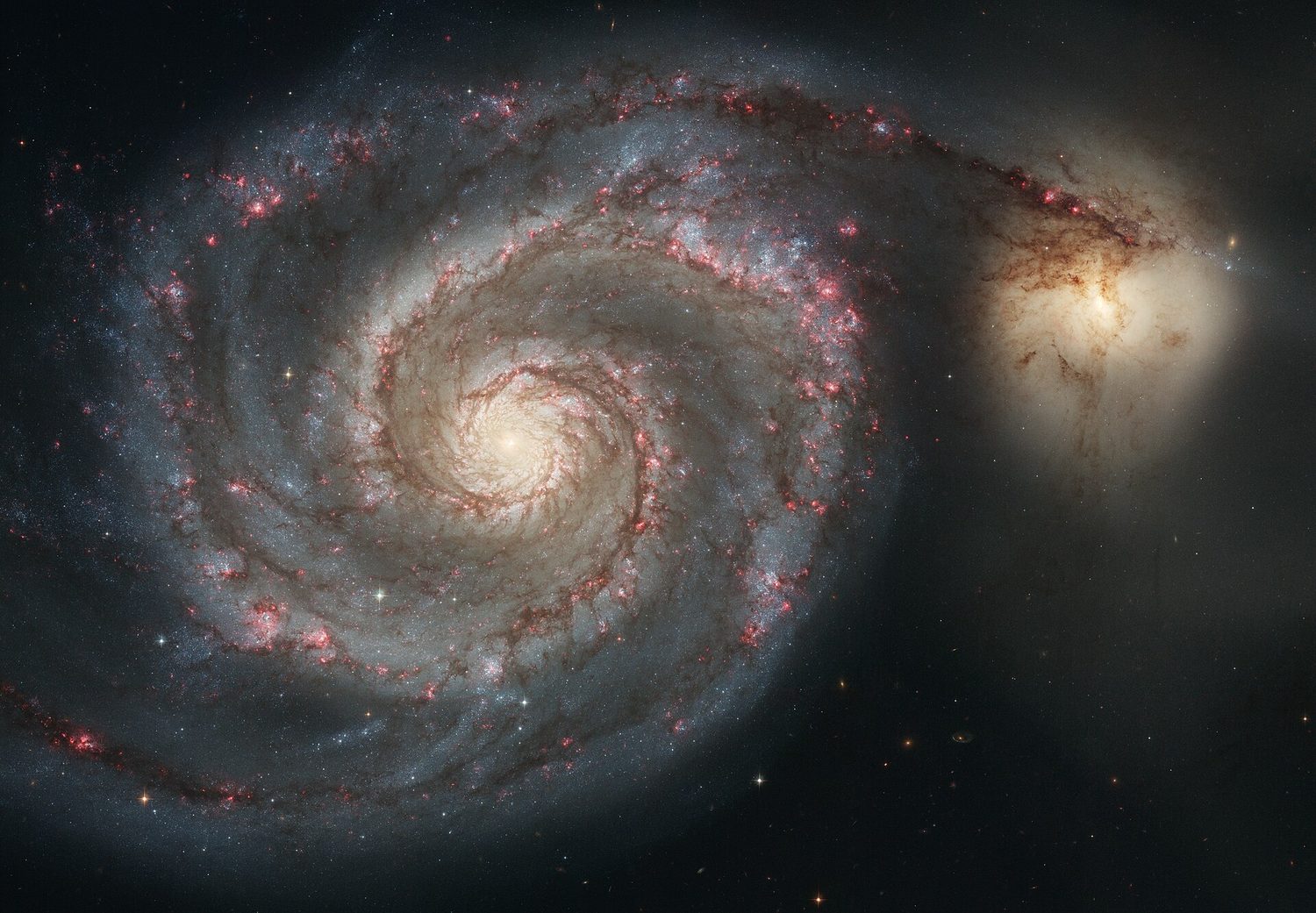
A galaxy 星系 is a group of many billions of stars held together by gravity. Our Sun is one star in the galaxy called the Milky Way 银河系. All the other stars in the Milky Way are very much further from the Earth than the Sun is.
Distances between stars are so big that we measure them in light-years 光年. One light-year is the distance light travels in one year (in the vacuum of space), which is about $9.5 \times 10^{15}\ \text{m}$.
The Milky Way is about $100\,000$ light-years across (its diameter 直径). It is just one of many billions of galaxies. All of these galaxies together make up the Universe 宇宙.
العربية
المجرة هي مجموعة تضم مليارات النجوم متماسكة بواسطة الجاذبية. شمسينا هي نجمة واحدة في المجرة التي تُسمى التبانة. جميع النجوم الأخرى في التبانة تبعد عن الأرض مسافات أبعد بكثير مما تبعد عنه الشمس.
مجرة لولبية: مليارات النجوم متماسكة بالجاذبية
المسافات بين النجوم كبيرة جدًا لذا نقيسها بـالسنوات الضوئية. السنة الضوئية هي المسافة التي يقطعها الضوء في سنة واحدة (في فراغ الفضاء)، وهي تساوي تقريبًا $9.5 \times 10^{15}\ \text{m}$.
المجرّة الدائرية ممتدة بحوالي $100\,000$ سنة ضوئية عبرها (قطرها). إنها واحدة فقط من بين مليارات المجرات العديدة. كل هذه المجرات مجتمعة تُشكل الكون.
تلسكوب عملاق يدرس السماء الليلية؛ يساعد الشعاع الليزري على التقاط صور حادة للنجوم البعيدة
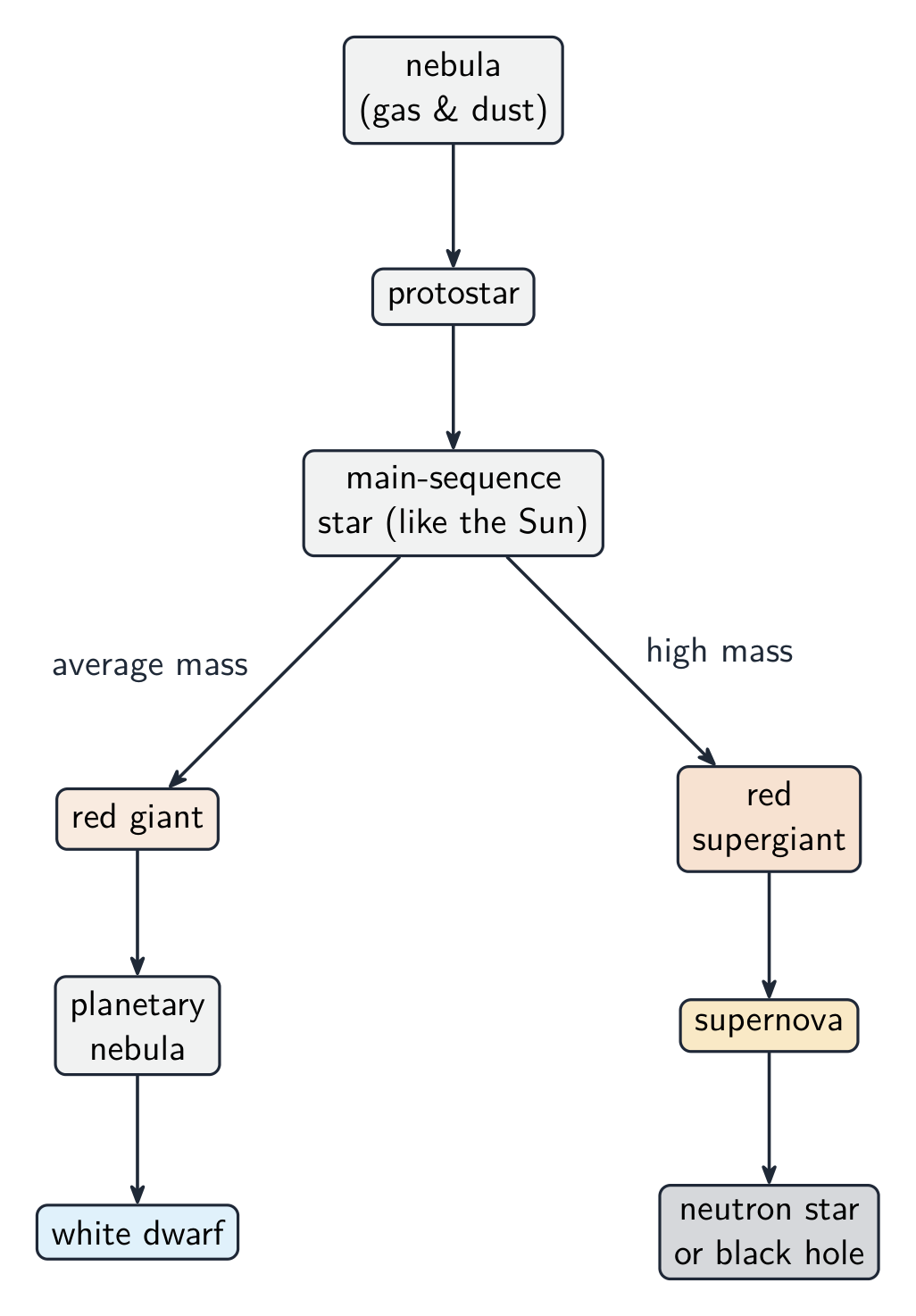
A star is born, lives and dies over a very long time:
A star forms from an interstellar cloud 星际云 of gas and dust that contains hydrogen.
Gravity pulls the cloud inwards, and it heats up. This collapsing, heating cloud is a protostar 原恒星.
The protostar becomes a stable 稳定 star when the inward pull of gravity is balanced by an outward push caused by the very high temperature in its centre.
In time, every star runs out of hydrogen fuel 燃料 for fusion.
What happens next depends on the mass of the star:
A medium star (like the Sun) swells into a red giant 红巨星. It then throws off its outer layers as a glowing cloud called a planetary nebula 星云, leaving a small, hot white dwarf 白矮星 at the centre.
A much heavier star swells into a red supergiant 红超巨星 and then explodes as a supernova 超新星. This blast spreads out a nebula containing hydrogen and new, heavier elements, and leaves behind a neutron star 中子星 or a black hole 黑洞.
The nebula from a supernova can later form new stars, with planets orbiting them — so our own Solar System came from earlier stars.
العربية
يولد النجم ويعيش ويموت خلال وقت طويل جدًا:
يتشكل النجم من سحابة بين نجمية من الغاز والغبار تحتوي على الهيدروجين.
تجذب الجاذبية السحابة للداخل، فتسخن. تُسمى هذه السحابة المنهارة والمسخنة النجم الأولي.
يصبح النجم الأولي نجماً مستقراً عندما يتوازن سحب الجاذبية الداخلي مع الدفع الخارجي الناتج عن درجات الحرارة العالية جداً في مركزه.
مع مرور الوقت، ينتهي كل نجم من وقود الهيدروجين اللازم للاندماج.
ما يحدث بعد ذلك يعتمد على كتلة النجم:
النجم المتوسط (مثل الشمس) ينتفخ ليصبح عملاقاً أحمر. ثم يطرد طبقاته الخارجية كسحابة مضيئة تُسمى سديم كوكبي، تاركاً قزماً أبيض صغيراً وساخناً في المنتصف.
النجم الأثقل بكثير ينتفخ ليصبح عملاقاً أحمر عملاق ثم ينهار كـمستعر أعظم. ينتشر هذا الانفجار سديماً يحتوي على الهيدروجين وعناصر أثقل جديدة، ويترك وراءه نجماً نيوترونياً أو ثقباً أسود.
يبدأ كل نجم في سديم؛ يعتمد نهايته على كتلته
يمكن للسديم الناتج عن انفجار مستعر عظيم أن يُكوّن نجومًا جديدة لاحقًا، مع كواكب تدور حولها — لذا نشأ نظامنا الشمسي من نجوم سابقة.
Explore · استكشف
The life cycle of a star · دورة حياة النجم
Gravity pulls a gas cloud together; fusion lights the star; when its fuel runs low it swells and finally fades. · تجمع الجاذبية سحابة الغاز؛ تضيء الانصهار النجم؛ وعندما ينتهي وقوده ينتفخ أخيراً ويختفي.
Explore · استكشف
The life cycle of a Sun-like star · الدورة الحياتية لنجم شبيه بالشمس
Step through how a star like our Sun is born, lives and dies. · مرر عبر كيفية ولادة نجم مثل شمسنا وعيشه وموته.
When a star or galaxy moves away from us (it is receding 退行), the light we receive from it has a longer wavelength 波长 than normal — it is shifted towards the red end of the spectrum. This is redshift 红移.
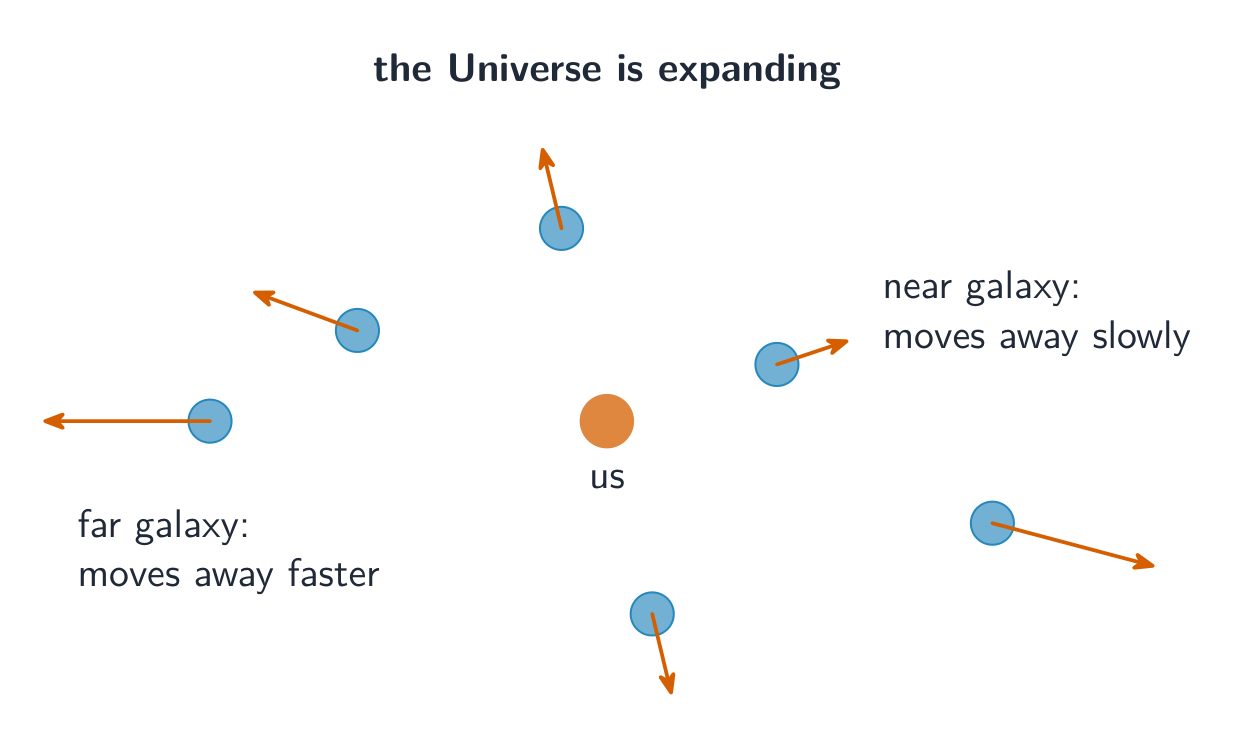
The light from distant galaxies is redshifted, and the further away a galaxy is, the bigger its redshift. This tells us that the galaxies are moving apart: the Universe is expanding 膨胀. Running this backwards, everything was once together at a single point — this is the evidence for the Big Bang 大爆炸 theory.
More evidence and the age of the Universe
Faint microwave 微波radiation 辐射 is found coming from every direction in space. This is the cosmic microwave background radiation 宇宙微波背景辐射 (CMBR). It was made as high-energy radiation soon after the Big Bang, and has been stretched out into the microwave part of the spectrum as the Universe expanded.
For a distant galaxy:
its speed $v$ of moving away can be found from the redshift of its starlight;
its distance $d$ can be found from the brightness of a supernova seen in it.
The Hubble constant 哈勃常数$H_0$ links these two:
$$H_0 = \frac{v}{d}$$
Its value today is about $2.2 \times 10^{-18}$ per second. Turning this around gives an estimate for the age of the Universe:
$$\frac{d}{v} = \frac{1}{H_0}$$
Worked example. The Hubble constant is about $H_0 = 2.2 \times 10^{-18}$ per second. Estimate the age of the Universe.
This works because every galaxy seems to have started from the same single point at the same time — more support for the Big Bang.
العربية
عندما يبتعد نجم أو مجرة عنا (هو يتراجع)، يكون الضوء الذي نستقبله منه له طول موجي أطول من المعتاد — حيث ينحرف نحو الطرف الأحمر للمطياف. هذا هو الانزياح الأحمر.
الخطوط الداكنة في طيف مجرة بعيدة تنحرف نحو الطرف الأحمر — هذا هو الانزياح الأحمر
ضوء المجرات البعيدة مُزاح أحمر، وكلما كانت المجرة أبعد، كان انزياحها الأحمر أكبر. هذا يخبرنا أن المجرات تبتعد عن بعضها: الكون متوسع. عند عكس ذلك، كان كل شيء معًا في نقطة واحدة في الماضي — وهذا هو الدليل على نظرية الانفجار العظيم.
كل مجرة تبتعد عنا، والمجرات الأبعد تبتعد أسرع — الكون يتوسع
أدلة إضافية وعمر الكون
يوجد إشعاعميكروي خافت يأتي من كل اتجاه في الفضاء. هذا هو إشعاع الخلفية الميكروية الكونية (CMBR). نتج كإشعاع عالي الطاقة قريبًا من الانفجار العظيم، وتمدد إلى جزء الميكروويو من الطيف مع توسع الكون.
تصوير السماء بأكملها بالميكروويو: هذا التوهج الخفيف يصل إلينا من كل اتجاه كحرارة متبقية من الكون الصغير — دليل قوي على الانفجار العظيم
لمجرة بعيدة:
سرعتها $v$ في الابتعاد يمكن إيجادها من انزياح ضوء النجوم فيها؛
مسافتها $d$ يمكن إيجادها من سطوع مستعر عظيم مرصود فيها.
ثابت هابل $H_0$ يربط بين هذين العاملين:
$$H_0 = \frac{v}{d}$$
قيمته اليوم حوالي $2.2 \times 10^{-18}$ لكل ثانية. وعكس هذه القيمة يعطي تقديرًا لعمر الكون:
$$\frac{d}{v} = \frac{1}{H_0}$$
مثال محلول. ثابت هابل حوالي $H_0 = 2.2 \times 10^{-18}$ لكل ثانية. قدر عمر الكون.
In $v = \dfrac{2\pi r}{T}$, $r$ is the orbit radius and $T$ is the time for one full orbit in seconds — convert km to m and hours to seconds first.
Planets closer to the Sun feel stronger gravity, so they orbit faster and take less time. In an elliptical orbit a body speeds up as it nears the Sun (gravitational potential energy turns into kinetic energy).
A light-year is a distance, not a time — how far light travels in one year.
A star is stable when the inward pull of gravity is balanced by the outward push from the energy released by fusion in its core. What it becomes when its fuel runs out depends on its mass.
Redshift — light from distant galaxies shifted to longer (redder) wavelengths, with a bigger shift the further away — is the evidence that the Universe is expanding, which supports the Big Bang.
العربية
في $v = \dfrac{2\pi r}{T}$، $r$ هو نصف قطر المدار و$T$ هو الزمن لدورة كاملة بالثواني — حول الكيلومتر إلى متر والساعة إلى ثوانٍ أولاً.
الكواكب الأقرب للشمس تشعر بجاذبية أقوى، لذا تدور بسرعة وتأخذ وقتًا أقل. في مدار إهليجي، يتسارع الجسم عندما يقترب من الشمس (تحول الطاقة الكامنة الجاذبية إلى طاقة حركية).
السنة الضوئية هي مسافة، وليست زمنًا — المسافة التي يقطعها الضوء في سنة واحدة.
النجم مستقر عندما تتوازن قوة الجذب inward للجاذبية مع الدفع outward الناتج عن الاندماج في جوفه. ما سيصبح عليه عند نفاد وقوده يعتمد على كتلته.
الانزياح الأحمر — الضوء من المجرات البعيدة المنحرف إلى أطوال موجية أطول (أكثر حمرة)، مع انزياح أكبر كلما ابتعدت — هو الدليل على أن الكون متوسع، مما يدعم الانفجار العظيم.
Interactive lessons on this topic · دروس تفاعلية حول هذا الموضوع
Work through it step by step, with instant-check exercises. · ا-working عليه خطوة بخطوة، مع تمارين تحقق فوري.
Pick one and the site follows you — notes, papers, videos and practice all open on it. · اختر واحدًا وسيتبعك الموقع — الملاحظات، الأوراق، الفيديوهات والتدريب جميعها تفتح عليه.
Type to search notes, lessons, code, vocabulary and past-paper questions across every subject. · اكتب للبحث عن ملاحظات، دروس، أكواد، مفردات وأسئلة امتحانات سابقة عبر جميع المواد.