كل ما حولك مصنوع من ذرات — ومع ذلك الذرة فارغة تقريباً بالكامل. إذا كانت النواة بحجم حبة مرمر، ستكون الذرة كاملة بحجم…
English narration · English + 中文 subtitles burned in · سرد باللغة الإنجليزية · ترجمة مدمجة بالإنجليزية + الصينية
5.1
The atom · الذرة
Syllabus · المنهج
English
5.1.1 The atom
Core
Supplement
1 Describe the structure of an atom in terms of a positively charged nucleus and negatively charged electrons in orbit around the nucleus
3 Describe how the scattering of alpha ($\alpha$) particles by a sheet of thin metal supports the nuclear model of the atom, by providing evidence for: (a) a very small nucleus surrounded by mostly empty space (b) a nucleus containing most of the mass of the atom (c) a nucleus that is positively charged
2 Know how atoms may form positive ions by losing electrons or form negative ions by gaining electrons
5.1.2 The nucleus
Core
Supplement
1 Describe the composition of the nucleus in terms of protons and neutrons
6 Describe the processes of nuclear fission and nuclear fusion as the splitting or joining of nuclei, to include the nuclide equation and qualitative description of mass and energy changes without values
2 State the relative charges of protons, neutrons and electrons as +1, 0 and –1 respectively
3 Define the terms proton number (atomic number) $Z$ and nucleon number (mass number) $A$ and be able to calculate the number of neutrons in a nucleus
7 Know the relationship between the proton number and the relative charge on a nucleus
8 Know the relationship between the nucleon number and the relative mass of a nucleus
4 Use the nuclide notation $^{A}_{Z}\text{X}$
5 Explain what is meant by an isotope and state that an element may have more than one isotope
العربية
5.1.1 الذرة
أساسي
تكميلي
1 صف بنية الذرة بدلالة نواة موجبة الشحنة وإلكترونات سالبة الشحنة تدور حول النواة
3 صف كيف يدعم تشتت جسيمات ألفا ($\alpha$) عبر رقة معدنية النموذج النووي للذرة، من خلال تقديم أدلة على: (أ) نواة صغيرة جداً محاطة بمساحة فارغة في الغالب (ب) نواة تحتوي على معظم كتلة الذرة (ج) نواة موجبة الشحنة
2 اعرف كيف يمكن للذرات أن تكون أيونات موجبة بفقدان الإلكترونات أو أيونات سالبة باكتسابها للإلكترونات
5.1.2 النواة
أساسي
تكميلي
1 صف تركيب النواة بدلالة البروتونات والنيوترونات
6 صف عمليتي الانشطار النووي والاندماج النووي كانشطار أو اندماج للنوى، بما في ذلك معادلة النويدات والوصف النوعي للتغيرات في الكتلة والطاقة بدون قيم
2 اذكر الشحنات النسبية للبروتونات والنيوترونات والإلكترونات وهي +1 و 0 و –1 على الترتيب
3 عرّف مصطلحي العدد البروتوني (العدد الذري) $Z$ والعدد النووي (العدد الكتلي) $A$ وقادر على حساب عدد النيوترونات في النواة
7 اعرف العلاقة بين العدد البروتوني والشحنة النسبية للنواة
8 اعرف العلاقة بين العدد النووي والكتلة النسبية للنواة
4 استخدم رموز النويدات $^{A}_{Z}\text{X}$
5 اشرح ما يُقصد بـالنظائر وأذكر أن العنصر قد يكون له أكثر من نظير
Source: Cambridge International syllabus · المصدر: منهج كامبريدج الدولي
English
An atom 原子 is made of a tiny central nucleus 原子核 with electrons 电子 moving around it (in orbit 轨道, like planets around the Sun).
The nucleus has a positive charge 电荷.
The electrons have a negative charge.
The atom as a whole is neutral, because the positive and negative charges are equal.
Almost all the mass 质量 is in the nucleus, but the nucleus is very small compared with the whole atom. So an atom is mostly empty space.
Ions
An atom is neutral, but it can gain or lose electrons to become an ion 离子.
Lose one or more electrons → a positive ion (now there are more protons than electrons).
Gain one or more electrons → a negative ion.
The alpha-scattering experiment
This experiment gave the evidence for the nuclear model. Alpha particles α粒子 (small, fast, positive) were fired at a very thin gold foil 金箔, and the scattering 散射 (the way they bounced off) was watched.
The results and what they tell us:
Almost all the alpha particles went straight through. → The atom is mostly empty space.
A few were deflected 偏转 (bent) through small angles. → The nucleus has a positive charge, which pushes the positive alpha particles away.
A very few bounced almost straight back. → The nucleus is very small and very heavy, and holds most of the mass of the atom.
العربية
تتكون الذرة من نواة مركزية صغيرة تحيط بها إلكترونات تدور حولها (في مدار، مثل الكواكب حول الشمس).
للنواة شحنة موجبة.
للإلكترونات شحنة سالبة.
تكون الذرة بأكملها متعادلة، لأن الشحنات الموجبة والسالبة متساوية.
معظم الكتلة توجد في النواة، لكن النواة صغيرة جداً مقارنة بالذرة بأكملها. لذا فإن الذرة تتكون في الغالب من فراغ.
الذرة النووية: نواة صغيرة وكثيفة من البروتونات والنيوترونات، مع إلكترونات في مدارات حولها
الأيونات
الذرة متعادلة، لكنها قد تكتسب أو تفقد إلكترونات لتصبح أيوناً.
فقدان إلكترون واحد أو أكثر → أيون موجب (هناك الآن بروتونات أكثر من الإلكترونات).
اكتساب إلكترون واحد أو أكثر → أيون سالب.
تجربة تشتت ألفا
قدمت هذه التجربة الدليل على النموذج النووي. تم إطلاق جسيمات ألفا α (صغيرة، سريعة، موجبة) نحو رقاقة ذهبية رقيقة جداً، وتم مراقبة التشتت (طريقة ارتدادها).
النتائج وما تخبرنا به:
مرّ معظم جسيمات ألفا بشكل مستقيم. ← الذرة تتكون في الغالب من فراغ.
انحرف القليل منها (انحنى) بزوايا صغيرة. ← النواة تحمل شحنة موجبة، مما يدفع جسيمات ألفا الموجبة بعيداً.
ارتد القليل جداً تقريباً بشكل مستقيم عكسياً. ← النواة صغيرة جداً وثقيلة، وتحمل معظم كتلة الذرة.
معظم جسيمات ألفا تمر بشكل مستقيم؛ القليل ينحرف والقليل جداً يرتد عن النواة الصغيرة والكثيفة
Explore · استكشف
Inside the atom · داخل الذرة
A tiny dense nucleus sits at the centre with electrons in shells around it — drag the proton number and watch the shells fill outward. · نواة صغيرة وكثيفة تقع في المركز مع إلكترونات في مدارات حولها — اسحب العدد البروتوني وشاهد كيف تمتلئ المدارات خارجياً.
The nucleus is made of two kinds of particle, together called nucleons 核子:
protons 质子, which have a relative 相对 charge of $+1$;
neutrons 中子, which have a relative charge of $0$ (they are neutral).
An electron has a relative charge of $-1$. A proton and a neutron each have a relative mass of about $1$; an electron is almost massless in comparison.
Two numbers describe a nucleus:
the proton number 质子数$Z$ (also called the atomic number) — the number of protons;
the nucleon number 核子数$A$ (also called the mass number) — the number of protons plus neutrons.
So the number of neutrons is $A - Z$.
We write a nucleus in nuclide 核素 notation:
$$^{A}_{Z}\text{X}$$
where X is the chemical symbol. For example, $^{197}_{\ 79}\text{Au}$ has $79$ protons and $197 - 79 = 118$ neutrons. The relative charge of the whole nucleus is just $+Z$ (here $+79$), and its relative mass is about $A$.
Isotopes
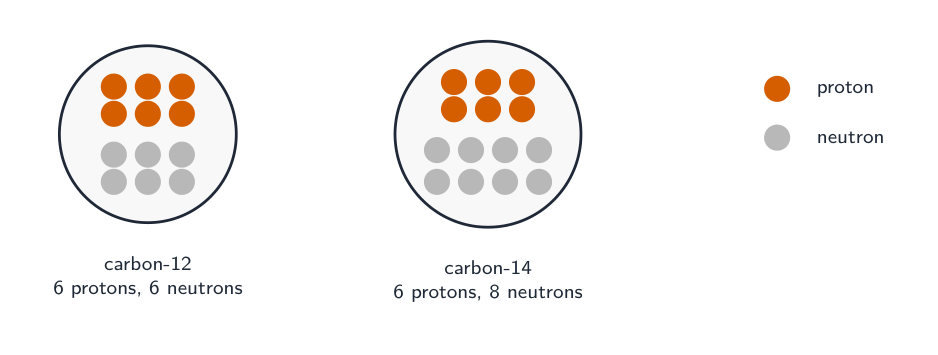
Isotopes 同位素 are atoms of the same element (the same $Z$) but with different numbers of neutrons (different $A$). They behave the same in chemistry but differently in the nucleus. For example, $^{12}_{\ 6}\text{C}$ and $^{14}_{\ 6}\text{C}$ are both carbon.
Nuclear fission and fusion
In nuclear fission 核裂变, a heavy nucleus absorbs a neutron and then splits into two smaller nuclei, giving out two or three neutrons and a lot of energy 能量:
The top numbers (nucleon numbers) balance on both sides, and so do the bottom numbers (proton numbers). You can use this to find a missing number — for example, how many neutrons are released.
In nuclear fusion 核聚变, two light nuclei join to make a heavier one, also giving out energy. This is how the Sun makes its energy, joining hydrogen 氢 nuclei to make helium 氦. The reaction below — two heavy forms of hydrogen (deuterium and tritium) joining into helium — is the one used in fusion reactors on Earth:
In both fission and fusion, a small amount of mass is lost and turned into energy.
العربية
تتكون النواة من نوعين من الجسيمات، يُطلق عليهما مجتمعة اسم النوكليونات:
البروتونات، التي تحمل شحنة نسبية قدرها $+1$;
النيوترونات، التي تحمل شحنة نسبية قدرها $0$ (وهي متعادلة).
لإلكترون شحنة نسبية قدرها $-1$. ولكل من البروتون والنيوترون كتلة نسبية تبلغ حوالي $1$؛ بينما الإلكترون شبه عديم الكتلة بالمقارنة.
يصف عددان النواة:
عدد البروتونات$Z$ (يُسمى أيضاً العدد الذري) — وهو عدد البروتونات;
عدد النوكليونات$A$ (يُسمى أيضاً العدد الكتلي) — وهو مجموع عدد البروتونات والنيوترونات.
إذن عدد النيوترونات هو $A - Z$.
نكتب النواة باستخدام رمز النظير:
$$^{A}_{Z}\text{X}$$
حيث X هو الرمز الكيميائي. على سبيل المثال، $^{197}_{\ 79}\text{Au}$ يحتوي على $79$ بروتون و$197 - 79 = 118$ نيوترون. الشحنة النسبية للنواة بأكملها هي $+Z$ فقط (هنا $+79$)، وكتلتها النسبية حوالي $A$.
النظائر
النظائر هي ذرات لنفس العنصر (نفس $Z$) ولكن بأعداد مختلفة من النيوترونات (أعداد مختلفة لـ $A$). تتصرف بنفس الطريقة في الكيمياء ولكن differently في النواة. على سبيل المثال، $^{12}_{\ 6}\text{C}$ و$^{14}_{\ 6}\text{C}$ كلاهما كربون.
نظائر الكربون تحتوي على نفس الستة بروتونات لكن بأعداد مختلفة من النيوترونات، لذا فهي نفس العنصر بكتلة مختلفة
الانشطار والاندماج النووي
في الانشطار النووي، تمتص نواة ثقيلة نيوتروناً ثم تنقسم إلى نواتين أصغر، مما يحرر نيوترونين أو ثلاثة ويخرج كمية كبيرة من الطاقة:
نيوترون يقسم نواة U-235 إلى نواتين أصغر، محرراً المزيد من النيوترونات والطاقة
الأرقام العلوية (أعداد النوكليونات) متوازنة في كلا الطرفين، وكذلك الأرقام السفلية (أعداد البروتونات). يمكنك استخدام ذلك لإيجاد رقم مفقود — على سبيل المثال، كم عدد النيوترونات المحررة.
في الاندماج النووي، ترتبط نواتان خفيفتان لتكوين واحدة أثقل، وتحرر أيضاً طاقة. هذه هي الطريقة التي تصنع بها الشمس طاقتها، بربط نوى الهيدروجين لتكوين الهيليوم. التفاعل أدناه — ارتباط شكلين ثقيلين من الهيدروجين (الدوتيريوم والتريتيوم) لتكوين الهيليوم — هو التفاعل المستخدم في مفاعلات الاندماج على الأرض:
*في الاندماج تندمج نواتان خفيفتان في واحدة أثقل، محررة نيوترون وطاقة — تفاعل الدوتيريوم-التريتيوم المستخدم في مفاعلات الاندماج
في كل من الانشطار والاندماج، تُفقد كمية صغيرة من الكتلة وتتحول إلى طاقة.
تستخدم محطة الطاقة النووية طاقة الانشطار لتوليد الكهرباء؛ وتطلق الأبراج الحرارة الزائدة على شكل بخار
Explore · استكشف
The fission chain reaction · تفاعل الانشطار المتسلسل
A neutron splits a uranium nucleus, which releases energy AND more neutrons — those split more nuclei, and so on. · نيوترون يشق نواة اليورانيوم، مما يطلق الطاقة AND المزيد من النيوترونات — تلك تشق نوياً أخرى، وهكذا.
2 Know the sources that make a significant contribution to background radiation including: (a) radon gas (in the air) (b) rocks and buildings (c) food and drink (d) cosmic rays
3 Know that ionising nuclear radiation can be measured using a detector connected to a counter
4 Use count rate measured in counts / s or counts / minute
5 Use measurements of background radiation to determine a corrected count rate
5.2.2 The three types of nuclear emission
Core
Supplement
1 Describe the emission of radiation from a nucleus as spontaneous and random in direction
2 Identify alpha ($\alpha$), beta ($\beta$) and gamma ($\gamma$) emissions from the nucleus by recalling: (a) their nature (b) their relative ionising effects (c) their relative penetrating abilities ($\beta^+$ are not included, $\beta$-particles will be taken to refer to $\beta^-$)
3 Describe the deflection of $\alpha$-particles, $\beta$-particles and $\gamma$-radiation in electric fields and magnetic fields
4 Explain their relative ionising effects with reference to: (a) kinetic energy (b) electric charge
5.2.3 Radioactive decay
Core
Supplement
1 Know that radioactive decay is a change in an unstable nucleus that can result in the emission of $\alpha$-particles or $\beta$-particles and/or $\gamma$-radiation and know that these changes are spontaneous and random
3 Know that isotopes of an element may be radioactive due to an excess of neutrons in the nucleus and/or the nucleus being too heavy
2 State that during $\alpha$-decay or $\beta$-decay, the nucleus changes to that of a different element
4 Describe the effect of $\alpha$-decay, $\beta$-decay and $\gamma$-emissions on the nucleus, including an increase in stability and a reduction in the number of excess neutrons; the following change in the nucleus occurs during $\beta$-emission neutron $\rightarrow$ proton + electron
5 Use decay equations, using nuclide notation, to show the emission of $\alpha$-particles, $\beta$-particles and $\gamma$-radiation
5.2.4 Half-life
Core
Supplement
1 Define the half-life of a particular isotope as the time taken for half the nuclei of that isotope in any sample to decay; recall and use this definition in simple calculations, which might involve information in tables or decay curves (calculations will not include background radiation)
2 Calculate half-life from data or decay curves from which background radiation has not been subtracted
3 Explain how the type of radiation emitted and the half-life of an isotope determine which isotope is used for applications including: (a) household fire (smoke) alarms (b) irradiating food to kill bacteria (c) sterilisation of equipment using gamma rays (d) measuring and controlling thicknesses of materials with the choice of radiations used linked to penetration and absorption (e) diagnosis and treatment of cancer using gamma rays
5.2.5 Safety precautions
Core
Supplement
1 State the effects of ionising nuclear radiations on living things, including cell death, mutations and cancer
2 Describe how radioactive materials are moved, used and stored in a safe way
3 Explain safety precautions for all ionising radiation in terms of reducing exposure time, increasing distance between source and living tissue and using shielding to absorb radiation
العربية
5.2.1 كشف الإشعاع
أساسي
تكميلي
1 اعرف ما يُقصد بـالإشعاع الخلفي
2 اعرف المصادر التي تساهم بشكل كبير في الإشعاع الخلفي بما في ذلك: (أ) غاز الرادون (في الهواء) (ب) الصخور والمباني (ج) الطعام والشراب (د) الأشعة الكونية
3 اعرف أن الإشعاع النووي المؤين يمكن قياسه باستخدام كاشف متصل بعدّاد
4 استخدم معدل العد المقاس بوحدات عد / ثانية أو عد / دقيقة
5 استخدم قياسات الإشعاع الخلفي لتحديد معدل عد مُصحَّح
5.2.2 أنواع الإشعاع النووي الثلاثة
أساسي
تكميلي
1 صف انبعاث الإشعاع من النواة بأنه تلقائي وعشوائي الاتجاه
2 حدد انبعاثات ألفا ($\alpha$)، بيتا ($\beta$) وغاما ($\gamma$) من النواة بتذكّر: (أ) طبيعتها (ب) تأثيراتها التأينية النسبية (ج) قدراتها الاختراقية النسبية ($\beta^+$ غير مدرجة، وستُعتبر جسيمات $\beta$ أنها تشير إلى $\beta^-$)
3 صف انحراف جسيمات $\alpha$ وجسيمات $\beta$ وإشعاع $\gamma$ في المجالات الكهربائية والمغناطيسية
4 اشرح تأثيراتها التأينية النسبية بالإشارة إلى: (أ) الطاقة الحركية (ب) الشحنة الكهربائية
5.2.3 التحلل الإشعاعي
أساسي
تكميلي
1 اعرف أن التحلل الإشعاعي هو تغيير في نواة غير مستقرة قد يؤدي إلى انبعاث جسيمات $\alpha$ أو جسيمات $\beta$ و/أو إشعاع $\gamma$ ويعرف أن هذه التغيرات تلقائية وعشوائية
3 اعرف أن النظائر للعنصر قد تكون مشعة بسبب فائض النيوترونات في النواة و/أو ثقل النواة الزائد
2 اذكر أنه خلال تفكك $\alpha$ أو تفكك $\beta$، يتغير النواة إلى نواة لعنصر مختلف
4 صف تأثير التفكك $\alpha$، التفكك $\beta$ والإشعاع $\gamma$ على النواة، بما في ذلك زيادة الاستقرار وتقليل عدد النيوترونات الزائدة؛ يحدث التغير التالي في النواة أثناء الإشعاع $\beta$ نيوترون $\rightarrow$ بروتون + إلكترون
5 استخدم معادلات التحلل، باستخدام رموز النويدات، لإظهار انبعاث جسيمات $\alpha$ وجسيمات $\beta$ وإشعاع $\gamma$
5.2.4 عمر النصف
أساسي
تكميلي
1 عرّف عمر النصف لنظير معين بأنه الوقت اللازم لنصف نوى هذا النظير في أي عينة أن تتحلل؛ استذكر واستخدم هذا التعريف في الحسابات البسيطة، والتي قد تتضمن معلومات من جداول أو منحنيات التحلل (لن تشمل الحسابات الإشعاع الخلفي)
2 احسب عمر النصف من البيانات أو منحنيات التحلل التي لم يُطرح منها الإشعاع الخلفي
3 اشرح كيف يحدد نوع الإشعاع المنبعث وعمر النصف للنظير النظير المستخدم في التطبيقات بما في ذلك: (أ) كواشف الدخان المنزلية (ب) تعقيم الطعام لقتل البكتيريا (ج) تعقيم المعدات باستخدام أشعة غاما (د) قياس والتحكم في سماكة المواد باختيار الإشعاعات المرتبطة بالاختراق والامتصاص (هـ) تشخيص وعلاج السرطان باستخدام أشعة غاما
5.2.5 احتياطات السلامة
أساسي
تكميلي
1 اذكر تأثيرات الإشعاعات النووية المؤينة على الكائنات الحية، بما في ذلك موت الخلايا، الطفرات، وسرطان
2 صف كيفية نقل المواد المشعة واستخدامها وتخزينها بطريقة آمنة
3 اشرح احتياطات السلامة لجميع الإشعاعات المؤينة بدلالة تقليل وقت التعرض، وزيادة المسافة بين المصدر والأنسجة الحية، واستخدام الحواجز لامتصاص الإشعاع
Source: Cambridge International syllabus · المصدر: منهج كامبريدج الدولي
English
Radioactive decay & half-life
A nucleus that is unstable 不稳定 will sooner or later break down and give out radiation 辐射. This is radioactive 放射性decay 衰变. A nucleus may be unstable because it has too many neutrons, or because it is too heavy.
Decay is spontaneous 自发 (it happens on its own, and you cannot speed it up or slow it down) and random 随机 (you cannot say which nucleus will decay next, or exactly when).
Background radiation
Some radiation is around us all the time. This is background radiation 背景辐射. Its main sources are:
radon 氡 gas in the air (usually the biggest source);
rocks and buildings;
food and drink;
cosmic rays 宇宙射线 from space.
Measuring radiation
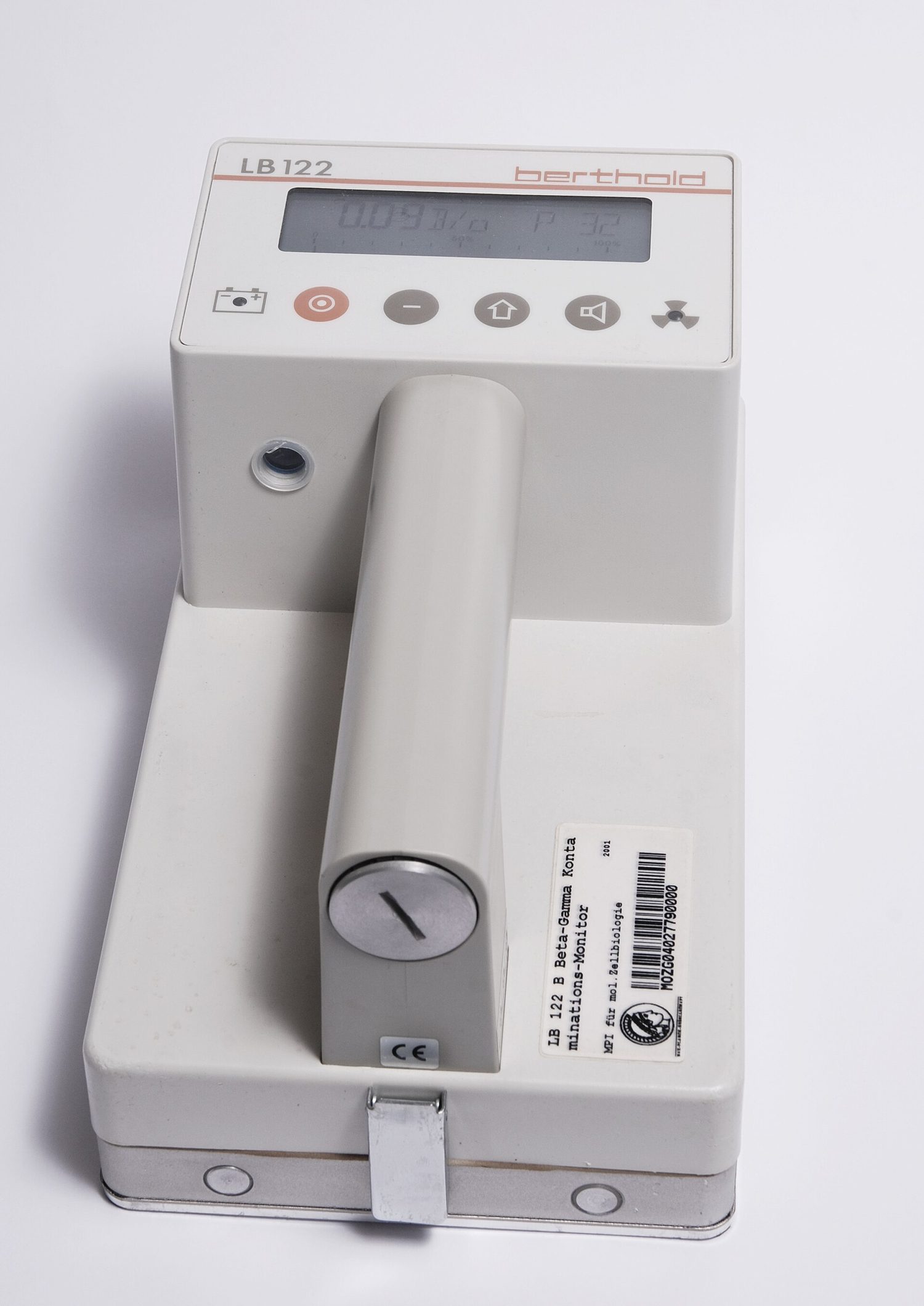
Radiation can be measured with a detector 探测器 joined to a counter 计数器. The count rate 计数率 is the number of counts each second (or each minute).
To find the true count rate from a source, first measure the background count rate on its own, then subtract it. The answer is the corrected 修正 count rate:
Worked example. A detector placed next to a source reads $250$ counts/min. With the source taken away, the background count rate is $30$ counts/min. Find the corrected count rate.
$$250 - 30 = 220\ \text{counts/min}$$
العربية
التناضح الإشعاعي وعمر النصف
النواة غير المستقرة ستتحلل وتصدر إشعاعاً عاجلاً أم آجلاً. هذا هو التحلل الإشعاعي. قد تكون النواة غير مستقرة بسبب وجود الكثير من النيوترونات، أو لأنها ثقيلة جداً.
التحلل تلقائي (يحدث من تلقاء نفسه، ولا يمكن تسريعه أو إبطائه) وعشوائي (لا يمكنك تحديد أي نواة ستتحلل التالية، أو متى بالضبط).
الإشعاع الخلفي
بعض الإشعاع موجود حولنا طوال الوقت. هذا هو الإشعاع الخلفي. sourcesه الرئيسية هي:
غاز الرادون في الهواء (عادة أكبر مصدر);
الصخور والمباني;
الطعام والشراب;
الأشعة الكونية من الفضاء.
قياس الإشعاع
يمكن قياس الإشعاع باستخدام كاشف متصل بـ عداد. معدل العد هو عدد العدادات في كل ثانية (أو كل دقيقة).
لإيجاد معدل العد الحقيقي من مصدر، قس أولاً معدل العد الخلفي بمفرده، ثم اطرحه. النتيجة هي معدل العد المصحح:
The three types of radiation · الأنواع الثلاثة للإشعاع
English
The radiation can be one of three types. Each type is ionising 电离, which means it can knock electrons off atoms in its path.
Type
What it is
Ionising effect
Stopped by
alpha (α)
a helium nucleus: 2 protons + 2 neutrons, charge $+2$
strongest
a sheet of paper, or a few cm of air
beta (β)
a fast-moving electron, charge $-1$
medium
a few mm of aluminium 铝
gamma (γ)
a high-energy electromagnetic wave 电磁波, no charge
weakest
thick lead 铅 or concrete (only reduced, never fully stopped)
So an alpha particle is the most ionising but the least penetrating 穿透 (it is easily absorbed 吸收). A beta particle β粒子 is in the middle. Gamma radiation γ射线 is the least ionising but the most penetrating.
We can explain the ionising effects from charge and kinetic energy 动能: an alpha particle has a large charge ($+2$) and is slow and heavy, so it pulls strongly on the electrons it passes and ionises a lot. A beta particle has a smaller charge and moves faster, so it ionises less.
Deflection in fields
Because alpha and beta particles are charged, they are deflected by an electric field 电场 and by a magnetic field 磁场. They bend in opposite directions, because their charges have opposite signs, and the lighter beta particle bends more. Gamma rays have no charge, so they are not deflected at all.
العربية
الإشعاع يمكن أن يكون من ثلاثة أنواع. كل نوع مؤين، مما يعني أنه يمكنه نزع الإلكترونات من الذرات في طريقه.
النوع
ما هو
التأثير المؤين
يوقفه
ألفا (α)
نواة هيليوم: 2 بروتونات + 2 نيوترونات، شحنة $+2$
الأقوى
ورقة أو بضعة سنتيمترات من الهواء
بيتا (β)
إلكترون سريع الحركة، شحنة $-1$
متوسط
بضعة مليمترات من الألمنيوم
غاما (γ)
موجة كهربائية مغناطيسية عالية الطاقة، لا شحنة
الأضعف
رصاص سميك أو خرسانة (يُخفف فقط، ولا يُوقف كلياً أبداً)
لذا فإن جسيم ألفا هو الأكثر تأثيراً مؤيناً لكن الأقل اختراقاً (يتم امتصاصه بسهولة). جسيم بيتا β يقع في المنتصف. إشعاع غاما γ هو الأقل تأثيراً مؤيناً لكن الأكثر اختراقاً.
الورق يوقف ألفا، بضعة مليمترات من الألمنيوم توقف بيتا، والرصاص السميك يُخفض غاما فقط
يمكننا تفسير التأثيرات المؤينة بناءً على الشحنة والطاقة الحركية: جسيم ألفا له شحنة كبيرة ($+2$) وهو بطيء وثقيل، لذا يسحب بقوة الإلكترونات التي يمر بها ويؤين الكثير. جسيم بيتا له شحنة أصغر ويتحرك أسرع، لذا يؤين أقل.
الانحراف في المجالات
بما أن جسيمات ألفا وبيتا مشحونة، فإنها تنحرف بسبب المجال الكهربائي والمجال المغناطيسي. تنحني في اتجاهين متعاكسين، لأن شحناتها ذات إشارات متعاكسة، وجسيم بيتا الأخف ينحني أكثر. أشعة غاما ليس لها شحنة، لذا لا تنحرف على الإطلاق.
ألفا وبيتا ينحنيان في اتجاهين متعاكسين؛ بيتا الأخف ينحني أكثر، وغاما غير المشحون لا ينحرف
5.2
Decay equations · معادلات التحلل
English
When a nucleus decays, the nucleon and proton numbers must balance on both sides.
Alpha decay — the nucleus loses 2 protons and 2 neutrons, so $A$ falls by $4$ and $Z$ falls by $2$. It becomes a different element:
Gamma emission — the nucleus loses only energy, so $A$ and $Z$ do not change. Alpha and beta decay leave the nucleus more stable 稳定; gamma is often given out at the same time to carry away spare energy.
العربية
عند تحلل النواة، يجب أن تتوازن أعداد النيوكليونات والبروتونات في كلا الطرفين.
انبعاث غاما — تفقد النواة الطاقة فقط، لذا $A$ و$Z$ لا يتغيران. يترك تحلل ألفا وبيتا النواة أكثر استقراراً؛ غالباً ما يُطلق غاما في نفس الوقت لنقل الطاقة الزائدة.
Because decay is random, we cannot follow one nucleus. Instead we describe a large sample 样品 using its half-life.
The half-life 半衰期 of an isotope is the time taken for half the unstable nuclei in a sample to decay. After each half-life, the count rate (or the number of unstable nuclei left) falls to half.
For example, if a source has a count rate of $800$ counts/min and a half-life of $3$ hours:
Time / hours
0
3
6
9
Count rate / (counts/min)
800
400
200
100
After $6$ hours (two half-lives) the count rate has halved twice: $800 \to 400 \to 200$. You can read a half-life off a decay graph by finding the time for the count rate to drop from any value to half of it. If the readings include background radiation, subtract the background count rate from every reading first, then find the half-life from the corrected values.
Worked example. The activity of a source falls from $800$ counts/min to $100$ counts/min. Its half-life is $5$ days. How long did this take?
Count the halvings: $800 \to 400 \to 200 \to 100$ is three half-lives, so the time is $3 \times 5 = 15\ \text{days}$.
العربية
بما أن التحلل عشوائي، لا يمكننا تتبع نواة واحدة. بدلاً من ذلك نصف عينة كبيرة باستخدام عمر النصف الخاص بها.
عمر النصف للنظير هو الزمن اللازم لتحلل نصف النوى غير المستقرة في العينة. بعد كل عمر نصف، ينخفض معدل العد (أو عدد النوى غير المستقرة المتبقية) إلى النصف.
على سبيل المثال، إذا كان للمصدر معدل عد قدره $800$ عدّ/دقيقة وعمر نصف قدره $3$ ساعة:
الوقت / ساعات
0
3
6
9
معدل العد / (عدّ/دقيقة)
800
400
200
100
بعد $6$ ساعات (عمرين نصف) انخفض معدل العد مرتين: $800 \to 400 \to 200$. يمكنك قراءة عمر النصف من منحنى التحلل بإيجاد الزمن الذي يستغرقه معدل العد ليهبط من أي قيمة إلى نصفها. إذا شملت القراءات الإشعاع الخلفي، اطرح معدل العد الخلفي من كل قراءة أولاً، ثم أوجد عمر النصف من القيم المصححة.
مثال محلول. نشاط مصدر ينخفض من $800$ عدّ/دقيقة إلى $100$ عدّ/دقيقة. عمر النصف هو $5$ أيام. كم استغرق هذا الوقت؟
احسب مرات النصف: $800 \to 400 \to 200 \to 100$ هي ثلاثة أعمار نصف، لذا الوقت هو $3 \times 5 = 15\ \text{days}$.
كل عمر نصف $T$ ينخفض معدل العد للنصف: $N_0 \to N_0/2 \to N_0/4 \to N_0/8$
Explore · استكشف
Half-life — watch the nuclei decay · عمر النصف — راقب تناضح الأنوية
Each nucleus has a fixed chance of decaying, at random. Move time forward: about half the remaining nuclei decay every half-life — so the count halves, then halves again. · لكل نواة فرصة ثابتة للتناضح، بشكل عشوائي. قم بتقدم الوقت: يتناضح حوالي نصف الأنوية المتبقية في كل عمر نصف — لذا يتناقص العد، ثم يتناقص مرة أخرى.
Uses of radioactivity · استخدامات النشاط الإشعاعي
English
The isotope chosen for a job depends on its type of radiation and its half-life:
smoke alarms 烟雾报警器 use an alpha source (alpha is easily blocked, so it is safe outside the alarm, and a long half-life means it lasts for years);
using radiation on food, or on equipment, kills bacteria 细菌 and germs — this needs penetrating gamma rays to sterilise 消毒 the sealed item;
measuring and controlling the thickness of paper or metal sheets uses a beta source (the amount that passes through changes with the thickness);
a medical tracer 医用示踪剂 is a small amount of a gamma-emitting isotope with a short half-life, injected into the body: a detector outside the body follows where it goes, gamma rays escape from the body easily, and the activity soon falls to a safe level;
gamma rays are used to find and to treat cancer 癌症 inside the body, because they can pass out of (or into) the body.
العربية
النظير المختار لعمل معين يعتمد على نوع إشعاعه وعمر نصفه:
كواشف الدخان تستخدم مصدراً ألفياً (ألفا يُحجب بسهولة، لذا فهو آمن خارج الكاشف، وعمر نصف طويل يعني أنه يدوم لسنوات)؛
استخدام الإشعاع على الطعام أو على المعدات يقتل البكتيريا والميكروبات — هذا يحتاج أشعة غاما الاختراقية لـتعقيم العنصر المحكم الإغلاق؛
قياس والتحكم في سماكة أوراق الورق أو الصفائح المعدنية يستخدم مصدراً بيتياً (الكمية التي تمر تتغير مع السماكة)؛
المُتتبع الطبي هو كمية صغيرة من نظير يشع غاما بعمر نصف قصير، تُحقن في الجسم: عتّاد خارج الجسم يتتبع مساره، وأشعة غاما تخرج من الجسم بسهولة، وينخفض النشاط بسرعة إلى مستوى آمن؛
تُستخدم أشعة غاما لإيجاد وعلاج سرطان داخل الجسم، لأنها تستطيع الخروج من (أو الدخول إلى) الجسم.
العلاج الإشعاعي: قناع شبكي يثبت المريض بينما توجه ليزرات المحاذاة أشعة غاما بدقة نحو الورم لعلاج السرطان
5.2
Safety · السلامة
English
Ionising radiation harms living cells 细胞. It can cause cell death, mutations 突变 (changes to the genes) and cancer.
When working with radioactive sources, keep the dose 剂量 (the amount of radiation received) low by:
reducing the exposure 照射 time — spend as little time near the source as possible;
increasing the distance between you and the source;
using shielding 屏蔽, such as lead, between the source and your body.
Radioactive sources should be handled with tongs (not bare hands), kept pointing away from people, and stored in a lead-lined box.
العربية
الإشعاع المؤين يضر بالخلايا الحية. يمكن أن يسبب موت الخلايا، طفرات (تغيرات في الجينات) وسرطان.
عند العمل مع المصادر المشعة، حافظ على الجرعة (كمية الإشعاع المستقبلة) منخفضة عن طريق:
تقليل زمن التعرض — أمضِ أقل قدر ممكن من الوقت بالقرب من المصدر;
زيادة المسافة بينك وبين المصدر;
استخدام الحواجز، مثل الرصاص، بين المصدر وجسمك.
يجب التعامل مع المصادر المشعة بملاقط (وليس بالأيدي العارية)، وتوجيهها بعيدًا عن الأشخاص، وتخزينها في صندوق مبطن بالرصاص.
5.2
Exam tips · نصائح للامتحان
English
The nucleon number (top) is protons + neutrons; the proton number (bottom) is protons only. Number of neutrons = nucleon number − proton number.
Isotopes have the same proton number but different nucleon numbers — the same element with a different number of neutrons.
Rank the radiations two ways: alpha is the most ionising but least penetrating (stopped by paper); gamma is the least ionising but most penetrating (needs thick lead). Beta is in between (stopped by a few mm of aluminium).
In every decay equation the top numbers must balance and the bottom numbers must balance. Alpha decay: $A-4$, $Z-2$. Beta decay: $A$ unchanged, $Z+1$.
Always subtract the background count rate before using a source's readings. After $n$ half-lives the count rate has halved $n$ times — count the halvings rather than guessing from the total time.
العربية
العدد النوكليوني (الأعلى) هو البروتونات + النيوترونات؛ العدد البروتوني (الأدنى) هو البروتونات فقط. عدد النيوترونات = العدد النوكليوني − العدد البروتوني.
النظائر لها نفس العدد البروتوني لكن أعداد نوكلونية مختلفة — نفس العنصر بعدد مختلف من النيوترونات.
رتب الإشعاعات بطريقتين: ألفا هو الأكثر تأييناً لكنه الأقل اختراقاً (يوقفه الورق)؛ جاما هو الأقل تأييناً لكنه الأكثر اختراقاً (يتطلب رصاصاً سميكاً). بيتا في المنتصف (يوقفه بضعة مم من الألمنيوم).
في كل معادلة تحلل يجب أن تتساوى الأرقام العلوية والأرقام السفلية. تحلل ألفا: $A-4$، $Z-2$. تحلل بيتا: $A$ لا يتغير، $Z+1$.
اطرح دائماً معدل الخلفية قبل استخدام قراءات المصدر. بعد $n$ نصف عمر، انخفض معدل العد $n$ مرات — عَدّ الانخفاضات بدلاً من التخمين من إجمالي الوقت.
Interactive lessons on this topic · دروس تفاعلية حول هذا الموضوع
Work through it step by step, with instant-check exercises. · ا-working عليه خطوة بخطوة، مع تمارين تحقق فوري.
Pick one and the site follows you — notes, papers, videos and practice all open on it. · اختر واحدًا وسيتبعك الموقع — الملاحظات، الأوراق، الفيديوهات والتدريب جميعها تفتح عليه.
Type to search notes, lessons, code, vocabulary and past-paper questions across every subject. · اكتب للبحث عن ملاحظات، دروس، أكواد، مفردات وأسئلة امتحانات سابقة عبر جميع المواد.



 *في الاندماج تندمج نواتان خفيفتان في واحدة أثقل، محررة نيوترون وطاقة — تفاعل الدوتيريوم-التريتيوم المستخدم في مفاعلات الاندماج