English
This handout covers Topic 8, Probability. Parts marked (Extended) are only tested on the Extended papers; everything else is for both levels.
 7:07
احتمال
هل ستمطر غداً؟ هل سيتأخر الحافلة؟ هل سيظهر هذا الرمز رقم ستة؟ لا شيء في الحياة مؤكد تقريباً، ولا شيء مستحيل تقريباً. معظم الأشياء تقع…
سرد باللغة الإنجليزية · ترجمة نصية بالإنجليزية و中文 يمكنك التبديل بينهما
This handout covers Topic 8, Probability. Parts marked (Extended) are only tested on the Extended papers; everything else is for both levels.
| محتوى المادة | ملاحظات وأمثلة |
|---|---|
| 1 فهم واستخدام مقياس الاحتمال من 0 إلى 1. | لا يلزم استخدام رموز الاحتمالات. يجب تقديم الاحتمالكسوراً أو أعشاراً أو نسب مئوية. قد تتطلب المسائل استخدام معلومات من جداول أو رسوم بيانية أو مخططات فن (محدود بمجموعتين). |
| 2 حساب احتمال حدث مفرد. | |
| 3 فهم أن احتمال عدم وقوع حدث ما = 1 – احتمال وقوع الحدث. | مثال: احتمال أن يكون قطعة زينة زرقاء هو 0.8. ما هو احتمال ألا تكون زرقاء؟ |
| محتوى المادة | ملاحظات وأمثلة |
|---|---|
| 1 افهم واستخدم مقياس الاحتمال من 0 إلى 1. | $\text{P}(A)$ هو احتمال $A$ |
| 2 افهم واستخدم رمز الاحتمالات. | $\text{P}(A')$ هو احتمال عدم $A$ |
| 3 احسب احتمال حدث مفرد. | يجب إعطاء الاحتمالات ككسر أو عشري أو نسبة مئوية. قد تتطلب المسائل استخدام معلومات من جداول أو رسوم بيانية أو مخططات فون. |
| 4 افهم أن احتمال عدم وقوع حدث = 1 – احتمال وقوع الحدث. | مثال: $\text{P}(B) = 0.8$، أوجد $\text{P}(B')$ |
المصدر: منهج كامبريدج الدولي
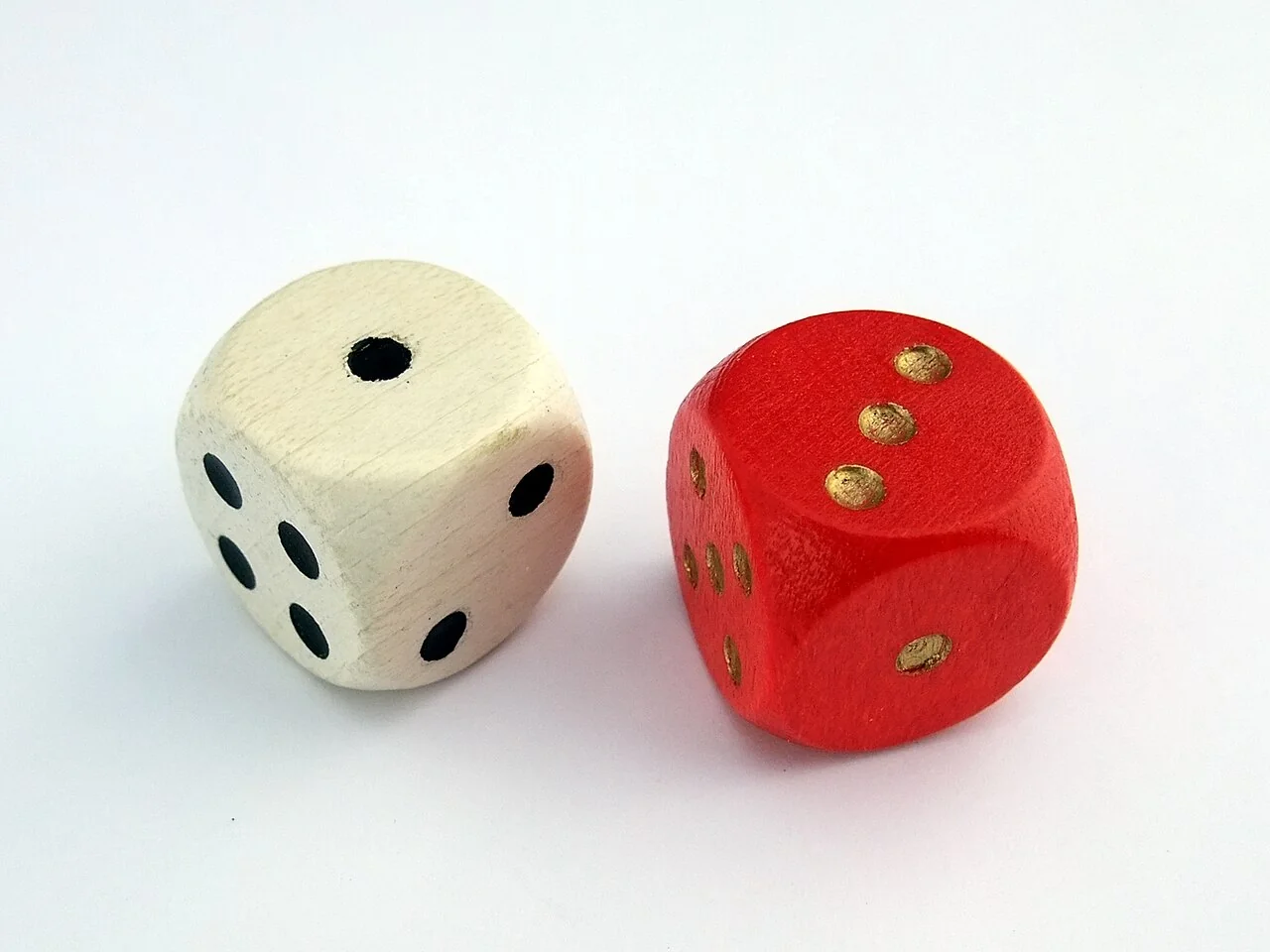
Probability 概率 measures how likely an event 事件 is. It runs on a scale from $0$ (impossible) to $1$ (certain), and can be written as a fraction, decimal or percentage. For example, rolling a $7$ on an ordinary six-sided die is impossible, while rolling a number from $1$ to $6$ is certain. An even chance is $\frac{1}{2}=0.5=50\%$. A fair 公平 coin has an even chance of heads; merely having two possible results does not guarantee equal chances. A probability of $1$ means $100\%$, not $100$.

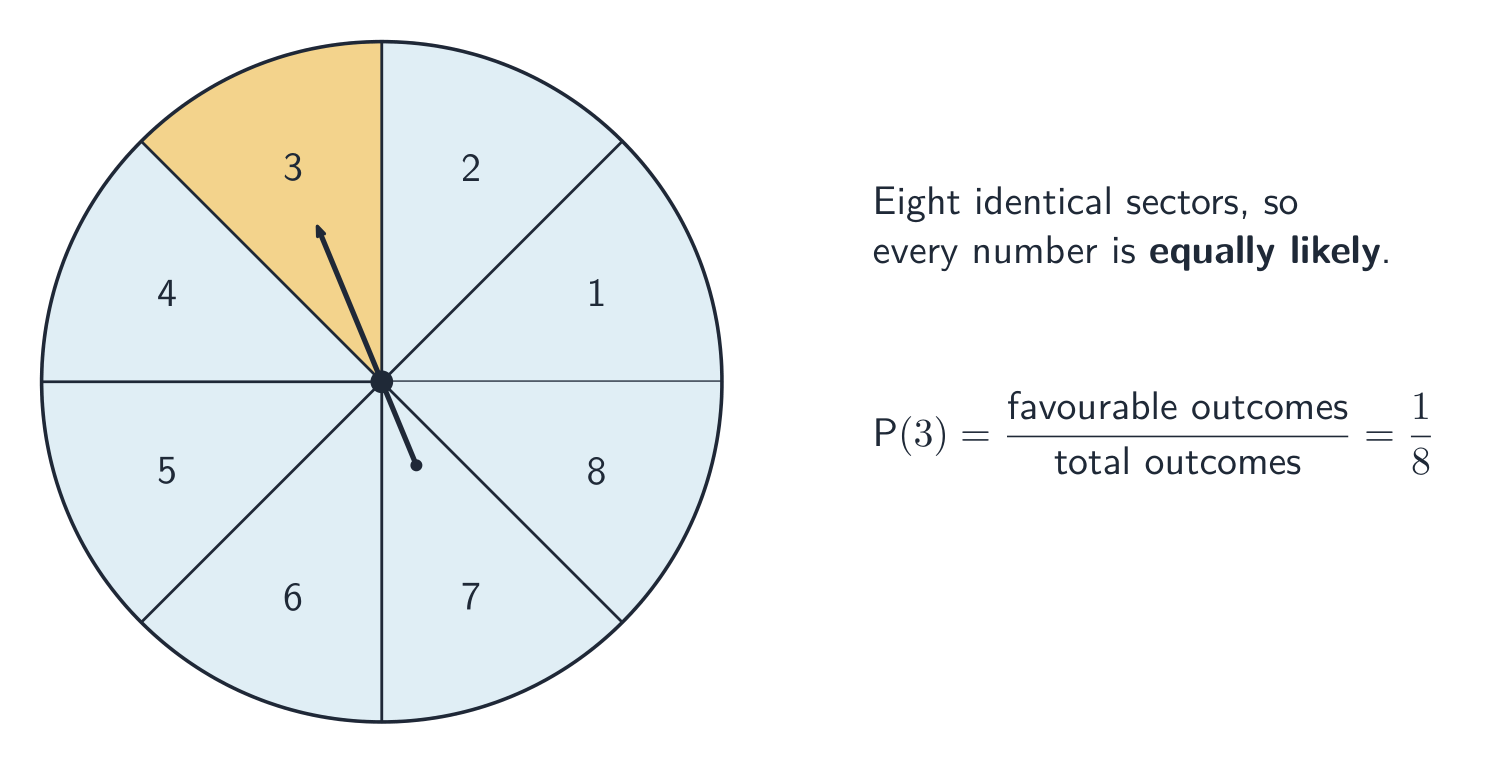
For equally likely outcomes 结果,
Worked example: count the full total. A bag has $3$ red and $5$ blue counters. Assume each counter is equally likely to be chosen. Red has probability $\frac{3}{8}=0.375=37.5\%$. Count individual counters, not just the two colour names: the colours are not equally likely.
An ideal fair spinner with $8$ equal sectors, $4$ blue, $3$ red and $1$ green, has blue probability $\frac{4}{8}=\frac{1}{2}$ and green probability $\frac{1}{8}$. Three colours do not imply a probability of $\frac{1}{3}$ each. Use favourable divided by total only when the outcomes you count are equally likely.
Read a table. Each of these $30$ students uses exactly one travel method. One student is chosen at random 随机 with equal chances.
| Travel method | Students |
|---|---|
| Walk | 12 |
| Bus | 9 |
| Bicycle | 6 |
| Car | 3 |
| Total | 30 |
The probability of bus is $\frac{9}{30}=\frac{3}{10}$. Use $30$ students in the denominator, not the four methods. Not walking includes all three other methods, so its probability is $\frac{9+6+3}{30}=\frac{18}{30}=0.6$.
An event and “not the event” cover all possibilities without overlap. Their probabilities add to $1$. The probability of an event not happening is $1$ minus the probability it happens. For example, if a parcel has probability $0.28$ of being late, it has probability $1-0.28=0.72$ of not being late.
Worked example. A bag has $3$ red and $5$ blue counters, each equally likely to be chosen. The probability of not red is $1-\frac{3}{8}=\frac{5}{8}$. If a different bag has $2$ red, $3$ blue and $5$ green counters, not blue includes both red and green, giving $\frac{2+5}{10}=\frac{7}{10}$. “Not blue” does not mean just one other colour.
Check the total. If the only colours are red, blue and green, their probabilities add to $1$. Given red $0.35$ and blue $0.25$, green is $1-0.35-0.25=0.40$. Proposed values $0.4$, $0.45$ and $0.3$ are invalid: they add to $1.15$, even though each individual value lies between $0$ and $1$.
Extended notation. Write $\text{P}(A)$ for the probability of event $A$, and $A'$ for “not $A$”. Then
This notation is not required at Core, where the same calculation can be described in words.
Try it. A box has $6$ red, $4$ blue and $5$ green counters, each equally likely to be chosen. Find the probabilities of blue and not blue. Answer: the total is $15$, so blue has probability $\frac{4}{15}$ and not blue has probability $\frac{6+5}{15}=\frac{11}{15}$. The total stays the same when the target colour changes.
Worked example: a table with a missing value. A spinner can land on four colours. Find $x$.
| Colour | red | blue | green | yellow |
|---|---|---|---|---|
| Probability | $0.2$ | $0.35$ | $x$ | $2x$ |
The probabilities add to $1$:
So $\text{P}(\text{green}) = 0.15$ and $\text{P}(\text{yellow}) = 0.3$.
اسحب المؤشر من 0 (مستحيل) إلى 1 (مؤكد) لوضع حدث على مقياس الاحتمال.
| English | العربية |
|---|---|
| probability/ˌprɒbəˈbɪlɪti/ | احتمال |
| event/ɪˈvent/ | حدث |
| outcome/ˈaʊtkʌm/ | نتيجة |
| fair/feə/ | عادل |
| random/ˈrændəm/ | عشوائي |
| محتوى المادة | ملاحظات وأمثلة |
|---|---|
| 1 فهم التواتر النسبي كتقدير للاحتمال. | مثال: استخدام نتائج تجارب دوارة لتقدير احتمال نتيجة معينة. |
| 2 حساب التواترات المتوقعة. | مثال: استخدام الاحتمال لتقدير قيمة متوقعة من مجتمع إحصائي. يشمل فهم المقصود بالتساوي، التحيز والعشوائية. |
| محتوى المادة | ملاحظات وأمثلة |
|---|---|
| 1 فهم التواتر النسبي كتقدير للاحتمال. | مثال: استخدام نتائج تجارب دوارة لتقدير احتمال نتيجة معينة. |
| 2 احسب التواترات المتوقعة. | مثال: استخدم الاحتمالات لتقدير قيمة متوقعة من مجتمع إحصائي. |
| يشمل فهم ما يعنيه العادل، التحيز والعشوائي. |
المصدر: منهج كامبريدج الدولي
Use an experiment when a probability is unknown, or to compare results with a theoretical model. The relative frequency 相对频率 estimates the probability:
For example, 84 point-up results in 200 drawing-pin drops give $84/200=0.42$. Include all drops in the denominator, not just those that land point-up.
With independent trials under the same conditions, more trials usually give a more reliable estimate; any one estimate can still vary. A fair die gives each face equal probability. Bias 偏倚 favours some outcomes compared with the intended fair model; random describes chance-based selection and does not by itself guarantee equal chances.
With stable chances and a consistent method, more trials usually give a more reliable estimate, but an extra trial can move it away from the true probability. More trials do not remove a systematic problem with the equipment or make an unrepresentative sample representative.
A fair coin gives heads and tails equal chances. Bias means the chances differ from the fair model. Random means the individual result is decided by chance; random does not mean equally likely. A biased coin can still give random results. An uneven finite result does not by itself prove that a coin is biased.
The expected frequency 期望频数 is a predicted count in $n$ trials, using the same probability for those trials:
Worked example. The probability of rolling a six on a fair die is $\tfrac{1}{6}$. How many sixes are expected in $300$ rolls?
The actual count need not be 50. For a fixed probability, expected count grows linearly with trials: doubling the trials doubles the expected count. An expected count can also be non-integer: $0.3\times15=4.5$, although an actual count must be a whole number.
Prediction from results. The drawing-pin estimate $0.42$ predicts $0.42\times500=210$ point-up results in another 500 similar drops. A prediction based on a sample assumes it represents the population and that conditions remain similar. To combine comparable experiments, add successes and trials before dividing; do not take an unweighted average when the trial counts differ.
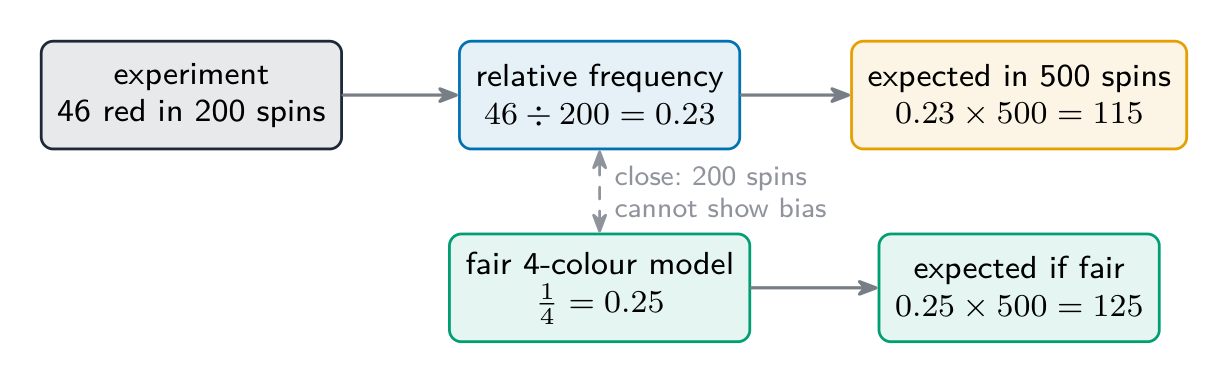
Worked example: relative frequency. A spinner is spun $200$ times and lands on red $46$ times. Estimate the probability of red, and how many reds to expect in $500$ spins.
A fair spinner with $4$ equal colours would give $0.25$. One experiment of $200$ spins is not enough to say this spinner is biased.
قارن النسب الملاحظة والاحتمالات النظرية لمجموعتي نرد مستقلة ونزيهة على مقياس مشترك. النتائج المحدودة تتفاوت.
| English | العربية |
|---|---|
| relative frequency/ˈrelətɪv ˈfriːkwənsi/ | تردد نسبي |
| bias/ˈbaɪəs/ | تحيز |
| expected frequency/ekˈspektɪd ˈfriːkwənsi/ | تردد متوقع |
| محتوى المادة | ملاحظات وأمثلة |
|---|---|
| حساب احتمال الأحداث المركبة باستخدام، عند الاقتضاء: • مخططات الفضاء العيني • مخططات فن • مخططات الشجرة. | ستكون الأحداث المركبة مع الإرجاع فقط. |
| ستقتصر مخططات فن على مجموعتين. | |
| في مخططات الشجرة، تُكتب النتائج في نهاية الفروع والاحتمالات بجانب الفروع. |
| محتوى المادة | ملاحظات وأمثلة |
|---|---|
| احسب احتمال الأحداث المشتركة باستخدام، حيثما يتناسب: • مخططات فضاء العينة • مخططات فون | الأحداث المشتركة قد تكون مع الاستبدال أو بدون استبدال. |
| يمكن استخدام الرمز $\text{P}(A \cap B)$ و $\text{P}(A \cup B)$ في سياق مخططات فون. | |
| • مخططات الأشجار. | في مخططات الأشجار تُكتب النتائج عند نهاية الفروع والاحتمالات بجانب الفروع. |
المصدر: منهج كامبريدج الدولي
For two or more events together (combined events 组合事件), check the conditions before choosing a rule:
Three pictures help you organise the work.
A sample space diagram 样本空间图 is a table or grid listing every possible outcome — useful for two dice or two spinners. Count the outcomes you want out of the total.
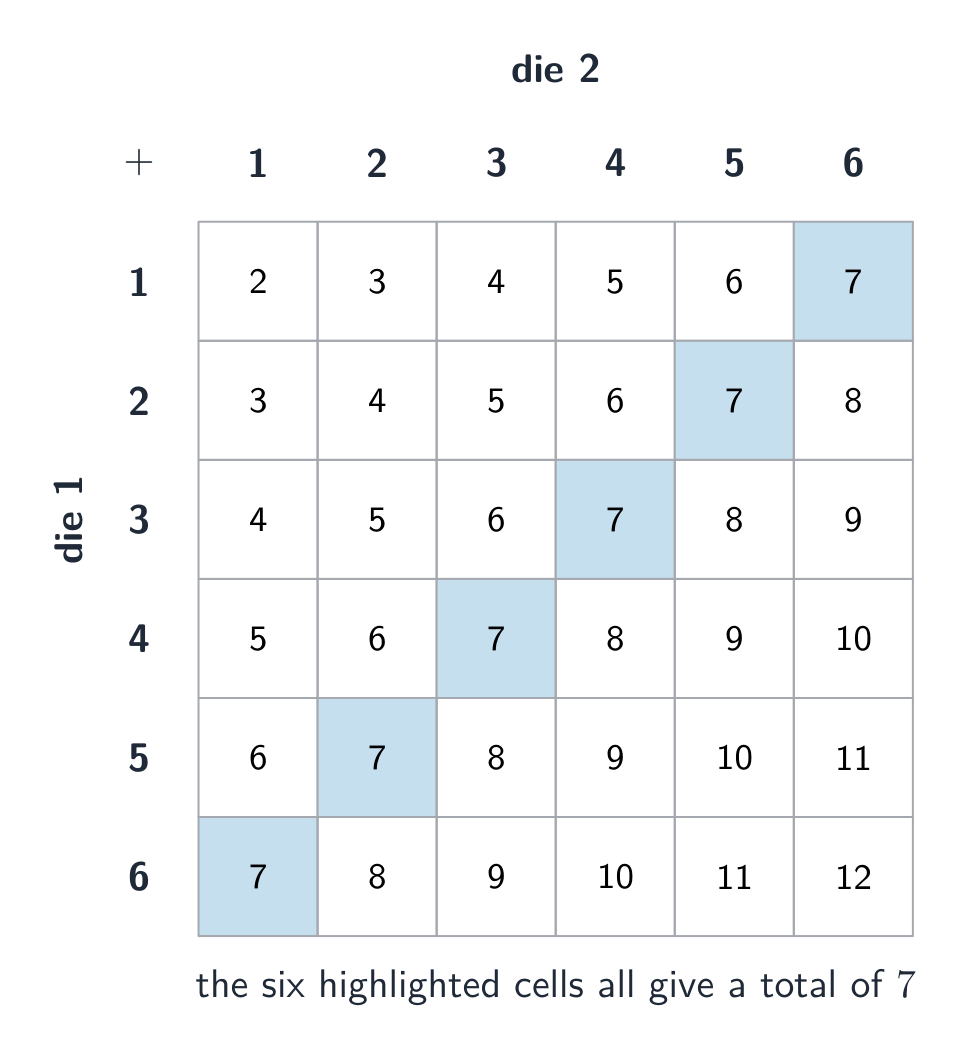
Worked example. Two fair dice are thrown. Find the probability that (a) the total is more than $9$, (b) at least one die shows a six.
(a) Totals of $10$, $11$ and $12$ fill $3 + 2 + 1 = 6$ cells, so the probability is $\dfrac{6}{36} = \dfrac{1}{6}$.
(b) The six row and the six column hold $6 + 6 = 12$ cells, but the cell (6, 6) is in both, so count it once: $\dfrac{11}{36}$.
A Venn diagram 维恩图 sorts outcomes into overlapping sets. From it you can read $\text{P}(A \cap B)$ (in both) and $\text{P}(A \cup B)$ (in either).
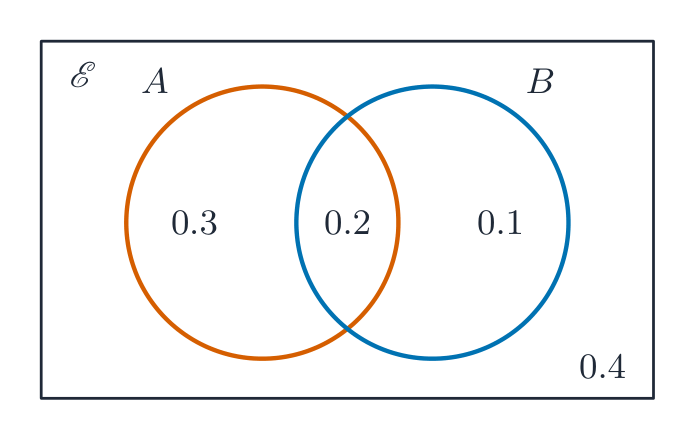
For these regions, $\text{P}(A)=0.3+0.2=0.5$ and $\text{P}(B)=0.2+0.1=0.3$. Adding $0.5+0.3$ would count the overlap twice. Instead add the three separate regions inside either circle: $0.3+0.2+0.1=0.6$. Here “either” includes both. The outside region is neither, so $0.6+0.4=1$.
Try it. On one fair six-sided die, find the chance of an even number or a number greater than $4$. Answer: the selected outcomes are $2,4,5,6$, so the probability is $\frac{4}{6}=\frac{2}{3}$. Counting $\frac{3}{6}+\frac{2}{6}$ would count the $6$ twice.
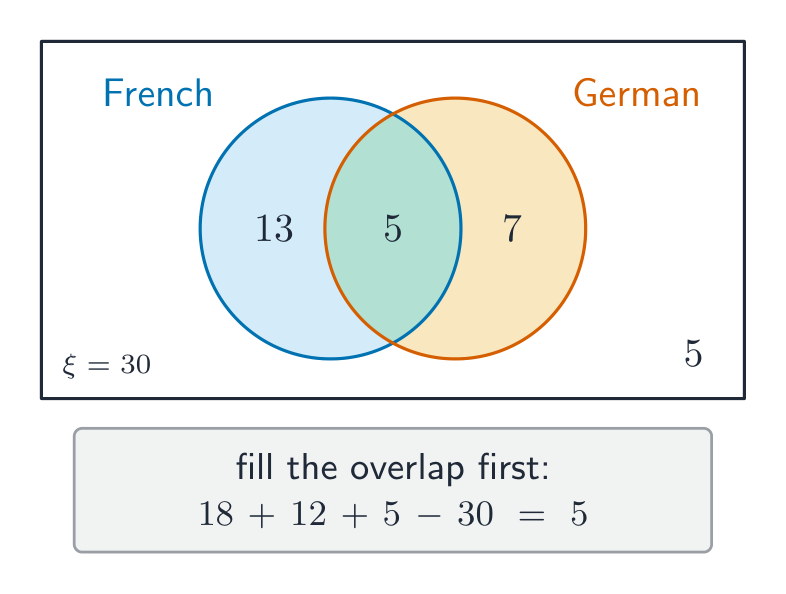
Worked example: fill in a Venn diagram. In a class of $30$, $18$ study French, $12$ study German and $5$ study neither. Find the probability that a student picked at random studies both.
$30 - 5 = 25$ students are inside the circles, but $18 + 12 = 30$. The extra $30 - 25 = 5$ students were counted twice, so $5$ study both. Fill the overlap first: French only $13$, German only $7$, both $5$, neither $5$ (total $30$).
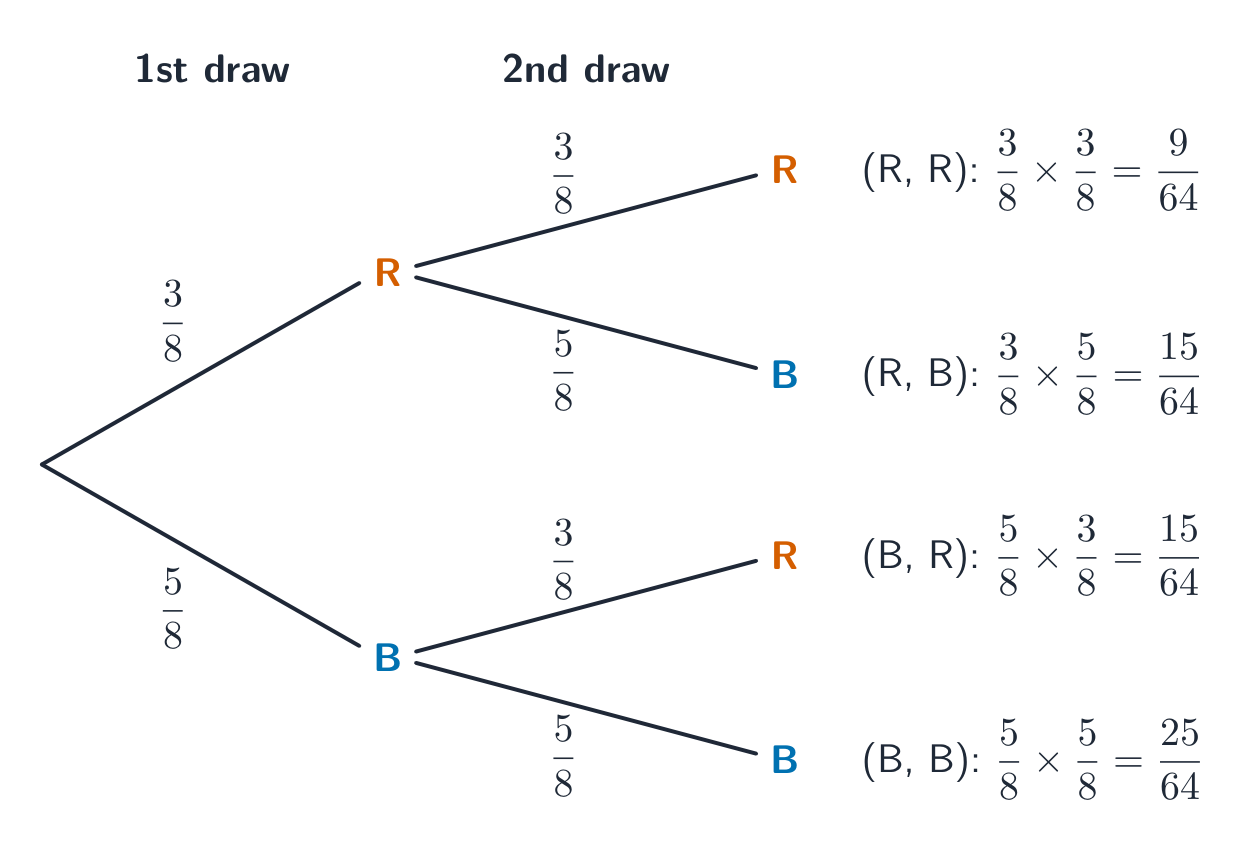
A tree diagram 树状图 shows each stage as a set of branches. Write the probability on each branch and the outcome at the end. Multiply along the branches, then add the paths you want.
Worked example (with replacement). From the bag ($3$ red, $5$ blue), a counter is drawn, replaced, then a second is drawn. This is with replacement 有放回, so the chances do not change. Find the probability of two reds.
For one of each colour, two paths count, red then blue and blue then red:
Exactly one versus at least one. A different bag contains $2$ red and $3$ blue counters. Draw twice at random, replacing the first counter and mixing thoroughly. The four paths have probabilities RR $=\frac{4}{25}$, RB $=\frac{6}{25}$, BR $=\frac{6}{25}$ and BB $=\frac{9}{25}$. These add to $1$.
Exactly one red means RB or BR: $\frac{6}{25}+\frac{6}{25}=\frac{12}{25}$. At least one red also includes RR, so its probability is $\frac{16}{25}$. Equivalently, subtract the no-red path: $1-\frac{9}{25}=\frac{16}{25}$. On a tree, multiply along a complete path, then add the wanted paths, which cannot happen together in the same pair of draws.
Worked example (without replacement, Extended). Return to the bag of $3$ red and $5$ blue. Now the first counter is not replaced — drawing without replacement 无放回. After one red is taken, $2$ reds remain out of $7$. After a first blue, all $3$ reds would remain out of $7$; removing a blue does not reduce the red count. Core combined-event questions use replacement; without replacement is Extended.
For "at least one blue", use the complement: the only path with no blue is red, red, so
Worked example: three draws (Extended). Three counters are taken from the same bag without replacement. Find the probability that all three are the same colour.
Common mistakes. Adding along a branch instead of multiplying, forgetting the second path in "one of each", and keeping the same denominator on the second draw without replacement (it goes down by one each time).
في الإعداد الافتراضي، يكون A أحمر أولًا وB أحمر ثانيًا لسحبين مع الإرجاع من 2 حبات حمراء و3 حبات زرقاء. اضرب على طول كل مسار كامل؛ اجمع RB وBR للحصول على أحمر واحد فقط. يفترض النموذج مراحل مستقلة.
| English | العربية |
|---|---|
| combined events/kəmˈbaɪnd ɪˈvents/ | أحداث مركبة |
| independent events/ˌɪndɪˈpendənt ɪˈvents/ | أحداث مستقلة |
| mutually exclusive/ˈmjuːtʃuːəli eksˈkluːsɪv/ | منفصل |
| sample space diagram/ˈsæmpl speɪs ˈdaɪəɡræm/ | مخطط فضاء العينة |
| Venn diagram/ven ˈdaɪəɡræm/ | مخطط فين |
| tree diagram/triː ˈdaɪəɡræm/ | رسم شجري |
| with replacement/wɪð rɪˈpleɪsmənt/ | مع الإرجاع |
| without replacement/wɪˈðaʊt rɪˈpleɪsmənt/ | بدون إرجاع |
| محتوى المادة | ملاحظات وأمثلة |
|---|---|
| احسب الاحتمال الشرطي باستخدام مخططات فون ومخططات الأشجار والجداول. | لا يُطلب معرفة الرمز $\text{P}(A|B)$ والصيغ المتعلقة بالاحتمال الشرطي. |
المصدر: منهج كامبريدج الدولي
Conditional probability 条件概率 is the chance of an event given some information. First restrict attention to the people or outcomes that meet the condition, then find the fraction that also meets the target. Use Venn diagrams, tables or tree diagrams; a special conditional-probability formula is not required.
Worked example: a two-way table. A class has these language choices. A student is chosen at random from the French group. Find the chance they also study German.
| Students | German | Not German | Total |
|---|---|---|---|
| French | 7 | 11 | 18 |
| Not French | 5 | 7 | 12 |
| Total | 12 | 18 | 30 |
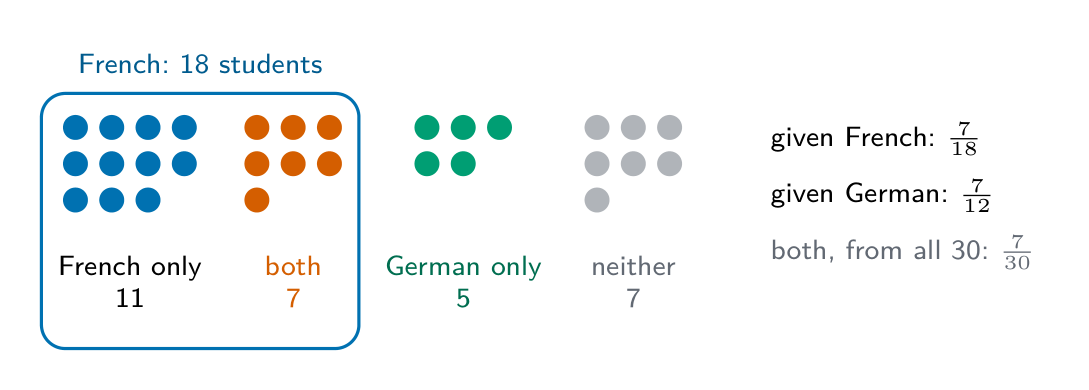
Only the $18$ French students can be selected, so the required probability is $\frac{7}{18}$. Choosing from the whole class instead would give $\frac{7}{30}$ for studying both languages. Reversing the condition gives another question: of the $12$ German students, $7$ study French, so the probability of French given German is $\frac{7}{12}$.
Using a Venn diagram. The same data give French only $11$, both $7$, German only $5$ and neither $7$. Given not French, look outside the French circle: $5+7=12$ students are available, of whom $5$ study German. The required probability is $\frac{5}{12}$. Include neither when the condition selects it.
Worked example: a tree without replacement. A bag contains $3$ red and $2$ blue counters. Two are drawn at random without replacement. Given that the first is blue, $3$ red and $1$ blue remain. The probability the second is red is therefore $\frac{3}{4}$. Multiplying $\frac{2}{5}\times\frac{3}{4}=\frac{3}{10}$ would find the probability of both first blue and then red, before either draw.
If the second counter is known to be red but the first colour is hidden, two paths meet the condition: RR has probability $\frac{3}{5}\times\frac{2}{4}=\frac{6}{20}$ and BR has probability $\frac{2}{5}\times\frac{3}{4}=\frac{6}{20}$. Their total is $\frac{12}{20}$. The chance the first was blue, given this information, is the BR share: $\frac{6}{20}\div\frac{12}{20}=\frac{1}{2}$. Compare path probabilities; do not assume paths are equally likely just because there are two of them.
Try it. In a class of $40$, $20$ students swim, $16$ play music and $8$ do both. Find the probability of music given swimming, then swimming given music. Explain the denominators.
Answer. $\frac{8}{20}=\frac{2}{5}$ and $\frac{8}{16}=\frac{1}{2}$. The overlap stays $8$; the condition changes the available group from $20$ swimmers to $16$ music students.
Worked example: from a tree. Two counters are taken from the bag ($3$ red, $5$ blue) without replacement. Given that they are the same colour, find the probability that they are both red.
From the tree, $\text{P}(\text{RR}) = \dfrac{6}{56}$ and $\text{P}(\text{BB}) = \dfrac{5}{8} \times \dfrac{4}{7} = \dfrac{20}{56}$. The condition "same colour" keeps only these two paths:
Common mistake. Dividing by the whole total instead of by the part that matches the condition. In the table above, the probability that a German student also studies French is $\dfrac{7}{12}$, not $\dfrac{7}{30}$.
| English | العربية |
|---|---|
| conditional probability/kənˈdɪʃənl ˌprɒbəˈbɪlɪti/ | احتمال شرطي |
ما المشكلة؟ لا يرى ذلك سوى فريق الموقع.
ا-working عليه خطوة بخطوة، مع تمارين تحقق فوري.
جار تحميل المواضيع…