مسامير فولاذية تُسقط في الماء تغوص مباشرة إلى القاع. الآن انظر إلى هذه السفينة. تم بناؤها من نفس الفولاذ، عشرات الآلاف من الأطنان منه، وهي…
English narration · English + 中文 subtitles burned in · سرد باللغة الإنجليزية · ترجمة مدمجة بالإنجليزية + الصينية
8.1
Internal Structure and Density · البنية الداخلية والكثافة
Syllabus · المنهج
English
Learning Objective 8.1.A: Describe the properties of a fluid.
8.1.A.1 Distinguishing properties of solids, liquids, and gases stem from the varying interactions between atoms and molecules.
8.1.A.2 A fluid is a substance that has no fixed shape.
8.1.A.3 Fluids can be characterized by their density. Density is defined as a ratio of mass to volume.
Equation:$\rho = \dfrac{m}{V}$
8.1.A.4 An ideal fluid is incompressible and has no viscosity.
العربية
الهدف التعليمي 8.1.A: وصف خصائص الموائع.
8.1.A.1 تنبع الخصائص المميزة للمواد الصلبة والسائلة والغازية من الاختلافات في التفاعلات بين الذرات والجزيئات.
8.1.A.2 المائع هو مادة ليس لها شكل ثابت.
8.1.A.3 يمكن تمييز الموائع بكثافتها. تُعرف الكثافة بأنها نسبة الكتلة إلى الحجم.
المعادلة:$\rho = \dfrac{m}{V}$
8.1.A.4 المائع المثالي غير قابل للانضغاط وليس له لزوجة.
Source: College Board AP Course and Exam Description · المصدر: وصف دورة وامتحان College Board AP
English
The differences between solids, liquids, and gases come from how strongly their particles interact. A fluid 流体 (liquid or gas) has no fixed shape – it flows because its particles move past one another. Density 密度 is mass per unit volume:
$$\rho=\frac{m}{V}.$$
It depends on the substance and its state. An object sinks or floats depending on how its density compares with the surrounding fluid's – less dense floats, more dense sinks. An ideal fluid 理想流体 is incompressible 不可压缩 (constant density, whatever the pressure) and has no viscosity 黏度 (internal friction) – the model AP uses throughout.
العربية
الاختلافات بين المواد الصلبة والسائلة والغازية تنبع من مدى قوة تفاعل جزيئاتها مع بعضها البعض. المائع (سائل أو غاز) ليس له شكل ثابت – يتدفق لأن جزيئاته تتحرك فوق بعضها البعض. الكثافة هي الكتلة لكل وحدة حجم:
$$\rho=\frac{m}{V}.$$
تعتمد على المادة وحالتها. يغوص الجسم أو يطفو اعتمادًا على مقارنة كثافته بكثافة المائع المحيط به – الأقل كثافة يطفو، والأكثر كثافة يغوص. المائع المثاليغير قابل للانضغاط (كثافة ثابتة، بغض النظر عن الضغط) ولا يوجد به لزوجة (احتكاك داخلي) – النموذج الذي يستخدمه AP طوال الوقت.
Explore · استكشف
Float or sink by density · طفو أو غرق بناءً على الكثافة
An object floats if it is less dense than the fluid. Change the density and watch it ride higher or sink, displacing its own weight of fluid. · يطفو الجسم إذا كانت كثافته أقل من كثافة السائل. غيّر الكثافة ولاحظ ارتفاعه أو غوصه، مستبدلاً وزنه الخاص من السائل.
8.2
Pressure · الضغط
Syllabus · المنهج
English
Learning Objective 8.2.A: Describe the pressure exerted on a surface by a given force.
8.2.A.1 Pressure is defined as the magnitude of the perpendicular force component exerted per unit area over a given surface area, as described by the equation
Equation:$P = \dfrac{F_\perp}{A}$
8.2.A.2 Pressure is a scalar quantity.
8.2.A.3 The volume and density of a given amount of an incompressible fluid is constant regardless of the pressure exerted on that fluid.
Learning Objective 8.2.B: Describe the pressure exerted by a fluid.
8.2.B.1 The pressure exerted by a fluid is the result of the entirety of the interactions between the fluid's constituent particles and the surface with which those particles interact.
8.2.B.2 The absolute pressure of a fluid at a given point is equal to the sum of a reference pressure $P_0$, such as the atmospheric pressure $P_{\text{atm}}$, and the gauge pressure $P_{\text{gauge}}$.
Equation:$P = P_0 + \rho g h$
8.2.B.3 The gauge pressure of a vertical column of fluid is described by the equation
Equation:$P_{\text{gauge}} = \rho g h$
العربية
الهدف التعليمي 8.2.A: وصف الضغط المُمارَس على سطح بواسطة قوة معينة.
8.2.A.1 يُعرَّف الضغط بأنه مقدار مركبة القوة العمودية المؤثرة لكل وحدة مساحة على سطح معين، كما هو موضح بالمعادلة
المعادلة:$P = \dfrac{F_\perp}{A}$
8.2.A.2 الضغط كمية قياسية.
8.2.A.3 حجم وكثافة كمية معينة من مائع غير قابل للانضغاط ثابتة بغض النظر عن الضغط المُمارَس على ذلك المائع.
الهدف التعليمي 8.2.B: وصف الضغط المُمارَس بواسطة المائع.
8.2.B.1 الضغط المُمارَس بواسطة المائع هو نتيجة لمجموع التفاعلات بين جسيمات المائع المكونة له والسطح الذي تتفاعل معه تلك الجسيمات.
8.2.B.2 الضغط الكلي للمائع عند نقطة معينة يساوي مجموع ضغط مرجعي $P_0$، مثل الضغط الجوي $P_{\text{atm}}$، وضغط العيار $P_{\text{gauge}}$.
المعادلة:$P = P_0 + \rho g h$
8.2.B.3 يُوصف ضغط عيار عمودي من المائع بالمعادلة
المعادلة:$P_{\text{gauge}} = \rho g h$
Source: College Board AP Course and Exam Description · المصدر: وصف دورة وامتحان College Board AP
English
Pressure 压强 is the perpendicular force per unit area, a scalar 标量 measured in pascals (Pa):
$$P=\frac{F_\perp}{A}.$$
In a fluid at rest, pressure increases with depth 深度 because of the weight of fluid above:
$$P=P_0+\rho g h,$$
where $P_0$ is the pressure at the surface and $h$ is the depth. Pressure acts equally in all directions at a point and pushes perpendicular to any surface.
Distinguish the two pressures AP asks about: the gauge pressure 表压 is the extra pressure the fluid column adds, $P_{\text{gauge}}=\rho g h$, while the absolute pressure 绝对压强 is the total, $P=P_0+P_{\text{gauge}}$ (with $P_0$ usually atmospheric). A tyre gauge reading "$200\ \text{kPa}$" is gauge pressure; the air inside is really at about $300\ \text{kPa}$ absolute.
Worked example. Find the total pressure on a diver $10\ \text{m}$ below the surface of water ($\rho=1000\ \text{kg/m}^3$, surface pressure $P_0=1.0\times10^{5}\ \text{Pa}$):
$$P=P_0+\rho g h=1.0\times10^{5}+1000\times9.8\times10=1.98\times10^{5}\ \text{Pa}.$$
Every $10\ \text{m}$ of water adds roughly one extra atmosphere of pressure. Notice the pressure does not depend on the shape or width of the container, only on the depth.
العربية
الضغط هو القوة العمودية لكل وحدة مساحة، كمية قياسية تقاس بالباسكال (Pa):
$$P=\frac{F_\perp}{A}.$$
في مائع ساكن، يزيد الضغط مع العمق بسبب وزن المائع أعلاه:
$$P=P_0+\rho g h,$$
حيث $P_0$ هو الضغط عند السطح و$h$ هو العمق. الضغط يؤثر بشكل متساوٍ في جميع الاتجاهات عند نقطة معينة ويدفع عموديًا على أي سطح.
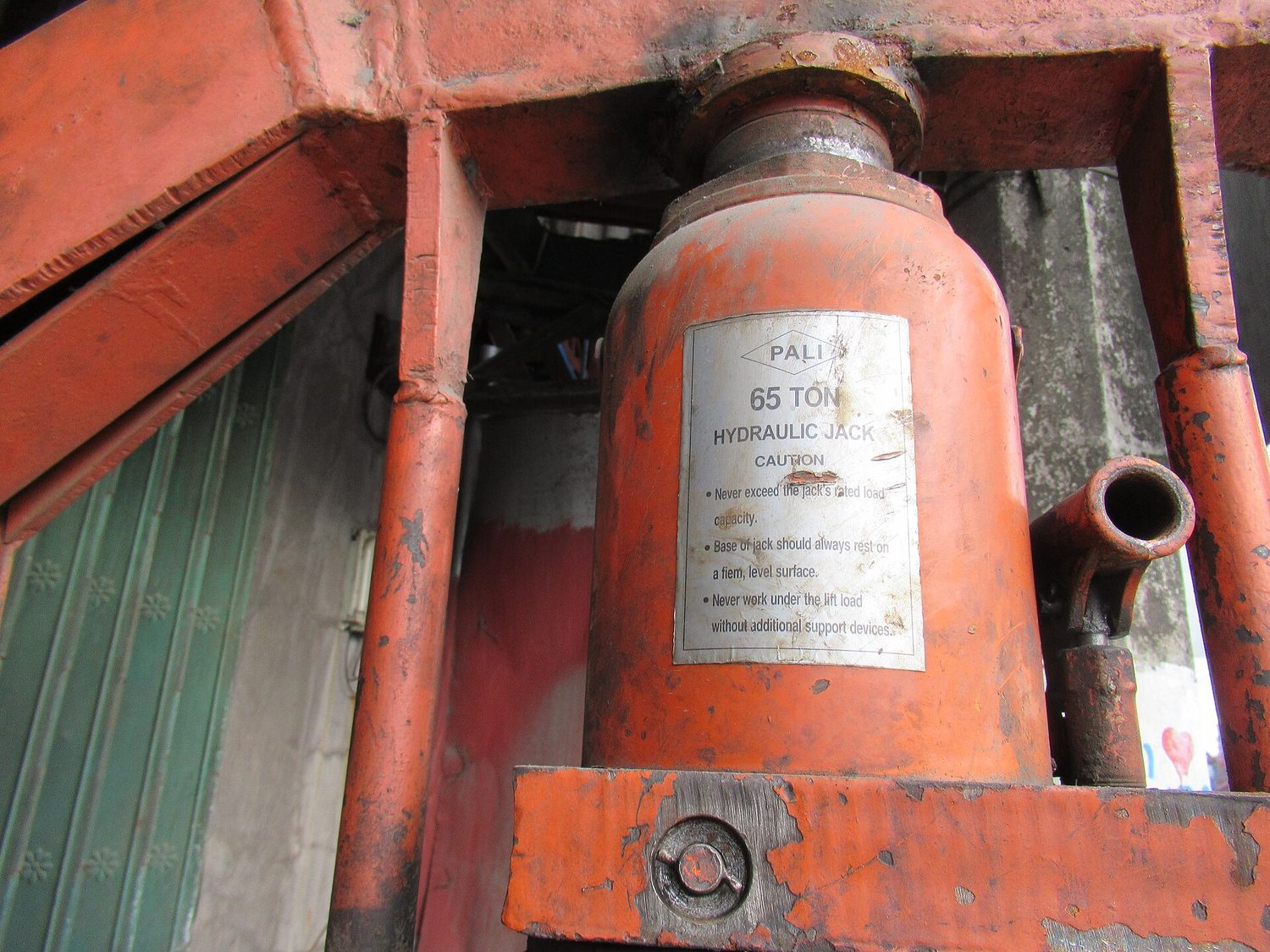
الرؤوس الهيدروليكية: الضغط المطبق على مكبس صغير يتم نقله دون نقص عبر المائع إلى مكبس كبير، لذلك قوة صغيرة ترفع سيارة
اميز بين الضغطين اللذين يطلبهما AP: ضغط المقاييس هو الضغط الإضافي الذي يضيفه عمود المائع، $P_{\text{gauge}}=\rho g h$، بينما الضغط الكلي هو المجموع، $P=P_0+P_{\text{gauge}}$ (مع $P_0$ عادةً الضغط الجوي). قراءة جهاز قياس الإطارات "$200\ \text{kPa}$" هي ضغط مقاييس؛ الهواء داخله في الواقع عند حوالي $300\ \text{kPa}$ كلياً.
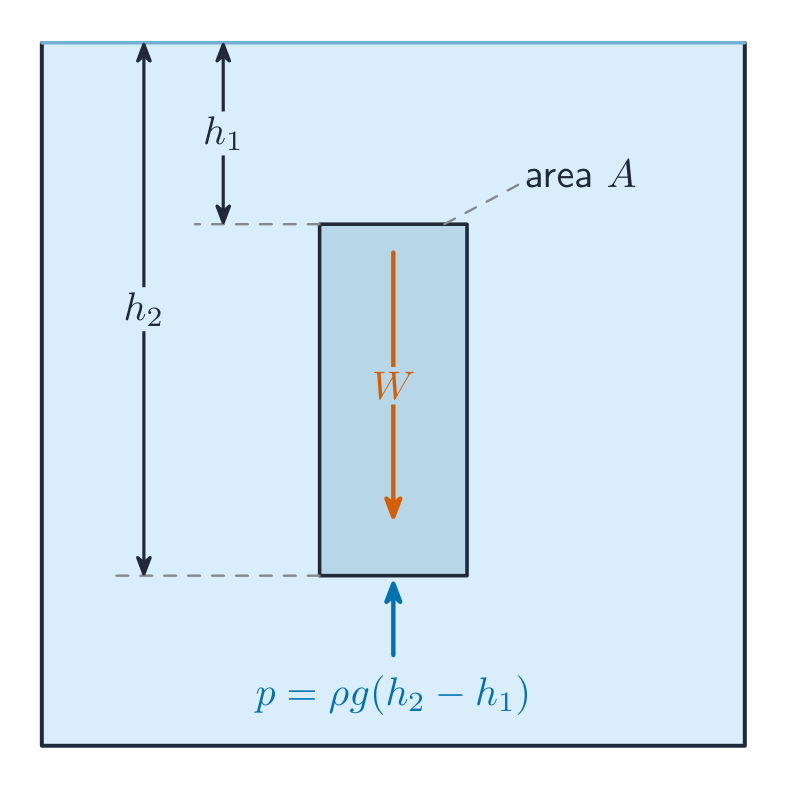
وزن عمود السائل يحدد الضغط الإضافي عند عمق معين
مثال محلول. أوجد الضغط الكلي على غاص $10\ \text{m}$ تحت سطح الماء ($\rho=1000\ \text{kg/m}^3$، ضغط السطح $P_0=1.0\times10^{5}\ \text{Pa}$):
$$P=P_0+\rho g h=1.0\times10^{5}+1000\times9.8\times10=1.98\times10^{5}\ \text{Pa}.$$
كل $10\ \text{m}$ من الماء يضيف تقريباً وحدة ضغط إضافية واحدة. لاحظ أن الضغط لا يعتمد على شكل أو عرض الحاوية، بل فقط على العمق.
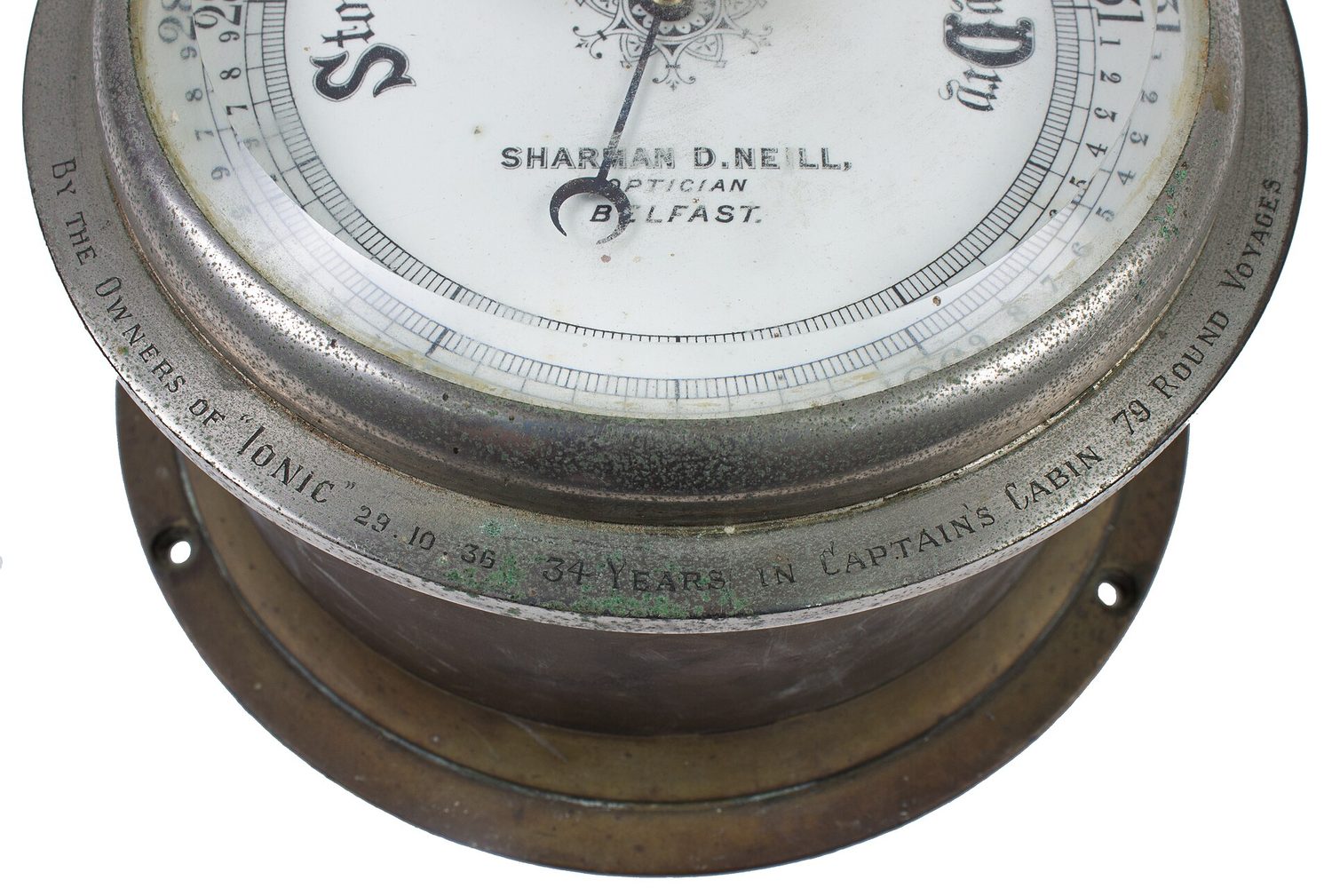
يقيس البارومتر اللاهوائي ضغط الهواء باستخدام صندوق معدني مغلق ينثني عند تغير الضغط الخارجي
Fluids and Newton's Laws · الموائع وقوانين نيوتن
Syllabus · المنهج
English
Learning Objective 8.3.A: Describe the conditions under which a fluid's velocity changes.
8.3.A.1 Newton's laws can be used to describe the motion of particles within a fluid.
8.3.A.2 The macroscopic behavior of a fluid is a result of the internal interactions between the fluid's constituent particles and external forces exerted on the fluid.
Learning Objective 8.3.B: Describe the buoyant force exerted on an object interacting with a fluid.
8.3.B.1 The buoyant force is a net upward force exerted on an object by a fluid.
8.3.B.2 The buoyant force exerted on an object by a fluid is a result of the collective forces exerted on the object by the particles making up the fluid.
8.3.B.3 The magnitude of the buoyant force exerted on an object by a fluid is equivalent to the weight of the fluid displaced by the object.
Equation:$F_b = \rho V g$
العربية
الهدف التعليمي 8.3.A: وصف الظروف التي يتغير فيها سرعة المائع.
8.3.A.1 يمكن استخدام قوانين نيوتن لوصف حركة الجسيمات داخل المائع.
8.3.A.2 السلوك المجهري للمائع هو نتيجة للتفاعلات الداخلية بين جسيمات المائع المكونة له والقوى الخارجية المُمارسة عليه.
الهدف التعليمي 8.3.B: وصف قوة الطفو المُمارَسة على جسم يتفاعل مع مائع.
8.3.B.1 قوة الطفو هي محصلة قوة رأسية مُمارَسة على جسم بواسطة مائع.
8.3.B.2 قوة الطفو المُمارَسة على جسم بواسطة مائع هي نتيجة لقوات مجتمعة تُمارَس على الجسم بواسطة الجسيمات المكوِّنة للمائع.
8.3.B.3 مقدار قوة الطفو المُمارَسة على جسم بواسطة مائع يساوي وزن المائع المزاح بواسطة الجسم.
المعادلة:$F_b = \rho V g$
Source: College Board AP Course and Exam Description · المصدر: وصف دورة وامتحان College Board AP
English
Buoyancy: float or sink
An object in a fluid feels an upward buoyant force 浮力 equal to the weight of the fluid it displaces – Archimedes' principle 阿基米德原理:
Combine this with Newton's laws: the object floats when buoyancy balances weight, sinks when weight wins, and rises when buoyancy wins. A floating object displaces exactly its own weight of fluid.
Worked example. A block of density $600\ \text{kg/m}^3$ floats in water ($1000\ \text{kg/m}^3$). What fraction is under the surface? For floating, the buoyant force equals the weight, so $\rho_{\text{fluid}}\,g\,V_{\text{sub}}=\rho_{\text{object}}\,g\,V$:
اجمع ذلك مع قوانين نيوتن: يطوف الجسم عندما تتوازن الطفو مع وزنه، يغوص عندما يفوز الوزن، ويرتفع عندما تفوق الطفو. الجسم العائم يحلExactly وزنه الخاص من المائع.
مثال محلول. كتلة كثافتها $600\ \text{kg/m}^3$ تطوف في الماء ($1000\ \text{kg/m}^3$). ما الكسر الموجود تحت السطح؟ بالنسبة للطفو، قوة الطفو تساوي الوزن، لذا $\rho_{\text{fluid}}\,g\,V_{\text{sub}}=\rho_{\text{object}}\,g\,V$:
Fluids and Conservation Laws · الموائع وقوانين الحفظ
Syllabus · المنهج
English
Learning Objective 8.4.A: Describe the flow of an incompressible fluid through a cross-sectional area by using mass conservation.
8.4.A.1 A difference in pressure between two locations causes a fluid to flow.
8.4.A.1.i The rate at which matter enters a fluid-filled tube open at both ends must equal the rate at which matter exits the tube.
8.4.A.1.ii The rate at which matter flows into a location is proportional to the cross-sectional area of the flow and the speed at which the fluid flows.
Derived equation:$\dfrac{V}{t} = A v$
8.4.A.2 The continuity equation for fluid flow describes conservation of mass flow rate in incompressible fluids.
Equation:$A_1 v_1 = A_2 v_2$
العربية
الهدف التعليمي 8.4.A: وصف تدفق مائع غير قابل للانضغاط عبر مساحة مقطع مستعرض باستخدام حفظ الكتلة.
8.4.A.1 الفرق في الضغط بين مكانين يسبب تدفق المائع.
8.4.A.1.i معدل دخول المادة إلى أنبوب مليء بالمائع ومفتوح من كلا الطرفين يجب أن يساوي معدل خروج المادة من الأنبوب.
8.4.A.1.ii معدل تدفق المادة نحو موقع ما يتناسب طردياً مع مساحة المقطع المستعرض للتدفق وسرعة تدفق المائع.
معادلة مشتقة:$\dfrac{V}{t} = A v$
8.4.A.2 تصف معادلة الاستمرارية لتدفق المائع حفظ معدل تدفق الكتلة في الموائع غير القابلة للانضغاط.
المعادلة:$A_1 v_1 = A_2 v_2$
Source: College Board AP Course and Exam Description · المصدر: وصف دورة وامتحان College Board AP
English
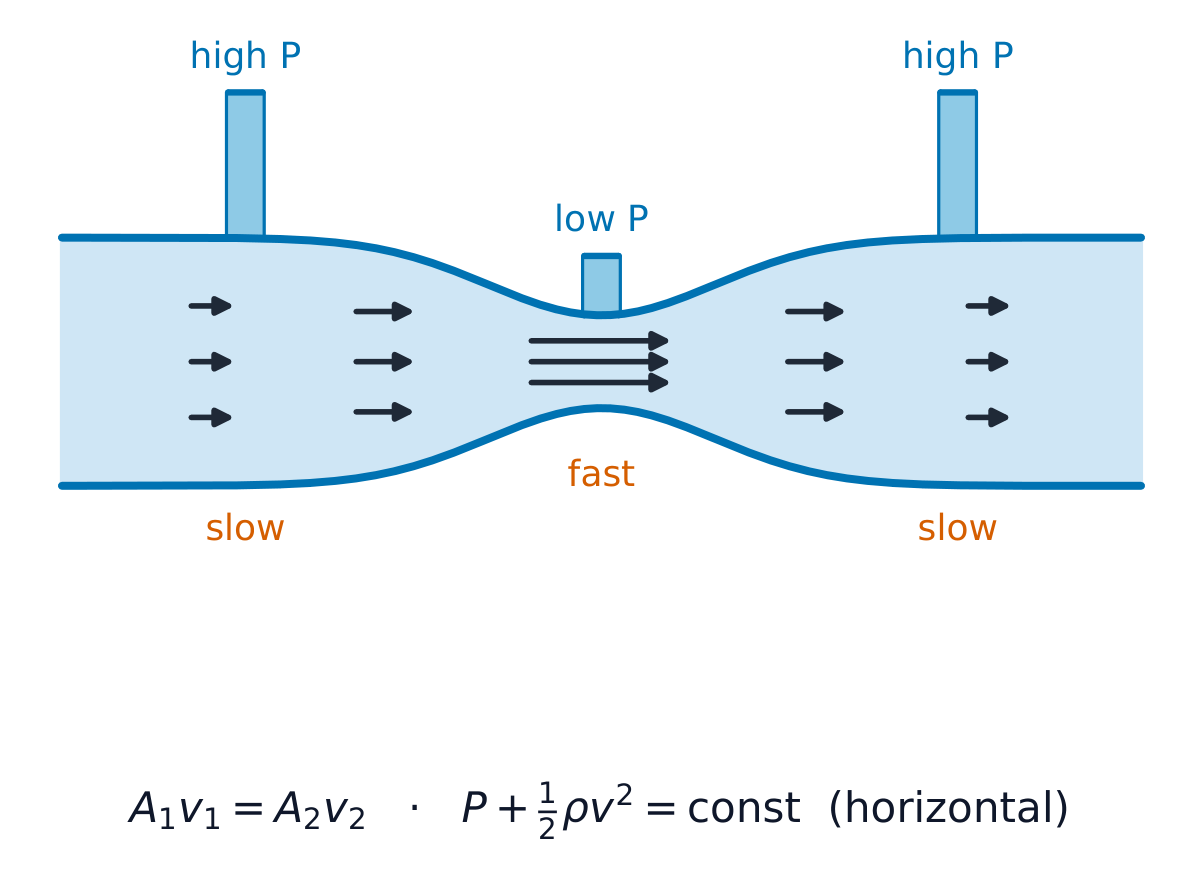
For an ideal fluid flowing steadily, two conservation ideas apply:
Continuity 连续性 (conservation of mass): the volume flow rate is constant, so $A_1 v_1 = A_2 v_2$. A narrower pipe forces faster flow.
Bernoulli's equation 伯努利方程 (conservation of energy per volume): along a streamline,
$$P+\tfrac{1}{2}\rho v^2+\rho g y = \text{constant}.$$
Together they explain why fluid speeds up and its pressure drops where a pipe narrows or where flow is fastest.
Worked example. Water flows at $2.0\ \text{m/s}$ through a pipe of cross-section $0.010\ \text{m}^2$, then enters a narrower section of $0.0040\ \text{m}^2$. By continuity the speed there is
By Bernoulli's equation this faster stream is at lower pressure – the effect that lifts an aeroplane wing and pulls two passing ships together.
Exam skill. Choose the right law by what changes. If the pipe changes width, start with continuity ($A_1v_1=A_2v_2$) to get the speeds; if you then need a pressure, feed those speeds into Bernoulli. Watch the height term $\rho g y$ only when the pipe also changes level.
العربية
بالنسبة لمائع مثالي يتدفق بشكل ثابت، ينطبق مبدأان للحفظ:
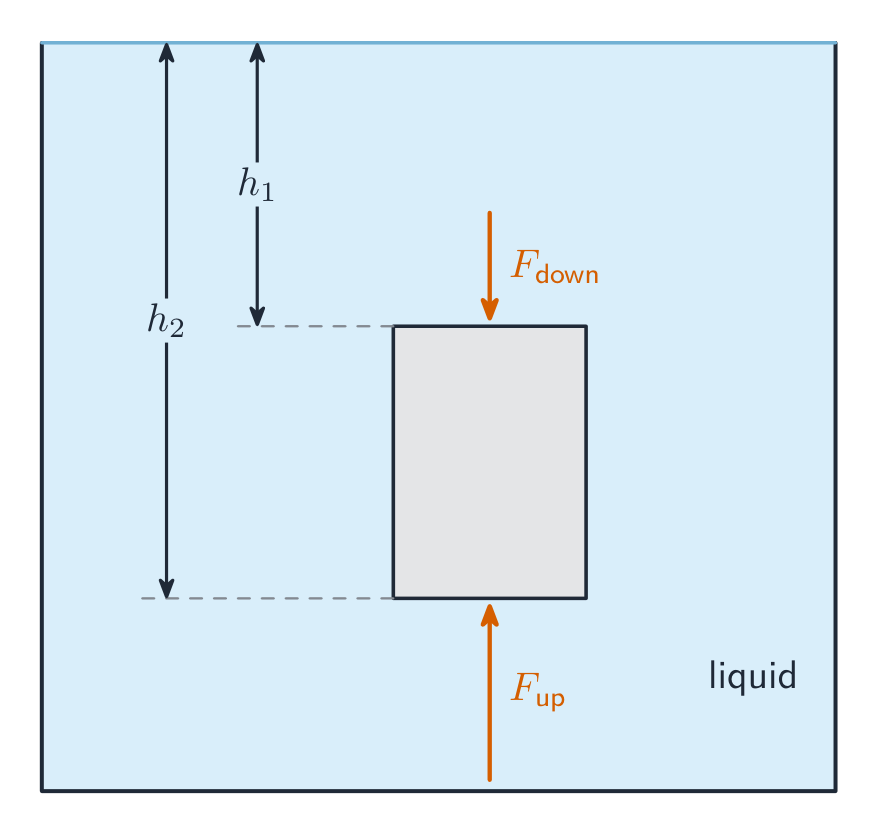
تنشأ قوة الدفع لأن الضغط على أسفل الجسم يتجاوز الضغط على الأعلى
الاتصال (حفظ الكتلة): معدل التدفق الحجمي ثابت، لذا $A_1 v_1 = A_2 v_2$. الأنبوب الضيق يجبر على تدفق أسرع.
معادلة برنولي (حفظ الطاقة لكل حجم): على طول خط التيار،
$$P+\tfrac{1}{2}\rho v^2+\rho g y = \text{constant}.$$
معاً يشرحان لماذا يسرع المائع وينخفض ضغطه حيث يضيق الأنبوب أو حيث يكون التدفق الأسرع.
مثال محلول. يتدفق الماء بسرعة $2.0\ \text{m/s}$ عبر أنبوب مساحته المقطعية $0.010\ \text{m}^2$، ثم يدخل جزءاً أضيق مساحته $0.0040\ \text{m}^2$. بالاتصال تكون السرعة هناك
بناءً على معادلة برنولي، هذه التيارات الأسرع تكون ذات ضغط أقل – التأثير الذي يرفع جناح الطائرة ويجذب سفنتين تمرين بعضهما البعض.
مهارة الامتحان. اختر القانون الصحيح بناءً على ما يتغير. إذا تغير الأنبوب العرض، ابدأ بالاتصال ($A_1v_1=A_2v_2$) للحصول على السرعات؛ إذا كنت تحتاج بعد ذلك إلى ضغط، أدخل تلك السرعات في برنولي. انتبه لحد الارتفاع $\rho g y$ فقط عندما يتغير الأنبوب أيضاً في المستوى.
8.4
Exam tips · نصائح للامتحان
English
Pressure with depth is $P=P_0+\rho g h$ — it depends on depth only, not the container's shape or width.
Buoyant force = weight of fluid displaced ($\rho_{\text{fluid}}\,gV_{\text{disp}}$); a floating object displaces its own weight, so the fraction submerged is $\rho_{\text{object}}/\rho_{\text{fluid}}$.
Compare densities to predict floating vs sinking; a floating object is in equilibrium (buoyancy = weight), not weightless.
Use continuity$A_1v_1=A_2v_2$: a narrower pipe means faster flow.
Bernoulli: where a fluid flows faster its pressure is lower (wing lift, spray).
العربية
الضغط مع العمق هو $P=P_0+\rho g h$ — إنه يعتمد على العمق فقط، وليس شكل أو عرض الحاوية.
القوة الطافية = وزن المائع المحلوع ($\rho_{\text{fluid}}\,gV_{\text{disp}}$)؛ الجسم العائم يحلوز وزنه الخاص، لذا الكسر المغمور هو $\rho_{\text{object}}/\rho_{\text{fluid}}$.
قارن الكثافات للتنبؤ بالطفو مقابل الغوص؛ الجسم العائم في حالة توازن (الطفو = الوزن)، ليس عديم الوزن.
استخدم الاتصال$A_1v_1=A_2v_2$: الأنبوب الضيق يعني تدفقاً أسرع.
برنولي: حيث يتدفق المائع بأسرع، يكون ضغطه أقل (رفع الأجنحة، الرذاذ).
Interactive lessons on this topic · دروس تفاعلية حول هذا الموضوع
Work through it step by step, with instant-check exercises. · ا-working عليه خطوة بخطوة، مع تمارين تحقق فوري.
Pick one and the site follows you — notes, papers, videos and practice all open on it. · اختر واحدًا وسيتبعك الموقع — الملاحظات، الأوراق، الفيديوهات والتدريب جميعها تفتح عليه.
Type to search notes, lessons, code, vocabulary and past-paper questions across every subject. · اكتب للبحث عن ملاحظات، دروس، أكواد، مفردات وأسئلة امتحانات سابقة عبر جميع المواد.