Skip to content · ⁨الانتقال إلى المحتوى⁩

Acids and Bases · ⁨الأحماض والقواعد⁩

AP Chemistry · ⁨AP الكيمياء⁩ · Topic 8 · ⁨الموضوع 8⁩

Video lesson for this topic · ⁨درس فيديو لهذا الموضوع⁩ Open the video page · ⁨افتح صفحة الفيديو⁩
8:24

الأحماض والقواعد

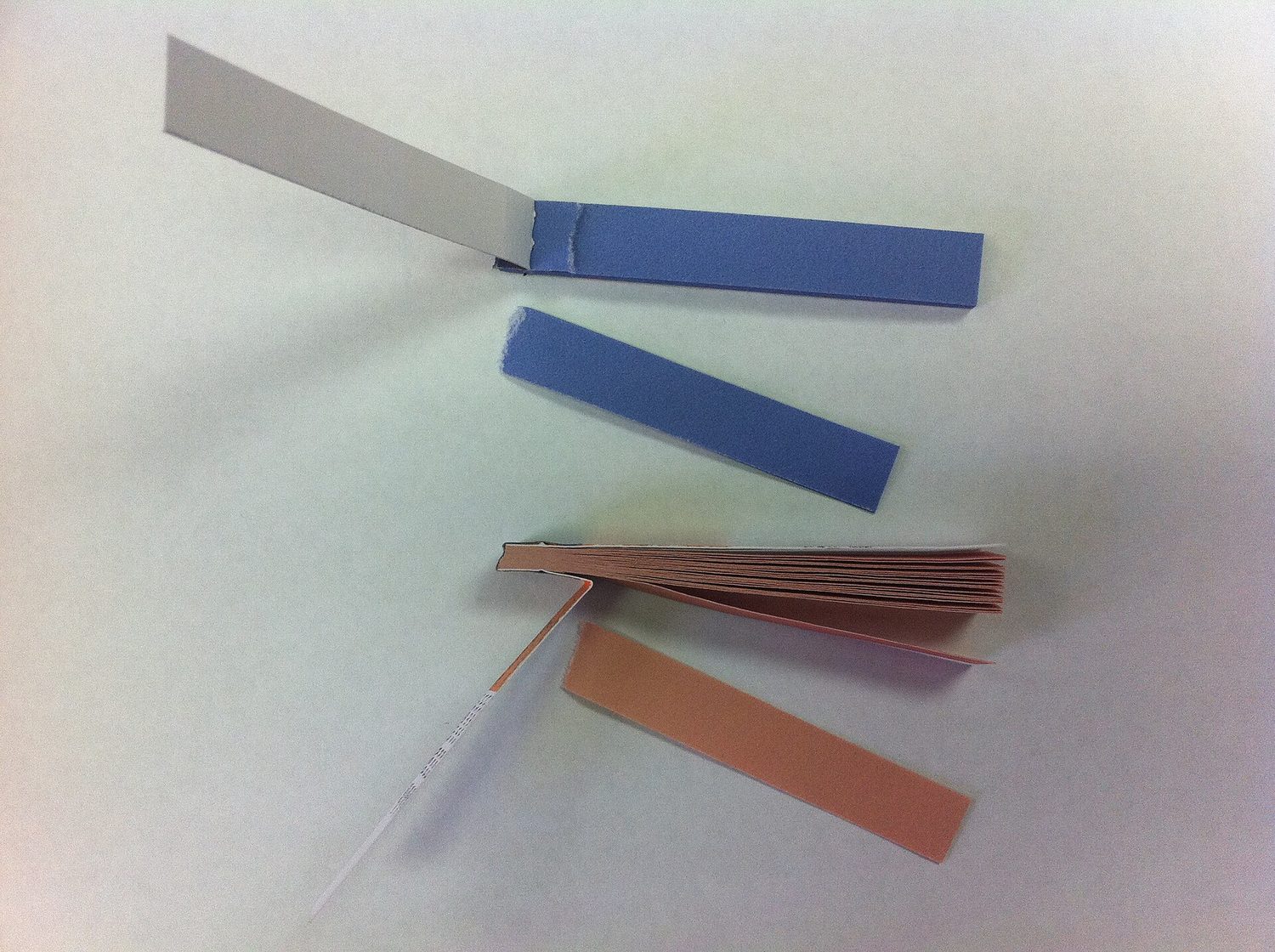
شريطان من الورق — أحدهما أحمر والآخر أزرق. أغمسهما في سائل ويتغير اللون، وهذا اللون يخبرك ما إذا كان السائل حمضاً أم قاعداً.…

English narration · English + 中文 subtitles burned in · ⁨سرد باللغة الإنجليزية · ترجمة مدمجة بالإنجليزية + الصينية⁩

8.1

Introduction to Acids and Bases · ⁨مقدمة الأحماض والقواعد⁩

Syllabus · ⁨المنهج⁩
English

Learning Objective 8.1.A: Calculate the values of $\mathrm{pH}$ and $\mathrm{pOH}$, based on $K_w$ and the concentration of all species present in a neutral solution of water.

  • 8.1.A.1 The concentrations of hydronium ion and hydroxide ion are often reported as $\mathrm{pH}$ and $\mathrm{pOH}$, respectively.
    • Equation: $\mathrm{pH} = -\log[\mathrm{H_3O^+}]$
    • Equation: $\mathrm{pOH} = -\log[\mathrm{OH^-}]$
    • The terms "hydrogen ion" and "hydronium ion" and the symbols $\mathrm{H^+}(aq)$ and $\mathrm{H_3O^+}(aq)$ are often used interchangeably for the aqueous ion of hydrogen. Hydronium ion and $\mathrm{H_3O^+}(aq)$ are preferred, but $\mathrm{H^+}(aq)$ is also accepted on the AP Exam.
  • 8.1.A.2 Water autoionizes with an equilibrium constant $K_w$.
    • Equation: $K_w = [\mathrm{H_3O^+}][\mathrm{OH^-}] = 1.0 \times 10^{-14}$ at 25°C
  • 8.1.A.3 In pure water, $\mathrm{pH} = \mathrm{pOH}$ is called a neutral solution. At 25°C, $\mathrm{p}K_w = 14.0$ and thus $\mathrm{pH} = \mathrm{pOH} = 7.0$.
    • Equation: $\mathrm{p}K_w = 14 = \mathrm{pH} + \mathrm{pOH}$ at 25°C
  • 8.1.A.4 The value of $K_w$ is temperature dependent, so the pH of pure, neutral water will deviate from 7.0 at temperatures other than 25°C.
العربية

هدف التعلم 8.1.A: حساب قيم $\mathrm{pH}$ و$\mathrm{pOH}$، بناءً على $K_w$ وتركيز جميع الأنواع الموجودة في محلول مائي محايد.

  • 8.1.A.1 غالباً ما يتم الإبلاغ عن تركيزات أيونات الهيدرونيوم وهيدروكسيد على شكل $\mathrm{pH}$ و$\mathrm{pOH}$ على التوالي.
    • المعادلة: $\mathrm{pH} = -\log[\mathrm{H_3O^+}]$
    • المعادلة: $\mathrm{pOH} = -\log[\mathrm{OH^-}]$
    • تُستخدم مصطلحات "أيون الهيدروجين" و"أيون الهيدرونيوم" والرموز $\mathrm{H^+}(aq)$ و$\mathrm{H_3O^+}(aq)$ غالباً بشكل مترادف لأيون الهيدروجين المائي. يُفضل أيون الهيدرونيوم و$\mathrm{H_3O^+}(aq)$، لكن $\mathrm{H^+}(aq)$ مقبول أيضاً في امتحان AP.
  • 8.1.A.2 يتأين الماء ذاتياً بثابت توازن $K_w$.
    • المعادلة: $K_w = [\mathrm{H_3O^+}][\mathrm{OH^-}] = 1.0 \times 10^{-14}$ عند 25°C
  • 8.1.A.3 في الماء النقي، يُسمى $\mathrm{pH} = \mathrm{pOH}$ محلولاً محايداً. عند 25°C، $\mathrm{p}K_w = 14.0$ وبالتالي $\mathrm{pH} = \mathrm{pOH} = 7.0$.
    • المعادلة: $\mathrm{p}K_w = 14 = \mathrm{pH} + \mathrm{pOH}$ عند 25°C
  • 8.1.A.4 قيمة $K_w$ تعتمد على درجة الحرارة، لذا سينحرف الرقم الهيدروجيني للماء النقي المحايد عن 7.0 عند درجات حرارة أخرى غير 25°C.
Source: College Board AP Course and Exam Description · ⁨المصدر: وصف دورة وامتحان College Board AP⁩

English

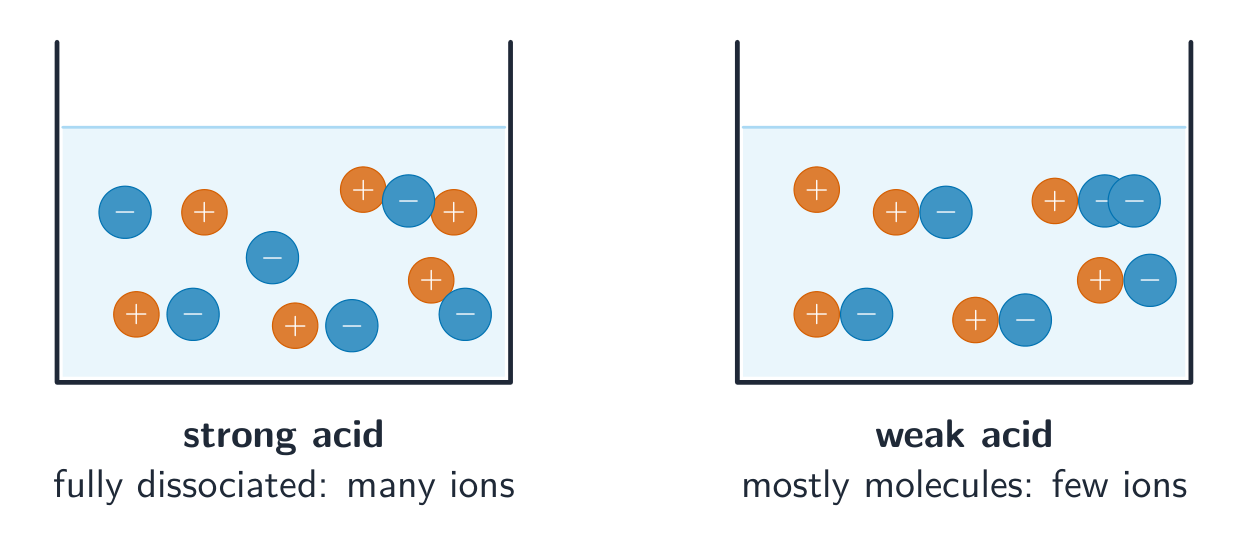
By the Brønsted–Lowry definition, an acid 酸 is a proton ($\text{H}^+$) donor and a base 碱 is a proton acceptor. When an acid donates a proton it becomes its conjugate base 共轭碱; a base gaining a proton becomes its conjugate acid 共轭酸. Water is amphoteric – it can act as either.

العربية
ورق الليتموس: مؤشرات الحموضة والقاعدة تغير لونها مع تركيز H⁺ (pH)
ورقة الكحول: تتغير مؤشرات الحموضة والقاعدة لونها مع تركيز H⁺ (pH)

وفقاً لتعريف برونستد-لوري، الحامض هو مانح للبروتون ($\text{H}^+$) والقاعدة هي مستقبل للبروتون. عندما يعطي الحامض بروتوناً يصبح قاعدته المرافقة؛ والقاعدة التي تستقبل بروتوناً تصبح حامضها المرافق. الماء متصاوغ – يمكن أن يعمل كأي منهما.

الحمض القوي منفصل كلياً؛ الحمض الضعيف منفصل جزئياً فقط
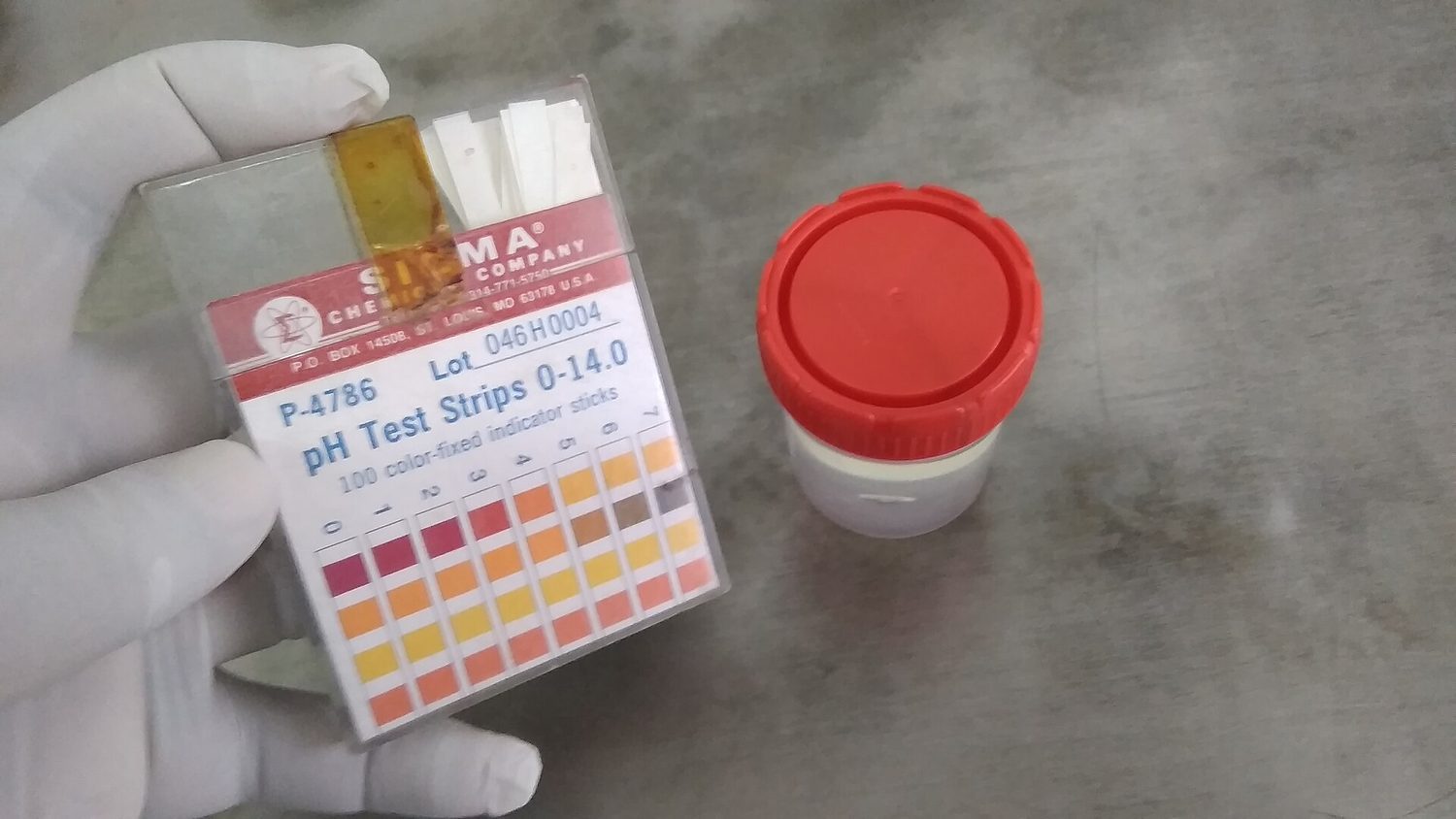
شرائط اختبار pH: قوة الحموض والقواعد وتركيزها تحدد قيمة pH التي تقاس
Vocabulary · ⁨مفردات⁩ Train · ⁨تدريب⁩
English العربية
acid/ˈæsɪd/ حمض
base/beɪs/ القاعدة
conjugate base/ˈkɒndʒuːɡeɪt beɪs/ قاعدته المرافقة
conjugate acid/ˈkɒndʒuːɡeɪt ˈæsɪd/ حمض مرافق
autoionization/ˌɔːtəʊˌaɪənaɪˈzeɪʃn/ التأين الذاتي
hydronium ion/haɪˈdrəʊnɪəm ˈaɪɒn/ أيون الهيدرونيوم
ion-product constant of water/ˈaɪɒn ˈprɒdʌkt ˈkɒnstənt ɒv ˈwɔːtə/ ثابت حاصل ضرب الأيونات للماء
neutral/ˈnjuːtrəl/ متعادل
pH/piː eɪtʃ/ درجة الحموضة (pH)
strong acid/strɒŋ ˈæsɪd/ حمض قوي
strong base/strɒŋ beɪs/ قاعدة قوية
weak acid/wiːk ˈæsɪd/ القاعدة المرافقة
8.1

The Autoionization of Water · ⁨تأين الماء ذاتياً⁩

Syllabus · ⁨المنهج⁩
English

Learning Objective 8.1.A: Calculate the values of $\mathrm{pH}$ and $\mathrm{pOH}$, based on $K_w$ and the concentration of all species present in a neutral solution of water.

  • 8.1.A.1 The concentrations of hydronium ion and hydroxide ion are often reported as $\mathrm{pH}$ and $\mathrm{pOH}$, respectively.
    • Equation: $\mathrm{pH} = -\log[\mathrm{H_3O^+}]$
    • Equation: $\mathrm{pOH} = -\log[\mathrm{OH^-}]$
    • The terms "hydrogen ion" and "hydronium ion" and the symbols $\mathrm{H^+}(aq)$ and $\mathrm{H_3O^+}(aq)$ are often used interchangeably for the aqueous ion of hydrogen. Hydronium ion and $\mathrm{H_3O^+}(aq)$ are preferred, but $\mathrm{H^+}(aq)$ is also accepted on the AP Exam.
  • 8.1.A.2 Water autoionizes with an equilibrium constant $K_w$.
    • Equation: $K_w = [\mathrm{H_3O^+}][\mathrm{OH^-}] = 1.0 \times 10^{-14}$ at 25°C
  • 8.1.A.3 In pure water, $\mathrm{pH} = \mathrm{pOH}$ is called a neutral solution. At 25°C, $\mathrm{p}K_w = 14.0$ and thus $\mathrm{pH} = \mathrm{pOH} = 7.0$.
    • Equation: $\mathrm{p}K_w = 14 = \mathrm{pH} + \mathrm{pOH}$ at 25°C
  • 8.1.A.4 The value of $K_w$ is temperature dependent, so the pH of pure, neutral water will deviate from 7.0 at temperatures other than 25°C.
العربية

هدف التعلم 8.1.A: حساب قيم $\mathrm{pH}$ و$\mathrm{pOH}$، بناءً على $K_w$ وتركيز جميع الأنواع الموجودة في محلول مائي محايد.

  • 8.1.A.1 غالباً ما يتم الإبلاغ عن تركيزات أيونات الهيدرونيوم وهيدروكسيد على شكل $\mathrm{pH}$ و$\mathrm{pOH}$ على التوالي.
    • المعادلة: $\mathrm{pH} = -\log[\mathrm{H_3O^+}]$
    • المعادلة: $\mathrm{pOH} = -\log[\mathrm{OH^-}]$
    • تُستخدم مصطلحات "أيون الهيدروجين" و"أيون الهيدرونيوم" والرموز $\mathrm{H^+}(aq)$ و$\mathrm{H_3O^+}(aq)$ غالباً بشكل مترادف لأيون الهيدروجين المائي. يُفضل أيون الهيدرونيوم و$\mathrm{H_3O^+}(aq)$، لكن $\mathrm{H^+}(aq)$ مقبول أيضاً في امتحان AP.
  • 8.1.A.2 يتأين الماء ذاتياً بثابت توازن $K_w$.
    • المعادلة: $K_w = [\mathrm{H_3O^+}][\mathrm{OH^-}] = 1.0 \times 10^{-14}$ عند 25°C
  • 8.1.A.3 في الماء النقي، يُسمى $\mathrm{pH} = \mathrm{pOH}$ محلولاً محايداً. عند 25°C، $\mathrm{p}K_w = 14.0$ وبالتالي $\mathrm{pH} = \mathrm{pOH} = 7.0$.
    • المعادلة: $\mathrm{p}K_w = 14 = \mathrm{pH} + \mathrm{pOH}$ عند 25°C
  • 8.1.A.4 قيمة $K_w$ تعتمد على درجة الحرارة، لذا سينحرف الرقم الهيدروجيني للماء النقي المحايد عن 7.0 عند درجات حرارة أخرى غير 25°C.
Source: College Board AP Course and Exam Description · ⁨المصدر: وصف دورة وامتحان College Board AP⁩

English

Even pure water conducts a tiny current, because water molecules react with each other in a reaction called autoionization 自偶电离:

$$2\text{H}_2\text{O} \rightleftharpoons \text{H}_3\text{O}^+ + \text{OH}^-.$$
One water molecule passes a proton to another, making a hydronium ion 水合氢离子 ($\text{H}_3\text{O}^+$, the ion we loosely write as $\text{H}^+$) and a hydroxide ion. This equilibrium has its own constant, the ion-product constant of water 水的离子积:
$$K_w = [\text{H}_3\text{O}^+][\text{OH}^-] = 1.0\times10^{-14}$$
at 25 °C. Defining $\text{pOH}=-\log[\text{OH}^-]$ and taking $-\log$ of the $K_w$ expression gives the rule the rest of this topic leans on:
$$\text{pH} + \text{pOH} = \text{p}K_w = 14.0$$
(again at 25 °C). Know one of pH or pOH and you get the other by subtracting from 14.

In pure water the two ions form in equal numbers, so $[\text{H}_3\text{O}^+]=[\text{OH}^-]$ and $\text{pH}=\text{pOH}=7.0$. This is what neutral 中性 means. Acidic means $[\text{H}_3\text{O}^+]>[\text{OH}^-]$ (pH below 7); basic is the reverse.

Worked example. A solution has $[\text{H}_3\text{O}^+]=2.0\times10^{-3}\ \text{M}$. Find $[\text{OH}^-]$. Because $K_w$ always holds in water,

$$[\text{OH}^-]=\frac{K_w}{[\text{H}_3\text{O}^+]}=\frac{1.0\times10^{-14}}{2.0\times10^{-3}}=5.0\times10^{-12}\ \text{M}.$$
The hydroxide concentration is far smaller than the hydronium, confirming the solution is acidic.

$K_w$ is temperature dependent: autoionization is endothermic, so heating water shifts it forward and raises $K_w$. At 50 °C, $K_w>1.0\times10^{-14}$, so neutral water has $\text{pH}=\text{pOH}<7.0$. It is still neutral, because the ion concentrations are still equal – neutral means equal ions, not a pH of exactly 7.

العربية

حتى الماء النقي يوصل تياراً صغيراً، لأن جزيئات الماء تتفاعل مع بعضها البعض في تفاعل يسمى التأين الذاتي:

$$2\text{H}_2\text{O} \rightleftharpoons \text{H}_3\text{O}^+ + \text{OH}^-.$$
جزيء ماء واحد ينقل بروتوناً إلى آخر، مكوناً أيون الهيدرونيوم ($\text{H}_3\text{O}^+$، الأيون الذي نكتبه بحرف عام $\text{H}^+$) وأيون الهيدروكسيد. هذا التوازن له ثابت خاص به، وهو ثابت حاصل التأين للماء:
$$K_w = [\text{H}_3\text{O}^+][\text{OH}^-] = 1.0\times10^{-14}$$
عند 25 °C. بتعريف $\text{pOH}=-\log[\text{OH}^-]$ وأخذ $-\log$ من تعبير $K_w$ نحصل على القاعدة التي يعتمد عليها باقي هذا الموضوع:
$$\text{pH} + \text{pOH} = \text{p}K_w = 14.0$$
(مرة أخرى عند 25 °C). معرفة واحدة من pH أو pOH تكفي للحصول على الأخرى بطرحها من 14.

في الماء النقي يتكون الأيونان بعدد متساوٍ، لذا $[\text{H}_3\text{O}^+]=[\text{OH}^-]$ و$\text{pH}=\text{pOH}=7.0$. وهذا هو معنى التعادل. حمضي يعني $[\text{H}_3\text{O}^+]>[\text{OH}^-]$ (pH أقل من 7)؛ قاعدي هو العكس.

مثال محلول. محلول له $[\text{H}_3\text{O}^+]=2.0\times10^{-3}\ \text{M}$. أوجد $[\text{OH}^-]$. بما أن $K_w$ تنطبق دائماً في الماء،

$$[\text{OH}^-]=\frac{K_w}{[\text{H}_3\text{O}^+]}=\frac{1.0\times10^{-14}}{2.0\times10^{-3}}=5.0\times10^{-12}\ \text{M}.$$
تركيز الهيدروكسيد أقل بكثير من الهيدرونيوم، مما يؤكد أن المحلول حمضي.

$K_w$ يعتمد على درجة الحرارة: التأين الذاتي ممتص للحرارة، لذا تسخين الماء يحركه للأمام ويرفع $K_w$. عند 50 °C، $K_w>1.0\times10^{-14}$، لذا الماء المتعادل له $\text{pH}=\text{pOH}<7.0$. لا يزال متعادلاً، لأن تركيزات الأيونات لا تزال متساوية – التعادل يعني تساوي الأيونات، وليس بالضرورة pH يساوي 7 تماماً.

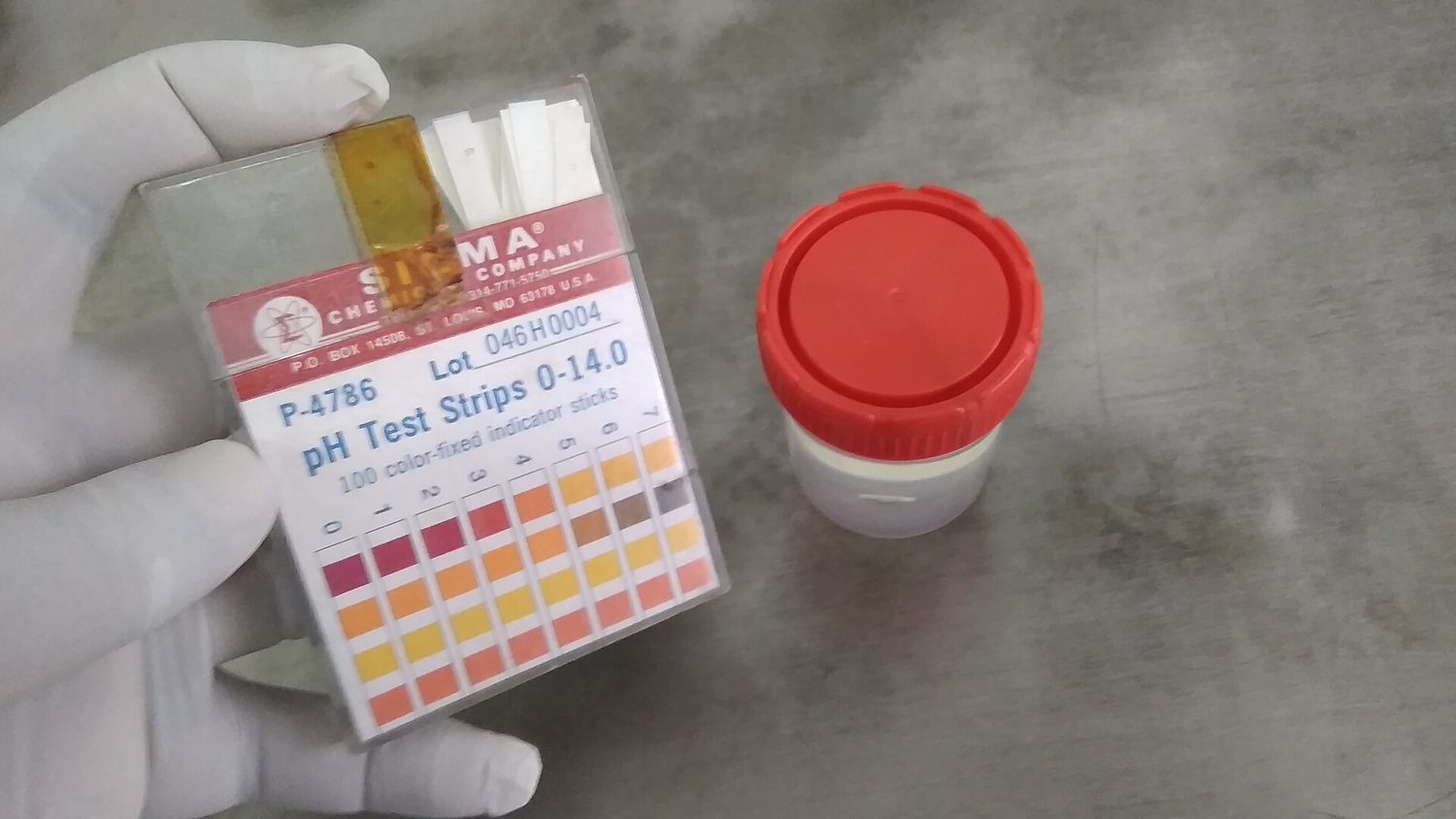
شرائط pH: يتأين الماء ذاتياً لذا الماء النقي له pH 7؛ الحموض والقواعد تحول H+ و OH-
8.2

pH and pOH of Strong Acids and Bases · ⁨pH و pOH للأحماض والقواعد القوية⁩

Syllabus · ⁨المنهج⁩
English

Learning Objective 8.2.A: Calculate $\mathrm{pH}$ and $\mathrm{pOH}$ based on concentrations of all species in a solution of a strong acid or a strong base.

  • 8.2.A.1 Molecules of a strong acid (e.g., $\mathrm{HCl}$, $\mathrm{HBr}$, $\mathrm{HI}$, $\mathrm{HClO_4}$, $\mathrm{H_2SO_4}$, and $\mathrm{HNO_3}$) will completely ionize in aqueous solution to produce hydronium ions and the conjugate base of the acid. As such, the concentration of $\mathrm{H_3O^+}$ in a strong acid solution is equal to the initial concentration of the strong acid, and thus the $\mathrm{pH}$ of the strong acid solution is easily calculated.
  • 8.2.A.2 When dissolved in solution, strong bases (e.g., group I and II hydroxides) completely dissociate to produce hydroxide ions. As such, the concentration of $\mathrm{OH^-}$ in a strong base solution is equal to the initial concentration of a group I hydroxide and double the initial concentration of a group II hydroxide, and thus the $\mathrm{pOH}$ (and $\mathrm{pH}$) of the strong base solution is easily calculated.
العربية

هدف التعلم 8.2.A: حساب $\mathrm{pH}$ و$\mathrm{pOH}$ بناءً على تركيزات جميع الأنواع في محلول حمض قوي أو قاعدة قوية.

  • 8.2.A.1 جزيئات الحمض القوي (مثل $\mathrm{HCl}$، $\mathrm{HBr}$، $\mathrm{HI}$، $\mathrm{HClO_4}$، $\mathrm{H_2SO_4}$، و$\mathrm{HNO_3}$) تتأين تماماً في المحلول المائي لإنتاج أيونات الهيدرونيوم والقاعدة المرافقة للحمض. وبذلك، فإن تركيز $\mathrm{H_3O^+}$ في محلول الحمض القوي يساوي التركيز الابتدائي للحمض القوي، وبالتالي يمكن حساب $\mathrm{pH}$ لمحلول الحمض القوي بسهولة.
  • 8.2.A.2 عند إذابة القواعد القوية (مثل هيدريدات المجموعة الأولى والثانية) في المحلول، تنحل كلياً لإنتاج أيونات الهيدروكسيد. وبذلك، فإن تركيز $\mathrm{OH^-}$ في محلول القاعدة القوية يساوي التركيز الابتدائي لهيدريد المجموعة الأولى وي ضعف التركيز الابتدائي لهيدريد المجموعة الثانية، وبالتالي يمكن حساب $\mathrm{pOH}$ (و$\mathrm{pH}$) لمحلول القاعدة القوية بسهولة.

Source: College Board AP Course and Exam Description · ⁨المصدر: وصف دورة وامتحان College Board AP⁩

English

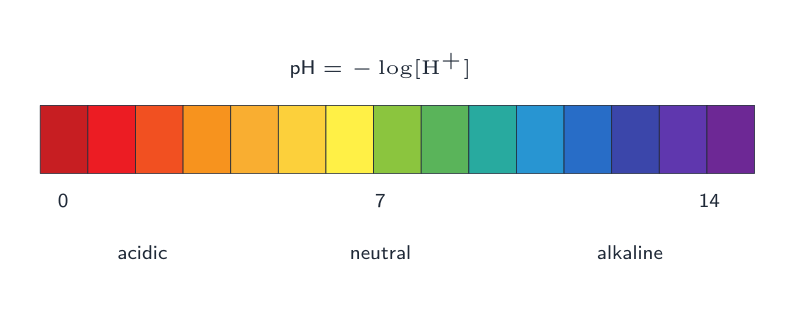
The pH pH值 scale measures acidity: $\text{pH}=-\log[\text{H}^+]$, with $\text{pH}+\text{pOH}=14$ at 25 °C. A strong acid 强酸 or strong base 强碱 dissociates completely, so its ion concentration equals its concentration – read pH directly. Lower pH means more acidic.

Worked example. Find the pH of $0.010\ \text{M}$ HCl. Because HCl is a strong acid it is fully dissociated, so $[\text{H}^+]=0.010\ \text{M}$ and

$$\text{pH}=-\log(0.010)=2.0.$$
For a strong base like $0.010\ \text{M}$ NaOH, $\text{pOH}=2.0$, so $\text{pH}=14-2.0=12.0$.

العربية

مقياس pH يقيس الحموضة: $\text{pH}=-\log[\text{H}^+]$، مع $\text{pH}+\text{pOH}=14$ عند 25 °C. الحامض القوي أو القاعدة القوية تتفكك كلياً، لذا يساوي تركيز أيونه تركيزه – اقرأ pH مباشرة. انخفاض pH يعني زيادة الحموضة.

مقياس pH: pH هو اللوغاريتم السالب لتركيز أيون الهيدروجين

مثال محلول. أوجد pH لـ $0.010\ \text{M}$ HCl. بما أن HCl حامض قوي فهو يتفكك كلياً، لذا $[\text{H}^+]=0.010\ \text{M}$ و

$$\text{pH}=-\log(0.010)=2.0.$$
لأساس قوي مثل $0.010\ \text{M}$ NaOH، $\text{pOH}=2.0$، لذا $\text{pH}=14-2.0=12.0$.

Explore · ⁨استكشف⁩

Move along the pH scale · ⁨تحرّك على مقياس الـ pH⁩

pH measures hydrogen-ion concentration on a log scale: each unit is a tenfold change. Strong acids sit low, strong bases high, 7 is neutral. · ⁨pH يقيز تركيز أيونات الهيدروجين على مقياس لوغاريتمي: كل وحدة تمثل تغييراً بمقدار عشرة أضعاف. الأحماض القوية منخفضة، والقواعد القوية عالية، و7 هو التعادل.⁩

8.3

Weak Acid and Base Equilibria · ⁨توازين الأحماض والقواعد الضعيفة⁩

Syllabus · ⁨المنهج⁩
English

Learning Objective 8.3.A: Explain the relationship among $\mathrm{pH}$, $\mathrm{pOH}$, and concentrations of all species in a solution of a monoprotic weak acid or weak base.

  • 8.3.A.1 Weak acids react with water to produce hydronium ions. However, only a small percentage of molecules of a weak acid will ionize in this way. Thus, the concentration of $\mathrm{H_3O^+}$ is much less than the initial concentration of the molecular acid, and the vast majority of the acid molecules remain un-ionized.
  • 8.3.A.2 A solution of a weak acid involves equilibrium between an un-ionized acid and its conjugate base. The equilibrium constant for this reaction is $K_a$, often reported as $\mathrm{p}K_a$. The pH of a weak acid solution can be determined from the initial acid concentration and the $\mathrm{p}K_a$.
    • Equation: $K_a = \dfrac{[\mathrm{H_3O^+}][\mathrm{A^-}]}{[\mathrm{HA}]}$
    • Equation: $\mathrm{p}K_a = -\log K_a$
  • 8.3.A.3 Weak bases react with water to produce hydroxide ions in solution. However, ordinarily just a small percentage of the molecules of a weak base in solution will ionize in this way. Thus, the concentration of $\mathrm{OH^-}$ in the solution does not equal the initial concentration of the base, and the vast majority of the base molecules remain un-ionized.
  • 8.3.A.4 A solution of a weak base involves equilibrium between an un-ionized base and its conjugate acid. The equilibrium constant for this reaction is $K_b$, often reported as $\mathrm{p}K_b$. The $\mathrm{pH}$ of a weak base solution can be determined from the initial base concentration and the $\mathrm{p}K_b$.
    • Equation: $K_b = \dfrac{[\mathrm{OH^-}][\mathrm{HB^+}]}{[\mathrm{B}]}$
    • Equation: $\mathrm{p}K_b = -\log K_b$
  • 8.3.A.5 The percent ionization of a weak acid (or base) can be calculated from its $\mathrm{p}K_a$ ($\mathrm{p}K_b$) and the initial concentration of the acid (base). The percent ionization can also be calculated from the initial concentration of the acid (base) and the equilibrium concentration of any of the species in the equilibrium expression.
  • 8.3.A.6 For any conjugate acid-base pair, the acid ionization constant and base ionization constant are related by $K_w$:
    • Equation: $K_w = K_a \times K_b$
    • Equation: $\mathrm{p}K_w = \mathrm{p}K_a + \mathrm{p}K_b$
العربية

هدف التعلم 8.3.A: شرح العلاقة بين $\mathrm{pH}$، $\mathrm{pOH}$، وتركيزات جميع الأنواع في محلول حمض ضعيف أحادي البروتون أو قاعدة ضعيفة.

  • 8.3.A.1 تتفاعل الأحماض الضعيفة مع الماء لإنتاج أيونات الهيدرونيوم. ومع ذلك، فقط نسبة صغيرة جداً من جزيئات الحمض الضعيف ستتأين بهذه الطريقة. وبالتالي، فإن تركيز $\mathrm{H_3O^+}$ أقل بكثير من التركيز الابتدائي للحمض الجزيئي، وتبقى الغالبية العظمى من جزيئات الحمض غير متأينة.
  • 8.3.A.2 يتضمن محلول الحمض الضعيف توازناً بين حمض غير متأين وقاعدته المرافقة. ثابت التوازن لهذا التفاعل هو $K_a$، وغالباً ما يتم الإبلاغ عنه على أنه $\mathrm{p}K_a$. يمكن تحديد الرقم الهيدروجيني لمحلول الحمض الضعيف من التركيز الابتدائي للحمض و$\mathrm{p}K_a$.
    • المعادلة: $K_a = \dfrac{[\mathrm{H_3O^+}][\mathrm{A^-}]}{[\mathrm{HA}]}$
    • المعادلة: $\mathrm{p}K_a = -\log K_a$
  • 8.3.A.3 تتفاعل القواعد الضعيفة مع الماء لإنتاج أيونات الهيدروكسيد في المحلول. ومع ذلك، عادةً ما تتأين فقط نسبة صغيرة جداً من جزيئات القاعدة الضعيفة في المحلول بهذه الطريقة. وبالتالي، فإن تركيز $\mathrm{OH^-}$ في المحلول لا يساوي التركيز الابتدائي للقاعدة، وتبقى الغالبية العظمى من جزيئات القاعدة غير متأينة.
  • 8.3.A.4 محلول قاعدة ضعيفة يتضمن توازناً بين قاعدة غير متأينة وحماضها المرافق. ثابت التوازن لهذا التفاعل هو $K_b$، وغالباً ما يُذكر على شكل $\mathrm{p}K_b$. يمكن تحديد $\mathrm{pH}$ لمحلول قاعدة ضعيفة من التركيز الأولي للقاعدة و$\mathrm{p}K_b$.
    • المعادلة: $K_b = \dfrac{[\mathrm{OH^-}][\mathrm{HB^+}]}{[\mathrm{B}]}$
    • المعادلة: $\mathrm{p}K_b = -\log K_b$
  • 8.3.A.5 يمكن حساب نسبة التأين لمحمض (أو قاعدة) ضعيفة من خلال $\mathrm{p}K_a$ ($\mathrm{p}K_b$) والتركيز الأولي للمحضر (القاعدة). يمكن أيضاً حساب نسبة التأين من التركيز الأولي للمحضر (القاعدة) والتركيز عند التوازن لأي من الأنواع في تعبير التوازن.
  • 8.3.A.6 بالنسبة لأي زوج حمض-قاعدة مترافق، يرتبط ثابت تأين الحمض وثابت تأين القاعدة بالعلاقة $K_w$:
    • المعادلة: $K_w = K_a \times K_b$
    • المعادلة: $\mathrm{p}K_w = \mathrm{p}K_a + \mathrm{p}K_b$

Source: College Board AP Course and Exam Description · ⁨المصدر: وصف دورة وامتحان College Board AP⁩

English

A weak acid 弱酸 only partly dissociates, described by an equilibrium constant $K_a$ (larger $K_a$ = stronger weak acid); a weak base has $K_b$. For any conjugate acid–base pair the two are linked through water, $K_a\times K_b = K_w$, so $\text{p}K_a+\text{p}K_b=14$ – a stronger acid always has a weaker conjugate base. Because dissociation is small, find $[\text{H}^+]$ with an ICE table and the $K_a$ expression, often using the small-$x$ approximation.

Worked example. Find the pH of $0.10\ \text{M}$ acetic acid, $K_a=1.8\times10^{-5}$. Let $x=[\text{H}^+]$ at equilibrium; the ICE table gives $K_a=\dfrac{x^2}{0.10-x}\approx\dfrac{x^2}{0.10}$ (small-$x$ approximation), so

$$x=\sqrt{K_a\times0.10}=\sqrt{1.8\times10^{-6}}=1.3\times10^{-3}\ \text{M}\;\Rightarrow\;\text{pH}=-\log(1.3\times10^{-3})=2.9.$$
The weak acid is far less acidic than a strong acid of the same concentration (which would be pH $1.0$).

العربية

الحامض الضعيف يتفكك جزئياً فقط، ويصفه ثابت توازن $K_a$ (أكبر $K_a$ = حامض ضعيف أقوى)؛ والقاعدة الضعيفة لها $K_b$. لأي زوج مرافق حامض-قاعدة يرتبط الاثنان عبر الماء، $K_a\times K_b = K_w$، لذا $\text{p}K_a+\text{p}K_b=14$ – فالحامض الأقوى له دائماً قاعدة مرافقة أضعف. وبما أن التفكك صغير، أوجد $[\text{H}^+]$ باستخدام جدول ICE وتعبير $K_a$، غالباً باستخدام تقريب صغير-$x$.

مثال محلول. أوجد pH لـ $0.10\ \text{M}$ حمض الخليك، $K_a=1.8\times10^{-5}$. ليكن $x=[\text{H}^+]$ عند التوازن؛ يعطي جدول ICE $K_a=\dfrac{x^2}{0.10-x}\approx\dfrac{x^2}{0.10}$ (تقريب صغير-$x$)، لذا

$$x=\sqrt{K_a\times0.10}=\sqrt{1.8\times10^{-6}}=1.3\times10^{-3}\ \text{M}\;\Rightarrow\;\text{pH}=-\log(1.3\times10^{-3})=2.9.$$
الحامض الضعيف أقل حموضاً بكثير من حامض قوي بنفس التركيز (والذي سيكون له pH $1.0$).

8.4

Acid-Base Reactions and Buffers · ⁨تفاعلات الأحماض والقواعد والمحاليل المُنظِّمة⁩

Syllabus · ⁨المنهج⁩
English

Learning Objective 8.4.A: Explain the relationship among the concentrations of major species in a mixture of weak and strong acids and bases.

  • 8.4.A.1 When a strong acid and a strong base are mixed, they react quantitatively in a reaction represented by the equation: $\mathrm{H^+}(aq) + \mathrm{OH^-}(aq) \rightarrow \mathrm{H_2O}(l)$. The pH of the resulting solution may be determined from the concentration of excess reagent.
  • 8.4.A.2 When a weak acid and a strong base are mixed, they react quantitatively in a reaction represented by the equation: $\mathrm{HA}(aq) + \mathrm{OH^-}(aq) \rightleftarrows \mathrm{A^-}(aq)\ \mathrm{H_2O}(l)$. If the weak acid is in excess, then a buffer solution is formed, and the $\mathrm{pH}$ can be determined from the Henderson-Hasselbalch (H–H) equation (see 8.9.A.1). If the strong base is in excess, then the $\mathrm{pH}$ can be determined from the moles of excess hydroxide ion and the total volume of solution. If they are equimolar, then the (slightly basic) $\mathrm{pH}$ can be determined from the equilibrium represented by the equation: $\mathrm{A^-}(aq) + \mathrm{H_2O}(l) \rightleftarrows \mathrm{HA}(aq) + \mathrm{OH^-}(aq)$.
  • 8.4.A.3 When a weak base and a strong acid are mixed, they will react quantitatively in a reaction represented by the equation: $\mathrm{B}(aq) + \mathrm{H_3O^+}(aq) \rightleftarrows \mathrm{HB^+}(aq) + \mathrm{H_2O}(l)$. If the weak base is in excess, then a buffer solution is formed, and the $\mathrm{pH}$ can be determined from the H–H equation. If the strong acid is in excess, then the $\mathrm{pH}$ can be determined from the moles of excess hydronium ion and the total volume of solution. If they are equimolar, then the (slightly acidic) $\mathrm{pH}$ can be determined from the equilibrium represented by the equation: $\mathrm{HB^+}(aq) + \mathrm{H_2O}(l) \rightleftarrows \mathrm{B}(aq) + \mathrm{H_3O^+}(aq)$.
  • 8.4.A.4 When a weak acid and a weak base are mixed, they will react to an equilibrium state whose reaction may be represented by the equation: $\mathrm{HA}(aq) + \mathrm{B}(aq) \rightleftarrows \mathrm{A^-}(aq) + \mathrm{HB^+}(aq)$.
العربية

هدف التعلم 8.4.A: اشرح العلاقة بين تركيزات الأنواع الرئيسية في خليط من الأحماض والقواعد الضعيفة والقوية.

  • 8.4.A.1 عند خلط حمض قوي وقاعدة قوية، يتفاعلان كميًا في تفاعل يمثله المعادلة: $\mathrm{H^+}(aq) + \mathrm{OH^-}(aq) \rightarrow \mathrm{H_2O}(l)$. يمكن تحديد درجة الحموضة (pH) للمحلول الناتج من تركيز الكاشف الزائد.
  • 8.4.A.2 عند خلط حمض ضعيف وقاعدة قوية، يتفاعلان كميًا في تفاعل يمثله المعادلة: $\mathrm{HA}(aq) + \mathrm{OH^-}(aq) \rightleftarrows \mathrm{A^-}(aq)\ \mathrm{H_2O}(l)$. إذا كان الحمض الضعيف زائداً، تتكون محلول ممتد، ويمكن تحديد $\mathrm{pH}$ من معادلة هندرسون-هاسلبالخ (H–H) (راجع 8.9.A.1). إذا كانت القاعدة القوية زائدة، يمكن تحديد $\mathrm{pH}$ من عدد مولات أيون الهيدروكسيد الزائد والحجم الكلي للمحلول. إذا كانا متساويين مولياً، يمكن تحديد $\mathrm{pH}$ (الذي يكون قلوياً قليلاً) من التوازن الذي تمثله المعادلة: $\mathrm{A^-}(aq) + \mathrm{H_2O}(l) \rightleftarrows \mathrm{HA}(aq) + \mathrm{OH^-}(aq)$.
  • 8.4.A.3 عند خلط قاعدة ضعيفة وحمض قوي، سيتفاعلان كميًا في تفاعل يمثله المعادلة: $\mathrm{B}(aq) + \mathrm{H_3O^+}(aq) \rightleftarrows \mathrm{HB^+}(aq) + \mathrm{H_2O}(l)$. إذا كانت القاعدة الضعيفة زائدة، تتكون محلول ممتد، ويمكن تحديد $\mathrm{pH}$ من معادلة H–H. إذا كان الحمض القوي زائداً، يمكن تحديد $\mathrm{pH}$ من عدد مولات أيون الهيدرونيوم الزائد والحجم الكلي للمحلول. إذا كانا متساويين مولياً، يمكن تحديد $\mathrm{pH}$ (الذي يكون حمضياً قليلاً) من التوازن الذي تمثله المعادلة: $\mathrm{HB^+}(aq) + \mathrm{H_2O}(l) \rightleftarrows \mathrm{B}(aq) + \mathrm{H_3O^+}(aq)$.
  • 8.4.A.4 عند خلط حمض ضعيف وقاعدة ضعيفة، سيتفاعلان حتى الوصول إلى حالة توازن يمكن تمثيل تفاعلها بالمعادلة: $\mathrm{HA}(aq) + \mathrm{B}(aq) \rightleftarrows \mathrm{A^-}(aq) + \mathrm{HB^+}(aq)$.

Source: College Board AP Course and Exam Description · ⁨المصدر: وصف دورة وامتحان College Board AP⁩

English

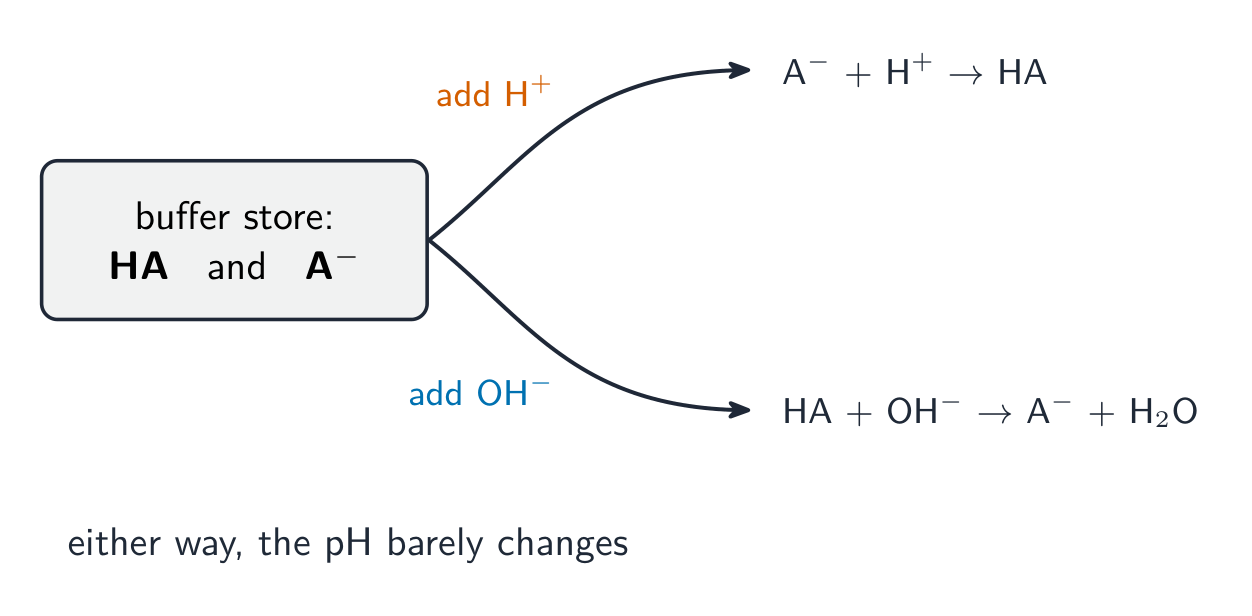
A buffer 缓冲溶液 resists pH change. It contains a weak acid and its conjugate base (or a weak base and its conjugate acid) in comparable amounts. Added acid is neutralized by the conjugate base, and added base by the weak acid, so pH barely moves.

العربية

المحلول المُناظِم يقاوم تغير pH. يحتوي على حامض ضعيف وقاعدة مرافقة له (أو قاعدة ضعيفة وحامض مرافق لها) بنسب مقاربة. يُعادلة الحمض المضاف بواسطة القاعدة المرافقة، والقاعدة المضافة بالحامض الضعيف، لذا لا يتحرك pH إلا قليلاً.

8.5

Acid-Base Titrations · ⁨معايرة الأحماض والقواعد⁩

Syllabus · ⁨المنهج⁩
English

Learning Objective 8.5.A: Explain results from the titration of a mono- or polyprotic acid or base solution, in relation to the properties of the solution and its components.

  • 8.5.A.1 An acid-base reaction can be carried out under controlled conditions in a titration. A titration curve, plotting $\mathrm{pH}$ against the volume of titrant added, is useful for summarizing results from a titration.
  • 8.5.A.2 At the equivalence point for titrations of monoprotic acids or bases, the number of moles of titrant added is equal to the number of moles of analyte originally present. This relationship can be used to obtain the concentration of the analyte. This is the case for titrations of strong acids/bases and weak acids/bases.
  • 8.5.A.3 For titrations of weak acids/bases, it is useful to consider the point halfway to the equivalence point, that is, the half-equivalence point. At this point, there are equal concentrations of each species in the conjugate acid-base pair, for example, for a weak acid $[\mathrm{HA}] = [\mathrm{A^-}]$. Because $\mathrm{pH} = \mathrm{p}K_a$ when the conjugate acid and base have equal concentrations, the $\mathrm{p}K_a$ can be determined from the $\mathrm{pH}$ at the half-equivalence point in a titration.
  • 8.5.A.4 At the equivalence point, pH is determined by the major species in solution. Strong acid and strong base titrations result in neutral pH at the equivalence point. However, in titrations of weak acids (weak bases), the conjugate base of the weak acid (conjugate acid of the weak base) is present at the equivalence point and can undergo proton-transfer reactions with the surrounding water, producing basic (acidic) solutions.
  • 8.5.A.5 For polyprotic acids, titration curves can be used to determine the number of acidic protons. In doing so, the major species present at any point along the curve can be identified, along with the $\mathrm{p}K_a$ associated with each proton in a weak polyprotic acid.
    • Exclusion statement: Computation of the concentration of each species present in the titration curve for polyprotic acids will not be assessed on the AP Exam. Such computations for titration of monoprotic acids are within the scope of the course (see 8.4.A.2 and 8.4.A.3), as is qualitative reasoning regarding what species are present in large versus small concentrations at any point in a titration of a polyprotic acid.
العربية

هدف التعلم 8.5.A: اشرح نتائج معايرة محلول حمض أو قاعدة أحادية أو متعددة البروتونات، فيما يتعلق بخصائص المحلول ومكوناته.

  • 8.5.A.1 يمكن إجراء تفاعل حمض-قاعدة تحت ظروف مسبوقة في المعايرة. من المفيد استخدام منحنى المعايرة، الذي يرسم $\mathrm{pH}$ مقابل حجم الكاشف المضاف، لتلخيص نتائج المعايرة.
  • 8.5.A.2 عند نقطة التكافؤ لمعايرات الأحماض أو القواعد أحادية البروتون، يكون عدد مولات الكاشف المضاف مساوياً لعدد مولات العينة الأصلية. يمكن استخدام هذه العلاقة للحصول على تركيز العينة. ينطبق هذا على معايرات الأحماض/القواعد القوية والأحماض/القواعد الضعيفة.
  • 8.5.A.3 لمعايرات الأحماض/القواعد الضعيفة، من المفيد النظر في النقطة التي تقع في منتصف الطريق إلى نقطة التكافؤ، أي نقطة نصف التكافؤ. عند هذه النقطة، تكون هناك تركيزات متساوية لكل نوع في الزوج الحمضي-القاعدي المترافق، على سبيل المثال، لحمض ضعيف $[\mathrm{HA}] = [\mathrm{A^-}]$. بما أن $\mathrm{pH} = \mathrm{p}K_a$ عندما يكون للحمض القاعد المترافق تركيزات متساوية، يمكن تحديد $\mathrm{p}K_a$ من $\mathrm{pH}$ عند نقطة نصف التكافؤ في المعايرة.
  • 8.5.A.4 عند نقطة التكافؤ، تُحدد درجة الحموضة (pH) بواسطة الأنواع الرئيسية في المحلول. تؤدي معايرات الأحماض والقواعد القوية إلى pH محايد عند نقطة التكافؤ. ومع ذلك، في معايرات الأحماض الضعيفة (القواعد الضعيفة)، يكون قاعدة الحمض الضعيف (حمض القاعدة المرافق للقاعدة الضعيفة) موجوداً عند نقطة التكافؤ ويمكن أن يخضع لتفاعلات نقل بروتون مع الماء المحيط، مما ينتج عنه محاليل قاعدية (حمضية).
  • 8.5.A.5 للأحماض متعددة البروتونات، يمكن استخدام منحنيات المعايرة لتحديد عدد البروتونات الحمضية. وفي ذلك، يمكن تحديد الأنواع الرئيسية الموجودة في أي نقطة على المنحنى، بالإضافة إلى $\mathrm{p}K_a$ المرتبطة بكل بروتون في حمض متعدد البروتونات ضعيف.
    • عبارة الاستبعاد: لن يتم تقييم حسابات تركيز كل نوع موجود في منحنى المعايرة للأحماض متعددة البروتونات في امتحان AP. مثل هذه الحسابات لمعايرة الأحماض أحادية البروتون تقع ضمن نطاق المقرر (راجع 8.4.A.2 و 8.4.A.3)، وكذلك الاستدلال النوعي فيما يتعلق بالأنواع الموجودة بتركيزات كبيرة مقابل صغيرة في أي نقطة من معايرة حمض متعدد البروتونات.

Source: College Board AP Course and Exam Description · ⁨المصدر: وصف دورة وامتحان College Board AP⁩

English
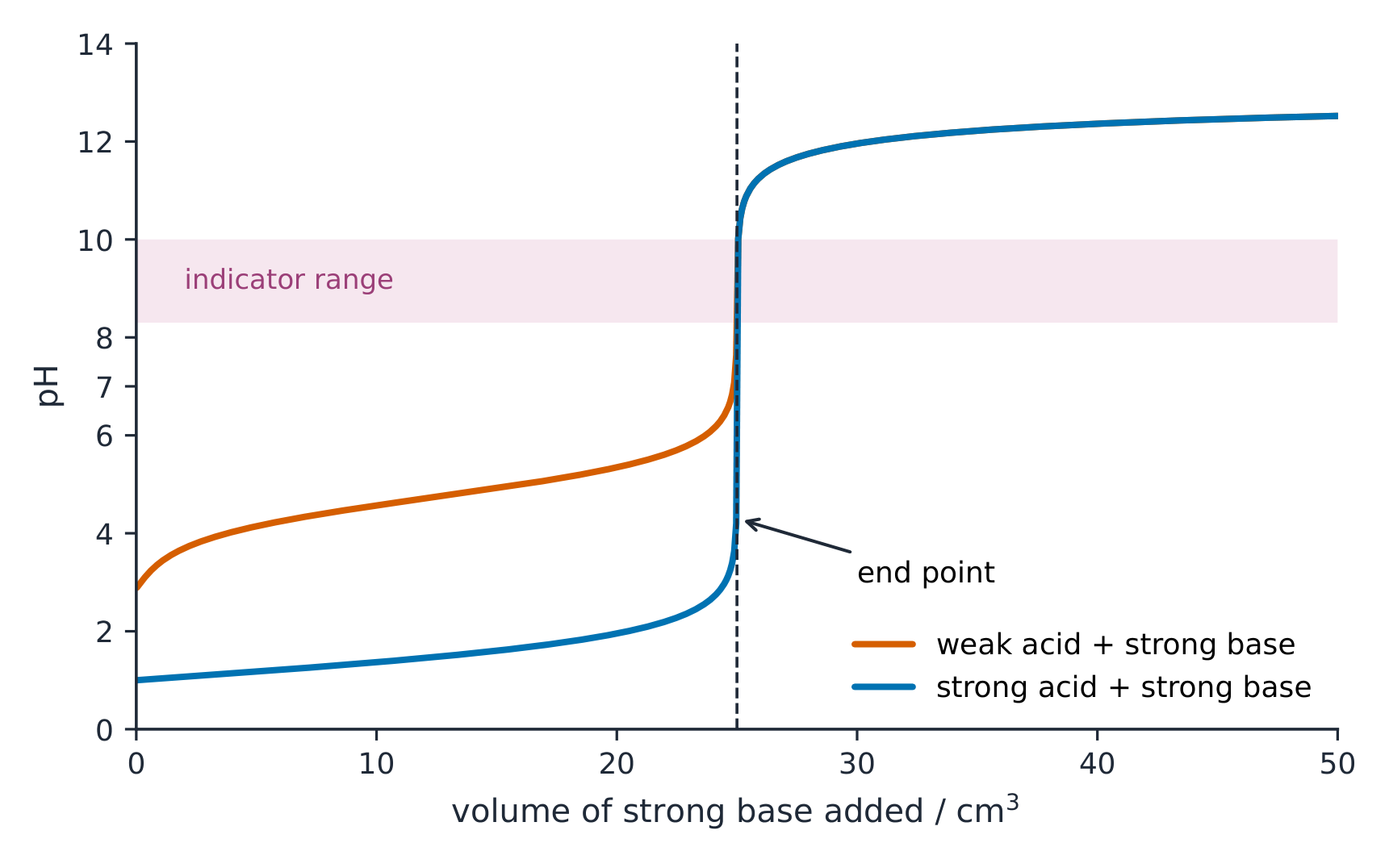
An acid–base titration curve

A titration curve 滴定曲线 plots pH as base (or acid) is added. Key points: the equivalence point 等当点 (moles of acid = moles of base – a steep jump), and the half-equivalence point, where $\text{pH}=\text{p}K_a$ (half the weak acid is converted, so a buffer is at its center).

An acid-base indicator 酸碱指示剂 is itself a weak acid whose protonated and deprotonated forms have different colours, so its colour responds to pH. You pick an indicator whose colour change happens near the titration's equivalence-point pH, so the colour flips just as the reaction completes.

العربية
منحنى معايرة حمض-قاعدة

منحنى المعايرة يرسم pH بينما تُضاف قاعدة (أو حامض). النقاط الرئيسية: نقطة التكافؤ (مولات الحامض = مولات القاعدة – قفزة حادة)، ونقطة نصف التكافؤ، حيث $\text{pH}=\text{p}K_a$ (نصف الحامض الضعيف تم تحويله، لذا يكون المحلول المُنظِم في مركزه).

مؤشر الحموضة والقاعدة هو نفسه حامض ضعيف لأشكاله المثبتة غير المثبتة ألوان مختلفة، لذا يستجيب لونه لـ pH. تختار مؤشراً يتغير لونه بالقرب من pH نقطة التكافؤ في المعايرة، حتى ينقلب اللون لحظة اكتمال التفاعل.

منحنى المعايرة يحتوي على قفزة حادة靠近 نقطة التكافؤ
Explore · ⁨استكشف⁩

Titrate to the equivalence point · ⁨إجراء المعايرة عند نقطة التكافؤ⁩

A titration curve rises gently, then sharply at the equivalence point where moles of acid and base match. The steep jump pinpoints that volume. · ⁨يرتفع منحنى المعايرة ببطء ثم حاداً عند نقطة التكافؤ حيث تتساوى مولات الحمض والقاعدة. يشير القفز الحاد بدقة إلى هذا الحجم.⁩

Vocabulary · ⁨مفردات⁩ Train · ⁨تدريب⁩
English العربية
titration curve/taɪˈtreɪʃn kɜːv/ منحنى المعايرة
equivalence point/ɪˈkwɪvələns pɔɪnt/ نقطة التكافؤ
acid-base indicator/ˈæsɪd beɪs ˈɪndɪkeɪtə/ كاشف الحمض والقاعدة
Buffer capacity/ˈbʌfə kəˈpæsɪti/ سعة المحلول المنظم
8.6

Molecular Structure of Acids and Bases · ⁨البنية الجزيئية للأحماض والقواعد⁩

Syllabus · ⁨المنهج⁩
English

Learning Objective 8.6.A: Explain the relationship between the strength of an acid or base and the structure of the molecule or ion.

  • 8.6.A.1 The protons on a molecule that will participate in acid-base reactions, and the relative strength of these protons, can be inferred from the molecular structure.
    • i. Strong acids (such as $\mathrm{HCl}$, $\mathrm{HBr}$, $\mathrm{HI}$, $\mathrm{HClO_4}$, $\mathrm{H_2SO_4}$, and $\mathrm{HNO_3}$) have very weak conjugate bases that are stabilized by electronegativity, inductive effects, resonance, or some combination thereof.
    • ii. Carboxylic acids are one common class of weak acid.
    • iii. Strong bases (such as group I and II hydroxides) have very weak conjugate acids.
    • iv. Common weak bases include nitrogenous bases such as ammonia as well as carboxylate ions.
    • v. Electronegative elements tend to stabilize the conjugate base relative to the conjugate acid, and so increase acid strength.
العربية

هدف التعلم 8.6.A: اشرح العلاقة بين قوة الحمض أو القاعدة وبنية الجزيء أو الأيون.

  • 8.6.A.1 يمكن استنتاج البروتونات في الجزيء التي ستشارك في تفاعلات حمض-قاعدة والقوة النسبية لهذه البروتونات من البنية الجزيئية.
    • i. الأحماض القوية (مثل $\mathrm{HCl}$، $\mathrm{HBr}$، $\mathrm{HI}$، $\mathrm{HClO_4}$، $\mathrm{H_2SO_4}$، و$\mathrm{HNO_3}$) لها قواعد مرافقة ضعيفة جداً يتم استقرارها عن طريق الكهروسلبية، أو التأثير الحثي، أو الرنين، أو مزيج من تلك العوامل.
    • ii. الأحماض الكربوكسيلية هي فئة شائعة من الأحماض الضعيفة.
    • iii. القواعد القوية (مثل هيدرويدات المجموعة الأولى والثانية) لها أحماض مرافقة ضعيفة جداً.
    • iv. تشمل القواعد الضعيفة الشائعة القواعد النيتروجينية مثل الأمونيا وأيونات الكربوكسيلات.
    • v. تميل العناصر الكهربية السالبة إلى استقرار القاعدة المرافقة مقارنةً بالحمض المرافق، وبالتالي زيادة قوة الحمض.

Source: College Board AP Course and Exam Description · ⁨المصدر: وصف دورة وامتحان College Board AP⁩

English

Strength has structural roots. An acid is stronger when its conjugate base is more stable – for example, more electronegative atoms or resonance spreading the negative charge stabilize it. For oxoacids, more oxygen atoms on the central atom means a stronger acid.

العربية

قوة الحمض لها جذور بنية. يكون الحمض أقوى عندما تكون قاعدته المرافقة أكثر استقراراً – على سبيل المثال، الذرات الأكثر كهرسلبية أو الرنين الذي يوزع الشحنة السالبة يستقرها. بالنسبة للأحماض الأكسجينية، زيادة عدد ذرات الأكسجين المرتبطة بالذرة المركزية تعني حمضاً أقوى.

8.7

pH and pKa · ⁨الأس الهيدروجيني (pH) والأس الكهروحمضي (pKa)⁩

Syllabus · ⁨المنهج⁩
Learning ObjectiveEssential Knowledge

8.7.A
Explain the relationship between the predominant form of a weak acid or base in solution at a given $\mathrm{pH}$ and the $\mathrm{p}K_a$ of the conjugate acid or the $\mathrm{p}K_b$ of the conjugate base.

  • 8.7.A.1 The protonation state of an acid or base (i.e., the relative concentrations of $\mathrm{HA}$ and $\mathrm{A^-}$) can be predicted by comparing the $\mathrm{pH}$ of a solution to the $\mathrm{p}K_a$ of the acid in that solution. When solution $\mathrm{pH} < \mathrm{acid}\ \mathrm{p}K_a$, the acid form has a higher concentration than the base form. When solution $\mathrm{pH} > \mathrm{acid}\ \mathrm{p}K_a$, the base form has a higher concentration than the acid form.
  • 8.7.A.2 Acid-base indicators are substances that exhibit different properties (such as color) in their protonated versus deprotonated state, making that property respond to the $\mathrm{pH}$ of a solution.
  • 8.7.A.3 To ensure accurate results in a titration experiment, acid-base indicators should be selected that have a $\mathrm{p}K_a$ close to the $\mathrm{pH}$ at the equivalence point.

Source: College Board AP Course and Exam Description · ⁨المصدر: وصف دورة وامتحان College Board AP⁩

English

$\text{p}K_a=-\log K_a$: a smaller $\text{p}K_a$ means a stronger acid. Comparing pH to $\text{p}K_a$ tells you the dominant form: below $\text{p}K_a$ the acid form dominates; above it, the conjugate base form dominates.

العربية

$\text{p}K_a=-\log K_a$: يعني أن $\text{p}K_a$ أصغر يعني حمضاً أقوى. مقارنة الـ pH بـ $\text{p}K_a$ تخبرك بالشكل السائد: أسفل $\text{p}K_a$ يهيمن الشكل الحمضي؛ فوقه يهيمن شكل القاعدة المرافقة.

8.8

Properties of Buffers · ⁨خصائص المحاليل العازلة⁩

Syllabus · ⁨المنهج⁩
English

Learning Objective 8.8.A: Explain the relationship between the ability of a buffer to stabilize $\mathrm{pH}$ and the reactions that occur when an acid or a base is added to a buffered solution.

  • 8.8.A.1 A buffer solution contains a large concentration of both members in a conjugate acid-base pair. The conjugate acid reacts with added base and the conjugate base reacts with added acid. These reactions are responsible for the ability of a buffer to stabilize $\mathrm{pH}$.
العربية

الهدف التعليمي 8.8.A: اشرح العلاقة بين قدرة المحلول المنظم على تثبيت $\mathrm{pH}$ والتفاعلات التي تحدث عند إضافة حمض أو قاعدة إلى محلول منظم.

  • 8.8.A.1 يحتوي المحلول المنظم على تركيز كبير من كلا عضويي زوج الحمض والقاعدة المرافقين. يتفاعل الحمض المرافق مع القاعدة المضافة وتتفاعل القاعدة المرافقة مع الحمض المضاف. هذه التفاعلات مسؤولة عن قدرة المحلول المنظم على تثبيت $\mathrm{pH}$.

Source: College Board AP Course and Exam Description · ⁨المصدر: وصف دورة وامتحان College Board AP⁩

English
How a buffer resists pH change

A buffer works best when the weak acid and conjugate base concentrations are similar (pH near $\text{p}K_a$). Choose a buffer whose $\text{p}K_a$ is close to the target pH. Diluting a buffer barely changes its pH, because the acid-to-base ratio stays the same.

العربية
كيف يقاوم المحلول العازل تغيرات الأس الهيدروجيني

يعمل المحلول العازل بشكل أفضل عندما تكون تراكيز الحمض الضعيف والقاعدة المرافقة متقاربة (pH قريب من $\text{p}K_a$). اختر محلولاً عازلاً يكون فيه $\text{p}K_a$ قريباً من الـ pH المستهدف. تخفيف المحلول العازل لا يغير his pH تقريباً، لأن نسبة الحمض إلى القاعدة تبقى كما هي.

المحلول العازل يقاوم تغيرات الأس الهيدروجيني عن طريق امتصاص الحمض أو القاعدة المضافة
Vocabulary · ⁨مفردات⁩ Train · ⁨تدريب⁩
English العربية
buffer/ˈbʌfə/ منظم
8.9

The Henderson-Hasselbalch Equation · ⁨معادلة هندرسون-هاسلبالتش⁩

Syllabus · ⁨المنهج⁩
English

Learning Objective 8.9.A: Identify the $\mathrm{pH}$ of a buffer solution based on the identity and concentrations of the conjugate acid-base pair used to create the buffer.

  • 8.9.A.1 The $\mathrm{pH}$ of the buffer is related to the $\mathrm{p}K_a$ of the acid and the concentration ratio of the conjugate acid-base pair. This relation is a consequence of the equilibrium expression associated with the dissociation of a weak acid, and is described by the Henderson-Hasselbalch equation. Adding small amounts of acid or base to a buffered solution does not significantly change the ratio of $[\mathrm{A^-}]/[\mathrm{HA}]$ and thus does not significantly change the solution $\mathrm{pH}$. The change in $\mathrm{pH}$ on addition of acid or base to a buffered solution is therefore much less than it would have been in the absence of the buffer.
    • Equation: $\mathrm{pH} = \mathrm{p}K_a + \log\dfrac{[\mathrm{A^-}]}{[\mathrm{HA}]}$
    • Exclusion statement: Computation of the change in pH resulting from the addition of an acid or a base to a buffer will not be assessed on the AP Exam.
    • Exclusion statement: Derivation of the Henderson-Hasselbalch equation will not be assessed on the AP Exam.
العربية

الهدف التعليمي 8.9.A: حدد $\mathrm{pH}$ المحلول المنظم بناءً على هوية وتركيزات زوج الحمض والقاعدة المرافقين المستخدمين لإنشاء المحلول.

  • 8.9.A.1 يرتبط $\mathrm{pH}$ المحلول المنظم بـ $\mathrm{p}K_a$ الحمض ونسبة تركيز زوج الحمض والقاعدة المرافقين. هذه العلاقة نتيجة للتعبير عن الاتزان المرتبط بتفكك حمض ضعيف، وتُوصف بمعادلة هندرسون-هاسلبالتش. إضافة كميات صغيرة من الحمض أو القاعدة إلى المحلول المنظم لا يغير بشكل كبير نسبة $[\mathrm{A^-}]/[\mathrm{HA}]$ وبالتالي لا يغير بشكل كبير $\mathrm{pH}$ المحلول. لذلك يكون التغير في $\mathrm{pH}$ عند إضافة الحمض أو القاعدة إلى المحلول المنظم أقل بكثير مما كان سيحدث في غياب المحلول المنظم.
    • المعادلة: $\mathrm{pH} = \mathrm{p}K_a + \log\dfrac{[\mathrm{A^-}]}{[\mathrm{HA}]}$
    • بيان الاستبعاد: لن يتم تقييم حساب التغير في الـpH الناتج عن إضافة حمض أو قاعدة إلى محلول ممتد في امتحان AP.
    • بيان الاستبعاد: لن يتم اشتقاق معادلة هندرسون-هاسلبالتش في امتحان AP.

Source: College Board AP Course and Exam Description · ⁨المصدر: وصف دورة وامتحان College Board AP⁩

English

For a buffer, the pH follows from the acid-to-base ratio:

$$\text{pH}=\text{p}K_a+\log\frac{[\text{A}^-]}{[\text{HA}]}.$$
When the concentrations are equal, the log is zero and $\text{pH}=\text{p}K_a$. Use it to design a buffer or find its pH quickly.

Worked example. A buffer holds $0.20\ \text{M}$ acetic acid ($\text{p}K_a=4.74$) and $0.30\ \text{M}$ acetate. Its pH is

$$\text{pH}=4.74+\log\frac{0.30}{0.20}=4.74+\log(1.5)=4.74+0.18=4.92.$$
A little more conjugate base than acid pushes the pH just above $\text{p}K_a$, as the equation predicts.

العربية

بالنسبة للمحلول العازل، يُستنتج الـ pH من نسبة الحمض إلى القاعدة:

$$\text{pH}=\text{p}K_a+\log\frac{[\text{A}^-]}{[\text{HA}]}.$$
عند تساوي التراكيز، يكون اللوغاريتم صفراً وتكون $\text{pH}=\text{p}K_a$. استخدمها لتصميم محلول عازل أو لإيجاد الـ pH الخاص به بسرعة.

مثال محلل. يحتوي المحلول العازل على $0.20\ \text{M}$ حمض أسيتيك ($\text{p}K_a=4.74$) و$0.30\ \text{M}$ أسيتات. يكون الـ pH الخاص به

$$\text{pH}=4.74+\log\frac{0.30}{0.20}=4.74+\log(1.5)=4.74+0.18=4.92.$$
زيادة طفيفة في القاعدة المرافقة عن الحمض تدفع الـ pH قليلاً فوق $\text{p}K_a$، كما تتنبأ المعادلة.

8.10

Buffer Capacity · ⁨سعة المحلول العازل⁩

Syllabus · ⁨المنهج⁩
English

Learning Objective 8.10.A: Explain the relationship between the buffer capacity of a solution and the relative concentrations of the conjugate acid and conjugate base components of the solution.

  • 8.10.A.1 Increasing the concentration of the buffer components (while keeping the ratio of these concentrations constant) keeps the $\mathrm{pH}$ of the buffer the same but increases the capacity of the buffer to neutralize added acid or base.
  • 8.10.A.2 When a buffer has more conjugate acid than base, it has a greater buffer capacity for addition of added base than acid. When a buffer has more conjugate base than acid, it has a greater buffer capacity for addition of added acid than base.
العربية

هدف التعلم 8.10.A: شرح العلاقة بين سعة المحلول المنظم والتركيزات النسبية لمكونات الحمض المرافق والقاعدة المرافقة في المحلول.

  • 8.10.A.1 زيادة تركيز مكونات المحلول المنظم (مع الحفاظ على نسبة هذه التركيز ثابتة) يحافظ على $\mathrm{pH}$ للمحلول المنظم نفسه لكنه يزيد من قدرة المحلول المنظم على تعويض الحمض أو القاعدة المضافة.
  • 8.10.A.2 عندما يحتوي المحلول المنظم على حمض مرافق أكثر من قاعدة مرافقة، تكون لديه سعة أكبر لمحلول منظم لإضافة القاعدة مقارنة بالحمض. وعندما يحتوي المحلول المنظم على قاعدة مرافقة أكثر من حمض مرافق، تكون لديه سعة أكبر لمحلول منظم لإضافة الحمض مقارنة بالقاعدة.

Source: College Board AP Course and Exam Description · ⁨المصدر: وصف دورة وامتحان College Board AP⁩

English

Buffer capacity 缓冲容量 is how much acid or base a buffer can absorb before its pH changes sharply. It is greatest when the components are concentrated and in roughly equal amounts. Once one component is used up, the buffer fails.

العربية

سعة المحلول العازل هي كمية الحمض أو القاعدة التي يمكن للمحلول امتصاصها قبل أن يتغير الـ pH بشكل حاد. تكون أكبر ما يمكن عندما تكون المكونات مركزة وبكميات متقاربة تقريباً. بمجرد استهلاك أحد المكونات، يفشل المحلول العازل.

8.11

pH and Solubility · ⁨الأس الهيدروجيني والذوبانية⁩

Syllabus · ⁨المنهج⁩
English

Learning Objective 8.11.A: Identify the qualitative effect of changes in pH on the solubility of a salt.

  • 8.11.A.1 The solubility of a salt is pH sensitive when one of the constituent ions is a weak acid, a weak base, or the hydroxide ion. These effects can be understood qualitatively using Le Châtelier's principle.
    • Exclusion statement: Computations of solubility as a function of pH will not be assessed on the AP Exam.
العربية

هدف التعلم 8.11.A: تحديد التأثير النوعي لتغيرات الرقم الهيدروجيني على ذوبانية الملح.

  • 8.11.A.1 تكون ذوبانية الملح حساسة للرقم الهيدروجيني عندما يكون أحد الأيونات المكونة حمضاً ضعيفاً، أو قاعدة ضعيفة، أو أيون هيدروكسيد. يمكن فهم هذه التأثيرات بشكل نوعي باستخدام مبدأ لوشاتلييه.
    • عبارة الاستبعاد: لن يتم تقييم حسابات الذوبانية بدلالة الرقم الهيدروجيني (pH) في امتحان AP.

Source: College Board AP Course and Exam Description · ⁨المصدر: وصف دورة وامتحان College Board AP⁩

English

The solubility of a salt with a basic anion rises in acidic solution: the added $\text{H}^+$ reacts with the anion, removing it from the solubility equilibrium and pulling more solid to dissolve (Le Chatelier applied to $K_{sp}$). So pH can control whether an ionic solid dissolves.

العربية

تزداد ذوبانية ملح له أيون قاعدي في المحلول الحمضي: يتفاعل الأيون المضاف $\text{H}^+$ مع الأيون السالب، مما يزيله من توازن الذوبان وي سحب المزيد من المادة الصلبة للذوبان (بتطبيق مبدأ لوشاتلييه على $K_{sp}$). لذا يمكن للـ pH التحكم في ذوبان المادة الصلبة الأيونية.

8.11

Exam tips · ⁨نصائح للامتحان⁩

English
  • Neutral means equal ions, not pH 7. In pure water $[\text{H}_3\text{O}^+]=[\text{OH}^-]$; since $K_w$ rises with temperature, neutral pH drifts below 7 above 25 °C. Use $K_w=[\text{H}_3\text{O}^+][\text{OH}^-]=1.0\times10^{-14}$ (25 °C) to convert between $[\text{OH}^-]$ and $[\text{H}_3\text{O}^+]$.
  • $\text{pH}=-\log[\text{H}^+]$ is logarithmic — each unit is a ten-fold change in $[\text{H}^+]$.
  • A strong acid/base dissociates completely (so $[\text{H}^+]$ = concentration); a weak one only partly, needing $K_a$.
  • A buffer contains a weak acid and its conjugate base together; it resists pH change by mopping up added acid or base.
  • On a titration curve the equivalence point is the steep jump; the half-equivalence point has $\text{pH}=\text{p}K_a$.
  • A smaller $\text{p}K_a$ means a stronger acid.
العربية
  • المعنى المتعادل يعني تساوي الأيونات، وليس الـ pH يساوي 7. في الماء النقي $[\text{H}_3\text{O}^+]=[\text{OH}^-]$؛ بما أن $K_w$ يرتفع مع درجة الحرارة، فإن الـ pH المتعادل ينزاح تحت 7 فوق 25 °C. استخدم $K_w=[\text{H}_3\text{O}^+][\text{OH}^-]=1.0\times10^{-14}$ (25 °C) للتحويل بين $[\text{OH}^-]$ و$[\text{H}_3\text{O}^+]$.
  • $\text{pH}=-\log[\text{H}^+]$ هو لوغاريتمي – كل وحدة تمثل تغييراً بمقدار عشرة أضعاف في $[\text{H}^+]$.
  • الحمض/القوية القوية تتفكك كلياً (لذلك $[\text{H}^+]$ = التركيز)؛ بينما الضعيفة تتفكك جزئياً فقط، وتتطلب $K_a$.
  • المحلول العازل يحتوي على حمض ضعيف و قاعدته المرافقة معاً؛ ويقاوم تغيرات الـ pH عن طريق امتصاص الحمض أو القاعدة المضافة.
  • على منحنى المعايرة، نقطة التكافؤ هي القفز الحاد؛ نقطة نصف التكافؤ يكون فيها $\text{pH}=\text{p}K_a$.
  • قيمة $\text{p}K_a$ أصغر تعني حمضاً أقوى.

Interactive lessons on this topic · ⁨دروس تفاعلية حول هذا الموضوع⁩

Work through it step by step, with instant-check exercises. · ⁨ا-working عليه خطوة بخطوة، مع تمارين تحقق فوري.⁩

Past Papers · ⁨أوراق الامتحانات السابقة⁩

More topics in AP Chemistry · ⁨AP الكيمياء⁩ · ⁨المزيد من المواضيع في AP Chemistry · ⁨AP الكيمياء⁩⁩

Log in or create account · ⁨تسجيل الدخول أو إنشاء حساب⁩

IGCSE, A-Level & AP