Skip to content · ⁨الانتقال إلى المحتوى⁩

Equilibrium · ⁨التوازن⁩

AP Chemistry · ⁨AP الكيمياء⁩ · Topic 7 · ⁨الموضوع 7⁩

Video lesson for this topic · ⁨درس فيديو لهذا الموضوع⁩ Open the video page · ⁨افتح صفحة الفيديو⁩
8:24

التوازن

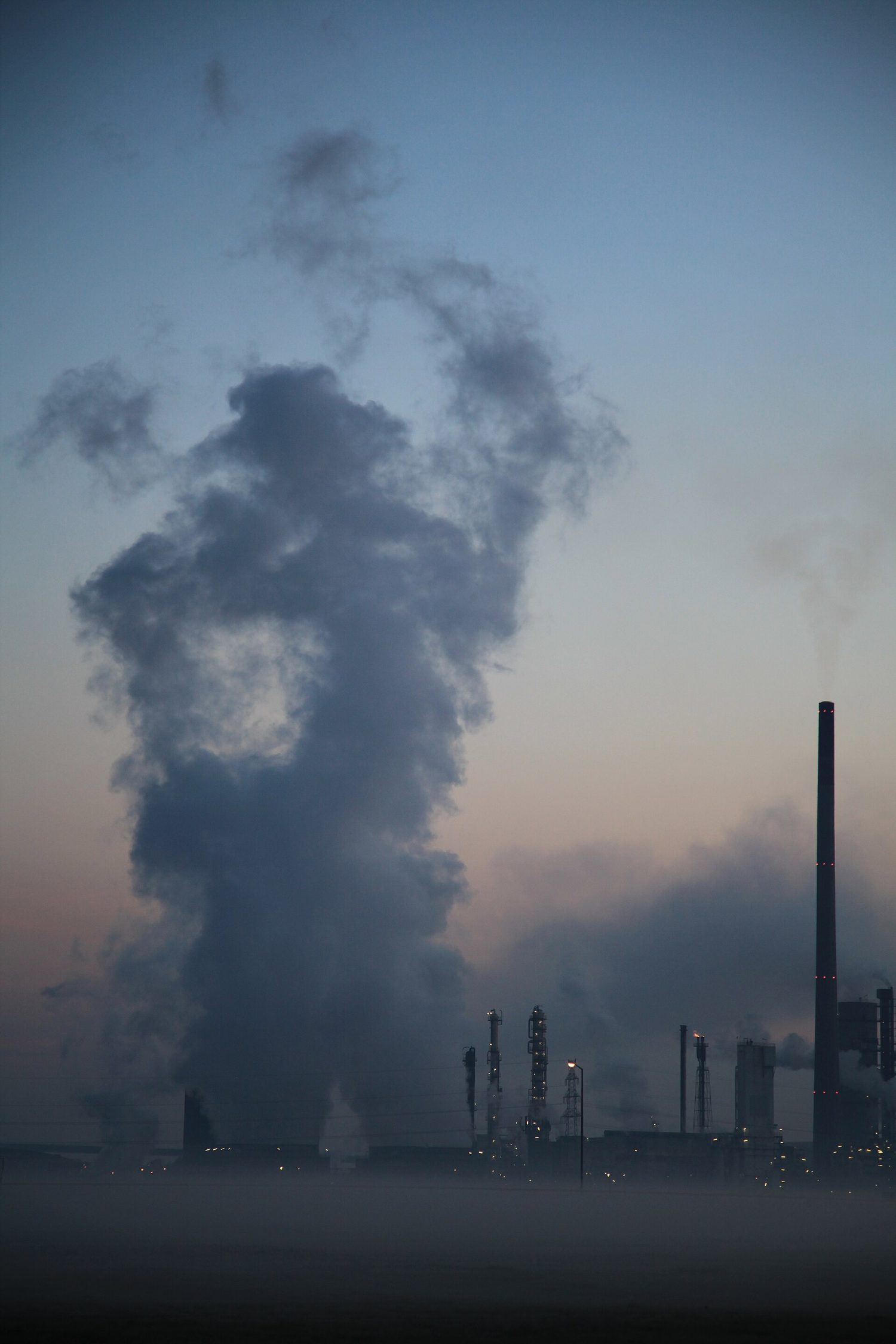
مصنع كيميائي وقت الغروب. بداخله، يتحول النيتروجين من الهواء إلى الأمونيا — السماد الذي يُغذي حوالي نصف سكان العالم اليوم. لكن الـ…

English narration · English + 中文 subtitles burned in · ⁨سرد باللغة الإنجليزية · ترجمة مدمجة بالإنجليزية + الصينية⁩

7.1

Introduction to Equilibrium · ⁨مقدمة في الاتزان⁩

Syllabus · ⁨المنهج⁩
English

Learning Objective 7.1.A: Explain the relationship between the occurrence of a reversible chemical or physical process, and the establishment of equilibrium, to experimental observations.

  • 7.1.A.1 Many observable processes are reversible. Examples include evaporation and condensation of water, absorption and desorption of a gas, or dissolution and precipitation of a salt. Some important reversible chemical processes include the transfer of protons in acid-base reactions and the transfer of electrons in redox reactions.
  • 7.1.A.2 When equilibrium is reached, no observable changes occur in the system. Reactants and products are simultaneously present, and the concentrations or partial pressures of all species remain constant.
  • 7.1.A.3 The equilibrium state is dynamic. The forward and reverse processes continue to occur at equal rates, resulting in no net observable change.
  • 7.1.A.4 Graphs of concentration, partial pressure, or rate of reaction versus time for simple chemical reactions can be used to understand the establishment of chemical equilibrium.
العربية

الهدف التعليمي 7.1.A: شرح العلاقة بين حدوث عملية كيميائية أو فيزياء عكسية، وإقامة التوازن، مع الملاحظات التجريبية.

  • 7.1.A.1 العديد من العمليات القابلة للملاحظة عكوسة. وتشمل أمثلة ذلك تبخر الماء وتكاثفه، وامتزاز الغاز وتحرره، أو ذوبان الملح وترسبه. ومن العمليات الكيميائية العكوسة الهامة نقل البروتونات في تفاعلات الحمض والقاعدة ونقل الإلكترونات في تفاعلات الأكسدة والاختزال.
  • 7.1.A.2 عندما يتم الوصول إلى التوازن، لا تحدث أي تغييرات ملحوظة في النظام. توجد المتفاعلات والنواتج في نفس الوقت، وتبقى تركيزات أو ضغوط جزئية جميع الأنواع ثابتة.
  • 7.1.A.3 حالة التوازن ديناميكية. تستمر العمليات الأمامية والعكسية بمعدلات متساوية، مما يؤدي إلى عدم وجود تغيير ملحوظ صافي.
  • 7.1.A.4 يمكن استخدام رسوم بيانية للتركيز أو الضغط الجزئي أو معدل التفاعل مقابل الزمن للتفاعلات الكيميائية البسيطة لفهم إقامة التوازن الكيميائي.
Source: College Board AP Course and Exam Description · ⁨المصدر: وصف دورة وامتحان College Board AP⁩

English
Dynamic equilibrium

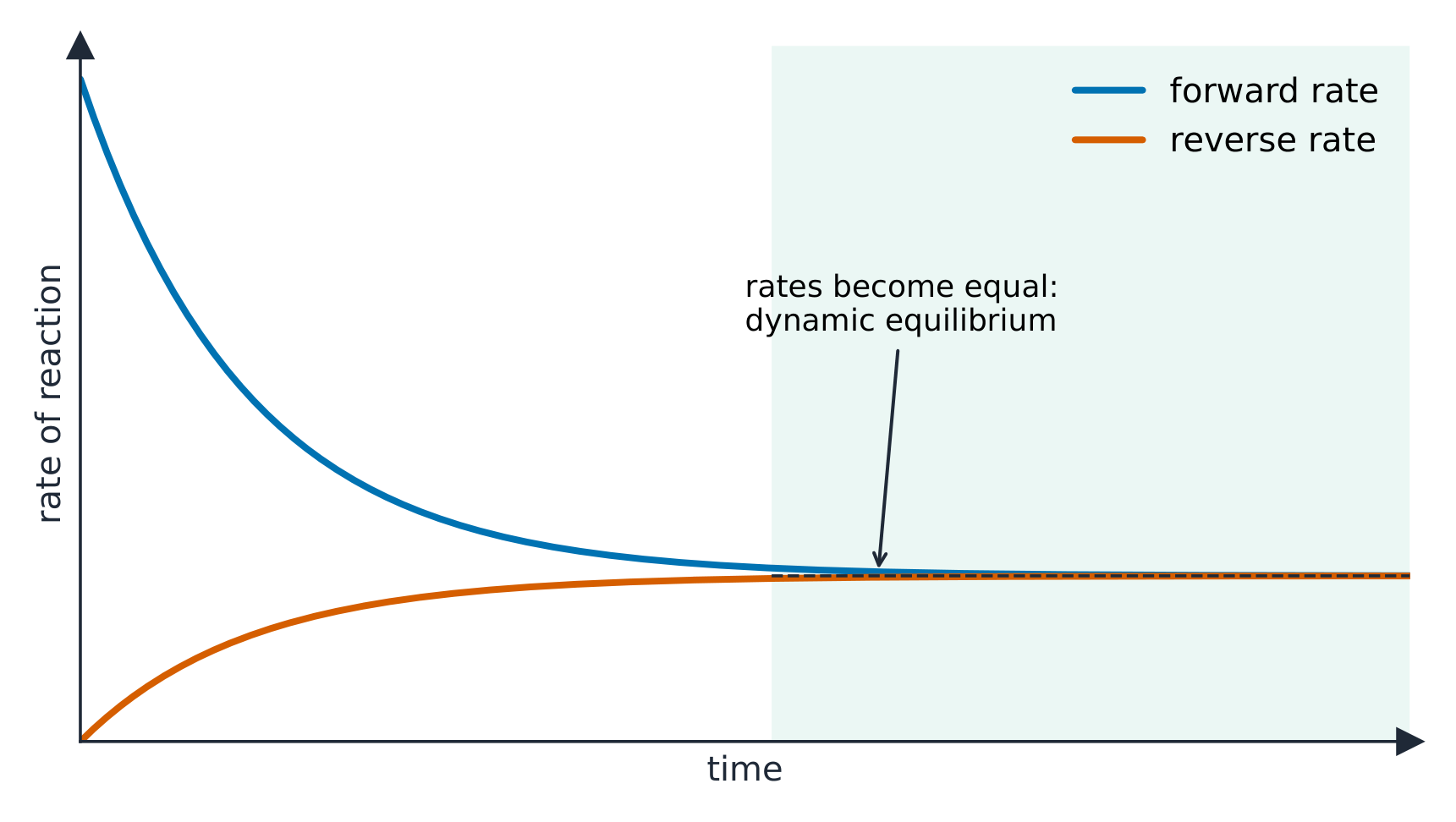
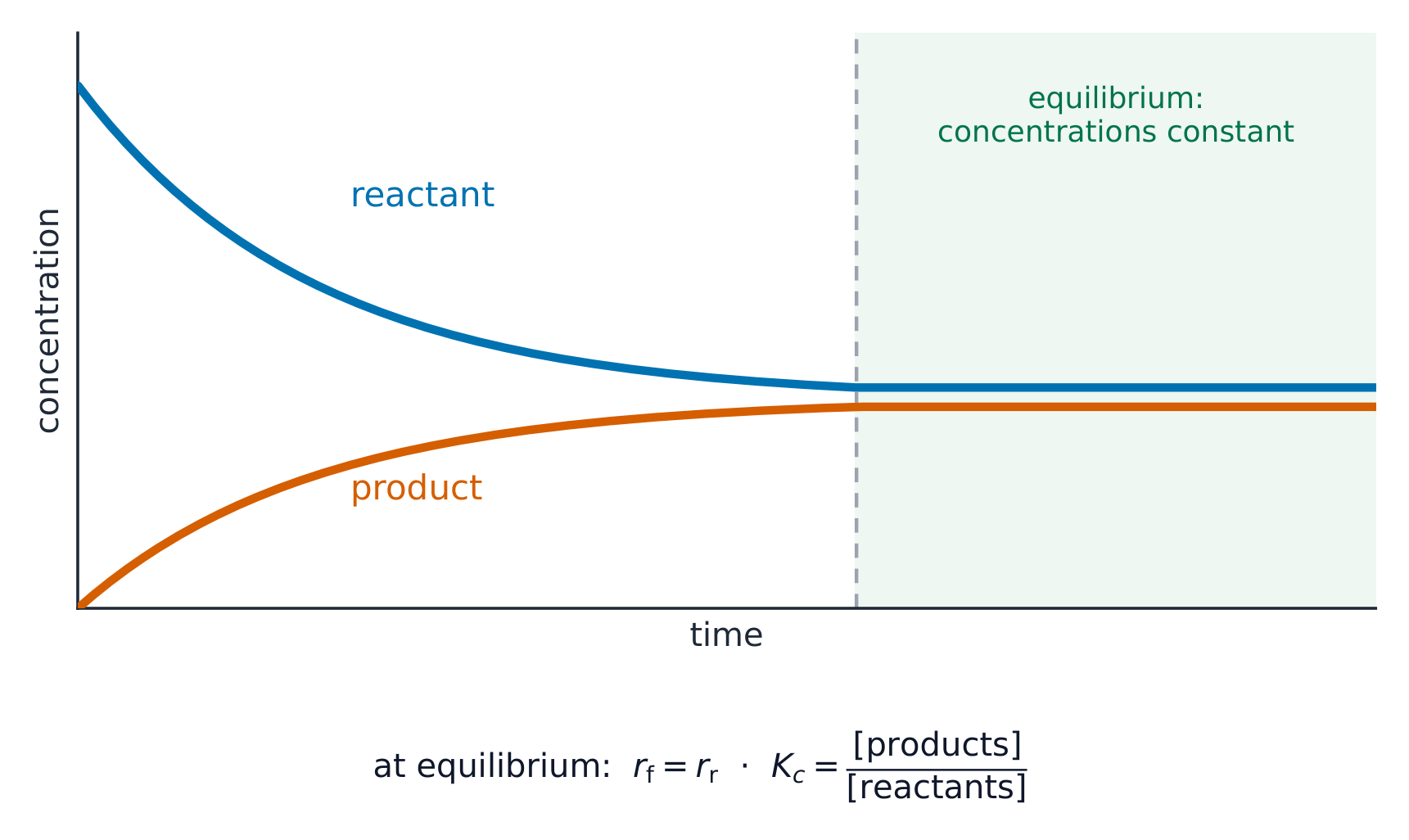
A reversible reaction 可逆反应 runs both ways. Chemical equilibrium 化学平衡 is reached when the forward and reverse rates become equal, so concentrations stop changing. Equilibrium is dynamic – both reactions continue, but at matching rates, so nothing appears to change.

The rates graph above explains why concentrations settle; this next graph shows what the concentrations do – reactants fall and products rise until, once the rates match, both hold constant (they need not be equal).

العربية
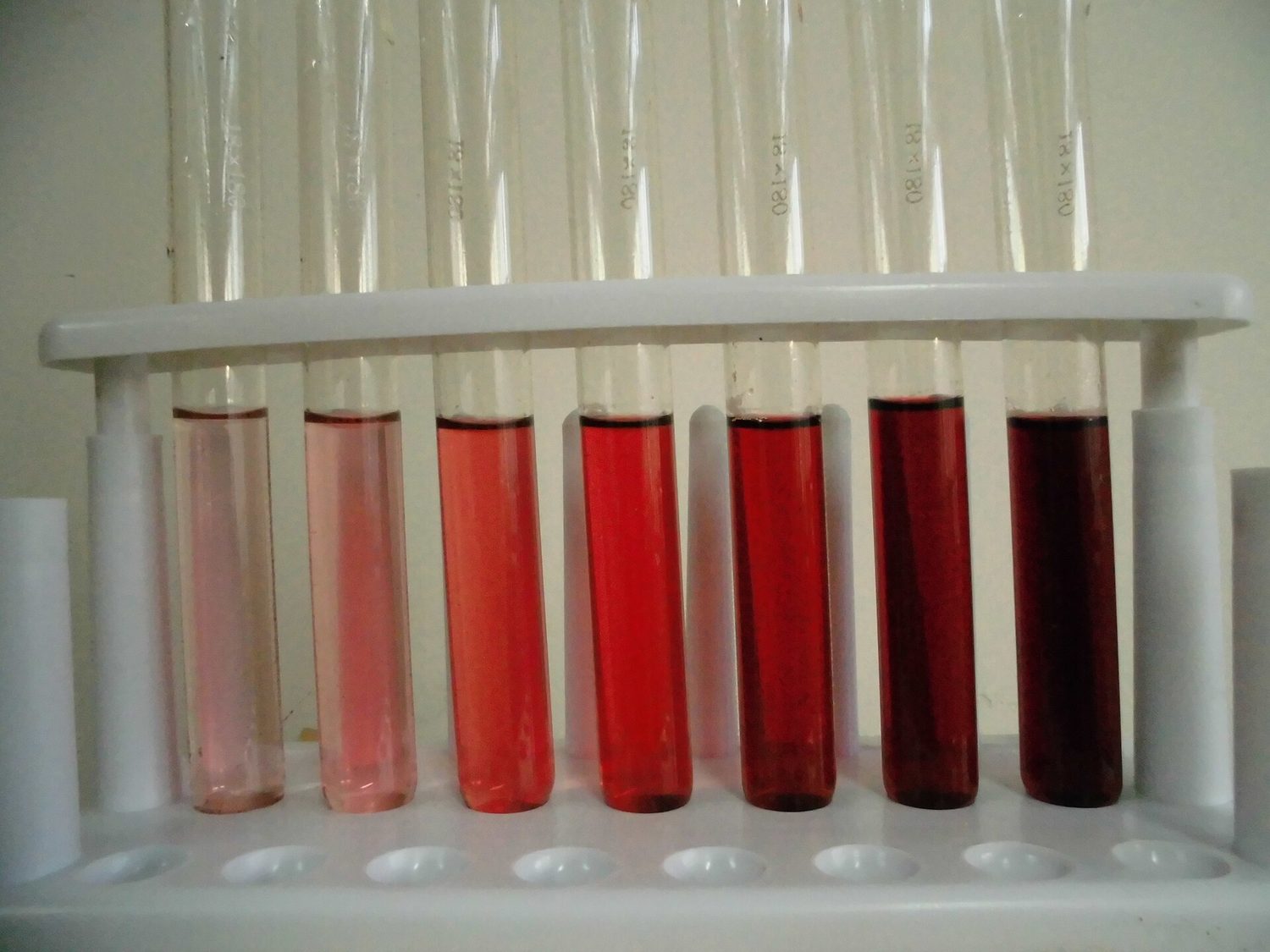
محاليل كلوريد الكوبالت: تنزاح أنظمة الاتزان عند تغير الظروف (لوشاتيلي)
اتزان ديناميكي

التفاعل العكسي يسير في الاتجاهين. يتحقق الاتزان الكيميائي عندما تصبح معدلات الأمام والخلف متساوية، فتتوقف التركيزات عن التغير. الاتزان ديناميكي — يستمر كلا التفاعلين، لكن بمعدلات متطابقة، فلا يبدو أن هناك تغييرًا.

التوازن الديناميكي: تصبح معدلات التفاعل الأمامي والعكسي متساوية
اتزان ديناميكي: تصبح معدلات الأمام والخلف متساوية

الرسم البياني للمعدلات أعلاه يشرح لماذا تستقر التركيزات؛ الرسم التالي يوضح ماذا تفعل التركيزات — تتناقص المتفاعلات وتزداد النواتج حتى، بمجرد تطابق المعدلات، تثبتان على ثباتهما (لا يشترط أن تكونا متساويتين).

تركيزات المتفاعلات والنواتج تتغير ثم تثبت بمجرد الوصول إلى التوازن
تركيزات المتفاعلات والنواتج تتغير، ثم تثبت عند الوصول للاتزان
Vocabulary · ⁨مفردات⁩ Train · ⁨تدريب⁩
English العربية
reversible reaction/rɪˈvɜːsɪbl rɪˈækʃn/ تفاعل عكسي
Chemical equilibrium/ˈkemɪkl ˌiːkwɪˈlɪbrɪəm/ التوازن الكيميائي
reaction quotient/rɪˈækʃn ˈkwəʊʃənt/ معامل التفاعل
equilibrium constant/ˌiːkwɪˈlɪbrɪəm ˈkɒnstənt/ ثابت التوازن
Le Chatelier's principle/lə ˈtʃeɪtlɪəz ˈprɪnsɪpl/ مبدأ لوشاتليه
solubility product/ˌsɒljuːˈbɪlɪti ˈprɒdʌkt/ ثابت حاصل الذوبانية
7.2

Direction of Reversible Reactions · ⁨اتجاه التفاعلات العكسية⁩

Syllabus · ⁨المنهج⁩
English

Learning Objective 7.2.A: Explain the relationship between the direction in which a reversible reaction proceeds and the relative rates of the forward and reverse reactions.

  • 7.2.A.1 If the rate of the forward reaction is greater than the reverse reaction, then there is a net conversion of reactants to products. If the rate of the reverse reaction is greater than that of the forward reaction, then there is a net conversion of products to reactants. An equilibrium state is reached when these rates are equal.
العربية

الهدف التعليمي 7.2.A: شرح العلاقة بين الاتجاه الذي تسير فيه تفاعل عكسي ومعدلات التفاعل الأمامي والعكسي النسبية.

  • 7.2.A.1 إذا كانت معدل التفاعل الأمامي أكبر من التفاعل العكسي، فإن هناك تحولاً صافياً للمتفاعلات إلى نواتج. وإذا كان معدل التفاعل العكسي أكبر من معدل التفاعل الأمامي، فإن هناك تحولاً صافياً للنواتج إلى متفاعلات. يتم الوصول إلى حالة التوازن عندما تتساوى هذه المعدلات.

Source: College Board AP Course and Exam Description · ⁨المصدر: وصف دورة وامتحان College Board AP⁩

English

At equilibrium the amounts of reactants and products are fixed but usually not equal. Whether the mixture favors products or reactants depends on the reaction; you compare the current state to the equilibrium condition to predict which way it shifts.

العربية

عند الاتزان تكون كميات المتفاعلات والنواتج ثابتة لكنها عادةً غير متساوية. اعتماد المزيج على النواتج أو المتفاعلات يعتمد على التفاعل؛ تقارن الحالة الحالية بحالة الاتزان للتنبؤ بالاتجاه الذي ينزاح فيه.

7.3

The Reaction Quotient and Equilibrium Constant · ⁨معامل تفاعل وثابت الاتزان⁩

Syllabus · ⁨المنهج⁩
English

Learning Objective 7.3.A: Represent the reaction quotient $Q_c$ or $Q_p$, for a reversible reaction, and the corresponding equilibrium expressions $K_c = Q_c$ or $K_p = Q_p$.

  • 7.3.A.1 The reaction quotient $Q_c$ describes the relative concentrations of reaction species at any time. For gas phase reactions, the reaction quotient may instead be written in terms of partial pressures as $Q_p$. The reaction quotient tends toward the equilibrium constant such that at equilibrium $K_c = Q_c$ and $K_p = Q_p$. As examples, for the reaction

    $$a\,\mathrm{A} + b\,\mathrm{B} \rightleftarrows c\,\mathrm{C} + d\,\mathrm{D}$$
    the law of mass action indicates that the equilibrium expression for $(K_c, Q_c)$ is

    • Equation: $K_c = \dfrac{[\mathrm{C}]^c [\mathrm{D}]^d}{[\mathrm{A}]^a [\mathrm{B}]^b}$

    and that for $(K_p, Q_p)$ is

    • Equation: $K_p = \dfrac{(P_\mathrm{C})^c (P_\mathrm{D})^d}{(P_\mathrm{A})^a (P_\mathrm{B})^b}$
    • Exclusion statement: Conversion between $K_c$ and $K_p$ will not be assessed on the AP Exam. Students should be aware of the conceptual differences and pay attention to whether $K_c$ or $K_p$ is used in an exam question.
    • Exclusion statement: Equilibrium calculations on systems where a dissolved species is in equilibrium with that species in the gas phase will not be assessed on the AP Exam.
  • 7.3.A.2 The reaction quotient does not include substances whose concentrations (or partial pressures) are independent of the amount, such as for solids and pure liquids.

العربية

الهدف التعليمي 7.3.A: تمثيل خارج قسمة التفاعل $Q_c$ أو $Q_p$، لتفاعل عكسي، والتعبيرات المتناظرة للتوازن $K_c = Q_c$ أو $K_p = Q_p$.

  • 7.3.A.1 يصف خارج قسمة التفاعل $Q_c$ التراكيز النسبية لأنواع التفاعل في أي وقت. بالنسبة لتفاعلات الطور الغازي، يمكن كتابة خارج قسمة التفاعل بدلالة الضغوط الجزئية كـ $Q_p$. يميل خارج قسمة التفاعل نحو ثابت التوازن بحيث يكون عند التوازن $K_c = Q_c$ و$K_p = Q_p$. كمثال، للتفاعل

    $$a\,\mathrm{A} + b\,\mathrm{B} \rightleftarrows c\,\mathrm{C} + d\,\mathrm{D}$$
    يشير قانون الكتلة إلى أن تعبير التوازن لـ $(K_c, Q_c)$ هو

    • المعادلة: $K_c = \dfrac{[\mathrm{C}]^c [\mathrm{D}]^d}{[\mathrm{A}]^a [\mathrm{B}]^b}$

    وأن التعبير لـ $(K_p, Q_p)$ هو

    • المعادلة: $K_p = \dfrac{(P_\mathrm{C})^c (P_\mathrm{D})^d}{(P_\mathrm{A})^a (P_\mathrm{B})^b}$
    • بيان استبعاد: لن يتم تقييم التحويل بين $K_c$ و$K_p$ في امتحان AP. يجب على الطلاب awareness الفروقات المفاهيمية والانتباه إلى ما إذا كان $K_c$ أو $K_p$ مستخدماً في سؤال الامتحان.
    • بيان استبعاد: لن يتم حسابات التوازن في الأنظمة التي يكون فيها نوع مذاب في توازن مع ذلك النوع في الطور الغازي في امتحان AP.
  • 7.3.A.2 لا يتضمن خارج قسمة التفاعل المواد whose concentrations (or partial pressures) are independent of the amount, such as for solids and pure liquids.

Source: College Board AP Course and Exam Description · ⁨المصدر: وصف دورة وامتحان College Board AP⁩

English

The reaction quotient 反应商 $Q$ has the same form as the equilibrium expression but uses current concentrations:

$$Q=\frac{[\text{products}]}{[\text{reactants}]}\ \text{(each raised to its coefficient)}.$$
At equilibrium $Q$ equals the equilibrium constant 平衡常数 $K$. Comparing them predicts direction: $Q shifts forward (toward products); $Q>K$ shifts reverse; $Q=K$ means already at equilibrium.

العربية

معامل تفاعل $Q$ له نفس صيغة تعبير الاتزان لكنه يستخدم تركيزات لحظية:

$$Q=\frac{[\text{products}]}{[\text{reactants}]}\ \text{(each raised to its coefficient)}.$$
عند الاتزان $Q$ يساوي ثابت الاتزان $K$. ومقارنتهما تتنبأ بالاتجاه: $Q ينزاح أماماً (نحو النواتج)؛ $Q>K$ ينزاح عكسياً؛ $Q=K$ يعني أنه بالفعل عند الاتزان.

7.4

Calculating the Equilibrium Constant · ⁨حساب ثابت الاتزان⁩

Syllabus · ⁨المنهج⁩
English

Learning Objective 7.4.A: Calculate $K_c$ or $K_p$ based on experimental observations of concentrations or pressures at equilibrium.

  • 7.4.A.1 Equilibrium constants can be determined from experimental measurements of the concentrations or partial pressures of the reactants and products at equilibrium.
العربية

الهدف التعليمي 7.4.A: حساب $K_c$ أو $K_p$ بناءً على ملاحظات تجريبية للتراكيز أو الضغوط عند التوازن.

  • 7.4.A.1 يمكن تحديد ثوابت التوازن من القياسات التجريبية لتراكيز أو الضغوط الجزئية للمتفاعلات والنواتج عند التوازن.

Source: College Board AP Course and Exam Description · ⁨المصدر: وصف دورة وامتحان College Board AP⁩

English

Write $K$ from the balanced equation (pure solids and liquids are left out). From equilibrium concentrations (or partial pressures for $K_p$), plug in and compute. $K_c$ uses molarities; $K_p$ uses pressures.

Worked example. For $\text{N}_2\text{O}_4\rightleftharpoons2\text{NO}_2$, the equilibrium concentrations are $[\text{N}_2\text{O}_4]=0.20\ \text{M}$ and $[\text{NO}_2]=0.10\ \text{M}$. Then

$$K_c=\frac{[\text{NO}_2]^2}{[\text{N}_2\text{O}_4]}=\frac{(0.10)^2}{0.20}=0.050.$$
The NO$_2$ coefficient of $2$ becomes the power; N$_2$O$_4$ (coefficient $1$) is just to the first power.

العربية

اكتب $K$ من المعادلة الموزونة (استبعد المواد الصلبة والسائلة الخالصة). من تركيزات الاتزان (أو الضغوط الجزئية لـ $K_p$)، عوض وحسب. $K_c$ يستخدم المولارية؛ $K_p$ يستخدم الضغوط.

مثال محلول. بالنسبة لـ $\text{N}_2\text{O}_4\rightleftharpoons2\text{NO}_2$، تكون تركيزات الاتزان $[\text{N}_2\text{O}_4]=0.20\ \text{M}$ و$[\text{NO}_2]=0.10\ \text{M}$. إذن

$$K_c=\frac{[\text{NO}_2]^2}{[\text{N}_2\text{O}_4]}=\frac{(0.10)^2}{0.20}=0.050.$$
معامل NO$_2$ في $2$ يصبح الأس؛ N$_2$O$_4$ (معامل $1$) يكون فقط في الأس الأول.

7.5

Magnitude of the Equilibrium Constant · ⁨مقدار ثابت الاتزان⁩

Syllabus · ⁨المنهج⁩
English

Learning Objective 7.5.A: Explain the relationship between very large or very small values of $K$ and the relative concentrations of chemical species at equilibrium.

  • 7.5.A.1 Some equilibrium reactions have very large $K$ values and proceed essentially to completion. Others have very small $K$ values and barely proceed at all.
العربية

الهدف التعليمي 7.5.A: شرح العلاقة بين القيم الكبيرة جداً أو الصغيرة جداً لـ $K$ والتراكيز النسبية للأنواع الكيميائية عند التوازن.

  • 7.5.A.1 بعض تفاعلات التوازن لها قيم $K$ كبيرة جداً وتسير عملياً حتى الاكتمال. وأخرى لها قيم $K$ صغيرة جداً ولا تكاد تسير على الإطلاق.

Source: College Board AP Course and Exam Description · ⁨المصدر: وصف دورة وامتحان College Board AP⁩

English
  • $K\gg 1$: products strongly favored (reaction nearly complete).
  • $K\ll 1$: reactants favored (little reaction).
  • $K\approx 1$: significant amounts of both.

The size of $K$ tells you where the equilibrium "sits."

العربية
  • $K\gg 1$: النواتج مفضلة بشدة (التفاعل شبه مكتمل).
  • $K\ll 1$: المتفاعلات مفضلة (قليل من التفاعل).
  • $K\approx 1$: كميات مهمة من كليهما.

حجم $K$ يخبرك أين "يقع" الاتزان.

7.6

Properties of the Equilibrium Constant · ⁨خصائص ثابت الاتزان⁩

Syllabus · ⁨المنهج⁩
English

Learning Objective 7.6.A: Represent a multistep process with an overall equilibrium expression, using the constituent $K$ expressions for each individual reaction.

  • 7.6.A.1 When a reaction is reversed, $K$ is inverted.
  • 7.6.A.2 When the stoichiometric coefficients of a reaction are multiplied by a factor $c$, $K$ is raised to the power $c$.
  • 7.6.A.3 When reactions are added together, the $K$ of the resulting overall reaction is the product of the $K$'s for the reactions that were summed.
  • 7.6.A.4 Since the expressions for $K$ and $Q$ have identical mathematical forms, all valid algebraic manipulations of $K$ also apply to $Q$.
العربية

الهدف التعليمي 7.6.A: تمثيل عملية متعددة الخطوات بتعبير توازن كلي، باستخدام التعبيرات المكونة $K$ لكل تفاعل فردي.

  • 7.6.A.1 عند عكس تفاعل، يتم قلب $K$.
  • 7.6.A.2 عند ضرب المعاملات الستوكيوميترية لتفاعل في عامل $c$، يُرفع $K$ أس $c$.
  • 7.6.A.3 عند جمع التفاعلات معاً، يكون $K$ للتفاعل الكلي الناتج هو حاصل ضرب $K$s للتفاعلات التي تم جمعها.
  • 7.6.A.4 بما أن التعبيرات لـ $K$ و$Q$ لها أشكال رياضية متطابقة، فإن جميع العمليات الجبرية الصالحة لـ $K$ تنطبق أيضاً على $Q$.

Source: College Board AP Course and Exam Description · ⁨المصدر: وصف دورة وامتحان College Board AP⁩

English

$K$ changes in predictable ways: reversing a reaction inverts $K$ ($1/K$); multiplying coefficients by $n$ raises $K$ to the $n$th power; adding reactions multiplies their $K$ values. Only temperature changes the value of $K$ itself.

العربية

$K$ يتغير بطرق قابلة للتنبؤ: عكس التفاعل يعكس $K$ ($1/K$)؛ ضرب المعاملات في $n$ يرفع $K$ إلى $n$؛ جمع التفاعلات يضرب قيم $K$ الخاصة بها. فقط درجة الحرارة تغير قيمة $K$ نفسها.

7.7

Calculating Equilibrium Concentrations · ⁨حساب تركيزات الاتزان⁩

Syllabus · ⁨المنهج⁩
English

Learning Objective 7.7.A: Identify the concentrations or partial pressures of chemical species at equilibrium based on the initial conditions and the equilibrium constant.

  • 7.7.A.1 The concentrations or partial pressures of species at equilibrium can be predicted given the balanced reaction, initial concentrations, and the appropriate $K$.
  • 7.7.A.2 When $Q < K$, the reaction will proceed with a net consumption of reactants and generation of products. When $Q > K$, the reaction will proceed with a net consumption of products and generation of reactants. When $Q = K$, the system is at dynamic equilibrium; both forward and reverse reactions proceed at the same rate, and the proportion of reactants and products remains constant.
العربية

الهدف التعليمي 7.7.A: تحديد التراكيز أو الضغوط الجزئية للأنواع الكيميائية عند التوازن بناءً على الظروف الأولية وثابت التوازن.

  • 7.7.A.1 يمكن التنبؤ بالتراكيز أو الضغوط الجزئية للأنواع عند التوازن给定 المعادلة الموزونة، والتراكيز الأولية، و$K$ المناسب.
  • 7.7.A.2 عندما $Q < K$، ستسير التفاعل مع استهلاك صافي للمواد المتفاعلة وتكوين نواتج. عندما $Q > K$، ستسير التفاعل مع استهلاك صافي للنواتج وتكوين مواد متفاعلة. عندما $Q = K$، يكون النظام في توازن ديناميكي؛ تسير التفاعلات الأمامية والعكسية بنفس المعدل، ويبقى نسبة المواد المتفاعلة والنواتج ثابتة.

Source: College Board AP Course and Exam Description · ⁨المصدر: وصف دورة وامتحان College Board AP⁩

English

Use an ICE table (Initial, Change, Equilibrium): fill in starting amounts, express the change with $x$ using the mole ratios, then substitute into the $K$ expression and solve for $x$. When $K$ is small, the approximation "$x$ is negligible" often simplifies the algebra.

Worked example. For $\text{H}_2+\text{I}_2\rightleftharpoons2\text{HI}$ with $K_c=50$, start with $0.100\ \text{M}$ each of H$_2$ and I$_2$. The ICE table gives equilibrium $[\text{H}_2]=[\text{I}_2]=0.100-x$ and $[\text{HI}]=2x$. Substitute:

$$K_c=\frac{(2x)^2}{(0.100-x)^2}=50\;\Rightarrow\;\frac{2x}{0.100-x}=\sqrt{50}=7.07\;\Rightarrow\;x=0.078,$$
so $[\text{HI}]=2x=0.156\ \text{M}$. Taking the square root of both sides works here because the expression is a perfect square.

العربية

استخدم جدول ICE (الأولي، التغير، الاتزان): املأ الكميات الابتدائية، عبّر عن التغير بـ $x$ باستخدام نسب المولات، ثم عوض في تعبير $K$ وحل لإيجاد $x$. عندما يكون $K$ صغيراً، فإن التقريب "$x$ مهمله" غالباً ما يبسط الحسابات الجبرية.

مثال محلول. بالنسبة لـ $\text{H}_2+\text{I}_2\rightleftharpoons2\text{HI}$ مع $K_c=50$، ابدأ بـ $0.100\ \text{M}$ من H$_2$ وI$_2$. يعطي جدول ICE الاتزان $[\text{H}_2]=[\text{I}_2]=0.100-x$ و$[\text{HI}]=2x$. عوض:

$$K_c=\frac{(2x)^2}{(0.100-x)^2}=50\;\Rightarrow\;\frac{2x}{0.100-x}=\sqrt{50}=7.07\;\Rightarrow\;x=0.078,$$
إذن $[\text{HI}]=2x=0.156\ \text{M}$. أخذ الجذر التربيعي للطرفين يعمل هنا لأن التعبير مربع كامل.

7.8

Representations of Equilibrium · ⁨تمثيلات الاتزان⁩

Syllabus · ⁨المنهج⁩
English

Learning Objective 7.8.A: Represent a system undergoing a reversible reaction with a particulate model.

  • 7.8.A.1 Particulate representations can be used to describe the relative numbers of reactant and product particles present prior to and at equilibrium, and the value of the equilibrium constant.
العربية

هدف التعلم 7.8.A: تمثيل نظام يخضع لتفاعل عكوس باستخدام نموذج جزيئي.

  • 7.8.A.1 يمكن استخدام التمثيلات الجزيئية لوصف الأعداد النسبية لجسيمات المواد المتفاعلة والنواتج الموجودة قبل التوازن وأثناءه، وقيمة ثابت التوازن.

Source: College Board AP Course and Exam Description · ⁨المصدر: وصف دورة وامتحان College Board AP⁩

English

A particulate picture at equilibrium shows a fixed mix of reactant and product particles. Graphs of concentration vs time level off (never reaching zero) once equilibrium is reached – both curves flatten at the same moment.

العربية

الصورة الجزيئية عند الاتزان تظهر مزيجاً ثابتاً من جسيمات المتفاعلات والنواتج. بيانات التركيز مقابل الوقت تسطح (دون الوصول للصفر) عند الوصول للاتزان — كلا المنحنيين يستويان في نفس اللحظة.

7.9

Introduction to Le Chatelier's Principle · ⁨مقدمة في مبدأ لوشاتيلي⁩

Syllabus · ⁨المنهج⁩
English

Learning Objective 7.9.A: Identify the response of a system at equilibrium to an external stress, using Le Châtelier's principle.

  • 7.9.A.1 Le Châtelier's principle can be used to predict the response of a system to stresses such as addition or removal of a chemical species, change in temperature, change in volume/pressure of a gas-phase system, or dilution of a reaction system.
  • 7.9.A.2 Le Châtelier's principle can be used to predict the effect that a stress will have on experimentally measurable properties such as pH, temperature, and color of a solution.
العربية

هدف التعلم 7.9.A: تحديد استجابة نظام عند التوازن لإجهاد خارجي، باستخدام مبدأ لوشاتلييه.

  • 7.9.A.1 يمكن استخدام مبدأ لوشاتلييه للتنبؤ باستجابة النظام للإجهادات مثل إضافة أو إزالة نوع كيميائي، أو تغيير درجة الحرارة، أو تغيير الحجم/الضغط لنظام طور غازي، أو تخفيف نظام التفاعل.
  • 7.9.A.2 يمكن استخدام مبدأ لوشاتلييه للتنبؤ بالتأثير الذي سيحدثه الإجهاد على الخصائص القابلة للقياس تجريبياً مثل الرقم الهيدروجيني (pH) ودرجة الحرارة ولون المحلول.

Source: College Board AP Course and Exam Description · ⁨المصدر: وصف دورة وامتحان College Board AP⁩

English
Le Chatelier's principle

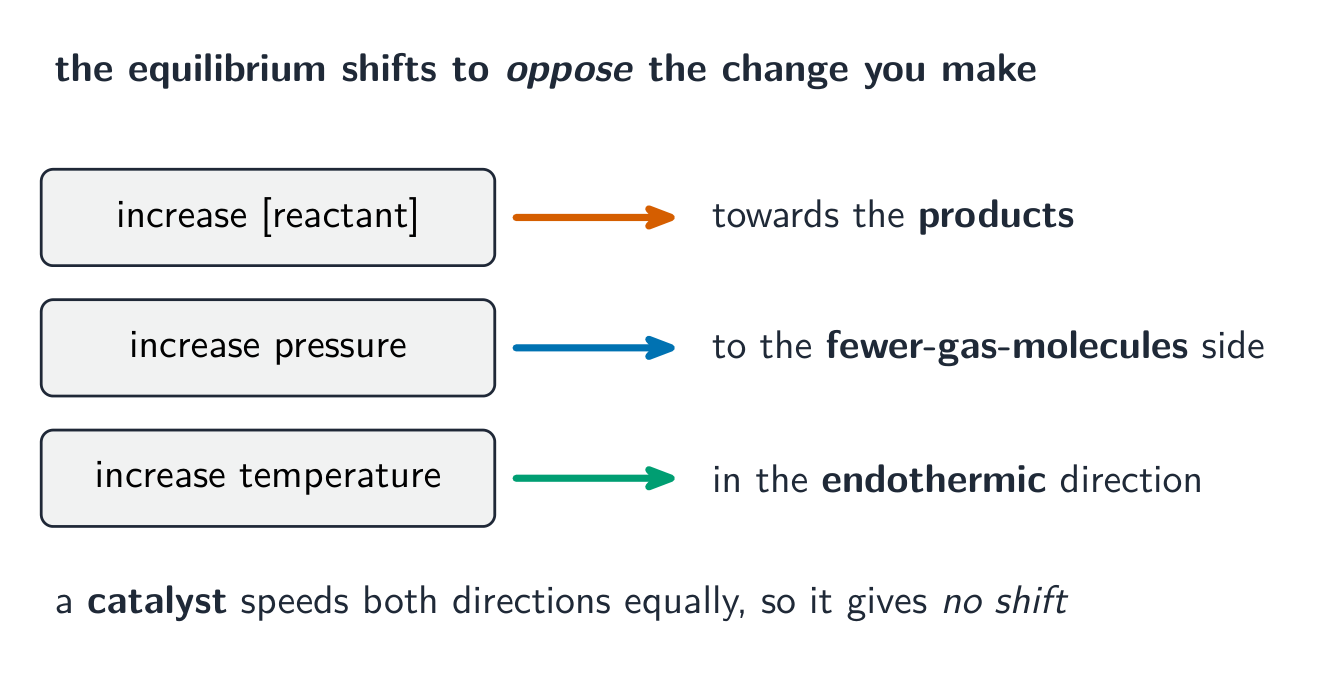
Le Chatelier's principle 勒沙特列原理: if you disturb a system at equilibrium, it shifts to partly counteract the change. Adding a reactant shifts forward; removing product shifts forward; increasing pressure (by reducing volume) shifts toward the side with fewer gas moles; raising temperature shifts in the endothermic direction.

العربية
مبدأ لوشاتلييه

مبدأ لوشاتيلي: إذا أخللت بنظام عند الاتزان، سينزاح جزئياً لمعاكسة التغيير. إضافة متفاعل تنزحه للأمام؛ إزالة نواتج تنزحه للأمام؛ زيادة الضغط (بتقليل الحجم) تنزحه نحو الجانب ذو عدد أقل من مولات الغازات؛ رفع درجة الحرارة ينزحه في الاتجاه الماص للحرارة.

مبدأ لوشاتلييه: يتحرك التوازن لمعارضة التغيير الذي طرأ
مبدأ لوشاتيلي: ينزاح الاتزان لمعاكسة التغيير
مصنع الأمونيا: التوازنيات الصناعية مثل عملية هابر تُقود بالضغط ودرجة الحرارة والمحفزات
مصنع للأمونيا: الاتزانات الصناعية مثل عملية هابر تُدفع بالضغط ودرجة الحرارة والمحفزات
Explore · ⁨استكشف⁩

Disturb an equilibrium · ⁨اضطراب التوازن⁩

Le Chatelier's principle: an equilibrium shifts to oppose a change. Add reactant, change pressure or temperature and watch the position of equilibrium move. · ⁨مبدأ لو شاتلييه: يتحرك التوازن لمعارضة التغير. أضف متفاعلاً أو غيّر الضغط أو درجة الحرارة وراقب انتقال موضع التوازن.⁩

7.10

The Reaction Quotient and Le Chatelier's Principle · ⁨معامل تفاعل ومبدأ لوشاتيلي⁩

Syllabus · ⁨المنهج⁩
English

Learning Objective 7.10.A: Explain the relationships between $Q$, $K$, and the direction in which a reversible reaction will proceed to reach equilibrium.

  • 7.10.A.1 A disturbance to a system at equilibrium causes $Q$ to differ from $K$, thereby taking the system out of equilibrium. The system responds by bringing $Q$ back into agreement with $K$, thereby establishing a new equilibrium state.
  • 7.10.A.2 Some stresses, such as changes in concentration, cause a change in $Q$ only. A change in temperature causes a change in $K$. In either case, the concentrations or partial pressures of species redistribute to bring $Q$ and $K$ back into equality.
العربية

الهدف التعليمي 7.10.A: شرح العلاقات بين $Q$، $K$، والاتجاه الذي سيمضي فيه تفاعل عكسي للوصول إلى التوازن.

  • 7.10.A.1 يؤدي الاضطراب في نظام عند الاتزان إلى اختلاف $Q$ عن $K$، مما يبعد النظام عن حالة الاتزان. يستجيب النظام بإعادة $Q$ لتتوافق مع $K$، مما يرسخ حالة اتزان جديدة.
  • 7.10.A.2 بعض الإجهادات، مثل التغيرات في التركيز، تسبب تغييراً في $Q$ فقط. والتغير في درجة الحرارة يسبب تغييراً في $K$. وفي كلتا الحالتين، تعيد التراكيز أو الضغوط الجزئية للأنواع إعادة توزيعها لإعادة $Q$ و$K$ إلى حالة التساوي.

Source: College Board AP Course and Exam Description · ⁨المصدر: وصف دورة وامتحان College Board AP⁩

English

You can justify every Le Chatelier shift with $Q$ versus $K$: a disturbance changes $Q$, and the system reacts to bring $Q$ back to $K$. This quantitative view backs up the qualitative rule and is the fuller answer on the exam.

العربية

يمكنك تبرير كل انزياح لوشاتيلي عبر مقارنة $Q$ بـ $K$: الاضطراب يغير $Q$، ويتفاعل النظام لجلب $Q$ مرة أخرى إلى $K$. هذه الرؤية الكمية تدعم القاعدة النوعية وهي الإجابة الكاملة في الامتحان.

Explore · ⁨استكشف⁩

Compare Q with K · ⁨قارن Q مع K⁩

If the reaction quotient $Q the forward reaction is favoured; $Q>K$ favours the reverse. Perturb the system and watch it move back toward $Q=K$. · ⁨إذا كان معامل التفاعل $Q فإن التفاعل الأمامي مُفضّل؛ و$Q>K$ يُفضّل العكسي. أزعِج النظام وراقبه عودته نحو $Q=K$.⁩

7.11 7.12

Introduction to Solubility Equilibria · ⁨مقدمة في توازن الذوبانية⁩

Syllabus · ⁨المنهج⁩
English

Learning Objective 7.11.A: Calculate the solubility of a salt based on the value of $K_{sp}$ for the salt.

  • 7.11.A.1 The dissolution of a salt is a reversible process whose extent can be described by $K_{sp}$, the solubility-product constant.
  • 7.11.A.2 The solubility of a substance can be calculated from the $K_{sp}$ for the dissolution process. This relationship can also be used to predict the relative solubility of different substances.
  • 7.11.A.3 The solubility rules (see 4.7.A.5) can be quantitatively related to $K_{sp}$, in which $K_{sp}$ values $>1$ correspond to soluble salts.
  • 7.11.A.4 The molar solubility of one or more species in a saturated solution can be used to calculate the $K_{sp}$ of a substance.
العربية

الهدف التعليمي 7.11.A: حساب ذوبانية ملح بناءً على قيمة $K_{sp}$ للملح.

  • 7.11.A.1 ذوبان الملح عملية عكسية يمكن وصف مدى حدوثها بواسطة $K_{sp}$، وهو ثابت حاصل ضرب الذوبانية.
  • 7.11.A.2 يمكن حساب ذوبانية مادة ما من خلال $K_{sp}$ لعملية الذوبان. ويمكن أيضاً استخدام هذه العلاقة للتنبؤ بالذوبانية النسبية لمواد مختلفة.
  • 7.11.A.3 يمكن ربط قواعد الذوبانية (راجع 4.7.A.5) ارتباطاً كمياً بـ $K_{sp}$، حيث تتوافق قيم $K_{sp}$ $>1$ مع الأملاح القابلة للذوبان.
  • 7.11.A.4 يمكن استخدام الذوبانية المولارية لنوع واحد أو أكثر في محلول مشبع لحساب $K_{sp}$ لمادة ما.
English

Learning Objective 7.12.A: Identify the solubility of a salt, and/or the value of $K_{sp}$ for the salt, based on the concentration of a common ion already present in solution.

  • 7.12.A.1 The solubility of a salt is reduced when it is dissolved into a solution that already contains one of the ions present in the salt. The impact of this "common-ion effect" on solubility can be understood qualitatively using Le Châtelier's principle or calculated from the $K_{sp}$ for the dissolution process.
العربية

الهدف التعليمي 7.12.A: تحديد ذوبانية ملح و/أو قيمة $K_{sp}$ للملح بناءً على تركيز أيون مشترك موجود بالفعل في المحلول.

  • 7.12.A.1 تقل ذوبانية الملح عند إذابته في محلول يحتوي بالفعل على أحد الأيونات المكونة للملح. يمكن فهم تأثير "تأثير الأيون المشترك" على الذوبانية بشكل نوعي باستخدام مبدأ لوشاتيليه أو حسابه من خلال $K_{sp}$ لعملية الذوبان.

Source: College Board AP Course and Exam Description · ⁨المصدر: وصف دورة وامتحان College Board AP⁩

English

For a slightly soluble salt, the solubility product 溶度积 $K_{sp}$ is the equilibrium constant for its dissolving:

$$\text{M}_a\text{X}_b(s)\rightleftharpoons a\,\text{M}^{b+}+b\,\text{X}^{a-},\qquad K_{sp}=[\text{M}^{b+}]^a[\text{X}^{a-}]^b.$$
A smaller $K_{sp}$ means less soluble. The common-ion effect – adding an ion already in the salt – pushes the equilibrium back and lowers solubility.

Worked example. Silver chloride has $K_{sp}=1.8\times10^{-10}$. If its molar solubility is $s$, then $[\text{Ag}^+]=[\text{Cl}^-]=s$, so $K_{sp}=s^2$ and

$$s=\sqrt{1.8\times10^{-10}}=1.3\times10^{-5}\ \text{M}.$$
Adding NaCl (a common ion) would raise $[\text{Cl}^-]$, forcing $s$ down – far less AgCl would dissolve.

العربية

بالنسبة لملح ضعيف الذوبان، فإن ثابت حاصل الذوبانية $K_{sp}$ هو ثابت التوازن لتذوقه:

$$\text{M}_a\text{X}_b(s)\rightleftharpoons a\,\text{M}^{b+}+b\,\text{X}^{a-},\qquad K_{sp}=[\text{M}^{b+}]^a[\text{X}^{a-}]^b.$$
كلما كان $K_{sp}$ أصغر، كانت الذوبانية أقل. يؤدي تأثير الأيون المشترك – وهو إضافة أيون موجود بالفعل في الملح – إلى إزاحة التوازن عكسياً ويقلل الذوبانية.

مثال محلول. كلوريد الفضة له $K_{sp}=1.8\times10^{-10}$. إذا كانت ذوبانيته المولارية $s$، فإن $[\text{Ag}^+]=[\text{Cl}^-]=s$، وبالتالي $K_{sp}=s^2$ و

$$s=\sqrt{1.8\times10^{-10}}=1.3\times10^{-5}\ \text{M}.$$
إضافة NaCl (أيون مشترك) سترفع $[\text{Cl}^-]$، مما يجبر $s$ على الانخفاض – سيذوب القليل جداً من AgCl.

7.11 7.12

Exam tips · ⁨نصائح للامتحان⁩

English
  • At equilibrium the forward and reverse rates are equal, but the amounts are usually not.
  • Leave pure solids and liquids out of the $K$ expression; a large $K$ favours products, a small $K$ favours reactants.
  • Apply Le Chatelier: add reactant → shift forward; raise pressure → shift toward fewer gas moles; raise temperature → shift in the endothermic direction.
  • A catalyst does not shift the position of equilibrium — it only speeds the approach.
  • Use an ICE table for equilibrium concentrations, and the small-$x$ approximation when $K$ is small.
العربية
  • عند التوازن تكون معدلات التفاعل الأمامي والعكسي متساوية، لكن الكميات عادة ما لا تكون متساوية.
  • استبعد المواد الصلبة والسائلة النقية من تعبير $K$؛ قيمة كبيرة لـ $K$ تفضل النواتج، وقيمة صغيرة لـ $K$ تفضل المتفاعلات.
  • طبق مبدأ لو شاتلييه: أضف متفاعلاً → يتحرك التفاعل للأمام؛ ارفع الضغط → يتحرك نحو عدد أقل من مولات الغاز؛ ارفع درجة الحرارة → يتحرك في الاتجاه الممتص للحرارة.
  • لا يحرك المحفز موضع التوازن – بل يسرع فقط الوصول إليه.
  • استخدم جدول ICE لتركيزات التوازن، وتقريب صغير-$x$ عندما يكون $K$ صغيراً.

Interactive lessons on this topic · ⁨دروس تفاعلية حول هذا الموضوع⁩

Work through it step by step, with instant-check exercises. · ⁨ا-working عليه خطوة بخطوة، مع تمارين تحقق فوري.⁩

Past Papers · ⁨أوراق الامتحانات السابقة⁩

More topics in AP Chemistry · ⁨AP الكيمياء⁩ · ⁨المزيد من المواضيع في AP Chemistry · ⁨AP الكيمياء⁩⁩

Log in or create account · ⁨تسجيل الدخول أو إنشاء حساب⁩

IGCSE, A-Level & AP