Skip to content · ⁨الانتقال إلى المحتوى⁩

Kinetics · ⁨الحركية الكيميائية⁩

AP Chemistry · ⁨AP الكيمياء⁩ · Topic 5 · ⁨الموضوع 5⁩

Video lesson for this topic · ⁨درس فيديو لهذا الموضوع⁩ Open the video page · ⁨افتح صفحة الفيديو⁩
8:00

الحركية الكيميائية

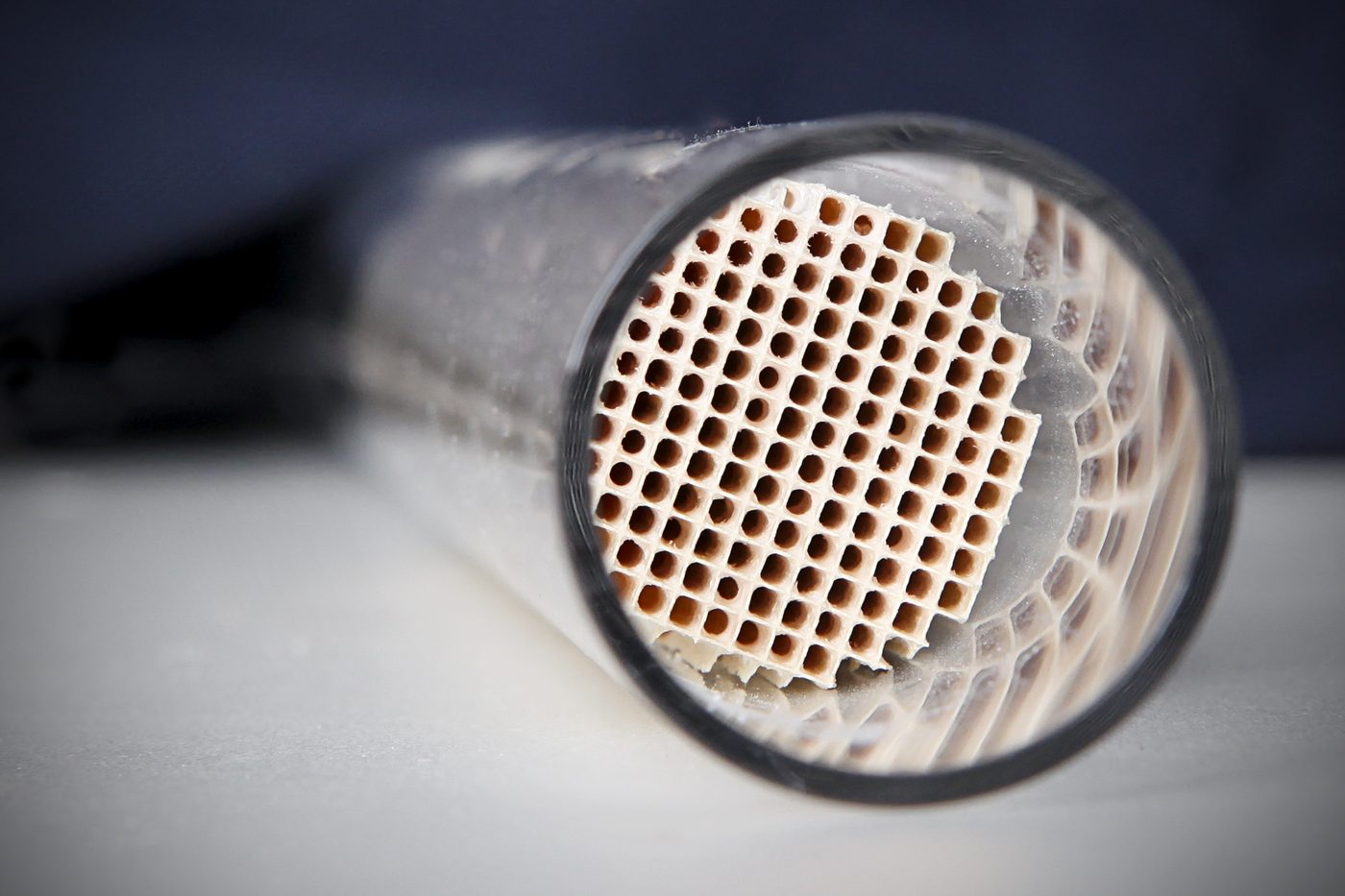
انظر داخل أنبوب عادم السيارة. هذه الخلية العسلية الخزفية هي محول حفاز. الغازات التي تمر عبره سامة. تُركت وحدها ستستغرق سنوات…

English narration · English + 中文 subtitles burned in · ⁨سرد باللغة الإنجليزية · ترجمة مدمجة بالإنجليزية + الصينية⁩

5.1

How Fast a Reaction Goes · ⁨سرعة التفاعل⁩

Syllabus · ⁨المنهج⁩
English

Learning Objective 5.1.A: Explain the relationship between the rate of a chemical reaction and experimental parameters.

  • 5.1.A.1 The kinetics of a chemical reaction is defined as the rate at which an amount of reactants is converted to products per unit of time.
  • 5.1.A.2 The rates of change of reactant and product concentrations are determined by the stoichiometry in the balanced chemical equation.
  • 5.1.A.3 The rate of a reaction is influenced by reactant concentrations, temperature, surface area, catalysts, and other environmental factors.
العربية

هدف التعلم 5.1.A: شرح العلاقة بين سرعة التفاعل الكيميائي والمعلمات التجريبية.

  • 5.1.A.1 حركية التفاعل الكيميائي تُعرف بأنها معدل تحويل كمية من المتفاعلات إلى نواتج لكل وحدة زمنية.
  • 5.1.A.2 تحدد معدلات تغير تراكيز المتفاعلات والنواتج من خلال الستوكيومترية في المعادلة الكيميائية الموزونة.
  • 5.1.A.3 تتأثر سرعة التفاعل بتراكيز المتفاعلات ودرجة الحرارة والمساحة السطحية والعوامل المحفزة وعوامل بيئية أخرى.
Source: College Board AP Course and Exam Description · ⁨المصدر: وصف دورة وامتحان College Board AP⁩

English
The Maxwell–Boltzmann distribution

Kinetics 动力学 studies reaction rate 反应速率 – how fast reactants become products. Rate is the change in concentration per unit time, and it typically decreases as reactants are used up. Rate rises with higher concentration, higher temperature, greater surface area, and a catalyst.

العربية
المحول المحفز: المحفزات تسرع السرعات بتقليل طاقة التنشيط دون أن تُستهلك
توزيع ماكسويل-بولتزمان

الحركية الكيميائية تدرس سرعة التفاعل – مدى سرعة تحول المتفاعلات إلى نواتج. السرعة هي التغير في التركيز لكل وحدة زمنية، وعادةً ما تنخفض مع استهلاك المتفاعلات. ترتبط السرعة بزيادة التركيز ودرجة الحرارة وسطح التلامس واستخدام عامل محفز.

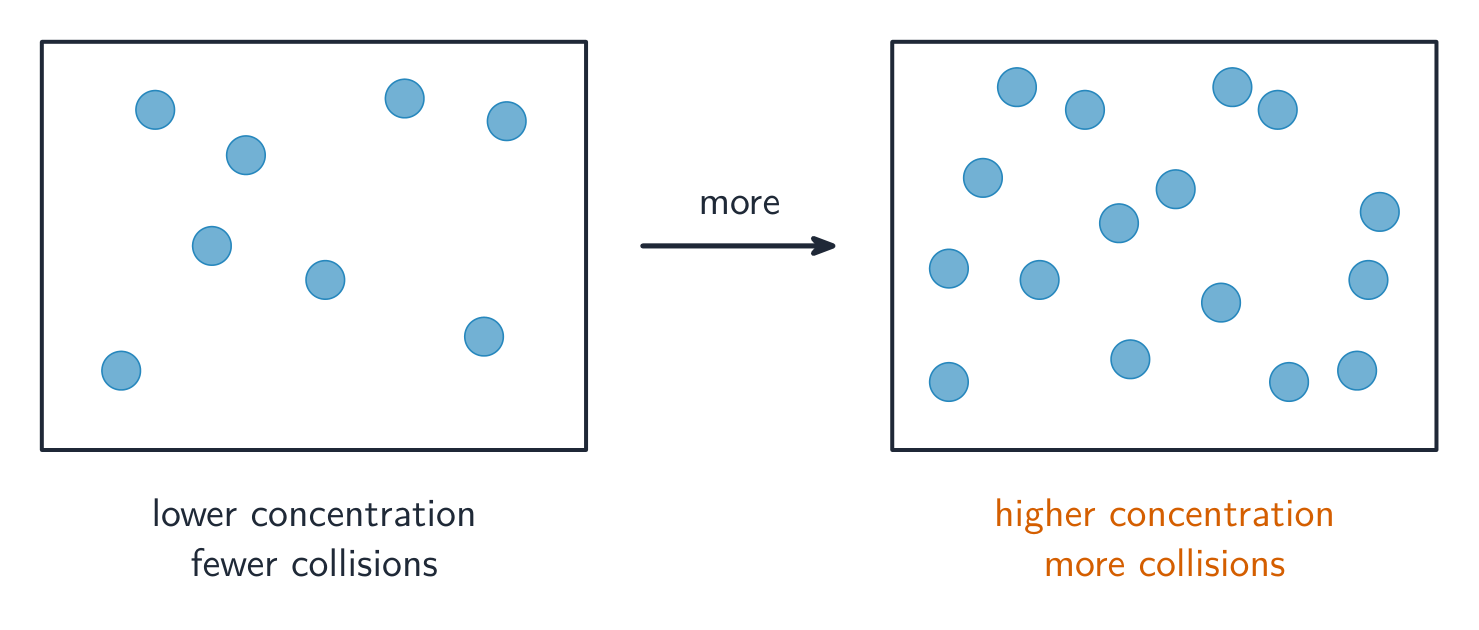
جسيمات أكثر في نفس الحجم تتصادم بشكل متكرر، لذا يرتفع المعدل
جسيمات أكثر في نفس الحجم تتصادم بشكل متكرر، فتزداد السرعة
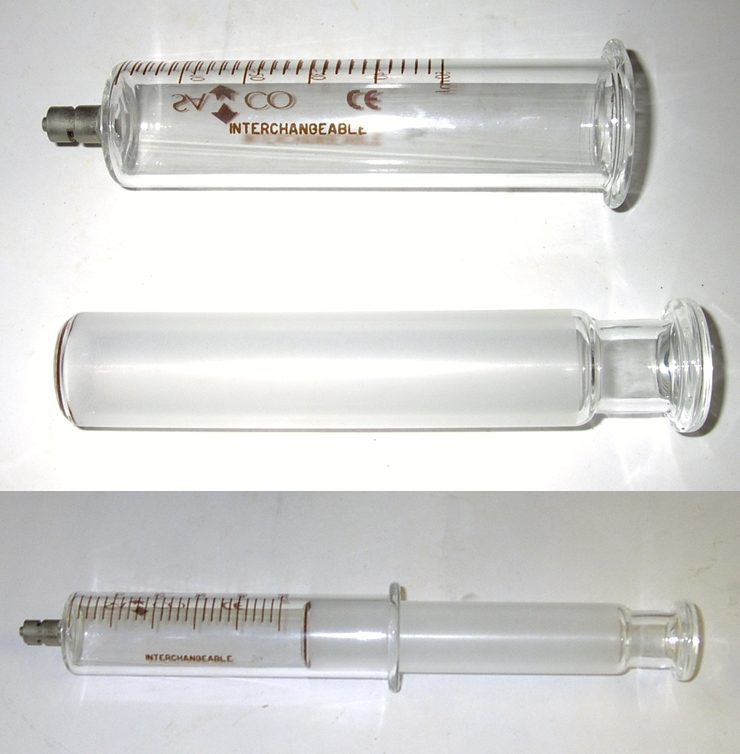
حقنة غاز: قياس حجم الغاز عبر الزمن يعطي سرعة التفاعل من الميل
Explore · ⁨استكشف⁩

Change conditions and watch the rate · ⁨غيّر الظروف وراقب السرعة⁩

Reaction rate rises with temperature, concentration, and a catalyst — each gives more frequent or more successful collisions. Change each and watch the reaction speed up. · ⁨يزداد سرعة التفاعل مع ارتفاع درجة الحرارة والتركيز وإضافة عامل محفز — حيث يوفر كل منها تصادمات أكثر تكرارًا أو أكثر فعالية. غيّر كل عامل وشاهد التفاعل يسرع.⁩

Vocabulary · ⁨مفردات⁩ Train · ⁨تدريب⁩
English العربية
Kinetics/kɪˈnetɪks/ الحركية الكيميائية
reaction rate/rɪˈækʃn reɪt/ سرعة التفاعل
rate law/reɪt lɔː/ قانون السرعة
rate constant/reɪt ˈkɒnstənt/ ثابت السرعة
orders/ˈɔːdəz/ رتب
catalyst/ˈkætəlɪst/ المحفز
5.2

Writing the Rate Law · ⁨صياغة قانون السرعة⁩

Syllabus · ⁨المنهج⁩
English

Learning Objective 5.2.A: Represent experimental data with a consistent rate law expression.

  • 5.2.A.1 Experimental methods can be used to monitor the amounts of reactants and/or products of a reaction over time and to determine the rate of the reaction.
  • 5.2.A.2 The rate law expresses the rate of a reaction as proportional to the concentration of each reactant raised to a power.
  • 5.2.A.3 The power of each reactant in the rate law is the order of the reaction with respect to that reactant. The sum of the powers of the reactant concentrations in the rate law is the overall order of the reaction.
  • 5.2.A.4 The proportionality constant in the rate law is called the rate constant. The value of this constant is temperature dependent and the units reflect the overall reaction order.
  • 5.2.A.5 Comparing initial rates of a reaction is a method to determine the order with respect to each reactant.
العربية

هدف التعلم 5.2.A: تمثيل البيانات التجريبية بتعبير قانون سرعة متسق.

  • 5.2.A.1 يمكن استخدام الطرق التجريبية لمراقبة كميات المتفاعلات و/أو النواتج لتفاعل ما مع مرور الوقت، ولتحديد معدل التفاعل.
  • 5.2.A.2 تعبر معادلة السرعة عن معدل التفاعل كنسبة طردية لتركيز كل متفاعل مرفوعاً لأس معين.
  • 5.2.A.3 أس كل متفاعل في معادلة السرعة هو رتبة التفاعل بالنسبة لذلك المتفاعل. ومجموع أسات تراكيز المتفاعلات في معادلة السرعة هو الرتبة الكلية للتفاعل.
  • 5.2.A.4 يُسمى ثابت التناسب في معادلة السرعة ثابت السرعة. وقيمة هذا الثابت تعتمد على درجة الحرارة، وتعكس وحداته الرتبة الكلية للتفاعل.
  • 5.2.A.5 مقارنة السرعات الابتدائية للتفاعل هي طريقة لتحديد الرتبة بالنسبة لكل متفاعل.

Source: College Board AP Course and Exam Description · ⁨المصدر: وصف دورة وامتحان College Board AP⁩

English

The rate law 速率方程 relates rate to reactant concentrations:

$$\text{rate}=k[\text{A}]^m[\text{B}]^n,$$
where $k$ is the rate constant 速率常数 and $m,n$ are the orders 级数. Orders are found experimentally (not from the balanced coefficients) by seeing how the rate changes when you change one concentration at a time.

Worked example. In experiments, doubling $[\text{A}]$ makes the rate four times larger, while doubling $[\text{B}]$ leaves the rate unchanged. So the reaction is second order in A ($2^2=4$) and zero order in B, giving $\text{rate}=k[\text{A}]^2$. The overall order is $2+0=2$. Never read the orders off the balanced coefficients – only experiment gives them.

العربية

قانون السرعة يربط بين سرعة التفاعل وتركيزات المتفاعلات:

$$\text{rate}=k[\text{A}]^m[\text{B}]^n,$$
حيث $k$ هو ثابت السرعة و$m,n$ هي رتب التفاعل. تُحدد رتب التفاعل تجريبيًا (وليس من معاملات المعادلة الموزونة) عن طريق ملاحظة كيف تتغير السرعة عند تغيير تركيز واحد فقط في كل مرة.

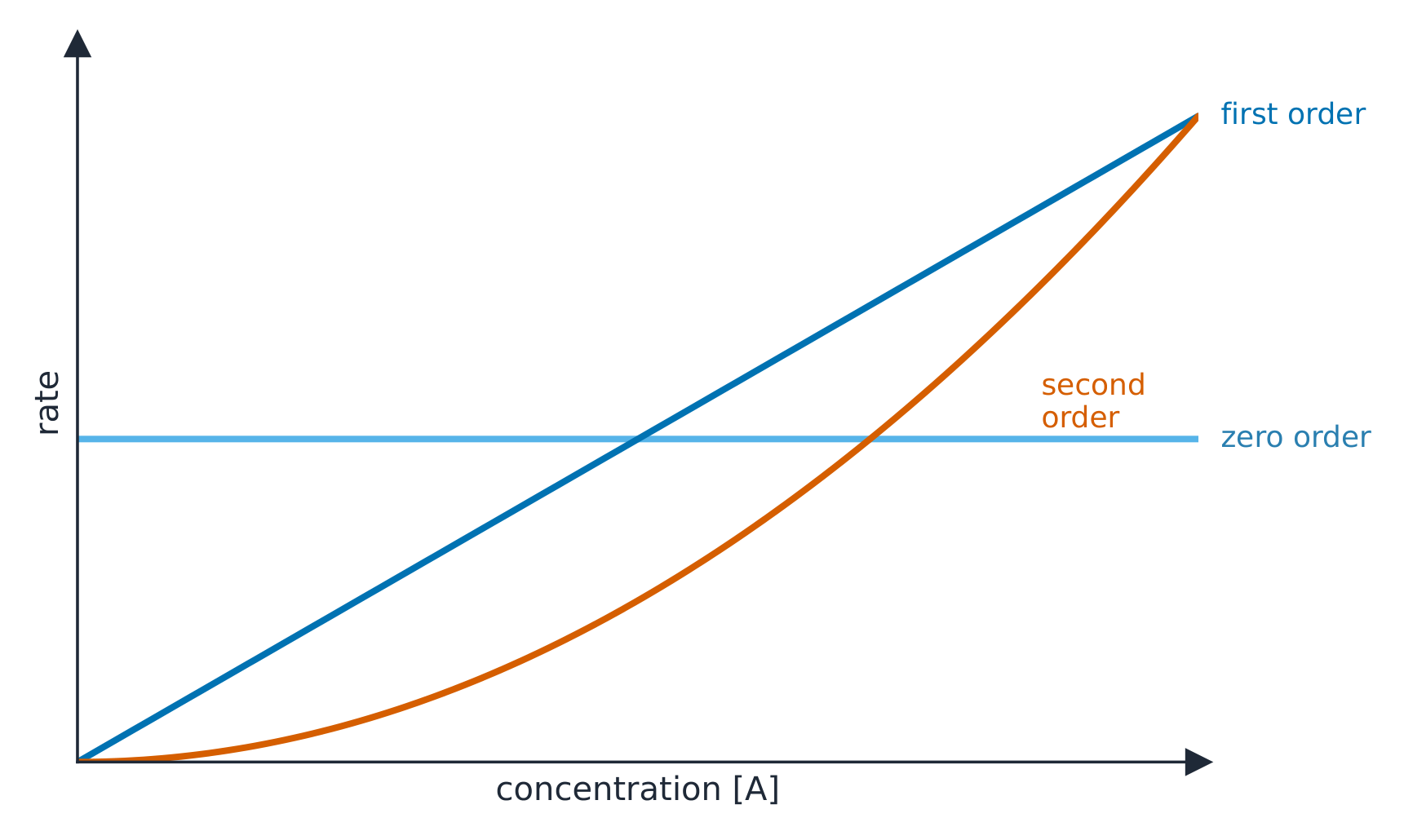
السرعة مقابل التركيز للتفاعلات من الرتبة الصفرية والأولى والثانية

مثال محلل. في التجارب، يؤدي مضاعفة $[\text{A}]$ إلى أن تصبح السرعة أربع مرات أكبر، بينما لا يتغير شيء عند مضاعفة $[\text{B}]$. إذن التفاعل من الرتبة الثانية بالنسبة لـ A ($2^2=4$) ومن الرتبة الصفرية بالنسبة لـ B، مما يعطي $\text{rate}=k[\text{A}]^2$. الرتبة الكلية هي $2+0=2$. لا تستنتج رتب التفاعل من معاملات المعادلة الموزونة أبداً – بل只提供ها التجربة وحدها.

5.3

Concentration Over Time · ⁨التركيز عبر الزمن⁩

Syllabus · ⁨المنهج⁩
English

Learning Objective 5.3.A: Identify the rate law expression of a chemical reaction using data that show how the concentrations of reaction species change over time.

  • 5.3.A.1 The order of a reaction can be inferred from a graph of concentration of reactant versus time.
  • 5.3.A.2 If a reaction is first order with respect to a reactant being monitored, a plot of the natural log (ln) of the reactant concentration as a function of time will be linear.
  • 5.3.A.3 If a reaction is second order with respect to a reactant being monitored, a plot of the reciprocal of the concentration of that reactant versus time will be linear.
  • 5.3.A.4 The slopes of the concentration versus time data for zeroth, first, and second order reactions can be used to determine the rate constant for the reaction.
    • Zeroth order:
    • Equation: $[\mathrm{A}]_t - [\mathrm{A}]_0 = -kt$
    • First order:
    • Equation: $\ln[\mathrm{A}]_t - \ln[\mathrm{A}]_0 = -kt$
    • Second order:
    • Equation: $1/[\mathrm{A}]_t - 1/[\mathrm{A}]_0 = kt$
  • 5.3.A.5 Half-life is a critical parameter for first order reactions because the half-life is constant and related to the rate constant for the reaction by the equation:
    • Equation: $t_{1/2} = 0.693/k.$
  • 5.3.A.6 Radioactive decay processes provide an important illustration of first order kinetics.
العربية

الهدف التعليمي 5.3.A: تحديد صيغة معادلة السرعة لتفاعل كيميائي باستخدام بيانات تظهر كيف تتغير تراكيز أنواع التفاعل مع مرور الزمن.

  • 5.3.A.1 يمكن استنتاج رتبة التفاعل من رسم بياني لتركيز المتفاعل مقابل الزمن.
  • 5.3.A.2 إذا كان التفاعل من الرتبة الأولى بالنسبة لمتفاعل يتم مراقبته، فإن رسم البياني للوغاريتم الطبيعي (ln) لتركيز المتفاعل بدلالة الزمن سيكون خطياً.
  • 5.3.A.3 إذا كان التفاعل من الرتبة الثانية بالنسبة لمتفاعل يتم مراقبته، فإن رسم البياني لمقلوب تركيز ذلك المتفاعل بدلالة الزمن سيكون خطياً.
  • 5.3.A.4 يمكن استخدام ميل بيانات التركيز مقابل الزمن للتفاعلات من الرتبة الصفرية والأولى والثانية لتحديد ثابت السرعة للتفاعل.
    • الرتبة الصفرية:
    • المعادلة: $[\mathrm{A}]_t - [\mathrm{A}]_0 = -kt$
    • الرتبة الأولى:
    • المعادلة: $\ln[\mathrm{A}]_t - \ln[\mathrm{A}]_0 = -kt$
    • الرتبة الثانية:
    • المعادلة: $1/[\mathrm{A}]_t - 1/[\mathrm{A}]_0 = kt$
  • 5.3.A.5 عمر النصف هو معيار حاسم للتفاعلات من الرتبة الأولى لأن عمر النصف ثابت ويرتبط بثابت السرعة للتفاعل بالمعادلة:
    • المعادلة: $t_{1/2} = 0.693/k.$
  • 5.3.A.6 توفر عمليات التحلل الإشعاعي مثالاً مهماً على ديناميكيات الرتبة الأولى.

Source: College Board AP Course and Exam Description · ⁨المصدر: وصف دورة وامتحان College Board AP⁩

English

The integrated rate laws describe how concentration falls with time and give straight-line tests:

  • Zero order: $[\text{A}]$ vs $t$ is linear.
  • First order: $\ln[\text{A}]$ vs $t$ is linear; constant half-life 半衰期.
  • Second order: $\dfrac{1}{[\text{A}]}$ vs $t$ is linear.

Whichever plot is straight tells you the order and gives $k$ from its slope.

Worked example. A first-order reaction has rate constant $k=0.030\ \text{s}^{-1}$. Its half-life is

$$t_{1/2}=\frac{0.693}{k}=\frac{0.693}{0.030}=23\ \text{s},$$
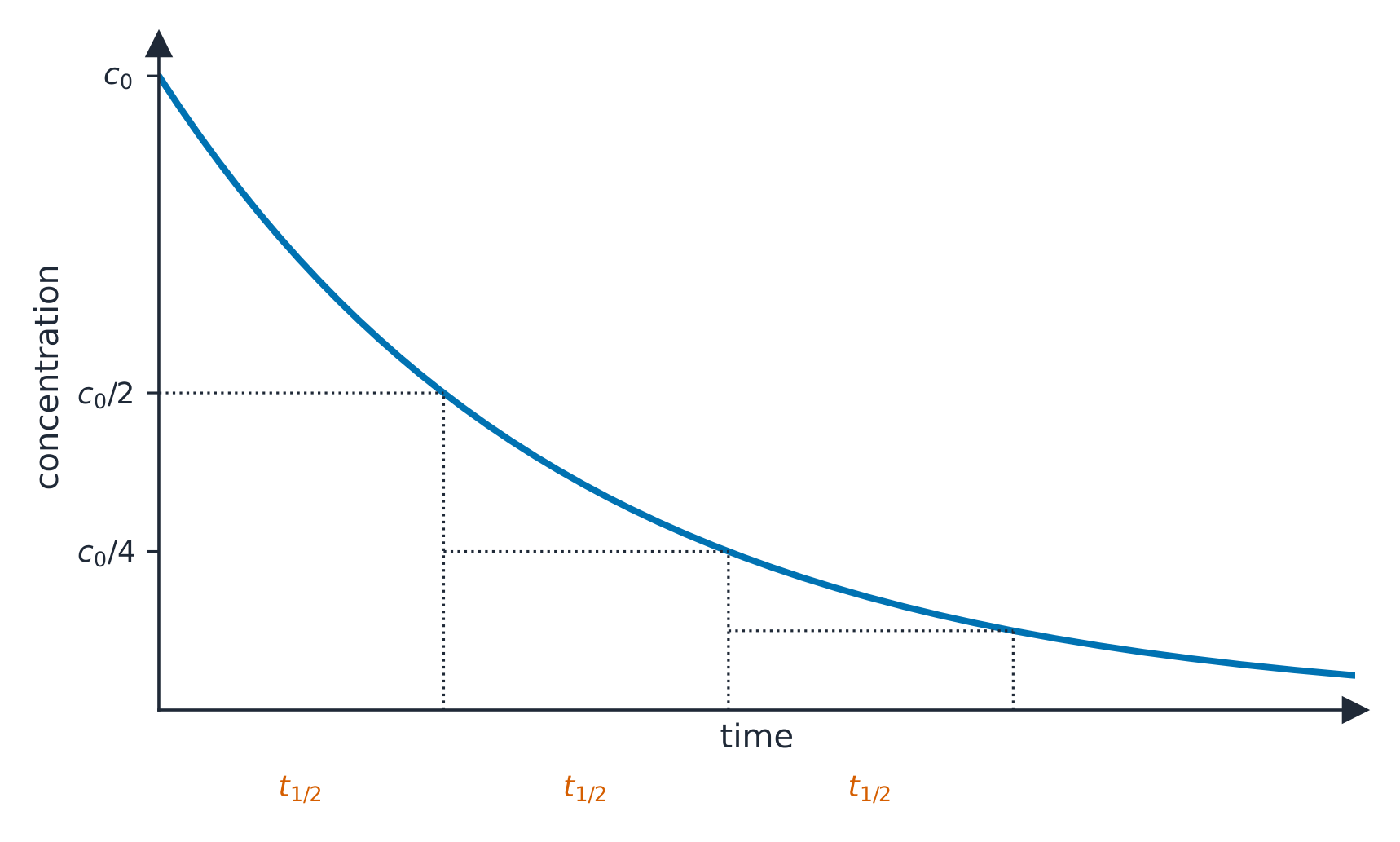
and, being first order, that half-life stays the same no matter how much reactant remains – so after $46\ \text{s}$ ($2$ half-lives) one quarter is left.

العربية

قوانين السرعة المدمجة تصف كيف ينخفض التركيز بمرور الوقت وتقدم اختبارات الخط المستقيم:

تفاعل من الرتبة الأولى له نصف عمر ثابت
  • الرتبة الصفرية: الرسم البياني لـ $[\text{A}]$ مقابل $t$ يكون خطيًا.
  • الرتبة الأولى: الرسم البياني لـ $\ln[\text{A}]$ مقابل $t$ يكون خطيًا؛ عمر النصف ثابت.
  • الرتبة الثانية: الرسم البياني لـ $\dfrac{1}{[\text{A}]}$ مقابل $t$ يكون خطيًا.

أي رسم بياني يظهر كخط مستقيم يخبرك بالرتبة ويعطيك $k$ من خلال ميله.

مثال محلل. تفاعل من الرتبة الأولى له ثابت سرعة $k=0.030\ \text{s}^{-1}$. عمر النصف له هو

$$t_{1/2}=\frac{0.693}{k}=\frac{0.693}{0.030}=23\ \text{s},$$
وبما أنه من الرتبة الأولى، فإن هذا العمر النصف يبقى ثابتًا بغض النظر عن كمية المتفاعل المتبقية – لذا بعد $46\ \text{s}$ ($2$ أعمار نصف)، يتبقى الربع.

Explore · ⁨استكشف⁩

Track concentration as a reaction runs · ⁨تتبع التركيز أثناء سير التفاعل⁩

As reactants are used up the rate slows, so a concentration-time curve is steep at first and flattens out. Raising temperature or adding a catalyst steepens it. · ⁨مع استهلاك المتفاعلات، يقل السرعة، لذا يكون منحنى التركيز-الزمن حادًا في البداية ثم يستوي. رفع درجة الحرارة أو إضافة عامل محفز يزيد من حدة المنحنى.⁩

Vocabulary · ⁨مفردات⁩ Train · ⁨تدريب⁩
English العربية
half-life/hɑːf laɪf/ النصف عمر
reaction mechanism/rɪˈækʃn ˈmekənɪzəm/ آلية التفاعل
elementary steps/ˌelɪˈmentəri steps/ الخطوات الأولية
intermediates/ˌɪntəˈmiːdɪəts/ المركّبات الوسيطة
5.4

The Steps a Reaction Really Takes · ⁨الخطوات الفعلية التي يسلكها التفاعل⁩

Syllabus · ⁨المنهج⁩
English

Learning Objective 5.4.A: Represent an elementary reaction as a rate law expression using stoichiometry.

  • 5.4.A.1 The rate law of an elementary reaction can be inferred from the stoichiometry of the particles participating in a collision.
  • 5.4.A.2 Elementary reactions involving the simultaneous collision of three or more particles are rare.
العربية

الهدف التعليمي 5.4.A: تمثيل التفاعل الأولي بصيغة معادلة السرعة باستخدام الستوكيومترية.

  • 5.4.A.1 يمكن استنتاج معادلة السرعة للتفاعل الأولي من الستوكيومترية للجسيمات المشاركة في التصادم.
  • 5.4.A.2 التفاعلات الأولية التي تتضمن تصادمًا متزامنًا لثلاثة جسيمات أو أكثر نادرة الحدوث.

Source: College Board AP Course and Exam Description · ⁨المصدر: وصف دورة وامتحان College Board AP⁩

English

A reaction mechanism 反应机理 is the sequence of elementary steps 基元反应 that actually occur. Their molecularity (how many particles collide in a step) sets that step's rate law directly. Species made in one step and used up in a later one are intermediates 中间体.

العربية

آلية التفاعل هي تسلسل الخطوات الأولية التي تحدث فعليًا. تحدد الجزيئية (عدد الجسيمات التي تتصادم في الخطوة الواحدة) قانون سرعة تلك الخطوة مباشرة. الأنواع الكيميائية المنتجة في خطوة واحدة والمستهلكة في خطوة لاحقة تسمى المواصفات الوسيطة.

5.5

Why Collisions Do or Do Not React · ⁨لماذا تحدث التصادمات أو لا تحدث تفاعلاً⁩

Syllabus · ⁨المنهج⁩
English

Learning Objective 5.5.A: Explain the relationship between the rate of an elementary reaction and the frequency, energy, and orientation of particle collisions.

  • 5.5.A.1 For an elementary reaction to successfully produce products, reactants must successfully collide to initiate bond-breaking and bond-making events.
  • 5.5.A.2 In most reactions, only a small fraction of the collisions leads to a reaction. Successful collisions have both sufficient energy to overcome the activation energy requirements and orientations that allow the bonds to rearrange in the required manner.
  • 5.5.A.3 The Maxwell-Boltzmann distribution curve describes the distribution of particle energies; this distribution can be used to gain a qualitative estimate of the fraction of collisions with sufficient energy to lead to a reaction, and also how that fraction depends on temperature.
العربية

الهدف التعليمي 5.5.A: شرح العلاقة بين سرعة التفاعل الأولي وتكرار الطاقة واتجاه تصادم الجسيمات.

  • 5.5.A.1 لكي ينتج التفاعل الأولي نواتج بنجاح، يجب أن تتصادم المتفاعلات بنجاح لبدء أحداث كسر الروابط وتكوينها.
  • 5.5.A.2 في معظم التفاعلات، يؤدي فقط جزء صغير من التصادمات إلى حدوث تفاعل. التصادمات الناجحة تمتلك كلا من طاقة كافية للتغلب على متطلبات طاقة التنشيط واتجاهات تسمح بإعادة ترتيب الروبط بالطريقة المطلوبة.
  • 5.5.A.3 يصف منحنى توزيع ماكسويل-بولتزمان توزيع طاقات الجسيمات؛ يمكن استخدام هذا التوزيع للحصول على تقدير نوعي لكسر التصادمات ذات الطاقة الكافية لإحداث تفاعل، وكيفية اعتماد هذا الكسر على درجة الحرارة.

Source: College Board AP Course and Exam Description · ⁨المصدر: وصف دورة وامتحان College Board AP⁩

English
Collision theory

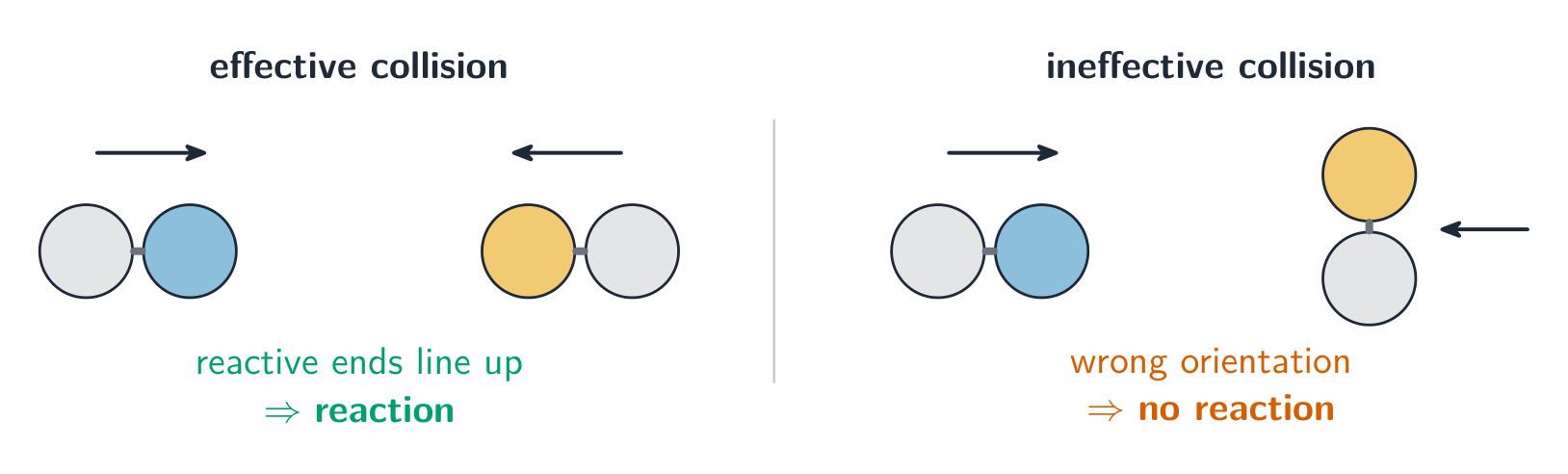
Collision theory 碰撞理论: molecules must collide with enough energy (the activation energy 活化能, $E_a$) and the correct orientation to react. Higher temperature means more molecules exceed $E_a$, so the reaction speeds up sharply.

العربية
نظرية التصادم

نظرية التصادم: يجب أن تتصادم الجزيئات بطاقة كافية (طاقة التنشيط، $E_a$) وباتجاه توجيه صحيح لتتفاعل. وارتفاع درجة الحرارة يعني أن عددًا أكبر من الجزيئات يتجاوز $E_a$، مما يسرع التفاعل بشكل حاد.

التصادم يتفاعل فقط بالاتجاه الصحيح وطاقة كافية
Explore · ⁨استكشف⁩

Which molecules clear the activation energy · ⁨أي الجزيئات تتجاوز طاقة التنشيط⁩

Only collisions with energy above the activation energy react. Heating shifts the speed distribution right, so a much larger fraction of molecules can react. · ⁨فقط التصادمات ذات الطاقة الأعلى من طاقة التنشيط تؤدي إلى التفاعل. يُزيح التسخين توزيع السرعات نحو اليمين، مما يعني أن جزءًا أكبر بكثير من الجزيئات يمكنه التفاعل.⁩

Vocabulary · ⁨مفردات⁩ Train · ⁨تدريب⁩
English العربية
Collision theory/kəˈlɪʒn ˈθɪəri/ نظرية التصادم
activation energy/ˌæktɪˈveɪʃn ˈenədʒi/ طاقة التنشيط
energy profile/ˈenədʒi ˈprəʊfaɪl/ ملف الطاقة
transition state/trænˈsɪʃn steɪt/ الحالة الانتقالية
5.6

Reading an Energy Profile · ⁨قراءة ملف الطاقة⁩

Syllabus · ⁨المنهج⁩
English

Learning Objective 5.6.A: Represent the activation energy and overall energy change in an elementary reaction using a reaction energy profile.

  • 5.6.A.1 Elementary reactions typically involve the breaking of some bonds and the forming of new ones.
  • 5.6.A.2 The reaction coordinate is the axis along which the complex set of motions involved in rearranging reactants to form products can be plotted.
  • 5.6.A.3 The energy profile gives the energy along the reaction coordinate, which typically proceeds from reactants, through a transition state, to products. The energy difference between the reactants and the transition state is the activation energy for the forward reaction.
  • 5.6.A.4 The rate of an elementary reaction is temperature dependent because the proportion of particle collisions that are energetic enough to reach the transition state varies with temperature. The Arrhenius equation relates the temperature dependence of the rate of an elementary reaction to the activation energy needed by molecular collisions to reach the transition state.
    • Exclusion statement: Calculations involving the Arrhenius equation will not be assessed on the AP Exam.
العربية

الهدف التعليمي 5.6.A: تمثيل طاقة التنشيط والتغير الكلي في الطاقة في تفاعل أولي باستخدام ملف طاقة التفاعل.

  • 5.6.A.1 عادة ما تتضمن التفاعلات الأولية كسر بعض الروابط وتكوين روابط جديدة.
  • 5.6.A.2 الإحداثي التفاعلي هو المحور الذي يمكن عليه رسم مجموعة الحركة المعقدة المصاحبة لإعادة ترتيب المتفاعلات لتكوين النواتج.
  • 5.6.A.3 يعطي ملف الطاقة الطاقة على طول الإحداثي التفاعلي، والذي يمر عادة من المتفاعلات، عبر حالة انتقالية، إلى النواتج. الفرق في الطاقة بين المتفاعلات وحالة الانتقال هو طاقة التنشيط للتفاعل الأمامي.
  • 5.6.A.4 سرعة التفاعل الأولي تعتمد على درجة الحرارة لأن نسبة تصادمات الجسيمات التي تكون كافية الطاقة للوصول إلى حالة الانتقالية تتغير مع درجة الحرارة. تربط معادلة أرهنيس dependence درجة الحرارة على سرعة التفاعل الأولي بطاقة التنشيط اللازمة لتصادمات الجزيئات للوصول إلى حالة الانتقال.
    • عبارة الاستبعاد: لن يتم تقييم الحسابات المتعلقة بمعادلة أرهنيس في امتحان AP.

Source: College Board AP Course and Exam Description · ⁨المصدر: وصف دورة وامتحان College Board AP⁩

English
Reaction energy profile

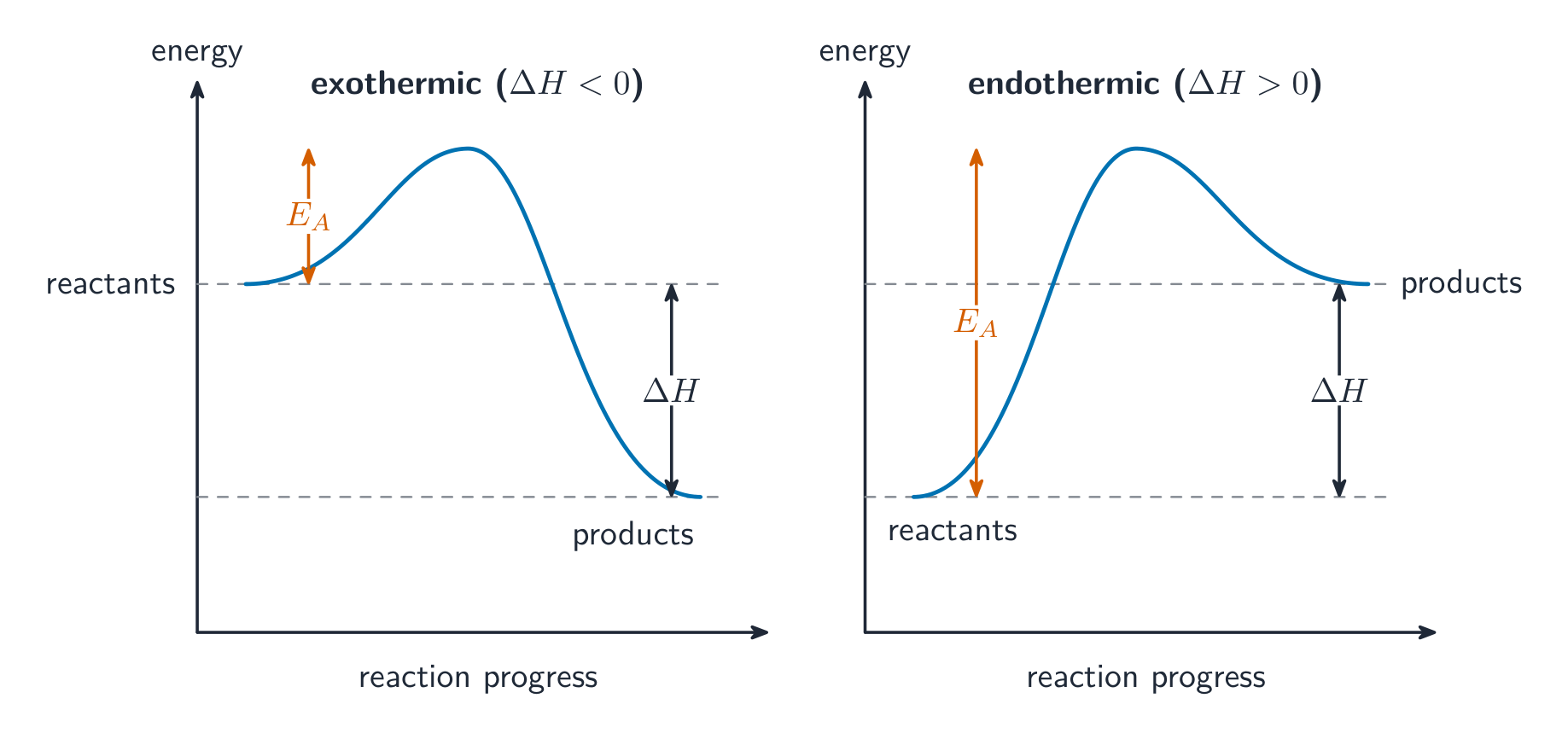
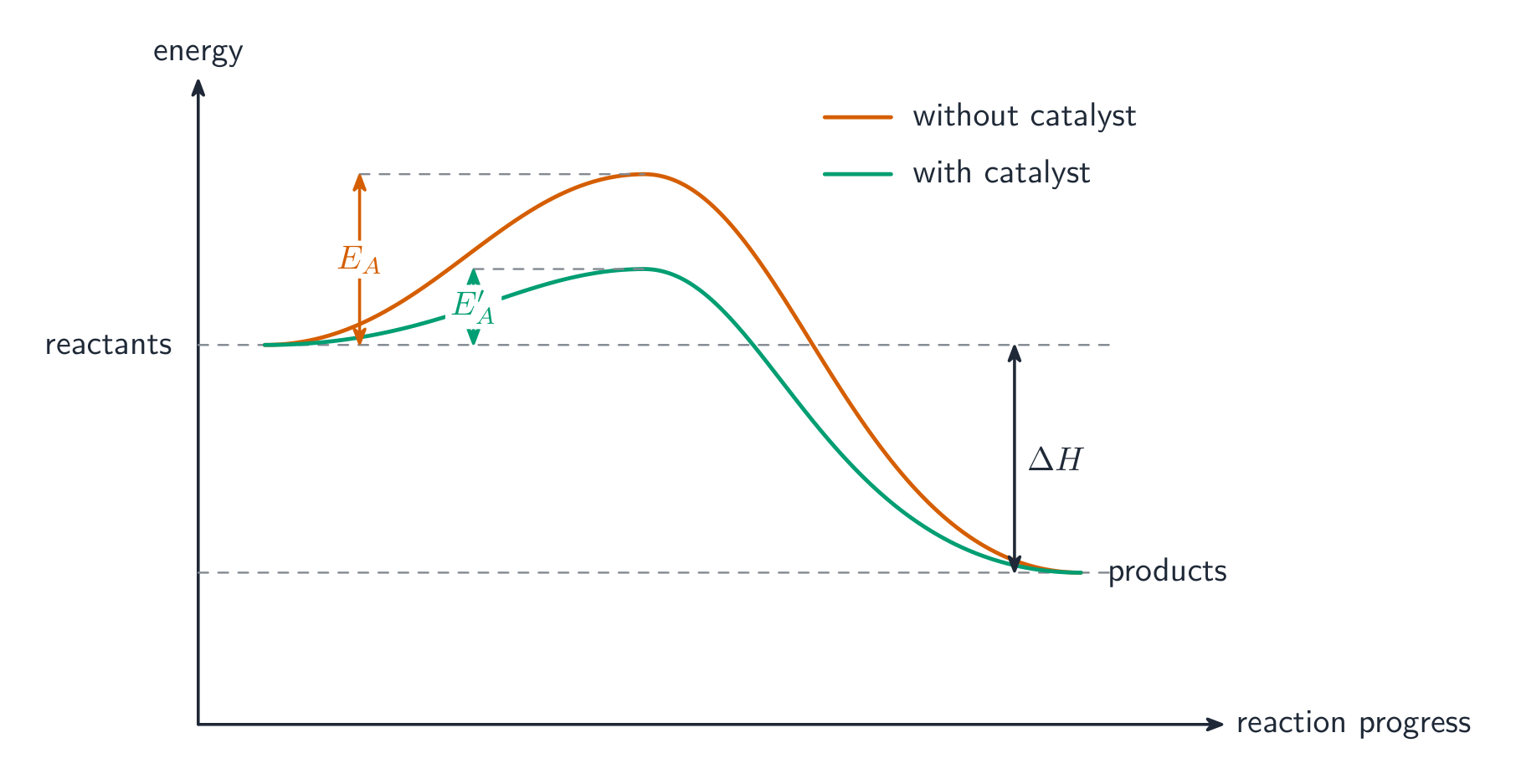
An energy profile 能量图 plots energy along the reaction path. The peak is the transition state 过渡态; the climb from reactants to the peak is $E_a$; the difference between reactant and product energies is the enthalpy change $\Delta H$ (down for exothermic).

العربية
ملف طاقة التفاعل

يرسم ملف الطاقة الطاقة على طول مسار التفاعل. القمة تمثل حالة الانتقال؛ والارتفاع من المتفاعلات إلى القمة هو $E_a$؛ والفارق بين طاقات المتفاعلات والنواتج هو تغير الإنثالبي $\Delta H$ (ينزل للأسفل في التفاعلات الطاردة للحرارة).

التفاعلات الطاردة للحرارة تنتهي أقل من المتفاعلات؛ والتفاعلات الممتصة للحرارة تنتهي أعلى
Explore · ⁨استكشف⁩

Read activation energy off the profile · ⁨اقرأ طاقة التنشيط من المنحنى⁩

An energy profile plots energy along the reaction. The hump is the activation energy; the drop from reactants to products is $\Delta H$. A catalyst lowers the hump. · ⁨يُصوّر المنحنى الطاقوي الطاقة على طول التفاعل. يمثل البروز طاقة التنشيط؛ بينما يمثل الانخفاض من المتفاعلات إلى النواتج $\Delta H$. يُقلل العامل المحفز ارتفاع البروز.⁩

5.7

The Sequence of Steps · ⁨تسلسل الخطوات⁩

Syllabus · ⁨المنهج⁩
English

Learning Objective 5.7.A: Identify the components of a reaction mechanism.

  • 5.7.A.1 A reaction mechanism consists of a series of elementary reactions, or steps, that occur in sequence. The components may include reactants, intermediates, products, and catalysts.
  • 5.7.A.2 The elementary steps when combined should align with the overall balanced equation of a chemical reaction.
  • 5.7.A.3 A reaction intermediate is produced by some elementary steps and consumed by others, such that it is present only while a reaction is occurring.
  • 5.7.A.4 Experimental detection of a reaction intermediate is a common way to build evidence in support of one reaction mechanism over an alternative mechanism.
    • Exclusion statement: Collection of data pertaining to detection of a reaction intermediate will not be assessed on the AP Exam.
العربية

الهدف التعليمي 5.7.A: تحديد مكونات آلية التفاعل.

  • 5.7.A.1 تتكون آلية التفاعل من سلسلة من التفاعلات الأولية، أو الخطوات، التي تحدث بالتتابع. قد تشمل المكونات المتفاعلات والوسطاء والنواتج والمحفزات.
  • 5.7.A.2 عند دمج الخطوات الأولية، يجب أن تتوافق مع المعادلة الموزونة الكلية للتفاعل الكيميائي.
  • 5.7.A.3 يتكون وسط التفاعل من خلال بعض الخطوات الأولية ويُستهلك من خلال أخرى، بحيث يكون موجودًا فقط أثناء حدوث التفاعل.
  • 5.7.A.4 الكشف التجريبي عن وسط التفاعل هو طريقة شائعة لبناء الأدلة الداعمة لآلية تفاعل واحدة بدلاً من آلية بديلة.
    • عبارة الاستبعاد: لن يتم تقييم جمع البيانات المتعلقة بالكشف عن وسط التفاعل في امتحان AP.

Source: College Board AP Course and Exam Description · ⁨المصدر: وصف دورة وامتحان College Board AP⁩

English

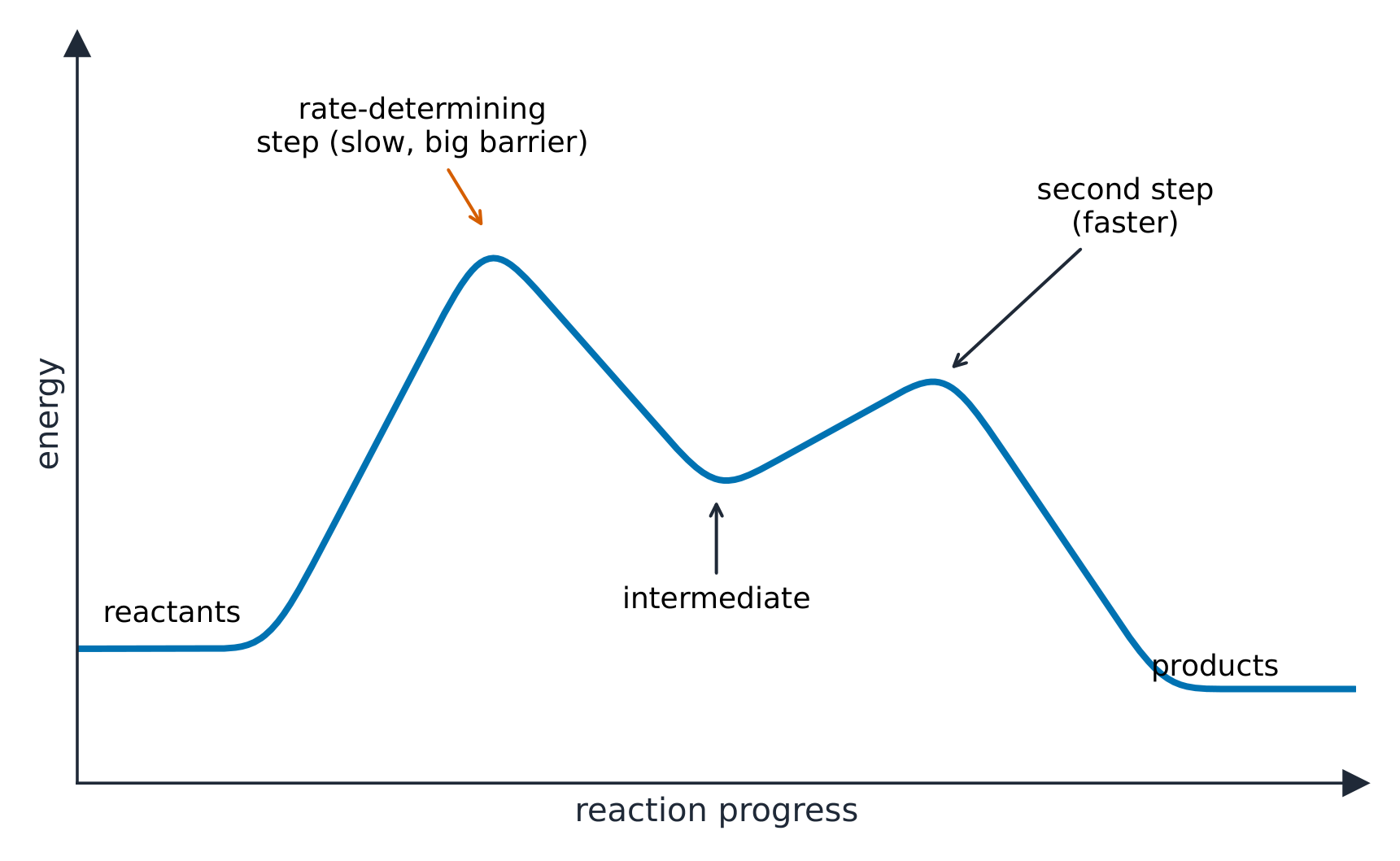
In a multi-step mechanism, the steps must add up to the overall balanced equation (intermediates cancel). Each step has its own energy hill; the tallest hill is the slowest step.

العربية

في الآلية متعددة الخطوات، يجب أن تجمع الخطوات معًا المعادلة الموزونة الكلية (وتتلاشى الوسيطات). لكل خطوة جبالها الخاصة من الطاقة؛ وأعلى جبل يمثل أبطأ خطوة.

الخطوة البطيئة ذات الحاجز الأعلى هي المحددة للمعدل
Vocabulary · ⁨مفردات⁩ Train · ⁨تدريب⁩
English العربية
rate-determining step/reɪt dɪˈtɜːmɪnɪŋ step/ الخطوة المحددة للمعدل
5.8

Finding the Rate Law From a Mechanism · ⁨إيجاد قانون السرعة من الآلية⁩

Syllabus · ⁨المنهج⁩
English

Learning Objective 5.8.A: Identify the rate law for a reaction from a mechanism in which the first step is rate limiting.

  • 5.8.A.1 For reaction mechanisms in which each elementary step is irreversible, or in which the first step is rate limiting, the rate law of the reaction is set by the molecularity of the slowest elementary step (i.e., the rate-limiting step).
    • Exclusion statement: Collection of data pertaining to detection of a reaction intermediate will not be assessed on the AP Exam.
العربية

الهدف التعليمي 5.8.A: تحديد معادلة السرعة لتفاعل من آلية يكون فيها الخطوة الأولى هي المحددة للسرعة.

  • 5.8.A.1 بالنسبة لآليات التفاعل التي تكون فيها كل خطوة جزئية لا عكوسة، أو في الحالات التي تكون فيها الخطوة الأولى هي المحددة للسرعة، يتم تحديد قانون السرعة للتفاعل بناءً على الجزيئية (عدد الجزيئات المشاركة) للخطوة الجزئية الأبطأ (أي الخطوة المحددة للسرعة).
    • عبارة الاستبعاد: لن يتم تقييم جمع البيانات المتعلقة بالكشف عن وسط التفاعل في امتحان AP.

Source: College Board AP Course and Exam Description · ⁨المصدر: وصف دورة وامتحان College Board AP⁩

English

The rate-determining step 决速步骤 is the slowest step; its molecularity gives the overall rate law. A valid mechanism must (1) add to the overall reaction and (2) predict the experimentally observed rate law.

Worked example. Suppose the slow (rate-determining) step is the bimolecular collision $\text{NO}_2+\text{NO}_2\rightarrow\text{NO}_3+\text{NO}$. Its molecularity gives the rate law directly: $\text{rate}=k[\text{NO}_2]^2$. If experiment shows exactly this, the proposed mechanism is consistent; if experiment gave $\text{rate}=k[\text{NO}_2]$, the mechanism would be wrong.

العربية

الخطوة المحددة للمعدل هي أبطأ خطوة؛ وتحدد جزيئية هذا الخطوة قانون السرعة الكلي. ويجب أن تكون الآلة الصالحة (1) تجمع لإعطاء التفاعل الكلي و(2) تتنبأ بقانون السرعة الملاحظ تجريبياً.

مثال محلول. افترض أن الخطوة البطيئة (المحددة للمعدل) هي تصادم ثنائي الجزيء $\text{NO}_2+\text{NO}_2\rightarrow\text{NO}_3+\text{NO}$. تعطي جزيئيتها قانون السرعة مباشرة: $\text{rate}=k[\text{NO}_2]^2$. إذا أظهرت التجربة هذا بالضبط، تكون الآلية المقترحة متسقة؛ أما إذا أعطت التجربة $\text{rate}=k[\text{NO}_2]$، فإن الآلية ستكون خاطئة.

5.9

When the First Step Is Fast · ⁨عندما تكون الخطوة الأولى سريعة⁩

Syllabus · ⁨المنهج⁩
English

Learning Objective 5.9.A: Identify the rate law for a reaction from a mechanism in which the first step is not rate limiting.

  • 5.9.A.1 If the first elementary reaction is not rate limiting, approximations (such as pre-equilibrium) must be made to determine a rate law expression.
العربية

هدف التعلم 5.9.A: تحديد قانون السرعة لتفاعل من خلال آلية يكون فيها الخطوة الأولى ليست محددة للسرعة.

  • 5.9.A.1 إذا كانت التفاعل الجزئي الأول ليس هو المحدد للسرعة، يجب إجراء تقديرات (مثل ما قبل التوازن) لتحديد تعبير قانون السرعة.

Source: College Board AP Course and Exam Description · ⁨المصدر: وصف دورة وامتحان College Board AP⁩

English

If a fast step precedes the slow one, an intermediate appears in the slow step's rate law. Use the fast pre-equilibrium to rewrite that intermediate in terms of reactants, so the final rate law contains only measurable species.

العربية

إذا سبقت خطوة سريعة الخطوة البطيئة، سيظهر وسيط في قانون سرعة الخطوة البطيئة. استخدم التوازن المسبق السريع لإعادة كتابة ذلك الوسيط بدلالة المتفاعلات، بحيث يحتوي قانون السرعة النهائي فقط على أنواع قابلة للقياس.

5.10

Energy Profiles for Many Steps · ⁨ملفات الطاقة للعديد من الخطوات⁩

Syllabus · ⁨المنهج⁩
English

Learning Objective 5.10.A: Represent the activation energy and overall energy change in a multistep reaction with a reaction energy profile.

  • 5.10.A.1 Knowledge of the energetics of each elementary reaction in a mechanism allows for the construction of an energy profile for a multistep reaction.
العربية

هدف التعلم 5.10.A: تمثيل طاقة التنشيط والتغير الكلي في الطاقة في تفاعل متعدد الملف باستخدام ملف طاقة التفاعل.

  • 5.10.A.1 معرفة الديناميكا الحرارية لكل تفاعل أولي في الآلية يسمح ببناء ملف طاقة لتفاعل متعدد الخطوات.

Source: College Board AP Course and Exam Description · ⁨المصدر: وصف دورة وامتحان College Board AP⁩

English

A multi-step reaction's profile shows several peaks (one per step) with valleys (intermediates) between them. The highest peak is the rate-determining transition state – it controls the overall rate.

العربية

يُظهر منحنى تفاعل متعدد الخطوات عدة قمم (قمة لكل خطوة) مع وديان (متوسطات) بينها. القمة الأعلى تمثل حالة الانتقالية المحددة للسرعة – فهي التي تتحكم في السرعة الإجمالية.

5.11

How Catalysts Speed Things Up · ⁨كيف تسرع المحفزات التفاعلات⁩

Syllabus · ⁨المنهج⁩
English

Learning Objective 5.11.A: Explain the relationship between the effect of a catalyst on a reaction and changes in the reaction mechanism.

  • 5.11.A.1 In order for a catalyst to increase the rate of a reaction, the addition of the catalyst must increase the number of effective collisions and/or provide a reaction path with a lower activation energy relative to the original reaction coordinate.
  • 5.11.A.2 In a reaction mechanism containing a catalyst, the net concentration of the catalyst is constant. However, the catalyst will frequently be consumed in the rate-determining step of the reaction, only to be regenerated in a subsequent step in the mechanism.
  • 5.11.A.3 Some catalysts accelerate a reaction by binding to the reactant(s). The reactants are either oriented more favorably or react with lower activation energy. There is often a new reaction intermediate in which the catalyst is bound to the reactant(s). Many enzymes function in this manner.
  • 5.11.A.4 Some catalysts involve covalent bonding between the catalyst and the reactant(s). An example is acid-base catalysis, in which a reactant or intermediate either gains or loses a proton. This introduces a new reaction intermediate and new elementary reactions involving that intermediate.
  • 5.11.A.5 In surface catalysis, a reactant or intermediate binds to, or forms a covalent bond with, the surface. This introduces elementary reactions involving these new bound reaction intermediate(s).
العربية

هدف التعلم 5.11.A: شرح العلاقة بين تأثير العامل المحفز على التفاعل والتغيرات في آلية التفاعل.

  • 5.11.A.1 لكي يزيد العامل المحفز من سرعة التفاعل، يجب أن يؤدي إضافة العامل المحفز إلى زيادة عدد التصادمات الفعالة و/أو توفير مسار تفاعل بطاقة تنشيط أقل مقارنة بإحداثيات التفاعل الأصلية.
  • 5.11.A.2 في آلية تفاعل تحتوي على عامل محفز، تكون التركيز الصافي للعامل المحفز ثابتًا. ومع ذلك، غالبًا ما يتم استهلاك العامل المحفز في الخطوة المحددة للسرعة للتفاعل، ليتم إعادة توليده فقط في خطوة لاحقة في الآلية.
  • 5.11.A.3 تسرع بعض العوامل المحفزة التفاعل عن طريق الارتباط بالمتفاعل(ات). يتم توجيه المتفاعلات بشكل أكثر ملاءمة أو تتفاعل بطاقة تنشيط أقل. غالبًا ما يكون هناك وسط تفاعل جديد يرتبط فيه العامل المحفز بالمتفاعل(ات). تعمل العديد من الإنزيمات بهذه الطريقة.
  • 5.11.A.4 بعض العوامل المحفزة تتضمن روابط تساهمية بين العامل المحفز والمتفاعل(ات). مثال على ذلك التحفيز الحمضي-القاعدي، حيث يكتسب أو يفقد المتفاعل أو الوسط بروتونًا. هذا يؤدي إلى وسط تفاعل جديد وتفاعلات أولية جديدة تتضمن ذلك الوسط.
  • 5.11.A.5 في التحفيز السطحي، يرتبط المتفاعل أو الوسط بالسطح أو يشكل رابطة تساهمية معه. هذا يؤدي إلى تفاعلات أولية تتضمن هذه الوسائط الجديدة المرتبطة بالتفاعل.

Source: College Board AP Course and Exam Description · ⁨المصدر: وصف دورة وامتحان College Board AP⁩

English

A catalyst 催化剂 speeds a reaction by providing a new pathway with a lower activation energy, without being consumed. It does not change $\Delta H$ or the equilibrium position – only how fast equilibrium is reached. On an energy profile, a catalyst lowers the peak(s).

العربية

المحفز يُسرّع التفاعل عن طريق توفير مسار جديد بـ طاقة تنشيط أقل، دون أن يُستهلك. لا يغير $\Delta H$ أو موضع الاتزان – بل يسرع فقط الوصول إلى الاتزان. على المنحنى الطاقة، يُخفض المحفز القمة(قمم).

الحافز يوفر مسارًا بطاقة تنشيط أقل؛ التغير الإنثالبي يبقى ثابتًا
5.11

Exam tips · ⁨نصائح للامتحان⁩

English
  • Rate rises with concentration, temperature, surface area, and a catalyst — explain each with collision theory (more, or more energetic, successful collisions).
  • Temperature works mainly by getting more particles above the activation energy, not just more collisions.
  • Reaction orders come from experiment, not the balanced coefficients — see how the rate changes when one concentration is varied.
  • On an energy profile the hill height is the activation energy and the reactant–product gap is $\Delta H$.
  • A catalyst lowers the activation energy (a new pathway) but leaves $\Delta H$ and the equilibrium position unchanged.
العربية
  • يرتفع معدل التفاعل مع التركيز، درجة الحرارة، مساحة السطح، والمحفز — اشرح كل منها باستخدام نظرية الاصطدامات (اصطدامات أكثر، أو اصطدامات أكثر طاقة ونجاحاً).
  • تعمل درجة الحرارة بشكل رئيسي على جعل عدد أكبر من الجسيمات يتجاوز طاقة التنشيط، وليس مجرد زيادة عدد الاصطدامات.
  • رتب التفاعل تُستخرج من التجربة، لا من معاملات المعادلة الموزونة — راقب كيف يتغير المعدل عند تغيير تركيز واحد.
  • على منحنى الطاقة ارتفاع التلة هو طاقة التنشيط والفارق بين المتفاعلات والنواتج هو $\Delta H$.
  • المحفز يُخفض طاقة التنشيط (مسار جديد) لكن يترك $\Delta H$ وموضع الاتزان دون تغيير.

Interactive lessons on this topic · ⁨دروس تفاعلية حول هذا الموضوع⁩

Work through it step by step, with instant-check exercises. · ⁨ا-working عليه خطوة بخطوة، مع تمارين تحقق فوري.⁩

Past Papers · ⁨أوراق الامتحانات السابقة⁩

More topics in AP Chemistry · ⁨AP الكيمياء⁩ · ⁨المزيد من المواضيع في AP Chemistry · ⁨AP الكيمياء⁩⁩

Log in or create account · ⁨تسجيل الدخول أو إنشاء حساب⁩

IGCSE, A-Level & AP