Skip to content · ⁨الانتقال إلى المحتوى⁩

Chemical Reactions · ⁨التفاعلات الكيميائية⁩

AP Chemistry · ⁨AP الكيمياء⁩ · Topic 4 · ⁨الموضوع 4⁩

Video lesson for this topic · ⁨درس فيديو لهذا الموضوع⁩ Open the video page · ⁨افتح صفحة الفيديو⁩
7:42

التفاعلات الكيميائية

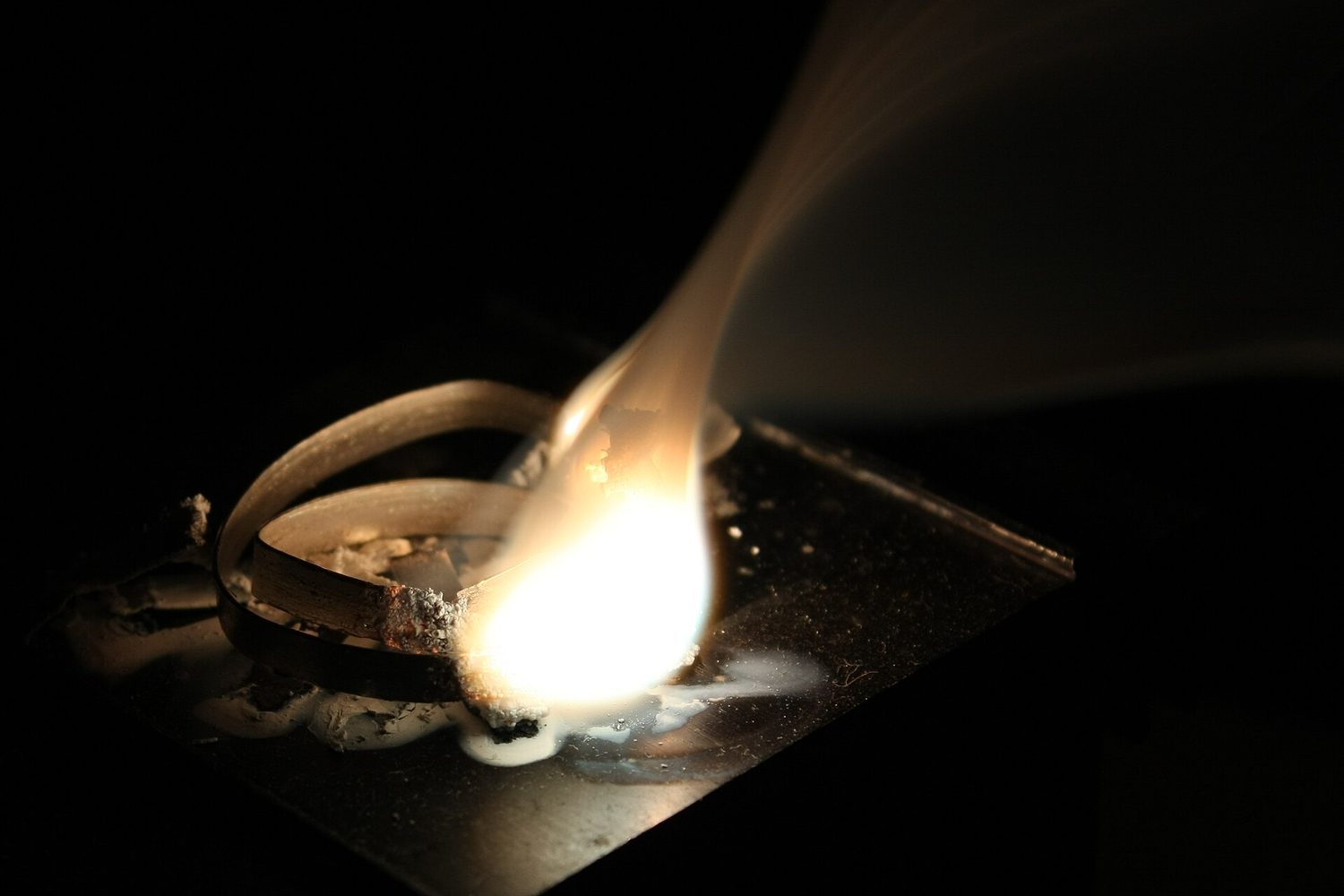
شريحة من معدن المغنيسيوم. لامسها بلهب فتحتتر — احتراق — بضوء ساطع لا يمكن النظر إليه. المتبقي لم يعد مغنيسيوم. إنه…

English narration · English + 中文 subtitles burned in · ⁨سرد باللغة الإنجليزية · ترجمة مدمجة بالإنجليزية + الصينية⁩

4.1

Recognizing a Chemical Reaction · ⁨التعرف على التفاعل الكيميائي⁩

Syllabus · ⁨المنهج⁩
English

Learning Objective 4.1.A: Identify evidence of chemical and physical changes in matter.

  • 4.1.A.1 A physical change occurs when a substance undergoes a change in properties but not a change in composition. Changes in the phase of a substance (solid, liquid, gas) or formation/separation of mixtures of substances are common physical changes.
  • 4.1.A.2 A chemical change occurs when substances are transformed into new substances, typically with different compositions. Production of heat or light, formation of a gas, formation of a precipitate, and/or color change provide possible evidence that a chemical change has occurred.
العربية

هدف التعلم 4.1.A: تحديد أدلة على التغيرات الكيميائية والفيزيائية في المادة.

  • 4.1.A.1 يحدث التغير الفيزيائي عندما تخضع مادة ما لتغير في الخصائص دون تغير في التركيب. تُعد التغيرات في طور المادة (صلب، سائل، غاز) أو تكوين/فصل مخلوطات المواد من التغيرات الفيزيائية الشائعة.
  • 4.1.A.2 يحدث التغير الكيميائي عندما تتحول مواد إلى مواد جديدة، عادةً ما تكون ذات تركيب مختلف. إنتاج الحرارة أو الضوء، وتكوين الغاز، وتكوين الراسب، و/أو تغير اللون قد توفر أدلة محتملة على حدوث تغير كيميائي.
Source: College Board AP Course and Exam Description · ⁨المصدر: وصف دورة وامتحان College Board AP⁩

English

A chemical reaction 化学反应 rearranges atoms into new substances. Signs one has happened: a color change, a gas or precipitate 沉淀 forming, or a temperature change. Atoms are conserved, so an equation must be balanced – the same count of each element on both sides.

العربية
احتراق المغنيسيوم: تفاعل كيميائي يعيد ترتيب الذرات ويطلق الطاقة كضوء وحرارة

التفاعل الكيميائي يعيد ترتيب الذرات لتكوين مواد جديدة. علامات حدوثه: تغير اللون، تكون غاز أو راسب، أو تغير في درجة الحرارة. الذرات محفوظة، لذا يجب أن تكون المعادلة موزونة – نفس عدد كل عنصر في كلا الطرفين.

4.2

Net Ionic Equations · ⁨المعادلات الأيونية الصافية⁩

Syllabus · ⁨المنهج⁩
English

Learning Objective 4.2.A: Represent changes in matter with a balanced chemical or net ionic equation: i. For physical changes. ii. For given information about the identity of the reactants and/or product. iii. For ions in a given chemical reaction.

  • 4.2.A.1 All physical and chemical processes can be represented symbolically by balanced equations.
  • 4.2.A.2 Chemical equations represent chemical changes. These changes are the result of a rearrangement of atoms into new combinations; thus, any representation of a chemical change must contain equal numbers of atoms of every element before and after the change occurred. Equations thus demonstrate that mass and charge are conserved in chemical reactions.
  • 4.2.A.3 Balanced molecular, complete ionic, and net ionic equations are differing symbolic forms used to represent a chemical reaction. The form used to represent the reaction depends on the context in which it is to be used.
العربية

هدف التعلم 4.2.A: تمثيل التغيرات في المادة بمعادلة كيميائية موزونة أو معادلة أيونات صافية: i. للتغيرات الفيزيائية. ii. لمعلومات معطاة حول هوية المتفاعلات و/أو النواتج. iii. للأيونات في تفاعل كيميائي معطى.

  • 4.2.A.1 يمكن تمثيل جميع العمليات الفيزيائية والكيميائية رمزيًا بواسطة معادلات موزونة.
  • 4.2.A.2 تمثل المعادلات الكيميائية التغيرات الكيميائية. تنتج هذه التغيرات عن إعادة ترتيب الذرات في تركيبات جديدة؛ وبالتالي، يجب أن تحتوي أي تمثيل للتغير الكيميائي على أعداد متساوية من ذرات كل عنصر قبل وبعد حدوث التغير. وهكذا تظهر المعادلات أن الكتلة والشحنة محفوظة في التفاعلات الكيميائية.
  • 4.2.A.3 المعادلات الجزيئية الموزونة، ومعادلات الأيونات الكاملة، ومعادلات الأيونات الصافية هي أشكال رمزية مختلفة تُستخدم لتمثيل تفاعل كيميائي. يعتمد الشكل المستخدم لتمثيل التفاعل على السياق الذي سيتم استخدامه فيه.

Source: College Board AP Course and Exam Description · ⁨المصدر: وصف دورة وامتحان College Board AP⁩

English

For reactions in water, ionic compounds split into ions. A net ionic equation 净离子方程式 shows only the species that actually change, leaving out the spectator ions 旁观离子 that appear unchanged on both sides. It captures the real chemistry (e.g. $\text{Ag}^+ + \text{Cl}^- \rightarrow \text{AgCl}(s)$).

العربية

للتفاعلات في الماء، تنحل المركبات الأيونية إلى أيونات. المعادلة الأيونية الصافية تُظهر فقط الأنواع التي تتغير فعلياً، متجاهلةً الأيونات المشاهدة التي تظهر دون تغيير في كلا الطرفين. إنها تلخص الكيمياء الحقيقية (مثل $\text{Ag}^+ + \text{Cl}^- \rightarrow \text{AgCl}(s)$).

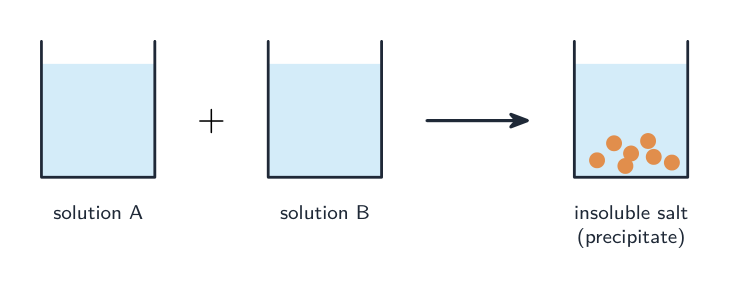
مزج محلولين قد يكون راسبًا غير قابل للذوبان
4.3

Three Ways to Represent a Reaction · ⁨ثلاث طرق لتمثيل التفاعل⁩

Syllabus · ⁨المنهج⁩
English

Learning Objective 4.3.A: Represent a given chemical reaction or physical process with a consistent particulate model.

  • 4.3.A.1 Balanced chemical equations in their various forms can be translated into symbolic particulate representations.
العربية

هدف التعلم 4.3.A: تمثيل تفاعل كيميائي معطى أو عملية فيزيائية بنموذج جسيمات متناسق.

  • 4.3.A.1 يمكن ترجمة المعادلات الكيميائية الموزونة بأشكالها المختلفة إلى تمثيلات جسيمية رمزية.

Source: College Board AP Course and Exam Description · ⁨المصدر: وصف دورة وامتحان College Board AP⁩

English

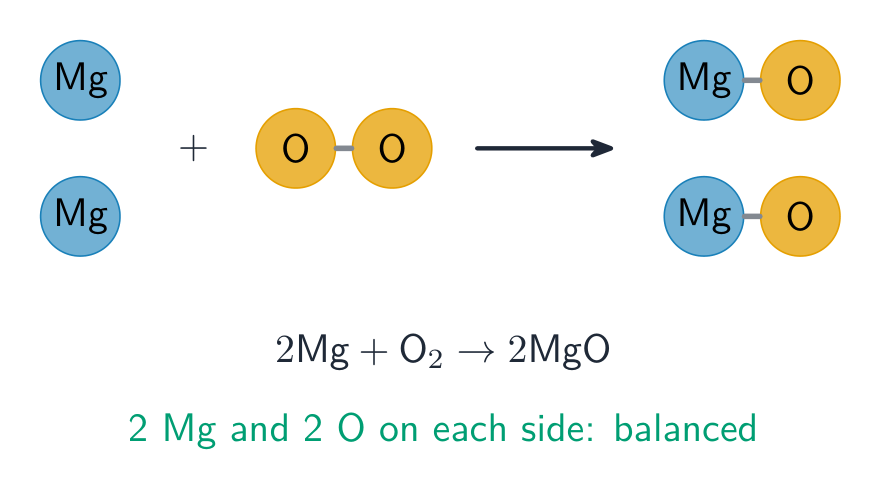
The same reaction can be shown as a symbolic equation, a particulate drawing (atoms and molecules), and a macroscopic observation (what you see). Moving between these levels – connecting the equation to the particles to the beaker – is a core skill.

العربية

يمكن عرض نفس التفاعل كمعادلة رمزية، ورسم جسيمات (ذرات وجزيئات)، وملاحظة ماكروسكوبية (ما تراه). الانتقال بين هذه المستويات – ربط المعادلة بالجسيمات بالبيشر – مهارة جوهرية.

المعادلة الموزونة تحتوي على نفس عدد كل ذرة في كلا الطرفين
4.4

Physical Changes versus Chemical Changes · ⁨التغيرات الفيزيائية مقابل التغيرات الكيميائية⁩

Syllabus · ⁨المنهج⁩
English

Learning Objective 4.4.A: Explain the relationship between macroscopic characteristics and bond interactions for: i. Chemical processes. ii. Physical processes.

  • 4.4.A.1 Processes that involve the breaking and/or formation of chemical bonds are typically classified as chemical processes. Processes that involve only changes in intermolecular interactions, such as phase changes, are typically classified as physical processes.
  • 4.4.A.2 Sometimes physical processes involve the breaking of chemical bonds. For example, plausible arguments could be made for the dissolution of a salt in water, as either a physical or chemical process, involves breaking of ionic bonds, and the formation of ion-dipole interactions between ions and solvent.
العربية

هدف التعلم 4.4.A: شرح العلاقة بين الخصائص الظاهرية وتفاعلات الروابط لـ: i. العمليات الكيميائية. ii. العمليات الفيزيائية.

  • 4.4.A.1 تُصنف العمليات التي تتضمن تكسير و/أو تكوين روابط كيميائية عادةً على أنها عمليات كيميائية. أما العمليات التي تتضمن فقط تغييرات في التفاعلات بين الجزيئات، مثل التغيرات الطورية، فتُصنف عادةً على أنها عمليات فيزيائية.
  • 4.4.A.2 أحيانًا تتضمن العمليات الفيزيائية تكسير الروابط الكيميائية. على سبيل المثال، يمكن تقديم حجج معقولة لفصل الملح في الماء، سواء كان عملية فيزيائية أو كيميائية، حيث يتضمن ذلك تكسير الروابط الأيونية، وتكوين تفاعلات أيون- ثنائي القطب بين الأيونات والمذيب.

Source: College Board AP Course and Exam Description · ⁨المصدر: وصف دورة وامتحان College Board AP⁩

English

A physical change 物理变化 alters form but not identity (melting, dissolving); a chemical change 化学变化 makes new substances by breaking and forming bonds. Dissolving salt is physical; the salt is unchanged and recoverable.

العربية

التغير الفيزيائي يغير الشكل لكن ليس الهوية (الانصهار، الذوبان)؛ التغير الكيميائي ينتج مواد جديدة بكسر وتكوين روابط. إذابة الملح هي فيزيائية؛ الملح لا يتغير ويمكن استرداده.

4.5

Stoichiometry · ⁨الحسابات الستوكيومترية⁩

Syllabus · ⁨المنهج⁩
English

Learning Objective 4.5.A: Explain changes in the amounts of reactants and products based on the balanced reaction equation for a chemical process.

  • 4.5.A.1 Because atoms must be conserved during a chemical process, it is possible to calculate product amounts by using known reactant amounts, or to calculate reactant amounts given known product amounts.
  • 4.5.A.2 Coefficients of balanced chemical equations contain information regarding the proportionality of the amounts of substances involved in the reaction. These values can be used in chemical calculations involving the mole concept.
  • 4.5.A.3 Stoichiometric calculations can be combined with the ideal gas law and calculations involving molarity to quantitatively study gases and solutions.
العربية

هدف التعلم 4.5.A: شرح التغيرات في كميات المتفاعلات والنواتج بناءً على معادلة التفاعل الموزونة لعملية كيميائية.

  • 4.5.A.1 نظرًا لأن الذرات يجب أن تحفظ أثناء العملية الكيميائية، فمن الممكن حساب كميات النواتج باستخدام كميات المتفاعلات المعروفة، أو حساب كميات المتفاعلات عند معرفة كميات النواتج.
  • 4.5.A.2 تحتوي معاملات المعادلات الكيميائية الموزونة على معلومات حول التناسب بين كميات المواد المشاركة في التفاعل. يمكن استخدام هذه القيم في الحسابات الكيميائية التي تتضمن مفهوم المول.
  • 4.5.A.3 يمكن دمج الحسابات الستوكيومترية مع قانون الغاز المثالي والحسابات المتعلقة بالتركيز المولاري لدراسة الغازات والمحاليل كمياً.

Source: College Board AP Course and Exam Description · ⁨المصدر: وصف دورة وامتحان College Board AP⁩

English

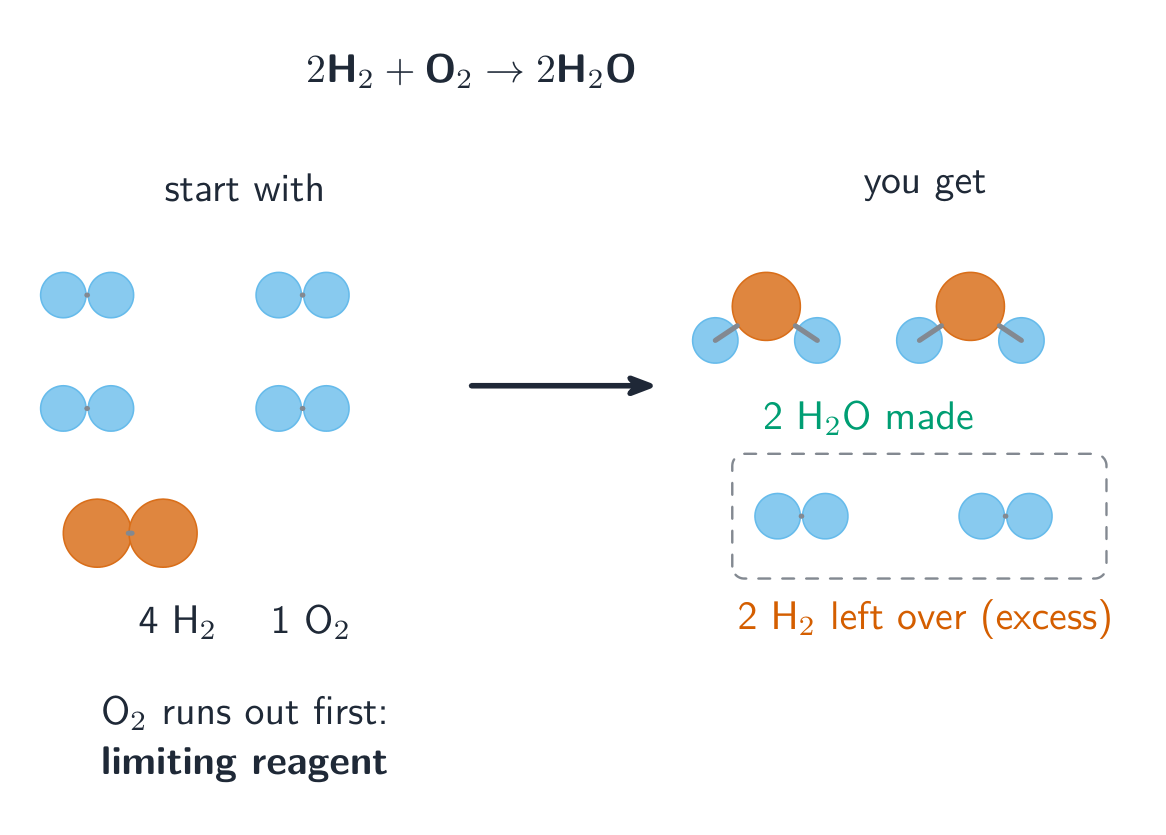
Stoichiometry 化学计量 uses the balanced equation's mole ratios to relate amounts of reactants and products. The path is always grams → moles → (mole ratio) → moles → grams. The limiting reactant 限量反应物 runs out first and sets the maximum product (the theoretical yield 理论产量); the percent yield compares actual to theoretical.

Worked example. How much water forms when $4.0\ \text{g}$ of hydrogen burns in excess oxygen? $2\text{H}_2+\text{O}_2\rightarrow2\text{H}_2\text{O}$. Convert to moles, cross the mole ratio ($2:2=1:1$ here), convert back:

$$n(\text{H}_2)=\frac{4.0}{2.0}=2.0\ \text{mol}\;\Rightarrow\;n(\text{H}_2\text{O})=2.0\ \text{mol}\;\Rightarrow\;m=2.0\times18=36\ \text{g}.$$

Worked example (limiting reactant). $10.0\ \text{g}$ of N$_2$ reacts with $5.0\ \text{g}$ of H$_2$ ($\text{N}_2+3\text{H}_2\rightarrow2\text{NH}_3$). Which runs out? Moles: $n(\text{N}_2)=10.0/28=0.36$, $n(\text{H}_2)=5.0/2=2.5$. The reaction needs $3$ H$_2$ per N$_2$; you have $2.5/0.36=7.0$, far more than $3$, so N$_2$ is limiting. It makes $2\times0.36=0.72\ \text{mol}$ of ammonia, with hydrogen left over.

العربية

الحسابات الستوكيومترية تستخدم نسب المولات من المعادلة الموزونة لربط كميات المتفاعلات والنواتج. المسار دائمًا: جرام → مولات → (نسبة المولات) → مولات → جرام. المتفاعل المحدد ينتهي أولاً ويحدد أقصى ناتج (العائد النظري)؛ العائد النسبي يقارن الفعلي بالنظري.

المتفاعل المحدد ينتهي أولاً ويحدد كمية الناتج المتكونة

مثال محلول. ما مقدار الماء المتكون عندما يحترق $4.0\ \text{g}$ من الهيدروجين في فائض الأكسجين؟ $2\text{H}_2+\text{O}_2\rightarrow2\text{H}_2\text{O}$. حوّل إلى مولات، عبر نسبة المولات ($2:2=1:1$ هنا)، حوّل مرة أخرى:

$$n(\text{H}_2)=\frac{4.0}{2.0}=2.0\ \text{mol}\;\Rightarrow\;n(\text{H}_2\text{O})=2.0\ \text{mol}\;\Rightarrow\;m=2.0\times18=36\ \text{g}.$$

مثال محلول (متفاعل محدود). $10.0\ \text{g}$ من N$_2$ يتفاعل مع $5.0\ \text{g}$ من H$_2$ ($\text{N}_2+3\text{H}_2\rightarrow2\text{NH}_3$). أيهما ينتهي أولاً؟ عدد المولات: $n(\text{N}_2)=10.0/28=0.36$، $n(\text{H}_2)=5.0/2=2.5$. التفاعل يحتاج $3$ H$_2$ لكل N$_2$؛ لديك $2.5/0.36=7.0$، أكثر بكثير من $3$، لذا N$_2$ هو المحدد. ينتج $2\times0.36=0.72\ \text{mol}$ من الأمونيا، مع بقاء هيدروجين زائد.

Explore · ⁨استكشف⁩

Scale reactants and products by the mole ratio · ⁨قيّم المتفاعلات والنواتج بناءً على نسبة المولات⁩

A balanced equation fixes the mole ratio between species. Product amount is proportional to the limiting reactant, scaled by that ratio. · ⁨معادلة موزونة تثبت نسبة المولات بين الأنواع. كمية النواتج تناسب طرديًا المتفاعل المحدد، مضروبة في تلك النسبة.⁩

4.6

Introduction to Titration · ⁨مقدمة في المعايرة⁩

Syllabus · ⁨المنهج⁩
English

Learning Objective 4.6.A: Identify the equivalence point in a titration based on the amounts of the titrant and analyte, assuming the titration reaction goes to completion.

  • 4.6.A.1 Titrations may be used to determine the amount of an analyte in solution. The titrant has a known concentration of a species that reacts specifically and quantitatively with the analyte. The equivalence point of the titration occurs when the analyte is totally consumed by the reacting species in the titrant. The equivalence point is often indicated by a change in a property (such as color) that occurs when the equivalence point is reached. This observable event is called the endpoint of the titration.
العربية

هدف التعلم 4.6.A: تحديد نقطة التكافؤ في المعايرة بناءً على كميات المحلول المعاير والمحلل، بافتراض أن تفاعل المعايرة يكتمل.

  • 4.6.A.1 يمكن استخدام المعايرة لتحديد كمية المادة المحلولة في المحلول. يحتوي الكاشف على تركيز معروف لنوع يتفاعل بشكل محدد وكمي مع المادة المراد تحليلها. occurs نقطة التكافؤ للمعايرة عندما تُستهلك المادة المراد تحليلها بالكامل بواسطة النوع المتفاعل في الكاشف. غالبًا ما يتم الإشارة إلى نقطة التكافؤ من خلال تغيير في خاصية (مثل اللون) يحدث عند الوصول إليها. يُسمى هذا الحدث القابل للرصد بنقطة النهاية للمعايرة.

Source: College Board AP Course and Exam Description · ⁨المصدر: وصف دورة وامتحان College Board AP⁩

English
An acid–base titration curve

A titration 滴定 finds an unknown concentration by reacting it with a solution of known concentration until they reach the equivalence point 等当点 (stoichiometrically equal). From the known volume and concentration, use the mole ratio to find the unknown. An indicator or a pH curve signals the endpoint.

Worked example. $25.0\ \text{mL}$ of hydrochloric acid is exactly neutralized by $30.0\ \text{mL}$ of $0.100\ \text{M}$ NaOH. Find the acid's concentration. The reaction is $1:1$, so the moles match:

$$n(\text{NaOH})=0.0300\times0.100=3.00\times10^{-3}\ \text{mol}=n(\text{HCl}),\qquad [\text{HCl}]=\frac{3.00\times10^{-3}}{0.0250}=0.120\ \text{M}.$$

العربية
منحنى معايرة حمض-قاعدة

المعايرة تجد تركيزاً مجهولاً بتفاعله مع محلول معلوم التركيز حتى يصلوا إلى نقطة التكافؤ (متساوية ستوكيومترياً). من الحجم والمعلومين والتركيز، استخدم نسبة المولات لإيجاد المجهول. المؤشر أو منحنى الرقم الهيدروجيني يشير إلى نقطة النهاية.

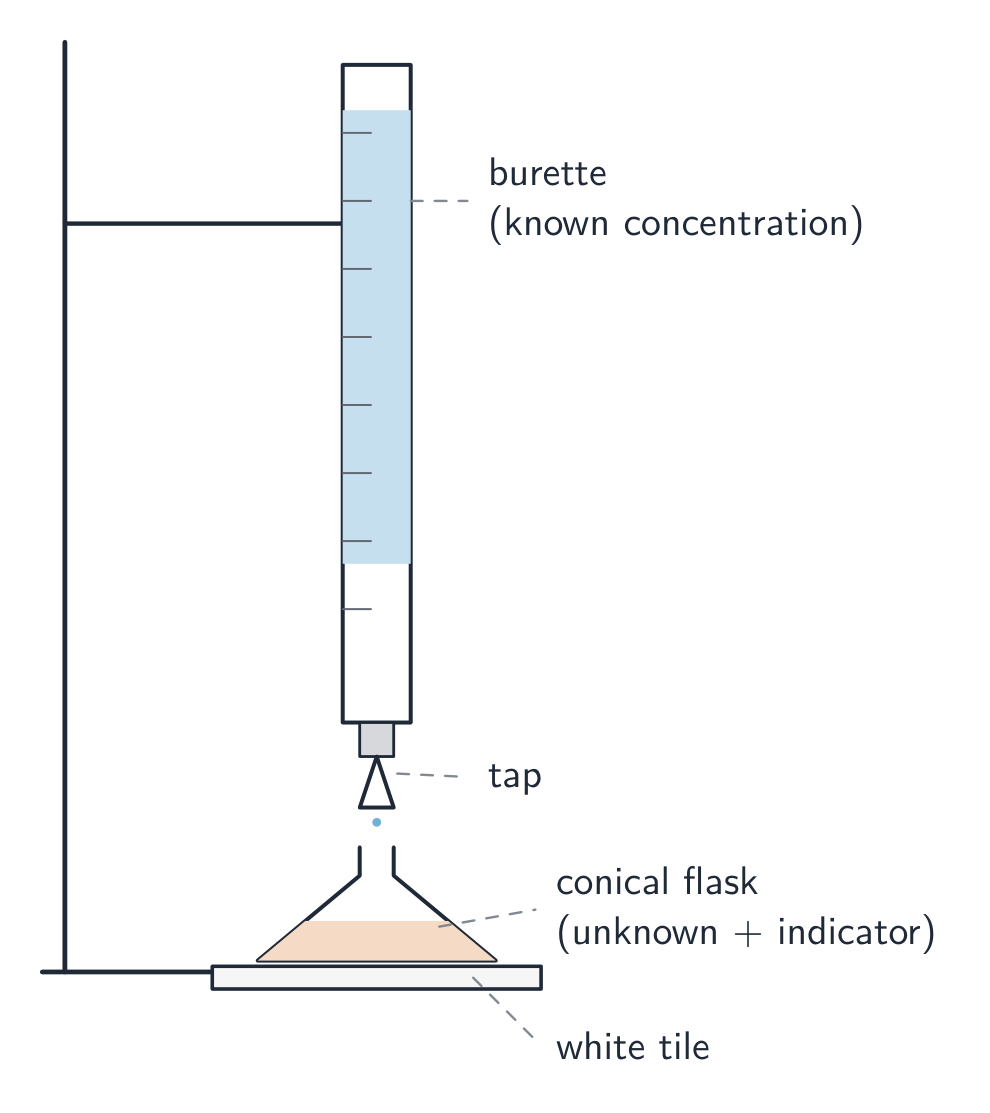
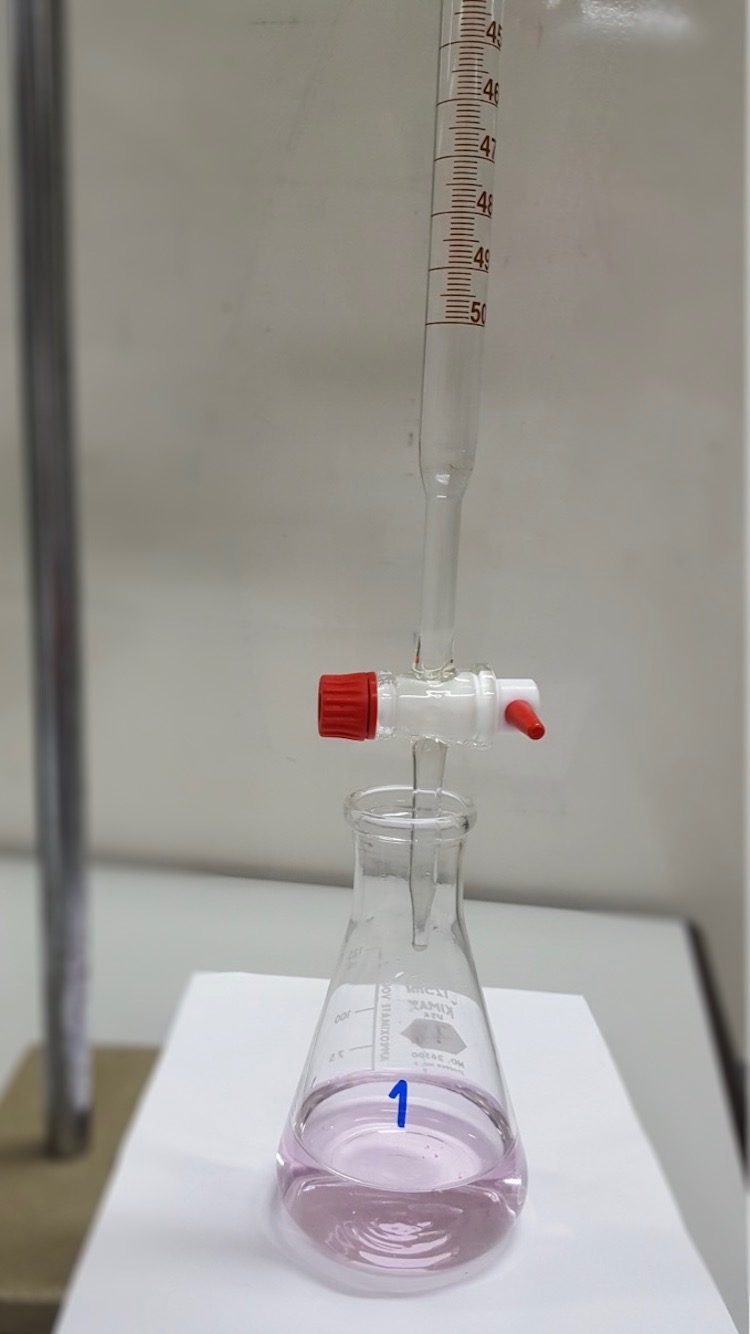
أجهزة المعايرة: البيريتي يصرف محلولاً معلوماً في دورق مخروطي
أجهزة المعايرة: البيريتي تعطي محلولاً معلوماً في دورق مخروطي

مثال محلول. $25.0\ \text{mL}$ من حمض الهيدروكلوريك يُعادل تماماً بواسطة $30.0\ \text{mL}$ من $0.100\ \text{M}$ NaOH. أوجد تركيز الحمض. التفاعل هو $1:1$، لذا تتطابق المولات:

$$n(\text{NaOH})=0.0300\times0.100=3.00\times10^{-3}\ \text{mol}=n(\text{HCl}),\qquad [\text{HCl}]=\frac{3.00\times10^{-3}}{0.0250}=0.120\ \text{M}.$$

إعداد المعايرة: أحجام التفاعل من البيريتي تجد تركيز محلول مجهول
Explore · ⁨استكشف⁩

Titrate an acid and find the equivalence point · ⁨أجرِ معايرة حمض وأوجد نقطة التكافؤ⁩

Adding base to acid raises the pH slowly, then sharply at the equivalence point where moles of acid and base are equal. The steep jump locates that volume. · ⁨إضافة قاعدة إلى الحمض ترفع الـ pH ببطء، ثم حادًا عند نقطة التكافؤ حيث تكون مولات الحمض والقاعدة متساوية. القفز الحاد يحدد ذلك الحجم.⁩

Vocabulary · ⁨مفردات⁩ Train · ⁨تدريب⁩
English العربية
chemical reaction/ˈkemɪkl rɪˈækʃn/ تفاعل كيميائي
precipitate/prɪˈsɪpɪteɪt/ راسب
net ionic equation/net aɪˈɒnɪk ɪˈkweɪʒn/ المعادلة الأيونية الصافية
spectator ions/spekˈteɪtə ˈaɪɒnz/ أيونات المشاهدة
physical change/ˈfɪzɪkl tʃeɪndʒ/ تغير فيزيائي
chemical change/ˈkemɪkl tʃeɪndʒ/ تغير كيميائي
Stoichiometry/ˌstəʊɪkɪˈɒmətri/ الحسابات الستوكيومترية
limiting reactant/ˈlɪmɪtɪŋ rɪˈæktənt/ المادة المتفاعلة المحددة
theoretical yield/θɪəˈretɪkl jiːld/ الناتج النظري
titration/taɪˈtreɪʃn/ المعايرة
equivalence point/ɪˈkwɪvələns pɔɪnt/ نقطة التكافؤ
acid/ˈæsɪd/ حمض
base/beɪs/ القاعدة
4.7

Types of Chemical Reactions · ⁨أنواع التفاعلات الكيميائية⁩

Syllabus · ⁨المنهج⁩
English

Learning Objective 4.7.A: Identify a reaction as acid-base, oxidation-reduction, or precipitation.

  • 4.7.A.1 Acid-base reactions involve transfer of one or more protons ($\text{H}^+$ ions) between chemical species.
  • 4.7.A.2 Oxidation-reduction (redox) reactions involve transfer of one or more electrons between chemical species, as indicated by changes in oxidation numbers of the involved species. Combustion is an important subclass of oxidation-reduction reactions, in which a species reacts with oxygen gas. In the case of hydrocarbons, carbon dioxide and water are products of complete combustion.
  • 4.7.A.3 In a redox reaction, electrons are transferred from the species that is oxidized to the species that is reduced.
    • Exclusion statement: The meaning of the terms "reducing agent" and "oxidizing agent" will not be assessed on the AP Exam.
  • 4.7.A.4 Oxidation numbers may be assigned to each of the atoms in the reactants and products; this is often an effective way to identify the oxidized and reduced species in a redox reaction.
  • 4.7.A.5 Precipitation reactions frequently involve mixing ions in aqueous solution to produce an insoluble or sparingly soluble ionic compound. All sodium, potassium, ammonium, and nitrate salts are soluble in water.
    • Exclusion statement: Rote memorization of "solubility rules" other than those implied in 4.7.A.5 will not be assessed on the AP Exam.
العربية

هدف التعلم 4.7.A: تحديد التفاعل كحمض-قاعدة، أو أكسدة-اختزال، أو ترسيب.

  • 4.7.A.1 تفاعلات الحمض والقاعدة تتضمن نقل بروتون واحد أو أكثر ($\text{H}^+$ أيونات) بين الأنواع الكيميائية.
  • 4.7.A.2 تفاعلات الأكسدة-الاختزال (الأكسدة الاختزال) تتضمن نقل إلكترون واحد أو أكثر بين الأنواع الكيميائية، كما هو موضح بتغيرات في أعداد الأكسدة للأنواع المشاركة. الاحتراق هو فرع فرعي مهم لتفاعلات الأكسدة-الاختزال، حيث يتفاعل نوع مع غاز الأكسجين. في حالة الهيدروكربونات، ثاني أكسيد الكربون والماء هي نواتج الاحتراق الكامل.
  • 4.7.A.3 في تفاعل الأكسدة-الاختزال، تنتقل الإلكترونات من النوع الذي تم أكسدته إلى النوع الذي تم اختزاله.
    • عبارة الاستبعاد: لن يتم تقييم معنى مصطلحي "عامل مختزل" و"عامل مؤكسد" في امتحان AP.
  • 4.7.A.4 يمكن تعيين أعداد الأكسدة لكل من الذرات في المتفاعلات والنواتج؛ وغالبًا ما يكون هذا طريقة فعالة لتحديد الأنواع المؤكسدة والمختزلة في تفاعل الأكسدة-الاختزال.
  • 4.7.A.5 تفاعلات الترسيب تنطوي عادةً على خلط الأيونات في محلول مائي لإنتاج مركب أيوني غير قابل للذوبان أو قليل الذوبان. جميع أملاح الصوديوم والبوتاسيوم والأمونيوم والنترات قابلة للذوبان في الماء.
    • عبارة الاستبعاد: الحفظ الصم لـ"قواعد الذوبانية" الأخرى غير تلك المستنتجة من 4.7.A.5 لن يتم تقييمها في امتحان AP.

Source: College Board AP Course and Exam Description · ⁨المصدر: وصف دورة وامتحان College Board AP⁩

English

Common patterns include synthesis (combining), decomposition (breaking apart), combustion (with oxygen, releasing energy), precipitation (forming an insoluble solid), acid–base (proton transfer), and redox (electron transfer). Recognizing the type helps predict the products.

العربية

تشمل الأنماط الشائعة البناء (الدمج)، التحلل (التفكك)، الاحتراق (مع الأكسجين، إطلاق الطاقة)، ترسيب (تكون صلب غير قابل للذوبان)، حمض-قاعدة (نقل بروتون)، و أكسدة-اختزال (نقل إلكترونات). التعرف على النوع يساعد في توقع النواتج.

4.8

Acid-Base Reactions · ⁨تفاعلات الأحماض والقواعد⁩

Syllabus · ⁨المنهج⁩
English

Learning Objective 4.8.A: Identify species as Brønsted-Lowry acids, bases, and/or conjugate acid-base pairs, based on proton-transfer involving those species.

  • 4.8.A.1 By definition, a Brønsted-Lowry acid is a proton donor and a Brønsted-Lowry base is a proton acceptor.
  • 4.8.A.2 Only in aqueous solutions, water plays an important role in many acid-base reactions, as its molecular structure allows it to accept protons from and donate protons to dissolved species.
  • 4.8.A.3 When an acid or base ionizes in water, the conjugate acid-base pairs can be identified and their relative strengths compared.
    • Exclusion statement: Lewis acid-base concepts will not be assessed on the AP Exam. The emphasis in AP Chemistry is on reactions in aqueous solution.
العربية

هدف التعلم 4.8.A: تحديد الأنواع كأحماض وبرونستد-لووري وقواعد وأزواج حمض-قاعدة مترافقة، بناءً على انتقال البروتونات التي تنطوي عليها تلك الأنواع.

  • 4.8.A.1 حسب التعريف، حمض برونستد-لووري هو مانح للبروتونات وقاعدة برونستد-لووري هي مستقبل للبروتونات.
  • 4.8.A.2 فقط في المحاليل المائية، يلعب الماء دورًا مهمًا في العديد من تفاعلات الحمض والقاعدة، لأن بنيته الجزيئية تسمح له باستقبال البروتونات منه ومنح البروتونات للأنواع المذابة.
  • 4.8.A.3 عند تأين حمض أو قاعدة في الماء، يمكن تحديد أزواج الأحماض والقواعد المترافقة ومقارنة قوتها النسبية.
    • عبارة الاستبعاد: مفاهيم أحماض وقواعد لويس لن يتم تقييمها في امتحان AP. التركيز في كيمياء AP هو على التفاعلات في المحلول المائي.

Source: College Board AP Course and Exam Description · ⁨المصدر: وصف دورة وامتحان College Board AP⁩

English

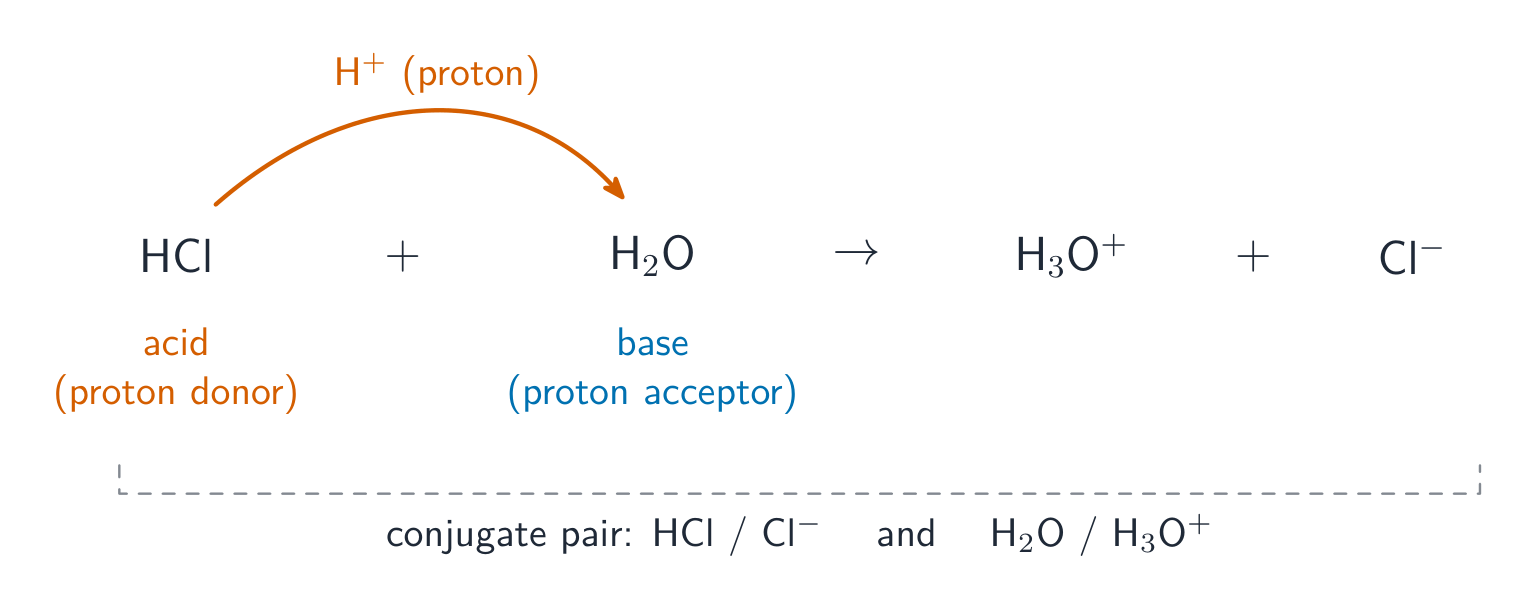
An acid 酸 donates a proton ($\text{H}^+$); a base 碱 accepts one (Brønsted–Lowry). They react to form water and a salt: $\text{H}^+ + \text{OH}^- \rightarrow \text{H}_2\text{O}$. Strong acids and bases dissociate completely; weak ones only partly.

العربية

الحمض يمنح بروتوناً ($\text{H}^+$)؛ القاعدة تستقبل واحداً (برونستد-لوري). يتفاعلان لتكوين ماء وملح: $\text{H}^+ + \text{OH}^- \rightarrow \text{H}_2\text{O}$. الأحماض والقواعد القوية تتأين كلياً؛ الضعيفة جزئياً فقط.

برونستيد-لوري: الحمض يتبرع ببروتون للقاعدة، مكوناً زوجين مترافقين
Explore · ⁨استكشف⁩

Move along the pH scale · ⁨تحرّك على مقياس الـ pH⁩

pH measures how acidic or basic a solution is. Each step of 1 pH is a tenfold change in hydrogen-ion concentration; 7 is neutral, below is acidic, above is basic. · ⁨pH يقيس مدى حمضية أو قاعدية المحلول. كل خطوة بمقدار 1 في الـ pH تمثل تغييرًا عشر أضعاف في تركيز أيونات الهيدروجين؛ 7 متعادل، ما أسفله حمضي، وما فوقه قاعدي.⁩

4.9

Oxidation-Reduction (Redox) Reactions · ⁨تفاعلات الأكسدة-الاختزال (Redox)⁩

Syllabus · ⁨المنهج⁩
English

Learning Objective 4.9.A: Represent a balanced redox reaction equation using half-reactions.

  • 4.9.A.1 Balanced chemical equations for redox reactions can be constructed from half-reactions.
العربية

هدف التعلم 4.9.A: تمثيل معادلة تفاعل أكسدة-اختزال متوازنة باستخدام أنصاف التفاعلات.

  • 4.9.A.1 يمكن بناء المعادلات الكيميائية الموزونة لتفاعلات الأكسدة-الاختزال من أنصاف التفاعلات.

Source: College Board AP Course and Exam Description · ⁨المصدر: وصف دورة وامتحان College Board AP⁩

English

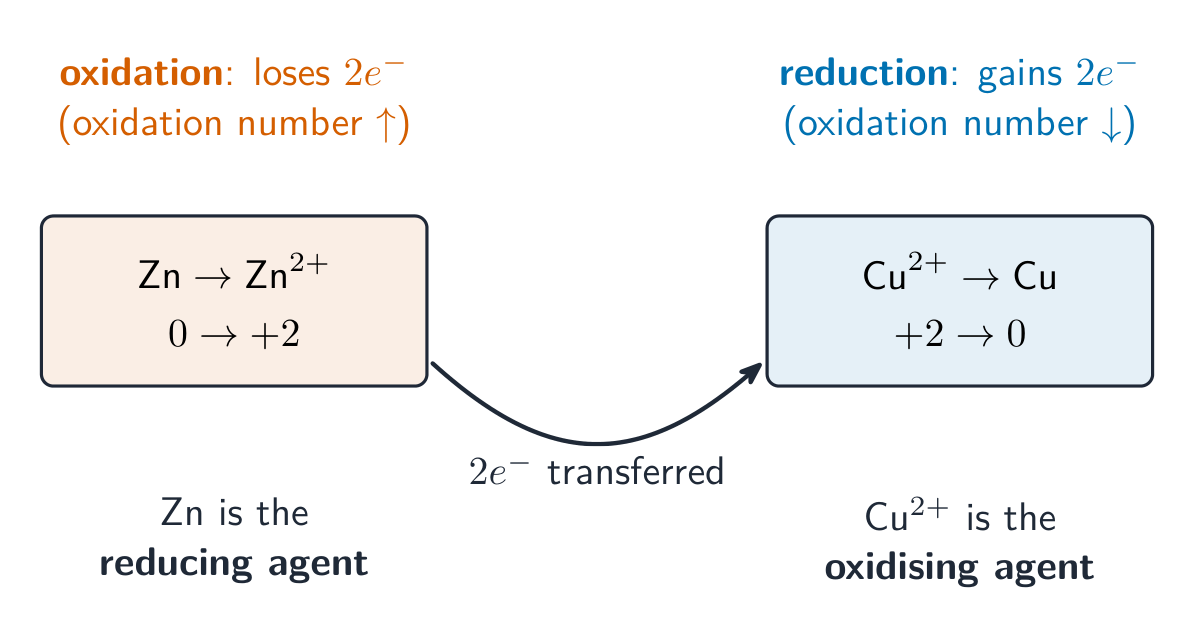
In a redox 氧化还原 reaction, electrons transfer between species. Oxidation 氧化 is loss of electrons (oxidation number rises); reduction 还原 is gain (oxidation number falls). Track changes with oxidation numbers, and remember every oxidation is paired with a reduction – the electrons lost equal the electrons gained.

Worked example. Find the oxidation number of manganese in permanganate, $\text{KMnO}_4$. Potassium is $+1$ and each oxygen is $-2$ (four of them, $-8$). The whole formula is neutral, so $(+1)+\text{Mn}+(-8)=0$, giving $\text{Mn}=+7$ – its maximum, which is why permanganate is a powerful oxidizing agent (it can only gain electrons).

العربية

في تفاعل أكسدة-اختزال، تنتقل الإلكترونات بين الأنواع. الأكسدة هي فقدان الإلكترونات (يرتفع رقم التأكسد)؛ الاختزال هو اكتساب (ينخفض رقم التأكسد). تتبع التغيرات عبر أرقام التأكسد، وتذكر أن كل أكسدة مقترنة باختزال – الإلكترونات المفقودة تساوي المكتسبة.

الأكسدة-الاختزال هي نقل إلكترونات: العامل المختزل يُأكسد، والعامل المؤكسد يُختزل

مثال محلول. أوجد عدد تأكسد المنجنيز في البرمنغنات، $\text{KMnO}_4$. البوتاسيوم هو $+1$ وكل أكسجين هو $-2$ (أربعة منها، $-8$). الصيغة بأكملها متعادلة، لذا $(+1)+\text{Mn}+(-8)=0$، مما يعطي $\text{Mn}=+7$ – وهي القيمة القصوى له، ولهذا السبب يُعد البرمنغنات عامل مؤكسد قوياً (لأنه يمكنه اكتساب الإلكترونات فقط).

Explore · ⁨استكشف⁩

Watch electrons transfer in a redox reaction · ⁨راقب انتقال الإلكترونات في تفاعل الأكسدة والاختزال⁩

In a redox reaction one species is oxidised (loses electrons) and another is reduced (gains them). Follow the electrons move from the metal to the non-metal. · ⁨في تفاعل أكسدة واختزال، يتم أكسدة نوع واحد (يفقد إلكترونات) واختزال نوع آخر (يكتسبها). تابع حركة الإلكترونات من المعدن إلى اللافلز.⁩

Vocabulary · ⁨مفردات⁩ Train · ⁨تدريب⁩
English العربية
redox/rɪˈdɒks/ أكسدة واختزال
Oxidation/ˌɒksɪˈdeɪʃn/ الأكسدة
reduction/rɪˈdʌkʃn/ الاختزال
4.9

Exam tips · ⁨نصائح للامتحان⁩

English
  • Balance every equation and work in moles — convert grams→moles, cross the mole ratio, then convert back.
  • Find the limiting reactant by comparing mole ratios; it sets the maximum product (theoretical yield).
  • In redox, remember OIL RIG: oxidation is loss of electrons, reduction is gain; every oxidation is paired with a reduction.
  • For titrations use the balanced ratio to link the known and unknown at the equivalence point.
  • A net ionic equation shows only the species that change; leave out spectator ions.
العربية
  • موازن كل معادلة واعمل بـ المولات — حول الجرامات→مولات، مر بنسبة المولات، ثم حول مرة أخرى.
  • حدد العامل المحدد بمقارنة نسب المولات؛ فهو يحدد أقصى ناتج (الناتج النظري).
  • في التأكسد والاختزال، تذكر OIL RIG: التأكسد هو فقدان الإلكترونات، الاختزال هو اكتسابها؛ كل تأكسد يقابله اختزال.
  • في المعايرة استخدم النسبة الموزونة لربط المعروف بالمجهول عند نقطة التكافؤ.
  • معادلة الأيونات الصافية تظهر فقط الأنواع التي تتغير؛ اترك أيونات المشاهدة.

Interactive lessons on this topic · ⁨دروس تفاعلية حول هذا الموضوع⁩

Work through it step by step, with instant-check exercises. · ⁨ا-working عليه خطوة بخطوة، مع تمارين تحقق فوري.⁩

Past Papers · ⁨أوراق الامتحانات السابقة⁩

More topics in AP Chemistry · ⁨AP الكيمياء⁩ · ⁨المزيد من المواضيع في AP Chemistry · ⁨AP الكيمياء⁩⁩

Log in or create account · ⁨تسجيل الدخول أو إنشاء حساب⁩

IGCSE, A-Level & AP