Skip to content · ⁨الانتقال إلى المحتوى⁩

Cellular Energetics · ⁨استقلاب الخلايا⁩

AP Biology · ⁨AP علم الأحياء⁩ · Topic 3 · ⁨الموضوع 3⁩

Video lesson for this topic · ⁨درس فيديو لهذا الموضوع⁩ Open the video page · ⁨افتح صفحة الفيديو⁩
9:13

استقلاب الخلايا

انظر إلى مسحوق الغسيل في خزانة المطبخ. في الماء الدافئ يزيل بقعة طعام في نصف ساعة. في المختبر، نفس المهمة تتطلب حمض قوي وغليان…

English narration · English + 中文 subtitles burned in · ⁨سرد باللغة الإنجليزية · ترجمة مدمجة بالإنجليزية + الصينية⁩

3.1

Enzymes as Biological Catalysts · ⁨الإنزيمات كمحفزات بيولوجية⁩

Syllabus · ⁨المنهج⁩
English

Big Idea 2 — Energetics: Biological systems use energy and molecular building blocks to grow, reproduce, and maintain dynamic homeostasis.

Learning Objective 3.1.A: Explain how enzymes affect the rate of biological reactions.

  • 3.1.A.1 The structure and function of enzymes contribute to the regulation of biological processes. Enzymes are proteins that are biological catalysts that facilitate chemical reactions in cells by lowering the activation energy.
  • 3.1.A.2 For an enzyme-mediated chemical reaction to occur, the shape and charge of the substrate must be compatible with the active site of the enzyme. This is illustrated by the enzyme-substrate complex model.
العربية

الفكرة الكبرى 2 — الديناميكا الحرارية: تستخدم الأنظمة البيولوجية الطاقة والكتل البنائية الجزيئية للنمو والتكاثر والحفاظ على ديناميكية التوازن الداخلي.

الهدف التعليمي 3.1.A: اشرح كيف تؤثر الإنزيمات على معدل التفاعلات البيولوجية.

  • 3.1.A.1 يساهم البنية والوظيفة للإنزيمات في تنظيم العمليات البيولوجية. الإنزيمات هي بروتينات تعمل كمحفزات بيولوجية تسهل التفاعلات الكيميائية في الخلايا عن طريق خفض طاقة التنشيط.
  • 3.1.A.2 لكي يحدث تفاعل كيميائي محفز بإنزيم، يجب أن يكون الشكل والشحنة للمادة المتفاعلة متوافقًا مع الموقع النشط للإنزيم. يتم ذلك التوضيح بواسطة نموذج معقد الإنزيم-المادة المتفاعلة.
Source: College Board AP Course and Exam Description · ⁨المصدر: وصف دورة وامتحان College Board AP⁩

English

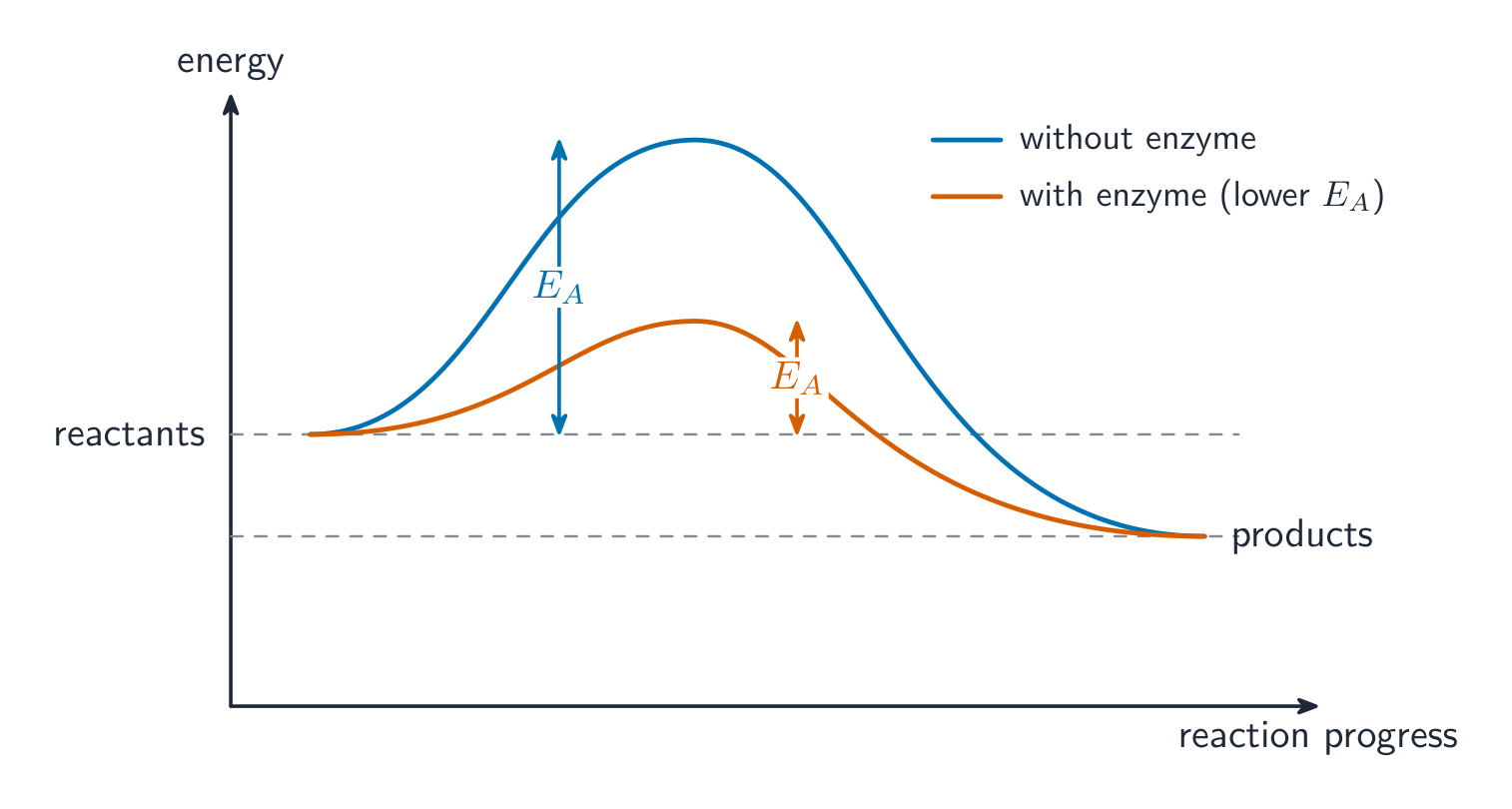
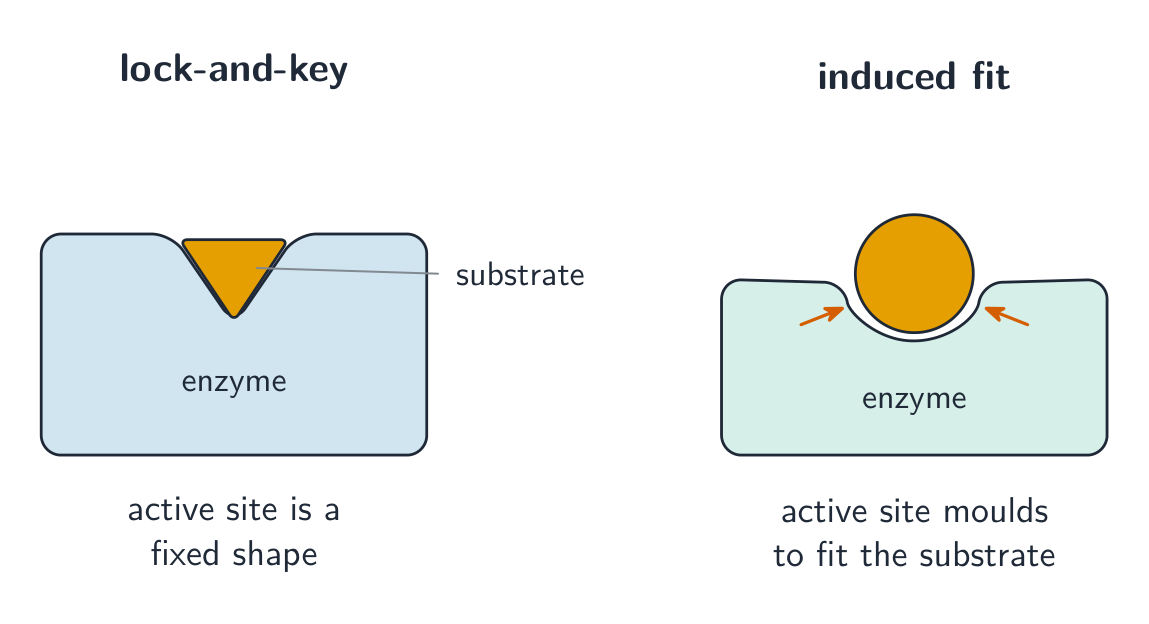
An enzyme 酶 is a protein catalyst 催化剂 that speeds a reaction by lowering its activation energy 活化能, without being used up. Each enzyme has an active site 活性位点 that binds a specific substrate 底物 (the "lock and key" or induced fit), so enzymes are highly specific. They do not change whether a reaction is favorable – only how fast it goes.

العربية
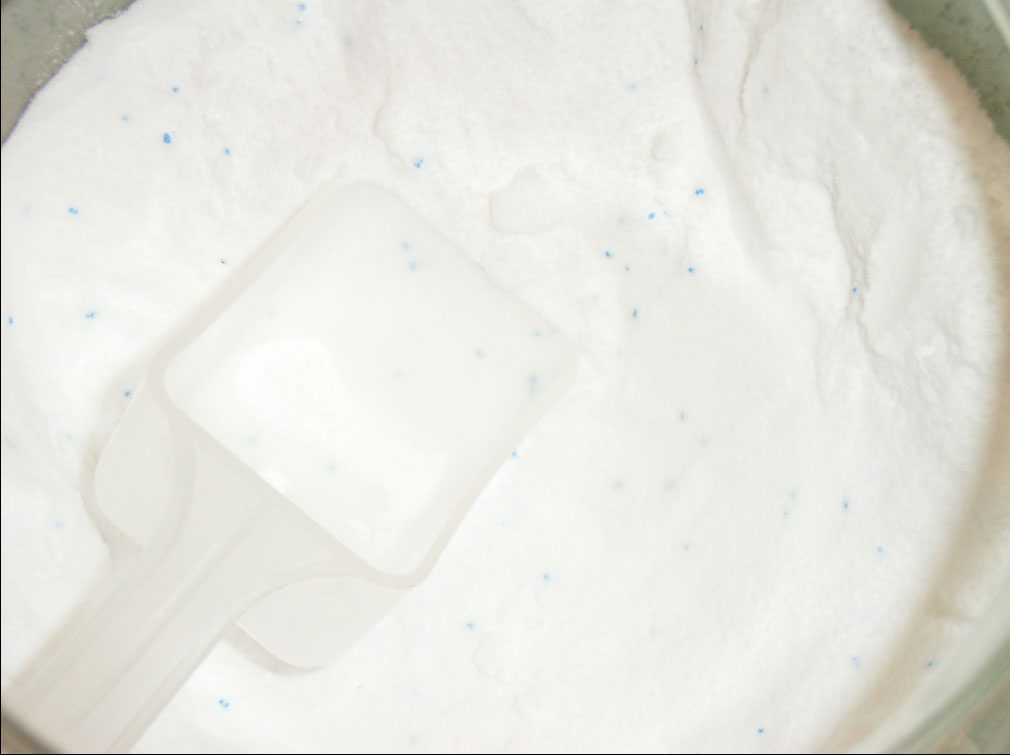
مسحوق غسيل حيوي يستخدم إنزيمات تعمل في درجة حرارة وحموضة معتدلتين

الإنزيم هو بروتين محفز يسرع التفاعل عن طريق خفض طاقة التنشيط، دون أن يُستهلك. لكل إنزيم موقع نشط يرتبط بـركيزة محددة (نموذج "القفل والمفتاح" أو التكيف المستحث)، مما يجعل الإنزيمات عالية التخصص. لا يغير الإنزيم ما إذا كان التفاعل مواتيًا أم لا - بل يحدد فقط سرعته.

يُخفض الإنزيم طاقة التنشيط للتفاعل
نموذجي القفل والمفتاح والتكيف المستحث لعمل الإنزيم
Explore · ⁨استكشف⁩

Raise substrate and watch the rate saturate · ⁨ارفع المادة المتفاعلة وشاهد معدل التفاعل يصل إلى التشبع⁩

An enzyme speeds a reaction by lowering activation energy. As substrate rises the rate climbs, then levels off once every active site is busy (saturation). · ⁨الإنزيم يسرع التفاعل عن طريق خفض طاقة التنشيط. كلما زاد المادة المتفاعلة ارتفع المعدل، ثم يستقر عندما تكون جميع المواقع النشطة مشغولة (التشبع).⁩

Vocabulary · ⁨مفردات⁩ Train · ⁨تدريب⁩
English العربية
enzyme/ˈenzaɪm/ إنزيم
catalyst/ˈkætəlɪst/ المحفز
activation energy/ˌæktɪˈveɪʃn ˈenədʒi/ طاقة التنشيط
active site/ˈæktɪv saɪt/ الموقع النشط
substrate/ˈsʌbstreɪt/ الجزيء المتفاعل
denatures/ˈdenətʃəz/ يتمسخ
Inhibitors/ɪnˈhɪbɪtəz/ المثبطات
The first law/ðə fɜːst lɔː/ القانون الأول
The second law/ðə ˈsekənd lɔː/ القانون الثاني
entropy/ˈentrəpi/ الإنتروبيا
constant input of free energy/ˈkɒnstənt ˈɪnpʊt ɒv friː ˈenədʒi/ مدخلات مستمرة للطاقة الحرة
Photosynthesis/ˌfəʊtəʊˈsɪnθəsɪs/ البناء الضوئي
Calvin cycle/ˈkælvɪn ˈsaɪkl/ دورة كالفن
prokaryotes/ˈprɒkərɪəʊts/ بدائيات النواة
cyanobacteria/ˌsaɪəˌnɒbəkˈtɪərɪə/ البكتيريا الخضراء المزرقة
oxygenated atmosphere/ˈɒksɪdʒeneɪtɪd ˈætməsfɪə/ الغلاف الجوي المؤكسد
banded iron formations/ˈbændɪd ˈaɪən fɔːˈmeɪʃnz/ تشكيلات الحديد المخطط
Cellular respiration/ˈseljʊlə ˌrespɪˈreɪʃn/ التنفس الخلوي
Glycolysis/ɡlaɪˈkɒləsɪs/ تحلل السكر
Krebs cycle/krebz ˈsaɪkl/ دورة كريبس
electron transport chain/ɪˈlektrɒn ˈtrænspɔːt tʃeɪn/ سلسلة نقل الإلكترون
fermentation/fɜːmənˈteɪʃn/ التخمر
3.2

Environmental Impacts on Enzyme Function · ⁨التأثيرات البيئية على عمل الإنزيم⁩

Syllabus · ⁨المنهج⁩
English

Big Idea 2 — Energetics: Biological systems use energy and molecular building blocks to grow, reproduce, and maintain dynamic homeostasis.

Learning Objective 3.2.A: Explain how changes to the structure of an enzyme may affect its function.

  • 3.2.A.1 Change to the molecular structure of a component in an enzymatic system may result in a change to its function or efficiency.
    • i. Denaturation of proteins, such as enzymes, occurs when the protein structure is disrupted by a change in temperature, pH, or chemical environment, eliminating the ability to catalyze reactions.
    • ii. Environmental temperatures and pH outside the optimal range for a given enzyme will cause changes to its structure (by disrupting the hydrogen bonds), altering the efficiency with which it catalyzes reactions.
  • 3.2.A.2 In some cases, enzyme denaturation is reversible, allowing the enzyme to regain activity.

Learning Objective 3.2.B: Explain how the cellular environment affects enzyme activity.

  • 3.2.B.1 The relative concentrations of substrates and products determine how efficiently an enzymatic reaction proceeds.
العربية

الفكرة الكبرى 2 — الديناميكا الحرارية: تستخدم الأنظمة البيولوجية الطاقة والكتل البنائية الجزيئية للنمو والتكاثر والحفاظ على ديناميكية التوازن الداخلي.

الهدف التعليمي 3.2.A: اشرح كيف قد تؤثر التغييرات في بنية الإنزيم على وظيفته.

  • 3.2.A.1 قد يؤدي التغيير في البنية الجزيئية لمكون في نظام إنزيمي إلى تغيير في وظيفته أو كفاءته.
    • i. يحدث تمسخ البروتينات، مثل الإنزيمات، عندما تتعرض بنية البروتين للاضطراب بسبب تغير في درجة الحرارة أو الرقم الهيدروجيني أو البيئة الكيميائية، مما يلغي القدرة على تحفيز التفاعلات.
    • ii. ستؤدي درجات الحرارة المحيطة والرقم الهيدروجيني خارج النطاق الأمثل لإنزيم معين إلى تغييرات في بنيته (عن طريق اضطراب الروابط الهيدروجينية)، مما يغير الكفاءة التي يحفز بها التفاعلات.
  • 3.2.A.2 في بعض الحالات، يكون تمسخ الإنزيم عكسياً، مما يسمح للإنزيم باستعادة نشاطه.

الهدف التعليمي 3.2.B: اشرح كيف يؤثر البيئة الخلوية على نشاط الإنزيم.

  • 3.2.B.1 تحدد النسب النسبية للمواد المتفاعلة والمنتجات مدى كفاءة سير التفاعل الإنزيمي.

Source: College Board AP Course and Exam Description · ⁨المصدر: وصف دورة وامتحان College Board AP⁩

English

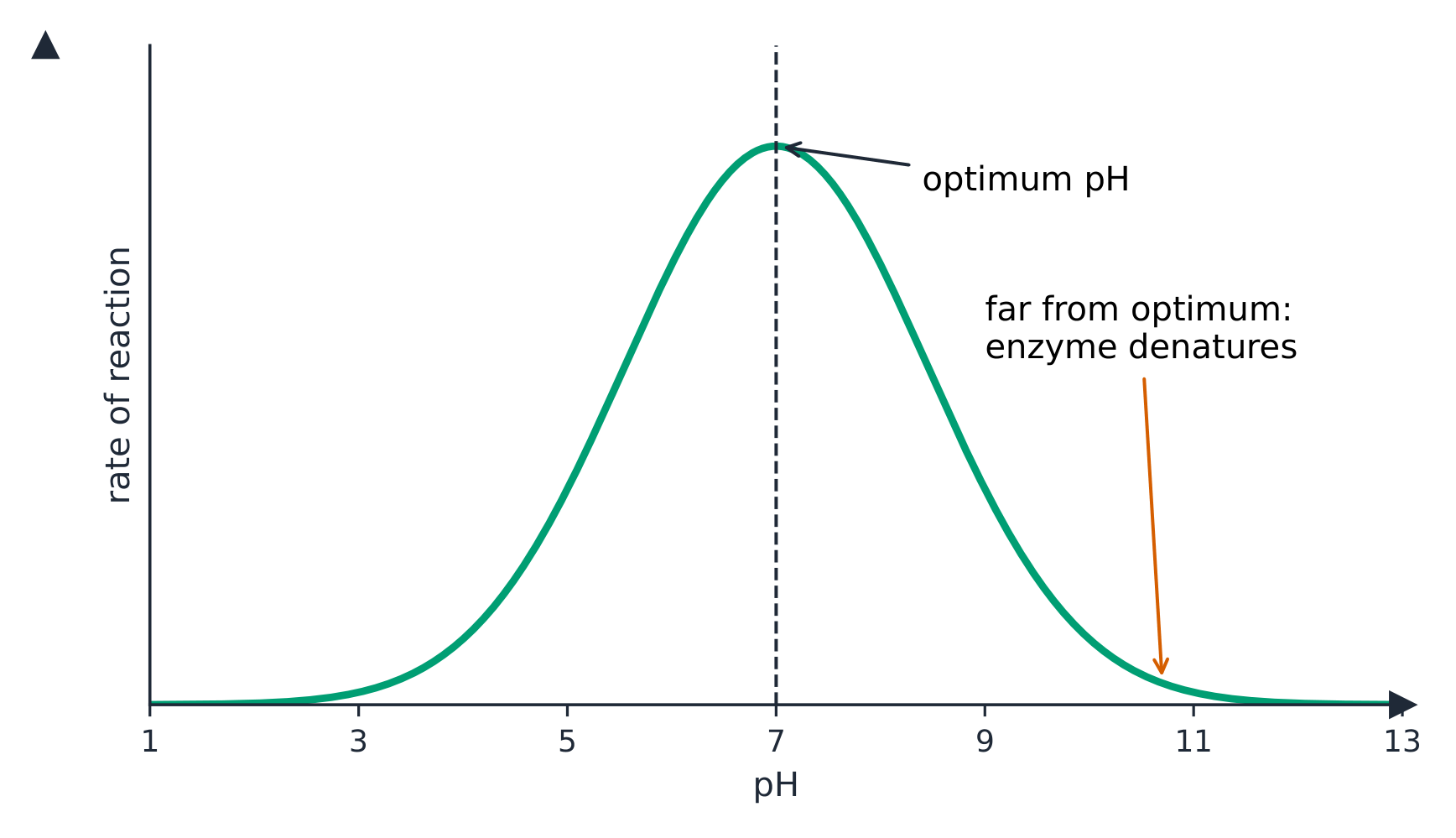
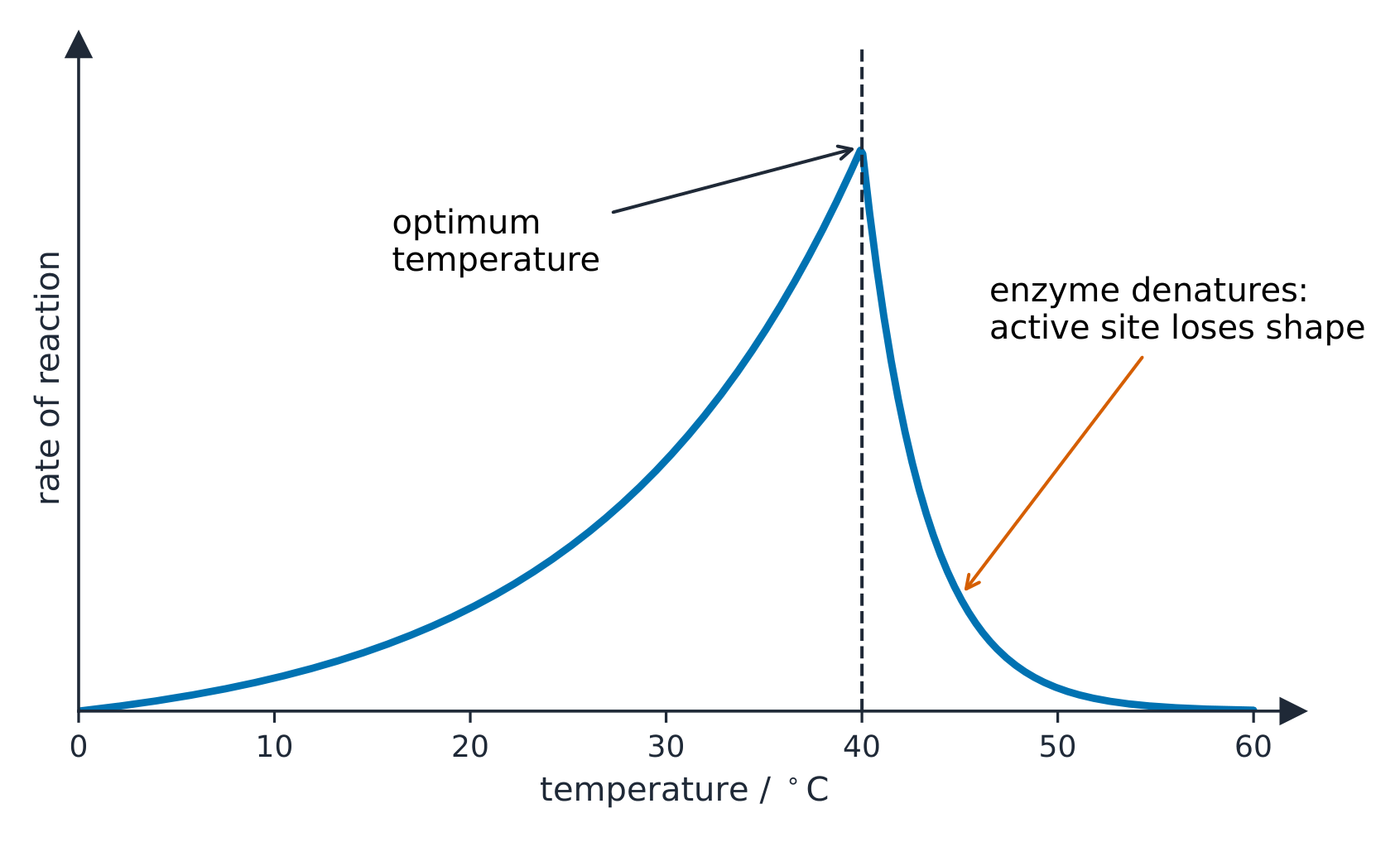
Enzyme activity depends on conditions. Each enzyme has an optimal temperature and pH; beyond it, the protein denatures 变性 (loses shape) and stops working. Substrate concentration raises the rate until the enzyme saturates. Inhibitors 抑制剂 slow enzymes – competitive ones block the active site, noncompetitive ones bind elsewhere and change the shape.

العربية

يعتمد نشاط الإنزيم على الظروف. لكل إنزيم درجة حرارة وحموضة مثلى; تتجاوزها، يتحلل البروتين (يفقد شكله) ويتوقف عن العمل. تركيز الركيزة يرفع السرعة حتى تشبع الإنزيم. المثبطات تُبطئ الإنزيمات - المنافسة تحجب الموقع النشط، وغير المنافسة ترتبط في مكان آخر وتغير الشكل.

لكل إنزيم حموضة مثلى
يرتفع المعدل حتى تصل إلى درجة حرارة مثلى، ثم ينخفض عندما يتحلل الإنزيم
Explore · ⁨استكشف⁩

Change temperature and watch enzyme activity · ⁨غيّر درجة الحرارة وشاهد نشاط الإنزيم⁩

Each enzyme has an optimum temperature and pH. Too cold is slow; too hot denatures the enzyme so its active site loses shape and activity crashes. · ⁨لكل إنزيم درجة حرارة مثلى ودرجة حموضة. البرودة الشديدة تجعله بطيئاً؛ والحرارة الشديدة تُدمّره بحيث تفقد موقعه النشط شكله وينهار النشاط.⁩

3.3

Cellular Energy and ATP · ⁨الطاقة الخلوية وATP⁩

Syllabus · ⁨المنهج⁩
English

Big Idea 2 — Energetics: Biological systems use energy and molecular building blocks to grow, reproduce, and maintain dynamic homeostasis.

Learning Objective 3.3.A: Describe the role of energy in living organisms.

  • 3.3.A.1 All living systems require an input of energy.
  • 3.3.A.2 Life requires a highly ordered system and does not violate the first and second laws of thermodynamics.
    • i. Energy input must exceed energy loss to maintain order and to power cellular processes.
    • ii. Cellular processes that release energy may be coupled with cellular processes that require energy.
    • iii. Significant loss of order or energy flow results in death.
    • Exclusion statement: Students will need to understand the concept of energy, but the equation for Gibbs free energy is beyond the scope of the AP Exam.
  • 3.3.A.3 Energy-related pathways in biological systems are sequential to allow for a more controlled transfer of energy. A product of a reaction in a metabolic pathway is typically the reactant for the subsequent step in the pathway.

Learning Objective 3.3.B: Explain how shared, conserved, and fundamental processes and features support the concept of common ancestry for all organisms.

  • 3.3.B.1 Core metabolic pathways (e.g., glycolysis, oxidative phosphorylation) are conserved across all currently recognized domains (Archaea, Bacteria, and Eukarya).
العربية

الفكرة الكبرى 2 — الديناميكا الحرارية: تستخدم الأنظمة البيولوجية الطاقة والكتل البنائية الجزيئية للنمو والتكاثر والحفاظ على ديناميكية التوازن الداخلي.

الهدف التعليمي 3.3.A: صف دور الطاقة في الكائنات الحية.

  • 3.3.A.1 تتطلب جميع الأنظمة الحية إدخال طاقة.
  • 3.3.A.2 تتطلب الحياة نظاماً عالي التنظيم ولا تنتهك القانونين الأول والثاني الديناميكي الحراري.
    • i. يجب أن يتجاوز إدخال الطاقة الفقدان للحفاظ على النظام ولتشغيل العمليات الخلوية.
    • ii. قد ترتبط العمليات الخلوية التي تطلق الطاقة بالعمليات الخلوية التي تتطلب الطاقة.
    • iii. يؤدي فقدان كبير للنظام أو تدفق الطاقة إلى الموت.
    • عبارة الاستبعاد: سيحتاج الطلاب إلى فهم مفهوم الطاقة، لكن معادلة الطاقة الحرة لجيبس تقع خارج نطاق امتحان AP.
  • 3.3.A.3 مسارات الطاقة في الأنظمة البيولوجية متسلسلة للسماح بنقل أكثر تحكمًا للطاقة. عادة ما تكون ناتج تفاعل في مسار استقلابي هو المادة المتفاعلة للخطوة التالية في المسار.

الهدف التعليمي 3.3.B: اشرح كيف تدعم العمليات والميزات المشتركة والمحمية والأساسية مفهوم النسب المشترك لجميع الكائنات.

  • 3.3.B.1 المسارات الاستقلابية الأساسية (مثل التحلل السكري، والفسفرة المؤكسدة) محفوظة عبر جميع المجالات المعترف بها حالياً (البدائيات العُظمى، البكتيريا، وحقيقيات النواة).

Source: College Board AP Course and Exam Description · ⁨المصدر: وصف دورة وامتحان College Board AP⁩

English

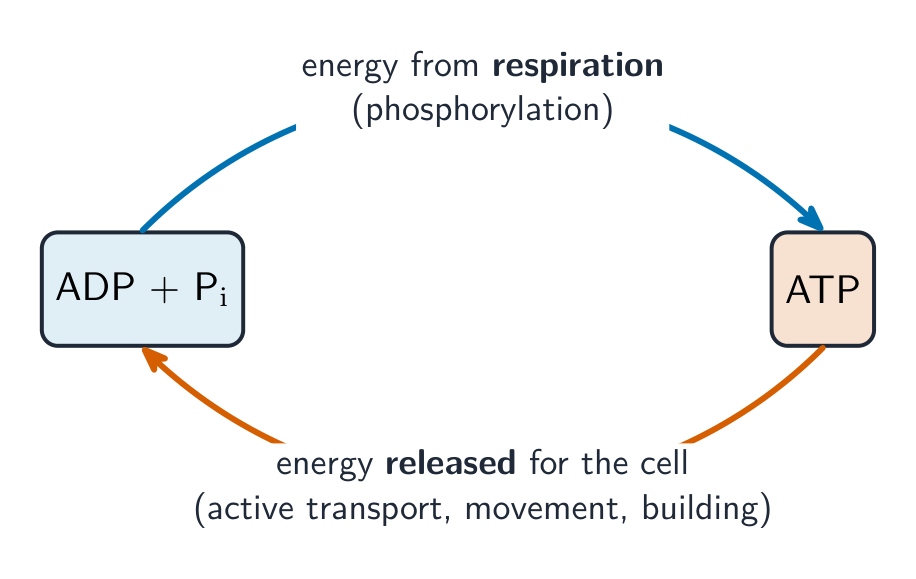
ATP (adenosine triphosphate) is the cell's energy currency. Energy is stored in its phosphate bonds; breaking off a phosphate (ATP → ADP) releases energy to power cellular work, and reattaching one stores energy. Cells constantly recycle ATP, coupling energy-releasing reactions to energy-requiring ones.

Life and the laws of thermodynamics

A living cell is highly ordered, and that order is often mistaken for a violation of physics. It is not.

  • The first law 热力学第一定律 says energy is conserved: it changes form but is never created or destroyed. A cell does not make energy — it transforms the chemical energy of glucose, or the light energy of the Sun, into the chemical energy of ATP.
  • The second law 热力学第二定律 says that in any energy transfer, some energy is lost as heat and the entropy 熵 of the universe increases. A cell builds order inside itself, but only by releasing more disorder to its surroundings, mostly as heat.

So life requires a constant input of free energy 自由能 from outside. This is why an organism cut off from its energy source dies: maintaining order is not free, and the moment the input stops, the ordered system runs down.

العربية

ATP (أدينوسين ثلاثي الفوسفات) هو عملة الطاقة في الخلية. تُخزن الطاقة في روابط الفوسفات الخاصة بها؛ وكسر فوسفات (ATP → ADP) يطلق الطاقة لتشغيل العمل الخلوي، وإعادة attaching واحد يخزن الطاقة. تعيد الخلايا تدوير ATP باستمرار، بربط التفاعلات المصاحبة لإطلاق الطاقة بالتفاعلات التي تتطلب طاقة.

يدورة ATP-ADP تخزن وتطلق الطاقة
دورة ATP-ADP تخزن وتطلق الطاقة

الحياة وقوانين الديناميكا الحرارية

الخلية الحية مرتبة للغاية، وغالبًا ما يُخطئ في هذا النظام باعتباره انتهاكًا للفيزياء. الأمر ليس كذلك.

  • القانون الأول ينص على حفظ الطاقة: فهي تتحول من صورة إلى أخرى لكنها لا تُخلق أو تُدمر. الخلية لا تصنع الطاقة - بل تحوّل الطاقة الكيميائية للجلوكوز، أو الطاقة الضوئية للشمس، إلى الطاقة الكيميائية لـATP.
  • القانون الثاني ينص على أنه في أي نقل للطاقة، تُفقد بعض الطاقة كحرارة وتزداد ** الإنتروبيا** في الكون. تبني الخلية النظام داخل نفسها، لكن ذلك فقط عن طريق إطلاق مزيد من الفوضى إلى محيطها، معظمها كحرارة.

لذلك تتطلب الحياة مدخلًا مستمرًا للطاقة الحرة من الخارج. ولهذا السبب يموت الكائن الحي الذي يُقطع عن مصدر طاقته: الحفاظ على النظام ليس مجانيًا، ولحظة توقف المدخل، يبدأ النظام المرتب في التدهور.

3.4

Photosynthesis · ⁨البناء الضوئي⁩

Syllabus · ⁨المنهج⁩
English

Big Idea 2 — Energetics: Biological systems use energy and molecular building blocks to grow, reproduce, and maintain dynamic homeostasis.

Learning Objective 3.4.A: Describe the photosynthetic processes and structural features of the chloroplast that allow organisms to capture and store energy.

  • 3.4.A.1 Photosynthesis is the series of reactions that use carbon dioxide $(\mathrm{CO_2})$, water $(\mathrm{H_2O})$, and light energy to make carbohydrates and oxygen $(\mathrm{O_2})$.
    • i. Photosynthetic organisms capture energy from the sun and produce sugars that can be used in biological processes or stored.
    • ii. Photosynthesis first evolved in prokaryotic organisms.
    • iii. Scientific evidence supports the claim that prokaryotic (cyanobacterial) photosynthesis was responsible for the production of an oxygenated atmosphere.
    • iv. Prokaryotic photosynthetic pathways were the foundation of eukaryotic photosynthesis.
    • Exclusion statement: Memorization of the steps in the Calvin cycle, the structure of the molecules, and the names of the enzymes involved, with the exception of ATP synthase, is beyond the scope of the AP Exam.
  • 3.4.A.2 Stroma and thylakoids are found within the chloroplast.
    • i. The stroma is the fluid within the inner chloroplast membrane and outside the thylakoid. The carbon fixation (Calvin cycle) reactions of photosynthesis occur in the stroma.
    • ii. The thylakoid membranes contain chlorophyll pigments organized into two photosystems, as well as electron transport proteins.
    • iii. Thylakoids are organized in stacks called grana. The light reactions of photosynthesis occur in the grana.
  • 3.4.A.3 The light reactions of photosynthesis in eukaryotes involve a series of coordinated reaction pathways that capture energy present in light to yield ATP and NADPH, which power the production of organic molecules in the Calvin cycle. This provides energy for metabolic processes.

Learning Objective 3.4.B: Explain how cells capture energy from light and transfer it to biological molecules for storage and use.

  • 3.4.B.1 Electron transport chain (ETC) reactions occur in chloroplasts, in mitochondria, and across prokaryotic plasma membranes. In photosynthesis, electrons that pass through the thylakoid membrane are picked up and ultimately transferred to $\mathrm{NADP^+}$ reducing it to NADPH in photosystem I.
    • Exclusion statement: The full names of the specific electron carriers in the electron transport chain are beyond the scope of the AP Exam.
    • Exclusion statement: Specific steps, names of enzymes, and intermediates of the pathways for these processes are beyond the scope of this course and the AP Exam.
  • 3.4.B.2 During photosynthesis, chlorophylls absorb energy from light, boosting electrons to a higher energy level in photosystems I and II. Water then splits, supplying electrons to replace those lost from photosystem II.
  • 3.4.B.3 Photosystems I and II are embedded in the thylakoid membranes of chloroplasts and are connected by the transfer of electrons through an ETC.
  • 3.4.B.4 When electrons are transferred between molecules in a series of oxidation/reduction reactions as they pass through the ETC, an electrochemical gradient of protons (hydrogen ions) is established across the thylakoid membrane. The membrane separates a region of low proton concentration outside the thylakoid membrane from a region of high proton concentration inside the thylakoid membrane.
  • 3.4.B.5 The formation of the proton gradient is linked to the synthesis of ATP from ADP and inorganic phosphate via ATP synthase. The flow of protons back through membrane-bound ATP synthase by chemiosmosis drives the formation of ATP from ADP and inorganic phosphate; this is known as photophosphorylation.
  • 3.4.B.6 The energy captured in the light reactions and transferred to ATP and NADPH powers the production of carbohydrates from carbon dioxide in the Calvin cycle. This occurs in the stroma of the chloroplast.
العربية

الفكرة الكبرى 2 — الديناميكا الحرارية: تستخدم الأنظمة البيولوجية الطاقة والكتل البنائية الجزيئية للنمو والتكاثر والحفاظ على ديناميكية التوازن الداخلي.

الهدف التعليمي 3.4.A: صف عمليات البناء الضوئي والميزات الهيكلية للبلاستيدات الخضراء التي تسمح للكائنات بالتقاط وتخزين الطاقة.

  • 3.4.A.1 البناء الضوئي هو سلسلة من التفاعلات تستخدم ثاني أكسيد الكربون $(\mathrm{CO_2})$، والماء $(\mathrm{H_2O})$، وطاقة الضوء لصنع الكربوهيدرات والأكسجين $(\mathrm{O_2})$.
    • i. تأخذ الكائنات ذات البناء الضوئي الطاقة من الشمس وتنتج السكريات التي يمكن استخدامها في العمليات البيولوجية أو تخزينها.
    • ii. تطورت عملية البناء الضوئي لأول مرة في الكائنات بدائية النواة.
    • iii. تدعم الأدلة العلمية الادعاء بأن البناء الضوئي بدائي النواة (الزرقاء) كان مسؤولاً عن إنتاج غلاف جوي مؤكسد.
    • iv. كانت مسارات البناء الضوئي بدائية النواة أساس البناء الضوئي حقيقي النواة.
    • بيان الاستبعاد: حفظ خطوات دورة كالفين، وبنية الجزيئات، وأسماء الإنزيمات المشاركة، باستثناء ATP synthase، هو خارج نطاق امتحان AP.
  • 3.4.A.2 يوجد الغشاء القاعدي والثيراكويدات داخل البلاستيد الأخضر.
    • i. الغشاء القاعدي هو السائل الموجود داخل الغشاء الداخلي للبلاستيد الأخضر وخارج الثيراكويدات. تحدث تفاعلات تثبيت الكربون (دورة كالفين) للبناء الضوئي في الغشاء القاعدي.
    • ii. تحتوي أغشية الثيراكويدات على صبغات الكلوروفيل منظمة في نظامين ضوئيين، بالإضافة إلى بروتينات نقل الإلكترون.
    • iii. تُنظم الثيراكويدات في تراكيب تسمى الكريات. تحدث التفاعلات الضوئية للبناء الضوئي في الكريات.
  • 3.4.A.3 تتضمن التفاعلات الضوئية للبناء الضوئي في حقيقيات النواة سلسلة من المسارات التفاعلية المنسقة التي تحبس الطاقة الموجودة في الضوء للحصول على ATP وNADPH، اللذين يحفزان إنتاج الجزيئات العضوية في دورة كالفين. وهذا يوفر الطاقة للعمليات الأيضية.

هدف التعلم 3.4.B: اشرح كيف تمسك الخلايا بالطاقة من الضوء وتنقلها إلى جزيئات بيولوجية للتخزين والاستخدام.

  • 3.4.B.1 تحدث تفاعلات سلسلة نقل الإلكترون (ETC) في البلاستيدات الخضراء والميتوكوندريا وعبر الأغشية البلازمية بدائية النواة. في البناء الضوئي، يتم التقاط الإلكترونات التي تمر عبر غشاء الثيراكويد ونقلها في النهاية إلى $\mathrm{NADP^+}$ مما يؤدي إلى اختزاله إلى NADPH في النظام الضوئي الأول.
    • بيان الاستبعاد: الأسماء الكاملة لحاملي الإلكترونات المحددة في سلسلة نقل الإلكترون هي خارج نطاق امتحان AP.
    • بيان الاستبعاد: الخطوات المحددة وأسماء الإنزيمات والوسطاء في مسارات هذه العمليات هي خارج نطاق هذا المقرر وامتحان AP.
  • 3.4.B.2 أثناء البناء الضوئي، تمتص الصبغات الكلوروفيلية الطاقة من الضوء، مما يرفع الإلكترونات إلى مستوى طاقة أعلى في النظامين الضوئيين الأول والثاني. ثم يتفكك الماء، مما يوفر إلكترونات لاستبدال تلك المفقودة من النظام الضوئي الثاني.
  • 3.4.B.3 مدمجة الأنظمة الضوئية الأولى والثانية في أغشية الثيراكويدات للبلاستيدات الخضراء ومتصلة بنقل الإلكترونات عبر ETC.
  • 3.4.B.4 عند نقل الإلكترونات بين الجزيئات في سلسلة من تفاعلات الأكسدة/الاختزال أثناء مرورها عبر ETC، يُنشأ تدرج كهروكيميائي للبروتونات (أيونات الهيدروجين) عبر غشاء الثيراكويد. يفصل الغشاء منطقة ذات تركيز منخفض للبروتونات خارج غشاء الثيراكويد عن منطقة ذات تركيز عالٍ للبروتونات داخل غشاء الثيراكويد.
  • 3.4.B.5 يرتبط تكوين تدرج البروتونات بتكوين ATP من ADP والفوسفات غير العضوي عبر إنزيم ATP synthase. يؤدي تدفق البروتونات عائدةً عبر ATP synthase المرتبطة بالغشاء بواسطة الكيمياء الأسموزية إلى تكوين ATP من ADP والفوسفات غير العضوي؛ ويُعرف هذا بالفسفرة الضوئية.
  • 3.4.B.6 الطاقة المسجلة في التفاعلات الضوئية والمنقولة إلى ATP وNADPH تحفز إنتاج الكربوهيدرات من ثاني أكسيد الكربون في دورة كالفين. يحدث هذا في الغشاء القاعدي للبلاستيد الأخضر.

Source: College Board AP Course and Exam Description · ⁨المصدر: وصف دورة وامتحان College Board AP⁩

English

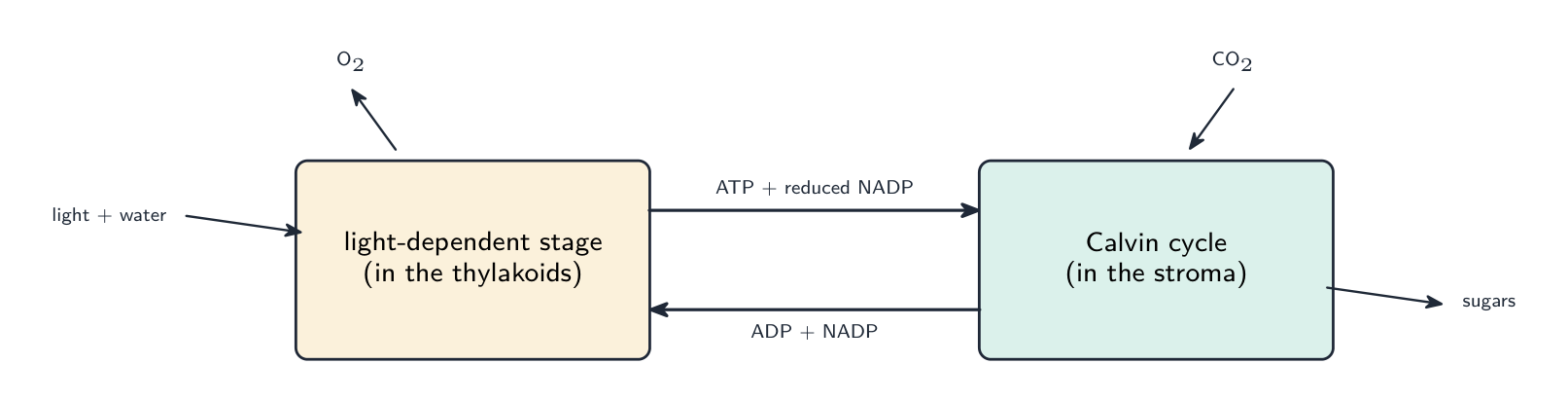
Photosynthesis 光合作用 captures light energy to build sugar from $\text{CO}_2$ and water, releasing $\text{O}_2$. It has two stages:

  • The light reactions (in the thylakoid membranes) use light to make ATP and NADPH and split water, releasing oxygen.
  • The Calvin cycle 卡尔文循环 (in the stroma) uses that ATP and NADPH to fix $\text{CO}_2$ into sugar.

So light energy becomes chemical energy stored in glucose.

Where the oxygen in the air came from

Photosynthesis did not only feed the first organisms; it changed the planet. Scientific evidence supports the claim that photosynthesis by prokaryotes 原核生物 — specifically cyanobacteria 蓝细菌 — produced the oxygen that built Earth's oxygenated atmosphere 含氧大气.

The evidence is physical: banded iron formations 条带状铁建造 in rocks about 2.4 billion years old record iron dissolved in the ocean being oxidised and precipitating out, which needs free oxygen. Before that event, called the Great Oxidation Event, the atmosphere held almost none.

Two consequences matter for the rest of the course. Free oxygen made aerobic respiration possible, which releases far more ATP per glucose than anaerobic pathways do. And it was lethal to much of the anaerobic life already present, so it counts as one of the largest extinction events in Earth's history — an early example of organisms changing their own environment.

العربية
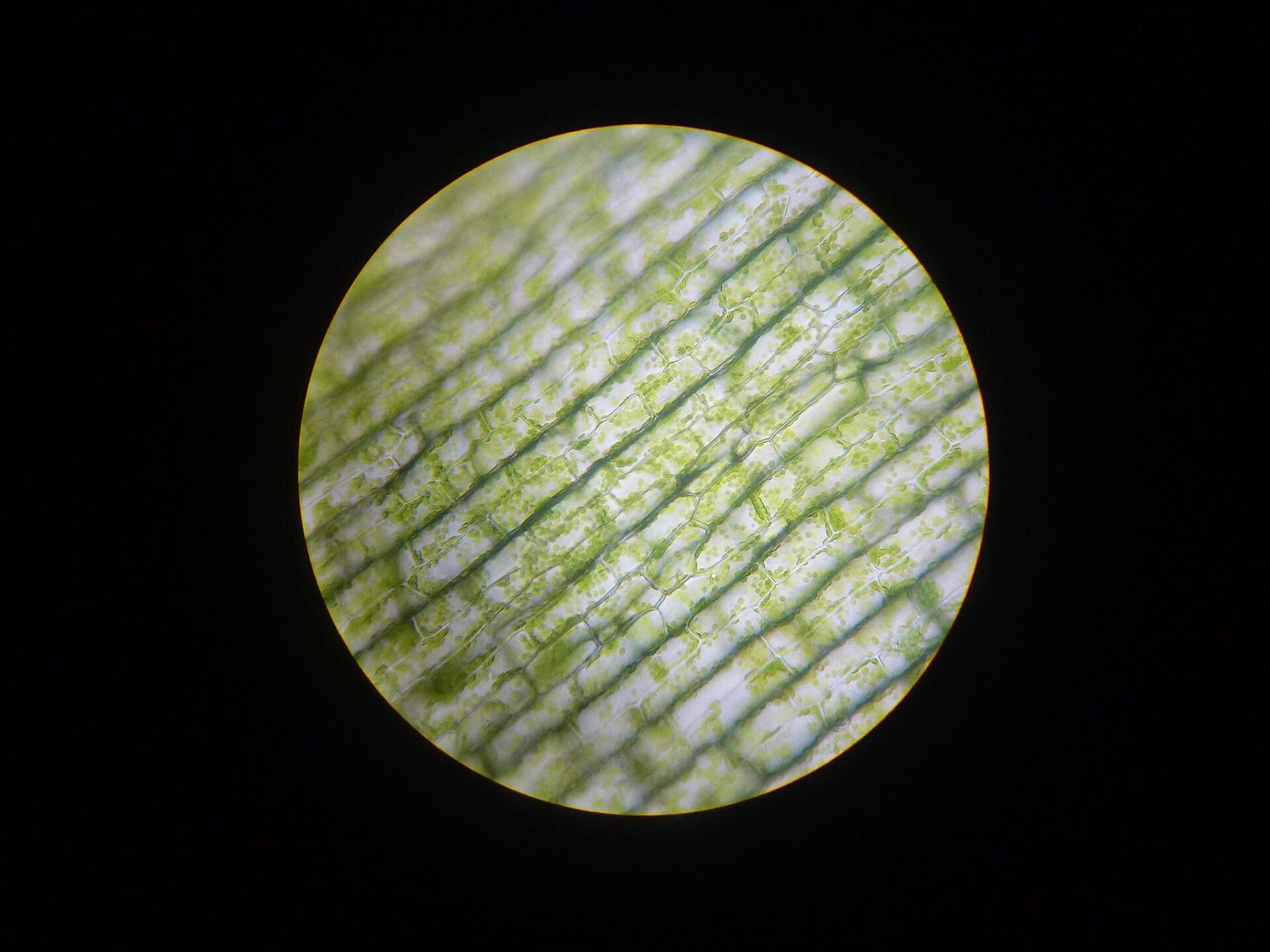
تعبأ البلاستيدات الخضراء خلايا النسيج الخشائي للنبات — وهي العضيات المسؤولة عن البناء الضوئي

البناء الضوئي يمتص الطاقة الضوئية لبناء السكر من $\text{CO}_2$ والماء، مع إطلاق $\text{O}_2$. يتكون من مرحلتين:

مرحلتا البناء الضوئي مترابطتان عبر ATP وNADPH
  • التفاعلات الضوئية (في أغشية الثايلاكويد) تستخدم الضوء لإنتاج ATP وNADHP وتكسير الماء، مما يطلق الأكسجين.
  • دورة كالفن (في السيتوبلازم) تستخدم هذا الـATP وNADHP لتثبيت $\text{CO}_2$ في السكر.

لذا تتحول الطاقة الضوئية إلى طاقة كيميائية مخزنة في الجلوكوز.

مصدر الأكسجين في الهواء

لم يقتصر دور البناء الضوئي على تغذية الكائنات الأولى فحسب؛ بل غير الكوكب أيضًا. تدعم الأدلة العلمية الادعاء بأن البناء الضوئي بواسطة بدائيات النوى — وتحديداً البكتيريا الزرقاء — أنتج الأكسجين الذي شكل الجو المؤكسد للأرض.

الدليل مادي: تسجل تشكيلات الحديد المخططة في الصخور التي يبلغ عمرها حوالي 2.4 مليار عام أن الحديد المذاب في المحيط قد تأكسد وترسب، وهو ما يتطلب وجود أكسجين حر. وقبل ذلك الحدث، المعروف باسم حدث التأكسد العظيم، كان الجو يحتوي على القليل جدًا منه.

نتيجتان مهمتان لباقي المقرر. جعل الأكسجين الحر التنفس الهوائي ممكنًا، والذي يحرر كمية أكبر بكثير من ATP لكل جزيء جلوكوز مقارنة بالمسارات اللاهوائية. وكان قاتلاً للعديد من الحياة اللاهوائية الموجودة مسبقًا، لذا يُعدّ واحدًا من أكبر أحداث الانقراض في تاريخ الأرض — كمثال مبكر على تغيير الكائنات الحية لبيئتها الخاصة.

3.5

Cellular Respiration · ⁨التنفس الخلوي⁩

Syllabus · ⁨المنهج⁩
English

Big Idea 2 — Energetics: Biological systems use energy and molecular building blocks to grow, reproduce, and maintain dynamic homeostasis.

Learning Objective 3.5.A: Describe the processes and structural features of mitochondria that allow organisms to use energy stored in biological macromolecules.

  • 3.5.A.1 Cellular respiration uses energy from biological macromolecules to synthesize ATP. Respiration and fermentation are characteristic of all forms of life.
  • 3.5.A.2 Aerobic cellular respiration in eukaryotes involves a series of coordinated enzyme-catalyzed reactions that capture energy from biological macromolecules.
  • 3.5.A.3 The ETC transfers electrons in a series of oxidation-reduction reactions that establish an electrochemical gradient across membranes.
    • i. In cellular respiration, electrons delivered by NADH and $\mathrm{FADH_2}$ are passed to a series of electron acceptors as they move toward the terminal electron acceptor, oxygen. Aerobic prokaryotes use oxygen as a terminal electron acceptor, while anaerobic prokaryotes use other molecules.
    • ii. The transfer of electrons, through the ETC, is accompanied by the formation of a proton gradient across the inner mitochondrial membrane, with the membrane(s) separating a region of high proton concentration outside the membrane from a region of low proton concentration inside the membrane. The folding of the inner membrane increases the surface area, which allows for more ATP to be synthesized. In prokaryotes, the passage of electrons is accompanied by the movement of protons across the plasma membrane.
    • iii. The flow of protons back through membrane-bound ATP synthase by chemiosmosis drives the formation of ATP from ADP and inorganic phosphate. This is known as oxidative phosphorylation in aerobic cellular respiration.
    • iv. In aerobic cellular respiration, decoupling oxidative phosphorylation from electron transport generates heat. This heat can be used by endothermic organisms to regulate body temperature.
    • Exclusion statement: The full names of the specific electron carriers in the electron transport chain are beyond the scope of the AP Exam.
    • Exclusion statement: Specific steps, names of enzymes, and intermediates of the pathways for these processes are beyond the scope of this course and the AP Exam.

Learning Objective 3.5.B: Explain how cells obtain energy from biological macromolecules in order to power cellular functions.

  • 3.5.B.1 Glycolysis is a biochemical pathway that releases the energy in glucose molecules to form ATP (from ADP and inorganic phosphate), NADH (from $\mathrm{NAD^+}$), and pyruvate.
  • 3.5.B.2 Pyruvate is transported from the cytosol to the mitochondrion where oxidation occurs. This process releases electrons during the Krebs (citric acid) cycle, reducing $\mathrm{NAD^+}$ to NADH and FAD to $\mathrm{FADH_2}$, and releasing $\mathrm{CO_2}$.
  • 3.5.B.3 The Krebs cycle takes place in the mitochondrial matrix. During the Krebs cycle, carbon dioxide is released from organic intermediates, ATP is synthesized from ADP and inorganic phosphate, and electrons are transferred by the coenzymes $\mathrm{NAD^+}$ and FAD.
  • 3.5.B.4 Electrons extracted in glycolysis and Krebs cycle reactions are transferred by NADH and $\mathrm{FADH_2}$ to the ETC in the inner mitochondrial membrane.
  • 3.5.B.5 When electrons are transferred between molecules in a sequence of reactions as they pass through the ETC, an electrochemical gradient of protons (hydrogen ions) across the inner mitochondrial membrane is established. The pH inside the mitochondrial matrix is higher than in the intermembrane space.
  • 3.5.B.6 Fermentation allows glycolysis to proceed in the absence of oxygen and produces organic molecules such as alcohol and lactic acid.
    • Exclusion statement: Memorization of the steps in glycolysis and the Krebs cycle, and of the structures of the molecules and the names of the enzymes involved, is beyond the scope of this course and the AP Exam.
العربية

الفكرة الكبرى 2 — الديناميكا الحرارية: تستخدم الأنظمة البيولوجية الطاقة والكتل البنائية الجزيئية للنمو والتكاثر والحفاظ على ديناميكية التوازن الداخلي.

هدف التعلم 3.5.A: وصف عمليات وميزات البنية للميتوكوندريا التي تسمح للكائنات باستخدام الطاقة المخزنة في الجزيئات البيولوجية الكبيرة.

  • 3.5.A.1 يستخدم التنفس الخلوي الطاقة من الجزيئات البيولوجية الكبيرة لتكوين ATP. التنفس والتخمر من سمات جميع أشكال الحياة.
  • 3.5.A.2 يتضمن التنفس الخلوي الهوائي في حقيقيات النواة سلسلة من التفاعلات المحفزة بإنزيمات تنسق لاحتجاز الطاقة من الجزيئات البيولوجية الكبيرة.
  • 3.5.A.3 ينقل ETC الإلكترونات في سلسلة من تفاعلات الأكسدة-الاختزال التي تنشئ تدرجاً كهروكيميائياً عبر الأغشية.
    • i. في التنفس الخلوي، يتم تمرير الإلكترونات التي يتم تسليمها بواسطة NADH و $\mathrm{FADH_2}$ إلى سلسلة من مستقبلات الإلكترونات أثناء حركتها نحو مستقبل الإلكترون النهائي، وهو الأكسجين. تستخدم بدائيات النواة الهوائية الأكسجين كمستقبل نهائي للإلكترونات، بينما تستخدم بدائيات النواة اللاهوائية جزيئات أخرى.
    • ii. يترافق نقل الإلكترونات، عبر ETC، مع تكوين تدرج بروتوني عبر الغشاء الداخلي للميتوكوندريا، حيث تفصل الغشاء(ات) منطقة ذات تركيز عالٍ للبروتونات خارج الغشاء عن منطقة ذات تركيز منخفض للبروتونات داخل الغشاء. يزيد طي الغشاء الداخلي من مساحة السطح، مما يسمح بمزيد من تصنيع ATP. في بدائيات النواة، يترافق مرور الإلكترونات مع حركة البروتونات عبر الغشاء البلازمي.
    • iii. يؤدي تدفق البروتونات عائدةً عبر ATP synthase المرتبطة بالغشاء بواسطة الكيمياء الأسموزية إلى تكوين ATP من ADP والفوسفات غير العضوي. يُعرف هذا بالفسفرة المؤكسدة في التنفس الخلوي الهوائي.
    • iv. في التنفس الخلوي الهوائي، فإن فصل الفسفرة المؤكسدة عن نقل الإلكترونات يولد الحرارة. يمكن استخدام هذه الحرارة من قبل الكائنات الدافئة الدم لتنظيم درجة حرارة الجسم.
    • بيان الاستبعاد: الأسماء الكاملة لحاملي الإلكترونات المحددة في سلسلة نقل الإلكترون هي خارج نطاق امتحان AP.
    • بيان الاستبعاد: الخطوات المحددة وأسماء الإنزيمات والوسطاء في مسارات هذه العمليات هي خارج نطاق هذا المقرر وامتحان AP.

هدف التعلم 3.5.B: اشرح كيف تحصل الخلايا على الطاقة من الجزيئات البيولوجية الكبيرة لتشغيل الوظائف الخلوية.

  • 3.5.B.1 التحلل السكري هو مسار كيميائي حيوي يطلق الطاقة في جزيئات الجلوكوس لتكوين ATP (من ADP والفوسفات غير العضوي)، وNADH (من $\mathrm{NAD^+}$)، والبيروفات.
  • 3.5.B.2 يتم نقل البيروفات من السيتوبلازم إلى الميتوكوندريا حيث يحدث الأكسدة. تطلق هذه العملية الإلكترونات خلال دورة كrebs (دورة حمض الستريك)، مما يؤدي إلى اختزال $\mathrm{NAD^+}$ إلى NADH و FAD إلى $\mathrm{FADH_2}$، مع إطلاق $\mathrm{CO_2}$.
  • 3.5.B.3 تحدث دورة كrebs في مصفوفة الميتوكوندريا. أثناء دورة كrebs، يتم إطلاق ثاني أكسيد الكربون من الوسيط العضوي، ويتم تصنيع ATP من ADP والفوسفور غير العضوي، وتنتقل الإلكترونات بواسطة الإنزيمات المساعدة $\mathrm{NAD^+}$ و FAD.
  • 3.5.B.4 تُنقل الإلكترونات المستخرجة في تفاعلات تحلل السكر ودورة كrebs بواسطة NADH و $\mathrm{FADH_2}$ إلى سلسلة نقل الإلكترون (ETC) في الغشاء الداخلي للميتوكوندريا.
  • 3.5.B.5 عندما تنتقل الإلكترونات بين الجزيئات في تسلسل من التفاعلات أثناء مرورها عبر سلسلة نقل الإلكترون، يتشكل تدرج كهروكيميائي للبروتونات (أيونات الهيدروجين) عبر الغشاء الداخلي للميتوكوندريا. يكون الرقم الهيدروجيني (pH) داخل مصفوفة الميتوكوندريا أعلى منه في الحيز بين الغشائي.
  • 3.5.B.6 يسمح التخمر بتقدم تحلل السكر في غياب الأكسجين وينتج جزيئات عضوية مثل الكحول وحمض اللاكتيك.
    • عبارة الاستبعاد: لا يُعد حفظ خطوات تحلل السكر ودورة كrebs، وهياكل الجزيئات وأسماء الإنزيمات المشاركة، ضمن نطاق هذا المقرر وامتحان AP.

Source: College Board AP Course and Exam Description · ⁨المصدر: وصف دورة وامتحان College Board AP⁩

English

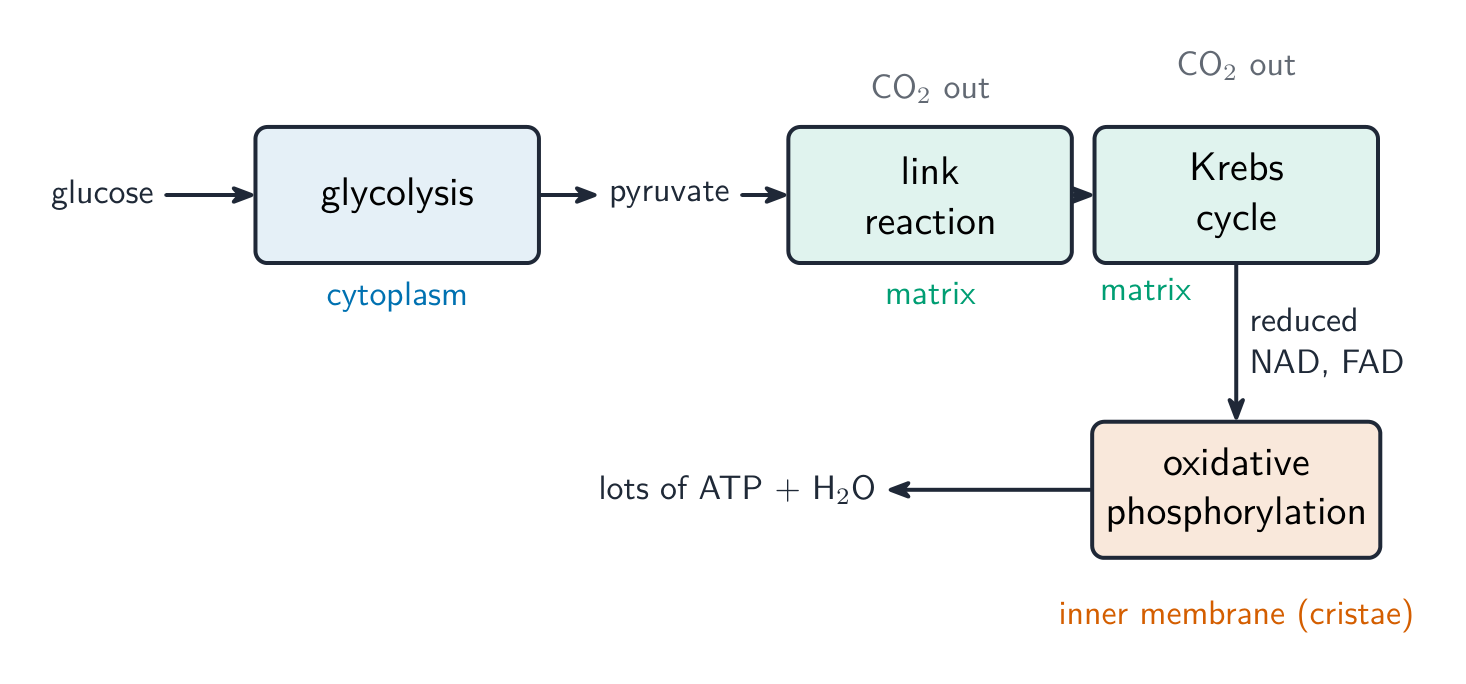
Cellular respiration 细胞呼吸 releases the energy in glucose to make ATP, mostly using oxygen. Its stages:

  • Glycolysis 糖酵解 (in the cytoplasm) splits glucose, making a little ATP.
  • The Krebs cycle 克雷布斯循环 (mitochondrial matrix) releases $\text{CO}_2$ and loads electron carriers.
  • The electron transport chain 电子传递链 (inner membrane) uses those electrons to pump protons and make most of the ATP, with oxygen as the final electron acceptor.

Without oxygen, cells use fermentation 发酵 to keep glycolysis running, making far less ATP. Photosynthesis and respiration are complementary – the products of one are the reactants of the other.

Worked example. Aerobic respiration of one glucose nets about 2 ATP from glycolysis, 2 ATP from the Krebs cycle, and about 28 ATP from oxidative phosphorylation, for $\approx$ 32 ATP total. With no oxygen only glycolysis runs, so fermentation nets just 2 ATP per glucose — roughly 16 times less energy, which is why aerobic pathways dominate in oxygen-rich cells.

العربية
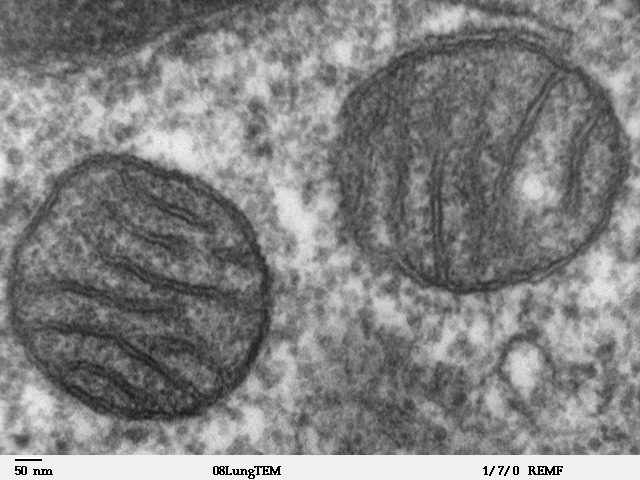
صورة TEM لميتوكوندريا: غشاء داخلي مطوي (أعراف) يضاعف السطح للتنفس
مجهري إلكتروني نفاذ (TEM) لميتوكوندريا: غشاء داخلي مطوي (كريستات) يضاعف السطح للتنفس

التنفس الخلوي يحرر الطاقة المخزنة في الجلوكوز لإنتاج ATP، ويستخدم معظمها الأكسجين. مراحلها:

مراحل التنفس الهوائي ومواقعها داخل الخلية
مراتب التنفس الهوائي وأماكن حدوثها داخل الخلية
  • تحلل السكر (في السيتوبلازم) يكسر الجلوكوز، منتجًا كمية صغيرة من ATP.
  • دورة كريبس (مصفوفة الميتوكوندريا) تطلق $\text{CO}_2$ وتحمل ناقلات الإلكترون.
  • سلسلة نقل الإلكترون (الغشاء الداخلي) تستخدم هذه الإلكترونات لضخ البروتونات وإنتاج معظم الـATP، مع اعتبار الأكسجين مستقبل الإلكترون النهائي.

بدون وجود الأكسجين، تستخدم الخلايا التخمر للحفاظ على عمل تحلل السكر، منتجةً كمية أقل بكثير من ATP. البناء الضوئي والتنفس متكاملان — فمنتجات أحدهما هي مواد متفاعلة للآخر.

مثال محلول. التنفس الهوائي لجزيء جلوكوز واحد يحقق صافي ربح قدره 2 ATP من تحلل السكر، و2 ATP من دورة كريبس، وحوالي 28 ATP من الفسفرة التأكسدية، ليصبح المجموع $\approx$ 32 ATP. وبغياب الأكسجين يعمل فقط تحلل السكر، لذا يحقق التخمر صافي ربح قدره 2 ATP فقط لكل جلوكوز — أي طاقة أقل بحوالي 16 مرة، وهذا هو السبب في سيطرة المسارات الهوائية في الخلايا الغنية بالأكسجين.

3.5

Exam tips · ⁨نصائح للامتحان⁩

English
  • An enzyme lowers the activation energy and is not used up; its active site is specific to one substrate (lock and key).
  • Rate rises with temperature only up to the optimum — beyond it the enzyme denatures and the rate falls (unlike an ordinary reaction).
  • Know the ATP↔ADP cycle: breaking a phosphate releases energy to power the cell.
  • Write the overall equations: photosynthesis stores energy (builds glucose); respiration releases it (breaks glucose down) — they are opposites.
  • Match each stage to its location and whether it needs oxygen.
العربية
  • إنزيم يقلل طاقة التنشيط ولا يُستهلك؛ وموقعه النشط محدد لمادة تفاعل واحدة (نموذج القفل والمفتاح).
  • يرتفع المعدل مع درجة الحرارة فقط حتى يصل إلى الحد الأمثل — وما بعده ينكسر الإنزيم المؤثر وينخفض المعدل (على عكس التفاعلات العادية).
  • تعرف على دورة ATP↔ADP: تكسير مجموعة فوسفات يحرر الطاقة لتشغيل الخلية.
  • اكتب المعادلات الإجمالية: البناء الضوئي يخزن الطاقة (يبني الجلوكوز)؛ التنفس يحررها (يكسر الجلوكوز) — وهما عمليتان عكسيتان.
  • طابق كل مرحلة بمكانها وما إذا كانت تحتاج إلى أكسجين.

Interactive lessons on this topic · ⁨دروس تفاعلية حول هذا الموضوع⁩

Work through it step by step, with instant-check exercises. · ⁨ا-working عليه خطوة بخطوة، مع تمارين تحقق فوري.⁩

Past Papers · ⁨أوراق الامتحانات السابقة⁩

More topics in AP Biology · ⁨AP علم الأحياء⁩ · ⁨المزيد من المواضيع في AP Biology · ⁨AP علم الأحياء⁩⁩

Log in or create account · ⁨تسجيل الدخول أو إنشاء حساب⁩

IGCSE, A-Level & AP