Cellular Energy
Introduced 9:12
Cellular Energetics
Look at the washing powder in your cupboard. In warm water it removes a food stain in half an hour. In a lab, the same job would need strong acid and boiling…
English narration · English and 中文 subtitles you can switch
In this lesson
| English |
|---|
| ATP/ˌeɪ tiː ˈpiː/ |
| currency/ˈkʌrənsi/ |
| phosphate/ˈfɒsfeɪt/ |
| ADP/ˌeɪ diː ˈpiː/ |
Why you must keep eating
- A resting adult uses about as much energy as a 100 W light bulb, and makes and breaks down roughly their own body mass in ATP every day. Stop the energy supply, as cyanide does by blocking respiration, and cells die within minutes.
- All living systems need a constant input of energy. This lesson explains why, and how cells use that energy through ATP, coupled reactions and step-by-step pathways.
Energy and order
- Living things are highly ordered, and they keep this order without breaking the laws of thermodynamics: energy is never created (1st law), and every transfer loses some as heat, increasing disorder (2nd law).
- So energy input must exceed energy loss to keep order and power the cell's work. Organisms get it from light (photosynthesis) or food. A large loss of order or of energy flow results in death.
Living organisms break the second law of thermodynamics because they become more ordered as they grow.
Difficulty 1/5 · 100 coins + a small bonus on first completion today
Organisms stay ordered by taking in energy and releasing heat, so total disorder of the organism plus surroundings still increases.
ATP: the cell's energy currency
- ATP (adenosine triphosphate) has three phosphate groups. Removing the last one (hydrolysis: ATP → ADP + P) releases energy the cell can use.
- Cells recharge ADP back to ATP using energy from respiration or the light reactions. One ATP is reused thousands of times a day.
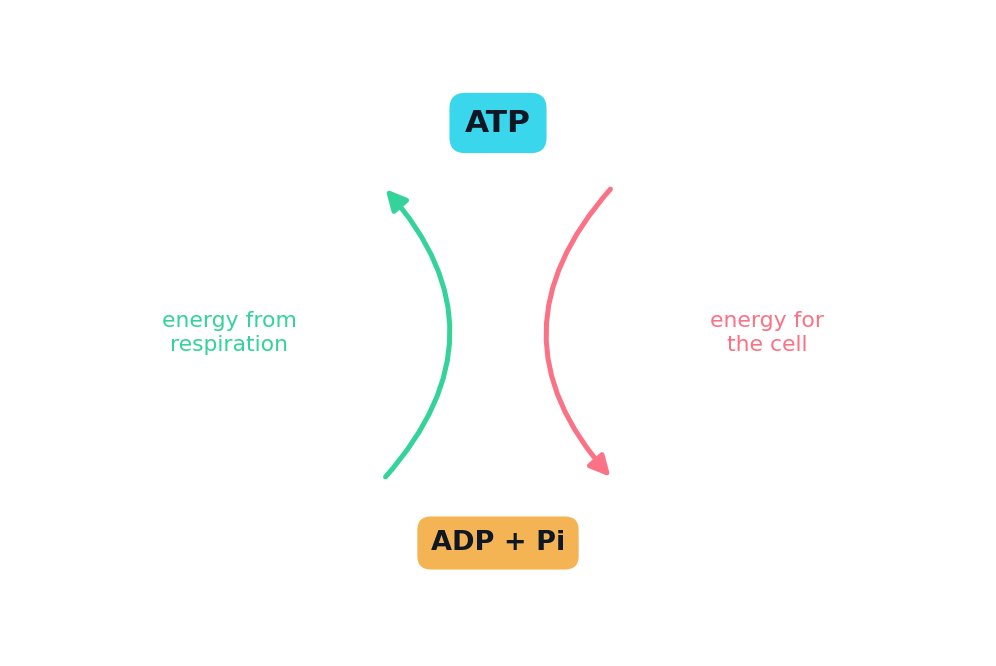
The ATP-ADP cycle
Step around the cycle — ATP loses a phosphate to power the cell, then respiration recharges ADP back to ATP.
What is the main job of ATP in a cell?
Difficulty 1/5 · 100 coins + a small bonus on first completion today
ATP is the cell's energy currency — it delivers energy in small, usable packets.
ATP releases energy when it…
Difficulty 1/5 · 100 coins + a small bonus on first completion today
Breaking off the third phosphate turns ATP into ADP and releases usable energy.
ADP is recharged back into ATP using energy from respiration.
Difficulty 1/5 · 100 coins + a small bonus on first completion today
Respiration provides the energy to add a phosphate back to ADP, remaking ATP.
Because it carries small usable packets of energy, ATP is called the cell's energy ____.
Difficulty 1/5 · 100 coins + a small bonus on first completion today
ATP is the energy currency — spent and remade constantly, like money in an economy.
How many phosphates are on ATP?
Difficulty 1/5 · 100 coins + a small bonus on first completion today
Hydrolysis to ADP removes one of the three.
Energy coupling
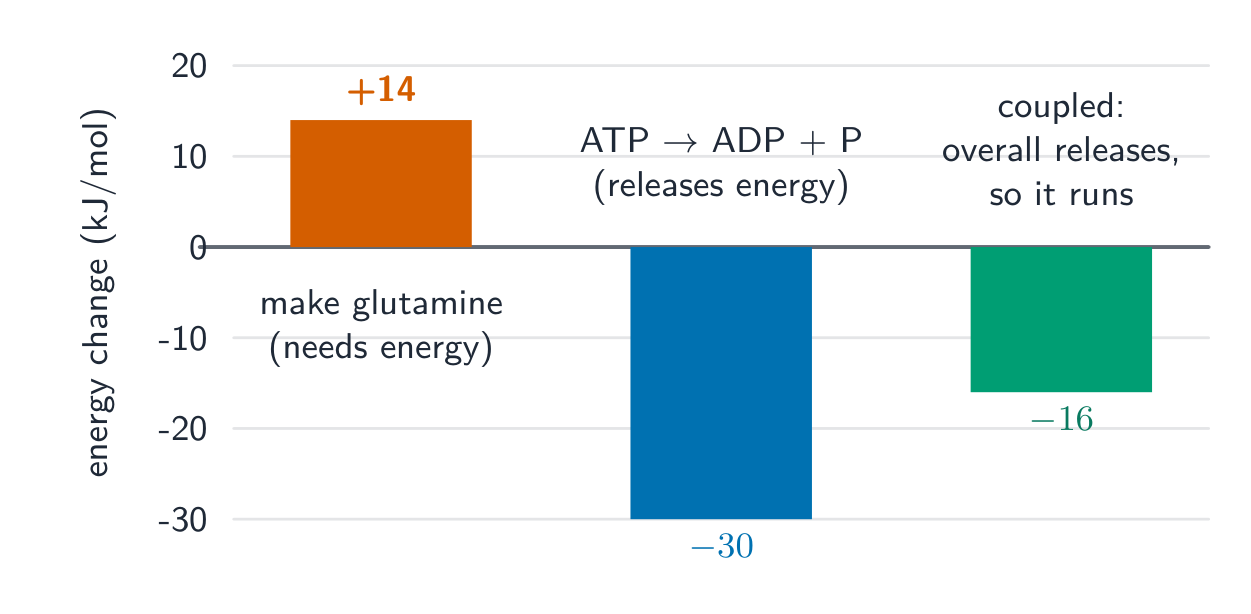
- Many reactions the cell needs, such as building proteins or pumping ions, require energy and will not happen by themselves. The cell couples them to a process that releases energy, usually ATP hydrolysis, often by transferring the phosphate to the reactant.
- The coupled process runs if the total energy released is greater than the energy required.
Select all true statements about ATP.
Difficulty 2/5 · 140 coins + a small bonus on first completion today
DNA stores genetic information, not ATP. The other three are correct.
A reaction needs 20 kJ/mol. ATP hydrolysis releases 30 kJ/mol. If the two are coupled, what happens?
Difficulty 1/5 · 100 coins + a small bonus on first completion today
Total: +20 − 30 = −10 kJ/mol. More energy is released than required, so the coupled process runs.
Pathways go step by step
- Energy-related pathways (respiration, photosynthesis) are sequential: the product of one reaction is the reactant for the next, each step catalyzed by its own enzyme.
- Releasing energy in small steps lets the cell capture more of it (as ATP) and control the pathway, instead of losing it all at once as heat, as in burning.
In the pathway W → X → Y → Z, the enzyme for X → Y stops working. Which molecule builds up?
Difficulty 1/5 · 100 coins + a small bonus on first completion today
X is still made from W but can no longer become Y, so X accumulates.
Worked FRQ answer
In a three-step pathway, A → B → C → D, each step is catalyzed by a different enzyme. A mutation inactivates the enzyme for step B → C.
(A) Predict how the amounts of B and D change, and justify. B builds up and D decreases: B can no longer be converted to C, so it is not used up, and no new C is made to produce D.
(B) Step C → D requires energy. Explain how a cell can make it proceed. Couple it to ATP hydrolysis, which releases more energy than the step needs, so the overall process releases energy and can proceed.
(C) Explain why an organism dies if its cells can no longer make ATP. Without ATP, the cell cannot power the work that keeps it ordered (pumps, building molecules). Energy loss then exceeds energy input, order is lost, and the cell dies.
- Why it scores: (A) follows the product → reactant chain; (B) uses coupling with a total energy argument; (C) links energy input to order.
- Life does not break the 2nd law: it stays ordered only by taking in energy, and it releases heat to its surroundings.
- ATP is not a long-term energy store; it is a short-term carrier, constantly recycled. Fats and carbohydrates store energy.
- Coupling works only if the total energy released exceeds the energy required.
Living systems need a constant energy input that exceeds energy loss to keep order; a major loss of order or energy flow means death. ATP hydrolysis releases usable energy, and ADP is recharged. Cells couple energy-releasing processes to energy-requiring ones. Energy pathways are sequential: each product is the next reactant, allowing controlled energy transfer.
What went wrong? Only the site team sees this.