يقفز قافز بونجي من جسر ويسقط — أسرع فأكثر، مباشرة نحو الأرض. ثم، في اللحظة الأخيرة، يتماسك حبل مرن ويجذب…
English narration · English + 中文 subtitles burned in · سرد باللغة الإنجليزية · ترجمة مدمجة بالإنجليزية + الصينية
6.1
Forces that cause deformation · القوى التي تسبب التشوه
Syllabus · المنهج
English
understand that deformation is caused by tensile or compressive forces (forces and deformations will be assumed to be in one dimension only)
understand and use the terms load, extension, compression and limit of proportionality
recall and use Hooke's law
recall and use the formula for the spring constant$k = F/x$
define and use the terms stress, strain and the Young modulus
describe an experiment to determine the Young modulus of a metal in the form of a wire
العربية
فهم أن التشوه ناتج عن قوى شد أو ضغط (سيُفترض أن القوى والتشوهات تكون في بُعد واحد فقط)
فهم واستخدام مصطلحات الحمل، التمدد، الانضغاط وحد التناسب
تذكر واستخدام قانون هوك
تذكر和使用 formula for the spring constant$k = F/x$
تعريف واستخدام مصطلحات الإجهاد، الانفعال ومعامل يونغ
وصف تجربة لتحديد معامل يونغ لمعدن على شكل سلك
Source: Cambridge International syllabus · المصدر: منهج كامبريدج الدولي
English
Hooke's law & the elastic limit
When a force acts on a solid along its length, the object changes shape (deformation 形变). Two cases (treated as one-dimensional here):
a tensile 拉伸 force stretches the object — it makes an extension 伸长量$x$,
a compressive force squeezes the object — it makes a compression 压缩, treated as a negative extension.
The applied force is the load 负载. The change from the natural length is the extension (or compression).
Both are measured from the natural, unstretched length, never from the loaded length: on a diagram of a spring under a box, the distance the spring has shortened is its compression. A spring's own mass is usually said to be negligible 可忽略的, so the only forces on it are the load and the tension it provides.
العربية
قانون هوك والحد المرن
عندما تؤثر قوة على جسم صلب على طوله، يتغير شكل الجسم (تشوه). حالتان (تُعامل هنا كمسألة ذات بُعد واحد):
قوة شد تمدد الجسم — مما يسبب استطالة$x$،
قوة ضغط تضغط الجسم — مما يسبب انضغاطاً، يُعامل كاستطالة سالبة.
القوة المطبقة تُسمى الحمل. التغير عن الطول الطبيعي هو الاستطالة (أو الانضغاط).
يُقاس كلاهما من الطول الطبيعي غير المشدود، وليس من الطول المحمل: في مخطط لزنبرك يحمل صندوقاً، المسافة التي قصرها الزنبرك هي انضغاطه. كتلة الزنبرك نفسها تُعتبر عادةً مهملة، لذا فإن القوى المؤثرة عليها هي الحمل والتوتر الذي يوفره.
Explore · استكشف
Hooke's law spring · زنبرك يخضع لقانون هوك
Hang a load on the real spring: up to the elastic limit the extension is proportional to the force; beyond it the spring is stretched for good. · علق حملاً على الزنبرك الحقيقي: حتى الحد المرن يكون الاستطالة متناسبة مع القوة؛ وما بعده يتمدد الزنبرك بشكل دائم.
Hooke's law and the spring constant · قانون هوث والثابت المرن للزنبرك
English
For many materials at small extensions, the extension is proportional to the load — this is Hooke's law 胡克定律. The constant that links them is the spring constant 劲度系数$k$:
$$F = kx \qquad\Longleftrightarrow\qquad k = \frac{F}{x}.$$
Unit of $k$: $\text{N m}^{-1}$.
Worked example. A spring stretches by $4.0\ \text{cm}$ when a $2.0\ \text{N}$ load is hung from it. Find its spring constant.
Converting the extension to metres ($4.0\ \text{cm} = 0.040\ \text{m}$):
For the one-mark "state Hooke's law", write it in words: the extension is directly proportional to the applied force (load), provided the limit of proportionality is not exceeded. The spring constant is the force per unit extension; the multiple-choice distractors are "extension per unit force" (that is $1/k$) and $\tfrac{1}{2}Fx$ (the energy stored).
Reading a graph:
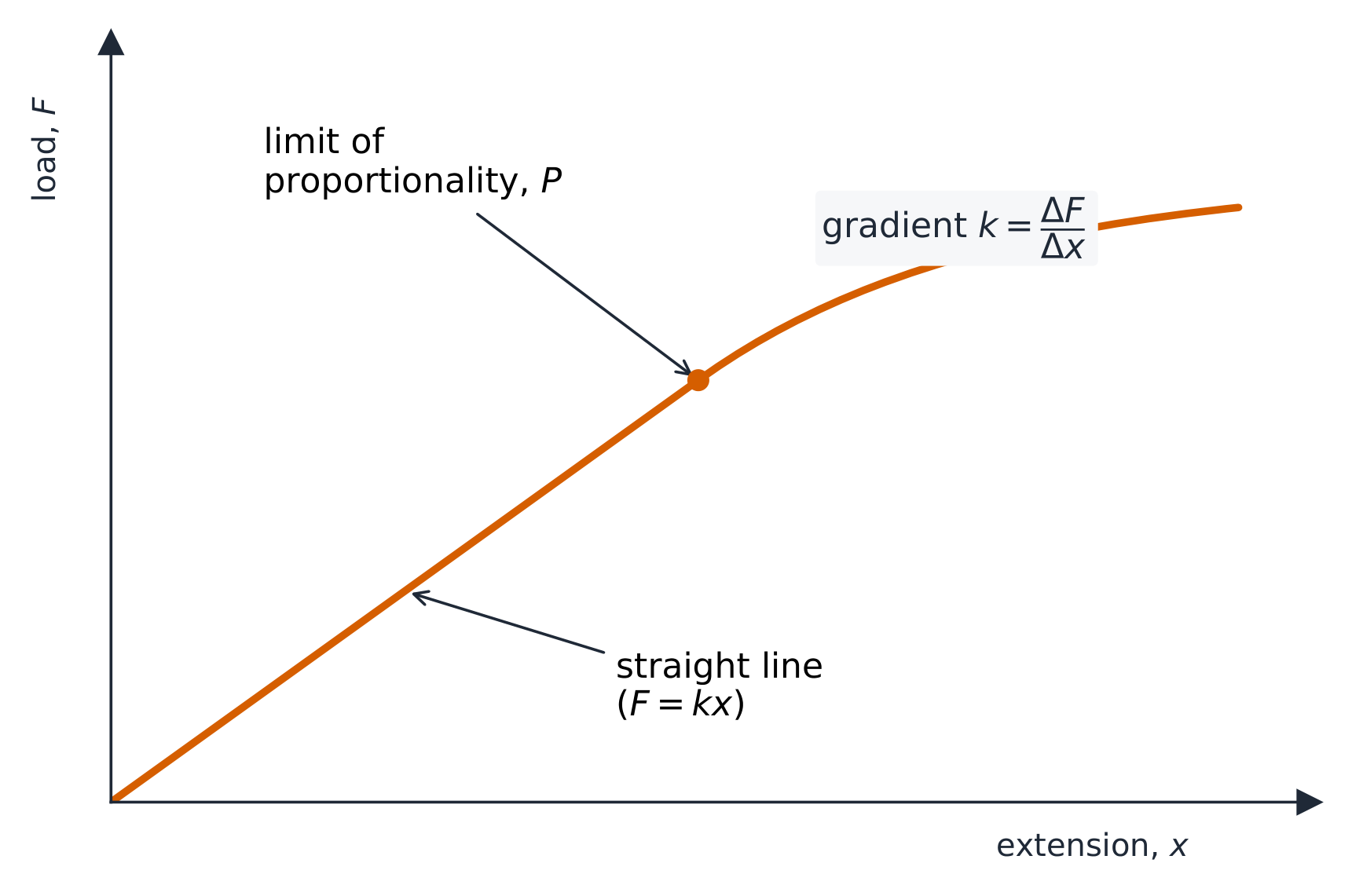
A force–extension ($F$ against $x$) graph has gradient $k$ in the Hooke's-law region.
An extension–force ($x$ against $F$) graph has gradient $1/k$ in the Hooke's-law region.
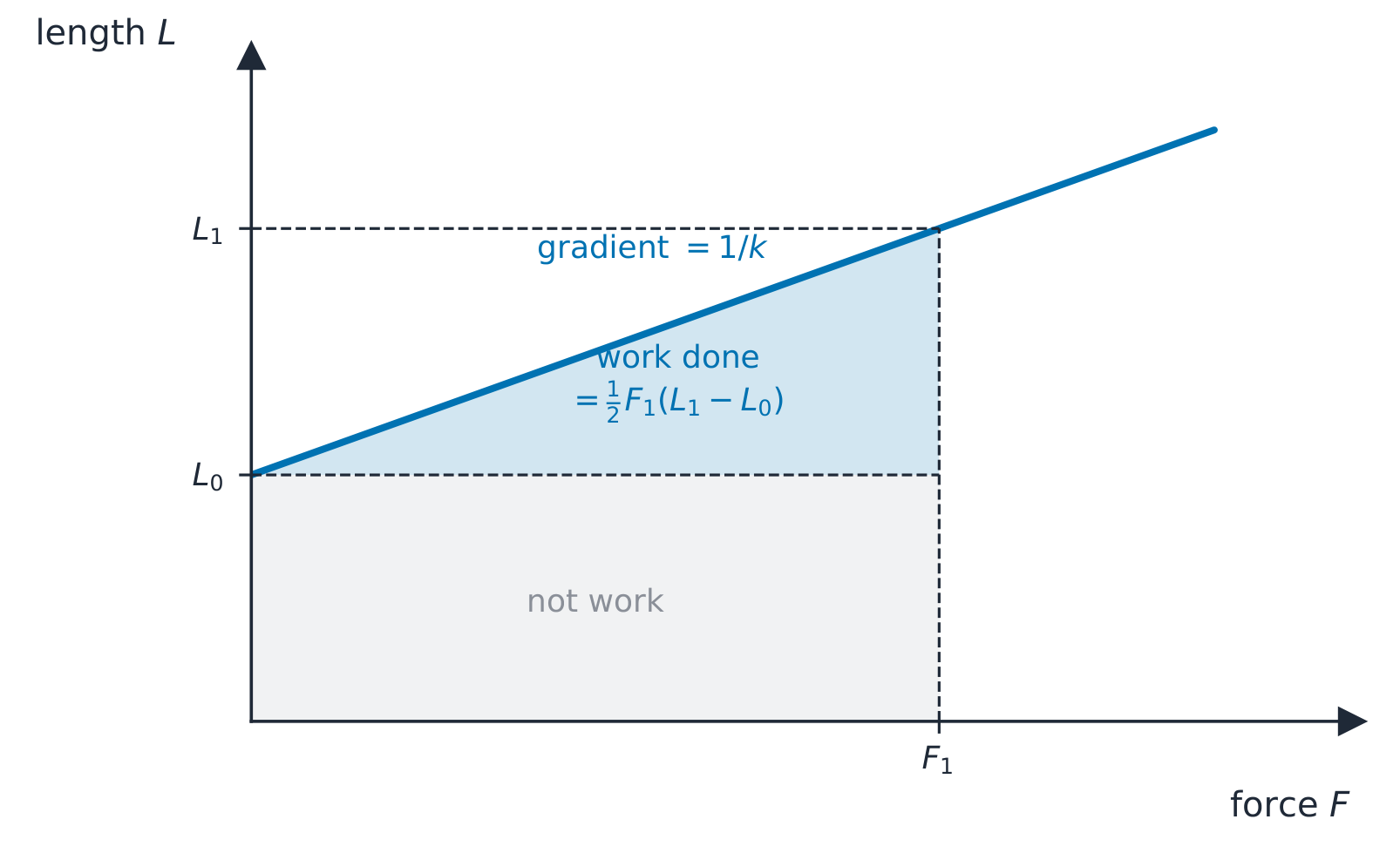
A common trap: if a graph plots length$L$ against force, you can still find the spring constant from the gradient (since $L = L_{0} + F/k$, the gradient is $1/k$ — read it off carefully).
Worked example. A spring has length $90\ \text{mm}$ under a force of $0.80\ \text{N}$ and $115\ \text{mm}$ under $1.30\ \text{N}$. Find the spring constant and the unstretched length.
The extra force $0.50\ \text{N}$ produces the extra extension $25\ \text{mm} = 0.025\ \text{m}$, so $k = 0.50 / 0.025 = 20\ \text{N m}^{-1}$. At $0.80\ \text{N}$ the extension is $x = F/k = 0.80 / 20 = 0.040\ \text{m}$, so the unstretched length is $90 - 40 = 50\ \text{mm}$. On a graph of length against force the intercept on the length axis is $L_{0}$, the gradient is $1/k$, and the work done in stretching the spring is the triangle between the line and the level $L = L_{0}$, not the whole area down to the force axis: the rectangle below $L_{0}$ is the unstretched length multiplied by the force, which means nothing.
Limit of proportionality
Hooke's law only holds up to the limit of proportionality 比例极限. Past this point the $F$ against $x$ line curves and is no longer straight. The material may still be elastic 弹性 (it returns to its first length when you remove the load) a little further, then it becomes plastic 塑性.
Springs in series and parallel
You may need to combine spring constants:
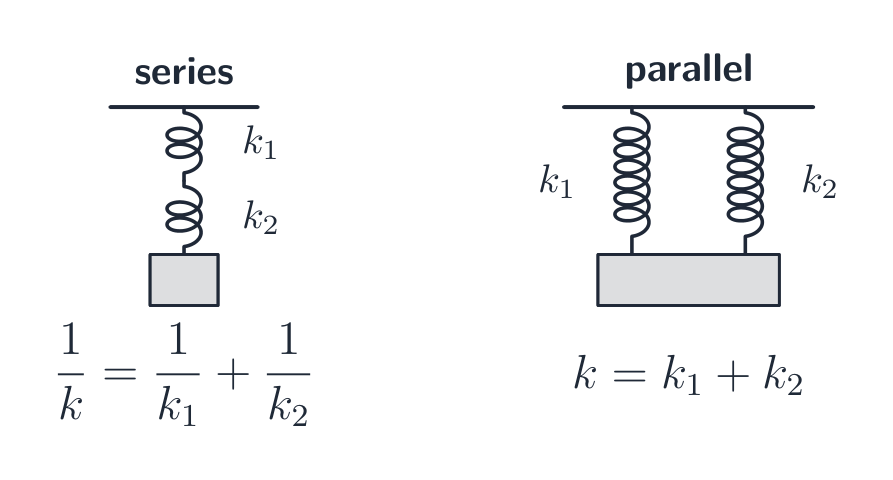
Series 串联 (one spring hangs from another): the same load passes through both, the total extension is the sum, so $\dfrac{1}{k_{\text{total}}} = \dfrac{1}{k_{1}} + \dfrac{1}{k_{2}}$.
Parallel 并联 (two springs side by side holding the same load): each takes half the load (if they are identical), the extensions are equal, so $k_{\text{total}} = k_{1} + k_{2}$.
Worked example. Springs of spring constant $6.0\ \text{N cm}^{-1}$ and $4.0\ \text{N cm}^{-1}$ are joined end to end and a load of $80\ \text{N}$ hangs from them. Find the total extension.
Each spring carries the full $80\ \text{N}$, so the extensions are $80/6.0 = 13.3\ \text{cm}$ and $80/4.0 = 20\ \text{cm}$: a total of $33\ \text{cm}$ (the same as $k = 2.4\ \text{N cm}^{-1}$ from $1/k = 1/6.0 + 1/4.0$). Three identical springs give the largest combined constant when all three are in parallel ($3k$) and the smallest when all are in series ($k/3$). When a load is shared by two identical springs in parallel, each carries half the force and so stores a quarter of the energy of one spring holding the whole load; the pair together stores half as much as the single spring did. A spring constant in $\text{N cm}^{-1}$ is $100$ times smaller than the same constant in $\text{N m}^{-1}$; give the unit the question asks for.
العربية
الزنبرك يخضع لقانون هوث: الاستطالة متناسبة مع القوة المطبقة.
لعدة مواد عند استطالات صغيرة، الاستطالة متناسبة مع الحمل — وهذا هو قانون هوث. الثابت الذي يربط بينهما هو ثابت الزنبرك$k$:
$$F = kx \qquad\Longleftrightarrow\qquad k = \frac{F}{x}.$$
وحدة $k$: $\text{N m}^{-1}$.
مثال محلول. يتمدد زنبرك بمقدار $4.0\ \text{cm}$ عندما يُعلق منه حمل قيمته $2.0\ \text{N}$. أوجد ثابت الزنبرك الخاص به.
بتحويل الاستطالة إلى أمتار ($4.0\ \text{cm} = 0.040\ \text{m}$):
بالنسبة للسؤال "اذكر قانون هوث" ذو العلامة الواحدة، اكتبه بالكلمات: الاستطالة متناسبة طردياً مع القوة المطبقة (الحمل)، شريطة ألا يتجاوز الحد المرن. ثابت الزنبرك هو القوة لكل وحدة استطالة؛ والخيارات الخادعة في أسئلة الاختيار من متعدد هي "الاستطالة لكل وحدة قوة" (أي $1/k$) و$\tfrac{1}{2}Fx$ (الطاقة المخزنة).
رسم الحمل–الاستطالة: خط مستقيم حتى الحد المرن $P$، ثم ينحني
قراءة الرسم البياني:
رسم القوة–الاستطالة ($F$ مقابل $x$) له ميل $k$ في منطقة قانون هوث.
رسم الاستطالة–القوة ($x$ مقابل $F$) له ميل $1/k$ في منطقة قانون هوث.
فخ شائع: إذا كان الرسم يوضح الطول$L$ مقابل القوة، ما زلت تستطيع إيجاد ثابت الزنبرك من الميل (بما أن $L = L_{0} + F/k$، فإن الميل هو $1/k$ — اقرأه بعناية).
مثال محلول. زنبرك طوله $90\ \text{mm}$ تحت قوة قدرها $0.80\ \text{N}$، وطوله $115\ \text{mm}$ تحت قوة قدرها $1.30\ \text{N}$. أوجد ثابت الزنبرك والطول غير المشدود.
القوة الإضافية $0.50\ \text{N}$ تنتج استطالة إضافية $25\ \text{mm} = 0.025\ \text{m}$، إذن $k = 0.50 / 0.025 = 20\ \text{N m}^{-1}$. عند $0.80\ \text{N}$ تكون الاستطالة $x = F/k = 0.80 / 20 = 0.040\ \text{m}$، إذن الطول غير المشدود هو $90 - 40 = 50\ \text{mm}$. في رسم للطول مقابل القوة، المقطع على محور الطول هو $L_{0}$، والميل هو $1/k$، والعمل المبذول في مد الزنبرك هو المثلث بين الخط ومستوى $L = L_{0}$، وليس المساحة الكلية حتى محور القوة: المستطيل أسفل $L_{0}$ يمثل الطول غير المشدود مضروباً في القوة، وهو لا قيمة له.
الطول مقابل القوة: المقطع هو $L_{0}$، والميل هو $1/k$، والمثلث فوق $L_{0}$ هو العمل المبذول فقط
الحد المرن
قانون هوث ساري فقط حتى الحد المرن. بعد هذه النقطة، يصبح المنحنى ($F$ مقابل $x$) منحنيًا不再 مستقيماً. قد يبقى المادة مرناً (يعود لطوله الأول عند إزالة الحمل) مسافة قصيرة، ثم يصبح لدناً.
الزنابير على التوالي والتوازي
قد تحتاج إلى دمج ثوابت الزنابير:
على التوالي (زنبرك يتدلى من آخر): نفس الحمل يمر عبر كليهما، والاستطالة الكلية هي المجموع، لذا $\dfrac{1}{k_{\text{total}}} = \dfrac{1}{k_{1}} + \dfrac{1}{k_{2}}$.
على التوازي (زنبران جنباً إلى جنب يحملان نفس الحمل): كل منهما يتحمل نصف الحمل (إذا كانا متطابقين)، والاستطالات متساوية، لذا $k_{\text{total}} = k_{1} + k_{2}$.
دمج ثوابت الزنابير: التوالي يعطي زنبركاً أكثر ليونة، والتوازي يعطي زنبركاً أكثر صلابة
مثال محلول. زنابير ثابتيها $6.0\ \text{N cm}^{-1}$ و$4.0\ \text{N cm}^{-1}$ مُوصَّلا طرفاً بطرف، ويُعلق منهما حمل قيمته $80\ \text{N}$. أوجد الاستطالة الكلية.
يحمل كل ربيع $80\ \text{N}$ الكامل، لذا فإن الامتدادات هي $80/6.0 = 13.3\ \text{cm}$ و$80/4.0 = 20\ \text{cm}$: المجموع $33\ \text{cm}$ (نفس $k = 2.4\ \text{N cm}^{-1}$ من $1/k = 1/6.0 + 1/4.0$). تعطي ثلاثة روابع متطابقة أكبر ثابت مجامع عندما تكون جميعها على التوازي ($3k$) وأصغر ثابت عند توصيلها على التوالي ($k/3$). عندما يُوزع الحمل على ربيعين متطابقين على التوازي، يحمل كل منهما نصف القوة ويخزن ربع الطاقة لربيع واحد يحمل الحمل الكامل؛ معًا يخزن الزوج نصف ما يخزنه الربيع المفرد. ثابت الربيع في $\text{N cm}^{-1}$ هو $100$ مرة أصغر من نفس الثابت في $\text{N m}^{-1}$؛ أجب بوحدة القياس المطلوبة في السؤال.
Explore · استكشف
Hooke's law · قانون هوك
F = k·x
Force is proportional to extension — the gradient is the spring constant k. · القوة متناسبة طردياً مع الاستطالة — الميل هو ثابت الزنبرك k.
Explore · استكشف
Hooke's law · قانون هوك
F = kx
Up to the limit, extension is proportional to force — the gradient is the spring constant k. · حتى حد التناسب، الاستطالة متناسبة مع القوة — الميل هو ثابت الزنبرك k.
Explore · استكشف
Hooke's law: F = kx · قانون هوك: F = kx
F = ax
Drag the spring constant. Force is proportional to extension — a straight line through the origin whose gradient is the spring constant. · اسحب ثابت المرونة. القوة تناسب الامتداد — خط مستقيم يمر بنقطة الأصل ميله هو ثابت المرونة.
limit of proportionality/ˈlɪmɪt ɒv prəˌpɔːʃəˈnælɪti/
حد التناسب
6.1
Stress, strain and the Young modulus · الإجهاد، الانفعال ومعامل يونغ
English
For a wire of uniform cross-section under a tensile load:
Stress 应力$\sigma = \dfrac{F}{A}$, where $F$ is the load and $A$ is the cross-sectional area 横截面积. Unit: $\text{Pa}$.
Strain 应变$\varepsilon = \dfrac{x}{L_{0}}$, where $x$ is the extension and $L_{0}$ is the original length. Strain has no unit (it is a ratio of lengths).
For the one-mark definitions: stress is the force per unit cross-sectional area (the force acting normally to the area); strain is the extension per unit original length. The unit of stress, $\text{Pa} = \text{N m}^{-2}$, is $\text{kg m}^{-1}\ \text{s}^{-2}$ in base units. The area of a round wire comes from its diameter $d$: $A = \pi d^{2}/4 = \pi r^{2}$, and using $d$ in place of $r$ makes the area four times too big. Convert $\text{mm}^{2}$ to $\text{m}^{2}$ with $10^{-6}$.
Worked example. A tensile force of $18\ \text{N}$ acts on a wire of cross-sectional area $3.2\ \text{mm}^{2}$. Find the stress.
$\sigma = F/A = 18 / (3.2 \times 10^{-6}) = 5.6 \times 10^{6}\ \text{Pa}$. The same force acts along the whole wire, so a bolt whose diameter is $2d$ at one end and $d$ at the other has four times the stress at the narrow end ($\sigma \propto 1/d^{2}$), and a wire of three times the radius carries one ninth of the stress.
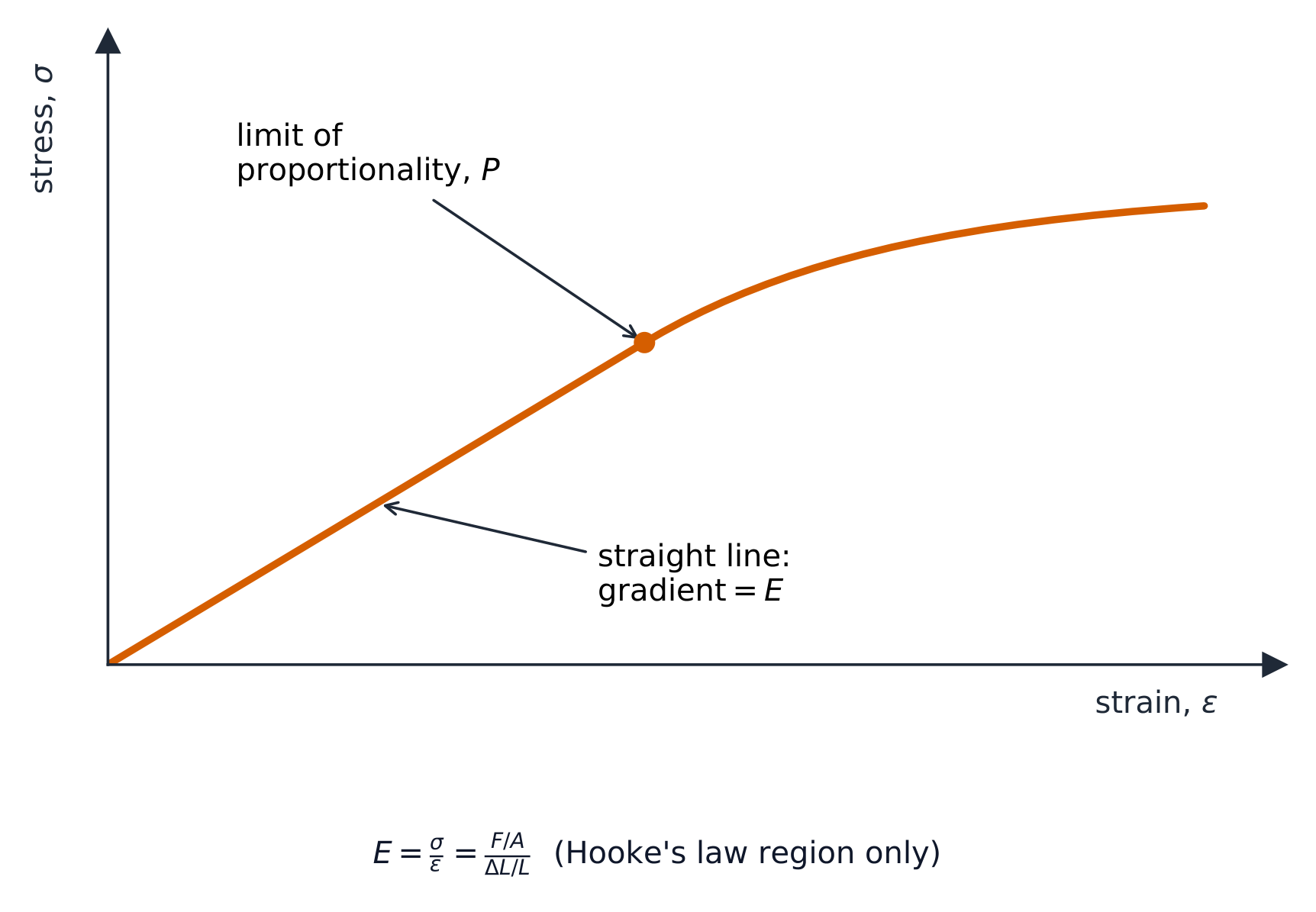
The Young modulus 杨氏模量 is the ratio of stress to strain in the Hooke's-law region:
Unit: $\text{Pa}$ (about $10^{11}$ for metals; e.g. steel $\approx 2.0 \times 10^{11}$ Pa).
Worked example. A steel wire of length $2.0\ \text{m}$ and cross-sectional area $1.5 \times 10^{-7}\ \text{m}^{2}$ stretches by $1.0\ \text{mm}$ under a load of $15\ \text{N}$. Find the Young modulus.
The Young modulus is a property of the material — it does not depend on the wire's shape or size. The spring constant $k$ depends on both the material and the size: $k = EA/L_{0}$.
For the one-mark definition: the Young modulus is the ratio of stress to strain (for a material deformed within its limit of proportionality). Because it belongs to the material, a thicker wire of the same metal has the same Young modulus: it stretches less under the same load because its area is larger, not because the metal is stiffer. A "show that $k = EA/L_{0}$" question wants two lines: $k = F/x$ and $E = FL_{0}/(Ax)$, so $E = kL_{0}/A$. Two things follow: a wire's spring constant stays constant while Hooke's law holds, whatever the force, and a wire of the same metal with twice the diameter has four times the spring constant.
Worked example. A copper wire of length $1.7\ \text{m}$ and diameter $0.64\ \text{mm}$ has Young modulus $1.2 \times 10^{11}\ \text{Pa}$. Find its spring constant.
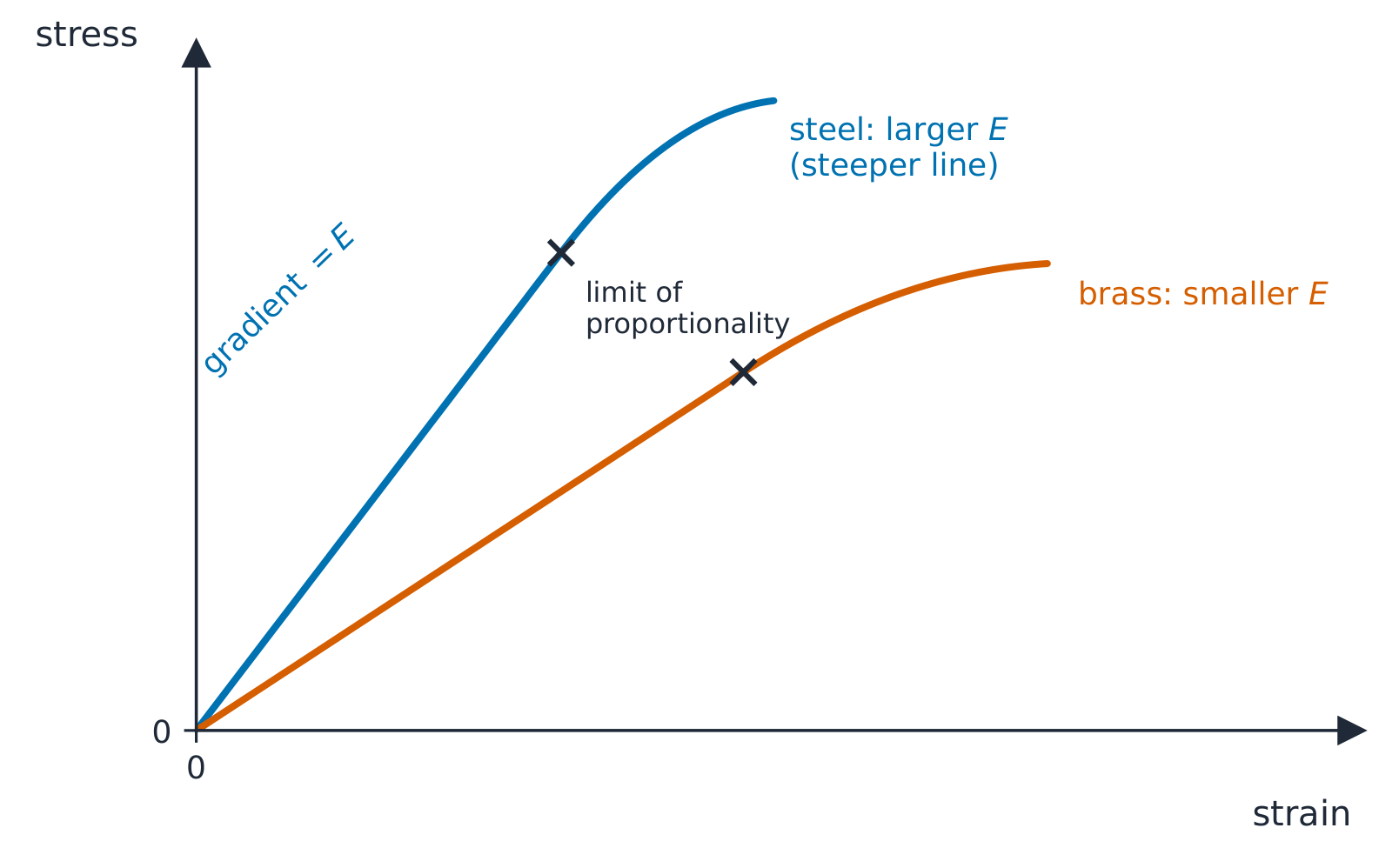
On a stress–strain graph the gradient of the straight part is $E$, so of two materials drawn on the same axes the steeper line is the stiffer material, and a wire with double the Young modulus is drawn as a line through the origin with twice the gradient. On a force–extension graph the gradient is $EA/L_{0}$ and the Young modulus is the gradient multiplied by $L_{0}/A$; only a stress–strain graph has a gradient equal to $E$ itself.
Experiment to find the Young modulus of a metal wire
A standard setup:
Clamp one end of a long, thin wire to a fixed support. Pass the wire over a pulley 滑轮 at the edge of the bench so it hangs straight down.
Measure the original length $L_{0}$ between the clamp and a marker near the pulley, using a metre rule.
Measure the diameter 直径$d$ of the wire at several places with a micrometer 螺旋测微器 and take the average. Work out $A = \pi d^{2}/4$.
Hang weights one at a time. Record the load $F$ and the extension $x$ (how far the marker moves against a fixed scale).
Plot $F$ against $x$. In the straight region the gradient is $EA/L_{0}$, so $E = \text{gradient} \times L_{0}/A$.
Why a long, thin wire? To make the extension big enough to measure well. Why repeat readings and measure $d$ at several places? To reduce random error 随机误差 and check the wire is uniform.
A "describe an experiment" answer earns its marks for the quantities measured and how ($L_{0}$ with a metre rule; $d$ with a micrometer at several points; the load from the masses or a newton meter; the extension from a marker read against a fixed scale, or a vernier scale), the graph ($F$ against $x$, gradient $EA/L_{0}$, or stress against strain, gradient $E$) and the precautions: safety goggles in case the wire snaps, a small load first to straighten kinks, and readings taken on unloading as well as loading to check the wire stayed elastic.
العربية
لسلك له مقطع عرضي منتظم تحت حمل شد:
الإجهاد$\sigma = \dfrac{F}{A}$، حيث $F$ هو الحمل و$A$ هو المقطع العرضي. الوحدة: $\text{Pa}$.
الانفعال$\varepsilon = \dfrac{x}{L_{0}}$، حيث $x$ هو الامتداد و$L_{0}$ هو الطول الأصلي. لا وحدة للانفعال (لأنه نسبة أطوال).
لتعريفات العلامة الواحدة: الإجهاد هو القوة لكل وحدة مساحة مقطع عرضي (القوة المؤثرة عمودياً على المساحة)؛ الانفعال هو الامتداد لكل وحدة طول أصلي. وحدة الإجهاد، $\text{Pa} = \text{N m}^{-2}$، هي $\text{kg m}^{-1}\ \text{s}^{-2}$ بالوحدات الأساسية. مساحة سلك دائري تُحسب من قطره $d$: $A = \pi d^{2}/4 = \pi r^{2}$، واستخدام $d$ بدلاً من $r$ يجعل المساحة أربعة أضعاف ما يجب أن تكون عليه. حول $\text{mm}^{2}$ إلى $\text{m}^{2}$ باستخدام $10^{-6}$.
مثال محلول. قوة شد مقدارها $18\ \text{N}$ تؤثر على سلك مساحته المقطعية $3.2\ \text{mm}^{2}$. أوجد الإجهاد.
$\sigma = F/A = 18 / (3.2 \times 10^{-6}) = 5.6 \times 10^{6}\ \text{Pa}$. نفس القوة تعمل على طول السلك بالكامل، لذا فإن مسمار قطره $2d$ في طرف و$d$ في الطرف الآخر يكون لديه إجهاد أربعة أضعاف عند الطرف الضيق ($\sigma \propto 1/d^{2}$)، وسلك نصف قطره ثلاث مرات يحوي تسعة أضعاف الإجهاد.
الإجهاد هو الحمل مقسوماً على المساحة المقطعية؛ الانفعال هو الامتداد مقسوماً على الطول الأصلي
معامل يونغ هو نسبة الإجهاد إلى الانفعال في منطقة قانون هوك:
رسم بياني للإجهاد-الانفعال، مستقيم حتى حد التناسب $P$
معامل يونغ هو خاصية للـ مادة — ولا يعتمد على شكل أو حجم السلك. ثابت الربيع $k$ يعتمد على المادة والحجم معاً: $k = EA/L_{0}$.
لتعريف علامة واحدة: معامل يونغ هو نسبة الإجهاد إلى الانفعال (لمادة مشوهة ضمن حد تناسبتها). بما أنه يملكه المادة، فإن سلكاً أكثر سماكة من نفس المعدن له نفس معامل يونغ: يتمدد أقل تحت نفس الحمل لأن مساحته أكبر، وليس لأن المعدن أكثر صلابة. سؤال "أثبت أن $k = EA/L_{0}$" يتطلب سطرين: $k = F/x$ و$E = FL_{0}/(Ax)$، لذا $E = kL_{0}/A$. ينتج عن ذلك شيئان: ثابت ربيع السلك يبقى ثابتاً طالما قانون هوك ساري بغض النظر عن القوة، وأن سلكاً من نفس المعدن وقطره ضعف القطر له ثابت ربيع بأربعة أضعاف.
مثال محلول. سلك نحاسي طوله $1.7\ \text{m}$ وقطره $0.64\ \text{mm}$ له معامل يونغ $1.2 \times 10^{11}\ \text{Pa}$. أوجد ثابت ربيعه.
في رسم بياني للإجهاد-الانفعال، ميل الجزء المستقيم هو $E$، لذا من بين مادتين مرسوميتين على نفس المحاور، الخط الأكثر انحداراً يمثل المادة الأكثر صلابة، والسلك الذي له ضعف معامل يونغ ترسمه كخط يمر بنقطة الأصل بميل مضاعف. في رسم بياني للقوة-الامتداد، الميل هو $EA/L_{0}$ ومعامل يونغ هو الميل مضروباً في $L_{0}/A$؛ فقط رسم الإجهاد-الانفعال له ميل يساوي $E$ نفسه.
*مادتان معدنيتان في رسم بياني واحد للإجهاد-الانفعال: الخط الأكثر انحداراً له معامل يونغ أكبر
تجربة لإيجاد معامل يونغ لسلك معدني
إعداد قياسي:
ثبت أحد طرفي سلك طويل ورقيق في دعامة ثابتة. مرر السلك عبر بكرة على حافة الطاولة ليحلّق بشكل مستقيم لأسفل.
قِس الطول الأصلي $L_{0}$ بين المثبت وعلامة قريبة من البكرة باستخدام مسطرة مترية.
قِس القطر$d$ للسلك في عدة مواقع باستخدام الميكرومتر وحسب المتوسط. احسب $A = \pi d^{2}/4$.
علق الأوزان واحداً تلو الآخر. سجّل الحمل $F$ والامتداد $x$ (كم تحركت العلامة مقابل مقياس ثابت).
ارسم $F$ مقابل $x$. في المنطقة المستقيمة، الميل هو $EA/L_{0}$، إذن $E = \text{gradient} \times L_{0}/A$.
لماذا سلك طويل ورقيق؟ لجعل الامتداد كبيراً بما يكفي لقياسه بدقة. لماذا نكرر القراءات ونقِس $d$ في عدة أماكن؟ لتقليل الخطأ العشوائي والتحقق من انتظام السلك.
تُكتسب الإجابة في سؤال "وصف تجربة" درجاتها من خلال الكميات المقاسة وكيفية قياسها ($L_{0}$ باستخدام مسطرة مترية؛ $d$ باستخدام الميكرومتر عند نقاط متعددة؛ الحمل من الكتل أو عداد القوة؛ الامتداد من قراءة مؤشر مقابل مقياس ثابت، أو مقياس فانييه)، والرسم البياني ($F$ مقابل $x$، والميل $EA/L_{0}$، أو الإجهاد مقابل الانفعال، والميل $E$) والتدابير الوقائية: نظارات واقية إذا انقطع السلك، حمل صغير أولاً لتنعيم التعرجات، وأخذ قراءات أثناء إزالة الحمل بالإضافة إلى إضافة الحمل للتحقق من بقاء السلك مرناً.
Elastic and plastic behaviour · السلوك المرن والبلاستيكي
Syllabus · المنهج
English
understand and use the terms elastic deformation, plastic deformation and elastic limit
understand that the area under the force–extension graph represents the work done
determine the elastic potential energy of a material deformed within its limit of proportionality from the area under the force–extension graph
recall and use $E_p = \frac{1}{2}Fx = \frac{1}{2}kx^2$ for a material deformed within its limit of proportionality
العربية
فهم واستخدام مصطلحات التشوه المرن، التشوه اللدن والحد المرن
فهم أن المساحة تحت منحنى القوة–التمدد تمثل الشغل المنجز
تحديد الطاقة الكامنة المرنة لمادة مشوهة ضمن حد التناسب من خلال المساحة تحت منحنى القوة–التمدد
تذكر واستخدام $E_p = \frac{1}{2}Fx = \frac{1}{2}kx^2$ لمادة مشوهة ضمن حد التناسب
Source: Cambridge International syllabus · المصدر: منهج كامبريدج الدولي
English
As the load grows:
Elastic and straight (Hooke obeyed) — up to the limit of proportionality. Removing the load returns the object to its first length.
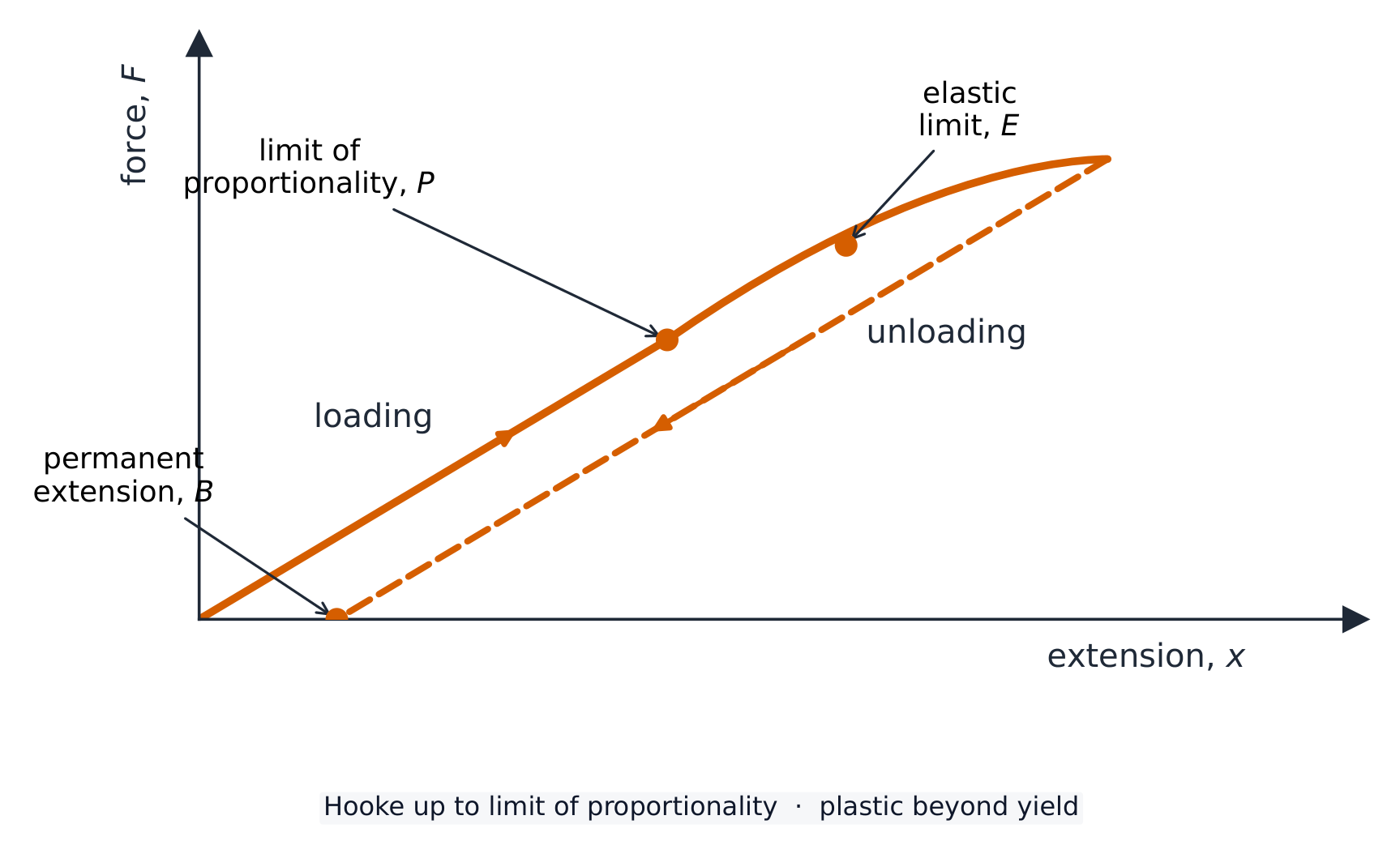
Elastic but curved — between the limit of proportionality and the elastic limit 弹性极限. The extension is no longer straight in the load, but on unloading the object still returns to its first length.
Plastic — past the elastic limit. On unloading, the object does not return to its first length; a permanent extension stays.
Hooke's law only holds in the straight, elastic region.
In words: elastic deformation means the object returns to its original length (or shape) when the load is removed; plastic deformation means it does not, and a permanent extension remains; the elastic limit is the maximum load (or extension) for which the deformation is still elastic; the limit of proportionality is the point beyond which the extension is no longer proportional to the load. On a graph the limit of proportionality is where the line stops being straight. The elastic limit lies a little beyond it and cannot be read from a loading line alone. So in a "which statement must be correct" item, the end of the straight part is the limit of proportionality, but whether a later point is the elastic limit or the breaking point cannot be told from the shape of the loading line.
On a force–extension graph for a material taken into the plastic region and then unloaded, the loading line and the unloading line are different. The unloading line is parallel to the first Hooke line but shifted to the right (the permanent extension left when the load reaches zero). The area between the loading and unloading lines is the energy turned into thermal energy 热能 in the material.
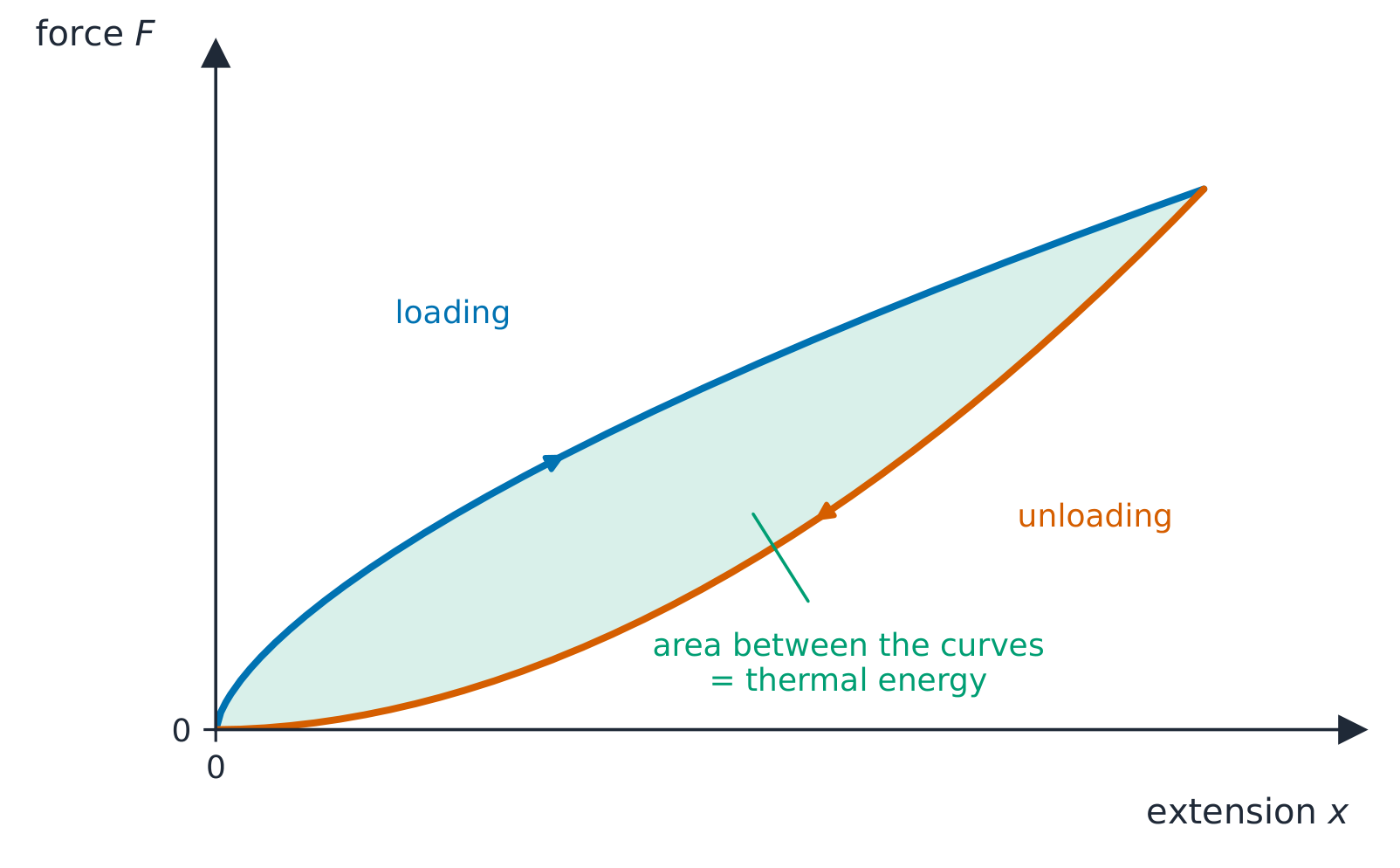
A rubber band 橡皮筋 also has different loading and unloading curves, but it returns to its original length: its deformation is elastic. The area between the two curves is again energy dissipated as thermal energy (elastic hysteresis 弹性滞后), and the energy recovered on unloading is the area under the lower curve. The two-mark "explain why the work done in stretching the wire is not equal to the energy recovered when the force is removed" answer says that the wire was taken past its elastic limit, so part of the deformation is plastic and a permanent extension remains, and that part of the work done became thermal energy in the wire.
العربية
مع زيادة الحمل:
مرن ومستقيم (يخضع لقانون هوك) — حتى حد التناسب. عند إزالة الحمل، يعود الجسم إلى طوله الأصلي.
مرن ولكن منحني — بين حد التناسب والحد المرن. لم يعد الامتداد مستقيماً بالنسبة للحمل، ولكن عند إزالة الحمل، لا يزال الجسم يعود إلى طوله الأصلي.
بلاستيكي — بعد الحد المرن. عند إزالة الحمل، لا يعود الجسم إلى طوله الأصلي؛ ويبقى امتداد دائم.
قانون هوك ساري فقط في المنطقة المستقيمة المرنة.
بالكلمات: التشوه المرن يعني أن الجسم يعود إلى طوله (أو شكله) الأصلي عند إزالة الحمل؛ التشوه البلاستيكي يعني أنه لا يفعل ذلك، ويظل امتداد دائم؛ الحد المرن هو أقصى حمل (أو امتداد) يكون عنده التشوه لا يزال مرناً؛ حد التناسب هو النقطة التي يتجاوزها الامتداد لم يعد متناسباً مع الحمل. في الرسم البياني، حد التناسب هو المكان الذي تتوقف فيه الخطوط عن أن تكون مستقيمة. يقع الحد المرن قليلاً وراءه ولا يمكن قراءته من خط الإضافة وحده. لذلك، في سؤال "أي عبارة يجب أن تكون صحيحة"، نهاية الجزء المستقيم هي حد التناسب، لكن ما إذا كانت نقطة لاحقة هي الحد المرن أو نقطة الكسر لا يمكن تحديدها من شكل خط الإضافة.
القوة–الامتداد بعد الحد المرن: $P$ و$E$ محددة، مع وجود امتداد دائم $B$ متبقي بعد إزالة الحملآلة اختبار الشد العام الحديثة تمدد العينة وتسجل القوة والامتداد
في رسم بياني للقوة–الامتداد لمادة تم سحبها إلى المنطقة البلاستيكية ثم إزالتها منها، يكون خط الإضافة وخط الإزالة مختلفين. خط الإزالة موازٍ للخط الأول الخاص بقانون هوك ولكنه مزاح إلى اليمين (الامتداد الدائم المتبقي عندما يصل الحمل إلى الصفر). المساحة بين خطي الإضافة والإزالة هي الطاقة المحولة إلى طاقة حرارية في المادة.
الشريط المطاطي أيضاً له منحنيات إضافة وإزالة مختلفة، لكنه يعود إلى طوله الأصلي: تشوهه مرن. المساحة بين المنحنيين هي مرة أخرى طاقة مشتتة كطاقة حرارية (التخلف المرن)، والطاقة المستعادة عند الإزالة هي المساحة تحت المنحنى السفلي. الإجابة ذات الدرجتين "اشرح لماذا الشغل المبذول في شد السلك لا يساوي الطاقة المستعادة عند إزالة القوة" تقول إن السلك سُحب تجاوز حدّه المرن، لذا جزء من التشوه بلاستيكي ويبقى امتداد دائم، وأن جزءاً من الشغل المبذول تحول إلى طاقة حرارية في السلك.
الشريط المطاطي يعود إلى طوله الأصلي، لكن المساحة بين الإضافة والإزالة تمثل طاقة ضائعة كطاقة حرارية
Energy stored in a stretched material · الطاقة المخزنة في مادة مشدودة
English
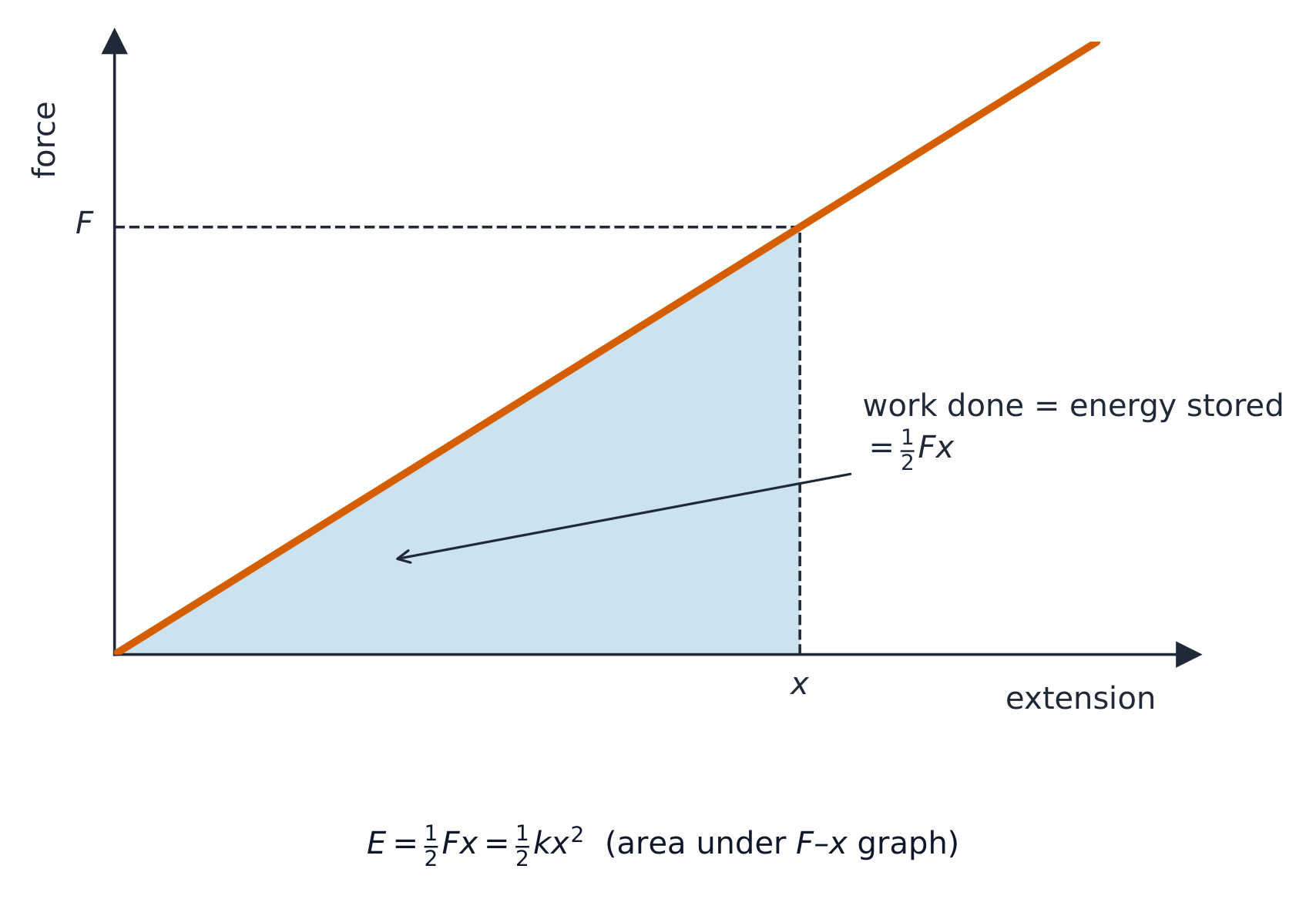
The work done in stretching a material from $0$ to extension $x$, as the load grows from $0$ to $F$, is the area under the force–extension graph.
Why the area: work done is force multiplied by the distance moved, but here the force grows as the material stretches, so the work is the sum of $F\,\Delta x$ over many small extensions, which is the area under the line. Within the limit of proportionality the force rises uniformly from $0$ to $F$, so the average force is $\tfrac{1}{2}F$ and the work is $\tfrac{1}{2}Fx$. On a force–extension graph the gradient is the spring constant.
Hooke's-law material
When Hooke's law holds, the $F$ against $x$ graph is a straight line through the origin. The area under it from $0$ to $x$ is a triangle:
$$E_{\text{P}} = \tfrac{1}{2} F x = \tfrac{1}{2} k x^{2}.$$
This is the elastic potential energy 弹性势能 stored in a spring or wire stretched within its limit of proportionality. An equal form:
$$E_{\text{P}} = \frac{F^{2}}{2k}.$$
Worked example. A spring of spring constant $50\ \text{N m}^{-1}$ is stretched by $0.20\ \text{m}$, within its limit of proportionality. Find the elastic potential energy stored.
Worked example. A wire of spring constant $2.0 \times 10^{4}\ \text{N m}^{-1}$ is already extended by $2.0\ \text{mm}$. Find the work done to increase its extension to $3.0\ \text{mm}$.
The stored energy rises from $\tfrac{1}{2} k x_{1}^{2}$ to $\tfrac{1}{2} k x_{2}^{2}$: $W = \tfrac{1}{2} \times 2.0 \times 10^{4} \times \left[(3.0 \times 10^{-3})^{2} - (2.0 \times 10^{-3})^{2}\right] = 0.050\ \text{J}$. This is the trapezium under the line between the two extensions, not $\tfrac{1}{2} k (x_{2} - x_{1})^{2}$. Because $E_{\text{P}} \propto x^{2}$ at fixed $k$, doubling the extension of a wire stores four times the energy ($0.65\ \text{J}$ becomes $2.6\ \text{J}$), and a stored energy gives the extension as $x = \sqrt{2E_{\text{P}}/k}$: a spring of $k = 400\ \text{N m}^{-1}$ storing $0.32\ \text{J}$ is compressed by $\sqrt{2 \times 0.32 / 400} = 0.040\ \text{m}$. For two wires joined end to end the tension is the same in both, so the total energy stored is $\tfrac{1}{2}F x_{1} + \tfrac{1}{2}F x_{2}$ with each wire's own extension.
Non-Hooke material
For a graph that is not a straight line (a stretched rubber band, or a spring past its limit of proportionality), find the area by counting grid squares or by using trapezia 梯形. The same idea holds: the area under the force–extension graph is the work done on the material. To estimate the work done up to the breaking point, count the squares under the whole curve (part squares as halves) and multiply by the energy one square represents, the force step multiplied by the extension step; saying that the area was found by counting squares is the "explain your reasoning" mark.
Comparing stored energy
A common multiple-choice case: two materials are stretched by the same force, or by the same extension. Using $E_{\text{P}} = \tfrac{1}{2} F x$:
same $F$, smaller $k$ (less stiff) → larger $x$ → more energy stored.
same $x$, larger $k$ (stiffer) → larger $F$ → more energy stored.
A sketch of $E_{\text{P}}$ against extension or compression is a curve through the origin that gets steeper ($E_{\text{P}} \propto x^{2}$), not a straight line. Of two wires of the same length and area under the same load, the one with the smaller Young modulus extends more and so stores more energy.
When a stretched spring is released onto a mass, the elastic potential energy becomes kinetic energy 动能 (and gravitational potential energy if the mass rises). Set $\tfrac{1}{2} k x^{2}$ equal to $\tfrac{1}{2} m v^{2}$ (plus any $mgh$) to find the speed or height.
العربية
الشغل المبذول في تمديد مادة من $0$ إلى استطالة $x$، بينما تتزايد الحمل من $0$ إلى $F$، هو المسطح تحت منحنى القوة–الاستطالة.
الشغل المبذول في مدّ المادة هو المساحة تحت رسم بياني القوة–الامتداد
لماذا المساحة: الشغل المبذول هو القوة مضروبة في المسافة المقطوعة، ولكن هنا القوة تزداد بينما تمتد المادة، لذا الشغل هو مجموع $F\,\Delta x$ على امتدادات صغيرة عديدة، وهو ما يمثل المساحة تحت الخط. ضمن حد التناسب، ترتفع القوة بانتظام من $0$ إلى $F$، لذا متوسط القوة هو $\tfrac{1}{2}F$ والشغل هو $\tfrac{1}{2}Fx$. في رسم بياني القوة–الامتداد، الميل هو ثابت الزنبرك.
مادة تخضع لقانون هوك
عندما ينطبق قانون هوك، يكون رسم بياني $F$ مقابل $x$ خطاً مستقيماً يمر بنقطة الأصل. المساحة تحته من $0$ إلى $x$ تشكل مثلثاً:
$$E_{\text{P}} = \tfrac{1}{2} F x = \tfrac{1}{2} k x^{2}.$$
هذه هي الطاقة الكامنة المرنة المخزنة في زنبرك أو سلك ممدود ضمن حد تناسبه. صيغة مساوية:
$$E_{\text{P}} = \frac{F^{2}}{2k}.$$
مثال محلول. زنبرك ثابت زنبرك $50\ \text{N m}^{-1}$ مُدد بمقدار $0.20\ \text{m}$، ضمن حد تناسبه. أوجد الطاقة الكامنة المرنة المخزنة.
مثال محلول. سلك ثابت مرونته $2.0 \times 10^{4}\ \text{N m}^{-1}$ ممدد بالفعل بمقدار $2.0\ \text{mm}$. أوجد الشغل المبذول لزيادة مدده إلى $3.0\ \text{mm}$.
تزداد الطاقة المخزنة من $\tfrac{1}{2} k x_{1}^{2}$ إلى $\tfrac{1}{2} k x_{2}^{2}$: $W = \tfrac{1}{2} \times 2.0 \times 10^{4} \times \left[(3.0 \times 10^{-3})^{2} - (2.0 \times 10^{-3})^{2}\right] = 0.050\ \text{J}$. هذا هو مساحة شبه المنحرف تحت الخط بين الامتدادين، وليس $\tfrac{1}{2} k (x_{2} - x_{1})^{2}$. بما أن $E_{\text{P}} \propto x^{2}$ عند $k$ ثابتة، فإن مضاعفة امتداد السلك تخزن أربعة أضعاف الطاقة (يصبح $0.65\ \text{J}$$2.6\ \text{J}$)، وتعطي الطاقة المخزنة قيمة الامتداد كما في $x = \sqrt{2E_{\text{P}}/k}$: نابض ثابت مرونته $k = 400\ \text{N m}^{-1}$ يخزن طاقة $0.32\ \text{J}$ يتم ضغطه بمقدار $\sqrt{2 \times 0.32 / 400} = 0.040\ \text{m}$. بالنسبة لسلكين متصلين طرفاً بطرف، يكون الشد متساويًا في كليهما، لذا تكون الطاقة الكلية المخزنة $\tfrac{1}{2}F x_{1} + \tfrac{1}{2}F x_{2}$ مع امتداد كل سلك خاص به.
مواد غير هوكية
لرسم بياني ليس خطًا مستقيمًا (شريط مطاطي مشدود، أو نابض تجاوز حد التناسب)، أوجد المساحة عن طريق عد مربعات الشبكة أو باستخدام شبه المنحرف. نفس الفكرة تنطبق: المساحة تحت منحنى القوة–الامتداد هي الشغل المبذول على المادة. لتقدير الشغل المبذول حتى نقطة الكسر، عد المربعات تحت المنحنى بالكامل (المربعات الجزئية تُحسب كنصف) واضرب في الطاقة التي تمثلها مربع واحد، أي خطوة القوة مضروبة في خطوة الامتداد؛ يُعد ذكر أن المساحة أُوجدت بعدد المربعات علامة "اشرح استنتاجك".
مقارنة الطاقة المخزنة
حالة شائعة في أسئلة الاختيار من متعدد: مادتان مشددتان بنفس القوة، أو بنفس الامتداد. باستخدام $E_{\text{P}} = \tfrac{1}{2} F x$:
نفس $F$، أصغر $k$ (أقل صلابة) → أكبر $x$ → طاقة مخزنة أكثر.
نفس $x$، أكبر $k$ (أكثر صلابة) → أكبر $F$ → طاقة مخزنة أكثر.
رسم تخطيطي لـ $E_{\text{P}}$ مقابل الامتداد أو الانضغاط هو منحنى يمر بنقطة الأصل ويصبح أكثر انحدارًا ($E_{\text{P}} \propto x^{2}$)، وليس خطًا مستقيمًا. بالنسبة لسلكين من نفس الطول ونفس المقطع العرضي تحتهما نفس الحمل، فإن الذي له معامل يونغ الأصغر يمتد أكثر وبالتالي يخزن طاقة أكثر.
عند إفلات نابض مشدود نحو كتلة، تتحول الطاقة الكامنة المرنة إلى طاقة حركية (وطاقة كامنة جاذبية إذا ارتفعت الكتلة). اجعل $\tfrac{1}{2} k x^{2}$ مساويًا لـ $\tfrac{1}{2} m v^{2}$ (زائد أي $mgh$) لإيجاد السرعة أو الارتفاع.
6.2
Definitions the examiner accepts · التعريفات التي يقبلها المصحح
English
A definition question is marked against fixed wording. Learn these exactly, and give one answer only.
Term
Definition
Hooke's law
the extension is directly proportional to the applied force, provided the limit of proportionality is not exceeded
spring constant
the force per unit extension
limit of proportionality
the point beyond which the extension is no longer proportional to the applied force
elastic limit
the maximum force (or extension) for which the material returns to its original length when the force is removed
elastic deformation
the material returns to its original length (shape) when the force is removed
plastic deformation
the material does not return to its original length when the force is removed; a permanent extension remains
stress
the force per unit cross-sectional area
strain
the extension per unit original length
Young modulus
the ratio of stress to strain (within the limit of proportionality)
elastic potential energy
the energy stored in an object because it has been stretched or compressed
العربية
تُصنّف أسئلة التعريف بناءً على صياغة ثابتة. احفظ هذه التعريفات بدقة، وقدم إجابة واحدة فقط.
مصطلح
تعريف
قانون هوك
الامتداد يتناسب طرديًا مع القوة المطبقة، بشرط عدم تجاوز حد التناسب
ثابت المرونة
القوة لكل وحدة امتداد
حد التناسب
النقطة التي يتجاوز بعدها الامتداد عدم تناسبه مع القوة المطبقة
الحد المرن
أقصى قوة (أو امتداد) تعود عنده المادة إلى طولها الأصلي عند إزالة القوة
التشوه المرن
تعود فيه المادة إلى طولها الأصلي (شكلها) عند إزالة القوة
التشوه اللدن
لا تعود فيه المادة إلى طولها الأصلي عند إزالة القوة؛ يبقى امتداد دائم
الإجهاد
القوة لكل وحدة مساحة مقطع عرضي
الانفعال
الامتداد لكل وحدة طول أولي
معامل يونغ
نسبة الإجهاد إلى الانفعال (ضمن حد التناسب)
الطاقة الكامنة المرنة
الطاقة المخزنة في جسم بسبب تمدده أو انضغاده
6.2
Exam tips · نصائح للامتحان
English
Hooke's law ($F = kx$) holds only up to the limit of proportionality.
Stress $= F/A$, strain $= x/L$, Young modulus $=$ stress$/$strain (gradient of the straight part of the stress-strain graph) — watch the units (Pa).
Energy stored $=$area under the force-extension graph$= \frac{1}{2}Fx$ in the elastic region.
Distinguish elastic (returns to shape) from plastic (permanent) deformation.
Common mistakes
Using the diameter as the radius in $A = \pi r^{2}$, or leaving an area in $\text{mm}^{2}$. Halve the diameter first; $1\ \text{mm}^{2} = 10^{-6}\ \text{m}^{2}$.
Reading the work done off a length–force graph as the whole area down to the axis. Only the triangle above $L_{0}$ is work.
Treating stored energy as proportional to extension. It goes as $x^{2}$: double the extension, four times the energy; and the work done between two extensions is the difference of two $\tfrac{1}{2}kx^{2}$ values.
Stating Hooke's law without its condition. "Provided the limit of proportionality is not exceeded" is part of the law.
Swapping the limit of proportionality (the end of the straight line) and the elastic limit (the end of elastic behaviour, a little beyond it).
Saying a thicker wire has a larger Young modulus. The modulus is the material's; the thicker wire has a larger spring constant.
العربية
قانون هوك ($F = kx$) صالح فقط حتى حد التناسب.
الإجهاد $= F/A$، الانفعال $= x/L$، معامل يونغ $=$ stress$/$strain (ميل الجزء المستقيم من رسم الإجهاد-الانفعال) — انتبه للوحدات (Pa).
الطاقة المخزنة $=$ = مساحة تحت منحنى القوة–الامتداد$= \frac{1}{2}Fx$ في المنطقة المرنة.
فرّق بين المرن (يعود للشكل) واللدن (دائم) للتشوهات.
أخطاء شائعة
استخدام القطر كـ نصف قطر في $A = \pi r^{2}$، أو ترك مساحة في $\text{mm}^{2}$. نقص القطر أولاً؛ $1\ \text{mm}^{2} = 10^{-6}\ \text{m}^{2}$.
قراءة الشغل من منحنى الطول–القوة كمساحة كاملة حتى المحور. فقط المثلث فوق $L_{0}$ يمثل شغلًا.
اعتبار الطاقة المخزنة متناسبة مع الامتداد. فهي تتناسب مع $x^{2}$: مضاعفة الامتداد تعني أربعة أضعاف الطاقة؛ والشغل المبذول بين امتدادين هو الفرق بين قيمتين لـ $\tfrac{1}{2}kx^{2}$.
ذكر قانون هوك بدون شرطه. "شرط عدم تجاوز حد التناسب" جزء من القانون.
تبديل حد التناسب (نهاية الخط المستقيم) بالحد المرن (نهاية السلوك المرن، وهو أبعد قليلاً منه).
قول إن السلك الأكثر سماكة له معامل يونغ أكبر. المعامل خاص بالمادة؛ السلك الأكثر سماكة له ثابت مرونة أكبر.
Interactive lessons on this topic · دروس تفاعلية حول هذا الموضوع
Work through it step by step, with instant-check exercises. · ا-working عليه خطوة بخطوة، مع تمارين تحقق فوري.
Pick one and the site follows you — notes, papers, videos and practice all open on it. · اختر واحدًا وسيتبعك الموقع — الملاحظات، الأوراق، الفيديوهات والتدريب جميعها تفتح عليه.
Type to search notes, lessons, code, vocabulary and past-paper questions across every subject. · اكتب للبحث عن ملاحظات، دروس، أكواد، مفردات وأسئلة امتحانات سابقة عبر جميع المواد.



 *مادتان معدنيتان في رسم بياني واحد للإجهاد-الانفعال: الخط الأكثر انحداراً له معامل يونغ أكبر