Elastic and plastic behaviour
Introduced| English | Meaning |
|---|---|
| elastic/ɪˈlæstɪk/ | Describing a material or object that returns to its original shape or size after a deforming force is removed, within its elastic limit. |
| plastic/ˈplæstɪk/ | Describing deformation that remains after the deforming force is removed. |
| limit of proportionality/ˈlɪmɪt ɒv prəˌpɔːʃəˈnælɪti/ | The point beyond which extension is no longer directly proportional to applied force. |
| elastic limit/ɪˈlæstɪk ˈlɪmɪt/ | The greatest stress or deformation a material can experience and still return to its original shape when unloaded. |
| permanent extension/ˈpɜːmənənt ekˈstenʃn/ | permanent extension |
The paperclip test
- Bend a paperclip a little and it springs back — elastic 弹性.
- Bend it far and it stays bent — plastic 塑性.
- The same material can do both, depending on how hard you push it.
Three stages of stretching
- Elastic and straight — obeys Hooke's law; returns to shape.
- Elastic but curved — past the limit of proportionality 比例极限; still returns to shape.
- Plastic — past the elastic limit 弹性极限; a permanent change is left.
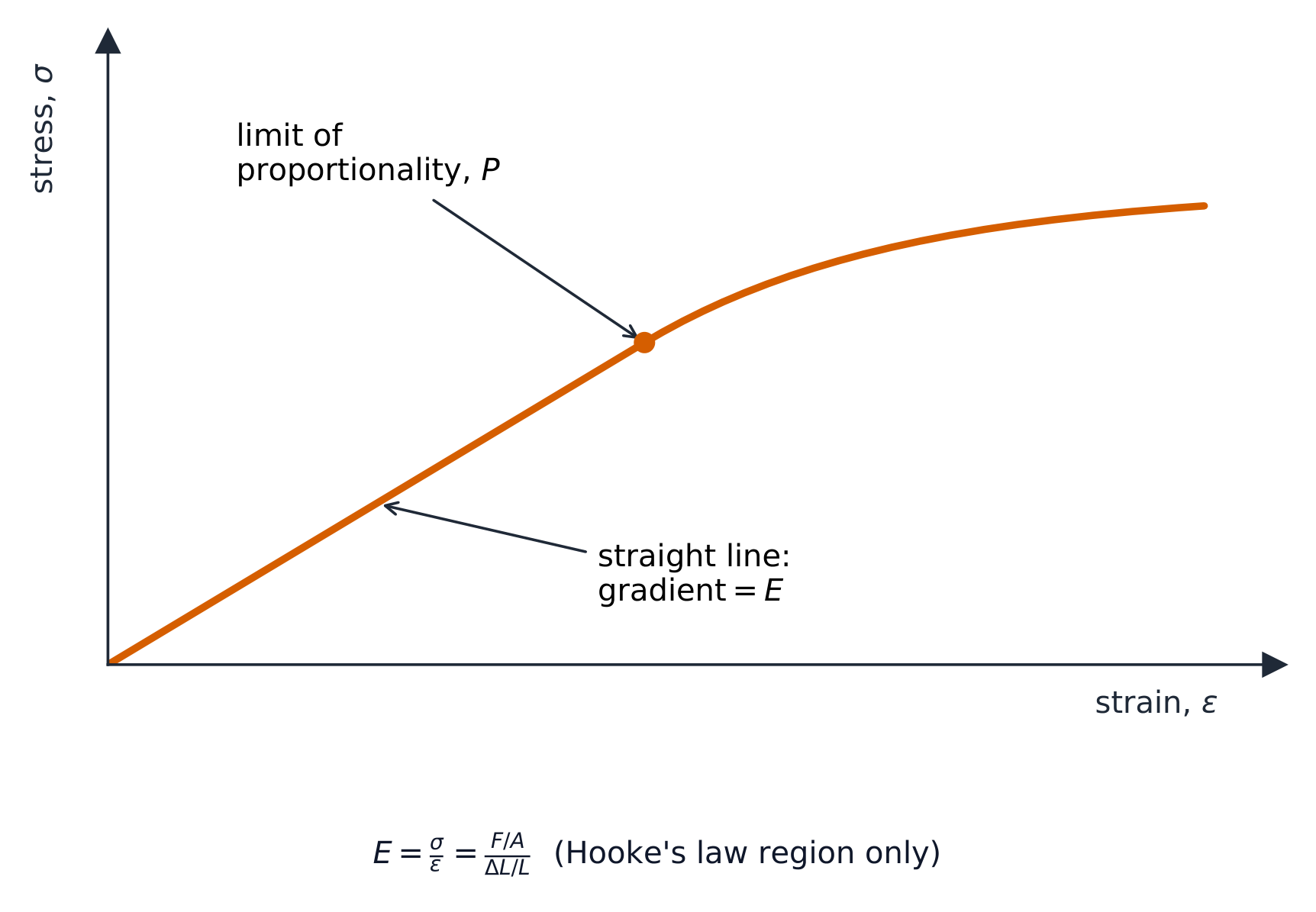
A stress-strain graph, straight up to the limit of proportionality P
Hooke's law
F = kx
Up to the limit, extension is proportional to force — the gradient is the spring constant k.
Match each stage of stretching to what happens.
Difficulty 2/5 · 140 coins + a small bonus on first completion today
Elastic = returns to its first length on unloading; plastic = a permanent change once you pass the elastic limit.
Loading and unloading
- Stretch past the elastic limit, then remove the load.
- The unloading line is parallel to the first line but shifted — leaving a permanent extension 永久伸长.
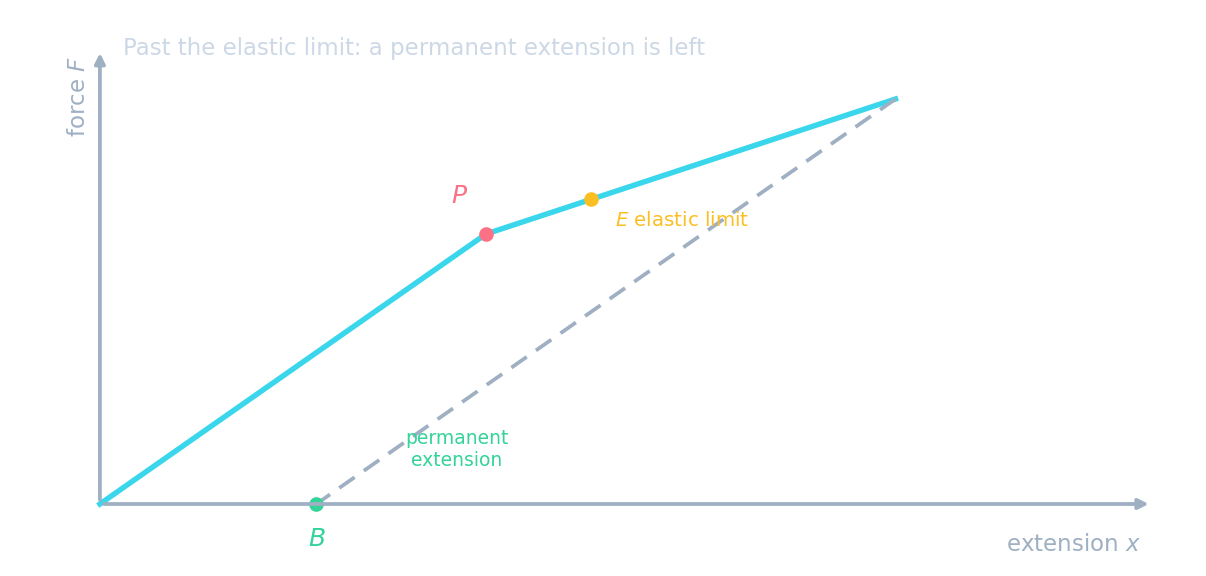
Past the elastic limit, an object returns to its original length when the load is removed.
Difficulty 1/5 · 100 coins + a small bonus on first completion today
No — in the plastic region a permanent extension stays after unloading.
Match each term to the definition the examiner marks.
Difficulty 2/5 · 140 coins + a small bonus on first completion today
The elastic limit sits a little beyond the limit of proportionality, so a material can stop obeying Hooke's law while still being elastic.
Energy = area under the graph
- The work done stretching a material is the area under its force–extension graph.
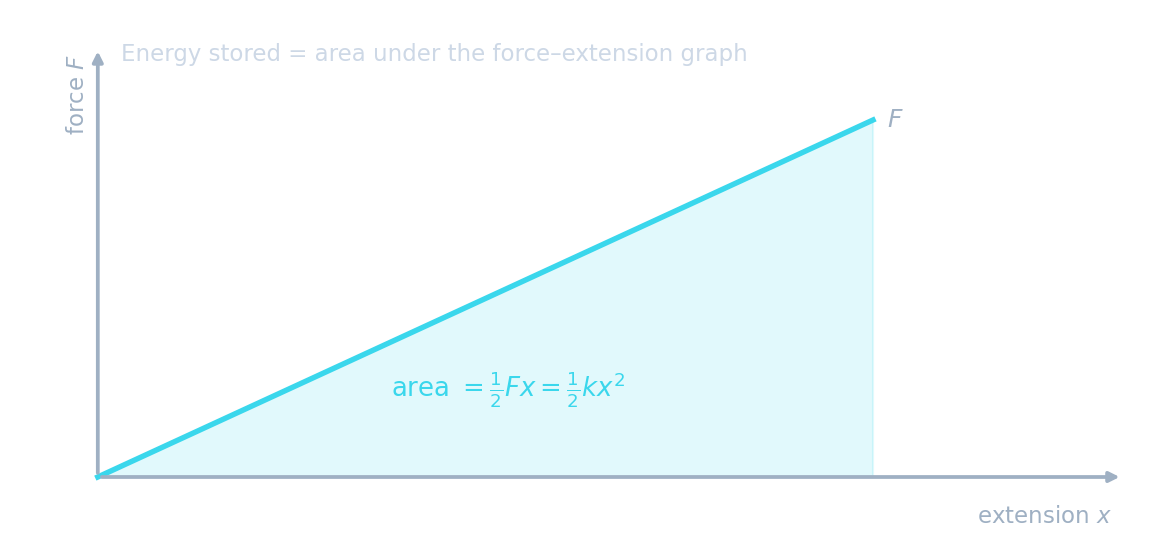
The energy stored in a stretched material equals the ____ under the force–extension graph.
Difficulty 1/5 · 100 coins + a small bonus on first completion today
Work done = area under the force–extension graph (a triangle for a Hooke material).
Stored elastic energy
- For a Hooke's-law material the area is a triangle: $E_{\text{P}} = \tfrac{1}{2}Fx = \tfrac{1}{2}kx^{2}$.
- An equal form is $E_{\text{P}} = \dfrac{F^{2}}{2k}$.

Force-extension past the elastic limit: P and E marked, with a permanent extension B left after unloading
A spring of constant $200\ \dfrac{\text{N}}{\text{m}}$ is stretched by $0.10\ \text{m}$. How much elastic PE is stored?
Difficulty 2/5 · 140 coins + a small bonus on first completion today
$E_{\text{P}} = \tfrac{1}{2}kx^{2} = \tfrac{1}{2} \times 200 \times 0.10^{2} = 1.0\ \text{J}$.
When it's not a straight line
- For rubber, or a spring past its limit, the graph is a curve.
- Find the area by counting squares or using trapezia — the rule is the same.
Comparing and releasing
- Same force, softer spring (smaller $k$) → bigger $x$ → more energy stored.
- Released onto a mass, the elastic PE becomes kinetic energy: $\tfrac{1}{2}kx^{2} = \tfrac{1}{2}mv^{2}$.
Two springs are pulled with the same force. The softer spring (smaller $k$) stores:
Difficulty 1/5 · 100 coins + a small bonus on first completion today
Same $F$, smaller $k$ → larger extension $x$ → larger area $\tfrac{1}{2}Fx$, so more energy is stored.
When a stretched spring is released onto a mass, its elastic PE becomes ____ energy.
Difficulty 1/5 · 100 coins + a small bonus on first completion today
Set $\tfrac{1}{2}kx^{2} = \tfrac{1}{2}mv^{2}$ (plus $mgh$ if it rises) to find the speed.
Worked example: energy from a graph
- A spring of spring constant $40\ \text{N/m}$ is stretched by $0.10\ \text{m}$. Find the energy stored, and the extra energy needed to stretch it to $0.20\ \text{m}$.
- Energy stored is the area under the force-extension line, a triangle: $E = \tfrac{1}{2}kx^2 = \tfrac{1}{2}(40)(0.10)^2 = 0.20\ \text{J}$.
- At $0.20\ \text{m}$: $E = \tfrac{1}{2}(40)(0.20)^2 = 0.80\ \text{J}$.
- The extra energy is the difference, $0.80 - 0.20 = 0.60\ \text{J}$, not $0.20\ \text{J}$ again.
- Energy goes as $x^2$: doubling the extension gives four times the energy, so the second half of a stretch always costs more than the first.
Marks that slip away
- On a force-extension graph the area is the energy and the gradient is the spring constant. Reading one for the other loses the whole question.
- Energy stored goes as $x^2$, not as $x$. The work between two extensions is the difference of two $\tfrac{1}{2}kx^2$ values.
- Elastic deformation returns to the original length when the force is removed; plastic deformation leaves a permanent extension.
- On a length-force graph only the part beyond the original length $L_0$ is extension. The area right down to the axis is not work.
- For a curved line the area must be estimated by counting squares, because $\tfrac{1}{2}kx^2$ assumes a straight line.
A spring of spring constant 40 N/m is stretched from 0.10 m to 0.20 m. How much extra energy does that take, in J?
Difficulty 2/5 · 140 coins + a small bonus on first completion today
0.80 J minus 0.20 J = 0.60 J. Energy goes as x^2, so the second half of a stretch costs three times the first, not the same again.
On a force-extension graph for a spring, which are true? Select all that apply.
Difficulty 2/5 · 140 coins + a small bonus on first completion today
Half k x squared assumes a straight line, so it is simply unavailable once the graph curves. Counting squares is then the only route.
Doubling the extension of a spring doubles the energy stored in it.
Difficulty 1/5 · 100 coins + a small bonus on first completion today
It quadruples it, because the energy goes as x squared. Treating stored energy as proportional to extension is one of this topic's standard errors.
You've got it
- elastic returns to shape; plastic leaves a permanent extension (past the elastic limit)
- energy stored = area under the force–extension graph
- for a Hooke material $E_{\text{P}} = \tfrac{1}{2}kx^{2}$