Hooke's law, stress and strain
Introduced| English | Meaning |
|---|---|
| Hooke's law/hʊks lɔː/ | The rule that extension is proportional to applied force while a spring remains within its limit of proportionality. |
| tensile/ˈtensaɪl/ | Relating to forces that stretch a material. |
| extension/ekˈstenʃn/ | The increase in length of an object. |
| compressive/kəmˈpresɪv/ | compressive |
| load/ləʊd/ | An object or force supported by a system, or an electrical component that draws energy from a supply. |
| spring constant/sprɪŋ ˈkɒnstənt/ | The force required per unit extension of a spring in its linear range. |
| limit of proportionality/ˈlɪmɪt ɒv prəˌpɔːʃəˈnælɪti/ | The point beyond which extension is no longer directly proportional to applied force. |
| stress/stres/ | The internal force per unit cross-sectional area in a material. |
| strain/streɪn/ | The fractional change in a dimension, such as extension divided by original length. |
| Young modulus/jʌŋ ˈmɒdjʊləs/ | The ratio of tensile stress to tensile strain in the region where they are proportional. |
Pull twice as hard
- Pull a spring twice as hard and it stretches twice as far.
- That neat straight-line rule is Hooke's law 胡克定律 — true up to a point.
- It lets us measure forces with springs and test materials.
Stretching and squeezing
- A tensile 拉伸 force stretches an object, giving an extension 伸长量 $x$.
- A compressive 压缩 force squeezes it. The applied force is the load 负载.

A modern universal testing machine stretches a sample and records the force and extension
Hooke's law
F = k·x
Force is proportional to extension — the gradient is the spring constant k.
Hooke's law
- The extension is proportional to the load: $F = kx$.
- $k$ is the spring constant 劲度系数 (stiffness), in $\dfrac{\text{N}}{\text{m}}$ — the gradient of an $F$–$x$ graph.
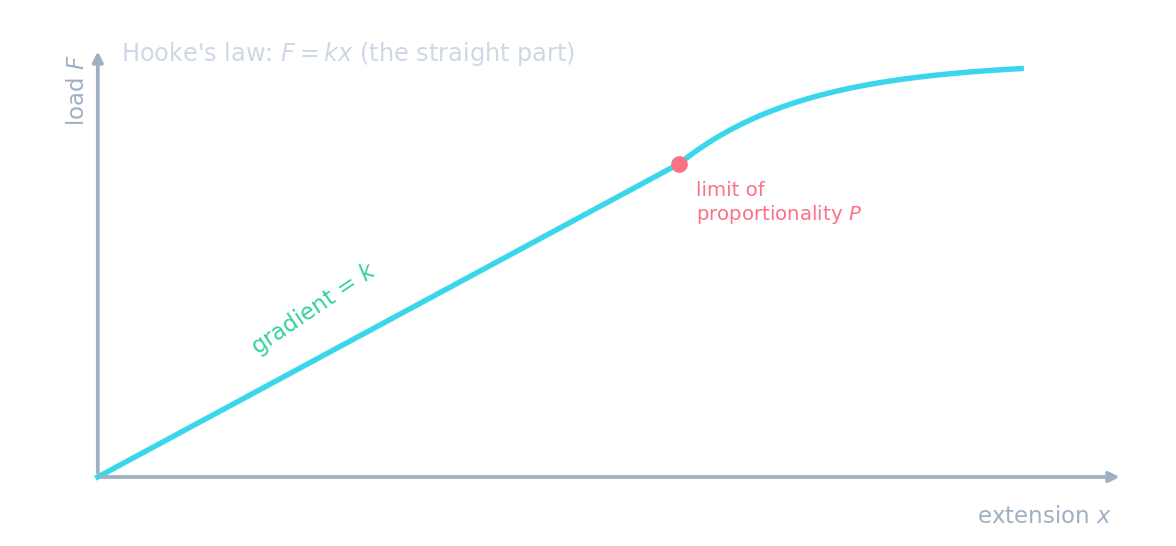
Hooke's law spring
Hang a load on the real spring: up to the elastic limit the extension is proportional to the force; beyond it the spring is stretched for good.
A load of $12\ \text{N}$ stretches a spring by $0.040\ \text{m}$. What is the spring constant?
Difficulty 2/5 · 140 coins + a small bonus on first completion today
$k = \dfrac{F}{x} = \dfrac{12}{0.040} = 300\ \dfrac{\text{N}}{\text{m}}$.
Within Hooke's law, doubling the load doubles the extension.
Difficulty 1/5 · 100 coins + a small bonus on first completion today
Yes — $F = kx$ is a straight-line (proportional) relationship, so $x$ scales with $F$.
The limit of proportionality 比例极限
- Hooke's law only holds up to the limit of proportionality.
- Past it the $F$–$x$ line curves — the simple $F = kx$ no longer works.

A spring obeys Hooke's law: extension is proportional to the force applied
The straight-line law $F = kx$ holds only up to the:
Difficulty 1/5 · 100 coins + a small bonus on first completion today
Beyond the limit of proportionality the $F$–$x$ graph curves and $F = kx$ no longer applies.
A complete statement of Hooke's law contains which of these? Select all that apply.
Difficulty 2/5 · 140 coins + a small bonus on first completion today
The condition is part of the law, not an extra. Rubber obeys nothing like it, and a metal stops obeying it beyond the straight line.
Springs together
- Series (end to end): $\dfrac{1}{k_{\text{total}}} = \dfrac{1}{k_1} + \dfrac{1}{k_2}$ — softer overall.
- Parallel (side by side): $k_{\text{total}} = k_1 + k_2$ — stiffer overall.
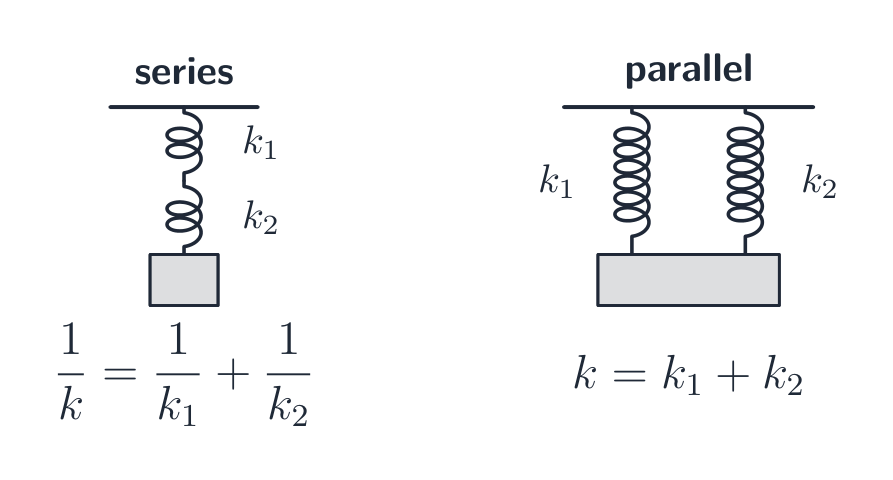
Springs in series are softer (1/k adds); springs in parallel are stiffer (k adds)
Two identical springs (each constant $k$) are joined in series. The combined spring constant is:
Difficulty 1/5 · 100 coins + a small bonus on first completion today
$\dfrac{1}{k_{\text{total}}} = \dfrac{1}{k} + \dfrac{1}{k} = \dfrac{2}{k}$, so $k_{\text{total}} = \tfrac{1}{2}k$ — the pair stretches more easily.
Stress 应力 and strain 应变
- Stress $\sigma = \dfrac{F}{A}$ (force per area, in Pa).
- Strain $\varepsilon = \dfrac{x}{L_0}$ (extension ÷ original length — no unit).
Match each quantity to its formula.
Difficulty 2/5 · 140 coins + a small bonus on first completion today
Stress is force per area; strain is the fractional extension; the spring constant is load per extension.
Match each term to the definition the examiner marks.
Difficulty 2/5 · 140 coins + a small bonus on first completion today
The Young modulus is a property of the MATERIAL and the spring constant of the SPECIMEN, which is why a thicker wire of the same metal changes one and not the other.
The Young modulus 杨氏模量
- $E = \dfrac{\sigma}{\varepsilon} = \dfrac{F L_0}{A x}$, in Pa (about $2 \times 10^{11}$ for steel).
- It is a property of the material only; the spring constant $k = \dfrac{EA}{L_0}$ also depends on size.
A material with Young modulus $2.0 \times 10^{11}\ \text{Pa}$ is under a stress of $1.0 \times 10^{8}\ \text{Pa}$. What is the strain?
Difficulty 2/5 · 140 coins + a small bonus on first completion today
$\varepsilon = \dfrac{\sigma}{E} = \dfrac{1.0 \times 10^{8}}{2.0 \times 10^{11}} = 5.0 \times 10^{-4}$.
The Young modulus of a wire depends on its length and thickness.
Difficulty 1/5 · 100 coins + a small bonus on first completion today
No — the Young modulus is a property of the material. The spring constant $k = EA/L_0$ is what depends on size.
A wire has diameter 0.50 mm. What is its cross-sectional area, in units of 1e-7 m^2?
Difficulty 2/5 · 140 coins + a small bonus on first completion today
Radius 0.25 mm = 2.5e-4 m, so A = pi r^2 = 1.96e-7 m^2. Using the diameter as the radius gives four times too much, the classic error here.
Measuring the Young modulus
- Use a long, thin wire so the extension is big enough to measure.
- Find the area from the diameter (a micrometer), load it step by step, and plot $F$ against $x$: gradient $= \dfrac{EA}{L_0}$.

A long, thin wire is loaded step by step; the gradient of F against x gives EA/L₀
A thicker wire of the same metal has a larger Young modulus.
Difficulty 1/5 · 100 coins + a small bonus on first completion today
The Young modulus is the material's own property, unchanged by thickness. The thicker wire has a larger spring constant, which is the specimen's property.
Marks that slip away
- Hooke's law needs its condition. "The extension is directly proportional to the applied force" is only half of it; add "provided the limit of proportionality is not exceeded".
- The limit of proportionality is the end of the straight line. The elastic limit is the end of elastic behaviour, a little beyond it. They are not the same point.
- In $A = \pi r^2$ use the radius, so halve a diameter first, and convert $\text{mm}^2$ to $\text{m}^2$ by $10^{-6}$, not $10^{-3}$.
- A thicker wire does not have a larger Young modulus. The modulus belongs to the material; the thicker wire has a larger spring constant.
- Stress is force per unit cross-sectional area and strain is extension per unit original length. Strain has no unit.
You've got it
- Hooke's law $F = kx$ holds up to the limit of proportionality
- stress $\sigma = \dfrac{F}{A}$, strain $\varepsilon = \dfrac{x}{L_0}$
- Young modulus $E = \dfrac{\sigma}{\varepsilon}$ — a property of the material, not its shape