إليك تفاعل حقيقي: بيروكسيد الهيدروجين يتفاعل مع أيونات اليوديد في وسط حمضي. انظر إلى المعادلة الموزونة. تستخدم أيونين من اليوديد وإيوني هيدروجين…
English narration · English + 中文 subtitles burned in · سرد باللغة الإنجليزية · ترجمة مدمجة بالإنجليزية + الصينية
26.1
Rate equations and orders · معادلات السرعة والرتب
Syllabus · المنهج
English
explain and use the terms rate equation, order of reaction, overall order of reaction, rate constant, half-life, rate-determining step and intermediate
(a) understand and use rate equations of the form $\text{rate} = k [\text{A}]^m[\text{B}]^n$ (for which $m$ and $n$ are 0, 1 or 2) (b) deduce the order of a reaction from concentration–time graphs or from experimental data relating to the initial rates method and half-life method (c) interpret experimental data in graphical form, including concentration–time and rate–concentration graphs (d) calculate an initial rate using concentration data (e) construct a rate equation
(a) show understanding that the half-life of a first-order reaction is independent of concentration (b) use the half-life of a first-order reaction in calculations
calculate the numerical value of a rate constant, for example by: (a) using the initial rates and the rate equation (b) using the half-life, $t_{\frac{1}{2}}$, and the equation $k = 0.693/t_{\frac{1}{2}}$
for a multi-step reaction: (a) suggest a reaction mechanism that is consistent with the rate equation and the equation for the overall reaction (b) predict the order that would result from a given reaction mechanism and rate-determining step (c) deduce a rate equation using a given reaction mechanism and rate-determining step for a given reaction (d) identify an intermediate or catalyst from a given reaction mechanism (e) identify the rate determining step from a rate equation and a given reaction mechanism
describe qualitatively the effect of temperature change on the rate constant and hence the rate of a reaction
العربية
شرح واستخدام مصطلحات معادلة السرعة، رتبة التفاعل، الرتبة الكلية للتفاعل، ثابت السرعة، العمر النصفي، الخطوة المحددة للسرعة والوسط
(أ) افهم واستخدم معادلات السرعة على شكل $\text{rate} = k [\text{A}]^m[\text{B}]^n$ (حيث تكون $m$ و$n$ 0، 1 أو 2) (ب) استنتج رتبة التفاعل من منحنيات التركيز-الزمن أو من البيانات التجريبية المتعلقة بطريقة السرعات الابتدائية وطريقة نصف العمر (ج) فسّر البيانات التجريبية بصيغة بيانية، بما في ذلك منحنيات التركيز-الزمن ومنحنيات السرعة-التركيز (د) احسب سرعة ابتدائية باستخدام بيانات التركيز (هـ) بِنِ معادلة السرعة
(أ) 表明对一级反应半衰期与浓度无关的理解 (b) 在一阶反应的计算中使用半衰期
احسب القيمة العددية لمعامل السرعة، على سبيل المثال عن طريق: (أ) استخدام السرعات الابتدائية ومعادلة السرعة (ب) استخدام نصف العمر، $t_{\frac{1}{2}}$، ومعادلة $k = 0.693/t_{\frac{1}{2}}$
لتفاعل متعدد الخطوات: (أ) اقترح آلية تفاعل متوافقة مع معادلة السرعة ومعادلة التفاعل الكلي (ب) تنبأ بالرتبة التي ستنتج عن آلية تفاعل محددة وخطوة تحديد السرعة (ج) استنتج معادلة السرعة باستخدام آلية تفاعل محددة وخطوة تحديد السرعة لتفاعل معين (د) حدد وسطاً تفاعلياً أو محفزاً من آلية تفاعل معينة (هـ) حدد خطوة تحديد السرعة من معادلة السرعة وآلية تفاعل معينة
صف بشكل نوعي تأثير تغير درجة الحرارة على معامل السرعة وبالتالي سرعة التفاعل
Source: Cambridge International syllabus · المصدر: منهج كامبريدج الدولي
English
A rate equation 速率方程 shows how the rate depends on the concentrations of the reactants:
$$\text{rate} = k\,[\text{A}]^m[\text{B}]^n$$
$m$ is the order of reaction 反应级数 with respect to A, and $n$ the order with respect to B. Each is $0$, $1$ or $2$.
the overall order of reaction 总反应级数 is $m + n$.
$k$ is the rate constant 速率常数. The rate equation can only be found by experiment, not from the balanced equation.
Finding the order
initial rates method: change one concentration at a time and see how the starting rate changes. If doubling $[\text{A}]$ doubles the rate, the order in A is 1; if it quadruples the rate, the order is 2; if the rate is unchanged, the order is 0.
Worked example. In experiments on $\text{A} + \text{B} \rightarrow$ products, doubling $[\text{A}]$ (with $[\text{B}]$ fixed) doubles the rate, and doubling $[\text{B}]$ (with $[\text{A}]$ fixed) quadruples the rate. Write the rate equation and give the overall order.
Doubling $[\text{A}]$ doubles the rate, so first order in A. Doubling $[\text{B}]$ quadruples ($2^2$) the rate, so second order in B. Hence
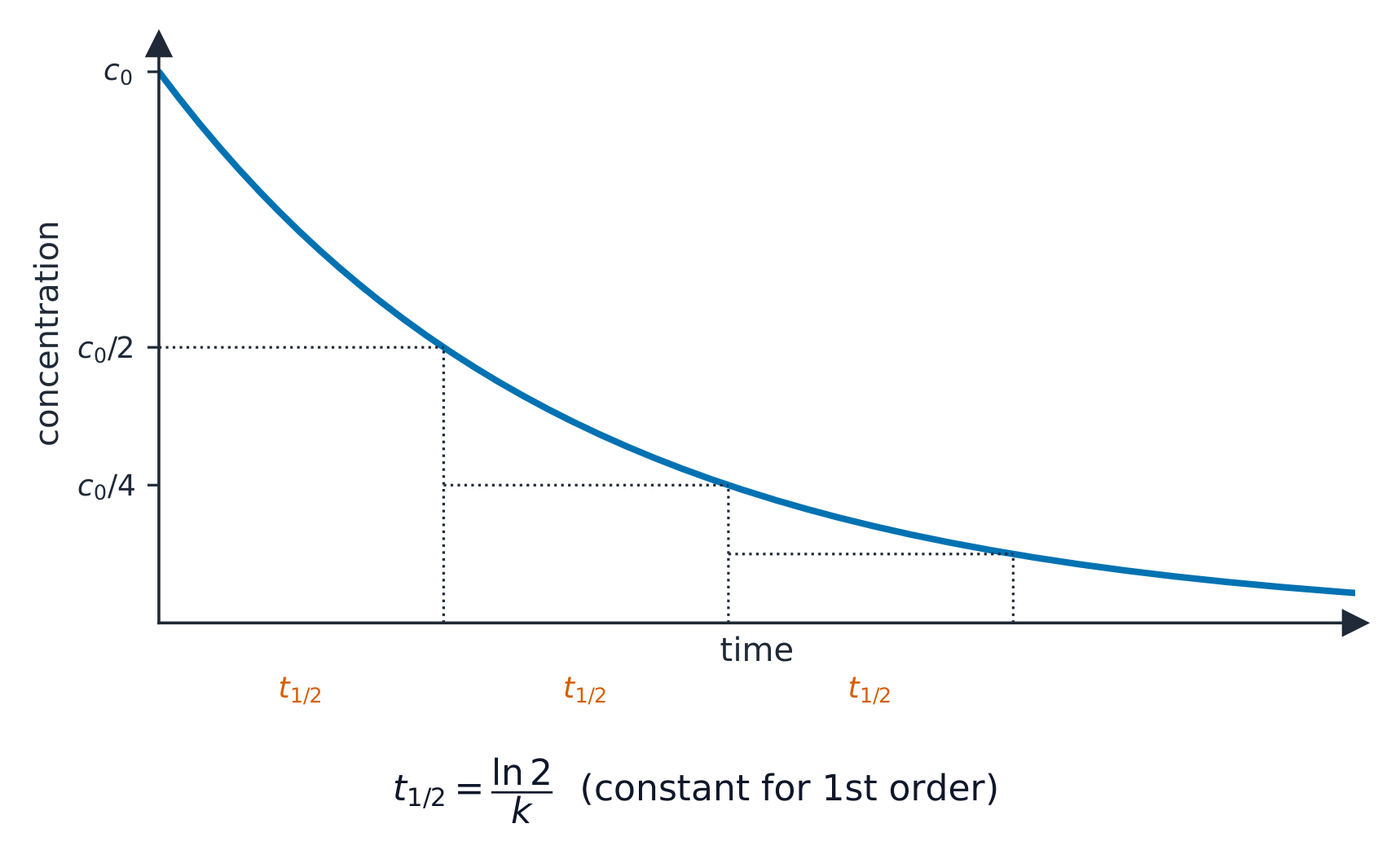
graphs: a concentration–time graph for a first-order reaction has a constant half-life 半衰期 (the time for the concentration to halve). A rate–concentration graph is a straight line through the origin for first order, and a curve for second order.
Half-life and the rate constant
For a first-order reaction the half-life is constant — it does not depend on the concentration. You can find the rate constant from it:
$$k = \frac{0.693}{t_{\frac{1}{2}}}$$
Worked example. A first-order reaction has a half-life of $120\ \text{s}$. Find its rate constant.
You can also find $k$ by putting initial-rate data into the rate equation.
العربية
معادلة السرعة توضح كيف تعتمد السرعة على تراكيز المتفاعلات:
$$\text{rate} = k\,[\text{A}]^m[\text{B}]^n$$
$m$ هو رتب التفاعل بالنسبة لـ A، و$n$ هو الرتبة بالنسبة لـ B. كل منهما هو $0$، $1$ أو $2$.
الرتب الكلي للتفاعل هو $m + n$.
$k$ هو ثابت السرعة. يمكن تحديد معادلة السرعة فقط من خلال التجربة، وليس من المعادلة الموزونة.
تقيس إبرة الغاز حجم الغاز الناتج بمرور الوقت، مما يعطي سرعة التفاعل
إيجاد الرتبة
طريقة السرعات الابتدائية: غيّر تركيزاً واحداً في كل مرة ولاحظ كيف تتغير السرعة الابتدائية. إذا مضاعفة $[\text{A}]$ ضاعفت السرعة، فإن الرتبة بالنسبة لـ A تساوي 1؛ إذا ربّعت السرعة، فالرتبة هي 2؛ إذا بقيت السرعة دون تغيير، فالرتبة هي 0.
مثال محلول. في تجارب على $\text{A} + \text{B} \rightarrow$ منتجات، يؤدي مضاعفة $[\text{A}]$ (مع ثبات $[\text{B}]$) إلى مضاعفة السرعة، ومضاعفة $[\text{B}]$ (مع ثبات $[\text{A}]$) إلى مضاعفة السرعة أربع مرات. اكتب معادلة السرعة وأعطِ الرتبة الكلية.
مضاعفة $[\text{A}]$ تضاعف السرعة، إذن رتبة أولى في A. مضاعفة $[\text{B}]$ تربّع $2^2$ السرعة، إذن رتبة ثانية في B. وبالتالي
الرسوم البيانية: رسم التركيز-الزمن لتفاعل من الرتبة الأولى له عمر نصف ثابت (الوقت اللازم ليصبح التركيز نصف قيمته). رسم السرعة-التركيز هو خط مستقيم يمر بنقطة الأصل للرتبة الأولى، ومنحنى للرتبة الثانية.
السرعة مقابل التركيز: الرتبة الصفرية خط أفقي، والرتبة الأولى خط مستقيم يمر بنقطة الأصل، والرتبة الثانية منحنى متصاعد
عمر نصف وثابت السرعة
بالنسبة للتفاعل من الرتبة الأولى، يكون عمر نصف ثابت — لا يعتمد على التركيز. يمكنك إيجاد ثابت السرعة منه:
$$k = \frac{0.693}{t_{\frac{1}{2}}}$$
التفاعل من الرتبة الأولى له عمر نصف ثابت: ينخفض التركيز لنصفه في نفس الوقت $t_{1/2}$ مراراً وتكراراً، بغض النظر عن القيمة الابتدائية
مثال محلول. تفاعل من الرتبة الأولى له عمر نصف قدره $120\ \text{s}$. أوجد ثابت سرعته.
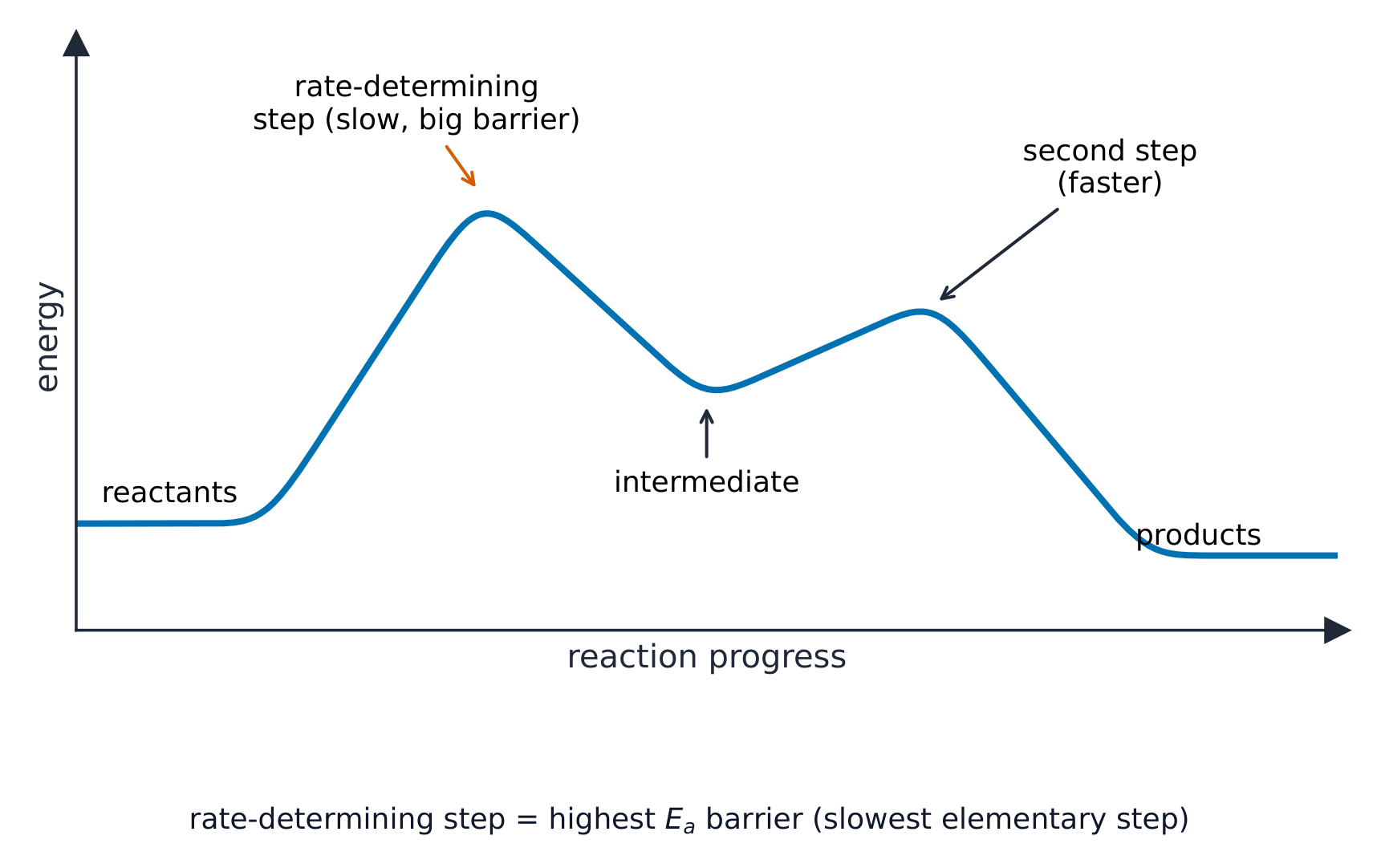
Most reactions happen in several steps. The slowest step is the rate-determining step 决速步骤, and it controls the overall rate. Only the species involved up to and including this step appear in the rate equation.
an intermediate 中间体 is a species made in one step and then used up in a later step. It is not in the overall equation.
you can suggest a mechanism that fits both the rate equation and the overall equation, predict the order from a given mechanism, or pick out the rate-determining step.
If you compare the initial rate 初始速率 of different mixtures, you can deduce the rate equation, and from that work out the mechanism.
Effect of temperature
Raising the temperature increases the rate constant $k$ (more molecules pass the activation energy), so the rate goes up.
العربية
تحدث معظم التفاعلات عبر عدة خطوات. الخطوة الأبطأ هي الخطوة المحددة للسرعة، وهي التي تحدد السرعة الكلية. تظهر في معادلة السرعة فقط الأنواع المشاركة حتى هذه الخطوة بما فيها.
ملف خطوتين: الخطوة الأبطأ لها الحاجز الأكبر وهي المحددة للسرعة؛ الانهيار بين الحاجزين هو ناتج وسيط
الناتج الوسيط هو نوع يتكون في خطوة ثم يُستهلك في خطوة لاحقة. لا يظهر في المعادلة الكلية.
يمكنك اقتراح آلية تتوافق مع كل من معادلة السرعة والمعادلة الكلية، أو التنبؤ بالرتبة من آلية معطاة، أو تحديد الخطوة المحددة للسرعة.
إذا قمت بمقارنة السرعة الابتدائية لمختلطات مختلفة، يمكنك استنتاج معادلة السرعة، ومن خلالها تحديد الآلية.
تأثير درجة الحرارة
رفع درجة الحرارة يزيد من ثابت السرعة $k$ (بسبب مرور عدد أكبر من الجزيئات عبر طاقة التنشيط)، لذا تزداد السرعة.
Explore · استكشف
Organic mechanism route · مسار آلية عضوية
Trace electron-pair movement from reagent to product. · تتبع حركة أزواج الإلكترونات من الكاشف إلى المنتج.
explain that catalysts can be homogeneous or heterogeneous
describe the mode of action of a heterogeneous catalyst to include adsorption of reactants, bond weakening and desorption of products, for example: (a) iron in the Haber process (b) palladium, platinum and rhodium in the catalytic removal of oxides of nitrogen from the exhaust gases of car engines
describe the mode of action of a homogeneous catalyst by being used in one step and reformed in a later step, for example: (a) atmospheric oxides of nitrogen in the oxidation of atmospheric sulfur dioxide (b) $\text{Fe}^{2+}$ or $\text{Fe}^{3+}$ in the $\text{I}^- / \text{S}_2\text{O}_8^{2-}$ reaction
العربية
اشرح أن المحفّزات يمكن أن تكون متجانسة أو غير متجانسة
صف طريقة عمل المحفّز غير المتجانس لتشمل الامتزاز للمواد المتفاعلة وضعف الروابط وإزالة الامتزاز للمنتجات، على سبيل المثال: (أ) الحديد في عملية هابر (ب) البلاديوم والبلاتين والروديوم في إزالة أكاسيد النيتروجين من غازات العادم لمحركات السيارات
صف طريقة عمل المحفّز المتجانس من خلال استخدامه في خطوة واحدة وإعادة تكوينه في خطوة لاحقة، على سبيل المثال: (أ) أكاسيد النيتروجين في الغلاف الجوي في أكسدة ثاني أكسيد الكبرون في الغلاف الجوي (ب) $\text{Fe}^{2+}$ أو $\text{Fe}^{3+}$ في تفاعل $\text{I}^- / \text{S}_2\text{O}_8^{2-}$
Source: Cambridge International syllabus · المصدر: منهج كامبريدج الدولي
English
Catalysts 催化剂 can be homogeneous or heterogeneous.
Heterogeneous catalysts
A heterogeneous catalyst 多相催化剂 is in a different physical state from the reactants (usually a solid with gases). It works in three stages:
adsorption 吸附: reactant molecules stick to the catalyst surface.
the bonds in the reactants are weakened, so they react more easily.
desorption 脱附: the product molecules leave the surface.
Examples are iron in the Haber process, and platinum, palladium and rhodium in a catalytic converter.
Homogeneous catalysts
A homogeneous catalyst 均相催化剂 is in the same physical state as the reactants. It is used up in one step and then reformed in a later step, so it comes back unchanged. Examples are oxides of nitrogen helping to oxidise atmospheric sulfur dioxide, and $\text{Fe}^{2+}$ or $\text{Fe}^{3+}$ speeding up the reaction between $\text{I}^-$ and $\text{S}_2\text{O}_8^{2-}$.
العربية
المحفزات يمكن أن تكون متجانسة أو غير متجانسة.
المحفزات غير المتجانسة
المحفز غير المتجانس يكون في حالة فيزيائية مختلفة عن المتفاعلات (عادة صلب مع غازات). يعمل في ثلاث مراحل:
الامتزاز: تلتصق جزيئات المتفاعلات بسطح المحفز.
تُضعف الروابط في المتفاعلات، مما يسهل تفاعلها.
الانحياز: تغادر جزيئات النواتج السطح.
المحفز غير المتجانس يعمل في ثلاث مراحل: تمتص المتفاعلات السطح، وتسمح روابطها المضعفة بالتفاعل، ثم تنحاز النواتجالمحفزات غير المتجانسة الحقيقية مصنوعة كحبوب مشكّلة صغيرة وحلقات وأقراص مثقوبة، مما يوفر مساحة سطح كبيرة لالتصاق المتفاعلات بها
من الأمثلة الحديد في عملية هابر، والبلاتين والبلاديوم والروديوم في المحول الحفاز.
المحفزات المتجانسة
المحفز المتجانس يكون في نفس الحالة الفيزيائية للمتفاعلات. يُستهلك في خطوة ثم يُعاد تكوينه في خطوة لاحقة، فيعود كما هو دون تغيير. من الأمثلة أكاسيد النيتروجين التي تساعد في أكسدة ثاني أكسيد الكبريت الجوي، و$\text{Fe}^{2+}$ أو $\text{Fe}^{3+}$ اللذان يسرعان تفاعل $\text{I}^-$ مع $\text{S}_2\text{O}_8^{2-}$.
Explore · استكشف
How a catalyst speeds a reaction · كيف يسرع المحفز التفاعل
Turn the catalyst on and watch the rate jump — it gives more successful collisions per second by offering a lower-energy path. · فعّل المحفز وشاهد قفزة في المعدل — فهو يوفر المزيد من التصادمات الناجحة لكل ثانية عن طريق تقديم مسار أقل طاقة.
Find orders from initial-rate data: doubling a concentration that doubles the rate is first order, quadruples it is second order, no change is zero order.
Write $\text{rate} = k[\text{A}]^m[\text{B}]^n$ and work out the units of $k$ from it.
The rate-determining step contains the species (and orders) in the rate equation — use this to test a mechanism.
A constant half-life means first order.
العربية
أوجد الرتب من بيانات السرعة الابتدائية: مضاعفة تركيز يضاعف السرعة هي رتبة أولى، ويربّع السرعة هي رتبة ثانية، ولا تغير السرعة هي رتبة صفرية.
اكتب $\text{rate} = k[\text{A}]^m[\text{B}]^n$ وأوجد وحدات $k$ منها.
الخطوة المحددة للسرعة تحتوي على الأنواع (والرتب) الموجودة في معادلة السرعة — استخدم هذا لاختبار الآلية.
عمر نصف ثابت يعني رتبة أولى.
Interactive lessons on this topic · دروس تفاعلية حول هذا الموضوع
Work through it step by step, with instant-check exercises. · ا-working عليه خطوة بخطوة، مع تمارين تحقق فوري.
Pick one and the site follows you — notes, papers, videos and practice all open on it. · اختر واحدًا وسيتبعك الموقع — الملاحظات، الأوراق، الفيديوهات والتدريب جميعها تفتح عليه.
Type to search notes, lessons, code, vocabulary and past-paper questions across every subject. · اكتب للبحث عن ملاحظات، دروس، أكواد، مفردات وأسئلة امتحانات سابقة عبر جميع المواد.