Skip to content · ⁨الانتقال إلى المحتوى⁩

Selection and evolution · ⁨الاختيار والتطور⁩

A-Level Biology · ⁨A-Level علم الأحياء⁩ · Topic 17 · ⁨الموضوع 17⁩

Video lesson for this topic · ⁨درس فيديو لهذا الموضوع⁩ Open the video page · ⁨افتح صفحة الفيديو⁩
8:23

التنوع والتطور

في أوائل القرن التاسع عشر، كانت كل العث المرقط في إنجلترا فاتحة اللون ومبقعة، مما أخفى جمالاً على لحاء مغطى بالطحالب. ثم…

English narration · English + 中文 subtitles burned in · ⁨سرد باللغة الإنجليزية · ترجمة مدمجة بالإنجليزية + الصينية⁩

17.1

Variation · ⁨التنوع⁩

Syllabus · ⁨المنهج⁩
English
  1. explain, with examples, that phenotypic variation is due to genetic factors or environmental factors or a combination of genetic and environmental factors
  2. explain what is meant by discontinuous variation and continuous variation
  3. explain the genetic basis of discontinuous variation and continuous variation
  4. use the t-test to compare the means of two different samples (the formula for the t-test will be provided, as shown in the Mathematical requirements)
العربية
  1. اشرح، مع الأمثلة، أن التنوع الظاهري ناتج عن عوامل جينية أو عوامل بيئية أو مزيج من العوامل الجينية والبيئية
  2. اشرح المقصود بـالتنوع المتقطع والتنوع المستمر
  3. اشرح الأساس الجيني للتنوع المتقطع والتنوع المستمر
  4. استخدم اختبار t لمقارنة متوسطي عينتين مختلفتين (سيتم تقديم صيغة اختبار t، كما هو موضح في المتطلبات الرياضية ⟦number⟧)

Source: Cambridge International syllabus · ⁨المصدر: منهج كامبريدج الدولي⁩

English

Variation 变异 means the differences between individuals. It has three possible causes:

  • genetic factors only — set by the alleles 等位基因 you inherit (for example human blood group).
  • environmental factors 环境因素 only — set by your surroundings (for example a scar, or the language you speak).
  • a combination of both — most features, such as height and body mass, depend on genes and on diet and lifestyle.

There are two patterns of variation:

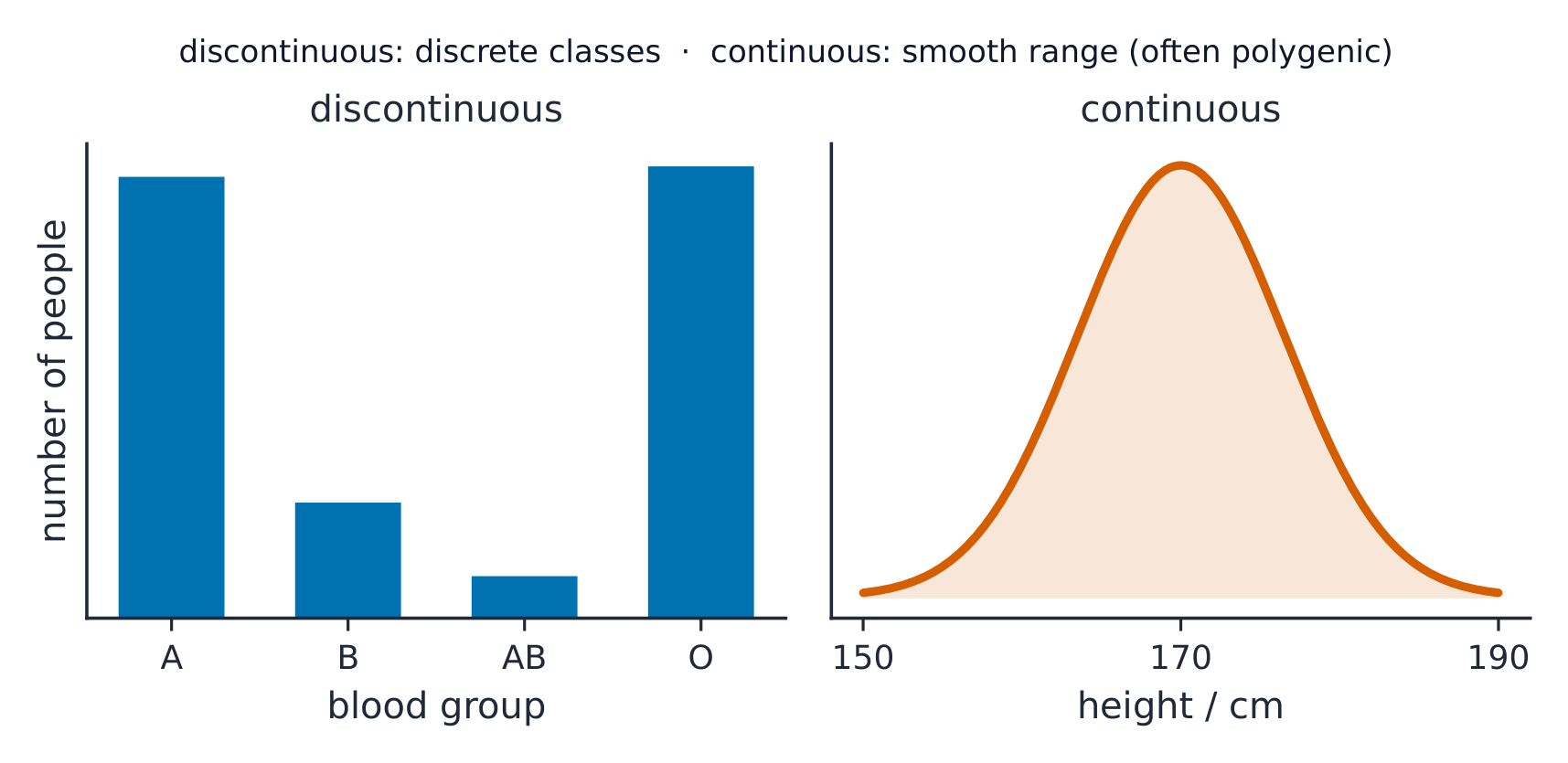
  • discontinuous variation 不连续变异 — clear, separate groups with nothing in between (for example blood group A, B, AB or O). It is usually controlled by one or a few genes 基因, with little effect from the environment.
  • continuous variation 连续变异 — a smooth range from one extreme to the other (for example height). It is controlled by many genes together, plus the environment.

To compare the means of two samples (for example the heights of plants in sun and in shade), you use the t-test, which tells you whether the difference is large enough to be real, or just due to chance.

العربية

التنوع يعني الاختلافات بين الأفراد. له ثلاثة أسباب محتملة:

  • عوامل جينية فقط — محددة بـ الأليلات التي ترثها (مثل زمرة الدم البشرية).
  • عوامل بيئية فقط — محددة ببيئة محيطة (مثل ندبة، أو اللغة التي تتحدثها).
  • مزيج من الاثنين — معظم السمات، مثل الطول وكتلة الجسم، تعتمد على الجينات وعلى النظام الغذائي ونمط الحياة.
حلزونان شريطيان بقواقع ملونة وشريطية مختلفة
الحلزونات الشريطية (Cepaea nemoralis) تظهر تنوعاً ملحوظاً في لون القوقعة والشريط

هناك نمطان من التنوع:

  • تنوع متقطع — مجموعات واضحة ومنفصلة بدون وسط (مثل زمرة الدم A أو B أو AB أو O). يتحكم به عادةً جين واحد أو عدد قليل من الجينات، وتأثير البيئة ضئيل.
  • تنوع مستمر — نطاق سلس من طرف إلى آخر (مثل الطول). يتحكم به عدة جينات معاً بالإضافة إلى البيئة.
رسمان بيانيان: مخطط أعمدة لزمرات الدم بأعمدة منفصلة (متقطع)، ومنحنى جرس سلس للطول (متصل)
التنوع المتقطع ينقسم لمجموعات منفصلة؛ والتنوع المستمر هو نطاق سلس

لمقارنة المتوسطات لعينتين (مثل أطوال النباتات في الشمس والظل)، تستخدم اختبار t، الذي يخبرك ما إذا كان الفرق كبيراً بما يكفي ليكون حقيقياً أم أنه مجرد صدفة.

Explore · ⁨استكشف⁩

The t-distribution behind the t-test · ⁨توزيع t الذي يكمن وراء اختبار t⁩

The t-test compares two sample means against a critical value you look up in a t-table. This is that table made live: the value depends on the degrees of freedom (here $n_1+n_2-2$). Drag df and watch the critical value change — small samples have heavier tails, so they need a larger difference to count as real. · ⁨اختبار t يقارن متوسطين لعينتين مقابل قيمة حرجة تبحث عنها في جدول t. هذا هو الجدول مصوّرًا: القيمة تعتمد على درجات الحرية (هنا $n_1+n_2-2$). اسحب df وشاهد تغير القيمة الحرجة — العينات الصغيرة لها ذيول أثقل، لذا فهي تحتاج إلى فرق أكبر لتُعتبر حقيقية.⁩

Explore · ⁨استكشف⁩

Variation type lab · ⁨مختبر أنواع التباين⁩

Classify examples by the source and pattern of variation. · ⁨صنّف الأمثلة حسب المصدر ونمط التباين.⁩

Vocabulary · ⁨مفردات⁩ Train · ⁨تدريب⁩
English العربية
variation/ˌveərɪˈeɪʃn/ التنوع
17.2

Natural selection · ⁨الانتقاء الطبيعي⁩

Syllabus · ⁨المنهج⁩
English
  1. explain that natural selection occurs because populations have the capacity to produce many offspring that compete for resources; in the ‘struggle for existence’, individuals that are best adapted are most likely to survive to reproduce and pass on their alleles to the next generation
  2. explain how environmental factors can act as stabilising, disruptive and directional forces of natural selection
  3. explain how selection, the founder effect and genetic drift, including the bottleneck effect, may affect allele frequencies in populations
  4. outline how bacteria become resistant to antibiotics as an example of natural selection
  5. use the Hardy–Weinberg principle to calculate allele and genotype frequencies in populations and state the conditions when this principle can be applied (the two equations for the Hardy–Weinberg principle will be provided, as shown in the Mathematical requirements)
  6. describe the principles of selective breeding (artificial selection)
  7. outline the following examples of selective breeding: • the introduction of disease resistance to varieties of wheat and rice • inbreeding and hybridisation to produce vigorous, uniform varieties of maize • improving the milk yield of dairy cattle
العربية
  1. اشرح أن الانتقاء الطبيعي يحدث لأن المجموعات السكانية لها القدرة على إنتاج عدد كبير من الذرية تتنافس على الموارد؛ وفي 'الصراع من أجل الوجود'، يكون الأفراد الأكثر تكيفاً هم الأكثر احتمالاً للبقاء حتى يتكاثروا وينقلوا أليلاتهم إلى الجيل التالي
  2. اشرح كيف يمكن للعوامل البيئية أن تعمل كقوى مستقرة ومدمرة واتجاهية للانتقاء الطبيعي
  3. اشرح كيف قد يؤثر الانتقاء وتأثير المؤسس والانجراف الجيني، بما في ذلك تأثير الزجاجة العنقانية، على ترددات الأليلات في المجموعات السكانية
  4. استعرض كيف تصبح البكتيريا مقاومة للمضادات الحيوية كمثال على الانتقاء الطبيعي
  5. استخدم مبدأ هاردي-واينبرغ لحساب ترددات الأليلات والنمط الجيني في المجموعات السكانية واستنتج الشروط التي يمكن تطبيق هذا المبدأ عليها (سيتم تقديم المعادلتين لمبدأ هاردي-واينبرغ، كما هو موضح في المتطلبات الرياضية number⟧)
  6. صف مبادئ التربية الانتقائية (الانتقاء الاصطناعي)
  7. استعرض الأمثلة التالية للتربية الانتقائية: • إدخال مقاومة الأمراض إلى أصناف القمح والأرز • التزاوج الداخلي والتزاوج الهجني لإنتاج أصناف متجانسة ونابضة بالحياة من الذرة • تحسين إنتاج الحليب لدى الأبقار اللبنية

Source: Cambridge International syllabus · ⁨المصدر: منهج كامبريدج الدولي⁩

English
Natural selection: the peppered moth

A population 种群 produces far more offspring 后代 than can survive, so the offspring must compete 竞争 for resources such as food and space. This is the "struggle for existence". The individuals that are best adapted 适应 are most likely to survive, reproduce 繁殖, and pass on their alleles to the next generation. Over many generations, the helpful alleles become more common in the population. This is natural selection 自然选择.

Environmental conditions can push selection in three ways:

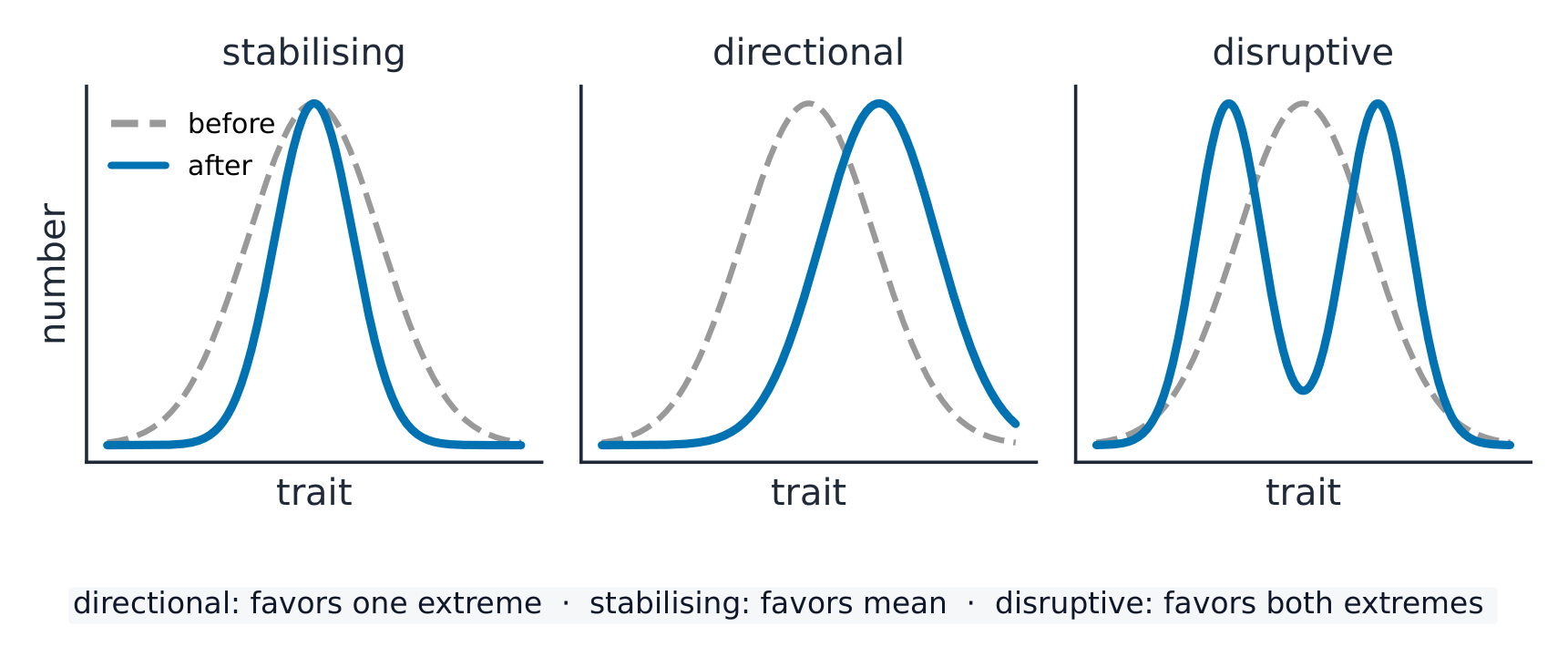
  • stabilising selection 稳定选择 favours the average and removes the extremes (the population stays the same).
  • directional selection 定向选择 favours one extreme, so the mean shifts that way.
  • disruptive selection 分裂选择 favours both extremes and removes the average.

Allele frequencies can also change in other ways:

  • the founder effect 奠基者效应 — a few individuals start a new population, so they carry only some of the alleles of the original group.
  • genetic drift 遗传漂变 — in a small population, allele frequencies change by chance from generation to generation.
  • the bottleneck effect 瓶颈效应 — a sudden fall in population size leaves few survivors, reducing the variety of alleles.

Antibiotic resistance as natural selection

A chance mutation 突变 makes a few bacteria resistant to an antibiotic 抗生素. When the antibiotic is used, the non-resistant bacteria die, but the resistant ones survive and reproduce. Over time the resistance 耐药性 spreads through the population. This is natural selection in action.

العربية
الانتقاء الطبيعي: العثة الفلفلوية

يُنتج التعداد السكاني عددًا أكبر بكثير من النسل مما يمكن أن ينجو، لذا يجب على النسل أن يتنافس على موارد مثل الغذاء والمساحة. يُعرف هذا بـ"المنافسة من أجل البقاء". الأفراد الذين يمتلكون أفضل التكيفات هم الأكثر احتمالاً للبقاء، والتكاثر، ونقل أليلاتهم إلى الجيل التالي. على مدار العديد من الأجيال، تصبح الأليلات المفيدة أكثر شيوعًا في التعداد السكاني. هذه هي الانتخاب الطبيعي.

فأعلة ثعبانين (peppered moths) تستريح على جذع شجرة: فأعل داكن، يكاد يكون أسود، على اللحاء الفاتح المغطى بالطحالب على اليسار، وأفعل فاتح مرقط على القشرة الداكنة على اليمين
يُظهر الفأعل الثعباني الانتخاب الطبيعي: يختبئ الشكل الداكن على القشرة الداكنة الملوثة بالقطران، بينما يختبئ الشكل الفاتح المرقط على اللحاء الفاتح — الطيور تأكل أي شكل يبرز

يمكن للظروف البيئية دفع الانتخاب في ثلاث اتجاهات:

  • الانتخاب المستقر: يفضل المتوسط ويزيل الأطراف المتطرفة (يبقى التعداد السكاني كما هو).
  • الانتخاب الاتجاهي: يفضل طرفًا متطرفًا واحدًا، لذلك يتحرك المتوسط في ذلك الاتجاه.
  • الانتخاب المُفرق: يفضل كلا الطرفين المتطرفين ويزيل المتوسط.

ثلاثة رسوم بيانية تقارن توزيع صفة قبل وبعد الانتخاب: يجعل الاستقراره أضيق، ويوجهه يغير موقعه نحو أحد الجانبين، والمُفرق يقسّمه إلى ذروتين *الاستقرار يضيق النطاق، والتوجيه يغير المتوسط، والمُفرق يقسّمه إلى قسمين

تتغير ترددات الأليلات أيضًا بطرق أخرى:

  • تأثير المؤسس: يبدأ عدد قليل من الأفراد تعدادًا سكانيًا جديدًا، لذا يحملون فقط بعض الأليلات من المجموعة الأصلية.
  • الانحراف الجيني: في التعداد السكاني الصغير، تتغير ترددات الأليلات عن طريق الصدفة من جيل إلى آخر.
  • تأثير الزجاجة: انخفاض مفاجئ في حجم التعداد السكاني يترك عددًا قليلاً من الناجين، مما يقلل من تنوع الأليلات.

تعداد سكاني كبير بألوان متعددة يمر عبر كارثة ينجو منها قلة فقط، لذا يحتوي التعداد الذي ينمو مجددًا على لونين أو ثلاثة فقط *زجاجة: ينجو عدد قليل من كارثة ما، لذا يكون للتعداد المسترد تنوع جيني أقل

مقاومة المضادات الحيوية كاختيار طبيعي

طفرة عشوائية تجعل بعض البكتيريا مقاومة لـمضاد حيوي. عند استخدام المضاد الحيوي، تموت البكتيريا غير المقاومة، لكن المقاومة تبقى وتتكاثر. مع مرور الوقت، تنتشر المقاومة عبر التعداد السكاني. هذا هو الانتخاب الطبيعي في العمل.

Explore · ⁨استكشف⁩

Natural selection · ⁨الانتقاء الطبيعي⁩

Step through Darwin's idea: variation + a selection pressure means the best-adapted survive and pass on their alleles. · ⁨خطوات فكرة داروين: التباين + ضغط انتقائي يعني أن الأنسب بقاءً وينقلون أليلاتهم.⁩

Vocabulary · ⁨مفردات⁩ Train · ⁨تدريب⁩
English العربية
natural selection/ˈnætʃərəl sɪˈlekʃn/ الانتخاب الطبيعي
stabilising selection/ˈsteɪbəlaɪzɪŋ sɪˈlekʃn/ الانتقاء التثبيتي
directional selection/daɪˈrekʃənl sɪˈlekʃn/ الانتقاء الاتجاهي
disruptive selection/dɪsˈrʌptɪv sɪˈlekʃn/ الانتقاء المدمر
founder effect/ˈfaʊndə ɪˈfekt/ تأثير المؤسس
genetic drift/dʒɪˈnetɪk drɪft/ الانحراف الجيني
bottleneck effect/ˈbɒtəlnek ɪˈfekt/ تأثير عنق الزجاجة
mutation/mjuːˈteɪʃn/ طفرة
antibiotic/ˌæntɪbaɪˈɒtɪk/ مضاد حيوي
resistance/rɪˈzɪstəns/ المقاومة
Hardy–Weinberg principle/ˈhɑːdi ˈwaɪnbɜːɡ ˈprɪnsɪpl/ مبدأ هاردي-واينبرغ
Watch lesson · ⁨شاهد الدرس⁩
17.2

The Hardy–Weinberg principle · ⁨مبدأ هاردي-واينبرغ⁩

English

The Hardy–Weinberg principle 哈迪-温伯格原理 lets you calculate the allele frequencies 等位基因频率 and genotype 基因型 frequencies in a population. It only holds true when there is a large population, mating is random, and there is no mutation, no migration and no natural selection.

Call the frequency of the dominant allele $p$ and the frequency of the recessive allele $q$. There are only two alleles, so:

$$p + q = 1.$$

The genotype frequencies then add up to 1, where $p^2$ is homozygous dominant, $2pq$ is heterozygous (the carriers), and $q^2$ is homozygous recessive:

$$p^2 + 2pq + q^2 = 1.$$

Worked example. A recessive condition affects $1$ in every $100$ people. Find the frequency of carriers.

Only the homozygous recessive genotype ($q^2$) shows the condition, so $q^2 = \tfrac{1}{100} = 0.01$, giving $q = \sqrt{0.01} = 0.1$. Then $p = 1 - q = 0.9$. The carriers are the heterozygotes:

$$2pq = 2 \times 0.9 \times 0.1 = 0.18.$$

So about $18\%$ of the population are carriers — far more than the $1\%$ who show the condition.

العربية

يمكّنك مبدأ هاردي-واينبرغ من حساب ترددات الأليلات وترددات النمط الجيني في تعداد سكاني. لا ينطبق إلا عندما يكون هناك تعداد سكاني كبير، وتزاوج عشوائي، ولا توجد طفرات، ولا هجرة، ولا انتخاب طبيعي.

ليكن تردد الأليل السائد $p$ وتردد الأليل المتنحي $q$. بما أن هناك أليلين فقط، فإننا نعلم أن:

$$p + q = 1.$$

تجمع ترددات النمط الجيني يساوي 1، حيث $p^2$ هو متماثل الأليلات السائد، و$2pq$ هو غير متماثل الأليلات (الحاملون)، و$q^2$ هو متماثل الأليلات المتنحي:

$$p^2 + 2pq + q^2 = 1.$$

مثال محلول. يؤثر شرط متنحي على $1$ من كل $100$ شخص. أوجد تردد الحاملين.

يظهر الشرط فقط النمط الجيني المتماثل الأليلات المتنحي ($q^2$)، لذا $q^2 = \tfrac{1}{100} = 0.01$، مما يعني $q = \sqrt{0.01} = 0.1$. ثم $p = 1 - q = 0.9$. الحاملون هم غير متماثلات الأليلات:

$$2pq = 2 \times 0.9 \times 0.1 = 0.18.$$

إذن حوالي $18\%$ من التعداد السكاني هم حاملون — أكثر بكثير من $1\%$ الذين يظهر عليهم الشرط.

هاردي-واينبرغ: ترددات الأليل p و q تعطي ترددات النمط الجيني p²، 2pq، q² *هاردي-واينبرغ: ترددات الأليل p و q تعطي ترددات النمط الجيني p²، 2pq، q²

17.2

Selective breeding (artificial selection) · ⁨التربية الانتقائية (الانتخاب الاصطناعي)⁩

English

In selective breeding 选择育种, also called artificial selection 人工选择, humans (not nature) choose which organisms breed, so that useful features are passed on. Examples:

  • breeding disease resistance 抗病性 into varieties of wheat and rice.
  • using inbreeding 近交 and hybridisation 杂交 (crossing different lines) to make vigorous, uniform maize.
  • breeding dairy cattle to improve their milk yield 产量.
العربية

في التربية الانتقائية، المعروفة أيضًا بـالانتخاب الاصطناعي، يختار البشر (وليس الطبيعة) الكائنات التي ستتكاثر، حتى تُنقل السمات المفيدة. أمثلة:

  • غرس مقاومة الأمراض في أصناف القمح والأرز.
  • استخدام التزاوج بين الأقارب والتهجين (تقاطع خطوط مختلفة) لإنتاج ذرة قوية وموحدة.
  • تربية أبقار الحليب لتحسين غلة الحليب.

ثلاثة أجيال من الأفراد: في كل مرة يتم تزاوج الأفراد الذين يمتلكون الصفة المرغوبة (الأخضر) فقط، فتزداد نسبة الأخضر حتى تمتلك السلالة بأكملها الصفة *التربية الانتقائية: اختيار الأفضل للتزاوج في كل جيجل يجعل الصفة المرغوبة أكثر وأكثر شيوعًا

Explore · ⁨استكشف⁩

Selective breeding · ⁨التربية الانتقائية⁩

Step through it. Humans take the role of the environment — choosing the breeders, generation after generation. · ⁨مرر بها. يأخذ البشر دور البيئة — باختيار المربّين، جيلاً بعد جيل.⁩

Vocabulary · ⁨مفردات⁩ Train · ⁨تدريب⁩
English العربية
selective breeding/sɪˈlektɪv ˈbriːdɪŋ/ التربية الانتقائية
artificial selection/ˌɑːtɪˈfɪʃl sɪˈlekʃn/ الانتقاء الاصطناعي
disease resistance/dɪˈziːz rɪˈzɪstəns/ مقاومة الأمراض
inbreeding/ˈɪnbriːdɪŋ/ الزواج من الأقارب
hybridisation/ˌhaɪbrɪdaɪˈzeɪʃn/ التهجين
yield/jiːld/ yield
evolution/ɪvəˈluːʃn/ التطور
species/ˈspiːsiːz/ نوع
gene pool/dʒiːn puːl/ المخزون الجيني
sequence/ˈsiːkwəns/ تسلسل
17.3

Evolution · ⁨التطور⁩

Syllabus · ⁨المنهج⁩
English
  1. outline the theory of evolution as a process leading to the formation of new species from pre-existing species over time, as a result of changes to gene pools from generation to generation
  2. discuss how DNA sequence data can show evolutionary relationships between species
  3. explain how speciation may occur as a result of genetic isolation by: • geographical separation (allopatric speciation) • ecological and behavioural separation (sympatric speciation)
العربية
  1. استعرض نظرية التطور كعملية تؤدي إلى تكوين أنواع جديدة من أنواع موجودة مسبقاً عبر الزمن، كنتيجة لتغيرات في المجموعات الجينية من جيل إلى آخر
  2. ناقش كيف يمكن أن تُظهر بيانات تسلسل الحمض النووي العلاقات التطورية بين الأنواع
  3. اشرح كيفية حدوث التشكل النوعي كنتيجة عن العزل الجيني عن طريق: • الفصل الجغرافي (التشكل النوعي البعيد الجغرافيا) • الفصل البيئي والسلوكي (التشكل النوعي القريب الجغرافيا)

Source: Cambridge International syllabus · ⁨المصدر: منهج كامبريدج الدولي⁩

English

Evolution 进化 is the slow formation of new species 物种 from earlier ones, as the gene pool 基因库 (all the alleles in a population) changes from generation to generation.

DNA sequence 序列 data can show how closely related two species are: the more similar their DNA sequences, the more recently they shared a common ancestor.

Speciation 物种形成 happens when two populations become genetically separated, so they can no longer breed together. This genetic isolation 隔离 can come about in two ways:

  • allopatric speciation 异域物种形成 — the populations are kept apart by a geographical separation 地理隔离, such as a sea or a mountain range.
  • sympatric speciation 同域物种形成 — the populations live in the same area but are separated by differences in behaviour or way of life.
العربية

التطور هو تكوين أنواع جديدة ببطء من الأنواع السابقة، عندما يتغير المحفظة الجينية (جميع الأليلات في تعداد سكاني) من جيل إلى آخر.

يمكن لبيانات تسلسل الحمض النووي أن تظهر مدى قرابة نوعين: كلما كانت تسلسلات حمض نوويهما أكثر تشابهًا، كان ذلك دليلًا على أنهم شاركوا سلفًا مشتركًا حديثًا نسبيًا.

التشكّل النوعي يحدث عندما يصبح تعدادان سكانيان معزولين جينيًا، بحيث لا يعود بإمكانهم التزاوج معًا. يمكن أن تنشأ هذه العزلة الجينية بطريقتين:

  • التشكّل النوعي الجغرافي: تُبقي العزلة الجغرافية، مثل البحر أو سلسلة جبلية، التعدادات السكانية منفصلة.
  • التشكّل النوعي المشترك: تعيش التعدادات السكانية في نفس المنطقة لكنها معزولة بسبب اختلافات في السلوك أو نمط الحياة.

طريقان لتشكيل أنواع جديدة: التشكّل النوعي الجغرافي، حيث يفصل حاجز مادي تعدادًا سكانيًا، والتشكّل النوعي المشترك، حيث يتجزأ تعداد سكاني في نفس المنطقة بسبب السلوك *التشكّل النوعي الجغرافي يتطلب حاجزًا ماديًا؛ يحدث التشكّل النوعي المشترك في نفس المنطقة

Explore · ⁨استكشف⁩

Allopatric speciation · ⁨تكون الأنواع الجغرافي (Allopatric speciation)⁩

Step through it. A barrier splits one population; the two halves diverge until they can no longer interbreed. · ⁨مرر عبر الخطوات. يفصل حاجز مجموعة سكانية واحدة؛ تنفصل النصفان حتى لا يعودا قادرين على التزاوج.⁩

Vocabulary · ⁨مفردات⁩ Train · ⁨تدريب⁩
English العربية
speciation/ˌspiːʃɪˈeɪʃn/ تكون الأنواع
isolation/ˌaɪsəˈleɪʃn/ العزلة
allopatric speciation/ˌæləˈpætrɪk ˌspiːʃɪˈeɪʃn/ تكون الأنواع المنفصل جغرافيًا
geographical separation/ˌdʒɪəˈɡræfɪkl ˌsepəˈreɪʃn/ العزل الجغرافي
sympatric speciation/ˈsɪmpətrɪk ˌspiːʃɪˈeɪʃn/ تكون الأنواع المتكافئ
Watch lesson · ⁨شاهد الدرس⁩
17.3

Exam tips · ⁨نصائح للامتحان⁩

English
  • Explain natural selection as a sequence: variation → selection pressure → the better-adapted survive and reproduce → allele frequency changes.
  • Use the Hardy–Weinberg equations ($p+q=1$, $p^2+2pq+q^2=1$); $q^2$ is the recessive-phenotype frequency — a common calculation.
  • Distinguish stabilising, directional and disruptive selection with an example of each.
  • Distinguish allopatric vs sympatric speciation (geographic vs reproductive isolation).
العربية
  • اشرح الانتخاب الطبيعي كتسلسل: التباين → ضغط الاختيار → survived and reproduce the better-adapted → changes in allele frequency.
  • استخدم معادلات هاردي-واينبرغ ($p+q=1$، $p^2+2pq+q^2=1$)؛ $q^2$ هو تردد النمط الظاهري المتنحي — وهو حساب شائع.
  • اميز بين الانتخاب المستقر، الاتجاهي والمُفرق بمثال لكل نوع.
  • افرق بين التشكّل الجغرافي مقابل التشكّل المتداخل (العزل الجغرافي مقابل العزل التكاثري).
Vocabulary · ⁨مفردات⁩ Train · ⁨تدريب⁩
English العربية
allele/əˈliːl/ أليل
environmental factor/enˌvaɪrənˈmentl ˈfæktə/ عامل بيئي
discontinuous variation/dɪskənˈtɪnjuːəs ˌveərɪˈeɪʃn/ تباين متقطع
gene/dʒiːn/ جين
continuous variation/kənˈtɪnjuːəs ˌveərɪˈeɪʃn/ تباين مستمر
population/ˌpɒpjʊˈleɪʃn/ السكان
offspring/ˈɒfsprɪŋ/ نسل
compete/kəmˈpiːt/ تنافس
adapted/əˈdæptɪd/ مُتكيف
reproduce/rɪprəˈdjuːs/ تكاثر
allele frequency/əˈliːl ˈfriːkwənsi/ تردد الأليل
genotype/ˈdʒenətaɪp/ تركيب وراثي

Interactive lessons on this topic · ⁨دروس تفاعلية حول هذا الموضوع⁩

Work through it step by step, with instant-check exercises. · ⁨ا-working عليه خطوة بخطوة، مع تمارين تحقق فوري.⁩

Past Papers · ⁨أوراق الامتحانات السابقة⁩

More topics in A-Level Biology · ⁨A-Level علم الأحياء⁩ · ⁨المزيد من المواضيع في A-Level Biology · ⁨A-Level علم الأحياء⁩⁩

Log in or create account · ⁨تسجيل الدخول أو إنشاء حساب⁩

IGCSE, A-Level & AP