English
- describe the relationship between the structure of chloroplasts, as shown in diagrams and electron micrographs, and their function
- explain that energy transferred as ATP and reduced NADP from the light-dependent stage is used during the light-independent stage (Calvin cycle) of photosynthesis to produce complex organic molecules
- state that within a chloroplast, the thylakoids (thylakoid membranes and thylakoid spaces), which occur in stacks called grana, are the site of the light-dependent stage and the stroma is the site of the light-independent stage
- describe the role of chloroplast pigments (chlorophyll a, chlorophyll b, carotene and xanthophyll) in light absorption in thylakoids
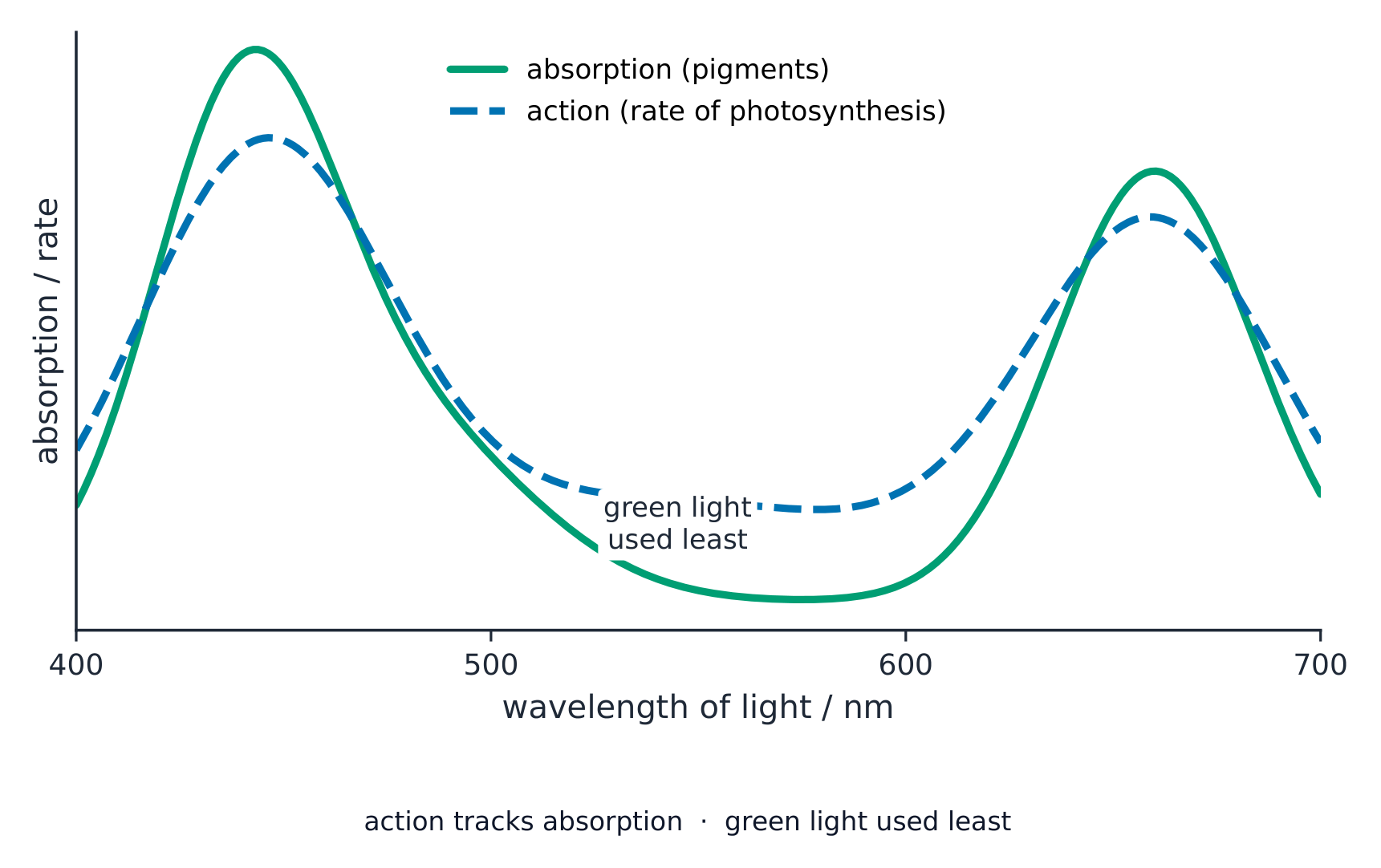
- interpret absorption spectra of chloroplast pigments and action spectra for photosynthesis
- describe and use chromatography to separate and identify chloroplast pigments (reference should be made to $R_f$ values in identification of chloroplast pigments)
- state that cyclic photophosphorylation and non-cyclic photophosphorylation occur during the light-dependent stage of photosynthesis
- explain that in cyclic photophosphorylation: • only photosystem I (PSI) is involved • photoactivation of chlorophyll occurs • ATP is synthesised
- explain that in non-cyclic photophosphorylation: • photosystem I (PSI) and photosystem II (PSII) are both involved • photoactivation of chlorophyll occurs • the oxygen-evolving complex catalyses the photolysis of water • ATP and reduced NADP are synthesised
- explain that during photophosphorylation: • energetic electrons release energy as they pass through the electron transport chain (details of carriers are not expected) • the released energy is used to transfer protons across the thylakoid membrane • protons return to the stroma from the thylakoid space by facilitated diffusion through ATP synthase, providing energy for ATP synthesis (details of ATP synthase are not expected)
- outline the three main stages of the Calvin cycle: • rubisco catalyses the fixation of carbon dioxide by combination with a molecule of ribulose bisphosphate (RuBP), a 5C compound, to yield two molecules of glycerate 3-phosphate (GP), a 3C compound • GP is reduced to triose phosphate (TP) in reactions involving reduced NADP and ATP • RuBP is regenerated from TP in reactions that use ATP
- state that Calvin cycle intermediates are used to produce other molecules, limited to GP to produce some amino acids and TP to produce carbohydrates, lipids and amino acids
العربية
- صف العلاقة بين بنية البلاسميدات الخضراء، كما تظهر في المخططات والمجهر الإلكتروني، ووظيفتها
- اشرح أن الطاقة المنتقلة على شكل ATP وNADP المختزل من المرحلة المعتمدة على الضوء تُستخدم خلال المرحلة المستقلة عن الضوء (دورة كالفن) في البناء الضوئي لإنتاج جزيئات عضوية معقدة
- أشر إلى أن داخل البلاستيدة الخضراء، الثيلاكويدات (أغشية الثيلاكويد وحيز الثيلاكويد)، التي تحدث في حزم تسمى الحزم، هي موقع المرحلة المعتمدة على الضوء، والعصارة هي موقع المرحلة المستقلة عن الضوء
- صف دور صبغات البلاستيدة الخضراء (كلوروفيل a، كلوروفيل b، كاروتين وإكسانثوفيل) في امتصاص الضوء في الثيلاكويدات
- طبّع الأطيف الامتصاصي لصبغات البلاستيدة الخضراء والأطيف الفعلي للبناء الضوئي
- صف واستخدم الكروماتوغرافيا لفصل وتحديد صبغات البلاستيدة الخضراء (يجب الإشارة إلى $R_f$ في تحديد صبغات البلاستيدة الخضراء)
- أشر إلى أن ** Fosforylation ضوئي دائري** و** Fosforylation ضوئي غير دائري** يحدثان خلال المرحلة المعتمدة على الضوء في البناء الضوئي
- اشرح أنه في الفسفرة الضوئية الدائرية: • يشارك فقط النظام الضوئي الأول (PSI) • يحدث تنشيط ضوئي للكلوروفيل • يتم تصنيع ATP
- اشرح أنه في الفسفرة الضوئية غير الدائرية: • يشارك كل من النظام الضوئي الأول (PSI) والنظام الضوئي الثاني (PSII) • يحدث تنشيط ضوئي للكلوروفيل • يحفز المركب المُنتج للأكسجين تحلل الضوء للماء • يتم تصنيع ATP وNADP المختزل
- اشرح أنه خلال الفسفرة الضوئية: • تطلق الإلكترونات ذات الطاقة العالية طاقة أثناء مرورها عبر سلسلة نقل الإلكترون (لم يُطلب تفاصيل الحاملات) • تُستخدم الطاقة المنطلقة لنقل البروتونات عبر غشاء الثيلاكويد • تعود البروتونات إلى العصارة من حيز الثيلاكويد عن طريق الانتشار المساعِد عبر إنزيم تركيب الـ ATP، مما يوفر الطاقة لتركيب الـ ATP (لم يُطلب تفاصيل إنزيم تركيب الـ ATP)
- استعرض المراحل الثلاث الرئيسية لدورة كالفن: • يحفز Rubisco تثبيت ثاني أكسيد الكربون بالاتحاد مع جزيء من ribulose bisphosphate (RuBP)، وهو مركب 5C، لإنتاج جزيئين من glycerate 3-phosphate (GP)، وهو مركب 3C • يُختزل GP إلى triose phosphate (TP) في تفاعلات تتضمن NADP المختزل وATP • يُعاد توليد RuBP من TP في تفاعلات تستخدم ATP
- أشر إلى أن وسطاء دورة كلفن تُستخدم لإنتاج جزيئات أخرى، مقتصرة على تحويل GP لإنتاج بعض الأحماض الأمينية وTP لإنتاج الكربوهيدرات والدهون والأحماض الأمينية